




Abstract
Drawing on intergroup threat theory, this article argues that immigrant integration policies can improve public attitudes toward immigrants and, particularly, toward refugees and asylum-seekers. Examining evidence from an original survey experiment conducted in the United Kingdom, I find that support for admitting asylum-seekers increases when respondents are made aware that prospective asylum-seekers will be required to partake in language and civic-education courses. This effect is particularly strong among respondents who were more likely to perceive asylum-seekers as a symbolic threat (i.e., conservatives). Similarly, support for admitting asylum-seekers increases when respondents are told that future asylum-seekers will only have limited access to welfare. This effect is stronger among respondents who were more likely to view asylum-seekers as a material threat (i.e., conservatives and individuals with low socioeconomic status). These findings have important implications for the literatures on immigrant integration policies, intergroup threat theory, and public immigration attitudes generally. Importantly, the results reported in this article illustrate the significance of structural determinants for the study of immigration attitudes and demonstrate the importance of disaggregating immigrant integration policies when evaluating their effects.
Introduction
Since the end of World War II, Western Europe has been a popular destination for immigrants (Castles, De Haas and Miller 2014, pp. 102–125). This observation rings particularly true for 2015, when a record number of over 1.2 million asylum-seekers entered the European Union (EU), a number more than double that of the previous year (Connor 2016). With the growing numbers of asylum-seekers and refugees, anti-immigration sentiments among native-born residents have also been on the rise in several European countries (Esipova, Ray and Pugliese 2020). For example, in 2015, there were more than 1,000 attacks on accommodations for asylum-seekers in Germany alone, running the gamut from arson to offensive graffiti (Schumacher 2016). Similarly, anti-immigration sentiments have played a major role in the recent success of several right-wing populist parties across Europe, such as the Freedom Party of Austria and the Alternative for Germany (Einbinder 2018; Weisskircher 2018). The outcome of the 2016 British referendum, in which 52 percent of votes were cast in favor of leaving the EU and which dealt a blow of unprecedented proportions to the project of European unity, is largely attributed to public anxiety over immigration in the United Kingdom (UK) (Gietel-Basten 2016; Hobolt 2016).
What can be done to improve public attitudes toward immigrants – refugees and asylum-seekers in particular – and to avoid such political fallout from widespread anti-immigration sentiments? This question has increasingly concerned both scholars (Dancygier and Laitin 2014; Hatton 2016) and policymakers (Scally 2018; Wintour 2018) in recent years. In this article, I contribute to this ongoing search for the determinants of pro-/anti-immigration sentiments by analyzing the effect of immigrant integration policies on public attitudes toward asylum-seekers through the lens of intergroup threat theory (Stephan, Ybarra and Rios 2016). Integration policies are generally defined as government efforts aimed at helping immigrants, particularly asylum-seekers and family migrants, adapt to life in the destination country, that is, ensuring that immigrants become both functional and accepted members of their new host society (Murphy 2016; Spencer 2011). While this broad definition of integration policies includes a variety of different government actions and laws (see MIPEX 2015), I argue that two types of integration policies are particularly relevant in shaping public immigration attitudes: 1 (1) mandatory language and civic-education requirements and (2) limited welfare access for asylum-seekers. Specifically, I posit that the former can mitigate views of asylum-seekers as a symbolic threat while the latter may alleviate perceptions of material threat, both thereby reducing anti-immigration sentiments. Examining data from an original survey experiment administered to a sample of 7,732 British adults in 2017, I find support for this argument.
By both theorizing and providing experimental evidence on the positive effect of immigrant integration policies on public immigration attitudes, this article makes several important contributions. First, by developing a theoretical framework which details the relationship between and among immigrant integration policies, threat perceptions, and immigration attitudes, it contributes to the literature on intergroup threat theory (e.g., Ben-Nun Bloom, Arikan and Lahav 2015; McLaren 2003), as well as to conceptual research on public attitudes toward immigrants and immigration more broadly (e.g., Alarian and Neureiter 2021; Ward and Masgoret 2008). Specifically, while previous research on immigration attitudes has traditionally focused on individual-level determinants of such attitudes (Abdelaaty and Steele 2020; Hainmueller and Hopkins 2014), this article demonstrates the relevance of structural factors, such as national policies, in shaping threat perceptions and immigration attitudes. Second, the findings presented here contribute to the ongoing debate in migration research about the effects of immigrant integration policies (e.g., Neureiter 2018). While a number of recent studies indicate that mandatory language and civic-education requirements help immigrants succeed in the labor market (Neureiter 2019; Qi et al. 2021), this article documents an additional benefit of these requirements in the form of improved public attitudes toward asylum-seekers. Third, the results of this analysis are of interest to policymakers looking to combat anti-refugee sentiments, as they suggest that priming 2 language and civic-education requirements, as well as limited welfare access, for asylum-seekers holds the potential for small shifts in public opinion.
The remainder of this article proceeds as follows. First, I review previous studies using intergroup threat theory to explain variation in attitudes toward immigrants, with a particular focus on attitudes toward refugees and asylum-seekers. 3 Drawing on this literature, I, then, develop a theoretical framework that details the mechanisms through which immigrant integration policies, particularly language and civic-education requirements and limited welfare access, affect public immigration attitudes. From this framework, five testable hypotheses are derived. Third, I elaborate on the research design used to test these hypotheses, that is, an original survey experiment administered to a large sample of British adults in 2017. 4 Fourth, I describe the results of this survey experiment, which provide support for the hypothesized relationships. A concluding section summarizes this article's main findings, discusses their implications for both scholars and policymakers, and indicates possible directions for future research on the subject.
Previous Research on Intergroup Threat Theory and Immigration Attitudes
A growing body of literature has examined the determinants of public attitudes toward refugees and asylum-seekers (e.g., Ariely 2021; Czymara 2021; Abdelaaty and Steele 2020). One prominent explanation of variation in attitudes toward refugees and asylum-seekers, and immigrants more generally, is intergroup threat theory, also referred to as integrated threat theory (Stephan, Ybarra and Rios 2016). Based on the foundational work of authors such as Blumer (1958), Blalock (1967), and Bobo (1988), intergroup threat theory posits that one social group's attitudes toward another, such as native-born individuals’ attitudes toward immigrants, are largely a function of the extent to which the former group perceives the latter as a threat. Such threat perceptions manifest themselves in two different forms: cultural and economic (Ben-Nun Bloom, Arikan and Lahav 2015; Fetzer 2000; Malhotra, Margalit and Mo 2013; Schneider 2008).
Cultural threats, which are also referred to as symbolic threats, are defined as concerns about intangible constructs such as national identity, value systems, and social institutions (Hainmueller and Hopkins 2014; Stephan et al. 2005). Applied to the context of migration, cultural threat models suggest that negative immigration attitudes primarily stem from a “fear of risking the positive status of the country's symbolic establishments as well as its ethnic and cultural cohesiveness due to increases in populations of differing race, language, norms and values” (Ben-Nun Bloom, Arikan and Lahav 2015, p. 1762). Several recent studies have shown that perceptions of cultural threat are a significant predictor of negative attitudes toward immigrants in general (Fasel, Green and Sarrasin 2013; Malhotra, Margalit and Mo 2013; Sniderman, Hagendoorn and Prior 2004), as well as toward refugees and asylum-seekers in particular (Gravelle 2018; Murray and Marx 2013; Onraet et al. 2019).
Not all immigrants and immigrant groups, however, are perceived as equally threatening to a host society's culture (Ben-Nun Bloom, Arikan and Lahav 2015). In other words, the intensity of cultural threat perceptions varies based on certain migrant characteristics. Generally, as the perceived distance between a migrant's cultural background and that of the host society increases, so does the perception of that migrant as a symbolic threat (Brunner and Kuhn 2018). Research on immigration attitudes in Europe has shown that perceptions of cultural threat are particularly pronounced for immigrants who do not speak the host-country language and who come from a Muslim background (Ben-Nun Bloom, Arikan and Lahav 2015; Chandler and Tsai 2001; Hjerm and Nagayoshi 2011). In addition, cultural threat perceptions not only vary across immigrants and immigrant groups but are also shaped by individual host-society members’ demographic, socioeconomic, and psychological characteristics (Newman, Hartman and Taber 2012). Political ideology has been shown to be a particularly important factor in this context, with conservatives being more likely to perceive immigrants as a symbolic threat (Erisen and Kentmen-Chin 2017; Lahav and Courtemanche 2012; Onraet et al. 2019).
Economic threats, which are also referred to as material or realistic threats, are defined as concerns about the availability and relative distribution of tangible resources such as money, housing, or jobs (McLaren 2003; Stephan, Ybarra and Rios 2016). Applied to the context of migration, economic threat models indicate that negative immigration attitudes primarily arise because immigrants are “seen as potential competitors over material resources, and increasing immigrant populations create a threat as they compete for scarce material resources” (Ben-Nun Bloom, Arikan and Lahav 2015, p. 1761). There are two variants of economic threat models: the labor market competition model and the fiscal burden model (Hainmueller and Hopkins 2014). The labor market competition model posits that host-society members view those migrants who are likely to compete with them in the labor market as most threatening, meaning that host-society members “should oppose immigrants with similar skill levels but favor immigrants with different skill levels” (Hainmueller and Hiscox 2010, p. 62). The fiscal burden model suggests that economic threat perceptions stem from immigrants being seen as a drain on the welfare system, meaning their use of public services supposedly far exceeds their contribution to tax revenues (Hainmueller and Hopkins 2014). While empirical support for the labor market competition model is limited and varies by country (Rustenbach 2010; Sides and Citrin 2007), research has shown that the fiscal burden model is a powerful explanation of variation in attitudes toward immigrants in general (Dustmann and Preston 2007; Hainmueller and Hiscox 2010), as well as toward refugees and asylum seekers in particular (Bansak, Hainmueller and Hangartner 2016; Hercowitz-Amir, Raijman and Davidov 2017).
Certain immigrants and immigrant groups are perceived as more of a fiscal burden (and, thus, an economic threat) than others. For example, asylum-seekers in Western host societies are more likely to be viewed as a fiscal burden than other immigrant categories, regardless of their sociodemographic characteristics (Tartakovsky and Walsh 2020). Similarly, low-skilled immigrants are more likely to be perceived as a drain on the welfare state than highly skilled ones (Hainmueller and Hiscox 2010; Helbling and Kriesi 2014). In addition, perceptions of immigrants as a fiscal burden vary by certain characteristics of host-society members. Studies have, for example, shown that native-born individuals with low socioeconomic status are more likely to perceive immigrants as a material threat (Hoxhaj and Zuccotti 2021), as immigrants also tend to be low in social status and, therefore, compete for the same welfare resources, such as government housing programs, free/subsidized healthcare, and cash assistance (Collier 2013, pp. 114−116; Manstead 2018), particularly in countries with high fiscal exposure (Hainmueller and Hiscox 2010), that is, countries with a relatively large immigrant population and generous social benefits for immigrants. Political ideology also plays an important role in this context, as public opinion research has consistently shown that conservatives are more likely than liberals to view immigrants as a drain on the welfare state (Goerres, Spies and Kumlin 2018; Pew Research Center 2017).
Immigrant Integration Policies, Threat Perceptions, and Attitudes Toward Asylum-Seekers
As the previous section showed, existing research on the drivers of cultural and economic threat perceptions, and immigration attitudes generally, has largely focused on individual-level characteristics of both migrants and host-society members; as a result, structural factors have received relatively little attention (Abdelaaty and Steele 2020; Ceabanu and Escandell 2010; Hainmueller and Hiscox 2010). An exception is attention to economic downturns/recessions, which have been extensively studied and have been shown to increase economic threat (Dancygier and Donnelly 2014; Goldstein and Peters 2014; Pichler 2010; Wilkes, Guppy and Farris 2008). In addition, a recent stream of research has begun to examine the effect of policy environments, particularly immigrant integration policies, on threat perceptions (Callens and Meuleman 2017; Hooghe and de Vroome 2015; Schlueter, Meuleman and Davidov 2013). By and large, these studies have found that laissez-faire integration policies reduce threat perceptions and anti-immigration sentiments.
This article focuses on two specific and important immigrant integration policies and their effects on attitudes toward immigrants, particularly refugees and asylum-seekers, that have not been explicitly examined by previous research: (1) mandatory language and civic-education requirements and (2) limited welfare access. 5 As for the former, several EU member-states, including Denmark, France, Germany, Italy, and the Netherlands, have adopted stricter integration measures for immigrants since the mid-2000s (Goodman 2014; Neureiter 2018). These measures include mandatory integration courses, contracts, and tests with the goal of promoting “basic knowledge of the host society's language, history, and institutions” and “respect for the basic values of the EU” (Mulcahy 2011, p. 34). 6 The requirements are mandatory in the sense that for certain immigrants, particularly family migrants and asylum-seekers, participation serves as a prerequisite for citizenship, permanent residency, or even entry (Neureiter 2019). Noncompliance can result in fines, denial of social benefits, or refusal of citizenship/residency/entry, thereby providing immigrants subject to these requirements with a strong incentive to acquire the host society's language and otherwise integrate (Goodman 2014; Schrep 2013).
While the primary purpose of these integration requirements is to improve immigrant integration outcomes (i.e., language acquisition, employment, identification with the host society, etc.) (Alarian and Neureiter 2021), I argue that they have a potential secondary benefit – that is, they may lead to more positive immigration attitudes, particularly toward asylum-seekers, by mitigating perceptions of cultural threat. As pointed out above, research suggests that perceptions of symbolic threat intensify as the cultural distance between the average host-society member and a particular immigrant community increases. The explicit purpose of mandatory integration requirements is to reduce this distance by teaching newcomers about their host society's language and basic values (Banulescu-Bogdan and Benton 2017). Previous studies have shown that European publics award special importance to host-country language proficiency as a benchmark for evaluating immigrants’ level of cultural threat and integration success (Esses, Hamilton and Gaucher 2017; Sobolewska, Galandini and Lessard-Phillips 2017). Given this central role of host-country language proficiency, it stands to reason that if host-society members are informed about newly arriving asylum-seekers having to participate in language and civic-education requirements, these host-society members will feel less culturally threated by asylum-seekers and, therefore, be more willing to admit them.
7
This effect should be particularly pronounced for host-society members with a high propensity for cultural threat perceptions, as those who do not perceive asylum-seekers as a cultural threat to begin with do not have much room to mitigate their threat perceptions as a response to mandatory integration requirements. As previously mentioned, one group that has a relatively high tendency to perceive immigrants as a cultural threat are those with conservative political beliefs. Thus, based on the predictions derived from intergroup threat theory, I expect conservative political beliefs to amplify the effect of mandatory integration requirements on immigration attitudes.
Similar to language acquisition and value commitment, welfare access for asylum-seekers and other categories of immigrants has been a contested issue in several EU member-states (Berry, Garcia-Blanco and Moore 2016). For the past half-century, most European countries have granted newcomers relatively generous access to social benefits such as government housing programs, free/subsidized healthcare, or cash assistance (Horn 2016; Porter 2015). In recent years, however, an increasing number of policymakers have voiced their intentions to curb immigrant access to welfare, with some countries already having restricted such access (Hasselbach 2015). For example, Austria's chancellor Sebastian Kurz made reduced welfare access for immigrants, especially asylum-seekers, a central issue of his political campaign in 2017, and, after his electoral victory in the same year, he moved quickly to make good on his campaign promise (Weisskircher 2018). Survey data indicate that large parts of the European public agree with the direction of such policies, as the majority of Europeans either are opposed to newcomers receiving any social benefits or wish to see their access to such benefits predicated on certain conditions (Meuleman et al. 2018).
According to intergroup threat theory, a significant portion of this opposition to immigrant welfare access among Europeans is the result of concerns about immigrants depleting finite resources meant for host-society members (Helbling and Kriesi 2014). Given that newly arriving immigrants, particularly asylum-seekers, tend to have a relatively low socioeconomic status (Collier 2013, p. 114), such perceptions of material threat especially arise in the context of resources such as government housing programs, free/subsidized healthcare, and cash assistance. Therefore, consistent with the fiscal burden model described above, if host-society members are told that newly arriving immigrants will have no or only limited access to social benefits, these host-society members should feel less economically threated by asylum-seekers and, therefore, more willing to admit them. This effect should be particularly strong for host-society members with a high propensity for economic threat perceptions, as those who do not perceive immigrants as an economic threat to begin with do not have much room to mitigate their threat perceptions as a response to limiting immigrant welfare access. As previously stated, studies have shown that individuals with low socioeconomic status are more likely to view immigrants – asylum-seekers and other types – as a fiscal burden and, thus, a material threat, as foreign-born individuals have, on average, a relatively high propensity for using social programs and as a result may compete for the same welfare resources as low-status host-society members. Similarly, conservatives are more likely than liberals to perceive foreign-born individuals as a fiscal burden (regardless of objective conditions). Therefore, I expect both low socioeconomic status and conservative political ideology to amplify the effect of limited immigrant welfare access on immigration attitudes.
Research Design
To test these hypotheses, I conducted an original survey experiment in the UK. The UK is an ideal testing ground, as it is representative of general migration and integration trends in Western Europe (Alarian and Neureiter 2021). First, foreign-born individuals account for roughly 14 percent of the UK's population (Vargas-Silva and Rienzo 2020), a figure which is close to the EU average of 12 percent (European Commission 2021). Second, the composition of the immigrant population in the UK is fairly similar to that of the immigrant population in other European countries, as the percentage of foreign-born individuals residing within the UK who originated from a non-EU country (61.1 percent) is almost equal to the EU average (61.4 percent) (Alarian and Neureiter 2021). Third, like most EU member-states, the UK has implemented stricter language and civic-education requirements for immigrants since the mid-2000s (Duevell and Vollmer 2014). Fourth, public opinion in the UK on refugees and asylum-seekers, as well as on people of Muslim background in general, is similar to that in other European countries (Wike, Stokes and Simmons 2016).
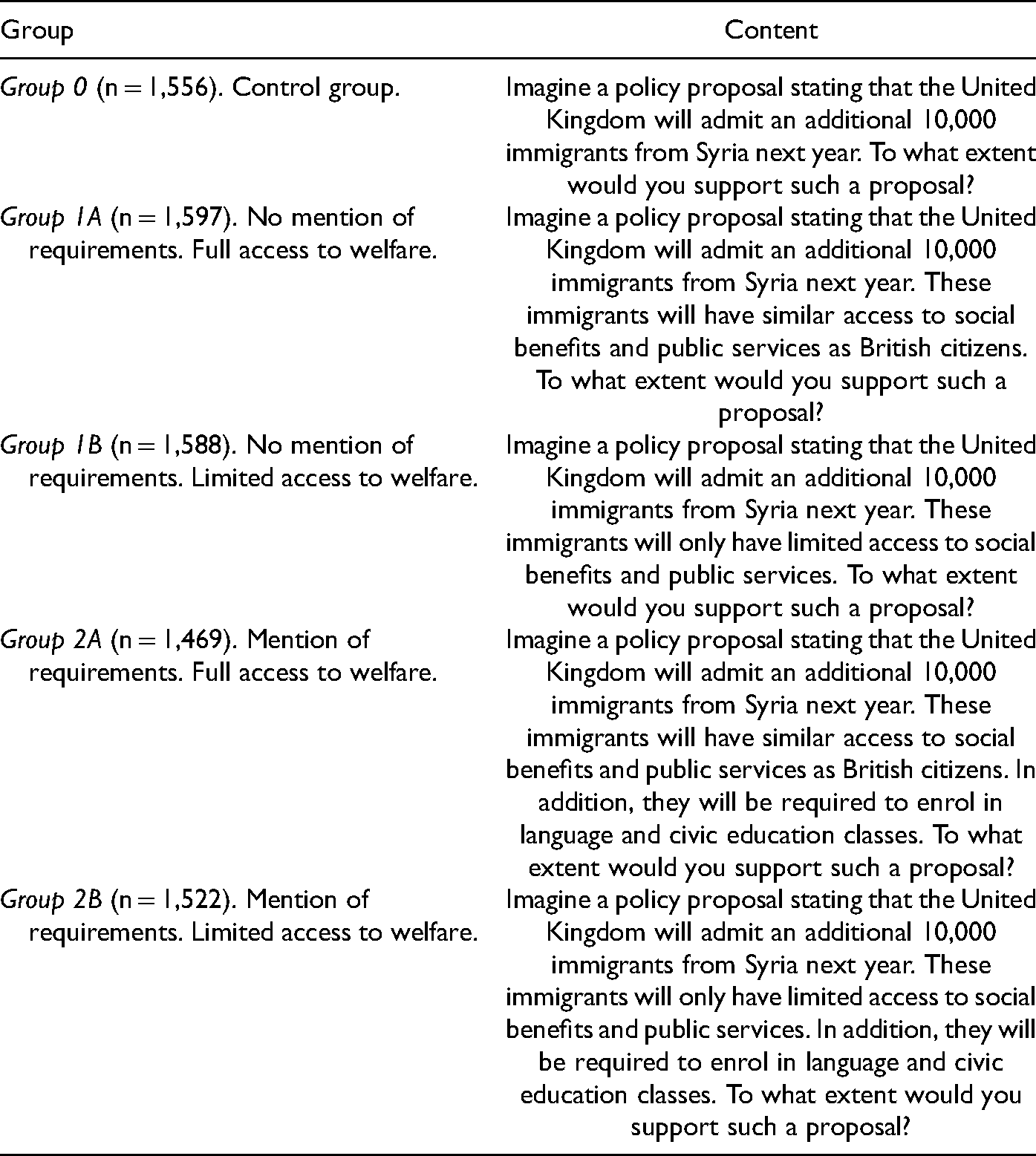
The experiment was implemented as part of the 11th wave of the British Election Study (BES) in April-May 2017. The 11th BES wave was administered online by YouGov to a probability sample of 31,014 British residents 18 and older, using members of its Internet panel. 8 The experiment was delivered to a random sub-sample of these 31,014 respondents. Specifically, 7,732 respondents were presented with the experiment; due to the experiment requiring a forced choice, the response rate was 100 percent. 9 The 7,732 respondents were randomly assigned to one of five experimental groups, including four treatment groups and one control group. Respondents in each group were presented with a hypothetical scenario involving the admission of an additional 10,000 immigrants from Syria to the UK 10 and then asked about their level of support for admitting said immigrants. 11 The scenarios varied across two dimensions: (a) whether mandatory language and civic-education requirements were mentioned and (b) whether immigrants were described as having full or limited access to social benefits and public assistance. In other words, there are two treatment conditions which are intended to increase respondents’ support for admission, one being the presence of mandatory integration requirements and the other being limited welfare access. Detailed question wording for each experimental group is provided in Table 1.
Experimental Conditions.
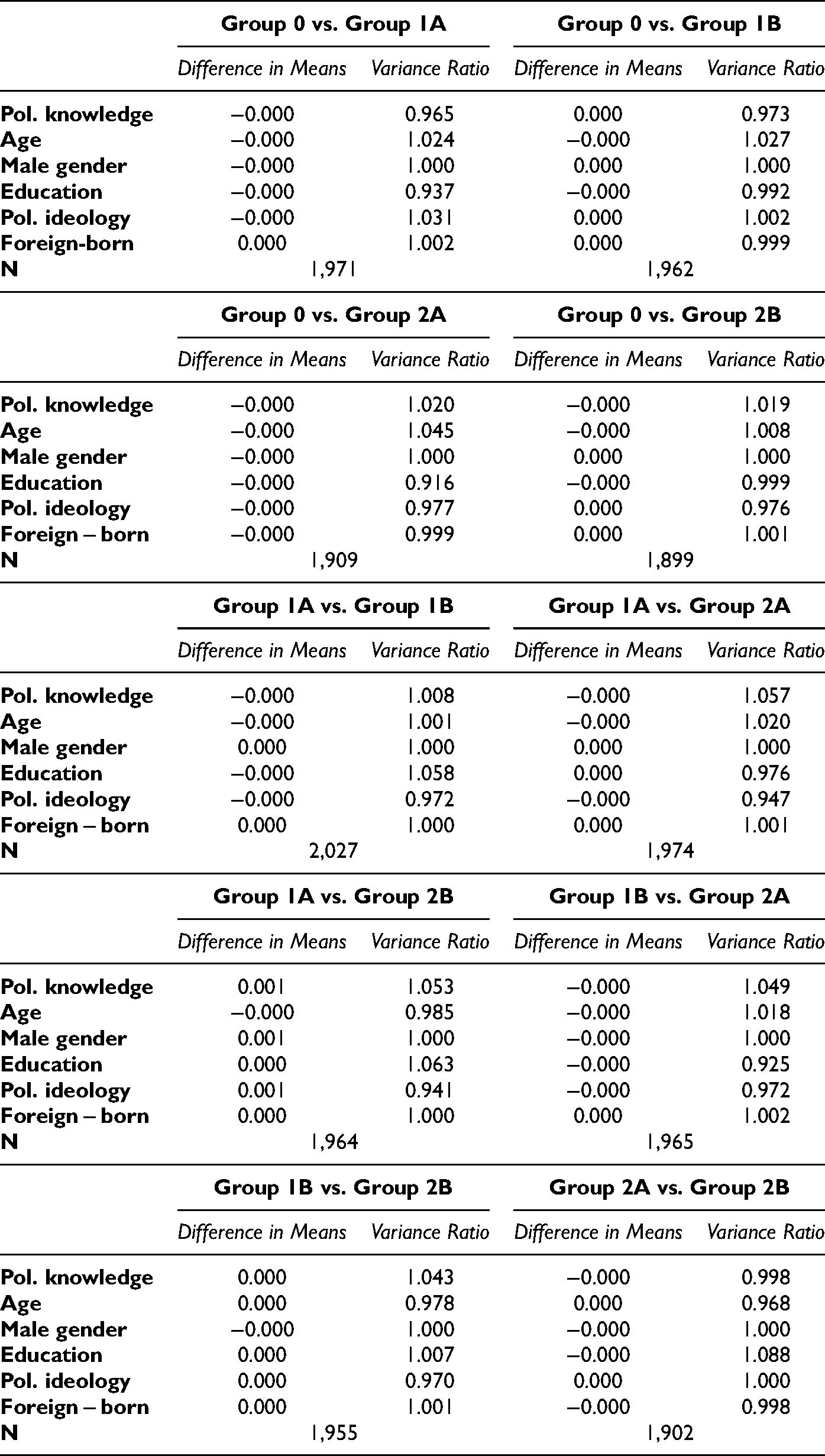
To test whether randomization was successful, that is, whether treatment and control groups are balanced, I examine balance measures for six important respondent characteristics: political knowledge, age, gender, education, political ideology, and immigrant background. To measure respondents’ political knowledge, the BES includes five true-or-false questions about Britain's political system. For every respondent, I generate a variable which counts the number of questions answered correctly; therefore, the resulting variable ranges from 0 to 5, with higher values representing greater political knowledge. Age is measured via a count variable capturing the number of years since a respondent was born. Gender is measured via a dummy variable coded 1 for male respondents and 0 for females. Education is captured by a six-point ordinal scale ranging from “no qualifications” to “postgraduate education completed.” To measure political ideology, I use respondents’ self-placement on a scale ranging from 0 to 10, with higher values representing a more conservative ideology. Lastly, immigrant background is captured by a binary variable coded 0 for respondents born in the UK and 1 for respondents born in a different country. For each of these six covariates, I examine the weighted difference in means and the weighted variance ratio. As Table 2 illustrates, all six covariates exhibit differences in means close to 0 and variance ratios close to 1 for all possible pairings of experimental groups, which indicates that the sample is well balanced.
Covariate Balance Summary.
Results
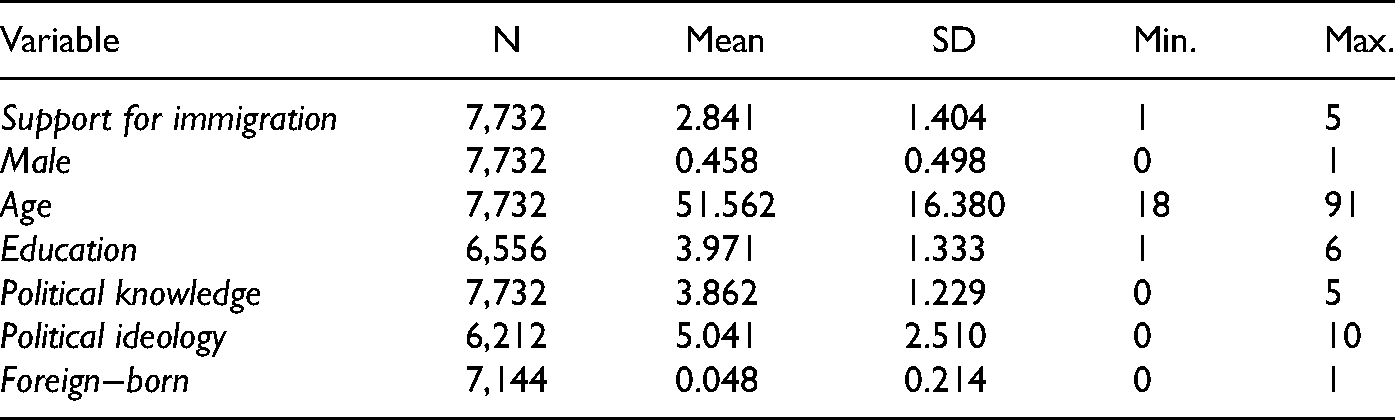
Table 3 shows the descriptive statistics for the dependent variable and covariates. About 24 percent of respondents fully opposed admitting the Syrian immigrants mentioned in the survey experiment, 19 percent somewhat opposed it, 20 percent neither supported nor opposed it, 21 percent somewhat supported it, and 16 percent fully supported it. Overall, then, British residents expressed lukewarm attitudes toward asylum-seekers, although the most frequent response was “fully oppose.” The overall mean for the outcome variable is 2.841, which is almost the exact midpoint on the scale. As for the covariates, the sample is almost evenly split among men and women, with 46 percent of respondents being male and 54 percent being female. Respondents’ average age was between 51 and 52 years, 12 and their mean education level was 4 (i.e., A-level) on a scale ranging from 1 (no education qualification) to 6 (postgraduate education completed). On average, respondents correctly answered between three and four of the five questions about the UK's political system. The mean score on the self-reported ideology scale was five, which is its exact midpoint. Lastly, approximately 5 percent of the sample was born outside the UK.
Descriptive Statistics.
Taken together, the descriptive statistics for the covariates indicate that the sample is representative of the adult British population (i.e., residents 18 and older) in terms of gender (Statista 2021), age (Office for National Statistics 2020), and education (Organisation for Economic Co-operation and Development 2021). The percentage of foreign-born sample respondents is somewhat lower than the percentage of foreign-born residents in Britain (5 vs. 14 percent), which may raise concerns about the sample’s representativeness. However, this discrepancy likely poses no serious threat to the sample’s representativeness for two reasons. First, the 14 percent figure is based on the total British population (all ages) and, therefore, not directly comparable to the 5 percent figure, which is based on the adult British population (18 and older). Since immigrants tend to be younger than the native-born population (Vargas-Silva and Rienzo 2020), the difference between the two figures is likely somewhat smaller. Second, all analyses are conducted using the BES survey weights, which increases the regression estimates’ precision and maximizes the sample's representativeness (Angrist and Pischke 2015, pp. 201−203; see also the FAQ section of the BES website which states that using the survey weights ensures that the sample is representative of the adult British population).
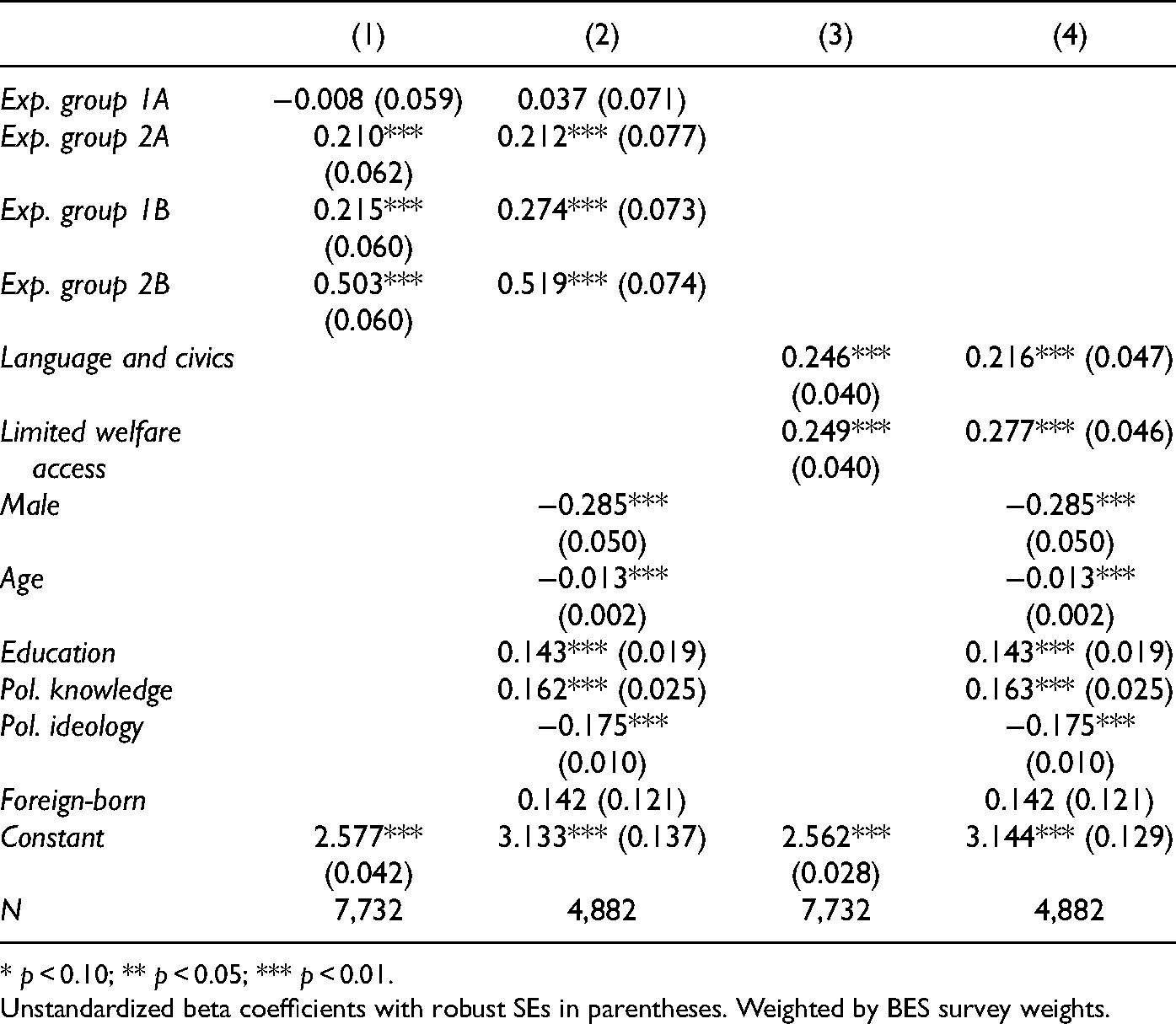
To test the hypotheses, I generated a series of binary variables, one for each experimental group and one for each of the two treatments. I then used OLS 13 to regress the dependent variable on these binary variables, as well as on the six covariates. 14 The results for these models are provided in Table 4. All models were estimated using robust standard errors and the BES survey weights. Model 1 shows the effect of belonging to a particular experimental group on the dependent variable relative to the control group, which is the omitted category in the model. The coefficients in this model can be interpreted as the weighted differences in means between the respective experimental groups and the control group. Specifically, the weighted mean level of support for admitting the 10,000 Syrian immigrants was 2.577 in the control group. The results also show that the weighted mean of experimental group 1A (no mention of requirements, full access to welfare) was statistically indistinguishable from that of the control group. With a difference of 0.210 and 0.215, respectively, the weighted mean level of support for admission in groups 2A (mention of requirements, full access to welfare) and 1B (no mention of requirements, limited access to welfare) was significantly higher than in the control group. As expected, support for admission was highest among respondents that received both treatments; the weighted mean in this group (i.e., 2B) was half a point higher than in the control group. Model 2 illustrates that these results are robust to the inclusion of the covariates in the model.
Immigrant Integration Policies and Immigration Attitudes – Direct Effects.
* p < 0.10; ** p < 0.05; *** p < 0.01.
Unstandardized beta coefficients with robust SEs in parentheses. Weighted by BES survey weights.
Model 3 shows the effect of the two binary treatment variables on the dependent variable. The coefficient for the constant indicates that the weighted mean level of support for admission among respondents who received neither of the two treatments was 2.562. Priming respondents with mandatory integration requirements and limited welfare access increased the level of support by 0.246 and 0.249, respectively; both of these differences are statistically significant at the 0.01 level. Again, as Model 4 illustrates, the results remain significant when the covariates were included in the model. Overall, then, the results of Table 4 provide support for Hypotheses 1a and 2a: immigrant integration policies, particularly language and civic-education requirements and limited welfare access for immigrants, lead to more positive public immigration attitudes.
Based on the predictions of intergroup threat theory, I expect respondents with a higher propensity for threat perceptions to be more receptive to the effects of immigrant integration policies. Specifically, language and civic-education requirements should be more effective for individuals with greater perceptions of cultural threat, and limited immigrant welfare access for individuals with greater perceptions of economic threat. To test these propositions, Table 5 presents the results of several interaction models. Model 5 interacts the binary variable for the mandatory integration requirements treatment with the measure of respondents’ political ideology, as conservatives are more likely to view foreign-born individuals as threats to their national culture and identity. The results indicate that political ideology, indeed, moderated the effect of language and civic-education requirements on immigration attitudes. The coefficients of Model 5 show that the effect of these integration requirements was insignificant for respondents at the low end of the ideology scale, that is, individuals who identified as very liberal. With every additional point on the ideology scale, however, this effect increased by 0.044 in magnitude; at the high end of the ideology scale (i.e., for respondents who identified as very conservative), the impact of mandatory language and civic-education requirements on support for immigration was 0.428.
Immigrant Integration Policies and Immigration Attitudes – Interaction Effects.
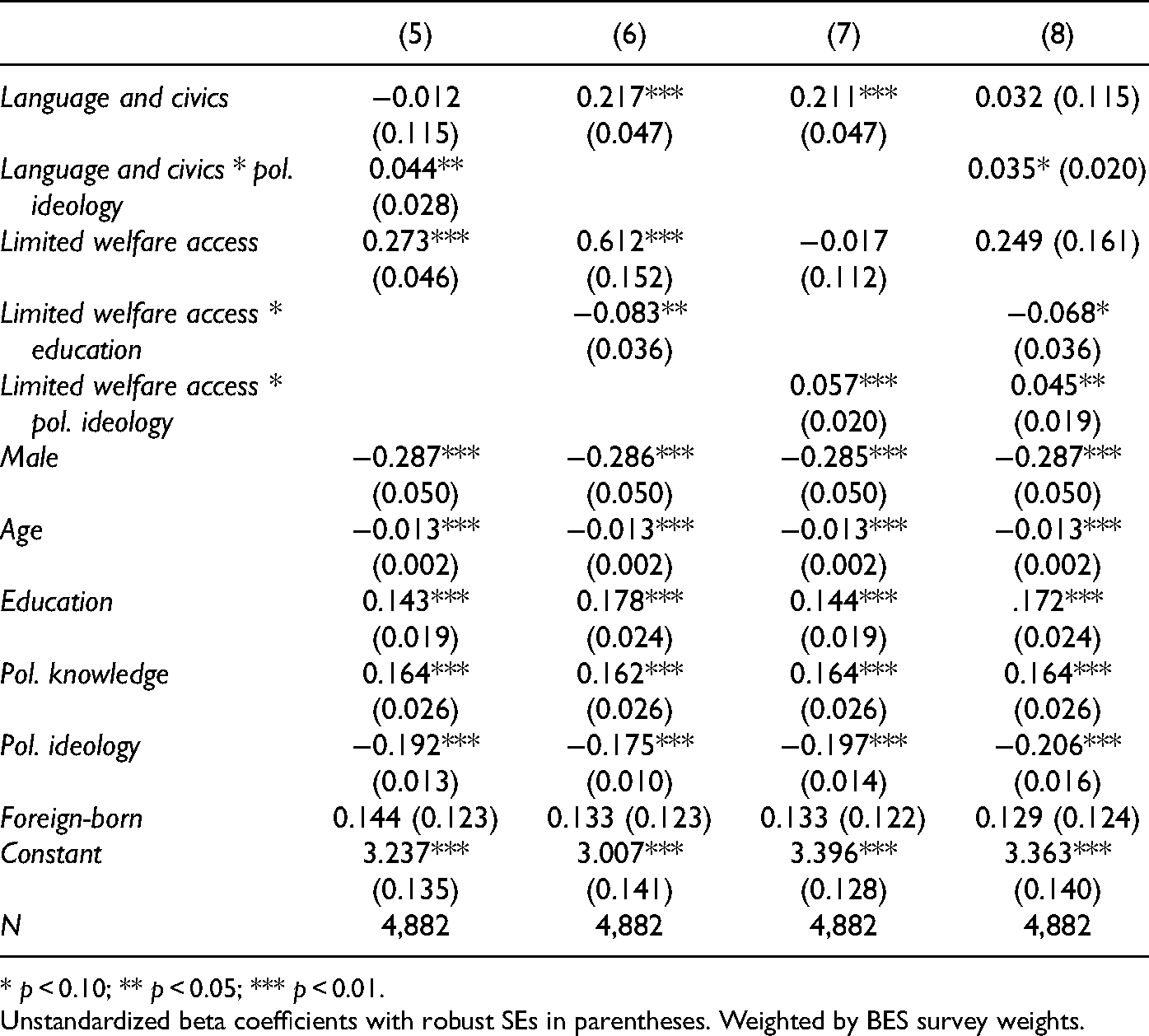
* p < 0.10; ** p < 0.05; *** p < 0.01.
Unstandardized beta coefficients with robust SEs in parentheses. Weighted by BES survey weights.
Similarly, Model 6 interacts the binary variable for the limited welfare treatment with the measure of respondents’ education level, as individuals with low socioeconomic status are more likely to be concerned about immigrants, particularly refugees and asylum-seekers, taking away public resources meant for them. The results suggest that socioeconomic status, indeed, moderated the impact of limiting welfare access for immigrants on immigration attitudes. The coefficients of Model 6 show that the effect of the limited welfare treatment on support for admission was quite large (0.612) for respondents at the low end of the education scale (i.e., for those individuals who reported having no qualifications). This effect decreased by 0.083 in magnitude with every additional point on the education scale and became insignificant for individuals with high education levels. Model 7 interacts the binary variable for the limited welfare treatment with the measure of respondents’ political ideology, as conservatives are more likely to view foreign-born individuals as a fiscal burden. In accordance with my theoretical expectations, the effect of limited immigrant welfare access was insignificant for respondents at the low end of the ideology scale, that is, individuals who identified as very liberal. With every additional point on the ideology scale, though, this effect increased by 0.057 in magnitude; at the high end of the ideology scale (i.e., for respondents who identified as very conservative), the impact of limited immigrant welfare access on support for immigration was 0.553. Lastly, Model 8 shows that the results hold when all three interaction terms were included simultaneously.
To further illustrate these interaction effects, Figure 1 provides a visual representation of Models 5, 6, and 7. It shows that the effect of language and civic-education requirements on immigration attitudes was insignificant at low levels of the political ideology scale and became stronger as respondents identified as more conservative. Similarly, the figure illustrates that the effect of limited immigrant welfare access on support for immigration was insignificant for respondents with postgraduate education, as well as for those who identified as liberal; conversely, this treatment's effect was quite strong for respondents who reported having low educational qualifications and for those with conservative political beliefs. Taken together, the results provide support for Hypotheses 1b, 2b, and 2c: the positive effects of mandatory integration requirements and limited welfare access on immigration attitudes were greater for individuals who were more likely to perceive immigrants as a cultural or economic threat, respectively.
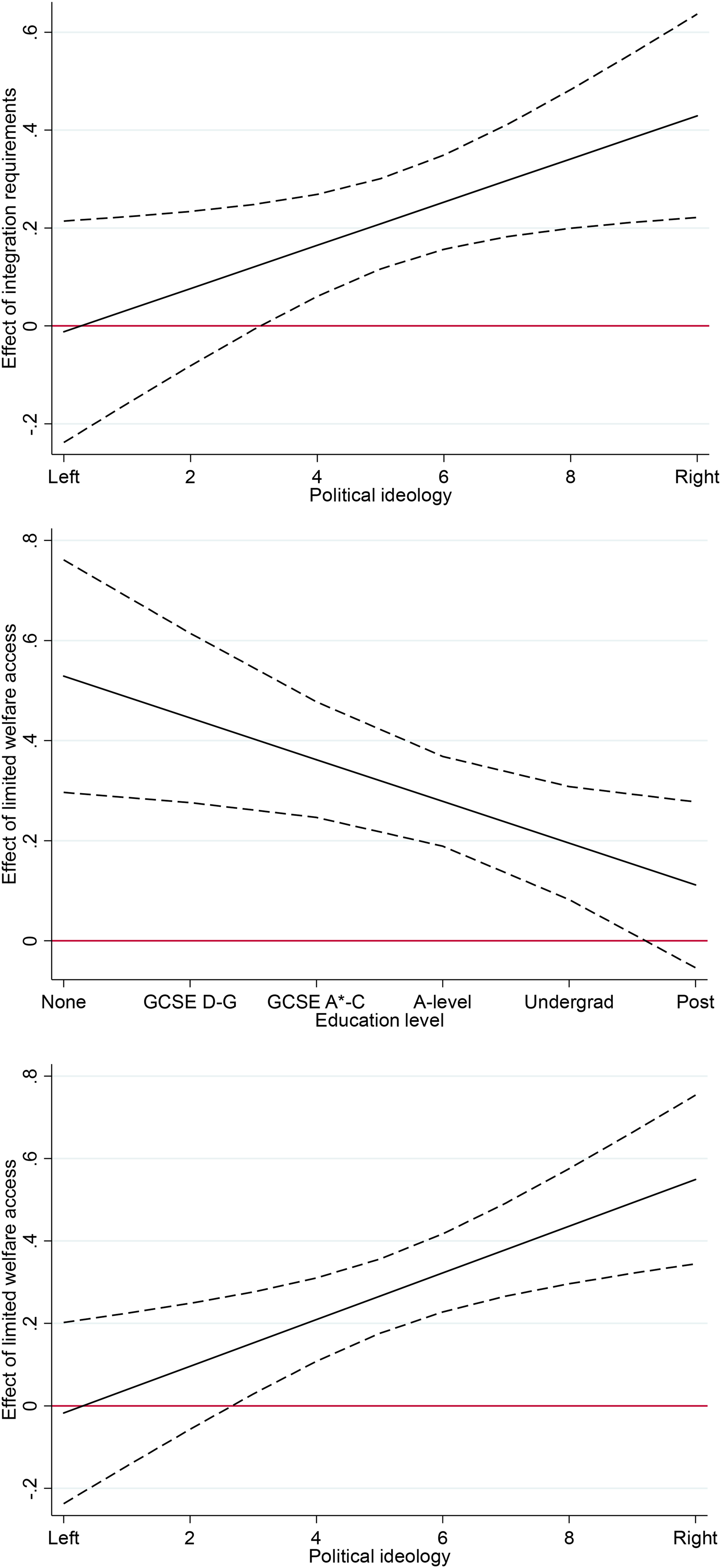
Conditional Effects Models (95% CIs).
Conclusion
In recent years, Europe's governments have been searching for ways to combat widespread anti-immigration sentiments and to ameliorate the threats to stability, liberalism, and European unity that accompany these sentiments (Monitor Editorial Board 2019; Muis and Immerzeel 2017). Using an original survey experiment in the UK, I found that the average level of support for admitting 10,000 additional immigrants from Syria increased significantly when respondents were told that these newcomers would be required to partake in language and civic-education courses. This effect is particularly strong for conservatives, which, in the past, have often been resistant to other efforts aimed at convincing them to support immigration (Peters 2017). Therefore, policymakers interested in improving public attitudes toward asylum-seekers and refugees, and perhaps immigrants generally, might consider the adoption/tightening of mandatory integration courses and other requirements, particularly since these measures appear to be beneficial for participants themselves as well (Neureiter 2019; Qi et al. 2021). Countries which already have adopted such requirements are well advised to expend more effort publicizing them. A recent EU-wide poll revealed that only 4 percent of Europeans considered themselves well informed about their country's integration policies (Eurobarometer 2018). Given that most European countries currently have at least some mandatory integration requirements in place, spreading information and increasing awareness about these policies represent opportunities to improve public immigration attitudes.
Moreover, my experimental results suggest that immigration attitudes are significantly more positive when newly arriving migrants are described as having only limited access to welfare. This relationship is particularly strong for individuals with low socioeconomic status, as well as for conservatives. That said, I hesitate to recommend restricting social benefits for immigrants generally or even particular immigrant groups as a blanket strategy for improving public immigration attitudes. Unlike mandatory language and civic-education requirements, limiting access to welfare does not have apparent benefits for immigrant communities themselves, does not enjoy support across large parts of the political spectrum (Neureiter 2018), and is not easily reconcilable with national, international, and supranational law (Cerami 2012; Heindlmaier and Blauberger 2017). In other words, while governments could potentially improve public immigration attitudes by restricting immigrants’ access to the welfare state, this course of action seems ethically questionable (especially given Europe's identity and self-understanding as a social democratic union) and, in many instances, politically impractical. 15 The results from my survey experiment suggest that requiring refugees and asylum-seekers to enroll in language and civics classes increases support for their admission at a rate similar to limiting their social benefits, making the former not only an effective but also a more viable and ethically less controversial alternative to the latter as a strategy for improving public immigration attitudes. Only in certain instances where the political fallout from widespread anti-immigration sentiments would be particularly severe, limiting immigrant access to welfare could be a prudent strategy after carefully weighing its benefits against its risks.
In addition to these policy considerations, the findings reported in this article also have important implications for scholarship on immigration attitudes, immigrant integration policies, and intergroup threat theory. First, they call into question the results of previous studies on the relationship between integration policies and public immigration attitudes which argued that laissez-faire integration policies reduce anti-immigrant prejudice (Callens and Meuleman 2017; Hooghe and de Vroome 2015; Schlueter, Meuleman and Davidov 2013). One reason for the difference in results may be that existing research on the subject has primarily relied on aggregate indicators such as the Migrant Integration Policy Index (MIPEX) to measure integration policies (e.g., Callens and Meuleman 2017; Schlueter, Meuleman and Davidov 2013). While such indicators have their merits, their use in studies on the determinants of immigration attitudes is problematic in that doing so conflates the effects of several different types of integration policies such as anti-discrimination protections and labor market access. 16 Therefore, from a methodological perspective, my findings make the case for examining the impact of individual immigrant integration policies through original coding and/or experimental means, rather than using aggregate policy measures. Second, this article contributes to the growing evidence on the positive effects of mandatory language and civic-education requirements on migrant-related outcomes (e.g., Ersanilli and Koopmans 2010; Koopmans 2010). These requirements appear to have benefits not only for the labor market integration of asylum-seekers and other participating migrants (Neureiter 2019; Qi et al. 2021) but also for society at large (to the extent that one considers the curbing of anti-immigration sentiments a benefit for society).
Third, my findings add to the literature on intergroup threat theory by not only providing support for its propositions but also showing how threat perceptions are partly driven by macro-level determinants such as national policies. More specifically, my findings provide additional support for the fiscal burden model, as suggested by Hainmueller and Hiscox (2010), which posits that concerns among poor host-society members about constraints on welfare benefits are a major driver of economic threat perceptions. Lastly, my results demonstrate that migration and public opinion scholars are well-advised to look beyond individual-level determinants of immigration attitudes with which studies in this research area have been preoccupied (Hainmueller and Hopkins 2014). An increased focus on structural factors seems particularly important for studies focusing on the determinants of public attitudes toward refugees and asylum-seekers, as recent research indicates that forced migrants and other types of immigrants are “viewed as distinct and that differences emerge because attitudes toward refugees are more often related to macro-level factors while immigrants are more frequently associated with micro-level economic concerns” (Abdelaaty and Steele 2020, p. 1). In other words, structural/macro-level factors are particularly important in explaining public attitudes toward refugees and asylum-seekers, which is something future research should consider when examining the determinants of public opinion on forced migrants.
This article is not without its limitations, with three standing out in particular. First, the survey experiment mentioned the term “immigrants,” so while it is highly likely that respondents thought of forced migrants when they read about Syria as the origin country, it is not possible to ascertain whether and how many respondents really made this association. Second, if respondents did, in fact, think of forced migrants when reading the questionnaire, the question arises to what extent the findings can be extrapolated to other types of immigrants or even forced migrants from other origin regions. Recent studies indicate that forced migrants, unlike other immigrant categories, evoke empathy (e.g., Kustov 2021; Newman et al. 2014) and that immigrants (including refugees and asylum-seekers) from majority-Muslim countries are more negatively perceived than those from other origin countries (e.g., Alarian and Neureiter 2021; Bansak, Hainmueller and Hangartner 2016). Both of these factors, empathy and anti-Muslim prejudice, raise potential concerns about whether my findings are generalizable beyond forced migrants from majority-Muslim countries. Therefore, a fruitful avenue for future research is to build on this article by implementing similar survey experiments for other immigrant categories (such as family migrants) and for forced migrants from other origin regions to determine whether the results reported here are, indeed, generalizable. Third, while I hypothesized that threat perceptions are the link between immigrant integration policies and support for immigration, the survey did not include a direct measure of this construct. Rather, I had to rely on proxy measures by using respondent characteristics that previous research has found to be associated with perceptions of symbolic and material threat (e.g., Goerres, Spies and Kumlin 2018; Hoxhaj and Zuccotti 2021). Future research could measure this link directly and thereby provide further evidence on the relationship between immigrant integration policies and public immigration attitudes.
These limitations aside, two additional avenues for future research seem worthwhile. First, scholars could explore the effect of other country-level covariates on public immigration attitudes, such as different immigration/integration policies, opinion climates, and political polarization. Doing so would further add to our understanding of the role of structural factors in shaping immigration attitudes. Second, it would be of interest to both scholars and policymakers to examine the relative impact of different forms of mandatory integration requirements (language vs. civic education, courses vs. tests, etc.). In general, studies on the relationship between immigrant integration policies and immigration attitudes are still relatively rare, and given the contradictory findings of recent experimental analyses in this area (Alarian and Neureiter 2021; Neureiter 2018), additional research on the subject is warranted.
Footnotes
Acknowledgments
This article is based in part on the author's doctoral dissertation On the Origins and Effects of Contemporary Immigrant Integration Policy in Western Europe. An earlier version of this article was presented at the 2018 International Studies Association Annual Convention in San Francisco, CA, USA. I am thankful to Steven Finkel, Daniela Donno, Jude Hays, Najeeb Shafiq, participants at the University of Pittsburgh's Workshop on Experimental Research Design (WERD), the editor, and several anonymous reviewers for their helpful comments and suggestions. Special thanks go to Jane Green for her help with implementing the survey experiment.
Declaration of Conflicting Interests
The author(s) declared no potential conflicts of interest with respect to the research, authorship, and/or publication of this article.
Funding
The author(s) received no financial support for the research, authorship and/or publication of this article.
