




Abstract
Wage gaps between migrants and natives persist in Germany, and traditional human capital endowments or work environments only partially explain these gaps. This article investigates whether noncognitive skills contribute to explaining male migrant wage gaps in Germany. While the economics literature shows that noncognitive skills affect educational and occupational outcomes, such as gender wage gaps, it is unclear if the same applies to the migrant wage gap. To address this lingering question, we analyze risk preference and the “Big Five Personality Dimensions,” a psychological concept categorizing an individual's personality into five factors. In doing so, we show that male migrants and male German natives differ in their average noncognitive skills and that these skills significantly relate to wages. The results of Oaxaca–Blinder wage decompositions reveal that noncognitive skills significantly contribute six percentage points to explaining the male migrant wage gap in Germany. We conclude that noncognitive skills are important predictors of heterogeneities in labor market outcomes.
Keywords
Introduction
Wage gaps between migrants and natives persist not only in Germany but across Europe (Kahanec and Zaiceva 2009), and understanding why they exist is imperative to decreasing them. 1 According to Human Capital Theory (Becker 1964), human capital and job-specific factors should explain wage differentials; however, such factors can only explain a part of the observed wage gaps (Dustmann 1993; Aldashev, Almaty and Thomsen 2012; Brenzel and Reichelt 2017). Therefore, we examine additional determinants to advance understandings of these gaps: risk preference and the Big Five Personality Dimensions, 2 a psychological concept categorizing an individual's personality into five factors (Barrick and Mount 1991).
The economics literature has recently shown that noncognitive skills, or personality traits, play a role in wage determination and contribute to observable wage differentials (Bowles, Gintis and Osborne 2001). Heckman, Stixrud, and Urzua (2006) have even argued that noncognitive skills might be more important than cognitive skills for labor market outcomes . Noncognitive skills have also been shown to have effects on gendered wage gaps (e.g., Mueller and Plug 2006; Heineck and Anger 2010), and in this article, we transfer the idea that noncognitive skills explain wage gaps to the migration context.
The first hypothesis for our approach is that migrants and natives differ in their average noncognitive skills. Empirical evidence exists for cross-country differences in personality traits (McCrae et al. 1999; Allik and McCrae 2004; McCrae and Terracciano 2005) and risk preferences, which developed differently due to dissimilar (historical) experiences and environments (Falk et al. 2018). Our second hypothesis is that noncognitive skills affect wages. Similar to human capital endowments, we understand an individual's noncognitive traits as a specific skill-set compensated for in the labor market. Thus, we assume a direct wage effect of this bundle of productive noncognitive skills (Bowles, Gintis and Osborne 2001; Heckman, Stixrud and Urzua 2006). Accordingly, wages depend on the nature, magnitude, and returns of these skills. Likewise, noncognitive skills indirectly affect wages through educational (Heckman, Stixrud and Urzua 2006; Lundberg 2013b; Peter and Storck 2015) or occupational sorting (Cobb-Clark and Tan 2011), wage bargaining (Mueller and Plug 2006), or employer learning, where employers initially determine wages based on observable characteristics and learn about true productivity over time (Altonji and Pierret 2001; Petre 2014).
This article is explorative, as we have no prior expectations about how noncognitive skills differ between German natives and migrants and only partial expectations about their effects on wages. In prior studies from psychology and gender economics, most noncognitive skills’ effect on wages seemed context dependent, except emotional stability (and the opposite end of the same personality dimension: neuroticism 3 ), which seems to positively influence labor market outcomes (Barrick and Mount 1991; Salgado 1997). Thus, a priori, we do not make assumptions about the effects of noncognitive skills; rather, we explore which differences in noncognitive skills exist between male 4 German natives and migrants and how those differences contribute to explaining wage differentials.
To explore the first hypothesis, we use the Linked Personnel Panel (LPP) and show that German natives and migrants differ in their average noncognitive skills. Further, we find an average raw wage difference between male migrants and male German natives of around 20 percent across the entire wage distribution (Figure 1A). When controlling for observable individual and establishment heterogeneity, the wage gap decreases but persists (Figure 1B). Then, to investigate the second hypothesis, we expand the wage gap literature by showing that noncognitive skills are significantly associated with wages for male natives and migrants and by revealing that noncognitive skills significantly contribute to the explained part of the male migrant wage gap. This additional explanatory power of noncognitive skills amounts to six percentage points.
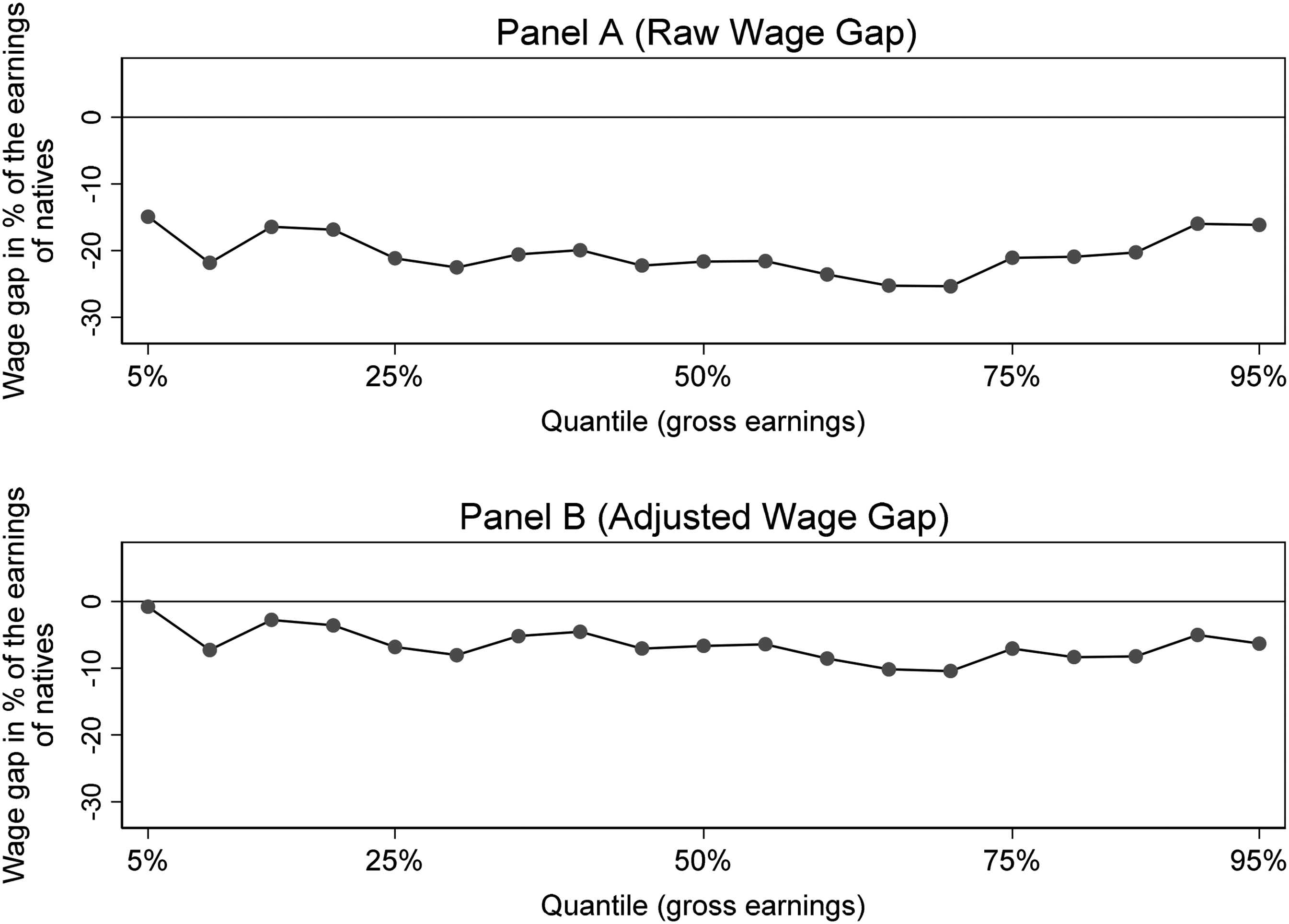
Migrant-native wage gap across the wage distribution.
Our primary contribution is to reveal that noncognitive skills help explain the male migrant wage gap in Germany. We are the first to combine the stylized fact that individuals from different countries differ in their average noncognitive skills with the theoretical concept that these skills affect wages. By doing so, we connect strands of the literature within the fields of psychology, gender economics, and migration and transfer the idea that noncognitive skills affect wages from personality and gender economics (Bowles, Gintis and Osborne 2001) to the migration context to explain labor market outcomes. Then, we apply the idea from gender economics that differences in average noncognitive skills explain gender wage gaps (Nyhus and Pons 2005; Mueller and Plug 2006; Heineck and Anger 2010; Blau and Kahn 2016) to migrant wage gaps. By combining these approaches, we assume that noncognitive skills are productive traits in which migrants and natives differ on average and that these skills differences contribute to explaining male migrant wage gaps. Thereby, we further understand the migrant wage differentials and show that noncognitive skills contribute to explaining male migrant wage gaps in Germany.
This article is outlined as follows. In the “Literature Overview” section, we provide an overview of migration patterns in Germany as a backdrop for our analyses. Then, we discuss the psychology and gender economics literature to show why we expect migrants and natives to differ in their average noncognitive skills and why we expect those skills to affect wages. In “The Data and Methods” section, we present data from the LPP and the methods we use, paying attention to mitigating endogeneity concerns. From there, we describe the sample and provide descriptive evidence for the average differences in noncognitive skills between male migrants and natives in Germany. In the “Results” section, we present the results of multivariate analyses, displaying baseline results and describing extensions to show the robustness and discuss potential biases. We show that noncognitive skills robustly relate to wages and contribute to explaining the male migrant wage gap in Germany. This finding is particularly true for neuroticism, one personality dimension within the Big Five Personality framework, which has two extreme poles at the end of a spectrum: neuroticism and emotional stability. Individuals sort themselves along the continuum between neuroticism and emotional stability. Then we conclude by highlighting our key findings and touching upon avenues for future research.
Literature Overview
Migration Patterns in Germany
The aftermath of World War II and Germany's division shaped migration to the country. In the period after the war until the 1950s, around 12 million (German) refugees came to West Germany from eastern and southeastern Europe (Schimany and von Loeffelholz 2013), and between 1987 and 2001, 2.8 million ethnic Germans from Eastern Europe and the former Soviet Union migrated to Germany (Glitz 2012). Additionally, two main migratory waves can be distinguished: the recruitment of guest workers and migration for humanitarian reasons (Kogan 2011).
In the first migratory wave, starting in the 1950s, (former West) Germany began recruiting labor migrants (i.e., guest workers), mainly from Southern Europe and Turkey. 5 These workers were a selective group in terms of lower human capital and often came from economically struggling regions of their home countries (Kogan 2011). The active recruitment of guest workers stopped in 1973, due to an economic recession (Schmidt 1997). Nevertheless, families of guest workers continued coming to Germany, changing the demographic composition of migrants and constituting a change in German immigration policy from demand-oriented migration toward family reunification and humanitarian migration (González-Ferrer 2007).
The second migratory wave, from the mid-1980s onwards, included refugees from the former Soviet Union, Turkey, and Iraq (Kogan 2011). In the mid-2000s, migrants also began to arrive from the Middle East, Asia, Africa, Eastern Europe, and Russia (Kogan 2011). Starting in the 1990s, migrants were, on average, more skilled but also more heterogeneous in their human capital endowments compared to previous migrants (Kogan 2011). While Turkish migrants tended to be less educated, free migration flows within the European Union brought highly educated migrants from other member states (Kogan 2011). The most important country clusters from which migrants came to Germany between 1995 and 2000 are Turkey (40%), Eastern Europe (15%), the European Union (22%), and former Yugoslavia (9%) (Kogan 2007, 38). In 2013, the year of our analyses, around 10.2 million first-generation migrants and around 6 million second-generation migrants lived in Germany, composing around 20% of the population (Höhne 2016).
Measures of Noncognitive Skills and Migratory Status
The noncognitive skills we analyze in this article are risk preference and the Big Five Personality Dimensions. Risk preference broadly distinguishes between risk aversion, neutrality, and affinity and is often measured in lottery or insurance experiments (Thomas 2016). When individuals face a decision with an uncertain outcome, risk preference influences the individual's utility function and shapes the likelihood of taking risks (Thomas 2016).
According to the concept of the Big Five Personality Dimensions, five global traits describe human personality: Extroversion, neuroticism, agreeableness, conscientiousness, and openness to experience (Table 1). Each trait can be further decomposed into underlying clusters of more specific characteristics (Barrick and Mount 1991). Each trait contains two poles of extreme personality, and each individual's personality can be sorted along a continuum between the poles, according to the individual’s characteristics (Barrick and Mount 1991).
The Big Five Personality Dimensions as Surveyed in the Linked Personnel Panel (LPP).
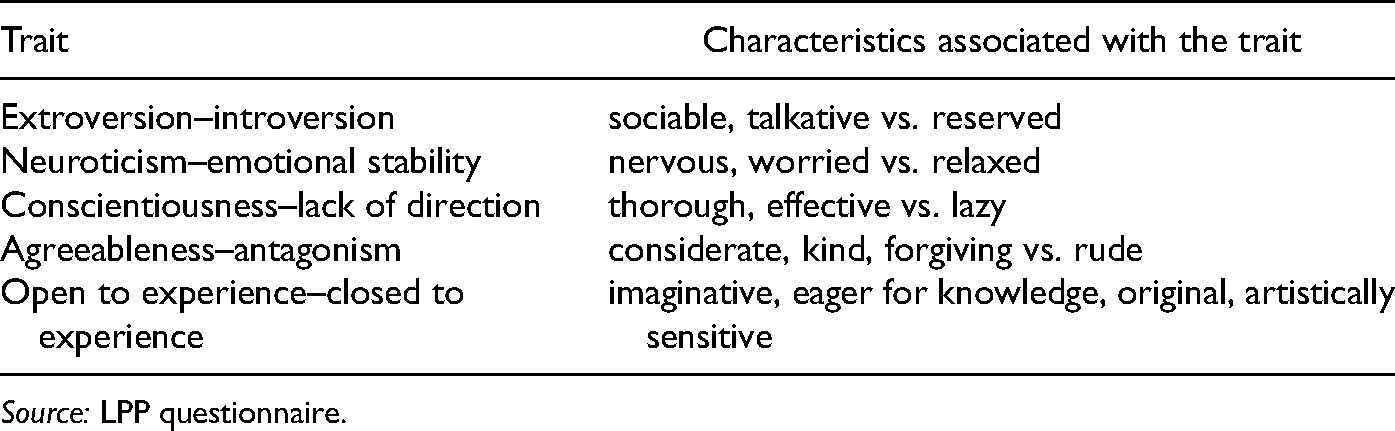
Source: LPP questionnaire.
We have no a priori expectations about how migrants and natives differ in their average noncognitive skills in our sample. However, we assume differences for two reasons. First, migrants often self-select into migration, thereby displaying traits that differ from stayers: Higher achievement and power motivation increase the probability to migrate (Boneva et al. 1998; Boneva and Frieze 2001), as does adaptability, particularly for individuals with lower cognitive skills (Bütikofer and Peri 2017). High adaptability reduces migration's nonmonetary costs and, therefore, increases migration probabilities, following Roy’s (1951) model. Further, high affiliation motives, related to high agreeableness (Jokela 2009), correlate with low desires to move to another country (Boneva et al. 1998). A study examining personality traits’ influence on migration patterns within and between US states suggests that openness to experience, low agreeableness, and high extroversion relate to migration probabilities, whereas conscientiousness and neuroticism do not (Jokela 2009). In contrast, Silventoinen et al. (2008) show that neuroticism influences migration patterns while also confirming that extroverted individuals are more likely to migrate. Similarly, Jaeger et al. (2010) reveal that risk takers are more willing to migrate. Further, the relationship between the migration decision, risk aversion, and labor market outcomes depends on ability, as predicted by self-selection models of migration (e.g., Borjas 1987; Chiswick 1978). Thus, the migration literature assumes that high-skilled migrants are more willing to take risks and that low-skilled migrants are more risk averse than natives (Bonin et al. 2009; Constant et al. 2011). Bonin et al. (2009) find that migrants are more risk averse than Germans, arguing that migrants did not need high-risk preferences to migrate as guest workers with good employment prospects.
Second, empirical evidence shows that average personality differs across nations (for an overview of the relationship between national cultures and personality, see Hofstede and McCrae (2004)). When comparing average Big Fives scores in Germany, Italy, Portugal, Croatia, and South Korea, significant differences appear (McCrae et al. 1999), and continental groupings also display differences, such that Europeans and Americans score higher in extroversion than Asians or Africans (Allik and McCrae 2004; McCrae and Terracciano 2005).
These differences may be the result of preference profiles developing differently across regions and following specific patterns (Falk et al. 2018). These patterns may find their origins in ancient migration and the effects of temporal distance, meaning that the longer populations have been separated, the larger the differences in their preferences (Becker, Enke and Falk 2018). Falk et al. (2018) find that country groups’ preference profiles correlate with geography (e.g., latitude, presence of large domestic animals, and the possibility of agriculture) and culture (e.g., individualism, religion, and linguistic structures). Moreover, differences in preferences and attitudes seem persistent, as (unemployed) second-generation migrants in Germany still display a higher willingness to take risks and are less likely to display low amounts of positive reciprocity than German natives (Constant et al. 2011).
Noncognitive Skills in a Wage Framework
How do noncognitive skills function in a wage framework, and how do these skills affect wages, irrespective of migratory status? Early research on personality traits in an economic context recognized a relationship between personality traits and labor market outcomes (Barrick and Mount 1991; Salgado 1997), and noncognitive skills are considered part of an individual's human capital, applying the concept of Human Capital Theory (Becker 1964).
One theoretical economic approach specifically models noncognitive skills in a wage framework (Bowles, Gintis and Osborne 2001). In their work, Bowles, Gintis, and Osborne (2001) propose a behavioral model of earnings, including noncognitive traits, to allow for factors other than human capital to affect wages. Based on incentive problems similar to principal-agency theory, the authors assume that employee reactions to incentives depend on noncognitive skills and that certain favorable employee characteristics, described as “incentive-enhancing preferences,” mitigate incentive problems. Employers reward favorable noncognitive skills through wages, independent of other determinants like human capital. Noncognitive skills are included in a standard maximization problem through a parameter in the employee's utility function that shifts the employee's response function. Assuming that incentive-enhancing preferences induce harder work at every wage rate and that the employer can identify when otherwise-identical employees have different levels of noncognitive skills, the employer pays higher wages to the employee with more favorable traits.
The gender economics literature performed empirical tests of the behavioral approach and showed that noncognitive skills matter for wage determination (e.g., Nyhus and Pons 2005; Mueller and Plug 2006; Heineck and Anger 2010; Heineck 2011; Blau and Kahn 2016) with the following mechanisms: Neurotic individuals may not perform well in stressful situations, while individuals in the opposite extreme of this personality dimension (i.e., emotionally stable individuals) may show better job performance (Barrick and Mount 1991; Salgado 1997). Extroverted individuals may be well matched for leadership roles or for jobs with high levels of social interaction, and extroversion's effects may depend on occupation (Nyhus and Pons 2005). Conscientiousness is positively associated with job performance (Barrick and Mount 1991; Salgado 1997; Judge et al. 1999), as well with wages, especially at the beginning of an employment relationship (Nyhus and Pons 2005). However, extreme levels of conscientiousness or its opposite can be damaging (Heineck 2011). Agreeable individuals perform well in teams or occupations with high degrees of social interaction (Nyhus and Pons 2005). However, they may be at a disadvantage in wage negotiations (Mueller and Plug 2006). Openness to experience may hinder achievements in jobs or careers where creativity and intellectuality deter from success (Judge et al. 1999; Heineck 2011). However, openness to new experiences relates to autonomy, which has a positive effect on wages as tenure increases (Nyhus and Pons 2005), and openness to experience additionally relates to intellect (Barrick and Mount 1991). Being open to experiences also increases the intent to attend a university, thereby encouraging indirect labor market effects through education (Peter and Storck 2015).
Risk preference leads to occupational sorting according to different earnings risks, thereby influencing occupational choice and wages (Bonin et al. 2007). Job Search Theory suggests that risk preference influences search behavior and reservation wages (Cox and Oaxaca 1989; Cox and Oaxaca 1992; Acemoglu and Shimer 1999) and that high-risk preferences relate to lower reemployment probabilities (Constant et al. 2011). Further, risk preference differs between men and women, and higher risk affinity is associated with higher wages (Croson and Gneezy 2009; Bertrand 2011).
In summary, the literature on noncognitive skills provides evidence that migrants and natives differ in their average noncognitive skills and that noncognitive skills relate to wages. We contribute to this literature by bringing together the different strands of the migration, psychology, and gender economics literature to investigate the relationship between noncognitive skills and male migrant wage gaps, using the behavioral model presented by Bowles, Gintis and Osborne (2001) as a theoretical base. Note that we do not assume that all noncognitive traits are equally favorable in the labor market or even across different countries’ labor markets. We cannot make clear a priori predictions for noncognitive skills’ effects, as prior empirical findings seem context dependent. Thus, we explore which traits relate to wages in Germany and how they contribute to explaining the male migrant wage gap.
The Data and Methods
Data and Sample Description
Our analyses use novel linked employer–employee data, the LPP, which is a supplement to the Establishment Panel Survey (“Betriebspanel” - BP). The BP is a longitudinal representative survey of Germany's labor demand (Fischer et al. 2009) in which approximately 16,000 establishments with at least one employee subject to social security are surveyed annually, representing all federal states, industries, and sizes. The first LPP wave, consisting of an employer and an employee survey, was carried out in 2012/2013 (Broszeit and Wolter 2015). The employer survey used a representative sample of 1,219 establishments with >50 employees subject to social security contributions who participated in the 2011 BP wave. Sampled from the LPP's establishments, 7,508 employees were surveyed on job-related and socio-demographic issues, including noncognitive skills and wages (Bellmann et al. 2015). To add information on tenure and unemployment, we link administrative data, the Integrated Employment Biographies (IEBs), to the survey data for individuals consenting to data linkage (83 percent). We chose the LPP because of its high data quality, linkage possibilities, and detailed information on employers.
We restrict our sample to men living in West Germany. This restriction is due to Germany's division after World War II, which led to structural differences that persist despite the Reunification in 1989 (Schnabel 2016). While the two regions are converging, labor market differences are still evident, putting East Germany at an economic disadvantage (Schnabel 2016). Structural differences include sectoral distribution, as well as East Germany's higher unemployment share, higher share of part-time work, lower share of establishments having a works council or collective bargaining agreement, and fewer individuals working in large establishments (Müller et al. 2018). In addition, Schnabel (2016) provides an overview of persistent wage differences between West and East Germany.
We restrict the sample to men for several reasons. First, persistent raw gender wage gaps of over 20 percent exist in Germany (DESTATIS 2020), and we do not want to confound the results by mixing gender and migrant wage gaps. Second, migrant women in employment are a selective group, as the traditional division of work often regards men as breadwinners (Kogan 2007). This selection is reflected in the proportion of migrant women in the labor force, 60 percent of whom worked in atypical employment, such as part-time, temporary, or fixed-term work in 2013 (Höhne 2016). Third, Bertrand (2011), as well as Croson and Gneezy (2009), demonstrate gender differences in noncognitive skills, leading to differential effects of noncognitive skills between men and women (Nyhus and Pons 2005; Mueller and Plug 2006; Heineck and Anger 2010; Heineck 2011; Blau and Kahn 2016). Consequently, by imposing these sample restrictions, we exclude regional and gender differences to avoid confounding our results.
As we cannot distinguish between individuals who migrated before or after the age of six, we define migrants as all individuals born outside Germany. Of the 2,999 individuals in our sample, 2,562 reported their wages. We impute the remaining cases by applying multiple regression techniques separately for migrants and natives and by using all covariates of the full model. Following Rubin (1976), this approach is efficient when missing values depend on observed values, as they do for migrant status and conscientiousness in our sample. We report the baseline results in Table 3 based on the sample without imputed values and provide a reference table with the imputed sample in Supplemental Table A2. The results between the imputed and nonimputed sample are very similar in effect size; therefore, we show the remaining tables based on the imputed sample, which yields higher efficiency. In our imputed sample, we include 326 male migrants and 2,673 male natives, working in 478 establishments.
An 11-point scale measures an individual's willingness to take risks, with zero indicating that they were not prepared to take risks and ten indicating that they were highly prepared to take them. This measure is well established and reliably predicts labor market outcomes (Bonin et al. 2007; Dohmen et al. 2011). The Big Five Inventory Short Scale uses a five-point Likert answer option for the 16 items in the survey. This scale displays internal coherence and strong indications for its validity (Gerlitz and Schupp 2005). Three items cover each personality dimension, except for openness to experience, which is covered by four. To check whether variability in the personality dimensions arises from measurement error, we calculate Cronbach's alpha (agreeableness: 0.46, openness to experience: 0.53, conscientiousness: 0.56, extroversion: 0.60, neuroticism: 0.51). While Cronbach's alphas are relatively low, they are comparable to those found in the gender economics literature (Mueller and Plug 2006; Heineck and Anger 2010) and in the socio-economic panel (Kampkötter et al. 2016), and their size directly relates to the small number of items per trait (Gosling, Rentfrow, and Swann 2003). Additionally, factor analyses show that respective items load on the desired personality dimensions. Thus, we are confident that the personality items reflect the correct traits.
For each Big Five trait and risk preference, we create an index and standardize each index to a mean of zero and a standard deviation of one. Negative values of a trait mean that the trait's opposite is more distinct (i.e., emotional stability vs. neuroticism). We use these indices in the empirical analyses, which we describe in the next section.
Methods
We start analyzing the relationship between noncognitive skills and wages with an extended Mincer earnings equation, following Bowles, Gintis, and Osborne (2001) and using ordinary least squares (OLS):
Next, we use Oaxaca–Blinder decompositions to break down the migrant wage gap's overall mean (Blinder 1973; Oaxaca 1973):
Mitigating Endogeneity Concerns
We are aware that our analyses lend themselves to endogeneity concerns, particularly for noncognitive skills. Reverse causality may arise when labor market success or failure alters personality (Anger, Camehl and Peter 2017). However, the psychological literature comes to the consensus that while changes can occur throughout life (Roberts, Walton and Viechtbauer 2006; Ferguson 2010), personality fluctuates around a core, which becomes increasingly stable with adulthood (Briley and Tucker-Drob 2014). This core stability is reflected in the definition of personality traits as “relatively enduring, automatic patterns of thoughts, feelings, and behaviors that people exhibit in similar situations across time” (Roberts and Davis 2016, 319).
The psychology literature provides evidence for the consensus on core stability. First, rank-orders of individual personality traits and risk preference are constant (Roberts and DelVecchio 2000; Schildberg-Hoerisch 2018), indicating a core stability. Second, a large share of personality and risk preference is hereditary (40%–60%; two-thirds in twin studies) (Jang, Livesley and Vemon 1996; Bouchard and Loehlin 2001; Cesarini et al. 2009; Kandler et al. 2010). Thus, personality traits are considered predominantly stable and reach a plateau around late middle age (Roberts and DelVecchio 2000; Soto 2018), when the individual's environment also reaches stability (Briley and Tucker-Drob 2014). Still, changes can occur over the life course with specific events (Roberts and DelVecchio 2000; Roberts, Walton and Viechtbauer 2006; Specht, Egloff and Schmukle 2011; Damian et al. 2019), leaving room for changes in adulthood (Roberts and Davis 2016).
Furthermore, personality traits are particularly stable for working-age individuals (Cobb-Clark and Schurer 2011; Cobb-Clark and Schurer 2012). Thus, adults must experience more than five adverse employment or income events for these events to have an effect (Cobb-Clark and Schurer 2012). The Big Five also remain nearly unchanged after involuntary job loss due to plant closure, with the exception of individuals with above-average educational attainment who experience positive effects on openness to experience (Anger, Camehl and Peter 2017). Additionally, unemployment affects neither mean-level nor rank-order stability of personality traits (Specht, Egloff and Schmukle 2011).
Similar evidence exists for the stability of risk preference in adults, and correlations in panel data imply “a persistent characteristic of an individual that is at least moderately stable over time” (Schildberg-Hoerisch 2018, 141). Individuals become more risk averse with age (Dohmen et al. 2017), but age-related changes in adults are slow and moderate (Schildberg-Hoerisch 2018) and risk tolerance stabilizes around the age of 45 years, with the exception of individuals from a very low socio-economic status (Schurer 2015). Exogenous shocks, such as economic crises or natural or human-made catastrophes, could alter risk preference, but these shocks are rare (Schildberg-Hoerisch 2018). 8
Note that despite a lack of studies focusing explicitly on migrants’ noncognitive skills, the cross-country psychology literature does not provide reasons to believe that migrants and natives should differ in this core stability of traits; thus, we believe that the assumption of stable skills can be transferred to the context of migration. Although the act of migration may alter noncognitive skills, our estimations should not be affected for two reasons. First, we measure noncognitive skills after migration, and the skills we measure are the ones employers can observe (i.e., the ones which relate to wages). Second, our sample includes few migrants with a short duration of stay, and while we expect that migrants’ noncognitive skills may have fluctuated around the stable core upon migrating, these skills should have settled back to the (potentially new) core with an increasing duration of stay in the host country.
In summary, we believe that changes in noncognitive skills can occur across life but that personality's stable component outweighs its variable component. Despite experimental studies providing evidence for noncognitive skills’ causal effects on wages (Cubel et al. 2016; Maczulskij and Viinikainen 2018), we do not claim causality, as we examine cross-sectional data and cannot test the stability assumption. Nevertheless, our sample's characteristics mitigate many endogeneity concerns. We regard individuals who are well into adulthood with an average age of over 40 years (Supplemental Table A1) and who are employed and have on average long tenure (Supplemental Table A1). Therefore, we do not expect recent personality-altering labor market events that change noncognitive skills. We assume that noncognitive skills are likely inherited and formed in the origin country and its culture but that they could have fluctuated due to migration or early discriminatory experiences in Germany. However, our sample includes few migrants having arrived within the last 10 years, and the long duration since migration should allow fluctuations to settle. Thus, we allow that migrants experience a personality fluctuation upon migration, as we are only interested in the personality trait present when the job was acquired postmigration.
Descriptive Statistics
To gain a better understanding of our sample, Supplemental Table A1 provides summary statistics for German natives and migrants. With an average hourly wage of €22, migrants earned less than natives (€28), indicating a relatively large descriptive wage gap. Migrants in our sample were slightly younger and had a higher share of secondary education, whereas the share of migrants with higher education was smaller than that of the natives’ share.
Further, the sample's migrants are selective, as recent migrants are scarce: While around half migrated to Germany between 1990 and 1999, 26 percent came between 1980 and 1989 and more than one-sixth before the 1980s. Additionally, more than half the migrants were from Europe. 9 This sample, therefore, likely includes few low-skilled guest workers from the first migratory wave and concentrates on the more heterogeneous group of migrants that came with the second migratory wave. An average tenure of around 11 years indicates a high labor market attachment and stable work environment, which is unusual insofar as migrants on average have more frequent employment transitions, unemployment risk, and shorter tenure than German natives (Kogan 2007). Considering this selectivity, we might underestimate the wage gap.
Despite migrants’ positive selection in the sample, Figure 2 shows that average noncognitive skills for male migrants and natives differed. Results from t-tests reveal lower scores for migrants in extroversion (estimated difference of means: dif = −0.138; p = .008) and conscientiousness (dif=−0.142; p = .031) and higher scores in neuroticism (dif = 0.228; p = .000) and agreeableness (dif = 0.124; p = .030). However, migrants do not significantly differ from natives in openness to experience (dif = −0.084; p = .134) or risk preference (dif = −0.092; p = .138).
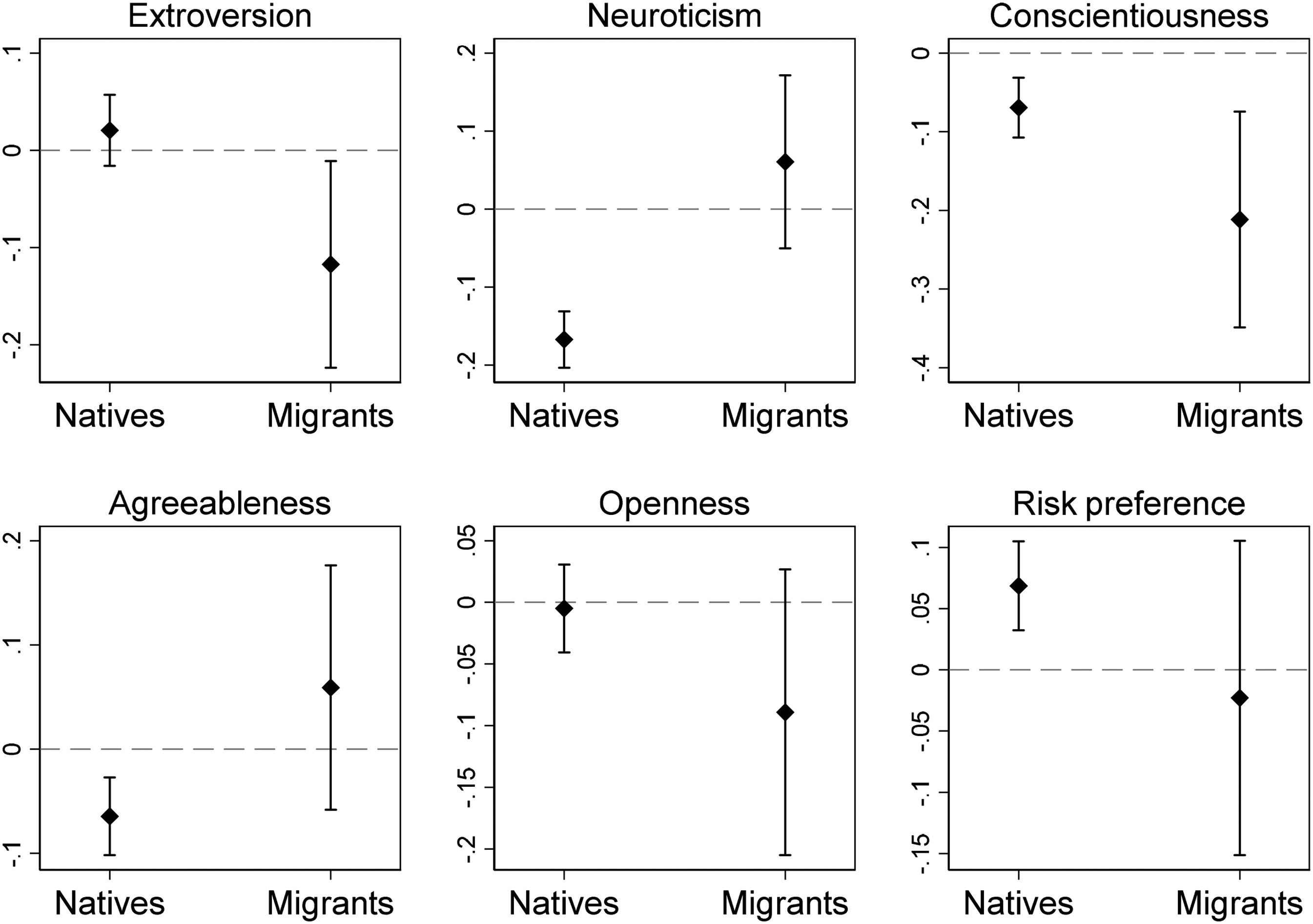
Average noncognitive skills for migrants and natives.
Table 2 presents average noncognitive skills for the origin continent to assess variations between migrant groups. We observe that male migrants differed from Germans in general but also that migrants from Europe differed from migrants from Asia. In particular, European migrants scored significantly higher in extroversion and agreeableness and lower in risk preference than did Asian migrants. Overall, these findings show that average differences in noncognitive skills between male migrants and natives exist.
Average Non-cognitive Skills for Migrant Groups.
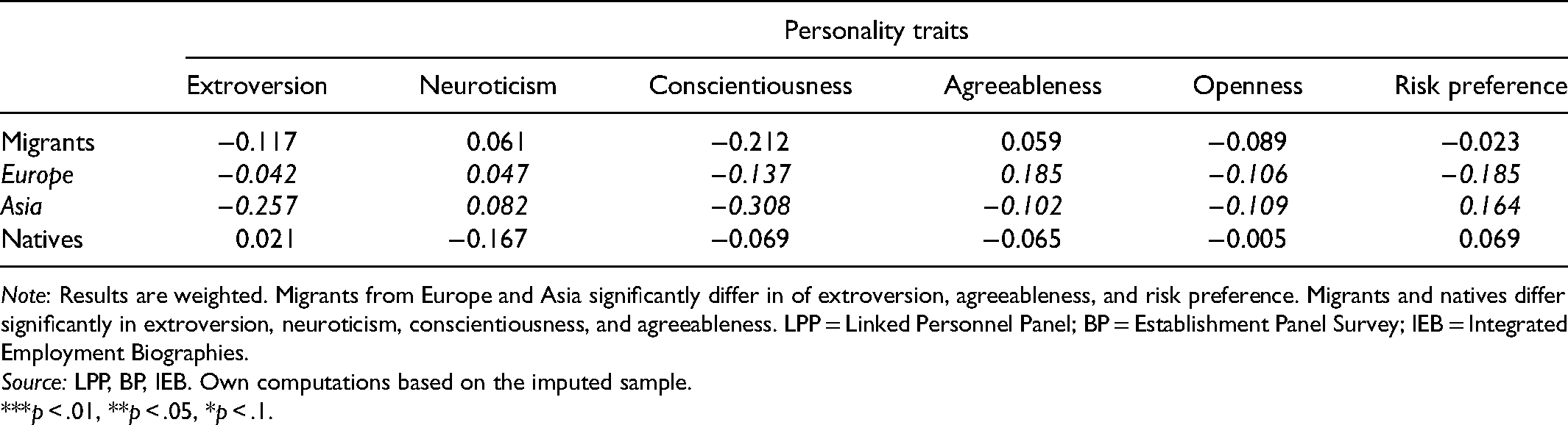
Note: Results are weighted. Migrants from Europe and Asia significantly differ in of extroversion, agreeableness, and risk preference. Migrants and natives differ significantly in extroversion, neuroticism, conscientiousness, and agreeableness. LPP = Linked Personnel Panel; BP = Establishment Panel Survey; IEB = Integrated Employment Biographies.
Source: LPP, BP, IEB. Own computations based on the imputed sample.
***p < .01, **p < .05, *p < .1.
Results
Mincer Equations
Results for the Baseline Mincer Equation
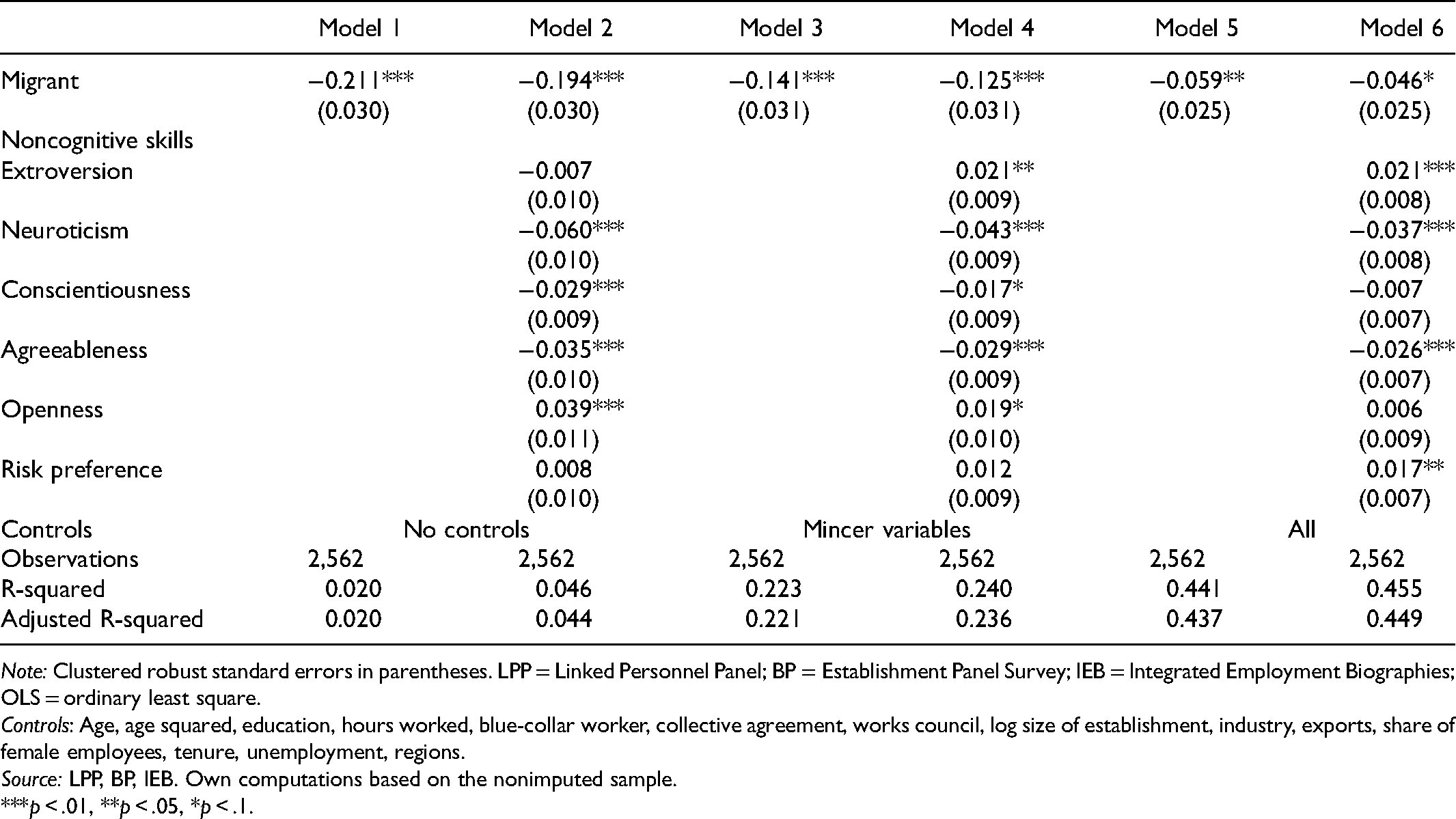
To assess the extent of the raw wage gap and the relationship between noncognitive skills and wages, we first estimate consecutive wage equations for the nonimputed sample in Table 3. Model 1 reveals a raw male migrant wage gap of 21 percent, which is in line with migrant wage gaps found in Germany in other studies (8 percent–20 percent) (Lehmer and Ludsteck 2011; Aldashev et al. 2012; Brenzel and Reichelt 2017). Including noncognitive skills in Model 2 reduces the wage gap and increases the model's explanatory power. As noncognitive skills may correlate with education and experience, we control for the Mincer variables in Model 3, which decreases the wage gap to around 14 percent. In Model 4, we include the noncognitive skills and the Mincer variables together, further reducing the wage gap. Note that including the Mincer variables changes the noncognitive skill coefficients’ magnitude when comparing Models 2 and 4, particularly for extroversion and openness to experience (see the next section for a discussion of these changes).
OLS Results for the Full Sample.
Note: Clustered robust standard errors in parentheses. LPP = Linked Personnel Panel; BP = Establishment Panel Survey; IEB = Integrated Employment Biographies; OLS = ordinary least square.
Controls: Age, age squared, education, hours worked, blue-collar worker, collective agreement, works council, log size of establishment, industry, exports, share of female employees, tenure, unemployment, regions.
Source: LPP, BP, IEB. Own computations based on the nonimputed sample.
***p < .01, **p < .05, *p < .1.
In Model 5, we include individual and establishment controls without the noncognitive skills, which reduce the estimated wage gap to 6 percent. In Model 6, we estimate the full specification. Including noncognitive skills further decreases the migrant wage gap to less than 5 percent and significantly increases the model's explanatory power (F(6, 2533) = 10.38; p = 0.0000). We test the difference between the migrant coefficients in Models 5 and 6, using a two-sided t-test for nested models, following Clogg, Petkova and Haritou (1995). The result (t = 5.9073; p= 0.000; df = 28) reveals that including noncognitive skills led to a significant decrease in the wage gap. Thus, noncognitive skills meaningfully contribute to explaining the variance in wages.
The coefficients have economically important effect sizes and indicate that noncognitive skills were not all favorable in the German labor market. Extroversion and risk preference positively correlated with wages, and one standard deviation in extroversion and risk preference, respectively, is associated with around a 2 percent wage increase. In contrast, a one standard deviation increase in neuroticism is associated with an hourly wage penalty of almost 4 percent. An explanation for this finding is that emotionally stable individuals are more productive (Barrick and Mount 1991; Salgado 1997). Agreeableness seems equally unfavorable, and a one standard deviation increase in agreeableness is associated with a wage penalty of over 2 percent. Possibly, agreeable individuals perform less well in wage negotiations (Nyhus and Pons 2005). Neither the coefficient for openness to experience nor conscientiousness is statistically significant. The latter result is possibly due to the sample's cropped distribution of conscientiousness. Supplemental Table A2 shows that the results for the sample with imputed values are robust. As imputing yields more efficiency and an increase in sample size, the results hereafter are based on the imputed sample.
Extensions Using Different Methods
We expand upon our results by using different methods to discuss robustness in this section. 10 We start by assessing whether the relationship between noncognitive skills and wages varies across the wage distribution to see if our linear modelling is adequate. Figure 1 shows the results from unconditional quantile regressions using a RIF approach. The confidence intervals of the noncognitive skills’ estimated coefficients overlap for all quantiles, indicating that their effects remain constant across the wage distribution. Therefore, we estimate linear models for the remainder of this article. Nevertheless, some coefficients for individual quantiles are significant by themselves. For example, the results for extroversion and risk preference seem driven by the 25th and 50th quantile of the distribution, while neuroticism and agreeableness reveal significant coefficients for all quantiles.
Next, we exploit the time variance in the survey to address the problem of reverse causality, as noncognitive skills and wages are measured at the same time. Due to a lack of consent for a panel survey or data linkage and panel attrition, only around 40 percent of the original observations remain. Further, as only the first LPP wave asked about noncognitive skills, we estimate a lagged model. The results of re-estimating the full specification of Table 3 with a lag show that all traits, except for neuroticism, are insignificant, highlighting this trait's robustness. The finding for neuroticism implies that individuals who display characteristics associated with its counter pole, emotional stability (i.e., who are, for example, relaxed), may have more advantageous wage outcomes.
Extensions Discussing Potential Biases
As a next step, we explored the mechanisms through which noncognitive skills related to wages. We also regard potential biases occurring because covariates in the estimation might be an indirect outcome of noncognitive skills themselves. First, we address the concern that noncognitive skills may change with age. To assess the stability of noncognitive skills with increasing age, we regress each trait on age and age squared to obtain residuals free of age effects (Nyhus and Pons 2005). To understand why in Table 3 extroversion switches from insignificant and negative (Model 2) to significant and positive (Model 4) when adding the Mincer variables, we include the estimated residualized noncognitive skills, instead of the original indices. When re-estimating these models with the residualized noncognitive skills, we observe the same change happening in extroversion, indicating that age might act as an omitted variable in Model 2 of Table 3. For the remaining noncognitive skills, estimating with the residuals does not change the results, indicating that our original measures adequately capture noncognitive skills’ stable core.
Second, to address indirect wage effects through education, we calculate predicted residuals of noncognitive skills free of education effects. Two possible channels can lead to indirect effects through education. First, schooling can affect both cognitive and noncognitive skills (Heckman et al. 2006). For example, empirical evidence shows that schooling's duration plays a role in men's extroversion (Anger and Dahmann 2014). Second, openness to new experiences contributes to explaining educational attainment, particularly the intent to attend a university (Lundberg 2013a; Lundberg 2013b; Peter and Storck 2015). Re-estimating Model 2 of Table 3 with the predicted residuals shows no effect on extroversion, possibly because for the individuals in the sample, age is of more importance. The coefficients for neuroticism and openness to experience decrease slightly, possibly indicating their importance for predicting educational attainment. Education seems to play a role for conscientiousness as well, as estimation with the residuals leads to insignificance for this noncognitive skill, which explains the result in Table 3 Model 6.
Third, Cobb-Clark and Tan (2011) point to occupational sorting due to noncognitive skills, as do Bonin et al. (2007) for risk preference. Therefore, we re-estimate Table 3 and additionally control for the one-digit German occupation classification. Comparing the new results with Model 2 of Table 3, the coefficient for conscientiousness halves and only remains significant at the 10 percent level, while the other noncognitive skills’ coefficients remain robust. When we add occupation to the respective models, the results do not change. We provide one further check and exclude industry and the dummy for blue-collar work and observe a minor change in openness to experiences, which becomes significant at the 10 percent level. As the LPP does not include civil servants, the self-employed, or individuals from establishments with less than50 employees, we reason that blue-collar work and industry capture occupational variation to an adequate extent. Note that despite the result's robustness when adding occupation controls, we cannot fully exclude a bias resulting from migrants’ occupational sorting through discrimination or problems with foreign qualification.
While we cannot exclude all potential endogeneity issues, we can shed light on the mechanisms through which noncognitive skills relate to wages. Thus, when regarding noncognitive skills’ raw effects, we likely find a combination of direct effects on wages, as well as indirect ones through age, education, or occupation. However, the robustness checks show that we control for a relevant set of variables to reduce potential biases in our estimations.
Extensions Discussing Employer Learning
Finally, we explored whether employer learning played a role in our estimations. According to Altonji and Pierret (2001), coefficients of characteristics that are hard to observe should rise, and those of easily observable characteristics should fall, as employers learn about their employees’ true productivity. Therefore, under the assumption of imperfect information on an individual's productivity at the beginning of an employment relationship, wages become more dependent on true productivity and less on observable characteristics over time. To analyze employer learning's role, we split the sample three ways, according to the distribution of tenure. The bottom 25 percent of the distribution of tenure includes individuals who have been working at the establishments for around five years or less; the top 75 percent comprise employees with 21 or more years of tenure. More than half the migrants are in the middle quartile of the tenure distribution. Note that the rather high tenure in the sample may lead to smaller effects compared to a sample including more recent hires.
The results show that the migrant dummy is not significant at the distribution's tails (Supplemental Table A3). While this dummy is similar in effect size for the bottom and middle of the tenure distribution, it is almost zero at the top. This result may indicate that the easily observable migratory status becomes less important as employers learn about their employees’ true productivity over time.
The noncognitive skills display heterogeneous results: Conscientiousness and openness to experience are insignificant for all split samples, while neuroticism is always negative, significant, and similar in effect size. Extroversion seems to be positive and significant in the middle of the tenure distribution, indicating that extroversion may not matter at the beginning of a working relationship or at high levels of tenure. Agreeableness no longer plays a role in the top 75 percent of the tenure distribution but negatively relates to wages at the bottom and middle of the distribution, possibly indicating wage negotiation effects at the beginning of an employment relationship. Risk preference is only significant and positive for those with middle and long tenure, possibly because these individuals may have roles in which making decisions is important. In summary, despite the high average tenure in the sample, we find some evidence for employer learning effects for noncognitive skills.
Split Samples
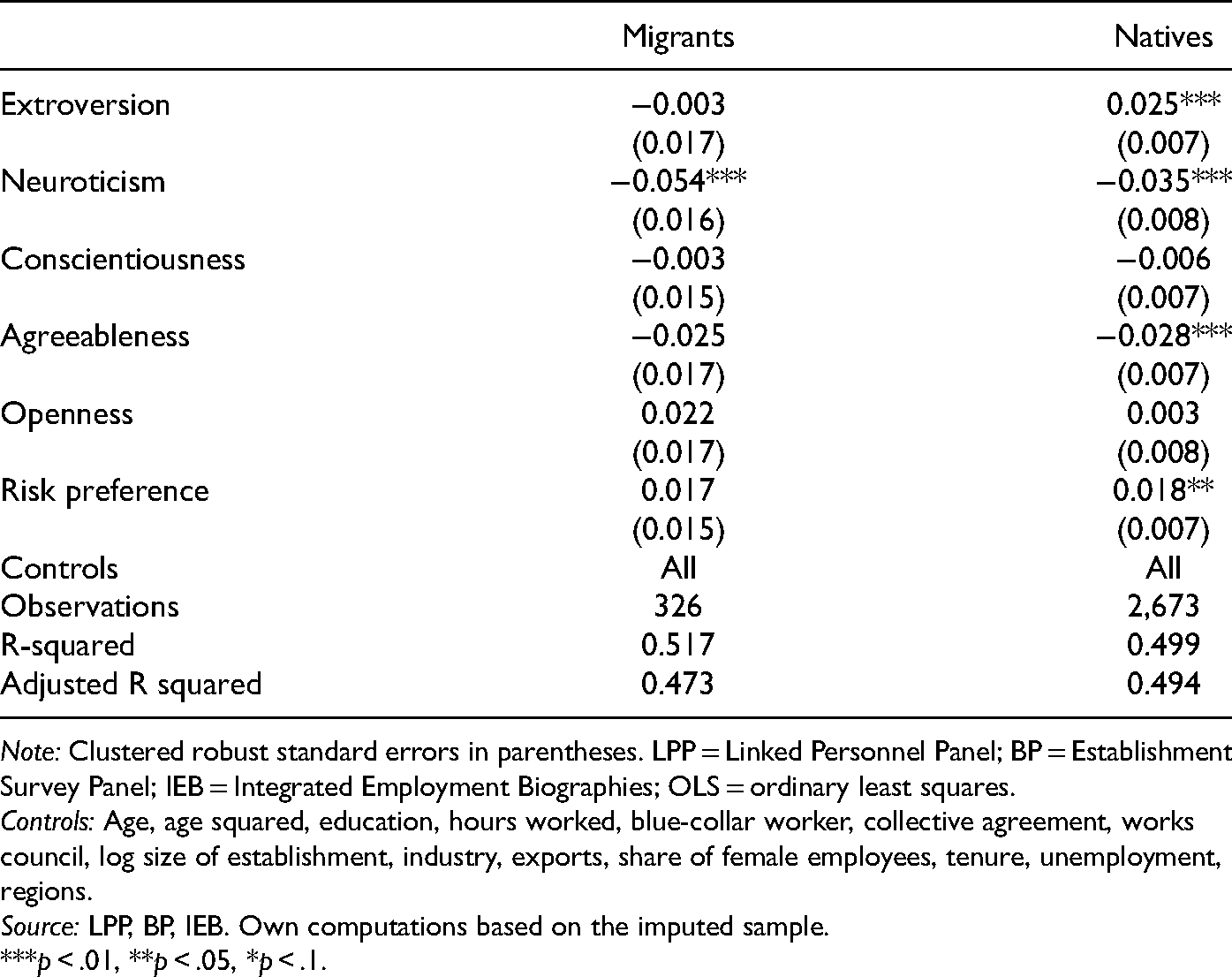
Next, we dig deeper into the relationship between noncognitive skills and migrants’ and natives’ wages. In particular, we are interested to see whether different noncognitive skills are relevant for the two groups, and Table 4 reports results for split wage equations.
OLS Results for the Split Samples.
Note: Clustered robust standard errors in parentheses. LPP = Linked Personnel Panel; BP = Establishment Survey Panel; IEB = Integrated Employment Biographies; OLS = ordinary least squares.
Controls: Age, age squared, education, hours worked, blue-collar worker, collective agreement, works council, log size of establishment, industry, exports, share of female employees, tenure, unemployment, regions.
Source: LPP, BP, IEB. Own computations based on the imputed sample.
***p < .01, **p < .05, *p < .1.
Table 4 shows no significant coefficients for risk preference, extroversion, and agreeableness for migrants. In contrast, natives are punished for agreeableness but rewarded for extroversion and risk preference. The coefficients for neuroticism are significantly negative and comparatively large for both migrants and natives. This finding indicates that employers reward the opposite of neuroticism (i.e., emotional stability), irrespective of the migratory status.
To account for differences between continent groupings, we further split the sample into European and Asian migrants. 11 The results show that European migrants entirely drive neuroticism's effect and that the German labor market does not reward emotional stability for Asian migrants. Finally, to account for years since migration, we split the sample into migrants arriving before 1990 and after. For both subsamples, neuroticism's coefficient is significant and negative, albeit slightly larger for migrants arriving after 1990. None of the remaining noncognitive skills is significant for these estimations.
Oaxaca–Blinder Decomposition
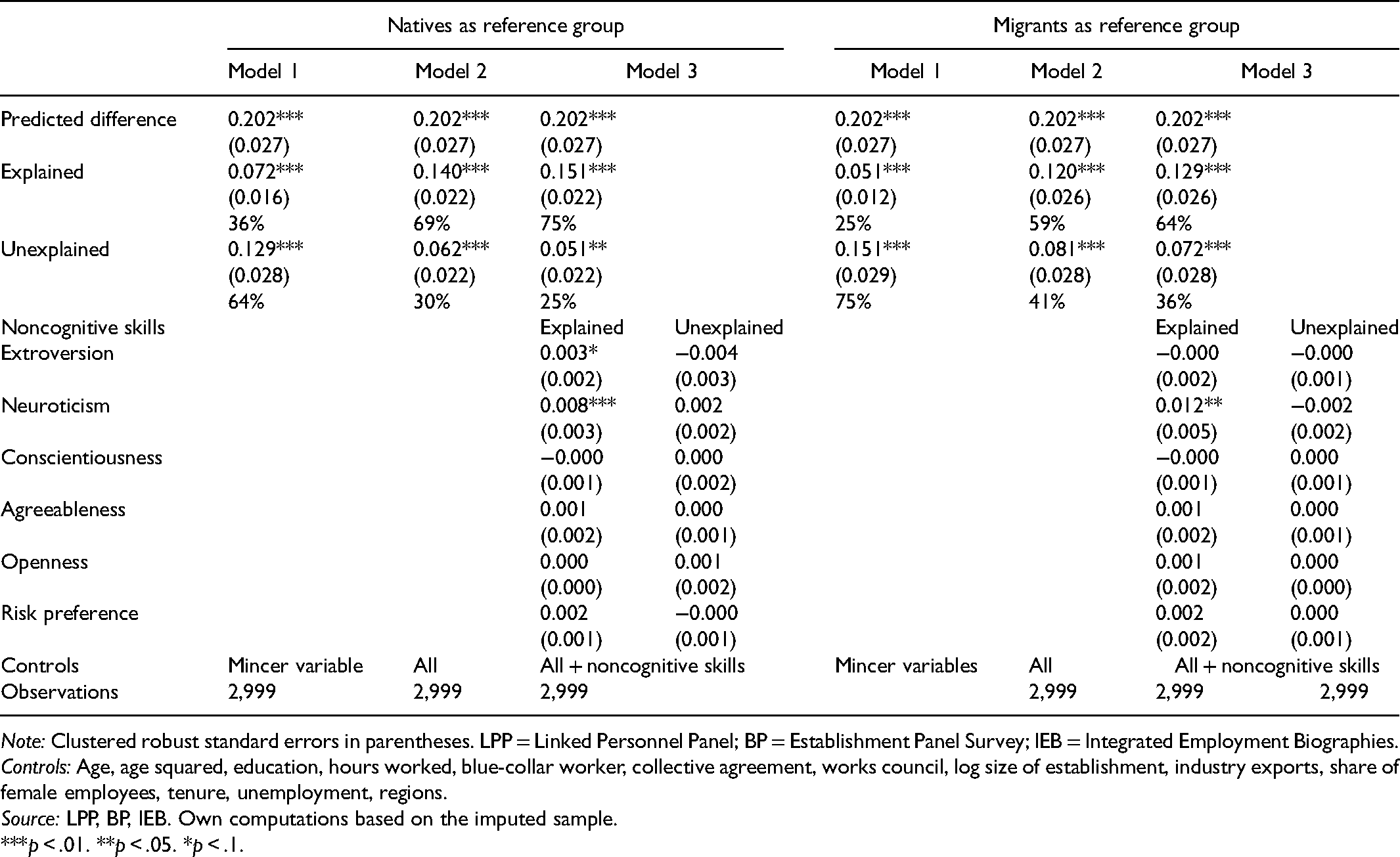
We estimate Oaxaca–Blinder wage decompositions to analyze the contribution of noncognitive traits to the male migrant wage gap in Germany. Table 5 presents the results of the wage decompositions for estimations with natives and migrants as a reference group, respectively. We first focus on the estimations with natives as the reference group, where we consecutively add controls to the model to illustrate the contribution of endowments to the explanation of the wage gap. Model 1 shows that natives earn more than migrants with a predicted difference of around 20 percent. The Mincer variables significantly explain 35 percent of this gap. The result is driven by age, as a proxy for experience, and higher education. This explained percentage increases to 69 percent when adding the controls in Model 2. The results indicate that the number of months in unemployment, blue-collar status, the establishment's share of women, and working in western compared to southern Germany further significantly contribute to the explained part of the wage gap. This result conforms with the summary statistics (Supplemental Table A1) showing that migrants were younger, more often in blue-collar employment, and had higher unemployment periods compared to natives.
Oaxaca–Blinder Decomposition.
Note: Clustered robust standard errors in parentheses. LPP = Linked Personnel Panel; BP = Establishment Panel Survey; IEB = Integrated Employment Biographies.
Controls: Age, age squared, education, hours worked, blue-collar worker, collective agreement, works council, log size of establishment, industry exports, share of female employees, tenure, unemployment, regions.
Source: LPP, BP, IEB. Own computations based on the imputed sample.
***p < .01. **p < .05. *p < .1.
We include noncognitive skills in Model 3, revealing the most important result and providing evidence that noncognitive skills increased the explained part of the wage gap. In our sample, the increase amounts to six percentage points. We estimate a two-sided t-test, following Clogg et al. (1995), 12 to confirm that the explained part's difference in the decomposition between the coefficients in Models 2 and 3 is significant.
Thus, noncognitive skills meaningfully and significantly contribute to explaining the migrant wage gap. The result is driven by extroversion and neuroticism (and its counter pole, emotional stability), the latter being a trait in which migrants score significantly lower than natives (Table 2). Accordingly, emotional stability is one of the more important traits employers rewards in the German labor market.
With migrants as the reference group, the results for the noncognitive skills remain robust and show a five percentage point increase in the explained part of the predicted wage difference. Again, the driver of this result is neuroticism, or its counter pole, emotional instability. We find that the Mincer variables do not contribute to the explained part of the wage gap in this estimation. However, unemployment, tenure, blue-collar work, and the share of women in the establishment significantly do.
These wage decompositions support the results of the OLS analyses and show that noncognitive skills significantly contribute to explaining male migrant wage gaps in Germany. In our sample, neuroticism or its opposite, emotional stability, drives the results. Considering the positive selection of migrants with long tenure in the host country, the explanatory power of noncognitive skills for the wage gap is not small. We likely estimate lower bounds, 13 and a sample with a less selective group of migrants may yield larger effects.
Nonlinearity in the Noncognitive Skill Distribution
To explore the mechanisms underlying noncognitive skills’ effects on wages, we analyze the extremes of the skill distribution. Thereby, instead of indices, we include two dummies for each noncognitive skill: one for the top 25 percent of each skill's distribution and one for the bottom 25 percent. Supplemental Table A4 Column 1 presents the results for the full model and Columns 2 and 3 for the split samples. For conscientiousness and openness to experience, neither of the trait's extremes is significant for the three specifications. For the other noncognitive skills, opposing patterns emerge. Introversion significantly and negatively relates to wages for natives only, while this trait's extreme seems irrelevant for migrants. Similarly, only natives are rewarded for high-risk preference, while migrants are not, and low-risk preference does not seem to be related to wages. While being antagonistic significantly and positively relates to wages for natives, being agreeable does not. In contrast, migrants are punished for being extremely agreeable, while being antagonistic has no effect. Finally, emotional stability positively relates to wages for both, while neuroticism is only significant and negative for natives.
When including the dummies for each noncognitive skill in the wage decomposition in Supplemental Table A5, we corroborate the result from Table 5. For natives as the reference group, both the bottom and top quartiles of the neuroticism distribution contribute to explaining the gap (i.e., both neuroticism and emotional stability play a role); however, only the bottom quartile (i.e., emotional stability) does so when we change the reference group. Additionally, we now find that being in the top 25 percent of the agreeableness distribution contributes to the unexplained part of the wage gap for both reference groups. Being in the top 25 percent of the extroversion distribution significantly contributes to the explained part of the wage gap for natives as a reference, while being in the top 25 percent of the agreeableness distribution does so for migrants as reference.
The Role of Neuroticism
Our findings so far reflect neuroticism's importance; therefore, we explore whether neuroticism only contributes to explaining wages when estimated with a bundle of noncognitive skills. Recall that neuroticism is one end of this personality dimension's spectrum while emotional stability is the other end. So far, neuroticism had a negative impact on wages, which entails that emotional stability positively relates to our outcome. We start by re-estimating the Mincer equations with neuroticism only. The results in Supplemental Table A6 show that neuroticism's coefficient is barely smaller compared to Table 3, providing evidence that neuroticism is meaningful on its own. Similarly, when comparing the results for the split samples of Supplemental Table A7 with those of Table 4, only small changes occur. In combination with the results from Supplemental Table A4, we assume that employers reward migrants for being emotionally stable but do not necessarily punish them for the opposing extreme of this trait. When we decompose the male migrant wage gap and compare Supplemental Table A8 with Table 5, we find that neuroticism's importance for explaining the migrant wage gap does not change. Overall, these results imply that neuroticism contributes to explaining wage gaps on its own, even without being included in a bundle of noncognitive skills. This result makes neuroticism the singular trait that always negatively relates to wages for both migrants and natives. In combination with the results from the previous sections, we conclude that employers reward emotional stability — no matter the circumstances.
Concluding Remarks
We provide the first evidence for the importance of noncognitive skills in an analysis of the male migrant wage gap in Germany. In doing so, we make an insightful contribution to the ongoing debate about wage gaps between migrants and natives (Dustmann 1993; Aldashev et al. 2012; Brenzel and Reichelt 2017). Due to cultural, geographic, or temporal differences, migrants and natives developed different average noncognitive skills — a phenomenon that we empirically observe in the data. Viewing noncognitive skills as productive traits, employers reward or punish employees based on these skills and their productivity-enhancing properties. Consequently, we observe that noncognitive skills lead to different returns and that these returns are not identical for migrants and natives. When we decompose the wage gap, we find that noncognitive skills significantly contribute six percentage points to explaining the male migrant wage gap. We expect that the sample's selective group of migrants leads to an estimation of a lower bound and that a different sample with more recently migrated or less tenured individuals would lead to larger estimates.
Throughout our estimations, neuroticism's effect is the most robust, suggesting that this personality dimension's counter pole (i.e., emotional stability) is desired in the German labor market, irrespective of the migratory status. This result is robust when we exclude the other noncognitive skills from the estimations. While we assume that noncognitive skills come in bundles and find a slightly higher explanatory power in the wage decomposition when including the full set of noncognitive skills, it seems that the personality dimension of neuroticism contributes to explaining the male migrant wage gap as a separate entity.
We have not yet addressed the importance of country context. In particular, the match between a migrant's set of noncognitive skills and the host country's demand for these skills may determine successful integration into the labor market. In Germany, emotionally stable individuals fare best in terms of wages. However, we do not know if other noncognitive skills might be valued in different countries. For example, Hofstede and McCrae (2004) correlate the Big Five and culture in the sense of Hofstede (2001), showing that extroversion positively correlates with individualism while agreeableness negatively correlates to uncertainty avoidance. While we assume that these patterns reflect a country's labor market preferences, further research is needed to explain country context's role in noncognitive skills across different host countries.
We also want to address some limitations of our article that might point to future research. This article is exploratory, as we do not make prior assumptions about noncognitive skills’ contribution to explaining wage gaps. Furthermore, while our results withstand robustness checks, they should not be interpreted as causal effects, as we cannot fully exclude endogeneity. Although the psychological research points to certain core stability of noncognitive traits in adults (Roberts and DelVeccio 2000; Briley and Tucker-Drob 2014; Soto 2018), noncognitive skill variability over the life course is possible. Additionally, we do not have enough information on migrants’ noncognitive skills before and after the act of migration to compare these skills’ stability over time. Thus, we only know that in the cross-sectional setting of our analysis, male German natives and male migrants differed on average in their noncognitive skills and can make no further inferences. In addition, while we control for occupation in robustness checks, we cannot exclude that wage differences in the sample result from occupational sorting due to discrimination or problems with foreign qualifications.
As children's noncognitive skills are still developing (Kankaraš and Suarez-Alvarez 2019), fostering certain skills could improve children's life outcomes. Regarding the 2015/2016 Refugee Crisis, this aspect becomes important as many children who came to Germany as refugees are now integrating into the educational system. Some studies looking at educational interventions, albeit in a nonmigration context, exploited natural experiments to show that the duration of preschooling (Bach, Koebe, and Peter 2018) and schooling (Anger and Dahmann 2014) can affect noncognitive skills measured later in life. Additionally, intervention programs also show effects on life outcomes (Heckman, Pinto and Savelyev 2013; Kosse et al. 2016).
In the context of adult migration, offering psychological assistance and classes strengthening emotional stability shortly after arrival in the host country might be helpful. With the stream of migrants coming to Germany increasingly shifting from guest workers to refugees, providing tools to increase emotional stability could lead to advantageous labor market outcomes for refugees. This idea may seem paradoxical at first, as we operate under the assumption of a stable core of noncognitive skills. However, this assumption does not exclude the possibility of fluctuations around a core upon major life changes; therefore, the immediate postmigration period might be a good time to develop coping mechanisms. However, before designing reliable intervention programs, we need more research to understand noncognitive skills’ causal impacts on labor market outcomes in adult life and their role for migrants and refugees.
Footnotes
Acknowledgements
For helpful comments and suggestions the authors would like to thank Lutz Bellmann, Herbert Brücker, Dana Müller, Silke Anger, Malte Reichelt, Simon Janssen, Anette Haas, Ute Leber, Heiko Stüber, Corinna Frodermann, Sandra Broszeit, the participants the GradAB 2015-2017, as well as the participants of the EALE 2018.
Declaration of Conflicting Interests
The authors declared no potential conflicts of interest with respect to the research, authorship, and/or publication of this article.
Funding
The authors disclosed receipt of the following financial support for the research, authorship, and/or publication of this article: This work was supported by the Joint Graduate Programme of the Institute for Employment Research (IAB) and the School of Business and Economics of the University of Erlangen-Nuremberg (FAU)

Notes
References
Supplementary Material
Please find the following supplemental material available below.
For Open Access articles published under a Creative Commons License, all supplemental material carries the same license as the article it is associated with.
For non-Open Access articles published, all supplemental material carries a non-exclusive license, and permission requests for re-use of supplemental material or any part of supplemental material shall be sent directly to the copyright owner as specified in the copyright notice associated with the article.
