




Abstract
We analyze the role of personality traits in destination-language proficiency among recent refugees in Germany. While personality traits have been shown to predict educational outcomes, they have been largely overlooked for immigrants’ language acquisition. We extend a well-established model of destination-language proficiency and assume that personality traits’ effects manifest through the channels of exposure, efficiency, and incentives. Using longitudinal data and growth curve models, we find that personality traits significantly shaped destination-language learning. Openness to new experiences, conscientiousness, risk appetite, locus of control and resilience were positively related to destination-language proficiency, while agreeableness and neuroticism were insignificant. The positive impact of extraversion and the negative impact of self-esteem on destination-language proficiency were only marginally significant. For all personality traits, we observe that both the efficiency of learning and exposure to learning opportunities represented possible channels through which personality traits affected refugees’ destination-language proficiency. In sum, personality traits affect refugees’ destination-language proficiency and, thereby, contribute to sustainable economic and societal integration processes. We conclude by discussing implications for international migration research and policy.
Keywords
Introduction
As a growing number of refugees 1 have arrived in countries of the Western Hemisphere in recent decades, their successful integration into the labor market and society has been a major political and societal issue (FitzGerald and Arar 2018; Triandafyllidou 2018). Refugees’ proficiency in the destination-country's language is a key aspect of sustainable economic and societal integration (Alba, Sloan and Sperling 2011; Dustmann and Fabbri 2003; Martinovic, van Tubergen and Maas 2009). Chiswick and Miller's (2001) seminal work provides a foundation for analyses of language attainment (for application to refugees, see Kosyakova, Kristen and Spörlein 2022; van Tubergen 2010). Prior studies applying this model have highlighted the importance of certain characteristics for immigrants’ successful language acquisition, such as age and education, time since arrival in the host country, access to language classes, and interethnic networks (for a review, see Kristen 2019; Kristen, Mühlau and Schacht 2016).
Thus far, another set of immigrant characteristics has not been sufficiently analyzed in the context of immigrants’ integration process: “soft” skills 2 or individual characteristics such as personality traits. Previous research has shown that personality traits may shape individual educational and labor market outcomes (Borghans et al. 2008; Heckman and Kautz 2012), although their impact is less well understood in the context of immigrants’ language acquisition. This limited view of personality traits is surprising insofar as they can be viewed as part of an individual's human capital (Becker 1994) and, thus, should affect immigrants’ language learning. While psychological studies have long studied the link between various personality traits and first- and second-language acquisition in the nonmigratory context (for a review, see Dewaele 2013; see also Verhoeven and Vermeer 2002), to date, only one study by Asfar et al. (2019) has addressed a few specific personality traits—conscientiousness and openness to experiences—in the process of immigrants’ language proficiency. However, this study covered a non-representative sample of Syrian and Eritrean refugees in the Netherlands with a short duration of stay (less than 18 months). Combining the literature on immigrants’ language skills (e.g., Chiswick and Miller 2001) and the literature on personality traits (e.g., Hahn et al. 2019; Ryan, Dooley and Benson 2008), we adopt a finer-grained approach to exploring the importance of multiple dimensions of personality traits—in particular, the Big Five personality dimensions, locus of control, risk appetite, resilience and self-esteem—for refugees’ language attainment. We focus on these agentic and proactive traits, as they are related to opportunity-seeking behavior, on the one hand (Hahn et al. 2019). On the other hand, these traits are most commonly analyzed in the sociological and economic literature on personal agency and can be linked to skill acquisition, for example, through further training (Caliendo et al. 2022; Laible, Anger and Baumann 2020).
Theoretically, we build upon a general model of language learning offered by Chiswick and Miller (2001) and extend it to include personality traits. While Chiswick and Miller's (2001) theoretical model predicts that exposure, efficiency, and incentives affect language proficiency, we additionally assume that personality traits influence these three constructs and, thereby, language proficiency. For instance, individuals who are more open to new experiences may more often expose themselves to the destination language through specific activities or behaviors (social interactions or language classes), which, in turn, may improve their proficiency. We thereby enrich the general model of language learning by adding insights from the socioecological model of agency that explicitly incorporates personality traits as part of the psychological resources affecting refugee integration (Hahn et al. 2019; Ryan, Dooley and Benson 2008). Specifically, we seek to answer two research questions: How do personality traits affect recent refugees’ language attainment? What is the relative importance of personality traits in refugees’ language-learning process? We follow a semiexploratory approach, as we formulate expectations based on the literature, rather than form theoretically derived hypotheses. Empirically, we rely on growth curve models and longitudinal data on recently arrived refugees in Germany—one of Europe's premier destinations for refugees, both historically (Rotte, Vogler and Zimmermann 1997) and recently (Brücker, Kosyakova and Vallizadeh 2020).
Focusing on refugees provides several advantages for our analyses. First, while migrants are not a random sample of their home country (Chiswick 1999), compared to economic or family migrants, refugees’ migration patterns are less selective (Spörlein et al. 2020), allowing us to mitigate some concerns about selectivity on productive characteristics relevant for language learning. As selectivity may still occur (Aksoy and Poutvaara 2021; Guichard 2020; Spörlein et al. 2020), we expect lower variation in refugees’ personality traits, leading to smaller effects compared to a sample of immigrants in general. Second, the 2013–2016 refugee cohort in Germany represents a more homogeneous population than other immigrant cohorts due to these refugees’ arrival in Germany at relatively similar points in time and exposure to similar postarrival experiences in a similar socio-economic context (Brücker, Kosyakova and Vallizadeh 2020). Third, refugees are unlikely to have prepared extensively for their forced migration (e.g., by taking language classes); thus, they likely enter the destination country with low or no destination-language skills (Brücker, Kosyakova and Vallizadeh 2020; Kosyakova, Kristen and Spörlein 2022). Therefore, we can follow learning growth without confounding factors stemming from the period before migration. Fourth, we exploit highly innovative survey data on refugees in Germany, the IAB-BAMF-SOEP Survey of Refugees (Brücker, Rother and Schupp 2017), the collection of which began shortly after the refugees’ arrival in Germany, enabling us to observe the most crucial periods for destination-language acquisition (Stevens 1999). These representative data also cover cognitive skills, allowing us to disentangle the effects of cognitive versus noncognitive skills.
This article improves upon past research, which has been mainly based on the nonmigratory context (e.g., Verhoeven and Vermeer 2002) or small-scale nonrepresentative studies (e.g., Asfar et al. 2019), at least in three ways. First, our analyses use a large-scale longitudinal representative sample of recently arrived refugees in Germany. The data analyzed were collected by interviewers with linguistic backgrounds similar to those of respondents, and questionnaires were available in various languages, thereby reducing sample selectivity and measurement error toward efficient language learners. Second, in contrast to previous studies (e.g., Asfar et al. 2019), we explicitly introduce multiple dimensions of personality traits into Chiswick and Miller's (2001) model of immigrants’ language acquisition and test whether individual personality helps with developing native-like language skills after arrival at the new destination, controlling for relevant individual and contextual factors identified by previous research (e.g., Kosyakova, Kristen and Spörlein 2022; Kristen 2019). By doing so, this article extends the empirical model for language learning by explicitly adding personality traits that originally were subsumed into “a residual to account for purely random unmeasured individual characteristics that affect language proficiency” (Chiswick and Miller 2001, p. 395). Finally, given that destination-language learning is often a prerequisite for any form of social integration (Alba, Sloan and Sperling 2011; Dustmann and Fabbri 2003; Martinovic, van Tubergen and Maas 2009) and in light of the growing attention on personal agency skills over cognitive skills for individuals’ labor market outcomes and social behavior (Heckman, Stixrud and Urzua 2006), our analyses contribute to the general literature on the role of personal agency in immigrants’ integration into the destination-country labor market and society.
The next section begins with an overview of the recent refugee influx in Germany, a brief presentation of this population's sociodemographic profile and integration challenges. We then review the literature on destination-language acquisition for immigrant integration and the importance of personality traits in the overall learning process. The following section briefly presents the standard model of destination-language acquisition and illustrates how personality traits can be considered within this theoretical framework. From there, we introduce the data, followed by our empirical results, where we demonstrate the absolute and relative importance of personality traits for refugees’ destination-language acquisition. The final section outlines the result's implications for future research and policy and discusses the limitations of our analyses.
Background on Recent Refugees in Germany
In 2015, Germany experienced the largest influx of refugees since the widespread displacements and flight movements at the end of World War II (Brücker, Kosyakova and Vallizadeh 2020). 3 With approximately 1.7 million first-time asylum applications from 2015 to 2019 (Eurostat 2021), Germany absorbed more than 50 percent of first-time asylum applications in the European Union (EU) and, in absolute terms, accepted more refugees than any other OECD country (Brücker, Kosyakova and Vallizadeh 2020). Overall, Germany's refugee population rose from approximately 600 thousand at the beginning of 2013 to a total of 1.8 million refugees at the end of 2019 (DESTATIS 2020). In absolute terms, these numbers represent the largest refugee population among EU member-states and OECD high-income countries, although a few other European countries, such as Austria, Malta, and Sweden, report higher shares of refugees relative to their populations (Brücker, Kosyakova and Vallizadeh 2020).
Refugees constitute a substantial part of recent immigration to Germany: Following estimations by Brücker, Kosyakova and Vallizadeh (2020), recent refugees who arrived since 2013 amount to 1.5 percent of Germany's population (Brücker, Kosyakova and Vallizadeh 2020), with the vast majority stemming from countries such as Syria (44 percent), Afghanistan (18 percent), and Iraq (11 percent) (i.e., countries strongly affected by war and other violent conflicts, political terror, and violations of political rights and civil liberties). In terms of sociodemographic composition, Germany's recent refugee population is disproportionately young (up to 70 percent of the adult population is aged between 18–35) and male (73 percent) (Ibid.). The majority of refugees in Germany have modest education levels, particularly in comparison with the host population (Ibid.).
Refugees’ labor market integration in Germany is progressing rather slowly, with most refugees entering temporary, marginal, or part-time employment in low-skilled and low-paid sectors, particularly at the earlier stages after arrival (Brell, Dustmann and Preston 2020; Brücker, Jaschke and Kosyakova 2019). While virtually no refugee spoke German at the time of their arrival (Brücker, Kosyakova and Vallizadeh 2020; Kosyakova, Kristen and Spörlein 2022), their language acquisition follows the pattern of all types of immigrants, with considerable initial increases in language proficiency that level off with duration of stay (Kosyakova, Kristen and Spörlein 2022).
In light of ongoing conflict in refugees’ origin countries, it can be assumed that a large number will remain in Germany permanently or at least for a longer period. This notion is also supported by the data: 96 percent of recent refugees in Germany intend to stay forever (Damelang and Kosyakova 2021, p. 6). Therefore, integrating refugees into the host-country's labor markets, education system, and other areas of society is of upmost importance. However, refugees are often disadvantaged in the host-countries’ labor markets compared to individuals who have migrated for other reasons, such as labor migration (e.g., Brell, Dustmann and Preston 2020; Brücker, Jaschke and Kosyakova 2019; Fasani, Frattini and Minale 2022). Compared to labor immigrants, refugees are not so well prepared for migration as a result of war and persecution, so that the qualifications and abilities they bring with them are less suited to the labor-market requirements in their destination countries, their destination-countries’ language proficiency is lower, and institutional circumstances, such as the legal uncertainty associated with asylum procedures, worsen refugees’ integration opportunities (Brell, Dustmann and Preston 2020; Brücker, Kosyakova and Vallizadeh 2020). Deficiencies in preparation are often attributed to refugees’ lower self-selection compared to labor migrants (Borjas 1987; Chiswick 1999). However, recent empirical evidence shows that the refugee population in Western destination countries is not unfavorably selected in terms of age or education (Birgier et al. 2018; Guichard 2020), particularly if refugees decide to go to more distant destination countries (Spörlein et al. 2020). Nevertheless, in comparison to economic migrants, refugees’ self-selection on labor-market-relevant characteristics is less pronounced (Schmidt, Kristen and Mühlau 2021; Spörlein et al. 2020). Indeed, noneconomic considerations might be more prominent in refugees’ decision to migrate due to the larger weight assigned by humanitarian migrants to noneconomic returns, such as safety, lack of persecution, or the ability to reunite with family (FitzGerald and Arar 2018).
Prior Research
The Role of Destination-Language Skills in Refugee Integration
Language attainment is key for immigrants’ and refugees’ successful integration into a destination country for several reasons. First, better destination-language skills enable immigrants to efficiently exploit the knowledge and skills acquired in their home country and to achieve superior educational results in destination countries (e.g., Schnepf 2007). Second, greater destination-language proficiency increases access to relevant labor-market information, improving immigrants’ labor-market opportunities and wages (e.g., Dustmann and Fabbri 2003). Third, destination-language proficiency facilitates contact with natives, thus fostering immigrants’ societal integration (Martinovic, van Tubergen and Maas 2009).
As refugees arrive abruptly following war, oppression, discrimination, or human rights violations (Hatton 2020), their destination-language proficiency has a different starting point than other (economic) immigrants (Kosyakova, Kristen and Spörlein 2022). Traumatic experiences before and during flight and postmigration stress may additionally hinder destination-language acquisition (van Tubergen 2010). Unsurprisingly, refugees lag behind other (economic) immigrants in destination-language proficiency upon arrival (Chiswick, Lee and Miller 2006; Kosyakova, Kristen and Spörlein 2022).
The Role of Personality Traits in Educational Processes
Personality traits are defined as “the relatively enduring patterns of thoughts, feelings, and behaviors that reflect the tendency to respond in certain ways under certain circumstances” (Roberts 2009, p. 140), and the psychological literature has shown their importance for educational success (for a review, see Lechner, Anger and Rammsted 2019). For instance, personality traits affect grades and test scores (Poropat 2009; Vedel and Poropat 2017) and predict educational attainment processes (Shanahan et al. 2014; Wiedner and Schaeffer 2020).
The strand of literature most closely related to this article concerns further vocational and private training in adulthood because adults’ acquisition of a foreign language can be understood as a further training activity (e.g., Pallas 2002). Following a theoretical model of training investment decisions, we assume that rational individuals invest in additional education with an eye toward future returns to such investments (Caliendo et al. 2022). The behavioral perspective considers learners’ uncertainty about potential returns and underpins the importance of internal versus external locus of control, i.e., individual beliefs about internal versus external causes of events in their life and their consequences (Rotter 1954). Correspondingly, a high internal locus of control promotes further occupational training participation (Caliendo et al. 2022). Likewise, personality traits, particularly openness to new experiences, seem to predict decisions to participate in further private and occupational training (Laible, Anger and Baumann 2020).
Personality Traits in a Migration Context
Migration research has mainly focused on differences in personality traits between immigrants and stayers (Butikofer and Peri 2017; Jaeger et al. 2010; Jokela 2009). For example, the skill of adaptability has been shown to increase migration propensity since it may reduce nonmonetary migration costs, particularly for migrants with lower cognitive skills (Butikofer and Peri 2017), while risk appetite relates to higher migration probabilities (Jaeger et al. 2010). Likewise, internal migration between US states seems to correlate positively with openness to experiences and extraversion, and negatively with agreeableness (Jokela 2009).
Turning to the question of personality traits’ role in refugees’ integration process, Ryan, Dooley and Benson (2008) proposed a “resource-based model” that explicitly incorporates personality traits as part of the psychological resources affecting refugee integration. To understand the importance of personality traits on refugees’ integration, the authors distinguished between skill-based resources, such as problem-solving and social skills, and trait-based resources, such as self-esteem, optimism, self-efficacy, and hope (Ryan, Dooley and Benson 2008, p. 7). Correspondingly, Hahn et al. (2019) revealed that internal locus of control, risk appetite, and reciprocating friendliness were related to refugees’ employment status, cross-cultural networks, and well-being. However, the authors did not focus on destination-language proficiency and merely controlled for it.
Another relevant study by Spörlein and Kristen (2019), while not measuring personality traits directly, examined the role of educational selectivity—an individual's educational attainment relative to others in the origin country—on immigrants’ destination-language proficiency, which approximated unmeasured characteristics such as motivation and drive to succeed (Spörlein and Kristen 2019, p. 1150). The results revealed that positively selected migrants were less proficient upon arrival but acquired the destination language faster, suggesting that personal agency may be an important predictor of language learning.
In this article, we go one step further to examine how personality traits affect the learning process of recently arrived refugees, relying on representative longitudinal data for Germany. Furthermore, we consider a large set of personality traits, namely, the Big Five personality dimensions (extraversion, neuroticism, 4 agreeableness, conscientiousness, and openness to experiences), locus of control, risk appetite, resilience, and self-esteem. In the following sections, we link the well-established model of immigrants’ language skill acquisition (Chiswick and Miller 2001) with the psychological literature on personality traits to infer the importance of personality traits for the process of refugees’ language acquisition.
Theoretical Model of Destination-Language Acquisition
To model refugees’ destination-language acquisition, we follow Chiswick and Miller's (2001) model of language attainment and its extensions for refugees (Kosyakova, Kristen and Spörlein 2022; van Tubergen 2010). This model assumes that language skills are an investment in human capital aimed at improving economic opportunities. The decision to invest in human capital undergoes cost–benefit calculations whereby the rational individual considers expected benefits and anticipated costs when making the decision to invest in destination-language acquisition. These cost–benefit calculations are influenced by a function of economic incentives and resources, exposure, and efficiency (Chiswick and Miller 2001).
The driving incentives to invest in language acquisition relate to potential economic returns (e.g., higher employment prospects or earnings) and noneconomic returns (e.g., greater involvement in political, societal, and cultural events) (Chiswick and Miller 2001). Immigrants weigh these incentives against the material costs associated with learning a new language (e.g., expenses for language learning), time constraints (e.g., effort required to study and practice a new language, forgone income due to not working), and available resources (Espinosa and Massey 1997; van Tubergen 2010). Exposure refers to the appropriate learning environment with the two dimensions of time units of exposure to the language and exposure intensity per unit of time (Chiswick and Miller 2001). Efficiency describes the learning capability allowing the translation of learning effort into language fluency.
Linking Personality Traits with Destination-Language Acquisition
We expand Chiswick and Miller's (2001) theoretical model by considering personal agency. We assume that personality affects second-language acquisition through the mechanisms of exposure, efficiency, and incentives and ultimately helps explain the speed and quality of an immigrant's language acquisition. Chiswick and Miller (2001) have argued that an empirical model's residual (i.e., the residual after accounting for the observed mechanisms of exposure, efficiency, and incentives) would capture unobserved individual characteristics, including innate language ability and personality (Chiswick and Miller 2001), as would the educational selectivity idea introduced by Spörlein and Kristen (2019). However, we explicitly model personality traits to decrease the residual's size and understand the importance of these traits.
The personality traits analyzed in this article are the Big Five personality dimensions, locus of control, risk appetite, resilience, and self-esteem. In most cases, it is impossible to assign specific personality traits to a single theoretical mechanism. Hence, we approach each personality trait separately, aiming to relate it to the constructs of exposure, efficiency, and incentives.
Individuals scoring high on extraversion are sociable and talkative, which allows them to engage in social networking more easily (Barrick and Mount 1991). Hence, extraverts are expected to expose themselves to language-learning opportunities via contact with natives and other outlets and, therefore, increase their time spent learning the new language. Other important features of extraverts relate to the speed of information retrieval from memory and stress resistance (Dewaele 2013), which likely contribute to learning efficiency. However, in a review by Dewaele (2013), the results of extraversion on second-language acquisition were inconclusive, particularly for written language. It seems that introverts may do better on written tests, while extraverts have higher oral language abilities (Dewaele 2013).
Individuals who score higher on neuroticism tend to be anxious, insecure, and easily embarrassed (Barrick and Mount 1991). These factors are likely to reduce engagement with learning processes (Komarraju et al. 2011), thereby reducing an individual's exposure to language-learning opportunities. At the same time, neurotic individuals are less able to manage performance pressure, which likely affects learning capabilities (Ibid.). Conforming to these ideas, Barrick and Mount (1991) showed that emotionally stable individuals were more productive and attained higher wages.
Agreeableness relates to trustfulness, caring attitudes toward others, and cooperative behavior (Barrick and Mount 1991). Agreeable individuals are prone to desire harmonious and friendly relationships with others (e.g., teachers) and, hence, have higher learning motivation aimed at academic performance and grade orientation (Vedel and Poropat 2017). Agreeable individuals are, therefore, likely to have greater incentives to invest in the destination language to “get along” in the new social environment.
Conscientious individuals are likely to be efficient learners, as they are usually well organized and achievement-oriented and tend to be hard-working and ambitious learners with a high level of self-control (Roberts et al. 2014). At the same time, despite being hard-working, they may not learn languages better but have a higher likelihood of completing language courses (Dewaele 2013), thereby having greater exposure to the destination language. Given their higher motivation and planned, rather than spontaneous, behavior, conscientious individuals are more likely to consider potential (non)economic returns in their cost–benefit analyses.
Individuals open to new experiences are described as curious and seeking out new experiences (Barrick and Mount 1991). In this sense, openness might be related to greater exposure to the destination language, since those scoring high on openness are likely to engage in learning, hearing, and understanding the new language (Komarraju et al. 2011). Likewise, openness is related to eagerness for knowledge and intelligence and facilitates academic performance (Ibid.). Hence, openness likely relates to learning efficiently and is perceived as a good predictor of foreign language attainment in a nonmigratory context (Dewaele 2013) and among children (Verhoeven and Vermeer 2002).
Internal locus of control reflects individuals’ perception of control of their lives and perceived causes and consequences of their own actions (Rotter 1966). Hence, internal locus of control may influence incentives to invest in language proficiency by shaping subjective beliefs about the returns to language acquisition. At the same time, following the previous education literature (e.g., Caliendo et al. 2022; Ng-Knight and Schoon 2017), individuals with a higher internal locus of control are more likely to thrive in their learning efforts through a greater perception of structural constraints or previous academic success. Accordingly, an internal locus of control likely increases language proficiency via learning efficiency.
Risk appetite describes “the tendency of utilizing new opportunities and being proactive despite uncertainties and risks” (Obschonka, Hahn and Bajwa 2018, p. 4). Correspondingly, risk-willing individuals are more likely to have greater and more intense exposure to the destination language, namely, they likely actively use and practice their second language since they are less deterred by the risk of looking foolish or the potential of social embarrassment in case of mistakes; this expectation has been supported by previous studies in a nonmigratory context (e.g., Samimy and Tabuse 1992). Moreover, under the assumption that second-language acquisition is an uncertain human capital investment, we expect risk-willing individuals to have higher incentives to invest in language acquisition because of their greater confidence in the returns to such investments (Dewaele 2012).
Resilience reflects the ability to effectively cope with stressful situations and events (Aburn, Gott and Hoare 2016). In the literature on refugee integration, it has also been described as a psychological robustness and energy driving refugees’ personal agency, despite the experiences of severe and challenging circumstances (Obschonka, Hahn and Bajwa 2018). The entrepreneurship literature has shown that resilience predicts not only refugees’ career adaptability but also entrepreneurial intentions (Ibid.). The educational literature has argued that individuals with higher resilience are more likely to be efficient learners since they are more capable of surmounting difficulties and learning from mistakes (Bittmann 2021). Since learning a second language could be a tedious, stress-inducing and time-consuming process, resilience may help coping with related stress and help to keep going despite learning difficulties (Kim and Kim 2017).
Finally, self-esteem captures perceptions of self-worth, even if this perception may not reflect reality (Baumeister et al. 2003). Following the psychological literature on individual performance and attainment in a nonmigratory context (Baumeister et al. 2003; Benabou and Tirole 2002; Drago 2011), there are several underlying mechanisms positively relating higher self-esteem to destination-language proficiency. Compared to individuals with lower self-esteem, individuals with higher self-esteem are likely (1) to have greater aspirations; (2) in case of initial failure, to persist and be less affected by crippling feelings of incompetence and self-doubt; and (3) to be more confident in tackling more ambitious goals and enjoy progress and success (Baumeister et al. 2003). Accordingly, self-esteem is likely to improve destination-language proficiency via mechanisms of efficiency and incentives. Individuals with greater self-esteem might be more efficient learners because of their greater learning effort aiming to succeed and their better self-regulation strategies. Since self-confident individuals are motivated to build up and maintain their self-esteem (cf. Benabou and Tirole 2002), learners with greater self-esteem likely have greater incentives to invest in their language proficiency.
Stability of Personality Traits: Assumptions
When analyzing personality traits, one crucial assumption is necessary to alleviate potential concerns about reverse causality, namely, the assumption that personality traits are stable. The psychological literature seems to agree that adults’ skills fluctuate around a stable core (Roberts and DelVecchio 2000). On the one hand, personality traits develop primarily in childhood through young adulthood, with possible variations in later life (Roberts and Davis 2016). On the other hand, genetics shape personality traits (Kandler et al. 2010), and these traits become increasingly stable throughout life (for a review, see Roberts and DelVecchio 2000). While variability can occur throughout life, the stable core of personality traits may outweigh malleability and situational fluctuations (Ferguson 2010). Even major life events, such as unemployment, do not lead to sizable changes in personality traits (Anger, Camehl and Peter 2017).
However, no prior literature focuses on the stability or malleability of migrants’ personality traits, particularly forced migrants, who have faced life-altering events. Defining forced migration as an external shock, we can transfer evidence from Schildberg-Hörisch (2018), who shows that external shocks affect risk preference. These shocks might be economic crises, natural or human-made catastrophes, or (temporary) stress or fear that occurs due to flight. Accordingly, while forced migration may alter personality traits, these alterations are negligible for our estimations, as we are interested only in the postmigration personality traits manifesting during destination-language acquisition. We fulfill this prerequisite by measuring both personality traits and language proficiency after arrival in the destination country. Thus, potential alterations of personality traits due to migration should not affect our analyses.
Data and Method
The IAB-BAMF-SOEP Survey of Refugees in Germany
The empirical analysis presented is based on the IAB-BAMF-SOEP Survey of Refugees (Brücker, Rother and Schupp 2017), a large-scale longitudinal survey of refugees and their household members in Germany. 5 The survey was launched in 2016 and has since been conducted annually. The survey's target population was drawn from the Central Register of Foreigners, Germany's national registry of foreign citizens. The data comprise three subsamples that cover slightly different target populations, referred to as M3, M4, and M5. M3 and M4 respondents were first surveyed in 2016 and are representative of adult refugees who arrived in Germany between January 1, 2013, and January 31, 2016. M5 respondents (not used for the analysis) were first surveyed in 2017 and extended the survey by persons who had entered the country by December 31, 2016. Face-to-face interviews were conducted with computer assistance (CAPI) and, if needed, support from translators, auditory instruments, and questionnaires in seven languages (Arabic, English, Farsi/Dari, German, Kurmanji, Pashtu, and Urdu). During the interview, the respondent and interviewer used a joint screen with both languages (German and the respondent's language) (Jacobsen 2018).
Only panel respondents in the second wave answered items on relevant behaviors and attitudes (47 percent of participants in the second wave; Brücker, Kosyakova and Vallizadeh 2020). Hence, we consider only the M3/4 respondents who participated in 2017, received the refugee questionnaire and were panel respondents. 6 For these respondents, we pool all available observations for the four survey years (2016–2019) (2,394 individuals with 7,787 observation-years). We further restricted our data to respondents with a duration of stay no longer than six years at the time of the first interview, those aged 18 to 55 at arrival, and those with valid information on language proficiency in the first interview. The Online Appendix, Section A provides further information on the survey and explains sample selection in more detail.
Variables
Dependent variable
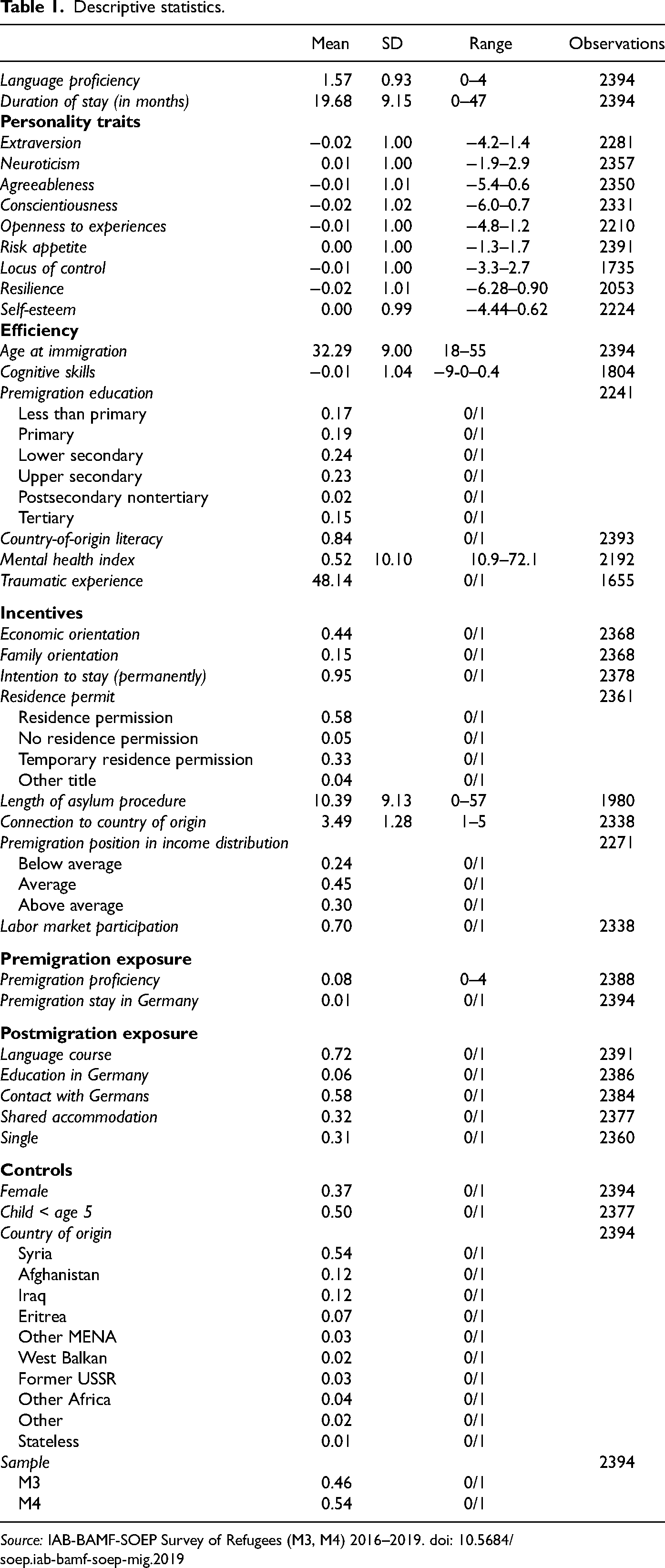
Language proficiency in German is based on a mean score comprising information on respondents’ self-rated competences in speaking, reading, and writing German. Each scale ranges from 0 (“very good”) to 4 (“not at all”). We reversed these scales before calculating the index so that greater values in a range between 0 and 4 indicate higher proficiency. The measure shows a high degree of internal consistency (Cronbach's alpha = 0.94), with individual variables loading on a single factor (eigenvalue = 2.66). Table 1 presents the distributions of dependent and further variables. Online Appendix Table B1 presents the definitions of all variables.
Descriptive statistics.
Source: IAB-BAMF-SOEP Survey of Refugees (M3, M4) 2016–2019. doi: 10.5684/soep.iab-bamf-soep-mig.2019
Personality Traits
We analyze the Big Five personality dimensions, locus of control, risk appetite, resilience, and self-esteem. The Big Five personality dimensions framework, or Five Factor Model, postulates that the individual personality can be described by five dimensions (Barrick and Mount 1991). Each dimension has an underlying cluster of characteristics (Ibid.), which sort themselves along a continuum between two poles. For example, the dimension of extraversion, with its counterpole introversion, describes individuals who are sociable, talkative, and active.
The Big Five Inventory Short relies on a seven-point Likert scale for 16 items in the survey. The scale displays internal coherence and strong indications for its validity (Dehne and Schupp 2007). Extraversion, neuroticism, agreeableness, and conscientiousness are surveyed with three items each, while openness to experiences is surveyed with four items. For ease of interpretation, we calculate a standardized index for each dimension with a mean of zero and a standard deviation of one. For the computation of the internal locus of control index, we consider two items measuring the internal locus of control and six items measuring the external locus of control, each with a seven-point Likert scale answer option. We follow Caliendo et al. (2022) and reverse the coding of the response scale for the external items so that higher values denote higher levels of disagreement. We then compute a standardized index from the eight items. Risk appetite is surveyed with one question asking respondents to rate their willingness to take risks on an eleven-point Likert scale ranging from not risk-taking at all to very risk-taking. As with the other personality traits, we standardized this question. Resilience is a standardized index based on a seven-point Likert scale for four items designed to capture how individuals cope with stress (Kocalevent et al. 2017). Self-esteem is captured using a single-item measure asking respondents whether they have a positive attitude toward themselves with a seven-point Likert scale answer option (Robins, Hendin and Trzesniewski 2001).
To measure the internal consistency of items and the amount of interrelatedness between them, we calculated Cronbach's Alpha for the Big Five personality traits, locus of control, and resilience (Online Appendix Table B2). The values are relatively low, although the size of Cronbach's Alpha is directly related to the small number of items per personality trait (Gosling, Rentfrow and Swann 2003). Moreover, the values are comparable to those found in the general population based on the SOEP data in Germany (Heineck and Anger 2010) or on other data sources (Laible and Brenzel 2021; Mueller and Plug 2006). Factor analyses show those respective items support load on the desired personality dimensions, making us confident that the personality items reflect the correct traits.
Efficiency, Exposure, Incentives, and Controls
The migration literature provides well-established indicators for the language acquisition of immigrants (Kristen, Mühlau and Schacht 2016; for an overview, see Kristen 2019) and refugees (Kosyakova, Kristen and Spörlein 2022; van Tubergen 2010), which we implement. Measures for efficiency include age at immigration, cognitive skills measured by the symbol-digit test, which is a speed-constrained measure of information-processing capacities (Lang et al. 2007), premigration education measured by the highest education level acquired in the country of origin, country-of-origin literacy, and mental health measured by a mental component summary scale (Andersen et al. 2007).
Measures for incentives include respondents’ migration motive, distinguishing between economic and family-related migration motives, 7 intention to stay in Germany, and the degree of connection to the country of origin as an indicator of individuals’ emotional attachment to their country of origin. Premigration status, which refers to respondents’ self-assessed economic position prior to migration relative to others in the country of origin, and premigration market participation likely affect incentives to invest in learning the destination-country's language because of the economic returns to proficiency. The type of residency title, which provides the legal basis for an individual's prospects for permanent residence, and the length of the asylum process are refugee-specific indicators.
We distinguish between premigration and postmigration exposure. Premigration exposure is measured by self-reported premigration language proficiency and premigration stay in Germany (i.e., refugees with repeated episodes of arrival in Germany). Postmigration exposure, capturing activities that signal exposure to the destination language after arriving in Germany, includes language course participation, education in Germany at the time of the interview, and contact with Germans. We further include the type of accommodation, which, especially in the early days after arrival, is shared accommodations with other refugees. We additionally control for respondents’ gender, whether children under the age of five lived in the household, the country of origin and the sample to which respondents belonged.
Method
To examine the role of personality traits in refugees’ destination-language acquisition, we proceed in two steps. First, we model the development of language acquisition over the duration of stay with random-effects growth curves (Hox, Moerbeek and van de Schoot 2017). Growth curve models estimate each individual's intercept and slope describing their growth trajectory based on the values of the dependent variable (i.e., language proficiency) at each time point. From these individual intercepts and slopes, average intercepts and slopes are computed, as well as individual deviations from the averages. We also model the covariance between random intercepts and random slopes, considering the relevance of the initial level of proficiency (at t0 of the panel) for the speed of language growth. A negative covariance could indicate that individuals with greater destination-language skills at t0 have less room for improvement and, therefore, experience slower progress.
Formally, we model the German language proficiency of individual i at time t (
Second, we estimate sheaf coefficients (Heise 1972), which are an example of regression models with parametrically weighted explanatory variables (Yamaguchi 2002). By allowing comparison of the relative influence of a group of variables, we can assess personality traits’ importance for the individual's learning process. Sheaf coefficients are standardized multiple-partial regression coefficients that summarize the coefficients of a set of variables when other variables are controlled for (Heise 1972). 8 Sheaf coefficients assume that a group of variables influences the dependent variable through latent variables, which, in our analyses, are personality traits, efficiency, incentives, and exposure. Because these latent variables’ coefficients are standardized to a mean of 0 and a standard deviation of 1, their comparison allows us to disentangle their relative importance for language learning.
To address item nonresponse, we apply multiple imputation using chained equations (van Buuren 2012). We estimate 25 imputed datasets with complete information. Following Rubin's (1987) approach, we combine the results of the analyses performed on each dataset. Table 1 (column 4) illustrates that missing information was present to varying degrees across measures. Replication codes are available at https://osf.io/un4pc/.
Results
Descriptive Results
Figure 1 shows the development of refugees’ German language proficiency since their arrival in Germany. For each refugee in the sample, we plotted learning trajectories for German language proficiency that reflected proficiency at arrival and in the last interview (gray lines), conducted between October 2017 and January 2020. Thus, the observed duration of stay since arrival ranged between 13 and 83 months, and individual lines can end anywhere within this range. We additionally depict the linear fit (dotted line) and the LOWESS smoother (locally weighted scatterplot smoothing, solid black line) to examine trends. LOWESS is based on linear and nonlinear least squares regression; a separate weighted regression is performed for every point in the data (Cleveland 1979).
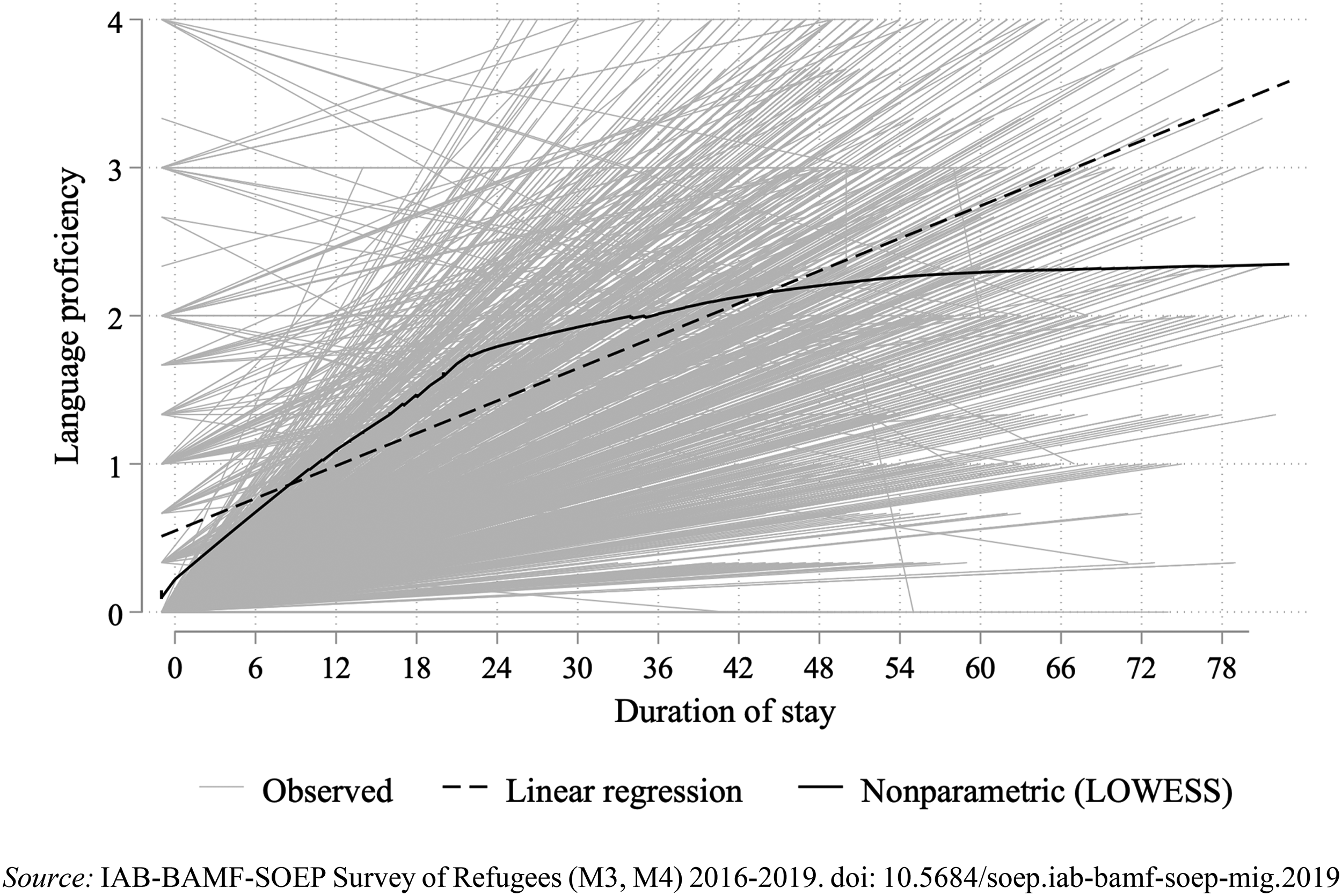
Language proficiency upon arrival and at the time of the last interview, with superimposed linear and nonparametric (LOWESS) regression lines. Source: IAB-BAMF-SOEP Survey of Refugees (M3, M4) 2016–2019. doi: 10.5684/soep.iab-bamf-soep-mig.2019.
Several findings become apparent. First, in line with prior empirical evidence for Germany (Brücker, Kosyakova and Vallizadeh 2020; Kosyakova, Kristen and Spörlein 2022), most refugees possessed, on average, little to no German language ability upon arrival in Germany. Second, most individuals developed their language proficiency considerably during their stay, which is noteworthy, considering the relatively low starting level of German language proficiency. The LOWESS smoother implies that refugees achieved a proficiency level of approximately 2.5 points during their duration of stay, corresponding to “fair” to “good” proficiency levels. Third, we observe a typical language acquisition pattern, with more rapid initial progress (reflected in a steeper learning curve), particularly in the first year after arrival, compared to refugees with previously acquired skill levels (Hartshorne, Tenenbaum and Pinker 2018).
Figure 2 describes the relationship between refugees’ language proficiency and their personality traits. To examine the overall trend, we again rely on the LOWESS (solid line) and linear (dashed line) fit. Additionally, two-sided t-tests describe the statistical correlation between refugees’ language proficiency and personality traits.
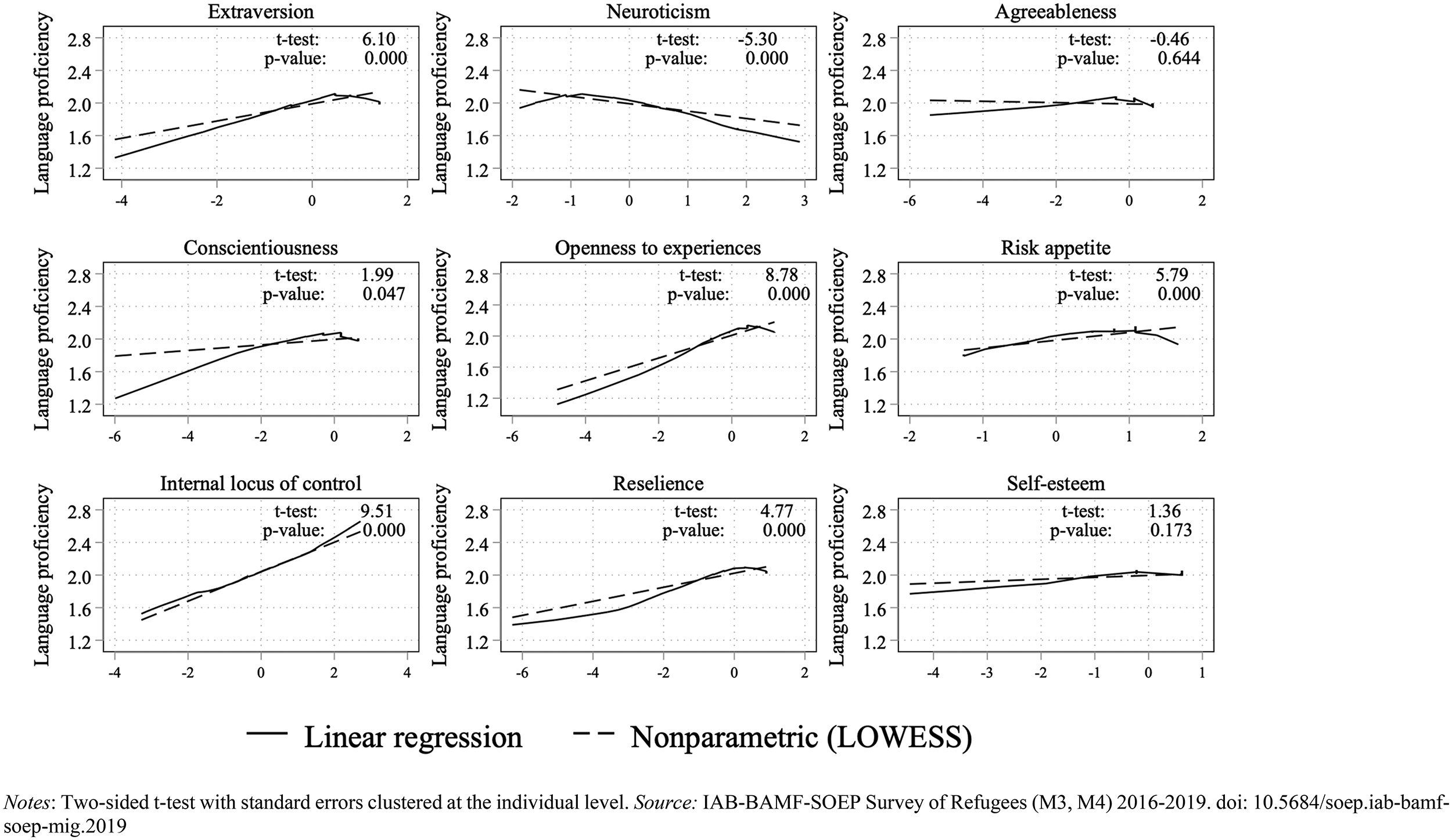
Personality traits and refugees’ language proficiency, with superimposed linear and nonparametric (LOWESS) regression lines. Notes: Two-sided t-test with standard errors clustered at the individual level. Source: IAB-BAMF-SOEP Survey of Refugees (M3, M4) 2016–2019. doi: 10.5684/soep.iab-bamf-soep-mig.2019.
Figure 2 indicates that personality traits were not equally favorable for destination-language proficiency. Extraversion, conscientiousness, openness, risk appetite, internal locus of control, and resilience positively correlated with German proficiency, while neuroticism implied a negative correlation. These results conform to the literature pointing to these traits’ importance for language acquisition among nonimmigrants (Dewaele 2013; Samimy and Tabuse 1992), human capital accumulation (Caliendo et al. 2022; Kim and Kim 2017; Laible, Anger and Baumann 2020; Lechner, Anger and Rammsted 2019), and immigrants’ economic and social prospects (Hahn et al. 2019; Obschonka, Hahn and Bajwa 2018). Agreeableness and self-esteem did not seem to relate to language proficiency.
Destination-Language Skills Growth
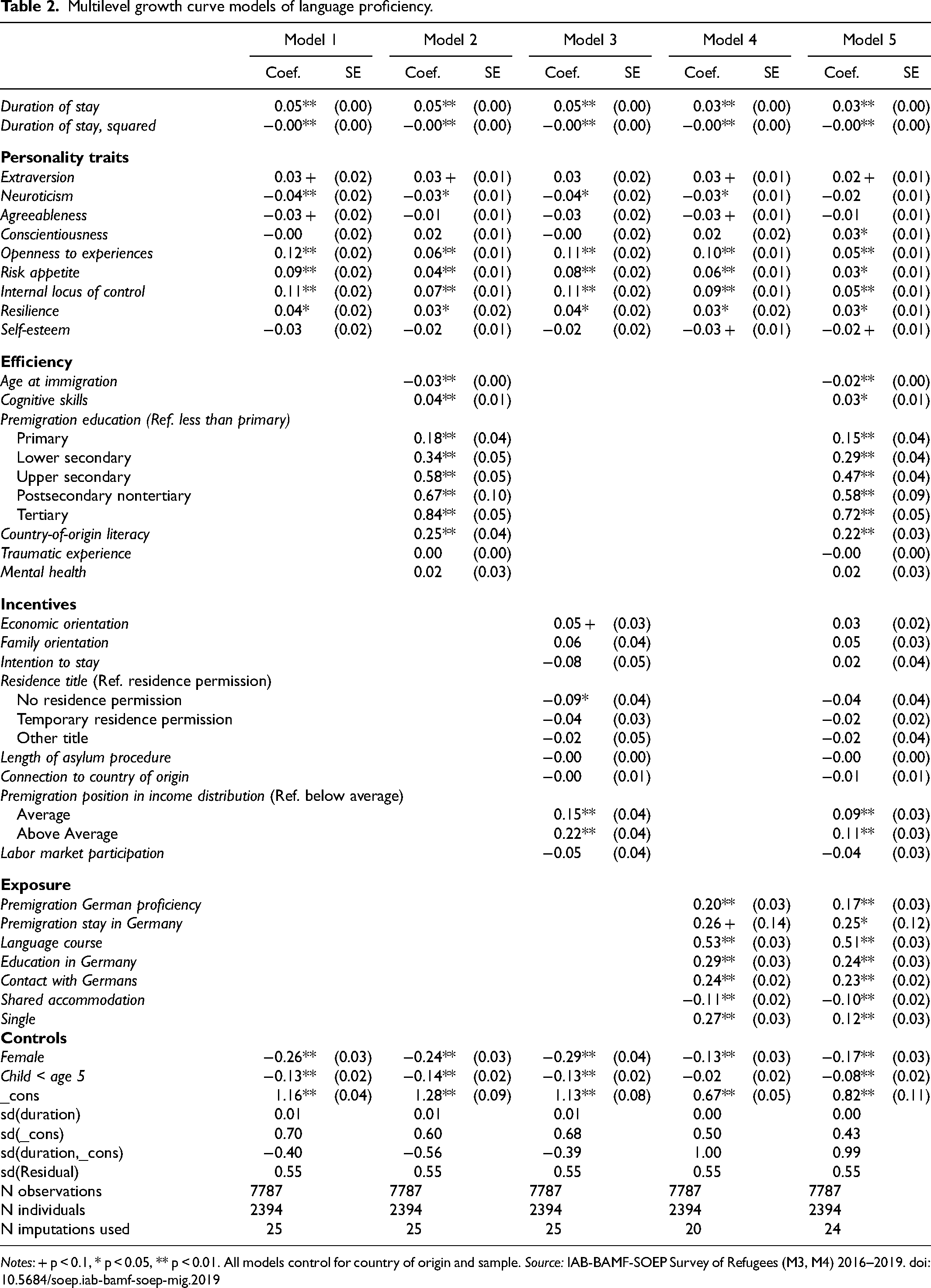
Next, we investigated how personality traits affected refugees’ development of destination-language skills when controlling for the primary theoretical constructs that affect immigrants’ language acquisition: efficiency, incentives, and exposure. Table 2 presents the results from random-effects growth curve regressions. Model 1 illustrates the baseline relationship between personality traits and language proficiency, accounting for controls. Models 2, 3, and 4 further introduce measures for efficiency, incentives, and exposure, respectively. In Model 5, we include all theoretical constructs simultaneously.
Multilevel growth curve models of language proficiency.
Notes: + p < 0.1, * p < 0.05, ** p < 0.01. All models control for country of origin and sample. Source: IAB-BAMF-SOEP Survey of Refugees (M3, M4) 2016–2019. doi: 10.5684/soep.iab-bamf-soep-mig.2019
The baseline relationship between extraversion and language proficiency was positive (Model 1), and a one standard deviation increase in extraversion was associated with a 0.03-point increase in language proficiency on a scale between 0–4. However, extraversion's effect was marginally significant; when accounting for all covariates, it slightly reduced in size (Model 5). The results further imply a negative impact of neuroticism on proficiency (Model 1), which is explained in the full model (Model 5). Neuroticism's impact seemed to be offset by exposure and efficiency. 9 Agreeableness seemed to be unfavorable for language proficiency, although the effect was only marginally significant and seemed to be explained by efficiency (Models 1–5). While conscientiousness was not significant in the baseline specification (Model 1), we detected a positive significant relationship when accounting for all model covariates (Model 5): An increase of one standard deviation in conscientiousness was associated with a 0.03-point increase in proficiency. The relationship's effect size increased when controlling for efficiency (Model 2) and exposure (Model 4). The coefficient for openness strongly predicted proficiency in the baseline model, although it reduced in size when controlling for efficiency (Model 2), suggesting that openness translated to better learning strategies in refugees’ initial human capital acquisition. The full model predicted a 0.05-point increase in proficiency with an increase of one standard deviation in openness (Model 5).
Risk appetite, internal locus of control, and resilience had a positive impact on refugees’ language proficiency: A one standard deviation increase in risk appetite and resilience were associated with 0.03-point increases in proficiency; a one standard deviation increase in internal locus of control was associated with a 0.05-point increase in proficiency (Model 5). As with the other personality traits, exposure and particularly the efficiency with which immigrants learned a new language appeared to mediate these positive relationships (Models 2–4). Self-esteem was not significant in the baseline specification (Model 1), whereas a negative marginally significant relationship arose when controlling for exposure (Model 4) and persisted in the full specification (Model 5). An increase of one standard deviation in self-esteem was associated with a 0.02-point decrease in proficiency.
We emphasize that Models 2 and 5 accounted for cognitive skills. The inclusion of cognitive skills does not detract from personality traits’ importance, indicating that we are not merely capturing omitted variable biases. This finding is remarkable, given that in the domain of organizational psychology and educational psychology, cognitive skills are one of the best (and usually the best) predictors of performance (Schmitt 2014).
Further analyses also revealed some interaction effects between personality traits and the model proxies for efficiency, incentives, and exposure (see the Online Appendix, Section C). For example, extraverted individuals experienced larger positive effects of contacts with Germans, while individuals open to experiences benefited more strongly from language courses. This moderation analysis indicates that personality traits multiplied the positive effects of exposure, efficiency, and incentives, again highlighting personality traits’ relevance in the language acquisition process.
Table 2 shows the trend in language growth with duration of stay and the variation in these trends across individuals. The baseline specification in Model 1 implies that at arrival, a one-month increase in the duration of stay increased language proficiency by 0.05 points, which translates to a one-point (1/0.05) increase in language proficiency requiring twenty months. The negative quadratic term implied that this increase lessened with duration of stay. However, the baseline association between duration of stay and language proficiency was reduced in the full model to 0.03 points, suggesting that a larger share of progress was attributed to individual covariates (Model 5).
Importance of Personality Traits for Language Components
Do personality traits equally impact different language components? Applied linguistic research implies that productive skills, such as conscientiousness and locus of control, may be more relevant for functional proficiency such as reading and writing (MacIntyre and Charos 1996). In turn, extraversion and openness, which may affect exposure and lower communication anxiety (Ibid.), are more likely related to speaking proficiency. Accordingly, Table 3 presents the results from the growth curve model for self-reported speaking, reading, and writing competency in German while controlling for the full set of covariates. With some notable differences, we observe effects similar to those reported in Table 2. Compared to the benchmark results (Model 5 in Table 2), extraversion significantly correlated with speaking skills (i.e., communication skills) (Table 3), as did conscientiousness. Likewise, neuroticism had a marginally significant impact on communication skills. Openness is mainly related to reading and writing skills (i.e., functional skills). Hence, our results imply that openness shaped the refugees’ development of learning abilities and the acquisition of pragmatic skills. Higher risk appetite and resilience favored functional language skills, whereas locus of control shaped communication skills slightly more strongly than functional skills. Self-esteem seemed to be negatively related to functional skills (marginally significant only for writing), while for communication skills, the relationship was not significant either statistically or in size.
Multilevel growth curve models of language proficiency components (speaking, reading, and writing) and interviewer assessment.
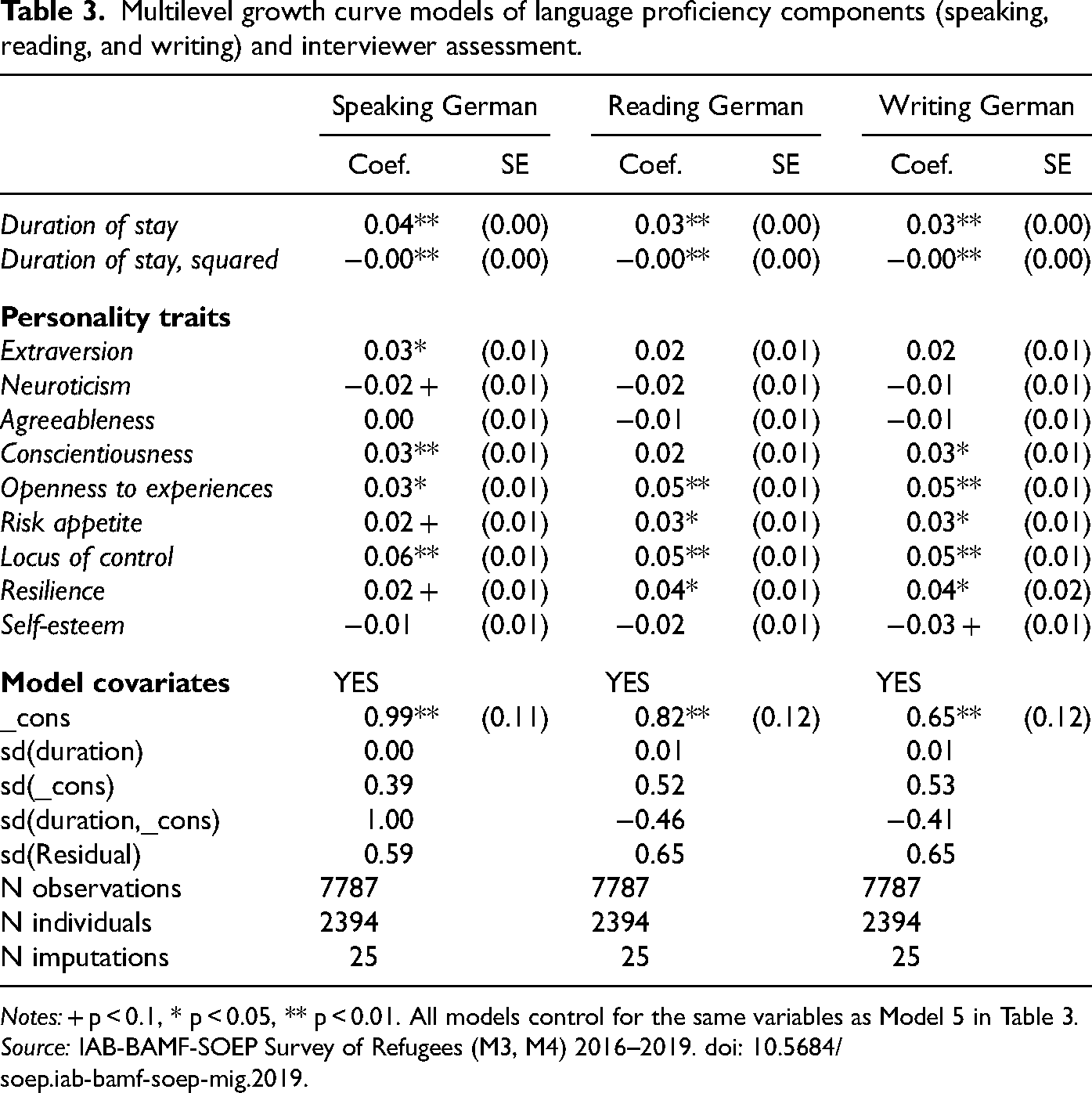
Notes: + p < 0.1, * p < 0.05, ** p < 0.01. All models control for the same variables as Model 5 in Table 3. Source: IAB-BAMF-SOEP Survey of Refugees (M3, M4) 2016–2019. doi: 10.5684/soep.iab-bamf-soep-mig.2019.
Relative Importance of Personality Traits for Language Proficiency
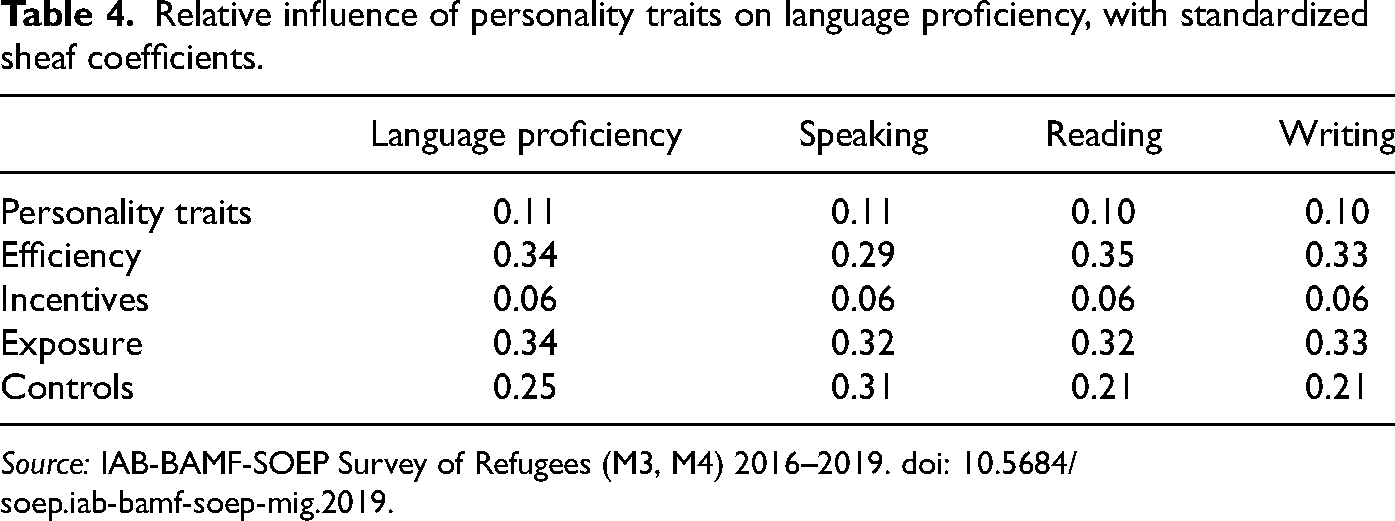
To assess personality traits’ relative importance, Table 4 presents the standardized Heise's (1972) sheaf coefficients, where one single effect size summarizes grouped variables (Buis 2009). For comparison, we illustrate the standardized sheaf coefficients for variable groups according to the theoretical constructs: efficiency, incentives, and exposure.
Relative influence of personality traits on language proficiency, with standardized sheaf coefficients.
Source: IAB-BAMF-SOEP Survey of Refugees (M3, M4) 2016–2019. doi: 10.5684/soep.iab-bamf-soep-mig.2019.
The results confirm our conclusion that personality traits are relevant in determining immigrants’ destination-country language proficiency. Specifically, Table 4 shows that personality traits were less important than efficiency and exposure but more important than incentives. Regarding the language proficiency components, personality traits appeared to be slightly more relevant for communication skills than for functional language skills. Efficiency seemed to be particularly decisive for functional language skills but much less important for communication skills.
Robustness Checks
Respondents may systematically overestimate their self-reported German language proficiency due to their personality traits. Therefore, we performed a series of robustness checks using our benchmark model (Model 5 in Table 2). The results are presented in the Online Appendix, Section D. First, we model the interviewer's assessment of the respondent's German communication proficiency (Table D1). The exact question was “How well could you conduct the interview in German?” with a five-point answer scale ranging from 1, “very well,” to 5, “very badly,” which we recoded so that higher values denoted higher proficiency. The correlation between self-reported proficiency and interviewers’ assessment amounted to 0.63 (p-value = 0.000). In most cases, we observe a similar relationship between personality traits and the interviewer's assessment as for our benchmark model. Similar to its effect on speaking skills (Table 3), extraversion significantly impacted the interviewers’ positive assessment of respondents’ proficiency. Note, however, that openness was negatively (albeit not significantly) related to interviewers’ assessments. Two possible explanations could drive this result. First, respondents who were open to new experiences may have more easily admitted to lower language proficiency while still volunteering to participate in the interview in German instead of requesting a translation. Second, open individuals are generally more talkative, regardless of language proficiency (Barrick and Mount 1991). In both cases, the interviewer had more opportunities to judge language proficiency. In contrast to our benchmark model (Model 5 in Table 2), resilience was not significantly related to interviewers’ assessments (Table D1), but the same pattern for resilience's impact on refugees’ speaking skills remains (Table 3).
Interviewers were further asked about the frequency of using written translations during the interview. Written translation for the entire questionnaire was used in 61 percent of interviews in the first wave and 47 percent in wave 4. We replicated our results excluding interviews where the entire interview was translated (Table D1). The results conform to the benchmark model, although the effects of conscientiousness and risk appetite were no longer statistically significant.
Next, as research shows that self-assessed language skills may be biased (Edele et al. 2015), we replicated our findings with a more “objective” measure of language proficiency (i.e., the respondent's highest certified language proficiency level) (Table D1). The corresponding variable varies between 0 (“no certificate/no participation”) and 6 (“C1/C2,” proficient user). The results suggest that agreeableness is negatively related to the CEFR 10 level (negative but insignificant in the benchmark model). While agreeable individuals are cooperative, success may negatively relate to extreme agreeableness due to a strong desire to please others (cf. Mueller and Plug 2006). In contrast, conscientiousness was not significantly related to language attainment level. Dewaele (2013) reported that conscientious individuals are more likely to complete a course, but conscientiousness does not affect actual learning proficiency and, therefore, may not affect the CEFR level. We also observed that resilience's impact was a positive but not statistically significant predictor of the CEFR level, which might be explained by resilience's association with learning efficiency but less with certificate attainment. Similar to the benchmark model, extraversion, openness, locus of control, and risk appetite increased the CEFR level.
Finally, the majority of recent refugees in Germany arrived from Middle Eastern countries (Brücker, Kosyakova and Vallizadeh 2020), which undermines the generalizability of our results to all refugees 11 other immigrants. We thus replicated our analyses based on highly comparable data from the IAB-SOEP Migration Sample (Brücker et al. 2014). For the sake of comparability and to capture the language-learning process in the earlier arrival periods, we restricted the original data to recent immigrants who arrived no later than six years before the first interview. The results from our replication are presented and discussed in the Online Appendix, Section E. Remarkably, the results for this set of immigrants are highly similar to those we observed for refugees in terms of both personality trait impact on language proficiency and the relative importance of personality traits, as measured by sheaf coefficients.
Discussion
This article offered a dynamic analysis of destination-language proficiency among recent refugees in Germany, with a focus on the role of personality traits in the destination-language acquisition process. Our underlying theoretical framework was based on Chiswick and Miller's (2001) well-established model of language acquisition, according to which language fluency is a function of exposure, efficiency, and incentives. We complemented this individual-centered approach with expectations rooted in the socioecological model of agency, which has recently gained attention in research on immigrant integration (Hahn et al. 2019; Ryan, Dooley and Benson 2008). Empirically, we relied on the most recent longitudinal data from the IAB-BAMF-SOEP Survey of Refugees (2016–2019) and multilevel growth curve models. By means of sheaf coefficients, we additionally tested personality traits’ relative importance for refugees’ language proficiency. We draw three conclusions from our analysis.
First, we found evidence that personality traits played an important role in refugees’ destination language skills, even when we controlled for efficiency, exposure, and incentives. In particular, we assumed that curiosity and eagerness for knowledge affect learning and observed a positive relationship between openness to experience and language skills. Organized, achievement-oriented, and hard-working individuals were expected to have a greater drive to succeed in efficient cost–benefit planning and ensuing language acquisition, which empirically translates to the positive impact of conscientiousness. The internal locus of control was expected to relate to learning capabilities and beliefs about language-acquisition returns, thereby driving learning efficiency. In confirmation, the internal locus of control's effect on language proficiency was positive. We also observed higher proficiency among risk-willing individuals, which corroborates the importance of incentives when facing uncertain human capital investments, on the one hand. On the other hand, risk appetite likely promoted destination-language proficiency via greater exposure when learners were less frightened to make mistakes or be ashamed during language use and practice. We further expected refugees who were able to cope with learning difficulties and stress to be more efficient learners, which was supported by the positive relationship between resilience and destination-language proficiency. We emphasize that our analyses account for cognitive skills, which are often regarded in the literature on cognitive ability and personality as superior predictors of performance (Schmitt 2014).
Second, we cannot empirically support some of our expectations. For instance, we expected extraverts to have greater expose to language-learning opportunities via contact with natives and other outlets. Our results revealed a positive but marginally significant extraversion's effect on refugees’ destination-language proficiency. While we expected that anxious or insecure individuals would acquire German language skills less efficiently, a negative relation between neuroticism and language acquisition was not statistically significant. In contrast to the expectation that agreeable individuals would have greater incentives to invest in the destination-language to adapt to the new social environment, we did not find any significant relationship between agreeableness and destination-language proficiency. While greater self-esteem was expected to contribute to language acquisition via greater learning effort aimed at succeeding (efficiency) and maintaining their self-esteem (incentives), our findings revealed a negative association (marginally significant) between self-esteem and destination-language proficiency. In their review study on self-esteem's effect on individual attainment, Baumeister et al. (2003) similarly find no evidence for self-esteem having a strong effect on subsequent academic achievement. Some findings even suggested a weak negative effect because of diminished performance as a result of soaring or artificially boosted self-esteem. Note that extraversion was marginally significant but additionally offset by efficiency and exposure. For all measures of personality traits, we observed mediating effects of efficiency or exposure; thus, it seems that both the efficiency of learning and exposure to learning opportunities represent possible channels through which personality traits affect refugees’ destination-language proficiency.
Third, using sheaf coefficients, we compared personality traits’ relative importance to the well-established mechanisms of efficiency, exposure, and incentives. Although exposure and efficiency were the main predictors of language proficiency, personality traits had a discernable influence, particularly when compared to incentives. This finding is remarkable, given that the migration literature emphasizes the role of (economic) incentives as a major driver of migration decisions (e.g., Chiswick 1999) and integration processes (e.g., Cortes 2004), including destination-language learning (Chiswick and Miller 2001; Esser 2006).
Nevertheless, five caveats remain. First, our focus was on the dynamics of refugees’ language proficiency in Germany. Nevertheless, we regard Germany to be of general interest for understanding the drivers of refugees’ acquisition of the destination language in developed countries because it has played a predominant role as a receiving country for asylum migration in Europe, not only historically but also in the recent European refugee immigration surge (Brücker, Kosyakova and Vallizadeh 2020). Second, personality trait measurement faces two potential restrictions. On the one hand, personality traits are measured with short scales, but at the same time, these well-established measures have been implemented in the SOEP for years (Richter et al. 2017) and can be considered reliable and valid (Rammstedt and John 2007). On the other hand, personality traits may be ethnocentric, and the measures might not work due to culture-specific answer behaviors. However, cross-country research on personality traits has successfully implemented the same scales across cultures and concluded that they are universally valid (Hofstede and McCrae 2004; Rolland 2002). Third, we leave it to future research to assess how the relationship between refugees’ culture interacts with the destination-country's culture and how an interaction of culturally shaped personality traits might affect language learning. Fourth, since the refugee influx studied here was dominated by Middle Eastern countries, we must use caution in interpreting our findings as generalizable for all refugees or for other immigrants (such as economic or family immigrants). We deem this to be only a minor limitation since our robustness analyses on the immigrant population in Germany revealed remarkably similar results as those we observed for refugees. Fifth, despite evidence for the validity of self-reported language proficiency through various robustness checks, it is important to recognize that the widely used self-reported measure in survey research should be replaced with independent tests for language proficiency (see Edele et al. 2015) in future research to validate the relationships identified by our study.
The findings presented here lend themselves to policy implications. The psychological literature on trait stability suggests that personality traits are relatively stable and, therefore, do not offer much potential for long-lasting changes beneficial to language attainment (Roberts and DelVecchio 2000). However, the way in which language is taught can be altered to fit specific personality traits, thereby contributing to language attainment. Thus, to increase language proficiency among refugees and immigrants, language courses and interventions could be tailored such that the teaching mode best matches personality traits (see Dewaele 2013). For instance, to appeal to the curiosity and imagination of learners open to experiences, instructors could design course assignments and testing methods linking learning content to current events and provide sequential assignments for conscientious learners (Komarraju et al. 2011). For learners driven by an external locus of control, instructors could emphasize an achievement orientation with a points system, while risk-willing individuals’ motivation is best addressed by encouraging students to use new languages (Cervantes 2014). Given the positive impact of resilience on destination-language proficiency, instructors could help individual learners develop and strengthen resilience by emphasizing that obstacles are a part of the learning process and that mistakes are important for progress (Bittmann 2021). The analyses of the three components of language proficiency—speaking, reading, and writing—showed that certain traits are better suited for the acquisition of specific language components, for example, extraversion and speaking proficiency. Therefore, extraverts’ language learning is best achieved by mimicking daily conversations or storytelling, whereas introverts would strongly benefit from individual tasks and activities (Hsain and Suliman 2015). 12
In sum, this article contributes to our understanding of immigrants’ destination-language acquisition by providing the first results on personality traits’ importance for refugees’ language attainment processes based on large-scale representative survey data. While prior research has shown that personality traits affect educational and labor market outcomes (Borghans et al. 2008; Heckman and Kautz 2012), this article goes a step further and combines the migration literature with the psychological literature to illuminate personality traits’ effects in a migration context. As clearly shown, personality traits should not be neglected in future research on immigrants’ destination-language acquisition. Therefore, this article deepens the understanding of the integration process of which language acquisition is a major component. Overall, our results reveal that personality traits are largely an overlooked but important mechanism in immigrants’ destination-language acquisition, particularly considering the relative importance of these traits compared to the relative importance of incentives. Personality traits thus shape refugees’ language acquisition and thereby contribute to their successful integration into a destination country. We conclude that combining insights from sociology and personality psychology in the study of immigrants’ integration process is a fruitful avenue for research.
Supplemental Material
sj-docx-1-mrx-10.1177_01979183221132538 - Supplemental material for Importance of Personality Traits for Destination-Language Acquisition: Evidence for Refugees in Germany
Supplemental material, sj-docx-1-mrx-10.1177_01979183221132538 for Importance of Personality Traits for Destination-Language Acquisition: Evidence for Refugees in Germany by Yuliya Kosyakova and Marie-Christine Laible in International Migration Review
Footnotes
Acknowledgements
We would like to thank Silke Anger and Franziska Schreyer for providing helpful advice on the earlier versions of this paper; Hanna Brenzel for engaging in insightful discussions at various stages of the research process; and all those who commented on the earlier presentations of this work at the following events: the LERN 2021 conference (March 2021), the IAB-ECSR interdisciplinary conference (May 2021), the MaD Colloquium at the WZB Berlin Social Science Center (June 2021), the 18th IMISCOE Annual Conference (July 2021), the virtual 2021 ASA Annual Meeting (August 2021), the ECSR Annual Conference (October 2021), and the FG-Wednesday at the German Center for Integration and Migration Research, DeZIM (October 2021). The views expressed in this article are exclusively those of the authors.
Declaration of Conflicting Interests
The author(s) declared no potential conflicts of interest with respect to the research, authorship, and/or publication of this article.
Funding
The author(s) received no financial support for the research, authorship, and/or publication of this article.

Supplemental Material
Supplemental material for this article is available online.
Notes
References
Supplementary Material
Please find the following supplemental material available below.
For Open Access articles published under a Creative Commons License, all supplemental material carries the same license as the article it is associated with.
For non-Open Access articles published, all supplemental material carries a non-exclusive license, and permission requests for re-use of supplemental material or any part of supplemental material shall be sent directly to the copyright owner as specified in the copyright notice associated with the article.
