




Abstract
This article explores religious adaptation among immigrant-origin youth in Norway, using the first wave of the Children of Immigrants Longitudinal Study in Norway (CILS-NOR). To capture different dimensions of religious change, we distinguish between 1) level of religiosity, measured by religious salience and religious practices, and 2) social forms of religious belief, measured as the level of rule orientation and theological exclusivism. We compare immigrant-origin youth in Norway with young people in their parents’ origin countries, using the World Value Survey. We then compare immigrant-origin youth who were born in Norway to those who were born abroad and according to their parents’ length of residence in Norway. As expected, immigrant-origin youth from outside Western Europe—and those originating in Muslim countries in particular—were more religious than native and western-origin youth and more rule oriented and exclusivist in their religious beliefs. However, our results suggest that a process of both religious decline and religious individualization is underway among immigrant origin youth in Norway, although this process appears to unfold slower for Muslims than for non-Muslims. The level and social forms of religiosity among immigrant-origin youth are partially linked to their integration in other fields, particularly inter-ethnic friendships. We argue that comparative studies on how national contexts of reception shape religious adaptations, as well as studies aiming to disentangle the complex relationship between religious adaptation and integration in other fields, are needed.
Introduction
Over the last century, Western European populations, which have traditionally been mostly Christian, have undergone a process of secularization (Bruce 2011). Nowhere has this process of secularization been more pronounced than in Scandinavia, where religion has largely retreated into the private sphere and now plays only a minor role in the lives of a majority of the population (Norris and Inglehart 2004). Over the last few decades, however, these same countries have received large numbers of immigrants who differ not only in terms of religious affiliation but also in their level and form of religiosity (Voas and Fleischmann 2012). In contrast to the United States, where religious backgrounds and levels of religiosity are more similar between natives and immigrants (Simsek et al. 2018), in Europe, this difference between native secularity and the much stronger religiosity of Muslim immigrants in particular has come into focus as a “bright boundary maker” and a major barrier for immigrant integration and acceptance (Alba 2005; Alba and Foner 2015). The question of how immigrants’ religious beliefs and practices are changing as they adapt to a new setting has, thus, become increasingly salient.
Classical theories of immigrant secularization and assimilation lead us to expect a post-migratory decline in religiosity, as immigrants and their children acculturate to more secular host societies (Berger [1969] 2011; Gordon 1964). Scholarship on the sociology of religion also suggests that religion may change not just in salience, but also in social form (Davie 1994; Fuller 2001). The religious individualization thesis suggests that traditional and institutionalized forms of religiosity—where religion provides authoritative rules governing social life—may be replaced by more subjective and individually oriented forms (Casanova 1994; Heelas et al. 2005). While religious individualization is often seen as an alternative to secularization (e.g., Davie 1994), other scholars regard it as a sub-component of the secularization process (Pollack and Pickel 2007).
Empirical studies of religious adaptation among children of immigrants have not provided a conclusive picture of overall trends. Some studies from across Europe have found indications of religious decline among immigrants and their children (Bisin et al. 2008; Maliepaard, Lubbers, and Gijsberts 2010; Güveli and Platt 2011). Other studies, however, suggest that Muslim immigrant populations, unlike immigrants belonging to other religions, retain high levels of religiosity over time and across generations (Voas and Fleischmann 2012; Simsek et al. 2018). Ethnographic studies on identities and practices among Muslim immigrant-origin youth describe a process of religious individualization (Peter 2006a, 2006b; El-Bachouti 2017). However, the extent to which such adaptations represent an overall trend remains uncertain. Moreover, the expected link between religiosity and other integration outcomes, such as in the education system or the labor market, appears to be weak or uncertain (Jacob and Kalter 2013). In other words, despite a wealth of research suggesting that long-term religious adaptation within immigrant populations is crucial for the broader integration and social cohesion of an increasingly diverse Europe, empirical studies have not provided a clear-cut answer to how these adaptations are actually playing out.
In this article, we use survey data on native and immigrant-origin youth in Norway, linked with register data and in combination with data from the World Value Survey collected in major immigrant-sending countries, to answer the following questions: Do children of immigrants become more or less religious—in terms of how important religion is in their lives and how actively they practice their faith—as they acculturate to Norwegian society? Do religious beliefs among children of immigrants change in their social forms by becoming less rule orientated and theologically exclusivist?
We contribute to the literature on religious adaptation among immigrants and their children in three ways. First, we investigate the process of immigrant secularization and religious change along different interrelated dimensions. We study the level of religiosity by looking at religious salience (how important religion is in one’s life) and religious practices (such as attending services and praying). We also study the social forms of religious beliefs in terms of rule orientation (is religion interpreted as a set of external rules governing social life or as a guideline for internal personal morals?) and theological exclusivism (to what extent does one see one’s own faith as the only acceptable one?). This distinction is highly relevant for understanding the extent to which religion will continue to be a barrier for integration among the children of immigrants in today’s secular Europe.
Second, we use different methodological techniques to measure change. We compare children of immigrants in Norway, using the Children of Immigrants Longitudinal Study in Norway (CILS-NOR), with youth samples drawn from their parents’ birth countries, using the World Value Survey. We then compare immigrant-origin youth according to their families’ length of residence and perform multivariate analyses looking specifically at the importance of immigrant generation (whether the respondent was born in Norway or born abroad), along with indicators of structural and social integration in terms of parental education, students’ own grade averages, participation in non-religious organizations and sports clubs, and interethnic friendships. Because there are substantial methodological difficulties involved with trying to measure long-term social change, we argue that using several different techniques adds to the robustness of the analyses.
Third, we test the immigrant secularization and individualization theses in Norway, which is a well suited, but understudied, case. Norway is not just one of the most secular and least religious countries in the world (Norris and Inglehart 2004) but also a country where the economic and social conditions for the long-term socio-economic integration of children of immigrants are relatively favorable (Hermansen 2016). To the extent that immigrants and their children adapt to the host society’s cultural patterns and that such adaptations are linked to socio-economic integration, as predicted by assimilation theory, we should expect that secularization processes have more scope to play out in Norway compared to many other contexts.
To develop these ideas, this article is structured as follows. After this brief introduction, we lay out different theoretical perspectives on the immigration and secularization nexus, before reviewing some of the existing empirical literature. We then provide contextual information about Norway, especially the role of religion in society and its recent immigration history, before providing detailed information about the data, measures, and methods used in the analysis. From there, we describe the different dimensions of religiosity among various native and immigrant-origin groups, before indicating changes in religious beliefs within the immigrant population, first, by comparing the children of immigrants in Norway with young people in their parents’ origin countries and, second, by comparing immigrant-origin youth in Norway by their families’ length of residence in the country, and finally, by conducting separate multivariate analysis of Muslim and non-Muslim immigrant-origin youth regarding five measures of religiosity and their associations with various measures of exposure and integration. We conclude by discussing the broader implications of our findings for the literature on immigrants and religiosity in a comparative perspective.
Theoretical Perspectives on Immigration and Secularization
According to the classical secularization thesis dating back to the works of Max Weber and Emile Durkheim, religion has diminished in its importance throughout the industrialized world as a result of a general process of modernization that has increased rationalization, functional differentiation, and economic growth (Berger [1969] 2011; Bruce 2011). In their updated version of the secularization thesis, Norris and Inglehart (2004, 2015) argue that the demand for religion is linked to people’s sense of existential security. People in poor countries, they suggest, have limited access to basic survival conditions, a social safety net, effective public services, or defense against violence and oppression. For people who are vulnerable to physical, societal, and personal risks, religion provides reassurance and meaning. As social and economic development reduces people’s exposure to risks, however, it also reduces demand for religion. Using data from the World Value Survey, Norris and Inglehart show that people in virtually all advanced industrial societies have become far less religious over the past fifty years (Norris and Inglehart 2004). While secularization theory has been contested (Stark and Finke 2000; Gorski and Altınordu 2008), religious decline as an empirical trend has been firmly established throughout the Western world (Burkimsher 2014).
However, religious beliefs may change not just in salience but also in their social forms (Pollack and Olson 2008). The religious individualization thesis maintains that traditional and institutionalized forms of religiosity have increasingly been replaced by more subjective and individually oriented forms (Luckmann 1963). With increasing functional differentiation and the emancipation of secular spheres, religion, it is argued, has retreated to the private realm and changed from a broad external set of rules governing social life into a more private set of moral principles and guidelines for those who believe (Hart 1987; Casanova 1994). While individualization is sometimes proposed as an alternative to the secularization thesis, where the level of religiosity remains but is channeled into more individualist social forms (Luckmann 1963; Davie 1994), other scholars argue that individualization is only one sub-component of the overall secularization process (Pollack and Pickel 2007).
What happens, however, when immigrants move from developing countries where religion plays a major role in people’s lives to secular industrialized ones where religion is less salient and mostly relegated to the private sphere? Classic assimilation theory posits that over time, immigrants will become more similar to their host societies’ majority population as they gradually integrate into the different arenas of social life (Gordon 1964; Park 1964). More recent versions of assimilation theory stress how this process is accompanied by the “remaking” of identities among the majority population as well, as elements from the minority population are incorporated into the mainstream (Alba and Nee 2009). Such changes are not necessarily a result of intentional adaptation but may happen as an unintended by-product of structural assimilation, for example, through exposure in the educational system (Alba and Nee 2009).
Based on secularization, individualization, and assimilation theory, we can, thus, expect to observe three distinct patterns of religious adaptation: 1) The secularization thesis leads us to expect a general decline in religious salience and practices from the population in the origin country to immigrants in the host country, as well as over time and across generations within the immigrant population. 2) The individualization thesis leads us to expect a similar change in religious beliefs in the direction of less rule-oriented and absolutist forms into more individual and private ones. Depending on the version of individualization theory, this process of individualization may happen instead of or in addition to religious decline. 3) Finally, assimilation theory—which states that immigrants and their children become more similar to the majority as they integrate into various institutional domains of the host society—leads us to expect a negative correlation between measures of integration in the (secular) host society and measures of immigrant religiosity.
Other theoretical frameworks offer alternative scenarios regarding immigrants’ religious adaptations. The religious vitality hypothesis emphasizes the continuity of minority religiosity through socialization within families and co-ethnic communities (Simsek et al. 2018). Religion’s importance may be related to the experience of migration itself, which is marked by uncertainty and alienation, and, thus, reinforce the immigrant’s psychological need for religious consolation (Smith 1978; Chafetz and Ebaugh 2000). Becoming part of an immigrant community may also increase religious involvement for newcomers because religious organizations often play a vital role in facilitating immigrant settlement (Voas and Fleischmann 2012). Increasing religious diversity also means increasing competition over people’s “hearts and minds” from various religious groups, intensifying religious life among immigrants (Stark and Finke 2000).
Segmented assimilation offers an alternative to the canonical view of assimilation, relevant for religious adaptation (e.g., Portes and Zhou 1993; Portes and Rumbaut 2001; Portes, Fernandez-Kelly, and Haller 2005). On the one hand, it suggests that not all immigrant groups succeed in their attempts to integrate and that people who feel rejected by the majority may be drawn toward strong religious identities in their quest for belonging. Some scholars have suggested that Muslim immigrants in Europe may develop a form of reactive religiosity as a response to discrimination and prejudice, further hampering their integration (Voas and Fleischmann 2012; Diehl, Koening, and Muhlau 2013). So-called selective acculturation, on the other hand, which involves holding onto a firm ethnic and/or religious identity, may, according to segmented assimilation theory, help immigrant-origin youths avoid alienation and steer clear of risky temptations and missteps on their path to integration (Portes and Rumbaut 2001; Portes and Fernández-Kelly 2008; Portes and Rivas 2011; Friberg 2019). Thus, we should expect neither a universal trend toward secularization nor a simple correlation between religiosity and structural integration.
Others, in turn, have argued that the secularization thesis draws too heavily on the experience of Christianity in Western Europe and its colonial offshoots and that characteristics of Islamic theology make Muslims more “immune” to secularization (Hamid 2016). Finally, a number of ethnographic studies have described how young Muslims try to construct a “pure” or “cultureless” Islamic identity that is separate from their parents’ traditional ethnic identities (Vertovec and Rogers 1998; Ebaugh, Helen, and Chafetz 2000; Haddad 2002; Lori 2005). Chen and Jeung (2012), for example, argue that religion may come to replace ethnicity as the most important identity marker for today’s second-generation Muslim immigrants in Europe, thus complicating traditional narratives of secularization. Based on these alternative theories, we should expect religious beliefs among immigrants and their children to remain vital and measures of religiosity to not necessarily correlate with measures of integration in other domains. Alternatively, we may expect a divergent pattern, with religious decline among non-Muslim immigrants and in particular among their children and revival among Muslim immigrants and in particular among their children. In the next section, we provide a brief overview of the existing empirical literature on religious adaptation among immigrants and their children.
Previous Research on Immigration and Secularization
Research on immigrants and their children in Europe has failed to produce strong and conclusive evidence to support the classical secularization and assimilation thesis. There is, for example, ample evidence of a strong persistent religious culture, particularly among immigrant-origin Muslims, despite normative pressure toward secularism in a European context (Drouhot and Nee 2019). However, existing studies do not provide an entirely coherent picture regarding long-term trends. Bisin et al. (2008) find some evidence of religious decline in the UK, although Muslims there are more religious and adapt at a slower pace than non-Muslims. Maliepaard et al. (2010) find that second-generation Dutch Turks and Moroccans report weaker ethnic and religious identities and engage less in religious practices than the first generation. Güveli and Platt (2011) find some religious decline among Muslims in the Netherlands but less so among British Muslims. Simsek et al. (2018) find that Muslim youth in the UK, Netherlands, and Germany, but not Sweden, are somewhat less religious than their parents, but at the same time they find that the second generation among Muslims is slightly more religious than those who have immigrated themselves. Fleischmann and Phalet (2012) find some support for the secularization hypothesis among the Turkish second generation in Berlin but continued religious vitality among the Turkish second generation in Amsterdam, Brussels, and Stockholm. Maliepaard and Lubbers (2013) find continuously high religious involvement, particularly within Turkish-Dutch and to a lesser extent Moroccan-Dutch communities. Jacob and Kalter (2013) find a pattern of stability or even increase in religiosity within Muslim immigrant families in the UK, Netherlands, Germany, and Sweden, in contrast to Christian immigrants whose religiosity declines over generations. There are also a number of qualitative studies which identify the individualization of religious beliefs as a major development within Europe’s Muslim communities (Peter 2006b; El-Bachouti 2017), but to our knowledge no quantitative studies measure the individualization of religious beliefs among immigrants.
Empirical studies have also been unable to establish a clear-cut relationship between religiosity and structural integration in other domains. van Tubergen (2007) finds that social participation and integration have the predicted negative effect on religiosity among immigrant-origin youth in the Netherlands, while Güveli and Platt (2011) find some correlation between integration in terms of educational attainment and language fluency and religious attachment among Muslims in the Netherlands and the UK. Fleischmann and Phalet (2012) find a negative correlation between religiosity and structural integration in Berlin, but not in Amsterdam, Brussels, or Stockholm. Jacob and Kalter (2013), on the other hand, find that secularization is only weakly related to assimilation in other domains of life among immigrant-origin youths in the UK, Netherlands, Germany, and Sweden. Beek and Fleischmann (2019) find that religious identification and practices are related to some measures of integration, but not others, and that the association to some extent changes across generations.
As this review shows, the empirical evidence for the secularization and assimilation hypothesis is at best weak and conflicting, suggesting that immigrant secularization unfolds much more slowly for Muslim immigrants than for other religious groups, if at all. Moreover, there is very little knowledge about how processes or secularization and religious individualization among immigrants plays out in a highly secular welfare state like Norway. Therefore, we now turn to the Norwegian context that is the focus of our analysis.
The Norwegian Context
Although Norway’s recent immigration history is similar to that of other Western European countries (Brochmann and Kjeldstadli 2008), it stands out for its low level of religiosity in the general population (Norris and Inglehart 2004) and its relatively favorable socio-economic context of reception, especially for the children of immigrants, who can benefit from Norway’s open comprehensive educational system and generous social support (Hermansen 2016). According to the assimilation thesis, both factors should be important for religious adaptation, making Norway an interesting case for studying the immigration-secularization nexus.
Norway’s diverse immigrant population has been shaped by successive waves of immigration through different channels: labor migrants from Pakistan, Morocco, India, and Turkey from the late 1960s until the “immigration stop” in 1975; successive groups of refugees from Vietnam, Chile, Iran, Sri Lanka, Iraq, Somalia, Bosnia, Kosovo, Ethiopia, Syria, and Eritrea from the late 1970s and onward; immigrants from the Nordic countries (through the open Nordic labor market since 1954) and Western Europe (as part of the open EU/EEA area from 1994); large-scale labor migration from new European Union (EU) members like Poland, Lithuania, and Romania following the eastward EU enlargements in 2004 and 2007; and family reunification and transnational family formation following every immigration wave (Brochmann and Kjeldstadli 2008). In 2020, 18.2 percent of Norway’s population was either immigrants (14.7 percent) or native-born children of immigrants (3.5 percent), according to Statistics Norway. However, immigrants and their descendants comprise a much larger proportion among the younger generations and in major urban areas. 1
Immigrants coming to Norway, many from highly religious countries in Africa and Asia, face one of the least religious populations in the world (Norris and Inglehart 2004). Traditionally Lutheran, Norway has until recently maintained a nominal state church, which for most practical purposes was dismantled through a series of legal amendments in 2012 and 2017 (Furseth 2017). The Church of Norway still has a relatively high membership rate, and religious communities, both new and old, receive generous financial support from the state (ibid.). However, religious belief is in sharp decline, and non-believers now outnumber believers. 2 The World Value Survey places Norway and its Scandinavian neighbors firmly among the least religious countries in the world (Norris and Inglehart 2004).
With a “social democratic” welfare regime, Norway offers a generous social safety net, free access to education, and a redistributive system of social benefits (Esping-Andersen 1990). Along with its neighbors, it is among the most equal societies in the world, with high rates of intergenerational socioeconomic mobility (Corak 2013). Research on children of immigrants suggests that institutional features of Norwegian society—including a generous universal welfare state, low levels of socio-economic inequality, and a publicly funded comprehensive and open education system—may be particularly conducive for upward mobility among the second generation (Hermansen 2016, 2017). This combination of low native religiosity and a favorable socio-economic context of reception should lead us to expect that the forces of secularization, as predicted by the classic secularization and assimilation theses, have a relatively wide scope to play out.
Data, Measures and Methods
Data
The first wave of the Children of Immigrants Longitudinal Study in Norway (CILS-NOR) was conducted in 2016, targeting students who were enrolled in their first year of secondary school and mostly sixteen to seventeen years of age. Since secondary education is a universal right in Norway and 97 percent of sixteen year olds enroll for the first year (Friberg 2019), this sample frame is a good approximation for the full age cohort. The study targeted students in Oslo and Akershus counties, plus selected schools in the nearby city of Drammen. Respondents could fill out an extensive questionnaire during school hours, and students who were not present received the questionnaire via the school email system. In total, 7,627 students completed the questionnaire. Among them, 2,901 had at least one immigrant parent. The response rate was 48 percent of the full school cohort, but the majority of non-response was at the school level. Some caution is, thus, necessary when drawing conclusions. The survey data were linked with administrative register data through personal identification numbers obtained from school authorities. Linking survey data with register data provided reliable information on demographic, parental, and economic background variables from public registers.
Measures
Dependent variables
We measure the level of religiosity, using one indicator of religious salience and two indicators of religious practice: Religious salience is measured by asking how important religion was in respondents’ lives, with answers from “not at all important,” through “somewhat important” and “fairly important” to “very important.” Religious practice is measured by asking first how often respondents visited a place of worship (we report on the share who said “every week” or more) and second, how often they prayed (we report on those who said “every day”).
Changes in the social form of religion are indicated, using two measures. Rule orientation, defined as the extent to which religion was interpreted as an external set of rules governing social life or as an internal moral compass for the individual, is measured by asking whether respondents thought that the most important meaning of religion was “to follow religious norms and ceremonies” or “to do good to other people.” Theological exclusivism, which is associated with a lack of tolerance toward other beliefs, is measured by reporting on the share of respondents who either fully or partially agreed with the statement: “The only acceptable religion is my religion.” All dependent variables were based on questions also used in the World Value Survey, allowing us to compare results from the CILS-NOR study with youth samples drawn from the parental origin countries. For information on the World Value Survey, we refer to the WVS Database. 3
Independent variables
Respondents with at least one immigrant parent were classified as having an immigrant origin. Note that this category included both Norwegian-born children of immigrant parents and adolescents who themselves had immigrated to Norway as children or adolescents. Different classifications were used to indicate origin country/region, based on information about respondents’ and their parents’ birth country drawn from the Norwegian population register. We make several distinctions in order to separate those with a European background from those with a non-European background, to separate between different origin countries, and to distinguish between respondents with a Muslim versus those with a non-Muslim background. In Tables 1 and 2, we distinguish between, on the one hand, those with an immigrant background from Europe, North America, and Australia and, on the other, those with an immigrant background from Africa, Asia, and Latin America. In Table 3, we distinguish between the thirteen largest single origin countries so that the results can be compared to the World Value Survey. In Table 4, we distinguish between those originating in majority-Muslim countries in the greater Middle East and North Africa (MENA) region (the largest groups are Pakistan, Somalia, Iraq, Afghanistan, Turkey, Iran, and Morocco) and those originating in non-Muslim majority countries in Asia and Africa (the largest groups are Sri Lanka, Vietnam, Philippines, India, Thailand, Eritrea, Ethiopia, Ghana, and China). In Table 5, which presents data for respondents originating in Muslim-majority countries only, we distinguish between Bosnia/Kosovo, Pakistan, Somalia, and Arabic-speaking and non-Arabic-speaking countries in the greater MENA region. In Table 6, where data for respondents with an immigrant origin from non-Muslim-majority countries are presented, we distinguish between respondents originating in other Nordic countries, other western European countries, Eastern Europe (excluding Bosnia/Kosovo), Latin America, Sub-Sahara Africa (excluding Somalia), South Asia (excluding Pakistan), and East and Southeast Asia.
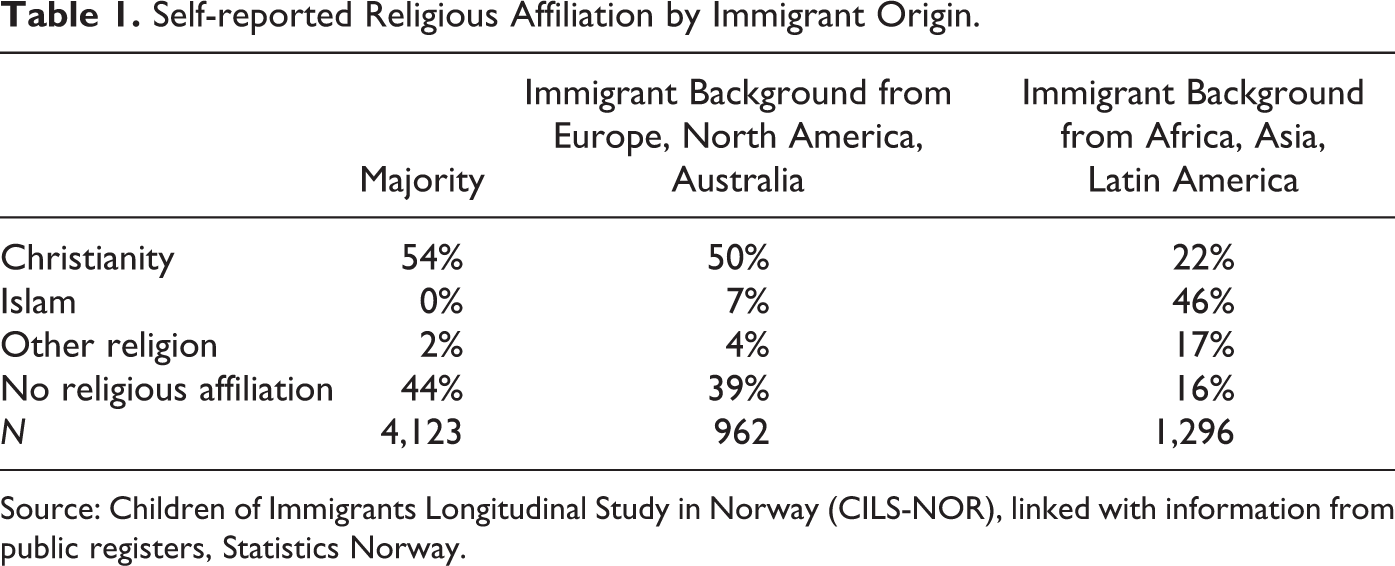
Self-reported Religious Affiliation by Immigrant Origin.
Source: Children of Immigrants Longitudinal Study in Norway (CILS-NOR), linked with information from public registers, Statistics Norway.
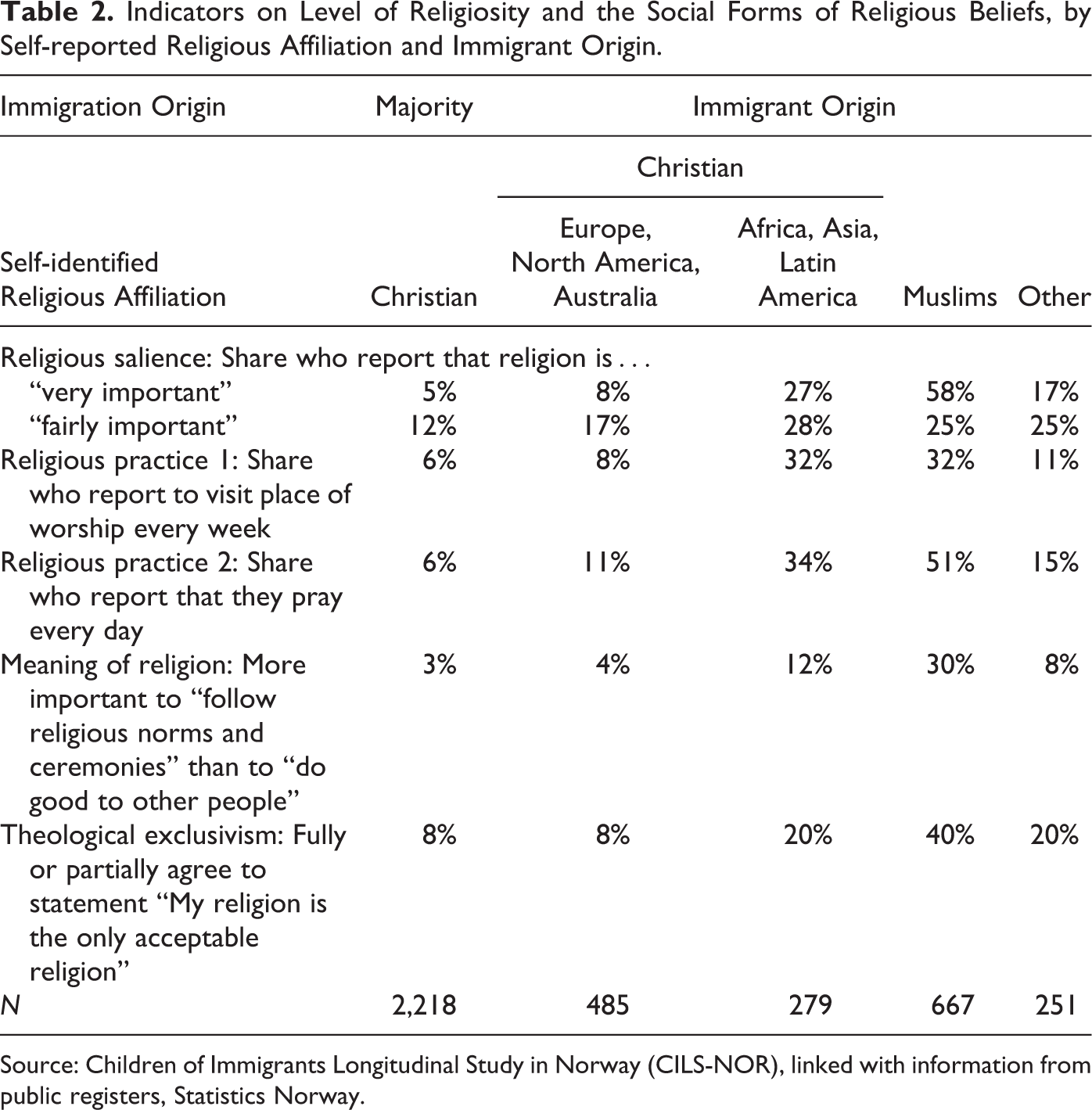
Indicators on Level of Religiosity and the Social Forms of Religious Beliefs, by Self-reported Religious Affiliation and Immigrant Origin.
Source: Children of Immigrants Longitudinal Study in Norway (CILS-NOR), linked with information from public registers, Statistics Norway.
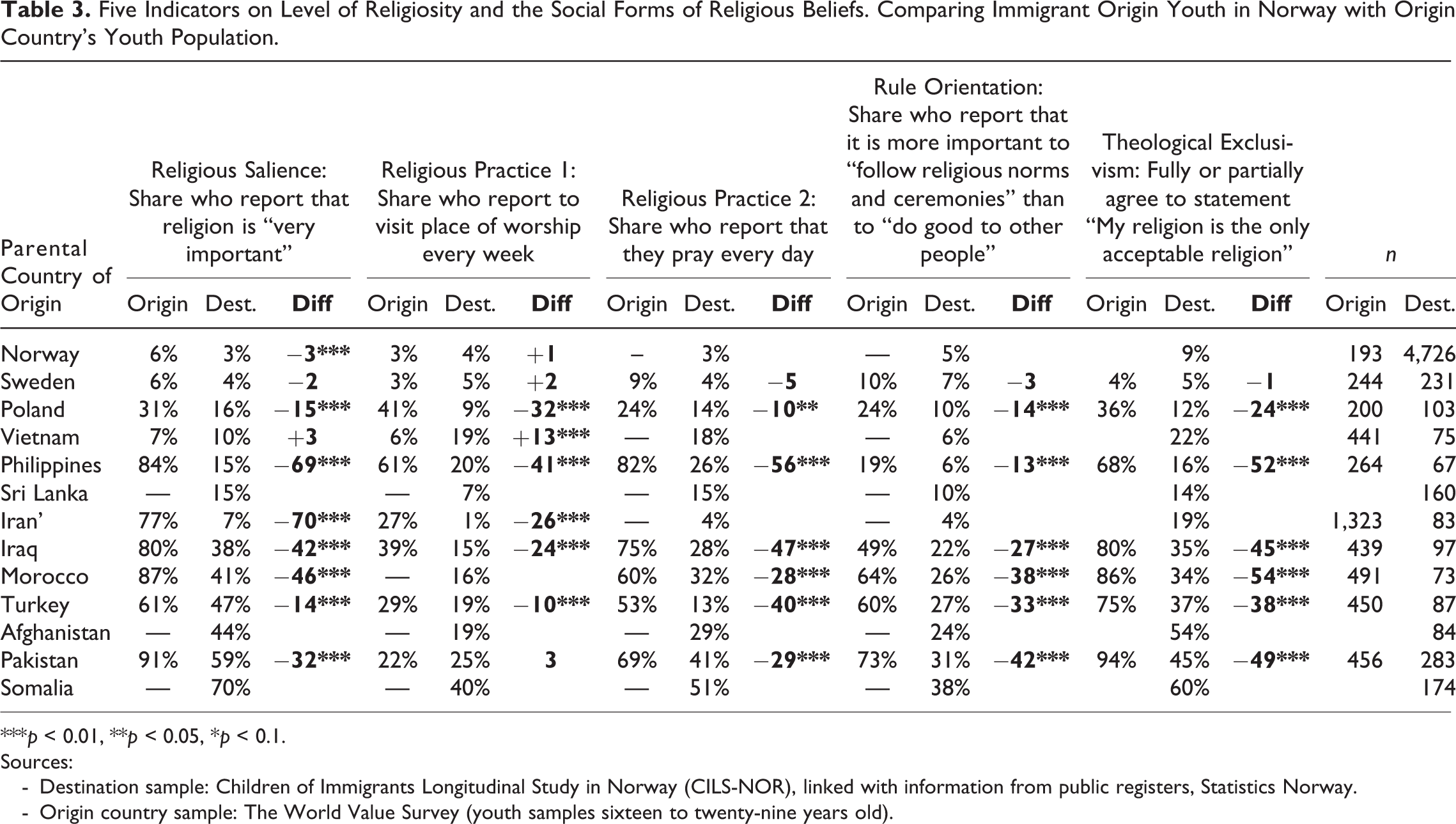
Five Indicators on Level of Religiosity and the Social Forms of Religious Beliefs. Comparing Immigrant Origin Youth in Norway with Origin Country’s Youth Population.
***p < 0.01, **p < 0.05, *p < 0.1.
Sources:
- Destination sample: Children of Immigrants Longitudinal Study in Norway (CILS-NOR), linked with information from public registers, Statistics Norway.
- Origin country sample: The World Value Survey (youth samples sixteen to twenty-nine years old).
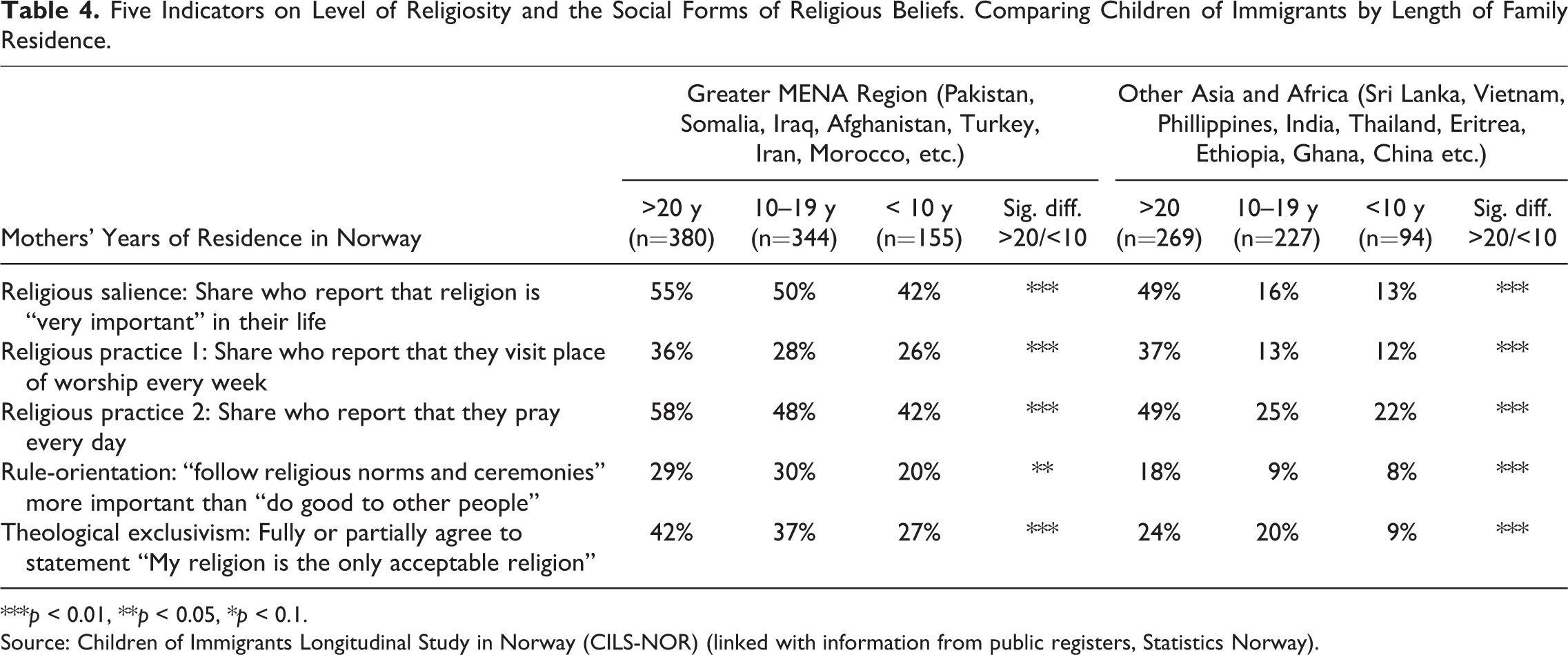
Five Indicators on Level of Religiosity and the Social Forms of Religious Beliefs. Comparing Children of Immigrants by Length of Family Residence.
***p < 0.01, **p < 0.05, *p < 0.1.
Source: Children of Immigrants Longitudinal Study in Norway (CILS-NOR) (linked with information from public registers, Statistics Norway).
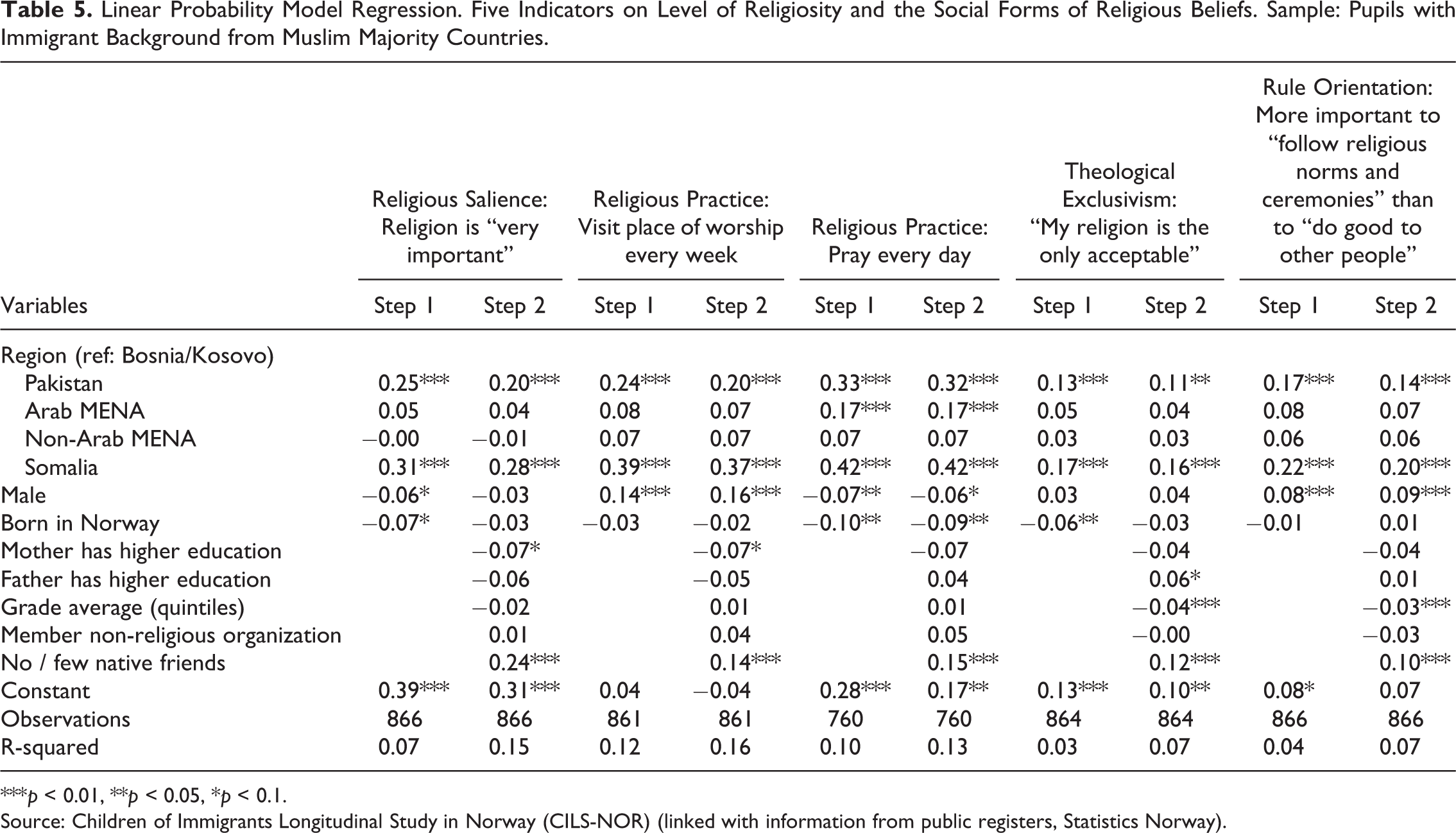
Linear Probability Model Regression. Five Indicators on Level of Religiosity and the Social Forms of Religious Beliefs. Sample: Pupils with Immigrant Background from Muslim Majority Countries.
***p < 0.01, **p < 0.05, *p < 0.1.
Source: Children of Immigrants Longitudinal Study in Norway (CILS-NOR) (linked with information from public registers, Statistics Norway).
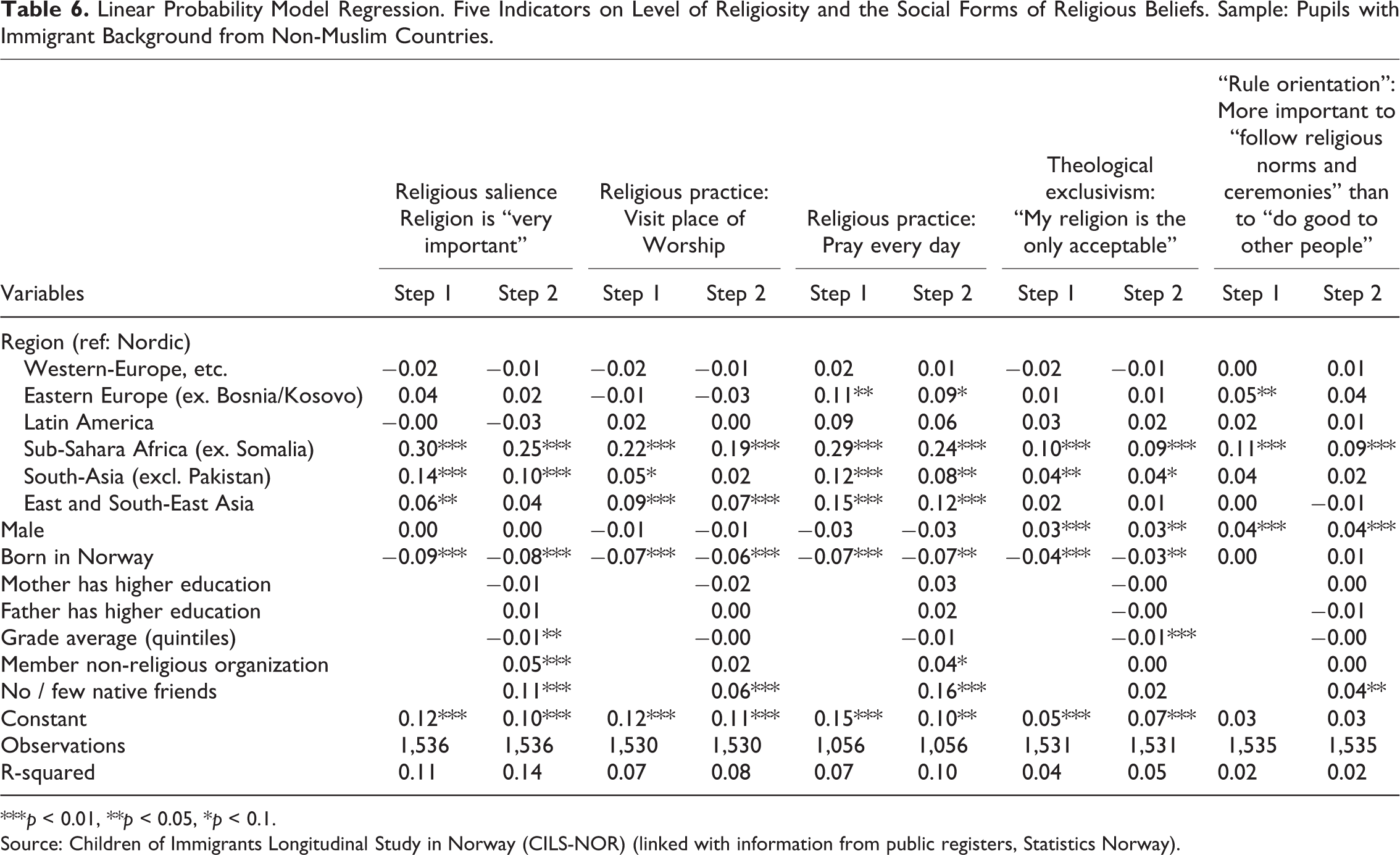
Linear Probability Model Regression. Five Indicators on Level of Religiosity and the Social Forms of Religious Beliefs. Sample: Pupils with Immigrant Background from Non-Muslim Countries.
***p < 0.01, **p < 0.05, *p < 0.1.
Source: Children of Immigrants Longitudinal Study in Norway (CILS-NOR) (linked with information from public registers, Statistics Norway).
Variables indicating gender (dummy boy/girl), immigrant generation (dummy indicating foreign born/Norwegian born), and mother’s length of residency (“more than twenty years”/“ten to nineteen years”/ “less than ten years”) are also based on data drawn from the Norwegian population register. Note that the variable immigrant generation references so-called synthetic generations, simply denoting the distinction between foreign-born adolescents and adolescents born in Norway (to immigrant parents). Parental educational level is measured, using information from the National Education Database, which registers the highest completed education for the entire population. For the regression, we use two separate dummy variables indicating whether the student’s mother and father were registered as having completed education at the university or college level. Grade average is measured using the students’ own grade point average from compulsory school (after tenth grade), which forms the basis for enrolment into secondary education. Information for each individual student was provided by the county educational authorities. For the regression analyses, we divide students’ grade averages into quintiles.
As a measure of social participation, we use information from the CILS-NOR survey. In the regression analyses, we use a simple dummy indicating whether the respondent was a member of and/or participated in regular activities organized by a sports club, music, dance or drama group, political organization, or other type of non-religious organization or association. Finally, to measure integration in terms of friendship networks, respondents were asked how many of their friends had immigrant parents, with five different answer categories (“none of them,” “a few,” “roughly half,” “most of them,” and “all of them”). For the regression, we use a dummy indicating those with few or no native friends, based on those who reported “most of them” or “all of them.”
Methods
The overall objective is to measure religious change, and we use different techniques to do so. First, we compare immigrant-origin youth in Norway to young people in their parental homelands, using youth samples from the World Value Survey. This comparison allows us to measure the extent to which children of immigrants retained the level and social form of religiosity prevalent in their parents’ homelands. Second, we compare respondents based on their families’ length of residence in Norway, as a measure of exposure, to indicate change over time. This comparison allows us to see if adolescents whose families had resided in Norway for a long time differed in their level and form of religiosity from those whose families had arrived more recently. Third, we perform regression analyses, using generation (second versus first generation) as a measure of exposure to the host country, along with parental education and own GPA average after tenth grade as measures of structural integration, and membership in non-religious clubs and organizations and share of native friends as measures of social integration, controlling for parents’ birth region and gender. We ran two separate analyses, one for adolescents originating from Muslim-majority countries and one for adolescents originating in non-Muslim majority countries. We ran these analyses in two steps to see the separate effects of origin and exposure, before introducing measures of integration. We use Linear Probability Model (OLS regression with binary dependent variable), since this method allows us to compare coefficients across models (Mood 2010).
We note that these techniques are associated with several methodological problems. Issues of data quality suggest caution when interpreting findings: for example, the World Value Survey lack data on war-torn countries such as Sri Lanka, Afghanistan, and Somalia, which all constitute major origin countries for refugees to Norway (Brochmann and Kjeldstadli 2008). Moreover, our respondents were sixteen to seventeen years old, and the youngest available age category from the World Value Survey includes people from sixteen to twenty-nine years. 4 When breaking down the CILS-NOR data by individual origin countries, some groups have relatively small samples. Answers may also be affected by a social desirability bias, which could have opposite effects in highly religious and highly secular contexts (Presser and Stinson 1998). Another problem is related to migrant selection: when comparing children of immigrants in Norway to youth in the origin countries of their parents, we cannot know if differences should be attributed to social change or to migrant selection. For example, a study of transnational migration between Turkey and Germany suggests that immigrants on average were more liberal than non-migrants, while return migrants on average were more conservative, which may lead to an overestimation of assimilation effects (Güveli 2015; Güveli et al. 2016).
Comparing different groups of children of immigrants based on generational status or parents’ length of residence avoids problems of selectivity within migration flows, but we cannot be sure that we are measuring stability and change over time as a result of exposure or observing a composition effect, since groups with different levels of religiosity may have arrived at different points in time. These composition effects are, to some extent, accounted for in the multivariate analyses by controlling for parental origin region, along with measures of integration in other domains. Cross-sectional data, however, are still not able to firmly determine social change. Nevertheless, we argue, in combination, these different methods provide a relatively robust indication of general trends.
Religion and Religiosity Compared
We start by describing respondents’ religious affiliations according to their immigration background. As expected, there are significant differences between immigrant- and native-origin youth in terms of both how many identified with a religion and with which religions they identified. Table 1 shows that among non-immigrant-origin respondents, slightly over half identified as Christians, while slightly less than half identified with no religion. Very few identified with religions other than Christianity. Respondents with immigrant parents from Europe, North America, or Australia were relatively similar to the majority in their religious affiliation, although a few, mostly children of refugees from Bosnia and Kosovo, identified as Muslims. In addition, we should expect the share of Catholics to be higher among European-origin immigrants than the predominantly Protestant native majority, but we do not have data on Christian denomination. Respondents with immigrant origin from Africa, Asia and Latin America, however, differed substantially from both the native majority and immigrant-origin youth from Europe, North America, and Australia. Almost half (46 percent) identified as Muslim; 22 percent identified as Christian; while another 17 percent identified as belonging to other religions, mostly Hinduism or Buddhism. Comparatively fewer—16 percent—identified as not belonging to any religion.
In Table 2, we compare religious salience and religious practices, as well as rule orientation and theological exclusivism. Among Christians, we distinguish between those whose parents immigrated from Europe, North America, or Australia and those whose parents immigrated from Africa, Asia, and Latin America (unfortunately, we lack information about the Catholic versus Protestant share). In addition, we show results for immigrant-origin youth identifying as Muslims and immigrant-origin youth belonging to religions other than Christianity and Islam, such as Hinduism and Buddhism (both groups originated almost exclusively from Africa and Asia). Two patterns emerge. First, there is a clear distinction between “the west” and “the rest.” For example, Christians with an immigrant origin from Europe were largely similar to non-immigrant Christians, in that religion played a relatively minor role in their lives, and they tended to interpret their religious beliefs in relatively individualist forms. Christians with an immigrant origin from Africa, Asia, and Latin America, on the other hand, were on average both more religious and more rule oriented and exclusivist in their religious beliefs, even if they adhered to the same religion. Second, there is a clear distinction between Muslims and non-Muslims: Muslim immigrant-origin youth were more religious and more rule oriented and exclusivist than immigrant-origin youth in other religious groups, regardless of their regional origin.
Comparing the Children of Immigrants in Norway with Young People in Origin Countries
To measure the extent to which children of immigrants retained the level and social form of religiosity prevalent in their parents’ homelands, we compare answers from the CILS-NOR study with answers to the same questions from youth samples from the World Value Survey drawn from the respondents’ parents’ birth countries (see Table 3). Results from the CILS-NOR study, which include both children who had immigrated themselves and Norwegian-born children of immigrants, show the same pattern as already observed: adolescents with an immigration background from countries in Africa and Asia, and to some extent Eastern Europe, tended to be more religious and more rule oriented and exclusivist in their religious beliefs than youth originating in Norway and Western Europe. Moreover, those originating from majority-Muslim countries were more religious and more rule oriented and exclusivist than immigrant-origin youth from other non-Muslim countries in the Global South.
However, when we compare immigrant-origin youth in Norway to youth samples drawn from their parents’ birth countries through the World Value Survey, we find that those living in Norway were consistently less religious and less rule oriented and exclusivist in their beliefs than youth in their parental homelands. The fact that 59 percent of Pakistani-origin youth in Norway reported that religion was very important in their lives may seem like a high percentage compared to only 3 percent among native-origin youth, but it is significantly less than the 91 percent of youth in Pakistan who reported the same. This pattern is found among all immigrant groups—both Muslim and non-Muslim—and in terms of both the level and social form of religiosity. Among all national groups where data are available, the immigrant sample from Norway scored substantially lower on all dimensions of religiosity. 5
As noted, we cannot determine to what extent differences between origin and destination samples reflect a process of post-migration change (secularization) or selective migration patterns. For example, adolescents with an immigration background from Iran appeared to be extremely secular compared to youth in Iran, but this difference is likely a reflection of the fact that most Iranians in Norway are political refugees from the secular opposition who fled after the Islamic revolution in 1979 (Brochmann and Kjeldstadli 2008). To what extent such selection mechanisms operate in other migration flows is less certain.
Comparing Children of Immigrants by Length of Family Residence
Our second measure of change is to compare youth whose families migrated to Norway at different points in time and, thus, differed in terms of their exposure to Norwegian society. We distinguish between respondents whose mothers migrated to Norway less than ten years ago (respondents most likely arrived after school age), between ten and nineteen years ago (respondents most likely either arrived before school age or were born in Norway), and more than twenty years ago (parents settled well before respondents’ birth). We report results for those originating in Muslim-majority countries and in non-Muslim majority countries in Africa and Asia separately.
Once again, the results are relatively consistent. Children of immigrants from Muslim-majority countries were more religious and more rule oriented and exclusivist in their beliefs than children of immigrants originating in non-Muslim majority countries in Africa and Asia. Nevertheless, we find that respondents whose families immigrated to Norway a long time ago reported somewhat lower levels of religiosity and of rule orientation and exclusivism than those who more recently arrived. The difference is smaller among Muslims, which may reflect that secularization unfolds slower for them. However, it may also be due to composition effects: Some of the largest and most religious groups among Muslims, such as Pakistanis, arrived early, while recent arrivals have been more diverse (Brochmann and Kjeldstadli 2008). Among non-Muslims, the pattern is opposite: those with long residence included relatively secular groups, like the Vietnamese, while recent arrivals included more religious groups (e.g., migrants from sub-Sahara Africa).
Multivariate Analysis
Although both techniques we have used come with uncertainty, the results so far provide moderate indications of both religious decline and individualization. This pattern applies to both Muslim and non-Muslim immigrant-origin youth, although starting from a much higher level of religiosity and perhaps unfolding slower for Muslims. To better account for composition effects and to see whether they are linked to integration outcomes in other fields, we perform Linear Probability regressions on five key indicators in two steps. In step one, to disentangle the effects of exposure (immigrant generation) from composition (origin country/region), we start by controlling for origin region, gender, and immigrant generation. In step two, we introduce variables indicating social and structural integration, controlling for parental education, student’s own grade average from compulsory school, a dummy variable indicating whether the respondent was an active member of a non-religious social, political, or sports organization, and a dummy variable indicating whether the respondent reported having few or no native friends. We perform separate analyses for youth originating in Muslim-majority countries (Table 5) and non-Muslim-majority countries (Table 6).
We start with adolescents originating in Muslim-majority countries (Table 5). Looking at the results from step one, we find that in terms of country origin, young people of Somali and Pakistani origin were both more religious and more rule oriented and exclusivist in their beliefs than youth from other parts of the greater Middle East. Gender has a somewhat-mixed relationship with religiosity. Muslim adolescent girls were more likely to say that religion was very important in their lives and more likely to pray every day, while Muslim adolescent boys were more likely to report visiting a place of worship every week and more exclusivist and rule oriented in their beliefs. We find a significant negative relationship between immigrant generation and three of our five measures of religiosity. Respondents who were born in Norway to immigrant parents were less likely to say that religion was very important in their lives, less likely to pray every day, and less likely to agree with the statement that their religion should be the only acceptable one, compared to respondents who were born abroad.
In step 2, we explored the relationship between different aspects of integration and religiosity. The results are mixed. Parental education appears to have a rather limited effect on religiosity among immigrant-origin youth (despite a negative association between mother’s education and religious salience and religious participation and a positive relationship between father’s education and theological exclusivism). We find no significant association between participation in non-religious civil-society organizations and any measure of religiosity. Respondents’ own grade average, however, is partially associated with religiosity. While there is no effect of grades on the level of religiosity (there is a weak negative non-significant association between grade average and religious salience and a weak positive non-significant association with both measures of religious practice), there is a relatively strong significant negative relationship between students’ grade averages and the social form of religiosity in terms of theological exclusivism and religious rule orientation. Respondents with better grade averages were substantially less likely to think that their own religious faith should be the only acceptable belief and also less likely to prioritize religious rules and ceremonies over good deeds, compared to respondents with lower grade averages. It may be that while educational success does not make immigrant-origin adolescents less religious, it does make them more susceptible to adapting their beliefs to a social form more compatible with Norway’s secular institutions. Finally, there is a strong and significant correlation between having few or no native-origin friends and all five measures of religiosity. Here, we may assume that causality runs both ways: on the one hand, young people are influenced by their peers. On the other, adolescents may seek out friends who are similar to themselves in terms of beliefs and lifestyles (i.e., regarding alcohol and gender relations). Either way, the results confirm that the Muslim-non-Muslim divide constitutes a major social boundary among youth in Norway.
Looking at Table 6, which shows results for immigrant-origin youth from non-Muslim majority countries, we find that although they were less religious than immigrant-origin youth from Muslim-majority countries, the overall pattern is quite similar, with some exceptions. Youth with an immigrant background from non-Muslim-majority countries in Asia and Africa were more religious than youth originating in non-Muslim-majority countries in Europe and Latin America. Boys were more rule oriented and exclusivist in their beliefs than girls. Those born in Norway scored significantly lower on four out of five measures of religiosity compared to those born abroad, once again indicating a process of secularization and individualization. Members in non-religious organizations were in fact more likely to say that religion was very important and that they prayed every day, but there are no significant association with other dimensions or religiosity. There is a weak negative association between grades and two measures of religiosity. We find a distinct association between friendship networks and religiosity, but this effect appears to be weaker for non-Muslim immigrant-origin youth than for Muslim immigrant-origin youth. All in all, however, we find indications for secularization and individualization for both groups and that these processes are partially related to other measures of integration. Young people with immigration-background from Muslim countries, however, stand out in terms of their more distinct levels and forms of religiosity, as well as in the way their religiosity is more strongly associated with friendship formation and social integration.
Conclusion
In a review of the literature on assimilation and the immigrant second generation in Europe and America, Drouhot and Nee (2019) argue that the primary segregating dynamics in today’s Western Europe are related to religious differences. Social reproduction of a strong religious culture, particularly in Muslim immigrant families, combined with this culture’s stigmatization by natives, produces a dynamic of cultural polarization which impedes integration. The long-term religious adaptation of immigrants, especially Muslim immigrants, and their children in various European countries has, therefore, become a key question for social scientists studying integration (Bisin et al. 2008; Fleischmann and Phalet 2012; Maliepaard, Gijsberts, and Lubbers 2012; Voas and Fleischmann 2012; Lewis and Kashyap 2013; Maliepaard and Lubbers 2013; de Hoon and van Tubergen 2014; Torrekens and Jacobs 2016; Simsek et al. 2018). In this article, we set out to ask if children of immigrants become more or less religious as they acculturate to Norwegian society and whether their religious beliefs change in their social forms.
All in all, our findings are similar to those which have been observed throughout Europe: children of Muslim immigrants were more religious compared both to the secular native population and to most other immigrant groups. However, our analyses also indicate that despite the continuing importance of conservative religious beliefs among Muslim immigrants and children of immigrants in particular, we find indications of a (slow) process of secularization. Immigrant-origin youth in Norway were on average far more secular than youth in their parents’ birth countries, and youth whose parents had resided in Norway for a long time were slightly more secular than those more recently arrived. The differences between the origin and destination samples are far more striking than the difference according to length of residence and immigrant generations, but this discrepancy is not necessarily surprising, given the possibility of selection effects, desirability bias, and composition effects. Nevertheless, the overall pattern is the same and applies to both Muslim immigrant-origin youth and non-Muslim immigrant-origin youth, although differences are smaller and start from a higher level of religiosity among the former.
Expanding on the literature on religious change among immigrants, we have explored not just religious salience and practices but also the social forms of religious beliefs. Our findings suggest that the immigrant population in Norway over time and across generations goes through a process of religious individualization whereby religious beliefs become somewhat less rule oriented and morally exclusivist. The pattern we find suggests that religious individualization is not an alternative to, but rather an intrinsic part of, a broader process of secularization. From an integration perspective, this development is perhaps even more significant than decline in the level of religiosity.
When looking at the association between religiosity and integration in other domains, we only find limited evidence supporting any causal link between integration and religiosity. We do find a negative relationship between students’ grade average and the level of rule orientation and religious exclusivism, suggesting that educational success is related to more individualized social forms of religious beliefs, particularly for immigrant-origin youth who are Muslims. The most striking pattern, however, is the strong relationship between having few or no ethnic Norwegian friends and all measures of religiosity, particularly for Muslim immigrant-origin youth. Here, causality most likely runs both ways, showing how religiosity works as a bright social boundary among adolescents in Norway.
While our results provide indications of both religious decline and individualization, they also point to a rather remarkable stability in Muslim religious life and leave ample room for theories of religious vitality and reproduction. For example, relatively high levels of participation in organized religious life among some groups (e.g., Pakistani-origin youth) reflect how religious organizations play a vital role in the (re)construction of diaspora communities. Similarly, the complex relationship between religiosity and educational success—where the association of educational success with religious practice appears to be the opposite of its relationship to rule orientation and theological exclusivism—may suggest that selective acculturation plays a part (see also Friberg 2019). Future research in this field should prioritize disentangling the different and perhaps counteracting mechanisms at play in processes of religious adaptation. The existence of such counteracting mechanisms is not antithetical to secularization but a reminder that cultural and religious change occurs slowly and rarely follows a straight path.
Finally, this article contributes to existing research by studying religious change among immigrants in Norway—an understudied, yet highly relevant, context. We introduced this article by arguing that the forces of secularization may have more scope to play out here than in many other European contexts, due to a highly secularized majority culture and a relatively favorable context of reception for children of immigrants. Our results, which provide slightly more support for the assimilation and secularization thesis than have some studies from elsewhere in Europe (e.g., Jacob and Kalter 2013), may point in that direction. However, given the methodological challenges involved in studying long-term religious change, one should be cautious in drawing conclusions. Instead, we argue that our findings call for more comparative studies on how national contexts of reception shape religious adaptations among immigrants and children of immigrants across different immigrant receiving countries.
Footnotes
Declaration of Conflicting Interests
The author(s) declared no potential conflicts of interest with respect to the research, authorship, and/or publication of this article.
Funding
The author(s) disclosed receipt of the following financial support for the research and/or authorship of this article: This article received funding from Norges Forskningsråd (Grant ID 237004) and NordForsk (Grant ID 95263).
