




Abstract
This article contributes to previous research on immigrant integration by examining how religiosity and gender roles in European countries influence immigrant women’s labor market outcomes. Moreover, we extend theoretical work on the importance of the receiving country’s norms and values by hypothesizing and testing whether receiving countries’ influence varies with immigrant women’s religiosity and gender-role attitudes. Using the European Social Survey data and multilevel regression models, we find that religious immigrant women participate less in the labor market and work fewer hours than nonreligious immigrant women. Immigrant women’s traditional gender-role attitudes partly explain the negative relationship between individual religiosity and labor market outcomes. While the receiving country’s religiosity is negatively related to immigrant women’s labor market outcomes, this negative relationship is significantly weaker for religious and gender-traditional immigrant women than for nonreligious and gender-egalitarian women. These findings suggest that the economic benefits of residing in countries that support female employment are limited to immigrant women who are ready and positioned to embrace gender-egalitarian norms and values.
The share of the foreign-born population in Europe was 3.5% at the end of the 1990s (Eurostat 2018). By 2018, this number had quadrupled to 14.9% (Eurostat 2018). The majority of these foreign-born residents are non-European Union (EU) nationals (Eurostat 2018), and the recent increase in people seeking humanitarian protection in Europe has only contributed to the growing ethnic and cultural diversity of European societies and communities. 1 Europe’s immigrant population not only has become more diverse but also originates from countries with higher levels of religiosity and more traditional gender roles than many European destinations (Röder and Mühlau 2014; Polavieja 2015). Another significant trend in European migration flows is that the share of female immigrants has been steadily growing and that now, female immigrants outnumber male immigrants in Europe (United Nations 2017). These recent trends in migration flows are imperative because immigrant women, particularly those coming from more gender-traditional countries, face substantial disadvantages in western countries’ labor markets (OECD 2018).
Several recent studies have attempted to explain immigrant women’s economic disadvantages in western countries, mainly by focusing on the importance of two factors: human capital and family structure (Powers, Seltzer, and Shi 1998; Antecol 2000, 2001; Adsera and Chiswick 2007; Donato, Piya, and Jacobs 2014). However, even after accounting for educational attainment, labor market experience, and family structure, a substantial economic disadvantage for immigrant women, particularly those coming from gender-traditional countries, persists (Antecol 2000, 2001; Donato, Piya, and Jacobs 2014). At the same time, studies on women in the general population in western countries have shown that individual- and country-level religiosity and traditional gender roles influence female economic outcomes as well (Clark, Ramsbey, and Adler 1991; Lehrer 1995; Crompton and Harris 1997; G. J. Rogers and Franzen 2014), suggesting that traditional norms and values may be an important omitted variable affecting immigrant women’s economic outcomes.
Although the importance of religion and gender roles for immigrant women’s economic outcomes has been recognized for a very long time in the migration literature (e.g., Reimers 1985), there has been little empirical evidence on this issue until recently. Toward this end, Read (2004a, 2004b) and Read and Oselin (2008) found that religiosity and traditional gender-role attitudes, together with ethnic and religious networks that encourage traditional gender roles, explain the economic disadvantage of Arab-American women. More recently, Khoudja and Fleischmann (2015a) found that in the Netherlands, women’s traditional gender-role attitudes largely explain the negative relationship between women’s religiosity and labor force participation. However, these studies are limited to a small number of specific groups (e.g., Arab Americans in the United States) in a single receiving country. Thus, little is known about whether their findings are generalizable to other ethnic groups and countries.
This article directly contributes to this research gap by examining how religiosity and gender roles of European countries influence immigrant women’s economic outcomes. Moreover, we extend theoretical work on the importance of the receiving country’s norms and values by hypothesizing and testing whether receiving countries’ influence varies across immigrant women with different levels of religiosity and traditional gender-role attitudes. Given that most migration flows into Europe are from less developed and gender-traditional countries, an important question is what happens to religious and gender-traditional women as they migrate to more gender-egalitarian countries.
Using the European Social Survey data, we first examine the influence of individual-level religion and religiosity on immigrant women’s economic outcomes and consider whether women’s gender-role attitudes mediate this influence. Next, we assess how the receiving country’s religiosity and gender roles are related to immigrant women’s economic outcomes and whether immigrant women’s religiosity and gender-role attitudes moderate these relationships. Our findings show that religious immigrant women participate less in the labor market and work fewer hours than nonreligious immigrant women. Traditional gender-role attitudes explain part of this negative relationship between individual religiosity and immigrant women’s labor market outcomes. The analyses also support our hypothesis that the receiving country’s religiosity is negatively related to immigrant women’s labor market outcomes. However, this relationship is weaker for religious and gender-traditional immigrant women than for nonreligious and gender-egalitarian women. These findings suggest that the economic benefits for immigrant women residing in countries that support female employment are limited to those women who are ready and positioned to embrace gender-egalitarian norms and values.
Religion, Gender-role Attitudes, and Immigrant Women Labor Market Outcomes
There is a growing literature on religion’s role in immigrant women’s labor market outcomes (e.g., Read 2004a, 2004b; Khoudja and Fleischmann 2015a, 2015b). Based on economic and sociological theories, researchers in this vein of scholarship argue that the main channel by which religion operates in influencing immigrant women’s economic behavior is through promoting traditional gender-role attitudes and a gendered division of labor (Lehrer 1995; Read 2004a, 2004b; Diehl, Koenig, and Ruckdeschel 2009). Traditional gender-role attitudes, they argue, emphasize that men are mainly responsible for providing the family’s financial means, and women for childcare and housekeeping, and underline differential power relations influenced by these roles (S. J. Rogers and Amato 2000). In contrast, egalitarian gender-role attitudes stress equal division of labor and power relations by gender (S. J. Rogers and Amato 2000). Thus, gender egalitarianism stresses men’s incorporation into family life and women’s incorporation into waged labor, placing higher importance on their professional career and financial contributions to the household.
In previous research, religion, particularly Islam, has often been associated with a negative influence on immigrant women’s labor market participation by promoting and emphasizing traditional gender-role attitudes (Lindley 2002; Predelli 2004; Heath and Martin 2013). Other studies, however, have disputed Islam’s prominent role in restricting female labor market participation (Chadwick and Garrett 1995; Read 2004b; Scheible and Fleischmann 2013; G. J. Rogers and Franzen 2014) and, instead, argued that all major religions embed gendered division of labor that hinder female labor participation. Because Muslims, particularly in Europe, tend to have higher levels of religiosity than natives, though, they are more likely to follow the prescribed rules of their religious denomination, including support for traditional gender-role attitudes and a gendered division of labor (Diehl, Koenig, and Ruckdeschel 2009; Röder and Mühlau 2014).
Following previous studies, we, thus, hypothesize that immigrant women with any religious affiliation, and more religious women in particular, have worse labor market outcomes than immigrant women without religious affiliation and lower levels of religiosity (Hypothesis 1). In addition, we expect that the main channel through which religious affiliation and religiosity operate in influencing women’s labor market outcomes is by promoting women’s support for traditional gender-role attitudes. Religious affiliation and religiosity may also expose women to romantic partners’ and ethnic and religious communities’ traditional gender roles (Lehrer 1995; Read 2004a; Dale, Lindley, and Dex 2006; Read and Oselin 2008; Farre and Vella 2013; Khoudja and Fleischmann 2015b). Therefore, we additionally hypothesize that the negative relationship between religious affiliation and religiosity, on the one hand, and female labor market outcomes, on the other hand, is partly mediated by traditional gender-role attitudes (Hypothesis 2). 2
The Receiving Country’s Religiosity and Gender Roles
Besides individual religiosity and gender role-attitudes, immigrant women’s labor market outcomes can also be influenced by the receiving country’s norms and values (Grunow and Veltkamp 2016). Previous research, for example, has shown that immigrant women’s labor participation is influenced by the traditional gender-role attitudes of their husbands and partners (Lehrer 1995; Farre and Vella 2013; Khoudja and Fleischmann 2015b) and ethnic and religious communities (Read 2004; Dale, Lindley, and Dex 2006; Read and Oselin 2008). However, the influence of social context may not be solely constrained to one’s religious or ethnic community but may also reflect social norms of a broader geographical context, such as that of a whole society (Uunk, Kalmijn, and Muffels 2005; Grunow and Veltkamp 2016; Steiber, Berghammer, and Haas 2016). In this context, researchers have argued that prevailing societal gender roles may provide a normative reference point on acceptable ways to combine paid work with care obligations (Grunow and Veltkamp 2016) and are likely to indirectly influence women’s economic behavior by facilitating or impeding institutional support for working women and mothers (Gornick, Meyers, and Ross 1997; Uunk, Kalmijn, and Muffels 2005).
While European countries have become more secularized in terms of religious beliefs and behavior and while egalitarian gender roles have been on the rise, there are significant cross-national differences in religiosity levels across European countries (Norris and Inglehart 2011). For instance, there is a sharp contrast between predominantly Protestant countries of Northern Europe, where religious attendance and beliefs tend to be lower, and predominantly Catholic countries of Southern and Central Europe, where a substantial share of the population still attends religious services and believes in God (Atlas of European Values 2017). European countries also differ in their current gender roles (Atlas of European Values 2017). For example, Southern Europeans tend to generally agree, while Scandinavians tend to disagree, with the statement: “A child suffers when mum is working.”
Previous research among women in the general population in western countries shows that when societies rank low on traditional gender roles, women in those societies are more likely to participate in the labor market (Clark, Ramsbey, and Adler 1991; Sainsbury 1996; Crompton and Harris 1997; Gornick, Meyers, and Ross 1997; Pfau-Effinger 1998; Mandel and Semyonov 2006; Boeckmann, Misra, and Budig 2015). More recently, researchers have shown that the receiving country’s norms and values are also important for immigrant integration. For example, Steinmann (2020) has demonstrated that natives’ religiosity is a facilitating factor for establishing contacts with refugees in Germany. Likewise, in her qualitative study of Vietnamese marriage immigrants in Taiwan and South Korea, Chang (2019) showed that the way the origin and receiving country’s gender roles interact either hindered or facilitated immigrants’ cultural integration. This article contributes to and extends existing research by examining whether European countries’ religiosity and gender roles influence immigrant women’s labor market outcomes and whether this influence varies across women with different levels of religiosity and traditional gender-role attitudes.
Based on previous work on native women in western countries, we hypothesize that immigrant women who migrated to religious and gender-traditional countries will have lower labor market outcomes than immigrant women who moved to nonreligious and gender-egalitarian countries (Hypothesis 3). Next, we expect that the influence of the receiving country’s religiosity and gender-traditional roles will be weaker for religious and gender-traditional immigrant women than for nonreligious and gender-egalitarian immigrant women. It can be argued that immigrants whose norms and values differ substantially from those of the receiving country are less likely to be influenced by these norms and values (Inglehart and Baker 2000; Sniderman and Hagendoorn 2007; Norris and Inglehart 2012). In particular, religious values and gender roles, which are formed in one’s primary socialization and constitute a part of one’s religious and ethnic identity, may be resistant to change (Norris and Inglehart 2012). In line with this argument, Blau, Kahn, and Paps (2011) showed that in the United States, net of human capital and other socio-demographic variables, immigrant women from countries with low female labor participation worked less than women from countries with high female labor participation, arguing that origin-country norms and values may still matter if immigrant women do not acculturate fully to their new environment. In contrast, nonreligious and gender-egalitarian immigrant women may be more prone to change and reduce their participation in the labor market after moving to gender-traditional countries to avoid a “second shift” at home (Fuwa 2004). Hence, we hypothesize that the influence of the receiving country’s religiosity and traditional gender roles on immigrant women’s labor market outcomes will be stronger for nonreligious and gender-egalitarian than for religious and gender-traditional immigrant women (Hypothesis 4).
Data and Methods
Testing these hypotheses about the importance of individual and country-level religiosity and gender-role attitudes poses two challenges. First, it requires individual-level data on immigrants that include information about their religious affiliation, religiosity, gender-role attitudes, and several controls, some of them specific to immigrants, such as years since migration and birth country. Second, our comparative focus requires variables that are strictly comparable across surveys. To address these challenges, we draw on three waves of the European Social Survey (ESS), which included measures of individual-level gender-egalitarian attitudes (ESS-2 Data 2004; ESS-4 Data 2008; ESS-5 Data 2010). The ESS is a cross-national survey conducted in over 30 European countries. It was established in 2001 and is held every two years, using recurring key items and rotating specific topic modules. New respondents are selected for every survey-round. Individuals are chosen through random probability methods to ensure that samples are representative of all persons aged 15 and over in a country.
While immigrants are not the ESS’s primary target population, the survey includes information about participants’ (parental) birth country, allowing a distinction between first- and second-generation immigrants and immigrant origins. Moreover, the ESS provides information on immigrants’ religion and gender-role attitudes combined with other indicators of human capital, family structure, and economic outcomes. Thus, it has a significant comparative advantage for studying immigrant women’s populations over other cross-national surveys used in previous research — namely, the European Union Labour Force Survey (Kogan 2006) and IPUMS-International data (Donato, Piya, and Jacobs 2014).
Dependent and Independent Variables
The labor market outcomes are measured by two variables. First, we measure immigrant women labor force participation (LFP), equal to one if a respondent participated in the labor force and zero otherwise. Following the International Labour Organization’s standard definition (ILO 2015), respondents are considered as participating in the labor market if they are either employed or unemployed but actively seeking work. Respondents who are currently enrolled in education, retired, permanently sick, or disabled are excluded from the sample (20.7 percent). While active women may be unemployed for many reasons, some of them out of their control (e.g., economic crisis, discrimination), LFP can be considered more subject to an individual’s decision than unemployment (Khoudja and Fleischmann 2015a). Second, we measure the number of weekly working hours (WH). Women who reported being unemployed or inactive are set to zero. Working hours greater than 50 are set to 50 (6.2 percent).
Our key independent variables on the individual level are religious affiliation, religiosity, and gender-role attitudes. Religious affiliation is measured by the questions, “Do you consider yourself as belonging to any particular religion or denomination?” and “If yes, which one?” To ensure that the religious groups in the analysis consist of a sufficient number of respondents, they are grouped according to denominational similarity (May and Reynolds 2018): “Roman Catholic and Eastern Orthodox,” “Protestant,” “Muslim,” “Other-denominations,” and “No religious denomination.” “Other-denominations” consists of other Christian denominations, Asian religions, other non-Christian religions, and Judaism.
Subjective religiosity is measured by the question: “Regardless of whether you belong to a particular religion, how religious would you say you are?” Answer categories range from 0 “not at all religious” to 10 “very religious” (M = 5.44, SD = 2.92). Religious affiliation and religiosity are related to belonging and believing (intensity of belief/how religious someone is) dimensions of religiosity, respectively (Saroglou 2011).
The ESS provides several questions that can be used to measure gender-role attitudes, but only two questions were asked in all three waves: “Men should have more right to a job than women when jobs are scarce” and “Women should be prepared to cut down on paid work for the sake of the family.” The answer categories range from 1 “strongly disagree” to 5 “strongly agree.” Both questions relate to one domain of gender-role attitudes, the primacy of the breadwinner role (Davis and Greenstein 2009). Thus, we combined them by adding up the scores and dividing by two (Cronbach’s α = .56). A higher score indicates a more traditional gender-role attitude (M = 2.75, SD = 1.02).
To capture the receiving country’s gender-egalitarian climate, we include two indicators in the analyses. Country-level religiosity is measured by the average religiosity of native-born respondents of each country-round unit of ESS (M = 4.52, SD = 1.00). Country-level gender roles are measured by native respondents’ gender-role attitudes measured in the European Value Survey (EVS Longitudinal Data File 1981-2008). 3 The EVS is a large-scale, cross-national, longitudinal survey on fundamental human values conducted in 47 countries. The samples are nationally representative and consist of adult citizens (aged 18 years and older). Respondents are asked, among other things, to answer seven attitudinal questions relating to gender-role attitudes. We ran exploratory factor analysis to examine the dimensionality of the scale. Items were retained if they had a first-factor loading of >.40 and in the case of loading on more than one factor, the difference between loadings was at least .2. Based on these criteria, items were removed (each at a time) until a one-factor solution was attained. Four items loaded high on the first factor (eigenvalue = 2.23 and factor loadings > .66, second-factor eigenvalue .54 and factor loadings < .47) that explained 90 percent of the variance. 4 We, therefore, computed an average of these items (Cronbach’s α = .75). Values can take any number from 1 to 4, with higher scores indicating more gender-traditional roles in the country (M = 2.21, SD = .21). We mean-centered variables measuring individual and the receiving country’s religiosity and gender roles to enhance the results’ interpretation. 5
Control Variables
We control for standard predictors of female labor market participation in the analyses. Educational attainment is measured according to the International Standard Classification of Education (ISCED). We distinguish between five categories: 1 “less than lower secondary education” (ISCED 0–1), 2 “lower secondary education completed” (ISCED 2), 3 “upper secondary education completed” (ISCED 3), 4 “post-secondary non-tertiary education completed” (ISCED 4), and 5 “tertiary education completed” (ISCED 5–6). Education has a direct effect on female labor market outcomes by increasing women’s human capital and productivity (Becker 2009) and an indirect effect by increasing support for egalitarian gender-role attitudes (Röder and Mühlau 2014). We also control for the length of residence in the destination country and age. Length of residence is measured by a categorical variable with five categories: 0 “born in the country,” 1 “0–5 years,” 2 “6–10 years,” 3 “11–20 years,” and 4 “More than 20 years.” Age is measured by a continuous variable in years. We additionally control for a nonlinear effect of age by including the age-squared term. While the length of residence is related to higher levels of host-country specific resources such as language skills, social contacts with natives, and cultural capital (Kanas, Van Tubergen, and Van der Lippe 2011), age is often used as an indirect measure of immigrants’ work experience (Chiswick and Miller 2007).
Another critical factor affecting women’s labor market outcomes is family structure (Antecol 2000, 2001; Adsera and Chiswick 2007; Donato, Piya, and Jacobs 2014). We include the following variables in the analyses: Young children variable is measured by a binary variable indicating whether children younger than 12 are present in the household (1) or not (0). Partner is measured by a categorical variable with three categories: 1 “An employed partner in the household,” 2 “An unemployed partner in the household,” and 3 “single.” The presence of both an (employed) partner and young children is expected to be negatively related to immigrant women’s labor market outcomes due to the negative effect of childbearing on female past and current labor supply and work effort and increased family obligations for women (Antecol 2000, 2001; Adsera and Chiswick 2007; Donato, Piya, and Jacobs 2014). Finally, the survey year is included at the individual level to control for changing economic opportunities in the labor market.
Although degrees of freedom at the country level are limited, we control for four additional country-level variables that may affect female LFP and WH and otherwise drive our findings. The first concern is that female LFP may be influenced by employment opportunities, including part-time work, irrespective of the normative context. We, therefore, control for female unemployment rates (in the estimation of LFP), female part-time employment (in the estimation of WH), and the size of the service sector (as a percent of total employment) reported by the World Bank and measured separately for each country and survey year. A second concern is that female LFP and WH may be higher in countries with better institutional support for female employment, such as the provision of affordable childcare (Gornick, Meyers, and Ross 1997; Uunk, Kalmijn, and Muffels 2005; Steiber, Berghammer, and Haas 2016). Therefore, we control for the provision of subsidies for early childhood education and care (ECEC) as a percent of GDP reported by the OECD and measured separately for each country and survey year. Table 1 presents the summary statistics of all variables included in the analyses. Table A1 provides summary statistics for the receiving country’s variables per country, and Table A2 shows bivariate correlations between these variables.
Descriptive Statistics.
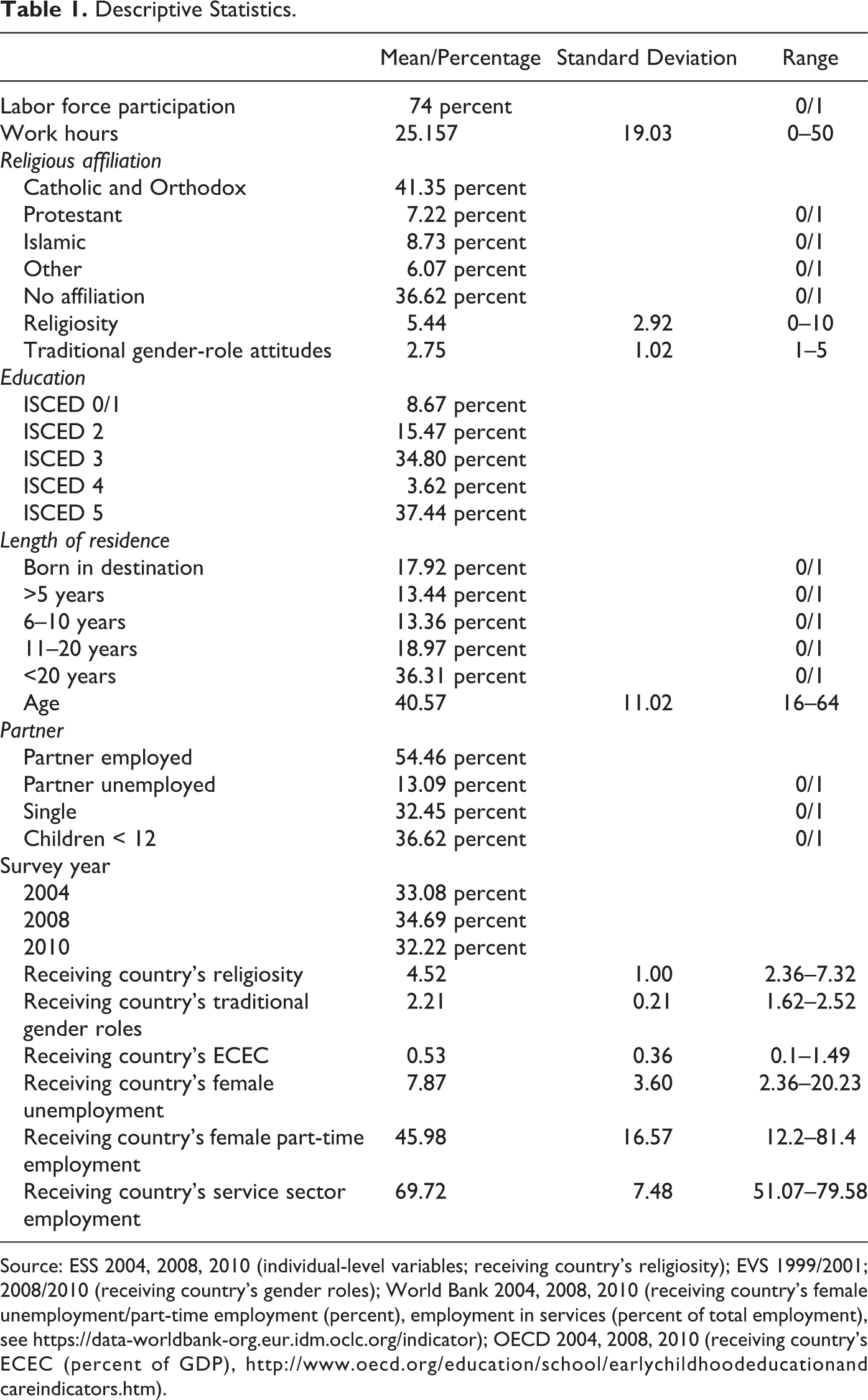
Source: ESS 2004, 2008, 2010 (individual-level variables; receiving country’s religiosity); EVS 1999/2001; 2008/2010 (receiving country’s gender roles); World Bank 2004, 2008, 2010 (receiving country’s female unemployment/part-time employment (percent), employment in services (percent of total employment), see https://data-worldbank-org.eur.idm.oclc.org/indicator); OECD 2004, 2008, 2010 (receiving country’s ECEC (percent of GDP), http://www.oecd.org/education/school/earlychildhoodeducationandcareindicators.htm).
Methods
We employ multilevel regression modeling with respondents (level 1) “nested” within countries (level 2) to account for country-level differences in religiosity and gender roles. This design also allows for testing hypotheses concerning whether the relationship between country-level religiosity and gender roles is steeper for nonreligious and gender-egalitarian or religious and gender-traditional immigrant women (cross-level interaction). We include random slopes for lower-level variables entered into cross-level interactions to allow the effects of individual religiosity and gender-role attitudes to vary across countries. A recent methodological paper by Heisig and Schaeffer (2019) shows that estimates based on models omitting the random slope would not have reached conventional levels of statistical significance in a correctly specified model. We employ binary logistic regression using maximum likelihood estimation (estimation of LFP) and linear regression (estimation of WH). We performed a mediation analysis using a Karlson/Holm/Breen (KHB) method (Breen, Karlson, and Holm 2013). The KHB method calculates a mediated percentage, which may be approximately interpreted as the percentage of the association between, for example, individual religiosity and female LFP that is mediated by gender-role attitudes. We chose this method because it allows comparisons of the total and direct effects of independent variables that are unaffected by rescaling or by attenuation bias that usually occurs when the outcome variable is binary.
Our analytic sample includes female immigrant respondents between the ages of 15–64 and with valid observations on all variables (N = 4,776) distributed over 23 countries. Missing values (16 percent) were excluded, using listwise deletion. The largest percentage of missing values was on employment status (9 percent), individual religiosity (2 percent), and gender-role attitudes (1 percent). For the remaining variables, the missing values were less than 1 percent. Country-specific sample sizes are presented in Table A3 in the Appendix. 6 Immigrant status is determined by the birth country of respondents and their parents. Respondents who were not born in the survey country are classified as first-generation immigrants, while individuals born in the destination country but with both parents born abroad are classified as second-generation immigrants. Respondents with one parent born abroad are treated as natives and excluded from the analysis. Finally, all models are estimated without weights, but replicating Models 5–8 with analytical weights (an interaction between population and design weights recommended by ESS data guidelines) does not alter our conclusions.
Results
We start presenting results by showing the bivariate correlations between female LFP and WH on the vertical axis and country-level religiosity and gender roles on the horizontal axis (Figure 1). In countries with high religiosity levels, such as Greece or Croatia, immigrant women’s LFP and WH tended to be lower than in less religious countries like Sweden, Estonia, or the Czech Republic. There is also some evidence that female LFP and WH were lower in countries with high support for traditional gender roles (i.e., Greece, Ukraine, and Austria) than in more gender-egalitarian countries (i.e., Norway, Sweden, and Denmark). The bivariate correlations are also useful for identifying possible outliers (see the sensitivity analyses in the Results section in which we remove influential countries). A limitation of these bivariate correlations is that they do not control for immigrant populations’ compositional differences across European countries. The bivariate correlations also do not show whether the effects of the receiving country’s religiosity and gender roles on labor market outcomes vary across women with different levels of religiosity and gender-role attitudes.
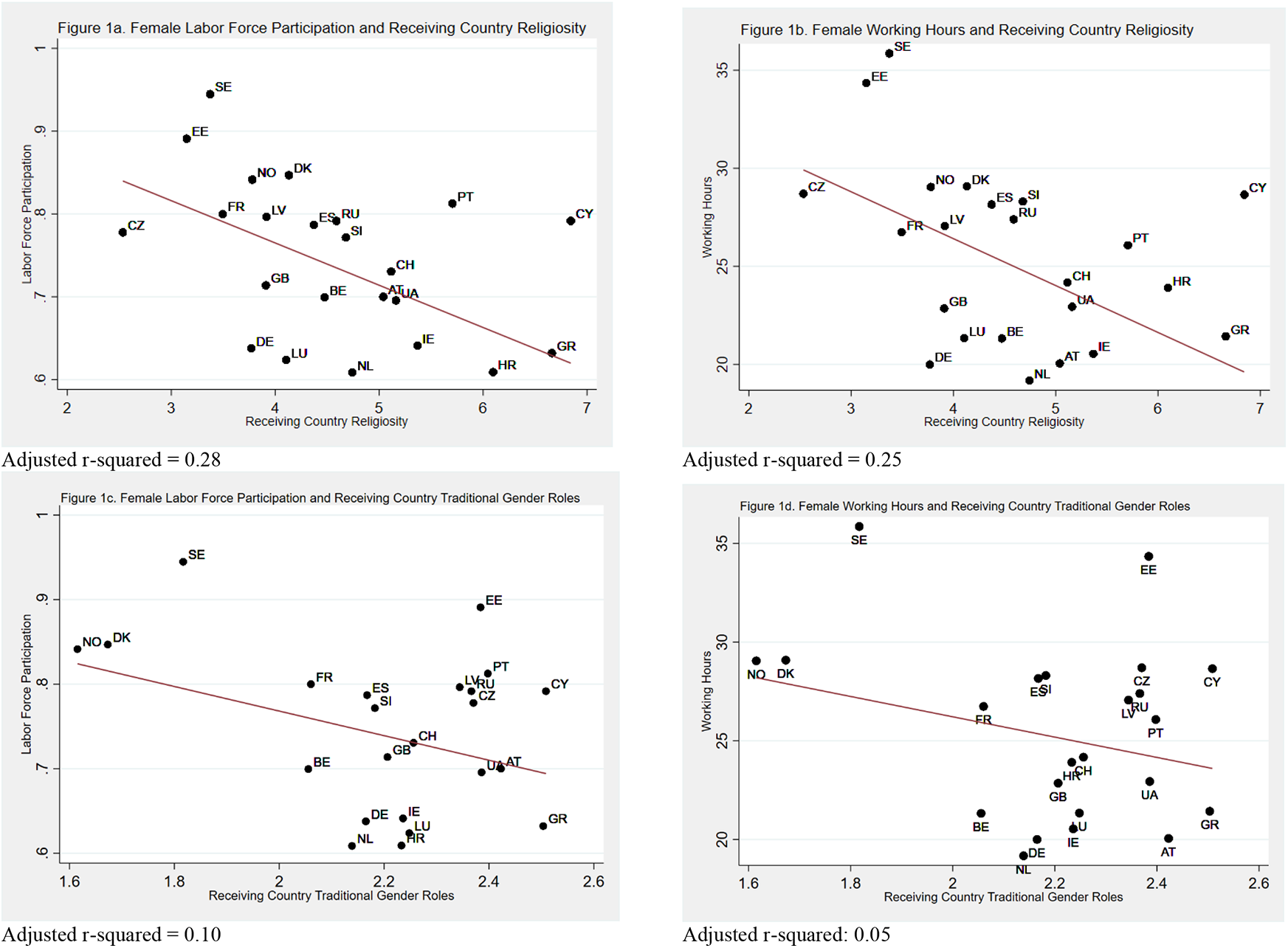
Bivariate correlations.
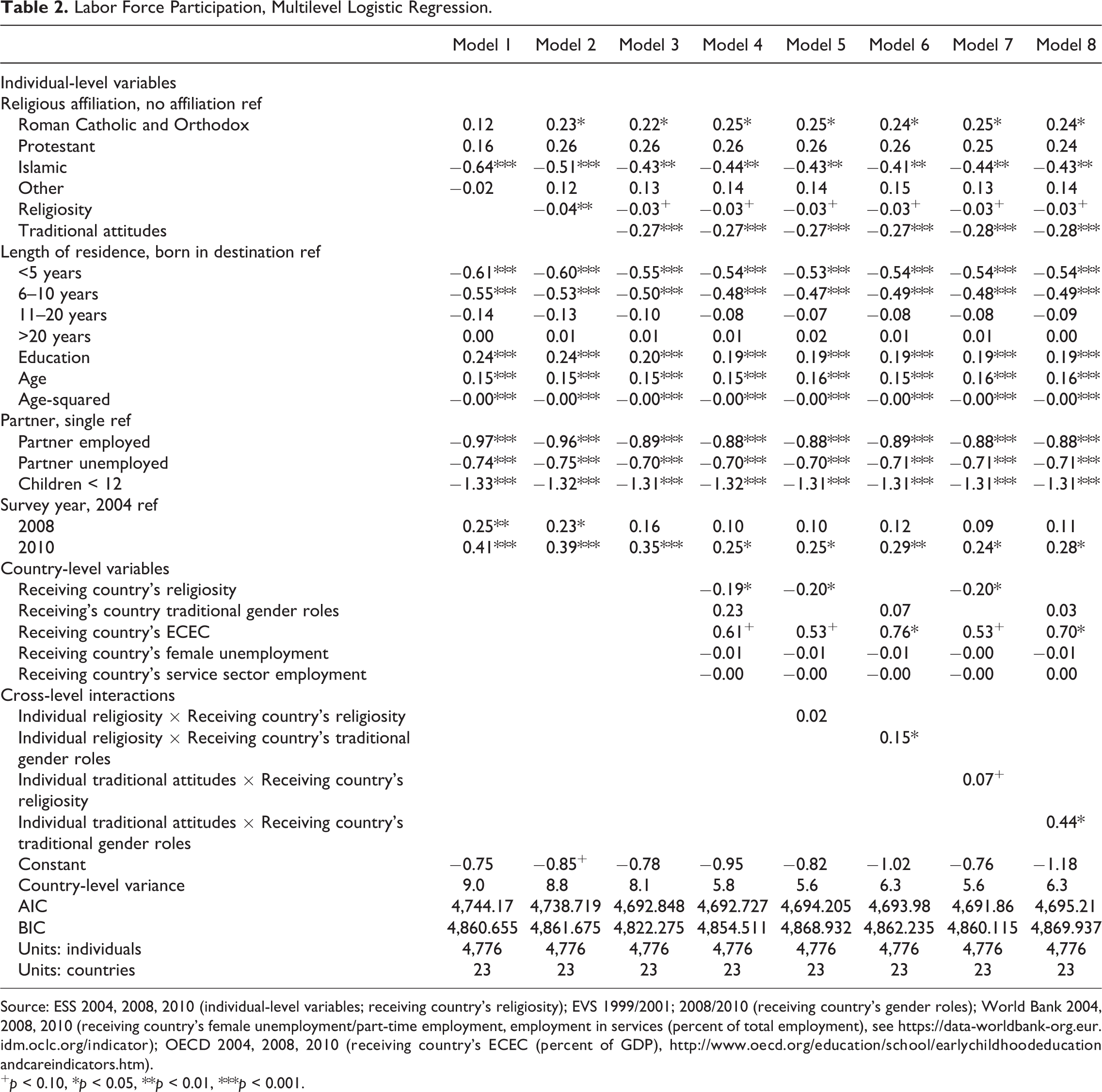
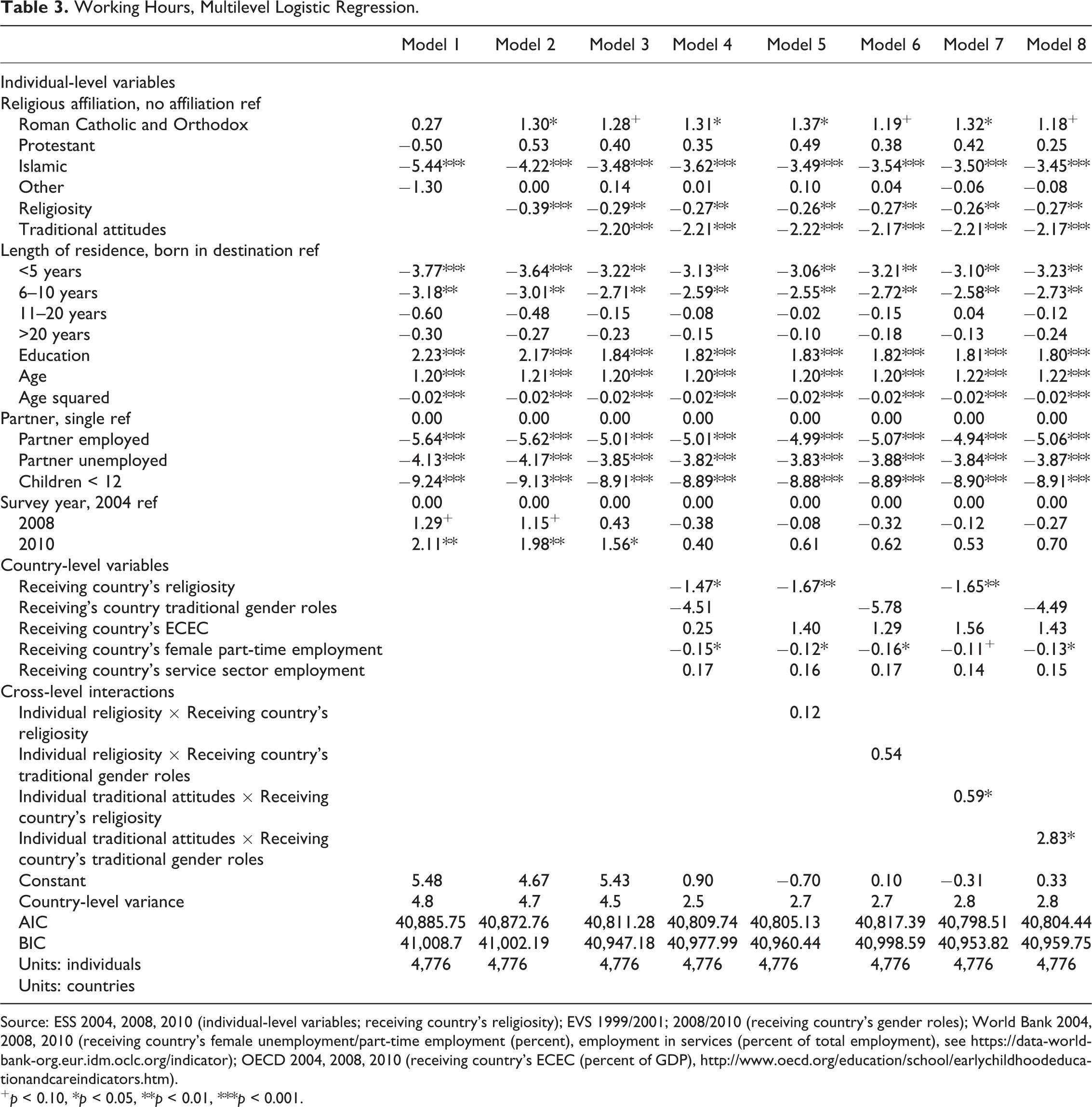
Tables 2 and 3 present the results for multilevel regressions. We first hypothesize that immigrant women with any religious affiliation, and more religious immigrant women in particular, are less likely to participate in the labor market and work fewer hours than immigrant women without religious affiliation and lower levels of religiosity (Hypothesis 1). Our results provide partial support for the role of religious affiliation and unequivocal support for religiosity in immigrant women’s economic outcomes. Model 1 (Tables 2 and 3) shows that Muslim immigrant women had significantly lower LFP and worked considerably fewer hours than immigrant women without religious affiliation. We do not find significant differences regarding other religious affiliations, however. Model 2 presents the effect of religious affiliation, net of individual religiosity, on immigrant women’s labor market outcomes. As expected, more religious immigrant women had lower LFP and worked fewer hours than less religious immigrant women. The mediation analysis reveals that religiosity explained Muslim affiliation’s effect on LFP and WH by 20 percent (95 percent CI, −.220 to −.034) and 22.6 percent (95 percent CI, −1.77 to −.69), respectively. Interestingly, after controlling for individual religiosity, the effects of Roman Catholic and Orthodox affiliation on LFP and WH significantly increased by 87 percent (95 percent CI, −.18 to −.03) and percent (95 percent CI, −1.48 to −.56), respectively. Thus, rather than mediating the effect of Catholic and Orthodox affiliations on immigrant women’s LFP and WH, religiosity suppressed this effect.
Labor Force Participation, Multilevel Logistic Regression.
Source: ESS 2004, 2008, 2010 (individual-level variables; receiving country’s religiosity); EVS 1999/2001; 2008/2010 (receiving country’s gender roles); World Bank 2004, 2008, 2010 (receiving country’s female unemployment/part-time employment, employment in services (percent of total employment), see https://data-worldbank-org.eur.idm.oclc.org/indicator); OECD 2004, 2008, 2010 (receiving country’s ECEC (percent of GDP), http://www.oecd.org/education/school/earlychildhoodeducationandcareindicators.htm).
+ p < 0.10, *p < 0.05, **p < 0.01, ***p < 0.001.
Working Hours, Multilevel Logistic Regression.
Source: ESS 2004, 2008, 2010 (individual-level variables; receiving country’s religiosity); EVS 1999/2001; 2008/2010 (receiving country’s gender roles); World Bank 2004, 2008, 2010 (receiving country’s female unemployment/part-time employment (percent), employment in services (percent of total employment), see https://data-worldbank-org.eur.idm.oclc.org/indicator); OECD 2004, 2008, 2010 (receiving country’s ECEC (percent of GDP), http://www.oecd.org/education/school/earlychildhoodeducationandcareindicators.htm).
+ p < 0.10, *p < 0.05, **p < 0.01, ***p < 0.001.
Next, we hypothesize that the negative relationship between religious affiliation and religiosity, on the one hand, and female labor market outcomes, on the other hand, is partly mediated by traditional gender-role attitudes (Hypothesis 2). Model 3 confirms this hypothesis for religiosity, but not for religious affiliation. As a start, Model 3 (Tables 2 and 3) clearly shows that traditional gender-role attitudes are negatively related to immigrant women’s LFP and WH. The effect is not only statistically significant but also substantial in size. Keeping other factors constant, immigrant women with a maximum score on traditional gender-role attitudes (3.5 percent of the sample) had 66 percent [(exp(−.27*4)−1)*100] lower odds of LFP and worked 8.8 (−2.20*4) fewer hours than immigrant women with a minimum score (8.2 percent of the sample).
In line with Hypothesis 2, we find that the negative relationship between religiosity and female LFP was significantly reduced by 30 percent after controlling for traditional gender-role attitudes (95 percent CI, −.02 to −.01). Likewise, the negative relationship between religiosity and female WH is significantly reduced by 25 percent (95 percent CI, −.13 to −.05) when controlling for traditional gender-role attitudes. These results suggest that religious immigrant women were more likely to endorse traditional gender-role attitudes, either because they internalized these attitudes or because their partner or religious community enforced such attitudes. However, the religiosity coefficient’s remaining significance also suggests that gender-role attitudes were not the only channel through which religiosity influenced immigrant women’s labor outcomes.
Regarding religious affiliation, the mediation analysis reveals that gender-role attitudes explained about 17 percent of Muslim affiliation’s effect on LFP and WH (95 percent CI, −.15 to −.02 for LFP and 95 percent CI, −1.24 to −.14 for WH). Muslim affiliation’s significant effect on female LFP and WH, net of individual religiosity and gender-role attitudes, and other socio-demographic variables suggests a persisting economic disadvantage for Muslim immigrant women. One concern with the current analyses, however, is that we do not control for immigrants’ origin country and ethnicity, which may partly explain Muslim affiliation’s negative effect. Researchers have shown that female immigrants’ labor market outcomes vary substantially by origin country, with women from less-developed and more gender-traditional countries facing the most considerable labor market disadvantages (Antecol 2000, 2001; OECD 2018). Therefore, we reran the analyses, including immigrants’ geographical origin (Heath, Schneider, and Butt 2016), but the results remained substantially the same. We do not find any significant differences among immigrant-origin groups, while Muslim affiliation’s effect remains unchanged. The final analyses do not control for immigrants’ geographical origin because of missing values in this measure. Another possible explanation for Muslim immigrant women’s disadvantage could be a high level of discrimination against Muslims in European countries (Foner and Alba 2008). For example, about one-third of Muslim immigrant women in our sample perceived themselves to belong to a group discriminated against. This perception was considerably lower among other religious denominations, varying between 17.7 percent (Protestants) and 14.1 percent (Atheists). Therefore, we reran our analyses with an additional control variable, “belonging to a group being discriminated against,” but the results remained robust.
Turning to the effects of country-level predictors, we hypothesize that immigrant women who moved to more religious and less gender-egalitarian contexts would have lower levels of LFP and work fewer hours than women who moved to less religious and more gender-egalitarian contexts (Hypotheses 3). Our results only partly support this hypothesis. Specifically, Model 4 (Tables 2 and 3) shows that the receiving country’s religiosity was associated with lower levels of immigrant women’s LFP and WH (b = −.19, p < .05 and b = −1.47, p < .05 in Model 4, Table 2 and 3). The effect of religious context was not only statistically significant but also relevant. For example, the odds of LFP among immigrant women living in the most religious society in our sample, Greece, were [100*(exp(−.19* 4.95)−1)] 61 percent smaller than for immigrant women who moved to the least religious society, Czech Republic, holding other aspects constant. However, there is no evidence that net of the receiving-context religiosity, country-level gender roles are significantly related to female labor market outcomes. 7 Regarding the control variables’ effects, there is some evidence that the odds of LFP were significantly higher in countries where a higher percentage of GDP was spent on ECEC (Model 4, Table 2). Likewise, immigrant women tended to work fewer hours in countries with a higher share of female part-time employment (Model 4, Table 3).
Finally, Models 5 through 8 (Tables 2 and 3) present the results concerning Hypothesis 4 that the receiving country’s religiosity and gender roles have a stronger influence on labor market outcomes among nonreligious and gender-egalitarian immigrant women than among religious and gender-traditional immigrant women. Our results provide unequivocal support for this hypothesis, as indicated by positive cross-level interaction effects between individual- and country-level religiosity and traditional gender roles. Specifically, Model 6 (Table 2) shows that religious immigrant women had significantly lower LFP than nonreligious immigrant women. However, the negative relationship between individual religiosity and female LFP was significantly weaker in more gender-traditional contexts, implying that the gap in LFP between religious and nonreligious immigrant women is smaller in gender-traditional than in gender-egalitarian contexts. We interpret this finding as caused by the receiving country’s stronger influence on nonreligious immigrant women who decrease their LFP with the receiving country’s increasing religiosity.
Likewise, we find support for Hypothesis 4 regarding the relationship between individual gender-role attitudes and country-level religiosity (Model 7, Tables 2 and 3) and gender roles (Model 8, Tables 2 and 3). Specifically, immigrant women with traditional gender-role attitudes had significantly lower LFP and WH than women with egalitarian gender-role attitudes. Moreover, the negative relationship between traditional gender-role attitudes and women’s LFP and WH was weaker in religious and gender-traditional countries.
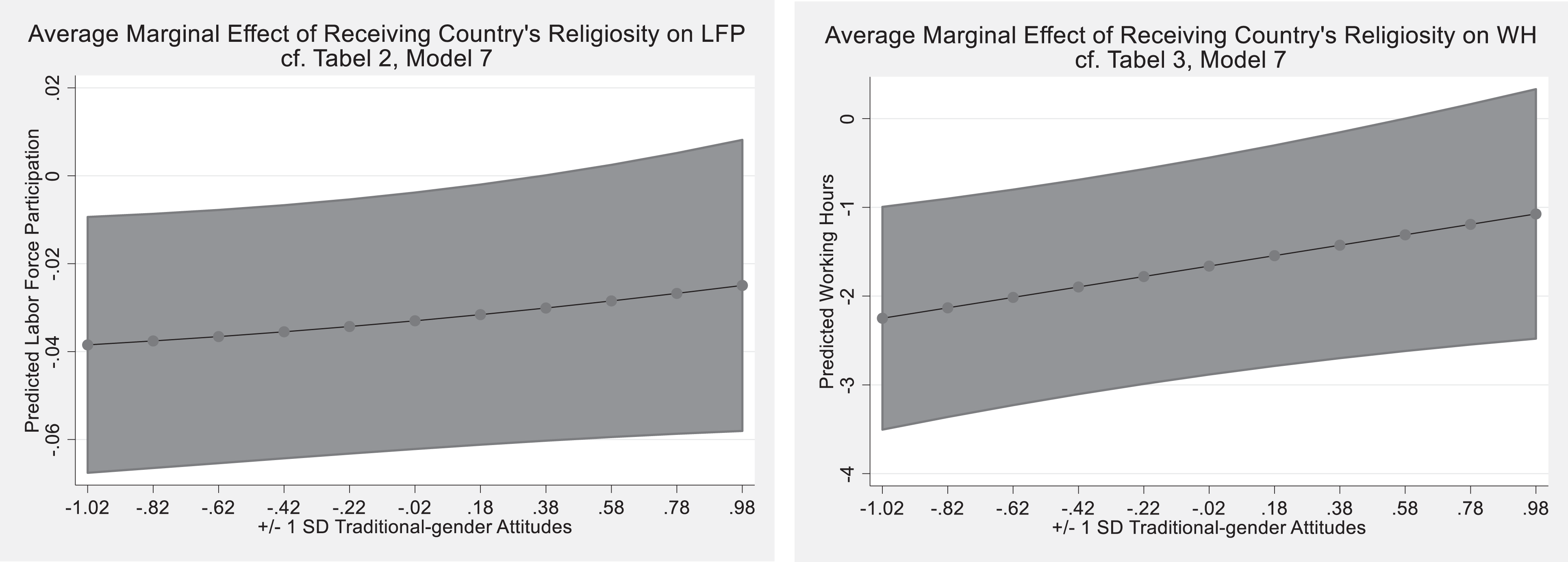
To provide a graphical illustration of these findings, Figures 2a and 2b present average marginal effects of the association between the receiving country’s religiosity and immigrant women’s LFP and WH at different values of individual gender-role attitudes (we apply command margins and marginsplot in Stata 15). The marginal effects estimation considers the interaction and main effects and is calculated separately at different levels of traditional gender-role attitudes (ranging between ± 1 SD) while holding other variables at their means. Consistent with results in Tables 2 and 3 (Model 7), the receiving country’s religiosity is negatively related to immigrant women’s LFP and WH. When comparing women with different levels of traditional-gender attitudes, the effect of country’s religiosity is more substantial and statistically significant for gender-egalitarian women than for gender-traditional women. On average, the estimates in Figure 2a and 2b suggest that country’s religiosity is associated with a 4 percentage points decrease in the probability of LFP and a 2.3 decrease in WH among gender-egalitarian women and 2.5 percentage points decrease in the probability of LFP and a 1.1 decrease in WH for gender-traditional women.
Sensitivity Analyses
To assess the robustness of the country-level results, we carried out several sensitivity analyses. Given our small country-level sample, a first robustness check addressed concerns about potential, influential cases (i.e., countries). Three countries appeared as influential cases, as indicated by DFBETAS values above
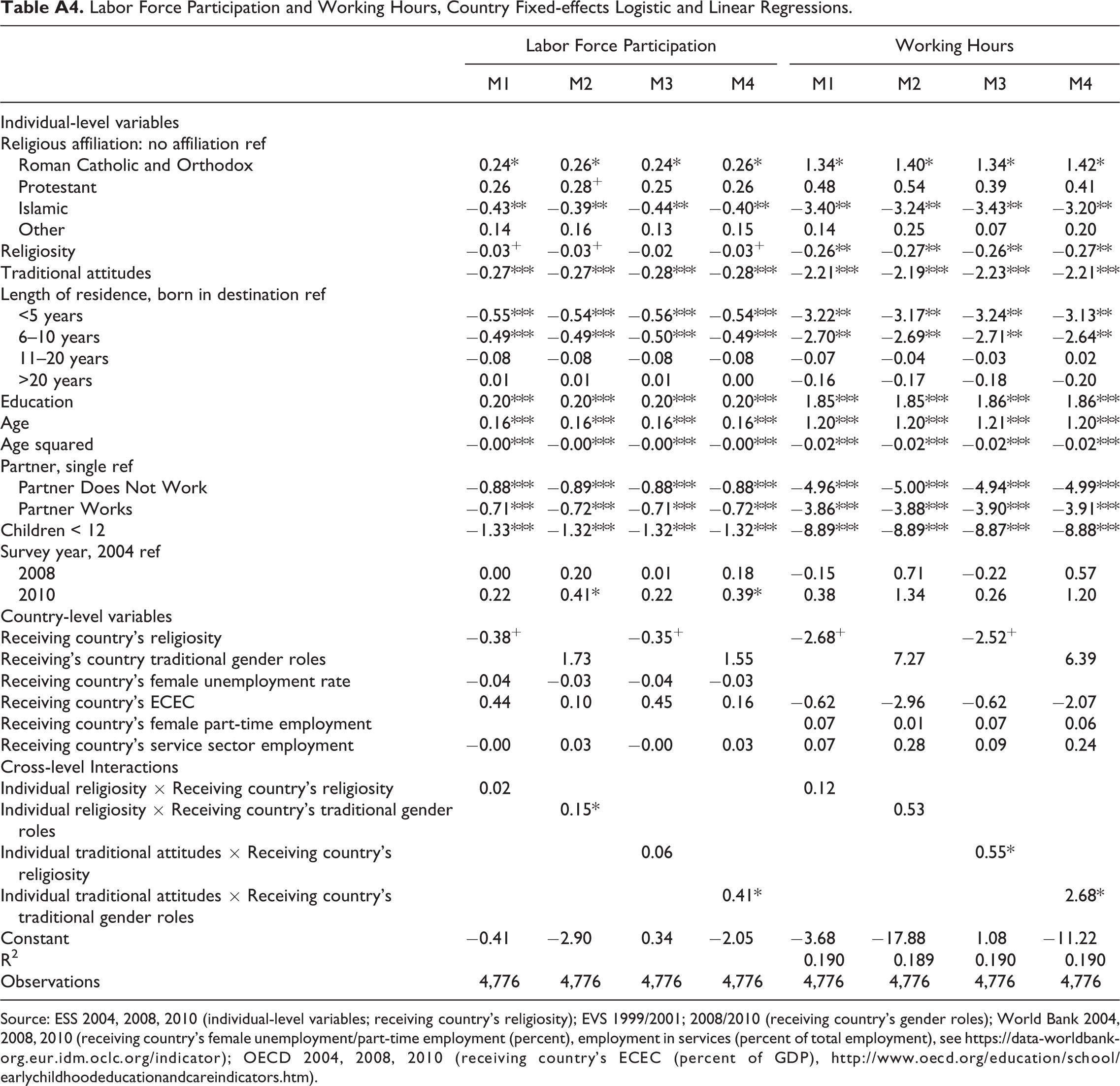
A second sensitivity check is related to the modeling approach to estimate cross-level interactions. A growing body of research suggests that the estimates of country-level effects may be unreliable when the number of level-two units (countries) is small (Bryan and Jenkins 2015). We, therefore, reran our analyses, using an alternative approach — namely, logistic and linear regressions with country fixed effects and four cross-level interactions (Giesselmann and Schmidt-Catran 2018). Note that by including country fixed effects, we fully control for country-specific characteristics, which may influence female labor market participation but could not be included in the multilevel analyses because of a small number of countries. Importantly, our results (presented in Table A4 in the Appendix) are robust to the alternative modeling strategy. Thus, we confirm our conclusions about the role of the receiving country’s religiosity and gender roles in LFP and WH of immigrant women with different religiosity and gender-role attitudes.
Third, the ESS-8 Data 2016 includes one of the items measuring traditional gender-role attitudes used in the analyses (i.e., Men should have more right to a job than women when jobs are scarce), providing us with an opportunity to replicate our analyses with more recent data. The results were overall similar to those based on the current sample, with two exceptions. The positive interaction between individual gender-role attitudes and the country’s religiosity on LFP and WH did not reach statistical significance (c.f., Model 7 in Tables 2 and 3). These results could be driven by the fact that we could only use one item to measure individual gender-role attitudes. We, therefore, decided not to use the ESS-8 Data 2016 in the final analyses.
Fourth, we compared our findings for the individual- and country-level religiosity with alternative specifications that measure religiosity by frequency of religious attendance and praying. We also tested an alternative specification of country-level gender roles that uses ESS items. Replicating Models 5–8 did not alter our main conclusions, except for one cross-level interaction between individual-level religiosity and country-level gender roles on LFP (c.f., Model 6, Table 2), which was insignificant when using any of the alternative measures. Fifth, in our analyses on WH, unemployed or inactive immigrant women were set to zero working hours. To see whether our results are sensitive to this specification, we reran analyses on WH with unemployed and inactive women excluded from the sample (N = 1,490). The results are robust to these sample restrictions.
Finally, when selecting the analytical sample, we followed an OECD definition of the working-age population (i.e., people aged 15 to 64 years). We, therefore, reran our analyses to see whether using the general working population (i.e., people aged 20 to 64 years) changed our conclusions, but the results remained unaffected. It should be noted that because women who were enrolled in education at the time of the survey are excluded from the sample, increasing the age cut-off point to 20 decreased our sample by less than 1.6 percent.
Conclusions and Discussion
This article contributes to research on immigrant integration by examining how European receiving countries’ religiosity and gender roles influence immigrant women’s labor market outcomes. Moreover, we extend theoretical work on the receiving country’s importance for immigrant women’s economic outcomes by hypothesizing and testing whether receiving countries’ influence varies across women with different religiosity and traditional gender-role attitudes. In line with previous findings based on a few immigrant groups in a single context (Read 2004a, 2004b; Khoudja and Fleischmann 2015a), we find that religious immigrant women were less likely to participate in European labor markets and worked fewer hours than nonreligious immigrant women. This negative relationship between individual religiosity and immigrant women’s labor participation is partly explained by religious immigrant women’s more traditional gender-role attitudes.
Interestingly, for the majority of religious groups in Europe, religious affiliation had no significant effect on immigrant female labor market outcomes. The exception is Muslim affiliation, which had a persisting negative impact on immigrant women’s labor market outcomes, even after taking into account individual religiosity and gender-role attitudes, as well as many socio-demographic variables. This finding suggests the significance of structural barriers in the labor market, beyond immigrant women’s personal preference and cultural norms, for their economic outcomes. It also confirms previous research suggesting high levels of discrimination faced by Muslim immigrant women in European societies (Foner and Alba 2008; Weichselbaumer 2016).
One of the most significant findings from this article concerns the impact of the receiving country’s religiosity and gender roles on immigrant women with different levels of religiosity and traditional-gender attitudes. We find that migration to countries with high levels of native religiosity is associated with decreased odds of immigrant women’s LFP and fewer WH. We also find that the influence of the receiving country’s religiosity and gender roles is significantly weaker for religious and gender-traditional immigrant women than for nonreligious and gender-egalitarian women, as indicated by positive cross-level interaction terms. These findings suggest that the economic benefits for immigrant women of moving to countries that support female employment are limited to those women who are ready and positioned to embrace gender-egalitarian norms and values. As argued earlier, for religious women, adhering to traditional gender roles might be essential for maintaining their religious and ethnic identity and close ties to ethnic and religious networks that share traditional values (Lehrer 1995; Read 2004a, 2004b; Diehl, Koenig, and Ruckdeschel 2009). Although our research is limited to cultural factors, it suggests that the receiving country’s constrained ability to influence religious and gender-traditional immigrant women could potentially amplify their disadvantage in the labor market.
It could be that, rather than being influenced by the receiving country’s norms and values, immigrant women select destination countries whose religiosity and gender roles match their own individual preferences. For example, gender-egalitarian women may move to less religious and gender-egalitarian countries, leading to an overestimation of the receiving country’s influence. There are at least two reasons why immigrant women’s selectivity is less likely to affect our conclusions. First, the selection explanation assumes that immigrant women are free to move. While some immigrant women may choose their destination, for many, entry to the European labor markets is restricted by visa requirements (European Union 2011). Thus, immigrant women’s destination country is not necessarily their preferred one but rather a preferred country among those with lower visa restrictions (Cohen, Haberfeld, and Kogan 2011; Kanas and Steinmetz 2020). Another reason is that immigrant women often migrate for family reasons, with a small number of immigrant women seeking international protection (European Union 2011). As such, their immigration decision is influenced by existing ties in the destination country rather than by the country’s cultural norms and values (Kanas and Steinmetz 2020). Second, controlling for immigrant women’s preferences regarding gender roles, we show that, contrary to selectivity arguments, residing in a religious and gender-traditional country had a weaker influence on religious and gender-traditional than nonreligious and gender-egalitarian women.
We suggest two theoretical and methodological improvements for future research. First, since this article focused on one channel through which religion affects immigrant women’s labor market outcomes — traditional gender-role attitudes, a study that incorporates more complex mechanisms would be fruitful for further investigation. For instance, it could be that immigrant women with traditional gender-role attitudes are less likely to invest in human capital, limiting their chances in the labor market (Blau and Kahn 2015). Women coming from more traditional countries also often have higher intraethnic marriage rates (Kalmijn and Van Tubergen 2010) and move to ethnic enclaves, suggesting the importance of religious and ethnic community for immigrant women labor market outcomes (Read 2003).
Second, our analysis of additional country-level variables reveals other institutional influences on immigrant women’s labor market outcomes. There is some indication, for example, that family policy supporting women’s employment, such as spending on early childcare, is positively related to immigrant women’s labor force participation. In contrast, the share of female part-time work is negatively associated with female working hours. Future research, relying on a larger number of countries, should consider a broader selection of institutional influences (i.e., child care provision, length of maternity leave) and whether these institutions are equally important for different types of women. A crucial task for future research, thus, is to establish these broader contextual influences on immigrant women’s labor market outcomes and their possible interactions with individual characteristics.
Footnotes
Appendix
Labor Force Participation and Working Hours, Country Fixed-effects Logistic and Linear Regressions.
| Labor Force Participation | Working Hours | |||||||
|---|---|---|---|---|---|---|---|---|
| M1 | M2 | M3 | M4 | M1 | M2 | M3 | M4 | |
| Individual-level variables | ||||||||
| Religious affiliation: no affiliation ref | ||||||||
| Roman Catholic and Orthodox | 0.24* | 0.26* | 0.24* | 0.26* | 1.34* | 1.40* | 1.34* | 1.42* |
| Protestant | 0.26 | 0.28+ | 0.25 | 0.26 | 0.48 | 0.54 | 0.39 | 0.41 |
| Islamic | −0.43** | −0.39** | −0.44** | −0.40** | −3.40** | −3.24** | −3.43** | −3.20** |
| Other | 0.14 | 0.16 | 0.13 | 0.15 | 0.14 | 0.25 | 0.07 | 0.20 |
| Religiosity | −0.03+ | −0.03+ | −0.02 | −0.03+ | −0.26** | −0.27** | −0.26** | −0.27** |
| Traditional attitudes | −0.27*** | −0.27*** | −0.28*** | −0.28*** | −2.21*** | −2.19*** | −2.23*** | −2.21*** |
| Length of residence, born in destination ref | ||||||||
| <5 years | −0.55*** | −0.54*** | −0.56*** | −0.54*** | −3.22** | −3.17** | −3.24** | −3.13** |
| 6–10 years | −0.49*** | −0.49*** | −0.50*** | −0.49*** | −2.70** | −2.69** | −2.71** | −2.64** |
| 11–20 years | −0.08 | −0.08 | −0.08 | −0.08 | −0.07 | −0.04 | −0.03 | 0.02 |
| >20 years | 0.01 | 0.01 | 0.01 | 0.00 | −0.16 | −0.17 | −0.18 | −0.20 |
| Education | 0.20*** | 0.20*** | 0.20*** | 0.20*** | 1.85*** | 1.85*** | 1.86*** | 1.86*** |
| Age | 0.16*** | 0.16*** | 0.16*** | 0.16*** | 1.20*** | 1.20*** | 1.21*** | 1.20*** |
| Age squared | −0.00*** | −0.00*** | −0.00*** | −0.00*** | −0.02*** | −0.02*** | −0.02*** | −0.02*** |
| Partner, single ref | ||||||||
| Partner Does Not Work | −0.88*** | −0.89*** | −0.88*** | −0.88*** | −4.96*** | −5.00*** | −4.94*** | −4.99*** |
| Partner Works | −0.71*** | −0.72*** | −0.71*** | −0.72*** | −3.86*** | −3.88*** | −3.90*** | −3.91*** |
| Children < 12 | −1.33*** | −1.32*** | −1.32*** | −1.32*** | −8.89*** | −8.89*** | −8.87*** | −8.88*** |
| Survey year, 2004 ref | ||||||||
| 2008 | 0.00 | 0.20 | 0.01 | 0.18 | −0.15 | 0.71 | −0.22 | 0.57 |
| 2010 | 0.22 | 0.41* | 0.22 | 0.39* | 0.38 | 1.34 | 0.26 | 1.20 |
| Country-level variables | ||||||||
| Receiving country’s religiosity | −0.38+ | −0.35+ | −2.68+ | −2.52+ | ||||
| Receiving’s country traditional gender roles | 1.73 | 1.55 | 7.27 | 6.39 | ||||
| Receiving country’s female unemployment rate | −0.04 | −0.03 | −0.04 | −0.03 | ||||
| Receiving country’s ECEC | 0.44 | 0.10 | 0.45 | 0.16 | −0.62 | −2.96 | −0.62 | −2.07 |
| Receiving country’s female part-time employment | 0.07 | 0.01 | 0.07 | 0.06 | ||||
| Receiving country’s service sector employment | −0.00 | 0.03 | −0.00 | 0.03 | 0.07 | 0.28 | 0.09 | 0.24 |
| Cross-level Interactions | ||||||||
| Individual religiosity × Receiving country’s religiosity | 0.02 | 0.12 | ||||||
| Individual religiosity × Receiving country’s traditional gender roles | 0.15* | 0.53 | ||||||
| Individual traditional attitudes × Receiving country’s religiosity | 0.06 | 0.55* | ||||||
| Individual traditional attitudes × Receiving country’s traditional gender roles | 0.41* | 2.68* | ||||||
| Constant | −0.41 | −2.90 | 0.34 | −2.05 | −3.68 | −17.88 | 1.08 | −11.22 |
| R2 | 0.190 | 0.189 | 0.190 | 0.190 | ||||
| Observations | 4,776 | 4,776 | 4,776 | 4,776 | 4,776 | 4,776 | 4,776 | 4,776 |
Source: ESS 2004, 2008, 2010 (individual-level variables; receiving country’s religiosity); EVS 1999/2001; 2008/2010 (receiving country’s gender roles); World Bank 2004, 2008, 2010 (receiving country’s female unemployment/part-time employment (percent), employment in services (percent of total employment), see https://data-worldbank-org.eur.idm.oclc.org/indicator); OECD 2004, 2008, 2010 (receiving country’s ECEC (percent of GDP), http://www.oecd.org/education/school/earlychildhoodeducationandcareindicators.htm).
Authors’ Note
Both authors contributed equally to this work and are listed alphabetically.
Acknowledgment
An earlier version of this manuscript was presented at the International Sociological Association RC28 Spring Meeting in Frankfurt, Germany (March 21–23, 2019), Fourth International ESS Conference, Mannheim University (April 15–17, 2019), and the ISOL seminar in Amsterdam, the Netherlands (May 29, 2019).
Declaration of Conflicting Interests
The author(s) declared no potential conflicts of interest with respect to the research, authorship, and/or publication of this article.
Funding
The author(s) received no financial support for the research, authorship, and/or publication of this article.
