




Abstract
There is considerable variation in research explaining household solar-panel investment, leading to mixed evidence regarding influences of income and capital. We provide analysis aiding interpretation of economic influences on solar-panel uptake in other studies. We conduct a meta-regression using 234 papers to provide analytical insights focusing on economic influences on solar-panel investment. We find that the research approach and context explain a range of income influences. More specifically, studies using household-level data are less likely to find negative income impacts compared to studies using aggregate data. Developing-country studies have been less likely to include income; but when income is included, developing-country studies have been more likely to find a significant link from income to solar-panel uptake. Capital (e.g., asset) impacts are nearly always positive and significant when included, but only 22 percent of analyzed studies included a relevant variable. Our concluding policy discussion suggests greater focus on assets for means testing.
1. Introduction
Household solar-panel investment is growing strongly in many countries, offering an approach to reduce risk related to climate change and address energy affordability issues for households (International Energy Agency 2022). The importance of household solar-panel investment is evident when considering the massive potential across millions of households in many countries. Recognizing this potential, governments often subsidize household adoption of solar panels, and further policy development is likely. However, there has been considerable variation in research contexts and findings when it comes to household solar-panel investment, meaning that there is a lack of a reliable foundation for formulation of policies which support low-income or low-wealth households. Our meta-regression therefore seeks to clarify key areas of inconsistencies for explaining the impact of income and wealth on household solar-panel uptake: we examine (i) why there is so much diversity in income impacts (Balta-Ozkan, Yildirim and Connor 2015; Best 2023; Best, Burke and Nishitateno 2019b; Dong, Wiser and Rai 2018); (ii) which types of studies include household capital; and (iii) which types of studies include explanatory variables for the upfront cost of solar panels, as well as resulting implications for research and policy.
Specifically, the aim of the paper is to offer a systematic review of prior research to provide analytical contributions. We provide a meta-regression analysis for 234 prior papers identified through a systematic review process, focusing on the key economic determinants of household income and variables related to capital. A key definitional issue is that income is a flow variable. Capital, assets, and wealth, in contrast, are examples of stock variables. From a theoretical perspective, understanding core economic aspects of income and wealth effects is a crucial complement for solar-uptake studies using social theories, such as the Theory of Planned Behaviour (Wolske, Stern and Dietz 2017). In addition, our paper aims to help with understanding the results of prior literature, and to provide an agenda with key issues for future studies on household solar-panel uptake. For impact, enhanced understanding of economic determinants can lead to improved policies which can support more households in installing solar panels.
In support of the overall aim of our paper, we build on systematic reviews and analysis which have begun to add knowledge on solar-uptake determinants. For example, a study by Alipour et al. (2020) classified predictors and provided a taxonomy. A follow-up review also detailed the types of methods used in prior studies, along with the theories discussed in prior papers (Alipour et al. 2021). Another paper on intentions, and not actual uptake, found that only eight studies of intentions provided correlations which were suitable for the chosen type of meta-analysis (Schulte et al. 2022).
This study instead focuses on economic influences, which are likely to be particularly relevant for policymaking, in contrast to a smaller prior meta-analysis which focused on the socio-demographic aspects of education and ethnicity (Best, Marrone and Linnenluecke 2023). Our research question on whether income and capital drive solar panel adoption, which has not been analyzed in prior reviews or meta-analysis, is crucial for policy formulation as an increasing number of governments use income and capital thresholds for their solar adoption policies. We cover both actual uptake and intentions. Instead of assessing correlations, we use categorical variables that we define based on the sign of relationships (positive, negative, or insignificant) or the inclusion/exclusion of key aspects. While income and capital are important for policy formulation, we also acknowledge the broader context for policymakers, which can include aspects such as promoting sustainability in circular business models (Van Opstal and Smeets 2023).
Our analysis has three major findings: First, our results suggest that omission of capital variables may be an important issue. Section 3.4 shows that most studies omit capital variables, but that positive and significant results for capital variables are nearly always found when included. The lack of research investigating capital variables has the important implication that policy guidance is also less substantial than it could be if more research were to be available.
Second, our results suggest that studies using household-level data are more likely to find positive impacts of income compared to studies using aggregate data. Aggregation issues can be present where data is aggregated to group levels such as census tracts, census blocks, or zip-codes. It is possible that results at these aggregated levels are different to what would be obtained using a household level of analysis (Banzhaf, Ma and Timmins 2019). Whilst there has been related awareness for some time in various fields (Robinson 1950), the solar-panel uptake literature rarely discusses this issue. An example where this issue has been raised is the study by Palm (2020), which notes that income results could differ based on the aggregation level. The issue is also evident in a study of a single country (Best and Chareunsy 2022). In contrast, we provide meta-regressions to analytically investigate the potential for aggregation issues. This can inform understanding of past and future research, because we identify links between aggregation and research outcomes.
Third, our results suggest that studies of intended solar-panel uptake are more likely to omit income and less likely to find positive income impacts, compared to studies of actual uptake. Studies of intentions can be useful to assess future interest and might be beneficial for planning purposes. However, there might be hypothetical bias, where stated intentions do not translate into actual uptake. Prior research generally considers either intentions or actual uptake, rather than both aspects within a single paper. In the small number of papers that consider both aspects, evidence has been absent that income impacts are consistent across intentions and actual uptake (Best, Burke and Nishitateno 2019a; Corbett et al. 2022; Horne, Kennedy and Familia 2021; Simpson and Clifton 2017). Meta-regressions provide a novel alternative in the absence of single studies providing comprehensive understanding of potentially different impacts of income on actual and intended solar-panel uptake. Our meta-regressions provide motivation for future studies of intended solar-panel uptake to consider strategies for overcoming hypothetical bias in relation to the impact of income on uptake.
Our results are intended to motivate future research on actual solar panel investment with household-level data and key capital variables. Our focus on the fundamental issues of income and wealth effects, along with important empirical issues, means that our analysis can also be applied more widely. For example, any household energy studies may consider possibilities of omitted variables, hypothetical bias, and aggregation issues. Our paper is structured to next give background on the systematic review context, prior to presenting the method and then our analytical insights. We conclude by offering implications for future research and policy decision-making.
2. Systematic Review Context
Our large sample and focus on analytical and policy issues for household solar-panel uptake add to contributions from prior meta studies on different energy contexts. For example, Mattmann, Logar and Brouwer (2016) produced meta-analysis of valuation studies on hydropower externalities for eighty-one observations across twenty-nine studies, finding sensitivity to scope. Menegaki et al. (2021) provided a systematic literature review of energy-economy-environment links across 162 articles, using cross-tabulation to identify research gaps. For solar panel-uptake, a meta-analysis of 157 papers found that significant effects of education and ethnicity were less likely to be found when studies use household-level data (Best, Marrone and Linnenluecke 2023).
Our novel meta study of economic influences on household solar-panel uptake, compared to different contexts in prior meta studies, requires consideration of income as a key determinant. Income has been one of the most assessed explanatory variables in the solar-uptake literature, yet there are mixed results for its impact on household solar-panel investment (Alipour et al. 2020; van der Kam et al. 2018). Theoretically, income might have a positive influence if it provides economic resources for households to afford solar panels. However, higher-income households could be less interested in solar panels to lower their electricity bills. These ideas might also combine to give a non-linear relationship where there is a peak in solar-panel uptake for the middle of the income distribution (Best, Burke and Nishitateno 2019b; Bondio, Shahnazari and McHugh 2018). Some studies have suggested that uptake in the early years by innovators and environmentalists might have been less related to income, while more recent adoption may have been more driven by economics (Jacksohn et al. 2019; Palm 2020). The lack of consistent findings across studies motivates systematic analysis in this paper.
Capital or wealth variables represent another major economic factor which can provide resources to enable households to afford solar-panel investment. We use “capital,” “assets,” and “wealth” interchangeably for our context, as these are stock variables in contrast to “income,” which is a flow variable. Capital might be particularly important for solar-panel investment, which often entails large upfront costs requiring access to accumulated resources. However, many studies do not account for capital variables (see Section 3.4).
Those prior studies that have included capital variables have used a wide variety of variables to measure capital or its components. These diverse approaches include variables such as dwelling values (Best and Esplin 2023; Best and Trück 2020; Bollinger and Gillingham 2012; Crago and Chernyakhovskiy 2017; Davidson et al. 2014; De Groote, Pepermans and Verboven 2016; Dong, Sigrin and Brinkman 2017; Halleck Vega, van Leeuwen and van Twillert 2022; Kim and Gim 2021; Kucher, Lacombe and Davidson 2020; Kwan 2012; Palm 2020; Palm and Lantz 2020; Reames 2020); land values (Lee and Hong 2019); agricultural assets (Guta 2018); having a car or bank account in a developing country (Aklin, Cheng and Urpelainen 2018; Rahut et al. 2018); accumulated savings (Aklin et al. 2018; Petrovich, Hille and Wüstenhagen 2019); pension balances (Best, Burke and Nishitateno 2019b); combined categories for financial or non-financial assets (Best, Nepal and Saba 2021); and comprehensive wealth variables (Aarakit et al. 2021; Best, Burke and Nishitateno 2019a; Best, Chareunsy and Li 2021).
The relevance of income and capital in this context is that they can help to overcome the constraint imposed by the upfront cost of acquiring solar panels. Prior studies have used a range of variables which explicitly or implicitly refer to the upfront cost. For example, some variables refer directly to the cost or price of the panels (Bollinger and Gillingham 2012; Kucher, Lacombe and Davidson 2020), while others refer to payback periods (Zander 2021) or return on investment (Dharshing 2017). However, most studies have not included a variable for the upfront cost. Omitting cost considerations from solar-panel uptake studies might skew insights on solar-uptake drivers, especially because upfront costs have changed substantially over the years.
We seek to provide new analysis which can promote both future research and future policy enhancements. Understanding of income and capital effects is crucial for researchers and policymakers and these economic resources are likely to be key determinants for empirical research. Also, policy approaches are increasingly considering income levels when determining subsidy support. Our findings on why income impacts are apparently so mixed across studies are helpful for policymakers who set policies which refer to income. Our findings on the rare use of capital variables in prior research, and possible reasons for this, promote future research on capital variables which can then inform policy formulation.
3. Data and Method
We seek to identify the main factors which help to explain the differences between prior study outcomes (Labandeira et al. 2020). While some meta studies in other energy contexts assess the magnitude of single effects with known signs (Buckley 2020; Labandeira et al. 2020), we take a broader approach. We assess reasons for different signs, as well as non-significant findings, in addition to potential reasons for inclusion or exclusion of explanatory variables. This broader focus allows us to have a larger sample size, as described in Section 3.1. Rather than investigating coefficient magnitudes, we assess each of inclusion, significance, and sign of income coefficients.
3.1. Sample Selection
This paper analyses a large sample of studies from prior literature on residential solar photovoltaic (PV) uptake. In particular, we analyze 250 studies from 234 prior papers. The specific sample selection approach is described below.
3.1.1. Eligibility Criteria
Studies were included if:
They assessed explanatory-variable determinants of solar PV adoption or related correlation assessments.
They had suitable methods for analysis. This primarily meant analyzing regression studies, structural equation modeling, and stated preference studies. We also included descriptive statistics which compared solar and non-solar groups when statistical significance was assessed.
They were peer reviewed and written in English. This excludes conference papers and other gray literature (book chapters, reports) that had not been peer reviewed.
If we found multiple eligible and distinct studies per paper, then we treated them as separate studies for our meta-analysis. “Distinct studies” in this context refers to different approaches which result in our binary explanatory variables having different values for research characteristics, as described in Section 3.3.
The equation from eligible previous papers is generally of the form:

S is the dependent variable for solar-panel uptake. Y is an explanatory variable for income, and λ is often a coefficient of interest. Other explanatory variables are in the T vector. These variables often include age and education, among other variables. This vector includes capital and upfront cost in a minority of cases. The level of aggregation
3.1.2. Exclusion Criteria
Studies were excluded for:
Installations other than solar PV.
Not allowing statistical analysis, such as with the absence of statistical significance.
Not analyzing determinants of solar PV adoption. We also excluded simulation and forecasting studies, including agent-based modeling.
Irrelevant variables with respect to our meta-analysis. We excluded studies if they did not assess variables related to solar PV adoption, or where adoption was not included as a dependent variable.
Focus on other types of analysis including economic cost-benefit analysis, environmental assessments, and technical or engineering assessments.
3.1.3. Sample Compilation
We began with the sample of 167 studies from 157 papers that was used in the equity analysis of education and ethnicity by Best, Marrone and Linnenluecke (2023). This was based on a Scopus database search, a forward/backward search, 1 and a further manual search of reference lists in existing literature reviews.
We then updated these three search strategies including: (1) a Scopus database search up to 20 August 2023; (2) a forwards/backwards search for other studies based on the reference lists of identified studies; (3) a check on reference lists in existing literature. The Scopus search was based on a detailed string. 2
We found 355 papers in 2022 and 2023 through the Scopus search on August 20, 2023. Of these, there were thirty-six papers which we added to our sample, after reviewing the title, abstract, and main text. In addition, a new forward/backward search revealed another twenty-eight relevant papers. Manual searches of key papers revealed another thirteen relevant papers. Of the seventy-seven new papers published between 2022 and 2023, six featured two distinct types of studies which both met our inclusion criteria. We included these studies separately. When added to the 167 studies from the social analysis by Best, Marrone and Linnenluecke (2023), we have a total of 250 studies for our meta-analysis. The sample selection is summarized in the flow chart in Figure 1.
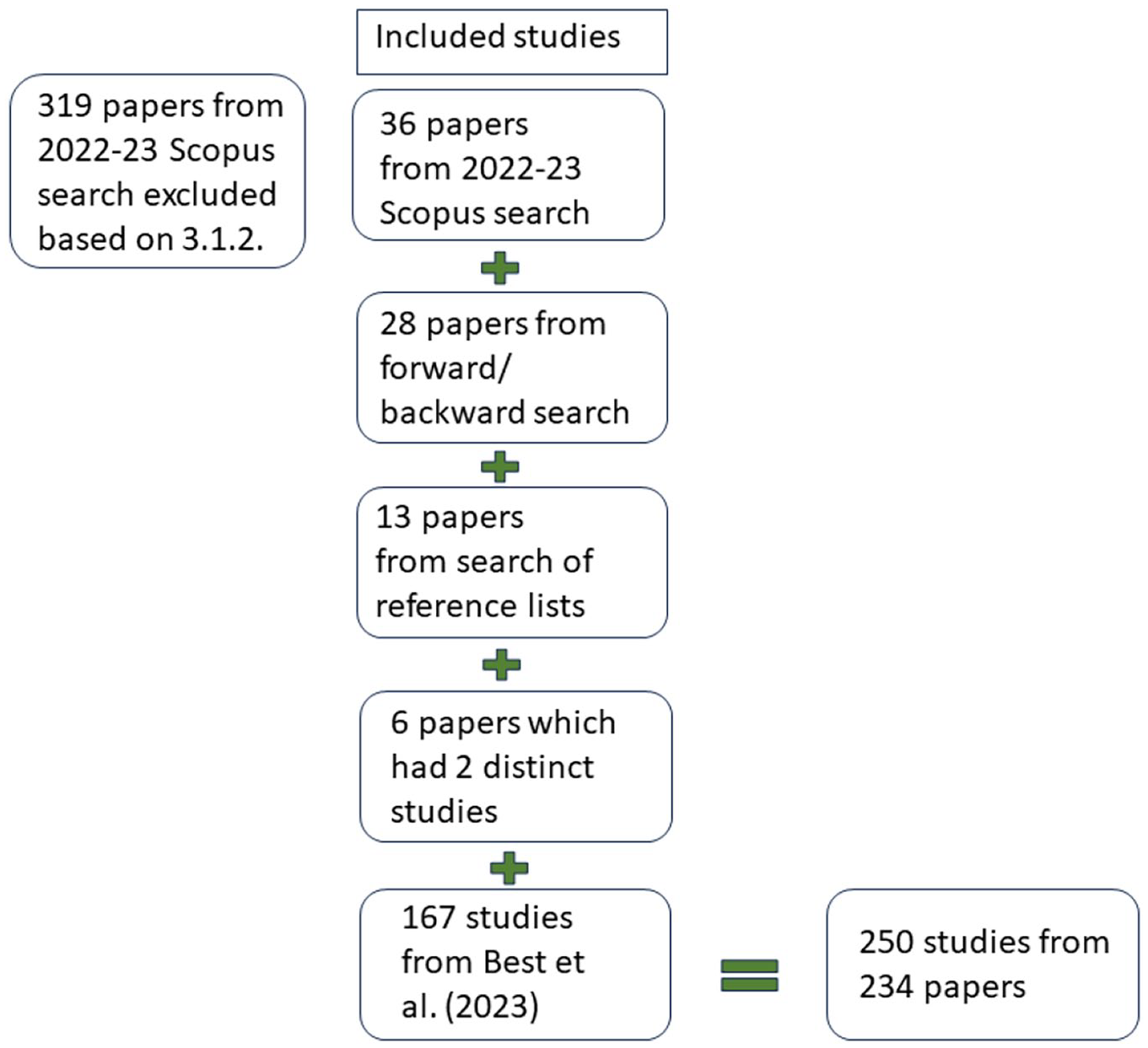
Sample selection of 250 studies from 234 papers.
3.2. Variable Construction
We construct variables for income and capital which categorize findings in prior studies as either positive, negative, insignificant, or an omission. Significance includes any statistical significance reported in each paper up to a 10 percent level. In addition, we construct a binary variable equal to one when a study controls for the upfront cost via either an explicit variable for the cost or through related variables such as payback periods or return on investment.
We also construct other variables for the inclusion of important covariates in prior studies. For example, studies which include an explicit variable distinguishing between owners and renters have a value of one for our binary renter/owner variable. Conceptually, the renter/owner variable is a useful measure for property rights constraints since renters have limited rights for property modification. We do not categorize studies as including a capital variable if they only have a binary renter/owner variable, since this dimension is separately measured in our renter/owner variable. In contrast, home values are included in the definition of capital when the magnitudes are given, because the magnitudes give an indication of the extent of wealth related to housing.
Most classifications of study findings on income or capital impacts are straightforward, although judgment is required in a minority of cases. For example, a small number of studies include variables to account for possible non-linear impacts, although it is not common for non-linear impacts to be found. One exception finds a turning point around the 95th percentile of the wealth distribution (Best, Burke and Nishitateno 2019a). Since the impact is primarily positive, with only a negative impact for around 5 percent of households, we use the main effect to classify this as a positive impact of capital. Another judgment situation is when papers show differing results with different sets of explanatory variables. For example, De Groote, Pepermans and Verboven (2016) show positive coefficients for housing values in a concise model, followed by some negative impacts in a more comprehensive model. We use the more comprehensive model to classify this paper as finding a negative impact of capital. Variable descriptions are summarized in Table 1.
Variable Descriptions.

3.3. Meta Regressions
We use regression models with the general format given in equation (2). There are three different dependent variables which we assess in separate models for prior-study income impacts, capital-variable inclusion, and inclusion of a variable for upfront cost. The type of model is based on the dependent variable, as described below. The explanatory variables in our meta-regressions can be grouped as research characteristics (H), covariates used in prior studies which are likely to be correlated with economic variables (O), and extra covariates (E). The research characteristics include binary variables for whether studies (s) are cross-sectional or temporal, on actual or intended uptake, for Organisation for Economic Co-operation and Development (OECD) or non-OECD countries, or which use aggregated or household-level data. This addresses heterogeneity, similarly to the approach of Buckley (2020), who included binary variables for study characteristics as controls. There are also numerical research characteristics for years since publication and the natural log of the sample size. Covariates from prior studies are included in some of our meta-regressions and these include binary variables for when studies include some of age, education, renting/owning status, income, peer effects, environmental concerns, and policy variables.
The first dependent variable for our meta-regression approach is a research outcome related to the impact of income on solar-panel uptake, as shown in equation (2). Studies can be classified into one of four groups for their finding on this impact: positive and significant, negative and significant, insignificant, and income omitted from the analysis. A multinomial logit model is used for this categorical dependent variable, which does not have a clear numerical ordering.

The second dependent variable for our meta-regressions is a binary variable equal to one for studies which include a capital variable when investigating influences on solar-panel uptake.

The third type of dependent variable for our meta-regressions is a binary variable equal to one for studies which control for the upfront cost. We again use a logit model. We assess the impact of research characteristics and inclusion of other covariates on the binary outcome of studies controlling for the upfront cost of solar panels. Equation (4) shows the standard logistic link function for explaining inclusion of the upfront cost of solar panels.

The research characteristics (H) are included in every meta-regression. Most meta-regressions also include key covariates of age, education, and renting (O). These covariates have been assessed in many prior studies and may be correlated with economic variables. For exploratory analysis on whether studies have included control variables for capital or upfront cost, we also include other covariates such as environmental preferences, peer effects, and policies (E). Gradually adding variables across columns allows us to assess result robustness.
3.4. Data Description: Possible Omitted Variable Bias
Omitted variable bias poses an issue for studies aiming to identify impacts of socio-economic variables on solar-panel uptake. Omitted capital variables are a leading candidate for causing omitted variable bias, based on two main reasons. One is that capital tends to be correlated with many socio-economic and demographic variables, so there might be correlation between explanatory variables and the error term in regressions which exclude capital. Second, capital is likely to have an important influence on a dependent variable of solar-panel uptake since the upfront cost can be the key constraint for microgeneration investment including solar-panel uptake (Balcombe, Rigby and Azapagic 2013).
Figure 2 shows that over 75 percent of studies do not include variables for capital when explaining solar-panel uptake. When included, capital variables nearly always have positive and significant coefficients. This is despite the wide variety of different types of capital variables in prior studies, as mentioned in Section 2. Even if studies with a binary renter/owner variable were to be included as capital variables, there would still be 65 percent of studies not including capital. Contrasting with the capital case, it is much more common for studies to include a variable for income. Findings are mixed in these studies, with positive coefficients for income being the most common, followed by insignificant outcomes. There are still a substantial number of studies finding negative impacts of income on solar-panel uptake.
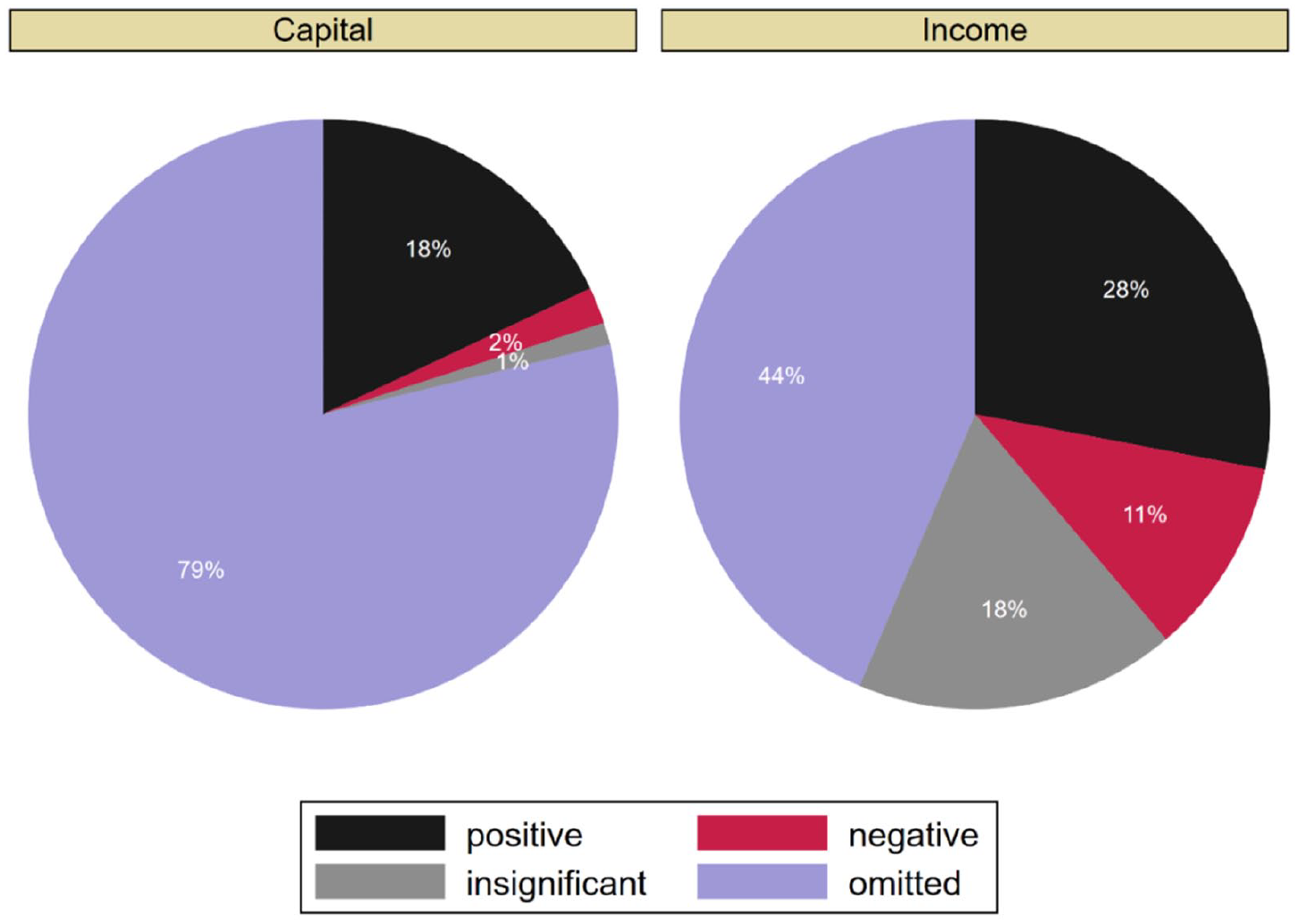
The breakdown of studies based on the relationship of either capital or income with solar-panel uptake. Both parts of the chart refer to 250 studies.
3.5. Data Description: Possible Aggregation Issues
Studies can either use data at the household level or can use data aggregated to some level. Examples of aggregated levels are census tracts, census blocks, zip codes, or postcodes. Aggregated data may be useful in giving comprehensive coverage of all solar panels in a region and can be useful for assessing variables which are defined at the corresponding area level. For example, policies which vary by postcode can be assessed effectively using postcode-level data. Also, some variables can be defined at area levels, such as the notion that peers within an area could have effects on the uptake of solar panels by others within the area. There are also possible aggregation issues, such as ecological fallacies, which are sometimes recognized in other fields (Robinson 1950). These issues are likely to be most prominent for aspects which vary across aggregated regions. These aspects include a wide range of demographic and socio-economic variables, such as income.
Figure 3 raises the possibility of aggregation issues. Studies using aggregated data are more likely to find negative rather than positive impacts of income on solar-panel uptake. In contrast, household-level studies rarely find negative and significant associations between income and solar-panel uptake. Studies using household-level data in our sample are also less likely to have income as an explanatory variable, compared to aggregated studies, despite the advantage of the household level for income, which varies across households.
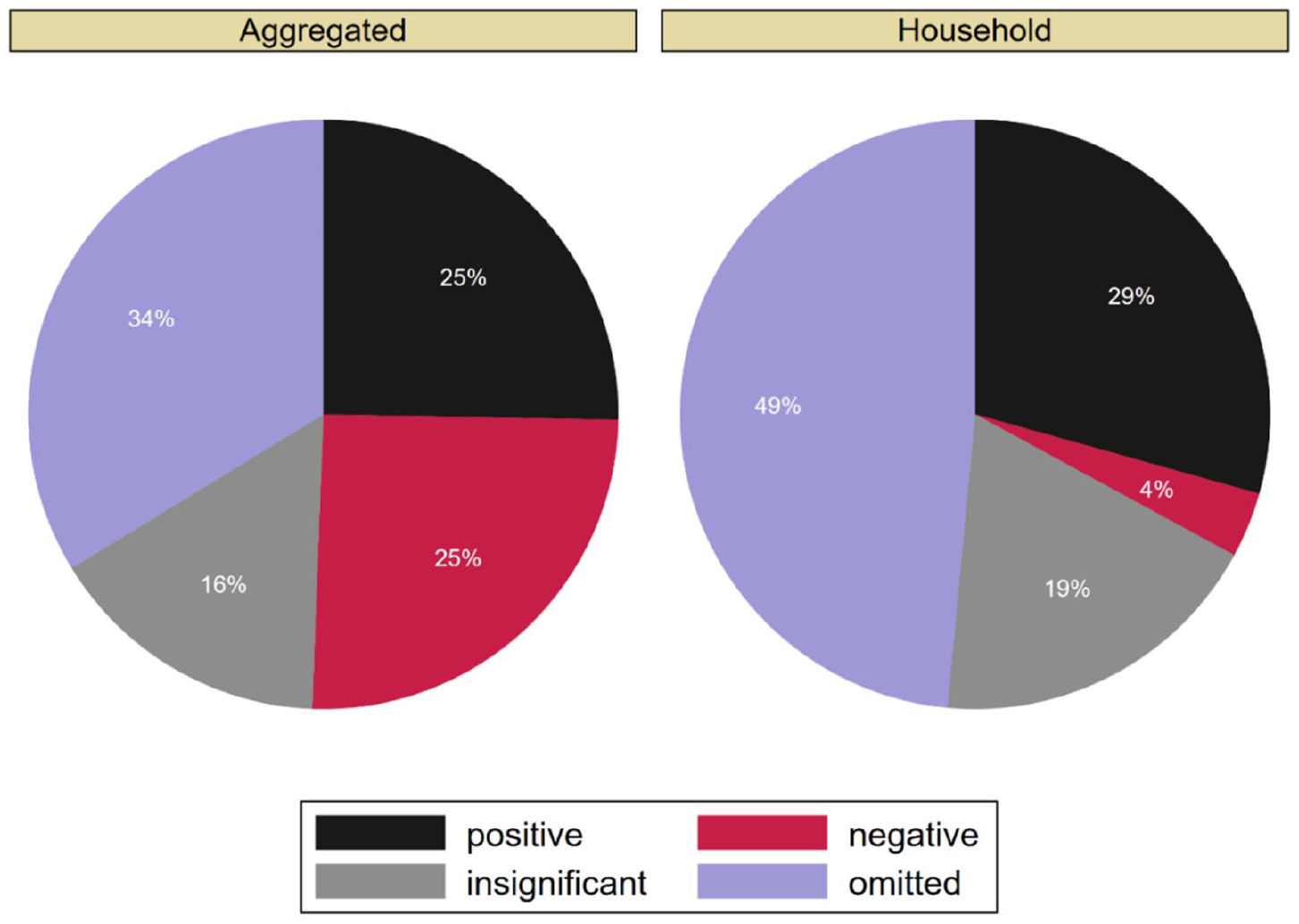
The incidence of four potential outcomes for the influence of income on solar-panel uptake for 83 studies using aggregated data and 167 studies using household-level data.
3.6. Data Description: Hypothetical Bias
Studies can either assess actual uptake of solar panels which has already happened, or they can assess future intentions. Investigations of intentions have the advantage of being forward looking, which might be useful for policymakers and system planners, although there can also be hypothetical bias. There is a caveat for expressions of intentions, given that at least some intended installations will not actually happen. People may experience changed circumstances or changes in preferences which imply a difference between some intentions and subsequent actions. It is therefore possible that the impact of income on intended uptake will differ from the impact on actual uptake. For instance, it is possible that expressions of intentions will not involve adequate consideration of the cost of solar-panel installation and how this relates to households being able to access economic resources.
Figure 4 gives an indication that studies produce different findings on the impact of income on solar-panel uptake, according to whether the uptake is actual or intended. Income is assessed in nearly 75 percent of studies investigating actual uptake of solar panels. A positive and significant impact of income on solar-panel adoption is the most common occurrence. However, there are still mixed outcomes across studies, with each of the four possibilities being relatively common. In contrast, most studies of intended uptake do not include a variable for income in the quantitative analysis. When included, income is most often found to be insignificant for these studies of intended uptake.
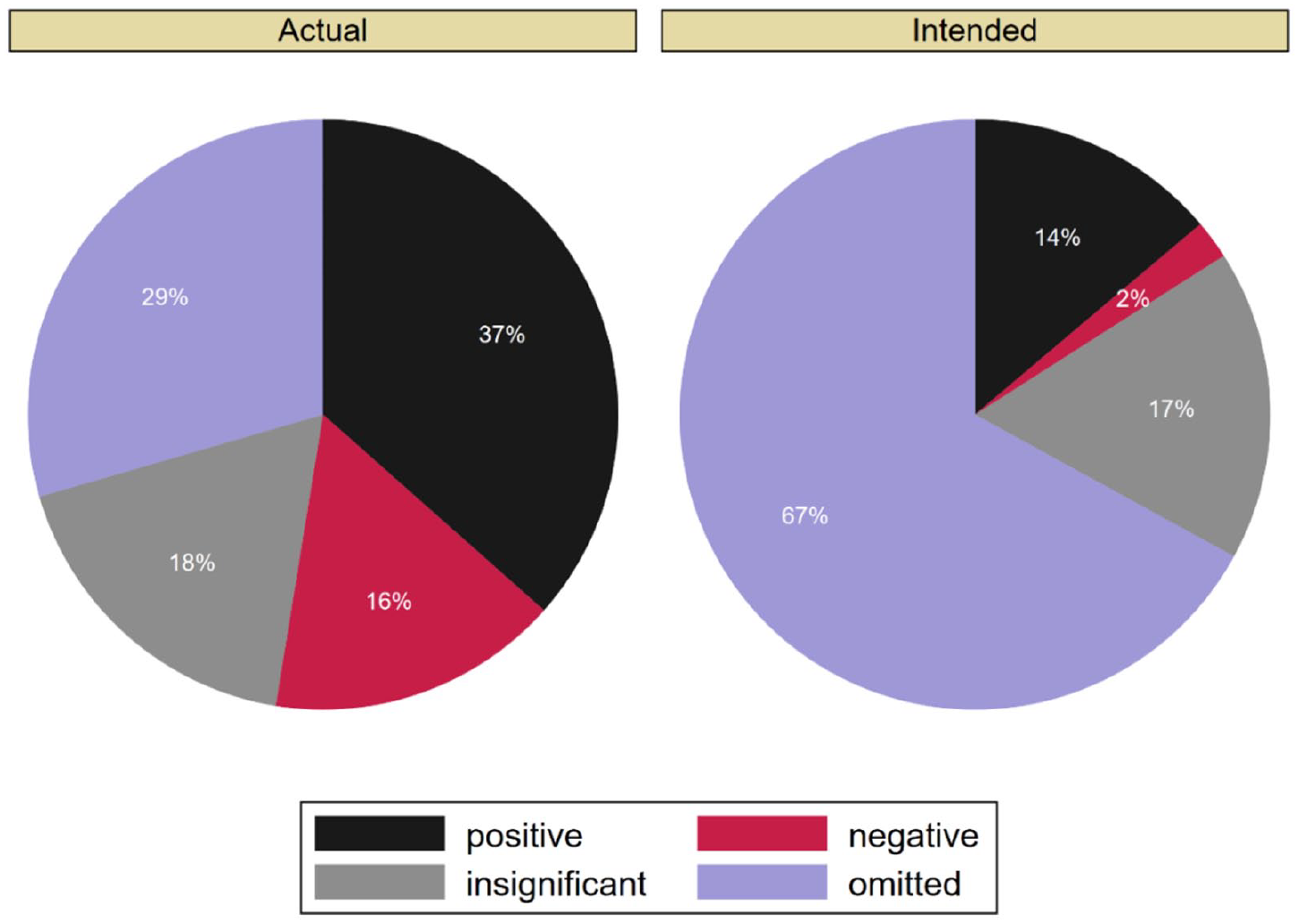
Four outcomes for the influence of income on solar-panel uptake for 156 studies investigating actual uptake and 94 studies investigating intended uptake.
4. Results
4.1. What Explains the Apparent Influence of Income?
Table 2 shows marginal effects from a single multinomial logit model for a meta-regression on 249 prior studies. Each column shows the marginal effects for one of the four possible outcomes of study findings on the influence of income on solar-panel uptake. The explanatory variables of our meta-regression include research characteristics such as a binary variable equal to one for cross-sectional studies.
Marginal Effects From a Multinomial Logit: Dependent Categories Are Income Signs.

Note. There are 249 observations (one study out of 250 does not appear to report sample size). Pseudo R2: .272.
*** and ** represent statistical significance at the 1 and 5 percent levels respectively. Standard errors are in brackets.
Table 2 shows that studies using household-level data are more likely to find positive and significant impacts and less likely to find negative and significant impacts of income on solar-panel uptake. There is statistical significance at the 5 percent level for the positive outcome and the 1 percent level for the negative outcome. The magnitudes are close to 15 percentage points in both cases. The results follow the general theme of Figure 3, although the magnitudes are different when including control variables.
Studies of intended uptake, compared to actual uptake, also produce statistically different outcomes for the influence of income on solar-panel uptake. Studies of intentions are less likely to find positive impacts of income on solar-panel uptake, with the coefficient in our meta-regression having significance at the 1 percent level. The magnitude is large at 19 percentage points. There is also evidence that studies of intentions are more likely to omit income from analysis. These findings align with Figure 4.
Table 2 also provides evidence that studies of non-OECD countries, which are mostly developing countries in our sample, are less likely to find insignificance. This marginal effect is significant at the 1 percent level, and the magnitude is 21 percentage points. However, this is based on a smaller number of studies; most solar-uptake studies have been for OECD countries. Also, studies of non-OECD countries are more likely to omit income.
There is also a range of other significant coefficients. When studies include age as an explanatory variable, they are less likely to omit income but more likely to find an insignificant coefficient for the influence of income on solar-panel uptake. This raises the possibility that income could act as a proxy for age in some cases where age is omitted from studies. This possibility is based on a common positive correlation between age and income for part of the age distribution. A similar story is possible for the renting coefficients in cases where renters tend to have lower incomes. The signs of the coefficients on the education row are again similar, but statistical significance varies. The negative and significant coefficients in the final column for the age, education, and renting rows are reasonable, since studies focusing on socio-economic and demographic determinants are likely to include all common variables of these types. We interpret these particular coefficients as suggestive rather than causal since choices of control/explanatory variables can occur simultaneously.
A further finding is that studies with larger sample sizes are more likely to find a positive influence from income on solar-panel uptake. If a positive impact is the most intuitive expectation for the influence of income on solar-panel uptake, then our results can provide motivation for collection of larger sample sizes where possible.
4.2. Which Studies Include Capital Variables?
Column (1) of Table 3 starts with explanatory variables for research characteristics that describe the structure of research studies, such as the type of data. We find significant coefficients for the cross-sectional variable, the sample size, and for intentions.
Logit Coefficients for Studies Investigating Capital.

Note. The dependent variable is based on a binary equal to one if a study includes an explanatory variable for capital or wealth (types are described in Section 2). Coefficients for constants are not shown.
, **, * represent statistical significance at the 1, 5, and 10 percent levels respectively. Standard errors are in brackets.
Our meta-regression results in Table 3 suggest that cross-sectional studies are more likely to include capital variables when investigating the determinants of solar-panel uptake. This may be because of data availability constraints for a panel context and the greater variability in capital variables in a cross-sectional dimension. However, we note that the statistical significance is at the 10 percent level, and subsequent columns no longer have any statistical significance for the positive cross-sectional coefficients.
The positive coefficients for the log of the sample size in Table 3 imply that larger sample sizes are more likely to be associated with inclusion of capital variables. It might imply that these larger sample sizes are also associated with more variables being available for use, including capital variables. The unavailability of information on capital variables is likely to be a major reason for its omission in many cases, given the intuitive importance of capital variables.
Column (1) of Table 3 also implies that studies on intended solar-panel uptake are less likely to include capital variables in the analysis. This is understandable, as hypothetical studies of intentions are less likely to be grounded in practical realities such as capital-constraint impacts. However, there is a possibility that this misses a key point of the influence of capital on solar-panel uptake; some people who intend to get solar panels may not actually do so if they subsequently become aware of solar-panel cost relative to their assets. The subsequent columns of Table 3 also show a robust link between the investigation of solar intentions and inclusion of capital variables. A variable-clustering narrative can also be given based on Table 3. Studies including the age of household respondents, one of the most assessed socio-demographic variables (Alipour et al. 2020), are also more likely to assess capital variables.
Columns (3) and (4) focus on the sub-sample of studies which use regression approaches. Results are very similar to the full sample, given that most of the studies in our sample are regression approaches. Three extra controls are also reported in column (4), including a variable equal to one when a study assesses peer effects. A focus on peer effects might make it less likely that studies will also assess capital variables, based on the negative coefficient in column (4) of Table 3. Peer effects are not core economic issues; they are more aligned to marketing or social studies. Future studies of peer effects can provide further assurance or robustness by including capital variables in the analysis. This could avoid perceptions that apparent influences of neighbors on each other are instead picking up omitted correlation of wealth across neighbors. This suggestion could also apply in reverse, as identification of capital impacts may be improved if peer effects are included.
Non-independence is not a major issue for our paper as 234 of the 250 studies are from different papers. We produce an extra robustness test which shows similar results when dropping the sixteen papers with two studies in the sample, and this is available through the Stata code. 3
4.3. Upfront Cost
Table 4 displays results explaining whether studies include a variable for upfront costs when assessing the drivers of solar-panel uptake. Studies using cross-sectional analysis are less likely to include a variable for the upfront cost. This is probably because there is more variation in solar panel costs over time, rather than across closely situated cross-sectional units. There is also a negative and significant link between the log of the sample size and inclusion of upfront cost in solar-uptake analysis. This may be a concern, as the current state of knowledge on upfront-cost impacts has tended to be based on smaller studies. A key finding in Table 4 is that studies of solar intentions are more likely to include a variable for the upfront cost of solar panels. Knowledge on the link between the upfront cost and solar-panel uptake is therefore primarily based on hypothetical studies of intentions.
Logit Coefficients for Studies Including a Variable for the Upfront Cost.

Note. All explanatory variables are binary except the log sample size and the years since publication. Coefficients for constants are not shown.
, **, * represent statistical significance at the 1, 5, and 10 percent levels respectively. Standard errors are in brackets.
5. Conclusion and Policy Implications
Our meta-regressions covering 234 papers enhance understanding of prior literature on the economic determinants of uptake of household solar panels. Our contributions can be summarized as enhancing understanding of economic aspects of household solar-panel uptake, offering ideas for future research, and providing a firmer foundation for policy formulation.
A general finding to enhance understanding is that the research characteristics of studies appear to contribute to the likelihood of finding various results for income impacts. These characteristics include the use of household-level data or aggregated data, with use of aggregated data appearing to contribute to some negative income impacts (e.g., higher income being associated with lower likelihood of installing solar panels). Also, studies of intentions are less likely to find positive income impacts. This is a possible indicator of hypothetical bias if economic resources are ignored when forming intentions. Omitted variable bias is also possible when noting that income impacts tend to be insignificant when other socio-economic and demographic variables are included, such as resident age and a renter/owner variable. It is possible that income could pick up correlated influences of other variables if key types of other variables are not included. This makes it very important that future research controls for all relevant variables, such as age and renting status, when trying to determine income impacts.
Our analysis also shows that it is uncommon for studies to include capital variables. Studies on actual uptake are more likely to have capital variables, compared to studies of intentions, implying that studies of intentions may sometimes be exposed to the possibility of a key omitted variable. A further interesting finding from our meta-regressions is that studies examining peer effects are less likely to include capital variables. Omitted variable bias may therefore exist in some cases when trying to identify effects of either peers or capital. We are therefore contributing an idea that future research should control for capital variables when assessing peer effects or other social influences. More frequent collection of capital variables, and collection of a wider range of capital variables, could enhance future research.
Our paper can be useful for future research which considers the influence of income or capital on solar-panel uptake. The potential for referring to our comprehensive analysis on economic influences extends to studies which only seek to include economic variables as a control and to studies which decide to exclude economic variables entirely. It is important to have a comprehensive source on this research context to inform research choices, given the major diversity in prior studies.
Our analysis also aims to contribute to researcher choices on method and data such as whether to use household or aggregated data and which variables to include in studies. More specifically, household-level data appears to be useful for understanding the link between income and solar-panel uptake, if some prior negative links between income and solar-panel uptake are erroneous findings based on aggregated data. Our study suggests that capital variables should be included more often, since there are nearly always positive and significant coefficients.
Future solar-uptake studies may also consider including variables for both capital and the upfront cost. Only 2 of 250 studies in our sample included variables related to each of capital and upfront costs, while also using actual household-level data and controlling for income (Ahmar et al. 2022; Bollinger et al. 2022). Inclusion of both capital and upfront costs is useful as households are probably more likely to have solar panels both when they have more capital, and when the upfront cost is lower. Past knowledge on upfront costs may have been limited, as it has tended to have been based on smaller samples investigating intended uptake. Future research could also consider the types of studies which have included ongoing energy costs as a determinant of solar-panel uptake (Liang et al. 2020).
Our paper can also be useful for future authors who seek to compare their results to prior literature. In addition to summarizing the findings from prior literature for the impact of income and capital on solar-panel uptake, we also explain reasons for prior-study outcomes. For example, we discuss the impacts of using aggregated data versus household data or cross-sectional analysis versus panel analysis. This provides future authors with some possible reasons for their results.
Our meta-analysis also aims to promote enhancements in future research in a range of other areas. Future research may benefit from further consideration of the three key methodological issues identified in this paper of potential aggregation issues, hypothetical bias, and omitted variable bias. These issues may not necessarily be a problem in all cases, and there may also be other issues beyond these three. The key issues can be investigated widely across not only solar-panel studies, but also many other household energy contexts. These contexts can include battery or electric vehicle investment, or perhaps studies of energy consumption and poverty. Studies of developing countries, where much of the growth in global energy demand will originate, will be of particular interest (Kettani and Sanin 2024). Broader studies encompassing circular economy aspects would also be of great interest (Van Opstal and Smeets 2023).
Our analysis aims to aid future policy development. In particular, there may be scope for future policies to target support based on capital variables, given that Figure 2 shows that nearly all studies find positive links between capital and solar-panel uptake when a capital variable is included. More household-level studies could be especially useful, as these identify how solar-panel uptake varies across household distributions. This future suggestion is useful as our findings analyzing past research (Table 3) did not find that household-level studies were significantly more likely to include a capital variable.
Supplemental Material
sj-csv-2-enj-10.1177_01956574241284501 – Supplemental material for Do Income and Capital Influence Household Solar Panel Investment? A Meta-regression
Supplemental material, sj-csv-2-enj-10.1177_01956574241284501 for Do Income and Capital Influence Household Solar Panel Investment? A Meta-regression by Rohan Best, Mauricio Marrone and Martina Linnenluecke in The Energy Journal
Supplemental Material
sj-do-1-enj-10.1177_01956574241284501 – Supplemental material for Do Income and Capital Influence Household Solar Panel Investment? A Meta-regression
Supplemental material, sj-do-1-enj-10.1177_01956574241284501 for Do Income and Capital Influence Household Solar Panel Investment? A Meta-regression by Rohan Best, Mauricio Marrone and Martina Linnenluecke in The Energy Journal
Supplemental Material
sj-docx-3-enj-10.1177_01956574241284501 – Supplemental material for Do Income and Capital Influence Household Solar Panel Investment? A Meta-regression
Supplemental material, sj-docx-3-enj-10.1177_01956574241284501 for Do Income and Capital Influence Household Solar Panel Investment? A Meta-regression by Rohan Best, Mauricio Marrone and Martina Linnenluecke in The Energy Journal
Footnotes
Declaration of Conflicting Interests
The author(s) declared no potential conflicts of interest with respect to the research, authorship, and/or publication of this article.
Funding
The author(s) received no financial support for the research, authorship, and/or publication of this article.

Supplemental Material
Supplemental material for this article is available online.
1
A backward search involves reviewing the references listed in the identified articles. By examining the cited works, it is possible to uncover earlier studies and foundational research relevant to the topic. A forward search involves using citation databases to find later articles that have been cited within our identified articles. This approach aids in discovering more recent articles in the field.
2
(TITLE ( "rooftop" OR "home" OR "homeowner*" OR "homeowner*" OR "residential" OR "household*" OR "domestic" ) AND TITLE ( "PV" OR photovoltaic OR "photo-voltaic" OR solar ) AND NOT TITLE ( "water" OR "wind*" OR "turbine*" OR "plant*" OR "pump*" OR "inverter*" OR "feeder" OR "therm*" OR "geotherm*" OR "biogas*" OR "wastewater" OR "sewage" OR "batter*" OR "storage" OR "vehicle" OR "heat*" OR "cool*" OR "air condition*" OR "refrigerat*" OR "cook*" OR "light*" OR "potential" OR "passive" ) ) AND NOT TITLE-ABS-KEY ( "algorithm*" OR "load*" OR "simulat*" ) AND ( LIMIT-TO ( SRCTYPE , "j" ) ) AND ( LIMIT-TO ( DOCTYPE , "ar" ) )
References
Supplementary Material
Please find the following supplemental material available below.
For Open Access articles published under a Creative Commons License, all supplemental material carries the same license as the article it is associated with.
For non-Open Access articles published, all supplemental material carries a non-exclusive license, and permission requests for re-use of supplemental material or any part of supplemental material shall be sent directly to the copyright owner as specified in the copyright notice associated with the article.
