




Abstract
This exploratory study demonstrates how a popular sports personality can influence public emotions regarding a controversial political issue. The focus is on the involvement of football player Neymar Jr. in discussions about PEC das Praias, a constitutional amendment proposal related to potential privatizations of coastal areas. The analysis corpus consists of 3,307 comments posted on the Instagram pages of the two largest-circulation newspapers in Brazil—Folha de S.Paulo and O Globo—between May 29 and June 7, 2024. The research method employed is a mixed thematic content analysis, which concluded that the athlete's involvement gave prominence to the debate and, consequently, influenced public emotions by increasing engagement and leading to polarization. Negative emotions, particularly indignation and frustration, were specially amplified. The results confirm that sports personalities are able to intensify political debates and shape public opinion, supporting the idea that social media amplifies political emotions, thus impacting citizens’ behavior and decisions in this context.
Introduction
It is possible to highlight various examples of the relation between sports and politics, some of which were evident during the Paris 2024 Olympic Games. Ideological debates and political demonstrations were projected to the massive audience. 1 Among them, the spread of fake news claiming that the Algerian boxer Imane Khelif was a trans athlete and would have an advantage because of it. 2 There were also complaints on social media against Noémi Gelle, the coach of a Hungarian gymnast, for making a gesture known as a dog whistle—associated with supremacists. 3 And the Afghan athlete Manizha Talash, from breaking, who competed for the refugee team, was disqualified for wearing an outfit with the message “Free Afghan women”: “The action violated the rules of the International DanceSport Federation […] as well as Rule 50 of the Olympic Charter, which addresses sporting neutrality.” (Kampf, 2024, s.p.).
These episodes illustrate how sport is also a space of symbolic contestation, capable of amplifying political and ideological debates on a global scale. Football, in particular, has a long history of deep connections with politics. It is not merely a political instrument but rather a phenomenon that, due to its popularity, is intrinsically linked to issues of individual and collective identity, reinforcing feelings of belonging—a characteristic also present in party dynamics (Damo, 1998).
Since its origins, football has involved media, money, power, and ideologies, transcending the boundaries of stadiums to become a means of expression and a mediator of conflicts inherent to societies marked by class antagonisms (Damatta, 1994; Murad, 2007; Patatt & Bandeira, 2020). In this context, it becomes essential to understand how football can be politically mobilized and what its effects are on public opinion. A recent example is the involvement of the player Neymar Jr.'s name in a controversial project to privatize Brazilian beaches, an episode that highlights the intersection between sport, politics, and digital engagement. The athlete's notoriety and his association with a contentious issue sparked widespread media coverage and intense polarization on social media.
This study aims to investigate whether the involvement of a sports personality in a political event can impact collective emotions and, consequently, influence public opinion on political issues based on media coverage. The starting point is the research question: How can the involvement of a sports personality in a political event influence public emotions—and consequently public opinion—based on media coverage?
The choice of the lens of emotions to analyze this phenomenon is justified by the central role they play in shaping political judgments and driving digital engagement. Studies show that emotions such as indignation, enthusiasm, and fear not only shape how individuals process information but also drive content sharing and mobilization on social media (Aira, 2020; Arias Maldonado, 2016; Damásio, 2017; Marcus, 2000; Marcus et al., 2004). By prioritizing the analysis of emotions, this study contributes to a deeper understanding of how public figures influence public opinion and how political engagement is structured on digital platforms.
Although the case analyzed took place in Brazil, its implications are broader, engaging with global debates on the intersection between sports and politics, the influence of celebrities on public discourse, and the emotional impacts of digital communication. The increasing prominence of athletes and sports figures in political discourse underscores the necessity to comprehend not only these personalities’ positions but also the emotional effects they generate in the public and how these feelings can be instrumentalized in the construction of political narratives.
Methodologically, this study is established through a mixed thematic content analysis (Bardin, 1977; Carriço Reis, 2017), conducted with the assistance of MAXQDA software and applied to comments made on posts related to the topic on Instagram accounts of the newspapers Folha de S.Paulo and O Globo, the two largest-circulation dailies in Brazil.
Football, Idolatry, and Society
Professional football has become a complex business, but at its core, it's a very simple sport: the ball can be made of cloth, and the goals can be made of sticks; it can be played barefoot on the street, at the beach, or in an empty lot. This simplicity makes it accessible. Furthermore, there's no strict physical standard for talent. Garrincha, one of the greatest players of all time, had crooked legs: “[…] his legs formed an arc […] It was already a miracle that he could walk, let alone play football.” (Mayrink, 1972, n.p.). By associating these particularities with the unpredictability arising from the use of the feet and the fact that a theoretically inferior team can win a match, it becomes possible to understand why this sport attracts, according to the International Football Federation, approximately five billion people worldwide—making it both the most followed and the most practised.
Increasingly, studies from different fields are attempting to understand this phenomenon of collective life that can synthesize all social life (Murad, 2007), considering the relationship between massification and profound aspects of historical, sociological, and anthropological order (Damatta, 1994; Milliet Filho, 2009). Football—which goes beyond the game and encompasses all the spaces, both physical and virtual, that surround it—becomes a means of expressing frustrations, ambitions, and desires. The transformation of football into a cultural phenomenon in Brazil is an example of this.
According to Murad (2007), the level of importance achieved by this sport is largely due to the integration of its social history into the general history of the country. In a way, it represents a means of transmutation of the marks of colonialism, slavery, and social exclusion, which were structural in the formation of Brazilian society. It became part of popular culture not only as a game but as an expression of the body and a metaphor for the reality of the majority of Brazilians.
The most notable example is Pelé: the King, recognized worldwide as the greatest football player of all time, was a black man from humble origins. It is worth remembering that, in the beginning, football was exclusively played by white men from the elite, and Pelé's existence is the result of a class struggle that culminated in the founding of clubs that are now also known worldwide, such as Sport Club Corinthians Paulista: the team from the city of São Paulo was created by a group of workers and had a tailor as its first president.
In fact, it was at Corinthians that the Democracia Corinthiana movement emerged in the 1980s. From it, decisions traditionally made by the coaching staff, such as training schedules, began to be voted on by the players. At the time, Brazil was under military dictatorship, and the actions extended beyond the club, contributing to the return of democratic rule. Athletes even entered the field wearing shirts emblazoned with political slogans such as “Diretas Já” (Brasileiro & Gozzi, 2002; Florenzano, 2021; Martins, 2012).
And these are not the only associations between football and politics; both, although often seen as antagonistic fields, are intertwined in a relationship that is evident not only in Brazil. The greater the attempt to dissociate them, the smaller the distance seems to be (Kassimeris, 2023). A similar dynamic occurs with the football-religion duet—another major source of power. After all, both belief in sport in general and in any deity are rooted in celebration, worship, and idolatry (Hoffman, 1992; Morris, 1985; Novak, 1994; Watson & Parker, 2014). Both are highly effective in terms of socialization, as they stimulate integration and can provoke identification and enthusiasm (Mathisen, 2006).
Hobsbawn (1987) already referred to football as the “secular religion of the working class” (p. 262). At the time, the English historian probably could not have imagined that a Church would exist based on football: the Iglesia Maradoniana, founded in 1998 in Argentina, has thousands of followers spread across dozens of countries and grants former player Diego Maradona the status of a deity. This phenomenon has been the subject of various studies, such as those by Anselmo (2009), Archetti (2016), and Salvati (2022).
In other words, in some cases, the religious idol—untouchable, invisible—is somewhat replaced by another who bears the mantle of a real-life hero: the athlete. Helal (2003) states that the explanation for this understanding of the player as an idol hero “lies in the agonistic aspect of struggle that permeates the world of sport” (p. 19). And the transformation of a player into a deity proves the power of these manifestations of idolatry beyond the four lines. Clubs often reflect social classes and political ideologies, fueled by the near-religious devotion extended to athletes. As a result, the player's role isn’t confined to the sporting field but carries significant influence beyond it.
Many athletes, aware of this power, strengthen certain archetypes to associate themselves with specific businesses (Rocha et al., 2021). In the case of electoral campaigns in Brazil, it's been common for football players to be involved, especially on the far-right (Dias et al., 2023). Among them is Neymar Jr. The forward was identified by Favikon, a French company specialist in online marketing, as the most influential person on social media in Brazil in 2024. 4 He has the most followed account in the country on Instagram, with 222 million followers, and ranks in the top 10 worldwide among male users, even after leaving PSG for Arab football. 5 The player, who has appeared alongside former president Jair Bolsonaro numerous times, publicly expressed support for the then-candidate for reelection in a video posted on his own online accounts in 2022. 6 The fact became international news and generated criticism from fans; both continue having a close relationship.
At various moments, not only with Neymar but also Bolsonaro used football in his advantage. He appeared wearing club jerseys in social media posts that didn’t discuss sports. This was a tactic “to create a closeness or a supposed affection with the fans and supporters of a particular team” (Dias et al., 2023, p. 7). Moreover, the attempt to identify with the idea of being an ordinary person (Adorno, 2015; Dias et al., 2023) is the same one that attracts idolatry in football, where simple men become myths (Helal, 2003).
In summary, numerous connections between football and politics are evident, which can shed light on various possibilities concerning belonging, identity, society, the power of idols, and the use of their images to strengthen certain discourses. As the writer Nelson Rodrigues (1993) once said: “In football, the worst blind person is the one who only sees the ball” (p. 103).
Emotions in the Political Context and the Influences of Social Media
The analysis of emotions in the contemporary political landscape is imperative for understanding the interactions between voters, leaders, and public opinion. Despite the historical emphasis on rationality in political thought, recent studies have highlighted the pivotal role of emotions in shaping political attitudes and in citizens’ decision-making (Berger & Milkman, 2012; Druckman et al., 2006; Erisen, 2018; Huddy et al., 2007; Marcus, 2000; Marcus et al., 2004; Yurdakul, 2021). Minor fluctuations in emotional states can exert a substantial influence on political behavior, impacting factors such as electoral engagement and ideological allegiance (Druckman et al., 2006).
Emotions can be classified by valence (positive, such as happiness and hope, or negative, such as fear and anger) or discretely (basic and universal, such as anger, sadness, and joy) (Lazarus, 1984; Plutchik, 1980). Two-dimensional models propose that emotions vary along with two main dimensions: valence (whether they are positive or negative) and activation (the level of excitement or energy associated with them). High-activation emotions, such as anger and enthusiasm, have been shown to stimulate action, while low-activation emotions, such as sadness and contentment, have been observed to generate more passive responses (Granberg & Brown, 1989; Kunst-Wilson & Zajonc, 1980). These models have been found to facilitate comprehension of the manner in which emotions influence political identities and responses to social issues (Elliott, 2010; Erisen, 2018). The Affective Intelligence (AI) model posits that emotions such as enthusiasm, anxiety, and anger influence political decisions, engagement, and information-seeking (Marcus, 2000; Marcus et al., 2004). Specifically, enthusiasm has been demonstrated to encourage active participation, while anxiety has been shown to motivate voters to become better informed (Erisen, 2018; Valenzuela & Bachmann, 2015).
In the AI model, the disposition system reinforces established political habits, while the surveillance system drives the search for new information (Rolls, 2000). This emotional influence is intensified on social media, where political emotions are amplified and shape interactions based on emotional and identity-based bonds (Rainie & Smith, 2012). Online interactions influence political participation through sharing and debates (Pennington & Palagi, 2023). Digital content is strategically designed to evoke emotions such as hatred, euphoria, and indignation, affecting opinion formation (Aira, 2020; Damásio, 2017).
The digital environment, then, fosters intense emotional reactions in response to exposure to different opinions. Emotions such as enthusiasm and aversion determine whether an individual will engage actively in the debate or avoid it. Enthusiastic individuals comment on and share content aligned with their beliefs, while those who feel aversion may ignore or block certain posts, shaping the tone of public debates (Eveland et al., 2011; Eveland & Hively, 2009; Pennington & Palagi, 2023; Su et al., 2022).
Furthermore, an understanding of emotions in politics enables the analysis of how perceptions of public figures influence political opinions (Lodge & Taber, 2005). Collective emotions have the capacity to either strengthen social cohesion or deepen conflicts, and they differ from strategic discourses in that they are more visceral and automatic in nature (Pennington & Palagi, 2023). Historically, emotions were viewed as manifestations of personality impulses or cognitive processes (Davies, 1980; Lasswell, 1930). However, research has demonstrated that emotions can influence political decisions independently of conscious cognition (Elster, 1999; Marcus, 1991). This suggests that emotional evaluations occur prior to rational perception (Marcus, 2000).
The measurement of emotions in a political context is challenging, but methodological advances have enhanced its precision, facilitating a more comprehensive understanding of its impact on electoral behavior (Yurdakul, 2021). Emotions explain unexpected changes in voting patterns and political engagement (Bozdag, 2020; Choi & Lee, 2021; Wolak & Sokhey, 2022). The influence of prominent public figures, such as athletes and influencers, has also been demonstrated to play a significant role in the mobilization of the electorate. In the digital environment, the number of followers and the perceived authority of these personalities amplify the impact of emotional messages (Giles, 2002). The phenomenon of parasocial interaction fosters the establishment of emotional bonds between influencers and their followers, thereby facilitating the rapid dissemination of political content (Settle, 2018; Settle et al., 2016). In this context, it is imperative to understand emotions in politics to differentiate citizens’ individual decisions and analyze how perceptions of public figures’ positions in football can influence opinions on political issues.
Consequently, emotion emerges as the most promising analytical category, given its central role in the formation of political identities and the interpretation of political events. When manifested collectively, emotions have the capacity to influence both social cohesion and political dynamics (Arias Maldonado, 2016). Furthermore, emotions differ from other political behaviors or discourses in that they are subjective phenomena that transcend pure rationality, directly impacting individual and collective actions. While political discourses can be strategic and calculated, emotions operate on a deeper level, guiding interpretations and responses to political events in ways that are often automatic and visceral. Consequently, collective emotions have the capacity to profoundly influence social and political dynamics, either fostering cohesion or exacerbating conflict. This capacity is not always replicated by other aspects of political behavior (Pennington & Palagi, 2023).
Methodology
To establish the context for the present discussion, it is first necessary to provide a concise overview of the legislation governing access to beaches in Brazil. Beaches are classified as public goods for common use, ensuring free public access to these areas. Federal Law No. 7,661, dated 16 May 1988, which established the National Coastal Management Plan, sets out guidelines for the sustainable use of the coastal zone's natural resources, including the preservation of public access, except in specific areas designated as being of national security interest.
The Proposed Constitutional Amendment—PEC das Praias—for which the rapporteur is Senator Flávio Bolsonaro (PL-RJ), son of former President Jair Bolsonaro—has generated intense debate. Critics have expressed concerns that transferring coastal lands from the Union to states and municipalities could lead to the privatization of areas adjacent to the beaches, potentially restricting public access. Although the PEC das Praias does not directly amend Law No. 7,661/1988, concerns remain that changes in the management of these lands might favor private interests at the expense of collective rights.
Proponents of the Constitutional Amendment argue that the measure seeks to decentralize the administration of these lands, allowing local governments—more attuned to regional realities—to manage these areas more efficiently. They contend that the proposal does not entail the privatization of the beaches but rather facilitates land registration and has the potential to attract investment and generate employment in coastal regions.
This study originates from footballer Neymar Jr.'s involvement with the PEC das Praias issue, whose discussion in the Brazilian Senate commenced in May 2024. 7 Such an association stemmed from the athlete's announcement regarding a partnership to construct high-end seafront properties in the north-east of the country. 8 Environmentalists mentioned the project in their negative arguments against the Constitutional Amendment, as it could benefit from the approval of the measure. This understanding prompted broad discussion, especially on social media.
The following hypotheses were established: H1) The involvement of Neymar Jr.'s name in PEC das Praias debate gave visibility to the discussion and, consequently, influenced emotions, given the increased public engagement. H2) The association of the athlete's name with the political agenda polarized emotions, just as it happens in football—affection or aversion for a club, for example, aversion or affection about PEC das Praias. H3) Football idolatry was evident in the observed emotions. H4) The player's prior involvement with political figures related to PEC das Praias, as well as the association of Neymar Jr.'s name with the topic in financial terms, influenced the observed emotions. H5) The player's image was affected by the involvement in the PEC das Praias debate.
Object and Corpus of Analysis
This paper analyses the comments posted by internet users on Instagram posts from the official profiles of the most widely circulated newspapers in Brazil. 9 :
Folha de S.Paulo, founded in 1921 in São Paulo. 10 , has 3.7 million followers on the mentioned social media platform. 11 , while O Globo, launched in 1925 in Rio de Janeiro. 12 , has 3.1 million followers on its profile. 13
Instagram was chosen because it is a social media with over 2 billion active monthly users and the third most used platform by Brazilians. 14 , representing a large data pool that allows for a broad and representative sample. On this platform, comments are textual interactions posted by users in response to other users’ posts, which can be read, liked, and replied to by anyone with access to the publication. In addition to its public, interactive nature and wide reach, the choice of Instagram is justified by other important factors related to emotions in the political context. Firstly, its visual nature, based on images and videos, facilitates the analysis of the public's emotional reactions, as multimodal content generates more intense responses (Romeo et al., 2022). It is also worth noting its significant use for political party purposes in Brazil (Santos et al., 2024).
The analysis corpus covers approximately 15% of the total comments on each post, totaling 3,466 comments selected from nine posts—three from O Globo and six from Folha de S.Paulo. Among these, 27 comments were automatically excluded by Export Comments, the software used for collection, because they were made by private profiles who did not authorize extraction, or because they were nested comments—secondary responses to other comments. After these exclusions, the total number of analyzed comments was 3,439.
The material was collected from the posts made on both pages between May 29 and June 7, 2024; all posts were required to reference Neymar Jr. This period initially encompasses the first day with a publication about PEC das Praias related to the player, followed by nine subsequent days, totaling ten days of coverage.
Procedures for Data Collection and Analysis
The mixed categorical content analysis is the research technique applied, justified by the perspectives of interpretations that can generate new questions and offer diverse possibilities for understanding messages and the implicit meaning within the objects of analysis (Carriço Reis, 2017). This approach provides a comprehensive and reliable view of the phenomenon under study by examining the content in its entireness and enabling the units of meaning classification present in the messages.
The coding process structure is based on Bardin (1977), dividing the conception of the analysis model into three main stages: selection of the unit of analysis, definition of counting rules, and selection of categories. In this case, the units of analysis include both the registration units and the context units.
The registration unit refers to the unit of meaning to be coded, representing the segment of content used as the basis for categorization and frequency counting (Bardin, 1977; Vala, 1986). In this research, the semantic level is applied through the observation of themes, which are widely used to identify emotional trends. The context units, which consist of broader content segments, aid in interpreting the coding of the registration units. This study considers the publication unit (static image and caption) as the context unit.
Counting rules were established for the enumeration unit, which represents the unit used for data quantification (Vala, 1986). Arithmetic enumeration was chosen because it allows for clear and objective counting of the frequency of indicators within each category, thereby signaling the predominance of certain factors in each publication unit.
The categorization process comprises two phases: inventory (isolation of elements) and classification (distribution of elements) (Bardin, 1977; Vala, 1986). The category system was constructed a priori, defined based on the literature review and the manual collection of publications related to the theme. To confirm the relevance of these categories, a preanalysis was conducted on 10 randomly selected comments.
The analysis model was constructed using emotional valence approaches, a discrete perspective, and the AI model to measure the public's emotional responses more precisely. The analysis categories were defined based on Plutchik (1980), Lazarus (1984), Marcus et al. (2004), Valenzuela & Bachmann (2015), and Erisen (2018).
In the proposed analysis model (Table 1), the emotion categories are divided into three main groups: Positive, Negative, and Neutral, each containing subcategories that refine the interpretation of the emotions expressed in the comments. The Positive category includes the Support subcategory, which is associated with the specific emotion of Enthusiasm. Within this subcategory, feelings such as joy, hope, and contentment serve as subjective indicators of expressions of direct support and satisfaction with the topic and/or the player. The Negative category includes the Criticism subcategory, which relates to the specific emotion of Aversion. Feelings such as anger, indignation, and frustration act as subjective indicators, reflecting clear disapproval and outrage from commentators. The Neutral category encompasses the Informative subcategory, which is linked to the specific emotion of Anxiety. In this subcategory, emotions such as interest, curiosity, and doubt indicate a desire to better understand the subject, without necessarily demonstrating a positive or negative position.
Model of Analysis.
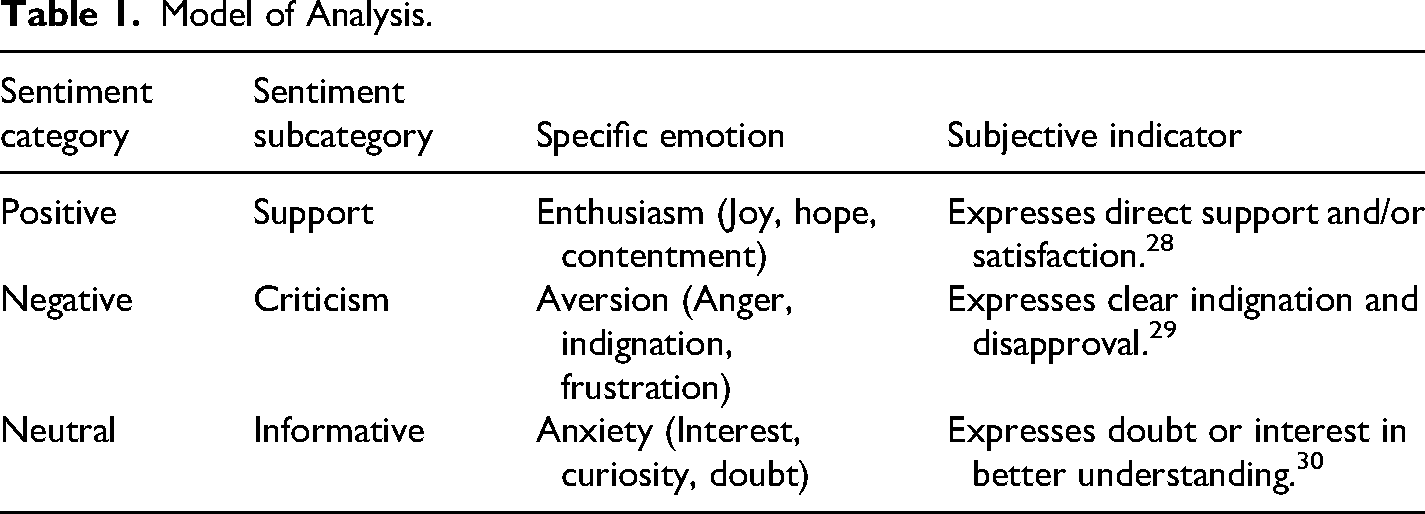
This model, applied to all units of analysis, allows for a detailed and structured observation of emotions, facilitating the identification of the public's emotional reactions and their impact on the perception of the topic and the influence of the football player. In the end, a simple count is conducted to identify the emotional patterns in the analyzed comments, followed by an objective (quantitative) and descriptive (qualitative) analysis of the observed phenomenon.
Analysis of the Data
Folha de S.Paulo
The analysis model was applied to a total of 2,286 comments selected as the most relevant by Export Comments software in the six posts collected from Instagram account of Folha de S.Paulo.
Post number one: Posted on May 31, 2024, it had 411 comments analyzed; it consists of a montage made with two photos, one of the player Neymar Jr. and another of the Brazilian actress Luana Piovani, with the following overlaid text: “Neymar is going to sue Luana Piovani after exchanging insults on social media. 15 ”
The privatization of beaches is mentioned in the caption of the post: “Player Neymar Jr. will sue actress Luana Piovani because of the statements she made last Thursday (30), accusing him of supporting a project aimed at privatizing some beaches along the Brazilian coast […].”
In this post, 57% of the analyzed comments expressed indignation toward Neymar; 14% expressed support for Piovani's position and criticized the player. The post sparked interest, doubt, and curiosity in 18%, 4%, and 2% of users, respectively. Comments associated with joy (1%) and contentment (1%) showed direct support for Neymar and/or PEC das Praias; the remaining 3% expressed anger.
Post number two: Posted on June 1, 2024, it had 395 comments analyzed. It consists of a screenshot from a post made by actress Luana Piovani on her own Instagram account, overlaid with the text: “Piovani questions Scooby's stance in a dispute with Neymar: ‘Friend of the despicable, but lives off the beach.’”. 16
Again, the political project related to the privatization of beaches is mentioned in the caption: “[…] She and the football player are arguing on social media after Luana criticized him for a project associated with the privatization of coastal areas in Brazil […].”
About 35% of users expressed outrage over the privatization issue; 21% showed hope—particularly in the support of surfers, including Pedro Scooby, against PEC das Praias; 8% expressed joy, and 2% expressed contentment with the mobilization; 7% felt frustration. Additionally, users showing interest, doubt, and curiosity accounted for 22%, 3%, and 1%, respectively.
Post number three: Unlike the previous ones, which focused on the public clash between two celebrities triggered by PEC das Praias, the third post. 17 had a political tone. Published on June 2, 2024, it featured an image of Congressman Flávio Bolsonaro with the headline “Understand the PEC that could privatize Union areas on the Brazilian coast.” Neymar Jr. is mentioned in the caption: “[…] The debate has gone beyond the limits of the National Congress and the Esplanade of Ministries, intensifying with the virtual clash between actress Luana Piovani and player Neymar—who recently announced a partnership with a construction company for beachfront developments […].”
A total of 323 comments were analyzed. Indignation regarding PEC das Praias and Neymar's connection with the Bolsonaro family reached 65%, while interest in the post accounted for 15%, followed by frustration at 11%. Additionally, 4% of users expressed doubt about the topic, 2% expressed anger, 1% expressed curiosity, 1% expressed joy, and 1% expressed contentment.
Post number four: Made on June 3, 2024; 409 comments were analyzed. In this one, the image is again a screenshot of a post by actress Luana Piovani on her Instagram account, with the overlaid text: “After a fight with Neymar, Luana Piovani praises Vini Jr and says the player is the ‘true idol’ of Brazil. 18 ” The issue of PEC das Praias is mentioned in the caption: “[…] In recent days, the actress engaged in a public dispute with the forward after criticizing him for a project associated with the privatization of coastal areas in Brazil […].”
In this case, the predominance was positive mentions regarding the Real Madrid player, Vinícius Júnior, either in terms of his athletic performance or his actions as a citizen (20% of the total comments on this post were marked by contentment and 13% by joy). The remaining percentage was divided between feelings of indignation (27%), interest in the post (27%), and frustration (9%). Finally, 3% were still related to hope, curiosity, and doubt (each with 1%).
Post number five: Also posted on June 3, 2024, it consists of an image of the Minister of Institutional Relations, Alexandre Padilha, and the headline “Lula's government is against any beach privatization program, says Padilha. 19 ” In the caption, Neymar Jr. is mentioned again: “[…] Padilha also stated that it's positive the National Congress held a public hearing to address the issue, and that the topic only gained resonance due to the virtual fight between Luana Piovani and Neymar.”
A total of 171 comments were analyzed; 39% expressed outrage regarding the beach privatization project; 13% expressed hope that the current government wouldn’t approve the PEC; and 12% expressed frustration with the project and/or its supporters (including Neymar). Additionally, 26% showed only interest in the publication; 4% expressed doubt; 3% expressed joy at the minister's announcement; 1% expressed anger; and 1% expressed contentment.
Post number six: With 577 comments analyzed, it was published on June 6, 2024, and consists of an aerial image of a beach under the text: “‘PEC das Praias’ does not authorize the privatization of the coast; federal law ensures public access to the coastline. 20 ” In the caption, the pattern was maintained with the mention of Neymar in the same context as the others: “[…] The proposal was the subject of a public hearing last week, which generated discussions both online and offline, including between actress Luana Piovani and player Neymar.”
60% of the comments expressed indignation; 23% frustration; 11% interest in the post; 2% doubt; and 3% expressed anger, hope, and curiosity (each at 1%).
Comparative Analysis: The detailed analysis of emotions in Folha de S.Paulo is visually represented in the comparative line diagram, which illustrates the distribution and variation of emotions expressed in the comments of the six analyzed publications. This diagram highlights both the minimum and maximum quantities of each emotion, revealing a predominance of “Indignation” and “Joy” (Figure 1).
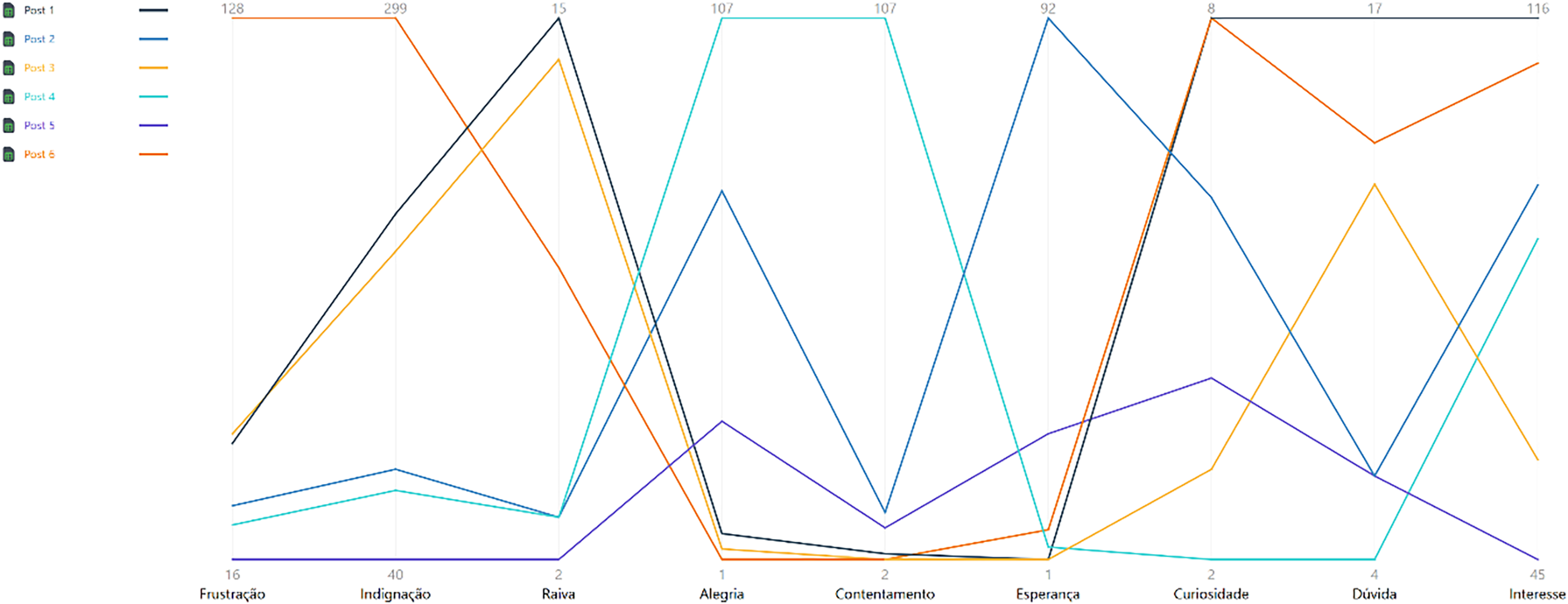
Diagram comparing the emotional profiles—Folha de S.Paulo.
The emotion “Indignation” reaches its highest peak in the third post, which features an image of Senator Flávio Bolsonaro, highlighting a strong rejection of the topic and the associated figures by users (Figure 2).
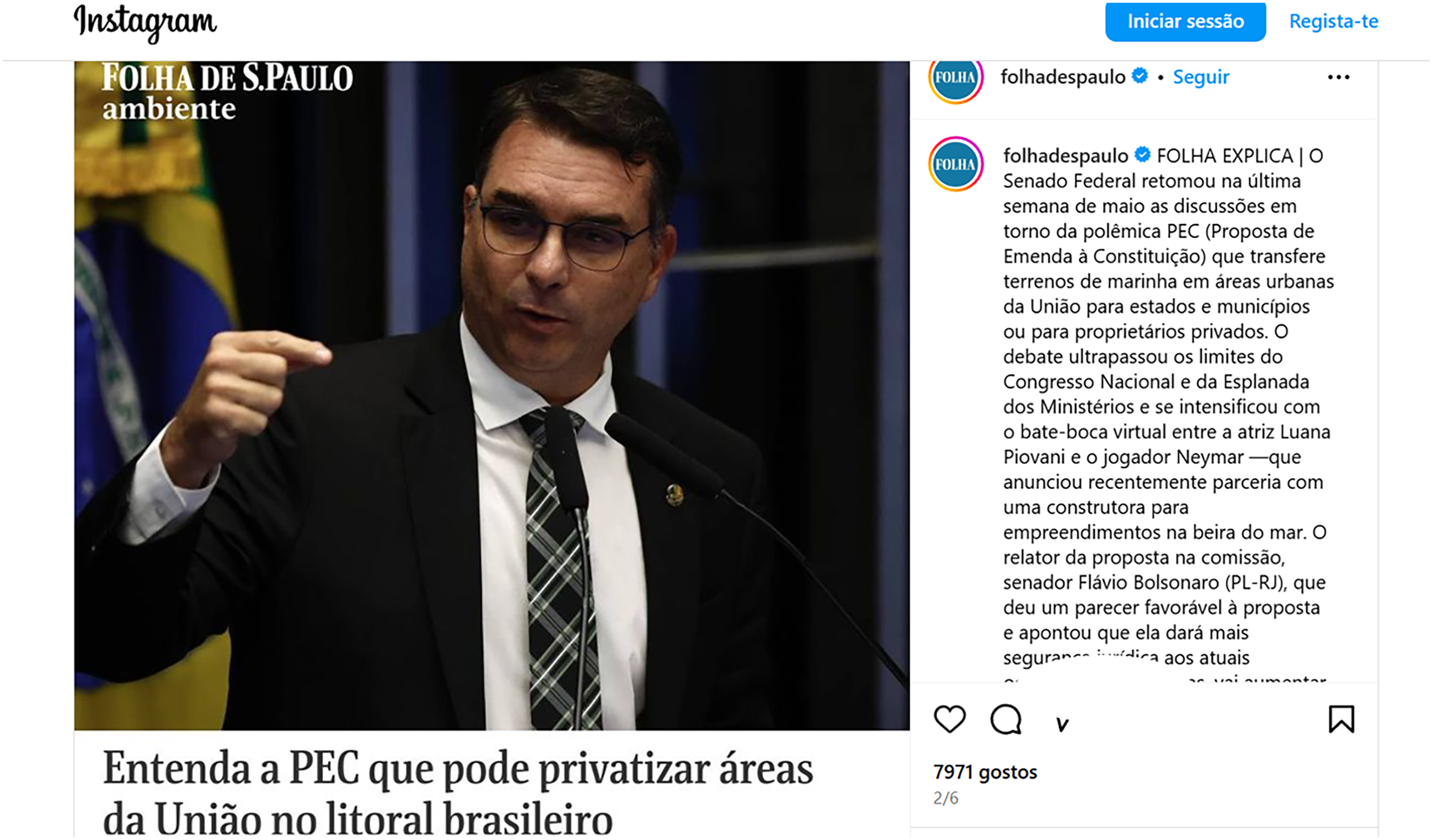
Third post analyzed on the Instagram account of Folha de S.Paulo.
On the other hand, “Joy” is an expressive emotion in the fourth post, which includes praise for another soccer player, Vinícius Jr. Additionally, “Curiosity” and “Interest” stand out, particularly in posts 6 and 5, respectively, indicating a search for information and engagement despite varied emotions. It's important to note that this research considered “Interest” to encompass all comments that engaged with the content without expressing a clear emotion, as well as those, although not nested, responded to other users without identifiable context.
The emotions “Hope” and “Contentment” appear to a lesser extent, suggesting a lower prevalence of deep positive feelings in the analyzed comments.
About 50% of the posts analyzed highlighted the discussion between Luana Piovani and Neymar related to PEC das Praias. At times, this focus brought the celebrity dispute to the forefront, but it still helped popularize the political issue.
Qualitatively, some points raised in the comments directly relate to the emotions observed: Neymar's relationship with the Bolsonaro family, as well as insinuations of joint economic interests and corruption; widespread use of terms such as “boy” and “kid” in reference to the player.
O Globo
The analysis model was applied to 1,153 comments selected as the most relevant by Export Comments software in three posts collected from the Instagram account of the newspaper O Globo.
Post number one: Published on May 29, 2024; 444 comments were analyzed. In this post, two photos were used—one of Neymar Jr. and other of actress Luana Piovani—placed side by side under the text: “Luana Piovani and Maeve Jinkings criticise Neymar for a project associated with the privatization of beaches. 21 ”
The PEC das Praias is also mentioned in the caption of the post, with more detail regarding the player's role in the controversy: “Neymar partnered with the developer Due for the creation of the ‘Rota Due Caribe Brasileiro,’ which plans to build 28 high-end properties along the 100 km stretch between the southern coast of Pernambuco and the northern coast of Alagoas, aiming to generate up to R$ 7.5 billion. The player became the target of public criticism, including from artists.”
In this case, a significant number of comments expressed indignation (55%) and frustration (10%) toward the player and PEC das Praias. 18% of the comments indicated interest in the post; anger and hope accounted for 6% each; 4% of the audience expressed contentment about the topic, and 1% expressed doubt.
Post number two: Published on May 30, 2024, has an image of the player next to a photo of a beachfront development project promoted by him, under the text: “Discover Neymar's development that clashes with PEC das Praias and has become the target of criticism. 22 ”
Two hundered comments were analyzed, in which public indignation and frustration were more evident (62% and 17%, respectively); 12% of the comments showed interest in the post, 5% expressed contentment, and 4% expressed anger.
Post number three: A total of 509 comments were analyzed in the post made on June 5, 2024. The image features Senator Flávio Bolsonaro with the headline: “‘I'm not taking money from Neymar,’ says Flávio Bolsonaro, calling the term ‘beach privatization’ fake news”. 23
There's a prominence of emotions related to indignation and frustration, fostering feelings of distrust—54% and 29%, respectively. The suspicions mainly focus on the deputy's statements, mocking his defence and the idea that it's fake news, especially considering the history of misinformation attributed to his family. The relation between Neymar and the deputy is viewed as one of significant economic interest; 14% of the audience expressed interest in the publication; other recorded emotions included anger (1%), hope (1%), and doubt (1%). Hope here manifests in the desire for the privatization project to move forward.
Comparative Analysis: The detailed analysis of emotions is visually represented in the comparative line diagram, which highlights how the emotions of “Indignation” and “Frustration” dominate the analyzed comments (Figure 3).
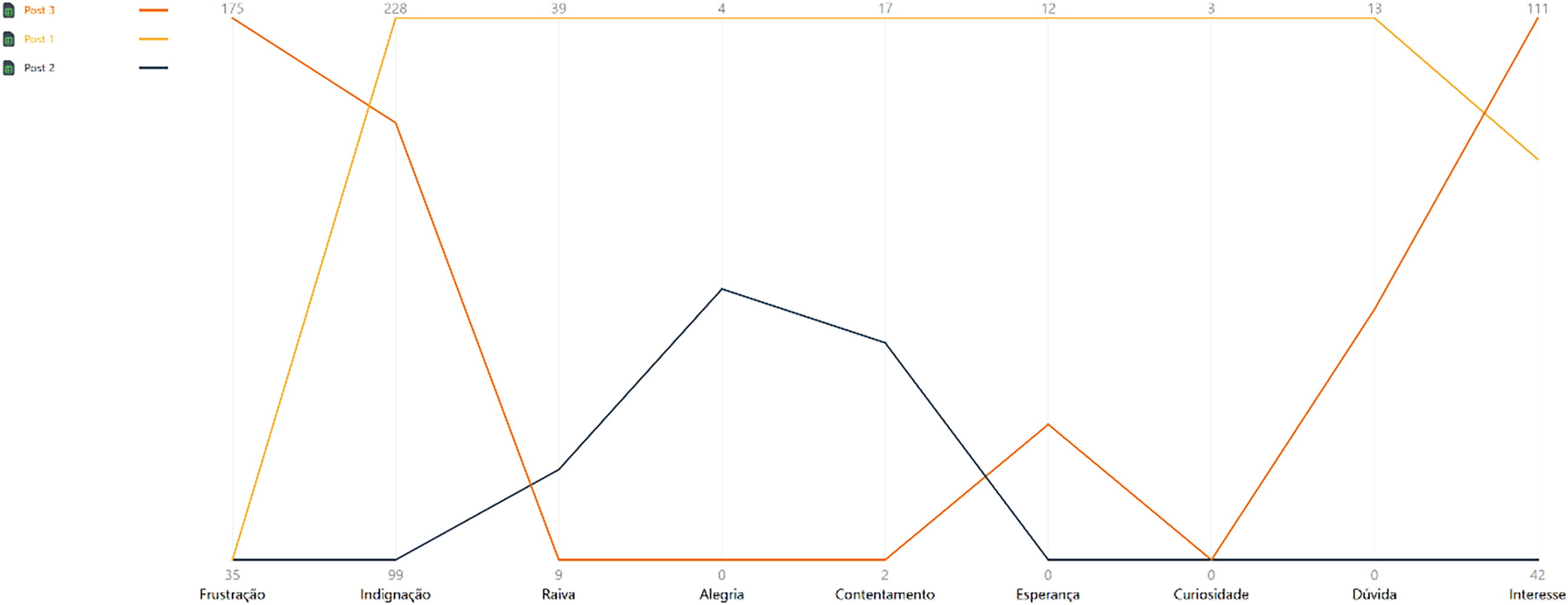
Diagram comparing the emotional profiles—O Globo.
The post related to Flávio Bolsonaro stands out in the analysis, showcasing a significant peak in “Indignation” (Figure 4).
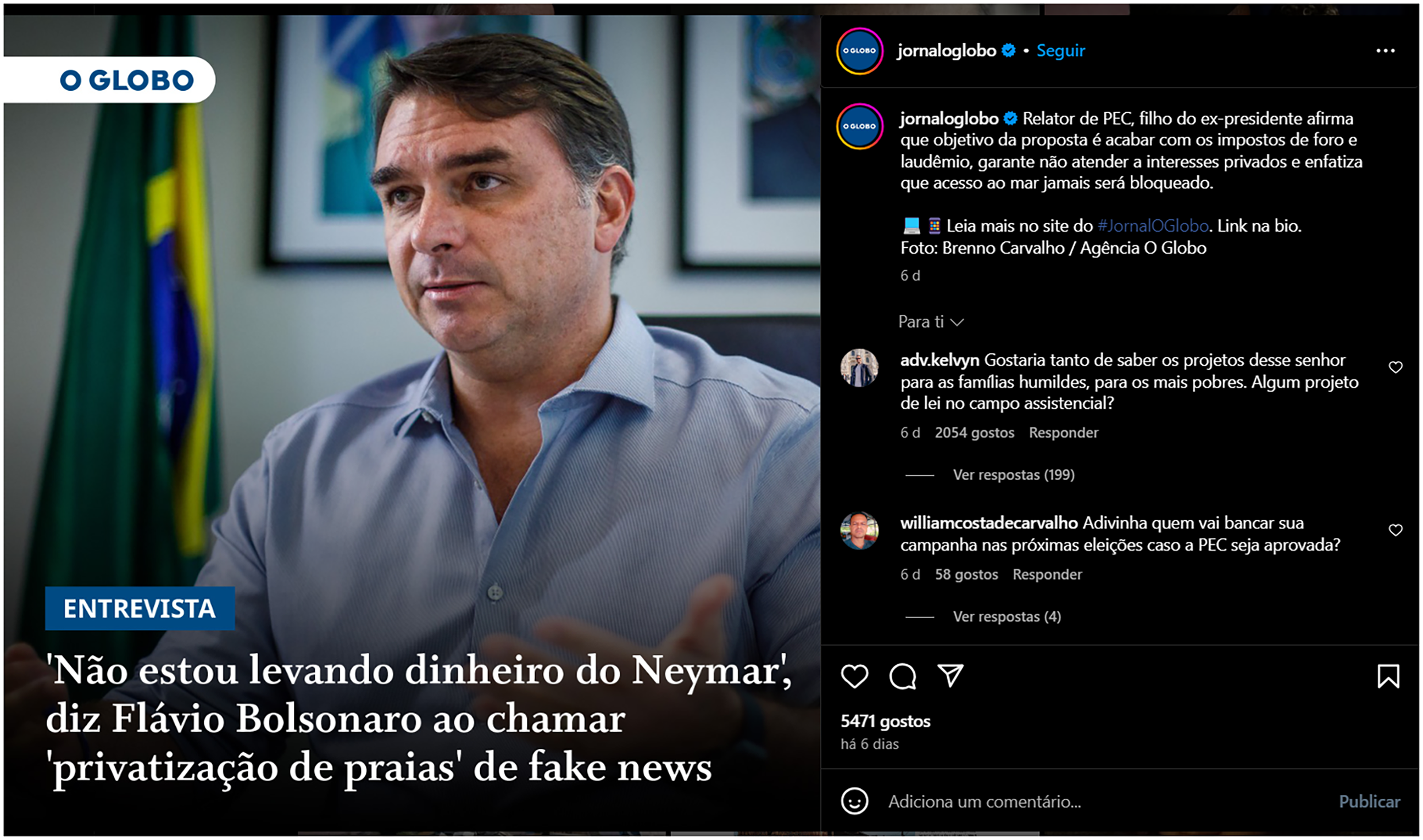
Post number three—O Globo.
Post number one also stands out due to the emotions “Indignation” and “Frustration”; in publication number two, “Anger” is the most prominent, reflecting the intense negative reaction from the public. Overall, the occurrence of “Interest” indicates a high level of engagement, despite the predominance of negative emotions.
The clarity in addressing Neymar Jr.'s involvement with the political topic, not only based on the discussion between celebrities about the constitutional amendment (PEC) but also made the comments more open, direct, and emotionally charged.
Qualitatively, there's a notable use of terms such as “boy,” “kid,” and diminutives—like “Ney”—to refer to the player in a way that discredits his personal choices, positions, and political opinions, especially regarding his connection with the Bolsonaro family. There were also criticisms of Neymar's performance in football, with comparisons to his off-field behavior.
Differences and Similarities Between the Analyzed Pages
Negative emotions prevail—especially indignation, which stands out as the most frequent in both newspapers. Regarding positive emotions, there is a significant difference between Folha de S. Paulo and O Globo, as can better seen in Figure 5. These positive emotions are largely associated with the stance and criticisms of actress Luana Piovani. The emotion of hope follows a similar trend, also linked to the celebrity's statements and the actions of Lula's government.
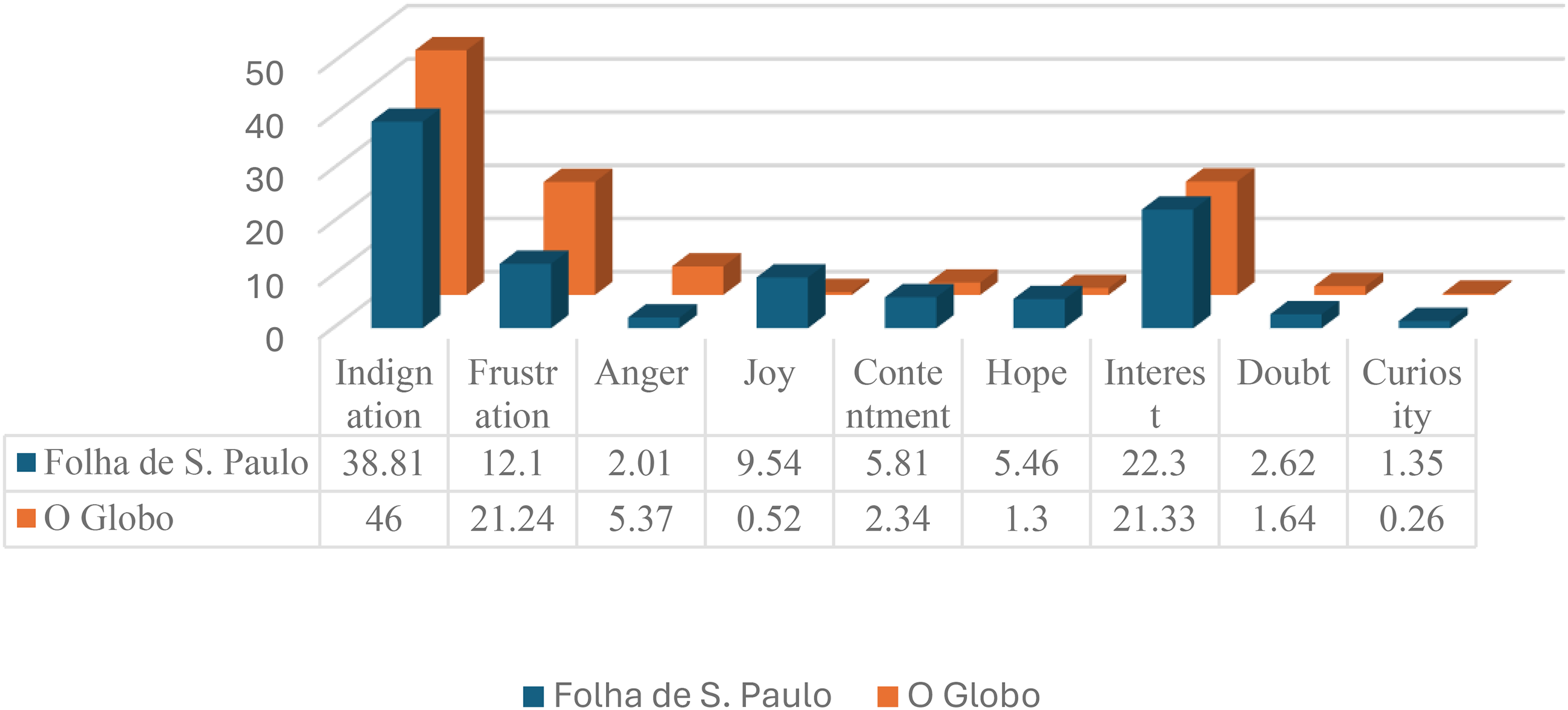
Comparison of the emotions found in the analysis of Folha de S.Paulo and O Globo.
The differences in editorial lines and readership profiles of Folha de S. Paulo and O Globo may influence emotional reactions to Neymar Jr.'s involvement in the discussion on the PEC das Praias. O Globo, as stated in its Editorial Principles document. 24 , adopts an independent and vigilant stance, committing to the defence of principles such as democracy, human rights, and individual freedom, without alignment to governments or specific groups. Its readership is predominantly female (55%), from social classes A and B, with higher education and aged between 20 and 29. 25
By contrast, Folha de S. Paulo values free enterprise, the modernization of social norms, and the peaceful resolution of conflicts, while maintaining a commitment to exclusive reporting and the guarantee of counterpoints, as outlined in its Editorial Principles document. 26 Its readers, mostly male (54%), belong to social classes B and C and are between 45 and 54 years old. 27
These distinctions suggest that both journalistic framing and the socioeconomic profile of the readership may influence how this issue was perceived, highlighting the subjectivity of emotions and their possible relationship with each newspaper's editorial approach. Furthermore, the frequent presence of the emotion “interest” in both outlets indicates that, despite differences in the distribution of positive and negative emotions, there is strong engagement with the topic, fueling debates among readers.
Discussion
Neymar's name began to be linked by the press to the issue of PEC das Praias following a statement made by actress Luana Piovani on social media, which led to a public confrontation between them. In other words, the principle of newsworthiness lies in the discussion among celebrities, as evidenced in the preanalysis: prior to the collection period for the corpus presented here, only one publication about the PEC was found; it was made on O Globo's Instagram page and only informed about the resumption of negotiations by the Senate.
Thus, it can be stated that the involvement of the football player's name motivated the projection of the political agenda, which subsequently gained prominence—a point that is even affirmed by the Minister of Institutional Relations, Alexandre Padilha, in the fifth post on the Instagram page of Folha de S.Paulo—partially responding to hypothesis 1 (H1). The remainder of the first hypothesis, concerning the influence on the public's emotions, was also confirmed, in line with what Marcus (2000) discusses; however, it additionally depends on an analysis of how the issue was addressed by both newspapers.
To elaborate further, on the Instagram account of Folha de S.Paulo, those who did not read the captions of the posts—or were not well-informed about the subject through other means—would not make any connection between the disputes involving Neymar Jr., the celebrity feuds, and PEC das Praias. The origin of the debate related to the player's name—his association with the construction company developing luxury seaside properties—is only briefly mentioned in the third post. Additionally, four of the six analyzed posts reference figures that convey opposition to the PEC das Praias and, directly or indirectly, to Neymar: Luana Piovani, surfer Pedro Scooby, football player Vinícius Jr., and the Lula government. As a result, emotions such as joy, contentment, and hope are observed—related to them, not Neymar—in much larger proportions than in the publications of O Globo, where such practices did not occur.
This is related to the central role of emotions in the formation of political attitudes and decision-making by citizens, as highlighted by authors such as Huddy et al. (2007) and Yurdakul (2021). What is observed is a specific effect: the association of the athlete's name with the political agenda did not generate a uniformly positive or negative response but instead polarized the public, creating a dichotomous dynamic between affection and aversion, similar to what happens in football, and directly linked to the confirmation of hypothesis 2 (H2).
Contrary to expectations, the idolization of the player was not sufficient to generate a significant movement of support for the PEC das Praias or even for the athlete's involvement in the issue. Thus, hypothesis 3 (H3) was refuted. This reinforces the discussion on social cognition and the evaluation of public figures (Lodge & Taber, 2005), as it demonstrates that admiration for an athlete does not necessarily translate into unconditional support for all their actions.
Hypothesis 4 (H4) was also supported. The athlete's prior association with political figures associated with the PEC das Praias and his financial ties to coastal developments significantly influenced the emotions observed. The quantified data and qualitative analysis show that posts with photos and statements from Senator Flávio Bolsonaro, for example, triggered spikes in negative emotions. This is aligned with the emotional assessment presented by Marcus et al. (2004), who argue that the way people perceive media-driven political events directly influences their emotional reactions. The reminder of Neymar's closeness to the Bolsonaro family was one of the factors driving negative feelings toward the PEC das Praias and the player himself, accompanied by terms associated with corruption and the spread of fake news.
These opinions and situations are in line with the arguments of Murad (2007) and Milliet Filho (2009), who highlight how sport, and football in particular, can amplify social and political dynamics by projecting its protagonists beyond the stadium. This dynamic underlines the importance of a thorough analysis of the emotional mechanisms in the digital sphere and their influence on political engagement and opinion formation.
Finally, hypothesis 5 (H5) was confirmed, as the athlete's image was negatively affected by his involvement in the discussion surrounding the PEC das Praias. The cross-referencing of quantitative and qualitative data revealed that the comments largely discredited Neymar Jr. not only as a public figure but also personally and professionally. Terms such as ‘boy’ and ‘brat’ were frequently used to undermine his decisions.
Complementing this, it is noteworthy that the debate on the PEC das Praias was suspended in the Senate following the negative backlash surrounding Neymar Jr. This is concordant with the conclusions of Berger & Milkman (2012) and Druckman et al. (2006), who highlight the decisive influence of emotions in political decisions. Furthermore, it reinforces the idea that social media has the power to intensively amplify political emotions, shaping public opinion and influencing citizens’ behavior, as argued by Rainie & Smith (2012) and Settle (2018).
Conclusions
A duality was observed in the answer to the guiding research question of this study. The objective was to understand how the involvement of a sports personality in a political issue might influence public emotions—and, consequently, public opinion—based on journalistic coverage; it was found that such an influence exists and occurs irrespective of whether the personality adopts an active stance on the issue. Simultaneously, the role of the media in shaping public emotions is critical.
It is important to note that Neymar Jr. did not take a position in the debate surrounding the PEC das Praias and did not even comment directly on the issue—none of the content analyzed contains direct statements on the matter; his association with the agenda was made by third parties, almost in the form of an accusation. The athlete's personal and professional history, as well as his previous political involvement, played a pivotal role in shaping emotions—and, consequently, opinions—in a negative direction regarding the PEC das Praias. This was particularly evident in the qualitative analysis of the comments, which referenced this. However, it is impossible to dissociate this reality from the role—and power—of journalistic coverage in constructing the athlete's image and, to some extent, steering these interpretations. In other words, the emotions generated are the result of the strength of the athlete's image combined with the manner in which the coverage is executed.
This study, utilizing an exploratory approach, adopts a mixed categorical analysis with predefined categories to identify emotional responses, considering the subjectivity involved in interpreting individual experiences. One of the main benefits of this approach is the ability to systematically map users’ emotions and reactions, providing relevant insights for more detailed future research. However, there are associated risks, such as the potential limitations in the depth of analysis due to the predefined categorization, which may not capture all emotional nuances or any new emerging categories. Therefore, the results should be interpreted with caution, recognizing the limitations and opportunities for broader investigations.
To strengthen this research and deepen the understanding of emotions in the political context associated with sports figures, it would be advisable to conduct a reception study using questionnaires, focus groups, or interviews, which could offer a more nuanced perspective on the topic. Similarly, as the analysis presented here did not delve into the newspapers’ stances, there are indicators mentioned that could be further explored in future studies, including the relationship between the editorial lines and positions of the newspapers. This is certainly an interesting avenue for further investigation and would add robustness to the study.
Supplemental Material
sj-xlsx-1-jss-10.1177_01937235251337083 - Supplemental material for Football is Politics: Analyzing Public Emotions in Neymar Jr.'s Case and PEC das Praias Through the Instagram Accounts of Folha de S.Paulo and O Globo Newspapers
Supplemental material, sj-xlsx-1-jss-10.1177_01937235251337083 for Football is Politics: Analyzing Public Emotions in Neymar Jr.'s Case and PEC das Praias Through the Instagram Accounts of Folha de S.Paulo and O Globo Newspapers by Caroline Patatt and Jéssica Sandes in Journal of Sport and Social Issues
Supplemental Material
sj-png-2-jss-10.1177_01937235251337083 - Supplemental material for Football is Politics: Analyzing Public Emotions in Neymar Jr.'s Case and PEC das Praias Through the Instagram Accounts of Folha de S.Paulo and O Globo Newspapers
Supplemental material, sj-png-2-jss-10.1177_01937235251337083 for Football is Politics: Analyzing Public Emotions in Neymar Jr.'s Case and PEC das Praias Through the Instagram Accounts of Folha de S.Paulo and O Globo Newspapers by Caroline Patatt and Jéssica Sandes in Journal of Sport and Social Issues
Supplemental Material
sj-png-3-jss-10.1177_01937235251337083 - Supplemental material for Football is Politics: Analyzing Public Emotions in Neymar Jr.'s Case and PEC das Praias Through the Instagram Accounts of Folha de S.Paulo and O Globo Newspapers
Supplemental material, sj-png-3-jss-10.1177_01937235251337083 for Football is Politics: Analyzing Public Emotions in Neymar Jr.'s Case and PEC das Praias Through the Instagram Accounts of Folha de S.Paulo and O Globo Newspapers by Caroline Patatt and Jéssica Sandes in Journal of Sport and Social Issues
Supplemental Material
sj-png-4-jss-10.1177_01937235251337083 - Supplemental material for Football is Politics: Analyzing Public Emotions in Neymar Jr.'s Case and PEC das Praias Through the Instagram Accounts of Folha de S.Paulo and O Globo Newspapers
Supplemental material, sj-png-4-jss-10.1177_01937235251337083 for Football is Politics: Analyzing Public Emotions in Neymar Jr.'s Case and PEC das Praias Through the Instagram Accounts of Folha de S.Paulo and O Globo Newspapers by Caroline Patatt and Jéssica Sandes in Journal of Sport and Social Issues
Supplemental Material
sj-png-5-jss-10.1177_01937235251337083 - Supplemental material for Football is Politics: Analyzing Public Emotions in Neymar Jr.'s Case and PEC das Praias Through the Instagram Accounts of Folha de S.Paulo and O Globo Newspapers
Supplemental material, sj-png-5-jss-10.1177_01937235251337083 for Football is Politics: Analyzing Public Emotions in Neymar Jr.'s Case and PEC das Praias Through the Instagram Accounts of Folha de S.Paulo and O Globo Newspapers by Caroline Patatt and Jéssica Sandes in Journal of Sport and Social Issues
Supplemental Material
sj-xlsx-6-jss-10.1177_01937235251337083 - Supplemental material for Football is Politics: Analyzing Public Emotions in Neymar Jr.'s Case and PEC das Praias Through the Instagram Accounts of Folha de S.Paulo and O Globo Newspapers
Supplemental material, sj-xlsx-6-jss-10.1177_01937235251337083 for Football is Politics: Analyzing Public Emotions in Neymar Jr.'s Case and PEC das Praias Through the Instagram Accounts of Folha de S.Paulo and O Globo Newspapers by Caroline Patatt and Jéssica Sandes in Journal of Sport and Social Issues
Supplemental Material
sj-xlsx-7-jss-10.1177_01937235251337083 - Supplemental material for Football is Politics: Analyzing Public Emotions in Neymar Jr.'s Case and PEC das Praias Through the Instagram Accounts of Folha de S.Paulo and O Globo Newspapers
Supplemental material, sj-xlsx-7-jss-10.1177_01937235251337083 for Football is Politics: Analyzing Public Emotions in Neymar Jr.'s Case and PEC das Praias Through the Instagram Accounts of Folha de S.Paulo and O Globo Newspapers by Caroline Patatt and Jéssica Sandes in Journal of Sport and Social Issues
Supplemental Material
sj-xlsx-8-jss-10.1177_01937235251337083 - Supplemental material for Football is Politics: Analyzing Public Emotions in Neymar Jr.'s Case and PEC das Praias Through the Instagram Accounts of Folha de S.Paulo and O Globo Newspapers
Supplemental material, sj-xlsx-8-jss-10.1177_01937235251337083 for Football is Politics: Analyzing Public Emotions in Neymar Jr.'s Case and PEC das Praias Through the Instagram Accounts of Folha de S.Paulo and O Globo Newspapers by Caroline Patatt and Jéssica Sandes in Journal of Sport and Social Issues
Supplemental Material
sj-xlsx-9-jss-10.1177_01937235251337083 - Supplemental material for Football is Politics: Analyzing Public Emotions in Neymar Jr.'s Case and PEC das Praias Through the Instagram Accounts of Folha de S.Paulo and O Globo Newspapers
Supplemental material, sj-xlsx-9-jss-10.1177_01937235251337083 for Football is Politics: Analyzing Public Emotions in Neymar Jr.'s Case and PEC das Praias Through the Instagram Accounts of Folha de S.Paulo and O Globo Newspapers by Caroline Patatt and Jéssica Sandes in Journal of Sport and Social Issues
Supplemental Material
sj-xlsx-10-jss-10.1177_01937235251337083 - Supplemental material for Football is Politics: Analyzing Public Emotions in Neymar Jr.'s Case and PEC das Praias Through the Instagram Accounts of Folha de S.Paulo and O Globo Newspapers
Supplemental material, sj-xlsx-10-jss-10.1177_01937235251337083 for Football is Politics: Analyzing Public Emotions in Neymar Jr.'s Case and PEC das Praias Through the Instagram Accounts of Folha de S.Paulo and O Globo Newspapers by Caroline Patatt and Jéssica Sandes in Journal of Sport and Social Issues
Supplemental Material
sj-xlsx-11-jss-10.1177_01937235251337083 - Supplemental material for Football is Politics: Analyzing Public Emotions in Neymar Jr.'s Case and PEC das Praias Through the Instagram Accounts of Folha de S.Paulo and O Globo Newspapers
Supplemental material, sj-xlsx-11-jss-10.1177_01937235251337083 for Football is Politics: Analyzing Public Emotions in Neymar Jr.'s Case and PEC das Praias Through the Instagram Accounts of Folha de S.Paulo and O Globo Newspapers by Caroline Patatt and Jéssica Sandes in Journal of Sport and Social Issues
Supplemental Material
sj-xlsx-12-jss-10.1177_01937235251337083 - Supplemental material for Football is Politics: Analyzing Public Emotions in Neymar Jr.'s Case and PEC das Praias Through the Instagram Accounts of Folha de S.Paulo and O Globo Newspapers
Supplemental material, sj-xlsx-12-jss-10.1177_01937235251337083 for Football is Politics: Analyzing Public Emotions in Neymar Jr.'s Case and PEC das Praias Through the Instagram Accounts of Folha de S.Paulo and O Globo Newspapers by Caroline Patatt and Jéssica Sandes in Journal of Sport and Social Issues
Supplemental Material
sj-xlsx-13-jss-10.1177_01937235251337083 - Supplemental material for Football is Politics: Analyzing Public Emotions in Neymar Jr.'s Case and PEC das Praias Through the Instagram Accounts of Folha de S.Paulo and O Globo Newspapers
Supplemental material, sj-xlsx-13-jss-10.1177_01937235251337083 for Football is Politics: Analyzing Public Emotions in Neymar Jr.'s Case and PEC das Praias Through the Instagram Accounts of Folha de S.Paulo and O Globo Newspapers by Caroline Patatt and Jéssica Sandes in Journal of Sport and Social Issues
Supplemental Material
sj-xlsx-14-jss-10.1177_01937235251337083 - Supplemental material for Football is Politics: Analyzing Public Emotions in Neymar Jr.'s Case and PEC das Praias Through the Instagram Accounts of Folha de S.Paulo and O Globo Newspapers
Supplemental material, sj-xlsx-14-jss-10.1177_01937235251337083 for Football is Politics: Analyzing Public Emotions in Neymar Jr.'s Case and PEC das Praias Through the Instagram Accounts of Folha de S.Paulo and O Globo Newspapers by Caroline Patatt and Jéssica Sandes in Journal of Sport and Social Issues
Supplemental Material
sj-xlsx-15-jss-10.1177_01937235251337083 - Supplemental material for Football is Politics: Analyzing Public Emotions in Neymar Jr.'s Case and PEC das Praias Through the Instagram Accounts of Folha de S.Paulo and O Globo Newspapers
Supplemental material, sj-xlsx-15-jss-10.1177_01937235251337083 for Football is Politics: Analyzing Public Emotions in Neymar Jr.'s Case and PEC das Praias Through the Instagram Accounts of Folha de S.Paulo and O Globo Newspapers by Caroline Patatt and Jéssica Sandes in Journal of Sport and Social Issues
Supplemental Material
sj-xlsx-16-jss-10.1177_01937235251337083 - Supplemental material for Football is Politics: Analyzing Public Emotions in Neymar Jr.'s Case and PEC das Praias Through the Instagram Accounts of Folha de S.Paulo and O Globo Newspapers
Supplemental material, sj-xlsx-16-jss-10.1177_01937235251337083 for Football is Politics: Analyzing Public Emotions in Neymar Jr.'s Case and PEC das Praias Through the Instagram Accounts of Folha de S.Paulo and O Globo Newspapers by Caroline Patatt and Jéssica Sandes in Journal of Sport and Social Issues
Supplemental Material
sj-xlsx-17-jss-10.1177_01937235251337083 - Supplemental material for Football is Politics: Analyzing Public Emotions in Neymar Jr.'s Case and PEC das Praias Through the Instagram Accounts of Folha de S.Paulo and O Globo Newspapers
Supplemental material, sj-xlsx-17-jss-10.1177_01937235251337083 for Football is Politics: Analyzing Public Emotions in Neymar Jr.'s Case and PEC das Praias Through the Instagram Accounts of Folha de S.Paulo and O Globo Newspapers by Caroline Patatt and Jéssica Sandes in Journal of Sport and Social Issues
Supplemental Material
sj-xlsx-18-jss-10.1177_01937235251337083 - Supplemental material for Football is Politics: Analyzing Public Emotions in Neymar Jr.'s Case and PEC das Praias Through the Instagram Accounts of Folha de S.Paulo and O Globo Newspapers
Supplemental material, sj-xlsx-18-jss-10.1177_01937235251337083 for Football is Politics: Analyzing Public Emotions in Neymar Jr.'s Case and PEC das Praias Through the Instagram Accounts of Folha de S.Paulo and O Globo Newspapers by Caroline Patatt and Jéssica Sandes in Journal of Sport and Social Issues
Supplemental Material
sj-xlsx-19-jss-10.1177_01937235251337083 - Supplemental material for Football is Politics: Analyzing Public Emotions in Neymar Jr.'s Case and PEC das Praias Through the Instagram Accounts of Folha de S.Paulo and O Globo Newspapers
Supplemental material, sj-xlsx-19-jss-10.1177_01937235251337083 for Football is Politics: Analyzing Public Emotions in Neymar Jr.'s Case and PEC das Praias Through the Instagram Accounts of Folha de S.Paulo and O Globo Newspapers by Caroline Patatt and Jéssica Sandes in Journal of Sport and Social Issues
Footnotes
Data Availability
All data generated or analyzed during this study are included in this published article [and its supplementary information files].
Declaration of Conflicting Interests
The author(s) declared no potential conflicts of interest with respect to the research, authorship, and/or publication of this article.
Ethical Considerations
All data collected for this research was obtained from public comments made on public pages of the social media platform Instagram, so no authorization was deemed necessary. In any case, no private user data were collected, and even the profile names are not mentioned in this study.
Funding
The author(s) received no financial support for the research, authorship, and/or publication of this article.

Supplemental Material
Supplemental material for this paper is available online
Notes
Author Biographies
References
Supplementary Material
Please find the following supplemental material available below.
For Open Access articles published under a Creative Commons License, all supplemental material carries the same license as the article it is associated with.
For non-Open Access articles published, all supplemental material carries a non-exclusive license, and permission requests for re-use of supplemental material or any part of supplemental material shall be sent directly to the copyright owner as specified in the copyright notice associated with the article.


