



Abstract
This study examines and compares the coverage of both the England men's and women's national football teams by their governing body, The Football Association (FA), immediately before, during and immediately following their respective 2020 and 2022 European Championships. Content analysis of two of the FA's official Twitter accounts demonstrates some positive shifts in the general representation of the women's football team. However, concerns remain regarding the FA's social media strategy whereby they promote the women's team through a discrete profile rather than their general Twitter account, which has a much larger following. This paper argues that social media provides governing bodies with an opportunity to effectively promote their women's teams and, as such, organisations hold significant responsibility to achieve this should they wish to see the more equitable promotion of women athletes in the wider media.
The England men's and women's national football teams entered their respective 2020 and 2022 European Championships on similar journeys. Each team had reached the semi-finals of the previous World Cup tournaments and was considered amongst the favourites in their respective European competitions, both of which had been postponed by a year due to the Covid-19 pandemic. The women's team, known as the Lionesses, competed as hosts during their tournament and whilst the men's competition was unprecedentedly held across 11 cities throughout Europe, England played six of their seven matches at Wembley Stadium in London. They also followed a parallel trajectory throughout their competitions with each victory increasing public belief that England would win its first major football tournament since the men's World Cup victory in 1966. Following a penalty shoot-out defeat to Italy in the men's final in July 2021, it was the Lionesses who would, as the famous song goes, bring football home with an extra-time victory over Germany in their final on 31 July 2022. The Lionesses’ victory appeared to be a significant moment for women's football. The final at Wembley broke two attendance records, becoming the most-attended women's international match in history, as well as filling more seats than any prior women's or men's European final (Keay, 2022). The Lionesses also saw success at the 2022 BBC Sports Personality of the Year Awards, an annual ceremony that recognises sporting accomplishments in Britain. Beth Mead became the first woman footballer to win the main prize, Sarina Wiegman was the first woman to win the Coach award, and the Lionesses were only the fourth women's squad to win Team of the Year.
Despite recent progression, the media coverage of women's football has been consistently poor (Black and Fielding-Lloyd, 2019), particularly when compared to the men's game (O’Neill and Mulready, 2015; Petty and Pope, 2019), and this pattern is commonplace across sport more broadly. However, designating accountability to any specific organisation can be difficult to prove from an empirical perspective, and, furthermore, measuring gendered realities in sport is challenging since gender prejudice is pervasive and complex across numerous societal sectors. Nonetheless, sports organisations have the responsibility to lessen gender inequalities and biases. Indeed, the Football Association (FA)'s 2020–24 vision is to ‘unite the game, inspire the nation’, by delivering ‘football for all’ (The Football Association, 2021: 12), and as such encompasses the promotion of both men's and women's football. Thanks to improvements in the Internet and, more specifically, social media, sports federations (including the FA) and athletes can connect directly with supporters, circumventing traditional media gatekeepers. These relatively new distribution platforms utilised by those who have traditionally received limited media attention has offered new hope to fans and players of women's sport. With its considerable reach and minimal costs, social media gives women's sport the opportunity to overcome financial barriers and communicate with fans, providing assistance in levelling the playing field with men's sports (Lebel and Danylchuk 2012).
The examination into the trifecta of gender, sport and social media is a burgeoning field (Geurin-Eagleman and Burch, 2016; Johnson et al., 2022; Pegoraro et al., 2017). The purpose of this study is to examine how the FA used social media, namely Twitter, to promote the Lionesses during 2022 European Championship and compare this to the promotion of the men's team during their tournament the previous year. Such analysis provides insight into the climate of gendered social media and builds upon relatively limited research into how governing bodies promote their teams through these platforms. To the best of the author's knowledge, this article is the first to compare coverage of men's and women's teams through their own governing body's social media accounts. The study provides new insights into gender (in)equality in sport by demonstrating a recent, more positive shift in the representation of women's football in England and cautiously proposes a new dawn of social media coverage in women's football that will aid in promoting teams and athletes more equally to their male counterparts.
Literature review
Media coverage comprises of frames that indicate the central organising idea for news content and are crucial in how the media present events through their reporting (Entman, 1993). Although research into framing has customarily been examined through traditional media, the same approach could occur via social media; in this paper's case the FA's social media team chooses what to post, when to post, and which of their affiliated accounts they post to.
Theoretical consideration – Hegemonic masculinity and femininity
The media actively select which sports to cover and some, for instance, men's football in the UK, is reported on considerably (Pope et al., 2022), whilst others, notably women's sport in general, are largely excluded from their coverage (Coche, 2022), emphasising the media as hegemonic gatekeepers of information. Correspondingly, it is impossible to discuss this gatekeeping without acknowledging gendered influences. The focus on male sport reinforces suggestions that sport is a celebration of manhood (Duncan, 2006), wherein historic Victorian definitions concerning gender, masculinity, and femininity remain apparent (Messner, 2007). Drawing on theory from sociologist Raewyn Connell (1987, 2005), patterns of power relations can be used to explain gendered order in society. Briefly, Connell's concept of hegemonic masculinity is considered the apex of this hierarchy and embodies the most celebrated characteristics of manliness, which historically centred upon assertiveness, physical toughness, heterosexuality, and strength. A consequence of promoting hegemonically masculine ideals is the legitimisation of women's subordination to men (Connell and Messerschmidt, 2005), and despite only a small number of men accurately demonstrating this model of masculinity, most are complicit as they benefit from the subsequent ‘patriarchal dividend’ (Connell, 2005: 79). Developed alongside hegemonic masculinity was its antithesis, hegemonic femininity, later retitled ‘emphasised femininity’, which acknowledges the disproportional position of masculinities and femininities in patriarchal gender orders (Connell and Messerschmidt, 2005: 848). Sport has been identified as the foremost definer of masculinity (Connell, 2005), with professional male athletes held as the embodiment of this (Connell and Messerschmidt, 2005). According to Magrath (2018), football in particular exemplifies masculinity because of its association with physical strength, skill, and power. The media has contributed little to suppress masculine dominance within sport and research indicates their compliance in reinforcing gendered stereotypes (Adams and Tuggle, 2004), through the overwhelming bias towards men's sport (Biscomb and Matheson, 2017; Kian et al., 2008). However, what is less clear within academic scholarship is how compliant, if at all, governing bodies are in this process and the extent to which they support or challenge hegemonic ideologies surrounding their athletes.
Coverage of women's sport
Although women's participation in sport has increased substantially over the past few decades (Petty and Pope, 2019), scholars have consistently established that traditional media depicts male and female athletes differently (Biscomb and Matheson, 2017; Cooky et al., 2015). As Toffoletti (2016) explains, research into the representation of women athletes can be broadly categorised into that which examines the quantity of coverage or the quality of their representation in various forms of media. A significant body of research concludes that a dramatic under-representation of women's sport occurs in all forms of media, including both traditional outlets and digital platforms (LaVoi and Calhoun, 2014; Magrath, 2020; Smallwood et al., 2014). For example, in the UK women's sport made up ten percent of all sports media coverage in 2017 (Women in Sport, 2018), whilst television coverage accounts for 5% (Bruce, 2016). The coverage that does occur involves several practises which minimise their sporting accomplishments and accentuate femininity (Kian et al., 2008), with reporting often trivialising women athletes by concentrating on physical appearances or sex appeal (Biscomb and Matheson, 2017; Cooky et al., 2015), occasionally reducing them to sex objects (Cooky, 2018; Daniels et al., 2021). Research further indicates that men receive significantly more photographic coverage than women (Hardin et al., 2002; Hull et al., 2015; Jones, 2013), and that photos of women are more likely to be sexually suggestive in nature (Clavio and Eagleman, 2011).
Largely denouncing this approach from the media (Coche, 2016), researchers have established that women athlete's heterosexuality and feminine characteristics are emphasised within reporting (Lenskyj and Kane, 1998), with emotional sentiment more prominent in coverage of women's sport compared to men's sport (Bernstein, 2002; Duncan et al., 2000). Moreover, journalists habitually depict women athletes through their roles as girlfriends, wives or mothers (Messner and Cooky, 2010). The English FA has been guilty of this themselves; following England's third-placed finish at the 2015 Women's World Cup, they were widely criticised for tweeting that the players could ‘go back to being mothers, partners and daughters’ on their return home (Bezants and Charlton, 2015). Despite this, Petty and Pope (2019) suggest a shift towards more positive media coverage of women's sport has occurred, initiated by the London 2012 Olympics, widely termed ‘The Women's Games’ by correspondents for the widespread media attention towards Team GB's female athletes (Godoy-Pressland and Griggs, 2014).
In football, research has exposed patronising media coverage (Crouse, 2013), with the perception that women's football is inferior to men's (Pfister, 2015), and a continually negative comparison of women players against the established male standard (Black and Fielding-Lloyd, 2019). Petty and Pope (2019), however, argue that comparisons between men's and women's football occur due to journalists’ and readers’ limited knowledge of female players, and that such comparisons with successful men's teams can help combat gendered distinctions by positioning women's football as a legitimate sport. This author contends that perception, suggesting that direct parallels continue to denigrate both women's football and its players, positioning them as the inferior ‘little sister’ of the masculine football world, unworthy of attention in their own right. Notwithstanding discouraging findings which suggest that women footballers are both underrepresented and underappreciated in the attention they receive, Ravel and Gareau's (2016) examination of the women's French national team during the 2011 World Cup and the 2012 Olympic Games revealed a positive response from the French media to the team's unexpected success in reaching the semi-finals in both tournaments.
This study recognises the distinction between traditional media studies and how sports organisations cover their own teams, given that governing bodies have an innate interest in promoting their teams and, thus, there is an expectation of greater equality of coverage rarely viewed in traditional media. However, this belief has rarely been empirically explored and hence this paper seeks to evaluate that assumption in the context of the English FA.
Women's sport online
The Internet is recognised as a crucial communication and information medium in society, having surpassed many traditional media consumption methods (Castells 2010). The study of gendered sports coverage on the Internet has become a growing field over the last two decades, with a large percentage focusing on websites and sports blogs (Eagleman et al., 2014). These analyses have often reflected entrenched female stereotypes, occasionally revealing unpleasant, malicious and patriarchal digital cultures which evoke parallels with traditional media (Cooper and Cooper, 2009; Lebel and Danylchuk, 2014). Coche's (2012) examination of gendered coverage at the tennis Australian Open on ESPN's website uncovered that 72% of articles focused on men's tennis, 20% on women's tennis, and the remaining on both or tennis more generally. Despite an equal number of participants, this study highlights the disparity in the gendered focus of articles for a specific event. These findings are echoed by Hull (2017) who observed that American sports broadcasters dedicated just 5% of their social media posts to women's sport. Meanwhile, Jones (2013) scrutinised four national online sports websites during the 2008 Beijing Olympics and found that 41% of stories were devoted to women athletes (59% to men) and 38% of photographs represented women (62% of men). This study indicated less discrepancy in men and women's representation than previous studies on traditional media sources, suggesting that women can achieve similar representation, at least quantitatively, through online platforms. Similarly, Burch et al. (2012) found more balanced coverage of women athletes in online spaces at the 2010 Winter Olympics.
The emergence and popularity of social media has resulted from a broader shift in the media environment (Bruce, 2016). Professional sports teams, organisations, and athletes use social media to keep followers up to date on news about the sport, club, or athlete, which may prove beneficial in building a community for their fans (Burt, 2006). Sports media organisations also use them to distribute content and provide live updates on match events, resulting in an engaging virtual experience (Kavanagh et al., 2016). As a result, academic scholarship into gender in this new media context has emerged, but findings are still in their infancy. Several scholars have pointed to social media as a possible equaliser for women's sport with potential to attract further attention which has been inadequately provided elsewhere (Geurin-Eagleman and Burch, 2016; Lebel and Danylchuk, 2012; Smith and Sanderson, 2015). Despite arguments from Lebel and Danylchuk (2012) that sportsmen maintain an advantage in social media environments where hegemonic attitudes endure, more recently Johnson et al. (2022) uncovered more equitable coverage between the genders in their study of Olympic Instagram accounts of the two official North American rights holders. Research has examined the portrayal of women athletes on visual media, such as Instagram and Snapchat. In these circumstances, women can control their presentation and contest gender preconceptions (Pegoraro et al., 2017; Geurin-Eagleman and Burch, 2016).
Twitter itself is regarded as a practical outlet with which to consider digital self-presentation in sport (Lebel and Danylchuk, 2014), implying that followers of women's sports should refer to social media for increased coverage to address the under-representation in traditional media. A growing field of research has investigated gendered sport representation on Twitter, indicating that gender disparity in representation still exists (Adá-Lameiras and Rodríguez-Castro, 2021; Hull, 2017; Sainz-de-Baranda et al., 2020), and that women athletes are often presented differently to male athletes on the platform (Litchfield and Kavanagh, 2019; Lebel and Danylchuk, 2012; Lebel and Danylchuk, 2014). How sports authorities promote women's sport on social media is an under-researched issue. Litchfield and Kavanagh (2019) compared gender coverage in Team GB and Australian Olympic Team Twitter feeds during the 2016 Olympics. Despite disparities in how athletes were represented, the quantity of coverage was similar. Conversely, when Coche (2016) studied how the US Soccer Federation (USSF) used Twitter during the 2011 Women's World Cup, she established that they presented the women's squad as less relevant than the men's, despite the study being purposefully conducted when women's football should have been prominent. Given the little research in this field, sports organisations’ promotion of their men's and women's teams requires further attention, especially through direct comparison.
Summary and research questions
Whilst women have made significant inroads in sports participation over the past few decades, media coverage of women's sport has failed to establish similar gains and overall reporting remains disproportionally low. Thus far, empirical research has analysed the topic predominantly from the perspective of traditional media outlets. Studying the online coverage of women's sport by what is, theoretically, gender-neutral governing bodies is severely limited. Based on previous literature, this study intends to answer the following research questions: RQ1: to what extent did the FA promote the women's national team during the 2022 European Championship through their @Lionesses Twitter account?
RQ2: to what extent did the FA promote the women's national team during the 2022 European Championship through their @England Twitter account?
RQ3: how do the findings of RQ1 and RQ2 compare to the FA's promotion of the men's national team during the 2020 European Championship through their @England Twitter account?
Methodology
The FA's promotion of the women's and men's teams throughout their respective European competitions was investigated using a content analysis of two Twitter accounts. Twitter is a microblogging social media site that allows its users to send and read others’ short (up to 280 characters) updates, known as tweets, which can contain text, pictures, or videos. In this study, quantitative content analysis was adopted, a research approach commonly used in the field of communication, whereby elements of textual and visual material can be systematically classified and recorded for analysis. This method enables researchers to make reproducible and accurate inferences from texts to the context in which they are used (Krippendorff, 2019). Conducting a successful content analysis involves following a set of guidelines about what features to look for in a text and strict procedural rules (coding) to move from unstructured text to answering research questions (White and Marsh, 2006). The fundamental component of this methodology indicates a deductive approach, in which categories are determined from the start and explicit coding rules are established to determine what goes where.
The current study followed recommendations from Krippendorff (2019) when utilising this methodology. The initial step identified the units to be sampled; two Twitter profiles were the focus: @England is the general account for the English national teams: the men's, women's, youth, and para, whilst @Lionesses exclusively posts updates relating to the women's national team. To answer RQ1 and RQ2, data from the two accounts were gathered to examine the coverage of the Lionesses directly before, during, and directly following the 2022 European Championship. All tweets from each account were logged, starting on 29 June 2022, seven days before the European Championship kicked off, and ending on 7 August 2022, seven days after the final of the tournament, therefore, covering a period of 40 days. The units of analysis were identified as single tweets. To answer RQ3, a similar approach was employed. However, solely tweets from the @England account were recorded, starting on 4 June 2021, seven days before the men's European Championship began, and ending on 18 July 2021, seven days after the final game of the tournament, with overall data collection totalling 44 days. The @Lionesses account was not included within this dataset for RQ3 given its focus on the women's national team.
To maintain consistency, the author initially gathered data by logging each individual tweet's weblink into an Excel codebook. Additionally, any images or videos embedded within tweets were captured and saved using the Download Helper extension for Google Chrome. The author also developed working definitions for each variable within the codebook, taking care to ensure that the construction of categories was unambiguous and exhaustive, thereby assuring that every coded unit of analysis could be allocated to a category within the codebook. The difficulties of consistency, validity, and reliability in the coding process are crucial to conducting a content analysis (Krippendorff, 2019; Riffe et al., 2014). The coding scheme was based on a system of categories and sub-categories, with the material coded being the manifest content. A limitation of the research must be acknowledged here as the majority of analysis was undertaken by a sole investigator. To mitigate bias and promote reliability of the analysis, 100 random tweets coded from each Twitter profile were verified by an additional coder who was introduced to the process through a step-by-step guide, and the intercoder reliability was calculated at 94.68%, which is considered ‘almost perfect’ (McHugh, 2012: 279). Coding recorded the following information:
The source – @Lionesses or @England. The format of the tweet – basic tweet, reply to another profile, or quote tweet (re-tweeting another tweet, with own comments added). The type of coverage – pre-match coverage, live match coverage, post-match coverage, squad information/engagement, fan engagement, advertisement/corporate, general information, other. Whether the tweet included an image or video. When a tweet contained multimedia material, these were coded to determine the coverage type – context of sport, match-related information, internal media, external media, emotions, behind-the-scenes, fan-related, pose/headshot, quote/statement, other.
As the investigation captured the entire population of tweets within the relevant timeframes (i.e., all tweets were captured, as opposed to a proportion) there was no need for inferential statistics, because measured differences were actual differences rather than projected disparities based on a sample of the coverage, consistent with Coche's (2016) approach.
Results
Frequency and type of tweets during the 2022 European Championship
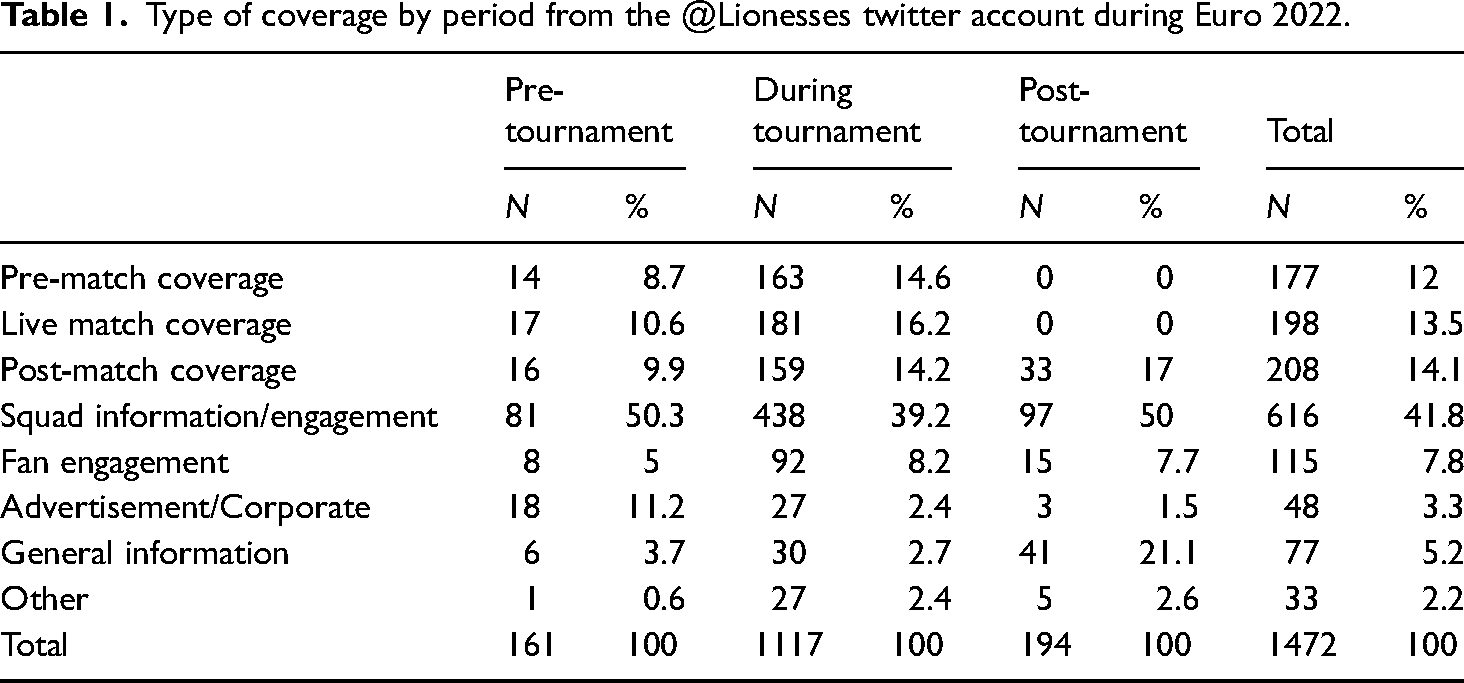
During the women's European Championship the FA tweeted 1472 times from their @Lionesses account. There were 161 tweets (10.9%) in the seven days before the competition began, 1117 (75.9%) during the 26-day tournament and 194 (13.2%) in the seven days after the competition concluded. Pre-tournament coverage averaged 23 tweets per day, increasing to 43 per day during the tournament, with 96 on England match days, whilst post-competition coverage averaged 28 tweets per day. The overall format of tweets was 94.5% basic tweets, 3.9% replies to other users (usually supporters) and 1.6% quote tweets (typically from @England or the @Lionesses’ profile itself). The majority of tweets from @Lionesses related to squad information/engagement (42%), which included updates on players or coaching staff, as well as involvement with internal media communications. Information on specific matches (before, during, and post coverage) was also tweeted regularly, and these three separate themes account for almost 40% of all tweets. The FA's social media team further utilised the account to engage with fans, launching quizzes and replying to various enquiries. A small percentage of tweets, 2.2%, were classified as ‘other’, which included competitions and external support for the team amongst others (Table 1).
Type of coverage by period from the @Lionesses twitter account during Euro 2022.
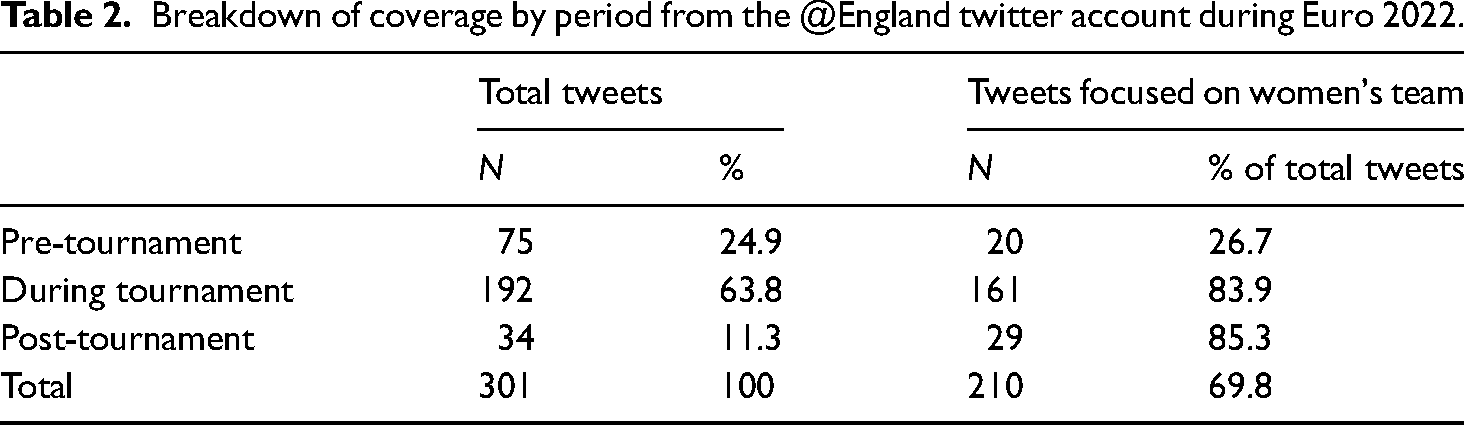
The FA tweeted from its @England account far less frequently throughout the same period, with only 301 messages in total and the Lionesses were the focus in 69.8% of these tweets. This proportion increased once the competition began, with 83.9% of tweets concentrating on the women's team and 85.3% in the seven days after their final triumph. Notably, just 26.7% of tweets prior to the commencement of the tournament centred on the Lionesses (Table 2). Unlike the @Lionesses account, @England's pre-tournament coverage averaged more tweets per day (11 tweets) than the actual competition (seven tweets). However, when just tweets directed to the women's team were included, the pattern inverted, with only three tweets per day prior to the competition and six tweets per day during the event. Throughout the tournament, the account tweeted an average of 17 times per day, with all but two of the 103 tweets focusing on the Lionesses. The post-tournament coverage from @England averaged five tweets per day, with 80% focusing on the Lionesses. These results show that despite the @England account tweeting less frequently the bulk of their tweets still centred on the Lionesses.
Breakdown of coverage by period from the @England twitter account during Euro 2022.
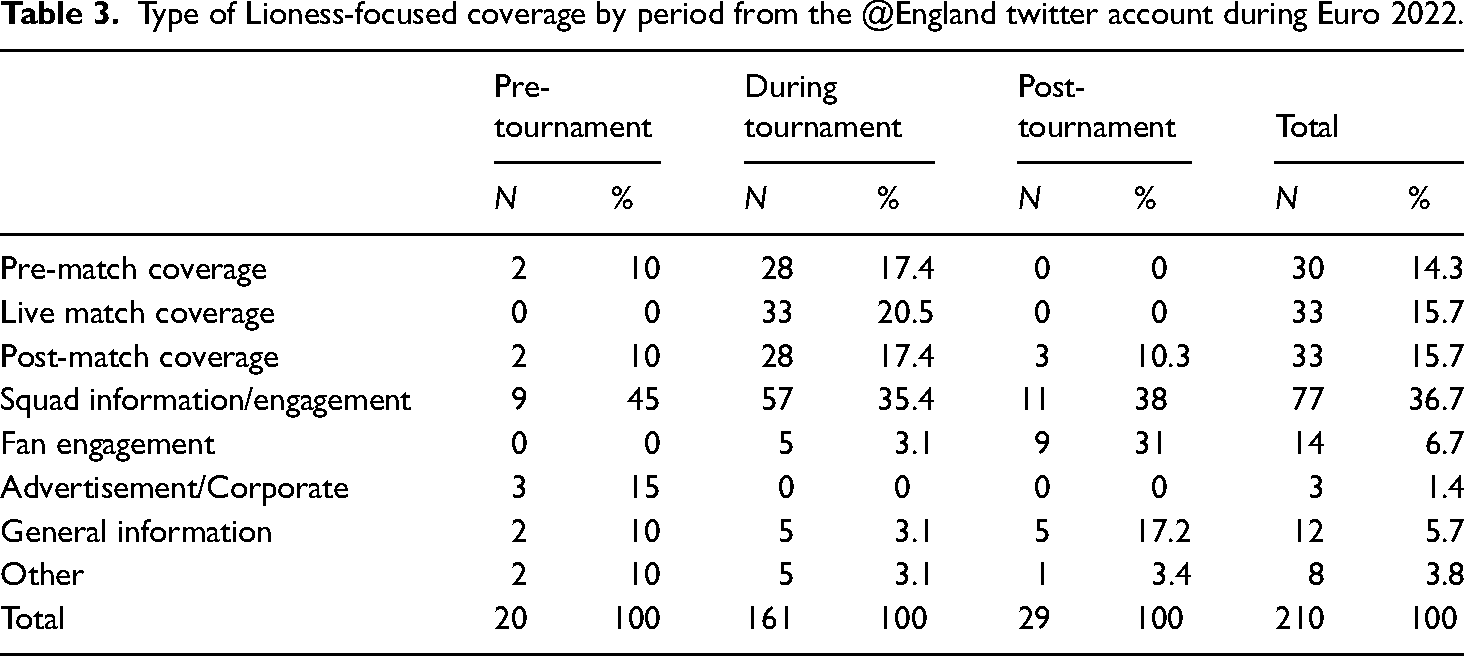
When just @England's tweets on the women's team were examined, the themes mirrored those of the @Lionesses account, with the biggest proportion classified as squad information/engagement (36.7%) and pre-match (14.3%), live match (15.7%) and post-match (15.7%) coverage. We can see from these numbers that the general account delivered more match coverage throughout games than the @Lionesses account. Engagement with fans was also prominent (31% of @England's post-tournament tweets), indicating that once the Lionesses were successful, the FA had a stronger willingness to communicate directly with supporters through their more widely followed Twitter account (Table 3).
Type of Lioness-focused coverage by period from the @England twitter account during Euro 2022.
Use of multimedia within tweets during the 2022 European Championship
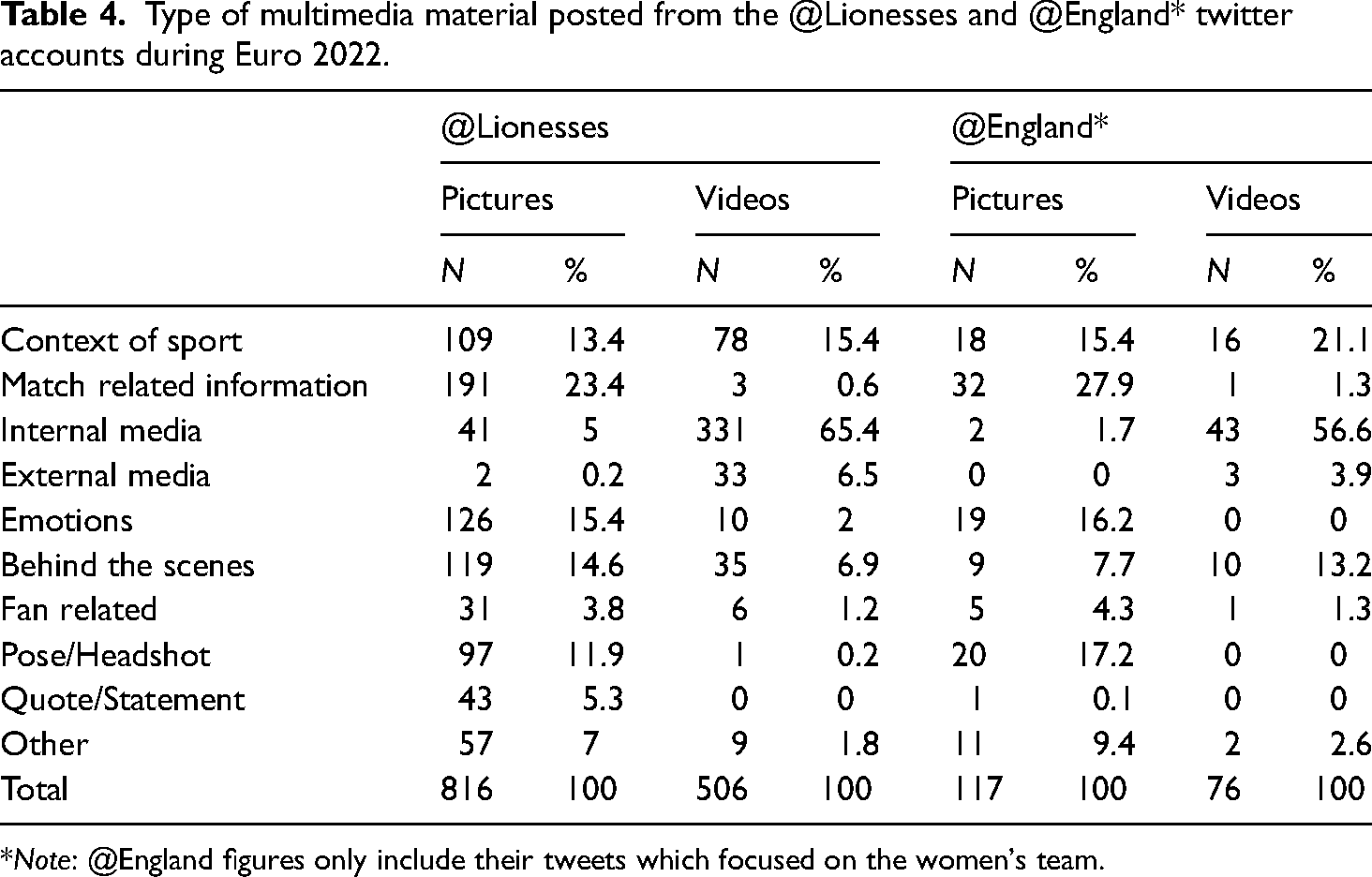
Approximately 71% of @Lionesses tweets included multimedia content, such as a photo (45.3%) or video (25.7%). The analysis found that the largest proportion of images showed match-related information concerning England's six matches during the tournament (23.4% of all images). Other common themes included images of the Lionesses portraying a state of emotion generally through celebration of their successes (15.4%), behind-the-scenes images of the team in natural conditions rather than poses or during media duties (14.6%), and images of the team engaged in sporting action during games or training (13.3%). Throughout the tournament, the FA attempted to increase interest in the Lionesses by introducing Lionesses Live, a daily broadcast that provided unique access and interviews from the England camp. Over 65% of the videos shared by @Lionesses were internal media, while external media, i.e., press responsibilities, accounted for only 6.5% of their video tweets. Coverage of the athletes in action was also widely circulated, accounting for around 15% of all videos (Table 4).
Type of multimedia material posted from the @Lionesses and @England* twitter accounts during Euro 2022.
*Note: @England figures only include their tweets which focused on the women's team.
Overall, 92% of the tweets from @England that focused exclusively on the Lionesses featured multimedia content. Match-related information (27.9%), emotions (16.2%) and visuals in the context of sport (15.4%) were frequently tweeted. Headshots or staged photos were also a common theme in @England's tweets (17.2%). Videos showcasing internal media coverage were prominent, accounting for 56.6% of footage, as were videos of players engaging in a game or training (21.1%). Many images, including stadiums, football clothing, and artwork, did not fit into any of the precise categories specified (Table 4).
The study indicated that just one tweet from both accounts featured a clear reference to an athlete's family status, when @Lionesses shared a video of Demi Stokes’ new-born son joining the squad for a team photo, captioned ‘Proud mother’. Meanwhile, there was virtually no sexualisation of female athletes. However, one prominent photograph of Chloe Kelly was often shared, showing Kelly celebrating her winning goal in the final by removing her shirt and exposing her sports bra beneath. The image, which echoed Brandi Chastain's legendary celebration during the 1999 World Cup final, was tweeted 11 times by @Lionesses and three times by @England.
Tweets from @England during the 2020 European Championship
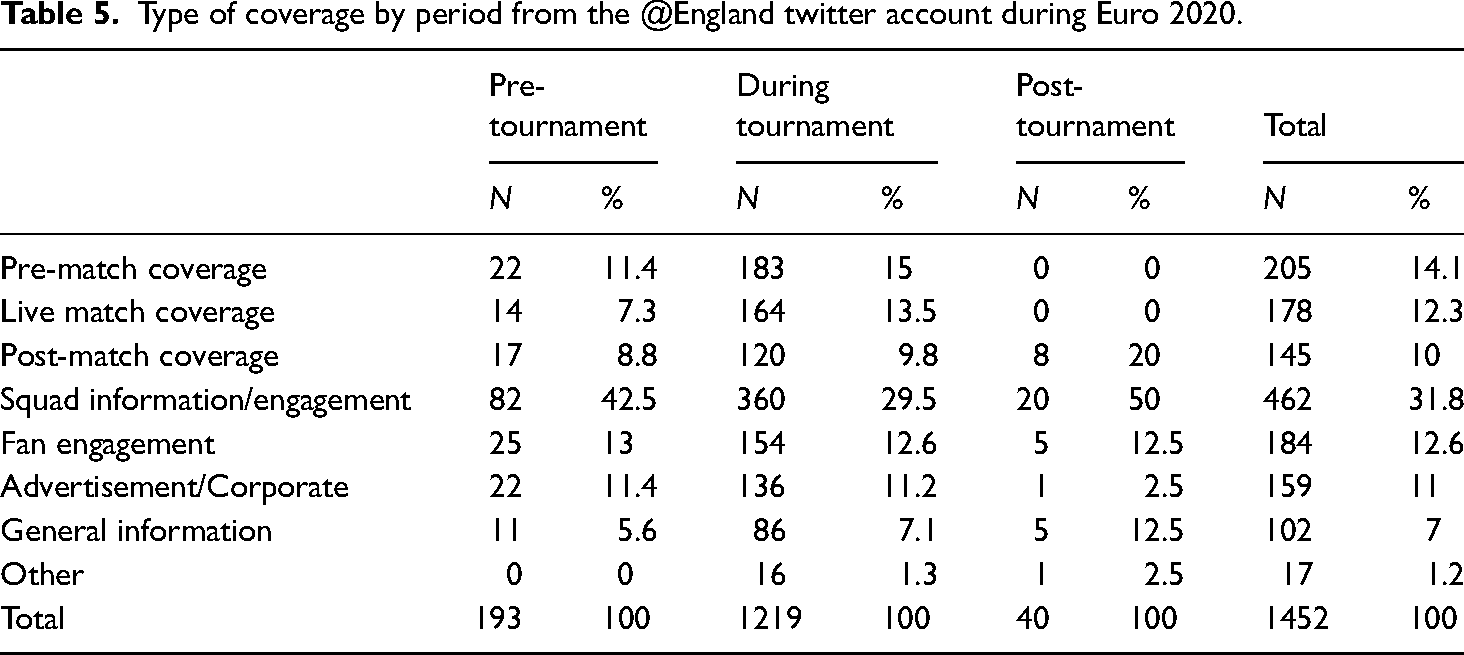
During the men's European Championship, the FA tweeted 1452 times from their @England account. The split was as follows: 193 tweets (13%) in the seven days leading up to the tournament, 1219 tweets (84%) during the tournament, and 40 (3%) in the seven days after the final match. Pre-competition tweets averaged 27.6 per day, in-competition coverage averaged 39.3 per day, increasing to 72.3 on England match days and post-competition reporting averaged 5.7 per day. The majority were basic tweets (87.7%), 6.3% replied to other users (often fans or players) and 6% were quote tweets (typically from fans, players or other football-related accounts). The majority of the tweets in the corpus were categorised as team information/engagement (31.8%) and match coverage (before, during and post-game updates totalled 36.4%). Engagement with fans (12.6%) occurred on a regular basis as the FA posed trivia questions for light-hearted entertainment, addressed supporters’ enquiries and promoted involvement by asking fans which players they wanted to see on their timeline (Table 5).
Type of coverage by period from the @England twitter account during Euro 2020.
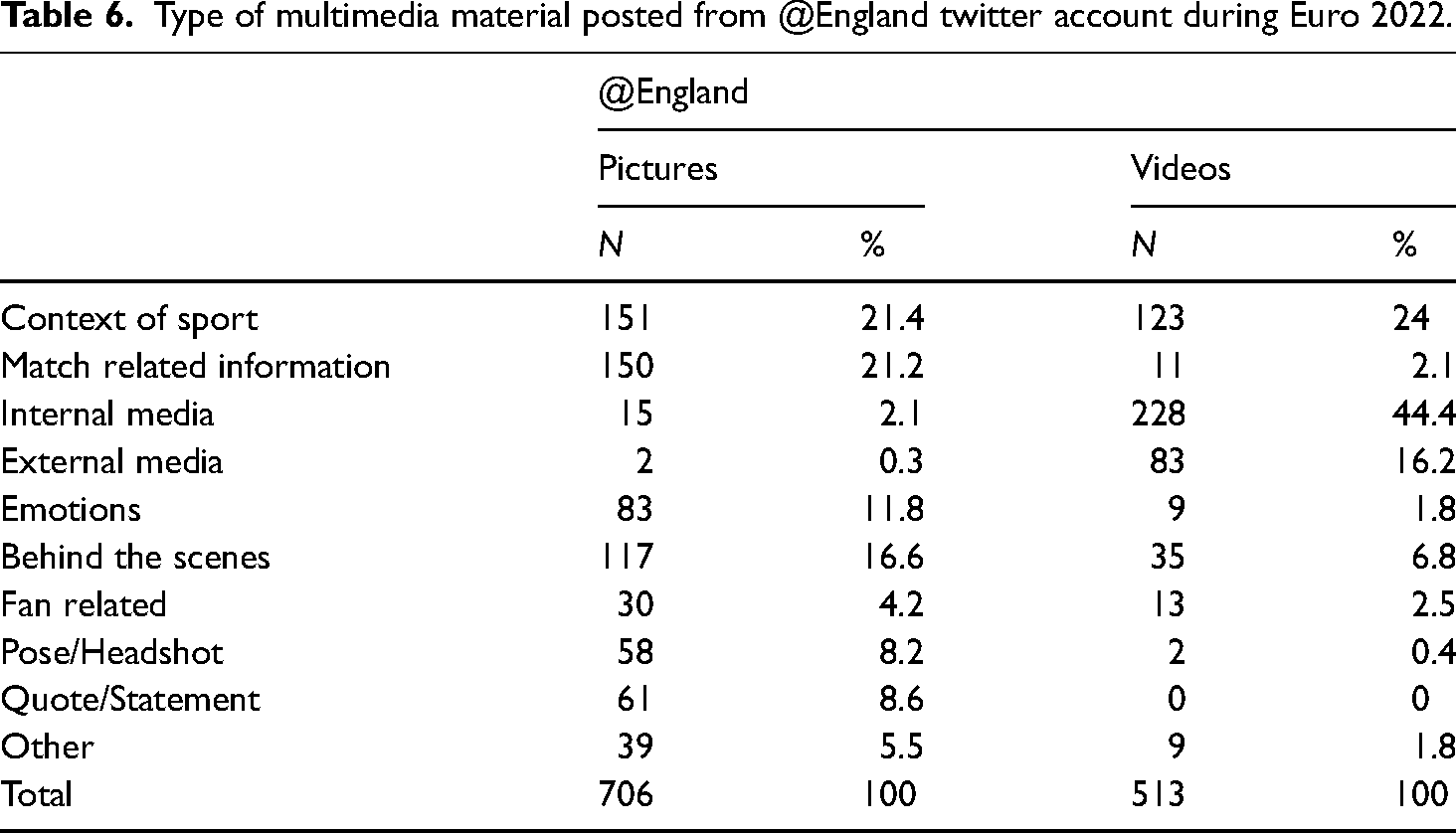
Overall, 84% of @England's tweets featured multimedia content (48.6% images and 34.5% videos). Images in a sporting context (21.4%) and match-related information (21.2%) were the most common themes. Images captured behind the scenes (16.6%) and emotional responses (11.8%) were also frequently tweeted. Of the 513 videos released, 44.4% were classified as internal media. The FA stimulated interest throughout the men's competition with its daily Lion's Den programme, which was broadcast on the organisation's social media channels and was promoted routinely through Twitter, similar to their approach with the Lionesses during the 2022 tournament. External media (16.2% of videos) was also common, with most showing players and coaching staff during news conferences (Table 6).
Type of multimedia material posted from @England twitter account during Euro 2022.
Discussion
This investigation expands on previous research by analysing social media coverage of a women's team via their own governing body and compares it to coverage of the men's squad. RQ1 examined the extent to which the FA promoted the Lionesses during the 2022 European Championship on Twitter using their official @Lionesses account. According to the findings, the FA judged that the competition would create enough public interest to support the Lionesses’ promotion through their specialised profile. Although this study did not examine activity on the @Lionesses account outside of the study period, one could assume a considerable boost in tweeting occurred in the immediate lead-up, during, and aftermath of the competition. Although substantial research indicates a dramatic and paradoxical under-representation of women's sport (e.g., Magrath, 2020; Smallwood et al., 2014), these findings imply that in the absence of gender parity in traditional media, governing bodies may use social media as a valuable platform for promoting women's sports teams, as previously identified by Lebel and Danylchuk (2014). Throughout the tournament, the FA championed the Lionesses’ victories, suggesting that the governing body does not mimic traditional media's technique of undermining women's sporting achievements, observed by Kian et al. (2008). The team was frequently depicted as professional athletes in the tweets examined, contradicting the mediated approach of portraying them as girlfriends, wives, and mothers (Cooky et al., 2015; Messner and Cooky, 2010), and challenging Connell and Messerschmidt's (2005) notion of emphasised femininity. The FA appears to have learned from their highly criticised tweet about this issue following the 2015 World Cup.
This study contends that there has been a movement toward more favourable and extensive coverage of women's sports in the United Kingdom, an observation shared by Petty and Pope (2019). The FA's reaction during the tournament suggests that they are aware of this and are performing their responsibilities to ensure that anyone with an interest in women's football has frequent access to updates and information. The FA's tweets on the @Lionesses profile lacked comparisons to men's football, specifically the men's national squad from the 2020 European Championship, highlighting a difference with conventional media (Black and Fielding-Lloyd, 2019). However, words of support from male footballers were tweeted on a semi-regular basis, particularly when approaching the final. These findings support the claims of Geurin-Eagleman and Burch (2016) and Smith and Sanderson (2015) that social media may function as a potential equaliser for women's sports. Indeed, on 29 June 2022, the first day of the data sample relating to RQ1 and RQ2, @Lionesses was followed by 192,000 Twitter users, and by 8 August 2022, the final date of the data sample, this had increased to 363,600 users, reinforcing Burt's (2006) belief that social media can prove beneficial in building a community for fans.
RQ2 intended to analyse coverage from the @England account throughout the 2022 European Championship. Findings highlight that the FA tweeted updates on the Lionesses far less frequently compared to the @Lionesses profile. While, in contrast to Coche's (2016) examination of US Soccer and the US women's squad, the majority of @England's tweets, particularly during and after the tournament, centred on the women's team, the consistency of updates was unquestionably lacking. It should be noted that the first phase of this research (prior to the 2022 European Championship) coincided with the final of the men's European Under-19 Championship, which England won, and thus much of @England's pre women's tournament coverage focused on this, with 27 tweets offering updates on the final match between England and Israel – more than any of the Lionesses’ matches with the exception of their final. This might be perceived as submission to the prevailing social order, reminding us that when both men's and women's sports exist, coverage of men's sports continues to dominate (Magrath, 2020; Smallwood et al., 2014). Given that the @England account had over 5.5 million Twitter followers when the competition began, this restricted coverage of the Lionesses looks to be a squandered opportunity if the FA is serious about promoting women's football beyond the confines of a four-week tournament. Furthermore, while @England tweeted about the women's squad, the FA made no clear push for people to follow the @Lionesses account, in contrast to Coche's (2016) findings regarding US Soccer and their dedicated women's team account during the World Cup.
Although the media has contributed little to suppress the masculine dominance in sport through their overwhelming bias towards men's sport (Biscomb and Matheson, 2017; Kian et al., 2008), the FA has, to some extent, attempted to overturn this by promoting the Lionesses prominently. During the investigation, no discernible differences in the type of coverage were observed between @Lionesses and @England. Like the @Lionesses account, @England's tweets emphasised the women's team as professional athletes first and foremost, with a strong emphasis on pre, during, and post-match coverage, as well as engagement with the players through their own media channel. Over half of the videos tweeted by @England were classified as internal media, and the establishment of Lionesses Live broadcast was prevalent through the @England account, allowing fans to become acquainted with female players they may not have been aware of before the competition.
Building upon limited research into a gender-neutral governing body's promotion of their sport on social media, this paper extends our knowledge through RQ3, which aimed to compare the FA's promotion of the women's team and the men's team during their respective championships. This research question provides the most insight into how satisfactorily the FA promotes the Lionesses. Quantitative data demonstrates that the FA promoted the women's squad more frequently (1472 tweets in a 40-day period) than the men's team (1452 tweets in a 45-day period) during their competitions. These general findings are consistent with Litchfield and Kavanagh (2019), who investigated the Team GB and Australian Olympic Team Twitter feeds during the 2016 Olympics, and calm Duncan's (2006) historically grounded conclusion that sport is a celebration of manhood, and suggestions that sport, notably football, is a definer of masculinity (Connell, 2005; Magrath, 2018), at least throughout these particular international tournaments. Although this dichotomy should not indicate equality between coverage of men's and women's sport, it does tentatively suggest a cultural change for women's football and alleviates certain tensions in their depiction.
During both competitions, photos, and videos were commonplace in tweets, with 71% of @Lionesses tweets and 92% of @England's coverage on the women's team including a multimedia element, compared to 84% of @England's tweets throughout the men's tournament, partially challenging Jones’s (2013) claim that females generally receive less photographic coverage than men. Further investigation into the multimedia categories reveals several relevant discussion points. Images of the men's team in a sporting context were more commonly shared compared to the women's team, corroborating research which suggests that males are more likely to be photographed in sporting activity (Hardin et al., 2002; Hull et al., 2015). However, we should acknowledge that several photographs classified as ‘emotions’ were captured during matches, exonerating the FA of blame in this case. Similarly, videos in the context of sport were more prominent throughout the men's tournament, indicating that coverage of players participating in sport was more regularly broadcast for the men. Scrutiny revealed that @Lionesses’ tweets contained more squad information/engagement, primarily through internal media, than the @England account during the men's tournament, implying that the FA may have strategically included more personal coverage of the women footballers in an effort to promote them through social media, thereby familiarising the public with the athletes. During the men's tournament, @England tweeted more advertising/corporate tweets (11%), compared to 3.3% from @Lionesses and 1.4% from @England during the women's tournament. This might imply that the FA feels there is more value in advertisment and sponsorship coverage through their men's squad and during men's tournaments. Clips of external media obligations, often during press conferences, were also more prevalent during the men's tournament. This theme is repeated in the image theme quotes/statements, where a bigger proportion of men's tweets fell into this category compared to @England's tweets during the women's tournament. This illustrates compliance with structural irregularities experienced by women athletes and coaches, suggesting that followers are less interested in what they have to say.
Despite the points raised above, which appear to favour the men's team, appraisal of the Lionesses coverage was generally positive. Unlike Clavio and Eagleman's (2011) results, the data suggest that female players were not sexualised. This implies a shift away from reducing women athletes to sexual objects, which contradicts earlier findings (e.g., Cooky, 2018; Daniels et al., 2021). Although typically studies focus on conventional media rather than governing body coverage, this outcome is a positive result in the conflation between gender, media, and sport and corresponds with Ravel and Gareau (2016), who identified an overall move toward better parity between the genders in football coverage. Although the quantity of tweets depicting Chloe Kelly's celebration has been mentioned briefly, the author would question the sexualisation of this. Indeed, since the final her celebration has been branded as ‘iconic’, and one that will unify and encourage women (Battison, 2022), as well as promoting ‘a spirit of enthusiasm that exceeded even the glittering victories on the pitch’ (Ward, 2022).
The findings relating to imagery validate Duncan et al.'s (2000) claim that pictures expressing emotional sentiment are more prevalent in women's sport. Negative connotations could be drawn given that the FA tweeted more pictures of the women's squad showing emotions than the men's, demonstrating duplicity in reinforcing the gendered representation of women as reactive (Bernstein, 2002). However, a more resonant reason can dispel this notion when appreciating the Lionesses’ achievement in front of their home crowd defined the 26-day international tournament and offers reasonable justification that images of players expressing emotion, often with their teammates, is reflective of other successful athletes celebrating momentous victories. Characteristics associated with hegemonic masculinity, such as passion and competitiveness, were commonplace in these images, highlighting a difficult issue with the concept of emphasised femininity. This research, amongst others (Petty and Pope, 2019), uncovers a challenge to Connell's antiquated definition of masculinity and femininity, as a result of a cultural shift and bonding between women athletes and their successes. Connell's perspective limits the inclusion of women who demonstrate characteristics historically associated with hegemonic masculinity, ironically including the qualities desirable for elite athletes. This paper recommends isolating these qualities from hegemonic masculinity since doing so risks perpetuating a binate approach to gender norms that questions women who display these features, thereby reinforcing the gender hierarchy.
In conclusion, while it is correct to highlight the FA's extensive coverage of the women's team via their @Lionesses account, it is also important to emphasise that compliments should be met with caution, as the findings nonetheless reveal a troublesome gender gap, even in the absence of traditional media gatekeepers. Although variations in coverage between men's and women's football favoured the Lionesses throughout the women's European Championship, this coverage was mostly geared towards the followers of the team's Twitter account, supporting conclusions drawn by Coche (2016). This could imply that the FA regard the women's team to be of lesser importance since they did not consider such extensive coverage was required, or desired, by followers of their general @England account. In a broader sense, the FA might be accused of reinforcing the gendered dichotomy prevalent within traditional media coverage. Nevertheless, it would be unproductive to fully criticise the FA for facilitating gender divides by providing limited coverage of the Lionesses via their @England account, and in terms of practical implications, this paper emphasises the importance of social media in covering women's sports teams, particularly from the standpoint of sports organisations. The Lionesses were promoted as equal to their male counterparts for the duration of the 2022 European Championship, at least in terms of quantitative coverage from the FA via their dedicated Twitter account, demonstrating a positive shift in the general representation of women's football on social media and cautious reason for optimism moving forward.
Limitations and directions for future research
The current study is not without limitations. Firstly, the governing body of just one nation was the focal point. Consequently, broad statements concerning women's football would be improper because other countries’ promotion of their women's teams is likely to differ. Since no comparison was made between the FA's promotion of the women's team between various tournaments, such as the 2017 and 2022 European Championships, there was no opportunity to monitor the growth in their coverage of the Lionesses on Twitter, assuming one existed. Furthermore, while it was a deliberate decision to investigate this subject through the governing body in order to bridge a substantial gap in research, the findings cannot be associated with the degree of coverage provided by traditional media. Finally, the researcher purposefully chose to analyse the data quantitatively in this study; a qualitative approach may provide different results, with a potential avenue to undertake a linguistic analysis to explore more acutely the nature of language evident within the tweets which may reveal that the FA promoted their women's and men's teams differently.
A broader examination of governing bodies’ usage of social media opens doors into a relatively under-explored topic, and scholars are encouraged to continue investigating this. Researchers are recommended to continue to focus attention on how governing bodies promote their women's teams, either by comparing them to men's teams or by monitoring the promotion of women's teams over time. It may also be advantageous for forthcoming research to compare the promotion of women's sport through different governing bodies. Although Twitter has been the focus of this study, the growth of alternative social media platforms for avenues of change, particularly among younger users, could provide an intriguing insight into how official organisations connect with them. Finally, future sociological research may benefit from focusing on themes of masculinity and femininity in sport to provide fresh insights on broader gender issues, perhaps challenging Connell's theoretical approach further.
Conclusion
This paper set out to analyse the FA's promotion of the Lionesses throughout the 2022 European Championship and offer a comparison to their promotion of the men's team during the 2020 European Championship. Unlike previous research that has focused on gender representation through traditional media, the current study presents one of the first unique observations into the field of sports reporting through the usage of social media by a governing body. Given that sports organisations are able to use social media to bring equity in their coverage, these findings have the potential to impact social media departments at such organisations, particularly those that advocate equality but may not adequately reflect it in their online communication.
Despite the financial precariousness of women's football becoming increasingly apparent during the Covid-19 pandemic, throughout a four-week period in July 2022, the Lionesses became the centrepiece of what may become a transition in how women's football is consumed within sports culture, particularly in England, contributing to a small step forward in the representation of female sports more broadly in the UK, as evidenced by the announcement of a major governmental review of women's football aimed at evaluating the game's potential audience reach and growth. Nonetheless, despite this paper arguing there has been an optimistic shift in the representation of women's football following the Lionesses’ victory, we must tread lightly in suggesting that the FA's coverage through a Twitter account dedicated to the Lionesses epitomises a significant sign of progress. If the FA have the desire to promote their men's and women's national teams equally then the organisation must reconsider its current social media strategy that implies they view their @England account as the de facto men's account, whilst promoting the women, albeit significantly, through a discrete profile. Considering the FA itself creates such clear distinctions between their national teams the question must be asked – can we, with any conviction, expect others to perceive men's and women's football as equals?
Footnotes
Declaration of Conflicting Interests
The author declared no potential conflicts of interest with respect to the research, authorship, and/or publication of this article.
Funding
The author received no financial support for the research, authorship, and/or publication of this article.
