




Abstract
This article explores how gender and disability inequity is addressed in research, policy and organisational strategies that shape the Australian sporting landscape. By examining the most current annual reports and strategic plans of 31 national sport organisations, national disabled sport organisations, peak bodies, and government agencies, we identify the implications of siloed thinking that considers gender and disability to be separate forms of diversity. Our analysis outlines the limitations of organisational strategies, specific plans and even participation data for women with disability. We argue that an understanding of the nuanced experiences of women with disability is needed to inform policies and practices that advance equitable sport provision, making visible what women's disabled bodies can do and become through sport.
Keywords
Introduction
International scholarship on disability sport has grown in the last decade, but there has not been a similar surge in research that examines the gendered sporting experiences of women with disability/disabled women 1 (Brighton et al., 2023; Culver et al., 2020). Recent work by Culver et al. (2020) has importantly mapped out key empirical research that has been conducted on women with disability in sport across a range of contexts and approaches, finding significant research gaps, including a lack of work on non-elite sport, youth, policy review, and other intersecting social categories (e.g., race, sexuality, religion). Twenty-six years after Karen DePauw's 1997 call for more attention to the intersectional nature of disability in sport there has been a sporadic response, despite repeated calls for research to move beyond the normative default of masculine bodies (e.g., Hardin, 2007; Hargreaves, 2000). There is a persistent lack of ‘theoretical imagination’ (Brighton et al., 2023, p. 13) evident in much disability sport research that has contributed to a gender knowledge gap and further invisibilised women's experience of disability with implications for policy and practice. Despite revolutionary conceptual developments within the broader field of feminist disability studies (see Garland-Thomson, 2002), there have only been small steps towards embracing intersectional approaches to equity and embodiment in sport sociology, management and policy.
There have been some significant contributions by feminist sport scholars who pursue intersectional understandings of gender that recognise the experiences of women and non-binary people with disability in the process of knowledge production and policy formulation (Frisby & Ponic, 2013; Kriger et al., 2022; Peers et al., 2023). Our article builds on this trajectory of feminist research to explore how gender inequity and disability are addressed in research, policy and organisational discourses that shape the Australian sporting landscape. Recognising the shifting conceptual terrain that connects gender and disability sport, this article focusses on what research and policy discourses ‘do’ within the Australian sport context. There are over two-million women with disability living in Australia, but ‘the lack of data, research and information about women and girls with disability results in their invisibility and marginalisation in society, their exclusion and marginalisation from policies, services and programs, and a critical lack of resources for this group’ (Frohmader, 2019, p. 5). This article is focused on the organisational strategies and framings that limit how sport participation is understood in relation to inequity.
In public disability sport narratives Paralympics Australia importantly emphasises equity to improve participation pathways, identifying ‘that of the 4.3 million people with a disability, only one in four participates in sport, while three in four want to participate’ (Sygall, 2023). However, the intersection of gender and disability inequity remains hidden in relation to national data showing women with disability have lower rates of participation in organised sport (19%) compared to both non-disabled women (34%) and men with disability (27%) (Australian Sports Commission, 2022). Such inequities are also evident at the elite level with the Australian Paralympic team in Tokyo including only 43.6% women identified athletes, which though above the worldwide average for the games (42.08%), was well below the 54% of women in the Olympic team (Australian Sports Commission, 2021). Furthermore, this data does not reflect the experience of gender-diverse people with disability; at least one Paralympian identified is non-binary, but they were presumably included in the statistics as a woman (Shalala, 2022).
Consequently, this paper pursues the research question: how are disability and gender positioned within Australian sport organisations as distinct identity categories and what are the implications of this framing for the way meanings of disability are produced for policy and practice? Undertaking an analysis of organisational reporting in strategies and plans within the Australian research context, we consider how assumptions about disability sport are shaped by discourses that render gender visible or invisible in particular ways. Hence, these discourses influence the thinking and actions of policymakers within Australian sport policies and organisational strategies. Our feminist analysis contributes a gender and disability lens to advance research and policy that seek to increase the involvement of ‘equity groups’ in all aspects of Australian sport, including participation, leadership, and coaching. Without a more nuanced and targeted understanding of ‘equity’, sport administrators and organisations face the risk of increasing the gender gap rather than learning from the lived experiences of women and non-binary people with disability. This article is thus both an intervention into the Australian policy and research agenda, as well as an endeavour to shift organisational thinking.
Theoretical Framework: Feminist Disability Studies and Intersectional Insights
The social model of disability refutes the notion that disability is a medical condition requiring medical solutions and instead understands disability as the interaction between a person's impairment/s and social, physical, and attitudinal barriers. In this article we extend the social model of disability, turning to the field of feminist disability studies. Feminist disability study is a body of scholarship underpinned by post-structuralist and post-humanist critiques of the power relations shaping normative identities and bodies (Garland-Thomson, 2011). Feminist disability studies scholars have argued for more nuanced understandings of the material and discursive forces that produce discrimination and exclusion by examining the ways in which gender and disability mutually constitute disabled women's experiences and opportunities (Garland-Thomson, 2011). Within feminist disability studies Garland-Thomson (2011) articulates the concept of ‘misfit’ to describe the way the world fails certain bodies, thus flesh, organisations and the environment become entangled in a co-constitutive relationship.
Extending the social model of disability's focus on the interconnected individual, organisational and broader structural levels of change and articulating the ‘misfit’ (Garland-Thomson, 2011) between bodies and the world, feminist scholars have pursued an intersectional understanding of disability by identifying the way in which multiple systems of oppression (e.g., ableism, racism, sexism, homo/transphobia, classism etc) intersect with disability to shape the experience of embodiment and everyday inequities (such as sport) (Brighton et al., 2023; Schalk, 2018). Drawing together conceptualisations of power and embodiment, feminist disability studies considers the multiple forces, identities and shifting relations of normativity that enable and impede social change within patriarchal and ableist worlds (Bê, 2019). Though useful for disability studies, it is important to recognise that intersectionality was first conceptualised to understand the intersecting areas of discrimination experienced by Black women (Crenshaw, 1989). Black disabled feminists have pushed for making race central to a disability framework, arguing that ‘racism, sexism, and ableism share a eugenic impulse that needs to be uncovered and felled’ (Bailey & Mobley, 2018, p. 21). These insights have yet to be adopted widely by disability sports scholars, and indeed, race is almost non-existent as an intersectional category throughout the literature (Cottingham et al., 2023). It is, therefore, worth reflecting on Schalk's (2018, p. 140) argument that it is necessary ‘to identify the multiple discursive systems at play even when certain identity groups do not seem to be present’.
Several authors have demonstrated how women and girls with a disability tend to receive less support on both an organisational and a societal level, with fewer opportunities for sports participation and less encouragement from family (Culver et al., 2020; Slocum et al., 2018). Women and girls with disability are often denied access to normative femininity. Instead ‘cultural stereotypes imagine disabled women as asexual, unfit to reproduce, overly dependent, unattractive – as generally removed from the sphere of true womanhood and feminine beauty’ (Garland-Thomson, 2002, p. 17). Without recognition of difference, women with disability are excluded from the normative identity category of women as defined by binary thinking, and hence become invisible within sport discourses framed by equity as a broad or gender specific concept. Women with disability struggle to push gender norms or resist the gender binary, as they are often required to perform gender ‘correctly’ to become intelligible as adults and resist the framing of the desexualised ‘cute little disabled girl’ (Slater et al., 2018, p. 417). Although much of the research on this topic in sport is older and in need of further exploration, these stereotypes place disabled sportswomen in the difficult position of having conflicting and ambivalent relationships with their bodies (Hardin, 2007). These stereotypes have implications for how the gendered experience of disability is addressed in ways that challenge normative assumptions about how sporting bodies are valued in policy discourse and representations.
More recently we have seen the emergence of intersectional thinking and frameworks for sport research, policy and practice. Peers et al. (2023, p. 310) emphasise that sport provision needs to shift to value ‘the knowledge of those who are marginalized by over-lapping systems of oppression instead of continuing to prioritize and deeply value only the knowledge of those usually positioned at the center’. Research has also begun to explore the ‘intersectional co-conditioning of dis/ability’ (Paccaud, 2022) in Powerchair Hockey by focussing on the interlocking oppressive relations that connect cognitive and physical functioning with normative assumptions about different bodies (gender, race, sexuality). In their work Richard et al. (2017, p. 76) argue for an intersectional analysis in their exploration of the tensions affecting disabled women in the unique context of mixed gender competition where ‘powered wheelchairs dissipate biological inequalities and gender is not a discriminating factor in performance’. Despite seemingly the gender-neutral context, male players and coaches continued to enact gender norms that discredited these sportswomen's embodied capabilities. This emerging body of research highlights the need for feminist analysis of the material conditions of disabled women in sport policy and practice (such as costs to participate, equipment, competition pathways), as well as the affective and discursive dimensions of experience that often remain silenced or invisible (feelings of exclusion, challenges of not being ‘woman’ enough, or being seen as a sexual object by men).
The Australian Context
In this section we outline the Australian context of sport policy and organisational structures and provide an overview of the existing Australian research on gender and disability to identify gaps in knowledge.
Australian sport generally follows a top-down approach within a federated system of sport governance, in which National Sport Organisations (NSOs) and National Sport Organisations for People with Disability (NSODs) develop policy in line with funding guidelines and priorities governed by the Australian Sports Commission (ASC) and the current Sport2030 policy (as well as sport specific international policies) (Jeanes et al., 2019). With federal government funding the ASC distributes funding to NSOs based on priorities that include growing community participation and elite success (Australian Sports Commission, 2022; Gowthorp et al., 2017). While NSOs can also obtain funding through various government grants (local, state and federal jurisdictions), sponsorships, donations, and revenue from events, they are largely dependent on government sport funding (Gowthorp et al., 2017).
Post-2000 Sydney Paralympic Games, most disability sport was ‘mainstreamed’, that is, integrated into NSOs that also run non-disabled sport, with the intention of allowing disabled athletes to capitalise on already established pathways (Hammond & Jeanes, 2018). While the ASC has implemented policies aimed at ensuring people with disability are given opportunities within NSOs, Jeanes et al. (2019) argue that this idea of inclusion has been ill-defined and uneven in its implementation. Additionally, NSODs provide disability-specific sport, eight of which have recently collaborated to form the Australian Sporting Alliance for People with Disability (ASAPD), a peak body that has been funded with support from the ASC. Currently, Australia does not have a national women's sport policy or a national disability sport policy. Indeed, the Australian sports system is a ‘complex hierarchy’ which often lacks collaboration and coordination (Gowthorp et al., 2017, p. 115). While there are pockets of good practice and policy, the sport policy landscape has yet to embrace research insights on intersectionality to recognise multiple, intersecting identities and develop nuanced responses to inequitable power relations.
Moreover, research on gender and disability sport in an Australian context is extremely limited, with minimal engagement with feminist disability studies or intersectional insights (e.g., Dehghansai et al., 2021; McNamara et al., 2022). Most research, though providing some important insights, does not offer any conceptualisation of how gender and disability intersect to shape the embodied experiences of women with disability within a sport system that has not historically been inclusive. There are some limited exceptions to this, often focused on media representations of sport and content analysis of the Paralympic Games (Ellis, 2008; Hilgemberg et al., 2019; Rees et al., 2018; Toffoletti, 2018).
Importantly, outside of the media space, Taylor et al. (2012), using an online survey, found that women with high support needs in Australia tended to be less likely to participate in sport. Their lack of participation was mainly due to social and structural constraints that highlight the gendered contexts of ableism, rather than the individual's impairment. They found the highest rated constraints were ‘no friends to participate with; no support to participate; lack of awareness of the benefits of sport and recreation; too many domestic duties; lack of accessible public transport; lack of accessible toilets and changerooms; sport and recreation not important; and, sport and recreation is “only for men”’ (p. 10). Several respondents called for sport organisations to specifically encourage and support women with disability, especially older women (Taylor et al., 2012). Those who already participated in sport reported that that it had significant benefits, including achievement; improved health, muscle tone and fitness; improved self-esteem; and friendship. Although Taylor et al., (2012, p. 11) noted that their article should act as a ‘foundation from which to gain an improved understanding of the participation of women with physical disabilities in recreational and sport activities’, little progress has been made. Spaaij et al.'s (2014, p. 356) analysis of community sports clubs highlighted a reason why: While some types of diversity (cultural, gender, disability) are considered by some sport organizations, these different axes of diversity are frequently treated in isolation from each other due in part to a policy or funding emphasis on having to prioritize particular forms of diversity.
Hanlon and Taylor (2022) addressed this siloed thinking specifically in terms of the workforce within sport organisations, engaging with critical disability theory and intersectionality to address the experiences of women with a disability. The women they interviewed were aware of their intersectional identity, with one participant explaining ‘there are a lot of limitations and barriers in place for minority groups and women and people with disability both fall into these. When you combine them, that's an extra layer of barrier’ (p. 7). This organisational study highlighted the need for organisations to develop policies and practices to explicitly address barriers that recognise how multiple power relations act to constrain women's agency to engage in the benefits of sport within an ableist world. Hanlon and Taylor's work reveals the value in applying an intersectional lens to sporting organisations with a focus on understanding how the experiences of women with a disability can inform practical change and to challenge stereotypes about women with disability. What is apparent through this exploration of the Australian context are the large gaps in knowledge about the diverse experiences of women with disability, hence their sporting lives have been largely invisible within the policy and practice landscape.
Research Methods
To explore the research question focus on the production of meaning about gender and disability sport inequities, our study employed a thematic analysis of the content of 59 public documents produced by sport organisations, including annual reports, strategic plans, and diversity and inclusion plans. The selection of publicly available plans reflected our interest in the public discourse that organisations contribute to and how they communicate their priorities about equity in sport provision. Our method adopted strategic sampling of 31 different sport organisations, including both NSOs and NSODs. These organisations include Paralympics Australia and their member organisations (the NSOs that govern individual Paralympic sports); ASAPD and their NSOD partner organisations (excluding Transplant Australia due to a lack of recent reports); the ASC; Cricket Australia and Powerlifting Australia. Cricket Australia was chosen because it has a significant presence in disability sport, however, is not a Paralympic sport, and thus offered an alternate perspective. Powerlifting Australia was selected as para-powerlifting is a Paralympic sport, however they are not currently a partner of Paralympics Australia. The organisations represent a wide swath of the Australian sporting landscape, from small organisations with limited funding to larger organisations with correspondingly higher funding.
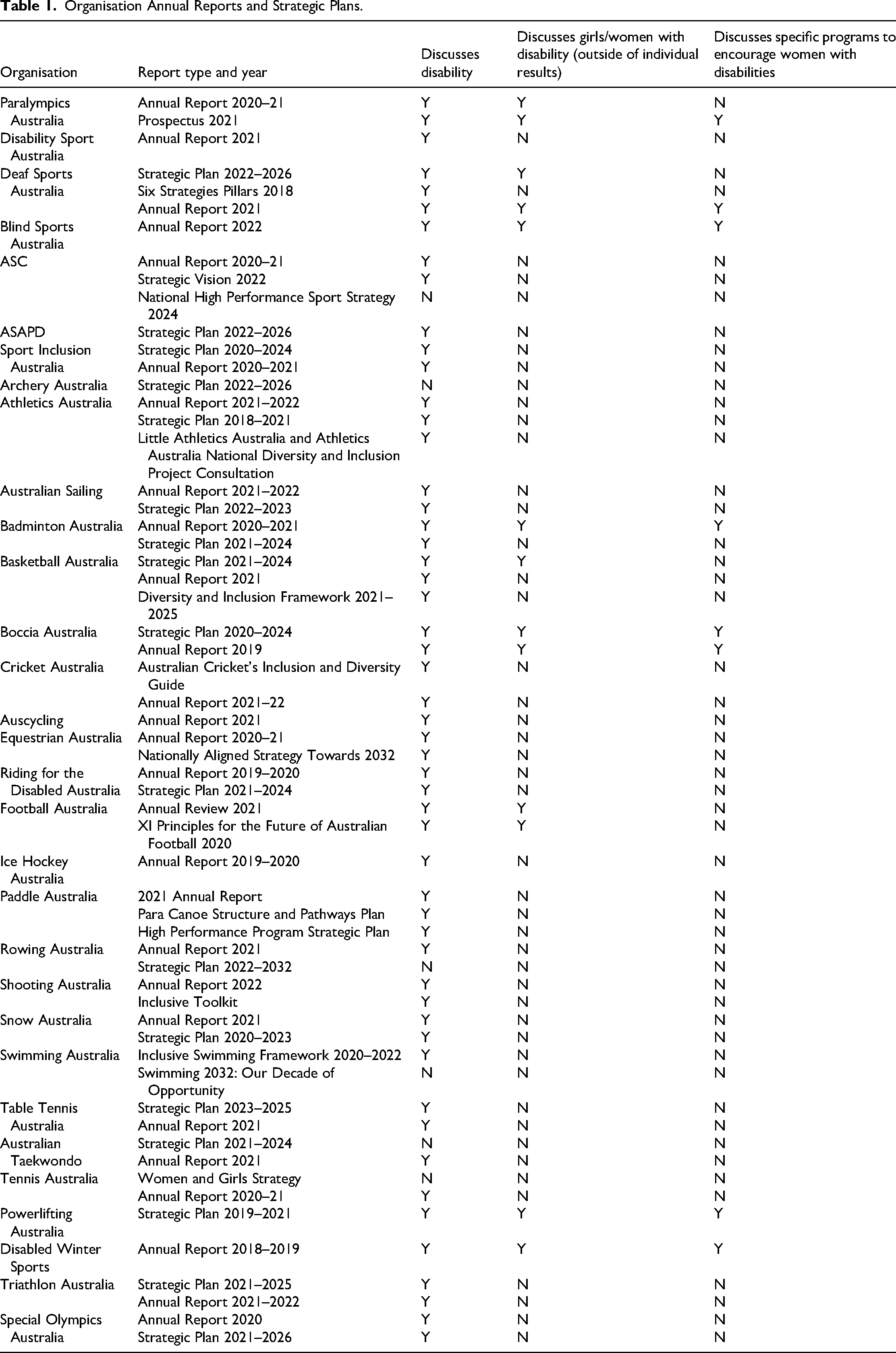
We selected annual reports, strategic plans, and plans focused on equity, diversity and inclusion in sport provision. We excluded Annual reports that comprised only financial statements, as they did not meet the selection criteria without content on equity, diversity and inclusion. The sample resulted in 59 reports. We sampled the most recent report at the time of access, December 2022, however the recency of the reports varied, as particularly smaller organisations did not always have recent reports. A full list of organisations and reports is included in Table 1.
Organisation Annual Reports and Strategic Plans.
At the heart of our methodology is the examination of key documents because they identify the organisational discourses that shape thinking and material outcomes with respect to priorities, programmes, funding etc (O’Kane & Boswell, 2018). They are ‘“institutionalized traces” which can be drawn on to grasp the ideas of their creators’ (O’Kane & Boswell, 2018, p. 627) and as such, analysis can be useful in determining common patterns as to how organisations either challenge or reify societal norms (Sankofa, 2022). Documents can thus be ‘tools for the construction of “ideoscapes”…these are fields of ideological contention, and as such, can impact on those who must live in and under those fields’ (O’Kane & Boswell, 2018, p. 627). Importantly, content that is not included in the reports is as important as what is included (the unsaid).
Following Braun et al. (2019), we employed a reflexive approach to thematic analysis (TA). Under this method, coding is an ‘organic and open iterative process’ (p. 848; emphasis in original), continually evolving as researchers analyse and reflexively engage with the data. Indeed, as Braun et al. (2019, p. 848) argue, the researchers’ subjectivities are recognised in the storytelling process where the aim is to ‘provide a coherent and compelling interpretation of the data, grounded in the data.’ As feminist researchers, we interpreted the data through an intersectional and feminist disability studies perspective, allowing key concepts, such as misfitting, to guide the development of our research question and help us in shaping and constructing the themes in our analysis. This reflexive approach enabled us to identify what was invisible in the way disability and gender were rendered intelligible in plans with respect to normative assumptions. Rather than simply focus on the discursive meaning of plans, we considered the ‘misfit’ between the claims of organisations to address disability and gender inequities, alongside the practices set out in plans for change (measures, targets), the object of change (e.g., elite sport) and what was proposed.
Thus, the authors followed the reflexive process outlined by Braun et al. (2019): Familiarization, Generating Codes, Constructing Themes, and Revising and Defining Themes. Author 1 began by compiling and becoming familiar with the documents, drawing out insights in relation to the data. These were then discussed with author 2, as we reflected on our initial ideas, thinking reflexively about our initial interpretations of the data. Then author 1 engaged in an inductive coding phase. As our TA was specifically focused on the intersection of gender and disability, author 1 sought ‘patterns of shared meaning’ (Braun & Clarke, 2019, p. 593) only in relation to this topic. These themes were then discussed with the co-authors, building a deeper interpretation of the data. The next stage of the process involved constructing themes, which were ‘built, molded, and given meaning at the intersection of data, researcher experience and subjectivity, and research question(s)’ (Braun et al., 2019, p. 854). Finally, themes were refined and defined into the four themes in this article.
The four themes identified are: Invisibility and a lack of participation data; focus on elite sport; lack of specific plans and measurable outcomes; and minimal strategic thought directed towards the sporting success of women with a disability. As Sankofa (2022, p. 2) argued document creation ‘is a demonstration of power that is often inaccessible to marginalized communities’. The invisibility of girls, women and non-binary people with a disability overlay each of these themes and reveals the institutional value placed on women's disability sport. This absence reveals an ongoing historical construction of the Australian sporting space that is underpinned by normative thinking that defaults to non-disabled men, in which others must fit.
Thematic Analysis and Discussion
The following sections identify each of the four themes and provide a detailed analysis of the document content, providing examples of commonalities and differences in the production of meaning.
Invisibility and Lack of Participation Data
This theme identifies the limited reporting and analysis evident across the documents about gender inequities in disability sport. Expanding upon our earlier discussion of the limited national statistics on gender and disability sport participation in Australia, the lack of visibility in organisational plans has important implications for policy and practice responses. Overall, in our sample individual sport organisations did not appear to collect or report participation data for women with disability, beyond the number of female Paralympians. Often there was not even a mention of gender and disability in the reports, let alone any rigorous data collection on participation, volunteering, employment etc. This finding resonates with Peers et al. (2023, p. 9) analysis of Canadian policies and plans, characterised by ‘the glaring absence of specific statements that addressed particular equity-denied groups, despite these groups being included in overarching inclusion statements’.
Some sports, such as Riding for the Disabled Australia (2020), did report some very limited data; however, they mainly focused on disability type, with gender breakdowns only in some categories, which reveals an ad hoc approach rather than a systemic approach to acknowledging intersectional inequalities. Similarly, Disabled Wintersport Australia (2019) provided a gender breakdown of membership data from 2018/19, with 738 men and 426 women (no reporting of non-binary genders). However, simply reporting on gender disparities without acknowledging the forces that contribute to it can also be problematic in terms of how inequity is represented in organisational discourse. It can serve to reproduce the status quo (such as, women aren’t interested in sport) and to the reader represents ‘marginalisation as though it is an inherent quality of particular groups of people, rather than an effect of particular choices and structures of sports organisations’ (Peers et al., 2023, p. 11). In some instances, this type of reporting with no explanation can serve to position women as a liability, with Pavlidis et al. (2023) noting the ways accounting for women in the Australian Football League was connected with notions of indebtedness.
There was one instance of high visibility, with Blind Sports Australia (2022) having conducted a nation-wide survey into participation for the first time in 2022, which identified important gender differences. They recognised a gender disparity with only 57% of women with vision impairment playing blind sport, compared to 75% of men. However, importantly they identified that 60% of vision-impaired women would be more likely to participate if specific initiatives were developed to encourage female participation. This finding has important implications for sport organisation strategies and programmes and points to the value of investigating and recognising the specific experiences of women with disability to improve equity, access, and inclusion in sport. However, the language of ‘females’ remains problematic for perpetuating stereotypes and there is scope to develop gender informed understandings that recognise intersectional thinking about how different women and gender-diverse people engage or not with participation initiatives. By making the gender disparity visible in this report, Blind Sports Australia made increasing female participation a priority (Wright, 2023). However other organisations have not made similar strategic decisions, and this may be due to the absence of data, and hence lack of visibility of women with disability.
What is clearly evident across the reports is the lack of any intersectional thought, as each form of diversity (disability or gender) is considered a unique and separate category, rendering women with disability virtually invisible. Of the 59 reports analysed, only 13 (22%) discussed women and girls with a disability (outside of individual results at elite events). It was clear that most organisations had three categories: men's sport, women's sport, and disability sport. This was even reflected in the organisation's sport awards. For example, Rowing Australia (2021) awarded male crew of the year, female crew of the year, and para-athlete of the year. There are also inconsistencies in categorisations, such as the grouping of teams within a sport that render women with disability invisible. Basketball Australia's (2021a) Annual Report discusses the non-disabled national teams, the Opals and Boomers, in separate sections with an entire page each, whereas the women and men's wheelchair national teams, the Rollers and Gliders, are discussed together in one page.
This siloed thinking is further reinforced in some of the visuals and tables used in Inclusion plans. Swimming Australia's Inclusion Framework (2020) includes a table that identifies seven areas of focus: Aboriginal and Torres Strait Islander; Sexuality, Trans and Gender Diverse; Culturally and Linguistically Diverse; People with a Disability; Women and Girls; Adults and Ageing; and Low Socio-Economic. Though this table has useful and detailed plans for each category, there is no recognition that people can experience intensification of inequity across multiple categories, and don’t always fit nicely into discrete categories. At this stage it seems the idea of using a gender lens across categories that could reveal hidden disparities has been seen as unnecessary or else unthought of. Basketball Australia's Strategic Plan (2021b) was the only report to acknowledge intersectionality by name, however this thinking is not reflected in the rest of the report. Women with disability are largely invisible given the ableist assumptions informing the growth of women's sport, and disability sport remains unreflexively masculine in focus.
Most examples of intersectional thinking were evident at an individual performance level but were not articulated in the discourse as such. For example, the Auscycling (2021, p. 25) Annual Report lauded Amanda Reid, noting ‘Reid became the only Indigenous Australian to win cycling gold at a Paralympic Games.’ However, there was no subsequent follow up or discussion of the structural issues that might keep Indigenous people with a disability out of para-cycling. We know little about the experience of sport for Indigenous women with a disability in Australia, however non-disabled Indigenous women report numerous constraints to their participation in sport, including a lack of culturally specific programs, material constraints such as cost, and racism (Stronach et al., 2016). Furthermore, King et al. (2014, p. 745) argued that Indigenous Australians have a different conception of disability than non-Indigenous people, in which ‘being a person with a disability is not just an additional set of disadvantages on top of being Indigenous, but is actually an experience that is negotiated such that being Indigenous becomes a strength,’ as community can help them navigate their disability to feel cultural connection. An intersectional understanding of Indigenous women's lived experience of disability is essential in understanding their unique experience of sport. It also provides an example of the need to extend cultural understandings of disability to include not just gender, but race, sexuality, and class.
Although some of this critique of reports may seem largely stylistic, the findings with respect to the effects of discourse about inequity in disability sport have material impacts. Spaaij et al. (2014) point out that funding is often tied to one distinct area of disadvantage, such as disability, gender, or culture, forcing organisations to focus their diversity efforts on one axis of disadvantage where homogeneity is assumed. If key national policy and funding bodies like the ASC perpetuate siloed thinking, it makes sense that other organisations will adopt a similar discourse that ignores the impacts of societal forces, such as ableism and sexism, on participation. The ASC (2021) Annual Report provides multiple infographics that demonstrate a commitment to the representation of women at the Olympic Games, however the Paralympic Games graphics have no similar mention of gender. The Olympic Games graphic highlights that 72% of female Olympians received AIS DAIS Grants, while the Paralympic Games graphic references that 86% of Paralympic Athletes received AIS DAIS Grant. Paralympians are constructed as a monolith in data, while Olympians have gender breakdowns. Furthermore, this construction of disabled athletes reinforces the conception of women with disabilities as non-gendered (Richard et al., 2017). The gendered discourses that stereotype women with disabilities as asexual, dependent, and childlike are challenged by women in sport, who push the boundaries of their embodied capabilities and defy conceptions of what the disabled body can ‘do’. However, their absence from the organisational construction of sport limits this capacity.
Focus on Elite Sport
While Australian sport policy priorities focus on both international elite success and growing grassroots participation, the majority of NSO funding is tied to winning medals with lesser investment for increasing participation. This theme identifies the particularity of disability sport where the focus of most sport organisations was almost entirely on elite sport and the success of their national team athletes. Most reports referenced Paralympic sport, however this interest did not extend to grassroots disability sport. This reflects the academic focus on elite disability sport (Culver et al., 2020). Even in the few sports with gender specific programmes for women with disability, the focus was identifying and developing future elite athletes. Badminton Australia (2021, p. 28), for example, conducted specific camps for women athletes, however their aim was to develop ‘female standing players as part of the talent pool for future medal hopes.’ Dehghansai et al.'s (2021) research on Paralympic Talent acquisition suggested that although High Performance staff value opportunities for all athletes, their limited resources forced them to focus on athletes with elite potential. They tended to look for athletes with specific characteristics, including independence from parents, sporting experience at a young age, favourable classification, and promising physical attributes. This is particularly an issue in targeting women athletes, who Dehghansai et al. (2021) argued are difficult to identify using traditional talent search methods, such as talent search days. This study reveals the gendered context that high performance staff notice in terms of overprotective parents, body image issues, and the need to engage girls at a young age to develop an athletic identity. This theme identifies the need for a more explicit focus on gender within elite disability sport plans and more engagement with community participation and pathways.
With respect to the national policy focus on growing sport participation, there was broad reporting across the organisational documents about grassroot participation. However, this content did not include disabled participants which points to ableist thinking within sporting organisations, where grassroots participation is conceived as non-disabled and separate from disability. For example, Auscycling's (2021) Annual Report has a section on grassroots participation that did not include any mention of disability or gender, whereas the only mention of para-cycling was in an elite context. This pattern was repeated across the sport organisations with little content on participation data for grassroots disability sport. One exception to this was Football Australia, that had participation data for Walking Football included in their Annual report section on grassroots participation. They found walking football ‘attracted over 2,500 participants over the age of 55 (22% of them women)’ (Footbal Australia, 2021, p. 28). Although walking football targets people over 55, many of whom are likely to have disability, it does not target disabled people, which might account for this anomaly. The policy impetus to report on improved grassroots participation numbers has not been inclusive of people with disability nor required more nuanced reporting of gender and related identity categories. The analytic focus of this theme highlights how athletes with disability have largely become visible within organisational plans in an elite context – as para-sport – and most often without recognition of gender inequity or identity.
As Jeanes et al. (2019) point out, the overinvestment in elite sport has long been criticised in all Australian sport policy with funding for non-disabled and disabled sport being tied to winning medals. However, our analysis of the reports in this study suggests that in disability sport the balance is even further skewed towards elite sport. The focus on elite sport is particularly problematic for women with disability. In Paralympic sport, men have more competitive opportunities and mixed gender sports in practice tend to be male dominant (Smith & Wrynn, 2014). Furthermore, disability sport still tends to privilege stable and measurable conceptions of disability (which white, male disability advocates also historically favour) that ignore the fluid complexities of disability and disproportionately affect women (Peers, 2012; Schalk & Kim, 2020). Pain disabilities such as Chronic Regional Pain Syndrome that dramatically disproportionally affect women (van Velzen et al., 2019), for example, are excluded, because as Peers (2012, p. 179) decried ‘they cannot quantify pain. Disability, apparently, is something you can point to and measure.’ More girls and women experience disability than men (Dean et al., 2022), however in many cases they do not experience the “right” kinds of disability for Paralympic sport. This has tangible effects; Taylor et al. (2012) found that the largest group of non-participants among women with disabilities were power chair users and those with a mobility problem that do not require mobility aids, the latter of whom often would not fit within Paralympic classification guidelines. The limited research on women with disability in sport means that these women unable to compete in Paralympic sport have not been researched and they are not considered within sport organisations.
Of course, even among women with disability who fit classification requirements, not everyone wants to play elite sport. Sport offers opportunities for belonging, social inclusion and wellbeing that are not tied to elite competition, yet this is often under acknowledged. The benefits of sport are often attached to elite competition, despite the opportunity that exists in casual, social, and informal sport contexts. People with disability in Australian sport are often quickly identified and thrust into elite programs, particularly those with acquired disabilities (Dehghansai et al., 2022). This often occurs without support or desire to be an elite athlete, yet the research we have on pathways tends to focus on those who have succeeded in Paralympic sport, rather than the experiences of those who drop out. We also know little about the specific experiences of women, for whom this effect is magnified due to limited numbers. Furthermore, Jeanes et al. (2019) suggest that even local sports clubs tend to prioritise competitive sport in providing opportunities for disabled athletes, fitting them into the existing dominant discourses of their organisation.
Lack of Specific Plans and Measurable Outcomes
Although most sport organisations paid some attention to the inclusion of people with disability, this tended to lack specificity in relation to reported goals or measurable outcomes to evaluate change. Archery Australia (2022), for example, repeatedly discussed inclusion in its strategic plan, but there is no specific mention of gender or disability. This vagueness could explain the difficulties local clubs have in implementing programs and understanding the complexities of the organisational structure of disability sport (Jeanes et al. 2019). This is multiplied when considering women with disability, who are largely invisible in sports organisations’ strategies or plans. Very few organisations had specific programs to encourage women with disability to participate in sport. Some notable exceptions include Disabled Winter Sports (2019) and Badminton Australia (2021), who hosted specific camps for women to identify new talent, although again, the focus remains on elite sport. Disabled Winter Sports (2019) specifically moved their women's camp to a better time in the season, expressing concern about the stagnation of growth in women's participation. Deaf Sports has a Deaf Sport awareness training program for women in Cricket and Paralympics Australia's Prospectus did refer to Women and Girls Program Partners, although there is very little information publicly available as to what these programs entail. However, these programs are notable for their rarity; after all, most organisations have not even identified the problem, let alone proposing solutions.
There are some Paralympic sports, such as Boccia, that have specific rules about gender diversity, and unsurprisingly they are the sports that are more proactive in encouraging women with disabilities. From 2018, World Boccia changed the rules to require at least one female athlete in their Teams and Pairs (World Boccia, 2017). Consequently, Boccia Australia has made increasing the number of women competitors a priority, making it one of their specific goals and action items. Boccia was also the only sport to recognise that its athletes with high-support needs could be particularly vulnerable, as people with a disability experience violence at a rate far greater rate than non-disabled people (Frohmader, 2019). However, even though some sports like Boccia give women certain opportunities, it can still be difficult to recruit women into disability sport (Dehghansai et al., 2021). This suggests that encouraging women to participate in disability sport goes beyond structural rule changes, but rather more research is necessary to discover other factors that would ensure women feel comfortable in the sports culture and environment, including research into violence and abuse.
While we have offered a critical focus on Paralympic sport, it is worth pointing out that the desire for successful competitors is an important driver for organisations to invest in women athletes. Paralympics Australia's (2021) Annual Report does outline the number of women who attended the Tokyo games, with almost every sport including at least one woman, with the exception of wheelchair tennis and Para-Judo (only one male competitor). In contrast, sports outside of the Paralympic system often do not have elite women's teams. Cricket, for example, does not have a national Women's Deaf Squad or Intellectual Disability Squad, and only introduced a Women's Blind Cricket team in 2023. Blind Sports Australia was particularly concerned about the lack of female blind cricket players, as only 7% of women with a visual impairment played cricket, compared with 20% of men (Wilkeson, 2022). These sports are often advertised as inclusive, but women and non-binary people are not conceived as part of this inclusion. If Paralympic medals are not the impetus, women with disabilities are an afterthought.
Although women with disability are absent from most plans, women are a key priority in sport, with most organisations having some focus or plan for women in sport generally. However, what these documents suggest is that the category of woman is non-disabled. Tennis Australia (2022), for instance, has a Women and Girls Strategy that does not mention disability, wheelchair tennis, or the Paralympics. This is repeated across most of the organisations, whose work continues to be informed by non-intersectional thinking, viewing gender and disability as discrete categories. This limits possibilities for alliances and innovative partnerships across the sport and disability sector, because as Garland-Thomson (1997, p. 12) highlights ‘perhaps most destructive to the potential for continuing relations is the normate's frequent assumption that a disability cancels out other qualities, reducing the complex person to a single attribute’.
Minimal Strategic Direction and Systemic Thinking
It is interesting to reflect on where disability is mentioned and where it is absent. Although Annual Reports often celebrated the success of Paralympians, disability was often absent or only received a cursory mention in Strategic Plans. Disabled sport is entirely absent from Rowing Australia (2022) and Archery Australia's (2022) Strategic Plans and Swimming Australia's (2021) ‘Swimming 2032: Our Decade of Opportunity’ report, while Australian Taekwondo (2021) does not even mention the Paralympic Games in their High-Performance strategic plan. Football Australia's (2020) ‘XI Principles for the Future of Australian Football’ includes a cursory mention of disability. The lack of strategic planning means that rather than any organisational wide plans, disability sport tends to rely on individuals with a passion for the sport (Richard et al., 2017). If there is no passionate individual, or if that person leaves the club, often the investment in disability sport disappears with them. Similarly, in disability-specific organisations, it generally requires a champion of women's disability sport for this experience of gender inequity to be recognised. For example, Richard et al. (2017, p. 75) found in their analysis of French powerchair football that one club had a particularly high number of women athletes due to the efforts of its former Club President, who made it an area of concern.
Even when disabled sport is mentioned in strategic plans, there is minimal attempt at making it a serious focus of the sport's strategy and there are no attempts at monetising disabled sports leagues. For example, Basketball Australia (2021b) has a strong plan to improve the Women's National Basketball League (WNBL), but there is no equivalent plan for the Women's National Wheelchair Basketball League (WNWBL). The result of this is that the WNWBL is often struggling to survive. The lack of strategic thinking shows the inherent ableism in sport organisations and belief that disability sport is a charity, not something to invest and grow in the same way as non-disabled sport. Women's sport has attracted increased investment and funding in recent years, but disabled women have been left out of the equation.
The lack of importance placed on disability sports from national sporting organisations influences practices in local sports clubs. Jeanes et al. (2019) argued that local sports clubs, where most people are engaged in sports, already struggle to implement nation-wide diversity policies, particularly in regard to disability. They point out that national sporting organisations rarely conceptualise what disability inclusion would look like in practice at the local level. Our analysis supports this, as while references to inclusion were common, the strategic thinking necessary to implement change at all levels was absent. There are parallels with the work of Frisby and Ponic (2013), who analysed how Canadian inclusion within sport policy was focussed on ‘opening the doors’, rather than examining processes to enable systemic change. More recently, Peers et al.'s (2023) work suggested that organisations discursively perform inclusion to deflect criticism and avoid doing the practical work of integrating intersectional ideas into their policies and systems; indeed, they found that in Canada, despite a recognition of intersectionality ostensibly being the guiding policy, not one organisation had integrated this understanding into their gender policies.
Conclusion: Implications for Policy and Practice
Our thematic analysis of select organisational documents has identified several problematic issues with respect to the inclusion of women with disabilities. Across the reports we identified i) the invisibility of women with disability and a lack of useful participation data, ii) an overly narrow focus on elite sport, iii) the lack of specific plans and measurable outcomes along with iv) minimal strategic direction or systemic thinking that embraces an intersectional understanding of inequity. Integrating an intersectional approach in sport is a current challenge for sport organisations in Australia. Women with disability are not counted, represented, or planned for in any comprehensive or strategic way. Assumptions about whom sport is for continue to plague organisational approaches to inclusion. By identifying the ‘misfit’ between bodies shaped by disability, gender, race and sexuality (Garland-Thomson, 2011) and the organisational worlds of sport, we bring into view the epistemic gap that needs to be addressed in strategic thinking about change. The focus on elite sportswomen with disability seems one of the few priority areas through which organisations frame the importance of participation. Yet this organisational understanding is limited as not all women aspire to an elite pathway and funding for national sporting organisations in Australia is clearly meant to support both grassroots participations and elite performance.
As more money is allocated to Paralympic sport in the lead up to the Brisbane 2032 Paralympic Games, as well as legacy plans to increase participation in disability sport by 500,000 people (Sygall, 2021), it will be essential for sport organisations to rework their thinking and expand their knowledge to ensure women with disability are represented and are able to contribute their lived experience to strategic directions. Furthermore, sport organisations need to develop women and girls’ policies that utilise intersectional thinking that does not assume that all women experience sport in the same way. The current additive model, where different axis of identity are considered separately, has failed to account for women with disability, particularly in grassroots sport. Without thinking intersectionally it is impossible to see where the gaps are, an issue that extends beyond women with disability to other people who “fit” more than one category. More research is needed to make visible these gaps, and sport organisations need to think reflexively and intersectionally in how they understand data and improve data collection and reporting. This involves a wholesale change in how they think about the effects of multiple inequalities to get more people involved in sport.
Furthermore, more research is necessary to identify what actually works to better the outcomes for women with disability and enable intersectional insights. Such an approach could support organisations to look to recognising the expertise of women with disability in leading the development of co-designed inclusive and intersectional programs and policy frameworks. Building on Hanlon and Taylor (2022), it is necessary to create more pathways for women with disability to work in sport policy and other leadership roles. There needs to be a concerted strategic focus on women with disability, along with measurable goals and outcomes to evaluate success.
Footnotes
Declaration of Conflicting Interests
The authors declared no potential conflicts of interest with respect to the research, authorship and/or publication of this article.
Funding
The authors received no financial support for the research, authorship and/or publication of this article.
