




Abstract
This study explores the gendered narratives constructed in the coverage of the 2016 Union of European Football Associations (UEFA) European Championship football tournament in selected English newspapers. Using qualitative textual analysis, the study tests the efficacy of three established classifications and draws them together with a new, fourth classification thereby creating a typology of the (re)presentations of emphasised femininity. The analysis suggests that despite the increasing prevalence of female sports journalists and the increasing coverage of female athletes in a variety of sports, including football, the reporting of men’s football in the English popular press continues to cast women in subordinate and sexualised roles. Furthermore, women who challenge these roles, particularly those who establish their own voice within the event’s discursive space, are criticised.
Much analysis on the representation of femininity in sport focuses on the mediation of sportswomen, which has left a significant gap in research about the (re)presentation of women and the articulation of femininity in the discursive space centred around male sport(s). As such, this article seeks to locate femininity in gendered narratives constructed during coverage of the most recent major international tournament involving the senior England men’s football team: the 2016 Union of European Football Associations (UEFA) European Championship (Euro 2016). Held every four years and contested by 24 teams, the European Championship is the primary tournament for senior men’s teams of European nations. Approximately 2.4m tickets were sold for Euro 2016’s 51 matches with a further two billion watching on TV (UEFA.com). For the purpose of this study, the 2016 iteration, held in France, was also significant as it was the first tournament to which the wives and girlfriends (known as ‘WAGs’ in media parlance) of English players had been allowed to accompany the team since the World Cup in 2006 when ‘the extensive newspaper coverage often veered away from the field [with] multiple articles largely focused on the English players’ personal lives, and in particular on the lifestyles of the English players’ WAGS’ (Vincent et al., 2011: 614). The Football Association’s (FA) decision to lift their decade-long ban on the partners of male players attending tournaments presented an opportunity to re-interrogate the gendered narratives constructed around male sport by the English popular press. Using qualitative textual analysis and drawing on Connell’s theory of gender power relations (Connell, 1987, 2002, 2005; Connell and Messerschmidt, 2005) for theoretical insight, the study: (a) creates a typology of the (re)presentations of emphasised femininity, by; (b) tests and extends three established classifications – the ‘pin-up wife’, the ‘devoted and supportive wife’ (Clayton and Harris, 2004) and the ‘space invader’ ‘(Vincent et al., 2011); and (c) draws them together with a new classification – the ‘domesticated mother figure’.
Women in the sports media
Following the London Olympics in 2012, Maria Miller, the newly appointed Culture Secretary, wrote to all the United Kingdom’s national broadcasters asking them to do more to improve the ‘woefully under-represented coverage of women’s sport’ (Wright, 2012). The broadcasters responded positively with increased coverage of a variety of women’s sports events such as the Women’s Rugby World Cup in 2014 and the Women’s Football World Cup in 2015. The same year also saw the Women’s Ashes broadcast in full on Sky Television and BBC radio for the first time. However, despite these small but important shifts, the final report of the Government’s Women and Sport Advisory Board found ‘sports media continues to be dominated by men’s sport, and while broadcasters continue to make good progress, other media continue with the status quo’ (Department of Culture, Media and Sport, 2015: 9). Numerous studies have highlighted the variety of ways in which the asymmetrically gendered coverage of sport is articulated, including: the lack of coverage of women’s sports (Cooky et al., 2013); stereotypical assumptions made about which sports are ‘female appropriate’ (Godoy-Pressland, 2014), and; discourse which gives women subordinate and/or sexualised roles. Longitudinal research of USA network televised coverage of sports found ‘that men want to think of women as sexual objects of desire, or perhaps as mothers, but not as powerful, competitive athletes’ (Messner et al., 2010: 24) and that ‘women were often presented in conventional heterosexual roles, including as wives or girlfriends of prominent male athletes’ (Cooky et al., 2013: 16). However, the increase in the number of women taking part in sport and the increased coverage of elite-level women’s sport means this ‘traditional unquestioned articulation of sport and masculinity has been weakened’ (Bruce, 2016: 370). Images of masculinity and femininity are being combined in a range of mediated spaces with women increasingly being shown as active, successful athletes, leading to the rise and increasing acceptance of what Bruce calls the ‘pretty and powerful articulation’ (Bruce, 2016: 370) of femininity within sports coverage.
Women in the men’s game
Echoes of the dominant sexualised and passive (re)presentations of sportswomen can be found in the discourses built around female non-athletes in coverage of the male game. In his study of the (re)presentation of women in The Sun during the 1996 UEFA European Championship, Harris argued that, ‘sport is still an essentially male activity, in which women are afforded only subordinate and/or highly sexualised roles’ (1999: 107). Clayton and Harris (2004) noted that footballers’ partners and the way they were represented in the media conformed to a particular look, being ‘slim, attractive and with tanned complexion, complementing their “natural” femininity with glamorous and often skimpy outfits’ (2004: 325) leading them to identify the typology of The Pin-Up Wife. They went on to argue that such ‘associations with stereotypically beautiful women are powerful images for the production of an individual masculine guise and in the construction of a masculinised footballing milieu’ (2004: 324).
The players’ partners are further trivialised (and sexualised) in the role of ‘unofficial cheerleaders’ in contrast to the players who are presented as ‘patriots at play’ (Vincent et al., 2011: 626). Several studies of the wives and partners of sportsmen from a variety of professions (Gmelch and San Antonio, 2001; Sheedy and Brown, 1998; Thompson, 1999) have demonstrated that the lives of the women concerned were subsumed by their husband’s or partner’s career. In this way these relationships replicate the traditional division of labour within the family identified by Connell which sees ‘certain kinds of work as domestic, unpaid and usually women’s, and other kinds as public, paid and usually men’s’ (1987: 122). Clayton and Harris identified this cultural stereotype in a second typology, ‘The Devoted and Supportive Wife’, suggesting that it is ‘increasingly important that the male athlete’s partner is seen and, moreover, is seen to be beautiful, feminine and wholly supportive of her man’ (Clayton and Harris, 2004: 327).
In her study of the construction of gender in baseball, Ferrante argued that although the role of the woman ‘is to bring comfort, meaning and identity’ to the male player (1994: 247) she is also afforded the role of the sexual temptress and so if the man fails in his contest with other men, ‘he is justified in blaming not himself but the woman, for it was she who interfered with his pure godlike state’ (Ferrante, 1994: 249). This contradictory narrative was identified by Clayton and Harris (2004) in media coverage of Victoria Beckham. Vincent et al. (2011) also found evidence of this contradictory narrative constructed around Beckham, and to a lesser extent other so-called ‘WAGs’, in their analysis of coverage of the 2006 World Cup. The coverage juxtaposed the women’s conformity with emphasised femininity with criticism directed at them for ‘invading a traditionally masculine space’ (Vincent et al., 2011: 622) leading to the identification of the ‘space invader’ typology.
Sexualised and passive (re)presentations of femininity have also been found at the intersection of football, fandom and gender. Rubin (2009), who looked at the coverage of female fans at successive World Cups between 2002 and 2010, argued that the ‘masculinisation’ of football stadia ‘caters to, supports, nurtures and reproduces “real men”, who look around and see other men behaving in “masculine” ways that are mutually recognised and celebrated’ (2009: 270). The media employs an embedded habitus similar to those used to report on players’ partners to reinforce this masculinisation of the space within the football-stadia. In the main, female fans were ignored, but when they were portrayed it was either in the passive role of the ‘WAG’ – attending the tournaments only as the partner of a male fan – or in a highly sexualised manner. This sexualisation was achieved by ignoring the majority of women who dressed in the same manner as their male counterparts and instead focusing on those wearing revealing attire. This was crucial, Rubin suggested, because ‘If “ordinary” female fans are acknowledged, then the link between football, fandom and masculinity is broken’ (2009: 272). In her post-feminist analysis of the (re)presentation of female fans at the 2014 World Cup, Toffoletti suggested that ‘women are invited to construct themselves as sexually autonomous and empowered’ (2017: 466). This sexualised performance of fandom is shown to be an expression of self-aware individualism divorced from the wider cultural inequalities which marginalise female athletes. As such, the ‘sexy sport fan’ femininity ‘differs from existing narratives of the sexualised female sport supporter such as the groupie, whose sexuality is interpreted as servicing the needs of players’ (Toffoletti, 2017: 466).
Gendered identity/Theoretical framework
In the context of the (re)presentation of women in male sport the most fruitful theoretical model is Connell’s neo-Gramscian concept of gender power relations. Connell (1987, 2000, 2002, 2005) argues that at any point in time there is a range of masculinities and femininities operating within a socially constructed gender hierarchy. While acknowledging masculinities are contextualised, Connell argues ‘hegemonic masculinity’ occurs when the most idealised masculinity ‘claims and sustains a leading position in social life’ (2005: 77). This hegemonic masculinity, which Connell (2000, 2002) posits is white, western, heterosexual and aggressive, becomes normalised and other forms of masculinity are, by contrast, subordinated, damagingly stigmatised and marginalised. This is exemplified by Connell’s argument that homosexual men are ‘expelled from the circle of legitimacy’ through a ‘symbolic blurring with femininity’ (2005: 79). Crucially, this demonisation is afforded cultural capital (Bourdieu, 1986) within society because, ‘popular versions of masculinity and femininity […] are repeated and become commonplace, universalized, so that they feel “natural” and acceptable, whereas in reality they are preferred, constructed images’ (Hargreaves, 1994: 163).
However, Connell argues, ‘The notion of “hegemony” generally implies a large measure of consent’ (1987: 185) from other masculinities because ‘most men benefit from the subordination of women and hegemonic masculinity is the cultural expression of this ascendancy’ (1987: 185). Therefore, hegemonic masculinity is not just constructed in relation to subordinated masculinities but also in relation to what Connell (1987) called ‘emphasised femininity’, which she associated with white, heterosexual, feminine women. Connell used the term ‘emphasised femininity’ as opposed to ‘hegemonic femininity’ because, she argued, in a patriarchal society no femininity can be hegemonic as all femininities are compliant with, and dominated by, masculinity and ‘constructed in the context of the overall subordination of women to men’ (Connell, 1987: 186–187). The ‘emphasised’ image of femininity may be less marginalised than other femininities, such as lesbianism, but it is still ‘defined around compliance with this subordination [to men] and is oriented to accommodating the interests and desires of men’ (Connell, 1987: 183).
Several criticisms have been made of Connell’s thesis, key among them the notion that her definition of hegemonic masculinity is attributional, negative and universal (Jefferson, 2002), which leads to a concentration on a stereotyped masculinity that fails to recognise the nuances of male behaviour in relation to women and other men in different scenarios. This critique has value and in their reformulation of the concept of hegemonic masculinity, Connell and Messerschmidt acknowledge that the focus on men within the study of hegemonic masculinity has led to the asymmetrical relationship between masculinity and femininity being overlooked. This, they argue, is problematic because, ‘Gender is always relational, and patterns of masculinity are socially defined in contradistinction from some model (whether real or imaginary) of femininity’ (2005: 848). Therefore, they suggest that any study of hegemonic masculinity must recognise ‘the agency of subordinate groups as much as the power of dominant groups’ (2005: 848).
Methodology
Qualitative textual analysis was used to examine how the narratives constructed within newspaper coverage of Euro 2016 reinforced the notions of emphasised femininity. Hard copies of the down-market, so-called ‘tabloid’, newspapers Daily Mail, the Daily Mirror, The Sun and the Daily Star and their respective Sunday counterparts 1 were analysed for a period of 40 days from 2 June, the day of England’s final ‘friendly’ pre-tournament warm-up match and eight days before the tournament’s start, until 11 July, the day after the tournament final. These newspapers, which all have national geographical reach within the UK, were chosen because of the space they devote to sport, and in particular football. Their ownership is spread across four companies 2 and the papers’ readerships are drawn from a cross section of demographic groups. The majority of the Daily Mail’s readership are women, over 55 and from the ABC1 demographic categories (upper middle class, middle class and lower middle class). The Daily Mirror’s readership is mostly male, over 55 and from the C2DE social categories (skilled working class, working class and non-working). The readerships of The Sun and the Daily Star are also mostly male and from the C2DE social categories, however the majority are under the age of 55. The Daily Mirror is to the left of the political spectrum while The Sun, the Daily Star and the Daily Mail are to the right of the political spectrum.
Furthermore, The Sun and Daily Mirror, and to a lesser extent the Daily Mail, have been the subject of previous analyses of the gendered narratives employed in media texts focused on the England men’s football team (Clayton and Harris, 2004; Harris, 1999; Vincent et al., 2011). Mirroring this research allows useful data comparisons that will hopefully identify what, if any, changes have occurred.
The newspapers were read twice and articles and comment pieces which included text and/or photographic imagery concerning women, be they players’ partners, female fans or models, and football or Euro 2016-related content were identified. This generated a total of 115 articles which were organised by newspaper and date. The transcripts were re-read twice with the aim of identifying dominant and/or contradictory narratives. To facilitate this, a constant comparison methodology using two levels of coding – open and axial – was used to inductively interpret the emerging themes and relationships (Corbin and Strauss, 2015; Cresswell, 1998). The codes that emerged from this process were subsequently interpreted using Connell’s notion of relational gender power dynamics (1987, 2000, 2005). While the use of Connell’s theories provided an important theoretical framework, it is important to acknowledge that this approach, as with any interpretation of social constructs, is not without its limitations. The use of existing theories to organise the analysis meant that certain themes relating to the gendered discourses were given greater prominence than others, which in turn potentially excluded alternative interpretations of the data set.
Results
Footballers’ wives and girlfriends, female fans and models were portrayed as hyper-feminine, glamorous and decorative, often being objectified in sexualised ‘bikini’ or ‘lingerie’ photos. The players’ partners, who were featured most often, appearing in 91 (79.1%) of the articles, were also cast in passive and subordinate domestic roles and the attitude towards them was at times disparaging or critical. The analysis revealed that previously identified classifications – the ‘pin-up wife’, the ‘devoted and supportive wife’ (Clayton and Harris, 2004) and the ‘space invader’ (Vincent et al., 2011) – were all still relevant. However the analysis found that the first two classifications were also evident in the coverage of female fans and models. To acknowledge this extension the classifications were relabelled the ‘sexualised pin-up’ and the ‘supportive cheerleader’ respectively. A new, fourth classification – the ‘domesticated mother figure’ – also emerged.
The Sun generated 56 articles, the Daily Star 31, the Daily Mirror 16 and the Daily Mail 12. The most prevalent category, was the ‘sexualised pin-up’ which was found in 84 (73.0%) of the 115 articles. As detailed in Table 1, it was also the most prevalent category in each individual newspaper. Significantly it featured least often – in just five articles (5.9% this category) – in the Daily Mail, the one paper with a higher female than male readership. It must be acknowledged that the boundaries between classifications were not rigid and in some articles women were portrayed as one or more classifications at the same time. The most prevalent crossover was between the ‘sexualised pin-up’ and ‘supportive cheerleader’ categories which appeared combined in 26 articles (22.6%). ‘Domesticated mother figure’ was the only classification which did not have a crossover with the ‘sexualised pin-up’ classification.
Amount of articles per classification.
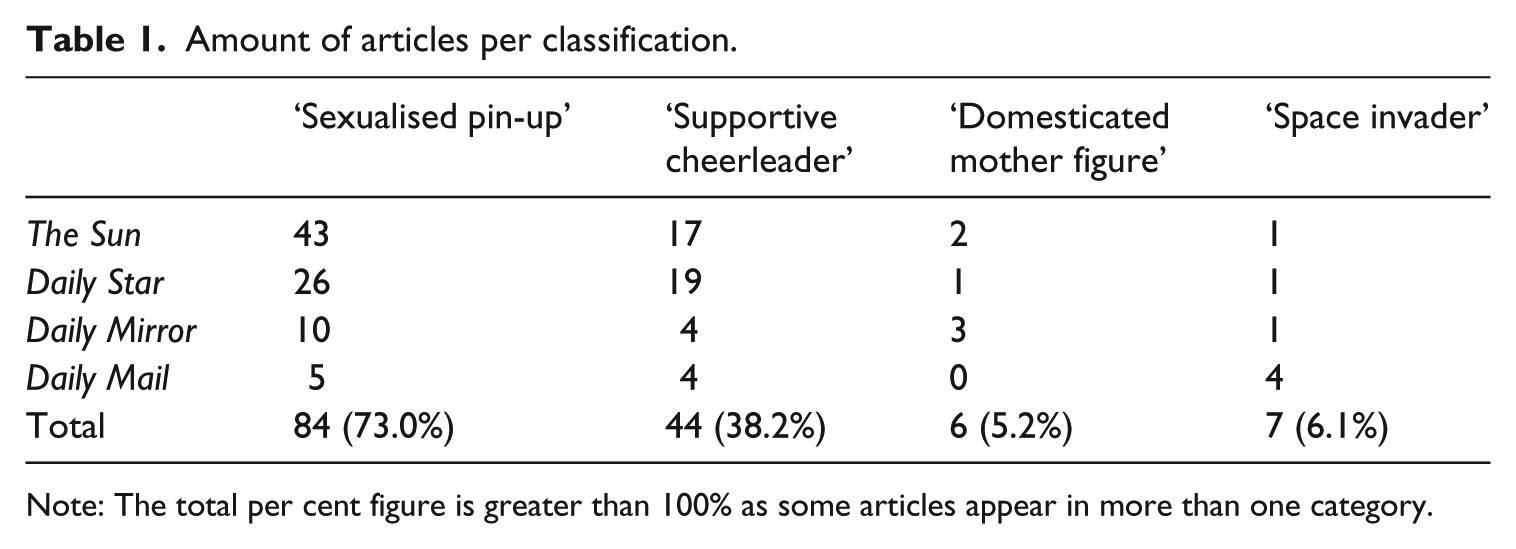
Note: The total per cent figure is greater than 100% as some articles appear in more than one category.
The following section outlines the four classifications in detail. Unless stated otherwise, the quotes cited represent a broad cross-section of meanings representative of those found in a variety of articles. To fully represent the gendered narratives running through the coverage of the tournament, the analysis utilises, where appropriate, ‘tabloid speak’ (Watson, 1998: 46), such as double-entendres, puns and sexualised language.
The sexualised pin-up
In articulating the ‘pin-up wife’ classification, Clayton and Harris noted that the (re)presentation of footballers’ wives in the English press during the 2006 World Cup ‘bolster[ed] hegemonic notions of women as idyllically feminine, sensual figures existing solely at and for the pleasure of men’ (2004: 325). These characteristics were similarly evident during Euro 2016. While players’ partners featured in 73.6% of the articles in this classification it was also evident in the (re)presentation of female fans, particularly in combination with the ‘supportive cheerleader’ classification, as discussed below, and female models. The ‘sexualised pin-up’ was most prevalent in the The Sun and the Daily Star, which both have a decades-long tradition of printing semi-nude or topless pictures of ‘page three’ models (so called because of where they featured within the papers). The category featured in 83% of the articles in the Daily Star, 76% of the articles in The Sun and 62.5% of the articles in the Daily Mirror – all papers with a mainly male readership. By contrast, the Daily Mail, which has a mainly female readership, featured this category in just 41% of the articles.
In the week preceding the tournament both the Daily Mirror (Hope, 2016) and the Daily Star published articles which profiled the players’ ‘gorgeous other halves’ (Moore, 2016), presenting them in glamorous and/or sexualised images. The Daily Mirror also gave each woman a ‘Wagometer rating’ out of five. Significantly, the lowest score (one out of five) was reserved for Zoe Riozzi, the partner of Ross Barkley, a nursery nurse who shuns publicity. Riozzi’s style is described as ‘practical’ as she ‘wears her hair scraped back and no make up to work’ (Hope, 2016). The photo used of her was unstaged and unglamorous – she was pictured in her work attire – and was relatively unflattering in comparison to the photos of other women used (which featured them in ‘glamorous’ attire whether staged or unstaged). As a consequence Riozzi, who failed to conform to the norms of emphasised femininity found in the dominant sexualised (re)presentation of a ‘WAG’, was symbolically penalised by her low score.
On 6 June, four days before the start of the tournament, The Sun began a daily feature entitled ‘The Beautiful Game’ which featured pictures of the partners of footballers from a variety of nations appearing at the tournament. The images were glamorised and provocative, showing the women in bikinis or lingerie. These were often juxtaposed with photos of the relevant players in action. Again, the emphasised femininity of the photos was reinforced by the words which accompanied them. For example, the brief article alongside a picture of Ann-Kathrin Brommel, who is married to German player Mario Gotze, in black lingerie began with the words ‘Strip, strip hooray’ (Doran, 2016) while the following day a revealing image of Viktoria Varga was accompanied by text which calls her ‘upfront’ and comments on her ‘striking formation’. Thus the focus on the wives and girlfriends of players ‘reinforce[d] the heteromasculine social capital of the’ players (Vincent et al., 2011: 622) while the situating of the images on page three, 3 a traditional location of sexualised images of women within the British tabloid newspaper milieu, ‘is suggestive of their sexual implication’ (Harris and Clayton, 2002: 408).
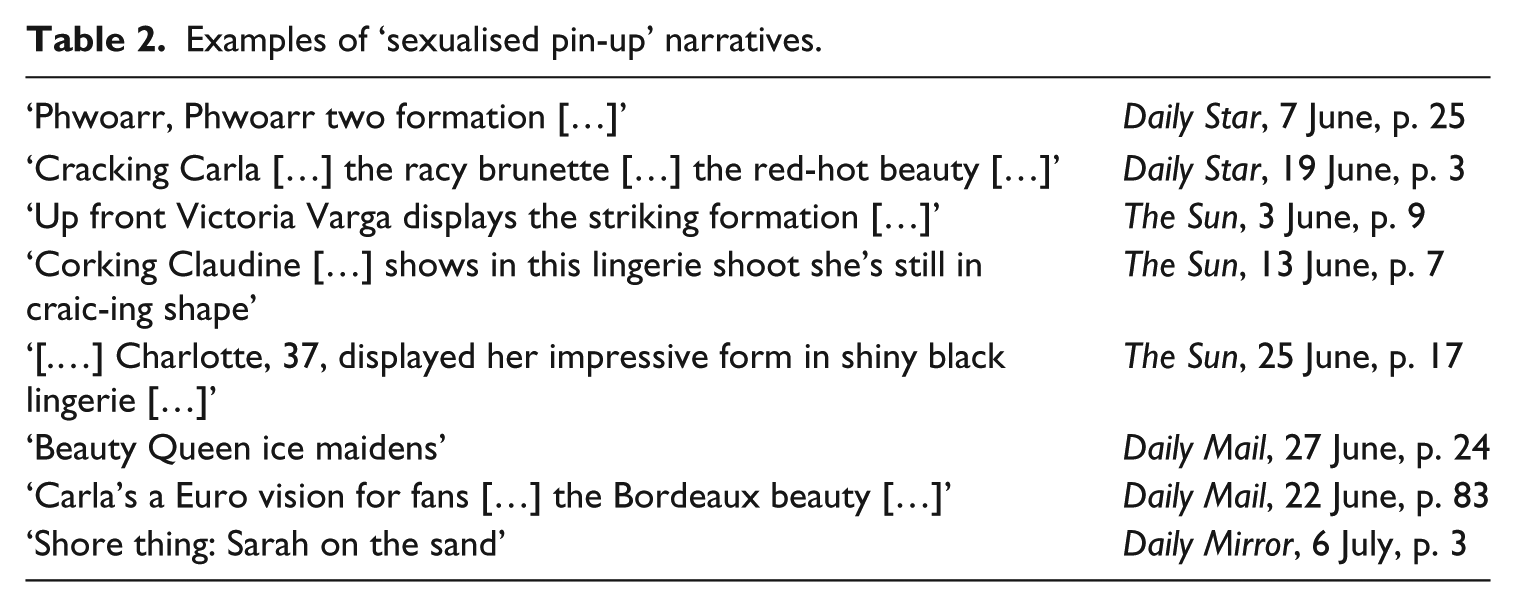
Another, related strategy to reinforce players’ ‘heteromasculine social capital’ is to foreground their virility by focusing on their sexual eminence. In a front page lead headlined ‘ON ME BED, SON’, which continued on page seven, the Daily Star (Lawton, 2016a) reported that following the Vardys’ recent wedding, ‘Becky is plotting a 72-hour sexfest so her husband maintains his sensational scoring form’. This ‘affirmation of heterosexuality and, moreover, an active sex-life’ (Clayton and Harris, 2004: 324) is fundamental to the production of hegemonic masculinity both for the individual player (Jamie Vardy) and footballers in general. In a similar vein to The Sun’s ‘The Beautiful Game’ series, the story was illustrated by sexualised images of Vardy in lingerie, suggestive of bridal wear. Further examples of the stereotyped narratives of the ‘sexualised pin-up’ evident in the text of the papers can be found in Table 2.
Examples of ‘sexualised pin-up’ narratives.
It has to be recognised that many of the photographs used, particularly of players’ wives and girlfriends but also of female models, were staged. Women’s willing participation in the production of such imagery, albeit for pecuniary gain and/or increased publicity, reflects the emphasis in contemporary media and advertising which portrays women as actively celebrating sex-object status (Gill, 2007). Using Gill’s concept of a post-feminist sensibility in the context of sport, Toffoletti suggests that ‘portrayals of women as passive objects for male consumption have largely given way to images of women as “choosing” to present themselves as active and sexually desiring subjects’ (2017: 466). However, it is important to acknowledge that women are rarely in control of either the manner in which the images are used or the sexualised meaning attributed to them. It is such lack of control that continues to cause concern that the women are ‘complicit in their own domination’ (Bullen, 2014: 24). As such, as Connell and Messerschmidt (2005) argue, there is a danger in focusing only on the practices of men in the construction of hierarchical gender relations dominated by hegemonic masculinity and it is important to acknowledge that in reality ‘the concept of emphasised femininity focused on compliance to patriarchy’ (Connell and Messerschmidt, 2005: 848).
The ‘supportive cheerleader’
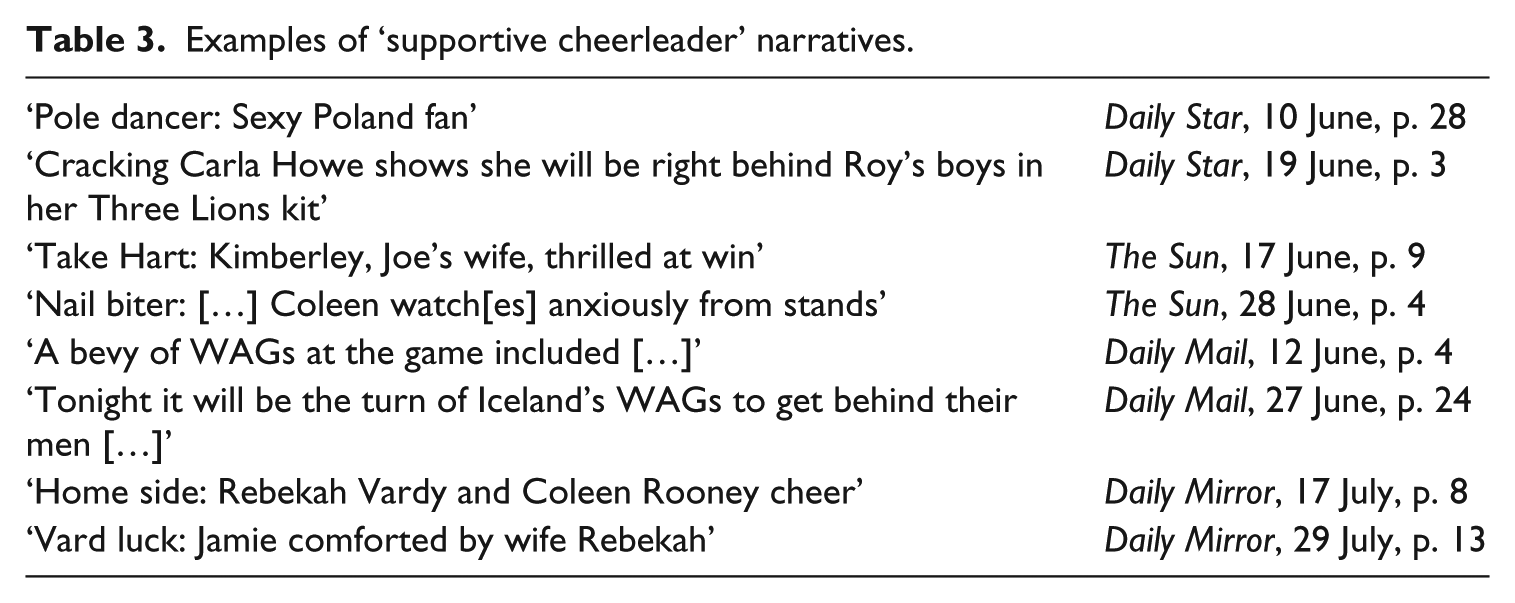
The ‘devoted and supportive wife’ classification identified by Clayton and Harris (2004) was also evident in the coverage of Euro 2016 in which footballers’ partners were again portrayed ‘not as women, with lives and minds of their own, but merely as “tools” for increasing the self-esteem and morale of the nation’s football team’ (Clayton and Harris, 2004: 327). Match reports in the sports sections were complemented by reports in the news sections focused on fans and their reactions. These were regularly illustrated by pictures of the players’ partners in the stands cheering the success of their menfolk or consoling them in the aftermath of defeat. The focus on the footballers’ partners in this passive, supportive role served to reinforce the players’ privileged status within the hierarchical gender order where women become more-or-less anonymous apart from when they are ‘identified in the stands’ simply because of the relation they have with a sportsman on the field of play (Thompson, 1999: 176). Following England’s victory against Wales, several papers featured pictures of the players’ partners celebrating supplemented by captions including words like ‘support’ (Lines et al., 2016a) ‘jubilant’, ‘Roo-joice’, ‘thrilled’ (Parker and Reilly, 2016) and ‘cheers’ (Lawton, 2016b), which reinforced the subordinate representation of the women. After England were knocked out of the tournament, Rooney and Vardy were shown with their husbands and their supportive roles were reinforced by captions employing words like ‘Comforted’ and ‘Consoled’ (Lines et al., 2016b). (Further examples of the ‘supportive cheerleader’ narrative can be found in Table 3.)
Examples of ‘supportive cheerleader’ narratives.
Twenty-six of the 44 articles in this classification (59%) crossed over with the ‘sexualised pin-up’ category. Following England’s defeat to Iceland The Sun (Fairburn, 2016) pictured the player Dele Alli receiving ‘a consolation kiss’ at the side of the pitch from ‘his stunning WAG’, Ruby Mae. The use of the determiner ‘his’ implies male ownership, as does the fact Mae was described as both ‘Dele-cious’ and ‘Dele-ctable’ – puns on the player’s name. The article, which ran across approximately one and a third pages, emphasised Mae’s feminine attributes and physicality by mentioning that, ‘at the same time [as the kiss] she gave everyone a flash of her impressive 32C cleavage’. It also played upon her conformity to the stereotypical tabloid image of a ‘WAG’ mentioning her work as a ‘lingerie model’ and including five photos of her in lingerie or swimwear. Lastly, the article said that, ‘[Alli] might be going home without a trophy but at least he has her on his arm’ thereby portraying Mae as a pseudo-trophy for Alli and a symbol of his virility even in his hour of defeat.
The crossover between ‘sexualised pin-up’ and ‘supportive cheerleader’ also extended to fans and models. Coverage of male fans in all papers pictured them fully clothed, whereas by contrast the coverage of female fans foregrounded scantily clad women who conformed to Connell’s notions of emphasised femininity (1987). In a voyeuristic photo spread entitled ‘We can see you peeking out’, The Sun focused on female fans watching their teams from the stands while wearing ‘Patriotic cropped tops’ (Moyes, 2016). The sexualised nature of the images was reinforced by captions which coupled the women’s support for their national teams with possession of a ‘sexy’ body. For example, the caption beside a female Russian fan wearing a figure-hugging top and pink hot pants read ‘Kits out for the Vlads’, a play on the football terrace chant directed at women, ‘get your tits out for the lads’ (sung to the tune of Guide Me, Oh Thou Great Redeemer) which ‘is a blatant display of heterosexual masculinity’ (Luhrs, 2014: 52). The brief article accompanying the photos ended with the words ‘Maybe we should start calling it the Beautiful Dame…’ (Moyes, 2016) reinforcing the fact that the primary focus was the women’s appearance and not their patriotism. Thus the women were presented for the gaze of the papers’ male readership while the (re)presentation of them reinforced the notion that football fandom was a masculine pursuit.
The ‘domesticated mother figure’
Although closely linked to the ‘devoted and supportive wife’ classification identified by Clayton and Harris (2004), the ‘domesticated mother figure’ category added another dimension by (re)presenting the wives and partners of some players – although not fans and models – as performing traditional feminine social roles and duties. However, significantly, the ‘domesticated mother figure’ category was the only one which did not crossover with the most prevalent category: ‘sexualised pin-up’. In her analysis of the coverage of the 2014 World Cup, Toffoletti identified a move away from the (re)presentation of female football fans in traditional feminine social roles (such as mothers or wives) in favour of an expression of femininity through ‘the possession of a desirable feminine body’ (2017: 465). This ‘decoupling’ was also in evidence in the coverage of Euro 2016 where the media foregrounded either the women’s displays of sexuality (‘sexualised pin-up’) or traditional feminine social roles (‘domesticated mother figure’) but never conflated the two.
During the tournament Coleen Rooney, the wife of England captain Wayne Rooney with whom she has three sons, was described in the Daily Mirror as a ‘high profile WAG, who prides herself on being a good mum’ (Lines and Vaz, 2016). She became embroiled in a row over whether the couple’s eldest son Kai, aged six, should have been taken out of school to attend England’s games at the tournament. For the purposes of this article the issue is not whether the decision was right, but that it was (re)presented as Coleen’s alone, in her feminine, domestic (unpaid) role. This reinforced the notion that Wayne Rooney had no part to play in his son’s schooling, allowing him to focus on his masculine, public (paid) role as a high-profile footballer. Charlotte Jackson, the wife of Wales manager Chris Coleman, was (re)presented in a similar role as she ‘juggles football and family’ (Retter, 2016: 14). The focus on Jackson, who was at the time nearly eight months pregnant, was entirely on her domestic responsibilities; looking after the couple’s young son and moving house, thereby allowing Coleman to ‘put his team first’ (Retter, 2016: 14). This was juxtaposed with a quote from Jackson saying that while Coleman has ‘an amazing football brain’ he will ‘forget three or four things’ if she sends him out with a shopping list, further reinforcing the gendered division of labour within the family unit. This foregrounding of Jackson’s domestic role meant that it was not until the 26th of 29 paragraphs that the article acknowledged that she is ‘successful in her own right’ as a Sky Sports presenter.
‘Domesticated mother figure’ was the only category that did not appear in all the newspapers as it was not in evidence in the Daily Mail which, with a right-wing political leaning and a high female readership, ‘seems to focus on marking out footballers’ wives as a group to be denigrated’ because they display characteristics, such as conspicuous consumption, which are at odds with middle-class femininities (Bullen, 2014: 72). To perpetuate this discourse it seems the Daily Mail is reluctant to publish stories which (re)present players’ partners performing roles at odds with the papers’ negative stereotype of the ‘WAG’, in this instance motherhood.
The ‘space invader’
Although at Euro 2016 the players’ partners were not as visible as a decade earlier, having been warned not to reveal their locations following a series of recent terror attacks across Europe (Boyle, 2016), the ‘space invader’ classification identified at the 2006 World Cup by Vincent et al. (2011) was still in evidence in seven of the 115 articles (6.1%). Even before the tournament began, in an article headlined ‘Vanity, vulgarity & vacuity’, Daily Mail columnist Jan Moir wrote how at the 2006 World Cup ‘it was not the poor performance of the [players] on the pitch that was blamed for the failure—it was the distracting behaviour of their WAGs [and] today’s crop are even WORSE’ (2016: 26).
Following defeat to Iceland, the Daily Mail re-articulated the narrative that the presence of the players’ partners was in some way to blame for England’s exit from the tournament. ‘Some will point to all the distractions’, wrote Robert Hardman before asking, ‘what were the wives and girlfriends doing in France?’ (2016: 16). In the same edition of the paper, another article suggested that, ‘England’s flops’ were distracted by, among other things, ‘pouting WAGs’ (Gysin, 2016: 14). Although all the papers analysed featured stories in this category, the majority (57%) were found in the Daily Mail which, as stated above, regularly vilifies women who conform to the ‘WAG’ stereotype. In contrast The Sun, the Daily Mirror and the Daily Star, which have higher working-class readerships than the Daily Mail, acknowledged the ‘WAG’ as an aspirational figure. For example, the Daily Star symbolically crowned Coleen Rooney – the only player’s partner present at both the 2006 World Cup and Euro 2016 – the ‘Queen of the WAGs’ (Moore, 2016: 24) thereby casting footballers’ and their wives as a pseudo-aristocracy.
Although Rooney was the player’s partner who had been in the media spotlight the longest, Rebekah Vardy, who is married to Leicester City’s Jamie Vardy, was the most prominent at the latter tournament, in part due to her regular activity on the social media platform Twitter. In the build-up to England’s last-16 match with Iceland it was reported that some England players had asked Vardy’s husband to ‘persuade his wife to tone down her angry Twitter rants’ (Lawton, 2016c: 6). The micro-blogging site was less than four months old at the start of the 2006 World Cup, meaning that the last time the players’ partners travelled to a tournament they could not use it as a tool with which to bypass the English media and express themselves or control their image(s) whereas the popularity of Twitter in 2016 empowered Vardy to do this. It must be noted that the criticism of Vardy was not because of anything in particular in the content of her Twitter output (for example, she made no criticisms of the England team) but instead simply because she was vocal in the discursive space created by social media. Significantly she was not criticised for her tournament diary in The Sun which suggests Vardy’s perceived transgression was her active negotiation of her own identity on Twitter which meant she was no longer subsumed by the subordinate role of ‘supportive cheerleader’ which players’ partners are expected to play. Furthermore, the short article about Vardy’s Twitter use was accompanied by a photo of her in lingerie, reinforcing both the dominant classification of women found in the analysis – the ‘sexualised pin-up’ – and also the contradictory discourse identified by Ferrante (1994) in her study of baseball, where women were afforded the dual roles of bringing comfort and support to their menfolk while also being sexual temptresses who are to blame for the players’ failure.
Concluding remarks
These findings suggest that despite improvements in the coverage of female athletes, coverage of other women associated with sport, particularly female non-athletes (re)presented in coverage of men’s football, remains highly resistant to change and continues to demonstrate entrenched gender ideologies and dominant representations of femininity. This provides a stark contrast between the English popular press’ (re)presentation of femininity in the discursive space around men’s football which sees it promoted as a masculine sport with women given subordinate, decorative and highly sexualised roles and the ‘pretty and powerful’ discourse (Bruce, 2016) which has begun to emerge in the coverage of sportswomen. This study has shown that during Euro 2016, the discursive strategy employed by the English popular press repeatedly utilised images and narratives of women, be they players’ partners, fans or models, which conformed to the subordinate characteristics of Connell’s notion of emphasised femininity. This article does not purport to be definitive. Further research could be undertaken to test the validity of the four outlined classifications in other media, particularly online. It is worth noting that during the tournament a range of websites including Sports Illustrated, the website of the American magazine, and caughtoffside.com , the self-titled ‘world’s most popular independent football blog’, ran features ranking female fans and the female partners of male players according to their conformity to stereotypical emphasised femininity. The typology could also be tested in future coverage of other sports events in which players’ wives or girlfriends and female fans receive coverage. It is worth noting that on 28 June, which was both the day after England’s defeat to Iceland and the day after the start of the Wimbledon tennis tournament, The Sun replaced the ‘The Beautiful Game’ with a similar feature – ‘Sets Appeal’ – which utilised similarly eroticised pictures of the partners of male tennis players (as well as eroticised pictures of female tennis players). This suggests that at the very least the ‘sexualised pin-up’ classification is not unique to football.
Footnotes
Funding
The author received no financial support for the research, authorship and/or publication of this article.