




Abstract
Competitive sport is often a gender-segregated activity underpinned by binary thinking that associates sporting talent with masculinity. In response to political, internal and grassroots activism, the English Football Association conducted a series of pilots to ascertain whether they should raise the age limit for competitive mixed football from Under-11 to Under-14. This paper presents an analysis of these trials using the concepts of accountability, doing and undoing gender to explore participants’ support for policy change, and the ways that normative notions of gender were negotiated, reproduced and disrupted during the trials. Typical rationale for segregating sports which constitute gender accountability frameworks such as physical differences between boys and girls, perceived differences in ability, and concerns about risk of injury for girls were undone as girls demonstrated they could make the team, enjoy the experience and develop their skills in a safe environment. Key arguments in favour of mixed football included the benefit to female players, the importance of friendships between boys and girls, and the similarities in boys’ and girls’ footballing skills. Support for mixed football and policy change reflected participants’ expectations that girls should be assessed on their capacity to play football and ‘fit in’ rather than expectations of gender difference. This article contributes to the limited research on mixed competitive youth sport and provides unique insights into gender-based policy change.
Competitive sports remain overwhelming segregated by gender. This segregation has been shown to maintain a sense that men’s sport is different: more important, more skilled and more newsworthy (Fink et al., 2016; Kane, 1995). The continued segregation of sport has been shown to be underpinned by assumptions about women’s inferior sporting abilities, concerns about fairness and the need to protect women from injury (Fink et al., 2016; Kane, 1995; McDonagh and Pappano, 2007). Often, there is some provision for mixed sport during childhood with the segregation of competitive sport beginning in early adolescence. The decisions about whether and at what age sport should be integrated is typically the province of national governing bodies for each country. In football (soccer) age limits vary greatly between countries ranging from no age limit for mixed participation to no provision for mixed football. Within Europe most countries have age limits for mixed football between Under-11 and Under-19 age groups. Limited information exists about the rationale for setting particular age limits in football, but it is typically based on beliefs about the appropriateness of mixed environments and the physical capabilities of girls and women. This paper focuses on the efforts of one national governing body, the English Football Association (EFA), to determine the appropriate age limit for mixed football.
The English Football Association’s consideration of raising the age limit for mixed football began as a result of a recommendation from a report authored by a UK Goverrnment, Culture, Media and Sport Select Committee. In response to the report’s finding that the age limit should be raised, the EFA conducted a series of surveys and consultation activities on mixed football. Further external pressure to raise the age arose from a highly mediated case of a girl and her MP advocating for change, and players, parents and coaches expressing views that the policy should change including picketing at an EFA shareholders’ meeting. Considerations of raising the age limit were initially highly contentious with fierce opposition from some participants and fervent support by others. Eventually, the EFA instituted a series of trials at the ages of Under-12 to Under-14 to explore whether to raise the age limit from Under-11. After three years of research, two of which were conducted by the authors, the age limit for mixed football was raised to Under-13. Subsequently, the authors conducted five further studies for the EFA which led to the current age limit of Under-18.
The divided opinions on the mixed trials can be linked to the history of football in the UK. Gender differences persist from grassroots to professional and national levels of the sport in relation to opportunities, career pathways, visibility and funding. These structural differences are underpinned by social practices, discourses, policies and rules which continue to associate football with masculinity. Research on young people and football has consistently shown that footballing knowledge, skills and cultures are male-identified in the UK and many other countries and supported through informal practices such as excluding girls, teasing girls and the more formal organisation of sports experiences in schools and clubs such as the availability of teams and coaches (Clark and Paechter, 2007; Hills, 2006; Jeanes, 2011; Pfister, 2010). These social practices constitute ‘doing gender’ by invoking and re-establishing traditional understandings of gender differences, often despite girls’ demonstrable footballing skills and interests.
While competitive sports continue to reify gender differences and reinforce hegemonic thinking and practices, there is also evidence that girls’ and women’s engagement in sport can ‘effectively unsettle the rigidity of gendered expectations’ (Butler, 1998). In the UK, girls and women have increasing opportunities to be involved in football, to play at higher levels through Centres of Excellence and the EFA Women’s Super League, and experience greater visibility in the media as players, commentators and coaches. The women’s national team played at Wembley, the national football stadium, for the first time in 2014, seven years after the new stadium opened, and 91 years after the first men’s match at the original Wembley Stadium. This event represented a seismic shift in attitudes that at one time seemed inconceivable. The trials constitute one of the events involved in the rethinking of football and gender and the growth of the women’s game.
This paper focuses on the initial trials and the arguments that participants used to articulate their opinions on raising the age limit. It contributes to the limited research on mixed competitive youth sport, particularly in the context of girls playing in predominately boys’ leagues, and provides unique insights into the discourses, processes and practices that were used to support gender-based policy change. The potential for social change through mixed sport is theorised using the concepts of accountability, doing and undoing gender. The research questions for this paper are:
How did participants rationalise their support for changing the policy for mixed football?
How were normative notions of gender and football negotiated, reproduced and disrupted during the trials?
This paper provides a review of relevant research on mixed-gender sport followed by a discussion of the theoretical constructs of accountability, doing and undoing gender. The methods are followed by the results and a discussion of key themes related to accountability and undoing gender and the conclusions.
Mixed gender sport
Mixed gender 1 sport provides opportunities for men and women or boys and girls to compete in sport together. Competing together disrupts the segregation of sport and binary thinking that normalises gender difference and ignores the overlap in male and female sporting capabilities (Fink et al., 2016; Kane, 1995; Musto, 2014). Kane’s (1995) influential article on the sports continuum suggests that sport is often segregated by gender due to assumptions of male superiority without consideration of whether it is appropriate or necessary. Research on mixed sport has evidenced some of the personal and social benefits of mixed contexts for participants as well as its capacity to influence notions of women’s capabilities. This section explores themes in previous research on mixed sport, including the organisation of mixed sport and its capacity to reinforce and challenge binary thinking, the experiences of girls playing in boys’ leagues and the potential benefits.
Research on sports where rules differentiate men’s and women’s roles often concludes that traditional gender hierarchies and expectations are reinforced (Henry and Comeaux, 1999; Wood and Garn, 2016). For example, Wood and Garn (2016) drew on the concept of shifting standards to illustrate how rule modifications designed to make mixed flag football more inclusive for women, such as awarding women extra points for scoring, were associated with a form of benevolent sexism which acknowledged women as teammates while assuming they were less capable. This benevolent sexism has been shown in other mixed sports such as mixed doubles tennis and softball leagues, where strategy and the style of play are also based on perceptions of women’s inferiority. In these environments, men tend to dominate play and feel that they have to ‘play down’ to accommodate women and women are often assigned to peripheral or ‘helper’ roles (Lake, 2016; Wachs, 2002). These studies indicate that mixed sport environments, particularly those associated with rule modifications, can reinforce notions of gender difference and expectations that men and boys will demonstrate more skill in sport than their female teammates.
Research on mixed sport environments that evidence more transformative changes to gender hierarchies and attitudes are characterised by expectations that males and females will be treated equitably, will evidence overlaps in performance and will share experiences. These include sports designed to be mixed without rule modifications, men and women training together and children’s sports. Within these contexts, hegemonic thinking does persist; however, gender binaries are less pronounced with greater appreciation for the value of mixed environments, fewer assumptions about gender and sporting abilities, and increased acceptance of potential overlaps in skills.
Quidditch is an example of a recently developed sport which is designed to be mixed without adaptions, although there is a requirement that the seven-member squad has no more than four players who identify as the same gender. 2 Using a feminist approach to intergroup contact theory, Cohen et al. (2014) identified that gender equity was facilitated by having explicit policies and rules that did not differentiate between males and females to compensate for assumed gender differences in ability. Young people and adults involved in quidditch felt that participation in the sport had reduced gender stereotyping, increased their appreciation of the skills and qualities of their differently gendered teammates and strengthened their valuing of equality. Some males continued to believe that the mixed context yielded a less physical sporting experience, reinforcing ideas of male sport superiority, but also valued participating with females. In contrast, young people who played korfball, also designed to be mixed, evidenced limited changes in binary thinking and perceptions of gender difference, but did enjoy the inclusive aspect of the sport (Gubby and Wellard, 2016).
Training can also be a space where men and women choose to engage in sport together. Fink et al. (2016) employed Kane’s concept of the sporting continuum to investigate whether a men’s practice team who trained with an elite university women’s basketball team changed their attitudes towards women’s basketball. Male players acknowledged that they were surprised to find that the women were better basketball players than the men’s training team. Even so, the male players continued to maintain beliefs about the superiority of men’s sports, characterising their female training partners players as ‘special’ or ‘honorary men’ (Fink et al., 2016: 1325). Ultimately, while the presence of the sporting continuum and the skills of women were acknowledged, beliefs associated with male hegemony were also sustained by the male players. Channon (2013) explored discourses of inclusion associated with martial arts where male and female participants often train, spar and occasionally compete together. He found that mixed-gender training was normalised as men and women expected to train together and training partners were evaluated by their knowledge, skill and experience rather than gender. Gender hierarchies were challenged by an ethos of inclusivity within the martial arts training environment, although segregation often persisted within activities such as sparring and competition (Channon, 2013).
Children’s sports are more likely to be integrated by gender as the physical development of boys and girls is typically similar and sport may be perceived to be more appropriate for girls during their childhood. Most of the work on children’s experiences of mixed sport are in the context of physical education lessons. One exception is Musto’s (2014) analysis of a children’s (10- and 11-year-olds) competitive swim team where swimmers were organised by ability rather than gender in training and competitions. A girl was acknowledged to be the best swimmer and boys, girls, coaches and parents expected that sometimes girls would be better than boys. Subsequently, the salience of gender was muted, resulting in more equitable, nonhegemonic interactions. During social times outside of training, girls and boys tended to occupy same-gender groups, reinforcing gender difference. Musto (2014) argues, however, that nonhegemonic beliefs ‘spillover’ into the relationships between children outside of the pool, evidencing the contextual elements of gender difference as well as the possibilities for change.
Girls playing in boys’ or men’s leagues in team sports presents a slightly different mixed context as teams are male dominated, typically fielding a small number of talented girls. Theberge’s (1998) retrospective research with women who participated on boys’ teams in ice hockey highlighted that the women felt that over time they developed the skills required to play in the boys’ leagues, and some felt at times they played better than many of the boys on their team. Women’s recollection of their experiences reinforced the notion that boys and men were better skilled; however, there were challenges to notions of gender difference as women identified overlaps between the physical abilities of males and females. In addition, women identified that there were no gaps in their technical knowledge of the game. The ability for girls to play on boys’ ice hockey teams provides evidence that some girls have the skills and knowledge to compete with boys.
The personal and social benefits attributed to mixed sport also have the potential to challenge gender binaries and expectations about women’s capabilities. Women have highlighted that mixed sport provides opportunities to develop skills and increase confidence within and beyond sport (Henry and Comeaux, 1999; Musto, 2014; Segrave, 2016; Theberge, 1998). For example, Musto (2014) found that girls who competed with boys on a swim team were more confident in their interactions with boys and less susceptible to teasing away from training. Women who played in boys’ ice hockey teams have identified that they enjoyed the challenge and that it helped them to develop their skills and experience a more physical side of the sport (Theberge, 1998).
In addition, mixed sport has been identified as having social benefits that can challenge the heteronormativity that often underpins interactions between males and females (Segrave, 2016). Maclean (2016) argues that the karate environment, where men and women train together, created a space where expectations for traditional forms of heterosexual relationships are reconstructed. Friendships between men and women moved away from traditional expectations of sexual relations, the objectification of women in banter was minimised, and women as well as men were perceived as knowledgeable about the sport. This led to more supportive, respectful and equitable relationships. Similarly, Anderson (2008) found that male university cheerleaders felt that participating on a mixed team led to the development of friendships with women that continued outside of training. Some participants who identified themselves as having sexist views of women before being involved in cheerleading stated that training with women and spending more time with them led to an increase in respect and a better appreciation of their capabilities and skills.
The development of friendships between men and women and boys and girls in sport may not always be an outcome of participation. For example, research on mixed-gender ice hockey found that girls and women varied in their level of enjoyment, with some feeling included and others marginalised (DiCarlo, 2016; Theberge, 1998). Young competitive swimmers (8 to 10 years) in Musto’s research and young people in an Under-13s korfball team (Gubby and Wellard, 2016) trained together but moved into gender-specific social groups after training. It may be that age is a factor in the development of friendships. Research on schooling suggests that some student cultures can make it challenging for boys and girls to identify as friends (Al-Attar et al., 2017; Hey, 1997). Young people aged 10–12 have been shown to experience a ‘hetero-relationship culture’ that can make friendship almost impossible (Renold, 2013). In Renold’s research, boys and girls who wanted to be friends sometimes felt compelled to pretend to be boyfriend and girlfriend to make their relationship comprehensible to their peers. There remains limited research on the role of friendship between male and female teammates in youth sport.
Sports, including football, have often been shown to reinforce beliefs about gender difference, associating sporting skills and knowledge with masculinity, and reinforcing male hegemony. Research on mixed sports provides some evidence that mixed contexts can also lead to the appreciation of girls’ and women’s sporting capabilities, strengthen feelings of equality and inclusion, and provide opportunities for males and females to enjoy competing and training together. Much of the research that identifies challenges to binary thinking involves sporting environments that are designed to be mixed where integration and equality are part of the explicit organisation of the sport and individuals have chosen to participate in the mixed setting. There remains a need to extend research to contexts that are more segregated and rooted in hegemonic thinking, such as football in the UK, to understand the benefits of mixed sport and its capacity to disrupt gender hierarchies and support equality and inclusion on and off the playing field.
Accountability, doing and undoing gender
Understandings of gender have been theorised using West and Zimmerman’s (2009) work on doing gender. The concept of doing gender emphasises the creation and re-creation of gender differences through micro-interactions, viewing gender as a product of social practices rather than a natural quality. Doing gender in sport reinforces a sense that men’s and women’s sports are different, that men’s sport is superior and that men are more likely to embody the qualities associated with sporting success. The processes of doing gender serve to make these differences seem inevitable rather than constructed. The lens of doing gender, originally associated with ethnomethodology, illustrates how gender is performed repeatedly in different contexts in ways that create and perpetuate gender binaries and support hegemonic masculinity.
Accountability serves as the process through which gender is recognised and enacted through social exchanges and practices. For individuals, accountability involves the ‘ever-present possibility of having one’s actions, circumstances, and even, one’s descriptions characterized in relation to one’s presumed membership in a particular category’ (West and Fenstermaker, 2002: 541). In mixed sport environments, participants’ expectations about gender have been shown to be enacted through rules which differentiate between males and females, through exchanges associated with benevolent sexism and hegemonic masculinity, as well as through recognition of girls’ sporting capabilities (Fink et al., 2016; Wood and Garn, 2016). Accountability involves a cycle of individuals’ expectations of others’ beliefs about gender and appropriate gendered behaviour and their subsequent self-regulation based on these beliefs (Hollander, 2013). Individuals manage expectations for the assessment of gender within sporting contexts, which are in turn influenced by broader societal norms. For example, depending on the context, girls participating in mixed sport may anticipate that they will be accepted as teammates, viewed as intruders or treated as inferior by their peers. These exchanges are influenced by broader understandings of the relationship between gender and, in this case, football. Accountability provides a way of connecting these individual beliefs and social interactions with broader social structures, making the link between more transient moments of doing, redoing and undoing gender that occur in day-to-day interactions and ongoing expectations about the characteristics of gender and gendered interactions.
The conceptual tools of undoing and redoing gender have been employed in analysing changes to accountability frameworks and normative expectations for gender (Deutsch, 2007; Risman, 2009; West and Zimmerman, 2009). For example, Deutsch (2007) proposed a framework for identifying instances of undoing gender by analysing interactions where gender is less salient. Using the lens of undoing imparts significance to events where gender difference is not invoked including identifying similarities between males and females, highlighting moments of resistance, and locating situations where gender is less salient.
While West and Zimmerman (2009: 117) agreed that change needed to be included in their conceptual understanding of doing gender, they argued that the term ‘undone’ implies ‘abandonment’ or a ‘doing away with’ gender which becomes ‘a category to which we are no longer accountable’. They proposed that the concept of redoing gender better captures the possibilities of change while acknowledging the ongoing influence of gendered systems of accountability. Redoing gender in this case refers to redefining and extending the meanings and practices associated with gender and accountability.
Within the current research, undoing gender is understood as a conceptual tool for capturing when gender hierarchies are challenged and identifying exchanges that ‘change the conditions of accountability of individual actions’ (Connell, 2009: 109) rather than negating the influence of gender. In the case of mixed-gender football, the framework of undoing gender can help to interpret occurrences that may underpin challenges to the assumptions of difference, such as demonstrating overlaps in ability or creating more equitable relationships between differently gendered teammates or training partners. Previous research on mixed sport demonstrates the complexity of understanding and interpreting the implications of integration.
Researching mixed-gender football
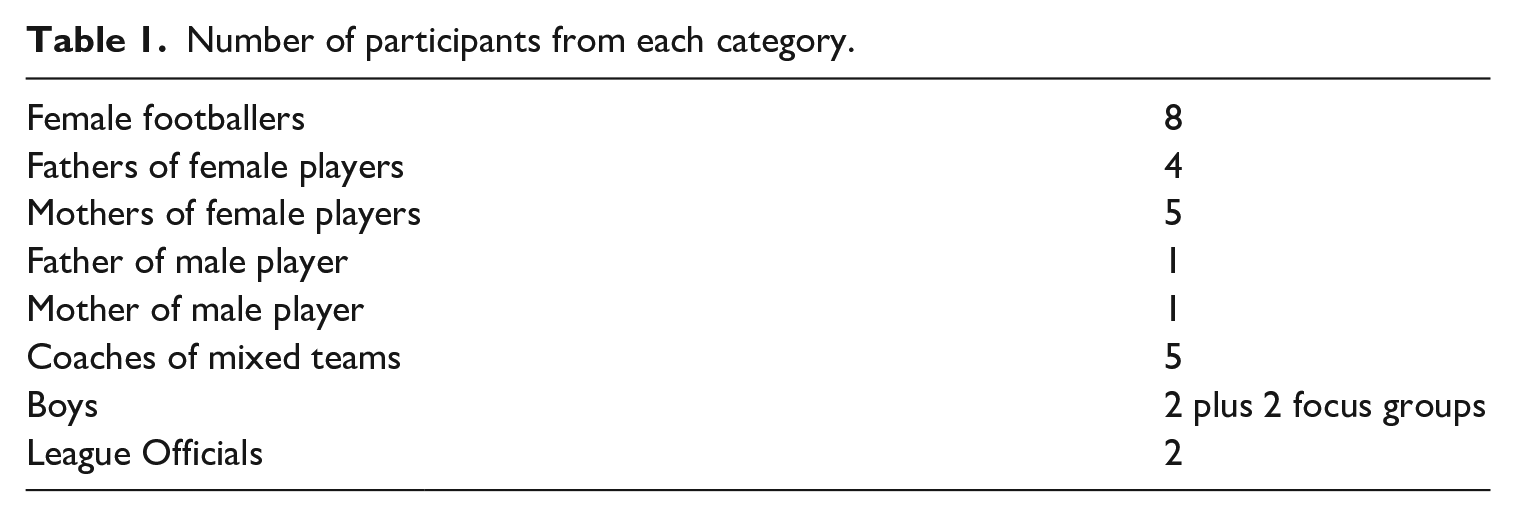
The research for this paper was part of a larger two-year evaluation of a pilot of mixed-gender football for young people participating in teams from Under-12 to Under-14. Initially, 16 teams requested dispensation to be involved in the mixed trials and from this four 11-a-side teams were chosen as case studies in the first year with an additional team added in year two of the research. Teams for case studies were selected to ensure a representation of different ages, leagues and geographical regions. Overall, eight girls representing five mixed football teams at either Under-12 or Under-13 were interviewed. The girls had between three and six years’ experience of playing mixed football as well as experience of playing on all-girls’ teams. We interviewed the girls (eight players), their parents (four fathers, five mothers), and the coaches (all male) for each case study. In addition, we conducted focus groups (two focus groups with male players) and interviews (two male players) with boys in three of the case studies (see Table 1). We also interviewed a male and female parent of two male players in two cases. We were unable to collect data with boys in two case studies as they were unavailable after the matches or training sessions.
Number of participants from each category.
Interviews took place at training or competitions, usually in the team clubhouse or along the side-lines. Further survey and interview data were conducted as part of the broader study but are not used for this paper.
We conducted semi-structured interviews with participants to understand their views on the pilots, including the reasons for participating in the trial, a discussion of the season, any potential issues that may have arisen, and perspectives on the overall process. For the EFA, key concerns were the overall operation of the trials and participants’ attitudes, the safety of female players playing in boys’ leagues, physical differences between boys and girls, the impact on the women’s game and the lack of changing facilities; these issues were included in the interviews. Ultimately, the impact on the women’s game and lack of facilities were not perceived as issues by the participants in the trials and are not discussed here. We created separate interview guides for parents, coaches, officials and female and male players to tailor our questions to their experiences. Interviews with female players and their parents included a focus on the player’s footballing background and aspirations and specific experience of playing in a boys’ league. Coaches were asked about any special treatment given to female players or challenges associated with mixed teams. We were keen to provide participants with an opportunity to tell their stories and to capture emerging themes and issues. This ultimately proved crucial as the experiences of the participants differed from the concerns raised by the funder. For example, injury risk was a key concern of the funder, but mixed football was not perceived to be riskier for girls by the participants. Conversely, friendship emerged as a key theme in the interviews but was not initially identified as an area of interest.
For the initial report to the EFA, the data were read and analysed by three members of the research team. Each team member read the transcripts and conducted line-by-line coding to identify key themes emerging in the data. Our initial codes were discussed in group meetings to check our interpretation of the data and to develop the overall themes. Our evaluation identified similarities and differences between participants’ views and experiences using an inductive approach. There were a number of participants, particularly some of the parents and coaches, who passionately believed that the age should be raised and were actively working for change. Subsequently, most of the data from participants in the trials supported the age change.
The data were reanalysed for this paper with attention to participants’ understandings of gender and mixed football and how this influenced their rationale for raising the age limit. We drew on West and Zimmerman’s (1987) explanation of accountability and investigated participants’ expectations of gender norms in football, their arguments around policy change and their responses to girls’ participation. We also read our data through the lens of Deutsch’s (2007) conceptualisation of undoing gender. This entails looking beyond processes that sustain gender difference to the exploration of similarities between males and females, acts of resistance, moments of cross-gender shared experience, and appreciation of within-group differences. These analytical tools helped to identify emerging themes such as the salience of young people’s discussions of cross-gender friendships and participants’ narratives of physical differences between boys and girls. From this analysis four themes emerged: exceptional girls; alternative readings of physical difference; disruptions to heterosexual practices; and challenging expectations.
Results
‘It’s about Maria’: Exceptional girls who ‘fit in’
One of the key arguments for supporting the mixed football trials centred on the skills and abilities of the female players and the opportunity for them to develop these skills further. Participants asserted that it was important for girls to develop their footballing skills to the highest level possible: The bottom line is Maria. It’s not about the football team or her parents or the coach, it’s about Maria because Maria will not get the level of footballing that she requires to develop if she plays singly and solely girls’ football. The quality’s not there. (Coach)
Girls echoed this argument, stating that playing with boys offered an important additional opportunity to develop their footballing skills and knowledge.
It improves your football a lot because it’s much rougher, the skills are more advanced . . . it’s good because I’m always improving. (Female player)
Parents, coaches and players argued that girls who played mixed football benefited from playing in boys’ leagues, which were viewed as more challenging and of a higher standard than the available girls’ football teams.
We asked girls whether they would recommend playing mixed football to other girls: Depending on your skill, if you were new to football I wouldn’t . . . you’ve got to be friendly with the team and sort of about the same skill. (Female player) If she’s a wuss she’s not got to be with the boys. But if she’s not, if she’s ‘hard’ than she should . . . every girl should, it’s good fun. (Female player)
In this case, the girls playing mixed football illustrate the expectations of what it takes to be a footballer on boys’ teams, such as toughness and skill. The girls in the trials expected to be treated the same as their male counterparts and felt that not all girls were suited to the experience, citing social and physical skills as well as being ‘hard’. Participants described girls in the trials as having exceptional footballing skills and we were told about skilled girls who won ‘man of the match’ awards, scored goals, and were generally recognised as having the requisite skills and attitude to play in the league. Although individual girls’ skills were acknowledged, the belief in the superiority of men’s and boys’ football remained intact as girls’ leagues were portrayed as less challenging. As in Fink et al.’s (2016: 1328) research with elite basketball players and their male training partners, women’s skill was acknowledged while retaining the view that men’s sport was superior, meaning ‘the gender binary was simultaneously challenged and reinforced’.
‘My lad’s small’: Within-group differences, injury risk and the complex physicality of football
While girls were thought to have the capacity to play with boys, there was some discussion over physical differences between boys and girls. Some coaches, parents and officials felt that physical differences were negligible within the ages of the trial: Until they get to fourteen and a half the girls are on average taller and heavier anyway. (League official).
Others suggested that boys had some physical advantages: On the physical side boys are more physically, not fit, but just in the their build, in a boy’s build Under-12 you can start seeing the difference between the boys and girls. (Mother of a female player and coach of a girls’ team)
This coach/parent went on to suggest that: Technically girls are far more superior than boys just ’cause they can read the game better . . . but then if they’ve played mixed football for a while then I don’t think there is any difference.
Her discussion illustrates some of the complexity of trying to associate gender with physical size and technical ability, particularly when girls and boys demonstrate overlaps in their size and skills.
A number of coaches and parents suggested that size differences between boys was often greater than between girls and boys: The FA allow boys to play two years up above their age. So, where’s the physical disparity equation involved in that? My lad’s small. He’s not physically tall and stronger; he’s a small Under-11 who’s playing Under-12. The FA says that’s ok. But, you know, you apply the rule to girls about physical disparity then he shouldn’t be allowed to play. (Coach) If they (the EFA) want to address any potential differences in power and strength . . . you have to look at the boys. (League official)
Normative expectations of gender difference and physical size were challenged by highlighting observable within-group differences in size between boys and the similarities in size and skill that exist between boys and girls (Deutsch, 2007).
Questions about physical difference were also challenged by questioning how much size matters in football. One parent argued that physical differences between boys and girls are present but not necessarily a problem: Some arguments are physical differences, but football isn’t a contact physical game, so skill surpasses the need for body strength. (Mother of a female player and coach of a girls’ team)
This echoes Kane’s argument that focusing on physical differences between males and females masks the complex array of factors that influence sports performance: ‘If performance were simply, or even primarily, about physical difference in, for example, size and strength, then smaller, weaker men would never (or rarely) outperform bigger, stronger men’ (Kane, 1995: 212). Participants who supported the mixed trials varied in their views on the existence of physical differences between boys and girls at this age; but generally agreed that girls evidenced the skills and technical knowledge required to succeed.
Within this research risk of injury was acknowledged as a part of football; however, individuals involved in the mixed-gender pilot had limited concern that girls were at greater risk than boys. A key element of this was the invocation of ability rather than gender as a criterion for participation in football. One coach stated: I’d like for someone to tell me why there should be [a greater risk of injury for girls] . . . When she trains my lads are more at risk from her than the other way around. She’s as likely to kick them as the other way around. (Coach)
Similarly, some coaches and parents resented the idea that they would put a player at risk: If I didn’t think that Maria could play football week in week out with the lads, I would stop her. I wouldn’t let her play. And if I had a lad, I wouldn’t let him play either. If he wasn’t good enough, he wouldn’t play. (Father of a female player)
The focus on football ability rather than gender is illustrated through this parent’s assertion that he would care for and evaluate potential risks equally for boys and girls. One coach stated: Sophie tackles and gets stuck in and there are some of the boys who are not physical and not so good at that, I will pick her above them. So no, the answer is no, there’s no special dispensation for her, none whatsoever. (Coach)
Coaches argued that girls and boys were treated and cared for equitably. Girls were expected to be as good as and sometimes better than their male teammates. Similarly, Musto (2014) found that coaching practices in swimming reduced the salience of gender in a sports environment by focusing on ability rather than gender. As in Musto’s work, the overlap between the abilities of boys and girls was clear and factors such as injury, size and skill were disassociated from gender by most participants in the trials.
‘They are my friends and we have fun’: Disrupting heterosexual practices
One of the emerging and initially unanticipated themes in our research was the importance of friendship to the mixed football experience. In many cases, girls had played on predominately boys’ teams from a young age and this environment was part of their social and sporting experience. Prior to the trials, some of the female players had been forced to leave their mixed teams. For example, one coach stated: [She] has been involved with us right from the age of five . . . Last year it was quite a sad time as Jodie had been involved all the way along and when we got to Under-11 it was quite emotional for some people that it was her last game. (Coach)
After the trials were initiated, some girls returned to the teams that they had left when they turned 11. Sophie’s father stated: Sophie was happy to be back with her friends, because they are all local boys and she’s grown up with most of them. (Father of a female player)
These findings echo the experience of England footballer Lucy Bronze, who had to quit playing with her local boys’ team when she turned 12 due to the mixed-gender policy.
I was devastated . . . It wasn’t about being told I had to play down in Blyth, Newcastle or Sunderland, which is about an hour away from Alnwick, it was the fact my mum had to take me away from my friends. That killed me at the time. I’d spent my childhood playing football with my friends. (Edwards, 2015)
Discourses of friendship highlighted the shared experience of boys and girls as teammates who enjoyed playing sport together. As one girl stated: It doesn’t matter that it’s girls and boys, just that they are my friends and we have fun. (Female player)
In one of our focus groups with boys on a mixed team, one boy who perhaps felt we were questioning the mixed context a little too much said ‘It’s not like she’s from another planet,’ neatly emphasising the shared experiences of boys and girls which is a component of undoing gender.
Parents seemed to be supportive of the friendships between girls and boys. One father stated: Playing on a girls’ team would involve ‘dropping standards’. . . it would also mean that she leaves behind her peer group, her own friendship group which is critical to her developing as a person. (Father of a female player)
Another father expressed his appreciation of the opportunity that his son had to be friends with a girl: It breaks down sex barriers [when I was their age] I was terrified to talk to a girl. It’s fantastic to have that freedom. (Father of a male player)
Most of the girls in the study played football on predominately boys’ teams in part because they had friends on the team.
This was not the case for all the girls, as sometimes being the only girl on a boys’ team could result in feelings of exclusion. One female player stated: Sometimes you get left out because most of them are boys . . . [I] would like more girls as I’m the only one on the team. (Female player)
Theberge’s (1998) research with girls and women who had experience of playing ice hockey with boys evidenced that for many girls playing on the boys’ teams was fun and challenging and their skill provided an entry into a welcoming team. For other girls, the experience was more uneven, combining enjoyable moments with feelings of exclusion or marginalisation. The possibility for developing friendships, enjoying being teammates and resisting heterosexual norms has also been identified as a rewarding part of young people’s experience of mixed cheerleading, quidditch and ice hockey (Anderson, 2008; Cohen et al., 2014; Theberge, 1998). In this case the focus on friendship provided a disruption to gender accountability frameworks by creating an acceptable space for girls and boys to be friends and teammates.
‘A secret weapon’: Challenging expectations on the pitch
While friendships on the pitch could mute the salience of gender, gender was often marked when competing against other teams.
These girls can play football and it’s been surprising I think for our opponents more than our own boys. (League official) I mean in the past we’ve had one or two comments . . . ‘it’s only a girl’ but they soon stop shouting ‘it’s only a girl’, because they realise, she’s not only a girl! She’s better than half of them. (Mother of a female player and coach of a girls’ team) The boys on the team have been fantastic, but it’s very funny when you turn up and play an all-boys’ team and suddenly, they look, ‘they’ve got a girl’. They may look at it, but when they see how these girls play, they have suddenly got to think ‘oh dear’. (Coach)
Coaches, players and parents felt pleasure in girls’ capacity to challenge expectations about their footballing capabilities. The male teammate of one female player stated that she was like a ‘secret weapon’ because ‘the other team might not expect it if the female is the best player’ (Focus group with boys on a mixed team). Similarly, Sophie stated that sometimes you get ‘more rewarded’ than the boys because they think you’ll not be one of the good players, but then you turn out to be one of their best players and they sort of come up and sort of shake your hand, some of the managers. (Female player)
Players, coaches and parents felt that female players challenged and changed perceptions of girls’ capabilities and began the process of normalising girls’ participation in the boys’ leagues.
Boys were not always comfortable playing with girls. Boys on the opposition team could face sanctions for being bested by a girl and a small number of boys in one focus group were more resistant to integrating football.
In science it’s physical that boys are stronger than girls, I think it’s a disadvantage [to have girls on a team]. (Focus group with boys on a mixed team)
Another boy in the same focus group said: At the start of the season we always learn like the new skills really quick and then they [girls] take a while to get it and when they do then they are like the same as us. (Focus group with boys on a mixed team)
This suggests that some boys may learn to appreciate the skills of their female teammates; however, they may also continue to draw on gender stereotypes to discuss girls’ ability in general.
Discussion and conclusion
The context of the mixed-gender Under-11 to Under-14 trials presented an opportunity to investigate discourses and practices that underpinned the change to policy. These discussions entailed addressing and responding to gender accountability systems associated with football as girls sought entry to male spaces. Hollander (2013: 11) argues that ‘when normal routines are interrupted . . . the process of doing gender, including the role of accountability, becomes more visible’. In the UK, where football is heavily associated with hegemonic masculinity, integration required a change to understandings of gender and gender expectations in sport. There is limited research on girls who play in boys’ teams and leagues, and this research indicates that these spaces can be integrated successfully.
Gender accountability is an interactive process involving individuals’ expectations of the demands of the environment and how this is reinforced or challenged by the behaviour and attitudes of others. Girls’ experience of mixed football and their relationships with teammates and coaches all served to reinforce that girls were expected to perform as footballers. Girls were expected to meet the demands of a football accountability system that included the demonstration of the requisite combination of skill, attitude and technical knowledge that characterised boys’ leagues. Boys, girls, parents and coaches in the trials expected girls to be able and drew on arguments associated with undoing gender to explain their support for girls. The process of minimising gender as an indicator of performance and belonging disrupted traditional beliefs about differences between boys and girls and their sporting abilities.
Previous research on mixed-gender sport has found that sporting environments where girls and boys are expected to perform equitably have greater potential to transform attitudes and expectations. For example, Musto (2014: 376) posits that ‘when the salience of gender is low and structural mechanisms allow individuals to interact in ways that illuminate similarities between the genders, it is possible for individuals to associate gender with nonhegemonic beliefs’. The concept of accountability worked well for identifying the processes through which change occurred within the scope of the trials. The gender hierarchies that often characterise sporting environments were minimised in relation to the female players whose desire to play football with the boys was supported by the players, parents and coaches involved with their teams as well as the EFA’s institution of the trials.
Gender accountability continued to be context-specific and became more salient during competitive matches. Some teams did not expect to see girls playing in the boys’ league as it was relatively uncommon in the initial stages of the trials. Coaches, parents and players often commented on the presence of a girl on the pitch and assumed that the girls would be less skilled. In these instances, gender accountability frameworks were invoked through expectations of differences between boys and girls. Deutsch (2007: 16) writes that ‘when sex category is activated, the stereotypes associated with it are also automatically activated’. In training, it was possible to minimise gender and ‘treat everyone the same’ but outside this space gender could be re-inscribed and girls playing football in boys’ leagues viewed as transgressive. Male and female players identified their enjoyment of disrupting expectations and showing girls’ ability to play well. Over time, the presence of girls in boys’ leagues became more normalised but gender accountability systems were re-scribed in some contexts and by some participants.
Gender accountability frameworks were also loosened through challenges to heteronormative thinking that often characterises relationships between boys and girls. The acknowledgement of shared experiences represents a component of undoing gender. In this case, boys and girls identified as friends and teammates who have fun together. There was some evidence of spillover as male and female players also spent social time together away from football. This was not the case for all players and some girls identified that they felt socially isolated without other girls on the team. This undoing of gender and gender accountability accords with other research that demonstrates that mixed sport environments have the potential to facilitate relationships between boys and girls that are more equitable (Anderson, 2008; Channon, 2013; Fink et al., 2016; Musto, 2014).
At present, the EFA ruling on mixed-gender youth football states: ‘A child in the age groups Under-7 to Under-18 inclusive may play in a match involving boys and girls.’ The initial process of change represented in raising the age limit for mixed football involved challenging traditional understandings of gender difference and recognising girls as footballers whose skills and knowledge overlapped with their male peers. Typical rationale for segregating sports which constitute part of gender accountability frameworks include expectations about differences in physical size and strength, differences in ability and differences in risk of injury. In supporting the policy change, the gender accountability framework was disrupted as participants prioritised footballing skills, viewing the girls as players first. Employing a football accountability framework meant that the success of the trials was supported by girls’ capacity to ‘fit in’ to the team with no ‘special dispensation’. This ‘fitting in’ could be captured through the lens of undoing gender, which illuminates challenges to doing gender through highlighting boys’ and girls’ similarities and shared experience.
The transformative elements in this research evidenced some limitations. The tenacity of gender accountability frameworks was evidenced by a persistent assumption that boys’ teams and leagues were different and better than girls’ teams and leagues. This belief was shared by all participants in the research despite their support for the mixed trials and girls’ participation in football. The acceptance of individual girls’ abilities and participation in boys’ leagues did not necessarily disrupt broader gender hierarchies situating men’s and boys’ football as superior to the girls’ and women’s game. Girls in the trials were characterised as exceptional, which serves to acknowledge the potential for some girls to be able, while maintaining the hierarchical thinking that underpins the organisation of sport more broadly.
It also does not necessarily mean that the league generally valued inclusiveness. Some girls and boys may feel like girls do not ‘fit in’ and there was little space for girls who were not ‘hard’ or physically and technically skilled (Jeanes, 2011). In addition, aspects of doing gender could be seen when opposing teams commented on the presence of girls or assumed that girls would be weaker players. Participants’ support for change was strongly linked to the individual girls involved who were highly skilled and the opportunities for them to develop their football prowess and sustain their friendships with their teammates.
Our interviews found that there was widespread support from players, parents, coaches and officials involved in the trials for the change to mixed-gender policy. This means that our data did not capture some of the arguments opposing policy change that were voiced by other players, parents, coaches and officials who were not involved in the trials. The disruption of the gender accountability framework therefore could be argued to be quite local to the teams and leagues supporting the trials. Over time, however, support for girls playing in boys’ leagues has continued and after this initial change in policy, there was little resistance from the EFA or football community to raising the age limit further.
The initial raising of the age limit was incumbent on a complex array of influences. The success of the trials, the efforts of some individuals within the EFA, the mediated political activities of supporters of mixed football, grassroots activism, and the EFA’s investment in research and the subsequent findings all worked to effect the policy changes. We suspect that some of those who were resistant to the change in policy were simply caught off guard by the level at which some individuals cared about opportunities for girls to play with boys. Perhaps, fundamentally, however, it was the capacity of the female footballers in the mixed trials to play with boys day after day in different leagues and teams throughout the country that made it almost impossible to deny that girls could play with boys.
Footnotes
Authors’ note
Amanda Croston is deceased but contributed to the data collection and analysis, and made comments on an earlier version of the manuscript. Consequently, she is included as an author.
Declaration of Conflicting Interests
The author(s) declared no potential conflicts of interest with respect to the research, authorship, and/or publication of this article.
Funding
The author(s) disclosed receipt of the following financial support for the research, authorship, and/or publication of this article: The research was funded by the English Football Association.
