




Abstract
Predatory journals—also called fraudulent, deceptive, or pseudo-journals—are publications that claim to be legitimate scholarly journals but misrepresent their publishing practices. Some common forms of predatory publishing practices include falsely claiming to provide peer review, hiding information about article processing charges, misrepresenting members of the journal’s editorial board, and other violations of copyright or scholarly ethics. Because of their increasing prevalence, this article aims to provide helpful information for authors on how to identify and avoid predatory journals.
Keywords
What Are Predatory Journals?
Beall, a librarian at the University of Colorado in Denver, is often credited as coining the term “predatory publishers,” which he described as organizations that “publish counterfeit journals to exploit the open-access model in which the author pays. These predatory publishers are dishonest and lack transparency. They aim to dupe researchers, especially those inexperienced in scholarly communication.” 1 Beall also hosted a list of publishers he believed to be predatory on his blog, Scholarly Open Access, from 2012 to 2017. 2 Since the popular “Beall’s List” was taken down, several other tools have been created to make it easier to identify which journals are reliable and which are potentially predatory. 3,4
The main goal of predatory journals is profit. They attempt to deceive authors to publish for a fee without providing robust peer-review or editorial services, thereby putting profit over trustworthy and dependable science. For many, career progression depends on publishing, so one may look for journals that promise to publish all submissions. However, there is variation in an author’s ability to assess an unfamiliar journal, and this is how predatory journals are able to persist. The purpose of this article is to provide useful information for an author to assess whether or not a journal engages in predatory practices. Table 1 lists some of the common characteristics of predatory journals.
Common Characteristics of Predatory Journals.
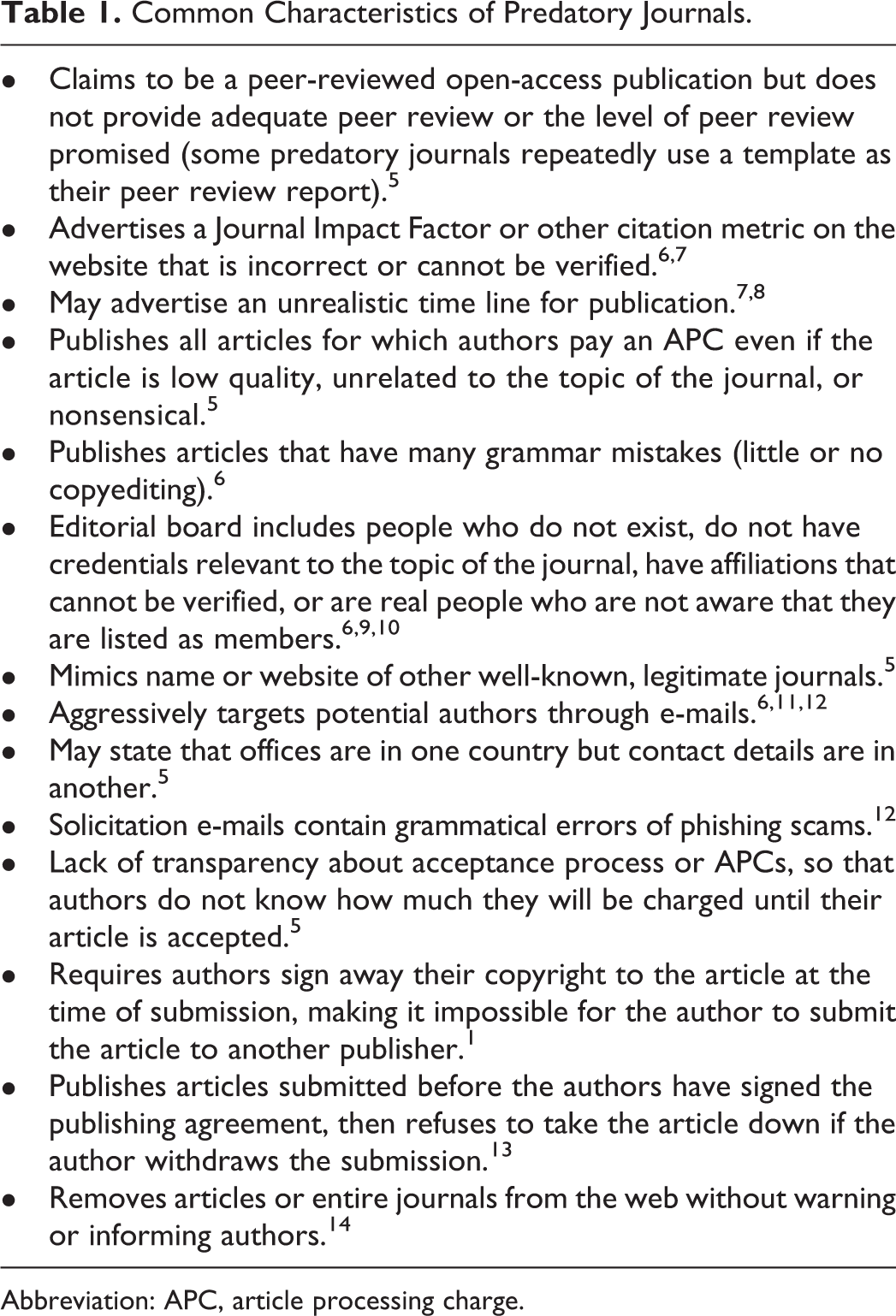
Abbreviation: APC, article processing charge.
Why You Should Avoid Submitting to Predatory Publishers
Many authors first encounter predatory publishers when they receive e-mails requesting that the author submits an article to one of their journals. These e-mails can be extremely flattering, make promises to publish anything the author submits, or promise review and publication on an unusually fast time line.
It may be tempting for authors to submit to these journals, particularly if they are not aware that it may be a scam, or if they are in a hurry to be published. 15 However, submitting articles to predatory journals may have serious negative consequences such as the ones listed below.
Fake Peer Review Undermines the Scientific Conversation
One of the most common forms of fraudulent publishing practices is for predatory journals to claim to provide true peer review when they do not. This practice leads to many problems in the broader context of scientific progress. Articles with flawed research or communication issues do not receive the benefit of peer feedback before publication and can be published with inaccurate information. Articles with low-quality or deliberately false information, which true peer review would likely catch, are also sometimes published in these journals. When articles like these are published under the false pretense of having received peer review, it can allow misinformation to enter the broader research community and slow or divert effort away from more legitimate lines of investigation.
Publishing in a Low-Quality Journal Can Make Your Research Harder to Find and Less Likely to Be Used By Others
Because fraudulent journals are perceived to be low quality and untrustworthy, researchers in your field are less likely to browse those journals or read them on their own. 16 Therefore, articles containing important research findings may be passed over by the broader scientific community. Many popular citation databases also do not index low-quality journals, so other researchers may not be able to find your work just by searching by topic.
You Could Be Scammed and Lose Your Work
The goal of predatory publishers is to convince authors to pay an article processing charge (APC) while performing the least amount of work possible on the publisher’s side. Sometimes, this includes not actually publishing accepted articles, taking articles or journal websites offline without notice, or publishing submitted articles before authors have signed a publishing agreement. Since many legitimate publishers will not accept articles that have been published before, submitting an article to a predatory publisher can be risky, even if you ultimately decide not to publish with them.
Tools and Strategies to Avoid Predatory Publishers
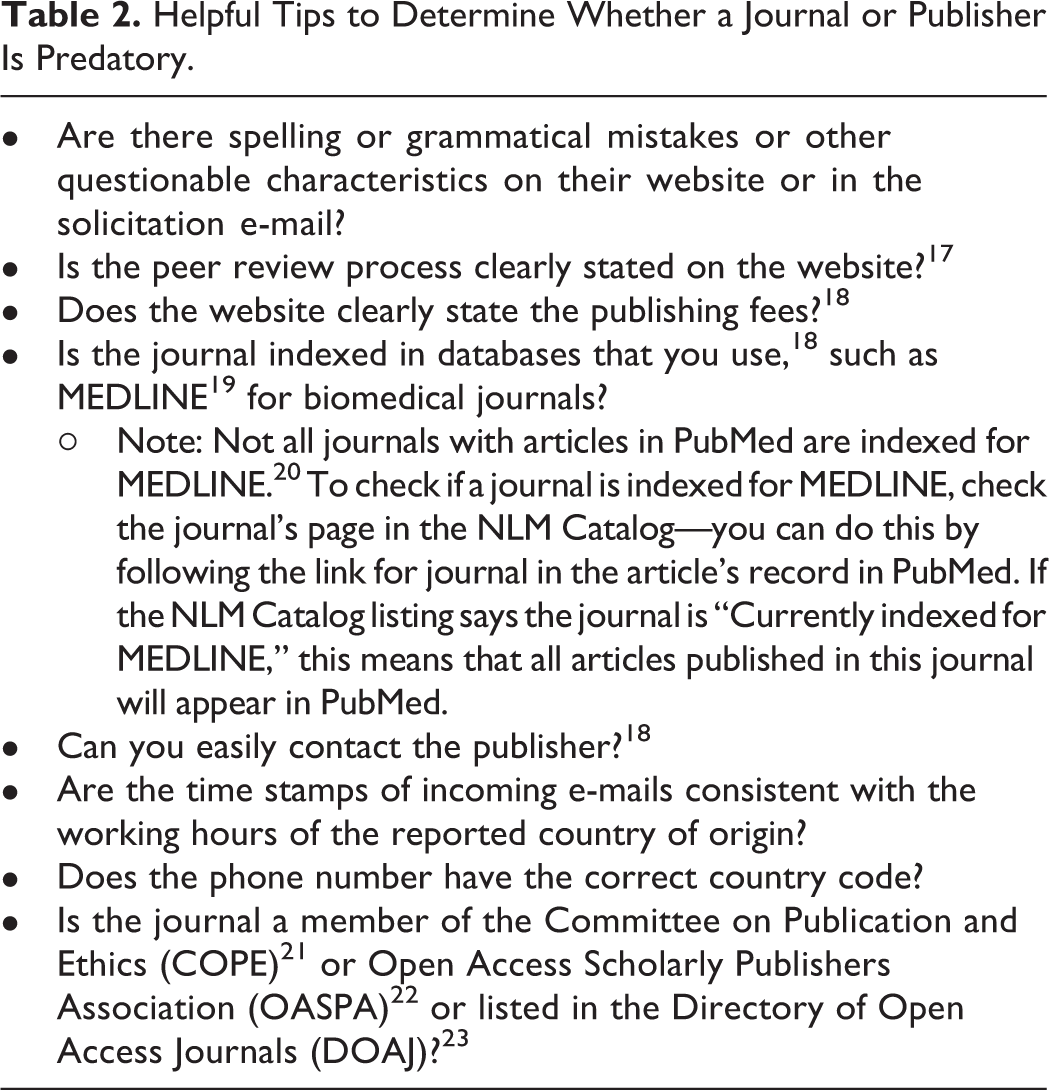
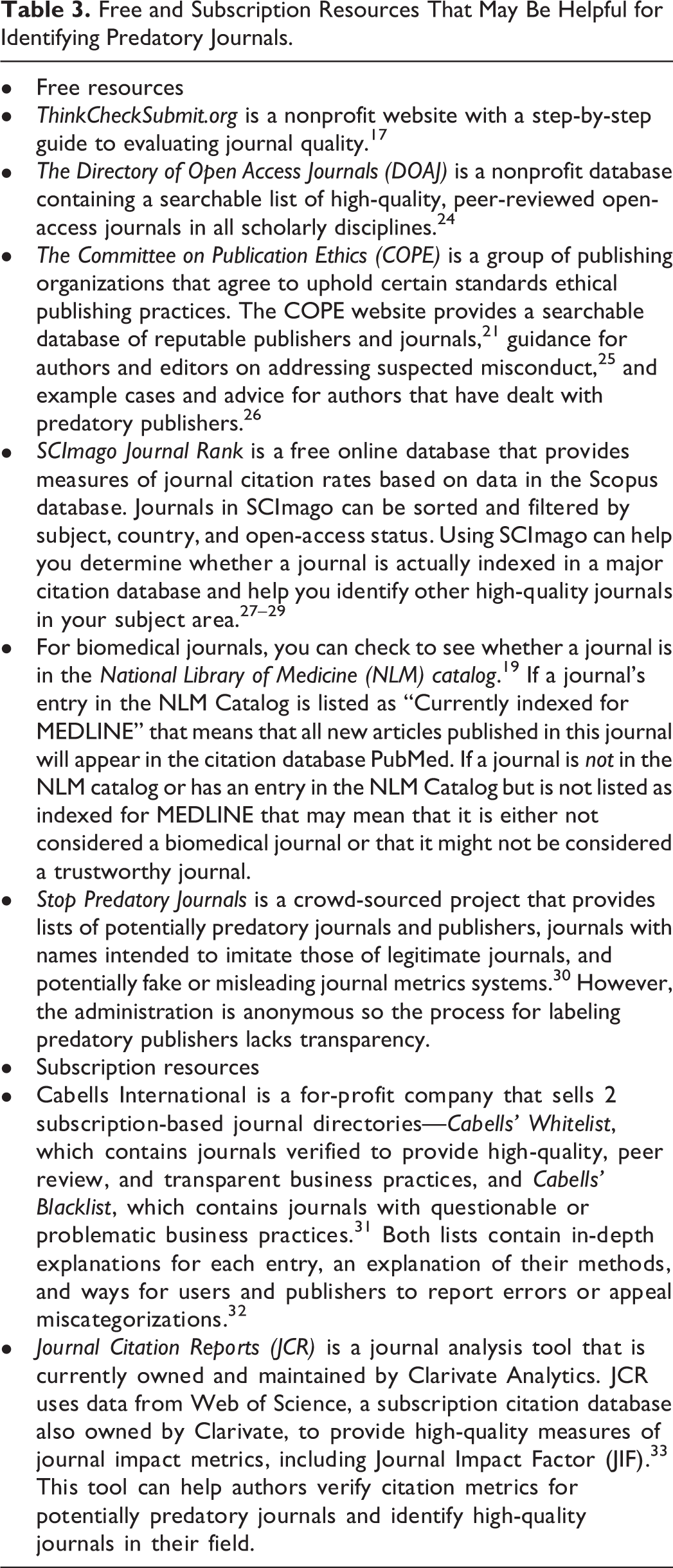
To avoid predatory journals and publishers, there are a number of techniques that an author can employ. These can be as simple as looking through the journal’s archives for articles that seem off-topic, checking that the APCs and review process are clearly stated on the journal website or just checking for grammar and spelling mistakes in solicitation e-mails. There are also several tools and checklists now available for verifying the identity of publishers. Table 2 provides some helpful tips on how to check the credibility of a journal or publisher. Table 3 provides a list of online resources for checking journal quality. If all of the above seems a bit daunting, we highly encourage you to ask your institutional or local librarian.
Helpful Tips to Determine Whether a Journal or Publisher Is Predatory.
Free and Subscription Resources That May Be Helpful for Identifying Predatory Journals.
Footnotes
Declaration of Conflicting Interests
The author(s) declared no potential conflicts of interest with respect to the research, authorship, and/or publication of this article.
Funding
The author(s) disclosed receipt of the following financial support for the research, authorship, and/or publication of this article: This work was supported [in part] by the NIH, National Institute of Environmental Health Sciences.
