




Abstract
Reactive oxygen species (ROS) have been revealed to be important factors for carcinogenesis and tumor progression. Therefore, we focused on an ROS-generating protein, nicotinamide adenine dinucleotide phosphate oxidase, and evaluated whether its inhibitor, apocynin, could suppress hepatocarcinogenesis in a medium-term rat liver bioassay. The number and size of glutathione S-transferase placental form (GST-P)-positive foci were significantly reduced by apocynin in a dose-dependent manner. The reduction of ROS generation by apocynin was confirmed by dihydroethidium staining. Apocynin treatment also significantly reduced Ki-67 positivity, downregulated cyclooxygenase 2, and suppressed the activation of the c-Myc pathway. Meanwhile, ROS generation was not different between GST-P-positive foci and surrounding GST-P-negative areas of the liver. In conclusion, the present data suggest that apocynin possesses a potential antihepatocarcinogenic property.
Keywords
Hepatocellular carcinoma (HCC) is one of the most common cancers worldwide and is a major cause of death, especially in Eastern and Southeastern Asia and parts of Africa (Torre et al. 2016). It is most often caused by chronic infection with hepatitis B virus (HBV) or hepatitis C virus (HCV) but is also caused by obesity, cirrhosis related to heavy alcohol consumption, and nonalcoholic fatty liver disease (Waghray, Murali, and Menon 2015).
Reactive oxygen species (ROS) can be important factors in carcinogenesis and tumor progression, not only inducing DNA damage but also producing cellular alterations such as the upregulation of mitogen-activated protein kinase, protein kinase C, and nuclear factor κB (NFκB; Wu 2006; Klaunig, Kamendulis, and Hocevar 2010). ROS production is increased not only in hepatitis with/without HBV and HCV but also in obesity (Higgs, Chouteau, and Lerat 2014; Furukawa et al. 2004). Therefore, we have focused on the inhibition of ROS production as an anticarcinogenic approach.
ROS are produced by mitochondria, peroxisomes, cytochrome P-450, and other cellular sources as a by-product of metabolism, and they are also generated by nicotinamide adenine dinucleotide phosphate (NADPH) oxidase, which is also implicated in a variety of signaling events including cell growth, cell survival, and cell death (Bedard and Krause 2007). NADPH oxidase consists of phagocytic oxidase (phox; gp91phox, p22phox, p40phox, p47phox, and p67phox) and Rac, which is a low molecular weight G-protein (Bedard and Krause 2007). Apocynin, a methoxy-substituted catechol that inhibits NADPH oxidase by blocking the association of p47phox and p67phox with gp91phox (Stolk et al. 1994), is now used as a standard NADPH oxidase inhibitor for research purposes (Bedard and Krause 2007). Additionally, apocynin can be converted by peroxidase-mediated oxidation to a dimer, which has been shown to be a more efficient inhibitor than apocynin itself (Stefanska and Pawliczak 2008). We previously presented evidence that apocynin reduced oxidative stress in arsenite-treated rat urothelium and prostate of the transgenic rat for adenocarcinoma of prostate model in vivo (Suzuki et al. 2009, 2013).
In the present study, we focused on investigating the potential anticarcinogenesis effects of apocynin using a medium-term rat liver bioassay system, which is well established to be reliable for the detection of broad-range carcinogens and specific promoters of hepatocarcinogenesis (Ito, Tamano, and Shirai 2003; Shirai, Hirose, and Ito 1999).
Materials and Methods
Animals
The animal experiment was performed in compliance with protocols approved by the Institutional Animal Care and Use Committee of Nagoya City University School of Medical Sciences. Five-week-old male F344 rats were obtained from Charles River Japan (Atsugi, Japan). They were housed in plastic cages with hardwood chip bedding in an air-conditioned room at 23°C ± 2°C and 55% ± 5% humidity with a 12-hr light/dark cycle and maintained on a basal diet (Oriental MF, Oriental Yeast Co., Tokyo, Japan) and tap water ad libitum.
Experimental Procedure
Animals were randomly divided into three groups of 15 or 16 rats each. All groups received an intraperitoneal injection of diethylnitrosamine at a dose of 200-mg/kg body weight as an initiation procedure. Starting 2 weeks later, they were given drinking water containing 0-, 100-, or 500-mg/L apocynin for 6 weeks. All rats were subjected to two-thirds partial hepatectomy at the end of week 3. Body weight and water consumption were recorded every week, and all surviving animals were sacrificed under isoflurane anesthesia at week 8. The livers were immediately excised, weighed, and cut into 2- to 3-mm-thick slices, 1 from the caudate lobe and 2 from the right lateral lobe. The slices were fixed in formalin for immunohistochemical examination. The remaining livers were immediately frozen in liquid nitrogen and stored at −80°C until processed.
Immunohistochemistry
Liver sections were treated with rabbit antirat glutathione S-transferase placental form (GST-P) antibody (MBL, Nagoya, Japan) or Ki-67 (Abcam plc, Cambridge, UK), followed by staining with BOND-MAX (Leica Biosystems, Wetzlar, Germany) according to the manufacturer’s instructions. Carcinogenic and promotional effects were quantitatively assessed with reference to the number and sizes of GST-P-positive foci (Ito, Tamano, and Shirai 2003; Shirai, Hirose, and Ito 1999). Areas of GST-P-positive foci larger than 0.2 mm in diameter in the liver were counted, and their diameters were measured under a microscope (BZ-9000; Keyence, Osaka, Japan). Staining intensity for GST-P was also quantitatively assessed via measuring the optical density of the stained tissue by microscopy (BZ-9000). Apoptotic cells in the liver were detected using an in situ apoptosis detection kit employing the terminal deoxynucleotidyl transferase dUTP nick end labeling (TUNEL) method according to the manufacturer’s instructions (Takara Bio, Otsu, Japan).
Detection of ROS Production
Six-micron frozen serial sections were cut on a standard cryostat with clean blades, mounted on slides, and then incubated with 6-µM dihydroethidium (Life Technologies, Carlsbad, CA) in phosphate-buffered saline for 15 min in the dark. The slides were washed two times with warm phosphate-buffered saline, and the fluorescence intensity was assessed at 518/605 nm with a spectrofluorometer. Images were also recorded with the microscope (BZ-9000). For the detection of ROS production inside and outside of GST-P-positive foci, each frozen section was first stained with dihydroethidium, and images were recorded, and then, it was fixed with formalin and stained with GST-P antibody.
Western Blot Analysis
Liver tissues were homogenized with radioimmunoprecipitation assay buffer (Pierce Biotechnology, Rockford, IL) containing a protease inhibitor (Pierce Biotechnology) on ice. The insoluble matter was removed by centrifugation at 13,500× g for 20 min at 4°C, and supernatants were collected. Protein concentrations were determined with a Coomassie Plus™ Kit (Pierce Biotechnology). Samples were mixed with 2× sample buffer (Bio-Rad Laboratories, Hercules, CA), heated for 5 min at 95°C, and then subjected to sodium dodecyl sulfate polyacrylamide gel electrophoresis. The separated proteins were transferred onto nitrocellulose membranes followed by blocking with SuperBlock Blocking Buffer (Thermo Fisher Scientific, Waltham, MA) for 1 hr at room temperature. Membranes were probed with antibodies for cyclin D1 (Santa Cruz Biotechnology, Dallas, TX), Nrf2, NAD(P)H quinone dehydrogenase 1(NQO1), phospho-phosphoinositide 3-kinase kinase (PI3K) p85 α (Y607; Abcam), PI3K p85, phospho-Akt (Ser473), Akt, phospho-NFκB-p65, NFκB-p65 (NFκB), phospho-Myc (Thr58/Ser62), Myc (Cell Signaling Technology, Danvers, MA), cyclooxygenase 2 (COX-2; Cayman Chemical, Ann Arbor, MI), and GST-P in 1× Tris-buffered saline containing 0.1% Tween® 20 at 4°C overnight, followed by exposure to peroxidase-conjugated appropriate secondary antibodies and visualization with an enhanced chemiluminescence detection system (GE Healthcare, Buckinghamshire, UK). To confirm equal protein loading, each membrane was stripped and reprobed with anti-β-actin (Sigma-Aldrich, St. Louis, MO).
Statistical Analyses
Statistical analyses were performed with mean ± standard deviation values using one-way analysis of variance and Dunnett’s test by Prism version 6 (GraphPad Software, Inc., La Jolla, CA). Differences of p < .05 were considered statistically significant. The Pearson correlation coefficient was used to estimate the dose–response relationship of apocynin treatment.
Results
Body and Organ Weights, Water Consumption
During the experimental period, minimal differences in body weight gain were observed among the groups, and final body and liver weights did not significantly vary. There were no significant differences in water consumption among the groups (Table 1).
Body and Liver Weights, Water Consumption, and Apocynin Intake.

Note. Values expressed as the mean ± standard deviation.
GST-P-Positive Foci, Ki-67, Cyclin D1, and TUNEL in the Liver
The number and area of GST-P-positive liver cell foci were clearly decreased by treatment with apocynin in a dose-dependent manner (Table 2). There was a significant decrease, in a dose-dependent manner, in the labeling index of Ki-67 in both GST-P-negative areas and GST-P-positive foci in the liver (Table 2). The expression of cyclin D1 in the liver was reduced (Figure 1). Meanwhile, differences in the TUNEL labeling index in the liver among the groups were not noted (Table 2). These findings indicate that apocynin inhibited hepatocarcinogenesis with decreased cell proliferation.
Effects of Treatment with Apocynin on GST-P-Positive Foci, Ki-67, and TUNEL Labeling Indexes.
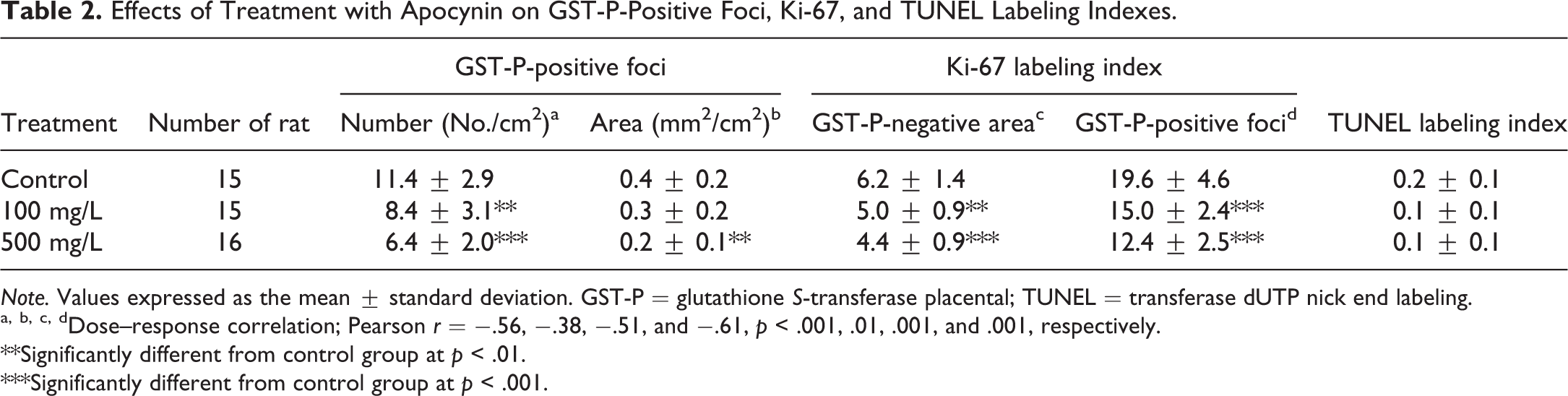
Note. Values expressed as the mean ± standard deviation. GST-P = glutathione S-transferase placental; TUNEL = transferase dUTP nick end labeling.
a, b, c, dDose–response correlation; Pearson r = −.56, −.38, −.51, and −.61, p < .001, .01, .001, and .001, respectively.
**Significantly different from control group at p < .01.
***Significantly different from control group at p < .001.
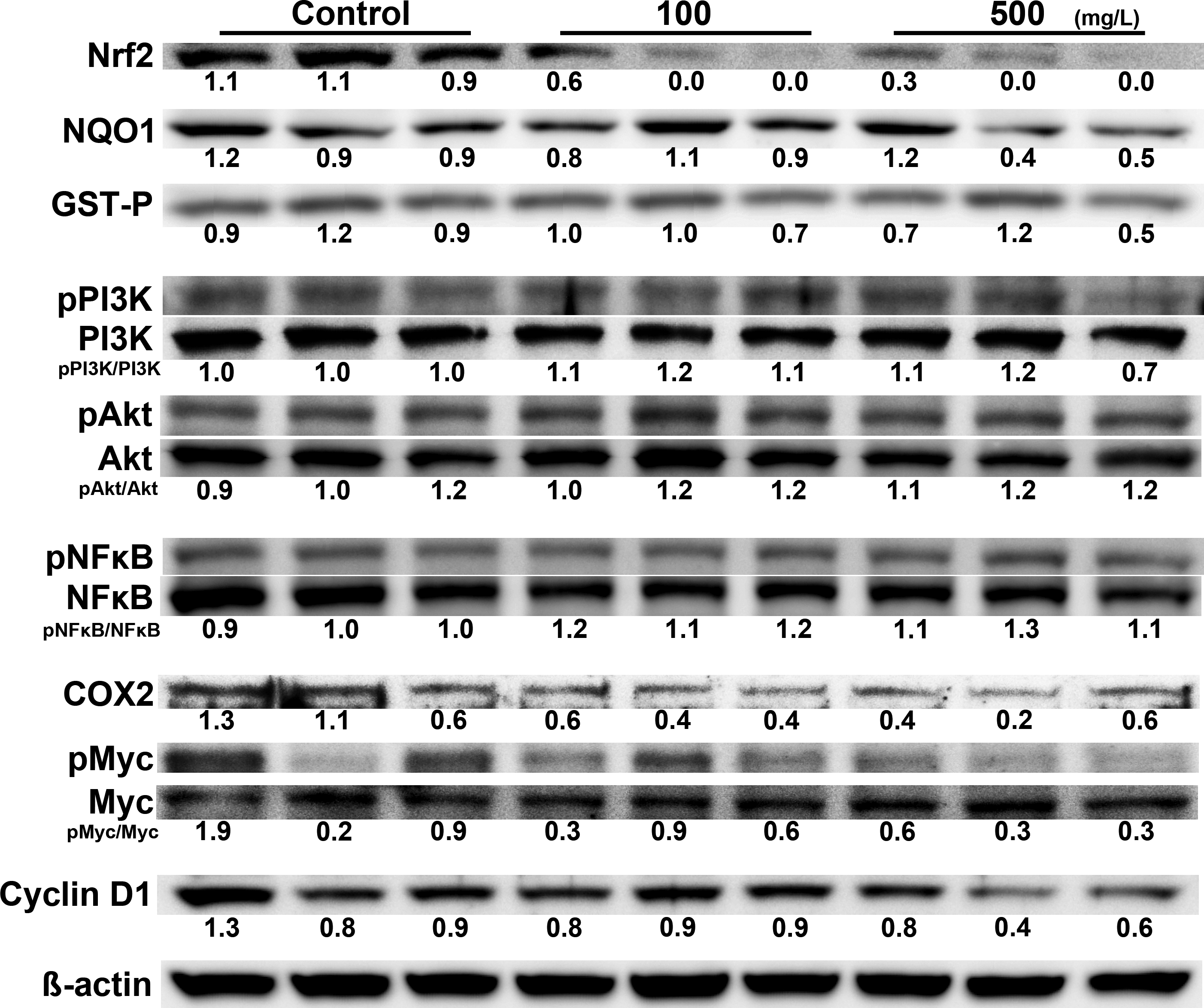
Immunoblot analysis in liver tissue. The liver tissues were harvested from three rats of each group. Results of immunoblot analysis of Nrf2, NQO1, glutathione S-transferase placental, phospho-PI3K, PI3K, phospho-Akt, Akt, phospho-nuclear factor κB (NFκB), NFκB, cyclooxygenase 2, phospho-Myc, Myc, cyclin D1, and β-actin in the liver of rats treated with apocynin. Values below individual bands indicate relative band intensities using β-actin protein for normalization. The average expression in the control was set as 1.0.
ROS Generation and Protein Expressions Related with ROS Generation in the Liver
Results for ROS detection in liver by dihydroethidium are presented in Figure 2A, with significant reductions (21% and 28% reductions at 100 and 500 mg/L, respectively) documented (Figure 2B). Because of the small GST-P-positive area in the liver, we only utilized the GST-P-negative area. In Western blot analyses, reduced abundances of Nrf2 and NQO1 were detected in the apocynin treatment groups, but the abundance of GST-P was not altered (Figure 1). On measuring the optical densities of GST-P foci in each group (Figure 3A), the mean staining intensity of GST-P in the foci was found to be significantly reduced by apocynin treatment in a dose-dependent manner (Figure 3B).
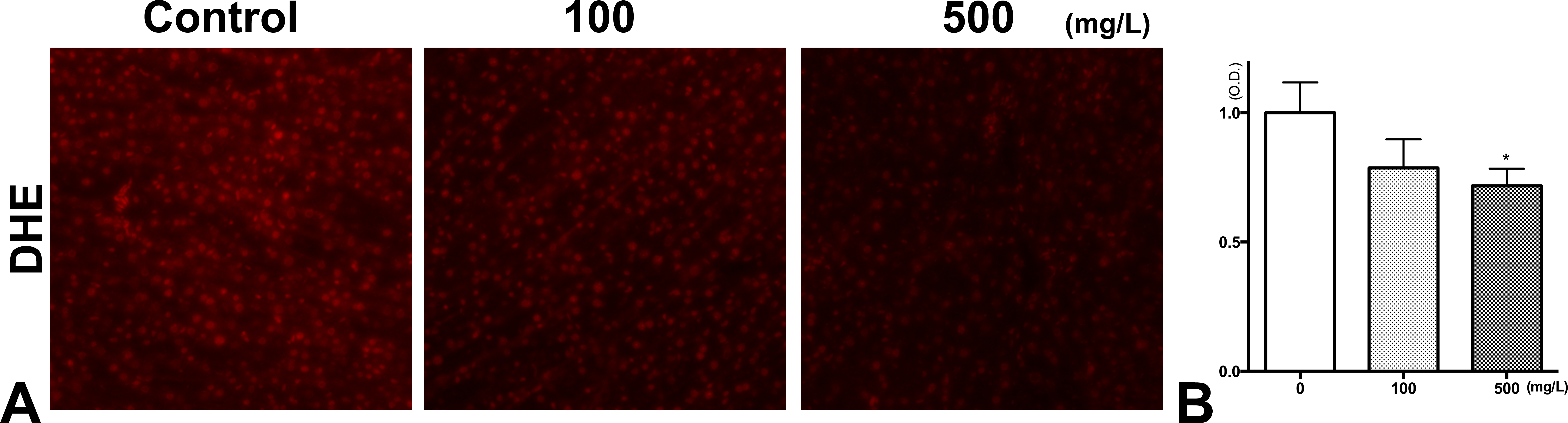
Effect of apocynin on reactive oxygen species (ROS) generation in the liver. Photographs (A) and data (B) for ROS production detected by dihydroethidium staining in the liver of rats treated with apocynin. Values were expressed as the mean ± standard deviation. *p < .05 compared to the 0-mg/L apocynin group.
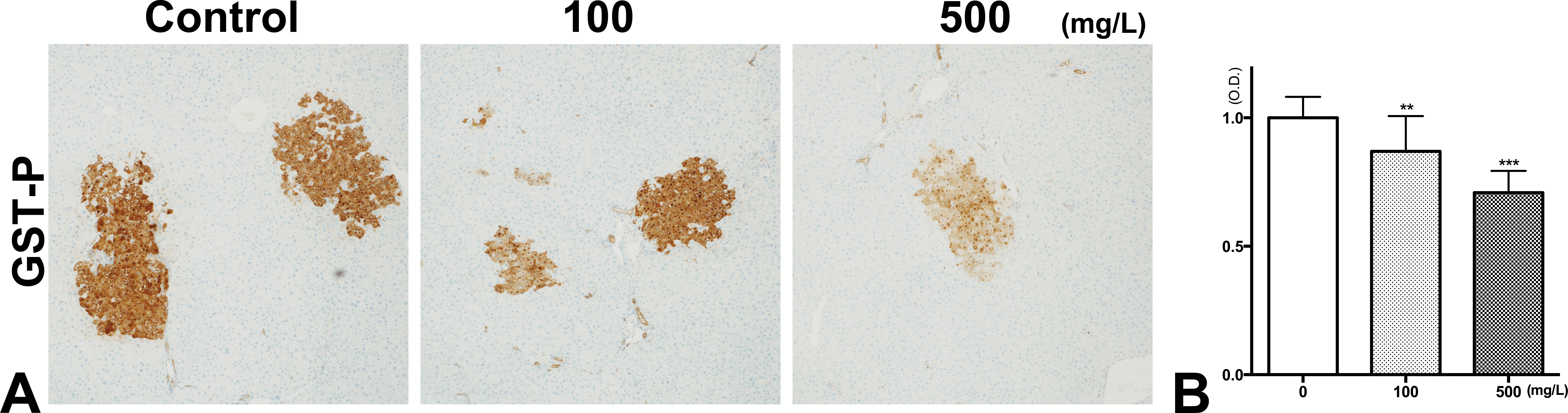
Effect of apocynin on glutathione S-transferase placental form (GST-P) expression in foci. Photographs (A) and data (B) for immunohistostaining of GST-P. The average optical density of the control was set as 1.0. Values were expressed as the mean ± standard deviation. **p < .01 compared to the 0-mg/L apocynin group. ***p < .001 compared to the 0-mg/L apocynin group.
Protein Expressions Related with the Regulation of Cell Proliferation in the Liver
In hepatocarcinogenesis, ROS induce the upregulation of stress-response genes such as Nrf2 and NFκB (Marra et al. 2011). Previous reports showed that the activation of the PI3K/Akt pathway occurred after the induction of Nrf2 activity (Mitsuishi et al. 2012; Shirasaki et al. 2014). To elucidate the mechanisms underlying the anticarcinogenic property of apocynin, we investigated the activation of PI3K, Akt, and NFκB in liver tissue. In this study, the phosphorylation levels of PI3K, Akt, and NFκB in liver were not changed among the groups. Meanwhile, the downregulation of COX-2 by apocynin treatment was detected. The phosphorylation of c-Myc, which is downstream of COX-2, was also inhibited by apocynin treatment (Figure 1).
The Relationship between GST-P Expression and ROS Generation
In cancer development, HCCs are thought to have high levels of ROS and low levels of superoxide dismutase (Marra et al. 2011), we investigated the condition of ROS generation in preneoplastic lesion in rat hepatocarcinogenesis. The results showed that dihydroethidium staining was not significantly different between the GST-P-positive foci and the surrounding GST-P-negative areas in the liver of rats in the control group (Figure 4A and B). The same phenomenon was detected in the liver of apocynin-treated rats (data not shown). The data indicate that an elevation in the level of ROS had not yet occurred in these early-stage preneoplastic lesions.
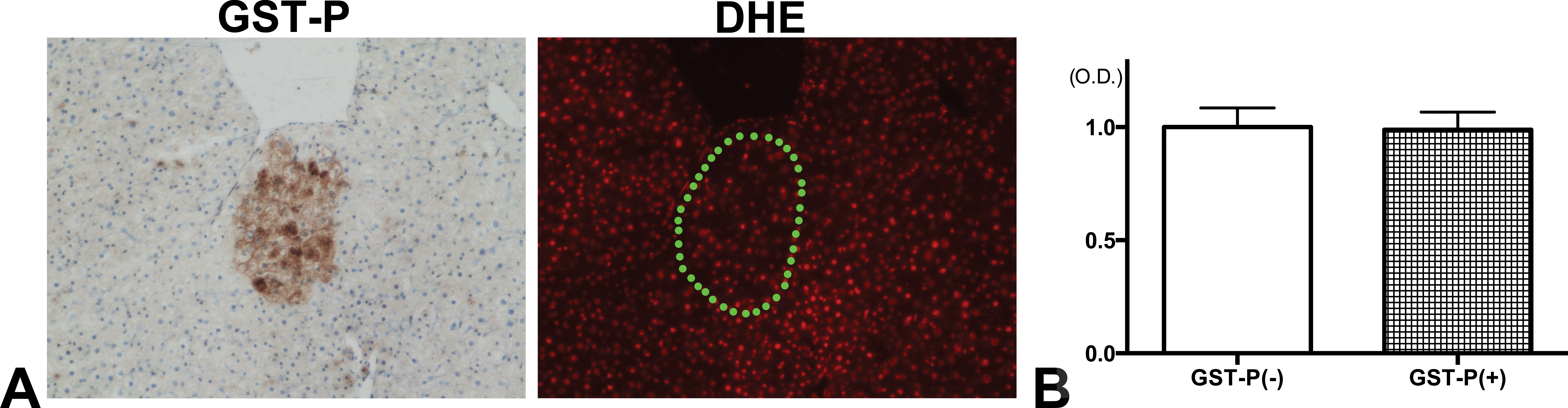
Relationship between glutathione S-transferase placental form (GST-P)-positive foci and reactive oxygen species (ROS) generation. Photographs (A) and data (B) for ROS production in GST-P-positive foci and the surrounding tissue. Values were expressed as the mean ± standard deviation.
Discussion
The medium-term rat liver bioassay used in the present study is known to be reliable for the detection of carcinogens and promoters of hepatocarcinogenesis (Ito, Tamano, and Shirai 2003; Shirai 1997; Shirai, Hirose, and Ito 1999). In this study, apocynin was thought to inhibit hepatocarcinogenesis based on the observed reductions in the number and area of GST-P-positive foci in the liver of the apocynin-treated rats.
Various sources including mitochondria, peroxisomes, and NADPH oxidase can produce ROS (Wu 2006). Apocynin only reduces ROS generation by NADPH oxidase, without affecting other ROS sources. In this study, decreased ROS generation in the liver by apocynin was detected by dihydroethidium, and this result was confirmed by the observations of reduced abundances of Nrf2 and NQO1 in liver tissue. It was also confirmed by the reduction of the optical density of GST-P immunostaining, which reflects GST-P expression. Because of the small GST-P-positive area in the liver, a significant decrease of GST-P expression might not be detected by Western blots. The dose of apocynin (500 mg/L) was previously reported as a chemopreventive dose for prostate and pancreatic carcinogenesis (Suzuki et al. 2013; Kato et al. 2015) and did not have any toxic effects on rats in those previous studies or the present study.
ROS generation is elevated in almost all cancers, and they contribute to maintaining the oncogenic phenotype and driving tumor progression (Liou and Storz 2010). Additionally, ROS are known to be important factors for carcinogenesis and tumor progression (Wu 2006; Klaunig, Kamendulis, and Hocevar 2010). Therefore, we hypothesized that high ROS generation locally promotes carcinogenesis, and we investigated ROS generation in GST-P-positive foci compared to the surrounding tissue. The results showed that ROS generation in GST-P-positive foci was not different from that in the surrounding tissue. Ki-67 positivity in GST-P-positive foci was higher than that in the surrounding tissue, indicating that the increased cell proliferation in GST-P-positive foci is not a consequence of altered ROS generation. Meanwhile, apocynin reduced both ROS generation and cell proliferation in a dose-dependent manner in both GST-P-positive foci and the surrounding tissue. These data suggest that ROS generation is related to cell proliferation during early hepatocarcinogenesis in rats.
Nrf2 is known to be one of the key transcription factors activated by ROS. In this study, the downregulation of Nrf2 was detected in the liver of apocynin-treated rats alongside decreased ROS generation; however, the activation of downstream pathways of Nrf2 such as PI3K and Akt, which regulate cell proliferation (Mitsuishi et al. 2012), was not significantly different among the groups. Therefore, Nrf2 activation is considered to be regulated by ROS based on the findings of this study. ROS generation in the liver was reported to be induced by carbon tetrachloride and associated with NFκB activity and COX-2 expression (Kim et al. 2002). The NFκB pathway was also associated with ROS generation in hepatocarcinogenesis (Marra et al. 2011); however, the activity of the NFκB pathway was not different among the groups in the present study. Meanwhile, the downregulation of COX-2 expression was detected in the liver of rats treated with apocynin. In rat liver, COX-2 activity was reported to be correlated with the activity of prostaglandin E2 (PGE2; Chung et al. 2015). The activation of c-Myc, which is a downstream signaling pathway of PGE2, was reported to promote the growth and invasion of HCC cells (Xia et al. 2014). Considering our results, the activation of this pathway for cell proliferation may be associated not only with HCC but also with ROS generation during early rat hepatocarcinogenesis.
In conclusion, apocynin, an NADPH oxidase inhibitor, suppressed hepatocarcinogenesis and reduced ROS generation in a medium-term rat liver bioassay. The mechanism underlying its antihepatocarcinogenic effect appears to involve the regulation of cell proliferation via modulating the expression of COX-2 and c-Myc. Apocynin warrants further attention as a promising chemopreventive drug for liver cancer.
Footnotes
Acknowledgments
We gratefully acknowledge the expert technical assistance of Yuko Nagayasu, Koji Kato, and Junko Takekawa.
Author Contribution
Authors contributed to conception or design (SS, ST); data acquisition, analysis, or interpretation (SF, SS, AN, HK, MH, YY, TK); drafted the manuscript (SS); and critically revised the manuscript (SF, AN, HK, MH, YY, TK, ST). All authors gave final approval and agreed to be accountable for all aspects of work in ensuring that questions relating to the accuracy or integrity of any part of the work are appropriately investigated and resolved.
Declaration of Conflicting Interests
The author(s) declared no potential conflicts of interest with respect to the research, authorship, and/or publication of this article.
Funding
The author(s) disclosed receipt of the following financial support for the research, authorship, and/or publication of this article: This work was supported by funding from the Aichi Cancer Research Foundation.