




Abstract
In non-rodent toxicity studies supporting pharmaceutical or chemical product registration, the value of histopathology evaluation of all tissues from all animals from all dose groups is an ongoing discussion topic among pathologists. This manuscript documents an examination of this topic through a retrospective review of internal nonclinical study data from non-rodent toxicity studies performed at three pharmaceutical companies (Abbott Laboratories, Eli Lilly, and Pfizer, Inc.) and an informal survey of the current practices within the toxicological pathology community. The retrospective review of 325 non-rodent studies in which all organs in all dose groups were examined revealed no evidence that risk assessment would have changed if only the control and high-dose animals and target organs only in intermediate dose groups had been examined. One study had target tissues in a lower-dose group that were not identified in the high-dose group; however, there was no impact on the overall study interpretation. The recently revised European Medicines Agency guideline regarding repeated-dose toxicity studies encourages the examination of all tissues at all dose levels in non-rodent studies. In conclusion, the evaluation of all tissues from all animals may not be justified as a routine practice; however, regulatory guidance with input from toxicologic pathologists will influence these policy decisions.
Keywords
Introduction
For non-rodent toxicity studies supporting pharmaceutical or chemical product registration, there is an ongoing discussion among toxicologic pathologists regarding the value of examining all tissues from all animals from all dose groups. Although most regulatory documents do not specifically refer to histopathologic evaluations among intermediate dose groups, a recent guidance of the European Medicines Agency states that complete histopathology “should be conducted in all animals at all dose levels” in non-rodent studies (EMEA 2010). Several companies were interested in determining the value of the routine evaluation of intermediate groups for non-rodent studies. This topic was explored by (1) reviewing participating companies’ internal nonclinical study data from non-rodent toxicity studies to determine the value of routine examination of all tissues from intermediate dose groups; and (2) reviewing current scientific practices within the pharmaceutical and agrichemical industries through the use of a survey.
Pharmaceutical companies are challenged to decrease costs and shorten the time to market of new products. The use of well-designed and efficient nonclinical safety studies is one means to reduce the resources and time necessary to advance compound candidates through the clinical trials. The microscopic examination of tissues is an important aspect of product safety evaluation in nonclinical studies. The practices for the microscopic examination of tissues from non-rodent studies vary among companies. There are companies—including Abbott Laboratories, Eli Lilly, and Pfizer, Inc.—in which all tissues from all animals in non-rodent toxicity studies are examined microscopically. There are other companies in which the microscopic examination is limited to all protocol tissues in control and high-dose animals and restricted to the target organs in other (intermediate) dose groups.
To evaluate the current industry practice regarding the microscopic examination of all tissues from all animals in all dose groups in non-rodent studies, an informal survey was sent to members of the toxicologic pathology community. We also reviewed 325 non-rodent general toxicity studies in which the tissues from all dose groups were evaluated microscopically to determine whether the examination of tissues in the intermediate dose groups affected risk assessment decisions in setting either the no-observed-effect level (NOEL) or the no-observed-adverse-effect level (NOAEL) for a test article under study.
We present here (1) the current industry practices based on the results of an informal survey sent to members of the toxicologic pathology community representing the pharmaceutical and agrichemical companies; and (2) the results of an internal non-rodent study review from our respective companies.
Materials and Methods
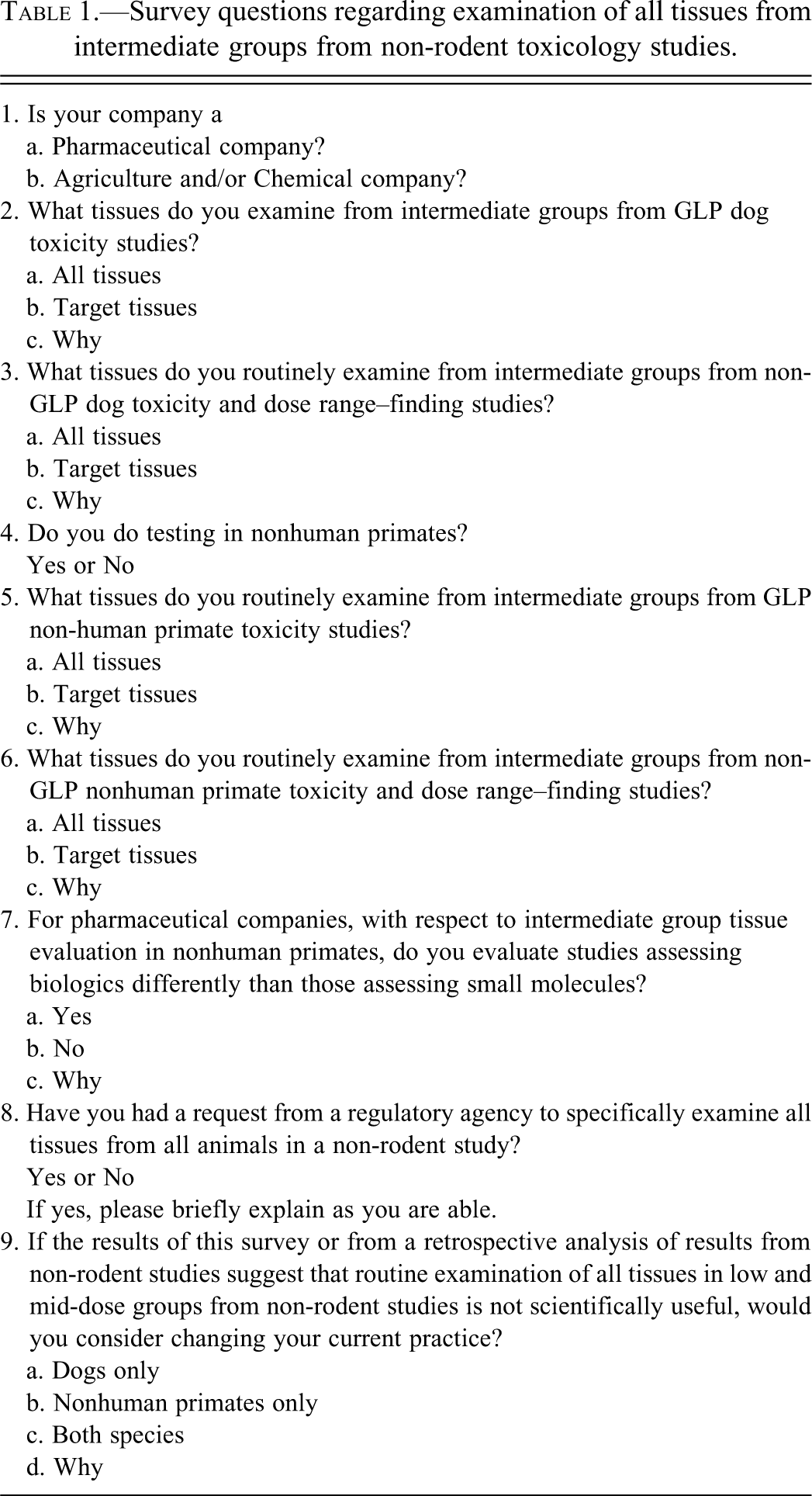
An informal survey was sent to members of the toxicologic pathology community representing forty-five pharmaceutical and agrichemical companies in Europe, Japan, and the United States (Table 1). Although many companies are global, responses were tabulated based on the location of the respondents. Because of the small sample size, no formal statistical analysis was possible.
Survey questions regarding examination of all tissues from intermediate groups from non-rodent toxicology studies.
In addition to the survey, the pathology reports and microscopic diagnostic tabular data from 194 dog and 131 nonhuman primate (NHP) general toxicity studies from our respective company files were retrospectively examined. The study types ranged from non-Good Laboratory Practice (GLP), two-week dose range–finding studies to twelve-month GLP studies. The dosing routes included oral gavage, subcutaneous, and intravenous injection, and a few inhalation studies. The majority of test articles were small molecules with limited numbers of biotherapeutic entities.
Results
Survey Responses
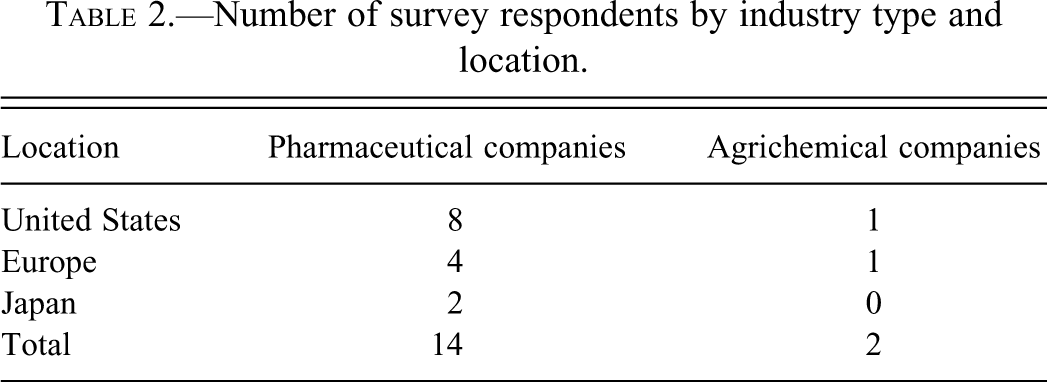
There were sixteen respondents from the forty-five survey requests sent to the pharmaceutical and agrichemical companies. The majority of responses were from the pharmaceutical industry, followed by the agrichemical industry. The respondents represented companies in Europe, Japan, and the United States. Of the sixteen companies that responded to the survey, 56% were from the United States, 31% from Europe, and 12% from Japan (Table 2). Responses for global organizations are expressed based on the location of the respondent. The results of the survey are presented in Tables 3 and 4.
Number of survey respondents by industry type and location.
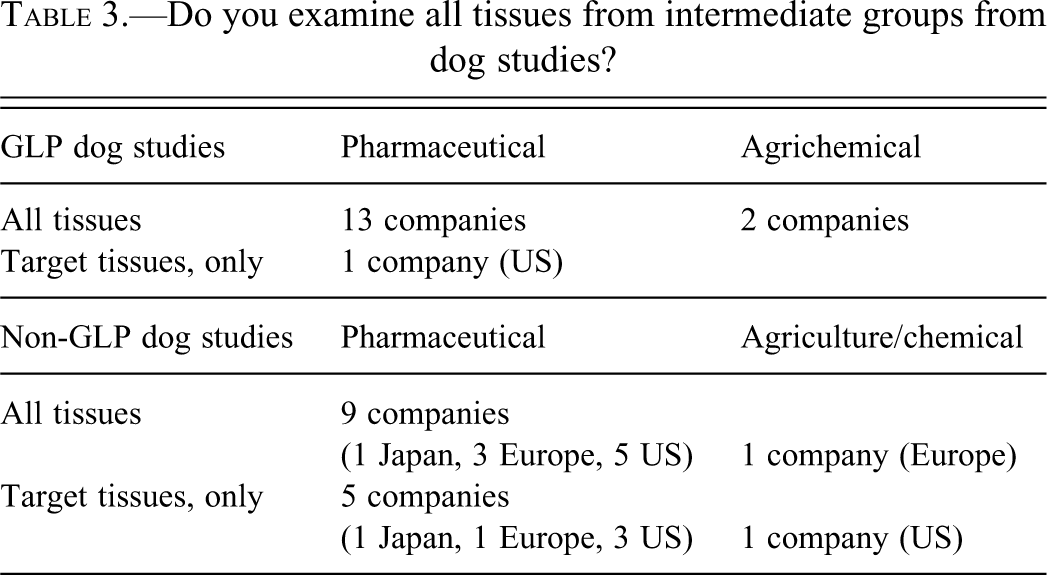
Do you examine all tissues from intermediate groups from dog studies?
Do you examine all tissues from intermediate groups from nonhuman primate studies?
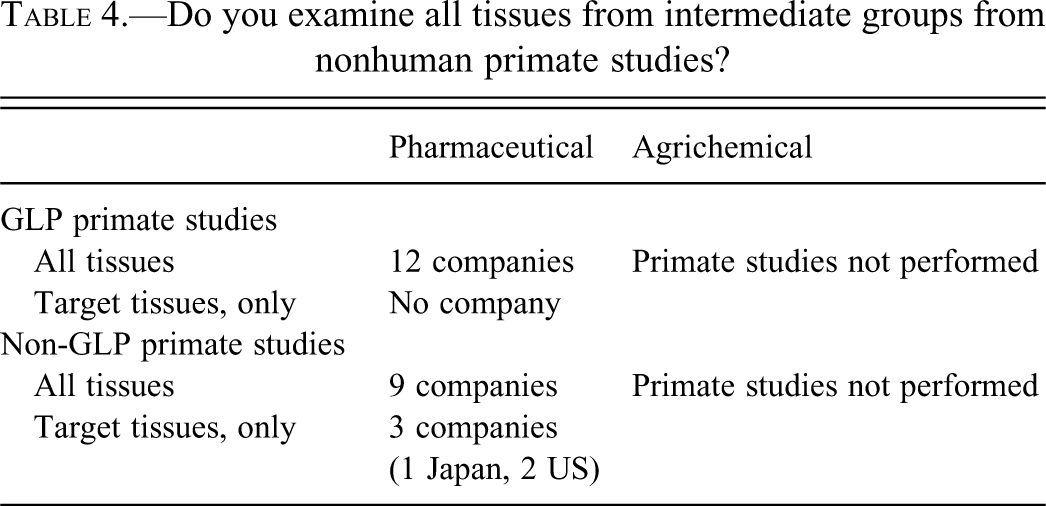
Fifteen of the sixteen responding companies examine all protocol tissues in all dose groups from all dogs in GLP studies, whereas one United States–based pharmaceutical company evaluates the control and high-dose groups and only target tissues in intermediate-dose groups in dog GLP studies. For non-GLP dog studies, ten companies examine all protocol tissues in all dose groups, whereas six companies examine the control and high-dose groups and only target tissues in intermediate-dose groups. Of the twelve pharmaceutical companies that use nonhuman primates, all companies examine all protocol tissues in all dose groups in nonhuman primate GLP studies; for non-GLP studies, three of these companies examine only control and high-dose groups and target organs in the intermediate-dose groups. Agrichemical companies do not conduct nonhuman primate studies.
Additional information was obtained from Questions 7 and 8. When asked whether intermediate-dose groups in nonhuman primate studies assessing biologics were evaluated differently than in studies assessing small molecules, all of the eleven pharmaceutical company respondents stated they evaluated small molecules and biotherapeutic entities in the same manner. In answer to Question 8, all thirteen pharmaceutical companies and one agrichemical company (100%) indicated that they had no requests for additional examination of tissues from submitted non-rodent studies; however, only one company in this responding group limits examination to all protocol tissues in the control and high-dose groups and to target organs in intermediate-dose groups of GLP dog studies.
Retrospective Analysis
In 325 non-rodent toxicity studies, examination of all protocol tissues in all dose groups did not alter the safety assessment in any study (Table 5). In only one study (involving nonhuman primates receiving a biotherapeutic test article by subcutaneous injection once weekly for four weeks) were there intermediate-dose group target tissues not identified among high-dose animals. A multi-organ effect was observed affecting sixteen target tissues, two of which were affected only in mid-dose animals. The presence of this widespread change in two additional organs in an intermediate-dose group did not have an impact on the study NOEL, NOAEL, or overall study interpretation.
Number of non-rodent studies reviewed.
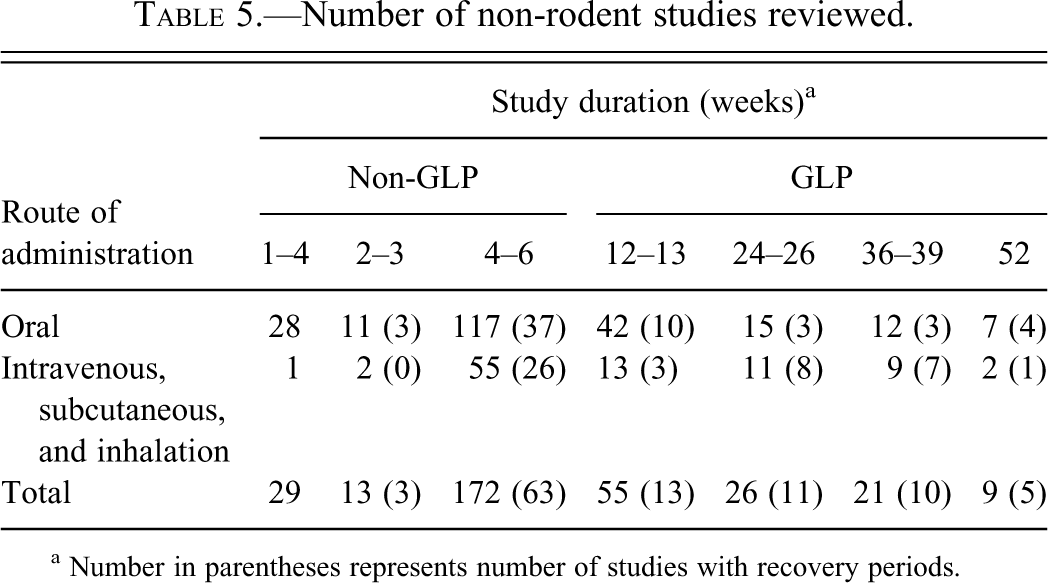
a Number in parentheses represents number of studies with recovery periods.
Discussion
Most companies surveyed currently examine all protocol tissues in all dose groups in non-rodent toxicity studies. Several reasons were cited by survey participants for examining all tissues in the intermediate groups. The most common reason was the low total number of animals used in these studies resulting in small group sizes. An additional concern was related to the CYP enzyme variability in dogs and variable pathology background findings in monkeys coming from multiple sources and suppliers. An ethical obligation to gather as much data as possible when using non-rodent species was also cited as a reason for complete tissue examination in all dose groups. Additional study-specific circumstances could influence a decision to review all tissues in a non-rodent study. Unusual toxicokinetics (e.g., test compound exposures in an intermediate-dose group higher than in the high-dose group) could be a reason for complete tissue assessment of all groups. Toxicokinetic data are frequently unavailable when histopathologic assessment is conducted, which possibly justifies proactive complete assessment of all tissues. Certain in-life phenomena such as immune-mediated reactions associated with induction of anti-drug antibody production by low doses of biologics may also necessitate complete tissue evaluation of an affected intermediate-dose group. There may be additional concerns that a specific test article or test article class may induce a hormetic-like or biphasic dose-response rather than an expected threshold dose-response relationship. In this instance, examination of intermediate groups may reveal low- or mid-dose stimulation in contrast to high-dose inhibition. However, the validity of the hormetic-like phenomena on risk assessment in standard toxicology studies has been questioned (Rodericks 2003). The reasons listed above, as well as the requirement to follow regulatory guidance, were cited to support examination of all tissues in intermediate-dose groups. The recently revised European Medicines Agency guideline regarding repeated dose toxicity studies encourages the examination of all tissues in intermediate groups from non-rodent studies (EMEA 2010). Interestingly, almost half of companies surveyed would consider changing the approach and examine only target tissues from intermediate-dose groups if there were scientific evidence supporting the change.
A retrospective review of non-rodent studies in which all organs in all dose groups were examined revealed no evidence that risk assessment would have been affected if only the control and high-dose groups and target organs in the intermediate-dose groups were examined. Among 352 studies conducted with dogs or cynomolgus monkeys, a single monkey study had target tissues in a lower-dose group that were not identified in the high-dose group; however, the NOAEL, NOEL, and overall study interpretations were not affected. Unquestionably, there are situations (e.g., unusual toxicokinetics, or in-life or clinical pathologic findings unique to an intermediate-dose group) in which complete tissue evaluation of all animals is important to the full understanding of the effects of a given test article in the context of that study; however, the retrospective review results indicate that such circumstances are infrequent, and that examination of all protocol tissues from all dose groups does not provide added value to the interpretation of most non-rodent studies.
Conclusion
Survey of industry peers disclosed that the prevalent practice among toxicologic pathologists is to review all protocol tissues from all animals of non-rodent toxicity studies, as is currently recommended by the European Medicines Agency. Results of a retrospective review of non-rodent studies indicate that information provided through assessment of all protocol tissues rather than only target tissues among intermediate-dose groups rarely influences the overall study evaluation. In conclusion, the complete tissue evaluation of intermediate-dose groups in non-rodent studies may not be justified as a routine practice and decisions might be made on a study-by-study basis whether complete histopathology is warranted. It is important to note that histopathologic examination is never completed in isolation without in-life observational, clinical pathology, and organ weight data, all of which are collected for all animals on study. With the ever-increasing menu of novel targets and chemicals, it is conceivable that unique risks might arise associated with these novel targets or chemicals. The additional standard in-life and anatomic pathology data, along with the scientific knowledge of any unique risks associated with a particular target, can assist in making the decision on a case-by-case basis to examine one or more intermediate groups. Ultimately, regulatory guidance with input from toxicological pathologists will influence these policy decisions.
Footnotes
Acknowledgments
The authors thank all the toxicologic pathology colleagues who responded to the survey and who engaged us (Schmidt/Weddle) in lively discussion at our poster presentation ( ). We also thank our respective departments for providing us with unfettered access to the historical study files and documents, to D. Morton for his review and comments in the preparation of our earlier poster and this manuscript, and to K. Whitney and other members of the Regulatory Forum committee for review of this manuscript.
The authors have declared no potential conflicts of interest with respect to the research, authorship, and/or publication of this article.
The authors received no financial support for the research, authorship, and/or publication of this article.