



Abstract
Changes to domestic divisions of labor have been widely documented, but some tasks seem particularly resistant to change. Using the lens of ‘doing gender’, this article draws on interviews with 25 heterosexual working parent British couples who produced a ‘household portrait’ of their division of labor. It examines how they explain men’s continuing responsibility for ‘man-typed’ domestic tasks and why this is so resistant to change. Although men’s ‘gatekeeping’ of these tasks is consequential for the overall household division of labor, there is relatively little opposition from their women partners. This gatekeeping reproduces gendered meanings of ‘man-typed’ tasks and enables both men and women to ‘do gender’ while supporting their image of a ‘sharing’ couple.
Keywords
Introduction
Understanding the reasons men and women give for why they do different household tasks is central to tackling gender inequality. While the gendered implications of the types of tasks that men and women do are well-known, there is still much to learn by looking at the micro-level interactions between couples which reproduce task divisions (Christopher, 2021; Carlson & Hans, 2020; Garcia & Tomlinson, 2021). Steps towards gender convergence in housework and childcare, and with it the reconstruction of masculinities (Elliott, 2016), have been documented internationally (Coltrane, 2009; Evertsson & Nermo, 2007; Gershuny & Sullivan, 2019; Roberts, 2018; Thomas & Hildingsson, 2009), but most studies focus on the changing gender division of tasks traditionally classed as ‘woman’s work’, asking what makes men more or less likely to carry out tasks like cooking and housecleaning (Beagan et al., 2008; Davis & Greenstein, 2020). Men’s responsibility for tasks such as mowing the lawn, home improvement and car maintenance receives little attention.
Connections between these tasks and masculinity have been documented (Gelber, 1997; Gorman-Murray, 2008; Kroska, 2003, 2004) even in households with stay-at-home fathers who, through their caregiving, challenge cultural notions of masculinity (Doucet & Merla, 2007; Latshaw, 2015; Medved, 2016). Yet, for the most part, research on domestic divisions label these tasks as ‘man-dominated’, ‘man-defined’, ‘man-typed’ or ‘masculine’ without further inquiry. When they are explored, alongside other tasks, resource-based theories are unable to explain why men are more likely than women to carry them out (Kolpashnikova & Kan, 2021). Even studies concerned with the meanings of household tasks tend to focus on individuals’ responses, rather than considering how these task divisions are conceptualised and negotiated at the couple level, thereby limiting our understanding of the role of interactional and relational processes (Twamley et al., 2021) in constructing these meanings.
Negotiating household divisions of labor has been seen as central to the production of gender, conceptualised as a process of social construction in which couples actively produce meaning through language and social interaction. In this article, I examine the interactional strategies (Risman, 2018) through which ‘man-typed’ tasks are defined and divided by drawing on a study of 25 heterosexual, working parent couples in the UK. Rather than focusing on individuals’ accounts, I analyse couples’ joint understandings of the persistence of men’s responsibility for certain tasks by examining couples’ creation of a ‘household portrait’ outlining their domestic division of labor. I ask why these task divisions are so resistant to change, and whether men’s responsibility for them is consequential for wider household labor divisions. Further, I show how male gatekeeping is itself a way of ‘doing gender’.
‘Doing Gender’, Gatekeeping and the Division of Household Labor
There is substantial evidence of men’s persistent responsibility for tasks such as mowing the lawn and home improvements (Bessen-Cassino, 2019; Kolpashnikova & Kan, 2021; Obioma, 2022). Even during the COVID-19 pandemic, men’s responsibility for ‘man-typed’ tasks was not subject to change (Chung et al., 2021; Van Tienovan et al., 2021), suggesting that certain tasks continue to be an important site for ‘masculine identity work’ (Gorman-Murray, 2008). Gelber (1997, p. 68) uses the concept of ‘domestic masculinity’ to explain how, historically, men were ‘able to move easily into home-based do-it-yourself activity because household construction, repair and maintenance were free from any hint of gender-role compromise’. Men’s responsibility for tasks such as domestic repairs/improvement, unlike cooking or cleaning, coincides with hegemonic masculinity (Connell, 2000; Doucet & Merla, 2007; Hunter et al., 2017). However, the precise connection between constructions of masculinity and responsibility for these tasks may be class-specific; for instance, Moisoi et al. (2013) found that men from lower income backgrounds see doing ‘man-typed’ tasks as a form of provisioning, especially if they are not the primary breadwinner, while higher earning men professionals connect these tasks to the masculine ‘craftsman ideal’.
In this article, I explore the masculinisation of certain tasks utilising the concepts of ‘doing gender’ (West & Zimmerman, 1987) and male gatekeeping (Miller, 2018). West and Zimmerman’s idea of ‘doing gender’ continues to be fruitfully applied to studies of domestic divisions of labor (Nyman et al., 2018) even with respect to couples with less traditional gendered arrangements, such as stay-at-home fathers, breadwinner mothers and those committed to ‘equal sharing’ (Deutsch & Gaunt, 2020; Latshaw & Hale, 2016; Latshaw, 2015; Deutsch, 2007). West and Zimmerman argue that gender is something you do rather than something you are and is accomplished through our everyday interactions; we are held accountable for what we do according to a binary frame. When women and men undertake household tasks in line with expected gender roles, they engage in gendered practices that reproduce and reinforce gendered identities and relations of power both within and outside the home (Davis & Greenstein, 2020). Even when individuals’ practices go against normative expectations, they are still compared to dominant norms, thus keeping the latter in play.
Critics argue that a focus on ‘doing’ leads to the reaffirmation of difference, rendering resistance and social change invisible (Deutsch, 2007; Risman, 2009). They ask: if we constantly reference gender norms, even when we go against them, then how can they be effectively challenged? Deutsch proposes that we shift attention to social interactions that ‘undo’ gender. It is true that some tasks are now re-signified, allowing men to do them without risking emasculation (Hollows, 2003). Cooking, for instance, is associated with ‘new fathering’ and ‘progressive masculinity’ (Neuman, 2020). Yet non-traditional practices may not be enough to ‘undo’ gender, if, for instance, men do formerly ‘woman-typed’ tasks differently. For example, men may not have to look after children while they cook, meaning the task is experienced as less demanding (Szabo, 2013).
Although we have seen a longstanding trend towards more egalitarian attitudes towards family and work arrangements among heterosexual couples (Daminger, 2020; Deutsch & Gaunt, 2020), ‘doing gender’ remains relevant as women’s and men’s behaviour in the home does not always accord with their expressed attitudes (Borgkist et al., 2020). Even in households committed to equality, gendered inequalities may be sustained through couples’ ‘de-gendering’ explanations for non-egalitarian practices, making gender-traditional outcomes more palatable (Daminger, 2020).
Gender-traditional outcomes may also be maintained through ‘gatekeeping’, something research has shown occurs mainly in relation to traditionally women’s tasks, specifically childcare. Allen and Hawkins (1999) suggest that cultural ideals of mothering and the need for external validation of their maternal role impede some women from relinquishing responsibility for tasks, even when in principle they support fathers’ involvement. Setting rigid standards and criticising men for not getting it right inhibits fathers’ involvement and prevents them from acquiring the necessary skills (Fagan & Barnett, 2003; Gaunt, 2008; Gaunt & Pinho, 2018; Kilzer & Pedersen, 2011). ‘Doing gender’ may thus rest on ‘maternal gatekeeping’, defined as ‘a collection of beliefs and behaviours that ultimately inhibits a collaborative effort between men and women in family work by limiting men’s opportunities for learning and growing through caring for home and children’ (Allen & Hawkins, 1999, p. 200). However, the notion of maternal gatekeeping remains controversial, as it may underestimate the crucial role men themselves play in determining their own level of involvement (Hauser, 2012; Sano et al., 2008; Walker & McGraw, 2000).
Although there have been calls for more diverse applications of gatekeeping theory (Pinho & Gaunt, 2021), few authors have explored how men may gatekeep; exceptions are Sweeney et al. (2017), who found that men in same sex couples were more likely to gatekeep than women in same sex couples, and Miller (2018), who suggested that men’s claims of their own incompetence in looking after children is a form of paternal gatekeeping, reinforcing the traditional gendered division of childcare tasks and ensuring that men do less, which may serve to maintain their privilege in paid work. However, there has not yet been attention to men’s gatekeeping around traditionally ‘man-typed’ tasks. As I will show, this new focus brings further features of gatekeeping to light. For instance, a partner’s gatekeeping is usually seen only to occur when the other partner actively seeks to participate. This might be because of the focus on childcare, which both partners may see as rewarding (Sullivan, 2013). In contrast, this article suggests that looking at partners’ involvement in ‘man-typed’ household tasks suggests that we need to widen the conceptualisation of gatekeeping recognising that it may also be present in other circumstances, especially at the interactional and relational level of task allocation. My research suggests that gatekeeping may operate as a key social mechanism through which couples reproduce particular constructs of masculinity and femininity. Examining the persistence of men’s responsibility for these tasks highlights the extent of ‘male gatekeeping’ and its relation to ‘doing gender’.
In what follows, I start by describing the study and summarising participating couples’ relative contributions to ‘man-typed’ tasks. I then concentrate first on men’s gatekeeping, showing how, in their discussions with their partner and me, men embrace ‘man-typed’ jobs that enable them to ‘do gender’, especially because they enable them to learn and display ‘man-typed’ skills. I then identify some of the wider social constructions of ‘man-typed’ tasks on which men gatekeepers draw. Finally, I focus on the interactions between couples, showing that although women may complain about the time their partners spend on ‘man-typed’ tasks, when women discuss their own contributions to these tasks, they usually cooperate with their partners by disavowing their own contribution, thereby doing gender themselves. I conclude that men’s gatekeeping can be understood as a way of ‘doing gender’ and that both partners reproduce gendered divisions of ‘man-typed’ tasks through their interactional strategies.
The Study
This article is based on research conducted in the UK West Midlands in 2014/15 1 , involving interviews with 25 heterosexual working parent couples on how they divide housework and childcare tasks. The findings presented here are part of a wider project which involved an in-depth exploration of couples’ experiences of combining housework and childcare alongside paid employment. The couples were recruited using snowball sampling. I initially distributed adverts in nurseries and on community noticeboards and I was able to ask those who agreed to be interviewed to put me in touch with other potential participants, and then asked new participants to recommend others. Personal recommendation resulted in more interviews than my original blanket approach. Since the interview was likely to take place in people’s homes, it was understandable that familiarity, even through a third party, was necessary to obtain access.
Each couple had between one and three children aged between 1 and 13 years. I chose couples whose youngest child was at least a year old because one year is the maximum length of maternity leave in the UK and I wanted participants who had all returned to paid employment. I imposed an age limit of no more than 13 years for the oldest child to ensure comparability between couples. I defined social class on the basis of occupation; participants in the sample represented a range of occupations and most would be categorised as middle class (National Statistics Socio-Economic Classification (NS-SEC), 2010). The sample was predominantly White, with three participants who identified as Asian. The relative absence of minority ethnic or working-class participants was unfortunate since social class and ethnicity have been linked to differences in domestic divisions of labor (Kan & Laurie, 2018; Miller & Carlson, 2016).
Couples were interviewed together and all but one interview took place in couples’ homes, mostly on weekday evenings after their children had gone to bed. Eight of the interviews were conducted at the weekend with pre-school children present. Informed consent was obtained from participants for the interview to be recorded, transcribed verbatim and quoted in publications. All names featured in the article are pseudonyms.
The interviews lasted around 2hrs and started by exploring each participant’s work history, current work commitments and the work–life balance policies at their workplaces. The second part of the interview used a creative participatory technique called the ‘Household Portrait’, originally developed by Doucet (1996). Couples were asked to work together to create a ‘household portrait’ showing how they divide between them over 25 housework and childcare tasks. They were given a set of sticky-backed cards, each listing a specific task, and asked to decide which member of the couple undertook the task most of the time. Once in agreement, they stuck the cards in one of five columns on an A1 sheet of paper. Each column signified a different division of labor, with the columns labelled: 1) woman only; (2) woman (man helps); (3) shared; (4) man only; and (5) man (woman helps). Participants were instructed to envisage a ‘shared’ task as divided 50/50 and a partner ‘helping’ as carrying out the task some, but for less than half, of the time. The couple were asked to add to their portrait any tasks not included and to add notes to existing cards if they felt further clarification was required. Figure 1 shows an example of a household portrait created by one of the couples. Household portrait of Gemma and Tim.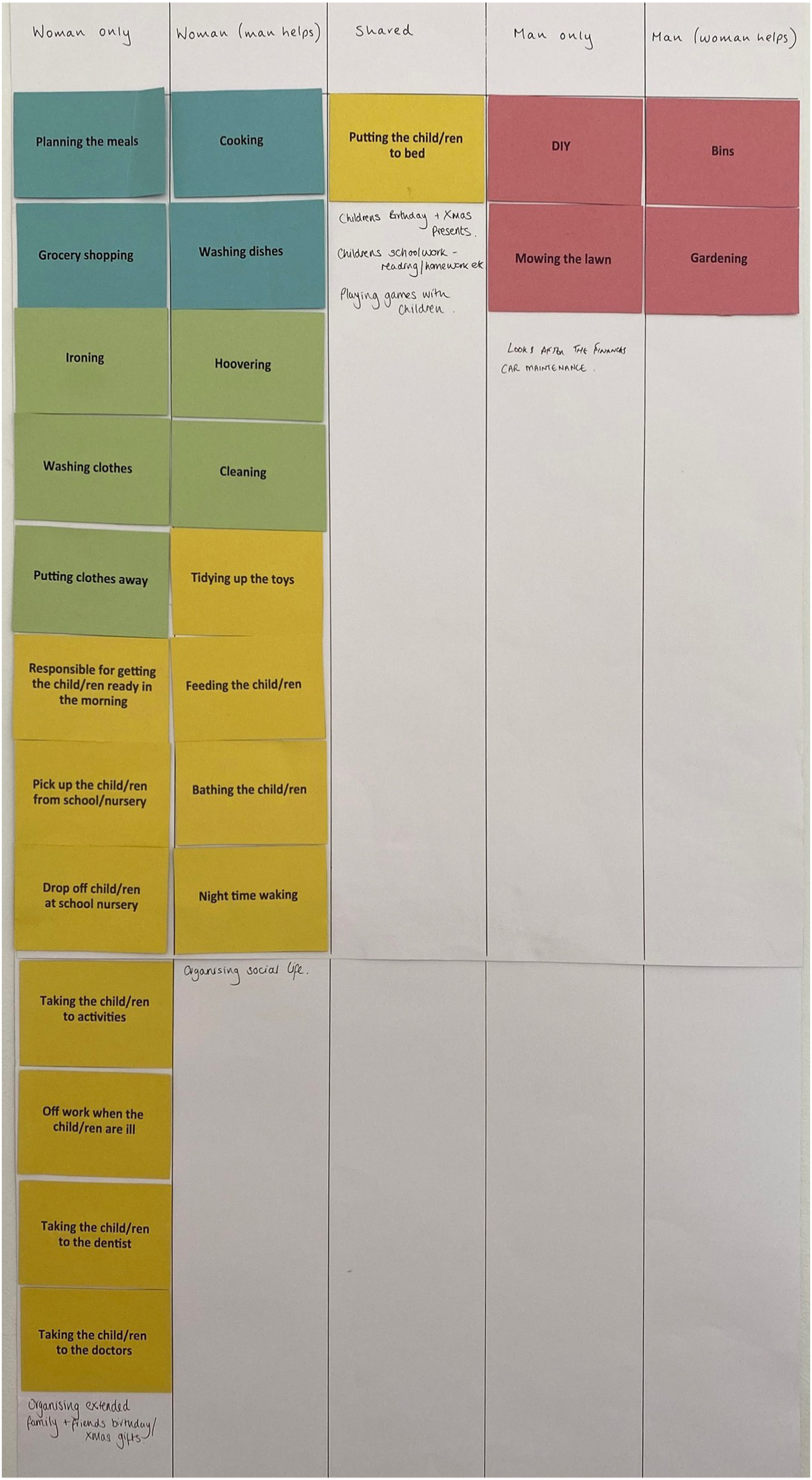
The Household Portrait technique encourages couples to discuss, agree or disagree with each other’s observations of who undertakes tasks. The portraits were analysed alongside the interview transcripts, which included the discussions between couples as they completed their household portraits. Thematic analysis (Braun & Clarke, 2006) was used to identify patterns within the data using both NVIVO computer-aided qualitative data analysis software and manual coding. This involved an in-depth examination of multiple readings of the transcripts and listening repeatedly to the audio files, paying attention to the kinds of discourses couples drew on when agreeing, disagreeing, explaining, and justifying who did which tasks and why. My analysis was informed by existing concepts, but I also approached it in a way which allowed themes and ideas to emerge from the data in line with the principles of grounded theory (Strauss & Corbin, 1998).
The themes that emerged included enjoyment of tasks, the gendering of tasks, their conceptualisation and measurement. As I explore in this article, male gatekeeping was a key theme to emerge in relation to ‘man-typed’ tasks. Another theme ‘doing gender’ was identified when couples explained divisions by drawing on gendered discourses and social norms to explain divisions, such as those pertaining to perceived ‘natural’ differences between women’s and men’s bodies, technical ability and skill. My analysis of couples’ conversations with each other and with me led to insights into the ways couples conceptualise tasks, their intractability, and how couple discussions evidenced men’s gatekeeping. These conversations can also be seen as a ‘negotiated performance’ (Twamley, 2021, p. 72) as they proved to be an opportunity for couples to ‘do gender’ in their justifications of current divisions of labor, with me as their audience. I take account of this in my interpretations of the discussion and my analysis.
Who Does ‘Man-Typed’ Tasks?
Who Does the ‘Man-Typed’ Tasks.
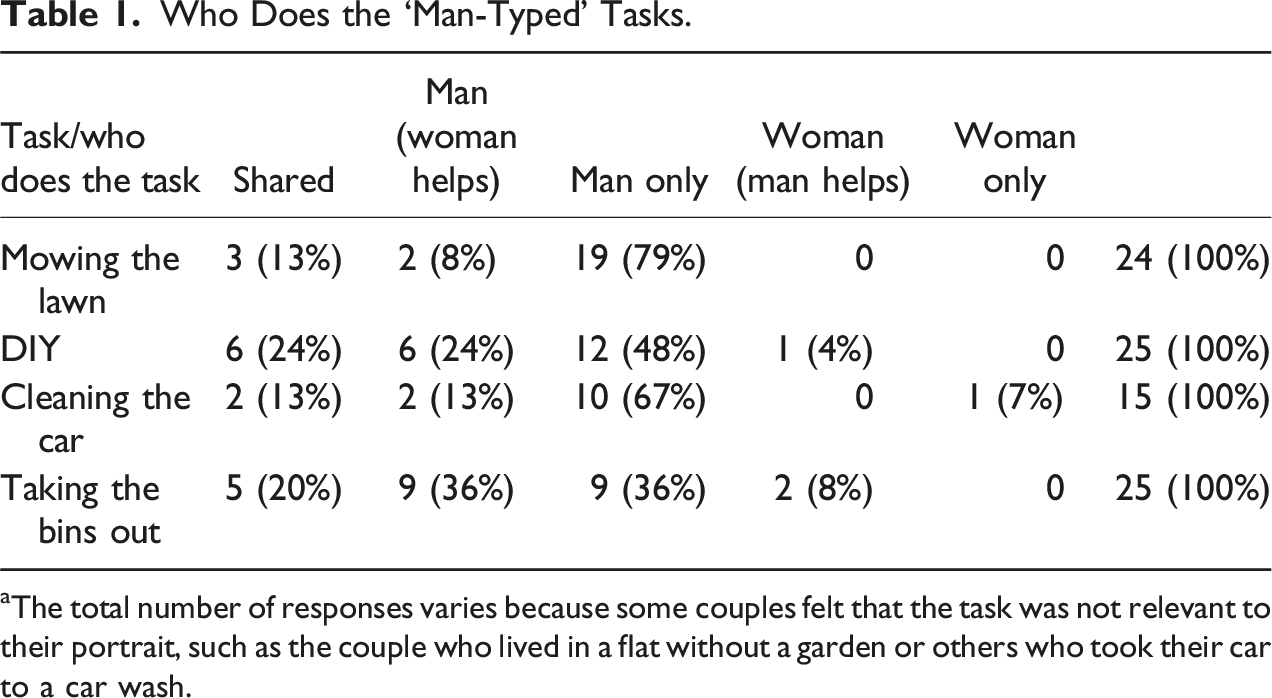
aThe total number of responses varies because some couples felt that the task was not relevant to their portrait, such as the couple who lived in a flat without a garden or others who took their car to a car wash.
Table 1 shows just how male-dominated these household tasks are. The most gendered, mowing the lawn, was described by 79% of couples as ‘man only’. Although not shown in this table, most of these tasks were much more gendered than traditionally women’s tasks. For instance, while only 20% of couples described cleaning the house as ‘woman only’, two-thirds of the couples (67%) described cleaning the car as ‘man only’.
Women’s contribution to these tasks was through ‘helping’ or ‘sharing’, with only one woman doing a ‘man-typed’ task entirely herself (cleaning the car). In their discussions, 84% of couples mentioned the woman as having a ‘helping’ or ‘sharing’ role in at least one of the ‘man-typed’ tasks, but not all gave women credit in the portrait itself. Later, I will discuss the particular ways women’s contributions are conceptualised in the conversations between the couples. The micro aspects of task accomplishment and differences in how partners assess their own and their partners’ contributions present a complex picture (Christopher, 2021).
‘It’s a Man’s Job’
The couples in my study were very explicit that certain tasks should be done by men. These tasks were characterised by both men and women as a ‘man’s job’, that is, a way of ‘doing masculinity’, with women underestimating their own contributions and competence.
Although one could say that couples’ assigning tasks by gender is partly an artefact of the methodology (which requires couples to say whether the woman or man does each task), normative expectations were much more evident with respect to traditionally ‘man-typed’ tasks than it was for traditionally defined women’s tasks. Whereas most of the couples explicitly identified at least one task as ‘a man’s job’, none of the couples identified any of the tasks in the household portrait as ‘a woman’s job’, even when women were carrying out the task most or all of the time Christopher (forthcoming). Moreover, there were far fewer disagreements between partners in their assessment of how ‘man-typed’ tasks were divided as compared to ‘woman-typed’ tasks, where couples differed, sometimes acrimoniously, in their assessment of who did what and why (Christopher, 2021). Most couples recognised the moral force of the ‘sharing couple’ (Scarborough et al., 2018) and both partners were keen to show their contributions to a wide variety of housework and childcare tasks. But ‘man-typed’ tasks were exempt, both in terms of how the couples envisioned their division of labor and the ways they characterised the tasks. This raises the question of why ‘man-typed’ tasks were exempt from expectations of equal participation.
Both partners agreed that the way they divided ‘man-typed’ tasks was ‘sexist’, in effect providing a way for men to ‘do masculinity’. Men’s gatekeeping involved men stressing tasks as their own even in couples who shared other housework and childcare. For instance, although Will and Rachel share traditionally ‘woman-typed’ tasks such as washing clothes, Will explains that it is he who mainly takes the bins out, saying ‘It’s all 50/50 but there are fundamental ‘man jobs’ in all of this’ [pointing to the portrait], and Rachel agreed. The men’s gatekeeping operated at the level of interaction, as women were complicit in these narratives. Several women accepted that certain tasks were a ‘man’s job’ despite expressing a wish to carry them out themselves. For example, Jo and Dave are discussing who mows the lawn: Dave: Mowing the lawn, that is me and always will be. Jo: I would quite like to try Me: Why would it be you, Dave? Jo: Man’s job. Dave: Yeah, and men do it better
Dave’s gatekeeping parallels early conceptualisations of maternal gatekeeping as an inhibitive practice and similarly highlights gender-specific competency: the masculinisation of competence, in this case on mowing the lawn, naturalises Dave’s role in this task.
However, discussions also revealed complexity behind the motives and direction of gatekeeping, since men’s gatekeeping took place even when the woman partner did not express an interest in wanting to carry out the task. For example, although Alexandra and Rob share tasks such as washing clothes and hoovering, when asked why they placed ‘mowing the lawn’ in the ‘man only’ column they responded, much like Dave and Jo, by highlighting the man’s greater competence: Alexandra: Sexist really, it’s a man’s job Rob (laughs): I don’t think you know how to start the lawn mower.
As I discuss later, men’s gatekeeping presented an opportunity for both partners to ‘do gender’, with women’s complicity in these narratives meaning they do not carry out tasks which might otherwise have added to their workloads. Even in the most equitable of couples, women mostly carried out housework tasks such as cleaning and were responsible for most of the cognitive labor associated with the household Christopher (forthcoming). In this context, they might have been happy not to do tasks which would default to the man without question or argument.
As well as providing opportunities to ‘do gender’, a crucial reason for men’s gatekeeping was their expressed enjoyment of these tasks, often precisely because they are men’s jobs. For instance, when discussing who washes the car, Paul said, ‘I do. It’s a guy thing, it’s almost not a chore’. Similarly, when asked why Steve mostly cleans the car, he replied ‘I don’t know. I just think of it as a man’s thing to do really. I quite enjoy it’.
As important for some was sharing this work with their sons and daughters. Three of the men involved their children, one in mowing the lawn and two in cleaning the car. For instance, James described how he enjoys mowing the lawn with his son: ‘I love it. It is relaxing. It’s also quite nice because our son has got a little push-along [toy mower] and likes following me around’.
However, usually children were not present; this was presumably connected to the task involving machinery or equipment which is potentially dangerous for children. Possibly this is one reason why these tasks were not usually connected with ‘good fathering’, so did not mirror the way certain ‘woman-defined’ tasks are associated with ‘good mothering’ (Hays, 1998). What these tasks provided instead was opportunity for uninterrupted and not so pressured time (although men did not acknowledge it as such). This points to the gendered experience of domestic time, in which women are more likely to experience time intensity, as they often carry out multiple tasks simultaneously (Sullivan, 1997). Doing these tasks afforded men time to listen to music or sport while working (Latshaw, 2015). Ben said, ‘Yeah, get my headphones on. I like cutting the lawn’. Ed said that he washes the car because he enjoys it: ‘the radio is on certainly if my team are playing away from home, I will have the local game on’. This supports other research that has found that tasks undertaken by men are experienced as relaxing, especially when combined with other symbols of leisure such as music (Szabo, 2013).
Enacting Gender
Couples’ interactions do not take place in a social vacuum. Not only did couples see certain household tasks as a man’s job, their discussions also incorporated and reproduced wider constructions of tasks which materially and symbolically identify certain elements of household labor as masculine. Such constructions include the temporal frame of ‘man-typed’ tasks, whether they are indoor or outdoor, and how dirty the work is thought to be. These constructions strengthen men’s claims to these jobs, while gatekeeping keeps gender typing in play.
Compared to ‘woman-typed’ tasks, ‘man-typed’ tasks were temporally independent. Tasks like mowing the lawn, doing DIY and cleaning the car were done mainly in the evening or on a weekend, so there was no conflict with men’s paid work. This allowed the men to ‘do gender’ by prioritising, as men, their paid work, engaging in household tasks in their time off, and, in some cases, as we shall see later, excusing them from carrying out ‘feminine’ tasks.
Symbolically, the division between ‘man-typed’ and ‘woman-typed’ tasks also mirrors the traditional masculine/public, feminine/private divide. ‘Man-typed’ tasks are spatially distinct from other housework and childcare, often taking place outside the house or bridging indoors and out, for instance, cutting tiles outside to lay a floor inside or filling the bin inside to be taken outside. This gendered spatial division between indoor and outdoor tasks also extended to the gendering of different kinds of dirt (Wolkowitz, 2002). Cleaning the house was often put in the ‘woman only’ and ‘woman man helps’ columns, and women sometimes complained that their partner did not do the cleaning properly, especially bathrooms and toilets. In contrast, although in practice some of the women helped with taking the rubbish out or bringing in the empty bins, they described putting out the bins as a ‘man’s job’ because the bins were ‘stinky’ or ‘too smelly’. Perceptions of the dirtiness of the job and its materiality (Simpson & Simpson, 2018) ascribed it a masculine meaning which saw both partners ‘doing gender’ both in their explanations and how the task was divided.
Men’s gatekeeping was further legitimated by drawing on understandings of men’s and women’s bodily differences, especially physical strength (Latshaw, 2015). What Adamson (2015) terms a ‘body-work alignment’ between gendered bodies and particular types of work ensures that tasks are related to men’s ‘embodied social identities’ (Ashcraft, 2013), naturalising men’s roles and making them appear inevitable.
In couples’ discussions, men’s gatekeeping was often directed specifically towards rejecting their partner’s participation, while also bringing these wider constructions into household negotiations. In conversation about who mows the lawn, for instance, Charlie said, ‘the mower is too heavy, and you find Helen is in the fence’. Similarly, Tim pointed out that Gemma doesn’t do the DIY because she is ‘too short’. As discussed earlier, they also highlighted their partner’s lack of embodied skills and expertise, often making fun of the women’s past efforts in a way which implies that they would not be able to learn the skills. Bodily difference also included physical adeptness, as when Kevin said to Emma: Kevin: DIY that has got to be me, that is me. I won’t let Emma do DIY. You are a bit like a bull in a china shop, aren’t you? Paint everywhere, gets a hammer and oh dear. Emma: Not up to his standard
Here, Emma confirmed Kevin’s assumed competence mirroring fathers who agree with the superiority of their wives’ ‘systems’ of childcare (Miller, 2018), evidencing the relational aspect to this gatekeeping.
Just as women have been reported to set standards of housework or childcare that exclude men, some of the men set standards that demarcate tasks as their own or prevent women from acquiring new skills, further sustaining men’s responsibility for those tasks. For instance, when it came to mowing the lawn, the men often spoke of the importance of creating stripes. Kevin said: ‘The lawn has to be cut nicely, got to have straight lines. We have got a really long garden so if I look out of the window and see wiggly lines it just stresses me out’.
The men’s motives for gatekeeping certain roles may be that, like the women’s attitudes to other areas of domestic labor and childcare, it was important to them that these ‘man-typed’ tasks were done ‘properly’. The tasks’ affinity with understandings of masculinity (outdoor, dirty and physical) and men’s physical bodies (strong, competent) meant that men felt accountable for the job being done well and they did not think that the women had the necessary strength or skills. The men could also be seen to gatekeep to ensure their continuing dominance in tasks which freed them from carrying out other more temporally dependent tasks which they didn’t want to do. For example, Steve and Alison discussed how neither of them likes taking their children to birthday parties, yet that card is placed in the ‘woman only’ column. Steve explained, ‘I will be doing the DIY usually when you [Alison] are doing that’. The persistence of men’s responsibility for these tasks is important as it suggests it may be impeding change in other areas of domestic work.
Gendered Interactions
Within the parameters of the gendered constructions identified above, there is still room for negotiation between couples. We have already seen hints that women usually confirm their partner’s prerogative, giving way to assumptions that he is inevitably more competent. Here, I want to look further at how couples talk to each other about ‘man-typed’ tasks, showing that, while women usually confirm men’s right to monopolise ‘man-typed’ tasks, couples make subtle distinctions to ensure that both men and women can ‘do gender’ successfully.
Men’s gatekeeping was usually naturalised by their partners, with women accepting descriptions of their own incompetence. For instance, when Steve said of his partner, ‘She is not very good with tools and machinery’, Alison agreed, saying ‘I am not good at things like that’. Further, the women referred to rubbish bins being ‘too heavy’ for them to carry. Annabel said to Peter ‘Well, no, you take the big heavy ones out because you are physically stronger’. The depiction of the physical aspects of these tasks and the strength needed to do them was a way for both partners to ‘do gender’, since having superior strength is associated with ‘masculinity’ rather than ‘femininity’ (Pope et al., 2022). This is not to say that the bins were not heavy but rather that, as discussed earlier, faced with the demands of their other household work, women may be happy to not participate in chores which men are willing to do. Both men and women drew on readily accessible cultural narratives of the gendered embodiment of ‘masculine work’, albeit for different reasons. Naturalising the division of labor as a question of bodily strength meant there was little conflict or disagreement over who carried out this work.
In fact, women participants seemed eager to minimise their contributions to ‘man-typed’ household tasks. As we saw in Table 1, in compiling their household portrait some couples recorded that the ‘man-typed’ tasks were not done only by men: nearly a quarter of the couples assigned DIY to the ‘shared’ column and some women occasionally did one or more of the other ‘man-typed’ tasks. However, even this may under-count women’s actual contribution. As noted above, in their conversations more than eighty percent of the couples mentioned that at least one of the tasks was shared or the woman helped, but this was not necessarily acknowledged in the portraits.
In analysing the transcripts of the couples’ discussions, one can see that often they placed a card in a column only after a more or less extended discussion that revealed the woman’s contribution to a task. The normative expectations which see men as responsible for DIY meant that, as part of ‘doing’ gender, the women often denied or misrecognised their own contribution, since their participation in these tasks does not conform to gendered expectations. For instance, several women almost automatically declared DIY to be a ‘man’s job’ but were then corrected by their partner. For example, Angela and Ed debated who does the DIY: Angela: That’s you, I don’t do any Ed: Rubbish Angela: No, I do the painting don’t I? I paint the house so do we go down the shared route?
A few of the women downplayed their contribution as a protective narrative, since taking credit would imply criticism of their partner for not fulfilling a traditional ‘masculine role’ or ‘doing gender’ properly (Deutsch & Gaunt, 2020; Jurczyk et al., 2019), especially if it involved fixing things or construction. For instance, Mark started by placing the DIY card in the ‘woman man helps’ column, saying that: Mark: We don’t really do it and Lucy doesn’t trust me so…
However, Lucy then insisted that the DIY task is ‘shared’, rather than Mark merely helping, by pointing to the shared column in their portrait. She went on to mention sharing the work in the past: Lucy: But things like, so we had to do the thing round the bath and we did that together.
Their discussion continued: Mark: Lucy is really practical. I can’t wear the tool belt in this relationship because you have a better sense of organising things and I can be a bit…I rush it a bit whereas you do it more methodically. Lucy: When we used to get stuff from IKEA, I would put it together but only because you were busy working
Here, Mark recognises the masculine associations of DIY when he refers to himself as not wearing ‘the tool belt in their relationship’. Lucy’s response, explaining that Mark had been unable to do DIY in the past because of his paid work, emphasises his masculine provider role. Lucy’s attempt to protect Mark’s masculine status by insisting that their DIY was shared was quite different from how they discussed how they divided up ‘woman-typed’ tasks. In the latter case, Lucy was reluctant to see these as ‘shared’ equally, even though Mark probably did more of the cooking, for instance, than he did DIY.
In fact, there was only one case in which a woman readily claimed to solely do a ‘man-typed’ task, and she was immediately knocked back by her partner, who was embarrassed by their reversal of roles. Eleanor and Joe discussed who does the DIY: Eleanor: I am probably better at DIY Joe: I think it’s woman man helps…let’s not rub it in.
More usually the couples made subtle ‘micro’ distinctions within these ‘man-typed’ tasks that qualified the meaning of women’s contribution, especially regarding DIY. Even though we see men like Ed or Mark, above, initiating acknowledgment of their partners’ participation in DIY, for most this was limited to women painting rooms in the house. This component of the DIY task could be considered ‘feminine’, linked to interior décor, meaning women’s participation in DIY could be more easily squared with the men’s understanding of DIY as masculine. Indeed, of the five couples who described the woman as doing painting and the man being responsible for other DIY tasks, such as repairs or construction, only two saw ‘DIY’ as ‘shared’, with the other three seeing it as ‘man woman helps’. This demonstrates couples’ not only ‘doing gender’ through task divisions but also actively ‘doing gender’ during the interview through how they characterise micro aspects of task accomplishment and report who does what and why, since room painting is less rigidly gendered than other DIY tasks.
In other cases, couples made a distinction between who instigated the work and who actually did it. In these cases, women were considered to ‘share’ or have a ‘helping’ role in DIY because they instigated the work to be done by their partner and/or were responsible for making sure that their partner completed the work. This supports findings from Daminger (2019), who found that women are more likely than men to carry out the ‘cognitive components’ of ‘anticipating’ and ‘monitoring’, especially in home maintenance; for instance, women identified that the house needed ‘winterizing’ and then both partners assumed that the man would do the associated task of cleaning out leaves from the gutter.
In my study, if the men didn’t themselves carry out home repairs, they were quick to tell me that they were the ones who usually arranged for the work to be done by someone else. In these instances, they were still ‘doing gender’ as this involved ‘getting a man in’ or organising one of their fathers to do the work, whom they perceived to have superior skill. Men organising outside help also lends support to the gendered dimensions of cognitive labor since the men carried out the work of ‘deciding’ what needed doing (Daminger, 2019) when related to ‘man-typed’ tasks but were less likely to carry out this element of cognitive work when it related to childcare arrangements or when organising birthday and Christmas presents.
Finally, it appears that while women often complained about men’s reluctance to take on as much of the traditionally defined women’s work as they would have liked (Christopher, 2021), they rarely complained that ‘man-typed’ work was not more evenly shared. It seemed as though these tasks were seen to be outside the construct of the sharing couple. The naturalisation of the ‘masculine’ meanings of these tasks, and the opportunity these divisions provided for both partners to ‘do gender’, meant that men’s greater involvement was normally unquestioned but, as discussed in this article, was articulated within the interview setting. It might also be because some of the men carried out ‘woman-typed’ tasks, such as cooking and childcare, so the division of labor was seen as fair (Baxter, 2000).
The only time women did admit dissatisfaction was when men’s doing ‘masculine tasks’ burdened them with other, time-pressured housework. Telling Chris what she does while he is doing DIY at the weekend, Sandra said: ‘Nobody ever thinks about what we are having for dinner other than me, and I find that disheartening. So, it’s not looking after the children that bothers me at the weekends, it’s not that. It’s the grind of knowing that I have to go and get something for our dinner, or I have to peel the potatoes and I have to load the dishwasher for the second time that day, and I have to get the washing on and all that daily grind that I find tedious, and I think, God I wish I was on a ladder painting outside’.
This suggests that while women may know that men’s monopolisation of ‘man-typed’ tasks has repercussions for their overall division of labor, they are fatalistic about who does the DIY. While Sandra expresses a wish to do the painting, the tone of her remarks implies that she knows that this is unlikely to happen.
Discussion and Conclusions
This research shows that ‘doing gender’ continues to be an important aspect of family dynamics for heterosexual, working parent British couples. When it comes to traditionally ‘man-typed’ tasks, couples ‘do gender’ in assigning tasks, justifying their assignments and discussing their household division of labor with each other. Male gatekeeping is not only an individual strategy within couples but a social mechanism which reproduces particular constructs of masculinity and femininity within households. To challenge the gendered division of household tasks, we must therefore examine the micro aspects of change-resistant task divisions to understand how gender, as a social construction, is produced in social settings and sustained through interactional and relational processes.
The primary aim of this article has been to examine why ‘man-typed’ task divisions are so resistant to change, and whether men’s responsibility for them is consequential for wider gendered domestic divisions. In accordance with previous research (Daminger, 2020; Deutsch & Gaunt, 2020), this study found couples acknowledging the moral force of the sharing couple and advocating, at least in intention, a more equal sharing of housework and childcare tasks. But significantly, most located the responsibility for ‘man-typed’ tasks outside the boundaries of this implicit egalitarian moral code, with both men and women openly displaying preferences for differentiated roles where ‘man-typed’ tasks were concerned. Furthering our understanding of these tasks’ relationship with doing masculinity (Doucet & Merla, 2007; Gelber, 1997; Gorman- Murray, 2008; Kroska, 2003; Latshaw, 2015; Medved, 2016), I show the intractability of the ‘masculine’ meanings of these tasks, especially the recourse to perceived differences between men’s and women’s bodies.
I argue that the stability of these task divisions lies in the difficulties in re-signifying their meanings and the opportunities they provide for partners to ‘do gender’ in the context of gendered normative expectations. These meanings are reproduced at the level of interaction, when partners mutually construct these tasks as masculine. This suggests that gatekeeping is most effective in interaction, when partners collaborate in maintaining gendered divisions of labor. In this study, I see this happening in four distinct ways:
First, I have demonstrated that gatekeeping is not something only women do (Miller, 2018; Sweeney et al., 2017). Men set standards too, redo tasks and narrate normative, gendered understandings of women’s and men’s physical strength and men’s superior skill in handling machinery and tools which allows them to claim tasks as their own. Second, I demonstrate that men’s gatekeeping operates at the level of interaction. In this case, the interdependence of men’s gatekeeping and women’s support for men’s narratives of women’s ineptitude provides opportunities for both partners to ‘do gender’ through understanding and maintaining household task divisions (West & Zimmerman, 1987). Third, by paying closer attention to the relational negotiation of these tasks (Twamley et al., 2021), we can better recognise that successful gatekeeping needs to be seen in the context of both partners’ understandings of ‘doing gender’, rather than operating in a unidimensional fashion (Hauser, 2012; Sano et al., 2008; Walker & McGraw, 2000). Finally, gatekeeping operates in ways not necessarily reliant on one partner actively wanting to carry out a task and being prevented from doing so.
Men have much to gain by gatekeeping ‘man-typed’ tasks, as these are temporally unpressured, pose little interference with paid work and are treated as leisure (Szabo, 2013). On the other hand, women’s claims of incompetence, in response to men’s gatekeeping of ‘man-typed’ tasks, generate little advantage beyond having one less task to carry out, but this may be significant if their men partners do little else around the house. Further, it reinforces their own femininity, providing a way for them to ‘do gender’ too.
By masculinising these tasks, men are presented as the only ones able to do them (or to do them ‘well’), which can excuse them from the more temporally demanding tasks which women are likely to be carrying out. A limitation of the study is that I did not directly ask participants what the women were doing while these ‘man-typed’ tasks were undertaken, but when participants did volunteer this information, it pointed to women undertaking a considerable list of housework tasks alongside childcare and men using these task divisions to avoid chores which they did not enjoy; this added to women’s domestic workload. This highlights the importance of examining what both partners are doing when tasks are being carried out (Vagni, 2019). Future research could garner information on what men’s partners do while men are engaged in this work, and how responsibility for ‘masculine’ tasks may or may not excuse men from doing other chores within the home.
Finally, I find support for ‘doing gender’ in the reporting of how tasks are divided even when people transgress gender norms (West & Zimmerman, 1987). My women participants ‘do gender’ by misrecognising their own contribution to ‘man-typed’ tasks, not anticipating being judged based on their participation. These findings suggest that as researchers, we might too readily assume these tasks to be done by men, especially if methods do not provide an opportunity to challenge individuals’ claims. Mistakenly accepting at face value the claim that men do all these tasks all the time may risk reinforcing a gendered discourse. To build on this study, future research might consider closer inspection of how the micro aspects of ‘man-typed’ tasks including the cognitive work involved may be shared.
Footnotes
Acknowledgments
I wish to thank the participants who agreed to be interviewed as part of this study, and also the anonymous reviewers for their helpful comments on my work. I also wish to express my thanks and gratitude to Nickie Charles and Carol Wolkowitz for their invaluable comments on this paper.
Declaration of conflicting interests
The author(s) declared no potential conflicts of interest with respect to the research, authorship, and/or publication of this article.
Funding
The author(s) received no financial support for the research, authorship, and/or publication of this article.
