




Abstract
Female breadwinning has recently gained in significance in Germany. This article examines the extent to which female breadwinning is linked to new gender roles, and the impacts the role reversal may have on families’ everyday lives. Qualitative interviews with female breadwinners living in Western Germany were conducted to explore families’ ways of doing gender and doing family as an interrelated process. The research examined, first, the female-breadwinner families’ division of employment and domestic labor and second, the relationship between individual gender self-concepts and factual income arrangements. Some examples of modernization of gender roles and arrangements in everyday life in female-breadwinner families were found, but traditional gender concepts and practices prevailed. The families achieved doing family results comparable to couples with other breadwinning arrangements, but this demanded extraordinary efforts. We reconstructed “practices of normalization,” which couples used to reassure themselves and others of their “normalness” despite their gender-atypical roles.
Introduction
Since the 1970s, globalization and technical developments have shifted countries’ economic focus from the production of material goods to the production of services and knowledge. As a result, employment has become more intense, flexible in time and space, nonstandard and precarious. As families have become increasingly dependent on the incomes of both parents, the presence of the mother as the continuous provider of private care cannot be taken for granted, and traditional gender roles are challenged. Moreover, these dynamics have contributed to blurring the boundaries between once distinctive areas—private life and employment; traditional families and male-oriented labor markets (Jurczyk, Schier, Szymenderski, Lange, & Voss, 2009). In Western Germany, a strong male-breadwinner model represented the norm and normality for decades, anchored in the gender pay gap; inadequate child care provision; and in the tax and social security systems, which favor families with one stay-at-home parent (Pfau-Effinger, 2001; Possinger, 2013). This single-earner model has been supported by a largely moderate conservative–familialistic welfare regime, which has recently acquired some elements of modernization, as outlined in more detail below. However, cultural ideals still favor traditional gender roles. It is therefore timely to investigate what the increasingly common phenomenon of female breadwinning means for gender roles and the family.
Focusing in this article on heterosexual-partner families, rather than the breadwinning of lone mothers, allows us to understand the extent to which male and female gender roles in the family are affected. Although it has been demonstrated that parenthood is a key process in adopting or maintaining gender–traditional behavior (Chesley, 2017; Huinink & Reichart, 2008) research on female breadwinners has so far neglected the manner in which gender roles are performed in these families. Taking the mothers’ perspective, our analysis examines what it means for daily family life when the traditional gendered work–family pattern is eroded. We investigate how mothers and fathers divide housework and the extent to which sole or primary female breadwinning result in, or go hand in hand with, new gender roles and perceptions, rather than mere practical gender arrangements. In this context, we also briefly address the significance of money for the distribution of power within a couple. Our research findings point to a heterogeneity of female-breadwinner families: some examples of modernization in gender self-concepts 1 by the mothers and fathers could be identified. However, traditional gender concepts and practices prevailed. The study offers new insights into practices of doing family in everyday life, not least in families’ efforts to employ “practices of normalization.” They could thus reassure themselves and others of their “normalness” despite the parents’ gender-atypical roles.
The German Socioeconomic Context and the Phenomenon of Female Breadwinning
In Germany and elsewhere in Europe, women are now outperforming men in educational achievements. For example, women obtain university entry qualifications more often and complete tertiary education more successfully than do men (Authoring Group, 2016, Klesment & Van Bavel, 2015). Despite these attainments, women still participate less than men in the labor market, 2 are less represented in senior management positions, 3 and are affected by a relatively large gender pay gap. 4 Such phenomena have primarily been explained with the ongoing traditional division of domestic labor, gendered labor markets, and gendered patterns of time use (Oláh, Richter, & Kotowska, 2014). At the cultural level of attitudes toward gender roles, new and contradictory developments are observable. On the one hand, underlying hegemonic norms of gender roles are reflected in the fact that couples continue to practice an unequal division of child care and housework. On the other hand, more egalitarian ideals, which have recently been promoted in political and public discourses and at the levels of family policy and welfare provisions, have become more attractive to many (or even most) couples. 5 Traditional patterns are becoming fluid and subject to negotiations (Gerhard, Knijn, & Weckwert, 2003; Jurczyk et al., 2009), while gender perceptions as well as practices reveal ambivalences. For example, better-qualified women often aim for more equal opportunities in their employment, but also retain traditional elements in their self-concepts of motherhood in the context of wider cultural ideals. Mothers sometimes act as “gatekeepers” to caretaking duties for their male partners, while simultaneously asking them to share care work (Schoppe-Sullivan, Brown, Cannon, Mangelsdorf, & Sokolowski, 2008). Despite women’s educational gains, in Western Germany (unlike in the East of the country) women are still regarded as bearing the main responsibility for care work. Debates are ongoing about the extent to which mothers’ employment may have detrimental effects on small children (younger than age 3). Over recent years, federal, Länder, and community agencies have begun the process of developing the quality of child care provisions, emphasizing in particular an educational component of child care. Nonetheless, such institutions are still often perceived as providing little more than a roof over children’s heads, serving to promote women’s employment and thus the national economy (Schneider, Diabaté, & Ruckdeschel, 2015). Deeply anchored individual and societal gender and parenthood concepts posit a link between a “real” woman’s life and motherhood. This relationship is inverted for men, who appreciate equal gender relations and express the wish to spend more time with their children, but struggle to fulfil the roles and behavior associated with traditional men beyond the breadwinner role. The desire for more gender equality is juxtaposed with the idea that caring for others is women’s work, both at home and in employment.
Ambivalences and ambiguities of gender concepts have been influenced by contradictory political measures in Germany since reunification of East and West. For example, on the one hand, the tax system provides negative incentives for women’s labor market participation. On the other hand, access to child care facilities has been steadily expanded in Western Germany, especially over the past decade (Bundesministeriums für Familie, Senioren, Frauen und Jugend [BMFSFJ], 2015), but a gap between provisions and parents’ child care needs has remained 6 and formal child care is often seen as difficult to afford (Jentsch & Schier, 2019). The socioeconomic context of our study can thus be conceptualized as “patriarchal modernization” (Jurczyk, 2001): a contradictory mixture of traditional and modern elements of gender concepts, regimes, and practices, which do not invalidate the hegemonic gender hierarchy in family and work life.
Against this background, the phenomenon of female breadwinning—where the woman is the family’s sole or dominant earner (Chesley, 2017)—has gained in significance over recent years in Germany (as well as in Europe in general; Klenner & Klammer 2009; Klesment & Van Bavel, 2015; Wang, Parker, & Tylor, 2013). The proportion of couples with underage children with a female breadwinner in Germany has increased from 10% in 2003 (Destatis, 2015) to 12.2% in 2016. 7
The proportion of female-breadwinner couples with children is much higher in Eastern Germany (23.9%) than in Western Germany (9.6%) 8 —a fact, which has partly been attributed to historically higher levels of female employment coupled with higher male unemployment rates since reunification in the East (Klammer, Neukirch, & Weßler-Poßberg, 2012). The proportion of breadwinning mothers rises with the age of the youngest child in the household (Klesment & Van Bavel, 2015). Higher qualifications increase the probability of female breadwinning, although a considerable proportion of female breadwinners have mid-level professional qualifications (Klammer et al., 2012). Most female breadwinners residing in a two-adult household, are between 30 and 50 years of age, and thus in the “classic” family phase (Klammer et al., 2012). Concerning employment patterns of this group, the constellation of a female full-time and male part-time worker is dominant in female-breadwinner households in Western Germany, whereas it has been and still is more common in Eastern Germany for both partners to work full-time. As opposed to the situation in Eastern Germany, male unemployment is rarely the reason for a female breadwinner role in the West (Klammer et al., 2012). Given the gender pay gap referred to above, it is not surprising that female breadwinners—and here especially single parents—receive a markedly lower income than their male counterparts (Klammer et al., 2012), so that these families are often financially disadvantaged. This may in part explain why female breadwinning tends to be merely a transitory arrangement (Drago, Black, & Wooden, 2005; Winkler et al., 2005).
Pathways Into and Effects of Female Breadwinning
The literature has outlined two main pathways into female breadwinning: first, educational assertive mating and second, men’s increasingly precarious labor market position. Concerning the former, Klesment and Van Bavel (2015) established that in Europe, women’s higher educational attainments have increased the probability of female breadwinning through changing patterns of educational assortative mating, from women “marrying up” (hypergamy) to women “marrying down” (hypogamy). German statistics indicate that in the group of couples with female breadwinners, marrying down is widespread and three times more common than in the group of couples with male breadwinners (Destatis, 2015). Second, the rise of female breadwinning is seen as a result of rising unemployment rates, poor labor market positions and lower earnings for (low-skilled) men alongside the professional head start of highly qualified women (Drago et al., 2005, Klammer et al., 2012).
Concerning the impact of earnings reversals within families, Brennan, Barnett, and Gareis (2001) found that for traditionally oriented men, having wives who earn higher salaries undermine the husband’s perception of their role as primary providers, and is likely to result in perceptions of a low marital role quality. Similarly, Rogers and DeBoer (2001, p. 458) established that “married men’s well-being is significantly lower when married women’s proportional contributions to the total family income are increased.” Their self-identity remains to be intertwined with earning the family wage (Medved, 2009). By contrast, women were shown to often experience higher marital happiness when their income increases in absolute and relative terms. Full-time employed women in dual earner couples also experienced high marital role quality when their partners played a greater role in child care (Brennan et al., 2001; Kanji & Schober, 2014; Rogers & DeBoer, 2001). Nonetheless, most women’s identities tend to be rooted in mothering, and evidence shows that only in a few cases is female breadwinning motivated by ideals of gender equity and the majority driven by economic circumstances (Drago et al., 2005; Medved, 2009).
Regarding the role of financial resources in female-breadwinner families, it has been found that, especially in families with relatively few resources, women manage the finances without significant financial rewards and often experience challenges with making ends meet (Tichenor, 1999; Yodanis & Lauer, 2007). Moreover, gendered rules for behavior prevent female breadwinners from taking advantage of their privileged access to resources. Although a combination of increased economic power and less time available for housework leads to a reduction in the time women spend on housework (Baxter, Hewitt, & Western, 2005), this reduction of the share of domestic tasks is only marginal (Wieber & Holst, 2015). It is also noteworthy that men tend to contribute less to domestic tasks than their female partners, even if the latter are the breadwinners (Organisation for Economic Co-operation and Development, 2016
Studies that focus on the consequences of female breadwinning for families’ everyday lives are rare, but an example comprises Chesley’s (2011) research on stay-at-home fathers and breadwinning mothers. It shows that this earning and care arrangement reduces gender differences in parenting as well as inequities that stem from a traditionally gendered division of work/family responsibilities. Hence, despite the existence of a limited number of diverse studies about female breadwinners, there are significant gaps, for example, in the microsociological knowledge on the practices of how female breadwinning within families is addressed. How is it performed by mothers and fathers in everyday life? What are the consequences for their doing family? Furthermore, we lack knowledge on the implications of female breadwinning for gender self-concepts and gender arrangements contesting hegemonic gender roles.
“Doing Family” and “Doing Gender” as Conceptual Frameworks
The concept of doing family refers to the constructivist concept of doing gender that preceded it. With their assumption that gender is a social category and has to be permanently constructed, West and Zimmerman (1987) propelled gender studies toward agency orientation instead of arguing along structure and nature. They suggest an investigation of those social processes in which gender is used as a category for differentiation (Gildemeister, 2004). 9 The question is therefore not whether there are gender differences and of what kind, but what processes of constructing gender look like (Wetterer, 2004). The concept of doing family is related to this approach and highlights that family is neither a sharply defined societal institution nor a given natural resource to individuals and society. It is instead the result of a permanent process of doing family relations within daily life and over the course of one’s life: one does not simply have a family, one has to do it (Jurczyk, 2014). Family is a permanently executed practice centered on care obligations. The doing family approach on which this study draws is rooted in the concept of “the conduct of everyday life” (Jurczyk, Voß, & Weihrich, 2016): the interpersonal intertwining of life conducts in the material, spatial, temporal, emotional, and social field.
According to Jurczyk (2018), the effort to produce family in the context of and through familial life involves first, all those organizational activities, which can be associated with “balance management”: the practices of intertwining the lives of family members through coordinating and synchronizing individuals’ lives in order to become family life; as well as distributing rights and delegating duties. Second, at the level of identity, there is the symbolic construction of togetherness, which can be divided into three categories. First, the creation of social ties through processes of creating family “boundaries,” that is, by including and excluding individuals in/from the group that is defined as family. Second, the construction of intimacy and a sense of belonging through the production of a sense of “we-ness.” Third, displaying family, or performing and acting out family through practices of outward staging and inward processes of reasserting the condition of belonging together.
Several practices of doing gender while doing family (and vice versa) have been identified and conceptualized through terms such as the “economy of gratitude” (Hochschild & Machung, 1989) 10 or “maternal gatekeeping” (Schoppe-Sullivan et al., 2008). Our study aims at examining the connections between the two processes of doing gender and doing family in greater detail by analyzing labor division practices in paid and familial work as well as the relationship between self-concepts and factual income arrangements.
Empirical Background
In order to explore the research questions outlined above, a qualitative method was selected to capture individual actions, individual perceptions and interpretations of social realities in depth. Seventeen female-breadwinner mothers were surveyed in the period between 2013 and 2015, using problem-centered interviews (Witzel & Reiter, 2012). The sample was recruited in Western Germany on the basis of criterion sampling (Patton, 2015) to select heterosexual mothers who lived in a household with at least one underage child and a partner, and who earned more than their partner. 11 Additional factors included a variance in income levels, in the constellations of the partners’ earning and working patterns, as well as in the age and number of children.
The mothers interviewed were on average 42 years and their partners 45 years old. Indeed, 16 women and 13 of the women’s partners had an academic qualification. 12 Only one partner had a higher academic qualification than the female breadwinner. All of the couples but one were married. The families encompassed one to three children. In five of the families, the youngest child was older than 10 years of age. Twelve of the families comprised children all of whom were 10 years of age or younger. Seven families had children below school age. All mothers interviewed earned more than their partners, with varying contributions made to the household income, as can be seen in Table 1.
Women’s Varying Contributions to the Household Income.

In 9 of the 17 families, the declared net monthly household income was below the average net household income for couples with children younger than age 18 in Western Germany. 13
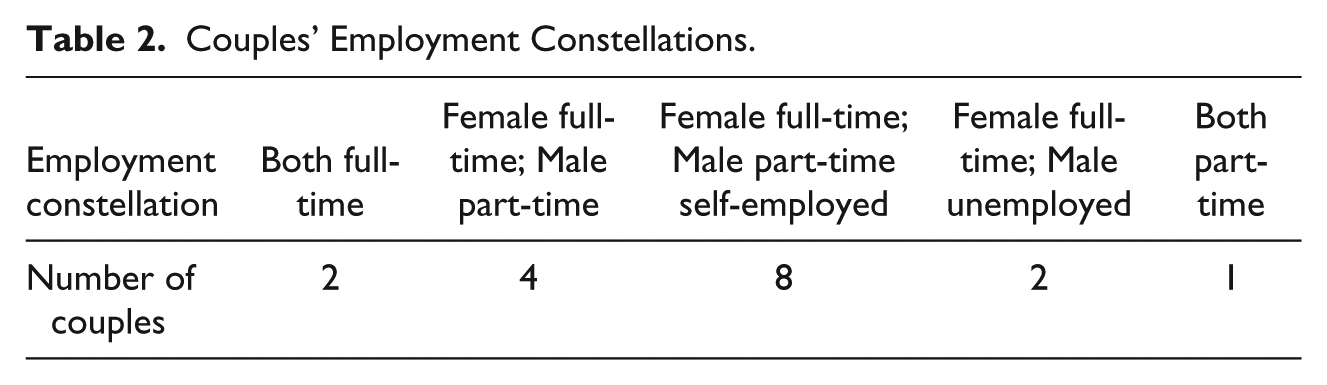
In all cases, but one was the mother in full-time employment, as can be seen in Table 2.
Couples’ Employment Constellations.
The vast majority of the women worked in occupations with a focus on care and education for families, the elderly and children (health care, social work, child care, and teaching). Four women held management positions, two of them in the social sector. The interviews lasted between 1½ to 3 hours, followed a semistructured interview guide and a short demographic questionnaire, were recorded digitally and transcribed. They were analyzed following Kluge’s (2000) process of classification following: the material was first thematically structured whereby the two relevant comparative dimensions emerged, which are the focus of this article (labor division practices, the relationship between self-concepts, and factual income arrangements). The cases were then grouped along those dimensions and analyzed in accordance with their empirical regularities. As in all qualitative research, our findings are not generalizable in a probabilistic way, but they are likely to provide an explanatory theory for the everyday lives of and dynamics in female-breadwinner families in comparable situations to those of our interviewees.
Results: Doing Gender and Doing Family in Female-Breadwinner Families
The presentation of our findings in this section relates first, to the division of employment and domestic labor and second, to the relationship between subjective gender concepts and factual income arrangements.
Labor Division Practices in Paid and Familial Work
Since in most cases in our sample, the mothers worked longer hours in employment than their partner (see Table 2), this could have facilitated the negotiation of deep-seated traditional arrangements at home. Five division-of-labor arrangements could be identified in the data of the interviews with the female breadwinners: an equal, a balanced, and three unequal types of arrangements.
The equal arrangement, 14 in which both partners were described as dedicating the same amount of time to paid and domestic work, is represented only by the Uffinger 15 family. In this one case, both partners had explicitly declared their willingness to live according to an egalitarian arrangement. Not only was Mr. Uffinger prepared to take on responsibilities at home, but Ms. Uffinger was also prepared to abdicate these responsibilities, thus refraining from any form of maternal gatekeeping.
So, as I said, even when I’m on a night shift we get home an hour early and I do the handover, I have a shower and have something to eat and then set off. And the children then have something to eat here with Johannes and entertain themselves with Johannes, it is, I think, structured something like this. I don’t know exactly, but he always kind of does his thing with the children.
Ms. Uffinger had, furthermore, accepted that her partner employed a person as a market substitute for his share of household labor. It is clear that confrontational negotiations form the backdrop to the arrangement.
We argued so much ( . . . ) that [was] almost the end of our relationship for a while, that I was really so cross with him because I worked so much and he did none, or very few, of the household chores. ( . . . ) That was an enormous problem ( . . . ) it was an absolute catastrophe, so a cleaning lady comes in every 2 weeks. ( . . . ) Johannes pays for it ( . . . ) she has been coming in for 3 years now ( . . . ) and every 2 weeks she comes over and does Johannes’s part.
The regular interaction between the couple—the frequent arguments—could have resulted in a transformative process: the husband’s agreement to pay a cleaner after numerous arguments resulted in an equal arrangement (Sullivan, 2004).
In the second, balanced, arrangements couples with a stay-at-home father seemed to have tacitly agreed on the arrangement that the female’s hours in paid work were “balanced” by the male’s increased share of child care and chores. The female breadwinner themselves evoked the concept of “balanced” in this context, and stressed the fact that their paid employment would not be possible to the same extent if their partner did not complete the bulk of the domestic work.
The first of the three unequal arrangements comprised cases where women spent longer hours than their partner in paid work, but they still shouldered roughly the same amount of housework as him. In the second unequal arrangement, both parents spent an equal amount of time in paid work, with the woman being responsible for most of the organization of everyday family life and more of the domestic work. Despite this inequality, this arrangement was perceived as balanced by the women. Both these cases therefore represent a single domain inequality—mothers spend more time either in the labor market or at domestic tasks.
The third unequal arrangement consists of a double-domain inequality: women performing the bulk of the work in the labor market as well as at home. This double inequality could lead to conflict in the couple’s relationship, but generally tended to be tolerated by the women interviewed, for example, by Ms. Wieser. She described the disproportionate amount of domestic work she performed as a price she had to pay in order “to be allowed” to engage in paid employment, while in return her husband looked after the children in her absence. In fact, in several cases, the mothers interpreted inequalities as compensation for the ability to pursue paid employment and to deviate from the gender norm. Here, the adherence to traditional gender roles may explain the fact that the women assume primary responsibility in the domestic sphere although they spend more hours in paid work. This is in accord with Bittman, England, Folbre, Sayer, and Matheson’s (2003) conclusion: “couples that deviate from the normative income standard (men make more money than women) seem to compensate with a more traditional division of household work” (p. 186). Perceptions of appropriate “gender display” are then being prioritized over the “logic of resource exchange” (Tichenor, 2005, p. 193).
Women’s juggling of full-time professional lives with their perceived and actual comprehensive family responsibilities resulted in enormous strain for them—similar to Chesley’s (2017) findings of female breadwinners reporting enhanced stress and pressure. For example, Ms. Leusing cared for her dependent mother, as well as for her two children with learning difficulties, who required regular therapy sessions and daily practice in school subjects. Aspects of her exhausting role were explained as in this example: ( . . . ) then the wicked mum comes home and says, “TV off, now it is time to do some work. And now we are going to sit down,” and although mum is dead tired herself and really can’t be bothered, even less than the children, she has to make sure that ( . . . ) they do their sums or their reading.
Not surprisingly, Ms. Leusing had been diagnosed with burnout syndrome some months before the interview. This example illustrates that there are, of course, factors beyond gender self-concepts, which may affect women’s perception of their role as breadwinners—notably the high level of effort required, often with a relatively low household income in return (Klammer et al., 2012). Moreover, it is also possible that such factors influenced women’s gender self-concepts, so that women less satisfied with their role and achievements in employment were less likely to accept, let alone enjoy, their new gender role.
It is noteworthy that in all employment constellations, the women interviewed reported that they tended to perform the majority of organizational balance management tasks (i.e., familial coordinating and synchronizing—the first level of doing family) despite the relatively long time spent in employment. Although our interviewees often referred to their exhaustion due to the demands on them in the private and public domains, they also emphasized their priority of spending time with their family. Especially in the evenings, at weekends and during holidays, they carved out time to engage in family activities, perhaps also to reassure themselves and others that they belonged together and that their family did not differ from others.
Once a week we go to the library, that’s another one of those rituals ( . . . ), let’s just say that it is also important to me ( . . . ) going to Sunday school ( . . . ) or to mass, that is what we do on a Sunday morning at the weekend, the ritual. ( . . . ) In the summer we’ll want to go to the lake again ( . . . ) and then out to supper. Then we read to them ( . . . ). We have been reading for years, we are already on Volume 7 of Harry Potter because they love him so much. ( . . . ) so my husband always reads Harry Potter to them for about 20 minutes and then I take them to bed. (Ms. Leusing)
Similar to Ms. Leusing’s statement above, most women in our study reported that both parents were involved in the production of togetherness through rituals and shared activities.
The Relationship Between Gender Self-Concepts and Factual Income Arrangements
Female breadwinning can place the employment and mothering conflict into stark relief and these women may experience a sense that they undermine their husbands’ masculinity (Chesley, 2017). We examined from the mothers’ perspective the extent to which both parents’ subjective gender self-concepts (“woman,” “mother”—“man,” ‘father’) and the factual income arrangement (“high-earning woman”—stay-at-home father,” “unemployed man,” “man in precarious self-employment,” “low-earning man”) interacted with one another. The women constructed their own gender self-concepts, in this case in relation to their motherhood, against the backdrop of three aspects. First, their counternormative 16 gendered actions (earning more than their partner; being a full-time employed mothers with young children); second, the counternormative gendered actions of their partner (who earns less or has no income); and, third, their perception of the way in which their partner interprets his nonstereotypical role (“avant-garde” vs. “personal failure”).
According to the mothers interviewed, their status as the family breadwinner was perceived and judged very differently by the couples in our sample, ranging from partners who were both content to those who could not at all identify with their nontraditional gender role. In addition, there were couples where traditional and modernized approaches to the female and male self-concept of gender and concrete practices seemed to be misaligned, one partner espousing their counternormative role, while the other rejected it. Hence, four patterns could be identified, in which the gender self-concepts of the partners were either aligned (two patterns) or misaligned (two patterns).
As far as partners are concerned whose gender self-concepts were misaligned, we find, first, a pattern, where the female breadwinner saw a discrepancy between her gender self-concept and the income arrangement. Her partner, on the other hand, was perceived to be content with the set-up. For example, Ms. Uffinger regarded her employment merely as a means to support the family, but clearly focused her life on her role as a mother. This is in accord with research findings, which highlight that conflicts between work and family can be linked to intensive mothering expectations (Chesley, 2017).
It was ( . . . ) obvious that I just had to take up the reins again because Johannes earned no money at all. ( . . . ) I don’t live to work now, either, ( . . . ) but ( . . . ) I just have to work because I need the money, and then I go home and that is where I have my children. And that is more important than anything else to me.
Ms. Uffinger viewed her paid work as a midwife partly as a physical strain that was difficult to reconcile with her motherhood. Simultaneously, she wished that she had a husband who relieved her of that burden, but still underlined his masculinity by emphasizing his role in completing do-it-yourself tasks associated with typical manhood, such as drilling holes into the wall. Moreover, Ms. Uffinger aspired to a feminine role for herself, that of the “vulnerable” woman who needed to be “protected” and who likes to be given flowers on occasion. Ms. Uffinger believed her husband to be happy with his comfortable situation. Having relieved him from any financial responsibility for several years, she had enabled him to have children while also pursuing his studies.
Because I said to him, you know what, it’ll work financially. ( . . . ) I’ll shoulder the responsibility then because I would like to have a baby. And he said, “Yes, I’d quite like to have a baby with you, too, but I am not earning any money,” and I was like, “Yeah, never mind, because I can just go back to work again straight away.”
Although she initially chose the income arrangement herself, her subjective gender concepts clashed with the fact that her husband earned less than she did. Mr. Uffinger therefore appeared to adhere to a more countercultural gender self-concept, whereas Ms. Uffinger identified with a traditional self-concept of gender. Ms. Uffinger represents those women who experience their earning arrangement as a work to family conflict and who regard breadwinning primarily as a burden. Where the dissonance between gender self-concepts and the actual income arrangement was particularly keenly felt either by the woman or by both partners, the female breadwinner refrained from using money as an instrument of control and power. Indeed, if the female breadwinner adhered to a traditional gender self-concept, there were rarely conflicts in relation to money. Ms. Uffinger identified less with her status as the higher earner and made less use of the concomitant power. 17 In addition to their gender concepts, other factors may have contributed to women’s dissatisfaction with their breadwinning role.
In the second pattern of families where the partners’ self-concepts were misaligned, the conflict between the gender self-concept and the actual income arrangements was more acutely felt by the man than the woman. The Statke family is exemplary of this group. Ms. Statke is proud that she earns more than her husband does, and that he looks after the children and the home: Of course I am pleased that I earn a decent income and am able to support a family, absolutely, it feels good, it is good. ( . . . ) I couldn’t do this job if he did not, so to speak, have my back, then I’d work part-time like lots of my female colleagues and would earn less. Yes, if I had a husband who was never around I couldn’t work all day. That’s just how it is. And ( . . . ) I think it’s great that we manage things like this, I am really happy, umm, that he does such a good job.
Ms. Statke therefore does not adhere to a strictly traditional concept of motherhood, but in her view, her husband experiences the situation as problematic. Despite being content with his stay-at-home father role, he chooses to legitimize his choices in the face of existing gender-role expectations. Ms. Statke indicated that the conflict between individual gender self-concepts and normative gender roles was strongly felt by her husband. Her positive perception of the arrangement suggests that she had moved further away from a traditional gender role than had her husband.
In the two patterns that follow, the gender self-concepts were aligned, either so that both partners rejected their nontraditional role or accepted it. Concerning the former, Ms. Würf regarded her counternormative gendered actions—her status as the family’s main breadwinner—as negative and worthy of change: We have actually slipped into a role reversal without really aiming for or wanting that. It basically kind of happened to us, ( . . . ) one slips into a role like this that one never actually wanted and that one really would have found dreadful in one’s own father.
Ms. Würf took a critical view of her husband’s precarious employment situation: ( . . . ) what bothers me is when the man has no money at all. In other words when you go out for a meal on my birthday, he pays, and it is my money ( . . . ).
She expressed her perception that it would be preferable for him to perform more paid work and earn more, and interpreted the current situation of dependency as unsatisfactory also for him—views deeply rooted in a traditional concept of gender roles, with a man as the family’s main breadwinner.
In the fourth and final pattern, no or hardly any conflict existed between individual gender self-concepts and actual income arrangements for both partners. The gender self-concepts between the partners were thus aligned. For example, Ms. Müller had a neutral approach to her own actions that deviated from hegemonic gender roles. She had offered the particular income arrangement to her husband in the knowledge that she could support both of them, which suggests that an inverted income arrangement caused no conflict in her gender self-concept. Ms. Müller described her concept of motherhood as unconventional, commenting that although she liked being a mother and appreciated her children, she was “not the self-sacrificing mother” who finds fulfillment in her role as a mother. Although she realized that she fell short of the ideal of motherhood, she accepted that that was who she was. In her view, Mr. Müller also valued the situation as it allowed him to realize his own independence.
Yes, I think I have found a rare specimen who doesn’t define his manhood through money, what he earns, instead he just has other dreams.
Interestingly, and similar to other studies, women in each of the identified groups constructed the men, who are financially in an inferior position, as positive and even superior by drawing on other characteristics and abilities than breadwinning (Hochschild & Machung, 1989; Klammer et al., 2012). In our case, this “economy of gratitude” became visible through the strategy that most women emphatically praised the fathers’ parenting and domestic skills: Like I said, I think when it comes to all the homework supervision—he is now much better at it than I am. I often notice that I am not really very patient in that respect, umm, when there’s some problem with the homework, when it takes too long or there is stubbornness. And he does it brilliantly, with the patience of a saint. (Frau Stadke) [When I have been away], I didn’t have to worry. He has been able to handle my son much better than I can. (Frau Hase) I have a very modern husband, I have to say, even if he did not learn that at home, but it’s his inner attitude. As a student, he acquired all the skills you need to run a household. He is doing this better than myself, I have to say. Faster, he is far more efficient, and he cooks much better than me, and ehm,—so this was another reason why I wanted to work again. I am not equipped to be a housewife, not at all. (Frau Rieser)
While it could be argued that these are merely appreciations of the fathers’ skills, it is noteworthy, first, that in this context, the interviewees chose to draw direct comparisons with their own skills and, second, that they thereby consistently rated their own competences as inferior. Conflicts relating to gender self-concepts were eclipsed or minimized in this way. The elevation of the men reestablishes the women’s inferior positions, which appears to coincide more neatly with traditional gender roles. Although the ability to look after children is initially associated with femininity, it was transformed to construct the man’s superiority. Despite the fact that the income and employment arrangements were countercultural, traditional gender roles often continued to be used as beacons, and compromises between the two were sometimes strategically reconstructed. As opposed to cases in the United States where female breadwinners “naturalized” their role (Medved, 2016) and found themselves more suitable or more ambitious than their partners in the breadwinning role (Meisenbach, 2010), such cases did not exist in our German sample. This may highlight the particular Western German cultural ideal where “real women” are still seen as primarily espousing motherhood, as explained in more detail above.
According to the mothers interviewed, their status as the family breadwinner was perceived and judged very differently by the couples in our sample, ranging from partners who were both content to those who could not at all identify with their nontraditional gender roles. In addition, there were couples where traditional and modernized approaches to the female and male self-concept of gender and concrete practices seemed to be misaligned, one partner espousing their counternormative role while the other rejected it.
Conclusion
This article examined the extent to which female breadwinning is linked to new gender roles and the possible impact the role reversal may have on families’ everyday lives. Our qualitative study showed that whenever everyday family life, gender concepts, and gender arrangements are not clearly predetermined and they no longer follow hegemonic patterns, their production becomes particularly visible. Some women distanced themselves from the traditional ideas relating to women and mothers, were proud of their status as breadwinners and valued their control over the money. Sometimes, the female interviewees found that the men, too, adapted well to their new role. In individual cases, the paid and unpaid work arrangements even approached an equal “halving it all” (Deutsch, 1999) and a balanced gender arrangement was reported.
However, traditional gender concepts and practices of domestic-work division in female-breadwinner families proved to be very resilient despite the inversion of the income arrangement and, in most cases, the employment arrangement. Our particular focus on the interrelated processes of doing family and doing gender in female breadwinner generated new insights here; while women sometimes resented unequal divisions of labor, it was surprising to learn about the extent to which these inequalities were consistently accepted or at least tolerated by female breadwinners in pursuit of the ideal of a satisfying family life, including all aspects of creating togetherness and “we-ness” in the doing family process. Performing disproportionate amounts of domestic work was seen by female breadwinners as compensation for “being allowed” to work in the labor market. These women’s inclination to engage in appropriate gender display may well be particularly pronounced in the (Western) German context, where women are still largely expected to be the main care provider, and where (wives’) part-time work or a single-earner household is rewarded by the tax and welfare system. Further studies could explore whether and to what extent the current gradual modernization of this system in Germany will impact on the division of labor among family members.
Not surprisingly given the findings above, and similar to other studies (Bittman et al., 2003; Chesley, 2017; Greenstein, 2000; Tichenor, 2005), the female breadwinners reported that their higher income hardly affected the balance of power in the family, let alone changed it in the mother’s favor. In fact, it may even have diminished women’s power: the endeavors undertaken to compensate for the “deviation” from the normative income arrangement may have resulted in couples adhering more strongly to traditional norms in their everyday lives than would have been the case in a constellation with a male primary breadwinner. This also seemed to apply to the intensified efforts of doing family at the symbolic level with regard to constructing we-ness, togetherness, and displaying family. The continued existence of traditional gender self-concepts (and, in some cases, their strategic reconstruction) was thus very pervasive, resulting in a high degree of strain for the female breadwinners due to their disproportionate burden of responsibilities. Given these circumstances, most of the female breadwinners interviewed would have preferred to hand over their responsibility as the breadwinner in the short or medium term.
Concerning insights into the practice of doing family, our study demonstrated that the organizational balance management, the first level of doing family, was still largely the responsibility of women despite the particular employment constellations, and even if fathers were becoming increasingly involved. The families’ everyday lives were running fairly smoothly, mainly due to the mothers’ strong engagement in both, employment and family—an exhausting and not necessarily sustainable endeavor.
As regards the second level of doing family—the construction of a sense of togetherness—new insights could be gained: we found that our female-breadwinner families hardly differed from other family constellations; gender did not appear to play a significant role in this dimension of doing family. Co-presence and shared family time, which are essential to the production of family, appeared not to have been in shorter supply than they are in male-breadwinner families. Instead, strategies were consciously developed to promote togetherness, shared interactions were an explicit goal and family rituals that generally involved both parents were “invented.” Exhaustion prevented only a small number of mothers from participating in a whole range of activities of family life. The female-breadwinner families were aware of their unusual situations and perceived themselves as being “different” from other families. Our data allowed us to reconstruct “practices of normalization,” which family members used to reassure themselves and others (in our case the interviewer) of their “normalness.” This displaying family applied, for example, to women’s attempts to embellish the quality of their partners’ contributions to family life while diminishing their own. The female breadwinners did thereby not only construct the traditionally inferior role expected from a mother but also ensured their family met conventional norms.
Concerning further research that can build on these findings, useful insights might be gained through a multiperspective approach, interviewing also the male partners and the families’ children. Furthermore, study areas with a greater range of structural and cultural variations could prove fruitful by facilitating comparisons between, for example, Eastern and Western Germany or between Germany and other European countries.
Footnotes
Acknowledgements
The authors are very grateful to the two anonymous referees, whose constructive and insightful comments proved very helpful.
Authors’ Note
Julia Sailer left the German Youth Institute in May 2016 and is currently not affiliated to any other institution.
Declaration of Conflicting Interests
The author(s) declared no potential conflicts of interest with respect to the research, authorship, and/or publication of this article.
Funding
The author(s) disclosed receipt of the following financial support for the research, authorship, and/or publication of this article: The research leading to these findings received funding from the European Union’s Seventh Framework Programme (FP7/2007-2013) under Grant agreement No. 320116 for the research project FamiliesAndSocieties.