




Abstract
Premarital sex predicts divorce, but we do not know why. Scholars have attributed the relationship to factors such as differences in beliefs and values, but these explanations have not been tested. It is further unclear how this relationship changes by number of sexual partners, or differs by gender. We re-examine this relationship with event history models using data from the National Longitudinal Study of Adolescent to Adult Health. Models include measures of adolescent beliefs and values, religious background, and personal characteristics, as well as approximate number of premarital sexual partners in young adulthood. We find the relationship between premarital sex and divorce is highly significant and robust even when accounting for early-life factors. Compared to people with no premarital partners other than eventual spouses, those with nine or more partners exhibit the highest divorce risk, followed by those with one to eight partners. There is no evidence of gender differences.
Premarital sex is linked to higher rates of divorce (Kahn and London, 1991; Paik, 2011), particularly when it involves partners other than one’s eventual spouse (Teachman, 2003), but the nature of this relationship is poorly understood. Three key questions remain unanswered, concerning explanatory mechanisms, variable effect sizes, and sex differences. Scholars have speculated that the effect of premarital sex on divorce may be related to beliefs and values about marriage and commitment, religious background, or learned relationship patterns (Paik, 2011; Teachman, 2003), but these hypotheses have not been tested. Past research has not examined how the effect of premarital sex on divorce varies by the number of sexual partners. Finally, we do not know whether the effect of premarital sex partners differs between men and women.
These represent key gaps in our understanding of the link between past and present intimate relationships, especially given the prevalence of premarital sex in the United States. Upwards of 90% of Americans first have sex prior to marriage, usually with someone other than their eventual spouse (Finer, 2007; Teachman, 2003; Wu, Martin, & England, 2017). The average number of premarital partners reported by women has increased in recent years (Wolfinger, 2016). These trends may have implications for divorce rates if premarital sex adversely affects marital stability. Given gender differences in sexual behaviors, motivations, and social attributions (England & Bearak, 2014; Regnerus & Uecker, 2011; Wells & Twenge, 2005), these implications may differ between men and women. An improved understanding of the link between premarital sex and divorce is therefore relevant for scholars of sexuality, marriage, and gender alike.
Previous research in this area has offered noteworthy insights, but has been limited by use of cross-sectional data and all-female samples. In this study, we build on existing scholarship by using longitudinal data on men and women from the Add Health survey to examine a) whether the effect of premarital sex on divorce can be explained by commonly cited factors such as early-life experiences or personal characteristics, b) how this effect changes according to the number of premarital partners, and c) whether this effect differs between men and women. We find no support for theorized explanations from past work—the effect of premarital sex on divorce is robust to controls for beliefs and values, religious background, family relationships, personality characteristics, and mental health in adolescence. Divorce risk is strongest for survey respondents with nine or more premarital partners, followed by those with one through eight partners, and lowest for those with none, thus indicating three “tiers” of divorce risk based on number of past partners. We find no evidence for differences between men and women in the relationship between premarital sex and marital dissolution.
Background
Although scholars have long been interested in the causes of divorce, the predictive role of premarital sexual partnerships has received relatively little research attention. What we do know is primarily based on three studies. Kahn and London (1991) compared women who reported any premarital sexual experience to those with none, and found higher divorce risk in the former group. Expanding on this finding, Teachman (2003) showed that there is elevated divorce risk only for those with premarital partners other than their eventual spouse, that is, sex with a future spouse alone does not predict divorce (but see Paik, 2011). Furthermore, he found that adverse effects of premarital cohabitation with someone other than a future spouse disappeared when controlling for premarital sex. Finally, Paik (2011) showed that the adverse effect of early sexual debut on marital stability can be explained by the fact that those who have sex earlier are more likely to have premarital sexual partners other than future spouses. Other studies also have demonstrated in passing that premarital sex predicts divorce (e.g., Heaton, 2002; Manning & Cohen, 2012). In each of these studies, the link between premarital sex and divorce is significant when controlling for a variety of individual characteristics.
These three studies have suggested various possible explanations for their findings, which largely mirror the literature on cohabitation and divorce (e.g., Rosenfeld & Roesler, 2019; Sassler & Lichter, 2020). Premarital sex may be an indicator of permissive attitudes toward sex and marriage, low religiosity, or a predilection for sexual variety, all of which are linked to higher divorce risk (Kahn & London, 1991; Paik, 2011; Vaaler, Ellison, & Powers, 2009). In this case, the premarital sex-divorce link is best explained by pre-existing differences between individuals. Alternatively, the experience of premarital sex itself, especially with multiple partners, may contribute to the development of more permissive attitudes toward sex or a greater awareness of sexual alternatives, either of which may serve to undermine marital stability (Paik, 2011; Teachman, 2003). In this case, the premarital sex-divorce link is better understood in terms of causality.
Extending Prior Research
Past research on premarital sex and divorce has relied almost entirely on data from the National Survey of Family Growth (NSFG), and thus presents with many of the same strengths and limitations. The NSFG contains detailed information on both marital timelines and sexual histories, and is therefore well suited to establishing the link between premarital sex and marriage dissolution. However, NSFG data are also limited in two key respects. First, as they are cross-sectional, they lack information on early-life factors which may contribute to both sexual behavior and marital outcomes. Second, they contain incomplete information on premarital sexual histories for men, leading to exclusive use of female samples in past research.
In this study, we rely on longitudinal data from the Add Health study to address three questions not resolved in past research. 1) To what extent is the effect of premarital sex on divorce explained by early-life factors such as beliefs and values about sex and marriage, religious background, personality traits, or parent–child relationships? 2) How does risk of divorce vary according to the number of premarital sexual partners? 3) Does the relationship between premarital sex and divorce differ between men and women?
Early-Life Factors and Personal Characteristics
As identified above, past scholarship has argued that the link between premarital sex and divorce is best explained by beliefs and values about sex and marriage, low religiosity, or preferences for sexual variety (Kahn & London, 1991; Paik, 2011). Premarital sexual behavior is further associated with factors known to predict divorce, including depression (Khan et al. 2009; Wade & Pevalin, 2004), low risk-aversion (Hoyle, Fejfar, & Miller, 2000; Kelly & Conley, 1987), and poor family relationships (Amato & Patterson, 2017; Kerpelman, McElwain, Pittman, & Adler-Baeder, 2016). Given that these factors are variable over time and may be a consequence as well as a cause of sexual behaviors and marital experiences (Teachman, 2003), cross-sectional data are insufficient for untangling cause and effect. In this study, we address this concern by including measures of individual attributes during adolescence, prior to marriage and in relatively early stages of sexual development.
Variable Effect Size
Past research has offered limited comparisons of divorce risk, contrasting virgins with people who only had premarital sex with a future spouse, and those with other premarital partners (Paik, 2011; Teachman, 2003). However, there is substantial variation in the number of premarital sexual partners reported by respondents, which may have as-yet-unexplored implications for divorce risk. For instance, recent NSFG estimates indicate a median of two premarital sexual partners among married women, and that over 10% report more than 10 partners (Centers for Disease Control and Prevention, 2020). The full extent of the relationship between premarital partner counts and divorce risk holds considerable practical relevance for our larger understanding of the link between past and present intimate relationships.
Prior research and theory offer relatively little guidance in predicting the functional form of the association between number of premarital sexual partners and marital dissolution (but see Wolfinger, 2016). Specifically, it is unclear whether we should expect the effect of premarital sex to become stronger or weaker as partners accumulate. On the one hand, it is plausible that having any premarital partners indicates a departure from idealized traditional linkages between sex and marriage, so that divorce risk should increase most strongly for lower-order counts of sexual partners and then level off. On the other hand, it may be that those with fewer premarital partners remain within a normative range and thus have relatively conventional attachments to institutional marriage or high-commitment relationship patterns, in which case we should see divorce risk rise most sharply for those with many partners.
Gender Differences
Prior research is unclear as to whether the effects of premarital sex on divorce risk might be stronger for men or women. We do know that men have stronger preferences for sexual frequency and variety, and women’s sexual behavior is tied more strongly to a particular relationship (Baumeister, Catanese, & Vohs, 2001; Wells & Twenge, 2005). Paik (2011) claims that a predilection for sexual variety can undermine marital commitment (but see Perry, 2020). This suggests that the effect of premarital sex on divorce rates should be stronger for men given their predisposition to sexual variety.
But there’s also a strong counterargument. Sex has stronger adverse consequences for mental and emotional health for women than men (Regnerus & Uecker, 2011; Townsend & Wasserman, 2011). Furthermore, women are subjected to a sexual double-standard in which they may face negative evaluations for sexual behavior, resulting in greater social consequences (England & Bearak, 2014; Sprecher, Treger, & Sakaluk, 2013). For these reasons, it is possible premarital sex will have a stronger effect on marital functioning, and ultimately the risk of divorce, for women than men.
Data and Methods
The data for this study come from the first, third, and fourth waves of the National Longitudinal Study of Adolescent to Adult Health (Add Health) (https://addhealth.cpc.unc.edu/) (Harris et al., 2019). The first wave of data collection occurred in 1994–1995 and consisted of 20,745 adolescents from grades 7–12, as well as 17,670 parents (mother if available, another adult in the household if not). Data for Wave III (N = 15,197) were collected in 2001–2002 when respondents were 18–26 years old. Wave IV took place in 2008–2009 and consisted of 15,701 respondents ages 24–32, with a response rate of 80.3%.
This study uses two separate samples from Add Health. The first sample is limited to those who had ever been married as of Wave IV (N = 7797), had a valid sample weight (N = 7393), and had sufficient data to calculate marital duration (N = 7286). We remove 67 cases where respondents, despite having been married, report no lifetime sexual partners, as this likely indicates an invalid response. An additional 166 cases were excluded due to reporting having no mother or father or any other household caregiver who serves this role at Wave I (e.g., grandparents, aunts/uncles), as some items regarding parental relationships are included in the analysis. A further 23 cases were removed due to reporting already being married as of Wave I. This leaves an analytic sample of 7030 respondents who had been in either opposite-sex (N = 6989) or same-sex (N = 41) marriages. The second sample is a subset of the 7030 which includes only respondents whose first marriages did not start until after Wave III (N = 3506).
Each sample contains distinct advantages and disadvantages. The first sample is larger, more representative, and offers a longer duration of observation of marriage, and is thus better suited to examining the effects of early-life factors and personal characteristics. The second sample is smaller and is selective of later marriages, but contains less ambiguity regarding the time ordering of sexual partners. This allows for greater approximation of the number of premarital partners needed in order to examine the shape of the association between sexual history and divorce risk.
Measures
Dependent Variable
The dependent variable in this study is the duration of first marriage in months. In Wave IV, respondents were asked to provide information regarding what month and year their marriages started and ended. The survey items did not distinguish between separation and divorce but instead relied on self-report as to when respondents viewed their marriages as ending. 1 If respondents reported their marriages were ongoing, the end date was set as the date of the Wave IV interview and observations were right-censored.
Independent Variables
Coding Criteria for Premarital Sex Indicator.
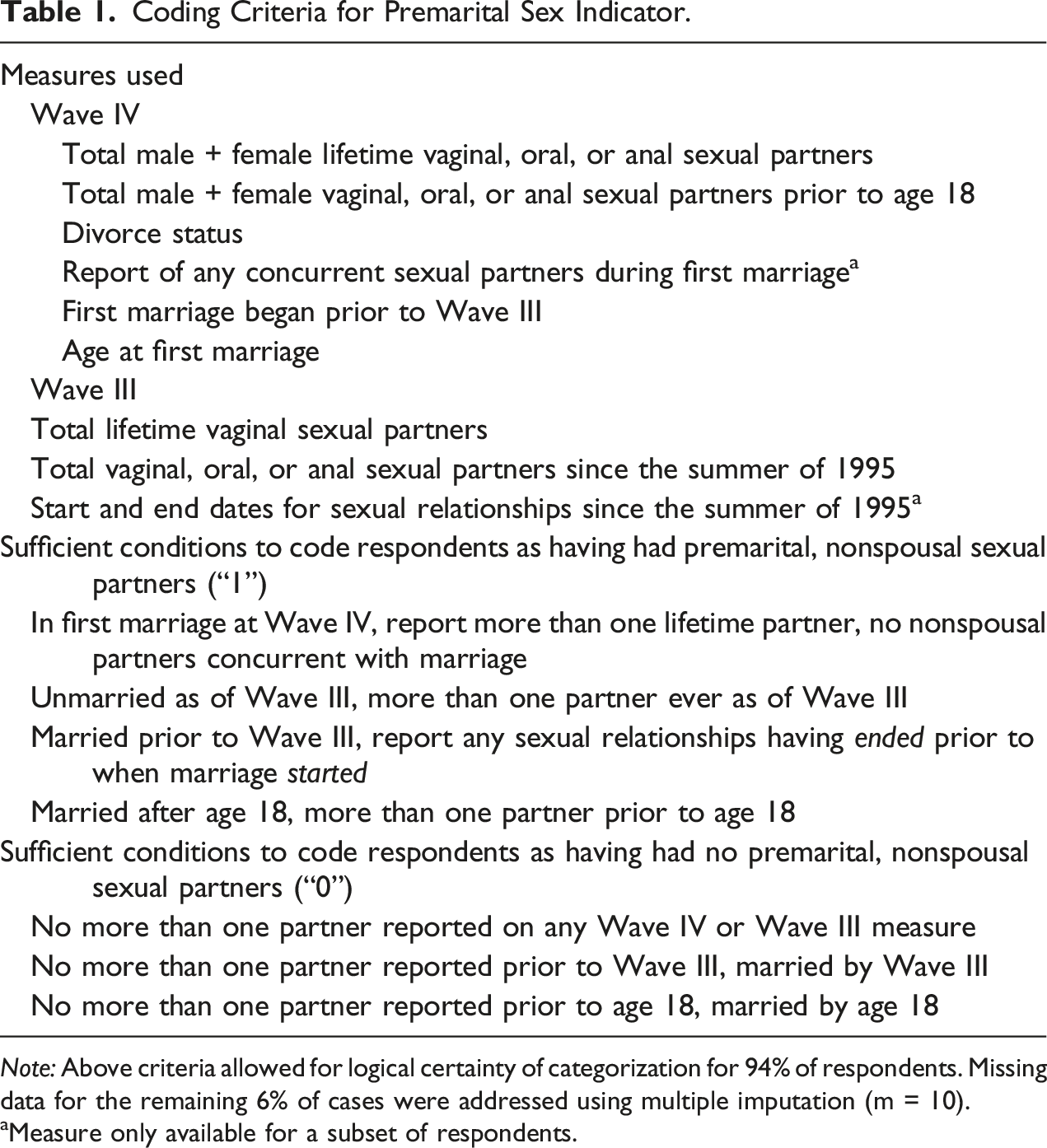
Note: Above criteria allowed for logical certainty of categorization for 94% of respondents. Missing data for the remaining 6% of cases were addressed using multiple imputation (m = 10).
aMeasure only available for a subset of respondents.
For the subsample of those who did not marry until after Wave III, we first take the highest number of sexual partners reported across three items: lifetime vaginal partners as of Wave III, total sexual partners of any kind between 1995 and Wave III data collection, or partners of any kind prior to age 18 as reported at Wave IV. The partners counted in these three measures may overlap, so we use the highest number to capture as many partners as possible while ensuring no partner is counted more than once. We subtract one from this number (unless respondents report no partners) to account for the possibility that a single partner may be the respondent’s eventual spouse. Next we divide the sample intro three groups: 1) Those with no premarital partners (excluding future spouses) as of Wave III, 2) those with one to eight partners, and 3) those with nine or more. We selected these categories based on a series of analyses using dichotomous indicators of sexual partners, which showed divorce risk to increase substantially with one partner and again with nine, while remaining stable for partner counts between one and eight (see appendix). This approach also provides an improved model fit as measured by the deviance scores, compared to alternative approaches such as using quartiles or a continuous sexual partner variable.
It should be noted that because this second stage of analysis only includes sexual partners measured as of Wave III, any premarital partners in between Waves III and IV are not counted. This may result in some measurement error, leading to estimates biased downwards. Results from this analysis should thus be regarded as conservative.
Adolescent and Family Characteristics
To account for early-life experiences and individual characteristics, we include several measures of respondents’ Wave I beliefs and values, religious involvement, and other traits. We measure religious identity using a modified version of Lehman and Sherkat’s (2018) recent typology (the key modification is that Latter-Day Saints are coded to the “Sectarian” category due to considerations of small cell sizes). Wave I religious attendance is included as a continuous variable. Unfortunately, Add Health respondents from Wave I who reported no religious affiliation were not asked about religious behaviors; these cases were coded as having no attendance.
We include two additional dichotomous variables to capture beliefs and values about premarital sex. The first indicates whether or not the respondent had ever taken a virginity pledge (Bearman & Brückner, 2001; Uecker, 2008). The second indicates whether adolescents report that in an ideal relationship, they would expect to have sex, but not get married, in the next year. Specifically, respondents were given a set of cards identifying different relationship activities (e.g., going out together in a group, holding hands, meeting partner’s parents, getting married), and asked to return to the interviewer any cards indicating activities they would not want to happen in the next year in their ideal relationship. If they kept the card for having sex, but returned the card for getting married, they were coded as a “1” on this indicator. 2
The analysis also includes scales of Wave I depressive symptoms, delinquent behaviors, and decision-making style, as these all may be associated with both sexual behavior and marital outcomes. The depression scale uses 10 items on the frequency of experiencing various depressive symptoms, drawn from the CES-D depression inventory (e.g., “You felt you were too tired to do things”) (α = .72). The delinquency scale includes 15 items on frequency of various delinquent activities in the past year (e.g., damaging property, lying to parents about activities) (α = .83). Finally, adolescents were asked to assess their own personalities. We use five items pertaining to decision-making (e.g., “When you have a problem to solve, one of the first things you do is get as many facts about the problem as possible,”) to create a scale measuring a cautious approach to making decisions (α = .64) (Uecker, Regnerus, & Vaaler, 2007).
Two items are included to capture potential parental influences on children’s sexual and later marital outcomes. As positive parent–child relationships may serve as a protective factor against high-risk sexual behaviors (McElwain & Bub, 2018; Price & Hyde, 2009), we measure parent–child relationship quality using a scale of five items indicating the adolescent’s perception of closeness to each parent (e.g., “Most of the time, your mother is warm and loving toward you”) (α = .85). This scale used responses about mothers where available, fathers otherwise. We further include a cumulative measure of the number of activities respondents report doing with their parent in the past 4 weeks (e.g., gone shopping, played a sport).
Sociodemographic Controls
Based on past studies, a number of controls are included to account for potential spuriousness in the relationship between premarital sex and marital stability. From Wave I, these include sex, race, and highest level of parent education in four categories: 1) Less than high school, 2) high school diploma/GED, 3) some post-high school education, and 4) college degree or higher. We further include measures of the number of family structure transitions experienced as of Waves I and II, using a variable constructed through procedures outlined in Gaydosh & Harris (2018; see also Martinson & Wu, 1992). 3 From Wave IV, we add respondent education and indicators of the respondent’s relationship history. These include age at first marriage, any premarital birth, any premarital cohabitation, age at first sex in three categories (before age 16, at ages 16 or 17, and age 18 or later), and a binary indicator of the experience of nonconsensual sex as a minor. 4
Analytic Strategy
In all analyses, we use discrete-time event history models to test the effects of premarital sex and other predictors on the rate of dissolution of first marriage. Specifically, we apply a complementary log-log estimator to data shaped to a marriage-month format, with one observation contributed for each month of first marriage of each respondent. Event history methods are ideal for studying divorce as they account for right censoring: some respondents will end their marriages subsequent to the most recent wave of data.
The first set of analyses includes the full sample of those who were ever married as of Wave IV. In a series of models, we examine the effects of having any premarital sexual partners on divorce risk in bivariate, with sociodemographic controls, and finally, with child and family characteristics. This serves as a test of the hypothesis that the effects of premarital sex are explained by early-life factors or personal characteristics. We proceed to conduct a second, nearly identical set of analyses on the subsample of those who were not married until after Wave III, the only difference being that we use a measure of three categories of sexual partners rather than the dichotomous variable. This provides an estimate of the shape of the relationship between premarital partners and divorce risk. Finally, we re-estimate all models with an interaction between premarital sex and gender in order to test for differences in effects between men and women. For all analyses, the baseline hazard is specified as the quadratic of marital duration in months. This produced substantively similar results to models specifying the baseline hazard with binary indicators for 1-year marriage intervals, so the quadratic in months was chosen for the sake of parsimony.
Missing data were handled via multiple imputation. Specifically, we used the mice package in R to create 10 imputed data sets for each subsample, conduct analyses for each data set, and pool the results, adjusting estimates for uncertainty in the imputed values (Van Buuren, 2018). All analyses include a survey weight and are adjusted for clustering and stratification.
Results
Descriptive Statistics for Ever-Married Respondents as of Add Health Wave IV.
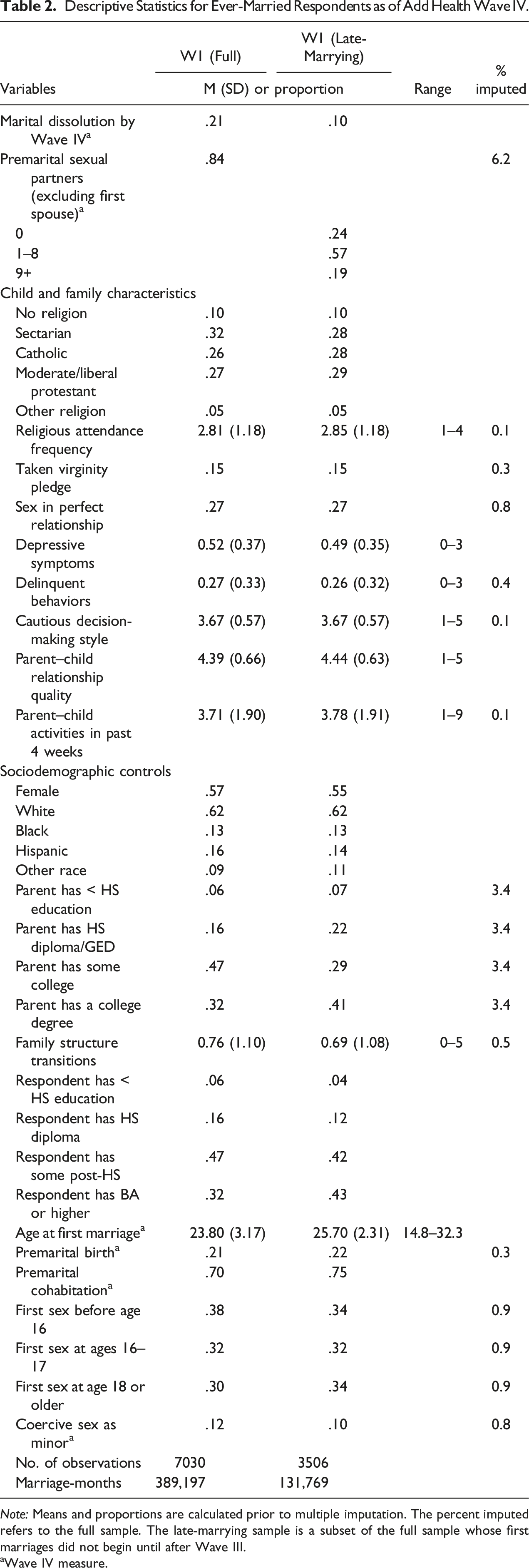
Note: Means and proportions are calculated prior to multiple imputation. The percent imputed refers to the full sample. The late-marrying sample is a subset of the full sample whose first marriages did not begin until after Wave III.
aWave IV measure.
Odds Ratios from Discrete-Time Event History Models Predicting Dissolution of First Marriage.
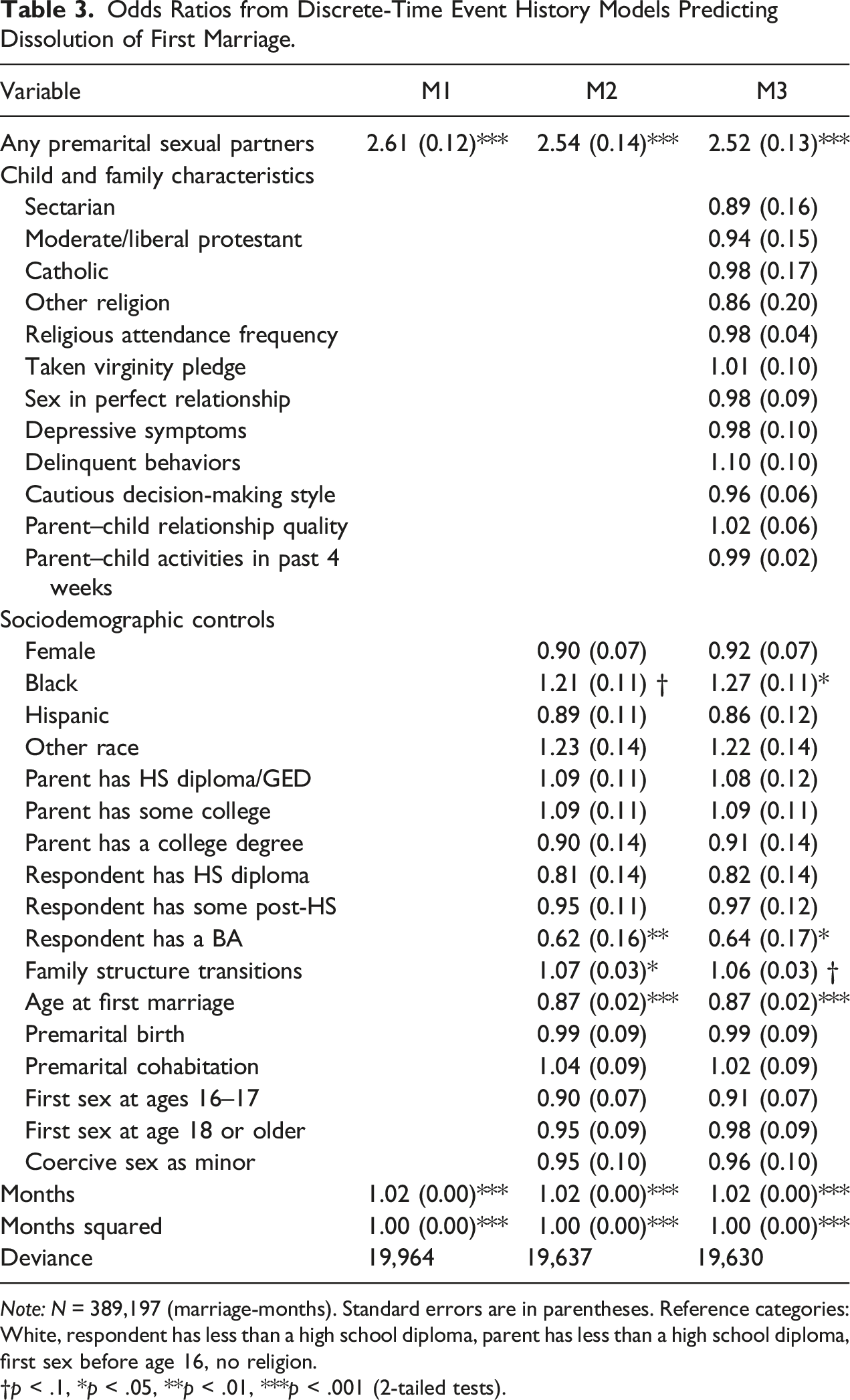
Note: N = 389,197 (marriage-months). Standard errors are in parentheses. Reference categories: White, respondent has less than a high school diploma, parent has less than a high school diploma, first sex before age 16, no religion.
†p < .1, *p < .05, **p < .01, ***p < .001 (2-tailed tests).
Odds Ratios from Discrete-Time Event History Models Predicting Dissolution of First Marriage among Later-Marrying Respondents.
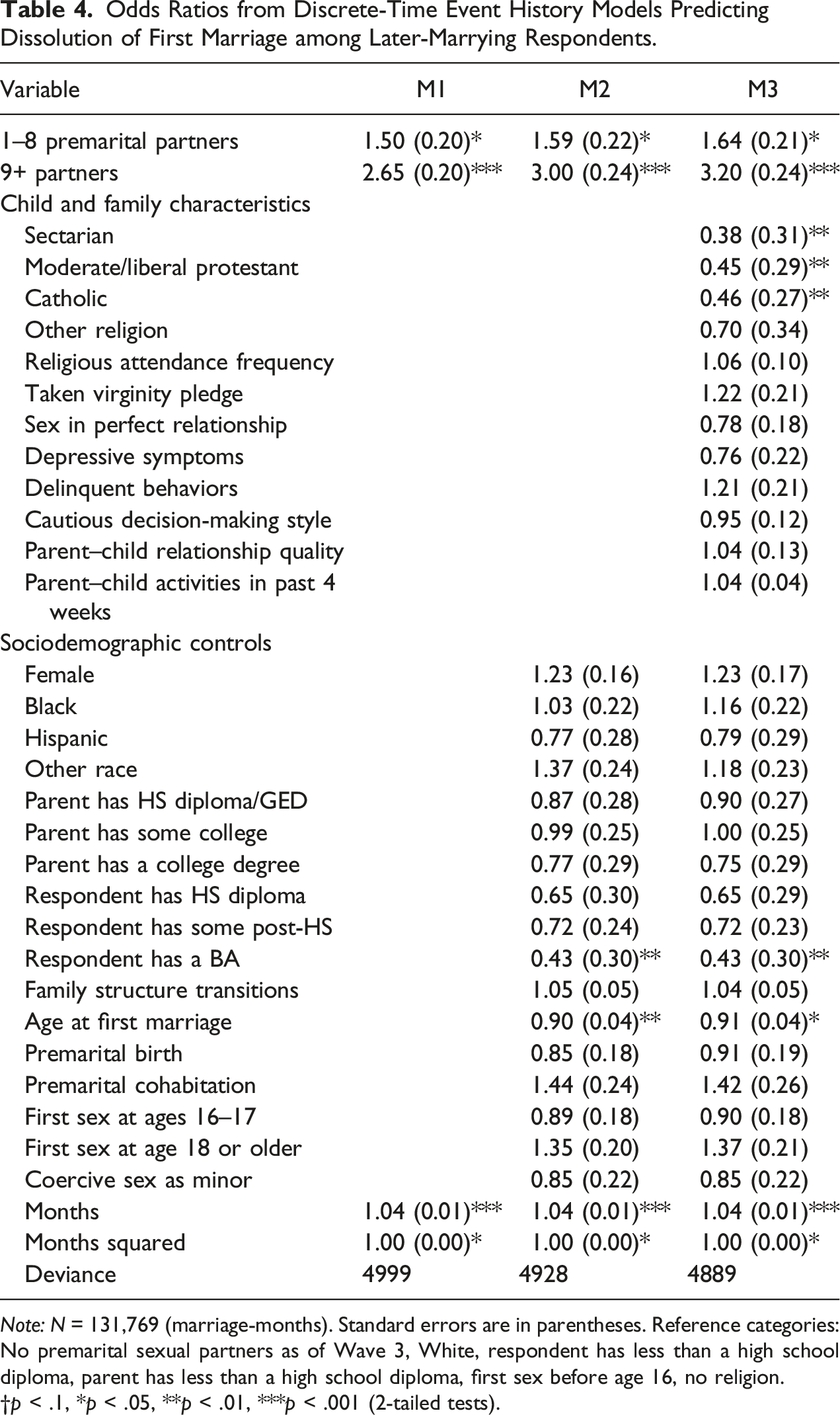
Note: N = 131,769 (marriage-months). Standard errors are in parentheses. Reference categories: No premarital sexual partners as of Wave 3, White, respondent has less than a high school diploma, parent has less than a high school diploma, first sex before age 16, no religion.
†p < .1, *p < .05, **p < .01, ***p < .001 (2-tailed tests).
Those with one to eight partners are also at greater risk of divorce, though this coefficient is weaker than for those with nine or more partners. Specifically, in the full model the odds of divorce for those with one to eight partners are 64% higher than those with no premarital partners (ORs = 1.50—1.64). This effect is also not attenuated as controls are added to the model, reinforcing the finding that explanations based on early-life experiences and personal characteristics are not supported. Additional analyses show those in this middle category to have a significantly lower divorce risk than those with nine or more partners, indicating three distinct groups. Taken together, these results suggest that the relationship between number of premarital partners and marital dissolution is nonlinear. They point rather to three tiers of divorce risk, with the lowest risk for those with no premarital, nonspousal partners, a modest increase for those with some, and a sharp increase for those with many. These results are more consistent with the notion that the effect of premarital sex on divorce becomes stronger, not weaker, as sexual partners accumulate.
Finally, to test for differences in the effect of premarital sex on divorce between men and women, we repeat all analyses from Tables 3 and 4 and include an interaction between gender and premarital sex variables (not shown). The results are straightforward: we do not any evidence of sex differences in the link between premarital sex and divorce risk in any model for either sample. Although there is theoretical reason to expect such a difference, our results suggest otherwise.
Discussion
Past research has established a clear link between premarital sex, particularly with partners other than an eventual spouse, and the risk of marital dissolution (Kahn & London, 1991; Paik, 2011; Teachman, 2003). Thus far, however, we know little about the nature of this link. The purpose of this study was to shed light on three areas which have not been fully addressed in past literature: the potential role of early-life factors or personal characteristics in explaining this relationship, the possibility of nonlinear effects of premarital sexual partnerships on divorce risk, and whether the relationship varies between men and women. A better understanding of these factors contributes to our knowledge of the links between early-life and later-life relationship experiences and outcomes, an important focus of theory and research on the family life course (Sassler, 2010).
Previous research pointed to a variety of individual and social variables to explain the relationship between premarital sex and divorce, including nontraditional views on sex and marriage, weaker religious attachments, and lower-quality family relationships (Kahn & London, 1991; Paik, 2011). We find no support for these explanations, and show that the effect of premarital sex remains highly significant after accounting for a wide range of individual and social differences between respondents. Needless to say, our analysis does not rule out the possibility that unmeasured variables might be driving selection. Future research should endeavor to test for the potential causal effects of premarital sex on divorce, and to elaborate on possible selection processes which have not been considered in past scholarship.
As expected, we find evidence of a nonlinear relationship between the number of sexual partners and the risk of divorce. Those in the highest category of partners (9+) consistently show the highest divorce risk by a substantial margin, followed by those with one to eight partners, with the lowest risk for those with none. In other words, we find distinct tiers of divorce risk between those with no, some, or many premarital, nonspousal sexual partners. As over half the sample falls into the middle category, these results may be interpreted as indicating two distinctive groups. At one extreme, having no premarital partners serves as a protective factor against divorce risk. At the other, those in the top quintile experience especially high levels of marital dissolution. These findings highlight the importance of incorporating the variation in sexual history into research in this area, rather than relying on dichotomous indicators of premarital sex. A possible implication here is that the robust effect of premarital sex found in past studies is being driven largely by a minority of respondents with especially high levels of both sexual partners and divorce rates. This reflects the fact that although partner counts of eight or less have become increasingly normative, having more partners may indicate distinctive characteristics which are not conducive to marital stability.
We find no evidence of gender differences in the link between premarital sex and divorce. This is a surprising finding—the domains of sexuality and marriage are highly gendered (e.g., Monin & Clark, 2011; Okami & Shackelford, 2001; Oliver & Hyde, 1993), and there are many plausible theoretical pathways by which the premarital sex-divorce relationship might be expected to differ between men and women. Future research might consider if the mechanisms linking premarital sex and divorce function the same way for men and women.
This study has contributed to our understanding of the link between premarital sex and marital dissolution by taking advantage of the mixed-sex sample and longitudinal design of the Add Health study in order to address some of the limitations of past literature. Yet Add Health has its own limitations with respect to the aims of this study. As all respondents at Wave IV were 32 years old or younger, the sample is selective of those who marry younger, and the time to observe divorce is somewhat limited. The results are therefore most reflective of early marriages and divorces. Also, at the start of data collection, respondents ranged from early to late adolescence, and many had already had sex. On a related note, in some cases it is unclear whether sexual partnerships occurred before, during or after marriage. To ensure proper temporal ordering, tests of the effects of the number of sexual partners were only performed on a late-marrying subsample, and the measure used did not capture all partners. Nevertheless, it represents a more detailed measure than almost all prior studies have used. Needless to say, a more exact measure for the full sample would be ideal. Similarly, we relied on proxies for beliefs and values about marriage and divorce as well as marital quality, so more precise measures would be preferable. Finally, though Add Health data are well-suited to ruling out some of the hypothesized selection processes explaining the premarital sex-divorce link, they are less appropriate for examining possible causal mechanisms. This would require more detailed timelines of sexual histories and more frequent waves of data collection than Add Health provides.
This study makes a contribution to our understanding of the link between premarital sex and divorce, which has been heretofore limited in key respects. It reinforces the finding that the effect of premarital sex is robust, and shows that it applies equally to men as well as women. Moreover, our findings help to rule out common explanations offered by past research. The results here also serve to highlight the importance of conceptualizing sexual history more broadly, taking into account its extent and timing, when considering how it might affect marriages. As relationship experiences over the life course have become more varied and complex in recent decades (Sassler & Lichter, 2020), it is increasingly vital that theory and analysis adjust to take account of these developments.
Footnotes
Declaration of Conflicting Interests
The author(s) declared no potential conflicts of interest with respect to the research, authorship, and/or publication of this article.
Funding
The author(s) disclosed receipt of the following financial support for the research, authorship, and/or publication of this article: This research was supported by funding from the Eunice Kennedy Shriver National Institute of Child Health and Human Development (NICHD) to the Population Research Institute at The Pennsylvania State University for Population Research Infrastructure (P2C HD041025) and Family Demography Training (T-32HD007514). The findings and conclusions do not necessarily reflect the views of the funding agency.

Notes
Appendix
Distribution of Premarital Sexual Partners (as of Wave III) by Sex. Note: Proportion by column in parentheses. Sample is limited to those whose first marriages began after Wave III (N = 3502 after removing four missing observations). One partner is subtracted for each respondent to ensure only partners other than eventual spouses are counted.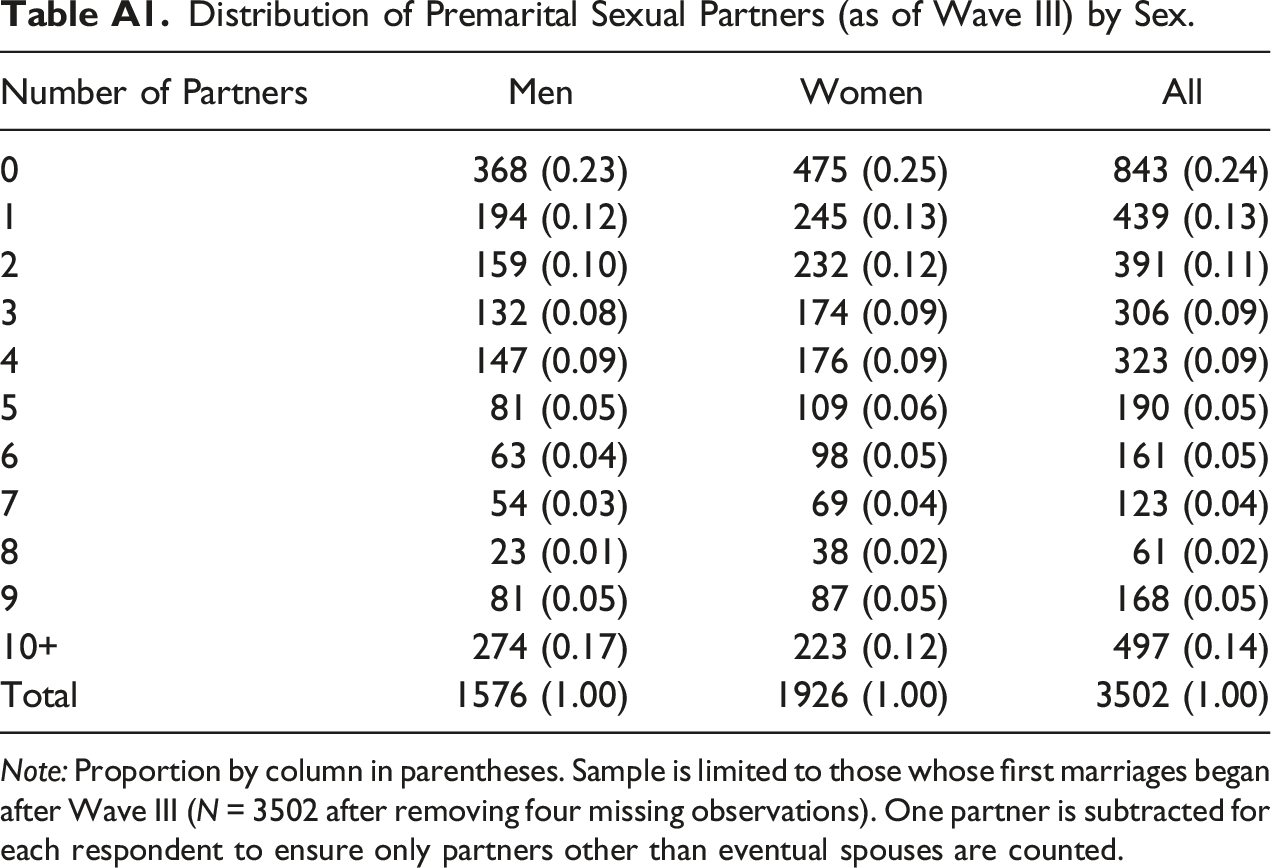
Number of Partners
Men
Women
All
0
368 (0.23)
475 (0.25)
843 (0.24)
1
194 (0.12)
245 (0.13)
439 (0.13)
2
159 (0.10)
232 (0.12)
391 (0.11)
3
132 (0.08)
174 (0.09)
306 (0.09)
4
147 (0.09)
176 (0.09)
323 (0.09)
5
81 (0.05)
109 (0.06)
190 (0.05)
6
63 (0.04)
98 (0.05)
161 (0.05)
7
54 (0.03)
69 (0.04)
123 (0.04)
8
23 (0.01)
38 (0.02)
61 (0.02)
9
81 (0.05)
87 (0.05)
168 (0.05)
10+
274 (0.17)
223 (0.12)
497 (0.14)
Total
1576 (1.00)
1926 (1.00)
3502 (1.00)
Odds ratios from Discrete-Time Event History Models Predicting Dissolution of First Marriage among Late-Marrying Respondents—Alternative Measure of Sexual Partners. Note: N = 131,769 (marriage-months). Models include all controls from Model 3 in Table 4. †p < .1, *p < .05, **p < .01, ***p < .001 (2-tailed tests).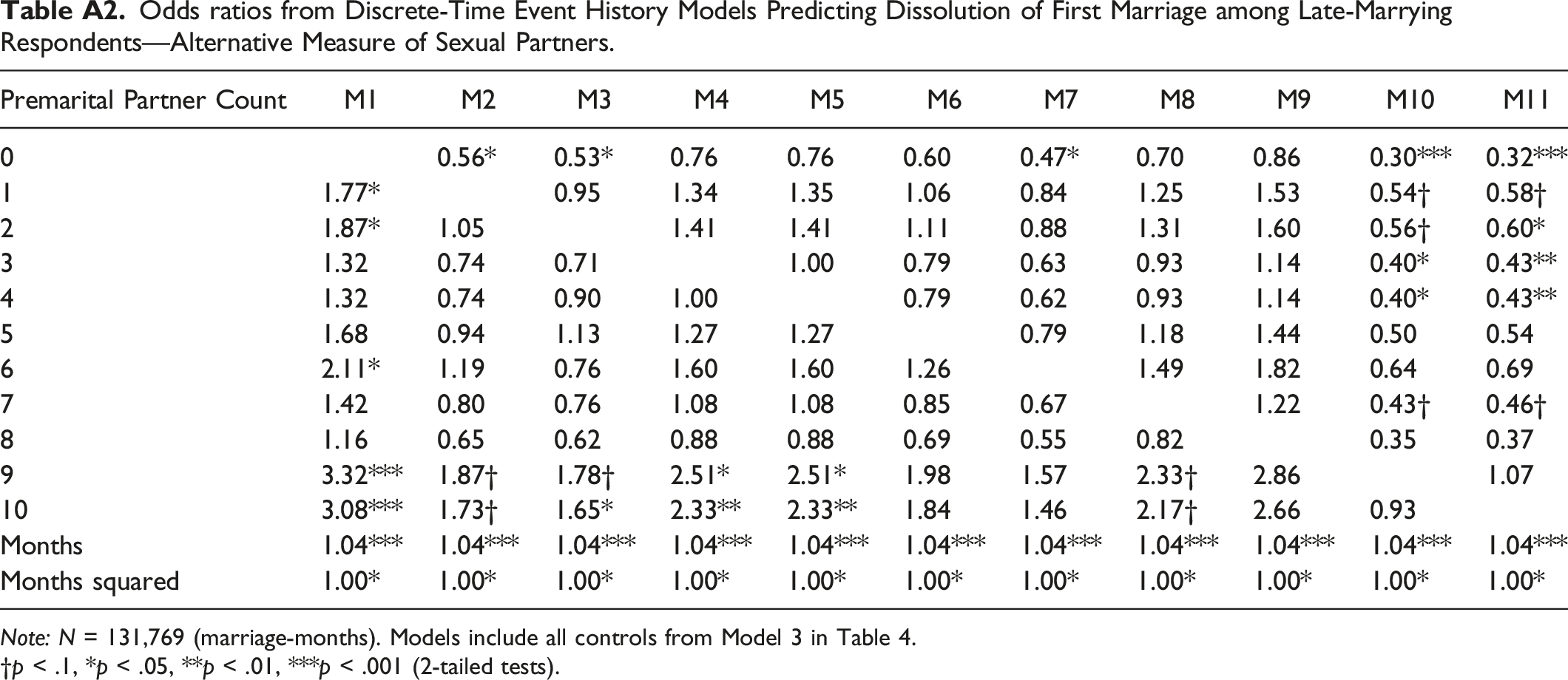
Premarital Partner Count
M1
M2
M3
M4
M5
M6
M7
M8
M9
M10
M11
0
0.56*
0.53*
0.76
0.76
0.60
0.47*
0.70
0.86
0.30***
0.32***
1
1.77*
0.95
1.34
1.35
1.06
0.84
1.25
1.53
0.54†
0.58†
2
1.87*
1.05
1.41
1.41
1.11
0.88
1.31
1.60
0.56†
0.60*
3
1.32
0.74
0.71
1.00
0.79
0.63
0.93
1.14
0.40*
0.43**
4
1.32
0.74
0.90
1.00
0.79
0.62
0.93
1.14
0.40*
0.43**
5
1.68
0.94
1.13
1.27
1.27
0.79
1.18
1.44
0.50
0.54
6
2.11*
1.19
0.76
1.60
1.60
1.26
1.49
1.82
0.64
0.69
7
1.42
0.80
0.76
1.08
1.08
0.85
0.67
1.22
0.43†
0.46†
8
1.16
0.65
0.62
0.88
0.88
0.69
0.55
0.82
0.35
0.37
9
3.32***
1.87†
1.78†
2.51*
2.51*
1.98
1.57
2.33†
2.86
1.07
10
3.08***
1.73†
1.65*
2.33**
2.33**
1.84
1.46
2.17†
2.66
0.93
Months
1.04***
1.04***
1.04***
1.04***
1.04***
1.04***
1.04***
1.04***
1.04***
1.04***
1.04***
Months squared
1.00*
1.00*
1.00*
1.00*
1.00*
1.00*
1.00*
1.00*
1.00*
1.00*
1.00*