



Abstract
Very few studies examine the help-seeking behaviors of male survivors of intimate partner violence (IPV) in Kenya or sub-Saharan Africa more generally. Using nationally representative cross-sectional data from 1,458 male survivors and multinomial logit models, we examined what influences men’s decision to seek help after experiencing IPV. Results show the majority of male survivors did not seek help. Those who did so turned to informal rather than formal sources. The severity of physical violence was the most robust and consistent predictor of help-seeking. Male survivors of severe physical abuse had higher odds of seeking help from informal support networks than not seeking help. Compared to the uneducated, highly educated men were significantly more likely to seek help from formal support networks than to not seek help at all. Sensitization programs are required to educate male survivors of IPV on available sources of support. In particular, barriers to help-seeking must be removed to encourage male survivors to find support.
Introduction
Intimate partner violence (IPV) is a global crisis affecting individuals and societies irrespective of racial, socio-economic, religious, and cultural backgrounds. Globally, about one-third of women have ever experienced IPV, but knowledge of its prevalence among men is scant (WHO 2017; Kishor & Bradley 2012; Kolbe & Buttner 2020). A study by Ringwald et al. (2020) in one of Kenya’s informal settlements suggests high prevalence of IPV among men, and in a study using the Kenya Demographic and Health Survey, Tenkorang (2021a) reported about 6.8, 3.6, and 20.1% of Kenyan men had experienced physical, sexual, and emotional/psychological violence, respectively. Although useful, these data are likely to be underreported given the patriarchal nature of Kenyan society and the gendered stereotypes associated with male experiences of IPV. For instance, there is a strong belief that it is “unmanly” for men to experience IPV (Morgan & Wells, 2016; Tenkorang, 2021b). Thus, attempts to share such experiences may be interpreted as a sign of weakness and a betrayal of what it means to be an African male.
This notion of masculinity has obvious implications for disclosure of IPV among male survivors in Kenya, undermining efforts to share and report their experiences for fear of being stigmatized and preventing them from seeking help. Disclosure of abuse and help-seeking are significant steps to finding temporary or permanent solutions to breaking the abuse chain (Tenkorang et al., 2016; Okenwa et al. 2009). Help-seeking may expose male survivors to a host of services aimed at providing emotional/psychological support and preventing recurrence of abuse, yet some qualitative data point to significant barriers to seeking or accessing help (Douglas and Hines 2011; Hines et al. 2007). While the barriers may be diverse, gendered socio-cultural notions are key, and domestic violence services often fail to cater to the needs of men. For instance, in a qualitative study examining the narratives of 30 male survivors of IPV, Cook (2009) observed that those who contacted domestic violence hotlines were told the services were meant for female survivors. In a related study, Douglas and Hines (2011) reported that about two-thirds of over 300 male survivors of IPV did not find domestic violence agencies and hotlines helpful. A systematic review by Huntley et al. (2019) identified fear of being turned away and not being believed by service providers as significant barriers to help-seeking. The same study observed that seeking help from families and friends was considered beneficial by male survivors of IPV.
At the moment, few studies examine the help-seeking behaviors of male victims of IPV globally (Huntley et al. 2019, 2020; Douglas & Hines 2011). The lack of research on this subject in Kenya and in sub-Saharan Africa in general is especially conspicuous. Our search of the literature found no comprehensive study on the help-seeking behaviors of male survivors of IPV in Kenya. Using nationally representative data from the Kenya Demographic and Health Survey, we begin to fill this gap in the literature.
Theorizing the Help-Seeking Behaviors of Male Survivors of Intimate Partner Violence
No specific theories have been developed to explain the help-seeking behaviors of male survivors of IPV. In this study, we adopt a generic framework developed by Liang and colleagues (2005) to explore the reasons for help-seeking among Kenyan men with experiences of IPV. After experiencing violence, most survivors do not seek help (Douglas & Hines, 2011; Tenkorang et al., 2016, 2018), but those who do so use both formal and informal avenues. Some organizations provide formal support and counseling, including but not limited to the police, members of the clergy, hospitals, and other state or non-state actors mandated to deal with and provide support for survivors of IPV. Informal support may be provided by family members, friends, community members, etc. Liang and colleagues argue survivors of IPV often go through an iterative cognitive process before seeking help and deciding where to go; each stage of the decision-making process is confounded by socio-cultural factors that may facilitate or deter help-seeking.
According to Liang and colleagues, the decision to seek help may first depend on the survivor’s ability to define the problem. This may involve an awareness and appraisal of the type and severity of the violence, and consequently, a decision of whether and where to seek help. For the majority of Kenyan men, acknowledging that IPV is a problem could undermine traditionally defined stereotypical behaviors associated with “maleness.” It is therefore possible for men to be oblivious of IPV in their relationships or for such awareness to be subsumed by their understanding of socially prescribed norms (Thobejane & Luthada, 2019; Dienye & Gbeneol, 2009). Hegemonic masculinity may deter IPV disclosure and help-seeking in general, but if female-perpetrated violence is severe, men may seek help. In their qualitative study on the help-seeking behaviors of Australian men, Walker et al. (2020) reported male survivors disclosed their experiences if they found abuse significant enough to warrant a report. This means the decision to seek help follows an appraisal of the problem as severe.
Help-seeking may also be hindered by feelings of guilt and shame. For male survivors in Kenya, these feelings may derive from the lack of acceptance of their plight by the larger society and service providers who privilege women. This may not only deter some Kenyan men from disclosing violence and seeking help but it may also limit them to certain types of help including family members, friends and other acquaintances within their networks. In a systematic review of the literature on men’s help-seeking behaviors, Huntley et al. (2019) found male survivors of IPV preferred to seek help from friends, family, and colleagues at work, deeming help from formal organizations to be both inaccessible and unhelpful.
The choice of a help provider is important for ending the abuse cycle and supporting survivors. The choice is made after a cost-benefit analysis of each potential source of support by the victim (Liang et al. 2005). Before male survivors seek help from formal support networks, they may consider the relative costs, including the stigma associated with help-seeking and the potential societal dangers of such behavior. Some research suggests male survivors face significant barriers to accessing help from domestic violence services. They may be mistakenly mislabeled as batterers by service providers when they are the victims, or service providers may express disbelief and refuse to respond (Cook 2009; Douglas and Hines 2011; Hines et al. 2007).
Based on the research, we expected the majority of Kenyan men would be more likely to disclose their victimization and seek help from informal support networks, including family members and friends, than to look for support from formal support networks. We also hypothesized that the severity of abuse would be a significant determinant of help-seeking from these informal support avenues.
There is little scholarly work on male victims’ characteristics and help-seeking behaviors. Socio-economic and demographic characteristics may be determinants of the decision to seek help. For instance, given their access to human and financial resources, male survivors with higher education and wealth may be more likely to seek help than uneducated and poorer men. Furthermore, the definition of abuse as problematic, assessment of the severity of abuse and the choice of a support network or service provider may be affected by male survivors’ socio-economic and demographic characteristics.
Data and Methods
To examine the help-seeking behaviors of male survivors of IPV in Kenya, we used data from the 2014 Kenya Demographic and Health Survey (KDHS). The 2014 KDHS is the sixth in a series of demographic and health surveys. The KDHS is a valuable source of information on demographic and health issues, including fertility, morbidity, and mortality. Importantly for present purposes, a domestic violence module with specific questions on violence against men was added in 2014 (Kenya National Bureau of Statistics 2015).
The sample for the 2014 KDHS came from a master sampling frame—the Fifth National Sample Survey and Evaluation Programme—used to conduct household surveys throughout Kenya and the 2009 Kenya Population and Housing Census (Kenya National Bureau of Statistics 2015). The selection of the sample was multi-staged. First, 40,300 households (25 households each) were selected from 1612 clusters (995 in rural and 617 in urban areas) across the country. Survey respondents were then selected from eligible households. For the men’s survey, a total of 14,217 men were identified as eligible, out of whom 12,819 were selected. As the domestic violence module was limited to ever-married men, the analytical sample for this study was reduced to 1458 ever-married men who experienced IPV and responded to questions on their help-seeking behaviors.
Information was elicited from respondents aged 15–54 years living in every second household using a household questionnaire. Respondents were asked questions about their experiences with IPV and their help-seeking behaviors. For confidentiality and privacy purposes, one eligible individual within a household was interviewed. In households with more than one eligible individual, random sampling was employed to select one eligible person for an interview (Kenya National Bureau of Statistics 2015). High ethical standards were observed, given the sensitive nature of domestic violence in Kenya. For instance, interviewers were given special training on how to ask sensitive questions and ensure privacy during data collection.
Measures
The outcome variable asked male survivors of IPV if they had sought help after experiencing violence, and if so, from which sources, including social service organizations, the police, religious leaders, lawyers, and doctors. These were grouped together and called formal services. Respondents were also asked if they sought help from their own family members, their wife/partner’s family, neighbors, and traditional leaders, grouped as informal services. Respondents who sought help from formal or informal support services were compared to those who did not.
Three main predictors tapping the domestic violence experiences of respondents were employed as focal independent variables: physical, emotional, and sexual violence. Physical violence was measured using a weighted summative index derived from seven indicators/items asking men if their spouses: ever slapped them; ever punched them with a fist or something harmful; ever kicked or dragged them; ever tried to strangle or burn them; ever threatened them with a gun/knife or other weapon; ever twisted their arms or pulled hair; and ever pushed or shook them or threw something at them. These variables were coded “yes = 1” if respondents answered in the affirmative and “no = 0” if they indicated otherwise. All variables loaded on the same construct using principal componentanalysis (PCA). The Anderson–Rubin factor scores were extracted and used as a scalar variable. Positive values on the scale meant respondents experienced severe physical violence; negative values indicated otherwise. Factor loadings for this scale ranged between 0.598 and 0.738. Cronbach’s alpha for the scale was 0.726.
Emotional violence was measured with four items asking if respondents were ever threatened with harm by their spouses; ever humiliated by their spouses; ever insulted or made to feel bad; and ever threatened with a gun. All variables loaded on the same construct using principal component analysis (PCA). The Anderson–Rubin factor scores were extracted and used as a scalar variable. Positive values on the scale meant respondents experienced severe emotional violence; negative values indicated otherwise. Factor loadings for this scale ranged between 0.605 and 0.785. Cronbach’s alpha for the scale was 0.724.
Two items measured sexual violence; men were asked if their spouses ever physically forced sex on them and ever forced any other sexual acts on them when not wanted. These variables were coded “yes = 1” if respondents answered in the affirmative and “no = 0” if they indicated otherwise. Factor loadings for this scale ranged between 0.802 and 0.856. Cronbach’s alpha for the scale was 0.602.
Given their possible confounding effects, we employed socio-economic and demographic characteristics as control variables. These include education (no = 0, primary education = 1, secondary education = 2, and higher education = 3), employment status (not employed = 0 and employed = 1), and wealth status 1 (poorest = 0, poorer = 1, middle = 2, richer = 3, and richest = 4). Demographic and socio-cultural variables identified as important predictors of IPV were employed as controls: age (15–24 = 0, 25–34 = 1, 35–44 = 2, and 45–54 = 3), ethnicity (Kikuyu = 0, Kalenjin = 1, Luhya = 2, Luo = 3, Kamba = 4, and other ethnic groups = 5), residence (rural = 0 and urban = 1), whether wife drinks alcohol (no = 0, yes = 1, and do not know = 2), whether respondent’s father beat mother (no = 0, yes = 1, and do not know = 2), and wife’s controlling behaviors. For the latter, respondents were asked if their wife/partner became jealous if they talked with other women; accused them of unfaithfulness; did not permit them to meet female friends; tried to limit their contact with family; insisted on knowing where they were; and did not trust them with money. All items were coded “no = 0” and “yes = 1.” A respondent’s wife/partner was deemed “controlling” if the respondent answered in the affirmative for at least one of these indicators; otherwise, she was considered “not controlling.”
Data Analysis
We employed a multinomial logit model to examine the effects of severity of violence and other socio-economic and demographic predictors on the help-seeking behaviors of male survivors of violence in Kenya. A multinomial model generates a K-1 set of parameter estimates and compares different categories/outcomes on the dependent variable to a certain base category/outcome. The base or reference outcome for this study was respondents who did not seek help after experiencing IPV. They were compared with respondents who sought help from formal support services and informal support services only. For meaningful interpretation, the coefficients were transformed into odds ratios where covariates greater than 1 in any of the categories of the dependent variable indicated the respondents with those characteristics had higher odds of falling into that category, compared to the base outcome; the reverse was true for covariates less than 1. We also computed two multivariate models. The first examined the effects of severity of violence on help-seeking behaviors; the second and final model added the socio-economic characteristics of the respondents as potential confounders.
Results
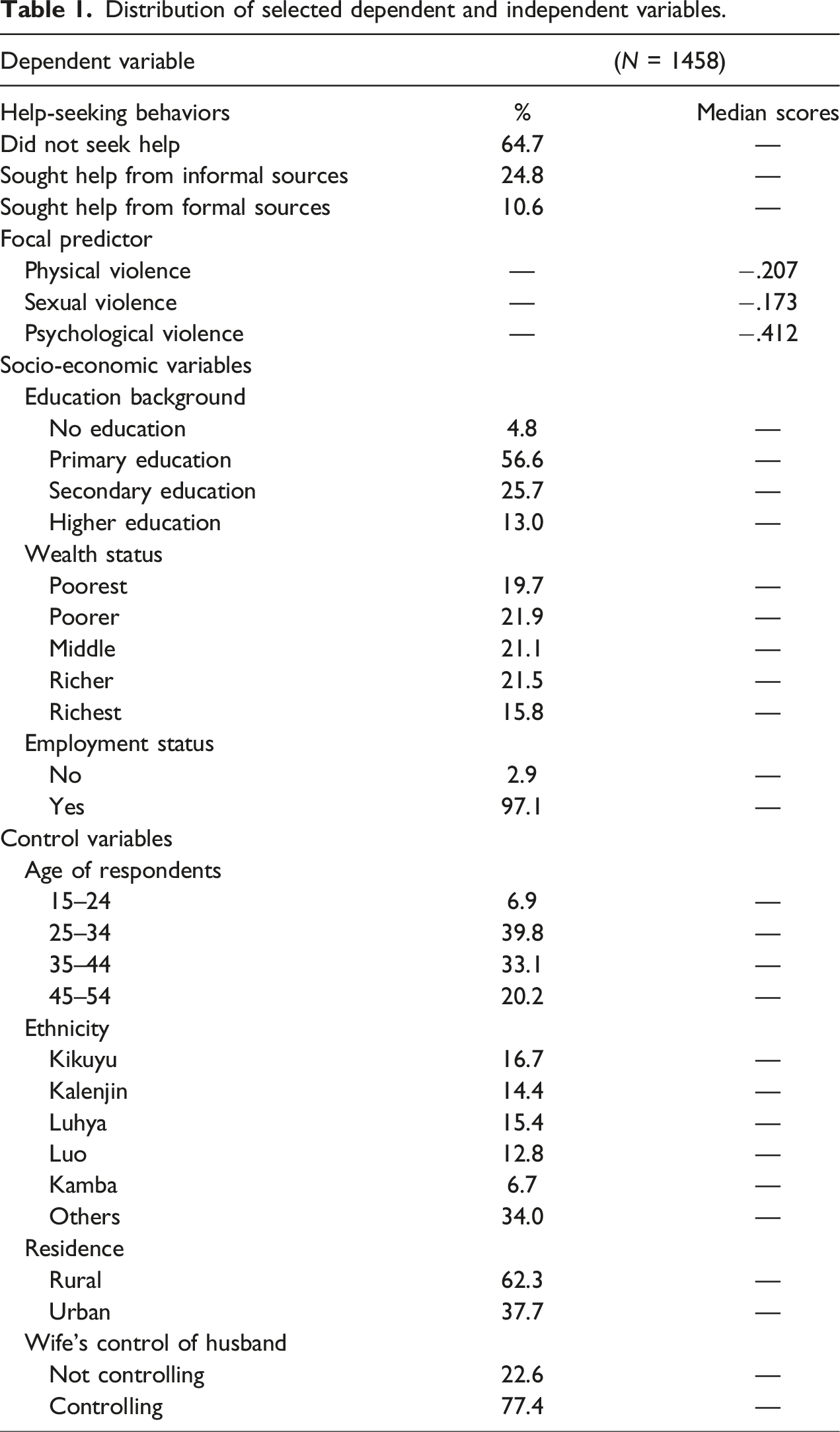
Distribution of selected dependent and independent variables.
Unadjusted odds ratios for men’s help-seeking behaviors in Kenya.
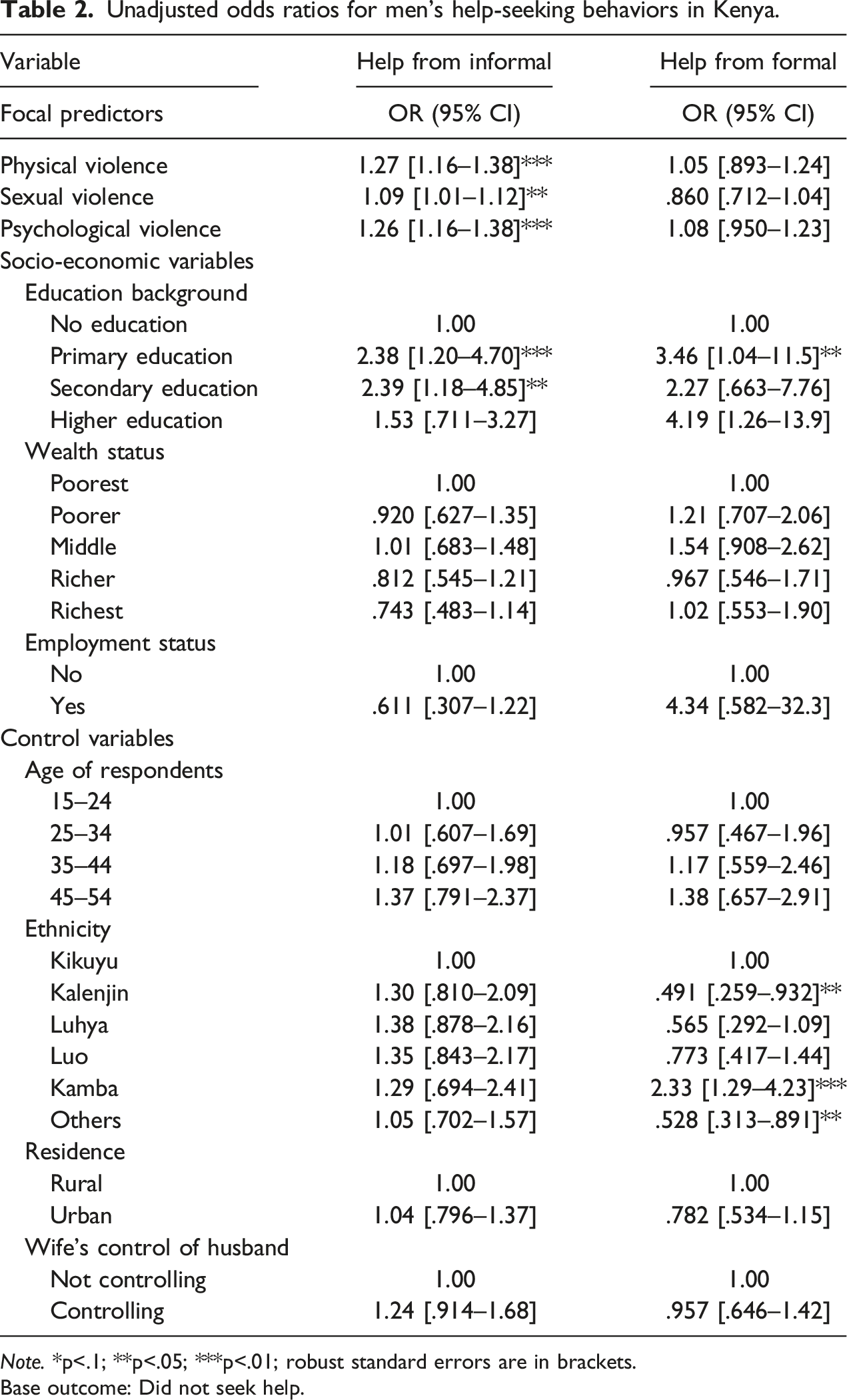
Note. *p<.1; **p<.05; ***p<.01; robust standard errors are in brackets.
Base outcome: Did not seek help.
Adjusted odds ratios for men’s help-seeking behaviors in Kenya.
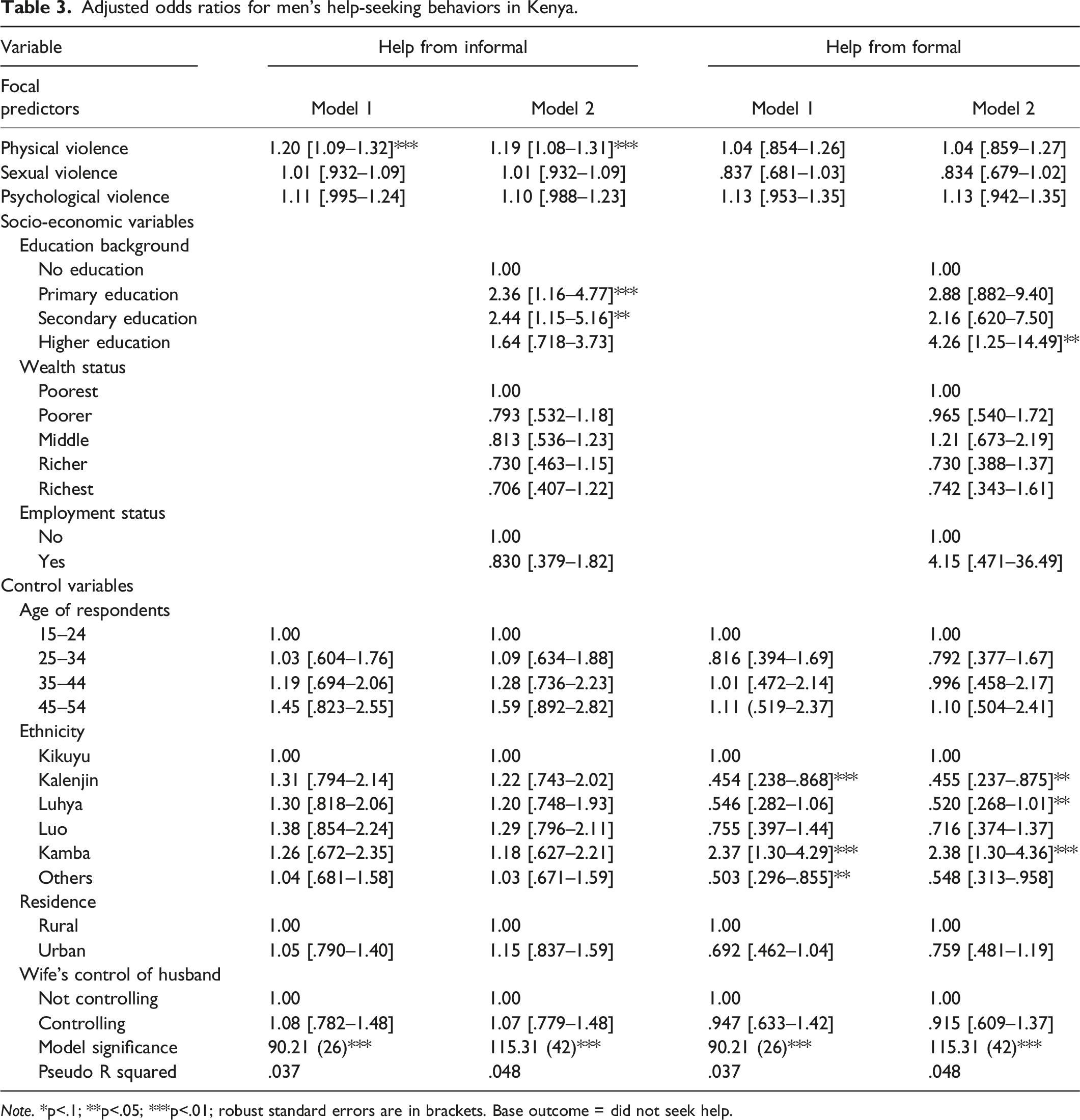
Note. *p<.1; **p<.05; ***p<.01; robust standard errors are in brackets. Base outcome = did not seek help.
Discussion
Research on violence against men and help-seeking behaviors is limited, especially in sub-Saharan Africa (Donne et al., 2018; Huntley et al., 2019; Walker et al., 2020). Research on the help-seeking behaviors of male survivors of IPV is particularly rare in spite of the need for evidence to develop gender-sensitive interventions. This study begins to fill an important gap by examining the help-seeking behaviors of male survivors of IPV using nationally representative data from Kenya. To the best of our knowledge, it is the first to provide a quantitative analysis of the help-seeking behaviors of men with experiences of IPV in Kenya and one of the few in sub-Saharan Africa. Negative median scores on the various dimensions of violence (physical, sexual, and emotional) suggest lower levels of violence against Kenyan men, but female-perpetrated violence may be underreported given the challenges Kenyan men face in disclosing abuse. As Douglas and Hines (2011) argue, in patriarchal cultures, female-perpetrated violence is often inconceivable, with men generally considered the instigators and perpetrators. Such perceptions will certainly affect men’s help-seeking behaviors. Not surprisingly, male survivors of abuse rarely report their experiences or seek help (Tsui et al. 2010; Douglas and Hines 2011; Huntley et al. 2019). In our study, the majority of Kenyan male IPV survivors did not seek help. Among those who did, a substantial proportion pursued informal rather than formal support. This tendency has been found among female survivors as well (Tenkorang et al., 2016; Fleming & Resick 2017).
An important question pursued in this research was the determinants of male survivors’ help-seeking behaviors and whether the severity of violence (physical, sexual, and emotional) influenced these behaviors. The severity of physical violence appeared to be the most consistent and robust predictor of help-seeking, not emotional or sexual violence, and those who sought help mostly turned to informal networks. Help-seeking for severe physical violence may be easier because such violence can leave visible scars. Disclosing sexual violence may be difficult for men given the conservative nature of Kenyan culture on issues of sexuality and the challenges of convincing help providers of sexual abuse—an act often considered inconsistent with traditional African norms.
The choice of help provider mattered. Our results point to physical violence as a powerful determinant of help-seeking from informal sources (friends, family, etc.). A number of qualitative studies identify reasons for the popularity of informal support networks among male survivors of IPV. Douglas and Hines (2011) reported that male survivors of IPV in the United States found family and friends were helpful, and survivors were highly satisfied with the support received. Using data from Australia, Walker et al. (2020) noted that although some families and friends expressed disbelief on hearing the experiences of male survivors, they still provided support by demonstrating understanding and sympathy. These reasons make informal support channels attractive and highly preferred by male survivors of IPV.
It was not surprising that severity of IPV was not significantly associated with help-seeking from formal support services. Barriers include unfair treatment and discrimination against male survivors of IPV by the criminal justice system, especially in countries like Kenya where men are perceived to be the primary aggressors. These perceptions can reduce confidence in disclosing IPV to the appropriate state institutions for redress while maximizing fear of disclosure (Hines & Douglas 2009; Huntley et al. 2019). Even so, our results showed that highly educated Kenyan male survivors of IPV were significantly more likely to seek help from formal support networks than those with no education. This finding suggests highly educated male survivors have different help-seeking experiences; they may be more informed about formal support avenues and may have the economic resources to handle the financial demands or cost barriers of seeking help from the criminal justice system, health delivery system, or other recognized formal support avenues in Kenya. We also observed ethnic differences in men’s help-seeking behaviors. In previous analysis of IPV with the same data set, Luhya men self-reported higher levels of physical and emotional violence compared to Kikuyu men. Kalenjin men also self-reported higher levels of emotional violence than Kikuyu men. No significant IPV differences were observed between Kamba and Kikuyu men (Tenkorang, 2021a). Meanwhile, the current analysis showed Luhya men were less likely to seek help for IPV, while Kamba men were more likely to do so. Reasons for non–help-seeking among Luhya men may be due to ideas of hegemonic masculinity, shame and guilt in accessing domestic violence services as discussed earlier. As limited work exist on ethnic differences in the help-seeking behaviors of male survivors of IPV in sub-Saharan Africa and Kenya, it remains unclear why Kamba men will seek help than Kikuyu men. Future research using both quantitative and qualitative data will shed useful light on educational and ethnic differences in help-seeking among Kenya men.
The findings have important implications for policy makers and other stakeholders interested in fighting domestic violence. First, the perception of violence against men is often influenced by preconceptions of masculinity. This creates a significant barrier to disclosing IPV and seeking help and presents challenges to help providers. A nationwide sensitization program could begin to educate the Kenyan public on violence against men (Ameh et al. 2012; Van Niekerk et al. 2015). In particular, male survivors of violence need to be informed and encouraged to seek help, and service providers must be trained to understand the needs of male survivors.
Admittedly, the study had some limitations. First, the data were cross-sectional. As a result, we cannot draw causal connections between predictors and outcomes. Second, in African settings, domestic violence is often considered a private and sensitive issue and is rarely discussed in public. This often leads to underreporting. In fact, the problem of underreporting is more pronounced for men, given the patriarchal nature of African societies, ideas of masculinity, and the belief that men should dominate and control instead of women. These beliefs can affect the way participants respond to questions and can produce socially desirable answers. These limitations notwithstanding, this study is one of the few if not the first to examine IPV against men in Kenya using nationally representative data.
Footnotes
Declaration of Conflicting Interests
The author(s) declared no potential conflicts of interest with respect to the research, authorship, and/or publication of this article.
Funding
The author(s) received no financial support for the research, authorship, and/or publication of this article.
