



Abstract
The problem of population aging in China has been widely documented. As a result of decreasing birth rates due to the Chinese one-child policy, birth rates have decreased dramatically, while life expectancy has increased. By 2040, it is expected that 24.6% of the Chinese population will be older than 65 years (United Nations, Department of Economic and Social Affairs, Population Division, 2015), with the majority of the elderly care likely to fall to their, often, singleton children. Little research has been conducted, however, with this future generation of caregivers. This article reports on a mixed-methods study comparing the attitudes of the one-child generation toward the future care of their parents and parents-in-law, in terms of gender, sibling status, and urban/rural providence. It includes the results of 26 in-depth interviews with students aged 18 to 22 years, and a survey among 351 first-year students of a semiprivate university in Zhuhai (China). No differences were found for gender, sibling status, or urban/rural providence for the intention to take care of the own parents in the future, although rural and nonsingleton participants were more likely to mention that they intended to live close to, or with their parents in the future than their urban and singleton counterparts. Concerning the care for future parents-in-law, male students in both the survey and the interviews were significantly less likely to accept responsibility for their care than female students, but no differences were found for urban/rural providence or for sibling status in this respect. Finally, female and rural students were found to be significantly much more likely to want to live in a separate house than their male and urban counterparts.
The problem of rapid population aging in China has been widely documented (Cai, Giles, O’Keefe, & Wang, 2012; Settles, Sheng, Zang, & Zhao, 2013; Zhang & Goza, 2006). Rapid improvements in health care, as well as better access to health care services have increased life expectancy in China from 43.4 to 75.8 years between 1960 and 2014 (The World Bank, n.d.), while during the same period, fertility rates have decreased from 5.8 to 1.6 children per woman (The World Bank, n.d.). The decrease in fertility rates is mostly due to the enforcement of the Chinese one-child policy between 1979 and 2015, although other policies before 1979, especially the later-longer-fewer (晚稀少) campaign, have also contributed (Bongaarts & Greenhalgh, 1985). As a result, population projections show that 24.6% of the Chinese population will be older than 65 years by 2040 (United Nations, Department of Economic and Social Affairs, Population Division, 2015), with a projected old-age dependency ratio of 43.0% (population older than 65 years divided by working-age population aged 20-64 years; United Nations, Department of Economic and Social Affairs, Population Division, 2015). Although the Chinese government finally seems to be taking measures to counter the worst effects of this rapid population aging, for example, by introducing a comprehensive rural social security scheme (urban areas were largely covered already), by relaxing the birth control policy, and by increasing the official retirement age, it is still likely that the large majority of future elderly care will fall to the children and the children-in-law of the (future) elderly (Festini & de Martino, 2004; Fong, 2004).
There is, however, a growing concern about the future elderly care by the one-child generation. Bai, Lai, and Guo (2016), for example, stated that “under the ‘one-child’ policy, it has become increasingly difficult for the younger generation to provide filial support in a traditional way as most of them do not have siblings to share the filial obligations” (p. 28). Other authors have pointed out the so-called 4-2-1 problem, in which two singletons of the one-child generation are expected to care for four aging parents and one child (e.g., Settles et al., 2013; Zhang & Goza, 2006), not taking into account potential surviving grandparents, or multiple children.
Anticipating this issue, the future elderly (the parents of the one-child generation) have adopted several coping strategies. In the absence of comprehensive social security and pension plans, the first of these strategies has been saving (Cai et al., 2012; Das Gupta, Ebenstein, & Sharygin, 2010), resulting in comparatively high-saving rates in China (Cai et al., 2012; The World Bank, 2016). A second strategy has been to ensure having a son, either because of traditional Confucian beliefs (described below) or, in the countryside, because of practical labor considerations, resulting in extremely skewed sex ratios at birth (Das Gupta et al., 2003; Murphy, 2014). A third strategy, finally, has been to have more children than allowed under the law, resulting in an unknown number of undocumented children, especially girls (Greenhalgh, 2003).
These last two strategies, however, are based on the assumption that the children of the one-child generation, and especially the sons, are actually going to fulfill their filial duty. Little direct research has focused on this assumption though, either because the one-child generation has only relatively recently come of age, as they were all born after 1979, or because the parents of the one-child generation have not yet retired, and are not yet of care-needing age. Notable exceptions are the studies of Deutsch (2006), Fong (2004), Liu (2008), and Zhan (2004), whose main findings will be described below. This study addressed this gap in the literature. The main research question of this exploratory study was “how do the children of the one-child generation see their role as future caregivers of their parents and parents-in-law?”
Socioeconomic and Cultural Background of Elderly Care in China
Traditional, feudal China was a strictly patriarchal society, organized according to Confucian doctrines that described the ethical codes of conduct within society, including among kinships (Sheng, 2005). These “ethical codes” were reinforced by a set of feudal orders as early as the Han Dynasty (206 BCE-220 CE; Sheng, 2005), and were thus in place for at least 2000 years. The care for the elderly was arranged following the concept of filial piety, including five main tasks that ruled the relation between parents and children, or, more precisely, between the parents and their son: The service which a filial son does to his parents is as follows: In his general conduct to them, he manifests the utmost reverence; in his nourishing of them, his endeavour is to give them the utmost pleasure; when they are ill, he feels the greatest anxiety; in mourning for them (dead), he exhibits every demonstration of grief; in sacrificing to them, he displays the utmost solemnity. When a son is complete in these five things (he may be pronounced) able to serve his parents. (Confucius in: Classic of Filial Piety, Legge, p. 480, 1879)
In the traditional Chinese culture, a son was thus responsible for the care of his own parents, both before and after they passed away (Bongaarts & Greenhalgh, 1985), while a daughter was married off according to a system of strict exogamy (Das Gupta et al., 2003), and became responsible for the care of her parents-in-law (Ikels, 2006; Settles et al., 2013; Shi, 2009). “Constrained by the distance from her new home to her parents’ home and a lack of convenient transport” and “subject to the approval of a woman’s husband and parents-in-law” (Shi, 2009, p. 353), a daughter would be practically cut off from her natal parents after marriage. In precommunist China, it was, therefore, imperative to have a son, even an adopted one, to ensure one’s physical well-being in old age, as well as one’s spiritual well-being after death (e.g., Das Gupta et al., 2003).
After the Chinese Communist Party came into power in 1949, this system was strongly attacked by Party leaders and abolished as a feudalist idea (Greenhalgh, 2003; Liu, 2008). In the new China, the obligation of children, both sons and daughters, to take care of their aging parents became clearly enshrined in the Chinese Constitution (1982), as well as in several specific laws (Fong, 2004; Zeng, George, Sereny, Gu, & Vaupel, 2015; Zhang & Goza, 2006). During the same time, following the economic reforms initiated after 1978, of which the one-child policy formed part (Greenhalgh, 2003), the Chinese economy has grown to become the largest economy in the world in terms of Gross National Income (Purchasing Power Parity), with China overtaking the United States in 2014 (The World Bank, 2016), even if income per capita is still lagging behind Western countries (The World Bank, 2016). As a result, China has gone through a rapid phase of modernization and urbanization, and traditional values are slowly disappearing, especially in the city (Stockman, 2000), while individualism is on the rise (Lu & Gilmour, 2004; Lu & Kao, 2002). At the same time, economic development has resulted in an emerging filial practice of women toward their natal parents, driven by women’s recently obtained decision-making power in marriage and greater economic leverage (Fong, 2004; Shi, 2009).
As a result of these developments, attitudes toward elderly care have rapidly changed in the past decades, although many of the Confucian ideals on filial obligations still seem to be in place (Fong, 2004; Liu, 2008). In addition, judging from the high sex ratio at birth, many parents still seem to believe that a son (and his future wife) will provide better care than a daughter (and her future husband).
Caregiving Roles in Contemporary China
In terms of caregiving roles in contemporary China, researchers have generally distinguished between three main types of assistance: Practical, financial, and emotional (e.g., Ikels, 2006; Zhan, 2005), with researchers often finding a negative relation between practical and financial assistance. The more practical assistance a caregiver provides, the less financial support they provide (Li, Feldman, & Jin, 2004; Zhan, 2005).
For practical assistance, it should, first of all, be noted that most practical care is provided by the spouse of an elderly person (e.g., Cooney & Di, 1999). Apart from the level of parental need, the main factors that were found to determine the amount of time spent on practical assistance were as follows: Physical distance, with people living further away providing less care (Ikels, 2006; Li et al., 2004; Sun, 2002); available time, with people with a paid job providing less care than those without a paid job (Zhan & Montgomery, 2003); and social pressure, with people who felt more pressure from their surroundings to care for their elderly parents providing more care than those who felt less social pressure (Zhan & Montgomery, 2003). In addition, women were found to spend significantly more time on elderly care than men (Cooney & Di, 1999; Sun, 2002; Zhan, 2005; Zhan & Montgomery, 2003), while also the kind of support provided was found to differ between men and women. While women generally provided personal care and help in domestic chores (Li et al., 2004; Shi, 2009; Sun, 2002; Zhan, 2005; Zhan & Montgomery, 2003), men were generally found to assist in practical chores such as shopping (Zhan, 2005; Zhan & Montgomery, 2003).
Financial support was found to depend positively on the financial ability of the caregiver (Li et al., 2004; Sun, 2002; Zhan, 2005), but negatively on the practical care provided by the caregiver, including cohabitation (Ikels, 2006; Li et al., 2004; Zhan, 2005; Zhan & Montgomery, 2003), and on the other income of the elderly parent(s), including pensions and contributions from caregiver’s siblings (Cai et al., 2012; Ikels, 2006; Li et al., 2004; Sun, 2002; Zhan & Montgomery, 2003). As a consequence of the first two factors, men were found to be more likely to provide financial support than women (Shi, 2009; Sun, 2002; Zhan, 2005). The availability of siblings was found to have a positive effect on the likelihood of providing financial assistance to an elderly parent, but a negative effect on the amount of such assistance (Cai et al., 2012; Sun, 2002).
Emotional care, finally, including visits by children, was mainly found to depend on gender (Shi, 2009) and on proximity (Ikels, 2006).
Regarding the care for parents-in-law, much of the existing research has, unfortunately, lumped married couples together, without accounting for the actual care provided by each partner. Care provided by a daughter-in-law was thus often classified under care by son (e.g., Li et al., 2004; Zeng et al., 2015), and it is therefore likely that the role of women described above is still underestimated. At the same time, it was found that married couples generally provide financial assistance to both sets of parents (Li et al., 2004; Shi, 2009), with couples in virilocal marriages more likely to provide financial and household support to the wife’s parents, and couples in uxorilocal marriages more likely to provide financial help for the husband’s parents, and housework support for the wife’s parents (Li et al., 2004).
Caregiving Intentions of the One-Child Generation
The research findings described above, however, largely apply to previous or current generations of elderly people and their caregivers, that is, the (great)grandparents and parents of the one-child generation, as research on the attitudes of the one-child generation toward elderly care is rare, as mentioned earlier. It is likely though, that the attitudes of the one-child generation will be shaped by the attitudes of their parents.
For the intentions of one-child generation itself, Deutsch (2006) found in a qualitative study that only sons were as likely to be responsive to parents’ future emotional needs as only daughters, while Liu (2008) found no differences between the men and women she interviewed in terms of filial piety toward their parents. This was also found in a quantitative survey conducted with students from the earliest cohort of the one-child generation by Zhan (2004), although she also found that the female students in her survey showed a marginally significant higher sense of obligation toward their parents than the male students. In terms of intentions of cohabitation, Liu (2008) found little difference between the young men and the women, although most of her respondents preferred to live close to, rather than with, their parents. This was also found by Deutsch (2006), Fong (2004), and Zhan (2004). Fong (2004) believed that it is likely that support toward the women’s natal parents will increase in the future, taking into consideration the emotional attention that the singleton women of the one-child generation have received from their parents while growing up.
Also for the one-child generation, Deutsch (2006) found that the availability of siblings had a negative relation with the caregiving intentions of urban students, with urban males with siblings found to be the least likely to anticipate helping their parents in the future. Zhan (2004) did not find this difference for filial piety, although she did find that students with siblings showed a significant lower sense of obligation toward the future care of their parents. Similarly, Fong (2004) and Liu (2008) found that singletons were more likely to mention “responding to parents’ emotional needs” than their counterparts with siblings.
Finally, between urban and rural students, Zhan (2004) found no differences, although she did find that respondents from higher income groups expressed higher levels of filial responsibility. Liu (2008), on the other hand, did not find any significant differences for socioeconomic status. None of these authors reported on future care for parents-in-law, although both Liu (2008) and Fong (2004) found that the future care for two sets of parents was perceived as a burden by their interviewees.
Objective and Research Question
Considering traditional values in China in combination with the recent abolishment of the one-child policy, many parents in China are now considering to have a second child to, among other reasons, provide for them in old age. In addition, many Chinese parents still seem to prefer to have a son rather than a daughter, considering the highly skewed sex ratio at birth, with the assumption that a grown-up son will take better care of them, even if research has shown that women generally provide more elderly care than men, as described above. Only very few researchers, however, have asked the young people of the one-child generation how they see the issue of future elderly care themselves, and whether the assumptions on which their parents have based (and are basing) their child-bearing decisions are actually valid. The study thus focused on the one-child generation, rather than just on single children, with the explicit aim to compare participants with and without siblings. As we have explained in Warmenhoven, Hoebink, and Janssens (forthcoming), the term “one-child policy” is actually misleading. As Greenhalgh (2010) pointed out, the policy was rather a 1.5-child policy, with several exceptions allowing for a second child (e.g., for those from the countryside, and those from Guangdong province until 1998). As aforementioned, the main research question of this study was “how do the children of the one-child generation see their role as future caregivers of their parents and parents-in-law?” More specifically, the study focused on three main factors: gender, urban or rural provenance, and sibling status.
Method
The study took a mixed-methods approach, combining both quantitative and qualitative methods. Qualitative interviews took place between April 2011 and June 2014. The first six interviews were conducted in April 2011, as a pilot study, after which a second group of students was interviewed in spring 2012, after which the first data analysis took place. Integrating the first results of those interviews, we then designed the questionnaire for the quantitative survey, which was conducted in May 2013. Based on the results of the questionnaire, it was then decided to interview a third group of students from another university, with students from different backgrounds, to see if there were any differences with the first interviews. This procedure allowed for better triangulation of the results of both methods.
Participants
Qualitative Interviews
Interviews were held with 26 students, born between 1990 and 1994 (aged 18-22 years at the time of the interviews), including 11 males and 15 females. Indeed, 13 of the participants were singleton, while the other 13 had a sibling. Three participants of the latter group had a sibling who was much younger than the participant (12-15 years younger), and one of them had a half brother of similar age, who grew up in a different household than the interviewee. However, 19 participants considered themselves from the city, while 7 of them considered themselves from the countryside, of which 2 grew up in the city. All participants from the countryside had a sibling. Most participants considered themselves to come from middle- or upper-middle-class families, although information about family income was not consistently gathered. This factor was thus omitted from the analysis. Participants were selected from two universities in Zhuhai, China, using convenience sampling: Some candidates were recommended by colleagues of the lead investigator, some indicated their willingness to be interviewed on the questionnaire used for the quantitative survey, and a third group was approached directly by the lead investigator. The first university is a semiprivate university 1 in Zhuhai, Guangdong Province, China as reported in Warmenhoven et al. (forthcoming). At the time the research took place, the university was considered a subtop university, attracting relatively wealthy students due to its semiprivate nature. The second university is a private English-taught college, cofounded by a Mainland university and a Hong Kong university. Due to its relatively high tuition fees for Chinese standards, students from the second university are likely to come from wealthier families than students from the first university.
Survey
The survey was conducted with students of the first university described above. The total sample included 351 randomly selected first-year students, aged 16 to 21 years. For the quantitative survey, first-year students were chosen as the target group, as they were at the beginning of a new important stage in life, and to be able to verify if there were differences between these younger students and the older students of the in-depth interviews.
As can be seen in Table 1, about 60% of the respondents were female, reflecting the reality of the university. The majority of them came from Guangdong (61.3%) and from the city (74.6%). About half of the respondents had a sibling, while the other half were singletons. The large majority of the respondents either came from rich/upper-middle-class families (50.1%), or from middle-class families (39.6%). The level of education of their parents, however, was mixed for both fathers and mothers, with the fathers having a slightly higher level of education. Fathers were involved in the upbringing of the respondents in 49.9% of the cases, while mothers were involved in 78.3% of the cases. A grandmother was involved in their upbringing in 43.6% of the cases, with the paternal grandmothers slightly more likely to have been involved (27.1%) than the maternal grandmothers (24.8%).
Demographic Characteristics of the Sample.
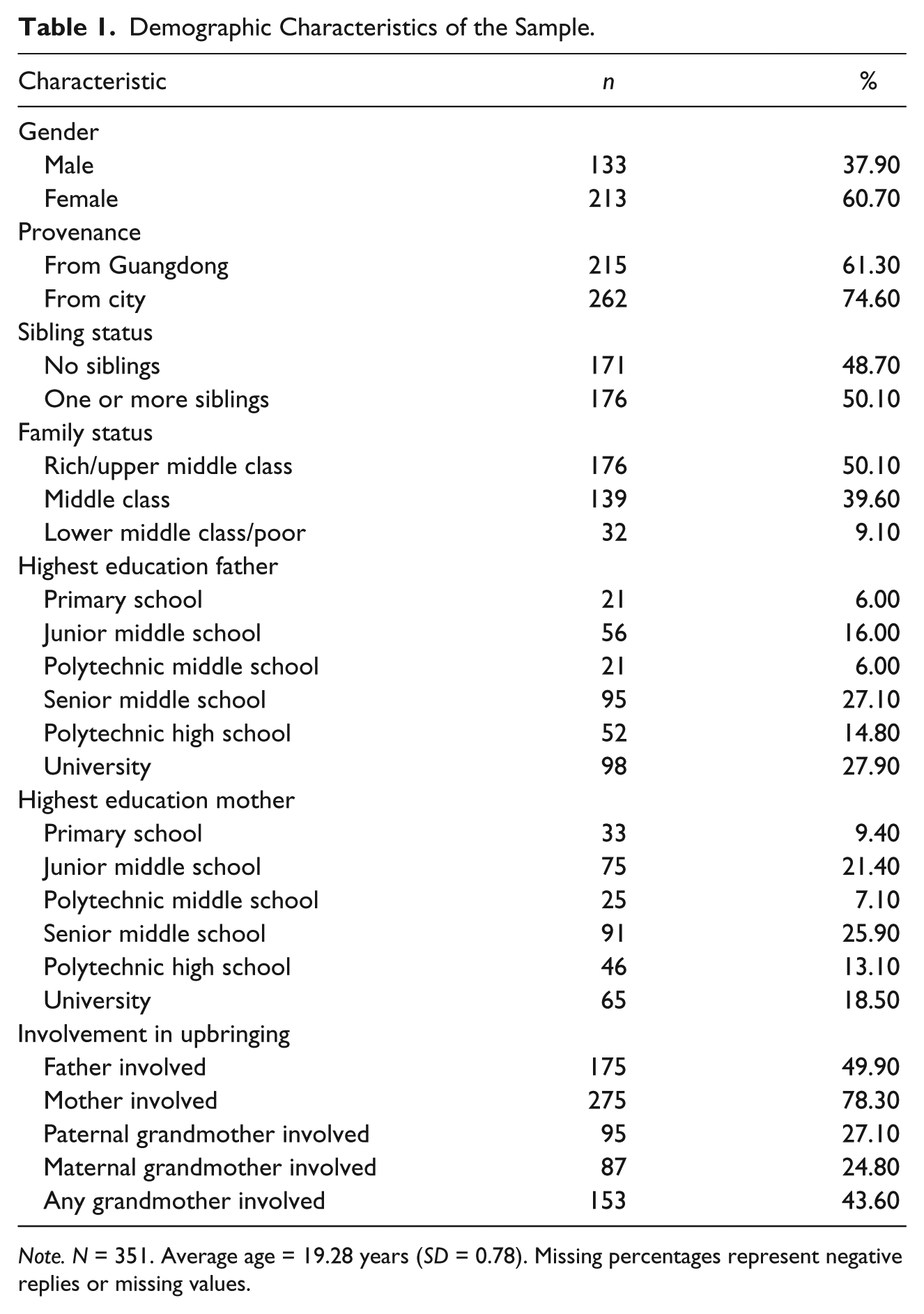
Note. N = 351. Average age = 19.28 years (SD = 0.78). Missing percentages represent negative replies or missing values.
Measures and Procedures
Qualitative Interviews
The in-depth interviews of this study were part of a larger research project into past, present, and future of the one-child generation, using a life-history approach. The interviews were semistructured, and would typically start with the early youth and general background of the interviewee, their school life, their dreams and fears, and how they arrived to the university. The interviews would then cover their close and extended family; decision-making processes and task division in their family, and their role in this; plans for the future in terms of career, marriage, and children, and the intended decision-making processes and task division in their future marriages; future caretaking intentions for their aging parents and in-laws; and their views on the challenges and opportunities of growing up in postreform China. For this study, we focused on two questions: “How do you intend to take care of your parents when they are old?” and “How do you intend to take care of your future partner’s parents when they are old?”
The interviews were mostly conducted one-on-one. All interviews were conducted in English and took place in the office of the interviewer. The interviews lasted between 60 and 90 minutes, with the discussion on these two questions lasting, on average, between 10 and 15 minutes. Two interviews were conducted in pairs, as two of the intended interviewees felt unsure about their level of English. These two interviews lasted up to 180 minutes, with the responses of the different participants separated at the analysis stage.
Most of the participants were former students of the interviewer. However, in order to allow a frank and open discussion, and to avoid potential future conflicts of interest, students were only selected if they would not be able to follow his classes in the future (e.g., because the interviewer had moved to another university, or because the participant was in his or her final year of study).
Prospective candidates were contacted by the interviewer by e-mail, explaining the purpose of the research and the language in which the interviews would be conducted. As explained above, some participants felt unsure about their level of English, although for most interviewees language was not a problem: Most of them were either recommended to be interviewed because of the English level, or were enrolled in an English-speaking university. When language problems occurred, the interviewee would explain in Chinese first, and then generally be able to explain in English afterward, with the help of a dictionary (first choice) or the lead investigator (second choice). In the few cases that a satisfactory translation was then still not found during the interview, the original Chinese was then translated by a translator during the transcription phase. All interviews were recorded with consent of the participant, and then transcribed and analyzed using content analysis. To assure the anonymity of the participants, recordings did not include their names. The names used in the remainder of this article are fictional.
In terms of potential bias, it should be noted that the interviewer is married to a Chinese woman (nonsingleton, born in the early years of the one-child policy). At the time of the interviews, they had an infant daughter.
Quantitative Survey
A questionnaire was used for the survey, as reported in Warmenhoven et al. (forthcoming), and included four questions regarding the future care of the respondent’s parents and parents-in-law. These questions were based on the first results of the qualitative interviews, and mainly focused on the future parents-in-law, as the different participants in the interviews expressed very similar ideas about the future care for their own parents. The four questions were as follows:
“The duty of a good husband/wife includes taking care of one’s partner’s parents (一个好老公/老婆的的职责包括照顾另一半的父母亲)”; “When they get old, I will have to take care of both my parents and my partner’s parents (当我和我爱人的父母亲年老时,我将不得不照顾他们)”; “It worries me that I have to take care of my parents/in-laws in the future (以后我要照顾我的父母或爱人的父母,让我很焦虑)”; and “I want to live in a separate house in the future (without parents/in-laws) (将来我想住在自己的房子里(不和父母或另一半的父母住在一起)).” Answers could be given on a 7-point Likert-type scale, rating from 1 = strongly disagree, to 7 = strongly agree, with a “don’t know” option provided. Background variables, as reported in Warmenhoven et al. (forthcoming), included questions on gender, age, sibling status, province of origin, providence from city or countryside, family status, level of education of the parents, and involvement of parents/grandmothers in the upbringing of the respondent.
The questionnaire was first designed in English and subsequently translated into Chinese using back-translation to ensure its accuracy. The questionnaire was first tested by a group of bilingual teachers and students for further refinement, after which the resulting bilingual questionnaire was randomly spread among students of the earlier-mentioned university. This resulted in a total sample of 351 valid questionnaires.
Results
Qualitative Interviews
Among the responses of the participants to the questions about their intentions of future care for their parents and potential parents-in-law, three levels could be distinguished, both for the future care for the own parents, and for the future partner’s parents. These were as follows: Whether the participant intended to take care, how they intended to take care, and potential worries about such care. Below, we will describe the findings for own parents and future partner parents separately.
Own Parents
Intention to take care
On the first level (whether they intended to take care), both male and female interviewees expressed fairly similar views when asked about their own parents. Most of them agreed that they had a responsibility to take care of their parents once these grew old, even though they differed in the practical approach toward such care. The same was observed for participants from the city and for those from the countryside, and for both singletons and nonsingletons.
How to take care?
On the second level (how participants intended to take care), the interviewees were, by and large, divided into two groups. On the one hand, there were those who would let their parents live with them, either in the same house or neolocally, and on the other hand, there were those who said that their parents had enough money to take care of themselves, and that visiting them sometimes would be enough. For this second group of participants, providing emotional care was considered to be more important than providing financial support. Between the young men and women, the opinions on this issue were, more or less, equally divided. Interviewees from countryside were more likely to mention the first option than those from the city, while singletons mentioned the second option more often than their counterparts with siblings. Among participants with a sibling, those from the countryside were more likely to mention coresiding with their aging parents than those from the city. The singletons, all from the city, fell somewhere in between those two groups. The two main opinions on this level are best expressed by Emma (female with an older sister from a minority village in Inner Mongolia) and Liam (male who grew up in a small mountain city in Guangdong with one much younger sister):
I really value my family love and I don’t want to (be) far away from them. When I graduate from school, I will go back and live with them in the same village until they die. I think, if I was the older person, I hope my children can come back, stay with me. So I (will) do this thing with my parents.
If I have work, it’s going to be easy to take care of them because they are government officers. The government will take care of them. When they retire they will get money. And not just money! When they (get) ill, in the hospital they will get a small insurance. So I don’t worry about that.
Worries about future care
On the third level (potential worries about future care), one of the main reasons for anxiety was caused by the fact that several of the interviewees were planning to study abroad and emigrate subsequently. Several of them expressed the wish to bring their parents over to their new country, although they realized that there would be severe practical problems in doing so, especially in terms of language barriers, or the willingness of the parents to leave China. Similar worries were expressed by those interviewees who were not planning to return to their hometowns after graduating, even if they were planning to stay in China. This is expressed, for example, by Lucas (singleton male from a small mountain city in Shanxi): I know some people (who) moved their parents from the countryside to the cityside, then their parents found there’s no friends, no community. They just felt lonely. And you know, their children, all they do is work, and working in a big city, and big pressure. (So) their children have no time to communicate with the parents. And then the parents, when they move to the city, the old friends disappear and they move to somewhere totally strange, so they feel lonely. So it’s hard to make this choice to move them (and) let them (be) with me, and that confuses me, I don’t know what to do.
But it was not just the male students who planned to move abroad: The female students were as likely to mention their intention to leave and stay abroad, or away from their parents’ hometown. Olivia (female with a younger sister and a younger brother from Guangdong, who grew up in a megacity, but felt she grew up with traditional ideas from the Chaozhou countryside) expressed similar feelings as Lucas above:
If I stay in (the) USA, I need to bring my parents to (the) USA too. I cannot leave them just here. (So) if I can stay in (the) USA, I would actually find a way to invite my parents to (the) USA too. But as I know, they don’t want to move to (the) USA, because they don’t know English. Yes, that is the problem, very big problem.
So because of this problem, I have to think about some other choices. After I finish the master in (the) USA, I would love to go to Australia. I want to find a way to emigrate to Australia, because this is a place with (a) lot of Chinese, and it is a very good place for the oldest. So I think if OK, I will go to there and bring my parents there, (and) because there are many Chinese there, they don’t have to worry about their English problem.
Olivia, however, was the only interviewee with siblings, and the only one who considered herself to be from the countryside, who planned to move abroad. All the others to mention this intention were singleton (all from the city). In this sense, the singletons showed much more anxiety about the future care for their parents than their counterparts with siblings, even if they were much more likely to say that their parents had enough money to take care of themselves, as aforementioned.
Partner’s Parents
Insofar as the opinions about taking care of one’s own parents were fairly similar between the different groups of students we interviewed, so different were their opinions about their future partner’s parents, especially between the young men and women. Most of the interviewees wanted to get married, with only two of them (one male and one female) saying they did not, and three of them being unsure.
Intention to take care
On the first level (whether they intended to take care), the female students generally accepted that they had a certain responsibility toward the future care of their partner’s parents, with a few exceptions. For the male students, however, the answers were very different. Only 4 out of the 11 male students we interviewed accepted that they had a responsibility in the future care of their parents-in-law, while several others stated that they had not thought about this issue before. Three male students, all from Guangdong, felt that the girl’s parents were not their responsibility, based on tradition. This difference did not seem to stem from urban or rural background, or to be influenced by sibling status.
This last opinion is, for example, expressed by Oliver (male who grew up with two brothers in the countryside in Guangdong, but moved with his family to a megacity for secondary school) and James (singleton male from a city in Guangdong).
The wife(‘s parents)? They have their sons! If they have (only) one girl, I think I will care about (them) more, but if they have another child, and the other child (can) care about them, I should (spend) more time (with) my family, not her family.
In our tradition, the husband (doesn’t) need to spend more time to take care of his wife’s family. Just my wife. If they are in (a) different city, my wife just can, or we can, just go to her hometown and stay with them for (a) couple of days, but if, like my mother’s mother, (they) live in Zhuhai, we can go there anytime.
In terms of sibling status, three more or less equally divided groups could be distinguished for the singletons: participants who accepted that they had a responsibility toward their future parents-in-law; participants who felt it was not their responsibility, but who would allow their partner to take care of them, or visit them; and participants who had not thought about the issue yet. The participants with siblings only mentioned the first two options. Between participants from the city and the countryside no marked differences were found, although it should be noted that the singletons all came from the city.
How to take care?
On the second level (how the participant intended to take care), the degree of foreseen involvement with the future parents-in-law varied in intensity. The answers between the different groups of interviewees did not differ much, although it should be stressed that only four male students had clear ideas about this issue. For those who did accept a certain responsibility in the care of their future parents-in-law, three levels of engagement could be distinguished, based on increasing intensity of involvement. The first step of engagement was keeping the future parents-in-law at a distance, but visiting them occasionally/regularly. The next step of involvement would be to live close to the parents-in-law, but not in the same house, while the final step would be to live together with the future parents-in-law, generally in the future location of the couple. This last option was not mentioned by the males and the singletons though, while also the large majority of the females and those with siblings were strongly opposed to the prospect of living with their in-laws. This is, once again, described by Olivia (described above):
But you know, in our age, most of the girls would not like to live with the parents. Both sides, they don’t like to live with (them), both sides, as I heard. And as I ask most of the girls in our class, they do not want to live with the parents.
Why not?
Because they’ll always quarrel. Maybe you didn’t see some movies or TV series in China. Most of them will, if they live together, have a lot of quarrel(s) because (of) the mother from the boy’s side, who think(s) the girl took away (her) son, so (she) just don’t like that girl. So they will just quarrel. . . . It’s very hard to find a balance: you like him, you like her and she like(s) you. It’s very difficult.
Six female students and one male student we interviewed stated that they would treat their parents-in-law the same as their own parents. These participants all came from the city and were, more or less, equally divided between singletons and nonsingletons.
Worries about future care
In terms of the third level of analysis (potential worries about future care), the main worry was about the future relation with the parents-in-law, in particular with the future mother-in-law, as exemplified by Olivia above. It should be noted though that only the young women expressed worries about the future care of their future parents-in-law, as the level of planned involvement by the young men was strikingly lower, as was their level of reflection about the issue of their future parents-in-law in general. This worry was equally noted for the urban and rural young women, and for the singletons and their counterparts with a sibling.
Quantitative Survey
The analysis of variance results for the questions on the future care for parents and parents-in-law can be found in Table 2. Women differed significantly from men for the statements: “The duty of a good husband/wife includes taking care of one’s partner’s parents” and “I want to live in a separate house in the future (without parents/in-laws),” with the women expressing more agreement with these statements than the men. No significant differences were found between women and men for the statements “When they get old, I will have to take care of both my parents and my partner’s parents” and “It worries me that I have to take care of my parents/in-laws in the future.”
Mean Differences Between Males and Females in Future Care for Parents and In-Laws (N = 351).
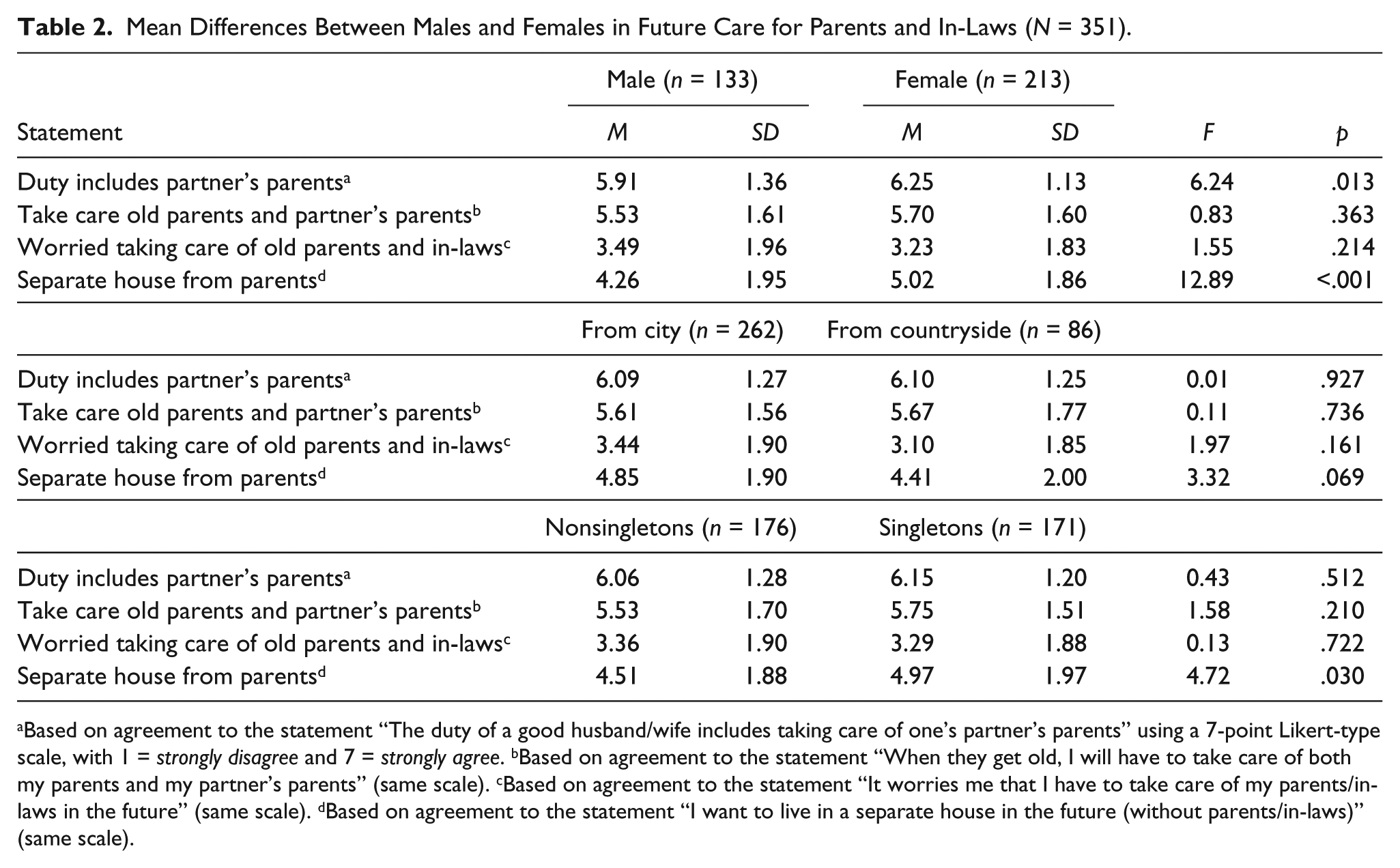
Based on agreement to the statement “The duty of a good husband/wife includes taking care of one’s partner’s parents” using a 7-point Likert-type scale, with 1 = strongly disagree and 7 = strongly agree. bBased on agreement to the statement “When they get old, I will have to take care of both my parents and my partner’s parents” (same scale). cBased on agreement to the statement “It worries me that I have to take care of my parents/in-laws in the future” (same scale). dBased on agreement to the statement “I want to live in a separate house in the future (without parents/in-laws)” (same scale).
Between students coming from the city and the countryside, we found no differences for any of the statements. For sibling status, we found a significant difference for the statement “I want to live in a separate house in the future (without parents/in-laws),” with the singletons expressing a higher agreement with this statement than those with a sibling, but no differences were found for sibling status for the other statements.
Discussion
This study set out to investigate how young people of the one-child generation see their role as future caregivers for their parents and their future parents-in-law. Regarding their own parents, we found that participants had fairly similar ideas, regardless of their gender, urban or rural provenance, or sibling status. Virtually all interviewees in the qualitative part of this study agreed that they had some responsibility toward the future care of their parents, whether emotionally, financially, or practically.
The finding that the female students felt equal responsibility toward their parents as the male students, echoes the findings of Deutsch (2006) and Liu (2008), and might be the result of the emotional conditioning of girls by parents, as found in previous research. Both Croll (1995) and Fong (2004) have argued that in the absence of male offspring, parents may have raised their singleton girls as substitute sons, with the expectation that the daughter would fulfill the filial duties normally expected of a son. In this sense, Fong (2004) found that singleton sons and daughters received equal emotional and financial parental investment. The fact that our respondents attended relatively expensive (semi)private universities might lend further credit to this interpretation.
The finding in the interviews that rural participants were more likely to mention that they would like to live with (or close to) their parents in the future, also echoes the findings of Deutsch (2006), as do our interview findings concerning singletons and nonsingletons. In both our sample and her sample, rural students (all with siblings) were most likely to anticipate coresiding with their parents, followed by urban singletons, and urban students with siblings. Surprisingly, though, we did not find this in the quantitative survey, where we found no differences between urban and rural students for the question on coresidence, whereas singletons were found to be more likely to want to live in a separate house from their parents and in-laws than the nonsingletons. These quantitative findings are in line with the findings of Zhan (2004). Further research into this question with a larger rural sample could be suggested.
In terms of their duties toward their future parents-in-law, large differences were found, especially between the male and female students. Both in the in-depth interviews and in the survey, we found that the females were significantly more likely to agree that they should take care of their future partner’s parents than the males. Also in terms of practical solutions toward future care for their future parents-in-law, the female students we interviewed had much clearer ideas about such care than the male students, even if both groups had similar ideas about the care for their own parents. In both parts of the study, therefore, it seems that there is a small, but persistent, group of male students that still adhere to the traditional model of filial piety, as described in the introduction. Unexpectedly, this difference does not seem to stem from sibling status, or urban or rural provenance.
This finding is both surprising and worrying. It is surprising in the sense that a significant minority of the young men in our sample still seems to adhere to the traditional notions of filial piety, despite the fact that the influence of traditional values has been declining in the past decades (e.g., Zhan & Montgomery, 2003). At the same time, this finding echoes the findings of Hu and Scott (2016), who found that young women born after 1978 were significantly less likely to support the idea of patrilineality than any other group, including young men born after 1978. This finding is worrying in the sense that it would put the future care for the female students’ parents at risk, even if the young women in our study had very clear ideas about the future care of their own parents. In addition, as the male and female students disagreed about the responsibility to care for the girl’s parents, this could potentially create strain on future marriages. Caring for two pairs of aging parents with a reluctant partner would be a major source of stress, especially for the women, who are likely to be taking up most of the practical care. This issue should be addressed on a policy level as soon as possible.
The finding that several of the male students had not yet considered the issue of their future partner’s parents in the qualitative interviews, can be interpreted in two ways. On the one hand, it could be argued that it means that their own parents have never raised this issue with them, either for selfish reasons similar to those evoked above for the girls’ parents, or for cultural reasons, perpetuating the Confucian patriarchal model. On the other hand, it is also possible that young men simply develop ideas about the future later than young women, as shown in previous research (e.g., Nurmi, 1991). Considering the findings in the survey, however, where the male students strongly agreed to the statement “The duty of a good husband/wife includes taking care of one’s partner’s parents” (5.91 on a scale of 7), we tend toward the second interpretation, despite the finding that they differed significantly from the female students, as discussed above.
The fact that we did not find any differences for the survey statement: “When they get old, I will have to take care of both my parents and my partner’s parents,” while we did find a significant difference for the statement “The duty of a good husband/wife includes taking care of one’s partner’s parents” is surprising. It seems that the young men in the study realized they would have to take care, even if they did not feel this was their duty. In the qualitative interviews, this difference did not appear. Further research could be suggested.
Several limitations to this study should be mentioned. First of all, the students in this study were relatively rich, and might therefore not be representative for Chinese young people in general, even if our findings echo the findings of previous research. Similarly, as we did not systematically ask about the family status of the participant during the interviews, and as the family status groups in the survey were relatively rough, few conclusions could be drawn about the influence of this factor. Further research with nonurban and less wealthy target groups could thus be suggested. Third, participants in the study were still relatively young. Although some of the male students might have felt that they did not need to take care of their future parents-in-law, most of them had not met their future wife (and her parents) yet. In this sense, the caveat to the study of Deutsch (2006) is equally valid here: This research studied intentions for future filial care, but plans can change. This study does, however, provide an insight to the filial intentions of the one-child generation, with important findings for both researchers and policy makers.
Conclusion and Implications
For policy makers and practitioners, it is, first of all, good news that young people seem to accept at least a minimum of responsibility toward the care of their own parents, even if the obligation of such care is enshrined in the Chinese constitution, as mentioned above. On the downside, however, the future care for the female students’ parents seems at risk, as the men in our study were significantly less likely to accept responsibility for the care of their future parents-in-law than the women. This should be addressed urgently at a policy level, as it puts large groups of future elderly at risk, is likely to put strain on future marriages, and puts undue burden on women. Failure to address this issue is likely to result in higher divorce rates, less availability of women in the future work force, and larger numbers of future neglected or impoverished elderly to be taken care of by the state. Practitioners in elderly care should prepare for such an eventuality, whereas those in marriage counselling should made aware of the issue. Finally, the finding that most students in our sample intend to live in a separate house from their parents and in-laws is of note for policy makers, as it will increase the need for appropriate housing capacity. Follow-up research could be suggested with the same target group in the future, researching how their intentions in this study match with their future reality.
Footnotes
Declaration of Conflicting Interests
The author(s) declared no potential conflicts of interest with respect to the research, authorship, and/or publication of this article.
Funding
The author(s) received no financial support for the research, authorship, and/or publication of this article.
