




Abstract
Confidence in political institutions has reportedly been in decline over the past 40 years. Yet there is heterogeneity in how this phenomenon has manifested across countries, political institutions and people with different partisan commitments. The increasing antagonism towards opposition partisans – known as affective polarization – may hasten this decline, undermining types of institutional confidence that were perceived to be more durable. This article investigates the effects of affective polarization across non-partisan institutions in Canada. We contend that stronger levels of affective polarization that produce lower levels of trust in partisan institutions may spill over to other non-partisan institutions because polarized individuals may perceive all institutions as reflecting government priorities. Using data from the 2004–2021 Canada Election Studies, we find evidence that spillover is happening to some degree, but that these effects are driven by specific party dynamics and government/opposition status. Although those who support the opposition party report less confidence in non-partisan institutions than government supporters across both main parties, Conservatives who are affectively polarized have lower institutional trust overall, regardless of whether their party is in government or opposition.
Affective polarization and institutional trust in Canada
As populism increases and traditional markers of civic engagement weaken, western liberal democracies appear to be under threat (Algan et al., 2017; Keefer et al., 2021). Although a general commitment to democratic norms remains (Van Ham, 2017), a rise in polarization amongst political parties and their partisans, known as affective polarization (Iyengar et al., 2019), has fuelled both anti-government rhetoric and an antipathy towards outpartisans, highlighting the possibility that more extreme forms of partisanship and confidence or trust 1 (or a lack of) in government may be linked (see Citrin and Stoker, 2018; Cook and Gronke, 2005; Hetherington and Rudolph, 2015). An acceleration of hostility towards people with different partisan preferences could theoretically hasten a decline in political trust, especially when one’s own party is not in power.
Research in the United States (US) suggests that this type of polarization is weakening the fabric of democratic representation and has consequences for the acceptance of basic democratic norms (Dawson and Krakoff, 2024; Iyengar et al., 2019). However, American political trends should be exported with caution as other states vary in their institutional and political preference structures. Canada, although certainly influenced by American political trends, currently does not display the same depth of decline in institutional confidence (Environics Research, 2022), nor the same ideological extremism (Johnston, 2023; Merkley et al., 2020), yet it is not immune to either (Kanji, 2002; Nevitte and Kanji, 2003). Canada is still considered a ‘high trust’ country (Bridgman et al., 2022; Dalton, 2017) but questions remain about the extent and durability of that trust. We have very little sense of: (a) the overall levels of Canadians’ confidence across political institutions over time; (b) whether partisanship plays a role in trusting attitudes; and (c) how these have changed over time. Consequently, to understand if Canadians’ confidence in institutions is influenced by affective polarization, we have to walk back the conversation on institutional trust in the context of a country that shares many liberal market, commercial features and cultural touchpoints with the US, but also institutional and party system elements of Westminster democracies that could insulate it from the more harmful effects of polarized partisanship (see Johnston, 2023). Even if Canada looks, on the surface, to be more resilient to this global trend in declining institutional trust, that relative durability may break down if affective polarization increases.
We take up these three challenges. In this article, we consider Canadians’ levels of trust in government institutions that have traditionally been thought to enjoy some protection from the volatility of public opinion because of their non-partisan nature (see Dalton (2017) and Schnaudt (2019) for studies of non-partisan institutions). Studies of institutional confidence tend to look at trust in the political executive and legislature because of the direct democratic link to citizens through elections (Citrin and Stoker, 2018). We argue, however, that looking beyond these institutions of government gives us a more fulsome picture of institutional trust. We distinguish between three types of confidence in political institutions: (a) government with a partisan dimension (the federal government); (b) non-partisan political institutions (courts, law enforcement, election administrators and the civil service); and (c) public political bodies that play a role in checking government (the media) (see Dawson and Krakoff, 2024; Grimmelikhuijsen and Knies, 2017). Second, we focus on understanding this dynamic by contrasting citizens who identify as affectively polarized and display a measure of hostility towards outpartisans with those who do not. This allows us to consider whether affective polarization is associated with less political trust, as well as whether polarization ‘spills over’ from the traditional highly political institutions of government to non-partisan ones thought to be insulated from shifting partisan winds. We test these relationships using the Canada Election Study (CES) data from six election cycles (2004 to 2021 2 ; Blais et al. 2023a; Gidengil et al. 2023; Fournier et al. 2023a, 2023b; Stephenson et al. 2023a, 2023b) because we anticipate the expression of partisan affect to be maximized during election periods.
We find evidence that the spillover referenced above is happening to some degree, but for some partisans more than others. Although we expect that affective polarization will be felt more strongly amongst partisans who are not aligned with the party in government, we also observe that these effects are largely driven by specific party dynamics, such that Conservatives who are affectively polarized have lower trust overall, regardless of whether their party is in government or opposition. Second, we find variation in trust patterns across institution types. Canadians who are affectively polarized and support the opposition report less confidence in non-partisan institutions than supporters of the governing party. However, the magnitude of these effects is somewhat muted for non-partisan government institutions. We conclude that affective polarization matters to institutional confidence, but it is dependent on who is doing the trusting and the object of that trust.
This research extends the study of institutional trust by considering the potential for spillover from partisan institutions of government to non-partisan and public institutions. Second, it highlights the importance of considering affective polarization as a way to explain changes in the composition of trust over time. Finally, it extends the literature on institutional confidence to a case wherein trust has historically been high, but where a cross-border contagion effect is possible because of a shared media environment and a strong cross-border informational flow. As hostility among political elites paves the way for greater polarization in the electorate, scholars should continue to investigate both the short- and long-term consequences for trust in political institutions.
Declining institutional confidence
Defining trust and its scope, when applied to political regimes, has drawn considerable attention in social science and behavioural studies (Citrin and Stoker, 2018; Dalton, 2005; Hardin, 2013; Uslaner, 2000; Zmerli and Newton, 2013). Trust is often defined as a relational predisposition or expectation (Hardin, 2002) when there is a risk associated with a relationship between two or more interdependent people/institutions (Bachmann, 2011). Although ‘generalized trust’ is understood as trust in ‘most people’ (Uslaner, 2012), political trust, more specifically, refers to the evaluative component of citizens’ orientation towards political systems (Citrin and Green, 1986; Easton, 1975). Not to be confused with short-term disaffection that may prompt attempts to remove incumbent governments from office, trust stems from a longer-term connection to political legitimacy, stability and institutional performance (Hooghe et al., 2015).
Yet within institutional trust lies a considerable amount of heterogeneity. There is an important distinction to be made between trust in institutions and trust in the (partisan) regimes that control them (Citrin and Stoker, 2018). Trust can be specific to office holders (Hardin, 2013), or more diffusely applied to the institutions within a regime, the principles that underlie it or to a historical notion of the state that may or may not be reflected at present (Citrin and Stoker, 2018; Easton, 1975). Like many political phenomena, it may be more useful to consider trust on a spectrum. Cook and Gronke (2005) suggest that the underlying concept behind trust operates on a continuum ranging from trust at one end to distrust at the other, with ‘skepticism’ (or mistrust) lying in between. Similarly, lack of trust or mistrust may simply suggest a cautious attitude towards political and social events or change that might not be the same as active distrust (Cook and Gronke, 2005: 789; Lenard, 2008: 313). Indeed, this type of scepticism can operate in a healthy democratic culture, particularly where it promotes political interest and demand for accountability. Furthermore, perceptions of trust may also fluctuate when variations in wording are introduced, such that measuring ‘trust’, ‘mistrust’, ‘distrust’ and ‘trustworthiness’ may produce outcomes that are not directly comparable (Fisher et al., 2010; Hardin, 2002).
Nonetheless, trust functions as an important barometer of public satisfaction (Keele, 2005: 884). It is correlated with higher levels of economic growth (Kaasa and Andriani, 2022), a greater likelihood of civic cooperation (Almond and Verba, 1963), satisfaction with electoral processes (Blais and Gélineau, 2007) and greater compliance with law and governmental policies (Hetherington, 2005). Social capital theory argues that social trust promotes a set of social attitudes that strongly correlate to civic engagement and create a ‘foundation for stable and effective democratic government’ (Zmerli and Newton, 2008: 706). Higher degrees of trust tend to enhance the working of democracy by reducing partisan gridlock and the potential for a climate of public grievance. Institutional trust also contributes to greater accountability amongst office-holders as citizens in high-trust environments are more likely to be aware of political change and more responsive to it (Van Der Meer and Zmerli, 2017).
Determinants of trust and the role of partisanship
There is a robust literature that looks at the determinants of political and institutional confidence. Uslaner (2000) takes the view that generalized trust is a product of early socialization and maps to greater civic engagement. Hardin (2013) depicts trust as emerging through specific life experiences that may colour perceptions of institutions. Some studies produce evidence that trust levels can take on a biological or physiological character (Merolla et al., 2013; Ojeda, 2016). Although these underlying dimensions may still have strong predictive power, some have suggested that a generational change has occurred, producing downward pressure on political trust in most developed democracies (Dalton and Shin, 2014; Norris, 2011).
Political trust has been strongly linked to socio-demographic factors that have produced long-standing and often negative interactions with particular areas of government. Race (Abrajano and Alvarez, 2010) and gender (Alesina and La Ferrara, 2002) have both been associated with lower level of trust (though findings are mixed on the latter). Similarly, lower levels of education, income and political interest produce lower levels of trust, though individuals with lower education are prone to trusting individual political personalities more – perhaps correlated with greater likelihood of supporting populist politics (Hetherington and Rudolph, 2015). Religious attendance is correlated with greater confidence in institutions, which is related to an overall virtuous circle with institutional trust (Mason, 2018a). Personality traits, such as extroversion, agreeableness and self-confidence, have been found to predict greater trust in government (Mondak and Halperin, 2008).
Another set of explanations relies more on direct experience with government and structural context. Citrin and Green’s (1986) list of the main precursors to confidence in institutions includes several performance-based explanations including policy, performance of party in power, partisanship and personality of leaders. Financial performance indices (Keele, 2005: 881), as well as egocentric measures of financial well-being, correlate with institutional confidence. Administrative performance can reduce trust if services are not delivered competently (Kampen et al., 2006). Nevitte (2002) advances the argument that increases in wealth and shifts in the source of that wealth, alongside technological enhancements and increases in speed of communications – all of which have been heightened since Nevitte’s writing – changed the orientation of citizens’ values and views of government.
Political polarization and institutional confidence
The observed acceleration of partisanship strength in the past 20 years suggests that there is value in investigating the relationship between partisanship and institutional trust in greater depth. As Valgarðsson et al. (2025: 3) note, even within a single regime, there is the potential for variation in trust between institutions of representation (which tend to take on a partisan character) and institutions of implementation (which may take on a more politically neutral character) owing to the ways in which the public views the partisan character of the institution and where its ‘loyalties’ lie. If evaluations or views of government are influenced by partisanship, then political polarization and other heightened forms of partisanship may have strong explanatory value (Hetherington and Rudolph, 2015). Polarization captures the extent of opposition along some theoretical pole (such as the left–right dimension) by voters, as well as a process of becoming more distanced or opposed over time. This phenomenon has been observed to be growing across western democracies, though there is some disagreement about whether it is reflected in the citizenry to the same extent that it is among political elites (Fiorina and Abrams, 2008; Iyengar et al., 2019). Scholars have differentiated between ‘ideological’ and ‘affective’ polarization, with the former turning on differences in policy views, and the latter focusing on the quantification of the emotional distrust of outpartisan groups (Iyengar et al., 2019).
This antipathy towards opposing partisans is often referred to in terms of its affective dimension, with individuals who carry strong partisan ties being less willing or unwilling to engage with partisans of other parties and more willing to describe them only in negative terms (Iyengar et al., 2019; McCoy 2023). This dimension of affect is straightforward to understand in a two-party system, where partisan ‘enemies’ are easily understood. However, multiparty systems present a challenge to understanding affective polarization for two reasons. First, parties are often located in known proximity to other parties on traditional and salient policy dimensions. For a partisan, this creates a sense of distance between some parties that may be stronger than the distance between others. Second, as the government in office rotates between political parties, the relationships between parties change, particularly if coalitions are formed or members of other parties are included within institutional roles such as cabinet. Wagner (2021: 2), whose measure we adopt, has argued that affective polarization in multiparty settings should be defined and assessed as the extent to which politics is seen as divided into two distinct camps, which relates to institutional features such as the size of parties and composition of government.
Political polarization presents a challenge and opportunity to expand on the existing institutional confidence literature. Citrin and Stoker (2018: 56) note that individual-level social trust tends to fluctuate less over the short term and therefore cannot account for the sharp declines in political trust evident in several countries. Yet the evolution towards a more polarized political climate in many countries may have hastened the decline in political trust. There are, of course, prima facie arguments for taking partisanship more seriously. Cook and Gronke (2005) observed that long-standing partisan and ideological commitments are predictors of institutional confidence. Opposition partisans, or those who do not support the party in government, are generally thought to be less trusting of government (Citrin and Stoker, 2018), which is magnified when there is a change in the party in power (Keele, 2005). 3 Our first hypothesis follows from these observations:
H1: Among opposition partisans, higher levels of affective polarization should produce lower levels of confidence in partisan government institutions. (The ‘partisan’ hypothesis)
To be clear, we expect that partisan effects on trust will be obvious for institutions that take on a partisan or representative character (Rothstein and Stolle, 2008). Further, these effects should be amplified in the context of affective polarization. But do citizens distinguish between institutions of representation and those that implement the government’s authority (e.g. the police, the courts or the civil service), or do some citizens presume that all aspects of the government are run by the party in power? Schnaudt (2019) suggests that this distinction between types of political institutions is one worth investigating. General measures of trust in government may be composed of separate strands of trust: one in the partisan institutions of government, another in the institutions of law enforcement such as the police and the courts, and potentially others that capture functions like policy implementation (e.g. the civil service) or government’s connection to the public (e.g. the media, particularly in environments with strong public broadcasters). Linking this to the influence of affective polarization, we argue that those who are affectively polarized against the government may react to perceived existential or system-wide threat and view even unelected institutions of government as ‘team members’ of the government of the day (Brewer, 1999). In this view, voters may think that political parties ‘capture’ the bureaucratic institutions of the state and infiltrate them with partisan actors (indeed, this may be true in some democracies). Therefore, if an affectively polarized voter perceives the party in government (which is not of their own political stripe) as hostile to their own political and personal objectives, then they might assign the same partisan characteristics to the other institutions of the state. This suggests a second testable hypothesis:
H2: Among opposition partisans, higher levels of affective polarization should produce lower levels of confidence in non-partisan government institutions. (The ‘spillover’ hypothesis)
We focus our attention on institutional confidence, with an important addition. We disaggregate our measure to consider three different types of institutions: (a) government with a partisan dimension (the federal government); (b) non-partisan institutions of implementation and enforcement (courts, police, election administrators and the civil service); and (c) public political bodies (the media). These have been elsewhere characterized as institutions of order and institutions of opposition (Cook and Gronke, 2005) or those of representation and implementation (Rothstein and Stolle, 2008), and we argue they should be treated separately since their relationships with citizens differ.
We test these hypotheses in a context that has historically been less dominated by aggressive partisanship. Canada is a useful test case for two reasons. First, recent studies of polarization in Canada have documented that partisan sorting has occurred (Johnston, 2015, 2023; Kevins and Soroka, 2018; Merkley, 2023), but that the nature of polarization is less extreme than observed in some other contexts (Merkley, 2021). The Canadian context is therefore one that mirrors some of the ideological differentiation that has occurred in the US without some of the same social consequences. Second, although the observed effects of partisanship are not as strong in Canada as they appear to be in the US, we observe that the Canadian political environment may be ‘contaminated’ to some degree by the heightened partisan discourse in the US (Collins, 2013). This is reflected in the adoption of various campaign techniques and discourses – either replicating American political narratives or explicitly rejecting them – by political leaders in Canada. Additionally, there is now ample evidence to suggest that elite-driven politics is exacerbating existing divides, ending Canada’s conventional brokerage model of parties as ‘big tents’ in which a range of supporters are welcome (Johnston, 2023: 391).
Data and methods
We test our hypotheses on data from the 2004–2021 CES (excluding 2006 since our dependent variable questions were not asked that year). Full details about the waves, sample sizes and modes of contact are available in the Supplementary Information File (SIF). Importantly, there was alternation between parties in government in this period, which allows us to capture the phenomenon of spillover among two different partisan groups – the Conservatives (in power from 2006 to 2015) and the Liberals (in power from 2004 to 2006 and 2015 to 2021 and beyond). The CES surveys capture representative samples of voting-age Canadians using a mix of probability and non-probability studies, conducted by telephone or through online panels. All analyses below are weighted to improve representativeness and adjust for differences in sample sizes. Each of the CES surveys during this period feature a quasi-consistent battery of questions about levels of confidence in a number of political and public institutions (see SIF Table 1). Of the six political institutions under study here, only four (federal government, civil service, police and media) are asked in all waves of the study. 4 The others were asked from 2008 to 2021 (Elections Canada) or from 2011 to 2021 (courts) only. 5
Measuring trust
Our dependent variables capture confidence in political institutions, using a format similar to the General Social Survey (i.e. ‘Please indicate how much confidence you have in the following’ (the federal government, the civil service, the police, the media, the courts, Elections Canada)). Respondents are asked to place themselves on a 4-point scale ranging from ‘A great deal’ to ‘None at all’. We analyse responses to each institution separately in the analyses below. However, since the literature has documented that trust can be at least partially informed by general predispositions, we also explored how much the responses to the variables relate to each other. We created a scale from all six measures (federal government, courts, civil service, Elections Canada, police, media); the Cronbach’s alpha score is .7451, and the average interitem covariance is 0.188. Factor analysis shows that all items load onto a single dimension (eigenvalue 1.73) at 0.41 or greater. Therefore, there does appear to be some underlying consideration that unites the measures. Figure 1 displays mean trust scores for these institutions over time using a combination of CES (1997-2021) and Democracy Checkup data (2020, 2022-2024) (Blais et al. 2023b, 2023c; Harell et al. 2022, 2023, 2024, 2025). We can observe that, on balance, trust in the police, the courts, Elections Canada (from 2008 onwards) and the civil service is comparatively higher than trust in the federal government and the media.
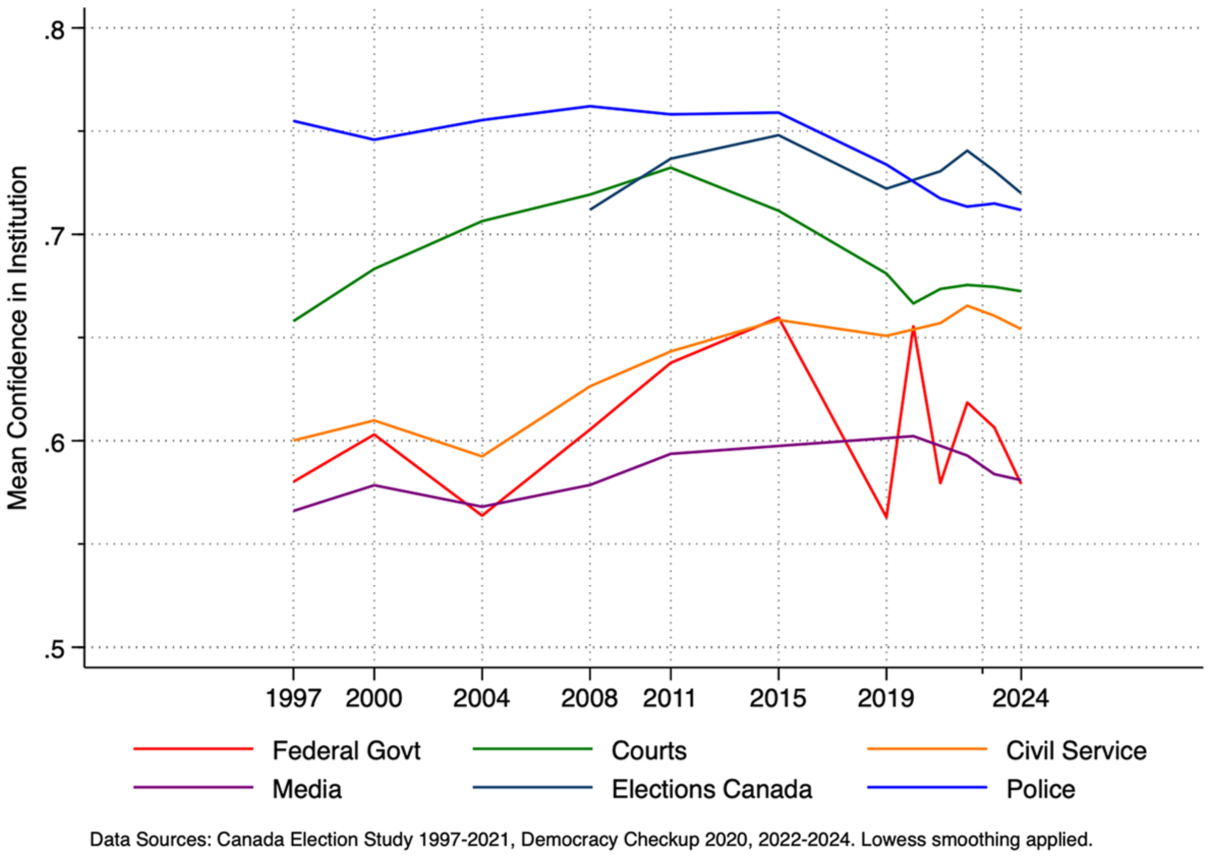
Confidence in institutions over time (1997–2024).
Although we may observe heterogeneity in levels of trust across institutions, we recognize that they are not necessarily fully independent of one another (Valgarðsson et al., 2025). Measuring trust in this collection of institutions may explore different theoretical dimensions of trust by tapping into different relationships that citizens have with government or public institutions. For example, trust in the federal government may reflect a composite of trust in the broader institutions of government and ‘how government is functioning’ but may be overshadowed by the partisan character of the government in office. Four of our institutions represent non-partisan enforcement and implementation dimensions of government (courts, police, the civil service and Elections Canada). Unlike other jurisdictions where the courts and electoral management body are highly politicized and made up of partisan appointments, Canada has maintained a non-partisan appointment structure that has largely produced politically neutral bureaucratic institutions. Still, there is always the possibility that citizens will perceive a partisan dimension to these offices, even if unsubstantiated. Our final institution – the media – is an institution of opposition to government (Cook and Gronke, 2005). Although the relationship between the government and media has not been as fractious in Canada as elsewhere, we would observe that even media that are not overtly antagonistic to government for partisan reasons still functions as an oppositional check on the government. As an institution which exists (in part) to interrogate the actions of government, media may not experience as much spillover from any decline in trust towards government, unless it is perceived to be broadly supportive of the government of the day (as some partisans have characterized Canada’s public broadcaster, the CBC).
Measuring affective polarization
Our primary explanatory variable of interest is affective polarization, which we calculate and operationalize using Wagner’s (2021) approach. This formula considers evaluations of all the parties (using the CES feeling thermometer scores, which run from 0 to 100) in a multiparty system and weights them for vote share. 6 This recognizes that evaluations of small parties are less likely to be indicators of someone’s level of polarization than evaluations of large, competitive parties. The Wagner formulation also considers the difference in weighted average party affect compared to the weighted average party affect for each respondent. Theoretically, the measure runs from 0 to 50; in our data, values run almost the full range of the scale, with the maximum never falling below 47 in any year. The mean value of affective polarization across all years is 21.01, ranging from 16.96 in 2004 to 26.30 in 2019. In our sample, approximately 17.4% of the sample would be classified as having ‘very high’ affective polarization (18% of Liberal partisans, 27% of Conservative partisans and 22% of New Democratic Party (NDP) partisans).
Looking at the distribution of the affective polarization measure over time in Figure 2, there is a clear upward trend that is consistent with the general trend in polarization globally. In particular, we observe a considerable and sustained increase in levels of affective polarization from 2015 to 2019 and 2021. Just as this period witnessed strong ideological and partisan tensions in US politics (Mason, 2018b), so too did Canada see some increases in social sorting procured by partisan disagreement (Kevins and Soroka, 2018), though the trend was more moderate.
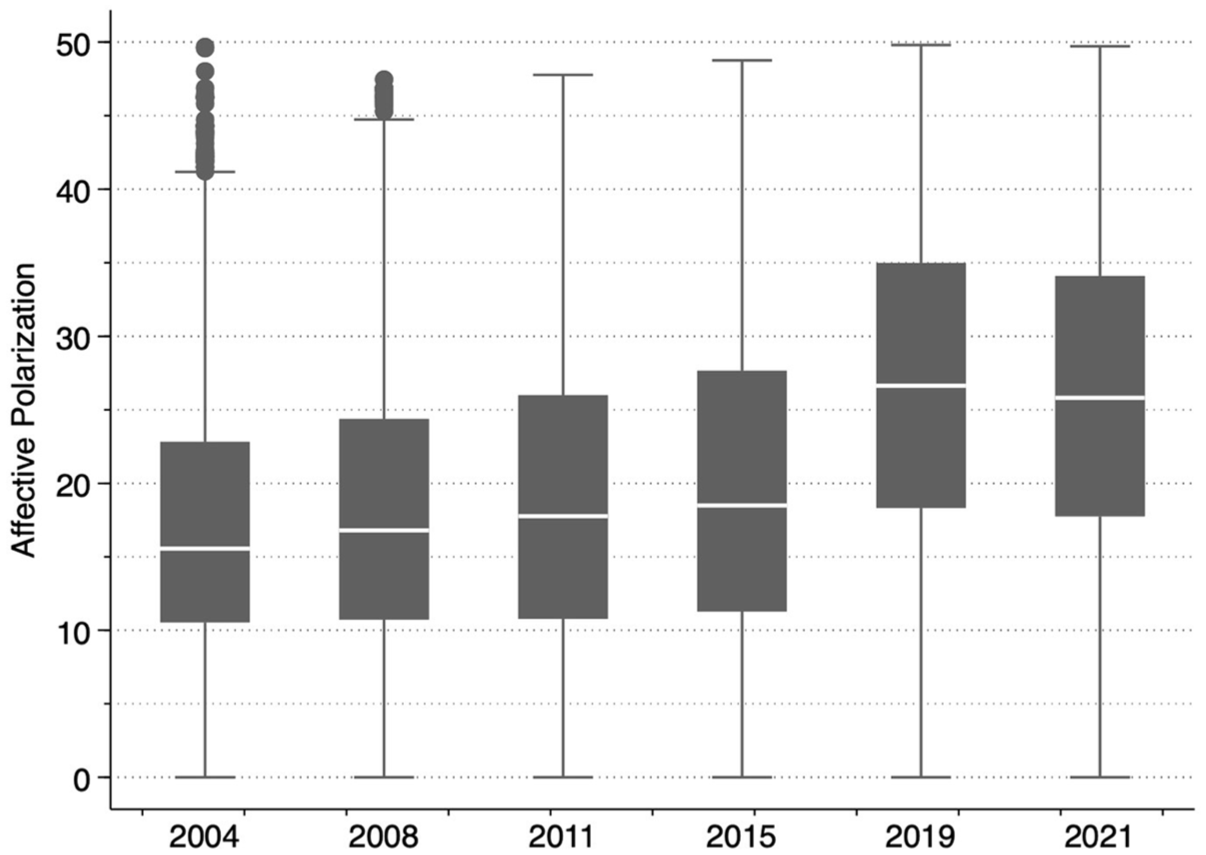
Affective polarization over time.
We can also look at the affective polarization of partisans of the major national parties (Figure 3). Our data shows that there has been an increase in affective polarization for all partisans, but there is some variation between the partisan groups, such that right-wing Conservatives (CPC) and the left-wing NDP supporters are both more affectively polarized than Liberal partisans (the most centrist major party). In the analyses below, we focus on Liberal and Conservative partisans as those are the only two parties which have held government, and are each other’s natural opposition in the party system and the legislature. Because we expect government partisans to have a natural pro-government bias and opposition parties to have a natural anti-government bias, we developed a measure for incumbent partisans that indicated whether someone supported the winning party in the election or not. In practice, this identifies Conservative partisans for 2008 and 2011 and Liberal partisans in other years. We also developed a measure for opposition partisans, which identifies the inverse. 7 Note that the 2008, 2011, 2019 and 2021 elections did not produce a change in the governing party. The 2015 election, however, brought about a sizeable change from a majority Conservative government to a majority Liberal government. Hence, interpreting effects for incumbent and opposition partisans in that year should be done with care.
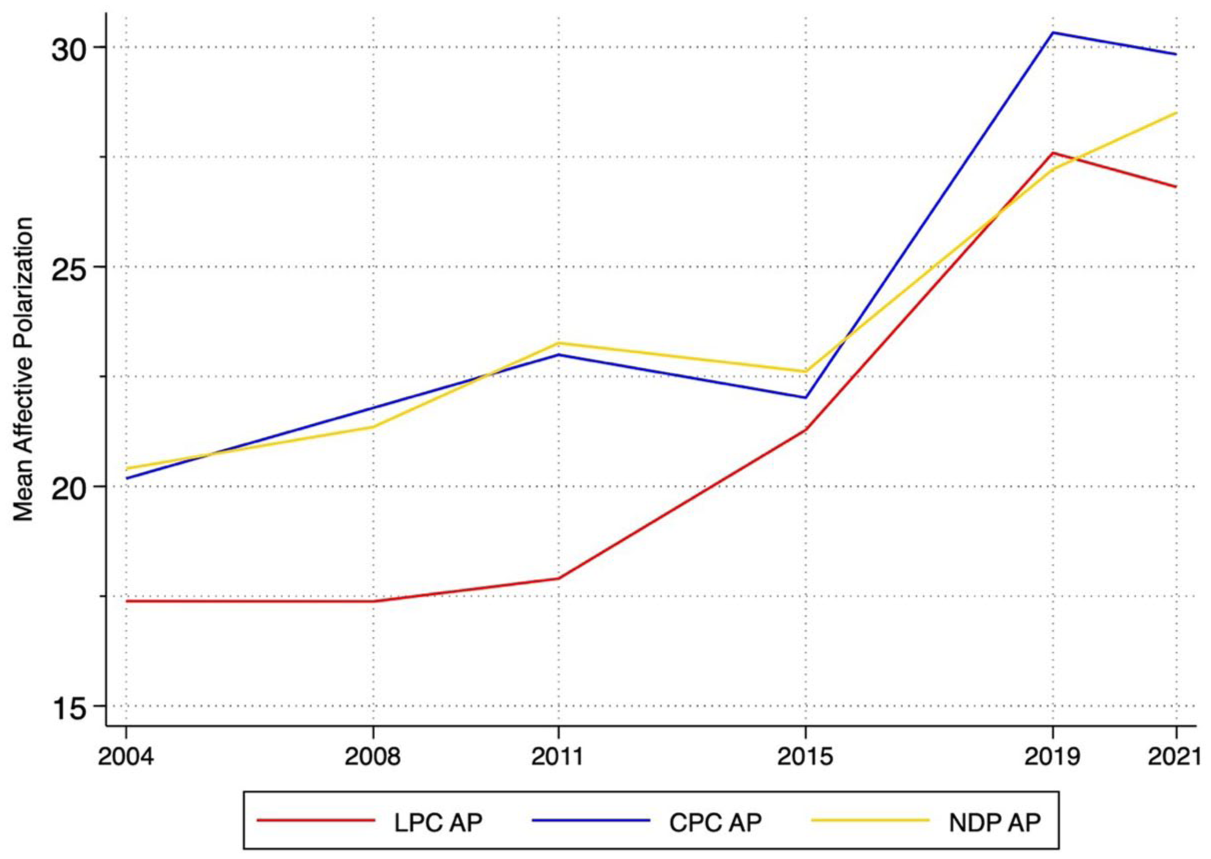
Affective polarization over time.
Control variables
We coded a number of established predictors of institutional trust in Canada as control variables: gender (female=1), education (university degree or greater=1), age (continuous), religious importance (4-point scale, from not important at all to very important), political interest (0–10 scale), political ideology (0–10, left-right) and economic outlook (retrospective egocentric and sociotropic evaluations, -1 to 1, where 1=better off and -1=worse off). Finally, we include a measure of satisfaction with democracy to account for the possibility that general satisfaction might support overall institutional trust (a 4-point scale from not satisfied at all to very satisfied). 8
Results
To determine whether polarized partisan attitudes influence trust in institutions, we plot levels of institutional trust over time for incumbent and opposition partisans who scored high on affective polarization (+1 standard deviation above the mean) (see Figure 4; grey shaded area represents Conservative government, unshaded indicates Liberal government). Across the six institutions we consider, four (federal government, Elections Canada, courts and media) show a clear downward trend in confidence among affectively polarized opposition partisans over time. In the early years of our sample, incumbent partisans display lower levels of trust than opposition partisans for certain institutions, including courts, the electoral management body and the media. Given that the confidence questions are asked in post-election portions of the CES, we suspect respondents are thinking about the party that would form the next government. 9
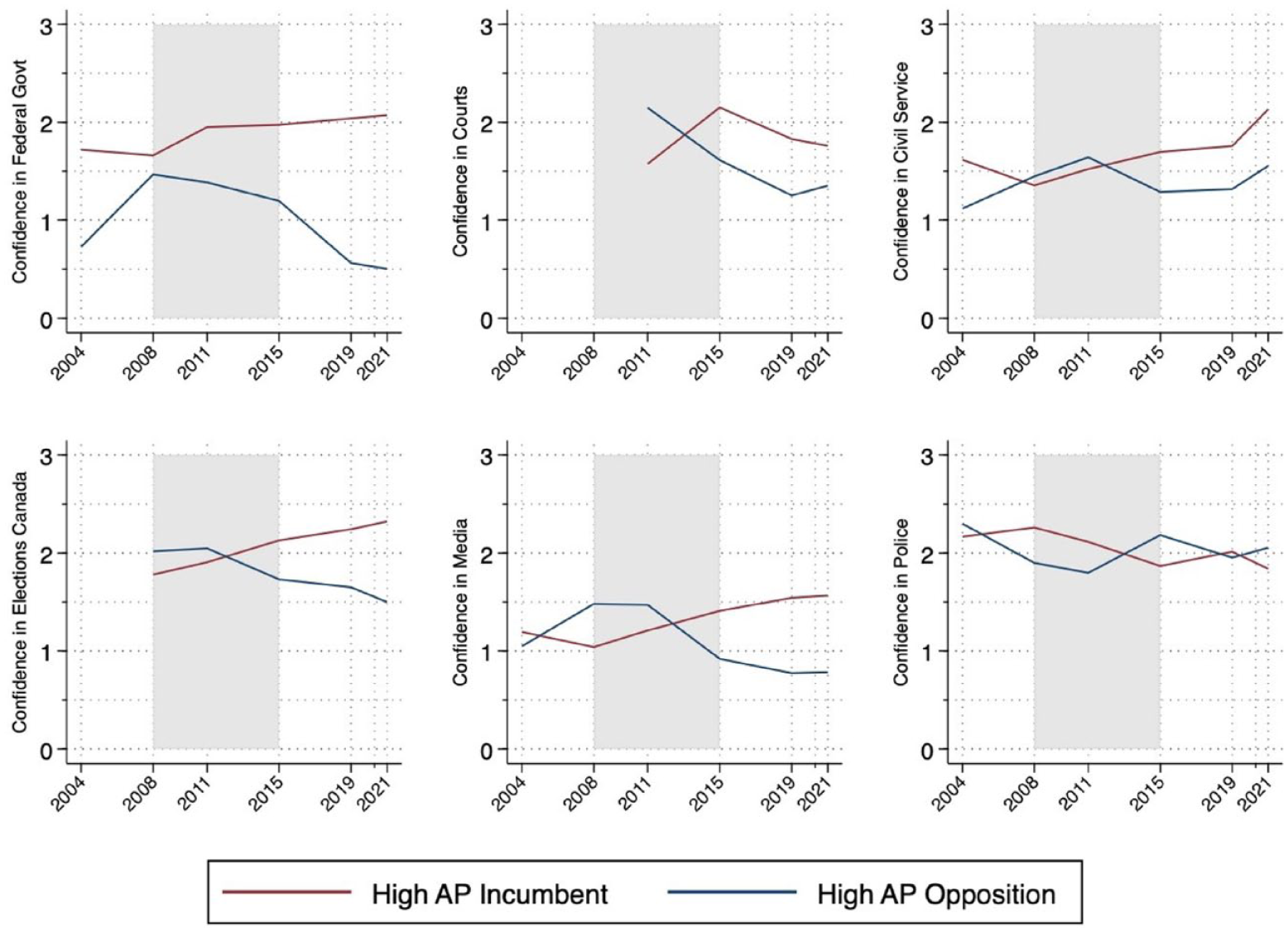
Confidence in institutions over time (incumbent and opposition high (+1 standard deviation) AP).
We also observe some distinctly partisan trends. In the years where the incumbent Liberals won the election (2004, 2015, 2019 and 2021), affectively polarized Liberal supporters exhibit high trust in government institutions (except for the police). In the years where the incumbent Conservatives won (2008 and 2011), trust for institutions among their supporters appears lower than that of the opposition Liberals for all institutions (with the exception of the police). 10 Interestingly, for institutions other than the federal government, where we would expect partisan sorting, there appears to be a general partisan split with Conservatives less trusting of institutions than Liberals.
Overall, these results suggest that there may be an increasing trend in attitude polarization even for non-partisan institutions that are typically thought to be somewhat insulated from polarized politics, suggestive of ‘spillover’, with two exceptions. First, confidence in the civil service has increased over time for those who are affectively polarized, regardless of whether they hold incumbent or opposition status (though the trend is more muted for those in opposition). Additionally, confidence in the police appears to be fairly steady over time amongst the affectively polarized. This is particularly surprising given the recent narrative in both Canada and the US about mistrust in the police; however, the trend may be explained by offsetting partisan elements of support for policing or that media narratives around trust in law enforcement have yet to reach public opinion in a systematic way.
Multivariate results
To account more fully for differentiated patterns in institutional trust, we ran multivariate analyses (ordinary least squares (OLS)) with trust for each institution as our dependent variables. Recall our expectations that affective polarization by opposition partisans will have a negative effect on trust in institutions (H1) and that affective polarization will lead to spillover effects for trust in non-partisan institutions (H2). Although we are primarily interested in the dynamics among opposition partisans, we also ran the models for government partisans for comparison. Figure 5 shows the predicted levels of trust in institutions across the full range of affective polarization scores (0 to 50) by government/opposition status (full results in Table 2 of the SIF). Considering opposition partisan affective polarization (the left panel), we can observe that, as affective polarization increases, trust in institutions decreases for all institutions, with the exception of the police (where it has a slightly positive effect). The downward slope for trust in the federal government is on a significantly steeper decline than the other institutions and is more in line with levels of trust in the media, which has received considerable criticism (fairly or not) for having its own political inclinations. 11
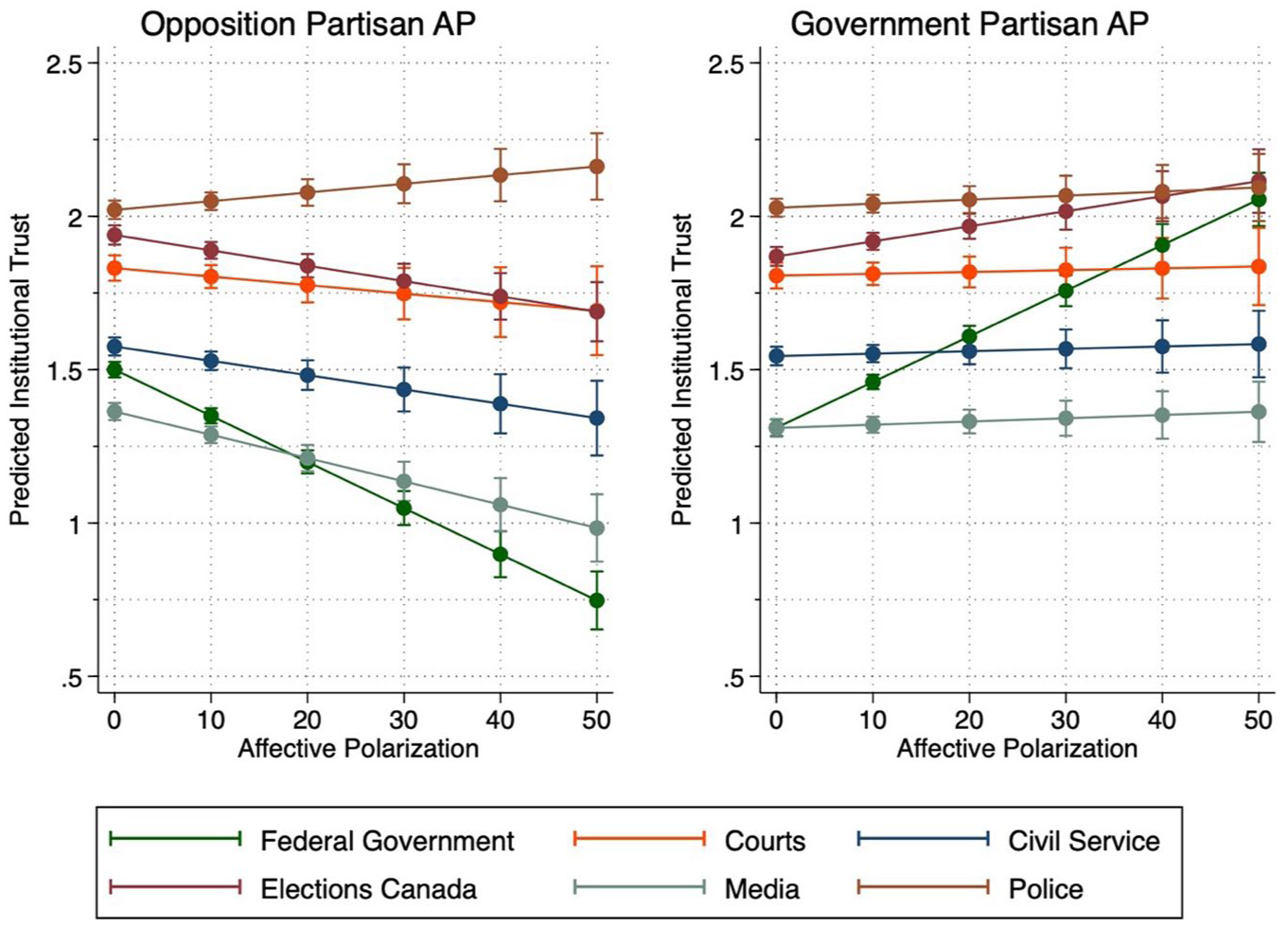
Predicted institutional trust by affectively polarized.
These findings contrast starkly with the results for affectively polarized government partisans (right panel in Figure 5). The differences support our intuition that it is among opposition partisans that negative affect might influence trust in institutions. As expected, trust in the federal government among affectively polarized government partisans has a steep upward slope. The only other significant effect is for trust levels in Elections Canada, which increases as government partisans become more polarized. One explanation may be an expectation amongst government partisans that the electoral management body is a closely related arm of government, reflecting a type of confirmation bias.
Taken together, these results provide support for our first hypothesis: the higher the degree of affective polarization, the greater the decline in trust, particularly among opposition partisans. In partial support for H2, results are applicable across institutions. There is evidence of a spillover effect in affective polarization (though perhaps a relatively moderate one) to all political institutions – other than the police. 12
Given the potential for institutional trust perceptions to be interrelated, as noted above, we recognize that individual models are not ideal for understanding the impact of affective polarization on what is likely a system of evaluations. However, as noted earlier, not all variables are asked in each election year. Further, in some years (2019 and 2021), some of the institutions were only asked of subsamples of the population, restricting the number of responses available for analysis. There were, however, four institutions that were queried in each of the election years we study – the federal government, civil society, the media and the police. To account for potential correlations across the errors in our models, we ran seemingly unrelated regression (SUR) models on these four dependent variables with relevant controls. 13 As with the other models, we included indicator variables for election year as well (2021 as the baseline). 14
The predicted values of trust are shown in Figure 6 (average marginal effects are reported in SIF Figure 3). The results from the SUR models echo our earlier analyses, as the impact of opposition affective polarization ranges considerably, with a positive result only for trust in the police. By contrast, affective polarization quite negatively affects trust in the federal government. The coefficients for the civil service and the media models are significantly different from those for the federal government, although neither decline is particularly pronounced (SIF Figure 3 illustrates that the average marginal effects are significantly different from those of the federal government and police models). Altogether, these results suggest that there are widespread declines in institutional confidence on the surface; however, these are most acutely felt by the elected and partisan institutions of government.
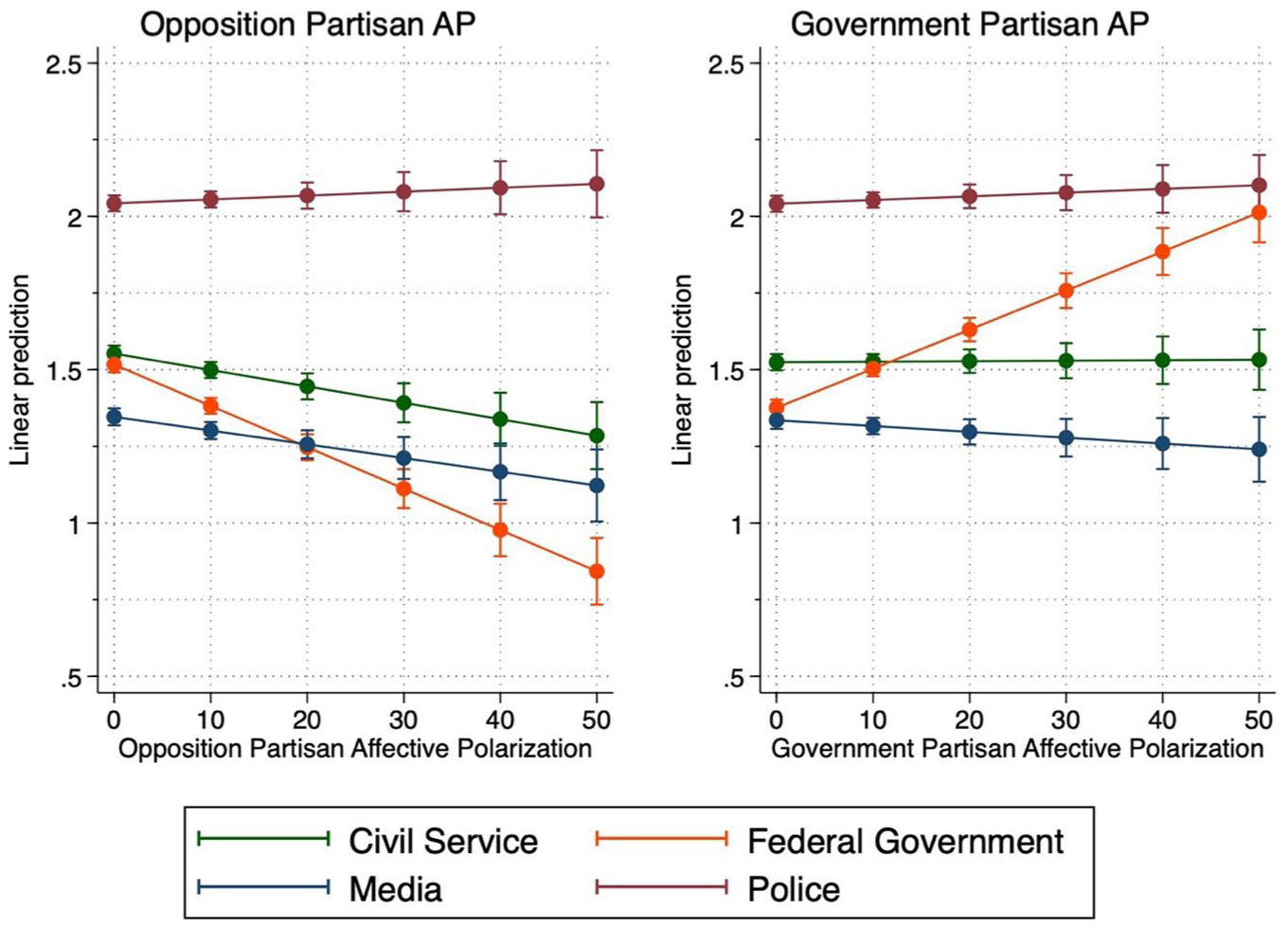
Predictive values of institutional confidence (opposition and government partisan affective polarization).
Further reflections on partisanship in Canada
Given our findings, we may question whether the heterogeneity in institutional trust is a product of affective polarization or if it reflects an underlying partisan story. As Johnston (2023) observed, Canada’s party system is not reflective of that of its neighbours, nor is it reflective any longer of the historic consensus that Canada’s two main parties operate according to a brokerage model. Canada’s parties are unique entities with increasingly ideological memberships (though perhaps less so for the Liberals). Although our results suggest that our expectations about opposition affective polarization are supported, the variation by party revealed in our earlier descriptive analysis of institutional trust suggests that we should go a step further, to consider whether our results are in fact masking a specific partisan dimension. 15
To explore whether unique partisan dynamics are at play, we ran the same models as above, for opposition and government partisans, but included a dummy variable that indicated either Liberal or Conservative partisanship and an interaction of that variable with affective polarization. 16 Results of these analyses reveal significantly different effects of being affectively polarized depending on Liberal or Conservative partisanship. To be clear: there is a relationship between affective polarization and trust in institutions at a high level, but these analyses show the variability across both institution and party. To best interpret these models and their interactions, we graph the predicted values of these interactions in Figure 7. Columns 1 and 3 show the results for each set of partisans when they are in government, and columns 2 and 4 show the same output for models with opposition partisans.
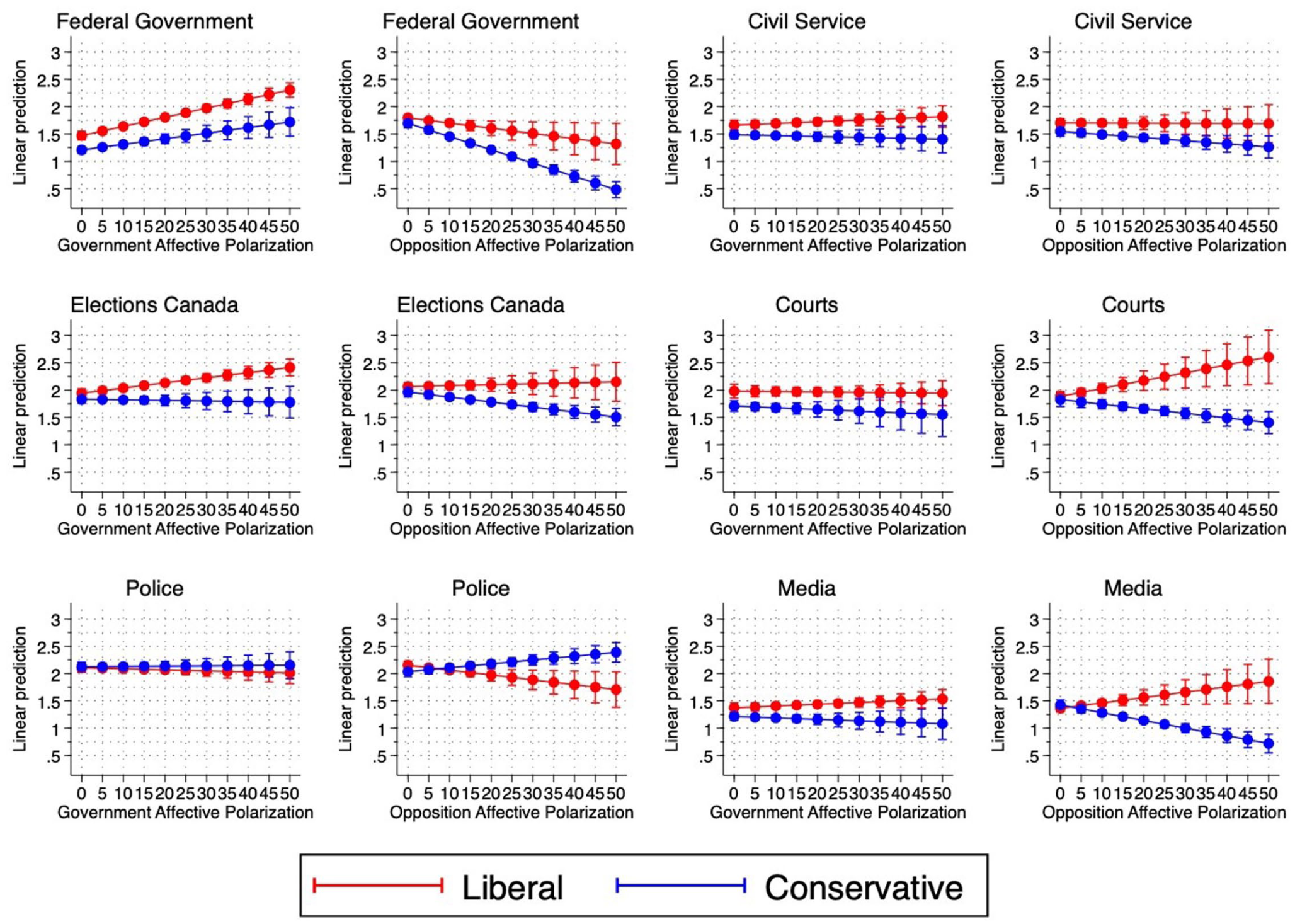
Impact of affective polarization on trust in institutions by partisanship and government/opposition status.
If affective polarization influences trust independent of partisanship and government status, we would expect to see trust decline as affective polarization increases. Instead, we find far more variability. Looking at the trust in the federal government, we observe that affectively polarized Conservatives have much lower trust than Liberals – even when they are in government. By contrast, even when in opposition, affective polarization only moderately attenuates trust for Liberal partisans. Although there is little movement on trust in the civil service for affectively polarized Liberals or Conservative when in government or opposition, we see divergence between the parties regarding the courts, the police and the media that depends upon role in government. When in government, affective polarization does not move either set of partisans’ levels of trust in the courts, the police or even the media. However, opposition status tends to make affectively polarized Liberals more trusting of courts, Elections Canada and the media (but less trusting of the police) and affectively polarized Conservatives moderately more trusting of the police and less trusting of the courts, Elections Canada and the media (see SIF Figure 4 for differences displayed as average marginal effects).
These results are surprising and nuance our findings on H1 and H2. Although affective polarization does decrease institutional trust in most cases, it is strongly conditioned on the institution and the partisan status of the person who is affectively polarized. Similarly, there is evidence of spillover in distrust from partisan to non-partisan institutions. Remarkably, though, there are situations where affective polarization may actually increase trust in institutions – for Liberals in opposition, affective polarization seems to produce a trust enhancing effect, suggesting that affectively polarized Liberals may perceive non-partisan institutions as protection against an outpartisan government. The same is not true for Conservatives, who only see this protective effect for the police. Together, this suggests that affectively polarized Conservatives may see non-partisan institutions of government as lacking the balancing quality against outpartisan government policies perceived by Liberals. That we did not find a similar result for NDP partisans (see note 16 and SIF Figure 5) suggests that this might be a unique reaction, but a full investigation of all partisan groups is needed to confirm that result. Since we do not have a clear explanation for this finding, more research is needed into the heterogeneity of institutional trust across partisan groups.
Discussion and conclusion
In the context of increasing partisan sorting, there is good reason to be concerned about its effects on questions central to the health of democracy. Institutional trust is linked to the health of democracy in that it reflects the degree of respect that political players from divergent ideological starting points have for the norms of democracy and the rules by which the game is played (Schedler, 2023). This article investigates the question of whether affective polarization has across-the-board negative consequences for institutional trust in non-partisan political institutions. We make an important contribution to the literature on institutional trust by changing the focus to the institutions of government that carry out the work of government without a partisan element. Additionally, by changing the context to Canada, we test the travelling capacity of findings demonstrated in the US case. Our results suggest that affective polarization can have negative consequences on more than just confidence in the public face of government. As a factor in attitudes and evaluations, affective polarization matters for trust in most political institutions (the police excepted). The impact of affective polarization on non-partisan institutions, although important, is not as extreme as for an obvious partisan target – the federal government. However, our results also suggest that there are very different effects by party, and that some of these effects carry over regardless of whether someone is a government or opposition supporter.
These results can be read in two ways. On the one hand, affective polarization is having an impact on institutional confidence for non-partisan institutions. This is of concern for those who are worried about the overall decline in trust in society and what it means for the future of democracy, and the ability of democratic institutions (particularly unelected institutions) to remain resilient against partisan pressures. On the other hand, that the effects are smaller for the courts, civil service and Elections Canada (and that there may even be protective effects for Liberals) provides a bit of a silver lining. These are explicitly non-partisan institutions that are crucial for the democratic operation of Canada. Although earlier research might have led us to suspect that they would be completely insulated from partisanship and changes in government, we can at least be encouraged that the effects are small in relation to confidence in the federal government.
We would caution, however, that the Canadian context is one in which election management and court decisions have not been historically accused of partisan bias (except on the margins). This is not to suggest these institutions are immune from individual actions that are unrepresentative of the broader institutions’ goals and legislative intent; perhaps, though, the durability of Canadian non-partisan institutions has not been ‘tested’ as it has been in other democratic settings. Given the recent increase in rancour in Canadian political discourse at the elite level, particularly at the end of Prime Minister Justin Trudeau’s time in office, such a test might be coming. This leaves open the possibility that the increase in affective polarization set out at the beginning of our empirical analysis still has the possibility to do damage to institutional trust – and indeed, our party-specific results suggest that this may already be occurring among Conservatives.
Future research should delve further into: (1) the mechanisms that produce citizens’ evaluations of trust; (2) why patterns differ between institutions; (3) why the impact of affective polarization is so different across parties, and (4) whether year-to-year changes in institutional confidence spillover are reflective of either short-term or more durable changes to levels of trust. All four would enhance our understanding of how the partisan climate is having an effect on overall trust in society and would go some way to suggesting how government (elected and unelected) can better insulate the operational machinery of government from partisan divisions.
Supplemental Material
sj-docx-1-ips-10.1177_01925121251388296 – Supplemental material for Affective polarization and institutional confidence in Canada
Supplemental material, sj-docx-1-ips-10.1177_01925121251388296 for Affective polarization and institutional confidence in Canada by Andrea Lawlor and Laura B. Stephenson in International Political Science Review
Footnotes
Acknowledgements
The authors wish to thank Henry Brady and Clareta Traeger for helpful comments provided at the Midwest Political Science Association Conference in April 2024, as well as the journal’s anonymous reviewers.
Data availability
Canadian Election Study data is publicly available through odesi.ca.
Declaration of conflicting interests
The authors declared no potential conflicts of interest with respect to the research, authorship and/or publication of this article.
Funding
The authors received no financial support for the research, authorship and/or publication of this article.

Supplemental material
Supplemental material for this article is available online.
Notes
Author biographies
References
Supplementary Material
Please find the following supplemental material available below.
For Open Access articles published under a Creative Commons License, all supplemental material carries the same license as the article it is associated with.
For non-Open Access articles published, all supplemental material carries a non-exclusive license, and permission requests for re-use of supplemental material or any part of supplemental material shall be sent directly to the copyright owner as specified in the copyright notice associated with the article.
