




Abstract
Academic freedom faces threats worldwide, including in some democracies that have traditionally been viewed as bastions of free universities. In the 21st century, academic freedom has declined in 20 (former) democracies, ranging from slow deterioration to abrupt collapse. Previous research shows that attacks on academic freedom are systematically linked to democratic backsliding. However, in some democracies that experience backsliding, academia remains autonomous. We employ data from the Varieties of Democracy project, utilizing the Episodes of Regime Transformation dataset and the Academic Freedom Index, alongside data on decline and growth episodes in academic freedom. Through an explorative study design, we analyse various political and academia-related determinants of academia’s resilience amidst democratic backsliding. Our analysis shows that an autocratization episode reduces academic freedom resilience only slightly to levels between 96.7% and 95.5% for a given country-year, compared to over 99.5% for country-years without such episodes. Overall, our analysis highlights remarkable academic resilience.
Keywords
Introduction
Academic freedom has received multifaceted and multidisciplinary attention in recent years, ranging from the effect of academic freedom on research output, innovation and international research collaboration (e.g. Audretsch et al., 2024; Fernandez F et al., 2024; Whetsell and Sidorova, 2024) to the political determinants of academic freedom (e.g. Berggren and Bjørnskov, 2024; Kinzelbach et al., 2024; Lerch et al., 2024; Lott, 2024; Roberts Lyer et al., 2022; Spannagel, 2025; Spannagel and Kinzelbach, 2023). The positive association between democracy and academic freedom has become more established, and is unsurprising from a theoretical perspective. Furthermore, as shown by previous research (Kinzelbach et al., 2024; Lott, 2024; Roberts Lyer et al., 2022), attacks on academic freedom are often associated with the backsliding and breakdown of democracies, as observed in Brazil (see Fernandez M, 2024), India, Hungary, Poland (see Bos and Kneuer, 2024) and the United States (see Keck, 2024), among other examples. However, in other democracies experiencing backsliding – for example, in Ghana, South Korea and the Philippines – academia demonstrates resilience. What may explain these different trajectories?
The systematic theoretical and empirical analysis of academic resilience in the context of democratic backsliding remains rudimentary. We begin to fill this gap by reviewing available empirical data on this pressing issue. Our findings are not only of theoretical interest. They are also timely given that academic freedom has come under pressure during the last decade. Globally, academic freedom declined by 9% from its peak of 0.65 in 2006 to 0.59 in 2023, on a scale between 0 (no academic freedom) and 1 (almost full academic freedom) using country averages from the Academic Freedom Index (see Spannagel and Kinzelbach, 2023). Using population-weighted averages, academic freedom declined even more from 0.59 in 2006 to 0.4 in 2023, a loss of 32% (Kinzelbach et al., 2024).
To further expand research on the decline of academic freedom in the present era, this article focuses specifically on democratic countries, which are known to protect academic freedom well. We document that in the 21st century, 20 (former) democracies have experienced declines in academic freedom in a substantial and statistically significant way, 1 ranging from short-term to long-term deterioration. Furthermore, we empirically explore several candidate factors that may increase academia’s resilience to democratic backsliding. We use the term ‘democratic backsliding’ for any move away from democracy taking place in democracies exclusively. ‘Autocratization’ (Lührmann and Lindberg, 2019) is the umbrella term that includes all moves away from democracy taking place in democracies and non-democracies, and can include regime erosion as well as regime change outcomes. Thus, democratic backsliding includes democratic regression and democratic breakdown, whereas it does not encompass processes of democratic decline in autocracies, such as autocratic deepening.
As a first effort to break new ground in this area, this article contributes an explorative empirical investigation of factors affecting academic freedom resilience in democracies and in situations of democratic backsliding. Hence, we do not offer a full theory of academic resilience but seek to offer building blocks for such a theory by providing an explorative analysis of potentially relevant political and academia-related factors. These include the constitutional protection of academic freedom, education centralization, the size of the university sector, political polarization and the accountability of the government, among other factors. We find that the constitutional protection of academic freedom is associated with greater resilience of academic freedom in autocratizing democracies, whereas most other factors have little explanatory power. Overall, in a counterintuitive finding, this study reveals that academic freedom remains relatively resilient in situations of democratic backsliding and it discusses possible determinants for academia’s resilience. We hope the theoretical notions emerging from these findings may be relevant for future theorizing.
The explanatory investigation of academic freedom resilience below proceeds in five steps. First, we discuss the methods and data used to explore the determinants of academic freedom resilience in times of democratic backsliding. Next, we descriptively analyse countries in which a decline episode in academic freedom has occurred since 2000, ranging from slow deterioration of academic freedom to abrupt collapse. After this initial description, we sample all democracies that have experienced democratic backsliding since 2000 in order to better understand why academia withers in some but not others. In the fourth part of the article, we systematically test different explanatory factors that may explain academic freedom resilience using all democratic country-years between 1900 and 2023. We conclude this explanatory analysis with a brief summary and an outlook.
Methods and data
Even as the specifics of academic freedom remain debated and contested (e.g. Altbach, 2001; Eisenberg, 1987; Fuchs, 1963; Kinzelbach, 2025; Marginson, 2014; Spannagel and Kinzelbach, 2023), international law offers a basis for a universalistic conceptualization of this freedom (Spannagel and Kinzelbach, 2023: 3973; United Nations (UN) Economic and Social Council, 2020; UN General Assembly, 2020; UN Human Rights Council, 2024). Accordingly, we understand academic freedom as the ‘de facto implementation of core components [of academic freedom], namely freedom to research and teach, freedom of academic exchange and dissemination, institutional autonomy, campus integrity, and freedom of cultural and academic expression’ (Lott, 2024: 1000; Spannagel and Kinzelbach, 2023). The Academic Freedom Index (AFI) measures the de facto realization of these five dimensions. These dimensions ‘are well aligned with the UN Committee on Economic, Social and Cultural Rights comments (CESCR, 2020) on article 15 of the International Covenant on Economic, Social and Cultural Rights of 1966’ (Lott, 2024: 1003). The AFI is expert-coded data and rests on assessments by more than 2300 country experts worldwide. The index typically gathers assessments from more than 5 country experts per country-year observation and, on average, 10 country-experts per country-year. Country experts have diverse backgrounds and expertise (see Lott and Spannagel, 2025) and assess the five academic freedom dimensions by answering standardized questionnaires.
Data on episodes of academic freedom decline comes from Lott (2024). 2 A decline episode in academic freedom is defined as a cumulative drop of 0.1 or more. A decline episode starts with a yearly decline in the AFI score of 0.01 points or more. A decline episode ends when there is a temporary stagnation in the AFI score with no further decline of 0.01 points over four years, or when the AFI score increases by 0.03 points from one year to the next. Lott (2024) used the Episodes of Regime Transformation (ERT) methodology introduced by Maerz et al. (2024) to gather data on episodes of academic freedom growth and decline. Furthermore, we controlled for overlapping uncertainty intervals to reduce the risk of measurement error driving the results. By using this episode approach to identifying academic freedom development, we can identify whether academic freedom erodes gradually or through a fast-moving process in an annual drop. We define resilience of academic freedom as the absence of any episode of academic freedom decline in a given country-year.
Data to identify democratic regimes comes from the Regimes of the World (RoW) data (Lührmann et al., 2018). We used version 14 of V-Dem and the respective RoW data (Coppedge et al., 2024; Pemstein et al., 2024). A country is coded as a democracy if it is classified as an electoral or liberal democracy in the RoW data. The RoW coding scheme classifies countries as electoral democracies if they have multi-party, free and fair elections, and minimally fulfil Dahl’s (2008) institutional prerequisites. A country is classified as a liberal democracy if – in addition to the electoral prerequisite of democracy – the rule of law and liberal principles are fulfilled, such as legislative and judicial oversight over the executive, checks and balances, and the protection of individual liberties.
Finally, we used ERT data (Maerz et al., 2024), version 14, to identify democratic regression and breakdown. The ERT data is based on the Varieties of Democracy (V-Dem) Institute’s Electoral Democracy Index and identifies different trajectories of democratization and autocratization processes by providing a ‘unified framework for studying regime transformation in either direction’ (Maerz et al., 2024: 967). In sum, the ERT data differentiates between liberalization in autocracies, democratic deepening in democracies, and democratic regression, as well as autocratic regression. In this article, we focus on autocratization episodes that have begun in democratic regimes, in order to detect gradual and sudden declines in levels of electoral democracy that may be associated with declines in academic freedom.
Academic freedom declines in democracies
In a first descriptive step, we analyse countries in which a decline episode in academic freedom has occurred since 2000. 3 Academic freedom declined in 20 (former) democracies, ranging in extremity from slow deterioration of academic freedom to abrupt collapse. 4 Of these 20 cases of declining academic freedom, 14 cases were connected to an autocratization episode within these democracies, as measured by the ERT dataset. In only six countries, namely Austria, Liberia, Lithuania, Suriname, the United Kingdom (UK) and the USA, were episodes of academic freedom decline not associated with an autocratization episode, according to the ERT data. Figure 1 shows the trajectories for the AFI, the Electoral Democracy Index and decline episodes in academic freedom across the 20 countries.
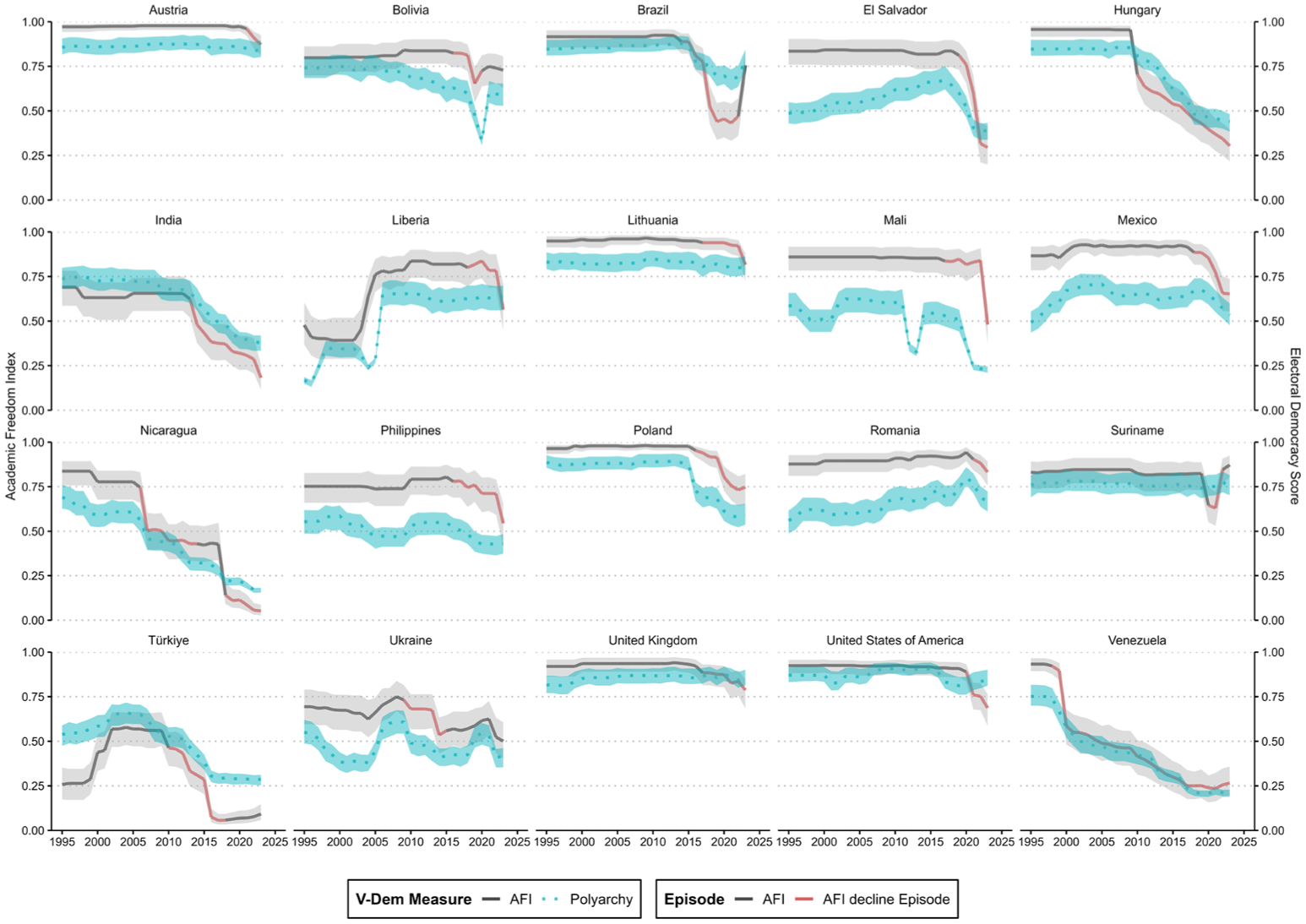
Academic freedom decline episodes and electoral democracy scores.
According to these data, episodes of academic freedom decline were often accompanied by autocratization episodes that resulted in a breakdown of democracy. This is the case in 10 countries, including Hungary, India and Venezuela. Yet Figure 1 also indicates that episodes of academic freedom decline in other countries were not associated with regression processes in democracies. The drop in academic freedom by 0.19 points in Suriname was only temporary and academic freedom fully recovered after three years to a level of 0.87 in 2023. In Liberia, academic freedom declined dramatically after 2022 by 0.26 points, while the state of democracy has remained preliminary intact. In Austria, academic freedom declined between 2021 and 2023 from 0.97 to 0.87, while the state of democracy remained almost unchanged. In this regard, it is noteworthy that the decline of academic freedom in Austria was driven by a small deterioration in institutional autonomy and the freedom to research and teach, rather than by a deterioration of free academic expression in the public arena. In the UK, academic freedom declined by 0.15 from 0.94 in 2014 to 0.79 in 2023. This decline in academic freedom may be related to austerity measures, Brexit and research-stifling audits (Allen, 2019), but it is not associated with an autocratization episode according to our data.
In the next descriptive step, we differentiate between decline episodes in academic freedom that lasted for less than four years, and can therefore be considered short-term deteriorations, and episodes that lasted four years and longer. 5 In Table 1, we present the respective countries. In sum, since 2000, short-term deteriorations have occurred in five countries, but the decline episode is right-censored in three cases, meaning we cannot make a definitive statement about the trajectory. In contrast, 15 countries show long-term deteriorations of academic freedom. Of these 15 cases, 11 countries are experiencing ongoing decline episodes.
Short-term and long-term deteriorations of academic freedom since 2000.
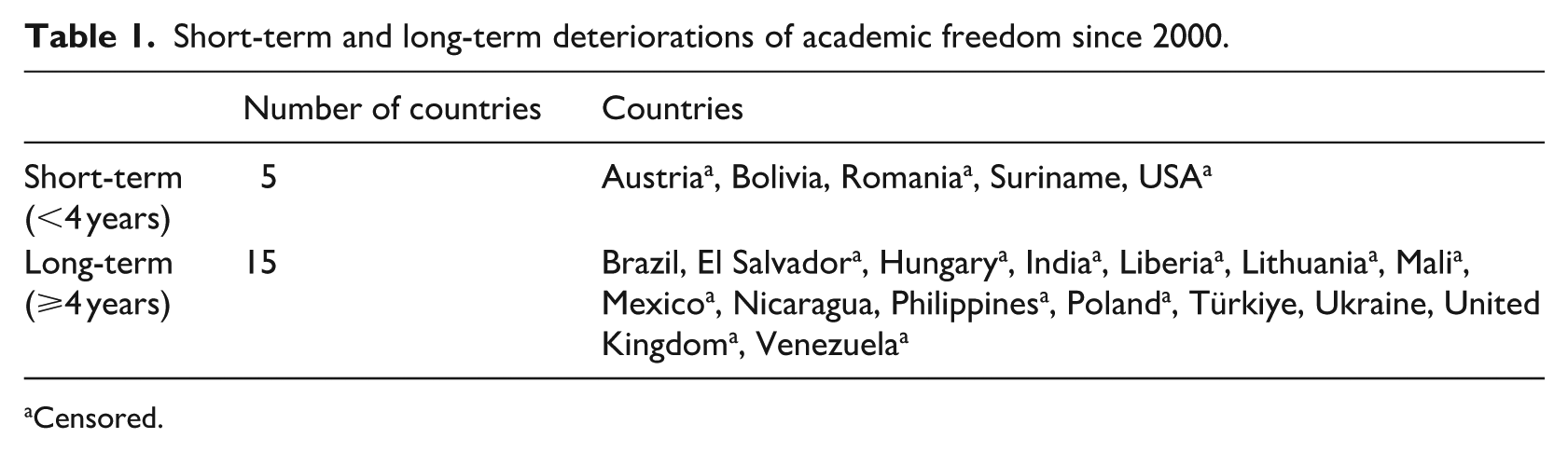
Censored.
Cases of democratic backsliding and how academic freedom withstands
To better understand why academia withers in some democracies that experience democratic backsliding, but not in others, we sampled all democracies since 2000 that have experienced either democratic breakdown, democratic regression or an autocratization episode but with a censored outcome. 6 Overall, an autocratization episode has occurred since 2000 in 51 democracies. Table 2 presents the summary statistics for these 51 democracies, with 56 autocratization episodes altogether. Some countries, such as Burkina Faso and South Korea, had multiple autocratization episodes. In 42 cases, an autocratization episode is not associated with an episode of academic freedom decline.
Resilience of academic freedom and autocratization episodes.
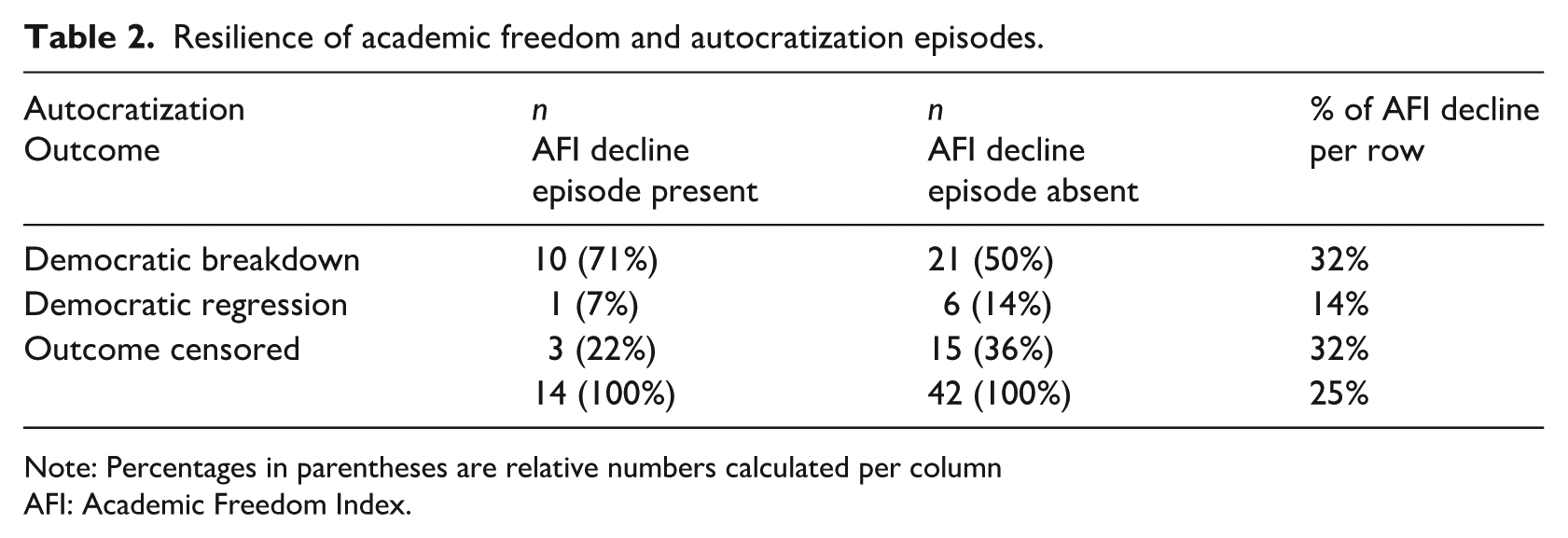
Note: Percentages in parentheses are relative numbers calculated per column
AFI: Academic Freedom Index.
Of 56 cases of democratic regression, democratic breakdown or with a censored outcome, only 14 (25%) cases had an episode of academic freedom decline. 7 This presents the first descriptive evidence that academia seems to be more robust in some countries with democratic regression and breakdown than in others. In particular, in 21 democratic breakdown cases, including Armenia (1998–2008), Bangladesh (2001–2007), Burkina Faso (2013–2015) and the Philippines (2000–2005), academia seems to be resilient according to AFI data. Several countries have relatively undifferentiated science systems, such as Burkina Faso, Madagascar and Mali. That said, it is worth stressing that the majority of democratic breakdown cases were associated with the resilience of academic freedom (68%), rather than cases of democratic breakdown coinciding with episodes of academic freedom decline (32%). Table 2 further indicates that only one of seven cases of democratic regression resulted in an episode of academic freedom decline.
Analysing determinates of academic freedom resilience
To further substantiate the finding that academia is more resilient in some countries experiencing democratic breakdown and regression than in others, we expanded the time-series under study to 1900–2023 and analysed the onset resilience of academic freedom 8 descriptively by using the heuristic presented in Boese et al. (2021). Table 3 demonstrates that democracies exhibit resilience of academic freedom in 99.23% of all country-years. This finding holds true when we differentiate between the period 1900–1999 and 2000–2023.
Resilience of academic freedom.
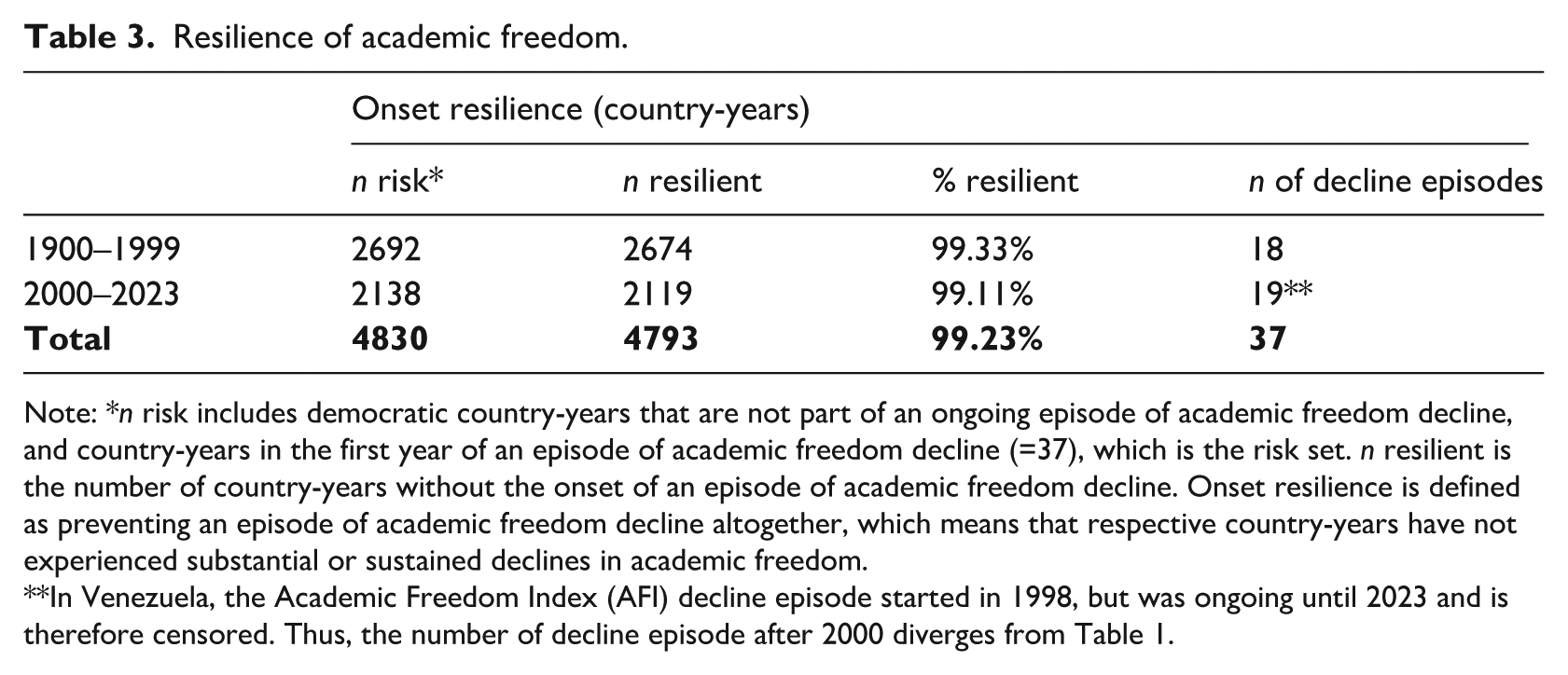
Note: *n risk includes democratic country-years that are not part of an ongoing episode of academic freedom decline, and country-years in the first year of an episode of academic freedom decline (=37), which is the risk set. n resilient is the number of country-years without the onset of an episode of academic freedom decline. Onset resilience is defined as preventing an episode of academic freedom decline altogether, which means that respective country-years have not experienced substantial or sustained declines in academic freedom.
In Venezuela, the Academic Freedom Index (AFI) decline episode started in 1998, but was ongoing until 2023 and is therefore censored. Thus, the number of decline episode after 2000 diverges from Table 1.
Overall, therefore, we find remarkable academic freedom resilience, in general (see Table 3) and even in situations of autocratization since 2000 (see Table 2). Academic resilience in the context of autocratization contrasts with developments in different dimensions of civic space and liberal rights. For example, Wiebrecht et al. (2023) show that media censorship, repression of civil society, the freedom of politically salient academic and cultural expression, 9 and the freedom of discussion are attacked most frequently in contexts of autocratization. These indicators declined in over 20 countries experiencing autocratization between 2013 and 2023. Using the AFI as an indicator of academic freedom, however, we go beyond academic expression in the public domain and focus on what is arguably the core of academic freedom, the freedom to research and teach, as well as universities’ autonomy. By doing so, we highlight that academic freedom – including its institutional dimension – has been remarkably resilient since 1900.
To further substantiate our descriptive findings, in the remaining empirical analysis we focus on determinants of academia’s ability to withstand autocratization processes. For this endeavour, we conducted an explorative study of determinants that may explain academic freedom resilience in the context of regression and breakdown in democratic countries across the world.
The literature on academic freedom has not systematically tested different explanatory factors that may explain academic freedom resilience. 10 However, many theoretical and empirical studies of democratic resilience (e.g. Boese et al., 2021; Croissant and Lott, 2024; Holloway and Manwaring, 2023; Levitsky and Way, 2023; Merkel and Lührmann, 2021; Riedl et al., 2025) inform our explanatory analysis of academic resilience to autocratization. 11 For example, Merkel and Lührmann (2021: 872–873) propose a four-level framework for democratic resilience that differentiates between the macro-institutional level, the political party actors’ level, the societal level and the political community level.
With regard to democratic resilience, Boese et al. (2021) distinguish between ‘onset’ and ‘breakdown’ resilience. A third type of democratic resilience – ‘bounce back’ resilience – manifests in a democracy’s ability to recover after a short period of autocracy, and turn around through a period of re-democratization (Croissant and Lott, 2024; see also Nord et al., 2025). We opt here to approach academic resilience parsimoniously as the absence of an episode of academic freedom decline in a given country-year. This is a pragmatic choice to enable this first exploratory study, which future work should nonetheless refine. In part, how to identify something like breakdown resilience when it comes to academic freedom is also less obvious. Solving that riddle would require some substantial additional theorizing, which we hope future work can accomplish.
Not completely substantiated by studies of democratic resilience, either, is that resilience should mean ‘the ability to endure [...] exogenous and endogenous shocks and stressors’ (Croissant and Lott, 2024: 5). These exogenous shocks and stressors include, for example, financial cuts implemented by the government, or democratic erosion fuelled by an anti-pluralist party in government. Endogenous shocks and stressors come from academia itself and can include the marketization of academic institutions, or preventive obedience by university leaders regarding demands from pressure groups and government actions, or excessively restrictive reactions to health and security risks, or other external factors. Yet whether academic freedom is facing such challenges is often unobservable or at least incredibly hard to measure precisely. This means that among cases that appear resilient, one will find both ‘structural zeros’ that are experiencing no pressures, and ‘true zeros’ that are experiencing pressures but with the ability to withstand them. At the present stage of exploring academic freedom resilience, we must accept this as a justifiable shortcoming that subsequent studies can hopefully address.
One additional shortcoming of measuring resilience as the absence of any episode of academic freedom decline, as we do here, is that stability after the end of a decline episode is classified as resilience. This may seem counterintuitive at first but we would argue that since academic freedom is a matter of degree, resilience can exist at different levels. It seems reasonable to us that avoiding further declines, even at relatively low levels of academic freedom and thus defending the remaining spaces, is a valid instance of resilience. However, one would want future work to distinguish resilience at higher levels from resilience at lower levels. In this study, we start addressing this issue by considering prior academic freedom stock as a candidate factor that may explain variations in academic freedom resilience.
To the best of our knowledge, there exist neither theoretical nor empirical accounts that use a comparative large-N design to model academic resilience to democratic backsliding. We conducted an explorative quantitative study for candidate factors that were tested in a sample of 118 democratic countries with 37 academic freedom decline episode onsets (up to 4830 country-year observations). These 37 onsets 12 include all 20 onsets presented in Table 1, as well as 17 additional cases that ended before 2000. We sampled all democratic country-years with non-missing data for the candidate explanatory factors between 1900 and 2023.
We use a probit model with Firth’s method of bias reduction (Firth, 1993) to estimate academic freedom resilience (for a comparable research design consulted for this research, see also Boese et al., 2021). Countries without resilience against episodes of academic freedom decline were coded as zero, and democratic country-years in ongoing episodes of academic freedom decline were excluded. 13
Candidate factors
The candidate explanatory factors that we consider in this article are the following: first, we tested for a set of academia-related factors. Here, we tested for the size of the university sector by using two different empirical proxies. The consideration behind this choice is the assumption that the size of the university sector may determine how many people are directly affected by academic freedom and are thus likely to counter infringements through popular protest, voting decisions and mobilization. The larger the university sector, the larger the potential political threat. We tested whether the size of the university sector, operationalized by the total number of universities (natural logarithm), increases or decreases the probability of an episode of academic freedom decline. Data for the total number of universities is curated in Coppedge et al. (2024) and is based on data from Apfeld (2019). Moreover, in an additional model, we tested for the association of tertiary enrolment rates with the probability of an onset of an academic freedom decline episode. Barro and Lee’s (2013) long-run enrolment ratios were interpolated to impute values for all years between the original five-year intervals. However, we built a separate model, as the country coverage of this variable is limited and leads to a sample of 108 countries.
Another academia-related factor is constitutional protection for academic freedom. Constitutional protection of academic freedom is a complex concept (Spannagel, 2024: 3) and only 52% of constitutions today adopt a constitutional protection of academic freedom (Spannagel, 2025). The Academic Freedom in Constitutions dataset (Spannagel, 2024) distinguishes between constitutions that mention the term ‘academic freedom’, the term ‘freedom of science’ and/or the term ‘university autonomy’. We assume that the constitutional protection of academic freedom creates a protective shield against government interference in academia. We tested whether constitutional protection – measured as any reference to academic freedom in the constitution as defined above – reduces the probability of a decline episode onset. In addition to the constitutional protection for academic freedom, we tested whether judicial review – as a more general concept of constitutional strength – is associated with the probability of the onset of an academic freedom decline episode. We used the judicial review indicator from the V-Dem dataset, 14 which asks whether any court in the judiciary has ‘the legal authority to invalidate governmental policies (e.g. statutes, regulations, decrees, administrative actions) on the grounds that they violate a constitutional provision’ (Coppedge et al., 2024: 178).
A final set of academia-related factors pertains to the level of education centralization. We assume that autocratizing actors in centralized education systems can intervene directly in higher education policies and that other subnational actors cannot prevent these policies. In contrast, in decentralized education systems, subnational (i.e. local and regional) governments are potential veto players that may hinder autocratizing actors from implementing policies that undermine academic freedom. In addition, education systems differ in terms of which entities operate universities: national-level public, subnational-level public or private non-state actors; in many countries, private and public university systems are combined. The question of which entities operate universities appears to be an important predictor of how autocratizing actors can interfere in academia’s freedom. To investigate this, we used data by Del Río et al. (2024) in the Education Policies and Systems Across Modern History (EPSM) dataset. We tested for the effect of the existence of a national-level education department. In addition, we asked which entities operate universities, 15 and constructed a variable that differentiates between university systems operated at the national or the subnational level, as well as by private entities or in partnership between public and private entities.
Second, we tested various political factors that are not directly related to the academic sector. Political polarization was discussed by Rekker (2021) in terms of polarization over science. Political polarization is problematic for the well-functioning of democracies because ‘democratic debate over policy requires at least some basic agreement on facts’ (Rekker, 2021: 353). Similarly, it appears likely that academic freedom is threatened in highly polarized societies ‘when it [academia] is no longer recognized as an impartial and trustworthy authority’ (Rekker, 2021: 353). Moreover, in different countries – for example, in the USA, Poland and Hungary – we see that rising political polarization goes hand in hand with declines in academic freedom (e.g. Kinzelbach et al., 2024). However, to the best of our knowledge, the association between political polarization and academic resilience has not been systematically tested by scholars in a cross-national large-N comparison. In this study, we test the assumption that academic institutions are more likely to withstand autocratization pressures in societies that have low political polarization, using the political polarization indicator from the V-Dem dataset (Coppedge et al., 2024). 16 The political polarization indicator asks whether the society is polarized into antagonistic political camps. It ranges from low levels of polarization to high levels of polarization where ‘supporters of opposing political camps generally interact in a hostile manner’ (Coppedge et al., 2024: 232).
Prior research also argues that horizontal accountability and the rule of law are associated with greater academic freedom (Berggren and Bjørnskov, 2022: 208f–210f; 2024: 4). Berggren and Bjørnskov argue that accountability introduces specified procedures for disciplining and removing misbehaviour. Accordingly, we test whether vertical, horizontal and diagonal accountability of the government are associated with resilience against attacks on academic freedom. Vertical accountability is the ‘ability of a state’s population to hold its government accountable through elections and political parties’ (Lührmann et al., 2020: 813), whereas horizontal accountability is conceptualized as the extent to which the government’s executive branch is held accountable to other state institutions. Diagonal accountability pertains to the ‘contribution of non-state actors to accountability’ (Lührmann et al., 2020: 813), including civil society organizations, the media and politically engaged citizens. We used accountability data from the V-Dem dataset (Coppedge et al., 2024) introduced by Lührmann et al. (2020). We assume that more accountability leads to more checks and balances, thereby inducing a greater threshold for government to undermine academic freedom. Thus, more accountability in any dimension – vertical, horizontal or diagonal – should be associated with a reduced probability of an academic freedom decline onset.
Moreover, we tested for countries’ accumulated experience with academic freedom (‘academic freedom stock’) as another explanatory variable. We expect that repression of free academia in the context of autocratization is more likely where academic freedom levels are high, because academic systems that function without a highly developed degree of freedom do not constitute a major risk for aspiring autocrats. We decided not to use the level of academic freedom but to test for the effect of a country’s accumulated experience with academic freedom and thereby follow important literature on historical legacies of democracy (e.g. Edgell et al., 2020; Gerring et al., 2005). The measure of academic freedom stock relies on the AFI by taking a cumulative weighted sum of AFI values for all previous years. We used a conventional 2% annual depreciation rate. 17 In addition, we tested for standard socioeconomic factors. We tested for gross domestic product (GDP) per capita and population size from Fariss et al. (2022). 18 All models also include region-fixed effects to account for regional time-invariant factors and quadratic time trends. By opting to consider academic freedom stock as an explanatory variable, we consequently do not consider the level of academic freedom in our conceptualization of academic freedom resilience (the dependent variable). In light of the models used in this study, and with a view to available data, we consider this a pragmatic and acceptable choice. However, we also recognize the value of further developing the concept of academic freedom resilience in future work, so as to distinguish between resilience at higher levels and lower levels.
Autocratization’s effect on academic resilience
In addition to these candidate factors, we tested whether an autocratization episode in the years before the potential onset of an episode of academic freedom decline increases the risks of declines in academic freedom. Previous research suggests – sometimes anecdotally and based on individual case-based evidence – that autocratization undermines academic freedom (e.g. Kinzelbach et al., 2024; Lott, 2024). In addition, it has been associated with prominent cases of academic freedom decline in Hungary, India and Turkey (e.g. Enyedi, 2018; Hünler, 2022; Jayal, 2022). We used empirical data from Maerz et al. (2024), as presented above. In different models, we first tested for different lag structures, including models testing for any autocratization episode one year, three years and five years, before the potential onset of the academic freedom decline episode.
Table 4 shows the effect of an autocratization episode on the probability of resilience of academic freedom (i.e. the absence of an academic freedom decline episode) for different autocratization lags. Table 4 reveals that an autocratization episode one year before the start of a potential decline episode in academic freedom has a negative effect on the probability of resilience of academic freedom. This also applies to an autocratization episode one-to-three years before the start, as well as for an autocratization episode one-to-five years before the start.
Main results of resilience of academic freedom in democracies, 1900–2023.
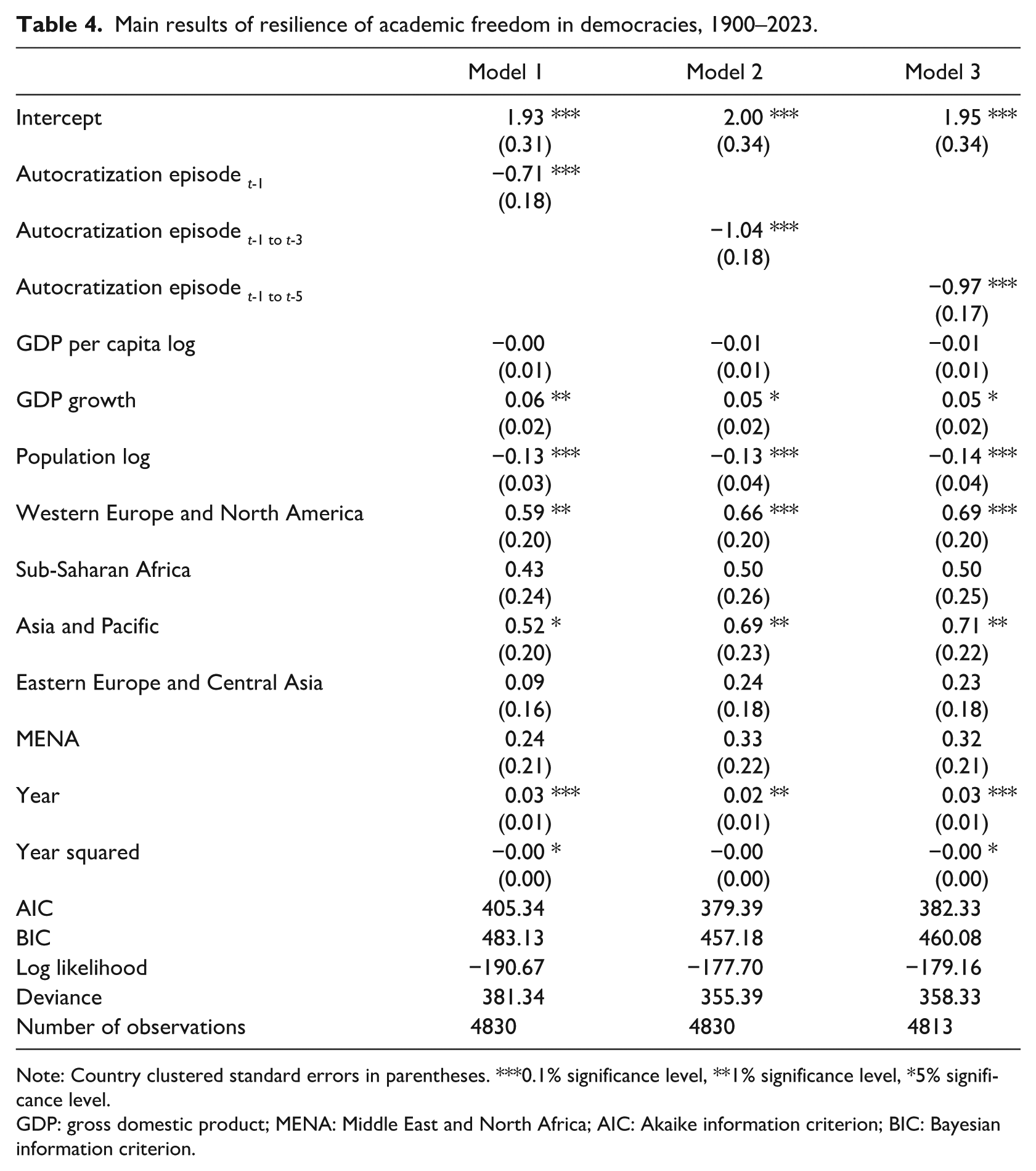
Note: Country clustered standard errors in parentheses. ***0.1% significance level, **1% significance level, *5% significance level.
GDP: gross domestic product; MENA: Middle East and North Africa; AIC: Akaike information criterion; BIC: Bayesian information criterion.
Figure 2 illustrates the substantive effects more intuitively by simulating predicted probabilities of resilience of academic freedom. 19 The plots in Figure 2 show how the probability of resilience of academic freedom ranges from 97.3% (95% confidence interval (CI) = [94.5%–98.8%]) in Model 1 to 95.5% (95% CI = [92.6%–97.8%]) in Model 2 per country-year, when an autocratization episode has occurred beforehand.
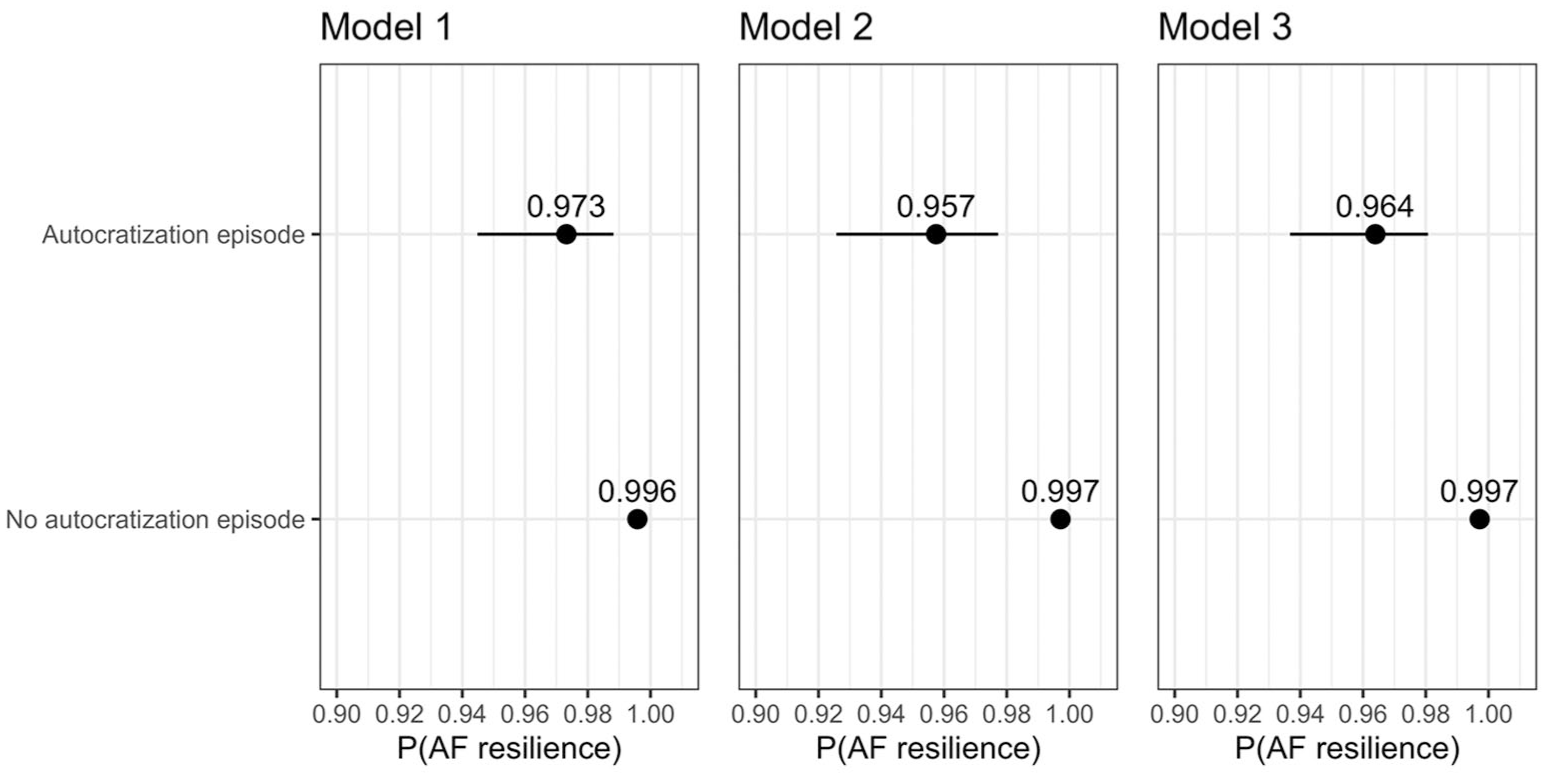
Predicted probabilities of resilience of academic freedom over different lag structure of autocratization episodes. Estimates and 95% confidence intervals are based on simulations.
Explanatory analyses of candidate factors
In the next step, we tested whether any of the candidate explanatory factors presented above are systematically associated with more or less resilience against an academic freedom decline onset. To do so, we investigated different candidate explanatory variables separately before putting the candidate explanatory variables into a comprehensive model. Overall, we find little empirical evidence to support some of our initial assumptions. However, Table 5 reveals that some candidate explanatory factors are significantly associated with the probability of resilience of academic freedom. For example, the constitutional protection of academic freedom, national-level education departments and political polarization are statistically significantly associated with resilience of academic freedom. The constitutional protection of academic freedom tends to be an important factor that increases the resilience of academic freedom in democracies. Whenever national-level education departments exist, resilience of academic freedom is predicted to be lower. Political polarization, in contrast, reduces resilience of academic freedom significantly, as suggested by prior research. Other factors, such as the number of universities, tertiary enrolment rates, judicial review and the different accountability dimensions are not significantly associated with resilience of academic freedom.
Main results of resilience of academic freedom in democracies, 1900–2023.
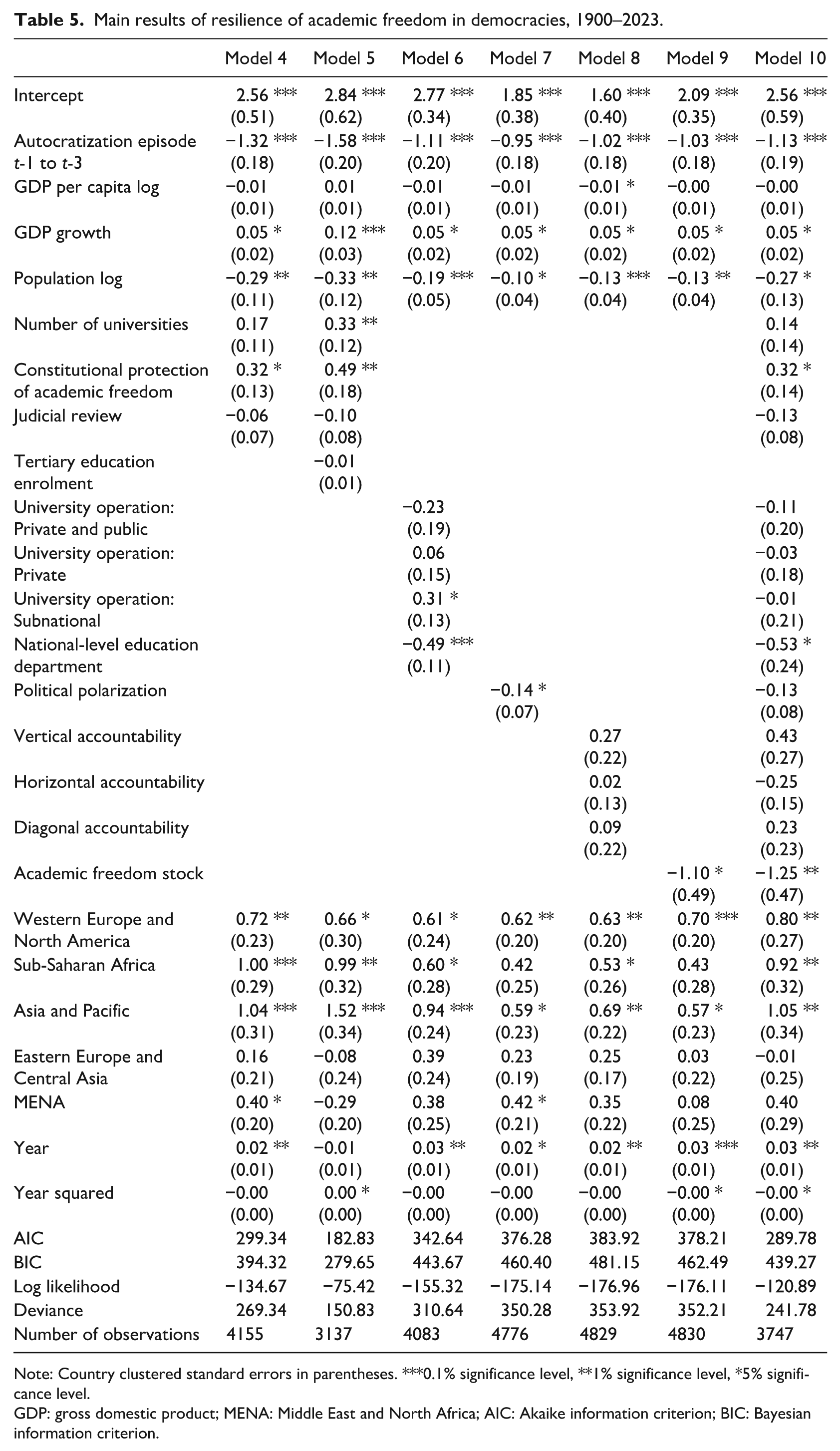
Note: Country clustered standard errors in parentheses. ***0.1% significance level, **1% significance level, *5% significance level.
GDP: gross domestic product; MENA: Middle East and North Africa; AIC: Akaike information criterion; BIC: Bayesian information criterion.
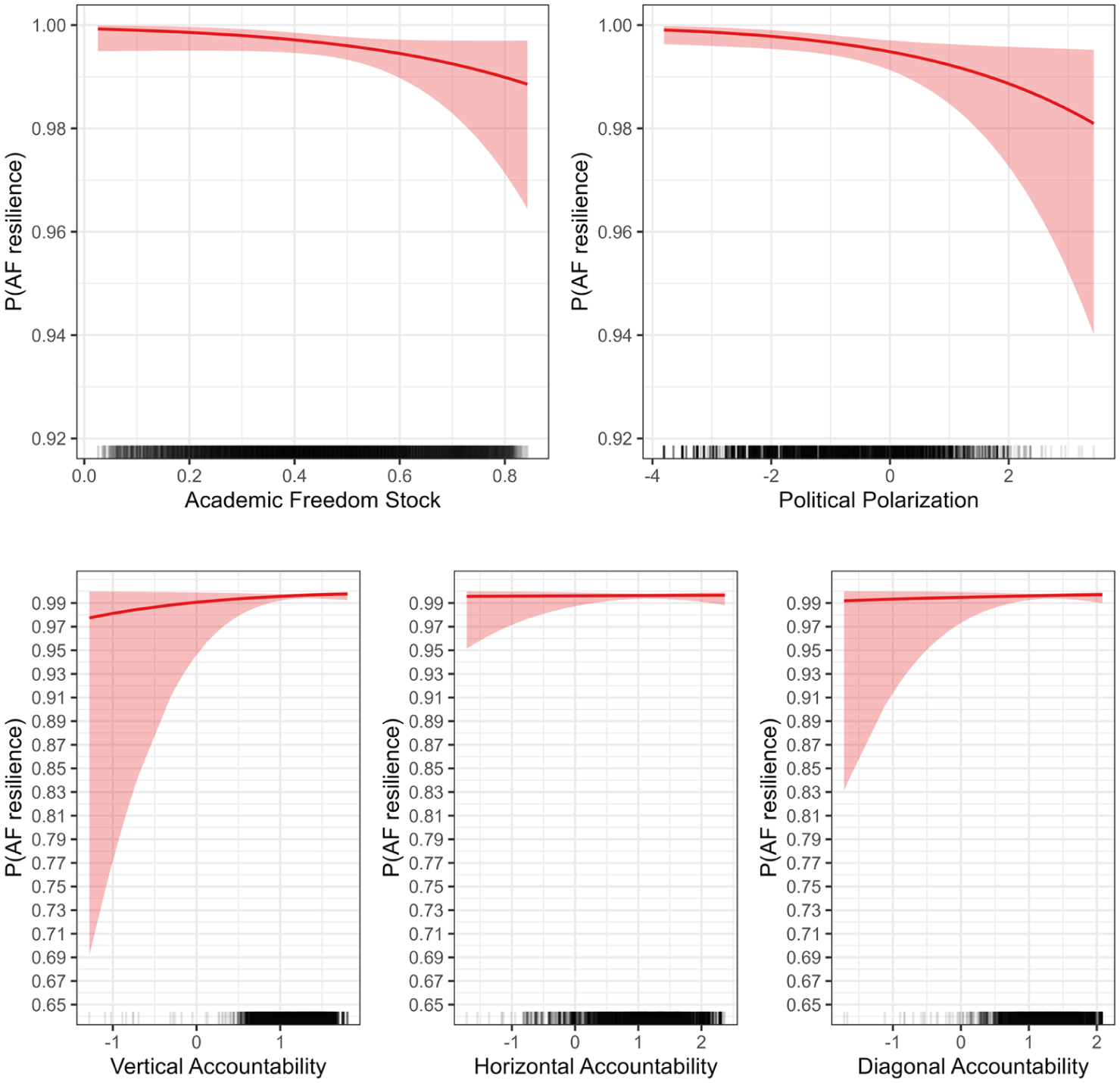
To illustrate the substantive effects more intuitively, we simulated predicted probabilities. The plots in Figures 3 and 4 show how the probability of resilience of academic freedom varies with different potential explanatory factors.
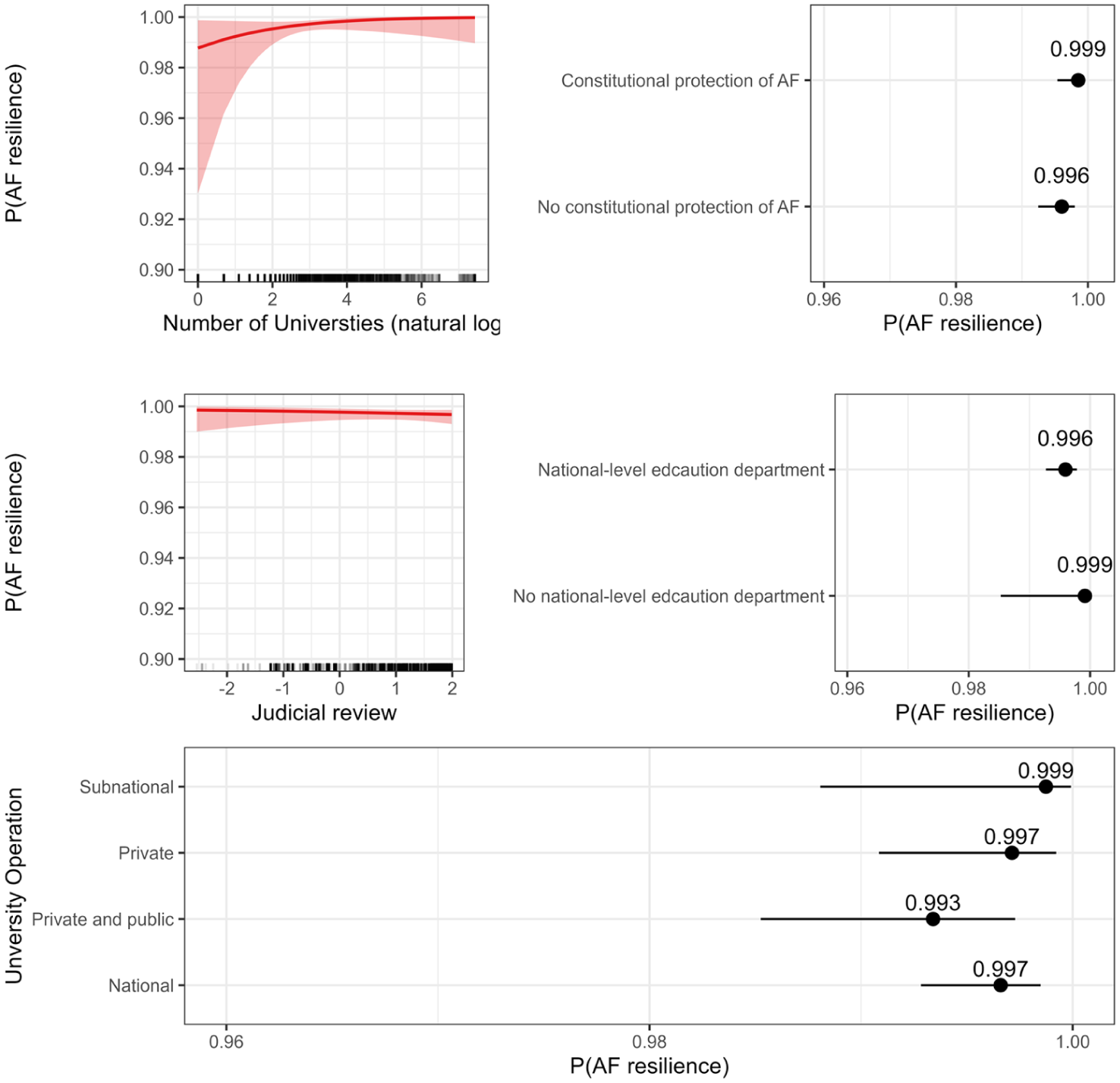
Predicted probabilities of resilience of academic freedom over different potential explanatory factors. Estimates and 95% confidence intervals are based on simulations.
Predicted probabilities of resilience of academic freedom over different potential explanatory factors. Estimates and 95% confidence intervals are based on simulations.
Figure 3 reveals that countries without constitutional protection of academic freedom have a predicted probability of resilience of academic freedom of 99.6%, whereas countries with such constitutional protection have a predicted probability of 99.9% for each country-year. Thus, the substantive effect of a constitutional guarantee is marginal. In an additional model presented in Figure 5, we test whether the effect of constitutional protection of academic freedom is conditioned by the presence of an autocratization episode. Figure 5 reveals that the predicted probability of resilience of academic freedom in situations of autocratization is only 92.2% (95% CI = [85.4%–96.2 %]) when the constitution does not protect academic freedom, but 95.9% (95% CI = [91.1%–98.3%]) in cases of constitutional protection. Although this relationship is not statistically significant at conventional levels, it nevertheless highlights the importance of constitutional protection for academic freedom in situations of democratic regression.
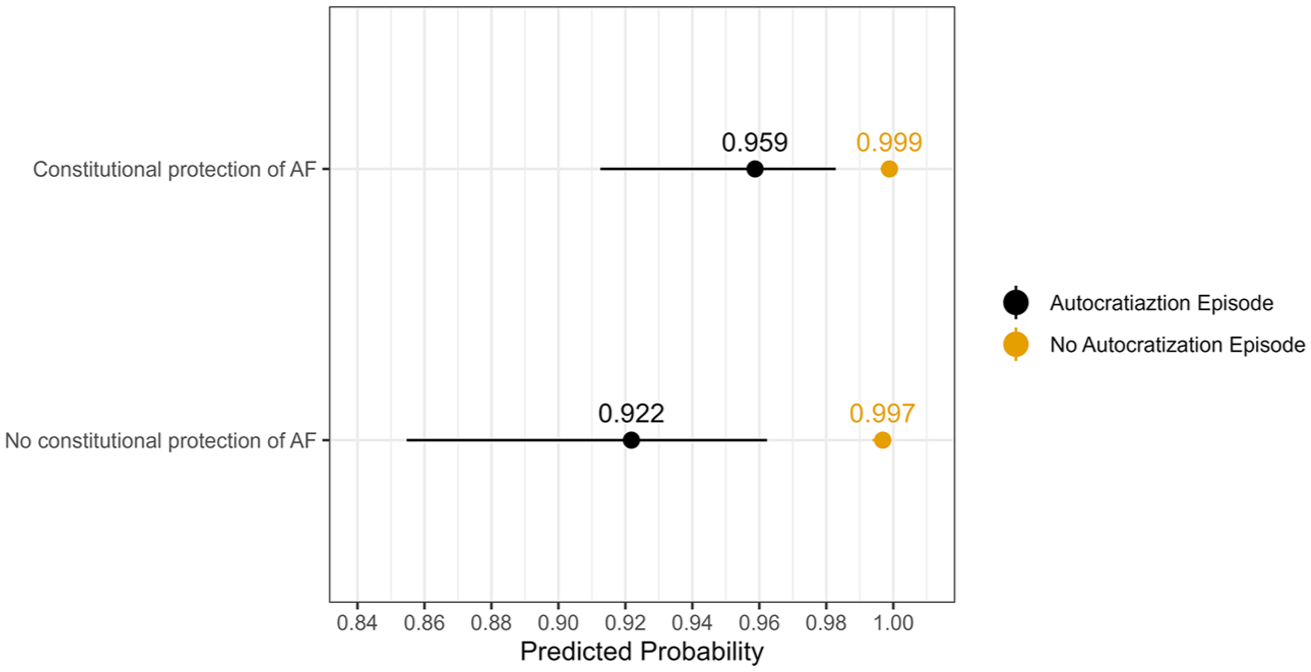
Predicted probabilities of resilience of academic freedom by constitutional protection of academic freedom and conditioned by autocratization episode. Estimates and 95% confidence intervals are based on simulations.
Figure 3 also plots the predicted probability of resilience of academic freedom with respect to different entities which operate universities, as well as the predicted probabilities conditional on whether a national-level educational department exists. It shows that these factors do not substantially affect the predicted probabilities of resilience of academic freedom. For example, the predicted probability of country-years with a national-level education department is 99.6% in contrast to 99.9% with no national-level education department (again, only a marginal difference). Moreover, in terms of academic resilience, which entities operate universities does not substantially matter, as shown in Figure 3.
Figure 4 also shows the predicted probability of resilience of academic freedom in relation to political factors. In highly polarized democracies, the predicted probability is around 98% for each country-year (thus, the risk of an onset of academic freedom decline is around 2% in a given country-year). In democracies without high levels of political polarization, the predicted probability is around 99.9%. In addition, Figure 4 shows the predicted probability conditional on the level of academic freedom stock. In line with our theoretical hint, higher levels of academic freedom stock are associated with a reduced predicted probability of resilience of academic freedom. However, the substantive effect remains marginal as the predicted probability decreases from almost 100% to approximately 99%. That the effect remains marginal may be due to structural factors that facilitate resistance against autocratization from within the university sector. Universities are typically large, long-established institutions where groups of people can organize in line with their interests and by drawing on international networks, thereby increasing the political risk for autocrats who crack down on academia. In addition, the economic costs related to such crack-downs may be significant, especially when autocrats do not only attack individual academics, isolated subjects or standalone universities but the university sector as a whole.
These potential explanations of our findings require further analysis through case studies, also because our data does not allow us to distinguish between the absence of attacks on the university sector and academia’s ability to withstand such attacks (see our negative definition of resilience of academic freedom above). In this context, we note that the case studies on Hungary and Poland (Bos and Kneuer, 2024), Turkey (Gol, 2024), the USA (Keck, 2024) and Brazil (Fernandez M, 2024) in this special issue complement and contrast our findings. Whereas the case studies analyse processes and mechanisms that explain how autocratization and academic freedom declines are related, our contribution draws the broader picture and reminds us that academic freedom is also relatively resilient in situations of democratic backsliding. Although all the cases analysed in this special issue are covered in our decline episodes data, the selecting on the dependent variable in the case studies can impede robust inference. In addition, Bos and Kneuer (2024: 1) argue that democratic backsliding follows an ‘evolutionary sequencing where the limitation of academic freedom takes place rather after the erosion agents had changed the fundamental institutional rules and after they secured persistence in power’. Assuming that this is indeed the case, for current and ongoing democratic backsliding cases – precisely 18 ongoing autocratization episodes (of which 3 already show a decline episode in academic freedom) – this would imply that restrictions and infringements on academic freedom may yet follow. On the other hand, it is far from certain whether the sequencing described by Bos and Kneuer on the basis of two country cases can be generalized; we find it more likely that cases will differ due to different opportunity structures and variance in stakeholders’ capabilities.
Conclusion
This study empirically analyses the relationship between autocratization, various academia-related and political factors, and academic resilience, which we define as the absence of any episode of academic freedom decline in a given country-year. We provide the first cross-national large-N study on the issue and reveal that academic resilience remains relatively high in situations of democratic regression and breakdown. In regression analyses, we find evidence that an autocratization episode decreases the resilience of academic freedom to levels between 97.3% and 95.7% for a given country-year compared to over 99.6% for country-years without such an episode.
The resilience of academic freedom is remarkable when we compare it to the resilience of democracy. Boese et al. (2021: 900) found that democracies are resilient over 90% of the time, while the fatality rate is 77% once an autocratization episode starts in a country. In our research, we documented a resilience of academic freedom rate of over 95%, even in situations of democratic backsliding. That said, we note that higher levels of prior academic freedom stock have a somewhat negative effect on the resilience of academic freedom, indicating that aspiring autocrats consider free academia a risk, whereas an academic sector with little accumulated academic freedom stock often appears less threatening. If aspiring autocrats have access to a national education department, academic freedom is at greater risk. Nevertheless, the remarkable resilience of academic freedom overall may be a positive message. This supports the notion that universities are important protection belts for democracy (e.g. Pelke, 2023). Yet our extensive analysis also reveals a sober message in that we only identify one factor that increases academic resilience in autocratization contexts, and that only with marginal effect: the constitutional protection of academic freedom. By analysing potential factors that contribute to the resilience of academic freedom against democratic backsliding as an external stressor, our analysis contributes to studies analysing the resilience of liberal democracies. Moreover, it is one of the first studies that contribute to the theory development of academia’s resilience factors by analysing these factors empirically.
Our findings complement and contrast case study-based research on countries where democratic regression and the decrease in academic freedom go hand in hand. By relying on observational data and statistical techniques, we cannot make any causal claims. Still, as democracies and universities experience political pressure (cf. Norris, 2024), our findings are of theoretical and also very practical scholarly interest. Scholars have reasons to remain confident in the strength of the academic sector. Those who wish to bolster academic freedom in times of democratic regression may be well advised to focus on one factor that is associated with lower resilience of academic freedom: political polarization. By countering polarization on and off campus, scholars may be able to slightly boost the chances of academia remaining free, while also preparing the ground for what academic scholarship is all about, namely facts-based reasoning to advance knowledge rather than ideology.
Supplemental Material
sj-docx-1-ips-10.1177_01925121251366162 – Supplemental material for Can free academia withstand democratic backsliding? Why some universities wither while others survive
Supplemental material, sj-docx-1-ips-10.1177_01925121251366162 for Can free academia withstand democratic backsliding? Why some universities wither while others survive by Lars Lott, Katrin Kinzelbach and Staffan I. Lindberg in International Political Science Review
Footnotes
Acknowledgements
The thank the two anonymous reviewers whose critical and constructive feedback was very helpful in revising the paper. We also appreciate the comments received at the American Political Science Association (APSA) Annual Meeting 2024 in Philadelphia when we presented the paper on the panel titled ‘Democratic Backsliding and Academic Freedom’. Additionally, we thank Fabian Fassmann for his skilful research assistance. All errors remain our own.
Data availability statement
Research documentation and data that support the findings of this study are openly available at the Harvard Dataverse: https://doi.org/10.7910/DVN/GPDAPN or at Zenodo: https://doi.org/10.5281/zenodo.16405695. The reproduction materials contain all data that are necessary to computationally reproduce the results presented in this article and the  .
.
Declaration of conflicting interests
The authors declared no potential conflicts of interest with respect to the research, authorship and/or publication of this article.
Funding
The authors disclosed receipt of the following financial support for the research, authorship and/or publication of this article: The authors received funding from the Volkswagen Foundation (grant number A138109), Principal Investigators: Katrin Kinzelbach and Staffan I. Lindberg.
Supplemental material
Supplemental material for this article is available online.
Notes
Author biographies
References
Supplementary Material
Please find the following supplemental material available below.
For Open Access articles published under a Creative Commons License, all supplemental material carries the same license as the article it is associated with.
For non-Open Access articles published, all supplemental material carries a non-exclusive license, and permission requests for re-use of supplemental material or any part of supplemental material shall be sent directly to the copyright owner as specified in the copyright notice associated with the article.
