



Abstract
This introduction to the special issue highlights the key findings and implications of democratic backsliding in Southeast Asia. It begins with an overview of the region's democratic landscape using the Varieties of Democracy (V-Dem) dataset and compares the patterns and modes of backsliding in six selected cases. Collectively, the articles suggest the importance of unpacking regime components and the growing attitudinal elite-mass gap in analyzing the quality of democracy. The liberalization effects of social media were found to be mixed. The theoretical and empirical findings offer a fertile ground for future comparative work beyond the region.
State of democracy in the region
This special issue features six research articles that examine the causes, patterns or effects of democratic backsliding in selected countries in Southeast Asia. In particular, we highlight a collection of countries that have experienced both positive and negative political changes in the last decade. The countries include Indonesia (Toha and Cosslett), Malaysia (Weiss), Myanmar (Ryan and Tran), the Philippines (Kasuya and Calimbahin), Singapore (Tan and Preece), Thailand (Sinpeng), and Vietnam (Truong). Collectively, the articles suggest the importance of unpacking the regime components, the attitudinal elite-mass gap, and the effects of social media in analyzing the quality of democracy in the varied political systems in the region.
Scholars conceptualize democratic backsliding in diverse ways, with some restricting the term to democratic regimes only (e.g. Bermeo, 2016; Lührmann and Lindberg, 2019) and others extending it to all regime types, including autocracies (e.g. Fong, 2020; Waldner and Lust, 2018). In this issue, we employ the latter approach and conceptualize democratic backsliding as a process and in a continuum that considers the decline in the quality of democratic governance across all regime types. Accordingly, countries typically regarded as autocracies, such as Vietnam, are included in this special issue. We contend that this approach allows us to overcome normative and controversial regime classification debates, focus on the sources and sequence of erosion, and assess the state of democracy in each case.
Over the last decade, countries in Southeast Asia have varied in their regime trajectories. Broadly, Malaysia, Vietnam, Laos, and Singapore have improved in the quality of democracy, while others, such as Cambodia, Indonesia, Myanmar, the Philippines, and Thailand, have backslided. Based on V-Dem Project's Liberal Democracy Index (LDI), which incorporates both the liberal and electoral principles of democracy, 1 Figure 1 provides a regional view of the level of democracy for nine Southeast Asian countries over the last decade, from 2012 to 2022. The score ranges from 0 to 1, with 1 representing the highest level of liberal democracy. While the x-axis represents the LDI score of selected countries for 2012, the y-axis represents their 2022 score. Countries above the 45-degree line show improvement in the quality of democracy.
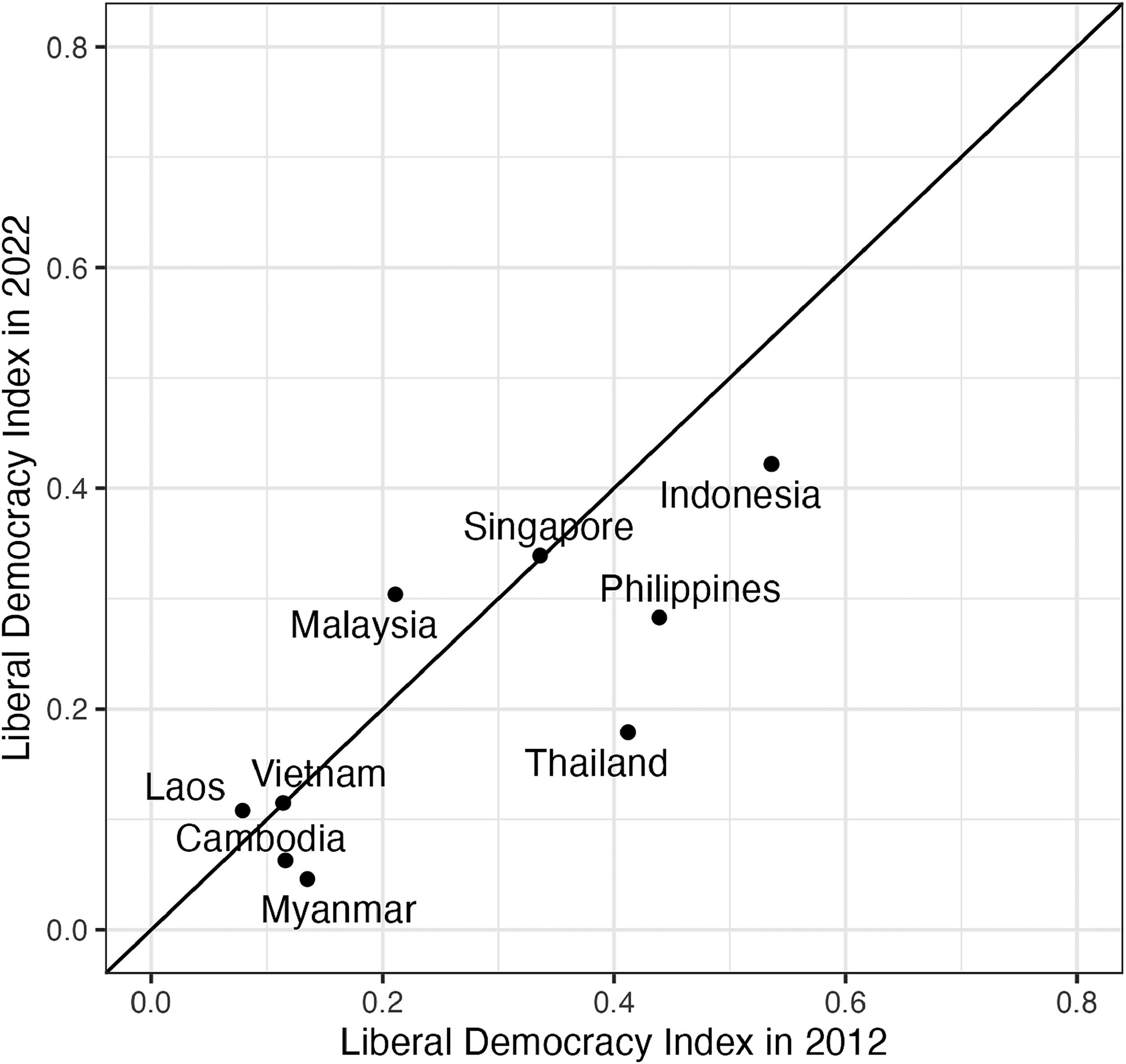
Change in the Liberal Democracy Index (LDI) between 2012 and 2022.
Those backsliding countries can be classified into two types according to the classification made in Bermeo (2016). One is “executive aggrandizement,” where “elected executives weaken checks on executive power one by one, undertaking a series of institutional changes that hamper the power of opposition forces to challenge executive preferences” (Bermeo, 2016: 10). Recent autocratization episodes in Indonesia and the Philippines fit this mode. The other is “promissory coups,” where the military takes over an elected government by claiming the coup is “a defense of democratic legality and … a public promise to hold elections and restore democracy as soon as possible” (Bermeo, 2016: 8). The backsliding that happened in Thailand and Myanmar during the years covered in Figure 1 belongs to the second mode. Whereas Thailand held a general election in 2019 after numerous delays, Myanmar remains under military rule, mired in civil war with ethnic insurgent groups. Research articles in this special issue address these autocratization episodes, and adopt novel research methods and original data to compare the sources and effects of democratic backsliding in these cases.
The importance of unpacking regime components
While comparative country graphs generated by datasets such as the V-Dem are often helpful in showing changes in democracy scores over time and across countries, the highly aggregated nature of the democracy scores obscures the distinct political dynamics that underline the sources of threat and implications for the future. To address this gap, our contributors were tasked with disaggregating the varied components of democracy in their respective countries and conducting an in-depth analysis of the causes of political changes and their broader effects.
The case studies of illiberal hybrid regimes, such as Malaysia and Singapore in this issue, highlight the importance of disaggregating the concept of democracy. For instance, Weiss (this volume) argues that Malaysia remains a “wobbly” hybrid regime despite its successful party alternation in the 2018 general elections after years of domination by the long-running coalition Barisan Nasional. Weiss contends that Malaysian civil society and civic norms are the main drivers of liberalization, while traditional political institutions such as political parties and the legislature vacillate between democratic and autocratic poles.
Singapore provides another example where it is inadequate to analyze change based on the aggregate level of democracy scores. While Singapore's overall democracy score has remained relatively stable over the past decade, as depicted in Figure 1, Tan and Preece (this volume) found that specific components of democracy, particularly those related to diagonal accountability in media and civil society, have declined. These declines were largely due to the influx of new anti-fake news laws, such as the Protection from Online Falsehood and Manipulation Act (POFMA) and defamation lawsuits, that curtailed media freedom and civil society activities and bolstered government's online control and presence.
It is also noteworthy that while Singapore's overall level of LDI (0.34) 2 was higher than Malaysia's (0.3) in 2022, Singapore's “freedom of expression and alternative sources of information” index (0.38) and “freedom of association” index (0.59) were lower than Malaysia's (0.59, 0.72 respectively). Hence, disaggregating and analyzing the LDI score in each case better reveals the democratic institutions, behaviors, and actors that are under threat.
Aside from hybrid regimes, our broader definitional approach of democratic backsliding also allowed us to identify opportunities for “opening” and the extent to which closed authoritarian regimes regress to consolidate power. For instance, Truong (in this issue) examines the impact of the reshuffling of the Vietnamese Communist Party Politburo leadership on citizens’ political attitudes and collective action. Drawing on an online experimental survey of Vietnamese citizens, she finds that heavy representation of police and public security officials in the latest Politburo has diminished the public's inclination to participate in grassroots activism such as petition signing and protests. This suggests that Vietnam's participatory dimension is under threat.
Elite-mass gap in attitudes toward democracy
Another contribution of this special issue is to highlight the disparity between the ruling elites and citizens toward democracy and its effects on the quality of democracy. The elite-mass gap occurs when the behavior of elites and the preferences of the general population toward democracy diverge. When studies depend solely on expert-coded democracy indices such as those provided by V-Dem, they may fail to identify less-observable sources of discontent toward democratic governance. Our articles on Indonesia and the Philippines address this oversight.
Toha and Cosslett (this issue) found that Indonesian politicians and citizens hold diverging views of their national identity as a global Muslim-majority democracy. Using a discourse analysis of official government texts and everyday texts by citizens over the last decade, such as op-eds, films, and novels, the authors found that while politicians often extol Indonesia's national identity as a democratic country, citizens are, in fact, disenchanted with and concerned about the country's democratic institutions. The citizens are particularly concerned with the country's weak political parties, the limited checks on the executive, and the muzzling of government critics. They argue that the mass disenchantment reflected in the popular discourse may be a clearer indicator of democratic decline than official narratives.
In the Philippines, Kasuya and Calimbahin (this issue) also found an attitudinal gap between the elites and citizens regarding democracy during President Rodrigo Duterte's period of rule (2016–2022). The authors investigate the puzzle of mass support for Duterte's presidency, which was marked by human rights violations and repression against drug traffickers. Using originally commissioned survey data and other existing data, the authors found that Filipino voters were not becoming illiberal as a result of their support for an illiberal president such as Duterte. Rather, Filipino voters were “contingent supporters of illiberal politics” who were still supportive of the procedural principles of democracy.
The mixed effects of social media
Our special issue also considers the impact of digital technology and social media on democratic backsliding. The use of digital technology and social media in Southeast Asia for information and communication has increased, and Ryan and Tran's study (this issue) shows how social media deterred democratic backsliding in Myanmar. Based on a mixed-method analysis of Facebook posts in 2021, they argue that pro-democracy activities in the pre-coup era used social media to build a vibrant civic space, which the military junta was unable to suppress after assuming power in 2021. They found that anti-coup activists were more effective and active in using Facebook for resistance and mass mobilization than the military's online counter-mobilization.
While Myanmar shows how social media could deter democratic backsliding, Thailand on the other hand shows how social media could bolster mass support for military rule and foster anti-democratic sentiments. Based on Facebook data on five pro-military pages before and after the May 2014 coup, Sinpeng (in this issue) compares the changes in pro-military sentiments and activities of the People's Democratic Reform Committee (PDRC)—a diverse anti-government pressure group. The social network analysis of pre- and post-coup Facebook posts shows that the sources of support for the military regime stemmed from anti-government sentiments, while post-coup military-government support emerged from varied policy preferences. Based on novel methods and data over time, these two articles demonstrate that social media is not a clear tool of liberalization or repression.
Final remarks
This special issue on Southeast Asia marks an important milestone in addressing the global trend toward democratic decline. The studies featured in the issue showcase a rich array of methodological approaches and original data to interrogate the procedural conceptualization of democracy and the sources of democratic backsliding in varied regime types. Looking ahead, a promising avenue for future research involves adopting a more comparative perspective that extends beyond the region. This approach will not only contribute valuable insights but also foster a deeper understanding of the complex dynamics at play. Despite the unique challenges faced by Southeast Asianists due to the diverse range of regime types in the region, this diversity presents an exciting opportunity for exploration and discovery. By embracing a comparative lens, scholars can unlock new avenues for collaboration and contribute to a more comprehensive understanding of democratic processes in Southeast Asia and beyond.
Footnotes
Acknowledgements
We acknowledge the financial support by the Suntory Foundation and thank all the participants and discussants for their feedback at our online workshop for this special issue on March 2022. We are especially grateful to Dr Yuichi Kubota, the managing editor of the Asian Journal of Comparative Politics for his invaluable support of this project.
Declaration of conflicting interests
The author(s) declared no potential conflicts of interest with respect to the research, authorship, and/or publication of this article.
Funding
The author(s) disclosed receipt of the following financial support for the research, authorship, and/or publication of this article: This work was supported by the Suntory Foundation.
