




Abstract
One way in which many scholars of public opinion have operationalized a country’s soft power abroad is to measure how favorably that country is viewed by people in foreign countries. While earlier research has demonstrated the mechanisms and factors correlated with how foreigners perceive a country, much less is known about how sudden and unexpected global events may impact how favorably citizens of different countries view another country. Analyzing recent Pew Global Attitudes Survey data, we assess how the COVID-19 pandemic changed public opinions of China and the United States—with Russia as a reference—in 12 OECD countries. Our analysis reveals that COVID-19 led to a decline in favorability toward both the US and China—the ‘soft power cost’ of COVID-19. While the cost is larger for China than for the US in most countries, we observe exceptions in Germany, Italy, and South Korea. We also explore the heterogeneity of the soft power cost by respondents’ individual attributes and other attitudes such as how COVID-19 impacted their lives.
Keywords
Introduction
To be a true world power, a country needs not only economic and military resources at home but also ‘soft power’ abroad. At the end of the Cold War, Nye (2004) developed the concept of soft power to describe the ability to co-opt others to do what one wants rather than ordering them to do so, building on older concepts such as Weber’s (1947: 130) legitimacy, Gramsci’s (1971: 323) hegemony, and Lukes’ (2004: 24) ideological third face of power. Various derivations of soft power—producing attractive cultural and technological products, exporting shared values and beliefs across national boundaries, openness to immigrants, providing aid to others, and building international institutions—have been around ever since the emergence of ancient expansionist empires. Scholars have demonstrated how influential countries transmit soft power through various mechanisms, including the rhetoric of foreign anti-establishment political parties (Fisher, 2021), visits by their leaders and top officials (Goldsmith et al., 2021), and remorseful political apologies by officials about past harms caused by their governments (Kitagawa and Chu, 2021).
One concrete way to measure a given country’s soft power is how favorably the country is viewed abroad (Agadjanian and Horiuchi, 2020; Fisher, 2021; Goldsmith et al., 2021; Kitagawa and Chu, 2021; Linley et al., 2012; Plouffe and Slingsby, 2019; van Noort, 2022). How favorably individuals view a foreign country is associated with individual-level factors such as nationalism and conservatism, and country-level factors such as social and political similarity (Kitagawa and Chu, 2021; Plouffe and Slingsby, 2019). The two most powerful countries in the world today, China and the United States (US), are potential adversaries in world affairs (Allison, 2017). While both have pervasive influence throughout the world, some scholars have found them to possess relatively little soft power (Atkinson, 2010), despite the significant material and financial investments they have made to strengthen their soft power. 1
Nye’s (2024) concept of soft power and the empirical research that followed it are mostly concerned with bilateral relations between two countries. Many scholars have already examined how China is viewed by residents of the US (He et al., 2022; Huang et al., 2021; Wang, 2019), or how the US is viewed by residents of China (Johnston, 2016; Wang, 2019; Xie et al., 2024). In this paper, we take a different approach and ask how China and the US are viewed by residents of Organisation for Economic Co-operation and Development (OECD) countries. Such countries are not only economically prosperous and politically important but also democratic, such that public opinion may have a real impact on government policies.
Our paper analyzes survey data collected by the Pew Research Center. Using Pew’s favorability measures, we assess how residents in OECD countries view either China’s government or the US government, rather than the Chinese or American people. In contrast to other researchers who have conceptualized soft power as a form of structural and discursive power derived from specific material resources such as China’s efficient and effective provision of public infrastructure in other countries (e.g. the Belt and Road Initiative) (Ho, 2020), we utilize favorability scores as direct indicators of soft power and analyze changes in such scores before and after COVID-19 and how strongly these scores are associated with how much COVID-19 impacted the lives of individuals.
Theoretical Motivations
Scholars and non-scholars alike have a tendency to depict the rivalry between the US and China in zero-sum relative terms, stressing how one country can only benefit at the expense of the other (Mearsheimer, 2010; Rachman, 2012). For example, Mearsheimer (2010) frequently notes China’s challenges to US hegemony not only at the level of material products but also with regard to scientific and technological innovations. Representing more optimistic views of US–China relations in earlier periods, Armitage and Nye (2007) argued that if both countries could collaborate in tackling mutual-interest issues such as global environmental protection, nuclear non-proliferation, and public health their soft power could increase in tandem. Rachman (2012) theorized a dramatic shift from an ‘Age of Optimism’ (1991–2008) during which the US engaged with China through international trade, finance, and cultural exchange in ways that yielded positive-sum gains to an ‘Age of Anxiety’ (post-2008) in which the US and China have increasingly adopted more nationalistic and protectionist foreign policies and view each other’s gains in relativistic, zero-sum terms.
As evidence of this shift, Americans have come to view efforts to limit China’s soft power to be the sixth-most important foreign policy goal of the US; this view is more prevalent among those who are Republican and older (Silver et al., 2020, 2021). The attitudes of people in China toward the US have also significantly deteriorated in recent years, particularly after COVID-19 (Xie et al. 2024). Some attribute much of the decline in Chinese attitudes toward the US to the perception that China handled COVID-19 more effectively than the US (Xie et al., 2024). In the words of Yamey and Jamison (2020), the ‘US response to COVID-19 is worse than China—a 100 times worse,’ referring to China–US differences in the COVID-related death rate by June 2020.
However, the China–US comparison in COVID-related deaths does not necessarily mean that democracy is inferior to autocracy in handling pandemics. Many relatively less autocratic societies and governments including Australia, Germany, Greece, Mongolia, New Zealand, South Korea, Taiwan, and Thailand kept their COVID-related fatalities below seven deaths per million residents, also far lower than the US rate (at 340 per million). As such, residents of OECD democracies may have come to view both China and the US less favorably, given that China failed to contain the virus and the US failed to control its spread. Furthermore, when China finally gave up its ‘zero COVID’ policy at the end of 2022 the omicron virus spread through its population far more rapidly than China’s official numbers suggest (Goldberg et al., 2023). Therefore, a narrow focus on whether the US or China is relatively ahead of the other in terms of soft power and other resources would overlook the possibility that both countries lost substantial soft power in the absolute terms.
In contrast to previous research that typically focuses on the relative balance of soft power due to the bilateral relations between China and the US (Goldsmith et al., 2021; Kitagawa and Chu, 2021; Wang et al., 2022), we assess a sudden global event that reduced how favorably OECD nationalities viewed these two ‘superpowers.’ We demonstrate that despite discourses of how China managed the COVID-19 pandemic far better than the US in 2020, the US had a slightly less significant decline in its soft power among OECD nationalities than China. Yet our most quantitatively consequential result is that COVID-19 resulted in an absolute negative-sum loss in soft power for both China and the US. We also show how this loss of soft power varied across individuals within the OECD populations in relation to how they reported COVID-19 impacted their lives and society, rather than how it varied across individual-level traits such as conservatism, travel experience, and social dominance orientation that prior scholars have examined (Kitagawa and Chu, 2021; Plouffe and Slingsby, 2019; Wang, 2019; Wang and Yang, 2009).
Soft Power in China–US Relations
Scholars have argued that several factors strengthen China’s soft power: attracting international students, leading scientific development, engaging in climate change negotiations, leading in international peacekeeping, and providing international aid (Li, 2008; Lai and Lu, 2012). 2 Constraints on China’s soft power include several factors, some of which may be based on perceptions: internal protests, inadequate protection of individual rights, insufficient rule of law, inequalities, corruption, environmental degradation, low moral standards and values, and a rising and threatening military (Lai and Lu, 2012; Li, 2008). Xie and Jin (2022) have found that public opinion toward China declined overall between 2005 and 2018, especially in developed and democratic countries. Favorability toward China was positively associated with China’s foreign direct investment in that country and negatively associated with China’s exports to that country. Concerns about the domestic economy, gender, paying attention to national and international affairs, and international travel experience all correlated with more favorable views of China (Linley et al., 2012; Wang and Yang, 2009). In terms of public diplomacy, Shambaugh (2015) argued that this decline is due to China’s attempt to ‘buy’ soft power with money rather than ‘earning’ it by offering its own citizens more rights and reducing its efforts to control opinion about China at home and abroad. Others have noted that China’s particularistic approach to soft power has more strongly emphasized both cultural and ideological relativity and diversity than the universalist approach of the US (Li, 2008).
The US has faced its own recent and drastic declines in soft power, especially during the first administration of President Donald Trump. Recent public opinion research suggested that the constraints on the US’s soft power include negative views toward its peculiar system of representative government, criminal justice system, gun violence, and treatment of racial and ethnic minorities, as well as negative reactions to Trump’s unilateral foreign policies (Wike et al., 2017). However, the US’s overall image benefited from a substantial reservoir of goodwill due to the ongoing global embrace of US popular cultural and technological products, and a general, if declining, respect for civil liberties (Wike et al., 2017). Nonetheless, by 2020, favorability toward the US in other countries had reached historically record lows (Wike, 2020), recovering only to some degree after the presidential election of Joe Biden (van Noort, 2022). Research suggests that that foreign opinion of the US depended more on the content of a US leader’s policies than who its leader is. This was strikingly even true for a leader like Trump, who was more disliked by foreigners than previous US presidents (Agadjanian and Horiuchi, 2020).
Such increasingly negative views of the US and China have occurred alongside an increase in unfavorable views on the part of people in the US and China toward each other’s governments (Silver et al., 2021; Yokley, 2021; Xie et al., 2024). Due to stark differences in values, ideologies, and cultural, economic, and political systems, the two countries increasingly perceived each other as competitors. As such, international relations scholars warn that they are in danger of falling into the ‘Thucydides Trap,’ a recurring historical pattern in which the challenge of an incumbent superpower by a rising superpower leads inevitably to war (Allison, 2017; Wang, 2019).
However, scholars also have pointed to several important factors that may complicate the rivalry between the US and China. First, Mearsheimer (2010) pointed out that the US—as well as China and the OECD countries—are much more economically interdependent on one another than prior rival superpowers, like the US and the Soviet Union during the Cold War. Second, Hartman and Whooley (2016) argued that until recently China and the US were not in a zero-sum competition economically, only politically. Third, the extent to which this general zero-sum framing of their rivalry can be extended to their soft power efforts is debatable: researchers have shown that how favorably individuals view China as a global economic actor is associated with how favorably they view the US (Yang et al., 2012). Together, such perspectives suggest that each superpower may enjoy a positive gain in soft power when the other’s image improves, rather than at the expense of the other. Yet a converse question is whether the reputation of both countries would decline together following an extremely harmful world-historical event, such as COVID-19.
COVID-19 as an Exogenous Factor for Soft Power
Correlation is not causation. Many of the correlates examined in previous studies may be spurious. Not only could they be caused by soft power, but unobserved factors could also affect both soft power and these correlates. Studies of exogenous factors on favorability toward countries are scarce due to the rarity of such factors. As one example, Ignatius Wibowo treated the unexpected Asian financial crisis in 1998 as an exogenous shock, finding that after the crash Southeast Asians—except those in democratic Indonesia and the Philippines—began to view China more favorably, because it had weathered the economic crisis much better than their own countries had (Chen et al., 2009).
The COVID-19 pandemic was a singular world event, one that affected much of humanity severely and dramatically in a short period. Previous literature has suggested that issue salience moderates the impact of events and policies on foreign public opinion (Ciuk and Yost, 2016; Goldsmith and Horiuchi, 2012). The COVID-19 pandemic was a highly salient issue in 2020. Unlike prior research into attitudes toward China, this paper assesses how an exogenous shock—COVID-19—has impacted how favorably 12 OECD nationalities view China and the US. We also consider heterogeneity in our overall findings for specific nationalities and sex, age, and educational subgroups. Finally, we assess how individuals’ views in OECD countries on China and the US are associated with the degree to which they perceive COVID-19 as impacting different aspects of their life.
Our analytical strategy is the quasi-experimental time series design formulated by Campbell and Stanley (2015), which compares the observed level in an outcome following an exogenous and unexpected treatment/event with the model-predicted level in the outcome had the exogenous shock not happened (Campbell and Stanley, 2015). We lack a control group because COVID-19 affected all the countries in our analytical sample. In certain analyses we use as a reference favorability toward Russia, another large, former superpower country. Finally, we stress that the scope of our conclusions is limited to OECD countries. Additional empirical research is needed to know whether they hold for non-OECD countries.
Hypotheses
We conjecture that COVID-19 reduced favorable views of both China and the US among OECD nationalities. We evaluate this impact with survey data. In the minds of many, China and the US were closely associated with COVID-19. According to most established news sources, COVID-19 originated in China. Thus, many people in other countries may ‘blame’ China for allowing COVID-19 to escape its borders and therefore view China less favorably. 3 For this reason, we formulate the following hypothesis.
H1: COVID-19 resulted in less favorable views toward China in 2020 than in 2019.
While the COVID-19 pandemic is generally understood to have originated in China, the US government’s poor handling of its outbreak and its potential aggravating of COVID-19’s spread to other countries could lead to individuals in other countries to view the US less favorably. OECD nationalities may have been disappointed with the poor management of the pandemic in the US, given how the Global Health Security Index ranked the United States as the best-prepared country in the world overall to handle a pandemic and how many OECD governments learned how to control pandemics from the US (Nuzzo and Ledesma, 2023). Yet the US suffered more than any other country in the world in the earlier period of the pandemic, totaling over 6044 infections and around 350 deaths per million inhabitants by June 10, 2020 (Johns Hopkins Coronavirus Resource Center, 2021), the date that Pew Research Center began collecting its 2020 Global Attitudes Survey data that we drew on in our analysis. For this reason, we formulate the following hypothesis:
H2: COVID-19 resulted in less favorable views toward the US in 2020 than in 2019.
However, earlier studies of public opinion toward China and the US have found that foreign nationals—and especially those who are citizens of OECD societies—on average view China more negatively than the US (Xie and Jin, 2022). In addition, that the initial outbreak of COVID-19 was in China and the failure to contain it within China sent shockwaves around the world, including the OECD countries. For this reason, we hypothesize the following difference in the impact that COVID-19 had on how favorably foreign nationals view China and the US:
H3: Given the widespread understanding that COVID-19 originated in China, the negative effect of COVID-19 on attitudes toward China was slightly greater in magnitude than the negative effect on attitudes toward the US.
The impact of COVID-19 on attitudes toward China and the US is likely to be heterogeneous within a population. For example, COVID-19 impacted some people’s lives more than others, given that many high-income professional laborers could work from home while other working class laborers had to continue to conduct jobs that put them at far higher risk of catching COVID-19. Depending on their individual circumstances and those of their social connections, as well as their sense of national unity, family ties, and religious faith, COVID-19 may have affected various aspects of people’s lives differently and thus how they view China and the US. We therefore also want to consider at the individual level the extent to which respondents believed that COVID-19 impacted their lives and whether these beliefs are associated with their views on China and the US.
H4: How favorably individuals viewed China and the US was associated with the extent to which they thought COVID-19 changed their life, divided their society, strengthened family bonds, and strengthened their own religious faith and the faith of their country.
In our analysis we focus on the attitudes of individuals that reside in 12 OECD countries. Consequently, our conclusions may not hold for people residing outside of OECD societies. We limit our analysis to OECD countries for the practical reason that during this challenging period under study (June to August 2020) the source of our data, the Pew Research Center, confronted logistical difficulties in collecting data due to COVID-19. Therefore, Pew chose to focus its scarce resources on collecting data in OECD countries. Sharing a commitment to democracy and the market economy, OECD countries have high per capita incomes and constitute important trade partners for the US and China. Therefore, how favorably their residents view the US and China is of great importance to the international relations of both countries. As a baseline with which to evaluate changes in how favorably residents of OECD countries view China and US, we also examined changes in attitudes toward Russia among the same survey participants with the same methodology. In this period, people perceived Russia as playing a much more marginal role in the spread of COVID-19 than China and the US. Therefore, Russia can serve as a reference to compare the decline in favorable views in OECD nationalities toward China and the US. If COVID-19 negatively altered favorability toward China and the US but not Russia then we can be more confident that COVID-19 was a cause for the decline in favorability toward China and the US.
Statistical averages often obscure subgroup differences. To guard against aggregation biases, we further examine heterogeneity in how various impacts of COVID-19 on individual lives was associated with how favorably individuals in OECD societies viewed China and the US across different countries and demographic groups. Earlier research has already suggested such heterogeneity by education and gender (Deeks et al., 2009; de la Vega et al., 2020; Noone and Stephens, 2008; Silver et al., 2021).
Data and Methods of Analysis
The primary data for this study came from the 2005–2020 waves of the Pew Research Center’s Global Attitudes Survey, with the 2020 wave conducted from June 10 to August 3, 2020. In the first part of the study, we focus on an analytical sample of 490,886 survey respondents in 12 OECD countries. 4 The dataset includes not only data on attitudes toward China, the US, and Russia, but also data about how COVID-19 has impacted the lives of respondents. Our outcome variable is how favorably the respondent views China, the US, and Russia, which can range from 0 (least favorable) to 4 (most favorable). In Analysis 1, we assess the overall impact of COVID-19 on how favorably OECD nationalities view China and the US by estimating a constant (‘no change’) model. 5 This model predicts how favorably individuals view China and the US in 2020 based on the mean value of how favorably all respondents view China and the US in years 2017–2019.
Campbell and Stanley (2015) argue that the main threat to the internal validity of the quasi-experimental time series design is how other historical events can confound estimates. We predict favorability values for 2020 based on the average values of favorability toward China and the US in 2017, 2018, and 2019. Due to temporal momentum, favorability in the 3 years immediately preceding 2020 should be predictive of favorability in 2020. This method assumes that, absent of COVID-19, attitudes toward China or the US would have remained unchanged. Of course, this is an untestable and unrealistic assumption. There is some evidence that favorability toward China and the US was already declining in this period (Silver et al., 2019; Wike et al., 2017; Xie and Jin, 2022). This decline must have been due to factors other than COVID-19; possibilities include aversion toward the foreign and domestic policies of Xi Jinping and Donald Trump and/or anxieties about problems emerging from globalization that had existed in earlier years. Therefore, we assume that in the absence of COVID-19 favorability toward China or the US in 2020 would be the average of the mean favorability in 2017, 2018, and 2019. The model generates a predicted value of what favorability would have been if the COVID-19 pandemic had not happened based on the mean values of favorability from the previous 3 years. We focus on the difference between the observed mean in 2020 and the model-predicted value. If our model is correct (i.e. no unobserved confounder between 2019 and 2020), COVID-19 accounts for the difference in observed and predicted favorability.
In Analysis 1, based on the observed and predicted favorability toward the US, China, and Russia for 2020, we calculate nine quantities: the observed favorability in 2020 toward: (1) China; (2) the US; and (3) Russia; the model-predicted favorability toward: (4) China; (5) the US; and (6) Russia; and the difference between observed and model-predicted favorability toward: (7) China; (8) the US; and (9) Russia. We also conduct a sensitivity analysis with data from 2005 to 2020 only with the data for the US, the UK, Spain, and France, which were the countries that had data available for all these years.
In Analysis 2, we build a validation model for our method in Analysis 1. We predict how favorably all individuals view China and the US in 2019 with the data from 2016 to 2018. This validation model allows us to assess the method used in Analysis 1. 6 A small difference between the observed favorability and the model-predicted favorability in 2019 would suggest that the constant (‘no change’) model is quite good in predicting the 2019 results, thus giving us confidence in the method used in Analysis 1. 7
In Analysis 3, we examine exceptions to the general trend in terms of the respondent’s: (a) nationality; (b) sex (male or female); (c) age category (below 45, from 45 and 65, and above 65 years); and (d) educational level (no college degree, college degree, and postgraduate degree). In our tables for each subgroup here we report the differences in observed and predicted favorability for: (1) China; (2) the US; and (3) the difference between these two differences, often called the ‘difference-in-difference’ estimate. (All quantities for predicted and observed favorability in views toward China and the US in 2020 are available on request.)
In Analysis 4, we examine the association between various individual-level perceived impacts of COVID-19 and favorability toward China and the US. We regress individual respondents’ favorability toward China and the US in 2020 on the perception of how much COVID-19 changed their life, divided their country, made their family closer, and strengthened their religious faith and the religious faith of the population in their country. We include the following control variables: respondent’s age, age squared, income rank, educational level, sex, and religious faith. We recoded some of these Pew Research Survey variables in certain ways to facilitate our analysis. 8
Results
Analysis 1
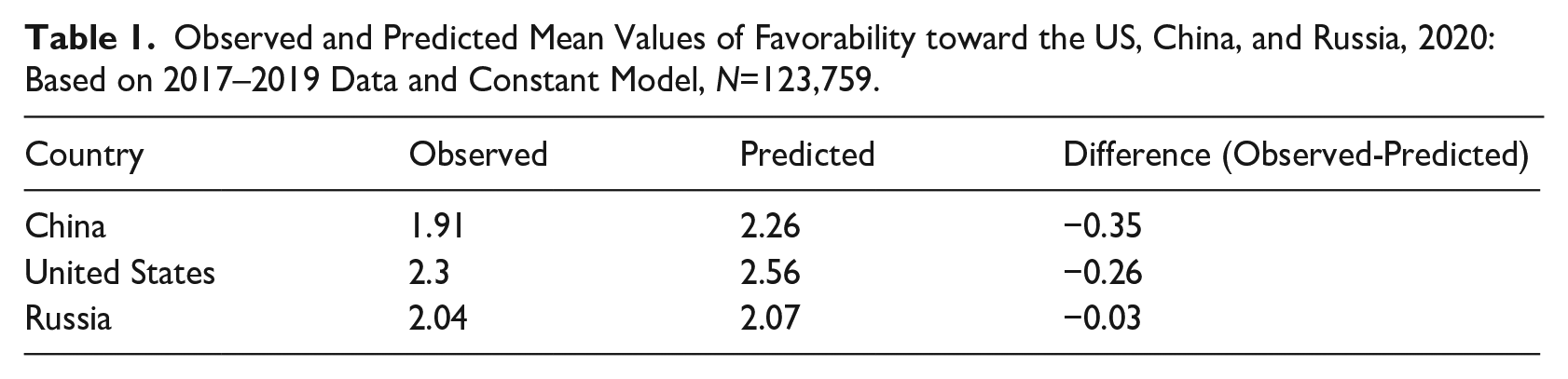
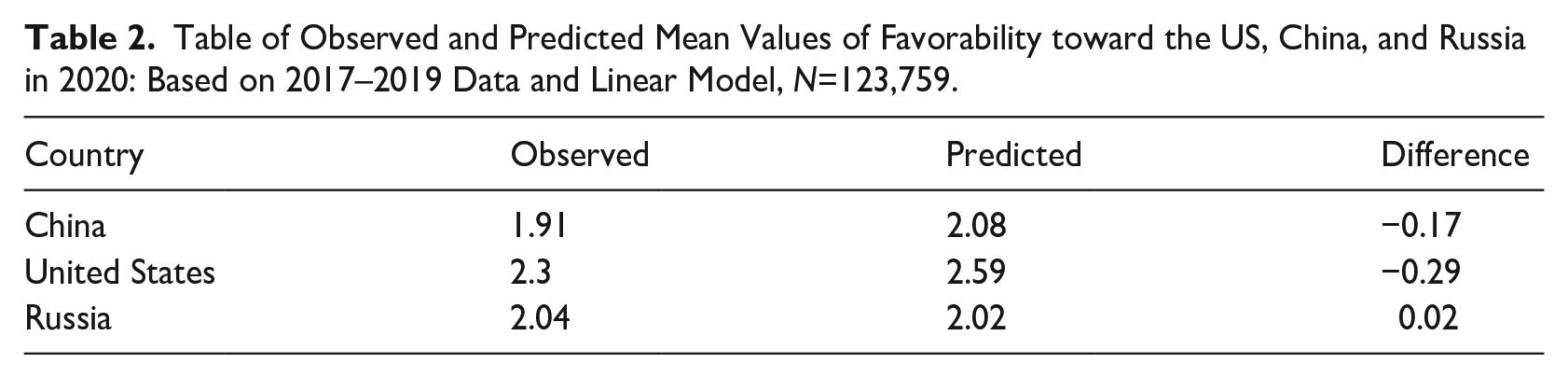
We first compare the observed favorability values in 2020 with those predicted by a constant model based on the means of favorability from years 2017–2019. Table 1 and Figure 1 show our results. Our model predicts that in the absence of the COVID-19 pandemic, respondents in these OECD countries would have viewed both China and the US more favorably than they actually did in 2020. However, the difference between observed and predicted favorability toward China (−0.35) was slightly greater in absolute value than that toward the US (−0.26). In contrast to these large differences, the difference in observed and predicted favorability toward Russia, our reference country, was approximately zero (−0.03). Respondents viewed China less favorably (1.91) than the US in 2020 (2.30), a difference of −0.39. However, if COVID-19 had not happened, our model predicts that the difference in favorability toward China (2.26) and the US (2.56) would have been somewhat smaller at −0.30. 9 Table 2 shows the corresponding results from the linear model. Figure 2 shows our results from a sensitivity analysis with data from 2005 to 2020 only for the US, the UK, Spain, and France, which were the countries that had data available for all these years. These results do not differ by much from those in Figure 1.
Observed and Predicted Mean Values of Favorability toward the US, China, and Russia, 2020: Based on 2017–2019 Data and Constant Model, N=123,759.
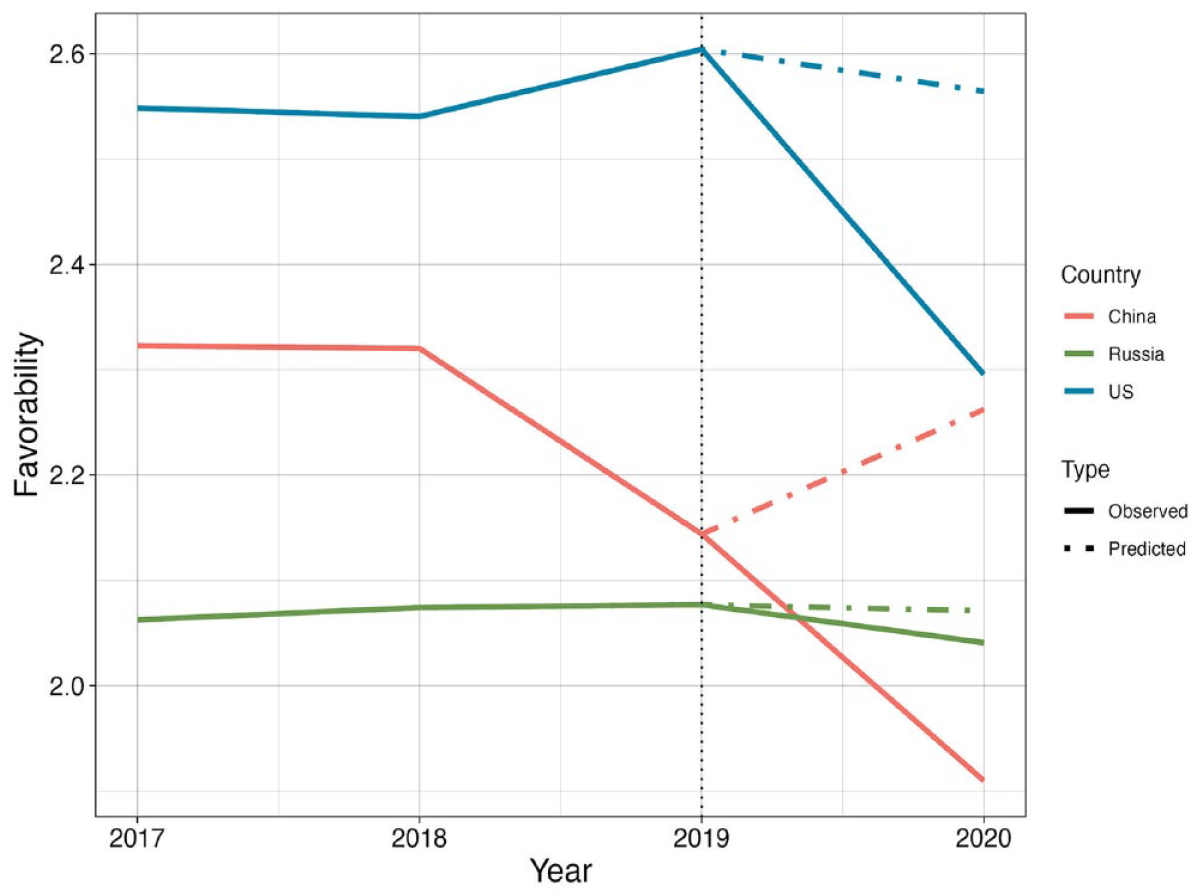
Favorability toward China, US, and Russia, 2017–2020.
Table of Observed and Predicted Mean Values of Favorability toward the US, China, and Russia in 2020: Based on 2017–2019 Data and Linear Model, N=123,759.
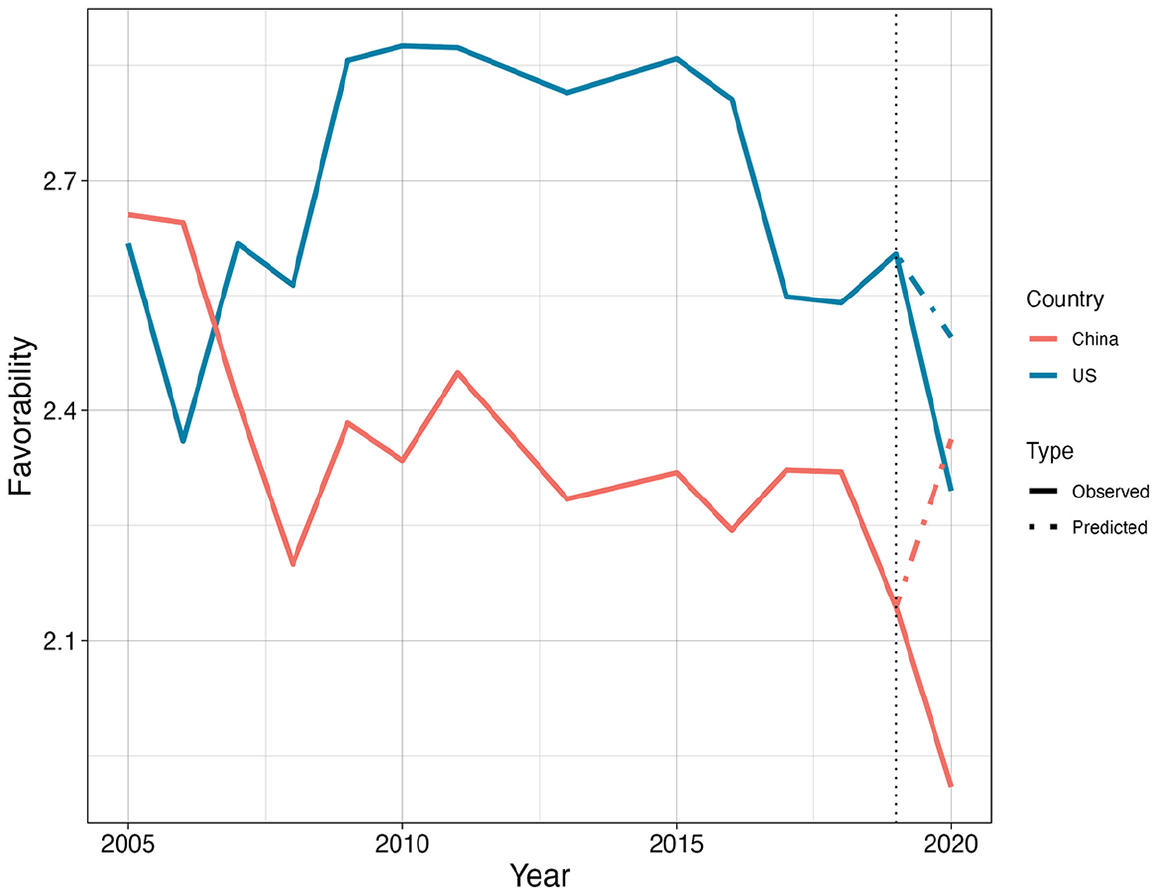
Favorability toward China and US, 2005–2020.
Analysis 2
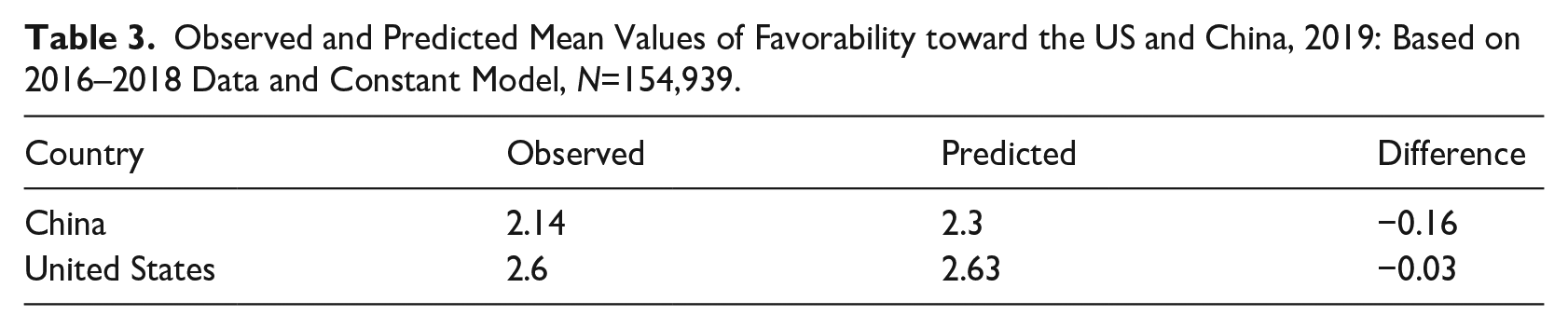
Table 3 and Figure 3 show that the same model using data on attitudes toward China from 2016 to 2018 predicts a much smaller difference (−0.16) between observed and predicted favorability in 2019, at 2.14 and 2.30, respectively. This is nearly one-third of the difference between the observed and predicted favorability in 2020 (−0.45). We also find a very small difference (−0.03) in predicted favorability (2.63) and observed favorability (2.60) toward the US in 2019. This is nearly one-ninth of the difference between the predicted and observed values in 2020 (−0.26). If we assume that factors other than COVID-19 did not alter favorability between 2019 and 2020 far more than they had in prior years, then the COVID-19 pandemic and its second-order effects likely account for the relatively larger discrepancies in observed and predicted favorability for 2020.
Observed and Predicted Mean Values of Favorability toward the US and China, 2019: Based on 2016–2018 Data and Constant Model, N=154,939.
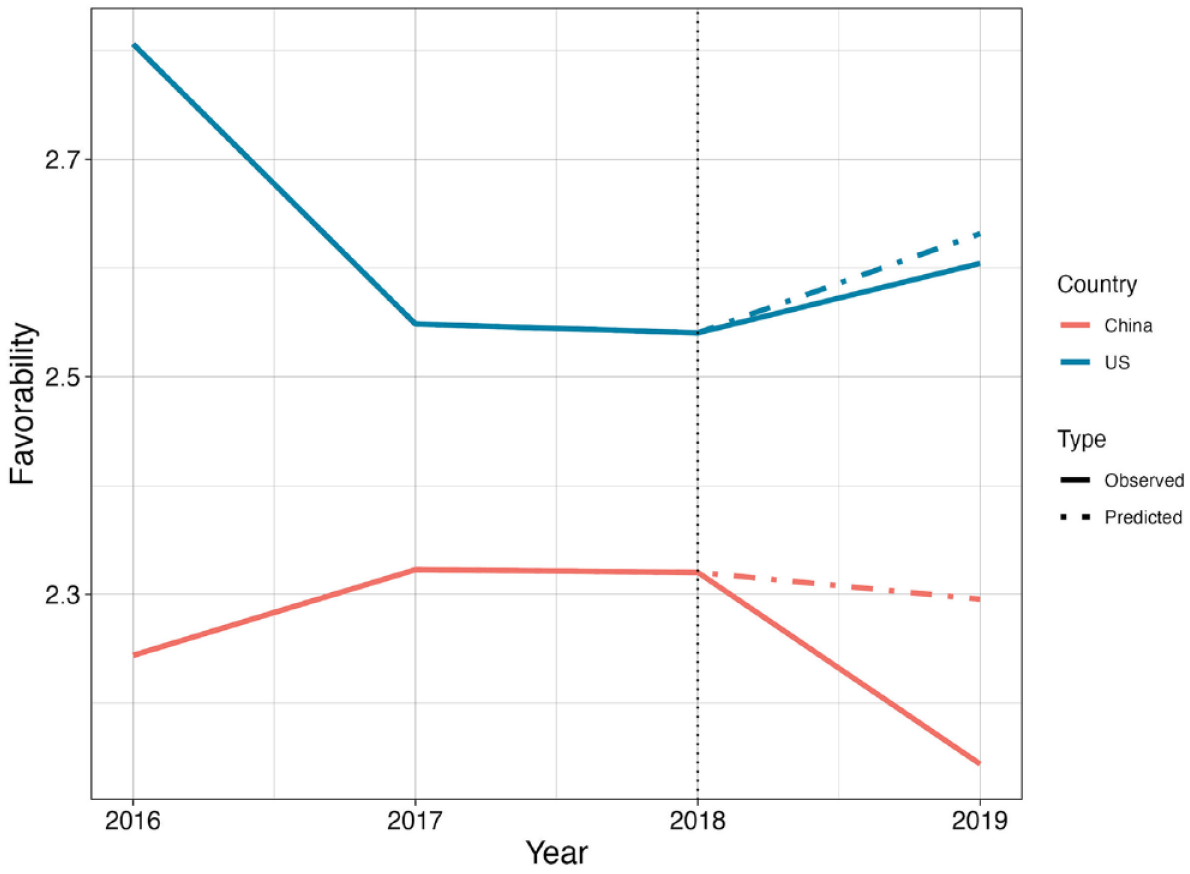
Favorability Toward China, the U.S., and Russia, 2016-2019.
Analysis 3
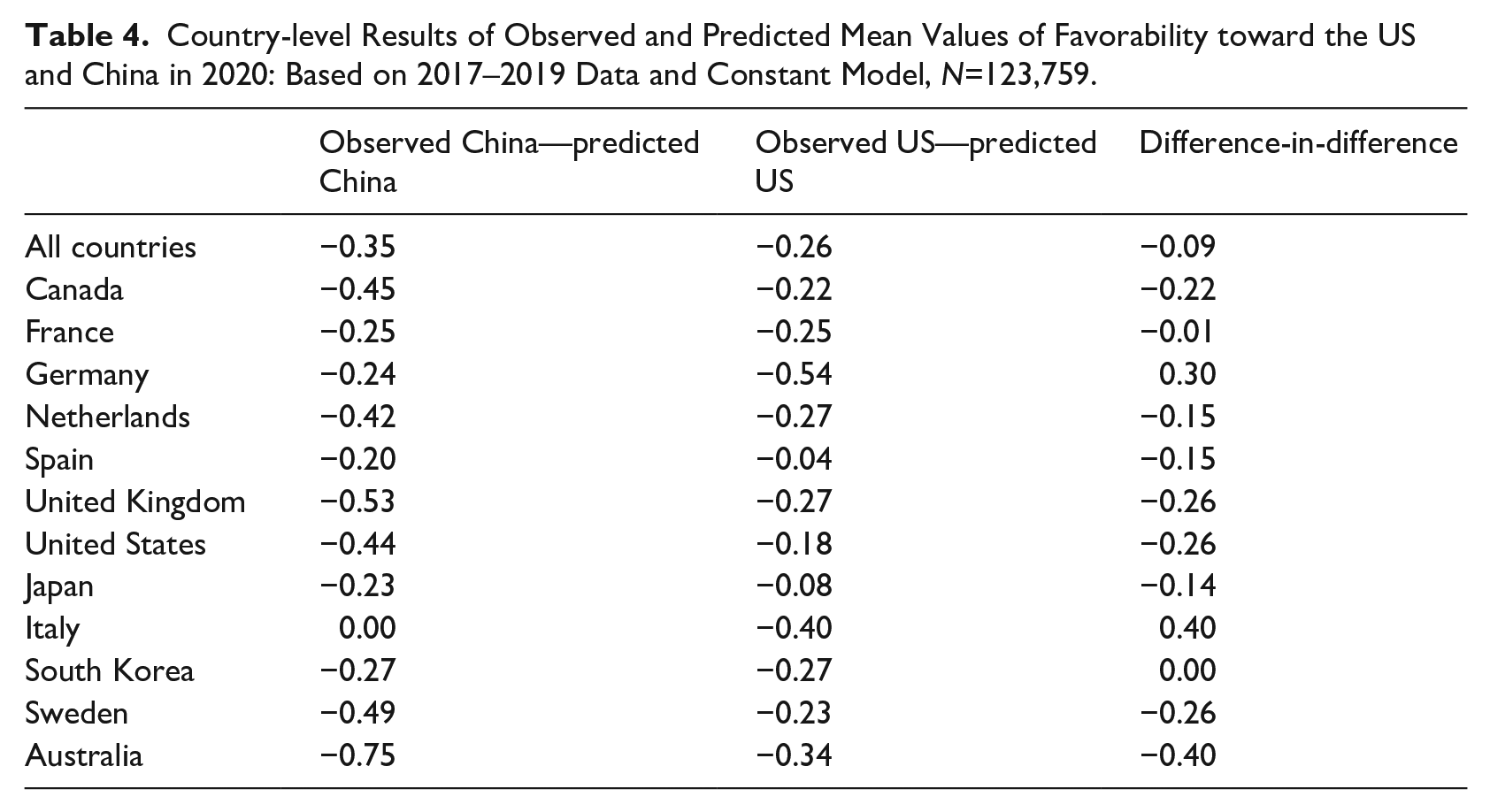
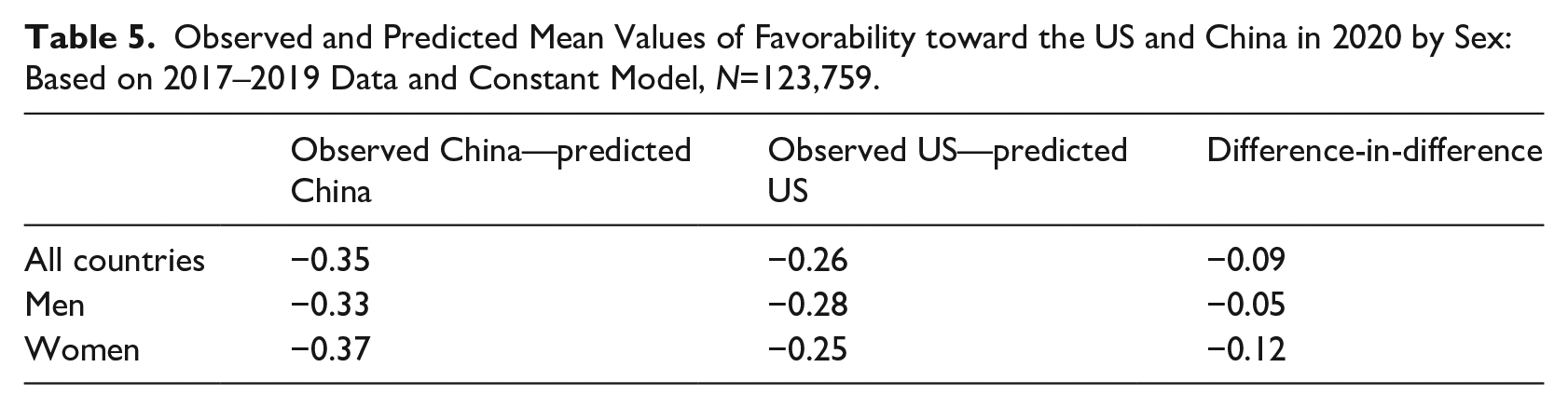
Tables 4 to 7 show more detailed results by nationality, sex, education, and age. We present three quantities: (1) the difference between predicted and observed favorability toward China; (2) the difference between predicted and observed favorability toward the US; and (3) the differences between (1) and (2). We focus on the last quantity in column 3, labelled ‘difference-in-difference,’ as the summary effect of COVID-19 on attitudes toward China in comparison with the effect for the US. The generally negative values of the entries in column 3 indicate negative effects of COVID-19 on attitudes toward China relative to those toward the US.
Country-level Results of Observed and Predicted Mean Values of Favorability toward the US and China in 2020: Based on 2017–2019 Data and Constant Model, N=123,759.
Observed and Predicted Mean Values of Favorability toward the US and China in 2020 by Sex: Based on 2017–2019 Data and Constant Model, N=123,759.
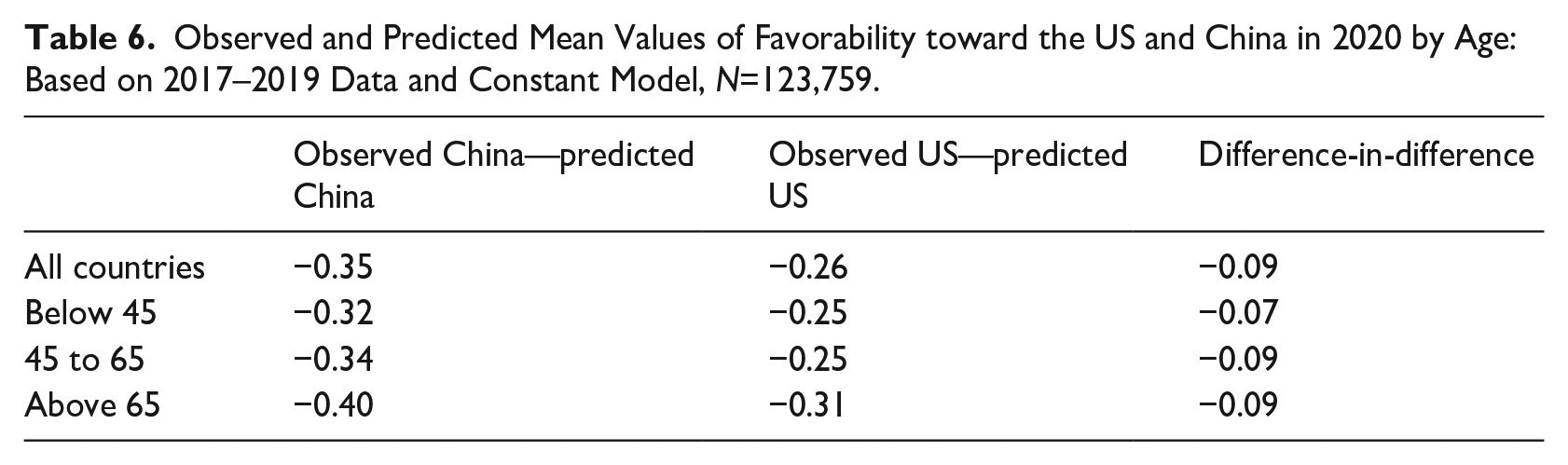
Observed and Predicted Mean Values of Favorability toward the US and China in 2020 by Age: Based on 2017–2019 Data and Constant Model, N=123,759.
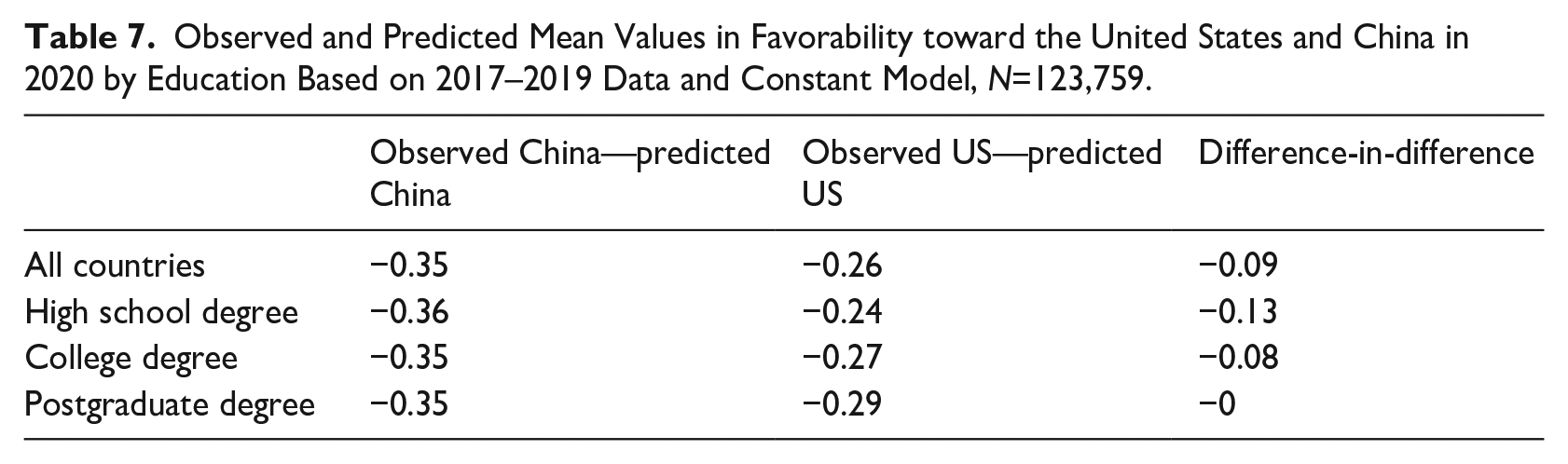
Observed and Predicted Mean Values in Favorability toward the United States and China in 2020 by Education Based on 2017–2019 Data and Constant Model, N=123,759.
Our results presented in Table 4 show much heterogeneity in favorability across different countries. We divide these results into two broad groups based on the difference-in-difference value in column 3. In group A—those nationalities for whom the value in column 3 is less than zero—we find Canada, the Netherlands, Spain, the UK, the US, Japan, Sweden, France, and Australia. These are the nationalities for whom attitudes toward China declined relative to those toward the US. In group B—those for whom the value in column 3 is zero or greater—we find only Germany, Italy, and South Korea.
Within group B, survey respondents in Germany viewed both China and the US much less favorably in 2020 than our model predicts, but the gap is smaller for attitudes toward China than those for the US (0.24 and 0.54 fewer favorability points, respectively). Among respondents in Italy, we observe no difference between observed and predicted favorability toward China in 2020; in contrast, Italian respondents viewed the US far less favorably in 2020 than our model would predict (−0.40). Finally, for South Korean respondents, the difference between observed and predicted favorability in 2020 was the same for both China and the US (−0.27).
We also consider how differences between observed and predicted favorability varied among different demographic groups in the entire sample. In terms of differences by men and women, our model does not predict any departure from the general pattern (Table 5). Similarly, in Table 6, we do not find pronounced differences across age groups. However, consistent with prior Pew surveys, the decline in favorability toward both China and the US among individuals over 65 years was greater than that for younger individuals, although the difference-in-difference estimates are the same across age groups.
As reported in Table 7, in no educational group was favorability toward China or the US much higher or lower than that which we found among all respondents (−0.09). We only find a somewhat greater decline in how favorably respondents with a postgraduate degree view the US (−0.29) compared with those with a high school education (−0.24). The difference-in-difference estimate is more negative for respondents with a high school degree (−0.13) than it is for respondents with a college education and postgraduate education (−0.08 and −0.06, respectively).
This means that lower levels of education are associated with a greater decline in favorability toward China relative to favorability toward the US. 10
Finally, Table 8 presents regression results from Analysis 4. They reveal that favorability toward China was most significantly and negatively associated with how much the respondent believed COVID-19 had divided their society (−0.13), strengthened the overall religious faith in their society (−0.02), and generally changed their life (−0.02). Favorability in views toward China were significantly and negatively associated with whether a respondent was a woman (0.05), their age (−0.01), and their income rank (−0.01).
Regression Results for Covid Change Life Models, 2020.
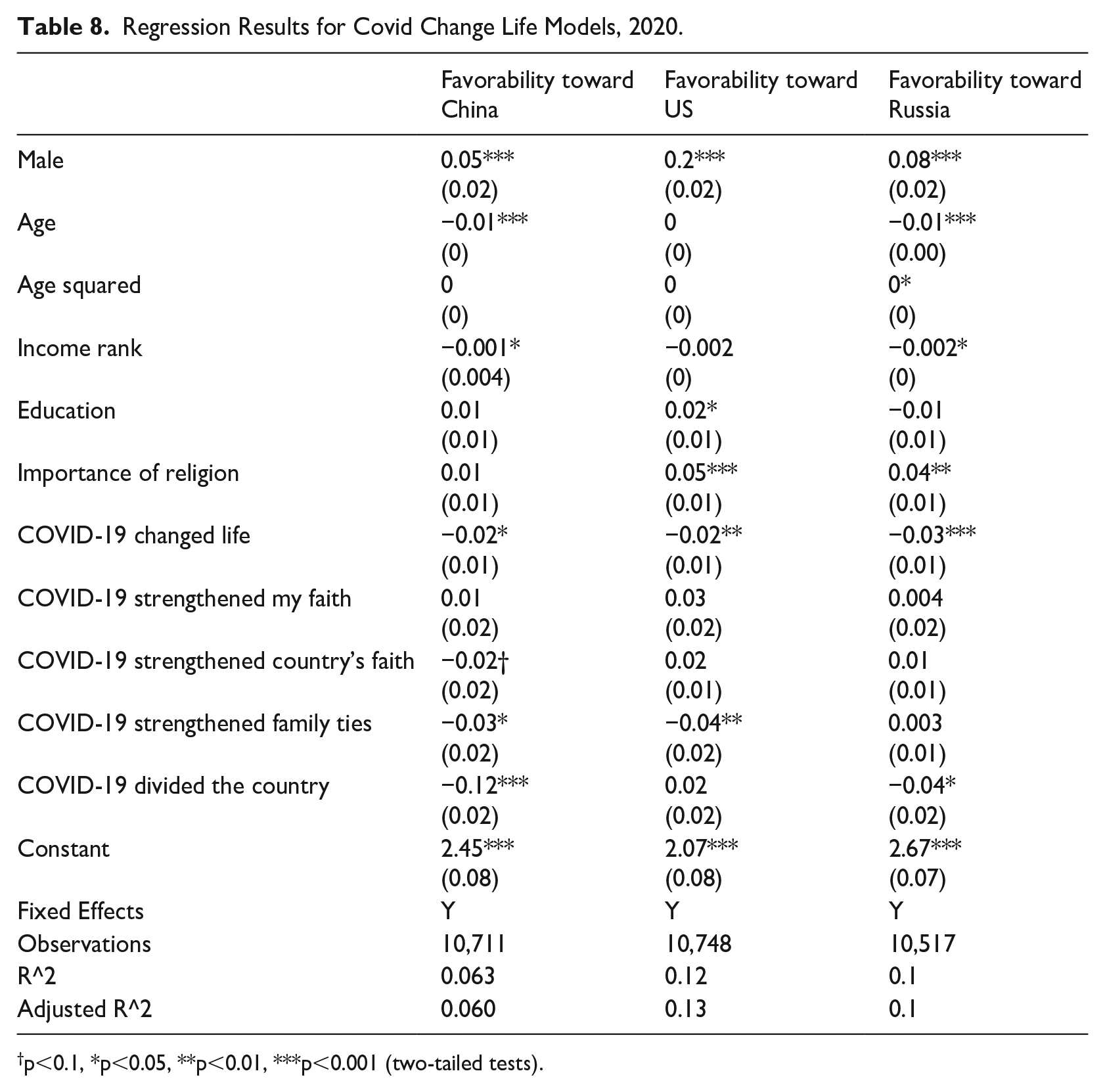
p<0.1, *p<0.05, **p<0.01, ***p<0.001 (two-tailed tests).
Favorability toward the US was also significantly and negatively associated with whether respondents perceived that COVID-19 had changed their life (−0.02) and strengthened their family ties (−0.04). We find no significant association between favorability toward the US and the view that COVID-19 had divided the respondent’s country, however. The significant negative association between favorability toward Russia (−0.4) and how much COVID-19 had divided the respondent’s country was notably one-third of the size of the coefficient for China (−0.12). The adjusted R-squared statistics suggest that the model explains more variance for the US and Russia than it does for China.
Discussion and Conclusion
In general, OECD nationalities viewed both China and the US far less favorably due to the COVID-19 pandemic, an outcome which we term the ‘soft power cost’ of COVID-19. Although popular discourse portrays the rivalry between China and the US in zero-sum relative terms, each country’s absolute loss in their soft power due to the COVID-19 pandemic was far greater than any change in the relative soft power gap between them. 11 We also find that the decline in favorability is limited to the world’s two most economically powerful countries, rather than due to a general trend toward foreign countries. In particular, we do not find a similar decline in how favorably OECD nationals viewed another large, former-superpower country—Russia—in 2020.
In terms of the heterogeneity of the soft power cost, our regression model results show that the degree to which COVID-19 changed respondents’ lives is significantly associated with a decline in favorability toward China, the US, and Russia. However, the degree to which COVID-19 strengthened family ties is significantly associated only with less favorable attitudes toward superpowers (China and the US), but not a non-superpower (Russia). Finally, our results suggest that feelings of both national unity and familial unity in OECD countries are more strongly associated with negative views toward China than the US. The results we report in this paper came from a constant model of the previous 3 years.
As the survey conducted by Pew Research Center in August of 2024 only collected data from OECD countries, we cannot draw inferences about non-OECD populations. Based on prior literature that shows that residents of lower-income and less democratic societies have more favorable views of China and less favorable views of the US than residents in high-income societies (Xie and Jin, 2022), the absolute decline in soft power due to COVID-19 might be somewhat less for China and somewhat more for the US in non-OECD populations. We welcome future research to explore this question empirically with data from non-OECD countries.
Our model is also limited due to data availability because at the time of our analysis we did not have substantial amounts of data with the same questions fielded by Pew after 2020. This limits the extent to which we can fully implement a regression-discontinuity design. The key findings of the paper—declines in attitudes towards China and the US—may be attributable to other factors concomitant with COVID-19. Potential candidates include aversion toward top political leaders and their domestic and foreign policies, and anxieties about globalization in general.
Finally, one might hypothesize that vaccine diplomacy—the practice of providing vaccines to other nation states—by nation states such as China, Russia, and the US could have later improved their soft power abroad. Indeed, many prior scholars have already both theorized this (Lee, 2023) and found it empirically to be the case (Barham et al., 2023; Chen, 2022; Kirgizov-Barskii and Morosov, 2022; Kobierecka, 2023; Manfredi-Sánchez, 2023; Singh et al., 2023). In particular, countries such as China and Russia increased their soft power by engaging in vaccine diplomacy, particularly in Asian countries, which they targeted more often than African countries (Johnson, 2022). However, vaccine diplomacy only became relevant after the historical period covered by our survey data (June to August 2020). The first COVID-19 vaccine emerged in December 2020. Prior research has found that most recipients of China’s vaccine diplomacy were low-income countries in Latin America (e.g. Bolivia, Ecuador), sub-Saharan Africa (e.g. Madagascar, Zimbabwe), and Asia (e.g. Myanmar, Mongolia, Iran) (Suzuki and Yang, 2023). Therefore, only with data from non-OECD populations can we effectively assess how much vaccine diplomacy mitigated the loss of soft power.
Previous research has only suggested an endogenous association between favorability in attitudes toward states and the actions of those states. The COVID-19 pandemic and the Pew data presented a new opportunity to assess how an exogenous and global event that affected populations around the world impacted the soft power of the world’s two most influential countries in the eyes of many OECD nationalities. This impact may affect future perceptions of China and the US. Many may continue to remember China as the alleged source of COVID-19 and the disappointing mismanagement of the pandemic by the US government. Although the contemporary discourses of politicians, the media, scholars, and the public have often been preoccupied with the question of whether one country comes out ahead of the other as their rivalry intensifies, both countries in fact lost soft power among OECD nationalities due to the pandemic. Both have emerged from the pandemic with substantially damaged reputations.
Footnotes
Acknowledgements
The author(s) would like to thank Tom Marling for editorial assistance. They would also like to thank the Pew Research Center for providing the data for this research and Yong’ai Jin for helpful comments on earlier versions of this paper.
Declaration of conflicting interests
The author(s) declared no potential conflicts of interest with respect to the research, authorship, and/or publication of this article.
Funding
The author(s) received no financial support for the research, authorship, and/or publication of this article.
