




Abstract
This study examines the initial phase of the COVID-19 pandemic (December 2019 to July 2020) and its impact on United States (US) soft power in Africa. It advances theoretical understanding by emphasizing the interplay between perceived leadership credibility, state capacity, and domestic crises. It argues that leadership’s perceived ability to handle challenges during exogenous shocks such as COVID-19 significantly influences soft power. Furthermore, it highlights the significance of emotional resonance and trust, noting that moral authority can be undermined by racial injustice and political polarization. Methodologically, it triangulates Gallup data with computational analysis of news from ten African countries, thereby mitigating survey biases for a comprehensive assessment. The findings indicate a critical perception of US influence, impacted by the Black Lives Matter movement, Donald Trump’s presidency and pandemic management. This study concludes that fostering trust remains crucial and advocates for a nuanced US public diplomacy strategy emphasizing tangible actions and mutual trust.
Introduction
The global landscape is experiencing a significant power shift, with the focus shifting from whether United States (US) influence is waning to the extent of its decline. Enhanced international critiques, internal divisions, and controversial foreign policy decisions depict a nation grappling with its global standing. This shift is particularly evident in Africa, a continent of growing geopolitical relevance with diverse media landscapes, where perceptions of the US are crucial to maintaining influence. This study examines the intricate interplay of these perceptions during the tumultuous period of the first wave of the COVID-19 pandemic (December 2019 to July 2020), a period marked by unprecedented challenges to international relations and public diplomacy.
The study addresses the critical question: Can the US effectively re-adjust its strategies to restore its moral authority, or will its self-inflicted wounds continue to accelerate its decline from global dominance, especially in the vital landscape region of Africa? This question is particularly relevant given President Donald Trump’s America First policy, which underpinned his 2016 campaign and his first term in office (2017–2021). By prioritizing the US interests over international commitments, the Trump administration withdrew from several global treaties and organizations, leading critics to label the policy as America Alone (Rose, 2024), especially during the turbulent period of the COVID-19 pandemic. The initial actions during Trump’s second term in office hint at a potentially turbulent period ahead, indicating that his policies may have become even more aggressive and confrontational than during his first presidency. Exploring COVID-19 as an exogenous shock offers a unique chance to assess the resilience of the US soft power during significant global crises. The US has strategically employed public diplomacy to advance its interests and project its values due to its long history of global engagement (Cull, 2013: 125). Africa, with its geopolitical significance, historical complexities and diverse media landscape, represents a crucial arena for these efforts. A careful analysis of US narratives and their reception within the African media is essential for refining diplomatic strategies and maintaining their influence in a rapidly evolving world.
This study advances public diplomacy research by introducing a quantitative toolkit for a rigorous analysis. We elucidate subtle variations in public diplomacy perception by employing Gallup World Poll data (Gallup Inc, 2024) on US approval ratings in conjunction with computational methods, including topic models, sentiment analysis, and emotion analysis of news coverage from ten African nations. Our methodology transcends conventional qualitative approaches, providing a replicable framework applicable across diverse geopolitical contexts. This study introduces a novel quantitative toolkit for public diplomacy research that utilizes computational methods alongside traditional survey data to rigorously analyse these complex and rapidly evolving dynamics. We leverage an extensive data corpus, integrating the Gallup World Poll survey data from 29,266 respondents across nine African nations with a computational analysis of 950 news articles from 21 diverse media outlets. Our theoretical grounding draws on the relational theory of soft power, emphasizing the crucial role of perceptions of US leadership and credibility in shaping its influence. Central to this framework is an evaluation of the perceived US state capacity to effectively manage both the domestic COVID-19 crisis and meaningfully contribute to the global pandemic crisis. This research was designed to foster a more nuanced understanding of soft power, viewing it as a socially constructed and context-dependent phenomenon, rather than as a static resource. Perceived sentiments and emotions are essential for US leadership approval, as relational effectiveness depends on global perception of the US in handling the situation. This includes assessing perceptions of the management of domestic crises, such as racial injustice protests, which profoundly impact a nation’s moral authority. A key aim was to assess whether the US could sustain trust even during challenging times. These findings provide insights into the multifaceted factors influencing soft power dynamics in Africa during the first wave of the COVID-19 pandemic.
Theoretical motivations
Since the late twentieth century, the concept of public diplomacy, often equated with soft power, has become fundamental in international relations. Joseph Nye popularized the term ‘soft power,’ defining it as the ability to influence others’ preferences and behaviours through attraction and persuasion rather than coercion or financial incentives (Cristo, 2005; Nye, 2004, 2023). This kind of power is derived from a nation’s cultural appeal, political values and foreign policies, distinguishing it from hard power, which relies on military strength or economic leverage (Neack, 2008: 48). The soft−hard power distinction extends beyond the theoretical discourse, signifying a significant shift in global influence mechanisms in an era of interdependence and digital connectivity (Siniver and Tsourapas, 2023). Scholarly literature emphasizes that soft power’s effectiveness transcends projecting a favourable image; it involves crafting authentic narratives capable of resonating across diverse audiences. Credibility and emotional resonance are crucial for soft power strategies to shape foreign perceptions effectively (Lee, 2009: 208). For instance, the US employs public diplomacy through cultural exports, educational programmes, media outreach and the promotion of shared democratic values (Hayden, 2012: 255). These initiatives aim to foster mutual understanding, build influence networks and align international public opinion with national interests. Public diplomacy thus serves as a vital tool for expressing a state’s identity and global role (Pamment, 2012: 151). Consequently, it functions more than as a complementary diplomatic tool; it is a core element of foreign policy, leveraging soft power to navigate the complexities of international relations.
The discourse on soft power and public diplomacy has expanded with increasing global diplomatic rivalry. Creswell (2019) examined how the US strategically utilizes public diplomacy to reinforce ideological and political legitimacy, though structural barriers limit its effectiveness. Trunkos (2021) analysed soft power trends from 1995 to 2015, indicating that despite perceptions of its decline, the US continues to hold a significant advantage over Russia and China, particularly in the economic and military spheres. Blair et al. (2022) argue that US aid to Africa strengthens democratic values and enhances support for American influence, whereas Chinese aid tends to lack favourability and may reinforce African affinities toward former colonial powers such as the United Kingdom and France.
The COVID-19 pandemic underscored the function of public diplomacy, with countries such as China and the US harnessing soft power to shape global perceptions. China’s ‘mask diplomacy’ and ‘vaccine diplomacy’ during the pandemic exemplified strategic soft power initiatives aimed at boosting its global image and geopolitical influence. However, international media narratives surrounding these efforts diverged significantly, reflecting broader geopolitical biases and perceptions of China’s motives (Ju et al., 2023; Kim et al., 2023). The US sought to reaffirm its normative leadership through vaccine donations and advocacy for transparency and equity, positioning itself differently from competitors such as China and Russia (Khlil, 2024; Sperrazza, 2021). In Africa, the US utilizes soft power to counterbalance the influence of China, Russia, and emerging powers such as Turkey (Siegle, 2021; Thiessen and Özerdem, 2019). Initiatives such as vaccine donations via COVAX (COVID-19 Vaccines Global Access) present US contributions as an act of global stewardship rather than mere diplomacy (Sperrazza, 2021). Additionally, through programmes such as Prosper Africa and the African Growth and Opportunity Act, the US projects its policies to promote democratic governance and economic development, emphasizing grassroots engagement and capacity building over China’s infrastructure-heavy investments criticized for fostering debt dependency (Blair et al., 2022).
Despite the seemingly benevolent nature of pandemic-related public diplomacy, some countries viewed these initiatives as politically driven, questioning whether they genuinely aimed at humanitarian goals or strategic leverage (Manfredi-Sánchez, 2022). This underscores a fundamental aspect of public diplomacy: the narratives surrounding these efforts often hold as much significance as the actions themselves. The COVID-19 pandemic has highlighted how internal governance challenges, such as political instability and perceived mismanagement, can directly impact a nation’s global image and soft power (Kahl and Wright, 2021). For example, the US faced considerable scrutiny during the pandemic due to domestic issues such as racial justice protests and political polarization, which raised questions about its credibility as a global leader in democratic values (Branicki et al., 2021).
Building on this study’s relational view of soft power, modern international relations are characterized by a profound global shift from a singular trans-Atlantic order to multiple interconnected orders. This transformation is not merely structural but involves ‘world-making’ narratives and practices that reshape global understandings and challenge established international norms (Fisher-Onar and Kavalski, 2023). To understand US soft power and public diplomacy in this evolving landscape, it is necessary to move beyond traditional ideas of multipolarity toward a relational framework that recognizes fixed regional worlds and diverse imaginaries (Fisher-Onar and Kavalski, 2023: 5). This approach, promoting ‘itinerant translation’ across these regional worlds, acknowledges the world as a ‘pluriversal space’ where multiple realities coexist, thereby challenging reductionist binary interpretations of international engagement (Fisher-Onar and Kavalski, 2023: 5, 8). Crucially, effective public diplomacy must consider this ‘intersubjective nature of identity construction’ and the co-constitution of global order, moving beyond Eurocentric perspectives to craft stories that genuinely resonate with diverse audiences (Fisher-Onar and Kavalski, 2023: 2).
Exploring COVID-19 as an exogenous shock offers a unique perspective on soft power resilience. Thomas et al. (2025) demonstrated that the pandemic disrupted positive perceptions of both China and the US in Organization for Economic Co-operation and Development (OECD) countries, highlighting broader challenges to soft power during global crises. Our study utilizes the initial phase of the pandemic to evaluate the durability of US soft power strategies in Africa, shedding light on how public diplomacy functions under extraordinary circumstances. Moving beyond traditional bilateral analyses, this research expands the scope by examining how global events, such as COVID-19, influenced perceptions of US soft power across Africa. In this context, it becomes especially crucial to analyse US soft power in Africa, amid concerns about the decline or transformation of its global influence. As competition with China and Russia intensifies, the effectiveness of the US to shape outcomes through attraction rather than coercion is increasingly questioned. Although soft power remains a vital tool in international diplomacy, its actual impact and credibility, particularly in strategically significant regions such as Africa, are under greater scrutiny and debate (Agadjanian and Horiuchi, 2020; Wike, 2020).
Furthermore, the decline in US leadership approval during the pandemic, as seen in African public opinion and media sentiments, raises broader questions about American strategic credibility in the Global South. As scholars of grand strategy have emphasized, a nation’s ability to maintain influence in peripheral regions is a key indicator of its global standing and strategic coherence (Gerstle, 2022; Ryan, 2022). Moreover, framing the COVID-19 pandemic as an exogenous shock positions this study within the expanding literature on crisis-driven power reconfiguration. ‘Black swan’ events such as pandemics or global economic crises test not only material capacities, but also normative authority and institutional resilience (Branicki et al., 2021; Thomas et al., 2025).
Building on existing research, our study offers a theoretical contribution by emphasizing the critical connection between perceived leadership credibility, state capacity, and domestic crises in shaping soft power. We argue that a nation’s soft power is not only determined by its cultural appeal or foreign policies but is also fundamentally influenced by the perception of its leadership, particularly its ability to effectively handle domestic and global challenges. This is especially crucial during exogenous shocks, such as the COVID-19 pandemic, which reveal a country’s governance strengths and weaknesses. Moreover, we underscored the significance of emotional resonance and trust in reinforcing soft power, implying that leadership approval depends on successfully communicating empathy, competence and shared values in times of crisis. Lastly, we contend that the effectiveness of soft power is intrinsically linked to its capacity to maintain moral authority, which internal issues, including racial injustice and political polarization, can undermine.
By illustrating these interconnected factors, our research enhances a nuanced understanding of the determinants of soft power, particularly its susceptibility to perceptions of leadership performance, state capacity and domestic governance. Our methodological rigour relies on data triangulation and diverse analytical techniques. This study provides insights into how soft power functions under conditions of systemic volatility in this regard by empirically demonstrating how a global health crisis altered perceptions of US leadership, particularly in a strategically contested region such as Africa. It addresses the ‘so what’ question by highlighting soft power as both a diplomatic asset and a strategic variable in times of global disruption. This study mitigates biases inherent with sole reliance on surveys, ensuring a more comprehensive and accurate assessment of US soft power dynamics during this critical period by combining survey analysis with computational methods to analyse African news media portrayals.
Data and methodology
This study employs a multi-method approach to explore the complex dynamics of US public diplomacy in Africa. It integrates survey data, topic models, sentiment analysis and emotion analysis to assess the soft power implications of COVID-19 in OECD countries. This study draws primarily on the Gallup World Poll surveys from 2019 to 2021, covering nine African nations: Ghana; Kenya; Namibia; Nigeria; South Africa; Tanzania; Uganda; Zambia; and Zimbabwe. Approximately 29,266 respondents contributed valuable insights into perceptions of the US during this period. The survey data facilitated an assessment of overall public sentiment toward the US and allowed for an examination of how various socioeconomic factors influence these perceptions.
A comprehensive examination of media portrayals was conducted to enhance the robustness of the analysis. Online Table 1A in the Appendix presents 950 articles from 21 news sources across ten African nations collected to ensure a broad representation of media perspectives across the continent. The data selection involved manual collection of articles with the US in the titles from the PROQUEST Central database and multiple online news sources. Online Appendix Table A1 illustrates that these sources were carefully selected to provide a broad representation of media viewpoints across the continent. The analysis focused on the period between December 2019 and July 2020, corresponding to the first wave of the COVID-19 pandemic.
Both the survey data and news articles were preprocessed for analysis. The survey data were examined for associations between various impacts from individuals and groups on US approval, using regression analysis. Descriptive statistics of the survey analysis are provided in the online Appendix. For news articles, preprocessing involves converting the text to lowercase and removing stop words, punctuation, and numerical digits. We offer a more robust assessment of the challenges to US soft power influence in Africa by analysing news media and information at the ground level and by triangulating survey data. To analyse the news data, we employed topic modelling, specifically the BERTopic 1 technique, to uncover the dominant themes and subjects present within a corpus of relevant news articles (Grootendorst, 2022). Further, we conducted sentiment and emotional analyses to understand the affective dimensions of this coverage. We performed sentiment analysis using Google application programming interface natural language processing and assessed the overall positive, negative, or neutral tones of news articles (Google Cloud, 2024). Complementing this, emotion analysis leveraging the National Research Council of Canada Emotion Lexicon (Mohammad and Turney, 2013) provided insights into the specific emotional categories expressed in the language.
The selected countries, Ghana, Kenya, Namibia, Nigeria, Rwanda, South Africa, Tanzania, Uganda, Zambia and Zimbabwe, constitute a regionally representative sample. 2 They encompass a spectrum of geographical, economic and socio-political contexts, thereby enhancing the generalizability in these dimensions. Moreover, the incorporation of both Anglophone and multilingual countries minimizes the potential linguistic bias. This research intentionally focuses on the dynamics of Sub-Saharan Africa, excluding North African countries, to maintain a focused analysis of a distinct geopolitical environment and diplomatic dynamics from those in North Africa.
Although our study utilizes the Gallup World Poll survey data to gauge public opinion across Africa, relying solely on these sources introduces several analytical limitations. According to Thomas et al. (2025), the potential for unobserved confounders to influence results is a key limitation. Survey responses may not fully capture the complex factors influencing individual perceptions of US soft power, including historical context, local political dynamics, and personal experiences. Additionally, surveys frequently rely on self-reported data, which may be susceptible to biases such as social desirability bias, where respondents provide answers that they perceive as more acceptable rather than a true reflection of their beliefs. These limitations underscore the challenge of isolating the specific impact of the COVID-19 pandemic on US soft power.
To address these limitations, our study incorporates news data analysis into survey data. We analyse African news media coverage to gain a complementary perspective on the prevailing narratives and sentiments toward the US. This approach offers a more contextualized comprehension of the factors shaping public opinion. The news data analysis uncovers specific issues and events that resonate with the African public and their impact on the US image. By triangulating survey data with news media content, our study offers a more robust and nuanced assessment of US influence, transcending the limitations of self-reported opinions to understand the underlying drivers and dynamics shaping the perceptions of US soft power in Africa.
Hypotheses
This study’s hypotheses are framed within the context of shifting evolving global power dynamics and the unprecedented challenges of the early phase of the COVID-19 pandemic, which heightened scrutiny of national leadership and crisis management (Kahl and Wright, 2021). Our theoretical motivation is based on the relational perspective of soft power, emphasizing that a nation’s soft power is profoundly influenced by the perception of its leadership’s credibility and its state capacity to effectively handle domestic issues, such as racial injustice protests, and global crises such as the pandemic (Agadjanian and Horiuchi, 2020). Consequently, our hypotheses examine how socioeconomic factors, such as education, gender and income, may influence perceptions of US leadership, considering that increasing access to information about perceived US shortcomings during the crisis may alter traditional associations (Kahl and Wright, 2021). Furthermore, we investigated the role of greater information access in fostering a nuanced understanding of the US pandemic response, enabling individuals to formulate independent judgements (Nye, 2004). This study investigated the correlation between African news media coverage and public approval ratings. Grounded on this theoretical foundation and the critical context of the early COVID-19 pandemic, we propose a series of testable hypotheses (H1−H7) that explore the nuanced relationships between these factors and perceptions of US leadership and soft power in Africa.
H1: The traditionally positive association between education and US leadership approval in Africa weakened during the early COVID-19 pandemic.
Typically, higher education correlates with favourable views of US global leadership, largely due to the promotion of democratic ideals. However, readily available knowledge about perceived US failures during the crisis may have shifted public sentiment, even among the educated individuals (Kahl and Wright, 2021).
H2: The gap in approval rates for US leadership between male and female respondents in Africa narrowed during the early COVID-19 pandemic.
Gender has historically influenced opinions on US foreign policy, with women often more receptive to global health assistance during crises such as COVID-19. US humanitarian efforts are likely viewed positively by women who tend to prioritize family wellness, including health, economic security, and social well-being of their households and communities. During this period, pandemic-related policies or initiatives resonated more strongly with women (Thomas et al., 2025).
H3: The positive relationship between higher income and US leadership approval in Africa strengthened following the early COVID-19 pandemic.
High-income groups may initially resist domestic policies such as trade and reconstruction programmes, but later support US-backed economic initiatives. Economic cooperation often favours wealthier demographics, potentially enhancing positive views of the US leadership. Successful economic restoration efforts within these demographics can increase support for US actions.
H4: Higher levels of information access mitigate the impact of negative sentiments on public opinion.
Individuals with more technological access are exposed to a wider range of information and can form their own judgements and opinions. Increased information exposure may provide a more nuanced comprehension of the US pandemic response, reducing the negative impact of economic hardship. This supports the argument that individuals equipped with technological tools and connectivity are empowered to critically evaluate information and formulate independent opinions (Nye, 2004).
H5: A higher proportion of news coverage focused on topics associated with the US aid and collaboration in specific countries will correlate with higher survey approval ratings of the US leadership in those countries.
Increased awareness of US aid and collaborative programmes within specific countries is hypothesized to correlate positively with heightened approval ratings for US leadership in those nations. This proposed relationship between greater news coverage and enhanced approval is predicated on the notion that heightened awareness of assistance programmes, coupled with the trust engendered by the US’s contributions to public goods provision, may foster a more favourable perception of US leadership (Blair et al., 2022).
H6a: Negative sentiment in African news negatively correlates with US leadership approval.
H6b: Negative emotions in African news are associated with lower US leadership approval, while positive emotions correlate with higher approval.
H6c: Increased coverage of the ‘Coronavirus’ topic is associated with a decline in approval ratings of the US leadership during the COVID-19 period.
African populations are likely sensitive to media coverage on the US failures and deficiencies, and leadership perception during crises (Branicki et al., 2021). We assume that in the early months, information access heavily depended on media portrayal; thus, negative coverage of the Coronavirus could lead to disapproval of the US leadership.
H7: Pre-existing higher levels of trust in the US government in African countries moderate the negative impact of increased reports of the US government’s COVID-19 (mis)management, during the pandemic, on emotion level.
We assumed that high levels of trust serve as a buffer against mismanagement. Thus, despite negative information from the US, countries rely on previous good experiences of trust among the countries (Owoeye, 2021).
Results
Analysis 1
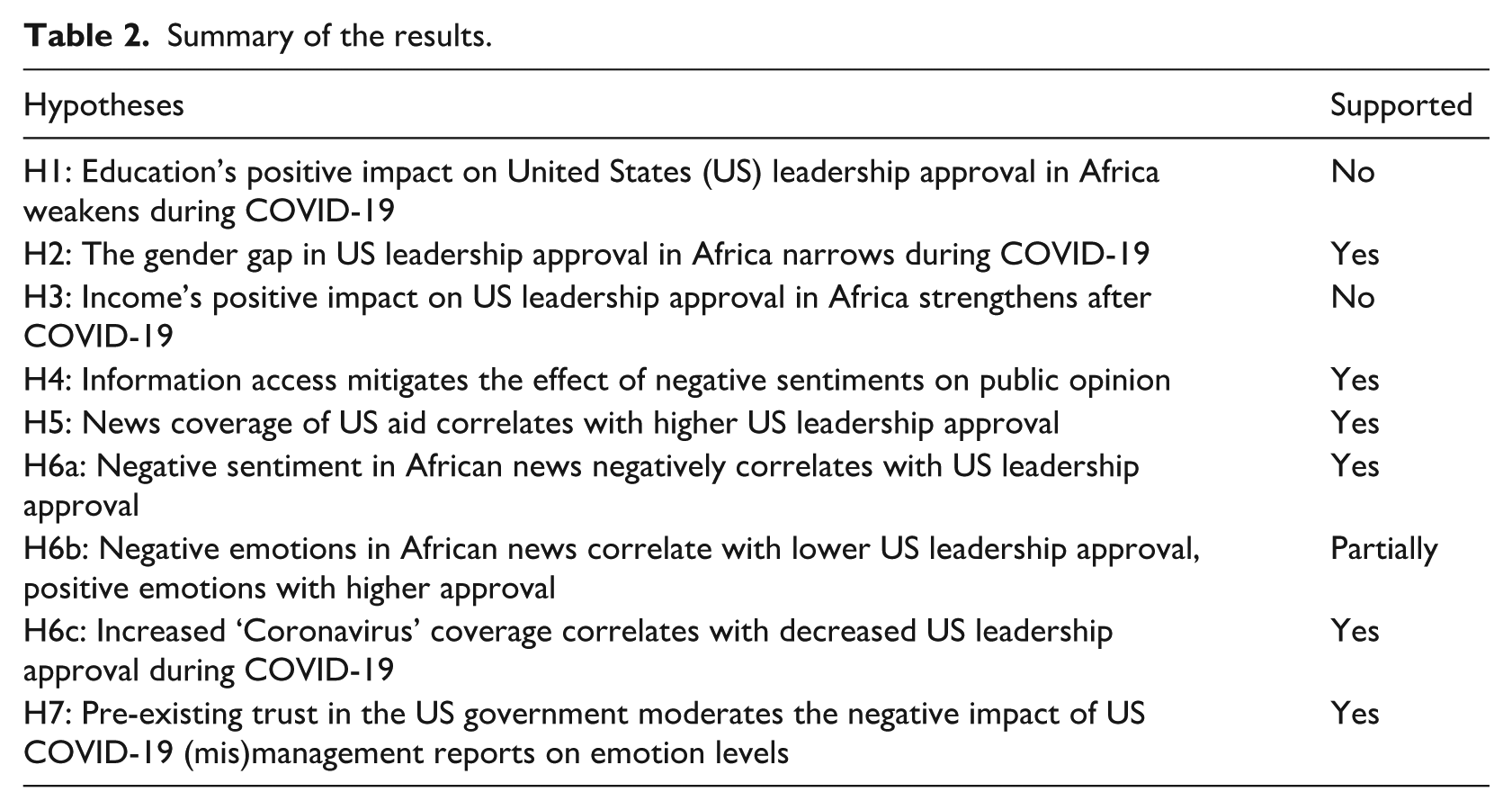
This subsection presents the findings associated with Hypotheses 1 to 4, examining how various socioeconomic factors influence the approval of US leadership in African countries, especially during and after the initial COVID-19 wave. Table 1 presents the probit estimation results, where country fixed effects are used with robust standard errors. 3 Model 1 provides the baseline results. Model 2 includes interaction terms of how gender impacts approval of US leadership during and after the pandemic. Model 3 introduces interaction terms between how income and approval shifted across these periods.
Public opinion on the United States approval.
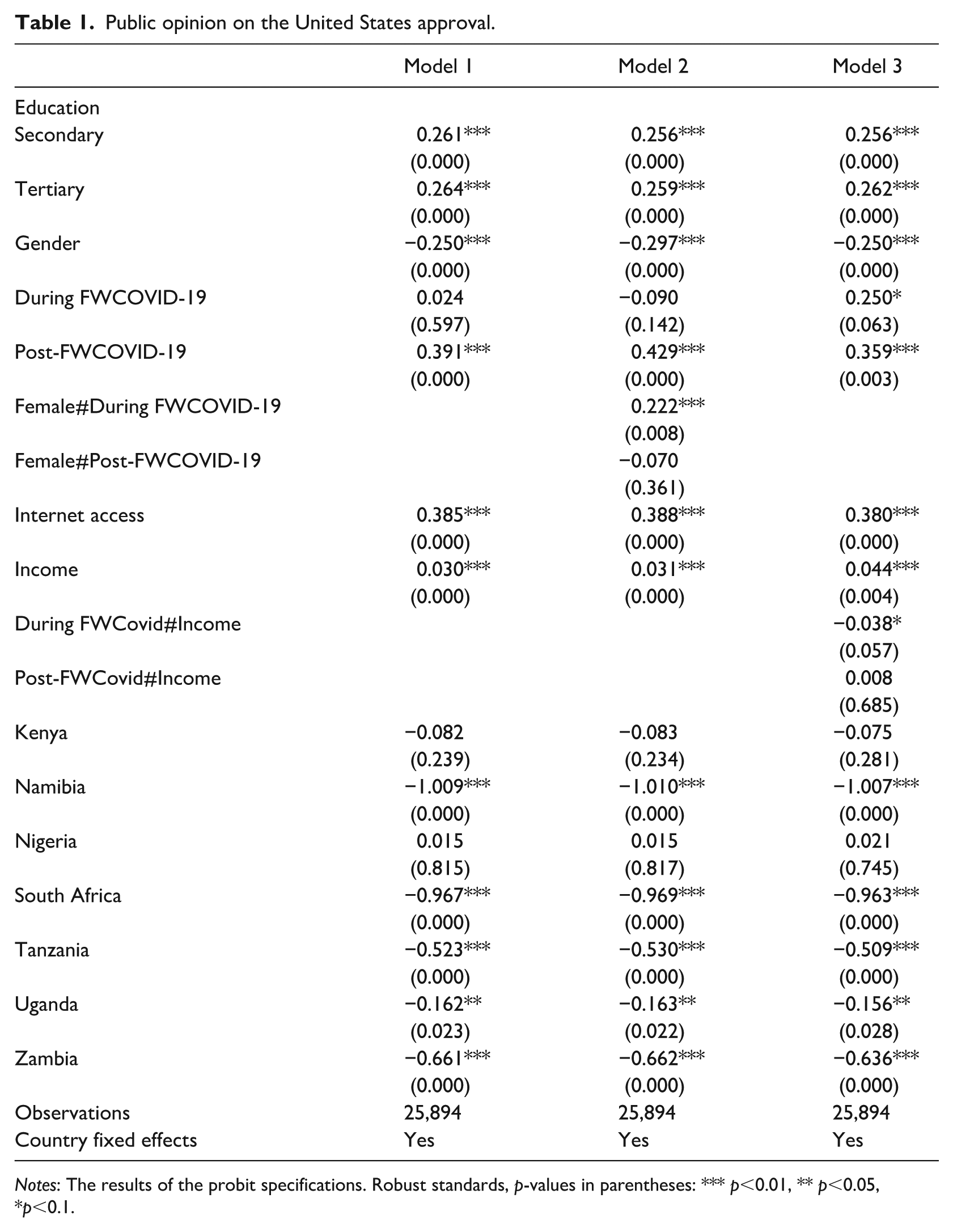
Notes: The results of the probit specifications. Robust standards, p-values in parentheses: *** p<0.01, ** p<0.05, *p<0.1.
Higher levels of education are positively associated with the approval of US leadership across all three regression models (refer to Table 1), challenging conventional expectations. Specifically, individuals with secondary and tertiary education exhibit significantly higher approval rates than those with lower education. The topic analysis in Figure 1 demonstrates that African media sources can access Western information thereby enhancing the population’s ability to receive such information. Consequently, H1, which hypothesized a diminishing of the traditionally positive relation between higher education and approval of US leadership during the FWCOVID-19, is not supported.
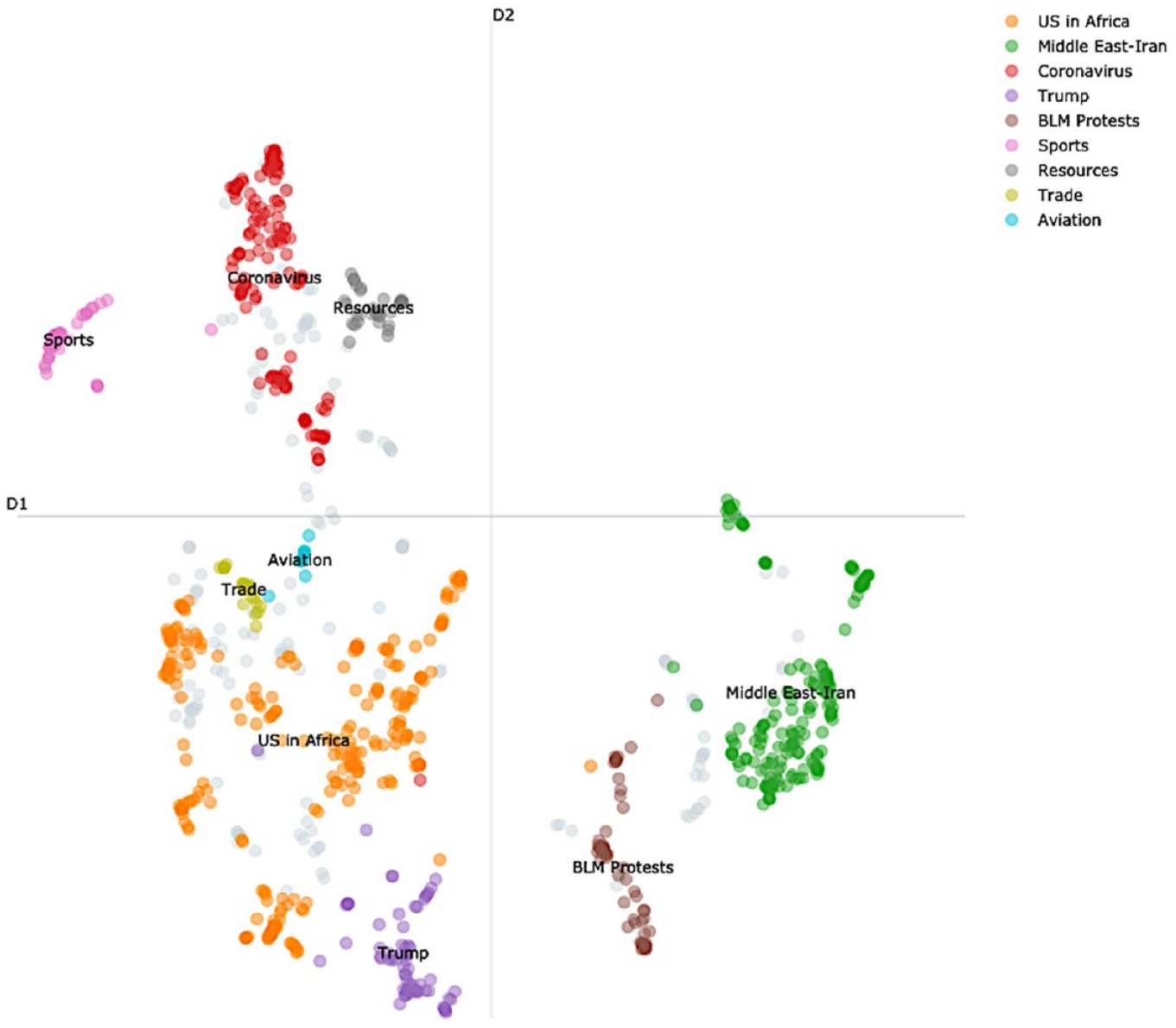
Topics in the US News: distribution in two dimensions.
Regarding gender (H2), our analysis reveals that being female generally has an adverse effect; however, the interaction term between females and FWCOVID-19 is positively significant. In contrast, the interaction between females and post-FWCOVID-19 is not significant. This indicates that during the FWCOVID-19 period, female respondents were more likely to approve of US leadership compared to their male counterparts, suggesting that the US’s pandemic-related policies or initiatives resonated more robustly with women at this time. Conversely, the negative and insignificant coefficients after the pandemic indicate no significant difference in approval between women and men during the post-FWCOVID-19 period. This means that the gap between males and females was narrowed during FWCOVID-19, whereas there was no evidence of gender differences thereafter.
An examination of the influence of economic status, as hypothesized in H3, indicates that higher income levels were positively correlated with approval ratings. However, considering the interactions of income with COVID-19, the negative and marginally significant interaction between income and the FWCOVID-19 period indicates that higher-income individuals were more likely to disapprove of the US leadership during the pandemic compared to pre-COVID-19 times. This disapproval may stem from dissatisfaction with how the US leadership managed global economic disruptions, such as trade, investments and international recovery efforts, which may have disproportionately impacted wealthier individuals’ interests. Alternatively, higher-income respondents may have heightened expectations of the US leadership during the crisis, causing greater disappointment when these were unmet. In the post-FWCOVID-19 period, the relationship between income and approval returned to pre-pandemic levels, indicating a normalization of perceptions as immediate pandemic-related concerns subsided, and economic stability improved. Therefore, H3, which predicts a strengthened positive association between higher income and approval of US leadership after FWCOVID-19, is not supported.
Finally, regarding H4, our results suggest that Internet access is positively correlated with approval ratings. This finding supports our hypothesis (H4), indicating that greater access to information mitigates the negative influence of prevailing negative sentiments on public opinion. It also reinforces the argument that individuals with technological tools and connectivity are empowered to critically assess information, formulate independent judgements, and resist the sway of homogeneous narratives even during a crisis. Our study reveals that this heightened access to a broader range of information sources contributes to a more nuanced comprehension of the multifaceted US approach to the pandemic, thereby buffering the negative impact of economic difficulties on perceptions of US leadership.
As a robustness check, we segmented the dataset into subsamples based on gender in online Table A4 and education in online Table A5 of the Appendix. The results remain consistent across all subsamples, confirming the robustness of the findings. Notably, for the gender subsample, the analysis indicates that women were more positively influenced during the first wave of COVID-19, whereas men experienced greater approval recovery in the subsequent period, highlighting subtle gender differences in response to the pandemic. Additionally, the coefficients for different countries are generally negative. Compared to Ghana (the base category), respondents from several countries exhibited lower approval of the US leadership. Namibia, South Africa, Tanzania, Uganda and Zambia exhibited significantly lower approval levels, reflecting country-specific factors such as differing perceptions of US policies, historical relationships, or socio-political dynamics. In contrast, Kenya and Nigeria do not display notable differences in approval levels compared to Ghana, indicating similar perceptions of US leadership. These findings underscore the variation in US leadership approval across the surveyed African countries.
The analysis provides valuable insights into the impact of the COVID-19 pandemic on US soft power. Approval ratings were negatively associated during the FWCOVID-19 period, indicating lower approval compared to the baseline level before the pandemic, whereas the opposite was true during the post-FWCOVID-19 period. Notably, the results indicate a negative association between income and US leadership approval during FWCOVID-19, implying that higher-income groups experienced a lesser negative effect on their perception of US soft power during FWCOVID-19. However, no evidence of such a difference was observed during the post-COVID-19 period. Overall, these findings suggest that the pandemic had a significant, though complex, impact on perceptions of US leadership, with the negative effect during the pandemic being mitigated by socioeconomic factors, such as income.
Analysis 2
Using topic analysis, sentiment analysis, emotion analysis and survey data, this subsection tests Hypotheses 5, 6a, 6b, 6c and 7, examining the correlation between African news media coverage in the US and public approval ratings.
To assess H5, we correlated topics related to US aid and collaboration with survey approval ratings. The visual representation of the topic distribution in two dimensions (Figure 1) and the topic model (see Figure 2) highlight major themes in African such as ‘US in Africa,’ ‘Trade,’ and ‘Resources’ in African news. The ‘US in Africa’ theme indicates a focus on bilateral relations, aid, or investments. According to Monitor, ‘Kenya received approximately KSh700 billion from PEPFAR [United States President’s Emergency Plan for AIDS Relief] over the past 15 years, making it the program’s largest beneficiary. PEPFAR, which funds most HIV activities in Kenya, has been reducing funding for Kenya since 2017.’ 4 ‘Trade’ implies discussions of economic partnerships, specifically focusing on products such as beef. The Namibian News exemplifies this trade theme by showing long-term efforts and creating positive trade relations, ‘. . .the 25 tons of beef is Meatco’s first full container exported to the US began after 18 years of extensive negotiations between the two countries.’ 5 Moreover, the salience of topics such as ‘Trade’ and ‘Resources’ also appears linked to higher survey approval ratings, suggesting that increased media coverage on these topics may enhance public trust and support for US leadership. This supports H5, which highlights that greater awareness of aid programmes builds trust and subsequently increases approval ratings for US leadership.
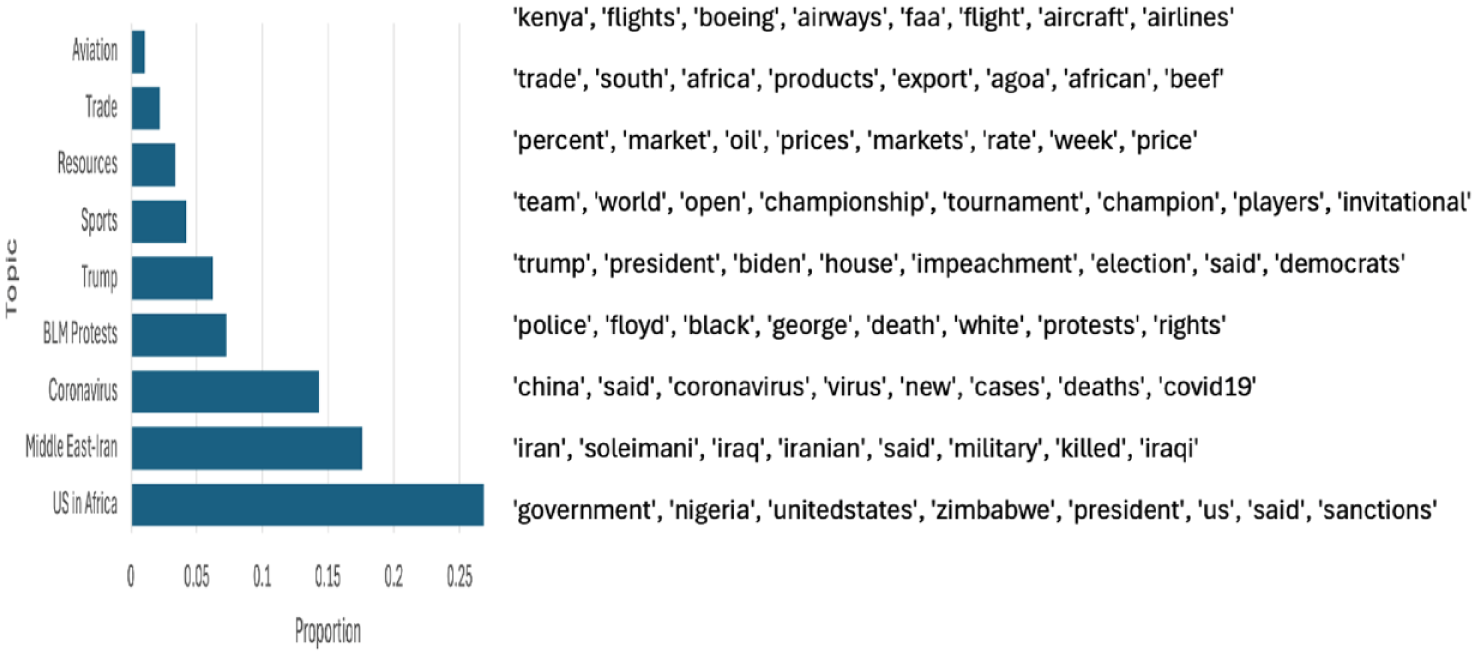
Topics in words in the US News: ratio and most common words for each dimension.
The sentiment analysis of African news media consistently reveals a negative tone toward US action, corroborating H6a. Figures 3 and 4 show that the sentiment score fluctuated across the months, with most scores below zero, particularly in the beginning, thus implying a predominantly negative tone toward the presentation of US-related issues in newspapers. Pretoria News emphasized President Trump’s controversial policy decisions and their negative impacts, ‘Trump’s trade wars taxed chief executives (and farmers) with significant financial and geographical disruption of products from medical devices to soybeans; consequently, it discouraged companies from establishing new American plants and equipment.’ 6 Additionally, sentiment scores showed significant volatility at the beginning of 2020, with sharp declines and rises reflecting the unpredictable and rapidly evolving nature of international affairs.
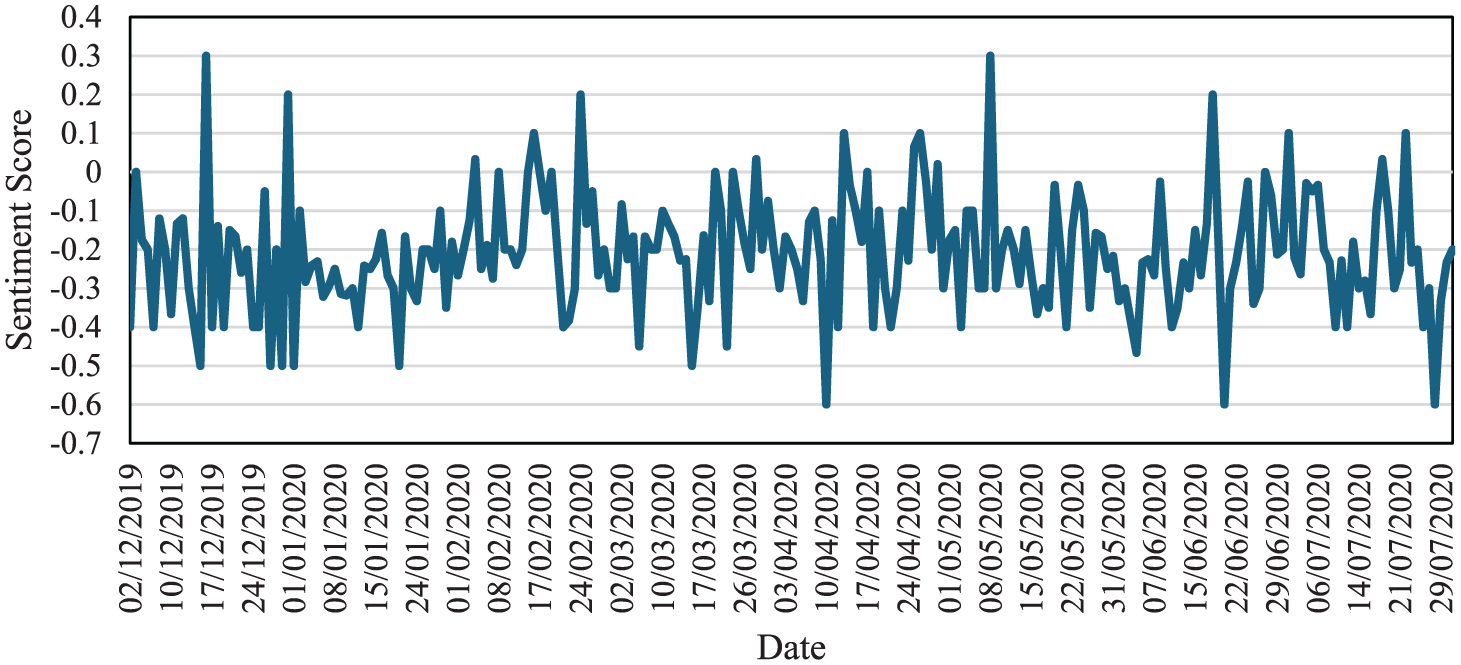
Sentiment score by date of the US News.
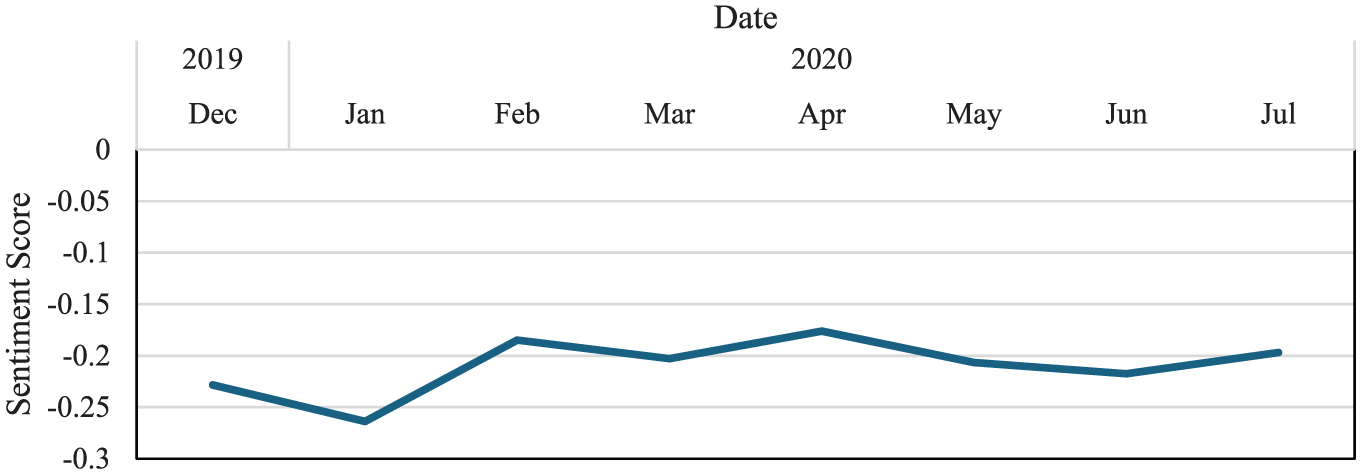
Average sentiment score of the US News.
Beginning in 2020, monthly sentiment scores revealed a steady increase in negative perception of the US, hitting a low point in June. A detailed analysis of sentiment scores from Figures 3 and 4, alongside specific events, offers valuable context. The decline in early 2020 coincided with the global spread of the pandemic, which triggered overwhelmingly negative coverage. The increase in negative sentiment, peaking in June, aligns with major domestic (Black Lives Matter protests) and international (Soleimani assassination, 3 January 2020) events. Given the consistently negative tone in African news media, this sentiment analysis supports H6a, which implies a correlation between negative media sentiment and potentially lower US leadership approval ratings.
The results offer a nuanced perspective on the relationship between emotional tone in African news coverage and the US leadership approval ratings, partially supporting Hypothesis 6b (see Table 2). Figure 5 indicates that positive news articles tend to have higher average emotional scores than negative ones and exhibit a wider range of values. Notably, positive emotions were high in December 2019 and subsequently declined slightly in January 2020, before rising significantly until February 2020, before stabilizing for the remainder of 2020. In contrast, negative values gradually increased from December 2019 through to January 2020, declined slightly in February 2020, and then rose to their peak in May 2020. Subsequently, it decreased again and remains constant in the final months. Throughout the period, the positive values consistently exceeded the negative values.
Summary of the results.
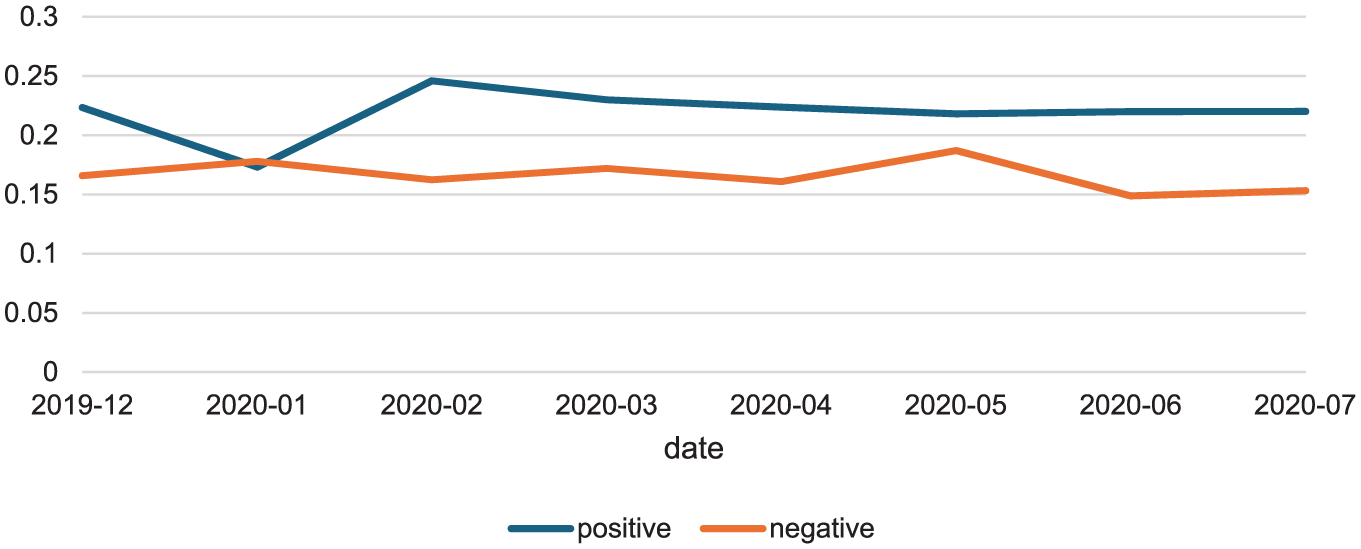
Positive and negative emotions in the US News.
Figure 6 illustrates an analysis of African news media during 2020, revealing fluctuating emotion-responses. Notable peaks in ‘fear’ and ‘sadness’ align with events such as the COVID-19 pandemic, social injustice and US policies. For example, the Herald’s quote exemplifies this emotional tone, expressing fear, sadness and disgust: it stated that George Floyd’s death highlights a systemic failure in America’s human rights record, disqualifying it from lecturing Africa. 7 Shifts in ‘trust’ and ‘anticipation’ reflect US political and economic changes, trade and aid promises. Emotional undertones significantly influence public perception. Overall, the emotional landscape conveyed by African news media, including positive and negative sentiments, significantly shapes public opinion and impacts the approval of US leadership.
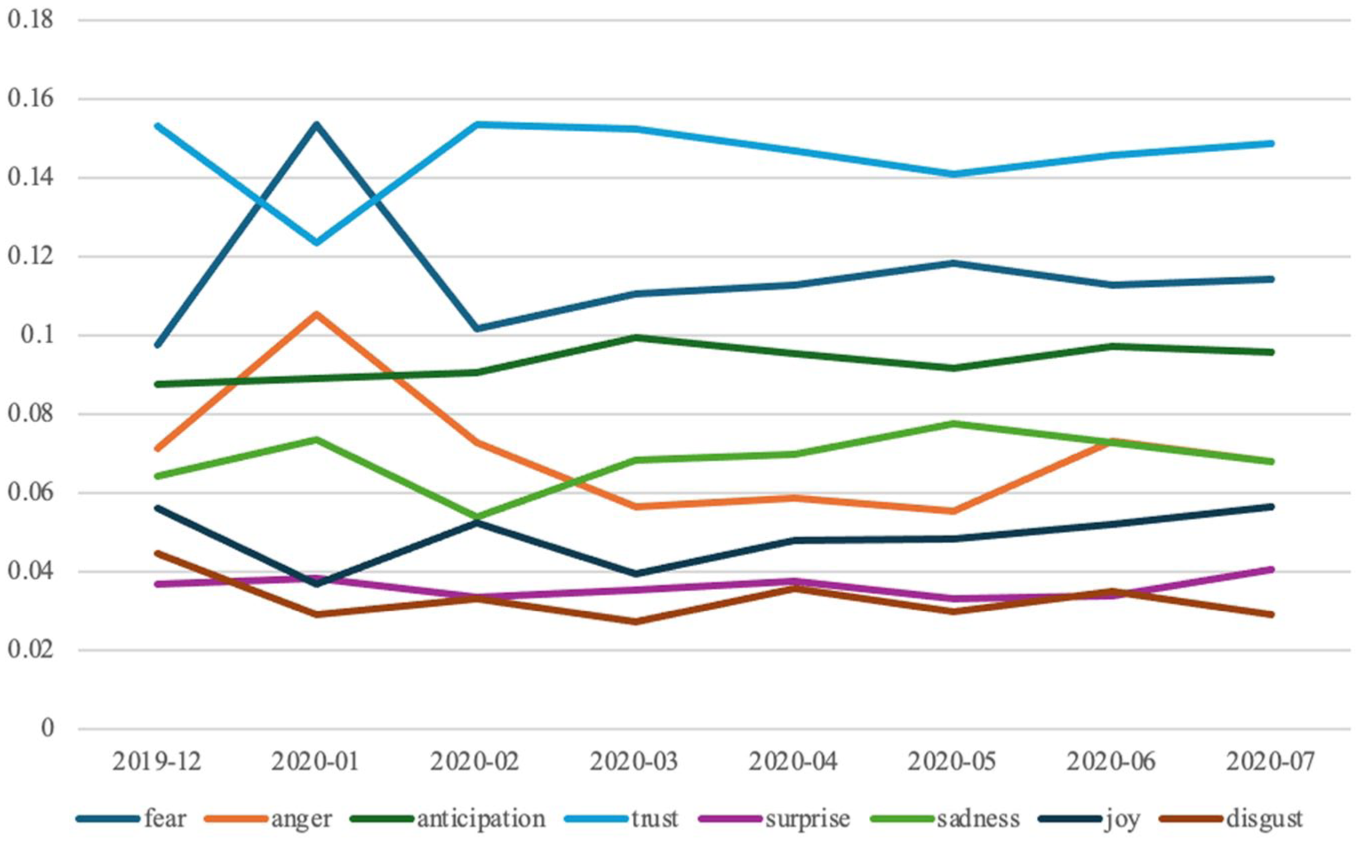
Trajectories of the eight emotions in the US News.
H6c posits that increased media coverage of the ‘Coronavirus’ topic correlates with decreased survey approval ratings. A Cape Argus article highlights the negative perception of US decisions during the pandemic: ‘Nations and health experts worldwide reacted with alarm. . .after President Donald Trump announced a halt to the substantial funding the US provides to the World Health Organization,’ warning it could ‘jeopardize global efforts.’ 8 The sentiment analysis reveals predominantly negative news coverage in the US, potentially due to COVID-19 crisis management or controversial policies. A Monitor quote underscores this sentiment: ‘Covid-19 has gone beyond being a health problem. It is an economic, social, and security problem. . . The US and globalized economies will go through more challenging times.’ 9 Conversely, the Lusaka Times reported positive sentiment, noting, ‘The United States is contributing nearly $10 million in health assistance to help Zambia respond to the COVID-19 outbreak.’ 10 However, such acts of goodwill were overshadowed by prevailing negative narratives. The US failed to effectively leverage soft power to enhance approval ratings during the initial phase of the pandemic. The study affirms H6c, indicating that increased coverage of ‘Coronavirus’ resulted in decreased approval ratings for US leadership, reflecting the negative perceptions of the US’s pandemic handling.
For H7, the findings supported the potential moderating effect of pre-existing trust on the negative impact of increased reports of COVID-19 mismanagement. Specifically, the emotion analysis reveals that ‘trust’ and ‘anticipation’ were prominent emotions linked to news articles. Despite predominantly negative sentiment associated with rising COVID mismanagement reports, positive emotions such as ‘trust’ and ‘hope’ persisted. Countries with higher pre-existing levels of trust in the US government in the surveyed African countries, such as Ghana, Kenya, Namibia, Nigeria, South Africa, Tanzania, Uganda, Zambia and Zimbabwe, significantly moderated the adverse effect of heightened media coverage of the US government’s COVID-19 mismanagement on emotion levels during the pandemic, as shown in online Figure A3. Countries with a higher baseline of trust exhibited significantly higher positive emotions (trust, hope and joy) or less decline in all other emotions in relation to the US in African news media. This indicates that although increased reports by the US government and COVID-19 mismanagement likely strained perceptions and increased negativity, some baseline of trust in the US endured, possibly softening the blow.
Discussion and conclusion
This study conducted a comprehensive analysis of the evolving landscape of the US soft power in Africa during the unprecedented challenges of the early COVID-19 pandemic (December 2019 to July 2020). This research offers a novel approach to understanding the complexities of US public diplomacy in Africa during the pivotal COVID-19 era. Using a multi-method approach, this study integrated data from the Gallup World Poll with advanced computational techniques, such as topic modelling, sentiment analysis and emotion analysis, to examine the representation of US public diplomacy in African public opinion and news media. This approach provides a detailed and contextual understanding that preserves intricate patterns of conversation on complex geopolitical issues. The primary focus is on survey data from nine African countries to assess changes in the US approval and level of receptivity. Complementary analyses were conducted across 21 news sources from ten African countries using newspaper data and evaluating multiple themes, sentiments, and emotional responses to enhance the survey analysis and ensure robustness. This method moves beyond a singular voice in public diplomacy, allowing for a more comprehensive and nuanced understanding of public opinion.
The COVID-19 pandemic provided a unique opportunity to examine US public diplomacy in Africa, as the crisis exposed existing inequalities and heightened competition among major global powers (Thomas et al., 2025). The US aimed to utilize its soft power resources to address the health and socioeconomic challenges faced by African nations, emphasizing principles of solidarity, cooperation and shared responsibility (Khlil, 2024). Despite facing numerous obstacles, the US sought to distinguish its approach by prioritizing transparency, equity and capacity building, positioning itself as a long-term partner in Africa’s health security and development efforts (Sheng, 2022). The research findings depict a complex and often contradictory landscape of the global turmoil during this period. On one hand, there was a notable decline in US soft power in Africa during the pandemic’s first wave, evidenced by negative sentiments toward the US in African news media and declining public approval ratings of the US leadership. Domestic issues, such as the Black Lives Matter movement, and international tensions, such as the Soleimani assassination, may have overshadowed the potential positive impact of economic engagement and bilateral relations. Furthermore, the research underscored the media’s critical role in shaping public perceptions: reporting on failures and deficiencies influenced approval rating with African media sentiments significantly correlating with public opinion. Specifically, negative emotions in media coverage (fear, anger and disgust) were associated with lower approval ratings, whereas persistent high levels of trust in the US within the media correlated with higher approval.
This study identified the key factors that mitigated the decline in US soft power. Specifically, higher education levels and Internet access were associated with a greater capacity to access diverse information sources, thereby reducing the effect of negative sentiments on public opinion. The findings demonstrate that increased information access mitigates the adverse effects of negative sentiments on public opinion, equipping people with technological tools to resist homogeneous narratives. These insights suggest that public diplomacy initiatives focusing on tangible actions and information dissemination could be more successful. Despite the volatile period at the start of 2020, marked by rapid fluctuations indicative of the unpredictable nature of international events, a volatile positive element was seemingly associated with pre-existing trust. Although US COVID-19 mismanagement likely strained perceptions and heightened negativity, a baseline of trust in the US persisted, potentially softening the overall impact. Overall, negative sentiment alone can be detrimental to US soft power unless reinforced with a strong base.
This research has significant implications for US public diplomacy strategies in Africa, particularly during the post-pandemic period. These findings emphasize the need for a more nuanced, responsive, and ethical approach involving concrete actions, policy alignment, and development of relationships based on mutual trust. Moreover, the US should focus on addressing domestic issues that undermine its international image, such as racial inequality and political polarization. Finally, the US should recognize the value of cultural exchange and collaboration on tangible issues rather than overemphasizing political messaging. Given the shortcomings of the current US approach, such as overdependence on political messaging, misaligned policies, congruence, lack of tangible engagement, and insufficient attention to social injustice and racial inequality, there is a need for more sensitive and context-aware public diplomacy efforts. This includes adapting to the cultural differences in various African nations, aligning foreign policy initiatives with core values, and fostering ethical and trust-based relationships.
One of the strengths of this study is demonstrating the complex dynamics between public perceptions, media representations and effective US public diplomacy in Africa, contributing to a deeper understanding of US foreign policy in the region. Despite prevalent negative feelings such as fear, anger, or scepticism, trust in the US remains relatively intact due to its financial and military power, and its ability to act, influence and shape global outcomes. This indicates that, although the US may have lost significant ground regarding moral authority, it still holds a unique advantage in regaining influence faster than other global actors. Unlike emerging powers or established rivals such as China and Russia, which frequently face deeper trust deficits due to ideological, political, or governance-related challenges, the US benefits from its historical and institutional presence in global affairs. This position helps it to rebuild trust more rapidly when strategic shifts occur, especially if it reaffirms its commitment to global governance, democracy and multilateralism.
Although this study focuses on the first Trump administration and its influence on US soft power in Africa, future research should explore the potential consequences of a second Trump term, particularly policy shifts such as the proposed dismantling of the United States Agency for International Development and development programmes. Such actions would represent a significant departure from traditional US public diplomacy and could further diminish normative leadership in the Global South. Understanding how a reduction in development aid influences trust, legitimacy, and long-term influence is crucial for evaluating the resilience of US soft power in post-pandemic geopolitical realignments.
This study adds to the expanding research investigating the relationship between soft power (Agadjanian and Horiuchi, 2020), demonstrating how various audiences interpret the state’s actions and narratives and their capacity for collaboration, public diplomacy and relational ethics. Goldsmith et al. (2021) suggested that successful public diplomacy depends on crafting a narrative perceived not as imposing a foreign agenda but as promoting mutual benefits and shared values. Furthermore, the analysis model developed can be adapted to different geopolitical contexts and timeframes by utilizing computational techniques such as topic modelling, sentiment analysis and emotion analysis. Finally, the framework can be modified to analyse public diplomacy efforts by various actors beyond nation-states. With slight adjustments, this methodology can include non-state actors such as non-governmental organizations, corporations, and advocacy groups in the realm of public diplomacy, reflecting the complex dynamics of the modern international sphere.
This study offers timely and original insights into the United States’ public diplomacy efforts in Africa during the COVID-19 pandemic, while also highlighting opportunities for more rigorous theoretical and methodological development. Future research should move beyond descriptive accounts to critically examine the relational and performative aspects of soft power, emphasizing its contingent, negotiated, and frequent contested nature. Theoretically, there is room to reconceptualize public diplomacy using alternative ontological perspectives, such as post-structuralism, critical constructivism and ontological security studies, which highlight the dynamic interplay of identity, perception, and symbolic power in international relations. These approaches would shift the focus from a resource-based view of soft power to a more sociologically grounded and context-sensitive understanding of influence. Methodologically, adopting an integrative research agenda that combines computational tools, such as temporal network analysis and dynamic sentiment tracking, with ethnographic immersion, critical discourse analysis, and interpretive media studies could harness the strengths of mixed-methods designs. Longitudinal and cross-regional comparative studies across Africa, Asia, Latin America and Europe could unveil global patterns and local particularities in the reception of US diplomatic narratives. Moreover, exploring underexamined data sources such as local language media, vernacular social media platforms, and stakeholder-centred interviews would deepen understanding of how public diplomacy is perceived, contested and rearticulated from the ground up. These theoretical and methodological enhancements can foster a more reflexive, adaptive, and contextually nuanced approach to public diplomacy in an increasingly multipolar and mediated world.
Supplemental Material
sj-csv-4-ips-10.1177_01925121251383798 – Supplemental material for The empire’s fading influence: United States soft power in Africa during the COVID-19 era
Supplemental material, sj-csv-4-ips-10.1177_01925121251383798 for The empire’s fading influence: United States soft power in Africa during the COVID-19 era by Bülent Aras, Alpaslan Özerdem and Ahmet Erdi Öztürk in International Political Science Review
Supplemental Material
sj-csv-5-ips-10.1177_01925121251383798 – Supplemental material for The empire’s fading influence: United States soft power in Africa during the COVID-19 era
Supplemental material, sj-csv-5-ips-10.1177_01925121251383798 for The empire’s fading influence: United States soft power in Africa during the COVID-19 era by Bülent Aras, Alpaslan Özerdem and Ahmet Erdi Öztürk in International Political Science Review
Supplemental Material
sj-csv-6-ips-10.1177_01925121251383798 – Supplemental material for The empire’s fading influence: United States soft power in Africa during the COVID-19 era
Supplemental material, sj-csv-6-ips-10.1177_01925121251383798 for The empire’s fading influence: United States soft power in Africa during the COVID-19 era by Bülent Aras, Alpaslan Özerdem and Ahmet Erdi Öztürk in International Political Science Review
Supplemental Material
sj-csv-7-ips-10.1177_01925121251383798 – Supplemental material for The empire’s fading influence: United States soft power in Africa during the COVID-19 era
Supplemental material, sj-csv-7-ips-10.1177_01925121251383798 for The empire’s fading influence: United States soft power in Africa during the COVID-19 era by Bülent Aras, Alpaslan Özerdem and Ahmet Erdi Öztürk in International Political Science Review
Supplemental Material
sj-csv-8-ips-10.1177_01925121251383798 – Supplemental material for The empire’s fading influence: United States soft power in Africa during the COVID-19 era
Supplemental material, sj-csv-8-ips-10.1177_01925121251383798 for The empire’s fading influence: United States soft power in Africa during the COVID-19 era by Bülent Aras, Alpaslan Özerdem and Ahmet Erdi Öztürk in International Political Science Review
Supplemental Material
sj-csv-9-ips-10.1177_01925121251383798 – Supplemental material for The empire’s fading influence: United States soft power in Africa during the COVID-19 era
Supplemental material, sj-csv-9-ips-10.1177_01925121251383798 for The empire’s fading influence: United States soft power in Africa during the COVID-19 era by Bülent Aras, Alpaslan Özerdem and Ahmet Erdi Öztürk in International Political Science Review
Supplemental Material
sj-do-3-ips-10.1177_01925121251383798 – Supplemental material for The empire’s fading influence: United States soft power in Africa during the COVID-19 era
Supplemental material, sj-do-3-ips-10.1177_01925121251383798 for The empire’s fading influence: United States soft power in Africa during the COVID-19 era by Bülent Aras, Alpaslan Özerdem and Ahmet Erdi Öztürk in International Political Science Review
Supplemental Material
sj-docx-1-ips-10.1177_01925121251383798 – Supplemental material for The empire’s fading influence: United States soft power in Africa during the COVID-19 era
Supplemental material, sj-docx-1-ips-10.1177_01925121251383798 for The empire’s fading influence: United States soft power in Africa during the COVID-19 era by Bülent Aras, Alpaslan Özerdem and Ahmet Erdi Öztürk in International Political Science Review
Supplemental Material
sj-docx-2-ips-10.1177_01925121251383798 – Supplemental material for The empire’s fading influence: United States soft power in Africa during the COVID-19 era
Supplemental material, sj-docx-2-ips-10.1177_01925121251383798 for The empire’s fading influence: United States soft power in Africa during the COVID-19 era by Bülent Aras, Alpaslan Özerdem and Ahmet Erdi Öztürk in International Political Science Review
Supplemental Material
sj-log-11-ips-10.1177_01925121251383798 – Supplemental material for The empire’s fading influence: United States soft power in Africa during the COVID-19 era
Supplemental material, sj-log-11-ips-10.1177_01925121251383798 for The empire’s fading influence: United States soft power in Africa during the COVID-19 era by Bülent Aras, Alpaslan Özerdem and Ahmet Erdi Öztürk in International Political Science Review
Supplemental Material
sj-txt-12-ips-10.1177_01925121251383798 – Supplemental material for The empire’s fading influence: United States soft power in Africa during the COVID-19 era
Supplemental material, sj-txt-12-ips-10.1177_01925121251383798 for The empire’s fading influence: United States soft power in Africa during the COVID-19 era by Bülent Aras, Alpaslan Özerdem and Ahmet Erdi Öztürk in International Political Science Review
Supplemental Material
sj-txt-13-ips-10.1177_01925121251383798 – Supplemental material for The empire’s fading influence: United States soft power in Africa during the COVID-19 era
Supplemental material, sj-txt-13-ips-10.1177_01925121251383798 for The empire’s fading influence: United States soft power in Africa during the COVID-19 era by Bülent Aras, Alpaslan Özerdem and Ahmet Erdi Öztürk in International Political Science Review
Supplemental Material
sj-txt-14-ips-10.1177_01925121251383798 – Supplemental material for The empire’s fading influence: United States soft power in Africa during the COVID-19 era
Supplemental material, sj-txt-14-ips-10.1177_01925121251383798 for The empire’s fading influence: United States soft power in Africa during the COVID-19 era by Bülent Aras, Alpaslan Özerdem and Ahmet Erdi Öztürk in International Political Science Review
Supplemental Material
sj-txt-15-ips-10.1177_01925121251383798 – Supplemental material for The empire’s fading influence: United States soft power in Africa during the COVID-19 era
Supplemental material, sj-txt-15-ips-10.1177_01925121251383798 for The empire’s fading influence: United States soft power in Africa during the COVID-19 era by Bülent Aras, Alpaslan Özerdem and Ahmet Erdi Öztürk in International Political Science Review
Supplemental Material
sj-txt-16-ips-10.1177_01925121251383798 – Supplemental material for The empire’s fading influence: United States soft power in Africa during the COVID-19 era
Supplemental material, sj-txt-16-ips-10.1177_01925121251383798 for The empire’s fading influence: United States soft power in Africa during the COVID-19 era by Bülent Aras, Alpaslan Özerdem and Ahmet Erdi Öztürk in International Political Science Review
Supplemental Material
sj-txt-17-ips-10.1177_01925121251383798 – Supplemental material for The empire’s fading influence: United States soft power in Africa during the COVID-19 era
Supplemental material, sj-txt-17-ips-10.1177_01925121251383798 for The empire’s fading influence: United States soft power in Africa during the COVID-19 era by Bülent Aras, Alpaslan Özerdem and Ahmet Erdi Öztürk in International Political Science Review
Supplemental Material
sj-xlsx-10-ips-10.1177_01925121251383798 – Supplemental material for The empire’s fading influence: United States soft power in Africa during the COVID-19 era
Supplemental material, sj-xlsx-10-ips-10.1177_01925121251383798 for The empire’s fading influence: United States soft power in Africa during the COVID-19 era by Bülent Aras, Alpaslan Özerdem and Ahmet Erdi Öztürk in International Political Science Review
Footnotes
Funding
The authors received no financial support for the research, authorship and/or publication of this article.

Supplemental material
Supplemental material for this article is available online.
Notes
Author biographies
References
Supplementary Material
Please find the following supplemental material available below.
For Open Access articles published under a Creative Commons License, all supplemental material carries the same license as the article it is associated with.
For non-Open Access articles published, all supplemental material carries a non-exclusive license, and permission requests for re-use of supplemental material or any part of supplemental material shall be sent directly to the copyright owner as specified in the copyright notice associated with the article.
