




Abstract
This research explores motivations for political party donations in Aotearoa New Zealand (NZ). Drawing on interview data from 29 political ‘insiders,’ we utilize McMenamin and Power’s theoretical framework to assess the pragmatic, partisan and social motivations for donations. We extend the original framework beyond business donations, incorporating a broader range of donor and non-donor insights. We observe strong social motivations for donating and a general agreement among political actors that donations provide access to politicians. The theoretical lens is expanded by NZ-specific factors, notably a strong concern for democracy and the potential for adverse impacts from donating. The latter brings negative motivations into the theoretical lens. We offer an amended framework that more closely reflects donation motivations in the NZ environment, which is dominated by a small pool of large donors, close connections between political actors and a desire for adequately funded political parties to enhance democratic outcomes.
Keywords
Introduction
In an effective democracy, candidates and parties are resourced to access voters. There can, however, be controversy regarding the sources of that funding, its volume and what – if anything – it purchases. According to established principles in Aotearoa New Zealand (NZ), the system for funding political parties needs to be fair and transparent, encourage electoral participation and uphold the principles of the Crown’s foundational pact with indigenous people, Te Tiriti o Waitangi (Ministry of Justice, 2021). It also needs to protect the integrity of government by preventing corruption or undue influence, and support parties to discharge their functions (Tham, 2010).
The actual funding of political parties, however, may contravene these principles. Imbalances in access, in which certain interest groups are heard while others are not, are generally concerning, and can be worsened if financial contributions to parties allow particular groups greater voice, visibility or influence. Even the perception of excess influence can damage the democratic process by lowering public trust in and support for elected representatives (Tham, 2010).
In response to these concerns, countries have adopted varying forms of political finance regulations. These commonly involve donation limits, the restriction of donations to certain entities (e.g., natural persons) and the publication of donors’ identities. Such regulations can be negatively characterized as infringing donors’ rights to privacy or deterring donations, or conversely, they can be seen as mitigating the potential for large donations to facilitate policy influence or the public’s perception that this influence exists.
Using data gathered from 29 interviews with a range of political ‘insiders,’ we examine the motivations behind those donations. Our study focuses on large donations (over $20,000 in 2023 and over $30,000 before this time – this artcle refers to Aotearoa New Zealand dollars throughout), as small donors are less likely to generate influence or access. The importance of large donors was noted by Gordon et al. (2007) who write that a ‘far more significant issue is the behavior of the small minority of contributors who control disproportionately large shares of society’s resources and the potential relationship between that behavior and the choices of elected officials’ (p. 1057).
We use NZ as a case study to examine motivations for political donations. Political party memberships have declined significantly over several decades, resulting in parties’ increasing reliance on donations (Rashbrooke and Marriott, 2022). Furthermore, NZ has relatively weak regulation of political donations, limited transparency about sources of parties’ funding and few restrictions on who and how much can be donated. This is unusual in developed countries, which mostly limit very large donations (Rashbrooke and Marriott, 2022).
Our contributions are twofold. First, we build on the theoretical framework developed by McMenamin and Power (2023), adding NZ-specific factors to extend the framework. Second, our empirical contribution is the perspective of individual donors’ motivations, along with those involved in soliciting donations. Much of the literature has used corporate donor motivations (for example, Bond, 2004; Lu et al., 2016; McMenamin and Power, 2023). However, an unusual aspect of the NZ political environment is that most donations are made by individuals. For example in the election year 2023, 10 companies made only 12 of the 126 large donations (Electoral Commission, 2024). Notwithstanding this observation, many of the large individual donors have well-established business interests, but the company is not used as a vehicle for donation, making the individual donor visible.
We contextualize the interview responses using McMenamin and Power’s (2023) theory of donations. Although this framework is focused on the motivations of business donors specifically, we assess its application to a broader range of actors or political ‘insiders.’ These include individual donors and others involved in handling donations.
The article commences with a short introduction to political party funding in NZ. This is followed by the third section, which outlines the theoretical framework. The fourth section examines a selection of the relevant literature, while the fifth section outlines the research method. The sixth section summarizes our interview data while the seventh section discusses the issues raised, informed by the theoretical lens outlined in the third section, and concludes.
Background: NZ
This section outlines the NZ approach to political party funding. The research focus is on donations to political parties, not candidates.
The NZ political parties have parliamentary and non-parliamentary wings. The parliamentary wing consists of the caucus of members of parliament (MPs) and their staff. The non-parliamentary wing comprises a party’s broader membership and is run by a council or board and headed by a president or general secretary. The parliamentary wing receives public funding for day-to-day activities such as debating and passing legislation. In addition, a state-funded election broadcasting allocation can be used for campaign advertising in an election year. However, the non-parliamentary wing does not receive public funding for its general operations, such as developing policies and communicating them to the electorate (except where this occurs through election broadcasting or in Parliament). Instead, the non-parliamentary wing must raise its funds via party membership fees, merchandise sales, event fees or – the most significant source of revenue – political donations.
The principal instrument for regulating donations is financial disclosure. Political parties are required to make annual donations returns, detailing the name and address of every donor or contributor who donated over $5,000 during the year 1 ; the number and total donations under $1,500 that are not made anonymously; and all donations ‘protected from disclosure’ (Electoral Commission, 2023). The latter are donations from NZ persons who wish to donate more than $1,500 to a party anonymously. The transaction is mediated through the Electoral Commission, which splits the payment into anonymized tranches, and passes it on to the relevant party at regular intervals. There are, however, few protected disclosures. They have been made in just four of the nine years up to the end of June 2023, three of which were election years. The sums were as follows: 2014 – $226,050; 2016 – $44,628; 2017 – $108,628; and 2020 – $163,644 (Electoral Commission, 2024). Protected disclosures range from 1% to just over 2% of total donations, indicating that most large donors want their donations to be visible to their party of choice.
During an election year, any donation over $20,000 (whether made as a lump sum or cumulatively) must be notified to the Electoral Commission within 10 working days. The Commission then publishes the donor’s name and address. 2 There are no caps on donations in NZ.
Theoretical lens
To frame our analysis, we use the heuristic framework proposed by McMenamin and Power (2023), which incorporates pragmatic, partisan and social motivations for donations. Extending this theoretical lens beyond its original focus on corporate donations, we capture the views of a broader set of stakeholders, including individual donors and others involved in the political donation process. First, however, we briefly outline the three motivations.
Pragmatic donations
In McMenamin and Power’s framework, pragmatism takes the form of self-interest: it is ‘focused on increasing [corporate] profits’ (McMenamin and Power, 2023: 273). More specifically, pragmatically focused companies fund political parties ‘in exchange for benefits from the political system’ (McMenamin, 2012: 7). Because pragmatically motivated donors are not (strongly) ideological, their donations are made ‘without regard to whether the business finds a party’s or politician’s stance on issues agreeable’ (Acton and Hawkins, 2022: 2). The focus is, instead, on other potential benefits of supporting a given party, which may include meetings or other opportunities to engage in social interactions with politicians. Pragmatic donations may also lead to other advantages, such as access to government contracts (Boas et al., 2014) and the opportunity to engage in direct lobbying (Acton and Hawkins, 2022).
McMenamin and Power suggest that corporate donations form a small proportion of firms’ wider political activity and that donations are unlikely to deliver a direct return. While the first part of this claim is undoubtedly correct, there is evidence to suggest that, at least in certain industries, a ‘return’ of some variety is present. For example, Griffiths and Emslie observe that Australia’s political parties rely on a small number of major donors, five of whom were, in 2020–2021, responsible for 39% and 57% of the Coalition’s and Labor’s declared donations, respectively, and as a result ‘achieve significant access and influence’ (Griffiths and Emslie, 2022: 2). McMenamin and Power also note that gaining effective access is important to business donors, citing the well-known finding from Hall and Wayman (1990) that some actors may be less interested in ‘buying’ a specific policy outcome than in seeking the access and time that may result from donating. This access is then reflected in ‘legislative involvement’ (Hall and Wayman, 1990: 797). We note that pragmatic (and partisan) motivations are also reported in Canada, where donations are restricted to relatively small amounts (Garnett et al., 2022), suggesting that a direct return is not expected.
McMenamin (2012) highlights the potential for both discrete and reciprocal exchanges to drive pragmatic motivations. Discrete exchanges are one-off and do not create a long-term relationship. Reciprocal exchanges may be more frequent and not have articulated terms of exchange. McMenamin (2012) suggests that a company that shifts allegiance ‘from right to left as power shifts from right to left’ is seeking a discrete exchange (p. 7). However, companies that ‘hedge consistently between government and opposition are likely to be seeking a reciprocal exchange’ from an opposition party that may come to power in the future (McMenamin, 2012: 7). Importantly, as reciprocal exchanges typically involve fewer and smaller payments, they can make it difficult to connect a specific payment to a particular policy outcome (McMenamin and Power, 2023).
Partisan donations
Partisan donations are those that do not appear to directly benefit the donor and are made instead based on a convergence of ideologies between donor and recipient (McMenamin and Power, 2023). They may nonetheless be a source of concern, especially if they help create an imbalance in resources between parties. An imbalance of resources is undesirable as it can result in the exclusion of some voices from political discourse. Partisan motivations are well established (Barber, 2016; Garnett et al., 2022; Ponce and Scarrow, 2011), with Hill and Huber (2017: 3) suggesting that donors are more ‘ideologically extreme’ than others. Hill and Huber (2017) further suggest that donating provides an opportunity for those who are concerned about the perceived stakes of an election to increase their participation, beyond voting.
In NZ, partisan donations appear to be significant. Large donations from individuals with significant business interests primarily accrue to the two largest conservative parties, and when donations are made across the political spectrum, these ‘are mostly from businesses and to the two dominant parties, suggesting that businesses are trying to buy the ear of the major power in government’ (Chapple and Anderson, 2021: 14). However, recently most donors are strongly partisan, for example, in the election year of 2023, no large donors contributed to both liberal and conservative parties (Electoral Commission, 2024). This is despite the suggestion that donors are simply people who ‘care about democracy’ (Coughlan, 2022) which would logically result in donations across the political spectrum.
Social donations
The social motivation to donate is driven by either an existing personal relationship or a preference to develop such a relationship. Existing research provides many examples of donations that have social motivations. For example, in Australia, researchers observe a small group of donors that typically contribute the bulk of political party funds or attend ‘pay for access’ fundraising events (Wood et al., 2018). Further research from Australia finds that professional and non-professional networks of directors influence corporate political donations (Lu et al., 2016).
What might present as a social motivation may be a tactic used by a pragmatically motivated donor, despite McMenamin and Power’s (2023: 274) observation that on ‘many social occasions, there will be too many people, and too little time, to even mention an important and sensitive issue’ that is of concern to the donor. McMenamin and Power (2023) continue to note that many opportunities that provide access are consistent with reciprocal, rather than discrete, exchanges and can build or maintain contacts that may facilitate future opportunities to influence policy. This further connects socially motivated donations to pragmatic motivation.
Other classifications
McMenamin and Power (2023) acknowledge that the framework they proposed is ‘not startlingly original’ (p. 276). However, it provides a model based on prior and original empirical research from which to test our interview data. We acknowledge the presence of frameworks that offer differing perspectives on motivations, but as the McMenamin and Power framework incorporates these findings, we do not repeat these at length here. Two key examples can be seen in Bond (2004) and Francia et al. (2003). Bond (2004) outlines three overlapping approaches, incorporating structural theories, managerialist organization theories and elite organization theories. Similarly, Francia et al. (2003) classify donor motives into the classifications of: material (i.e. personal gain); purposive motives (e.g. advancing a position on a particular issue or supporting a specific candidate); and solidary (meaning a community of interests, which reflects the social aspects such as opportunities to mix with influential politicians or perhaps be known as a donor).
Francia et al.’s (2003) survey results show strong purposive/partisan motives and conclude that ideological donors make the most contributions. Also present were social motives, where several donors advised that they donated because they were approached by someone involved with a particular party. Gimpel et al. (2006) also place more emphasis on ideological/partisan motivations, and acknowledge the presence of social motivations. In contrast, Harrigan’s (2017) research in Australia argues that corporate donations are largely motivated by economic self-interest, that is, pragmatic motives. Like McMenamin and Power (2023) Harrigan’s research focuses on business donations. Gordon et al. (2007) examine political contributions from individual executives from the American credit rating agency Standard & Poor’s firms. In noting that government policies ‘often have profound implications for firm profitability,’ these authors hypothesize that if executives anticipate that donations are ‘investments’ that will result in a positive return for the company, there would be an association between contribution behaviour and those who have income that is sensitive to overall firm performance (Gordon et al., 2007: 1058). These authors find strong support for this hypothesis, concluding that donations are consistent with pragmatic or ‘instrumental giving’ (Gordon et al., 2007: 1065).
Reference to the literature shows a range of motivations for making political donations, which are captured within the McMenamin and Power classification. The literature establishes that motivations are complex, likely to have some jurisdiction-specific political nuances and, in many cases, have multiple objectives. Francia et al. (2003: 47) acknowledge that ‘donors contribute in pursuit of material, purposive, and solidary goals.’ This is a factor we find in our study, although not in equal measures as will be shown later in the article.
What we know about political party funding
Tello et al. (2019) examine firms’ justifications for donations to political parties, as contained in company reports. Two of the three main justifications align with the motivations highlighted by McMenamin and Power (2023): building political connections for the organization (social); assisting with public policy development (pragmatic); and supporting the democratic process. Wood et al. : make similar findings but challenge the ‘democratic’ justification. They note that ‘most donors say they contribute to political parties and their associated entities to support Australian democracy or to create a stable political environment in which businesses can prosper,’ but go onto observe that ‘if [this] was the primary consideration we would expect to see more donors contributing to both major parties and fewer donations from industries with a lot of skin in the political game’ (Wood et al., 2018: 37). This indicates the presence of ‘cover stories’ – discussed later in this article.
Illustrating a pragmatic outcome, though not necessarily a pragmatic motivation, researchers in Brazil have shown that firms that made contributions to elected federal deputies experienced higher stock returns than firms that did not (Claessens et al., 2008). Elsewhere, research finds social outcomes from donations, reporting that political donors receive better access to legislative committees in Australia and Canada (Moxon, 2022). Research in the United Kingdom indicates the presence of both pragmatic and social motivations, whereby donations ‘play an outsize role’ in accounting for who receives peerages, a concerning finding given that peers have law-making powers (Mell et al., 2015: 1).
Further social reasons for donations, such as purchasing access to politicians through one-on-one meetings or invitations to events, have been identified (McMenamin, 2008; Wood et al., 2018). Similarly, research by Langbein (1986: 1052) finds that ‘money does indeed buy access,’ with access being a precondition for influencing public policy. Grimmer and Powell (2013: 974) likewise find evidence that ‘corporations and business [political action committees] use donations to acquire immediate access and favor – suggesting they at least anticipate that the donations will influence policy,’ indicating that the social motivation to gain access may be closely connected to the pragmatic motivation to obtain influence.
However, in more recent research, McMenamin suggests that ideological payments do not accrue equally to parties and that there is an unsurprising bias towards parties with pro-business ideology, in particular, the ‘free-market variety’ (McMenamin, 2013: 4). McMenamin’s research thus identifies both pragmatic and partisan explanations.
Multiple motivations were highlighted by the Australian Senate’s (2018) Select Committee into the Political Influence of Donations. Business donations were often in the form of subscriptions to business forums (ranging from A$25,000 to over A$100,000 per annum), which entitled the company to different levels of access depending on the type of subscription purchased. The Select Committee reported examples of pragmatic, partisan and social motivations. Typically, the access included participation in policy briefings, ‘boardroom-type events’ and other functions such as networking dinners (Australian Senate, 2018: 31). Several donors argued that their primary motivation was to support the democratic process, while others cited a desire to engage in policy discussions as their prime motivation (Australian Senate, 2018). Others saw opportunities for ‘building and maintaining relationships with key political stakeholders’ and the opportunity to ‘engage with members of Parliament on matters relevant to their industry’ (Australian Senate, 2018: 35).
Method
We completed 29 semi-structured interviews that sought views on a range of political party finance issues. Human Ethics approval for the interviews was obtained from the home university of the researchers. We spoke to officials, past and present political party presidents and secretaries, eight individual donors, national secretaries of two trade unions (which were also political donors), past and present MPs, a former Prime Minister, several fundraisers and three political party leaders. Among the eight individual donors, five had business interests that aligned with the party they donated to, while the other three donors were politically interested individuals. There were eight women and 21 men in the interview group. Of the 29 interviewees, 16 were aligned with the ‘centre-left,’ nine were aligned with the ‘centre-right’ and four were best described as centre. In the discussion that follows, reference to non-donors includes everyone who is not one of the eight individual or two trade union donors.
We approached people to participate in the study when they were known to have been involved in activities relating to the donation process, such as soliciting donations for political parties. In addition, we wrote to all those who made large donations to political parties from 2019 through to May 2022. 3 Donors’ names and addresses are publicly available on the Electoral Commission website. We sent 60 letters, received nine positive responses and interviewed eight people. In addition, we interviewed the national secretaries of two trade unions that had made large political donations.
Non-donors were asked their views on the current system for donations, why they believed people donated, preferred levels of disclosures such as for identifying donors and whether there should be more limitations on who can donate and how much can be donated. We asked donors why they donate, their reasons for donating to a particular party, any benefits or opportunities expected or received from the donation, their views on anonymity, if they would donate again and why, as well as their views on the current donations system. As the interviews were semi-structured, additional questions were asked based on answers provided.
We used NVivo 12 for analysis. Codes were created to identify common themes in the interview data, which facilitated the inductive analytical approach.
The average donation from the eight individuals who responded to our written request was $73,578, which was slightly lower than the average donation among the total donation group of $80,296. 4 The interview group was skewed in political leaning toward the left, with five of the eight donating to parties that identified with left or centre-left ideologies. This was at odds with the overall trend of donations, where 62.5% went to right or centre-right parties. We acknowledge that there may be some non-response bias in our interview sample due to the over-representation of liberal ideologically positioned interview subjects.
We acknowledge the limitations of the data we use in this study. Our interviews with eight individual donors and two trade union donors may not sufficiently capture all donor motivations. While the donors interviewed had contributed across the political spectrum, we cannot claim any reliability from the small sample. The additional interviews provide more breadth but, as they provide an external view, cannot be argued to represent donors despite being those who are closely involved in the political donation process.
Why do people or entities donate?
We use McMenamin and Power’s (2023) theoretical lens to structure this discussion, starting with their proposed explanatory factors and adding further insights from our data.
Social motivations
None of the donors we spoke to claimed to get any advantage from their donation. However, most acknowledged that they enjoyed access beyond what was typically offered to members of the public. By way of example of these mechanisms, we were told that: ‘donors might have had an extra lunch or dinner [with MPs or party leaders];’ that donors ‘get wonderful opportunities, such as cocktail parties;’ or the donor would have ‘more opportunity to have a direct meeting [with Ministers].’
When we asked why companies would make donations, we were advised by a former party president that they did so for ‘personal access’ or ‘the leverage of access that is provided as a payment, essentially, for a donation.’ A mechanism used by donors was to pay to attend a business or social function. One politician referred to a Minister’s presence at a function as ‘a form of lobbying – you are saying to local people that you can get your voice to the minister in a more personal setting. No money changes hands.’ This practice was also acknowledged as ‘buying time with the minister. That is buying access in a more personal way. They [party functions] are amazing for networking.’ Other interviewees, however, downplayed the idea that greater access resulted from attendance at such events. For example, a former party chief of staff advised that this type of donation ‘probably buys no more than a tenuous connection with a politician – vague familiarity, name to face, etc.’ We acknowledge that it is difficult to determine when pragmatically motivated donors (see more below) use social mechanisms to achieve their objectives.
Several donors noted a variation on the social motivation where financial contributions were made because of existing personal connections with a political party fundraiser, rather than because donors wished to develop a new relationship with the party. Some donors advised that they were approached directly by a fundraiser and had donated as a result. Often these were donors who had previously contributed to a given party.
A political party leader noted that engagement with donors ‘comes in different forms. There is sending out an email, but there is also having lunch with someone and talking through what they are trying to achieve.’ This indicates that some donations have pragmatic as well as social motivations, as they help expedite access and, potentially, influence. When we asked the same party leader whether politicians should be involved in fundraising, they argued that: ‘Having an intermediary doesn’t remove corruption. The reality is, if someone is going to give you $10,000, which is the minimum I would get involved in, the person wouldn’t want to talk to a party functionary.’
This suggests that the recipients of the donations are happy to meet the bargain of the social exchange.
Partisan motivations
Partisan motivations were evident from discussions with six of the eight donors and both trade unions. Three donors referred to specific party policies aligned with the donor’s views. One donor explained that his donations ‘have been to support a policy – not to buy a policy.’ Similar points were made by non-donors. For example, a political party leader advised that people donate to the party ‘because they like what I say, not because I say what they like.’
We encountered other examples of partisan motivation. One donor advised us that he gets ‘the benefit of a political party that suits my natural inclination more than the other side.’ Another donor provided a clearly partisan perspective, telling us: ‘I’m slightly far right – as a business owner point of view. . .of course, I won’t donate if the policy is not more pro-business.’ Another donor noted feeling ‘strongly about a lot of issues associated with conservative views.’
Other examples were specific to NZ’s Mixed Member Proportional voting system and its provision that parties must register 5% of the total vote to enter Parliament. One donor had donated to try to minimize the impact of a particular minority party, while another had donated to help ensure a minority party got over the 5% threshold.
Sometimes different motivations were tightly bound together. One donor noted that they had contributed to a party because they had an existing relationship with a politician (social motivation) but also because they had shared interests in policy (partisan motivation). This donor viewed his donation as a ‘cause,’ advising us: ‘We are well off, financially – and can afford to donate money to causes. We don’t have a monopoly on being well-off – and obviously 99% of people are less well off. We try and use that money in ways that are going to be helpful for people that we admire and know, but also in a way that is going to deliver some sort of social good.’
When asked if he thought the donation was self-interested, he responded, ‘I guess it is, but the self-interest is public interest.’
Pragmatic motivations
Our donor interviewees all claimed that their donation did not result in influence, nor had they sought any. They denied, in other words, any pragmatic motivations (as expected). However, other non-donor interviewees (a former Party President, a former politician, a fundraiser and a political party leader) made connections between donations from others and what appeared to be preferential treatment of specific industries. And, at times, even donors’ statements appeared to contradict the non-influence claim. For example, when discussing the threshold for disclosing donations, one donor advised us that ‘from a practical point of view, it shouldn’t be too low. Anything below $5,000 doesn’t need to be reported. $5,000 won’t buy much.’ This implied that sums over $5,000, in contrast, might buy something.
One former party president acknowledged some donors expected influence to follow: ‘they were a small group, but they were there – people who gave money because they wanted a particular piece of legislation or permission to emerge somewhere, either at local or national level.’
This person told us that: ‘the ability of a party president to influence that is limited, but you basically said no – where people were explicit. I was happy to say that was not how it worked.’ However, they also acknowledged there would be occasions that they did not control, such as fundraising dinners: ‘you don’t know what the agendas are around the table. You might have tables purchased by firms – and a minister might sit there for 20 minutes. Lobbying isn’t improper – but you don’t know if there is something that might follow from that.’
In this example, a social mechanism could be used by a pragmatically motivated donor.
The current general manager of one party told us that there is ‘no quid pro quo – this is made really clear,’ while a former party chief of staff made the same point. Another current general secretary told us that he had not seen any favours from donations, arguing that he does not have ‘any visibility over decision making in Cabinet – and they don’t have visibility over . . . money coming in.’ However, an issue raised by McMenamin and Power (2023) may be relevant, whereby a person can mistake a discrete exchange for a reciprocal exchange, such as payment to attend a social occasion where there is no opportunity at the time to ‘lobby’ but a future opportunity may arise.
The trade union representative advised us that ‘not everyone wants to donate for no reason – some think they are buying power or influence.’ Another trade union official noted that they could not determine how the party spent their donation, ‘but we will say where we want if there is something in relation to union members, e.g. fair pay agreements’ and that they ‘do their analysis of what is in the best interests of their membership base.’
Two former party presidents suggested that the contemporary NZ increase in donations-related prosecutions stemmed directly from MPs being involved in fundraising, especially as this could make them feel obliged to donors in some form. One politician advised that she never individually asked for money; her party might ask her to talk to someone, but she would never ask if they were a donor. However, as large donors are disclosed within a short period of time, it would not be difficult to find out if someone was a large donor.
Other motivations
Our interviews identified two further motivations for donating in the NZ context, beyond those articulated by McMenamin and Power. The first was a desire for parties to be adequately funded for the purposes of supporting a robust democracy. As a party general secretary noted, ‘democracy is poorly served if political parties can’t inform the public about what they are offering before they vote on it.’
One former party president suggested that people were donating not just to a party but to the democratic system. A similar point was made by another former party president, who argued that ‘parties are a key element of . . .democracy, so you should fund them. . .the pitch [to funders] was “supporting democracy” not “advance your interests”.’ This view was also supported by donors. For example, one felt a duty ‘to support the democratic system which has worked well for centuries. . .if we want to support the system, we should contribute to the cost of that.’ These arguments about democracy can also be found in the literature, as noted in the previous section. However, we question the validity of the argument of wanting to support democracy, as all political actors that we spoke to supported only one ‘side’ of democracy. Our challenge to donors’ claims of wanting to support democracy is supported by donation behaviour. Where donors provided funds to more than one party, the donations remained ideologically consistent (i.e. conservative or liberal). We further note that the infrequently used protected disclosure scheme provides a mechanism for anonymous donations, which we would expect to see utilized to a greater extent if support for democracy was a primary motivator.
Most interviewees concurred on the importance of ‘fairness’ in the democratic process and were generally concerned about the potential for those with money to have a stronger voice than those without. For example, one donor cited well-off acquaintances who ‘think that what they are doing is right for everyone, without knowing what it is like for those who are less well off.’ Another donor told us that ‘there is a real problem with people who accumulate a lot of money supporting the systems that have allowed them to accumulate a lot of money,’ while another said he ‘doesn’t think it is right that rich people can distort democracy.’ A current MP also advised that she thought it was not fair that ‘you can buy [opportunities for] talking to a Minister if you are wealthy.’ Two political party leaders agreed that donations can increase the influence of the ‘donating class,’ notably business leaders and the wealthy.
A second set of donor motivations, beyond those proposed by McMenamin and Power, relates to transparency. As large donors, our interviewees had all been publicly identified shortly following their donation. As opposed to motivations for donating, transparency-related arguments were adduced as reasons against donating. Four of the eight donors stressed this point. One noted the potential for ‘governments to take it out on parties who donate to their opponents,’ albeit without providing concrete examples of this; another cited ‘the opprobrium that comes to people who donate to parties.’ In addition, a former party president, a current party leader and a former politician all advised us of potential consequences from making donations. The former party president noted a concern among donors that ‘they would suffer in their business world,’ while the former politician advised that ‘there are real consequences from making donations in a small society, for example [difficulties in] getting jobs.’ The current party leader said they knew of one donor who donated just under the disclosure threshold, because identification might mean: ‘they would be less likely to win contracts or they might find themselves being harangued by officials in relation to the contract. Any number of ways once you are contracting with the party . . . The donors don’t have to take the risk, so why should they?’
In addition, one former party president noted that the belief that donating to an opposition party would make it harder for an individual to work with the current government.
Quantification
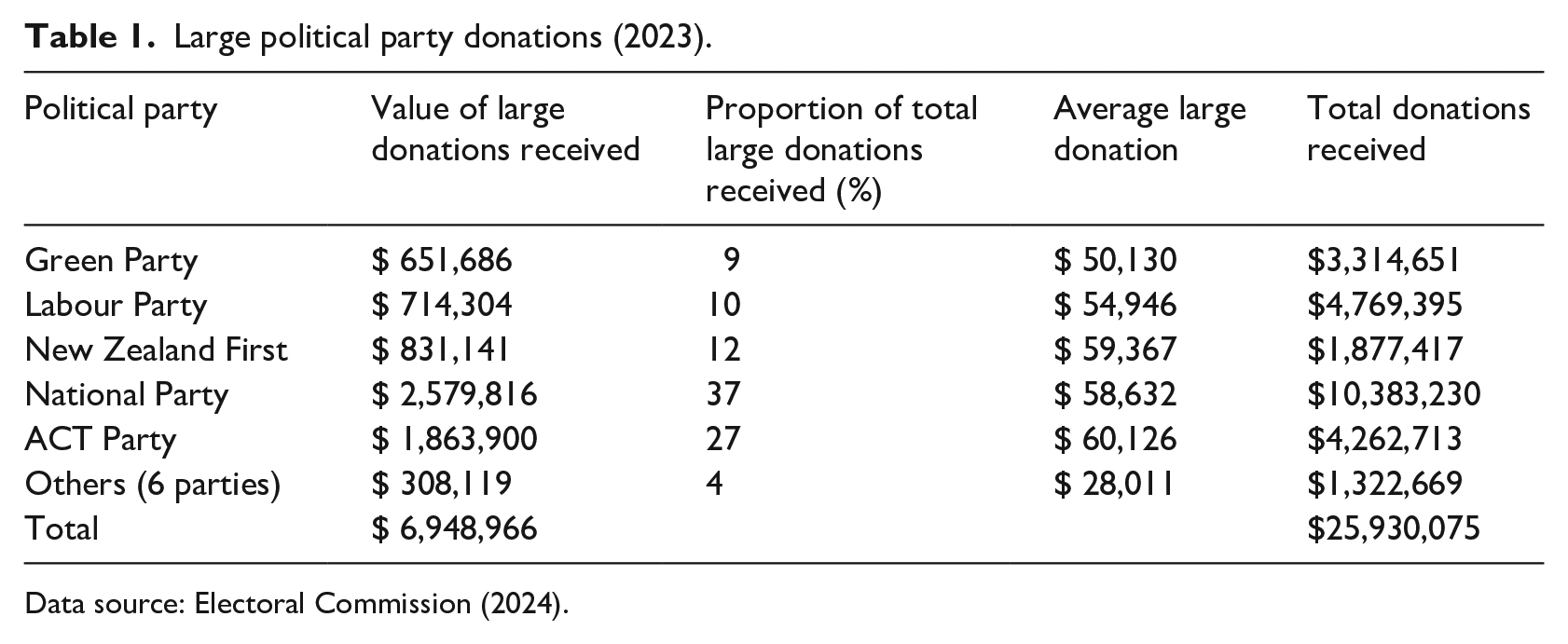
It can be challenging to examine donation motivations from a quantitative perspective. However, some tentative conclusions may be drawn. In the 2023 election year, large donations totalling $6.9 million were received by political parties. These must be declared separately by the party, with donors identified in most cases, although the donor may be, for example, a lawyer or company, rather than an individual. The breakdown of these for the main political parties is outlined in Table 1. Note that $260,000 (36%) of the value of large donations received by the Labour Party is from trade unions. We also include the total value of donations received for the parties in Table 1.
Large political party donations (2023).
Data source: Electoral Commission (2024).
Nearly two-thirds (64%) of total donations and 76% of large donations are received by New Zealand First, the National Party and the ACT Party. These are conservative groups whose policies generally privilege the wealthy. We suggest that in many cases, it is only the wealthy who can make large donations, indicating at least some presence of pragmatic and/or partisan motivations. The presence of social motivation is difficult to identify when looking only at who receives and makes donations; however, McMenamin and Power (2023: 278) suggest the presence of triple motivations when donations accrue largely to a ‘business party,’ which is ‘ideologically and/or traditionally associated with the business sector.’ While average donations to these three parties were slightly higher than to the two liberal parties, there is relatively little difference in average donations except to those made to the smaller (other) parties. 5
Historically, few donors have donated to both ‘sides’ of the political spectrum. We did not witness this from any large donors in 2023. When donors contributed to more than one political party, these were ideologically aligned, such as to the Labour Party and the Green Party (on the left) or the National Party and the ACT Party (on the right), indicating the presence of strong partisan donating behaviour.
Discussion and conclusion
Our interviewees’ views on donor motivation were mostly congruent with those identified in the literature – namely, that the principal drivers are a desire to participate in the democratic process and, at least to some extent, to benefit from greater access to politicians. Business and social interactions between donors and those in positions of power appear to be both common and expected. This disproportionate access to politicians gives donors greater opportunities to share their preferences and worldviews with policy-makers. Furthermore, the relatively small and closely connected political environment in NZ facilitates networking and social associations that exacerbate the potential for, and perspective of, influence.
Like McMenamin and Power (2023), our research strongly connects pragmatic and social motivations. Although a pragmatic donation may be made from a self-interested perspective, this self-interested perspective is often ‘social’ in nature. Our donor interviewees acknowledged that they expected to both benefit from social invitations and obtain preferential access from their donation.
Our interview participants – donors and non-donors – agreed that democracy benefits from the presence of well-funded political parties. Donors often claimed that their primary objective was to support the democratic process, echoing the findings of, for instance, the Australian Senate (2018) report and Wood et al. (2018). While partisan motivation captures a donor’s preference to support a party with their own ideological colouring, it does not capture the motivation of a donor who is concerned with the democratic process. This is likely to reflect the NZ environment where political parties are more reliant on donations, and there are close connections between those involved in fundraising and those who are donating. Therefore, we propose an expansion to McMenamin and Power’s framework to help capture the dynamics of the NZ environment (Figure 1). However, we acknowledge that the claims of supporting democracy maintain a strong overlap with the partisan motivation. Figure 1 also shows McMenamin and Power’s original model for comparison.
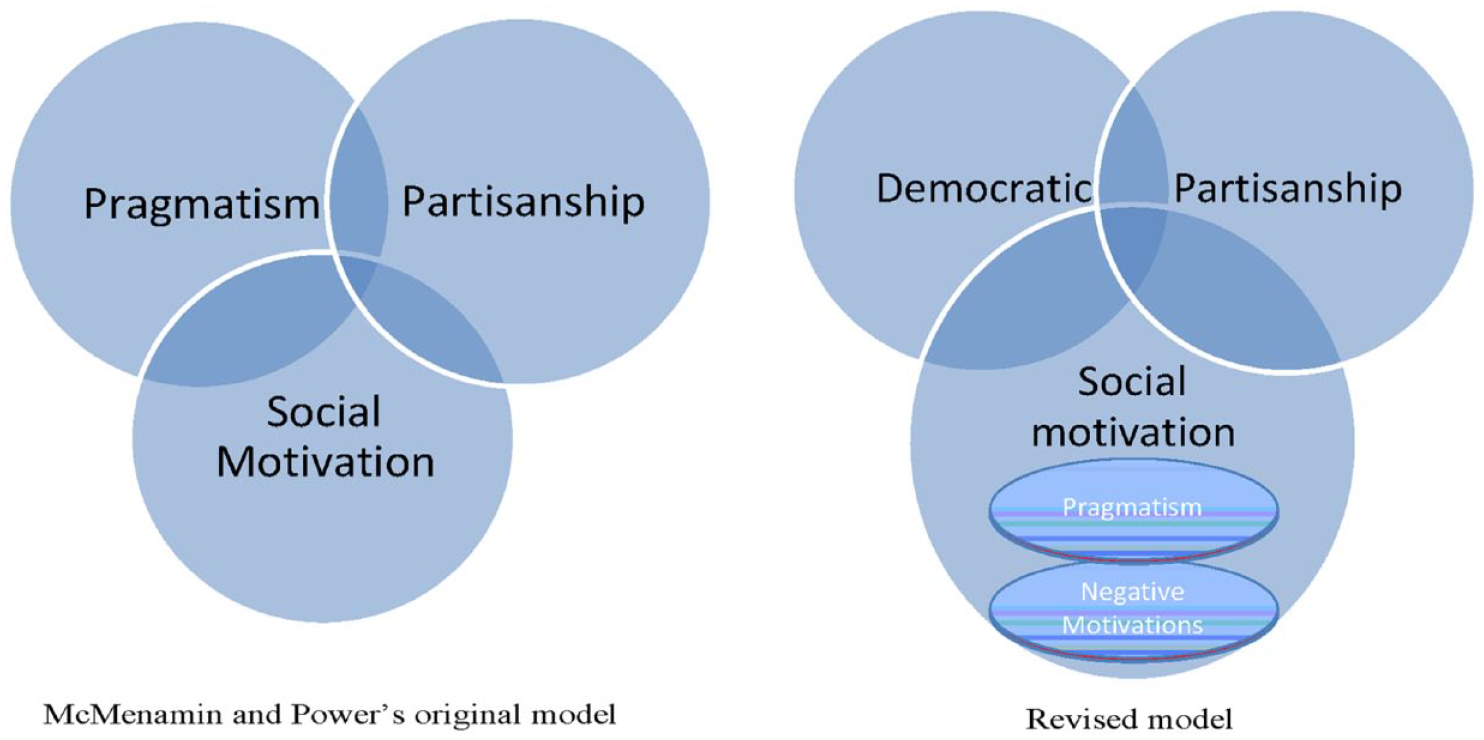
Motivations for political donations in Aotearoa New Zealand.
Among our interview respondents, no one explicitly admitted to a pragmatic motivation for their donation; nonetheless, the presence of pragmatic motivations was evident. Moreover, the donors, and indeed the other interview participants, were comfortable acknowledging social motivations and, in some cases, partisan motivations. Our study, like McMenamin and Power (2023) and other literature, finds multiple overlaps between the three motivations, or what McMenamin and Power call the ‘pragmatic–social,’ ‘pragmatic–partisan’ and ‘partisan–social’ positions (McMenamin and Power, 2023: 277). However, as shown in Figure 1, we propose the addition of a democratic motivation, to capture the desire on the part of individuals to ensure parties are sufficiently resourced to support a well-functioning democracy. We acknowledge that this democratic motivation is selective, rather than across the political spectrum. We also propose the inclusion of a ‘negative’ social motivation, which is the potential for donors to avoid donating – at least large amounts – to avoid negative impacts from public awareness of their political contribution.
In our research, the pragmatic–social motivation arose often. This is unsurprising given the well-established connection in the academic literature between influence and access. Influence represents the pragmatic motivation; access, the social motivation. It is often difficult to uncouple these two motivations, as individuals are more likely to acknowledge the social ones while disavowing the pragmatic ones. However, the explicit denials of pragmatic motivations were often accompanied by implicit statements indicating the presence of the very thing denied. Therefore, we position the pragmatic motivation within the social motivation, instead of locating it as overlapping with the other two motivators. Thus, while we accept the ‘triple motivation’ described by McMenamin and Power (2023: 276) as ‘interlocking and reinforcing of motivations’ our data showed the pragmatic motivator was more effectively positioned within the social sphere. In our research, the social motivation was the dominant one. While a pragmatic motivation often appeared to underpin the social impetus, we did not find evidence to support the idea that the former existed in isolation from the latter. It must be noted, however, that our interviewees were unlikely to admit to pragmatic motivations, given their close connection to corrupt behaviours, and the presence of these ‘cover stories’ (discussed further below) has the potential to obfuscate all political donation motivations.
To conclude, we find that McMenamin and Power’s framework captures many aspects of NZ donors’ motivations. However, some features of the NZ environment, including a relatively small group of well-connected donors and other political actors, result in the potential for negative outcomes for donors whose identities are publicly disclosed. This is a demotivator for some donors and acts as a negative social motivator. We also find a democratic motivation for donating that is not captured in the framework. Finally, in the NZ environment, we did not find evidence of explicit pragmatic motivations, except within the rubric of a social motivation. Therefore, we position the pragmatic motivator within the social motivator to reflect the enabling role that the social realm provides.
We acknowledge the potential for ‘cover stories’ to impact on motivations claimed (McMenamin and Power, 2023). Cover stories may deliberately obfuscate the rationale behind a donation, or they may facilitate a social motivation explanation to avoid further scrutiny of the payment. We surmise that the presence of cover stories explains the absence of strong pragmatic motivations among our interview subjects, and may contribute to the claim of wanting to support democracy. Cover stories may reduce the reliability of our data.
At least some of the different features we see in NZ may result in the relatively small case study. NZ has a population of just over five million, and a small cohort of well-connected political actors. This may result in social motivations having a greater impact due to the few degrees of separation among key political players. A further factor is the regulatory environment in NZ. NZ has a weak regulatory environment for political donations. There is limited transparency and few restrictions on donations. Therefore, unlike many other developed countries, the wealthy can make large donations for partisan or pragmatic motivations. Finally, NZ has had a mixed-member proportional electoral system since 1996, and all but one government has been a coalition. This means that a large donation to a smaller party that will not receive a majority of votes may still help that party to have influence. This may facilitate a broader range of donor motivations than a first-past-the-post electoral system.
Footnotes
Acknowledgements
The authors are grateful for the constructive feedback from three anonymous reviewers.
Data Availability
The coding themes used in this study are available from the corresponding author.
Funding
The authors disclosed receipt of the following financial support for the research, authorship, and/or publication of this article: funding from the Gama Foundation Fund in New Zealand.
