




Abstract
A fundamental insight of various trade theories is that trade does not have a universally negative effect on different business activities in different countries. Rather, trade’s impact varies concomitantly with the specific country and activity considered. This empirical note expands prior work linking trade to redistribution preferences by using sectoral comparative advantage to incorporate the notion that trade may hurt the prospects of a specific group in one country (e.g. workers in a highly tradeable or offshorable industry) but will simultaneously benefit this same group in another country. We expect that individuals in industries with a weaker (stronger) comparative advantage suffer (benefit) more from trade and are therefore more (less) in favour of redistribution. Empirical results confirm this expected effect of comparative advantage on redistribution preferences. We conclude that considering countries’ comparative (dis)advantage in certain activities provides a deeper and more general understanding of the political consequences of trade.
Keywords
Introduction
Individuals’ (perceived) economic prospects, positive or negative, affect their stance on redistribution and other key political issues and policies. Economic prospects and perceptions, in turn, are affected by a variety of factors, not least globalization (Kriesi et al., 2006). Much research has considered the political consequences of trade-induced economic anxieties and vulnerabilities, seeking to identify risk factors that link international trade to individuals’ support for redistribution (and to the demand-side of politics more generally). Some prototypical empirical results in this literature are that individuals are more supportive of government redistribution when working in a sector or occupation that is tradeable and thus exposed to foreign competition (Rueda and Stegmueller, 2019).
However, so far, this literature is asymmetrically focused on downside risks associated with increased competition from foreign imports and does not incorporate one of the core insights of standard trade theories, which is that trade may hurt the prospects of a specific group of workers in one country (e.g. workers in a highly offshorable industry or occupation) but that trade will simultaneously benefit this same group in another country. Both old and modern theories find that trade can worsen the prospects of some types of activities – for example, a specific industry (Industry 1) – in a given country (Country X). However, when an industry in a given country (Industry 1 in country X) suffers from foreign competition there will always be another country (Country Y) in which the same industry (Industry 1) flourishes because trade enables it to sell and compete internationally. The degree to which a specific industry’s exposure to trade, tradeability or offshorability poses a downside risk is thus not a characteristic that is inherent to an industry and that holds universally, regardless of where the industry is located. Trade entails both downside and upside risks that vary concomitantly with the specific country and the specific industry considered. 1
This paper seeks to expand prior literature linking globalization to the demand-side of politics to incorporate the notion that there is no industry (or other such units – for example, occupations, tasks or firms) in which all workers suffer from trade, irrespective of their location. Because of robust theoretical insights from standard trade theories and data availability, I focus on the effect of industries’ comparative advantage on individuals’ support for redistribution. Industry comparative advantage indicates how well a given industry in a country is performing compared to the same industry in other countries and compared to other industries in the same country. Hence, considering industry comparative advantage seems a very suitable way to capture the idea that trade can be a threat for some types of business activities in some locations but an opportunity for other types or in other locations. The specific prediction that I test is that, ceteris paribus, individuals in an industry in which their country has a stronger (weaker) comparative advantage are less (more) supportive of redistribution. Because comparative advantage varies with country and industry concomitantly, the main unit of analysis is country–industry combinations.
As it is, only a few empirical studies have acknowledged that comparative advantage likely plays a role in shaping redistribution preferences. Rehm (2009) considers whether an industry is a net exporter or net importer and Walter (2017) considers whether an industry is export-oriented (yes/no) and whether it is import-competing (yes/no). However, these two papers do not identify country–industry combinations as the unit of analysis and remain unclear on the relevant number of observations. In addition, their measures are crude dummy variables that do not capture the full extent of industries’ comparative (dis)advantage. Finally, and most problematically, these papers do not control for industry fixed effects (FEs) and therefore do not distinguish between effects due to unobservable industry-specific factors, including such traits as offshorability but also health and safety risks, and effects genuinely due to industries’ comparative advantage. 2
For the main empirical analyses, I consider the redistribution preferences of 31,790 individuals in 503 unique country–industry combinations. The relevant variation is the cross-sectional variation in support for redistribution that occurs between these country–industry combinations, which is about 12.2% of total variation in individuals’ redistribution support. The results support my prediction, indicating that individuals in sectors with a stronger (weaker) comparative advantage are significantly less (more) supportive of redistribution. Importantly, this negative empirical relationship exists completely independent from direct effects due to industries’ or occupations’ exposure to trade or any other fixed sectoral or occupational characteristic that is extensively considered in prior research. Of course, I do not claim or even attempt to show that direct effects of industries’ and occupations’ tradeability or other such industry- and occupation-specific influences are unimportant. However, the found added explanatory power of industries’ comparative advantage contributes a useful empirical insight to the large literature linking trade to the demand-side of politics. I thus conclude that understanding of the political economy of international trade can improve from explicit consideration of countries’ comparative advantage in specific types of business activities.
Background
Economic status and prospects and demand for government redistribution
Government policies often involve redistributing material wealth and demand for redistribution is extensively studied (Iversen and Goplerud, 2018). Considering demand for redistribution, political economy studies often refer to theoretical models that emphasize the role of individuals’ current economic status, specifically their income relative to the median (e.g. Romer, 1975). However, scholars are increasingly extending this narrow view with a more nuanced view that adds a role for individuals’ expected economic status as well as anxiety about possible future economic hardship. Individuals’ economic prospects are subject to external shocks such as globalization, and redistribution can work as a social insurance against the downside risks of such shocks (Kato and Takesue, 2023; Moene and Wallerstein, 2001). Similarly, individual expectations of upward instead of downward economic mobility (e.g. due to a positive rather than a negative trade shock) reduce rather than increase demand for government redistribution (Kim, 2023).
Industry comparative advantage and redistribution preferences
As indicated, trade theories – old and new – agree that trade’s costs and benefits for workers depend simultaneously on the specific business activity and on the specific country considered. Since Ricardo’s classic study of industry comparative advantage is so well known, I use that work as the theoretical backdrop to my analysis. Having a comparative advantage means that an entity (e.g. a firm, a region, a country or an industry) can perform a certain activity at relatively lower cost than another entity. However, a comparative advantage in one activity coincides with having a comparative disadvantage in another activity. Comparative advantage affects the prospects of different industries in different countries under trade. When trade occurs, industries (or other such groups or types of activities) in which countries have a comparative disadvantage dwindle, whereas the industries (or other such types of activities) in which countries have a comparative advantage expand. In the real world, economies comprise multiple sectors and economies have comparatively weaker or stronger comparative advantages in each type of sectoral activity. Germany, for example, has a much stronger comparative advantage in the manufacture of motor vehicles, trailers and semi-trailers than in fishing. Trade openness matters because under trade the former industry would have much potential for growth as it can export to other countries. Conversely, the latter industry’s future would be bleaker as it struggles to compete with foreign imports. These latter imports may come from Greece, which means that its fishing industry benefits from trade openness, while, at the same time, Greece’s motor vehicles industry might be struggling to compete with German imports. In short, whether a country has a comparative (dis)advantage in a particular industry links to the economic prospects of this industry in the country and, hence, the economic prospects of citizens in the industry. Other trade theories make the same prediction on the country-specificity of the costs and benefits of trade for specific groups of workers but may focus attention on units other than industries; for example, occupations, tasks or firms.
Following the above argument, I expect that weaker/stronger industry comparative advantage increases/decreases support for government redistribution by individuals in the industry. On average, individuals in industries with a strong comparative advantage likely have a better labour market position and better economic prospects. Hence, these individuals likely have a higher expected lifetime income, which reduces the net benefits that they receive and can expect to receive from government redistribution. In addition, being aware of how the comparative advantage of their sector of employment affects their economic prospects and the corresponding expected net benefits of redistribution, self-interest suggests that individuals are less supportive of redistribution the stronger the comparative advantage of their industries is. 3 At the same time, I recognize that if labour were perfectly mobile across sectors, workers in industries that dwindle under trade are re-employed in other industries instantly and without any cost to these workers (Owen, 2015). Empirical evidence, however, shows that labour is remarkably immobile and that adjusting to trade shocks takes at least a decade (see Autor et al., 2016 for a survey). Hence, I expect that their industries’ comparative advantage does indeed affect individuals’ economic prospects, including the future cost of labour market adjustment, and hence their redistribution preferences. Ukrainian workers, for instance, may benefit from German firms offshoring manufacturing of basic metals to Ukraine. Conversely, German workers benefit from the export of medical, precision and optical instruments to Ukraine, which puts pressure on the economic prospects of Ukrainian firms and workers active in this industry. Still, I should note that, as emphasized by ‘new new trade theory’, sectoral comparative advantage is hardly the only factor affecting trade’s cost and benefits for workers employed in the sector. In fact, I readily acknowledge that, within industries, trade likely hurts/fosters the economic prospects of some groups more/less. Similarly, my focus on cross-country cross-industry variation is not meant to suggest that countries cannot have a comparative advantage in specific tasks or that having a comparative advantage in certain tasks has a weaker effect on redistribution preferences than having a comparative advantage in certain industries does.
Data and method
The main data source is the European Social Survey (ESS; 2020), which is often used to study individuals’ preferences for various policies (e.g. Arikan and Ben-Nun Bloom, 2013; Stadelmann-Steffen and Eder, 2021). I complement these data with cross-country cross-industry data on so-called revealed comparative advantage (RCA) from the Organisation for Economic Co-operation and Development (OECD)’s (2010) STAN Structural Analysis database. The ESS is a biennial cross-national survey collecting individual-level data for representative samples from 32 European/Eurasian countries. The data are repeated cross-sections, and questions asked during the interviews concern personal attitudes, occupation and sector of employment, among others. The OECD STAN database contains data on economic characteristics of different industries across OECD member countries.
RCA data are available for the period 1999–2008. Although ESS data are available for the period after 2008, because of comparability of the industry classifications used in the ESS and the OECD data, I only consider data from the first four waves of the ESS (2002–2008). 4 Following prior research (e.g. Van Hoorn, 2022), I further exclude respondents with missing data on the control variables that I consider. Matching the RCA data to the ESS data leaves a main sample of 31,790 respondents nested in 503 country–industry combinations. Table 1 presents descriptive statistics for and details on selected variables. Tables S1 and S2 in the online supplemental material list the 21 countries and 25 industries in the sample. Table S3 lists the industries in which the countries in the sample have the strongest/weakest RCA. Although data have been collected over multiple years, the data are not an individual panel and I do not consider time-series variation in RCA. Figure S1 presents the structure of the data, emphasizing how individuals are nested in country–industry combinations, which are the main unit of analysis. Importantly, the relevant variation is not variation between countries or between industries but variation in redistribution preferences that is between country–industry combinations. As mentioned in the introduction, this country–industry variation is 12.2% (95% confidence interval (CI): 10.5, 14.0%; n = 503; n = 31,790) of total variation in individuals’ support for redistribution.
Descriptive statistics for and details on selected variables.
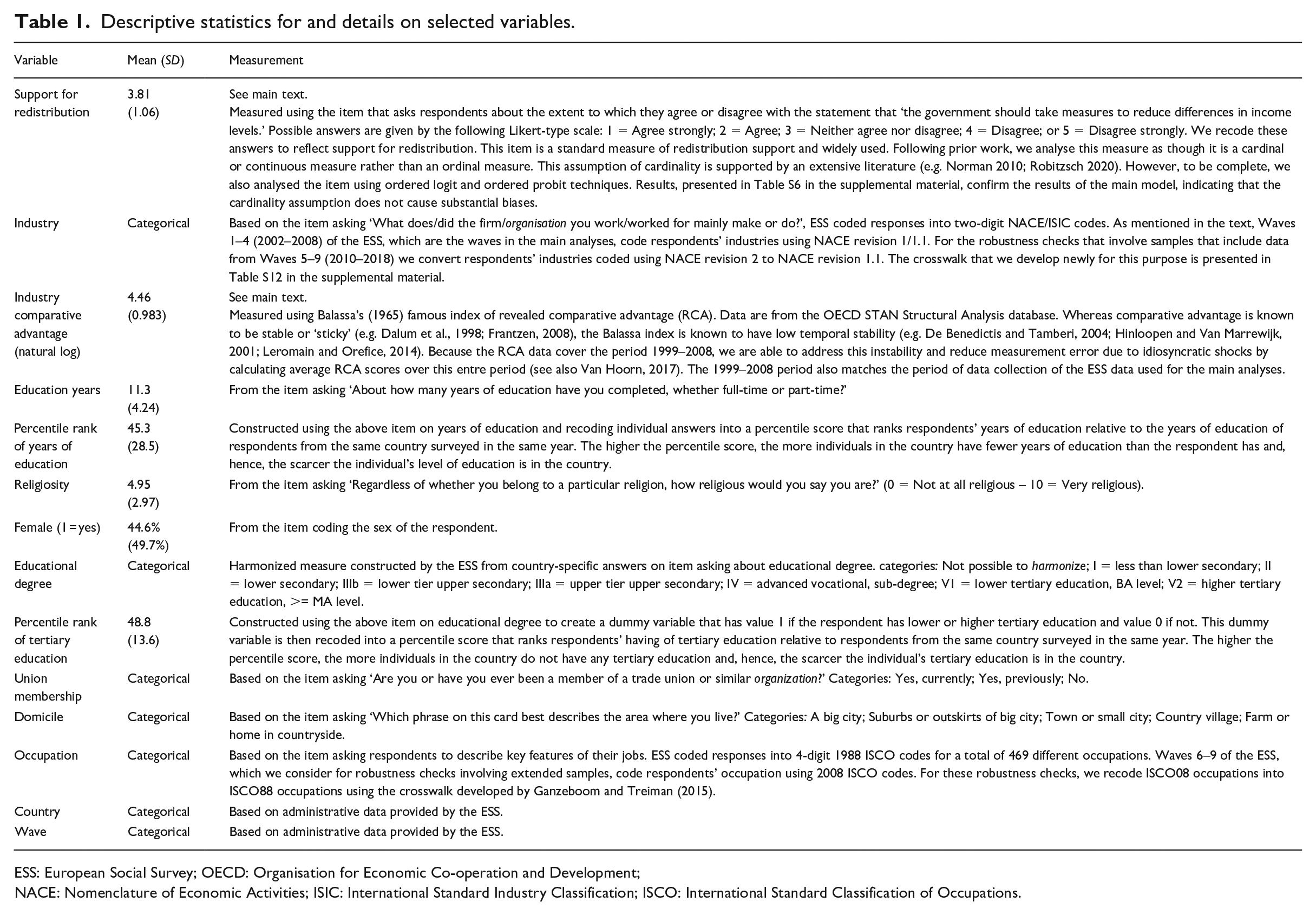
ESS: European Social Survey; OECD: Organisation for Economic Co-operation and Development;
NACE: Nomenclature of Economic Activities; ISIC: International Standard Industry Classification; ISCO: International Standard Classification of Occupations.
Variables and measures
I measure support for government redistribution using the ESS item asking respondents to indicate their agreement with the statement that ‘the government should take measures to reduce differences in income levels’ (1 = Agree strongly; 2 = Agree; 3 = Neither agree nor disagree; 4 = Disagree; 5 = Disagree strongly.) This and similar single-item scales have been used in many studies of the demand-side of government redistribution (e.g. Yang and Kwon, 2021). For the empirical analysis I reverse the scale to measure support for redistribution. To facilitate interpretation of the empirical results, I analyse this variable as a continuous variable. I obtain similar results when I estimate ordered logit or probit models (Table S6).
I measure the independent variable, comparative advantage, using the famous and widely used Balassa (1965) index. This index concerns the RCA of a particular country (c) in a particular industry (i):

Here Xci thereby denotes exports of country c in industry i, Xc denotes total exports of country c across all industries, Xi denotes total exports of industry i across all other countries, and X denotes total exports across all other countries. RCA is not a measure of trade or trade flows and is unaffected by the size of countries or industries. Mathematically, an industry’s RCA can vary between 0 and infinity and it is impossible for all industries in a country to have RCA > 100. My sample comprises only European countries. Nevertheless, in all countries there are both a number of industries that have a comparative disadvantage (RCA < 100) and a number of industries that have a comparative advantage (RCA > 100) (Table S4). More generally, several economies in the sample, notably Germany, export more in absolute monetary amounts than they import.
Although a country’s comparative advantage in a specific industry is a structural feature of its economy, external shocks can cause random, non-structural changes in the Balassa index scores across years (e.g. geopolitical events affecting oil prices). In general, a well-known limitation of the Balassa index is its low temporal stability (Hinloopen and Van Marrewijk, 2001). I therefore do not use yearly RCA scores but reduce measurement error by averaging scores across all the years for which there are RCA data (1999–2008) (see e.g. Van Hoorn, 2017). This way, I ensure that I am capturing RCA as a relatively ‘sticky’ feature of an industry in a country (Dalum et al., 1998).
I match the RCA data to the individual-level data from the ESS using country identifiers and two-digit NACE (Nomenclature of Economic Activities)/ISIC (International Standard Industry Classification) industry codes. Waves 1–3 of the ESS (2002–2006) have used revision 1 of the NACE classification, which is equal to NACE revision 1.1, which was used in Wave 4 (2008). NACE revision 1/1.1 is further equal to revision 3 of the ISIC, which is the classification used by the OECD STAN database. The 2-digit NACE/ISIC classification distinguishes 88 industries. Because RCA data are lacking for industries with few or no exports (mostly services-oriented industries), the main sample comprises 25 industries. I obtain similar results if I assign these non-exporting industries an RCA score of 100 for all countries and add them to the sample (Table S7).
The analysis considers various control variables. Following standard cross-country cross-industry analyses of RCA (Nunn and Trefler, 2014) I include both country and industry FEs as a means to focus on cross-country and cross-industry variation simultaneously and control for confounding country- and industry-specific effects. These FEs control for the potential confounding effect of country-specific factors such as welfare state regimes and industry-specific factors such as working conditions or tradeability as well as unit-specific measurement error. Because prior work linking trade to redistribution preferences emphasizes the role of occupation, all models also include occupation FEs. This way I address any potentially confounding effects of occupational traits such as tradeability, routine-task-intensity, automatability, etc. I also include wave FEs to control for – for example – year-specific measurement error as well as individual-level control variables commonly considered in studies of redistribution preferences. These individual controls involve standard demographics (age, age squared, gender and domicile) but also individuals’ religiosity and union membership. I further use both individuals’ years of education and dummies indicating education level to control for differences in skills and formal training. Finally, I add two more variables that speak to an individual’s formal and informal skills and competences relative to other people in their country. The first of these variables is the percentile rank of individuals’ years of education relative to fellow citizens. The rationale is that this percentile rank captures how scarce the individual’s skills and competences are in the country. The second one is the percentile rank of having tertiary education or not, which captures how scarce the individual’s tertiary education, if any, is. For one of the robustness checks, I further follow Van Hoorn (2022) and use variables that are also partly outcomes of RCA to control for potential confounders that can affect individuals’ redistribution preferences and also correlate with working in a certain industry, particularly individual ability differences (see note 3). Some key outcome variables that I add as controls are individuals’ employment status and the rank of their household income (both are proxies for individual ability and effectuations of the labour market implications of RCA), and left/right political preferences. Statisticians agree that such endogenous controls are bad controls and that they have an important disadvantage, which is that they cause a so-called included variable bias (Cinelli et al., 2022). I therefore do not include these controls in the main models and only consider them as powerful means for getting rid of omitted variable bias and a strict check of the robustness of the main results.
Method
I test the relationship between RCA and support for redistribution using regression analysis of individual-level survey data, which is standard in the literature linking macro-level phenomena such as trade to individuals’ preferences. Because data are structured hierarchically (individuals nested in unique country–industry combinations), I use cluster-robust standard errors. I obtain similar results when estimating (cross-classified) multilevel models that separate variation between and within country–industry combinations (Table S8; see also Figure S1). The basic empirical model concerns the support for redistribution (Shci) of individual h that lives in country c and works in industry i:

Here RCA
ci
denotes the comparative advantage of country c in industry i,
Results
Table 2 lists the main results. The simplest model that I estimate controls for country and industry FEs as well as occupation and wave FEs as potential confounders, thus focusing attention on variation in redistribution preferences among individuals from different countries working in different industries. Consistent with my expectation, results indicate a significant negative relationship between an industry’s RCA, which is country-specific, and support for redistribution (Model 1). Because I control for both industry and occupation FEs, this apparent effect exists in addition to the direct effect of industry- and occupation-specific trade exposure, import competition, tradeability and other such influences emphasized by prior work. Adding years of education, education level, union membership and other individual controls renders a closely similar estimated coefficient (Model 2). Hence, it seems that the found relationship between RCA and redistribution preferences is not driven by educational differences, among others. Comparing coefficients, which are standardized, the effect size of RCA appears to be in the same league as that of other important determinants of redistribution preferences identified in the literature.
Industry comparative advantage and the demand-side of redistribution.
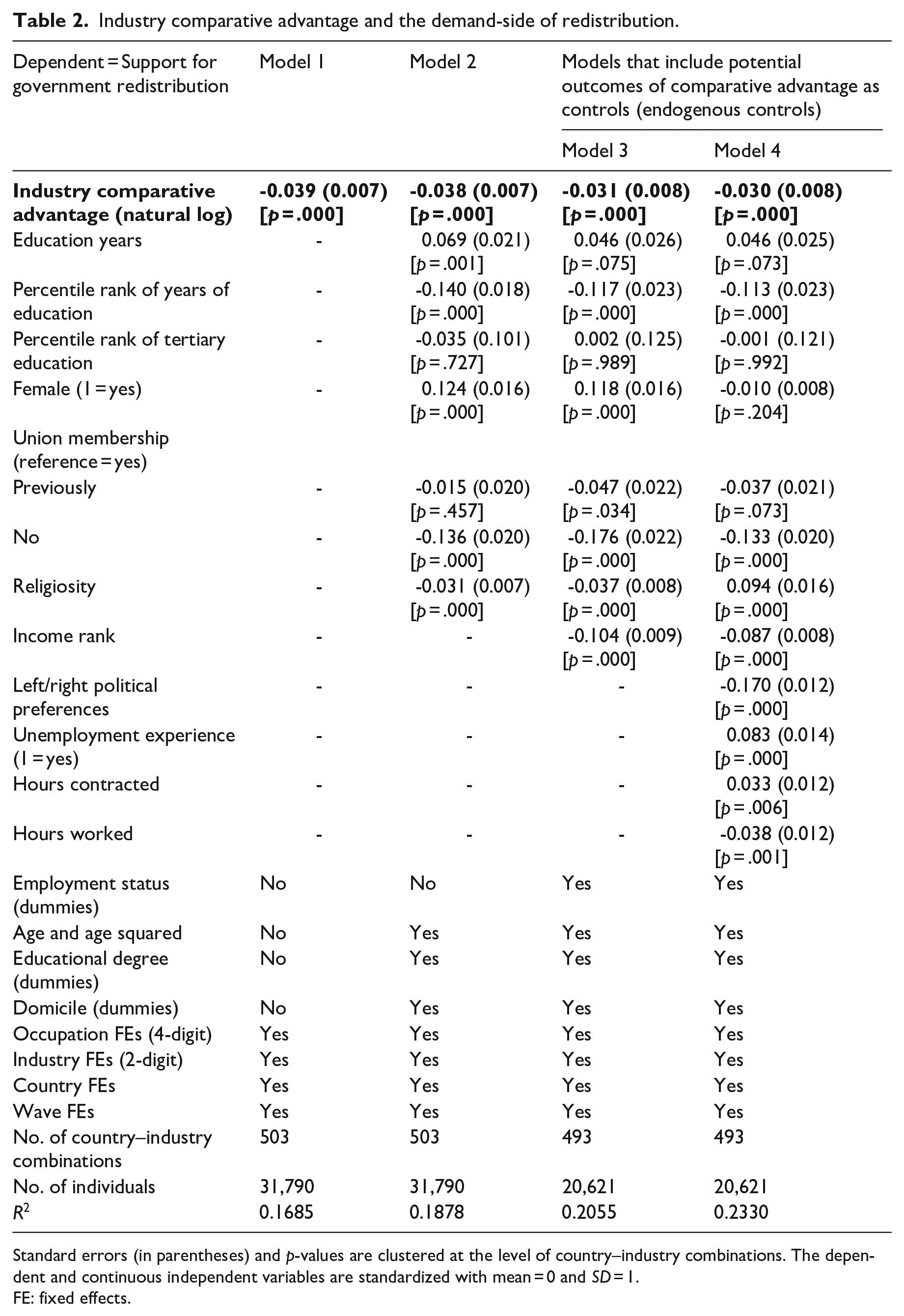
Standard errors (in parentheses) and p-values are clustered at the level of country–industry combinations. The dependent and continuous independent variables are standardized with mean = 0 and SD = 1.
FE: fixed effects.
country–industryI have assessed the robustness of the baseline results in different ways (e.g. Tables S6–S11). Here I highlight three main robustness checks. First, I have included potential outcome variables as added controls. As indicated, I have done this because it provides further means to rule out that the apparent relationship between industry RCA and support for redistribution is spurious. Model 3 in Table 2 adds income rank and employment status as control variables that speak to individuals’ actual or realized economic status. These variables proxy for ability differences but are also partly an effectuation of the impact that their industry’s RCA has on individuals’ economic prospects. Nevertheless, results indicate a significant negative relationship between RCA and support for redistribution. Model 4 further controls for left/right political preferences, among others. Left/right political preferences are closely related to preferences for redistribution (Thewissen and Rueda, 2019). Again, however, results confirm the main results. Second, I have broadened the analysis to allow the impact of RCA on support for redistribution to vary across the countries in the sample. Models 5 and 6 in Table 3 presents the results. Results are again similar to the baseline results. Hence, it seems that any bias due to non-homogeneity among the countries studied is minor. Third, I have extended the main sample, which includes ESS data covering the years 2002–2008, to include data covering the years 2010–2018 as well. Downside of this extension is that data are subject to more measurement error and noise. RCA data do not go beyond 2008 and later waves of the ESS use a different classification system for coding respondents’ industries (see Table 1 and above), which means that I need to develop and apply a crosswalk (see Table S12). 5 Hence, the extended samples are not my preferred samples. Results (Models 7 and 8 in Table 3) reveal the same negative relationship between RCA and support for redistribution as before. However, model fit (R2) is lower than before (Table 2), which is as expected given the period mismatch between the RCA data and later waves of the ESS and the imperfect recoding of respondents’ industries. Similarly, estimated coefficients, though still statistically significant at usual levels, are lower, and this is likely caused by attenuation bias due to measurement error.
Results for selected robustness checks.
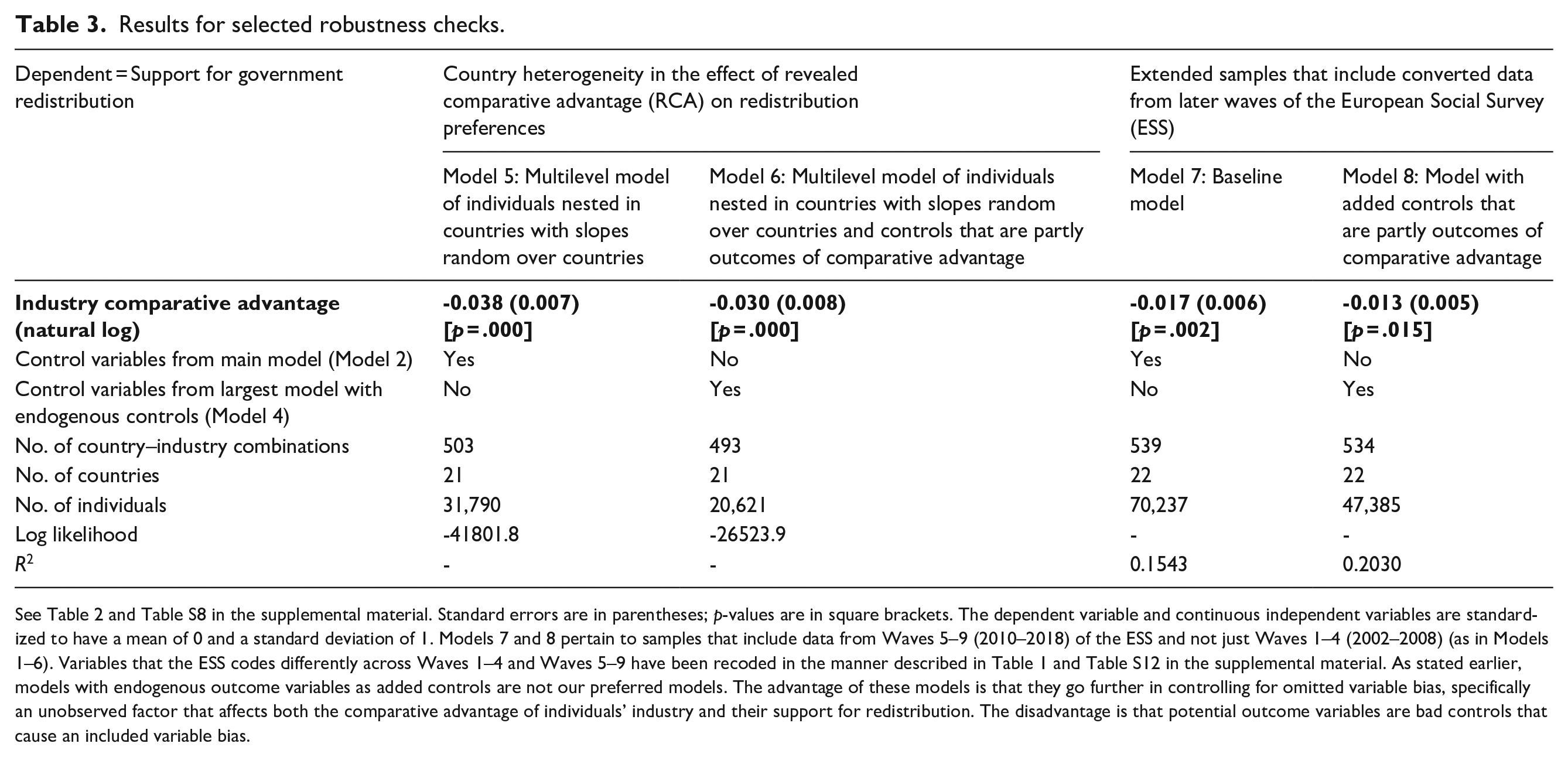
See Table 2 and Table S8 in the supplemental material. Standard errors are in parentheses; p-values are in square brackets. The dependent variable and continuous independent variables are standardized to have a mean of 0 and a standard deviation of 1. Models 7 and 8 pertain to samples that include data from Waves 5–9 (2010–2018) of the ESS and not just Waves 1–4 (2002–2008) (as in Models 1–6). Variables that the ESS codes differently across Waves 1–4 and Waves 5–9 have been recoded in the manner described in Table 1 and Table S12 in the supplemental material. As stated earlier, models with endogenous outcome variables as added controls are not our preferred models. The advantage of these models is that they go further in controlling for omitted variable bias, specifically an unobserved factor that affects both the comparative advantage of individuals’ industry and their support for redistribution. The disadvantage is that potential outcome variables are bad controls that cause an included variable bias.
Discussion and conclusion
The idea that international trade has distributional consequences and affects the demand-side of politics is widely accepted. Many studies have thereby considered how workers’ exposure to trade, operationalized by such measures as sectoral or occupational tradeability or offshorability, affects individuals’ policy preferences. 6 However, old and modern theories agree that whereas trade can be a threat to a given type of activity in one country, the ability to sell abroad also offers opportunities, either for other types of activities in the country or for the same type of activity in another country.
This paper’s empirical results underscore the value of incorporating the fundamental theoretical insight that trade does not have a universally negative effect on different business activities in different countries when analysing the distributional consequences of trade and their impact on policy preferences. Focusing on cross-country cross-industry variation, I find a strong negative relationship between individuals’ support for redistribution and their industries’ comparative advantage (measured by their revealed comparative advantage or RCA). Because I control for any possible sectoral and occupational confounders (as well as many other potentially confounding factors), this relationship exists on top of the direct effect of such factors as industries’ and occupations’ tradeability or offshorability. Based on the added explanatory power of RCA, I conclude that considering how trade may hurt the prospects of a specific group in one country but will simultaneously benefit this same group in another country provides a deeper understanding of globalization shaping the demand-side of politics than heretofore.
A limitation of the paper is that I cannot consider the process through which individuals take note of their industry’s comparative advantage and use this information to assess their labour market position and economic prospects and ultimately the net benefits that they receive and expect to receive from government redistribution. Another limitation is that countries’ comparative advantages could only be measured at the two-digit industry level. Industry comparative advantage is, however, hardly the only form of comparative advantage likely to affect individuals’ support for redistribution. Workers may be employed by firms in the country that are internationally competitive, for instance. An interesting extension to the present analysis therefore is to consider comparative advantage or international competitiveness measured for different units, for example, for the firms that individuals work for. A further interesting extension is to link (industry) comparative advantage to support for a specific redistribution policy, namely one that explicitly aims to help workers who are hurt by trade. Finally, an interesting empirical extension would be to track individuals over time and link selection into and out of certain industries to support for redistribution. However, as it is, the individual-level panel data required for such a study are lacking.
Overall, the essential insight is that a more complete understanding of the political economy of trade comes from recognizing that the costs and benefits of trade for specific groups of workers are not universal but country-specific and that countries’ comparative advantage in certain types of activities is an important determinant of the political consequences of trade.
Supplemental Material
sj-docx-1-ips-10.1177_01925121241242440 – Supplemental material for Industry comparative advantage and support for redistribution: A cross-country cross-industry analysis of the political economy of trade
Supplemental material, sj-docx-1-ips-10.1177_01925121241242440 for Industry comparative advantage and support for redistribution: A cross-country cross-industry analysis of the political economy of trade by André van Hoorn in International Political Science Review
Supplemental Material
sj-zip-2-ips-10.1177_01925121241242440 – Supplemental material for Industry comparative advantage and support for redistribution: A cross-country cross-industry analysis of the political economy of trade
Supplemental material, sj-zip-2-ips-10.1177_01925121241242440 for Industry comparative advantage and support for redistribution: A cross-country cross-industry analysis of the political economy of trade by André van Hoorn in International Political Science Review
Footnotes
Data accessibility statement
The data that support the findings of this study and the statistical files needed to replicate the results are available as an online Appendix to this study.
Declaration of conflicting interests
The author declared no potential conflicts of interest with respect to the research, authorship and/or publication of this article.
Funding
The author received no financial support for the research, authorship and/or publication of this article.

Supplemental material
Supplemental material for this article is available online.
Notes
Author biography
References
Supplementary Material
Please find the following supplemental material available below.
For Open Access articles published under a Creative Commons License, all supplemental material carries the same license as the article it is associated with.
For non-Open Access articles published, all supplemental material carries a non-exclusive license, and permission requests for re-use of supplemental material or any part of supplemental material shall be sent directly to the copyright owner as specified in the copyright notice associated with the article.
