



Abstract
Today, many far-right parties maintain youth wings, providing opportunities to mobilise members and future party leaders. However, they are often neglected in the study of the far right’s organisation. This article explores the development of the ‘Young Alternative’ and its ambivalent relationship with the ‘Alternative for Germany’. Theoretically, it argues that far-right youth wings can act as important drivers of radicalisation. It also tries to understand conflicts between far-right youth organisations and parties by discussing the interactions between organisational development and radicalisation. Empirically, it opens the ‘black box’ of the German case by drawing on a wide range of primary and secondary sources, including semi-structured interviews with high-ranking ‘Young Alternative’ members, (social) media communication and official documents of the ‘Young Alternative’, ‘Alternative for Germany’ and intelligence services. Overall, the article underlines the importance of far-right youth wings as part of the broader party organisation and offers substantial theoretical and empirical research perspectives.
Introduction
Although far-right youth organisations can be crucial for the far right’s broader mobilisation and radicalisation, knowledge about their development and role is scarce. Studies have only recently devoted more attention to the far right’s party organisation (Heinisch and Mazzoleni, 2016; Van Kessel and Albertazzi, 2021), although it is considered a key factor for electoral persistence (De Lange and Art, 2011). Even less attention is paid to (far-right) youth wings, which are part of the broader party organisation and can fulfil important recruitment and socialisation functions for parties. They mobilise young members, introduce them to the party’s ideology and create networks and starting points for political careers (Hooghe et al., 2004). Moreover, far-right youth wings can act as important drivers of radicalisation. However, we know very little about their development and relationship towards parties.
This also applies to the ‘Young Alternative’ (Junge Alternative (JA)), the youth wing of the ‘Alternative for Germany’ (Alternative für Deutschland (AfD)). Although studies have already investigated the AfD’s ideological as well as organisational development (Arzheimer, 2019; Heinze and Weisskircher, 2021), we know very little about the JA’s development and role for the AfD. In general, there is almost no research on the JA (Herkenhoff, 2016; Knopp, 2017). We need to tackle this research gap to understand the far right’s broader mobilisation and radicalisation, which has so far mainly been studied from a (narrow) party and electoral perspective (Castelli Gattinara, 2020).
This article explores how the JA developed organisationally and ideologically, and to what extent it can be seen as a driver of radicalisation. I focus on the JA as a crucial case (Gerring, 2007) that – just like the AfD – has achieved success in a country post-World War II where several other far-right organisations failed before. Studying this new and poorly explained case allows me to develop the sparse theory in this area.
Methodologically, I carry out process tracing (Bennett and Elman, 2006; Collier, 2011) to identify critical junctures in the JA’s development and to discover the causal mechanisms of its radicalisation processes. In doing so, I draw on a wide range of primary and secondary sources, including official documents of the JA, AfD and intelligence services, media articles and social media communication. I combine this data with original semi-structured interviews with high-ranking JA members, which allowed me to gain a strong internal perspective on these processes. Based on this rich data, I am able to provide a fine-grained reconstruction of the JA’s radicalisation and a deeper understanding of its links with the AfD.
Overall, the article’s contributions are twofold. Conceptually, I focus on the role of far-right youth wings, bridging the literature on party organisation and the far right. Empirically, I open the ‘black box’ of the JA by providing original insights into its development and role for the AfD. My findings show that the AfD’s recognition of the JA should be understood in the light of the party’s own organisational development as well as radicalisation. However, the threat of surveillance (and thus legitimacy losses) caused conflicts even after recognition. In the light of their radicalisation, both JA and AfD began to delegitimise the intelligence services and present themselves as the only ‘true opposition’. Finally, I discuss the implications of my findings more generally and point to important research perspectives.
Far-right youth wings as drivers of radicalisation
To date, there is hardly any research on (far-right) youth wings. Although some studies focus on individuals’ motivations for joining a youth wing, their attitudes and behaviour (e.g. Bruter and Harrison, 2009; Pirro and Róna, 2019), the organisations’ development and relationship towards parties is often neglected. This is a blind spot, as about 80% of parties in Western Europe have a youth organisation, making it the most common party sub-organisation – this is also true within the far right (Allern and Verge, 2017).
Today, most far-right parties maintain youth wings. This applies to older ones, like the Norwegian Progress Party and the Sweden Democrats (Jungar, 2016; Jupskås, 2016) as well as rather young ones, like the Dutch Forum for Democracy (De Jonge, 2021). In the following, I argue that far-right youth wings can act as important drivers of radicalisation, especially if they are well organised. Previous research has shown that today’s far-right parties are not stable entities but have a high degree of heterogeneity in political actors and positions (Mudde, 2019). This also applies to the AfD, where intra-party competition has shaped party ideology and decision-making procedures from the very beginning (Heinze et al., 2023; Pytlas and Biehler, 2023).
To understand how youth wings may influence their mother parties, we have to take a closer look at their functions. In general, youth wings represent young people’s interests (in the party and for the voters) and recruit members as well as future party leaders. First, political parties connect to social groups to ‘identify relevant societal interests’ and ‘to link with various segments of society between elections’; for instance, ‘by giving them formal status within the party and rights to access decision-making bodies’ (Allern and Verge, 2017: 106–107). Youth wings carry young people’s interests into the party and facilitate their identification with the party, which is particularly important as party members in Western Europe are becoming fewer and older (Van Biezen et al., 2012). Youth organisations are considered sensors for ‘youth-specific issues’ (Mycock and Tonge, 2012: 145) such as school or university policies, but also deal with other topics; for example, economy/finance, social issues or energy/climate (Jungblut and Weber, 2017: 135). In doing so, they often promote more radical profiles than their mother parties (Hooghe et al., 2004: 197). Youth wings usually see themselves as harbingers who can actually contribute to their party’s ideological and strategic transformation; for example, by seeking new cooperation partners (Krabbe, 2001: 297). Therefore, they can actively push for more radical agendas in their mother parties.
Second, youth organisations are highly relevant for the recruitment and socialisation of young members and future party leaders. They introduce them to the party’s ideology and ‘function as a kind of learning school, where the members gradually grow acquainted with political and party life’ (Hooghe et al., 2004: 196). Youth organisations generate networks and can be an important stepping stone in starting a political career. For instance, people will more likely be asked to enter an electoral list if they have already made a favourable impression at the youth level (Hooghe et al., 2004: 204–205). Many current or former leaders of parties such as the Sweden Democrats, the Danish People’s Party, the Austrian Freedom Party, the Flemish Interest or the League were first active in their party’s youth wings. In Norway, most former ministers of the Progress Party had been active in the youth organisation (Jupskås, 2016: 170). The recruitment function also distinguishes youth wings from elements of the non-party sector, such as publishers or intellectual schools (Veugelers and Menard, 2018). Although the latter may also be relevant for the far right’s social networks and external influence (e.g. by providing alternative modes of political socialisation), youth wings often provide privileged forms of recruitment channels and policy impact on their parties. If youth wings take more radical stances than their mother parties, they therefore serve as a radical pool for recruitment.
Despite all these advantages, conflicts between youth wings and their parties are not uncommon. In the following, I argue that cooperation may come not only with benefits for them, but also with (perceived) costs that need to be weighed. Three central factors may play a role here: funding, power and legitimacy. They can have a significant impact on the development and role of youth organisations.
First, access to public funding can influence the organisations’ willingness – or need – to cooperate with others. In general, parties usually have access to public funding, but ‘depend on it to a different degree and have greater or lesser access to private sources of funding, such as members’ fees or private donations’ (Allern and Verge, 2017: 125). Furthermore, ‘more generous public funding schemes seem to reduce parties’ incentives to create sub-organizations’, such as youth wings (Allern and Verge, 2017: 129). In Germany, parties’ public funding depends on their electoral results and membership base. Therefore, parties should be interested in engaging with youth wings to recruit (young) voters, members and (financial) contributors. At the same time, youth organisations without access to their own public funding are highly dependent on the (financial) support of their mother parties (especially since young members are rarely able to donate large amounts of money). As a result, such youth organisations will tend to hold back on fundamental criticism of their parties and try to serve them well (e.g. through campaigning).
Second, granting a youth wing formal status and representation rights is usually accompanied by some loss of power for the party in decision-making procedures. For example, youth organisations may have access to reserved seats in parties’ highest executive bodies or be allowed to send delegates (with or without voting rights) to party conferences. In this way, they will try to influence their parties’ policies or recruitment in their favour. At the same time, parties may retain instruments to control their youth wings – especially as these often hold more radical views than parties (Hooghe et al., 2004). In the wake of their strong centralisation and hierarchical organisation (Heinisch and Mazzoleni, 2016; Pytlas, 2021), radical right parties should be even more concerned about obedient party sub-organisations and try to control them. In the past, conflicts between radical right parties and youth wings have even led to splits or dissolutions; for example, in the cases of the youth wings of the Sweden Democrats (Jungar, 2016) and the Norwegian Progress Party (Jupskås, 2016). Both times, conflicts flared up over ideology and the broader course (e.g. (de-)radicalisation, movement-party strategy).
This already points to the third factor: legitimacy. In general, parties and youth wings can pursue different goals, leading to conflicts over ideology, strategy and personnel. Although parties usually pursue vote-, office- and policy-seeking strategies (Downs, 1957; Strøm, 1990), youth wings may also focus on their external mobilisation and socialisation in the non-electoral arena, which also includes, for example, street protest, intellectual circles and online activism, but often displays substantial linkages to the electoral arena (Pirro and Castelli Gattinara, 2018; Weisskircher, 2023). As we know from the literature on party development, organisational goals can also change over time (Harmel and Svåsand, 1993). Although at the beginning it is mainly about communicating a message and establishing identification, the importance of developing an organisation increases in the second period, which usually ‘begins when the number of parliamentary representatives exceeds a “handful,” and/or when a number of the party’s members have been elected to local offices’ (Harmel and Svåsand, 1993: 72). In this phase of electoral growth, party organisation becomes important to control members’ demands and office-holders’ behaviour, which may contradict official party positions (Harmel and Svåsand, 1993: 72–73). This may also include establishing a youth organisation to consolidate channels of recruitment, policy input and compromise-finding with younger cohorts. In the third phase, the party has developed a ‘routinised’ organisation, but lacks a proven record of ability to govern, so it shifts its focus from internal organisation to solidifying a credible and stable reputation (Harmel and Svåsand, 1993: 73). A well-developed youth wing may contribute to this stabilisation, besides other party sub-organisations (e.g. women’s or seniors’ groups, religious groups; Allern and Verge, 2017).
Today, many far-right parties try to normalise themselves – ideologically, rhetorically and/or organisationally – to increase their credibility, attract more support and be recognised as potential coalition partners (Art, 2011; Hutchins and Halikiopoulou, 2020). This may also include building mass-party organisations with an active grassroots following (like the Swiss People’s Party; Favero, 2021) or a vibrant youth wing. Such a normalisation strategy does not necessarily mean losing core support, as we have seen with some far-right parties in government (Albertazzi and McDonnell, 2005) as well as in opposition, such as the AfD, which campaigned around the slogan ‘Germany. But normal’ in 2021, while drawing on populist, nativist and authoritarian stances (Hansen and Olsen, 2022).
In this article, I focus on the JA’s development and role by exploring the following questions. How did the JA form and organise itself? How did it develop, both ideologically and organisationally? Which were the key events in this process? What is the relationship between JA and AfD, and to what extent has the youth wing been able to drive radicalisation?
Case selection and data
This article focuses on the JA as a crucial case (Gerring, 2007) and applies process tracing, using a variety of data. In this section, I explain my case selection and methodological approach in more detail.
First, investigating the JA provides an excellent opportunity to explore the development of a new, understudied youth organisation that had achieved success in a country where several other far-right parties failed before. Within the party family, the AfD is one of the youngest successful radical right parties in Europe. It has experienced a fundamental radical right turn, which is relatively well studied (Arzheimer, 2019). In contrast, we know little about the AfD’s organisation and even less about its youth wing as part of it. Previous research has investigated the AfD’s relatively strong party organisation, including its ‘movement-party’ strategy as well as its (surprising) collective leadership and high level of intra-party democracy (Heinze and Weisskircher, 2021; Heinze et al., 2023). Other studies have shed light on the JA’s early ideological positions (Herkenhoff, 2016; Knopp, 2017). However, the JA’s development and role for the AfD have not been examined so far, which is also due to the novelty of both organisations.
Second, the German context provides an excellent setting for studying the development of youth organisations. In general, all parties in the German Bundestag maintain their own youth wings, which enjoy a relatively high status in the strongly institutionalised party system. All these youth wings were founded bottom-up, rely on the (organisational and financial) support of their mother parties and often criticise them for being too moderate (e.g. when it comes to climate issues). This has already led to the split between parties and youth wings, as was the case with the first youth wing of the Liberal Party in 1982.
However, party law allows some room for manoeuvre in terms of ideology, organisation and funding, which can also influence the JA’s development and role. For example, linkages of youth wings and parties can vary between organisational integration with unified membership and separated membership with organisational, structural and financial autonomy (Gruber, 2010: 481). Today, all parties allow separated membership, but their memberships overlap. In the case of the JA, members do not have to join the party (unless they are chairpersons), and AfD members younger than 36 are not automatically JA members. However, around 70% of JA members are also members of the AfD (Steffen, 2018).
Moreover, all German parties grant their youth wings different participation rights. In the case of the JA, it can submit motions to the AfD’s most important bodies (party conference, executive committee, convention) and send one co-opted member without voting rights to the convention and – after a corresponding decision by the executive committee – to the AfD’s executive committee. Formally, the JA’s rights are thus higher than, for example, those of the Social Democratic Party’s youth wing, which has no such rights in its party’s statute, but lower than those of the Left, which can even send delegates to the party conference.
German youth wings also receive state funding, but – unlike in other countries (e.g. the Netherlands, De Roon, 2019) – the amount is independent from indicators such as the seat share of their mother party. Instead, the state funds the Ring politischer Jugend (RPJ), an association of the major youth organisations in which they decide for themselves to whom and how they distribute their funding. So far, the JA is excluded from the RPJ by the other youth wings (i.e. Young Union, Young Socialists, Green Youth and Young Liberals). Therefore, it depends on membership fees, donations and the AfD’s financial support.
Methodologically, I carry out process tracing (Collier, 2011) to identify critical junctures in the JA’s development and to discover the causal mechanisms of the JA’s radicalisation processes. Critical junctures describe turning points in path-dependent processes, when one of several plausible alternatives is selected that ‘constrains actors to keep to that particular path’ (Bennett and Elman, 2006: 464). To strengthen my argument, I draw on a wide range of data, including official documents (e.g. JA statutes and programmes, social media communication), media articles and semi-structured interviews with JA members. This triangulation and a rich knowledge of context should help to ‘strongly validate one explanation and rule out many others’ (Bennett and Elman, 2006: 459). However, such ‘smoking-gun tests’ provide ‘a sufficient but not necessary criterion for accepting the causal inference’, (Collier, 2011: 827), meaning that failing this test cannot reject a given hypothesis.
The semi-structured interviews were conducted with 4 high-ranking JA members who were members of the federal executive committee (comprised of 14 to 15 members) at the time. Due to their function and early involvement in the JA’s development, they should have great insights into its organisation. Moreover, they were still members of the JA even after its clear radicalisation. All of them promptly accepted the interview requests. The interviewees were asked, among others, about their function and tasks within the JA, its organisation and relationship with the AfD. Importantly, they could set their own priorities and present their individual views. The interviews were conducted virtually or by phone between October and November 2020 and lasted between 40 and 50 minutes. The interview atmosphere was mostly open and confidential, although the interviewees were short on some questions (e.g. about their financial resources). These observations were carefully included in the analysis.
To gain a fine-grained view in the JA’s development and to cross-validate and control the interviewee’s statements, I reviewed a variety of secondary sources, including official documents of the JA, AfD and intelligence services, media articles and social media communication. Media coverage was researched using Google and the database Nexis Uni® and also included coverage of the far-right newspaper Junge Freiheit, as in some cases it was the only one reporting on the JA. I was very careful in including JA and Junge Freiheit materials, as they are likely to be influenced by the actors’ views and motivations.
Social media communication of the JA associations and the interviewees were collected from Facebook and YouTube. I selected these channels based on their reach (at the beginning, the JA was only present on Facebook) and purpose (e.g. Interviewee 3 stated that Instagram is primarily used for recruitment and Facebook and YouTube for reporting on their political work). Moreover, the advanced search on Twitter did not yield enough relevant results (just as the AfD website did not). For the research of the (social) media communication, search terms were derived from the interview guideline and transcripts as well as a scoping research on JA (see Appendix). I have collected a database of all online sources, which is available upon request.
Analysis
In the following, I differentiate between four phases of the JA’s radicalisation processes. In doing so, I focus on its ideological positions, links to social movement groups and relations with the AfD.
The JA’s foundation and rapid rise (2013–2014)
Like other German youth organisations, the JA first had to found itself and establish basic organisational structures before it could fight for recognition from its mother party. Its bottom-up founding event took place on 15 June 2013 (Facebook, 23 June 2013), four months after the AfD’s foundation on 6 February 2013. Interviewee 1 was one of the initiators and explained his motivation as follows: ‘I was in the AfD from the very beginning [. . .]. The young members networked with each other and we said yes, let’s build a youth organisation directly, and since then I have been a functionary.’ In this respect, starting a youth wing seemed rather a matter of time than a choice from alternative options.
Ideologically, the JA often took more radical positions than the AfD early on. In its social media communication, the JA criticised the ‘inadequate responses of the established parties to the euro crisis’ and the supposed paternalism of citizens (Facebook, 23 June 2013), thus resembling the initial, rather Eurosceptic AfD (Berbuir et al., 2015). At its federal conference in February 2014, it even called for ‘going much further than the AfD’ in European Union (EU) issues (JA, 2 February 2014) and for the EU’s dissolution (and thus seven years before the AfD). It also attracted attention with anti-Islam frames, and cultivated contacts to extremist fraternities and far-right groups and publishers such as the Identitarian movement or the magazine Sezession (Herkenhoff, 2016).
As a result, especially ‘moderate’ AfD members remained rather sceptical about the JA and did not support its recognition as an official youth organisation. In February 2015, party co-chair Bernd Lucke even (unsuccessfully) proposed to dissolve the JA (which he considered too radical) and re-found it top-down (Kaiser, 2016). When the JA (unsuccessfully) applied to become the official youth wing at the AfD party conference in January 2015, party co-chair Frauke Petry explained that they had ‘not yet found common ground in terms of content’ (Scholz, 2015). Nevertheless, individual AfD members supported JA state associations’ founding events financially or personally (e.g. Alexander Gauland in Brandenburg (Facebook, 14 July 2014) or André Poggenburg, Frauke Petry and Andreas Kalbitz in Saxony-Anhalt (Facebook, 14 April 2015)). Moreover, the JA benefited – as did the AfD – from the favourable opportunity structures at that time (e.g. the high salience of the immigration issue). After only one year, it already had around 620 members and state associations in 13 of 16 federal states (Asche, 2014).
Trench warfare and urge for recognition (2015–2016)
After its rapid rise, the JA tried to strengthen its organisational structures to control members’ demands (e.g. by adopting its first statute in January 2015 which established basic organisational rules and procedures), but its control over members’ positions remained weak. This was particularly reflected in the ideological ‘trench warfare’ (Interviewee 1). Although the fluctuation of chairpersons was high early on, the first three of the nine chairpersons so far held comparatively ‘moderate’ views (see Table 1). After they soon resigned or, in the case of Philipp Meyer, were suspended by the JA, the first collective leadership was formed in May 2015 with rather moderate Sven W Tritschler and rather radical Markus Frohnmaier (Facebook, 1 June 2015). This election can be seen as a clear indication of the JA’s increasing radicalisation. It was followed by a resignation of 40 (rather moderate) of then 800 members (Junge Freiheit, 2015).
Federal Young Alternative chairpersons.
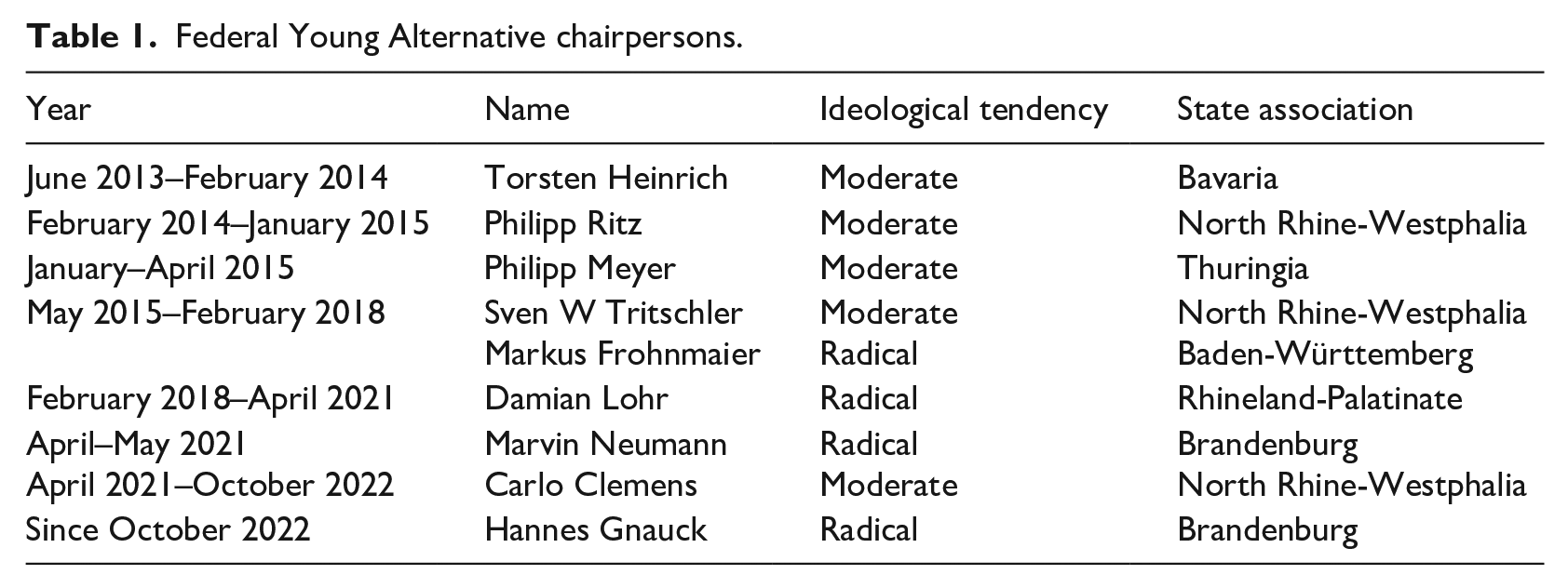
The AfD experienced a similar internal struggle between these two wings, which escalated shortly afterwards. The party conference in July 2015 was a landmark in this respect, when the rather moderate party co-founder Bernd Lucke was toppled, leaving the party with about 2000 to 3000 members (Heinze and Weisskircher, 2021). In the literature, this key event is usually interpreted as the AfD’s main turn to the radical right (Arzheimer, 2019). For the JA, it meant that ‘moderate’ members like Lucke lost power, paving the way to its own recognition.
Indeed, at the AfD party conference in November 2015, a clear majority of party members voted in favour of recognising the JA as the party’s official youth organisation, mentioning it in the party statute for the first time and granting it some formal participation rights and therefore power. Moreover, this decision once again reflected that the radical wing within the AfD had prevailed. From now on, the two organisations were officially ‘in the same boat’. Interestingly, most state associations were recognised earlier (see Table 2), indicating a better relationship at the subnational level and a potential uploading strategy. By October 2016, the JA maintained state associations in all 16 federal states (Facebook, 17 October 2016) and was thus represented nationwide.
Young Alternative state associations.
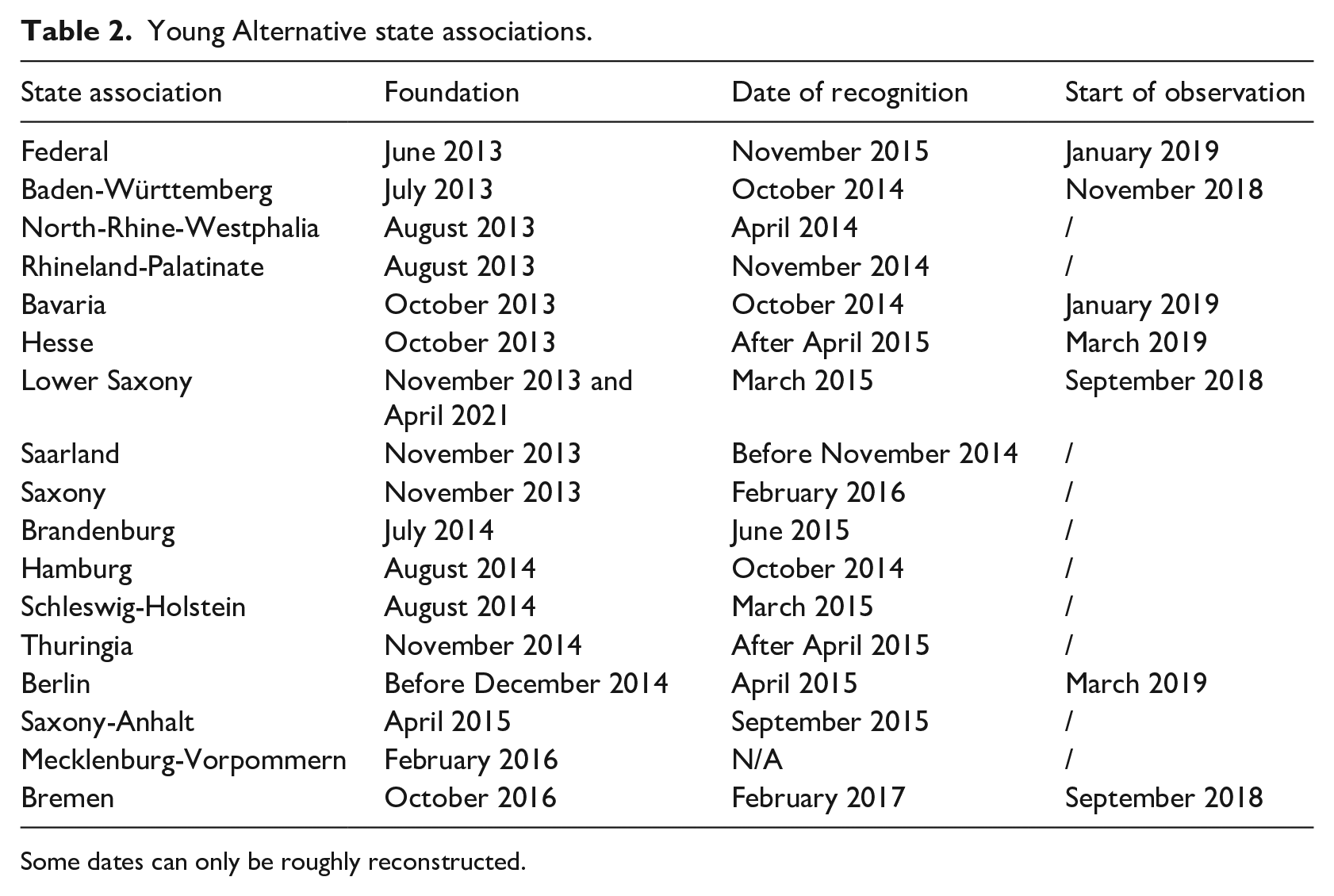
Some dates can only be roughly reconstructed.
Despite the radicalisation of its leadership and members, and in the course of its quest for legitimacy, the JA tried to distance itself from other far-right groups, at least formally. At its federal conference in July 2016, it decided on an incompatibility with the Identitarian movement, which was already under surveillance (Vollradt, 2016). However, even JA chairmen like Frohnmaier and Lohr maintained contacts with it (Fiedler, 2017; Rheinpfalz, 2018), underlining the high ideological overlap between both organisations and the JA’s still weak control.
Radicalisation and path to surveillance (2017–2019)
The establishment of basic organisational structures and in particular the recognition as the AfD’s youth wing opened up new possibilities for the JA to further develop its – increasingly radical – positions. In February 2018, Damian Lohr took over the JA’s chairmanship, uniting it with rather radical views and further marginalising the ‘moderate’ wing. For example, Lohr attended a Burschentag (day of fraternity) in spring 2018 and a demonstration of the Identitarian movement (Meister et al., 2019). This radicalisation was also reflected in the JA’s first basic programme called ‘Deutschlandplan’ (Germany Plan), adopted in June 2018 (JA, 3 June 2018). In it, the JA calls, among other things, for a migration policy that ‘puts the cultural and ethnic preservation of the German people first’ (thus clearly following the theory of ethnopluralism). It also formulates a wide range of repressive measures and legal restrictions, especially with regard to asylum seekers (e.g. the abolition of the basic right to asylum). At the respective federal conference, JA members sang the entire, partly nationalist ‘Deutschlandlied’ (Germany song) and displayed symbols of the Identitarian movement (Steffen, 2018). Therefore, the JA did not even try to cover its sympathy for the movement or their partly extremist views any more. Interestingly, the manifesto was written by a small group of activists (Interviewee 2), contradicting the more inclusive intra-party democracy within the AfD (Heinze and Weisskircher, 2021).
At the same time, the links between the JA and its mother party became increasingly visible. As of September 2017, the AfD was represented in the German Bundestag, with 8.5% of the elected AfD MPs being JA members themselves (8 out of 94; own research). On the one hand, this underlines the JA’s early function as a ‘cadre forge’ (Interviewee 1). On the other hand, this also explains why the JA’s increasingly open flank to extremism meant for the AfD the risk of observation by the Office for the Protection of the Constitution (Bundesamt für Verfassungsschutz (BfV)) and thus legitimacy losses. Therefore, the AfD set up the ‘Arbeitsgruppe Verfassungsschutz’, an internal working group coordinating the approach to the threat of surveillance. Lohr and his deputy Nicolai Boudaghi had to explain themselves to it and also testify before the AfD’s executive committee (Steffen, 2018).
These measures could not prevent that the state offices for the protection of the constitution classified the first two JA state associations (Bremen and Lower Saxony) as ‘Verdachtsfall’ (suspected case) in September 2018. Such organisations are not (yet) treated as anti-constitutional, but there are ‘actual indications’ that might merit such classification after further investigation, therefore reflecting the JA’s radicalisation. This was explained by the loss of power of moderate members and the JA’s overall far-right stances (Verfassungsschutz Niedersachsen, 2018: 90). Since observation was unfavourable for the JA’s legitimacy, the federal JA conference decided to dissolve the state association of Lower Saxony in November 2018 (Spiegel, 2018). Moreover, rather moderate AfD members (e.g. party leader Jörg Meuthen) even considered separating from the JA, but this option did not find a majority (ZEIT, 2018), underlining the radicalisation of both organisations.
In January 2019, the BfV classified the federal JA (as well as the informal grouping ‘the Wing’) as a ‘suspected case’, allowing for surveillance. It justified this decision by referring to the Deutschlandplan and various statements by JA officials expressing an ethnic-cultural understanding of ‘the people’ and an anti-Islam attitude (Verfassungsschutz, 2019: 88). This, and the JA’s radicalisation, led to more (‘moderate’) member resignations: From once about 2000 members, only 1600 were left in early 2019 (Breyton, 2019; Interviewees 1 and 2). As result, the JA changed its statutes in February 2019, to, among other things, be able to screen and exclude members more quickly (Facebook, 18 February 2018; Breyton, 2019). This comparatively ‘restrictive course’ lead to slight improvements in the ‘shabby’ relations (Interviewee 1) between JA and AfD.
Shift to (open) extreme right (since 2020)
In the following years, and especially during the COVID-19 pandemic, the JA (like the AfD) radicalised further. In July 2020, Lohr announced his resignation as chairperson, explaining his decision with the impression that a ‘middle course’ between the two wings was no longer wanted (Gerecke, 2020). In April 2021, another collective leadership was elected, consisting of Marvin Neumann and the rather moderate Carlo Clemens. Only days later, Neumann resigned from JA and AfD, anticipating his own expulsion, which the Arbeitsgruppe Verfassungsschutz had proposed to the AfD executive committee because of extremist statements (Balser and Schneider, 2021). This also indicates that the JA’s organisation and control of extremist members was still deficient. According to Interviewee 1, neither the federal JA nor the state associations knew exactly how many members they had (let alone their positions). Moreover, in his opinion, the JA was still kept on a (financially) ‘short leash’, contributing to its lack of organisation and administration. According to Interviewees 1 and 4, the federal JA had an annual budget of 20,000 euros, including (non-earmarked) 10,000 euros per year from the AfD. If this is true, it would be less than most other youth wings receive from their parties (only the Left Youth received less with about 4000 euros according to the 2020 accountability reports).
The JA’s increasing radicalisation was also reflected in the re-foundation of the controversial JA association in Lower Saxony in April 2021. Although some (rather moderate) AfD members had described this as a ‘gift’ for the BfV (Junge Freiheit, 2021), they were increasingly outnumbered. In October 2022, Hannes Gnauck – classified as a ‘proven extremist’ by the military intelligence service in 2020, but nevertheless full member of the Defence Committee of the AfD parliamentary group in the Bundestag – was elected as new JA chairman (Spiegel, 2022). His election was supported by speeches by prominent AfD politicians (e.g. co-leader Tino Chrupalla and extreme-right Björn Höcke). The increasing links between both organisations also manifested themselves in the AfD: in June 2022, Carlo Clemens and Dennis Hohloch became the first JA members in the AfD executive committee. Moreover, 5 of the AfD 80 MPs were JA members (6.3%; own research).
Finally, the increasingly open extremist stances led to surveillance. In March 2022, the AfD was classified as a suspected case and thus placed under surveillance, and in April 2023, the JA was even classified as ‘proven right-wing extremist’, allowing for observation by all intelligence means (e.g. by phone or mail). The Office for the Protection of the Constitution justified this decision with the JA’s nativist understanding of ‘the people’, but also with its anti-democratic aspirations (Götschenberg and Schmidt, 2023). In response, both JA und AfD intensified their (joint) efforts to delegitimise the intelligence services and present themselves as the only ‘true’ opposition. For instance, the JA claimed that the secret service’s only task was to suppress opposition (JA, 26 April 2023) and the AfD spokespersons called the BfV’s decision ‘outrageous’ and a ‘procedural manoeuvre’ to influence the upcoming court proceedings (AfD, 26 April 2023). For those members who had remained in these organisations up to that point, however, surveillance seemed to further confirm that they were ‘on the right side’ (e.g. AfD member Dominik Kaufner called for supporting the JA ‘now more than ever’; Facebook, 26 April 2023). In fact, the total number of JA members had risen to 2100 by May 2023, after stagnating at around 1700 since 2019 (Baumgärtner et al., 2023), which underlines the growing acceptance of a radicalised youth wing.
Overall, the JA’s development was not straightforward, but clearly marked by radicalisation processes. Before discussing possible reasons for this, Figure 1 summarises the key evidence for these.
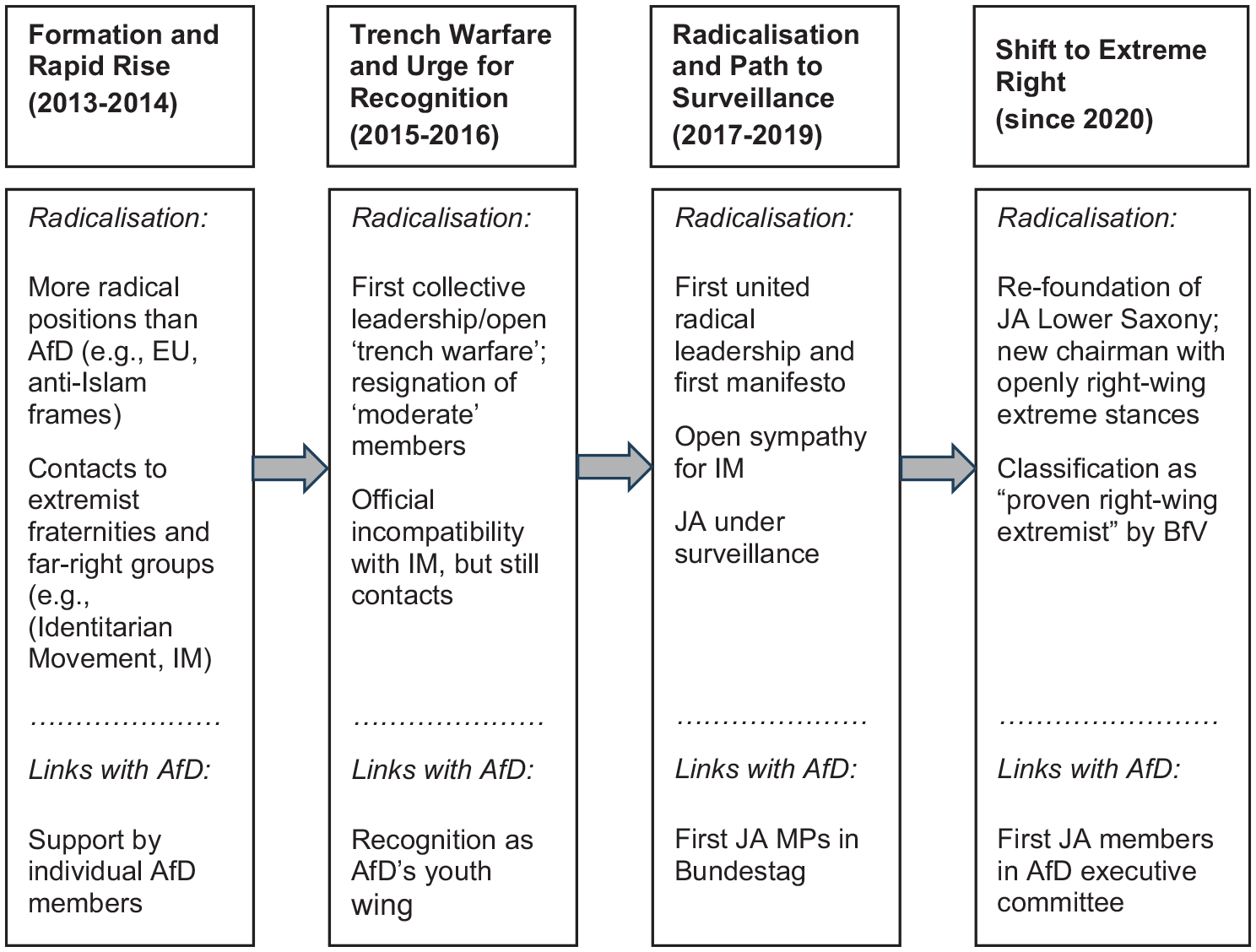
Summary of key evidence for the Young Alternative’s radicalisation processes.
Discussion
The analysis has shown that the JA quickly succeeded in establishing basic organisational structures, while radicalising further. Although it soon became the AfD’s official youth wing, relations between them remained tense. In this section, I discuss possible reasons for this and outline further research perspectives.
First, looking at the organisations’ ongoing development seems instructive for understanding their complex relationship. Before the JA could establish relations with other organisations (or be recognised by the AfD), it had to build its own organisation. At the time of the interviews, the JA’s organisational development was not yet complete (Harmel and Svåsand, 1993): although it had managed to create a relatively clear identification (e.g. statute, coherent branding of the federal and state associations) and organise events for its members, other organisational and administrative functions remained deficient. This resulted in unclear responsibilities and little control of extremist members and views. Since the JA seemed rather a changing target than a fixed entity, building solid relationships with it was difficult.
At the same time, the AfD was also still in its organisational (and ideological) development. Early on, some party members seemed to be aware of the advantages of a well-developed youth organisation (e.g. the rather moderate party leader Lucke). However, maintaining a youth wing posed a strategic dilemma to the AfD. On the one hand, following (organisational) templates from existing parties meant risking the loss of core support. Interviewee 1 confirmed that many party members see the existence of a youth wing as an alignment with the so-called Altparteien (old parties). On the other hand, the AfD was still divided over its ideological course and the extent to which it wanted to curb extremist tendencies to gain legitimacy and be accepted by the other parties (Heinze, 2022). In this respect, responding to the JA was another bone of contention within the AfD between the rather moderates and radicals.
In the early years, this lack of collective party support was compensated for by individual personal relationships, which helped some state organisations to develop more quickly and gain power. Some were recognised earlier by the AfD or received more (financial) support. For example, Interviewee 4 reported a ‘good relationship with the executive committee or with the people who are important and have influence. [. . .] They have also increased the budget that comes to us every year’ (similarly Interviewee 1). Personal relations were also important for recruitment. Some interviewees were asked to join the JA by AfD members or were ‘persuaded by members from the state parliamentary group’ (Interviewee 2). This underlines once again that some party members were aware of the importance of a supportive youth wing and tried to fill it with trustworthy people, pushing for the AfD’s long-term establishment.
In the long term, organisational development and radicalisation went hand in hand. The JA even seemed to be a driver or at least reflector of the AfD’s radicalisation. For example, it openly cooperated with the Identitarian movement early on and also expressed some rather radical positions that only found their way into the AfD years later (e.g. the JA called for the EU’s dissolution years before the AfD). Interviewee 2 even spoke about the JA’s influence on the (quite radical and much discussed) AfD’s pension policy:
The models that were discussed in the party partly came from our pens. René Aust, for example, who wrote the pension paper for Höcke in Thuringia, is a JA member, and Jörg Meuthen’s pension paper was essentially written by me. Basically, we have already had these policy debates, which the party is now conducting, in the JA.
This underlines the assumption that much can be learned about the intra-party politics of the far right by looking at their youth wings. Although the AfD sometimes distanced itself from the JA, it did not split from it. Instead, both organisations increasingly tried to present themselves as the (only) ‘true opposition’ fighting against the corrupt elites and intelligence services. Therefore, the JA’s radicalisation and the increasingly close relationship between JA and AfD also reflected the radicalisation of the mother party.
However, the JA was certainly not the only driver of the AfD’s radicalisation. In this respect, my insights add to the study by Pytlas and Biehler (2023: 6), for example, who demonstrate how the informal grouping ‘the Wing’ has contributed to the AfD’s radicalisation despite contextual pressures to normalise the party’s image (e.g. reactions of other parties and state authorities). Both the JA and ‘the Wing’ may be less relevant when it comes to AfD support or German political behaviour more general (see, for example, the relatively low membership or attention to the JA’s online sources), but it seems alarming that even in a militant democracy like Germany, radicalisation at the grassroots level could not be prevented. Although the intelligence services monitored the JA with around 1600 members and ‘the Wing’ with around 7000 members early on (i.e. almost one-third of 30,000 AfD members), these actors continued mobilising on a wide range of issues (e.g. COVID-19, climate, gender, Ukraine) and also cooperated with others in the far-right scene (e.g. Identitarian movement, III. Path, 1%, Compact).
Future research should therefore examine other organisations and actors that drive radicalisation (e.g. protest actors, online networks) and explore how far-right collective actors strategically use their intra-party conflicts and heterogeneity for their mobilisation. In this context, further research should investigate online and offline activities of far-right youth wings more closely, with the online sphere clearly gaining relevance. Interviewee 4 even described that besides the JA’s online activities, ‘everything else is pretty dead’ (which was certainly more than ever the case during the lockdown measures). However, studies should also examine local and regional mobilisation. We do not know, for example, whether the JA has strongholds in the eastern German states (as is the case with the AfD; Weisskircher, 2020) or whether its activities and relations to the mother party differ from those of its western branches. As this case analysis of the JA has demonstrated, youth wings are an important dimension of party organisation for the far right. Studying them can help to identify extremist tendencies at an early stage and develop political and civic counter measures (e.g. by strengthening democratic initiatives on the ground).
Conclusion
This analysis has shed light on the development and role of far-right youth wings, often neglected in the study of party organisation. I developed the sparse theory in this area by arguing that youth wings can be seen as important drivers of radicalisation. Although they can fulfil crucial representation, recruitment and socialisation functions for parties, both can come into conflict. Three factors may play a role in whether a cooperation is perceived as more beneficial or risky: funding, power and legitimacy. These can also have a significant impact on the development and role of a youth wing.
Empirically, I provided the first in-depth study of the JA’s radicalisation and outlined conflicts within the JA as well as between the JA and AfD. Based on a wide range of data, I have shown that after its foundation, the JA quickly succeeded in building basic organisational structures. However, the early trench warfare over ideology, personnel and strategy soon intensified, leading to a high fluctuation in leadership and membership. Although the party recognised the JA as its official youth organisation in 2015, relations between them remained difficult. A key conflict was how to deal with extremist members and views in order to contain the threat of surveillance (and thus legitimacy losses). Although the JA tried to cover some extremist tendencies, it could not prevent observation. A few years later, the (federal) AfD met the same fate. Since both organisations were in the same boat, they increasingly tried to delegitimise the intelligence services and presented themselves as the only ‘true opposition’.
To explain these developments and conflicts, I argued that the ongoing development of both organisations can help to understand why building solid relations between them remains difficult. Although the AfD is striving for long-term establishment (accepting a youth wing relatively soon), some questions remain strategically difficult, such as how much it wants to adapt (organisationally) to the ‘established’ parties. At the same time, the analysis has shown how organisational development and ideological radicalisation can go hand in hand: Although the AfD accepted the (more radical) JA in the course of its institutionalisation, this happened only after its own radicalisation. Even after this institutional linkage, however, the JA was able to further radicalise itself and advocate its far-right positions more and more openly. This underlines once again that much can be learned about the far right’s broader radicalisation by including youth wings as part of the party organisation, which can push for more radical agendas.
Overall, these findings point to important opportunities for future research. I have shown that the development and role of far-right youth wings is a complex process that can be shaped and even pushed back by the mother party at different stages. To learn more about the considerations and expectations before and after key events or formal and informal decision-making processes, interviews with (former) party members or analyses of speeches could be instructive. Furthermore, more cases in other institutional and political-cultural contexts should be analysed. For example, how did youth wings evolve in unitary state structures or how did longer-established cases change their organisation, ideology and rhetoric over time? Follow-up research should also explore the role of other organisations and actors in radicalisation; for instance, through participant observations at (protest) events or social media analyses. To understand the impact of far-right youth wings and to detect their anti-democratic potential, future studies should examine their online and offline activities as well as (transnational) cooperation with other collective actors (e.g. fraternities, university groups, publishers or ‘alternative media’ platforms). In the context of the far right’s extensive mobilisation, scholarship must study political parties in a broader perspective.
Supplemental Material
sj-docx-1-ips-10.1177_01925121231221961 – Supplemental material for Drivers of radicalisation? The development and role of the far-right youth organisation ‘Young Alternative’ in Germany
Supplemental material, sj-docx-1-ips-10.1177_01925121231221961 for Drivers of radicalisation? The development and role of the far-right youth organisation ‘Young Alternative’ in Germany by Anna-Sophie Heinze in International Political Science Review
Footnotes
Acknowledgements
I would like to thank the anonymous reviewers and the editors for their helpful comments, as well as the many colleagues who provided valuable feedback at German Political Science Association (DVPW) and European Consortium for Political Research (ECPR) events, at the Hannah Arendt Institute for Totalitarianism Studies (HAIT) Dresden, at the University of Mainz and at the WZB Berlin. I am deeply grateful to Luise Anter, who contributed significantly to the data collection; to Ann-Cathrine Jungar, who kindly included me in her research project; and to Manès Weisskircher, who supported me all along the way.
Funding
The author disclosed receipt of the following financial support for the research, authorship, and/or publication of this article: Funding for the data collection was received from the Swedish Research Council (Project: Making Tomorrow’s Leaders: Youth Movements of Right Wing Populist Parties). Funding for the open access was received from the VolkswagenStiftung (Project: Nurturing Democratic Resilience among Youth to Counter Far-Right Influence in the Eastern German Elections 2024).
Supplemental material
Supplemental material for this article is available online.
Author biography

References
Supplementary Material
Please find the following supplemental material available below.
For Open Access articles published under a Creative Commons License, all supplemental material carries the same license as the article it is associated with.
For non-Open Access articles published, all supplemental material carries a non-exclusive license, and permission requests for re-use of supplemental material or any part of supplemental material shall be sent directly to the copyright owner as specified in the copyright notice associated with the article.
