



Abstract
In this article, we investigate elected representatives’ attitudes to citizen participation and the design of participatory arrangements. We distinguish between citizenship-oriented and governance-oriented attitudes. Whereas citizenship-oriented attitudes imply designing participatory arrangements to safeguard the democratic values of equality, transparency and inclusion, governance-oriented attitudes imply designing participatory arrangements to support elected representatives in their roles. Based on unique data from a web-based survey sent to all local councillors in Norway, we found that although Norwegian local councillors tend towards citizenship-oriented rather than governance-oriented attitudes to citizen participation, there is great variation between councillors in this respect. Analysing strategic and ideological explanations, we found that right-wing politicians tend to hold more governance-oriented attitudes than left-wing politicians do. Strategic considerations seem to have no effect on councillors in power in this regard.
Keywords
Introduction
An increasingly common narrative about democracy is one of crisis – a state of affairs marked by widespread voter apathy, erosion of public confidence and waning support for politicians, political parties and political institutions (Mair, 2013). A growing interest in ‘putting the public back into governance’ (Fung, 2015: 513), via introducing new arrangements for facilitating citizen participation and engagement in politics, indicates widely held beliefs in democratic – or participatory – innovation as a viable strategy for countering the crisis (Geissel and Newton, 2012; Goodin, 2008). Therefore, many countries are actively trying out a wide variety of participatory arrangements, such as citizens’ juries (Font and Blanco, 2007), deliberative mini-publics (Grönlund et al., 2014) and a plethora of other schemes (Smith, 2005). However, different participatory arrangements entail various value-based design choices. For example, is it admissible to ‘cherry-pick’ certain ideas and inputs (Font et al., 2018), or must all opinions be given equal weight? Is it acceptable to solicit input just to see if a political idea will ‘sell’ (Goodin, 2008: 4), similar to market-testing, or should participants expect a certain degree of agenda control? Is the fairness of procedures for selecting participants a cause for concern (Smith, 2009: 21), or can politicians select participants freely? Value-laden design choices such as these pose more fundamental questions about participatory arrangements: should participatory arrangements first and foremost be oriented towards citizens and citizenship, by giving primacy to protecting and developing inclusive and meaningful participation, the quality of deliberation and citizens’ enlightenment (Geissel, 2013: 15)? Or should participatory arrangements primarily be governance-oriented, in the sense that the key priority is to improve policy outcomes by conveying information about citizens’ wants and needs to political leaders? In this article, we introduce a theoretical distinction between ‘citizenship-oriented’ and ‘governance-oriented’ attitudes to inclusion and discuss the implications of these orientations for the design of participatory arrangements. Based on a selection of ‘democratic goods’ (Smith, 2009) commonly used as evaluative criteria for participatory arrangements, we examine how real elected representatives actually relate to citizenship-oriented and governance-oriented inclusion. To explain why the balance between these orientations tends to differ amongst elected representatives, we then consider whether the representatives’ views on democratic values are influenced mostly by strategy or ideology – in other words, whether the representatives’ orientations are dictated by their positions in the political system or by their party affiliations.
In this article, we focus specifically on the role that councillors play in relation to citizens’ participation, as councillors are particularly important catalysts for political participation (Copus, 2003). As gatekeepers, councillors decide on the participatory arrangements that are available to citizens and, thereby, what opportunities citizens are given to affect policy development. Much is known about politicians’ appreciation of citizen participation and the relative success of various participatory efforts (Hertting and Kugelberg, 2018). However, with a few notable exceptions (e.g. Hendriks and Lees-Marshment, 2019), there is a knowledge gap regarding the kinds of public involvement that politicians value, and how they think participatory arrangements should be designed. We aimed to close this gap by analysing unique data from a web-based survey with more than 3000 Norwegian local councillors. The specific features of Norway’s local government system suggest that these informants may offer interesting insights of general relevance. In the European context, Norwegian local governments are relatively autonomous, and decisions by local councils carry substantial weight (Ladner et al., 2016). Furthermore, Norway’s long-standing tradition of local self-rule and its highly decentralised social-democratic welfare state mean that local governments are highly capable. While we believe that value judgements involved in designing participatory arrangements are equally relevant to all democratic governments, the need for making such judgements may be more acutely felt – and thus may be more readily observable – in Norway than in countries in which local decision-making processes are less consequential.
In the following section, we discuss and develop our proposed theoretical distinction between citizenship-oriented and governance-oriented attitudes to inclusion, and the implications of these orientations for the design of participatory arrangements. We propose two alternative hypotheses about why local councillors may adhere to one set of attitudes over the other. Then, we present the results and consider the implications that politicians’ procedural and governance-oriented attitudes have for citizens’ political participation arrangements.
Investigating politicians’ attitudes to participatory innovations
The distinction between citizenship- and governance-oriented attitudes to citizen participation
If participatory arrangements are to ‘cure the democratic malaise’ (Geissel and Newton, 2012), how should such arrangements be designed? One viable approach to discussing the design of participatory arrangements is to draw on insights from the varied literature on ‘democratic proceduralism’. In the liberal/egalitarian perspective on democratic proceduralism, the basic idea is to ensure democratic equality by designing procedures that safeguard ‘the equal opportunity to express one’s voice in politics, and the equal weight given to that voice in decision making’ (Saffon and Urbinati, 2013: 460). Similarly, in a deliberative perspective on democratic proceduralism, fair and critical discussion is to be ensured via procedures that structure communicative action (Hicks and Langsdorf, 1999: 140). The implication is that the primary purpose of participatory arenas is to protect and to promote democratic equality and discoursive freedom – in other words, to promote the enactment of democratic citizenship – and that participatory arenas should be designed accordingly. This predominantly citizenship-oriented approach to designing participatory arenas is also apparent in the literature on ‘democratic innovations’, which has gained considerable traction in recent years (Smith, 2009). Contributors to this literature have proposed several sets of criteria to specify the democratic goods that participatory arenas should seek to promote. These criteria include elements such as inclusive and meaningful participation, legitimacy, quality of deliberation, effectiveness and citizens’ enlightenment (Geissel, 2013: 15). The composite nature of these proposed criteria reflects an ecumenical approach to the diversification of democratic theory. As noted by Pateman (2012: 7), democracy ‘is usually now qualified by one of an array of adjectives, which include cosmopolitan, agonistic, republican, and monitory’, and more could be added. Recognising that all models of democracy are essentially partial (Smith, 2009: 10), contributors to the literature on democratic innovations have proposed evaluative criteria that reflect a broad range of approaches to democracy. Overall, however, we would contend that the proposed evaluative criteria developed in this literature are predominantly oriented towards the enactment of democratic citizenship. As stated by a prominent contributor, the aim of designing participatory arenas in line with democratic criteria is ‘realis[ing] significant goods that we associate with democratic institutions’ and ‘enhancing contemporary democratic practice through citizen participation’ (Smith, 2009: 193). We will discuss the specific implications of such citizenship-oriented design of participatory arenas later.
Although one would expect democratically elected representatives to support the basic normative assumptions of democratic citizenship, it is not self-evident that they would embrace a citizenship-oriented approach to designing participatory arrangements unreservedly. Politicians may not believe that people are strongly concerned about democratic standards; in fact, several studies have indicated that citizens are primarily interested in the problem-solving capacity of the political system and less so in democratic procedures (Rothstein, 2009). If citizens’ support is primarily contingent on system performance (Gustavsen et al., 2014), the most important criterion for designing participatory arrangements would be how suitable such arrangements are for obtaining citizens’ inputs that can contribute materially to effective and efficient governance – solving problems without delaying decision-making or producing confrontation and conflict (Moynihan, 2003). Furthermore, as the legitimacy of representative decision-making is already ensured through free and fair elections, politicians may not feel compelled to ensure the legitimacy of non-electoral participation by applying procedural criteria in the designs of participatory arrangements. As noted by Dean (2017: 218), according to a Weberian, hierarchical conception of democracy, ‘participation is to improve outcomes, not necessarily because of a right to participate’. Therefore, politicians who hold what we label ‘governance-oriented attitudes’ to citizen participation would not regard participation primarily as a way of enacting democratic citizenship. Rather, the purpose of citizen inclusion is to improve service quality, increase effectiveness, ‘market-test’ proposals and achieve political goals, thereby increasing democratic legitimacy through better governance (Sørensen, 2020).
In sum, while both ‘citizenship-oriented’ and ‘governance-oriented’ attitudes highly value participation, they do so for different reasons. Consequently, our dichotomy is not directly translatable into the established distinction between input- and output-based grounds for democratic legitimation. Scharpf’s (1999: 6) argument was that political choices can be legitimised either because they ‘can be derived from the authentic preferences of the members of a community’ – mainly through participation and deliberative consensus-seeking (input-orientation) – or because they ‘effectively promote the common welfare of the constituency in question’ (output-orientation). 1 ‘Governance-oriented’ attitudes to inclusion emphasise that participation is not solely a matter of securing input-oriented legitimation. In this orientation, participation is primarily meant to secure output-oriented legitimation – that is, to improve policy outcomes by providing decision-makers with information about citizens’ wants and needs. What distinguishes citizenship-oriented attitudes to inclusion from governance-oriented attitudes is that the latter essentially refute the relevance of democratic proceduralism for deciding how participatory arrangements should be designed. When the purpose of participation is to secure output-oriented legitimation, procedural considerations become, by definition, less important. The implication of conceptualising participation as ‘knowledge transfer’ (Dean, 2017) from citizens to the system – and not primarily as a way of enacting democratic citizenship – is not that participation and citizen engagement are unnecessary or useless; rather, it is the application of procedural criteria to participatory arrangements that becomes redundant.
We do not portray the distinction between citizenship-oriented and governance-oriented attitudes as absolute – the relationship between the two is not one of mutual exclusion but of difference in emphasis. Proponents of the citizenship-oriented attitude would certainly concur that participation can contribute to improved policy outcomes, yet their arguments seem to put more emphasis on enacting democratic citizenship. Portraying the relationship between the two orientations to inclusion as one of degree is useful for our analyses because we assume that elected representatives do not belong exclusively to one ‘camp’ or the other. Rather, we are interested in describing and understanding politicians’ varying levels of commitment to the two differing value sets.
If we assume that politicians to varying degrees hold citizenship-oriented or governance-oriented attitudes to the inclusion of citizens, how would such diverging orientations affect their choices regarding designing participatory arrangements? As noted, the literature on ‘democratic innovations’ has identified several democratic goods as evaluative criteria for participatory arrangements. We have chosen four criteria proposed by Smith (2009) 2 as a basis for specifying how diverging orientations can translate into diverging design choices over participatory arrangements. The first two design choices deal with inclusiveness as a democratic good (Smith, 2009: 20–22). Inclusiveness has two dimensions, the first being equality of presence – being allowed to participate in a given arrangement. As equality is often emphasised as a basic democratic value, we assume that a citizen-oriented attitude to inclusion precludes granting some citizens more extensive participation rights than others. Conversely, a governance-oriented attitude would imply that the municipality is unrestricted by concerns for equality and, hence, free to invite whichever participants that are likely to contribute fruitfully to policymaking.
The second design choice is whether it is problematic to ‘cherry-pick’ ideas from participatory processes (Font et al., 2018). This question is directly related to the second dimension of inclusiveness as a democratic good, namely equality of voice – that is, in addition to being present at participatory events, citizens should also have the right to ‘enjoy equal substantive opportunities to express their views and be heard on the issue under consideration and have equal chances to affect the output of the institution’ (Smith, 2009: 21). We assume that citizenship-oriented attitudes oblige politicians to equally consider input from all citizens, whereas the governance-oriented attitude implies no such obligation. Indeed, as the purpose of participation is to improve decision-making in representative bodies, it would be redundant and inefficient for politicians to engage with ideas they consider useless.
The third design choice is based on Smith’s (2009: 22–24) second democratic good: popular control. For politicians who hold citizenship-oriented attitudes, citizens should be able to participate in salient political issues, and political elites should not have the power to keep controversial issues off the agenda. However, involving citizens in controversial issues carries the risk of incurring the cost of ‘inevitable confrontation and conflict’ (Moynihan, 2003: 173), which would be counterproductive for politicians who hold governance-oriented attitudes.
The fourth design choice we have selected focuses on transparency as a democratic good (Smith, 2009: 25–26). Politicians with citizenship-oriented attitudes would likely emphasise that participatory proceedings need to be open to scrutiny, not only by the participants but also by the wider public. Transparency is crucial if the public is to judge institutions and their outputs as legitimate and trustworthy (Haus and Heinelt, 2005). Publicity can also motivate participants to arrive at public-spirited rather than self-interested judgements (Smith, 2009). Conversely, for politicians with governance-oriented attitudes, transparency is not mandatory because the purpose of citizen input is to inform elected politicians rather than to enact democratic citizenship.
Two hypotheses on politicians’ democratic attitudes to citizen participation
Why would some politicians lean towards citizenship-oriented rather than governance-oriented attitudes to inclusion? In accordance with Heinelt (2013), we argue that councillors’ notions of how democracy should work depend on their basic beliefs regarding appropriate behaviour and subjective norms. Prior studies have shown that in addition to institutions, interests and ideas are significant factors in councillors’ attitudes to participatory democracy (Junius et al., 2020). As we studied politicians in Norway only, we could not analyse the relevance of institutional factors. However, we assumed that ideological factors, in the sense of interest-based or strategic factors and ideas, may play a significant role in explaining politicians’ orientations to democratic inclusion. From a strategic perspective, our basic assumption is that power and position are decisive factors. A politician who is part of a majority coalition is co-responsible for political decisions and can be held accountable for the political system’s problem-solving capacity. Consequently, the primary concern for politicians in a majority coalition would probably be to obtain citizen input that could lead to material improvements in the quality of governance. We furthermore assume that politicians in a majority coalition will underscore the hierarchical logic of representative democracy – that free and fair elections provide a mandate for politicians to rule (Dean, 2017). Weberian principles depict public interest as the domain of democratically elected and accountable politicians. Therefore, this group of politicians seems likely to adopt governance-oriented attitudes to citizen inclusion.
By contrast, politicians who are not part of a majority coalition may regard citizen participation as a way of boosting the impact of opposing voices, as citizens’ opinions, once voiced in a formal setting, are hard to ignore (Junius et al., 2020: 5). Consequently, citizen participation would provide an opportunity to change prevailing policy by fostering a powerful and change-oriented public opinion. Adherence to citizenship-oriented norms can increase the chances of all voices being heard, including those congruent with the opposition’s opinions. Accordingly, we expected the opposition to have more citizenship-oriented attitudes to participation. Our first hypothesis is, therefore, as follows:
H1: Elected representatives who belong to a majority coalition tend to hold more governance-oriented attitudes to citizen participation than the opposition does.
Our second assumption is that the impact of strategic considerations is tempered by ideological factors. For example, left-wing voters are likelier to participate in protests, while right-wing voters prefer party politics to channel their demands (Torcal et al., 2016). Furthermore, while political parties are linked to social movements on both sides of the political spectrum, the left is likelier to rely on public protest outside the party system than the right is. It should also be noted that mobilisation of protest outside the established channels is considered more legitimate on the left than on the right (except for extreme right-wing parties). The revival of participatory democracy from the late 1960s and onwards has sought to challenge post-war ‘democratic elitism’ by embracing (sometimes radical) community activism and broad-scale inclusion of marginalised groups while maintaining a critical stance on existing power imbalances (Escobar, 2017: 421–425). While social movements across Western Europe and North America have been highly critical of representative democracy and parliamentary procedures, right-wing movements have mobilised mainly via electoral politics, relying on populist mobilisation within the representative system (Kriesi, 2014). Furthermore, local councillors and members of parliament from centre-left parties tend to be more enthusiastic regarding citizen participation than conservatives are (Copus, 2003).
Therefore, left-wing, socialist and social-democratic representatives may tend to be more citizenship-oriented about citizen inclusion than representatives of right-wing parties are. By relying more on formal channels for providing input to the representative system, right-wing politicians may implicitly be proponents of elite democracy. A more governance-oriented attitude to participation is also underscored by the New Public Management reforms from the 1980s forward, which have promoted liberal political ideas of management (Hood, 1991) and have emphasised public services and the outcome of political processes. Therefore, our second hypothesis is as follows:
H2: Whereas councillors who represent right-wing parties tend to assume governance-oriented attitudes to inclusion, councillors who represent left-wing parties tend to assume citizenship-oriented attitudes.
Study context
Norwegian municipalities are governed by proportionally composed councils elected every four years. The council elects a mayor and a vice mayor, usually from the largest and the second-largest party. As in other established democracies, party membership and turnout in local elections in Norway have dropped significantly since the early 1980s (Heidar and Wauters, 2019).
These developments have spurred interest in methods for engaging citizens in local politics between elections. Boards for specific groups (the elderly, children and youth, the disabled) are mandatory, and councils are legally obliged to seek citizens’ counsel in certain planning decisions. The council is also obliged to vote on citizen proposals that receive a certain number of signatures.
Most municipalities have also implemented non-mandatory participatory instruments. According to Monkerud et al. (2016), more than half of Norwegian municipalities have organised brainstorming seminars to receive input from the public, and a third of the municipalities have conducted ‘open hour’ sessions during council meetings. One in four municipalities has engaged in outreach activities, such as the ‘mayor’s bench’, where the mayor meets citizens at, for instance, a shopping mall. Digitalised systems are becoming more widespread, including the online transmission of council meetings and website- or application-based interfaces for information provision and dialogue.
Data and methods
To assess the prevalence of citizenship-oriented and governance-oriented attitudes to democratic inclusion amongst politicians, we used data from a nationwide online survey of Norwegian local councillors from all 428 municipalities (2018). The survey was distributed via email in the autumn of 2018 to all local councillors with valid email addresses. After 3 reminders, 3387 councillors replied, a 40% response rate.
Respondents were presented with four choices, designed as scales between a purely governance-oriented position (value 1) and a purely citizenship-oriented position (value 10). Accordingly, values 1–5 were defined as mostly governance-oriented, whereas values 6–10 were defined as mostly citizenship-oriented.
First, respondents were asked whether they thought that all citizens should be invited (citizenship-oriented position) or whether the municipality could select particular groups of participants (governance-oriented position). Second, the view that politicians should take all citizen inputs into consideration (citizenship-oriented position) was pitted against the view that politicians should be able to freely decide which inputs they consider (governance-oriented position). Third, respondents were asked whether participation in conflict-ridden issues is admissible (citizenship-oriented position) or to be avoided (governance-oriented position). Fourth, councillors were asked if written minutes from interactions with citizens are always required (citizenship-oriented position) or not (governance-oriented position). See Table 1 for an overview of how councillors’ choices were measured.
Operationalisation of councillors’ attitudes to citizen participation.
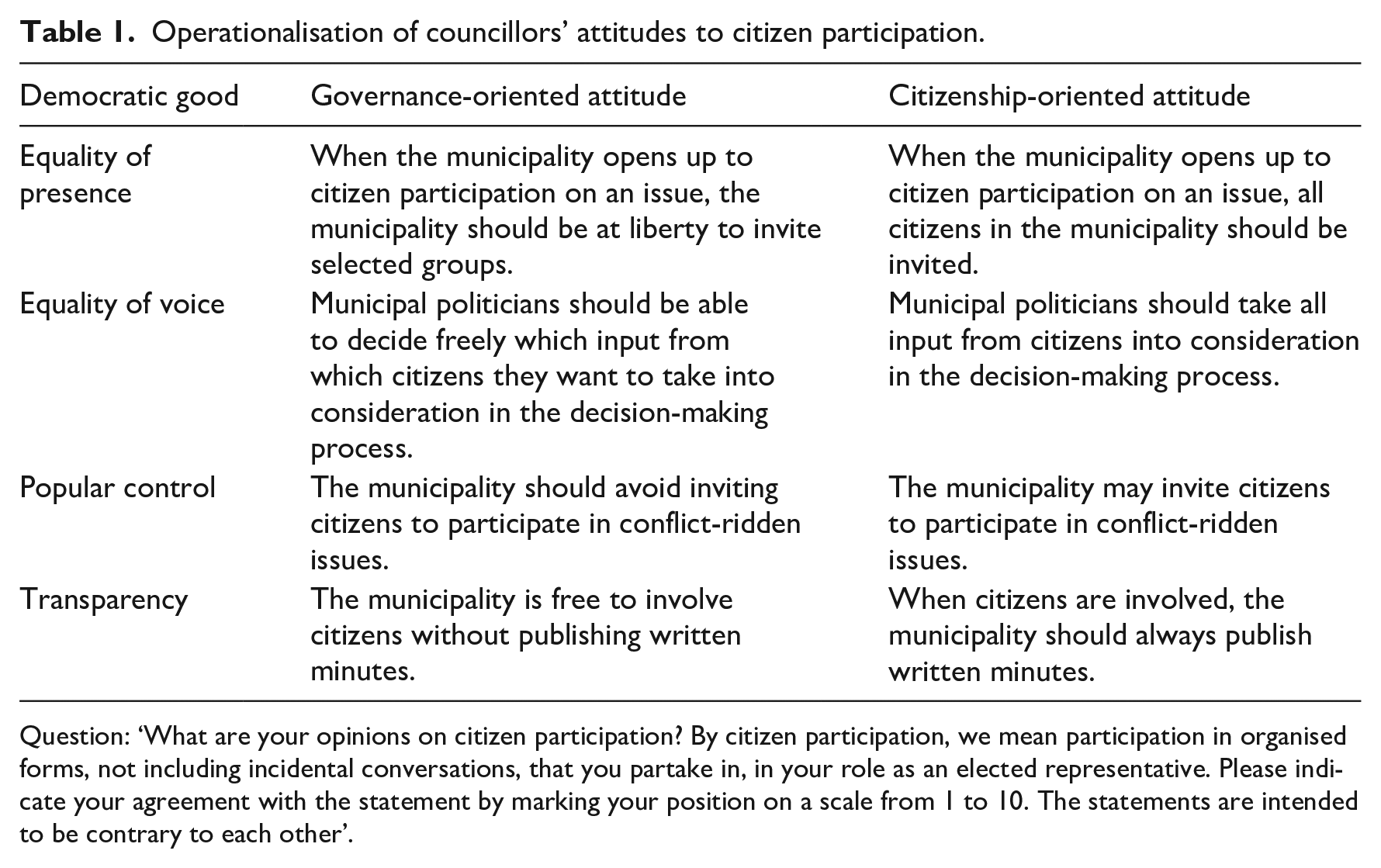
Question: ‘What are your opinions on citizen participation? By citizen participation, we mean participation in organised forms, not including incidental conversations, that you partake in, in your role as an elected representative. Please indicate your agreement with the statement by marking your position on a scale from 1 to 10. The statements are intended to be contrary to each other’.
The two hypotheses were studied separately for each of the four choices as well as together by combining all the choices into an additive index. Three of the four choices were moderately correlated (0.29–0.53) and were loaded on the same factor, with factor loadings ranging from 0.52 to 0.78. The odd choice out was equality of voice, which was weakly correlated to only one of the other choices and did not load on the same factor (see Supplemental Table A.2). The moderate (partly absent) correlation between the factors indicates that, empirically, the items did not necessarily express one underlying normative dimension. Politicians may embrace governance-oriented attitudes regarding some aspects of citizen participation while entertaining citizenship-oriented attitudes regarding others.
The independent variable in our first hypothesis, majority coalition (1), was operationalised as affiliation to the mayor’s or the vice mayor’s party. Belonging to the political opposition (0) was operationalised as affiliation with any other parties. Regarding our second hypothesis, right-wing affiliation (1) was operationalised as representing a party that either was part of or supported Norway’s conservative government at the time, including the Conservative Party, the Progress Party, the Christian Democrats and the Liberal Party. Left-wing affiliation (0) comprised the leftist opposition parties, including the Green Party, the Centre Party, the Labour Party, the Socialist Left Party and the Red Party.
We controlled for several factors that former studies of politicians’ attitudes to democratic issues found important (e.g. Heinelt, 2013; Junius et al., 2020). At the individual level, we controlled for experience, measured as the duration of membership in a political party (number of years), and being a newcomer (dummy variable that distinguished between the first term (0) and the consecutive terms (1)). Moreover, we controlled for formal assignments, measured as being an ordinary council member (0) or a member of the executive board (1). In Norwegian municipalities, the executive board is a proportionally composed committee that includes the most experienced politicians from both the government and the opposition and is led by the mayor. The executive board prepares cases for the council and normally has significant delegated decision-making powers. We expected experience and formal assignments to be associated with increased support for governance-oriented attitudes, as knowledge of the inner workings of politics often reveals to politicians the necessity of strategic considerations. Furthermore, we controlled for sector affiliation (working in the public sector (0) or working in the private sector (1)). We assumed public-sector employment would provide greater familiarity with the norms and procedures of democratic governance than would private-sector employment; therefore, we expected that public-sector employment would be associated with increased adherence to citizenship-oriented attitudes. Finally, we included variables on the respondents’ gender (male (0) and female (1)) and age (continuous variable). In studies of political attitudes and practices, gender has often been found to affect attitudes to participation – for instance, women favour participation more than men do (Heinelt, 2013). In the present context, one may surmise that female councillors would maintain citizenship-oriented attitudes for strategic reasons because insistence on citizenship-oriented norms could increase the inclusion of groups that tend to be underrepresented, such as women. Furthermore, governance-oriented attitudes would allow female councillors to pick freely amongst citizens and opinions, thereby giving women priority. Consequently, we included gender in the analysis on an exploratory basis. We assumed that the effect of age (e.g. increasing life experience) would be similar to our assumed effect of political experience and formal assignments, namely greater support for governance-oriented attitudes.
At the municipal level, we controlled for the effective number of parties (ENoP) in the council and whether the municipality was run by a mixed (block-crossing) coalition of parties. We measured ENoP using an index developed by Laakso and Taagepera (1979). The index accounted for both the number of parties represented (n) and their relative strengths. We used a dummy to measure mixed coalitions, with the value 1 if the mayor was from the left-wing bloc while the deputy mayor was not, or if the deputy mayor was from the left-wing bloc while the mayor was not. We assumed that a high ENoP and a mixed coalition would induce councillors to entertain citizenship-oriented attitudes to citizen participation because the strategic advantage of being in a majority coalition would be diminished. Lastly, we controlled for municipal size, measured as the natural logarithm of the number of inhabitants, without making specific assumptions about the relationship between municipal size and councillors’ views on participation. We took data for the independent variables from the questionnaire described above, from official Norwegian statistics (KOSTRA, 2021) and from a municipal data set collected by Fiva et al. (2020). See Supplemental Table A.3 for descriptive statistics.
The survey method is susceptible to several well-known method biases, and some may have affected our study. Respondents may tend to align their answers with perceived social norms, to adjust answers in trying to maintain consistency, to answer based on implicit or assumed causalities or simply to agree with the contentions presented, also known as yea-saying (Podsakoff et al., 2003). As we analysed adherence to democratic norms, we assumed a clear risk of social desirability bias (SDB) – respondents’ tendency to provide socially desirable answers. SDB consists of at least two factors (Paulhus, 1991): self-deceptive positivity (honest but overly favourable self-representation) and impression management (wishing to present oneself as aligned with social conventions). Accordingly, we assumed that elected politicians would want to present themselves as democratically minded people, thus tending to avoid responses perceived as conflicting with current democratic norms in Norway. To reduce the risk of SDB, we attempted to formulate the citizenship-oriented and governance-oriented positions on the four democratic norms as neutrally as possible and to avoid the impression of a ‘good’ and a ‘bad’ end of the 10-point scale. Furthermore, we varied the sequence of the citizenship-oriented and governance-oriented positions between the left and right sides of the 10-point scale to reduce the risk of respondents ticking off one particular response on all four indicators en bloc.
We took the dependent variables and most of the independent variables in our analysis from the survey. An associated, recognised validity threat is common-method variance (CMV). If survey responses to both the dependent and independent variables are affected similarly by SBD or other method biases, the analysis tends to inflate correlations. To forestall CMV, we included only survey data of a factual nature as measurements of the independent variables. Factual statements that use very concrete constructs are less susceptible to method biases than are value judgements (Meier and O’Toole, 2010). As it was improbable that councillors should misstate their party affiliation, position or tenure to acquiesce with social norms, we estimated the risk of CMV to be very low. As the individual councillors were nested within municipalities, we performed a multilevel regression analysis to test our two hypotheses.
Findings
Table 2 shows descriptive statistics for the four design choices and the additive index.
Four measures for governance-oriented versus citizenship-oriented attitudes to citizen participation – descriptive statistics (n = 3158).
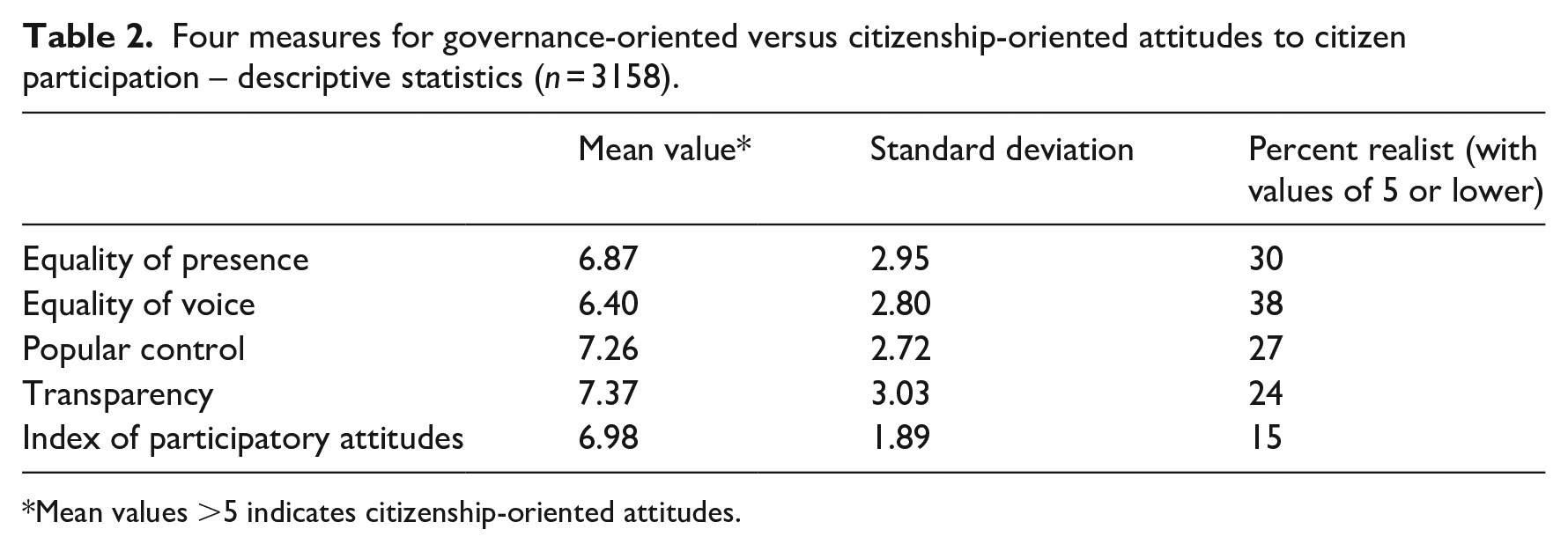
Mean values >5 indicates citizenship-oriented attitudes.
It shows that, on average, Norwegian councillors hold citizenship-oriented rather than governance-oriented attitudes to citizen participation. All mean values were at the citizenship-oriented end of the scale. Politicians seemed to have the most governance-oriented attitudes regarding equality of voice and the most citizenship-oriented attitudes regarding the importance of transparency. However, for all four choices, the standard deviation revealed substantial variation in attitudes. As a fair proportion of councillors belonged to the governance-oriented camp (values 5 or lower), we assumed that the citizenship-oriented and governance-oriented positions were, in fact, perceived as more or less neutral, as was intended to reduce the risk of SDB (see the previous section). Figure 1 shows the distribution between governance- and citizenship-orientation on the additive index.
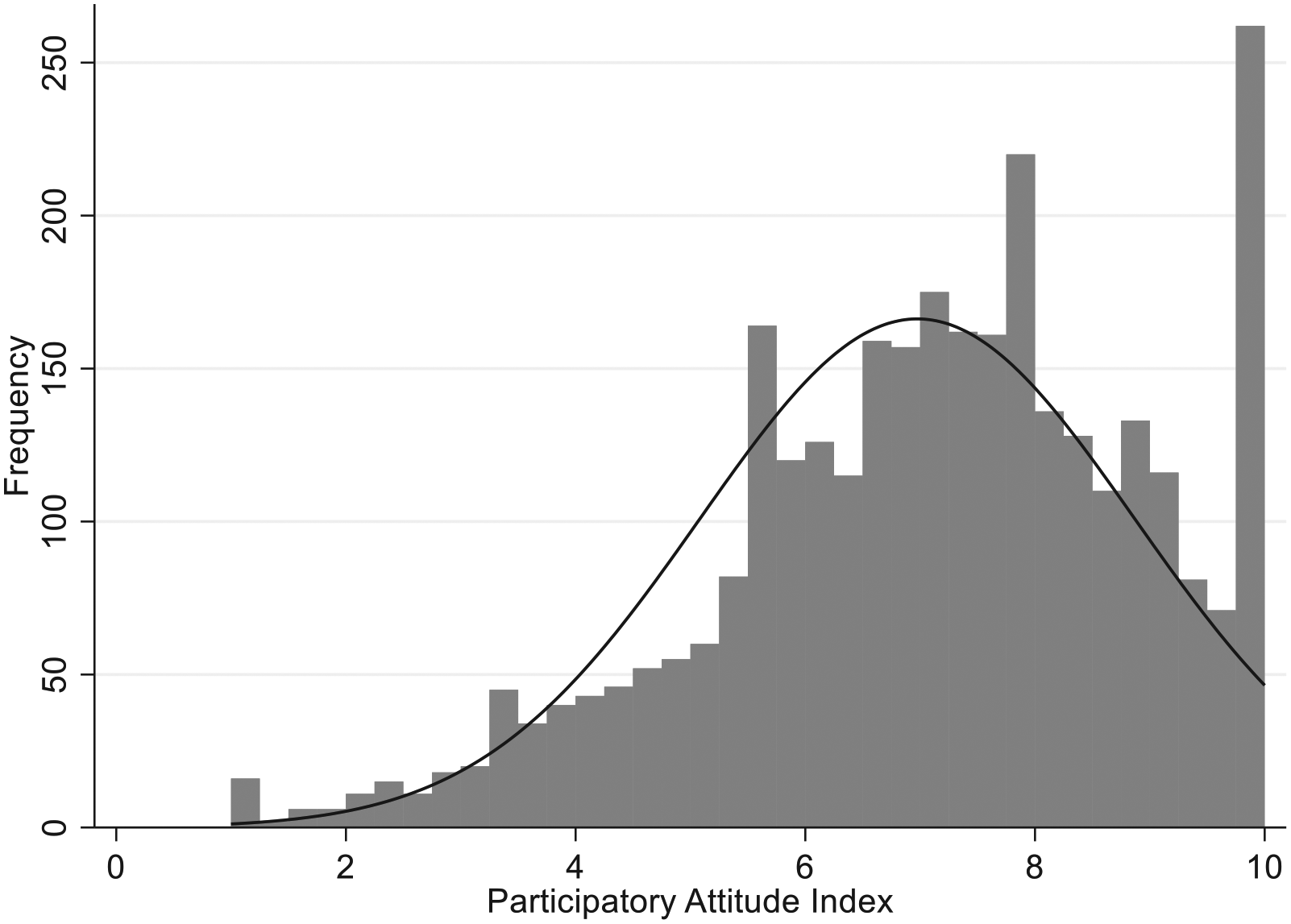
Distribution on the participatory attitude index ranging from 1 (governance-oriented) to 10 (citizenship-oriented).
Table 3 shows the results of a multilevel regression analysis of the relationship between politicians’ participatory values and the independent variables. Running an empty model resulted in an intraclass correlation coefficient (ICC) of 0.0013 for the index, which indicates that very little of the variance in participatory values can be ascribed to differences at the municipal level. For the independent items, the ICC varied between 0.00 (equality of presence and transparency), 0.01 (equality of voice) and 0.02 (popular control). Table 3 shows that positive coefficients predict a citizenship-oriented attitude to citizen participation.
Multilevel regression analysis of attitudes to citizen participation.
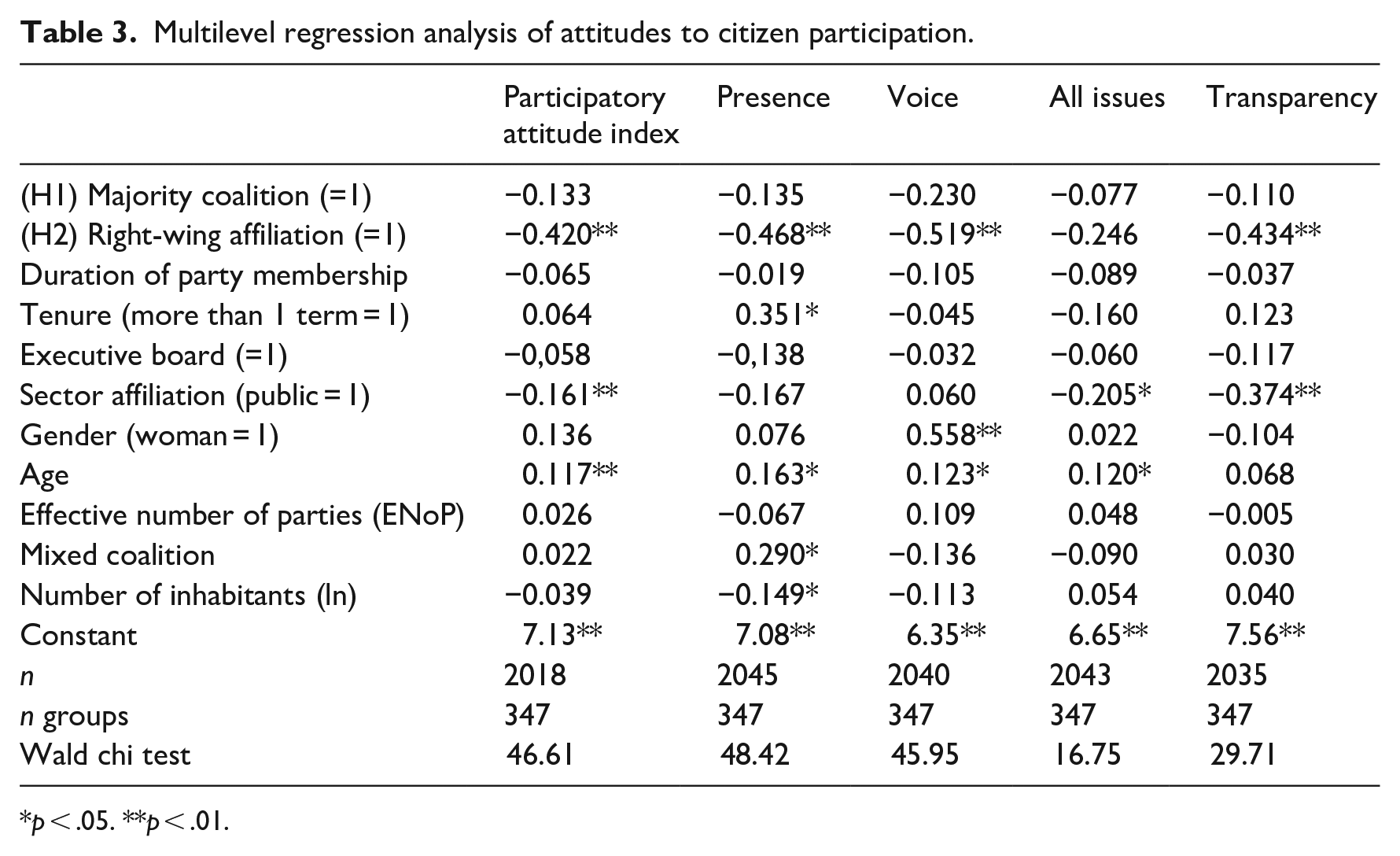
p < .05. **p < .01.
Table 3 shows that our first hypothesis, which assumed that councillors in a majority coalition would entertain more governance-oriented attitudes to citizen participation, was not supported. The negative coefficients indicated that councillors from the majority coalition are more governance-oriented than those who belong to the opposition, but none of the coefficients were significant. Our second hypothesis, which assumed that right-wing politicians would have a more governance-oriented attitude to citizen participation, was supported in three of the four criteria and the additive index.
Our expectation that experience would be associated with a more governance-oriented attitude to citizen participation was not supported. On the contrary, for one of the criteria, tenure seemed to be positively correlated with a citizenship-oriented attitude. Age was positively correlated with citizenship-oriented attitudes, and sector affiliation was associated with a governance-oriented attitude as predicted: councillors working in the private sector appeared to be more governance-oriented and councillors working in the public sector appeared to be more citizenship-oriented. Female councillors appeared to be more citizenship-oriented than their male colleagues regarding one criterion, namely equality of voice.
As indicated by the low ICC, municipal characteristics were weakly associated with participatory values. However, in line with our assumptions, councillors had a more citizenship-oriented attitude to one of the criteria, equality of presence, in municipalities with mixed coalitions. Councillors in small municipalities had a more governance-oriented attitude to two of the criteria: equality of presence and equality of voice.
Concluding discussion
Our analyses indicate that Norwegian local councillors tend to hold citizenship-oriented rather than governance-oriented attitudes to citizen participation. Most councillors tend to believe that the local government should always invite all citizens to have their say rather than inviting specific groups; should consider all citizen inputs rather than cherry-pick ideas; should ask for inputs on all kinds of issues, including controversial ones; and should ensure transparency by always publishing minutes from citizen encounters. However, attitudes do vary, and a substantial minority report holding governance-oriented attitudes, favouring selective inclusion, cherry-picking citizen inputs, avoiding controversial issues, and accepting less than fully transparent processes.
The analyses supported only one of our two hypotheses for explaining variation in attitudes to citizen participation. We found no support for our first assumption regarding interest-based and strategic determinants. Compared to the opposition, elected representatives who belonged to a majority coalition did not hold the more governance-oriented attitudes to participation. As for our second assumption on ideology, we did find a significant difference between councillors representing right-wing and left-wing parties, with right-wingers having the more governance-oriented attitudes. The long-standing leftist tradition of mobilisation likely makes leftist politicians more favourably disposed to procedures that allow people a say in politics than their right-wing counterparts are. In addition, right-wing politicians seemed more open to outcome-oriented participation than left-wingers were, probably due to their history of supporting formal channels and elitist democracy associated with the pure representative democratic system. The liberal political ideas inherent in the New Public Management reforms may also play a role in politicians’ attitudes through their attitude to how citizen participation should be organised between elections. These results resonate with findings from extant research, notably the findings of qualitative studies. Local-level participatory programmes were essential for democratic revival strategies pursued by leftist governments that came to power in several Latin American countries during the 1990s (Chavez and Goldfrank, 2004; Goldfrank, 2010). When participatory budgeting – a prominent democratic innovation to come out of this revival – was implemented across Europe, left-wing politicians were amongst its chief proponents (Sintomer et al., 2008: 175).
We found no controlled effect of being part of the majority coalition on councillors’ attitudes, which means voters have little reason to fear that representatives will change their attitudes to citizen participation when they get into office and gain power. Contrarily, the electorate seems to decide what kind of participation will be preferred in the locality. If voters prefer right-wing parties, it is likely that governance-oriented attitudes to citizen participation will flourish in the council. Conversely, in municipalities with left-leaning electorates, citizenship-oriented attitudes will predominate. Thus, the political orientation of the majority coalition in the council will likely result in different attitudes to citizen participation and, consequently, different opportunities for citizens to participate.
A striking finding is that attitudes to democratic norms seem to be shaped primarily by factors external to or preceding respondents’ formal positions as councillors. Contrary to basic assumptions in organisational theory (Christensen and Lægreid, 2018), organisation does not matter for elected councillors. The position in the political system does not seem to be formative for politicians’ attitudes of how citizens should be involved, even though citizen participation constitutes an opportunity for achieving strategic gains.
Assessing the control variables, we found that the examined municipal characteristics (ENoP, the kind of coalition found in the council or the number of inhabitants) had little impact on councillors’ attitudes to citizen participation. Being ‘governance-oriented’ or ‘citizenship-oriented’ seems to be closely associated with individual characteristics – not only party affiliation, as discussed above, but also councillors’ place of work, age and gender. Interestingly, public-sector employment is an effective ‘school of procedural democracy’, in the sense that councillors previously involved in the public sector tend to prefer keeping written minutes and not taking difficult issues off the table, positions that may be better aligned with the general ethos of the public sector than with that of private enterprise. Whereas public agencies always operate based on policies decided in elected bodies – where the right to put any issue on the table is guaranteed – corporate boards operate behind closed doors. Moreover, there is no private-sector counterpart to the Publicity Act, which mandates public access to elected bodies’ documents and proceedings.
Findings from Norway, a highly decentralised European state with relatively autonomous local governments, may be generalisable to similar countries. However, as we investigated one country only, we could not assess the impact of varying political-administrative systems, such as varying horizontal power relations between the council, the mayor and the leading bureaucrats (Mouritzen and Svara, 2002). Heinelt et al. (2018) found no support for the assumption that the important role played by councillors in systems with strong collegiate bodies is associated with a preference for representative democracy over participatory democracy. Hence, the Heinelt et al. study suggests that findings from Norway are valid across institutional settings regarding horizontal power relations, although our analysis is somewhat different.
A likely implication of the association between right-wing affiliation and governance-oriented attitudes is that participatory procedures may change when power shifts across the left–right axis after elections. Little is known about how acutely citizens understand politicians’ motivations for designing participatory arrangements and about how citizens’ perceptions of politicians’ motivations affect the citizens’ own motivations to participate, their sense of inclusion as citizens and, therefore, the legitimacy of local representative institutions. Consequently, a question for future research is whether being invited because of one’s democratic right is more or less motivating to citizens than being invited due to politicians’ need for citizens’ input. The question may also be posed as to how governance-oriented and citizenship-oriented attitudes affect citizens’ actual capacity to influence policy design.
Future studies should also consider how participatory norms translate into practices. Practices do not automatically follow from norms or attitudes (Ajzen, 1991). Elected officials may harbour citizenship-oriented attitudes but still act in a governance-oriented manner. Although no study known to us has assessed whether politicians interact with citizens in a governance-oriented or citizenship-oriented way, case studies of participatory designs indirectly address the inherent norms of participatory practices. Some studies have indicated that politicians often relate to participatory arrangements in a governance-oriented rather than citizenship-oriented manner. For example, in her study of new participatory initiatives in four Norwegian municipalities, Sønderskov (2020) found that councillors see participatory arrangements as tools for increasing the municipal governments’ problem-solving capacity and efficiency while seeming to be unconcerned about these arrangements’ contributions to the input-side of democracy. In their comparative case study, Radzik-Maruszak and Haveri (2020) found that procedural norms are emphasised more strongly in newly democratised countries than in old democracies, in which participatory tools are seen as additional sources of information. Elected officials often believe that norms such as democratic equality can be safeguarded most effectively by the representative system and not by participatory arrangements. Rather than promoting a citizenship-oriented application of participatory tools, therefore, procedural norms seem to be used as an argument against widespread citizen inclusion (Klijn and Koppenjan, 2000; Petit, 2020). While in the representative system, procedural norms are well institutionalised, such norms are seen as hard to apply in a rigorous manner in participatory governance schemes. Thus, whether citizenship-oriented attitudes amongst politicians are associated with reluctance towards extensive citizen inclusion is another question for further research.
Supplemental Material
sj-docx-1-ips-10.1177_01925121221092600 – Supplemental material for Competing perspectives on participatory arrangements: Explaining the attitudes of elected representatives
Supplemental material, sj-docx-1-ips-10.1177_01925121221092600 for Competing perspectives on participatory arrangements: Explaining the attitudes of elected representatives by Jan Erling Klausen, Signy Irene Vabo and Marte Winsvold in International Political Science Review
Footnotes
Funding
The authors disclosed receipt of the following financial support for the research, authorship and/or publication of this article: The data collection was funded by the Research Council of Norway under the program Democratic and Effective Governance, Planning and Public Administration (DEMOS), grant #254781.

Data availability statement
The data supporting this study’s findings are available from the corresponding author upon reasonable request.
Supplemental material
Supplemental material for this article is available online.
Notes
Author biographies
References
Supplementary Material
Please find the following supplemental material available below.
For Open Access articles published under a Creative Commons License, all supplemental material carries the same license as the article it is associated with.
For non-Open Access articles published, all supplemental material carries a non-exclusive license, and permission requests for re-use of supplemental material or any part of supplemental material shall be sent directly to the copyright owner as specified in the copyright notice associated with the article.
