




Abstract
Based on the German Longitudinal Election Study (2016), we explain citizens’ support for measures to increase women’s descriptive representation in parliament. Despite women’s underrepresentation, we find little support for positive action measures, and in particular for legal gender quotas. Binary logit analyses show that support for the introduction of positive action measures is not affected by citizens’ perceptions about the share of female members of parliament. However, experimental data reveal that receiving information about women’s actual proportion in parliament has an impact on citizens’ support for gender quotas, in particular among those who overestimate women’s representation. Once they learn that the actual share is lower than they thought, they are more likely to support the introduction of quotas. This indicates that support for positive action measures can be changed through providing the correct information.
Keywords
Introduction
While women’s descriptive representation has significantly increased during the last few decades, they are still underrepresented in most parliaments around the world. To increase women’s representation, more than 130 countries worldwide have introduced legal or party quotas during the last few decades (Hughes et al., 2019). Mirroring this diffusion of quotas in many democracies, research increasingly focuses on analyzing and explaining support for gender quotas. The available public opinion literature has shown that support for gender quotas is quite mixed across nations, but tends to be relatively low (Barnes and Córdova, 2016; Beauregard, 2018; Bolzendahl and Coffé, 2020; Keenan and McElroy, 2017). Although quotas have been introduced in many countries, they are often considered as controversial (Bacchi, 2006; Teigen and Karlsen, 2020). Therefore, understanding public support is important for the legitimacy and effectiveness of quotas, and more generally positive action measures (Page and Shapiro, 1983). In addition, research shows that negative attitudes towards quotas may negatively impact women and their political legitimacy in parliament (Meier, 2008; Morgenroth and Ryan, 2018).
To further improve our understanding of public support for measures to increase women’s descriptive representation in politics, we investigate to what extent perceptions about women’s representation affect support for positive action measures. Starting from an ‘exposure-based’ explanation suggesting that people are influenced by what they see and perceive as being (un)fair (Bolzendahl and Myers, 2004; Möhring and Teney, 2020), we anticipate that those who believe that there are few women in parliament to be more likely to support positive action measures. In a second step, we test how receiving the correct information about women’s representation affects public support towards such measures. We expect receiving the correct information to influence their support, though assume different effects between those who underestimate and those who overestimate women’s share.
To answer our research question, we rely on data collected in 2016 using an information-providing experimental design within the scope of the German Longitudinal Election Study. Although women’s representation has substantially increased during the last decades in the Bundestag, women are, with 30.9% since the 2017 Federal elections, still significantly underrepresented. While four of the seven parties in the Bundestag have adopted voluntary gender quotas, the others do not want to introduce quotas. The introduction of legal gender quotas is also widely discussed in Germany, both within parties and among the public.
Theory
Support for positive action measures
Whether gender quotas are an appropriate measure to increase women’s representation has been widely discussed in public and academic debates (e.g. Dahlerup, 2006; Mansbridge, 1999; Phillips, 1995). These debates tend to be controversial and normative since quotas have an impact on equality and representation, and represent a shift from ‘equality of opportunity’ towards ‘equality of results’ (e.g. Bacchi, 2006). For voters, positive action measures obviously have implications for who will represent them. Therefore, their support for the adaption of such measures is crucial for the legitimacy of these measures. In addition, it shows whether the adopted measures are responsive to public opinion. Research on elites’ and citizens’ support for positive action measures has revealed different levels of support. At the elite level, for instance, Piscopo (2016) shows widespread consensus in Latin America. Research on citizens’ support in a variety of contexts, however, shows relatively low levels of support (e.g. Barnes and Córdova, 2016; Beauregard, 2018; Bolzendahl and Coffé, 2020; Pereira and Porto, 2020).
Perceptions about women’s representation and support for positive action measures
In recent years, an increasing number of studies has focused on the determinants of public support for gender quotas (e.g. Allen and Cutts, 2016; Bolzendahl and Coffé, 2020; Gidengil, 1996). This research has shown that women (as the target group of the policy) are more likely to favor such quotas than men (Barnes and Córdova, 2016; Keenan and McElroy, 2017), which has been explained by group identity and self-interest (Coffé and Reiser, 2018; Mansbridge, 1999). Research has also revealed that holding egalitarian values and supporting minority rights is positively linked to support for gender quotas (Barnes and Córdova, 2016; Beauregard, 2018; Keenan and McElroy, 2017). Others, however, reveal that ‘there is a lack of an overall association between support for the principle of gender equality and support for electoral gender quotas’ (Pereira and Porto, 2020: 888). Sniderman et al. (1984) show that although the principle of equality influences support for descriptive representation, it does not extend to support for positive action measures since the view on the policy is influenced by their broader ideological views about the role of government in society and economy. Research has indeed confirmed that attitudes towards the role of government in society influences citizens’ support of quotas, with those more supportive of state interventions also being more supportive of gender quotas (Barnes and Córdova, 2016; Krook et al., 2009).
An under-explored issue in the literature is the role of perceptions about the (under)representation of women. Since (mis)perceptions are known to impact political attitudes (Ahler and Sood, 2018; Gilens, 2001; Kuklinski et al., 2000), we may assume an effect on support for positive action measures. An ‘exposure-based’ explanation (Bolzendahl and Myers, 2004; Möhring and Teney, 2020) suggests that people are influenced by their observation of the situation.
1
Sanbonmatsu (2003), for example, showed that Americans who underestimated the share of women in Congress were more likely to believe that there should be more women in Congress than those who estimated women’s share correctly or overestimated the share. Focusing on support for positive action policies for company boards, Möhring and Teney (2020) show in their European comparative study that the lower the gender equality in representation in a specific country, the higher the citizens’ support for quotas (see also Ahler and Sood, 2018; Kuklinski et al., 2000). This finding suggests that when people see low levels of gender equality, support for positive action measures will be higher. Hence, we expect those who believe that female members of parliament (MPs) are underrepresented in parliament to be more likely to support positive action measures than those who observe higher levels of representation. Hence, our first hypothesis is: Hypothesis 1: The more female MPs citizens believe there are in parliament, the less likely they are to support measures to increase women’s representation.
The impact of receiving the correct information about women’s representation
When discussing the effect of perceptions about women’s representation on support for positive action measures, an important – and so far unanswered – question is whether receiving the correct information about their descriptive representation makes a difference. Yet, from a normative perspective, it is important to know whether the effect of misperceptions on support for measures can be changed through providing the correct information. A functioning democracy relies on well-informed citizens (Kuklinski et al., 2000), and misinformation may influence political decision-making that runs counter to a society’s best interest.
Some studies have suggested that citizens’ opinions derive from strong and durable predispositions which are not influenced by new (factual) information (Flynn et al., 2017). For example, Sides and Citrin (2007) find that correcting misperceptions about the proportion of immigrants in the US population has little effect on attitudes towards immigration. Landy et al. (2018) have also argued that – depending on the source of error in the estimation of the immigration rate – informing citizens of the true rate may not have any effect.
Others, however, stress the influence of information on political attitudes and behavior (Delli Carpini and Keeter, 1996), though the effect may differ depending on the consistency between the received information and citizens’ general attitudes related to the topic. In particular, relying on the cognitive dissonance theory (Festinger, 1957) and the theory of motivated reasoning (Kunda, 1990), some scholars suggest that people are motivated to engage in reasoning processes when the new information is consistent with their beliefs.
There is, however, evidence showing that citizens are capable of absorbing new (factual) information (Barnes and Córdova, 2016; Kuklinski et al., 2000), and accepting information even despite inconsistency or partisan differences (e.g. Prior et al., 2015). Looking at the (mis)perceptions about party composition in the US, Ahler and Sood (2018) show that when provided with information about the out-party’s actual composition, people tend to change their minds. Various other studies (Gilens, 2001; Kuklinski et al., 2000) have also shown that issue opinions change when correct facts are provided.
Assuming an effect of receiving the correct information, we can formulate different expectations for those who underestimate and those who overestimate women’s representation. When people think that there are few women in parliament, we generally expect them to be more supportive of positive action measures (see Hypothesis 1). However, when people underestimating women’s proportion hear that there are actually more women in parliament than they thought, they are expected to be less supportive of positive action measures because they might indeed believe that measures are not as necessary as they thought. Hence, the hypothesis reads: Hypothesis 2a: Among respondents who underestimate the proportion of women in parliament, those who receive the correct information about their actual proportion in parliament are less likely to support positive action measures compared with those who do not receive the correct information.
People overestimating women’s representation and who receive the correct information are, in turn, expected to be more supportive of positive action measures (compared with those who also overestimate their proportion but do not receive the correct information) because they discover that women’s representation is lower than they thought. Therefore, they might indeed believe that there is more need for positive action measures. Hence, our hypothesis reads: Hypothesis 2b: Among respondents who overestimate the proportion of women in parliament, those who receive the correct information about their actual proportion in parliament are more likely to support positive action measures compared with those who do not receive the correct information.
Furthermore, we expect receiving the correct information to positively affect the likelihood of supporting positive action measures among those who are uninformed, thus who do not have knowledge or beliefs about it. Indeed, when people do not have any idea about their descriptive representation, they are likely to also not have an opinion about positive action measures (Flynn et al., 2017). Yet, when they receive the correct information about women’s actual representation, they are expected to form an opinion about the need of positive action measures. Thus, we expect receiving the correct information about women’s underrepresentation in parliament is to positively affect support for measures. Hence, our third hypothesis is: Hypothesis 3: Among respondents who claim not to know the proportion of female MPs, those who receive the correct information are more likely to support positive action measures than those who do not receive the correct information.
The case of Germany
Our study focuses on the German case. Women are still underrepresented in the German Bundestag: in 2016, when the survey was conducted, 37.3% of the MPs were women. Despite this underrepresentation, women’s share in parliament has significantly increased during the last few decades: from less than 10% in 1983 to over 20.5% in 1990 and to reaching 30.8% in 1998. Since 1998, the share of women has been above 30%, varying between 30.9% (2017) and 37.3% (2016) (Deutscher Bundestag, 2019). The increase has been related to the introduction of gender quotas for the party lists (based on a proportional representation (PR) system) (Davidson-Schmich, 2016; Reiser, 2014). The Greens, the Social Democratic Party (SPD) and the Left have a formal 50% quota for the state party lists, while the Christian Democratic Union (CDU) employs a ‘soft’ one-third quota. The Christian Social Union (CSU), Free Democratic Party (FDP) and the Alternative for Germany (AfD) have no gender quotas. The introduction and type of positive action measure is (still) a highly disputed topic in Germany, both within parties and among the public. For instance, there is an intense debate within the CDU about introducing a 50% gender quota for party lists (DW, 2020a). In 2019, the state parliaments of Thuringia and Brandenburg passed bills introducing legal gender quotas for regional elections. As a result of law suits of the AfD, in 2020, the constitutional courts of both states ruled the legal quota as unconstitutional because it would impede free competition (DW, 2020b). Considering these intense debates, an analysis of public support for positive action measures is highly relevant for the German case.
Data and measurements
To test our hypotheses, we rely on original data collected from the Long-term Online Tracking within the German Longitudinal Election Study (GLES). The data used were collected in December 2016 (Roßteutscher et al., 2017). One thousand and nine (1009) respondents participated in the survey (response rate: 28.8%). However, the question asking for respondents’ perceptions about the proportion of female MPs was only given to 679 respondents. The final sample size (after deleting respondents with missing information on the dependent and independent variable) is 550. 2
Our analyses rely on an information-providing experimental design which allows us to examine the causal effect of receiving the correct information on the likelihood of respondents agreeing that positive action measures should be taken (see also Ahler and Sood, 2018; Kuklinski et al., 2000). After respondents were asked the proportion of women in parliament, half of the respondents received the correct information about the share of female MPs (the so-called ‘ask and tell’ half) while the other half did not receive the information (the so-called ‘ask only’ half). Each respondent was randomly assigned to one of the two conditions.
Dependent variable
To measure support for positive action measures the questions were: ‘Considering the proportion of women in the Bundestag, do you think that measures should be taken to increase the proportion of women in the Bundestag? Which of the following statements do you agree with?’ The provided answer categories were:
No. There is no need to increase the proportion of women in the Bundestag.
No. Nothing should be done to increase women’s representation in the Bundestag; it will happen automatically.
Yes. By introducing legal quotas committing parties to nominate more women;
Yes. By political parties committing themselves voluntarily to nominate more women.
Yes. By encouraging more women to engage themselves politically.
A ‘Don’t know’ category was also provided but these respondents (n=66) are not included in our final sample. The respondents could only choose one answer. Other studies (e.g. Beauregard, 2018; Bolzendahl and Coffé, 2020) have also used this question which offers the possibility for cross-national comparisons. It also allows us to distinguish support for various positive action measures and gives respondents the option of rejecting measures for different reasons. The possible answers also provide a description of the measures, making sure that the different types are clear for all respondents. For the analyses presented below we recoded the variable in three different categories, distinguishing quotas (categories 3 and 4), encouraging women (category 5) and no positive action measures (categories 1 and 2). The first category thus includes both soft quotas (voluntary party quotas) and hard quotas (legislative quotas), with the latter one known to be the most ambitious, but also the most controversial type (Krook et al., 2009). 3 Both types of quotas are measures of the ‘fast track to equal representation’, while ‘encouraging women’ is seen as a measure of the ‘incremental track’ (Dahlerup and Freidenvall, 2006: 26).
Explanatory variable
Perceptions about women’s representation was measured by asking respondents ‘What is the proportion of women in the current Bundestag (the percentage of all MPs)?’ Respondents had to provide a number between 0 and 100. A ‘Don’t know’ category was also provided. However, we only include the respondents replying ‘Don’t know’ in the analyses testing Hypothesis 3 (distinguishing uninformed and informed (whether correctly or not) respondents).
To test Hypothesis 1, we included the variable as a continuous variable indicating the percentage that respondents answered. To test Hypotheses 2a and 2b, we operationalized two variables. The first variable is a variable measuring whether respondents (1) overestimated or (0) underestimated the proportion of female MPs or provided the correct answer. 4 The second variable measures the extent to which respondents overestimated or underestimated the proportion of female MPs. This variable allows us to test whether the effect of receiving the correct information differs depending on the extent to which they overestimated or underestimated their proportion. It is possible that receiving the correct information will have a stronger effect the more people overestimate or underestimate women’s representation. The variable was measured by calculating the net difference between the correct percentage of female MPs (37.3% (rounded 37%)) and the perceived proportion of female MPs.
Control variables
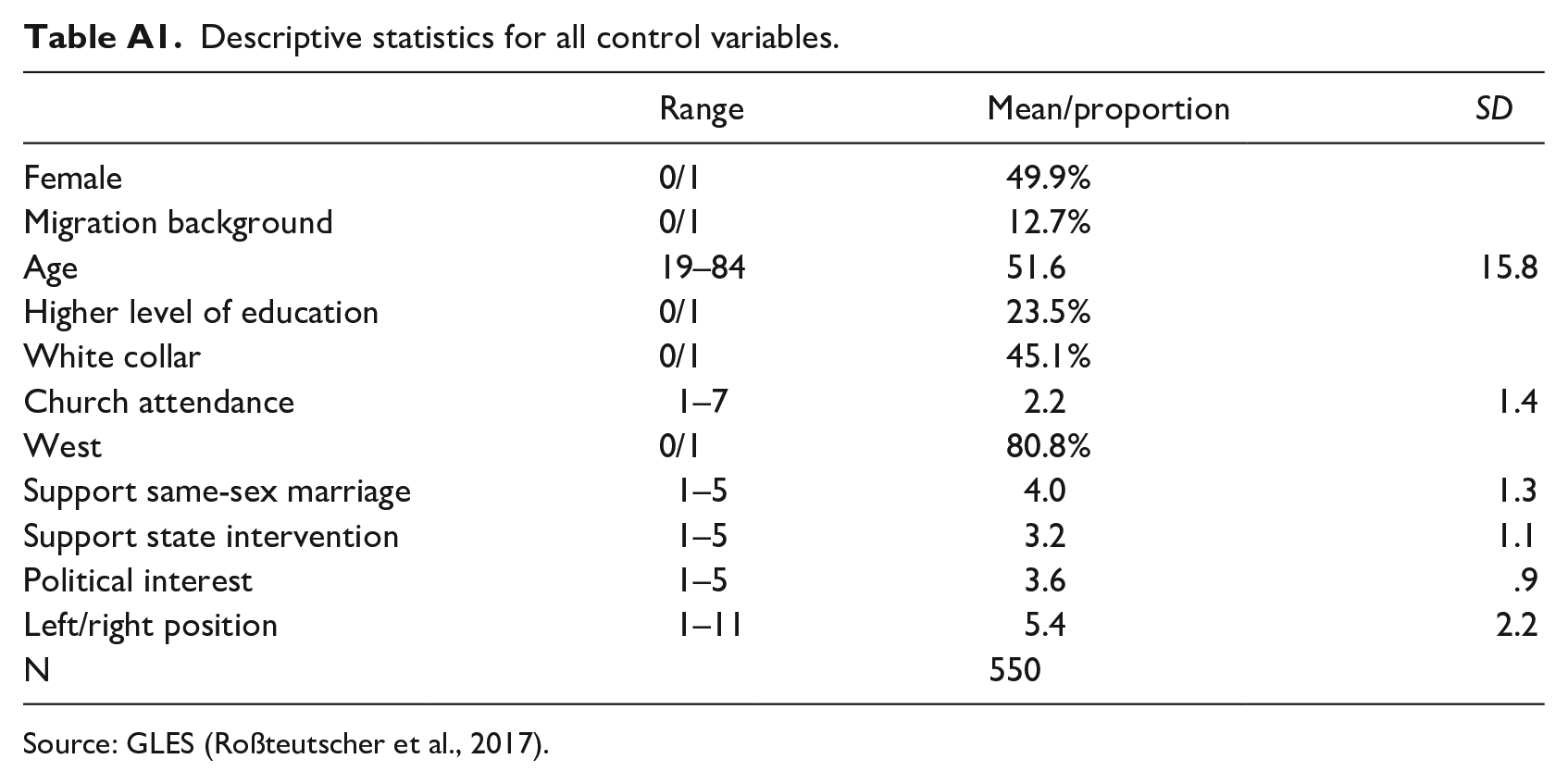
In the multivariate analyses below, we also include sociodemographic characteristics and political attitudes as control variables. Gender is a dichotomous variable distinguishing (0) male from (1) female. Having a migration background distinguishes people who were born in Germany and whose parents were born in Germany from (1) those who were not born in Germany or those who were born in Germany but who have at least one parent not born in Germany. Age is a continuous variable. Our measure for level of education distinguishes (1) those with higher education (defined as having at least a degree from either university or a polytechnic) from (0) those with lower levels of education. Employment status is also a dichotomous variable and has the value 1 for white-collar employment and 0 for other type of employment. Church attendance is a continuous variable ranging from (1) never to (7) often. A final variable distinguishes respondents living in (0) East and (1) West Germany.
Given that we expect support for positive action measures to be influenced by overall attitudes towards equality (e.g. Kane and Whipkey, 2009) and attitudes towards state interventions (Möhring and Teney, 2020), our analyses also include measurements for these attitudes. Unfortunately, a variable measuring attitudes towards gender equality is not available in the dataset. Since previous studies revealed that both egalitarian values and support for minority rights are positively linked to support of quotas (Beauregard, 2018), we decided to control for attitudes towards same-sex marriage. The question asks to what extent respondents agree with the statement ‘Same-sex marriages should be legally recognized’, with answer categories ranging from 1 (totally disagree) to 5 (totally agree). To measure attitudes towards state interventions we rely on the statement ‘The state should not intervene in the economy.’ Answer categories ranged from 1 (totally disagree) to 5 (totally agree), but were recoded in such a way that higher values refer to greater support for state intervention.
As political control variables, we include political ideology and political interest. 5 Our measure of political ideology relies on the question asking respondents to position themselves on a left–right scale ranging from (1) left to (11) right and is included as a continuous variable in the analyses below. Political interest relies on the question asking respondent how interested they generally are in politics. Answer categories range from (1) very interested to (5) not interested at all, but were recoded in such a way that higher values refer to greater political interest.
Table A1 in Appendix 1 provides an overview with descriptive information for all control variables. To test our hypotheses, we present binary logit analyses, investigating explanatory patterns for support for: (a) introducing quotas versus encouraging women; (b) introducing quotas versus no measures; and (c) encouraging women versus no measures. Such presentation offers a detailed investigation of the explanatory patterns for support for different types of positive action measures versus the belief that nothing should be done.
Analyses
Descriptive analyses
The descriptive analyses reveal that the respondents underestimate women’s representation in parliament. The mean score on the question asking the proportion of female MPs is 29.8%, which is below the actual proportion of 37.3%. Interestingly, the mean is significantly higher among women respondents compared with men (respectively 30.9% compared with 28.7%).
Figure 1 presents a histogram introducing the provided answers (in percentage) and the percentage of respondents providing each percentage. The most frequently provided answer was 30% of female MPs (23% of respondents), and 75% of the respondents gave a percentage lower than the actual share of 37%. The vast majority of respondents thus underestimated women’s representation.
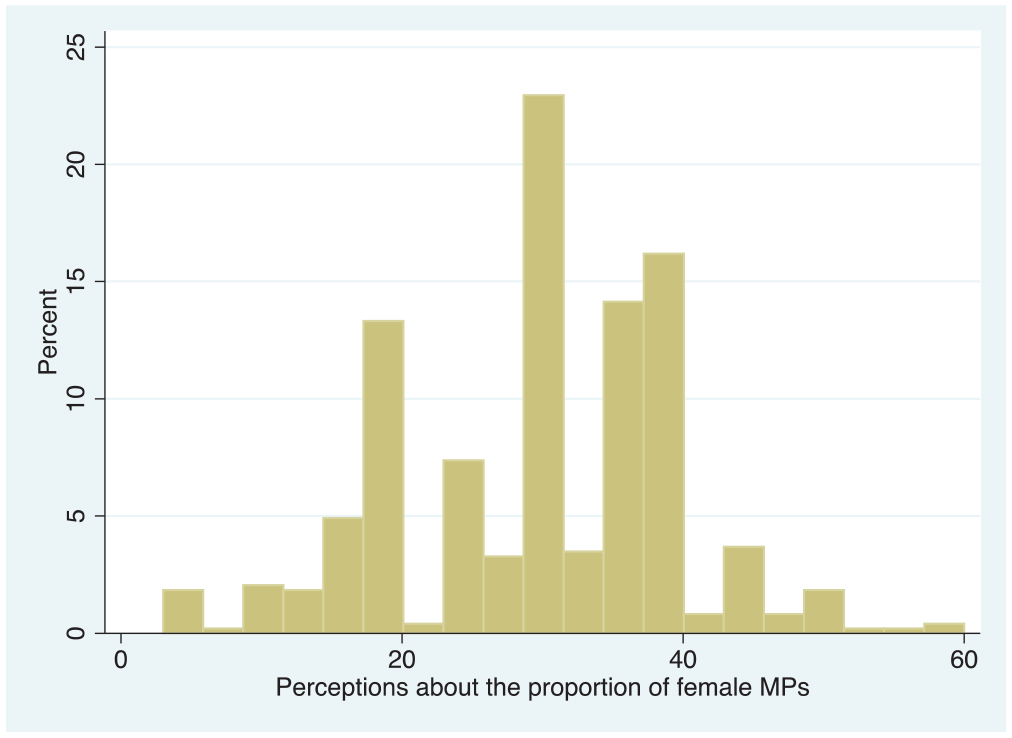
Histogram perceptions about the proportion of female members of parliament (MPs) (in percentage).
Interesting to note is also that an appreciable number of respondents (12.0%) does claim not to know the share of female MPs. Here, a significant gender difference occurs: 8.1% of the male respondents say that they do not know the percentage of women in parliament, compared with 16.0% of the female respondents. This confirms previous research showing a greater likelihood of answering ‘Don’t know’ among women compared with men (e.g. Fortin-Rittberger, 2016; Fraile, 2014 – see, however, Dolan, 2011).
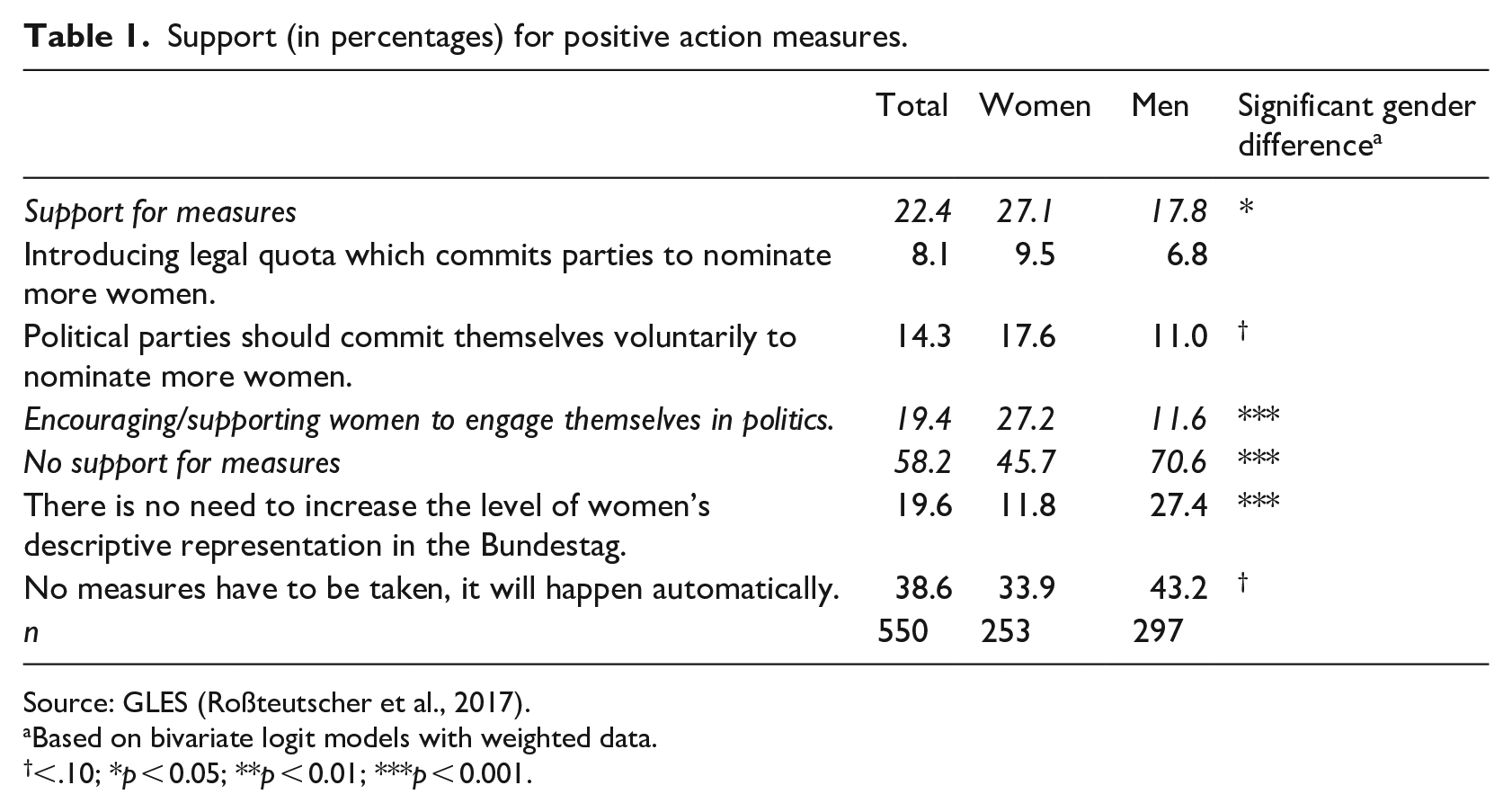
Table 1 presents overall support for measures to increase women’s representation. It shows that the vast majority of respondents (58.2 %) does not support the introduction of any positive action measure. They believe that women’s representation will increase automatically or that it is not necessary to increase their representation. A large gender gap however occurs, with men being significantly more likely to believe that no measures should be taken compared with women (70.6% compared with 45.7%).
Support (in percentages) for positive action measures.
Source: GLES (Roßteutscher et al., 2017).
Based on bivariate logit models with weighted data.
<.10; *p < 0.05; **p < 0.01; ***p < 0.001.
Only a minority of 22.4% of the respondents supports either legal or voluntary party quotas. Support is, however, higher among women compared with men (27.1% compared with 17.8%). These findings confirm that the target groups of positive action measures are more likely to support such actions, which has been explained by group identity and self-interest since they believe that their interests are better represented by MPs belonging to their own group (e.g. Allen and Cutts, 2016; Barnes and Córdova, 2016; Coffé and Reiser, 2018; Mansbridge, 1999).
The introduction of legal quotas is supported by only a small minority (8.1%). We thus find lower levels of support for legal quotas in Germany compared with Australia (Beauregard, 2018), but higher levels of support compared with 4% in New Zealand (Bolzendahl and Coffé, 2020). Voluntary party quotas are also only supported by a rather small group (14.3%). The majority of respondents prefers not to apply positive action measures, but a significant gender gap occurs here, with men being more likely to reject measures Almost one fifth (19.4 %) of the respondents believe that women should be encouraged to engage themselves in politics. Here, too, a significant gender difference occurs, with women being significantly more likely to say that women should be encouraged to engage in politics than men (27.2% compared with 11.6%).
Explanatory analyses
The effect of perceptions about women’s representation on support for positive action measures
Moving on to our multivariate analyses, we first examine the extent to which respondents’ perceptions about women’s representation are related to their likelihood of supporting positive action measures.
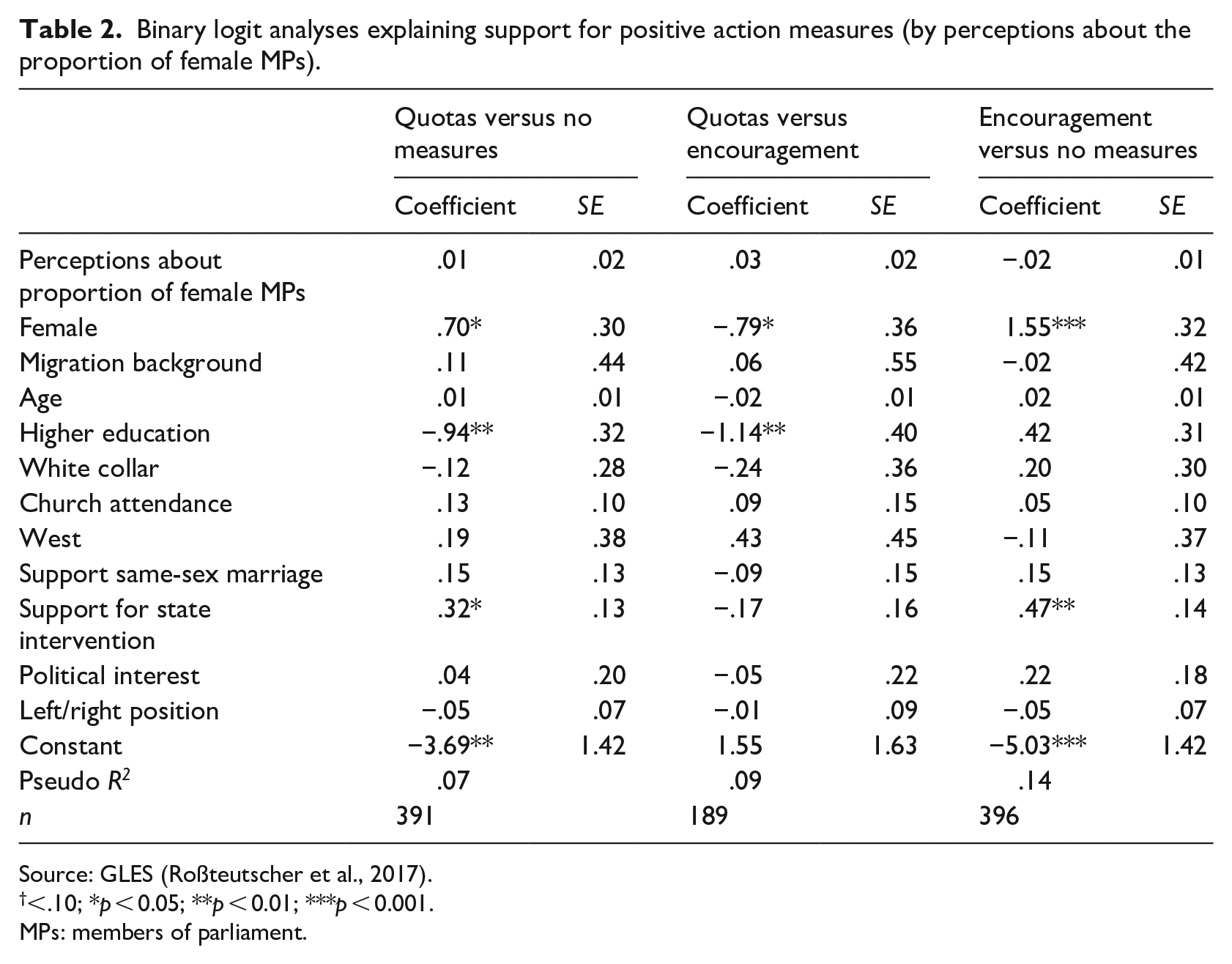
The analyses introduced in Table 2 fail to reveal a significant link between perceptions about the proportion of women in parliament and support for positive action measures, thus rejecting Hypothesis 1.
Binary logit analyses explaining support for positive action measures (by perceptions about the proportion of female MPs).
Source: GLES (Roßteutscher et al., 2017).
<.10; *p < 0.05; **p < 0.01; ***p < 0.001.
MPs: members of parliament.
Looking briefly at the control variables, the analyses show a significant gender effect in all three analyses. In particular, women prefer encouraging women to engage in politics over quotas. Yet after they also prefer quotas over no measures at all. Being supportive of state intervention increases the likelihood of supporting quotas (compared with no support for any measure) and of encouraging women (compared with no support for any measure) which is in line with other studies (e.g. Barnes and Córdova, 2016; Beauregard, 2018). Finally, being higher educated negatively affects support for quotas (versus no support for any measure and versus encouraging women).
The impact of receiving the correct information about women’s representation on support for positive action measures
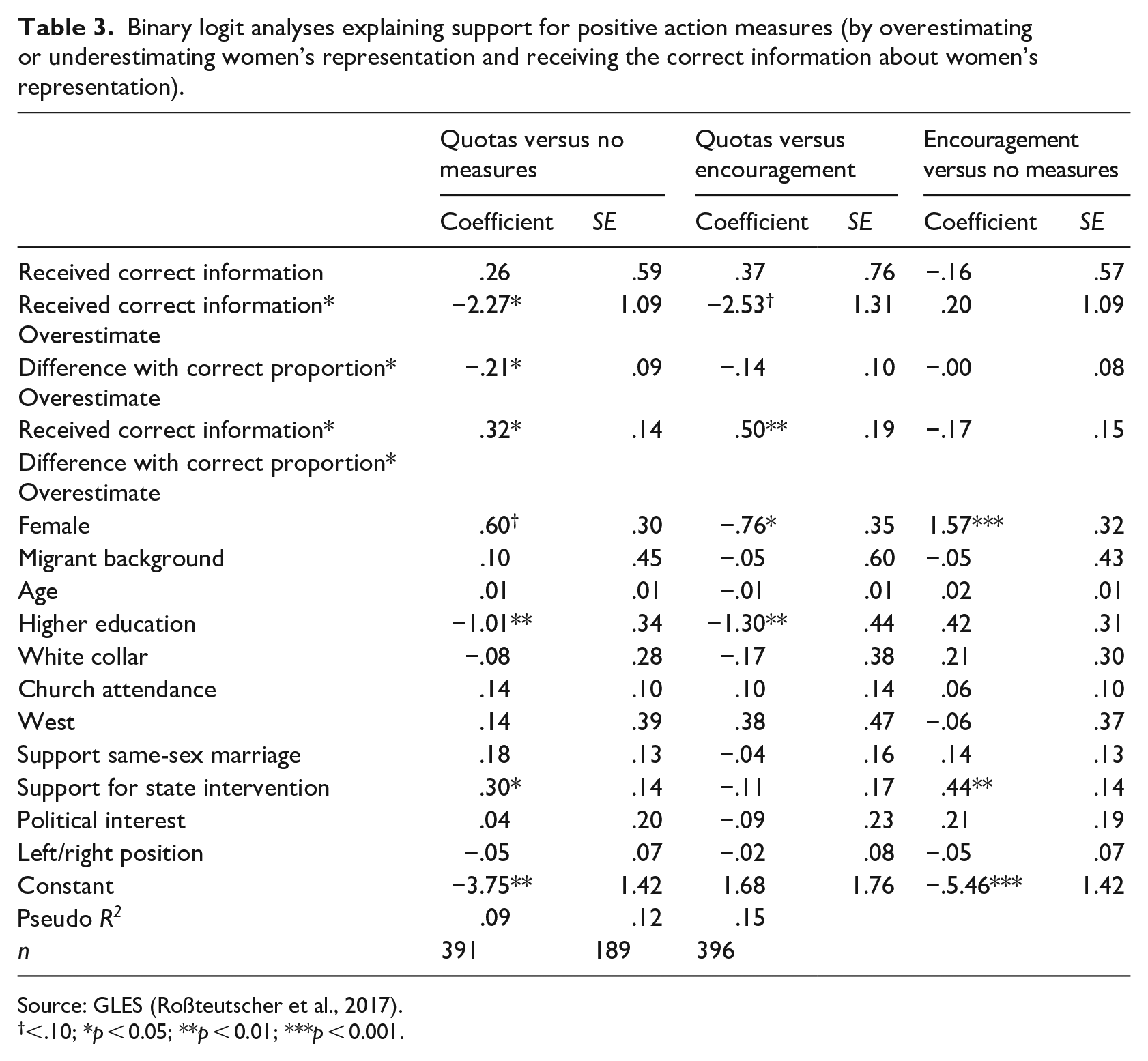
Moving on to investigating whether receiving the correct information about women’s representation affects respondents’ support for positive action measures, Table 3 presents analyses including interactions between receiving the correct information, overestimating women’s representation (or not) and the extent to which respondents overestimate (or underestimate) the proportion of women. These interactions allow us to test Hypotheses 2a and 2b suggesting a different effect of receiving the correct information among those who overestimate (positive effect) and those who underestimate (negative effect) the proportion of women, and to test whether the effects differ depending on the extent to which respondents over- or underestimate women’s representation. 6
Binary logit analyses explaining support for positive action measures (by overestimating or underestimating women’s representation and receiving the correct information about women’s representation).
Source: GLES (Roßteutscher et al., 2017).
<.10; *p < 0.05; **p < 0.01; ***p < 0.001.
Starting with the comparison between supporting quotas versus not supporting any measure, the analysis shows a significant two-way interaction between receiving the correct information and overestimating the share of women in parliament. It suggests that receiving the correct information has a stronger and more positive effect among those who overestimate women’s representation compared with the other respondents. The three-way interaction term, also including the extent to which people overestimate or underestimate women’s representation, is also significant. It indicates that the support for positive action measures is stronger the more women’s representation is overestimated.
There are similar patterns in the interaction terms when comparing support for quotas with encouraging women. Here, too, we find that receiving the correct information has a positive effect on support for quotas among those who overestimate women’s representation and that this effect is stronger the more women’s representation is overestimated. However, we see no significant interactions when investigating support for encouraging women versus no support for any measure.
To get a substantive understanding of the significant interactions, Figure 2 presents the predicted probabilities for the two-way interaction between receiving the correct information and overestimating the proportion of female MPs for support for quotas versus no support for any measure, and for support for quotas versus encouraging women. It shows a clear positive effect of receiving the correct information among those who overestimate the proportion of female MPs. Those who overestimate the proportion of female MPs and who received the correct information have a likelihood of .77 to support quotas (compared with encouraging women), compared with .52 among those who overestimate women’s representation but did not receive the correct information. A similar pattern occurs when comparing support for quotas with no support for any measure, with a likelihood of .38 to support quotas when overestimating women’s representation and receiving the correct information compared with a likelihood of .28 when overestimating women’s representation and not receiving the correct information about the proportion of female MPs. Receiving the correct information thus increases the likelihood of supporting measures among those who overestimate the proportion of female MPs. Hence, we find support for Hypothesis 2b. By contrast, receiving the correct information does not seem to make any difference among those who do not underestimate the representation of female MPs. We thus need to reject Hypothesis 2a. 7
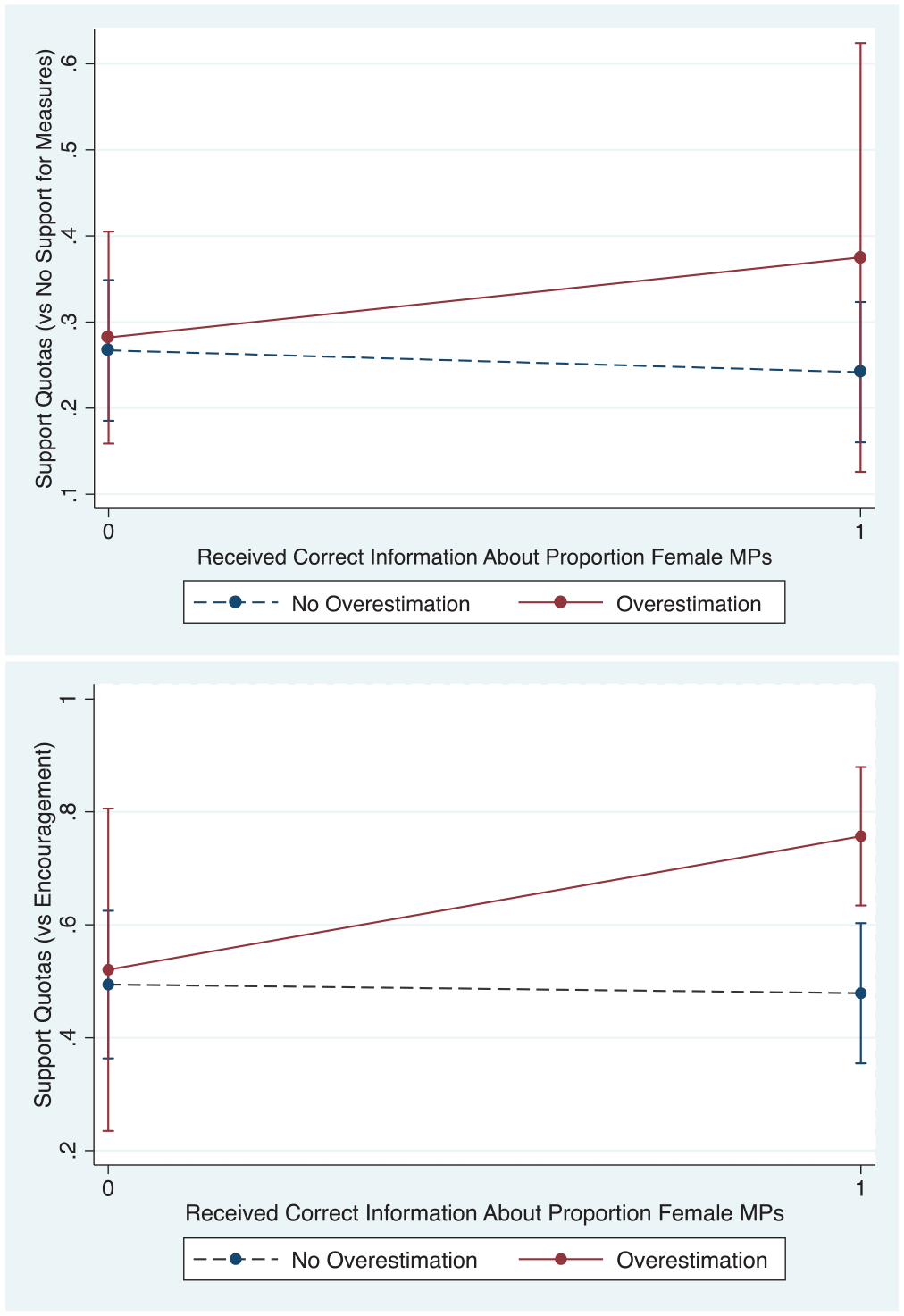
Predicted probabilities (with 95% confidence intervals): support for quotas (versus no support for measures and versus encouraging women) – according to overestimating the proportion of female members of parliament (MPs) and receiving the correct information about women’s representation.
Figure 3 presents the three-way interactions, also including the extent to which respondents overestimate or underestimate women’s representation, again both for support for quotas versus no support for any measure, and for support for quotas versus encouraging women. It illustrates that the positive effect of receiving the correct information among those who overestimate women’s representation is stronger the more they overestimate women’s representation. When those who do overestimate women’s representation do not receive the correct information, we see an opposite pattern, with the likelihood of supporting measures decreasing the more respondents overestimate women’s representation.
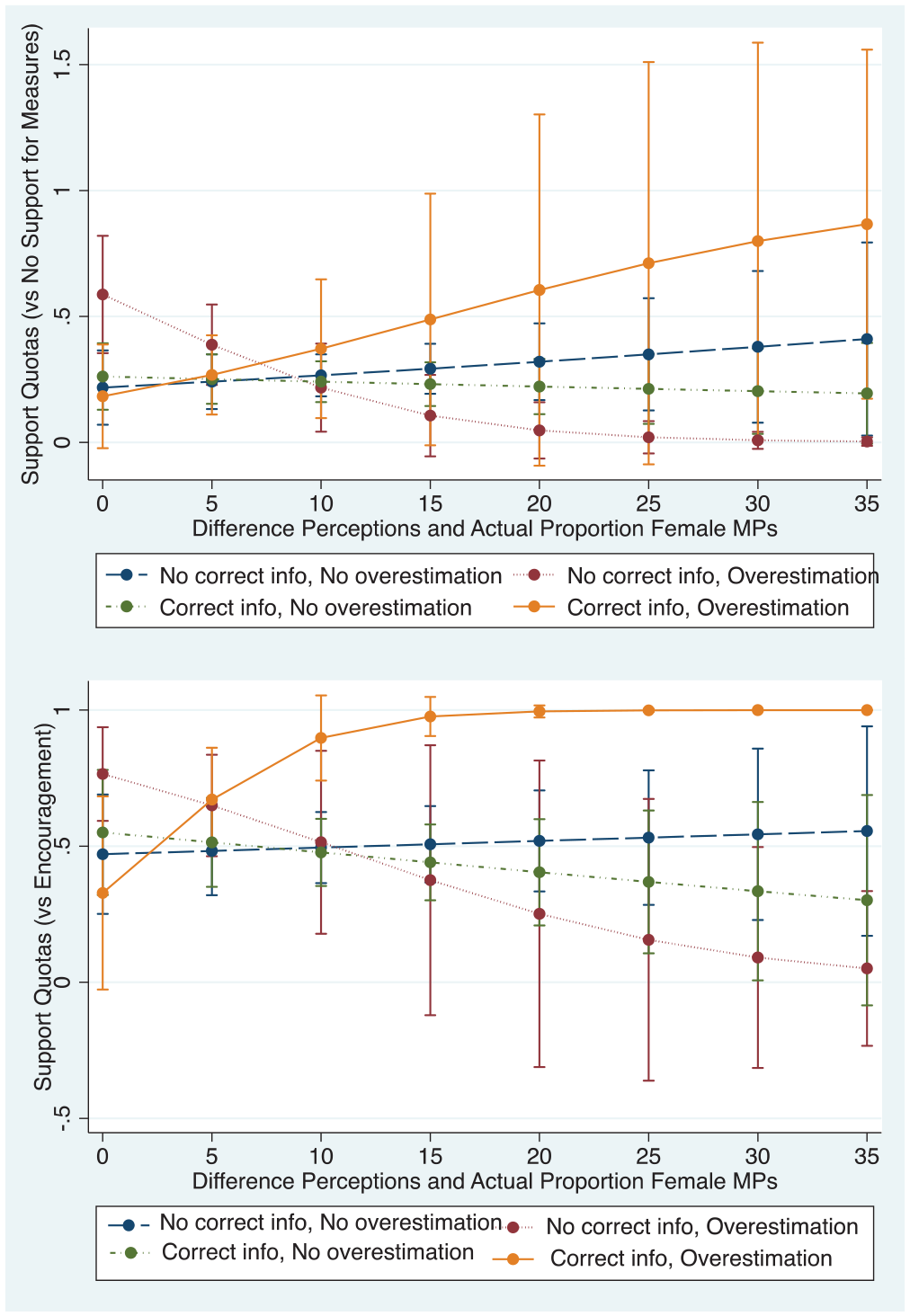
Predicted probabilities (with 95% confidence intervals): support for quotas (versus no support for measures and versus encouraging women) – according to overestimating the proportion of female MPs, the difference between perceptions about the proportion of female MPs and the actual proportion of female MPs, and receiving the correct information about women’s representation.
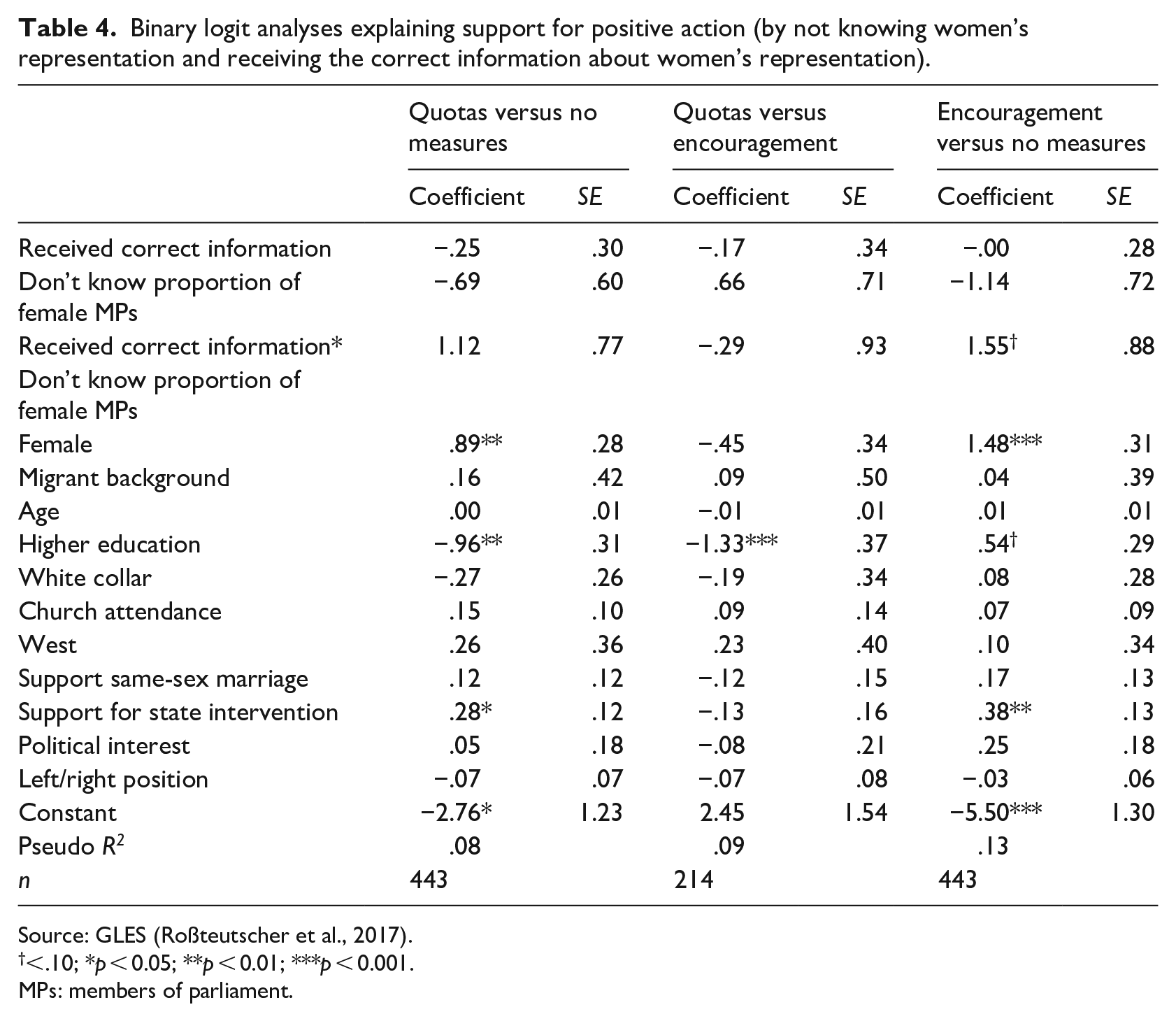
To test our final hypothesis (Hypothesis 3), suggesting that receiving the correct information will positively affect support for positive action measures among respondents who say they do not know the proportion of women in parliament, the analyses presented in Table 4 include a variable measuring whether or not the respondents answer that they know the proportion of women. This variable thus distinguishes those who are uninformed from those who know their proportion correctly and those who are misinformed, and investigates its interaction with receiving the correct information.
Binary logit analyses explaining support for positive action (by not knowing women’s representation and receiving the correct information about women’s representation).
Source: GLES (Roßteutscher et al., 2017).
<.10; *p < 0.05; **p < 0.01; ***p < 0.001.
MPs: members of parliament.
As can be seen in Table 4, the interaction between not knowing the proportion and receiving the correct information is not significant when comparing support for quotas versus no support for any measure and when comparing support for quotas versus encouraging women. However, a marginally significant interaction effect occurs for the comparison between encouraging women versus no support for any measure. The interaction suggests that receiving the correct information has a stronger and more positive effect among those who say they do not know the proportion of female MPs compared with those who gave a percentage (whether correctly or not) when asked the proportion of female MPs.
Figure 4 presents the predicted probabilities and shows that those who do not know the proportion of female MPs and who do not receive the correct information have a likelihood of .11 to argue that women should be encouraged to engage in politics (compared with not supporting any measure), whereas it increases to .33 when they do receive the correct information. While the interaction is only marginally significant, this pattern is in line with Hypothesis 3, though can only be confirmed for the comparison between support for encouraging women versus no support for any measure.
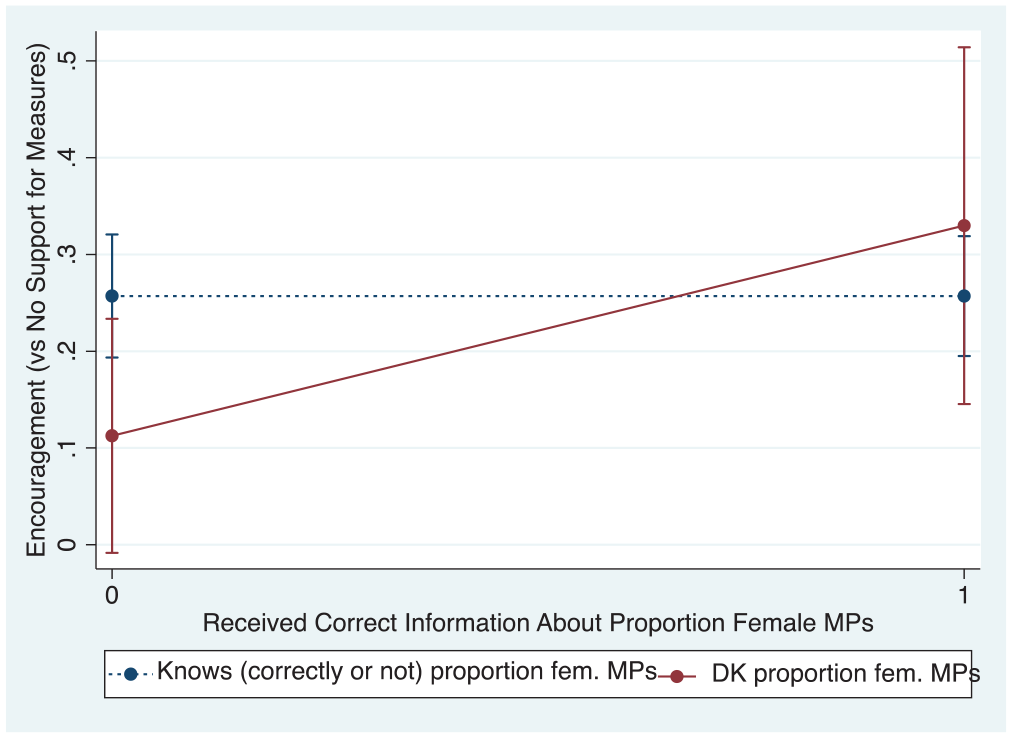
Predicted probabilities (with 95% confidence intervals): encouraging women to engage in politics (versus no support for measures) – according to not knowing the proportion of female members of parliament (MPs) and receiving the correct information about women’s representation.
Conclusion
As more and more countries and parties introduce quotas and other positive action measures to increase women’s representation, it is crucial to understand public support for such measures in order to know their legitimacy. Overall, our study shows that a clear majority (58.2%) of German citizens does not support the introduction of any positive action measure. In contrast, less than a quarter of the respondents support quotas as a fast track to equal gender representation. In particular, support for legal quotas is very low, confirming findings from other post-industrialized countries (Beauregard, 2018; Bolzendahl and Coffé, 2020). ‘Encouraging women to run for office’ – a measure of the incremental track to increase women’s representation – is supported by a fifth of the respondents.
Contrary to our expectation (Hypothesis 1) that perceptions about the proportion of women in parliament would be negatively related to attitudes towards positive action measures, our analyses do not reveal significant links. This result contradicts the assumption of an exposure-based model which suggests that perceptions and the everyday experiences of the existence of inequality have an influence on citizens’ attitudes towards positive action measures (Bolzendahl and Myers, 2004; Möhring and Teney, 2020). One explanation may be that people believe that women are relatively well represented and thus do not see a need to introduce positive action measures. It has indeed been suggested that even when women are underrepresented, people may perceive it as almost ‘parity’ or define a baseline preference for a certain level of representation which does not necessarily correspond with the descriptive representation in society. For instance, Kjær (1999) revealed that a share of 30% is seen as ‘parity’ by many. Therefore, it would be interesting for future research on attitudes towards positive action measures to include variables measuring when people consider women’s descriptive representation as ‘fair’ and/or ‘sufficient’.
While perceptions about women’s representation do not seem to be associated with support for positive action measures, our information-providing experimental data suggest that providing the correct percentage about women’s representation does change people’s mind about positive action measures, at least among those who overestimate their representation. When citizens who overestimate women’s representation learn that women’s representation is actually lower than they thought, they are significantly more likely to support quotas (both compared with encouraging women and with not supporting any measure), confirming Hypothesis 2b. In addition, the more respondents overestimate women’s representation, the stronger the effect of receiving the correct information on support for quotas. Overall, this result indicates that misperceptions about the composition of the parliament can be corrected when providing the correct information among those who overestimate women’s representation. However, contrary to our expectation (Hypothesis 2a), there is no significant effect of receiving the correct information on support for positive action measures among those who underestimate the proportion of female MPs. An explanation for this lack of effect may be the actual level of women’s underrepresentation in the German parliament. When citizens who underestimated the actual share of women learn that the actual proportion of women is higher than perceived, they still learn that women are underrepresented in parliament (while not as much as they thought). Thus, the provided correct information does not challenge their attitude towards positive action measures.
Finally, while receiving the correct information has no effect on support for quotas among the uninformed, it marginally increases the likelihood of believing that women should be encouraged to engage in politics (compared with arguing that no measure should be taken). We thus find partial support for Hypothesis 3, and the finding suggests that uninformed citizens may change their attitudes towards positive action measures once they know the proportion of female MPs.
Overall, receiving the correct information thus has some effect on support for positive action measures, which is in line with studies showing that attitudes change when correct facts are provided (e.g. Ahler and Sood, 2018; Kuklinski et al., 2000). It suggests that providing the correct information can make a difference. It is thus crucial for politicians and policy makers to provide factual information about women’s representation in debates and decision-making processes about gender quotas. Such information may affect support for gender quotas, and positive action measures more generally, and as such also increase the legitimacy of such measures.
Future research could usefully explore in greater detail why – as our analyses showed – receiving the correct information matters for those who overestimate women’s support, while it has little effect among the uninformed citizens and none among those who underestimate women’s representation. Furthermore, work by Teigen and Karlsen (2020) suggests that a positive framing of information increases support for quotas. Therefore, it would be interesting to explore whether the provided information about the current level of representation has different effects on support for quotas dependent on the framing of the information.
Research Data
sj-docx-1-ips-10.1177_0192512121995748 – How perceptions and information about women’s descriptive representation affect support for positive action measures
sj-docx-1-ips-10.1177_0192512121995748 for How perceptions and information about women’s descriptive representation affect support for positive action measures by Hilde Coffé and Marion Reiser in International Political Science Review
Supplemental Material
sj-pdf-2-ips-10.1177_0192512121995748 – Supplemental material for How perceptions and information about women’s descriptive representation affect support for positive action measures
Supplemental material, sj-pdf-2-ips-10.1177_0192512121995748 for How perceptions and information about women’s descriptive representation affect support for positive action measures by Hilde Coffé and Marion Reiser in International Political Science Review
Footnotes
Appendix 1
Descriptive statistics for all control variables.
| Range | Mean/proportion | SD | |
|---|---|---|---|
| Female | 0/1 | 49.9% | |
| Migration background | 0/1 | 12.7% | |
| Age | 19–84 | 51.6 | 15.8 |
| Higher level of education | 0/1 | 23.5% | |
| White collar | 0/1 | 45.1% | |
| Church attendance | 1–7 | 2.2 | 1.4 |
| West | 0/1 | 80.8% | |
| Support same-sex marriage | 1–5 | 4.0 | 1.3 |
| Support state intervention | 1–5 | 3.2 | 1.1 |
| Political interest | 1–5 | 3.6 | .9 |
| Left/right position | 1–11 | 5.4 | 2.2 |
| N | 550 | ||
Source: GLES (Roßteutscher et al., 2017).
Acknowledgements
Both authors contributed equally to this work. They would like to thank Laura Stoker for the fruitful discussions when developing the research project. Previous versions of the paper have been presented at research seminars in various institutions, including the University of Sussex, SciencePo Paris, University of Bath, at the General Conference of the German Political Science Association in Frankfurt, and at the Anxieties of Democracy Workshop at the University of Bamberg. We would like to thank all participants for their valuable feedback and suggestions. Finally, the authors would like to thank Ossip Fürnberg and Jörg Hebenstreit for their methodological help and the journal’s referees for their valuable comments and feedback.
Declaration of conflicting interests
The authors declared no potential conflicts of interest with respect to the research, authorship and/or publication of this article.
Funding
The authors received no financial support for the research, authorship and/or publication of this article.

Supplemental material
Supplemental material for this article is available online.
Notes
Author biographies
References
Supplementary Material
Please find the following supplemental material available below.
For Open Access articles published under a Creative Commons License, all supplemental material carries the same license as the article it is associated with.
For non-Open Access articles published, all supplemental material carries a non-exclusive license, and permission requests for re-use of supplemental material or any part of supplemental material shall be sent directly to the copyright owner as specified in the copyright notice associated with the article.
