




Abstract
Can gender quotas voluntarily adopted by political parties alter stereotypical views about women in politics? This article examines Namibia’s SWAPO, an electorally dominant party that introduced a 50/50 gender quota in 2013. Using an event study design, I analyze public attitudes before and after the 2014 elections, when women elected due to the quotas entered Parliament. The findings reveal that increased female representation had a positive impact on women’s belief that they should have equal access to political office, with no evidence of backlash among male respondents. These results underscore the role of voluntary party quotas in shaping public perceptions of female leadership, offering new insights into the symbolic effects of quotas in developing-country contexts.
Keywords
Introduction
Political scientists broadly agree that gender quotas lead to improved descriptive representation of women in politics (Dahlerup, 2012; Edgell, 2018; Franceschet et al., 2012; Hassim, 2010; Hughes et al., 2019). There is also evidence that more female politicians can have important downstream effects on women’s political engagement and participation (Barnes and Burchard, 2013; Kittilson and Schwindt-Bayer, 2012). We know less about whether and how gender quotas change attitudes toward female political leaders, particularly in developing countries where cultural norms about gender balance in politics might differ from Western democracies (Liu, 2018). Some studies suggest a positive effect on attitudes toward gender balance in politics (Fernández and Valiente, 2021; Allen and Cutts, 2018). Other research indicates that contrary to their intended goal, gender quotas can provoke backlash against women, reinforcing negative stereotypes rather than mitigating them (Clayton, 2015; Kerevel and Atkeson, 2017; Liu, 2018).
Greater focus on the specifics of different quota policies may help make sense of these seemingly contradictory findings. Quota policies have been employed in over 130 countries to date (Kim and Fallon, 2023), yet existing cross-sectional studies do not always distinguish between the effects of legislative quotas, reserved seats, and party-level interventions. 1 Legislative quotas mandate that a certain proportion of candidates in an election must be women. Reserved seat policies, on the other hand, mandate that a specific proportion of seats in parliaments be allocated to women. Voluntary party quotas, in contrast, are adopted internally by parties without a legal mandate. These differences might matter for both implementation and public reaction. Party-level quotas can be easier to institute and they might also generate less political controversy because they only affect the adopting party. Yet despite their prevalence, we know little about how party-level quotas affect public attitudes. Most existing research focuses on national or legislative policies, leaving the symbolic and causal effects of voluntary party quotas underexplored.
Understanding voluntary party quotas is important for two reasons. First, if these policies increase women’s visibility (Hinojosa and Kittilson, 2020) without provoking the backlash sometimes associated with top-down legislative reforms (Clayton, 2015), they may offer a politically feasible path toward attitudinal change. Second, the few studies that do examine quota type effects on attitudes are largely cross-sectional, making it difficult to isolate causality (Kim and Fallon, 2023). It remains unclear whether observed shifts in opinion reflect the quotas themselves or pre-existing voter beliefs in contexts where parties face bottom-up pressure to adopt gender reforms.
This article addresses these gaps by analyzing Namibia’s South West Africa People’s Organisation (SWAPO), an electorally dominant party that voluntarily introduced a 50/50 “zebra” quota in 2013. The policy requires SWAPO to alternate between men and women when nominating a list of candidates for National Assembly elections. Because of SWAPO’s dominant status, the number of women MPs increased markedly following the November 2014 election. SWAPO’s overwhelming electoral strength (consistently exceeding 65% of the vote in internationally recognized free and fair elections) minimizes concerns that quota adoption was a strategic choice that reflected pre-existing pro-equality voter attitudes. Instead, background research suggests that the policy was adopted in response to pressure exerted by select party elites and external NGOs. Taking advantage of multiple surveys collected before and after the 2014 election (Afrobarometer, 2017), I use an event study design to test whether the sudden increase of female SWAPO parliamentarians led to more supportive views of women’s role in politics. The findings suggest that the quota policy had a positive impact on support for women’s political leadership, but this effect was concentrated among female respondents in constituencies where SWAPO traditionally dominates. In contrast, there was no significant shift in attitudes among male respondents.
Visibility shaping attitudes
My theoretical expectations are driven by the notion that as women’s descriptive representation visibly increases as a result of a voluntary quota policy, so will the number of women who are perceived by ordinary voters as qualified for holding political office. This reasoning draws on normalization process theory (May and Finch, 2009), which holds that once new or modified practices become increasingly commonplace, they gradually become embedded as “normal” in a given social context. When more women get elected, female politicians can gain legitimacy in the eyes of the public because an increasing number of voters gain confidence in women’s ability to govern. When adopted by major parties, voluntary quotas can have a particularly significant impact, as they have the potential to greatly enhance women’s collective visibility in elected bodies and thus serve as a primary mechanism for shifting attitudes (Hinojosa and Kittilson, 2020; Wolbrecht and Campbell, 2007). This reasoning leads to my first hypothesis: • The increase in female SWAPO MPs following the introduction of the 50/50 quota policy will have a positive overall impact on public support for women’s participation in politics across both genders (H1).
However, this process may operate differently for men and women. Even though quota policies can legitimize female leaders in the eyes of the public in general, female respondents may be more likely to view women politicians as role models (Liu and Banaszak, 2017). This could reduce internalized stigma by confronting the notion that women lack the competence to participate in politics (Alexander, 2012). • The increase in female SWAPO MPs following the introduction of the 50/50 quota policy will have a positive impact on women’s support for women’s political participation by reinforcing role model effects (H2).
An analogous effect may not materialize among male respondents. A number of scholars suggest that norms about female participation in politics can change without men feeling threatened (Alexander, 2012; Morgan and Buice, 2013). Among men who oppose quota policies, the backlash associated with voluntary quotas may be comparatively smaller, as such policies are less likely to be perceived as imposed systemic changes that fundamentally alter the nature of political competition across the board. On the other hand, status discontent theory indicates that regardless of quota type, men can react negatively to women’s political advancement (Franceschet et al., 2012). Among some men, observing greater female representation could generate feelings of frustration, resentment, and a perception that it is in conflict with traditional values. Accordingly, I anticipate that: • The increase in female SWAPO MPs following the introduction of the 50/50 quota policy will have no positive impact on men’s support for women’s political participation and may even generate negative effects (H3).
SWAPO’s “zebra” quota
In June 2013, SWAPO amended its party constitution to mandate equal representation of men and women in both party leadership structures and the lower chamber of Namibia’s bicameral Parliament. This reform was the culmination of a prolonged internal struggle between progressive elites, including founding president Sam Nujoma, and more reluctant members of the SWAPO Politburo and Central Committee (Mongudhi, 2013). Although the party had formally resolved to introduce gender quotas in 2002, implementation was stalled for over a decade due to sustained opposition from influential male party stalwarts, who viewed the policy as a potential threat to their positions within party hierarchy. Clayton (2014) attributes the eventual adoption of the 50/50 policy primarily to sustained lobbying by advocacy groups rather than grassroots pressure from ordinary voters. 2 These lobbying efforts came from both within the party, notably the SWAPO Party Women’s Council, and from external organizations such as Sister Namibia and Women Action for Development, which played a critical role in shaping public discourse and influencing party leadership. Given that SWAPO’s electoral base is largely drawn from rural and culturally conservative regions of northern Namibia, it is unlikely that bottom-up electoral pressure played a decisive role in shaping the party’s decision. Appendix C provides additional details about the genesis and implementation of the quota policy.
Prior to the November 2014 election, SWAPO was the only party in Parliament with an internal gender quota. But because SWAPO held over 80% of seats after the election, internal SWAPO policies had far-reaching consequences for gender parity within the legislature. Between the fifth (2010–2015) and sixth (2015–2020) National Assembly, the proportion of female members increased from 21% to 41%. Of the 43 women who sat in the Assembly following the 2014 elections, 40 were members of SWAPO (Parliament of the Republic of Namibia, 2018). As Amupanda and Thomas (2019: 16) put it, “it becomes evidently clear that SWAPO’s 50/50 [policy] is solely responsible for the increased number of female MPs in the 6th National Assembly.”
Empirical strategy
I use georeferenced Afrobarometer survey data (BenYishay et al., 2017) in order to capture Namibian respondents’ evolving attitudes toward women in politics. Afrabarometer is a non-partisan, pan-African institution that has conducted public attitudes surveys in Namibia since 1999. Four survey rounds (3, 5, 6, and 7) include a question that probes respondents’ attitudes toward gender equality in politics. This question, which constitutes this study’s dependent variable, asks respondents to endorse (only) one of the following two statements: (1) Men make better political leaders than women, and should be elected rather than women. (2) Women should have the same chance of being elected to political office as men.
Respondents indicated which statement they agreed with more, and whether they “agreed” or “strongly agreed” with it. I code this question as a four-point Likert scale where 4 indicates the highest possible support for the inclusion of women in politics (strongly agree with statement 2). 3
I hypothesize that an attitudinal shift toward greater acceptance of women in politics should be driven by a sudden increase in the number of female SWAPO parliamentarians, increasing the visibility of female politicians in areas that elected them. The implied treatment is therefore a sudden increase of female MPs as a direct result of the quota, not the mere adoption of the 50/50 policy, or its announcement. While I cannot measure female MPs’ increased visibility directly, I assume that it can be proxied by respondents’ residence in constituencies where SWAPO enjoys electoral dominance because these constituencies experienced a sudden increase of female SWAPO MPs who represent them. Most members of Namibia’s National Assembly are elected through a system of closed list proportional representation where the entire country is one district. This means that voters vote for political parties and have virtually no influence on which party-supplied candidates are elected. This fact does not undermine the visibility mechanism, however, because the attitudes of SWAPO voters are arguably more likely to be affected by an increase of SWAPO MPs, as compared to non-SWAPO voters. Furthermore, the crucial identifying assumption that SWAPO’s decision to adopt the zebra quota was independent of voter preferences is most likely to hold in constituencies where SWAPO has maintained dominance over several electoral cycles.
I measure SWAPO’s electoral dominance using constituency-level electoral results from the 2004 and 2009 elections. Specifically, I compute the average level of SWAPO support across these two election cycles (SWAPO). This measure captures the extent of SWAPO’s historical electoral strength in each constituency while avoiding potential endogeneity concerns associated with using post-treatment election results. In concrete terms, SWAPO’s 2014 vote could theoretically be affected by the newly-adopted zebra policy. In practice, the correlation between SWAPO’s 2004, 2009, and 2014 constituency-level results is exceptionally high, exceeding 0.93 in all pairwise combinations. Figure 1 illustrates that SWAPO’s electoral support has remained overwhelmingly stable across multiple election cycles. Constituencies where SWAPO traditionally dominated in 2004 and 2009 continued to display exceptionally high levels of support in 2014, with many exceeding 80% of vote share consistently over time. This underscores the temporal consistency of SWAPO’s dominance and suggests that the adoption of the zebra quota did not significantly alter where the party maintained electoral control. While it is impossible to rule out that some voters’ choices may have been influenced by the increased presence of female candidates, the stability of SWAPO’s support across elections strongly indicates that the quota policy was not a response to shifting voter preferences. Rather than a reaction to electoral pressures, the 50/50 policy appears to have been a top-down political decision. SWAPO electoral dominance across elections. This figure displays SWAPO’s vote share at the constituency level in the 2004, 2009, and 2014 elections. The bottom right map presents the average SWAPO vote share across the 2004 and 2009 elections. Constituencies with darker shades indicate higher levels of SWAPO support, illustrating the party’s longstanding electoral dominance across multiple election cycles.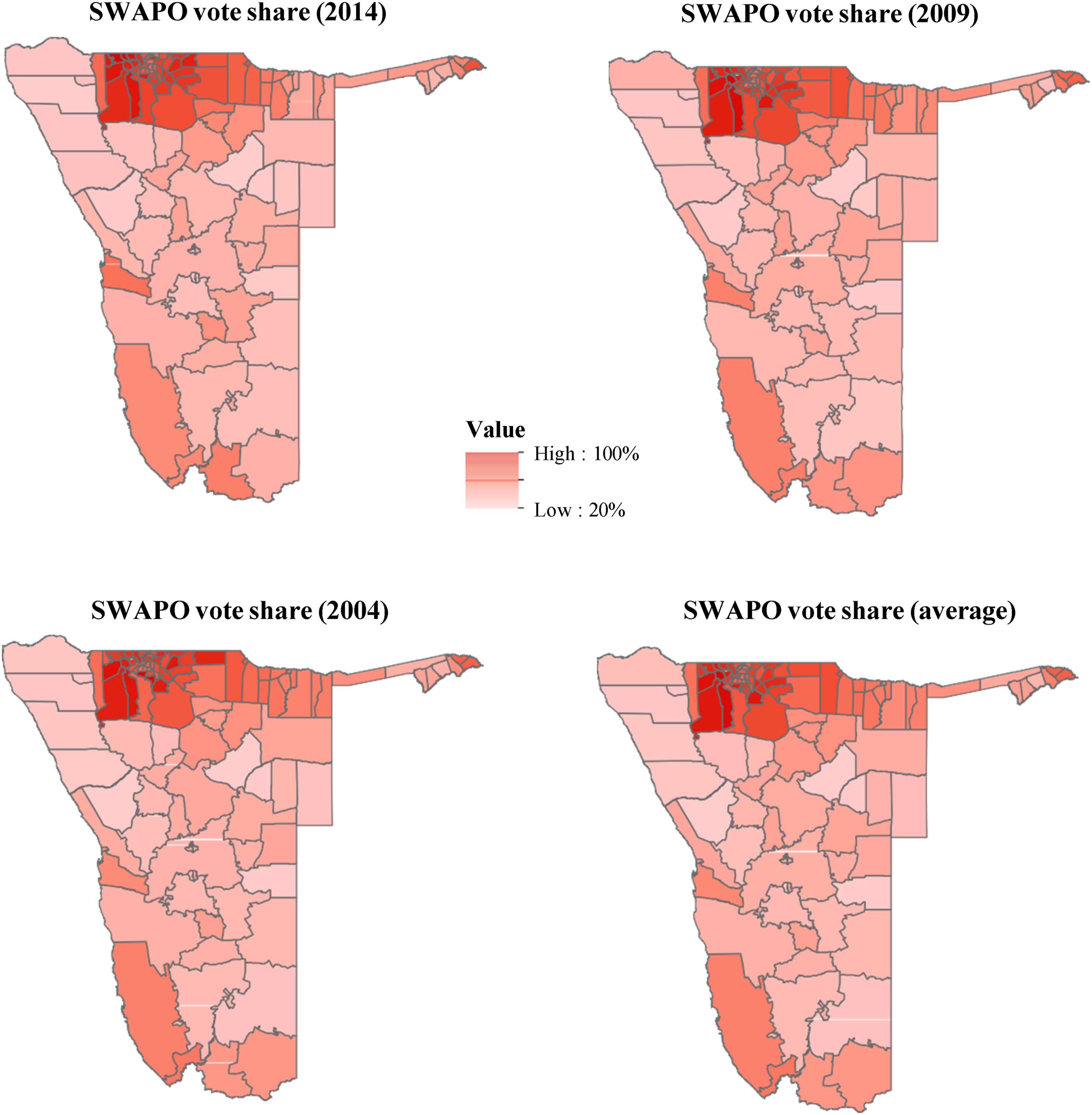
I examine whether the sudden increase of female SWAPO MPs following the 2014 election affected respondents’ attitudes toward women in politics by employing an event study design using residualized constituency-level data:

In the equation above, Y jt represents the residualized average attitude toward female political leaders in constituency j at time t. The residualization process was conducted in a first-stage regression, where individual-level attitudes were regressed on a set of control variables to remove variation unrelated to SWAPO’s electoral dominance. Specifically, I regress respondents’ attitudes on age, age 2 , education, employment status, gender, religious group membership, news consumption, self-reported living conditions, urban residence, and past voting behavior. 4 The residuals from this regression serve as the dependent variable in the main analysis, ensuring that any remaining variation is not confounded by these individual-level covariates.
SWAPO j represents the average level of SWAPO electoral dominance in constituency j, based on vote shares from the 2004 and 2009 elections. The variable “event_timeτ” is a categorical measure denoting time relative to the 2014 election, with the 2006 survey round serving as the reference category. Three of the survey rounds used in this analysis were conducted before the 2014 election (February–March 2006, November-December 2012, and August–September 2014), while one was conducted after it (November–December 2017). Coefficients βτ estimate the effect of SWAPO dominance on attitudes toward female leaders at different points in time relative to the reference category. I use 2006 as the baseline to avoid contamination from anticipation effects. By late 2012, gender quotas were publicly debated within SWAPO, including at the September 2012 National Policy Conference, with implementation formally deferred to the June 2013 Extraordinary Congress. These developments may have influenced attitudes captured in the 2012 and 2014 survey waves. Using survey data from 2006 as the baseline allows me to rule out this possibility.
The model includes constituency fixed effects (λ j ), which account for time-invariant differences across constituencies, such as historical political preferences or structural factors that could influence attitudes toward female leaders. Additionally, survey round fixed effects (δ t ) control for common shocks across all constituencies in a given survey wave, such as national-level political events or broader societal shifts. Standard errors are clustered at the constituency level to account for intra-constituency correlation in responses. Because this is an event study design, the parallel trends assumption is directly addressed by including leads and lags of the treatment variable, allowing for a visual and statistical assessment of whether pre-treatment trends are comparable between constituencies with varying levels of SWAPO dominance.
Results
Figure 2 presents the event study estimates for the effect of SWAPO’s gender quota on support for female leaders.
5
The plot shows separate estimates for the full sample, men, and women, tracking changes over time. Before the quota’s implementation, there is no statistically significant relationship between SWAPO electoral dominance and attitudes toward female leaders. In 2012 and 2014, the estimates remain indistinguishable from zero. However, by 2017, a positive and statistically significant shift appears among women respondents, while the estimates for men remain small and non-significant. The coefficient estimate for women (β3 = 0.745, p = 0.022) implies that a one-standard-deviation increase in SWAPO’s average constituency-level vote share (approximately 23 percentage points) is associated with a predicted 0.4 standard deviation increase in constituency-level average attitudes toward female leadership among women in 2017, relative to 2006. Shifting attitudes. This figure presents event study estimates of the effect of SWAPO’s gender quota on support for female leaders, separately for the full sample, men, and women. Whiskers capture 95% confidence intervals. The 2006 survey wave serves as baseline.
In contrast, male respondents show no meaningful shift in attitudes across survey rounds, indicating that the effects of increased female representation were not uniform across gender groups. The absence of significant pre-quota effects in 2012 and 2014 supports the validity of the design, suggesting that the observed post-quota changes reflect a genuine shift in attitudes rather than pre-existing trends. Furthermore, if the announcement or awareness of the quota alone had been sufficient to change public opinion, we would expect to see a shift in the 2014 survey, which was conducted after SWAPO implemented the policy in 2013. However, no such effect is observed, indicating that the attitudinal change was driven by the actual increase in female representation rather than the policy’s mere introduction. The findings also align with my third hypothesis, which anticipated that men may not update their beliefs in response to increased representation. Given entrenched gender norms, exposure to female politicians within their own constituency and political party may have reassured women that political office is accessible to them. Taken together, these findings provide strong evidence that the quota policy helped reshape gendered political attitudes in Namibia, with effects concentrated among women respondents rather than the population as a whole.
To assess whether the observed effects might be driven by random correlations, I conduct two placebo tests. First, I randomly reassign SWAPO’s average election results across constituencies while keeping all other variables unchanged. If the event study estimates remain significant, it would suggest that the relationship in the main analysis may be spurious. Second, I randomly shuffle support for female leaders across constituencies while keeping SWAPO’s election results fixed. If the estimates persist, this would indicate that the observed effects are not unique to the actual data structure. In both cases, the event study estimates become statistically insignificant, reinforcing confidence that the main findings are not artifacts of random variation. These results, presented in Appendix E, once again suggest that SWAPO’s gender quota meaningfully shaped attitudes toward female leaders rather than reflecting pre-existing constituency-level trends.
Conclusion
This article presents evidence that gender quotas voluntarily adopted by a major Namibian political party counteracted stereotypes about the capacity of women to enter politics. A cautious interpretation of the findings suggests that voluntary quota policies can achieve this outcome by increasing female politicians’ collective visibility. Unsurprisingly, the reported findings are driven by female respondents, perhaps because seeing other women successfully enter politics is a powerful antidote to internalized stigmas. The key contribution of this article is to demonstrate these effects in a case where pre-existing attitudes among voters were unlikely to confound SWAPO’s decision to adopt its quota policy. It remains the task for future empirical work to examine whether the findings generalize beyond the Namibian context. Nevertheless, this article demonstrates that quotas voluntarily adopted by political parties can be an effective tool for changing public opinion, especially in contexts where legislative or constitutional measures are unavailable.
Supplemental Material
Supplemental Material - Seeing is believing: Voluntary gender quotas change female leadership stereotypes
Supplemental Material for Seeing is believing: Voluntary gender quotas change female leadership stereotypes by Vladimir Chlouba in Research & Politics.
Supplemental Material
Supplemental Material - Seeing is believing: Voluntary gender quotas change female leadership stereotypes
Supplemental Material for Seeing is believing: Voluntary gender quotas change female leadership stereotypes by Vladimir Chlouba in Research & Politics.
Footnotes
Acknowledgments
I am grateful to Jan Pierskalla, Guzel Garifullina, Susan Franceschet, and participants at the 2025 annual meetings of the Midwest Political Science Association and the American Political Science Association for helpful comments on previous versions of this paper. I am thankful to the Electoral Commission of Namibia for providing election data. Thomas Boothby and Bella Erichsen provided excellent research assistance.

Funding
The author received no financial support for the research, authorship, and/or publication of this article.
Declaration of conflicting interests
The author declared no potential conflicts of interest with respect to the research, authorship, and/or publication of this article.
Carnegie Corporation of New York Grant
This publication was made possible (in part) by a grant from the Carnegie Corporation of New York. The statements made and views expressed are solely the responsibility of the author.
Supplemental Material
Notes
References
Supplementary Material
Please find the following supplemental material available below.
For Open Access articles published under a Creative Commons License, all supplemental material carries the same license as the article it is associated with.
For non-Open Access articles published, all supplemental material carries a non-exclusive license, and permission requests for re-use of supplemental material or any part of supplemental material shall be sent directly to the copyright owner as specified in the copyright notice associated with the article.
