




Abstract
Which candidates are more likely to go negative, and under which conditions? We analyze self-reported survey data from candidates having run in the 2017 German federal election for the main parties. More specifically, we test a comprehensive set of factors supposed to drive the use of (a) negative campaigning in general, (b) policy attacks, and (c) character attacks. Our results show that for all three versions of negative campaigning the political profile of candidates is most important, followed by personality traits, perceived campaign dynamics, social profile, and available campaign resources. Within these categories, five factors are important across the board: members of the governing parties are less likely to attack, ‘extreme ideology’ of the candidate fuels the use of attack politics, candidates who believe that the media can persuade voters attack more often, disagreeable candidates tend to go negative, and male candidates are more likely to attack than females.
Keywords
Introduction
In election campaigns, parties and candidates seek to persuade citizens to vote for them instead of voting for their political opponents. In order to convince voters, however, it is not only the content of the political offer that counts—that is, policy proposals, legislative records, and programmatic agendas— but also how that content is packaged. Research has paid great attention to the ‘negative packaging’ of content—that is, negative campaigning. The reasons for this are at least twofold. First, some scholars claim that negative campaigning has been increasing over time. This is particularly true for the United States (Fowler et al., 2016: 53; Geer, 2012); however, the situation for Europe is less clear-cut (Walter, 2014). Second, negative campaigning can potentially have ‘corrosive’ effects on democracy—for example, demobilizing voters and increasing political cynicism (Ansolabehere and Iyengar, 1995; Cappella and Jamieson, 1997). Due to the significance of negative campaigning, it is not only important to understand the impact of attacks, but also who uses them and when.
The existing literature on the drivers of negative campaigning faces, in our opinion, four main limitations. First, most of the available research tends to focus on a limited set of factors while ignoring other potential drivers of negativity, and analyses considering the full set of micro-level drivers—such as aspects of a candidate’s social profile, their political profile, and personality traits—are rare (but see Nai et al., 2019). From a theoretical standpoint, this can potentially lead to underdeveloped accounts of what drives candidates to go negative; models might be underspecified and therefore might not provide a robust assessment of the dependent variable in focus. To be sure, we are not claiming that existing studies voluntarily ignored important determinants; we are well aware of the difficulty of measuring characteristics of competing candidates, such as their personality profile. In contrast to most existing studies, we provide in this article what we believe is the most comprehensive assessment of how the candidates’ profile (and the environment they are embedded in) affect their use of negativity during an election campaign.
Second, most existing research usually analyzes the use of negative campaigning in general. However, attacks can have different foci (see Benoit, 2007: 44; Hopmann et al., 2018): On the one hand, criticism of the political opponent can deal with issues and policy positions. On the other hand, attacks can focus on the opponents’ character and persona. To the best of our knowledge, this distinction has rarely been of any relevance yet for the analysis of the drivers of negative campaigning.
Third, and from a methodological standpoint, most of existing research on the drivers of negative campaigning is based on content analyses of campaign material, such as ads (Fowler et al., 2016), speeches (Benoit, 2007), televised debates (Maier and Jansen, 2017), or press releases (Dolezal et al., 2017). However, this methodological approach comes with some limitations. First, candidates’ attitudes, personalities, and perceptions of the race cannot be as easily captured. Second, some scholars argue that scientists’ definitions of what should be considered as negative campaign communication does not necessarily match the understanding of other actors in the political game (e.g. Lipsitz and Geer, 2017). A more recent strand of research has used judgments from external observers—for example, voters (Donovan et al., 2016) or expert ratings from journalists (Patterson and Shea, 2004), political consultants (Swint, 1998), election agents (Walter and van der Eijk, 2019), and scholars (Nai, 2018a)—to measure the presence of attacks. Although this approach has important strengths—for example, allowing large-scale comparative research—it also has its downsides; for example, the extent to which expert ratings reflect ‘true’ values needs careful consideration.
Fourth, most studies in this field focus on the United States, and very little is still known about the drivers of negative campaigning in other countries (for non-US or comparative research see, for example, Elmelund-Praestekaer, 2010; Maier and Jansen, 2017; Nai 2018a; Walter et al., 2014). Unfortunately, trends found for the US case cannot simply be automatically transposed to other contexts, as the situation with respect to politics, society, and the media is, of course, usually very different.
Our article stems directly from the existence of these four limitations. Unlike all other studies we know of, we rely on information collected directly from those who are responsible for ‘going negative’: the candidates themselves. Hence, we are expanding the available data sources for the study of the use of negative campaigning. Although running interviews with candidates to get information about their campaigns is not new (see Herrnson, 1992), to the best of our knowledge this technique has never been used to understand the reasons leading to the use of negative campaigning. Via survey data covering more than 800 candidates of the most important parties competing in the 2017 German federal election, we explore to what extent their profiles drive their communication strategies, distinguishing between general attack behavior, policy attacks, and character attacks. The comprehensive dataset allows us to consider a large palette of variables considered as potential drivers of negativity in the literature, including information on the social and political profiles of candidates, self-assessments of personality traits, perceptions of the race, the impact of media on voting behavior, and the perceived profile of their electoral base. In particular, the use of self-reports gives us the opportunity to better understand how candidates themselves perceive the campaign and the conditions under which their perceptions lead to attacks against their political rivals (and the nature of such attacks). By simultaneously analyzing the major ‘pushes’ and ‘pulls’ of negative campaigning, our aim is, first and foremost, to comprehensively map the drivers of negative campaigning, bypassing important problems of other research designs in the field. By analyzing the German case the article contributes to a broader understanding of the dynamics of negative campaigning, towards a universal understanding of a phenomenon that is, still, mostly studied within the American case.
When do candidates go negative?
Scholars tend to agree that political actors decide to go negative on their rivals based on strategic—that is, rational—considerations, balancing expected benefits and potential costs associated with attack messages (Lau and Pomper, 2004). On the benefits side, competitors go negative to diminish positive feelings for their rivals, thus directly or indirectly increasing the favorability of their standing (Pinkleton, 1997). On the costs side, attack messages can backfire against the sender and depress their favorability in the eyes of the voters (Roese and Sande, 1993). The tradeoff between the costs and benefits of attack messages is not universally set, and various factors intervene to set up incentives in one direction or the other. Research on the use of negative campaigning has identified two broader sets of factors explaining when candidates opt to go negative: First, factors located on the micro level (i.e. characteristics of the attacker itself), and second, context factors (i.e. the constraints under which candidates compete).
Micro-level factors
Micro-level factors can be further divided into three subcategories: political profile, personality, and social profile.
Political profile
Among the most robust findings in the literature is that challengers go significantly more negative than incumbents (e.g. Benoit, 2007; Nai, 2018a; Valli and Nai, 2020). The reasons for this are manifold: Incumbents can refer to their political record, making it much easier for them to run positive campaigns highlighting the achievements of their term (Walter and Nai, 2015). Challengers usually do not have a record to showcase. They therefore have to compensate their lower media visibility by providing negative information—in line with theories of media logic (e.g. Kaid and Holtz-Bacha, 2006). In addition, challengers do not have an office to lose and thus are willing to take more risks and accept potential backlash effects stemming from the generally low popularity of negative campaigning among voters (Garramone, 1984).
Some studies indicate that party affiliation and ideology matter in the decision to go negative (Lau and Pomper, 2004; Nai, 2018a), even if ideological effects have been shown to be much smaller in the European context (Scammell and Langer, 2006). More consistently, research in multiparty contexts indicates that more ideologically extreme candidates from both the left and right attack more often than politically moderate actors (Elmelund-Præstekær, 2010; Nai and Sciarini, 2018). The rationale here is twofold: First, political extremism is associated, almost by definition, with a more uncompromising political style and unwillingness towards consensus and cooperation, often coupled with harsher and more fear-ridden campaigns (Nai, 2018b); these elements might provide an electoral advantage (Rabinowitz and Macdonald, 1989) and tend to increase media visibility (Maier and Nai, 2020). Second, extreme actors are usually less likely to be considered for future coalition building; hence, during campaigns they do not have to demonstrate that they are a congenial or compliant partner (Nai and Walter, 2015). Research using other indicators of an actor’s coalition potential (e.g. size of party, government experience) supports this general idea (Walter et al., 2014).
Beyond ideology, per se, a (mis)alignment between the candidate’s ideology and the position of their party can be a factor affecting the use of negativity. We expect political ‘mavericks’—candidates that are not in line with the ideological position of their party—to be more likely to attack their opponents in order to reinforce their image and prove their independence (Tavits, 2009). In contrast, stark ideological differences between a candidate and (his) voters should depress negative campaigning. As voters do not like candidates that are too far removed from their ideological position (Ditto and Mastronarde, 2009), these candidates face the risk of being considered as ‘black sheep’ that ‘betray’ their ingroup (Marques et al., 1988). Thus, they have incentives to try to avoid further disagreement with their supporters.
Personality traits
Recent research indicates that negativity is linked to candidates’ personality (Nai and Maier, 2020), in line with the renewed importance of individual differences for political attitudes and behaviors, including for political candidates (Scott and Medeiros, 2020). Personality—that is, ‘who we are as individuals’ (Mondak, 2010: 2)—has been shown to be relatively stable over the lifetime and most likely exogenous from political attitudes and ideological profile. Among the multiple competing classifications of personality in the literature the Big Five Inventory (BFI) is one of the most authoritative, particularly for the analysis of political behavior (Gerber et al., 2011). The BFI describes five personality traits: extraversion (sociability, energy, charisma), agreeableness (cooperative and pleasant social attitudes, conflict avoidance and tolerance), conscientiousness (discipline, responsibility and dependability), neuroticism (low emotional stability, low detachment, high emotional distress and anxiety), and openness (curiosity, a proclivity to make new experiences). In particular, research has demonstrated that high agreeableness decreases the likelihood for candidates to be verbally aggressive (de Vries et al., 2013) and to attack their opponents (Nai, 2019). Agreeable individuals tend to engage in pro-social activities and communal social interactions, and display a marked preference for conflict avoidance (Jensen-Campbell et al., 2003). Populist politicians represent perhaps the most indicative example of the reversed effect, as they simultaneously score quite low on agreeableness but frequently rely on character attacks and fear appeals (Nai, 2018b; Nai and Martínez i Coma, 2019; Nai et al., 2019). We might also expect candidates scoring low on emotional stability to be more likely to go negative on their rivals; neuroticism (i.e. low emotional stability) is often associated with edginess and anxiety, and neurotics have been shown to report higher scores of impulsiveness and premeditated aggressiveness (Stanford et al., 2003). Finally, because of its association with social boldness and impulsivity (Bono and Judge, 2004), extraversion could be expected to be associated with a greater use of attacks.
Social profile
Most research on the relationship between candidates’ social characteristics and negative campaigning focusses on the impact of gender, albeit with very mixed results (for a summary see Maier, 2015). Whereas some studies show that females attack less than males, other research comes to the opposite conclusion. What speaks in favor of the former trend is that female candidates can be assumed to face pressure from gender-specific expectations, derived from gender stereotypes (Eagly et al., 2000) that see women as, for example, passive, gentle, or moral (Banducci et al., 2012). These gendered societal pressures should also play a role for female politicians within the context of campaign communication (Dinzes et al., 1994). However, the finding that women attack their political opponents (at least) as hard as male politicians seems also plausible as a certain level of aggressiveness and assertiveness is a prerequisite for successful politicians (see Walter, 2013). In addition, research has demonstrated that members of ethnic minorities less often go negative (Krebs and Holian, 2007). The explanation here is that minorities candidates want to avoid threatening images in order to gain access to voters beyond their own ethnic group. Therefore, we expect candidates having a migration background to campaign less negative than candidates without migration background.
Finally, a case can be made that religious denomination and—even more importantly—religiosity is correlated with negative campaigning. Broadly speaking, religious beliefs provide for those who believe a ‘moral compass’ guiding behavior (Smith, 2003). Although, the relation between religiosity and prosocial behavior is complex and depends on a number of factors, such as individual attitudes and values, situations, and the type of behavior (for a summary, see Hardy and Carlo, 2005), most empirical studies find that religiosity is positively correlated with (public) prosocial behavior (see Shariff et al., 2016), including altruism, empathy, and kindness (Hardy and Carlo, 2005). This leads us to expect that religiosity is inversely related to the use of attack messages.
Context factors
Recent research has identified several contextual dimensions that are likely to influence the use of negative campaigning strategies by competing actors. We discuss below the expected role of the ‘immediate’ context, and focus on factors related to the structure of the race and the role of the media for voter persuasion, on the one hand, and the candidate’s opportunities in terms of the resources they can spent on the campaign, on the other.
Campaign dynamics
A quite robust finding in negative campaigning research is that attacks are more likely during close races (Fowler et al., 2016). Close races up the ante and make the issues at stake more salient. At the candidate level, there is evidence that candidates trailing in the polls attack more often as they no longer have much to lose anyway (Maier and Jansen, 2017; Nai and Sciarini, 2018). Regardless of the nature and competitiveness of the race, attracting the attention of the media is one of the main tasks of every campaign in order to connect with voters. Negative messages can be very useful here as they directly speak to the logic of modern mass media (Geer, 2012). A recent analysis supported the expectation that negative campaign communication is associated with a higher media coverage (Maier and Nai, 2020). Especially, those candidates who have difficulties attracting media attention should therefore be particularly tempted to go negative, but the incentive should exist across the board.
Some research suggests that campaigns have become increasingly personalized—that is, focusing on candidates instead on parties or on issues (De Winter et al., 2018; for an overview, see Adam and Maier, 2010). Furthermore, in personalized campaigns party and candidate strategy tend to be decoupled (Brettschneider, 2008). We expect that candidates who run personalized campaigns are less likely to attack their opponent(s). In the spotlight there is less place to hide in case of backlash effects. Indeed, empirical evidence suggests that negativity is substantially higher in ‘anonymous’ campaign messages (Nai and Sciarini, 2018).
Campaign resources
US research indicates that candidates with fewer resources tend to go more negative as they ‘need to get “more bang for the buck’’’ (Lau and Pomper, 2004: 32). Evidence for this relationship outside the United States is virtually inexistent, however; probably also because often in Europe, parties usually take over the candidates’ financing of the election campaign. Nevertheless, we support the rationale that negativity can be a cheap way to attract public attention, and thus it is more likely that candidates opt for attacks when the campaign resources (e.g., the available time, money, or staff) at their disposal are small.
Furthermore, scattered evidence, mostly from the US, seems to indicate that election campaigns supported by a professional apparatus are more likely to use attacks against their rivals as campaign consultants and that spin doctors are particularly likely to believe that negative campaigning strategies work (e.g. Grossmann, 2009). However, although empirical evidence is largely lacking, the US might be an extreme case in this respect. For instance, the popular narrative for Germany is that the level of negative campaigning is particularly low because the German voter very much dislikes attacks (Rauh, 2016: 23). In this sense, because it can be assumed that negativity is a particularly risky strategy within the German case, we expect the opposite effect: candidates who have access to professional campaign managers and consultants should be more likely to receive the advice to steer away from attack politics.
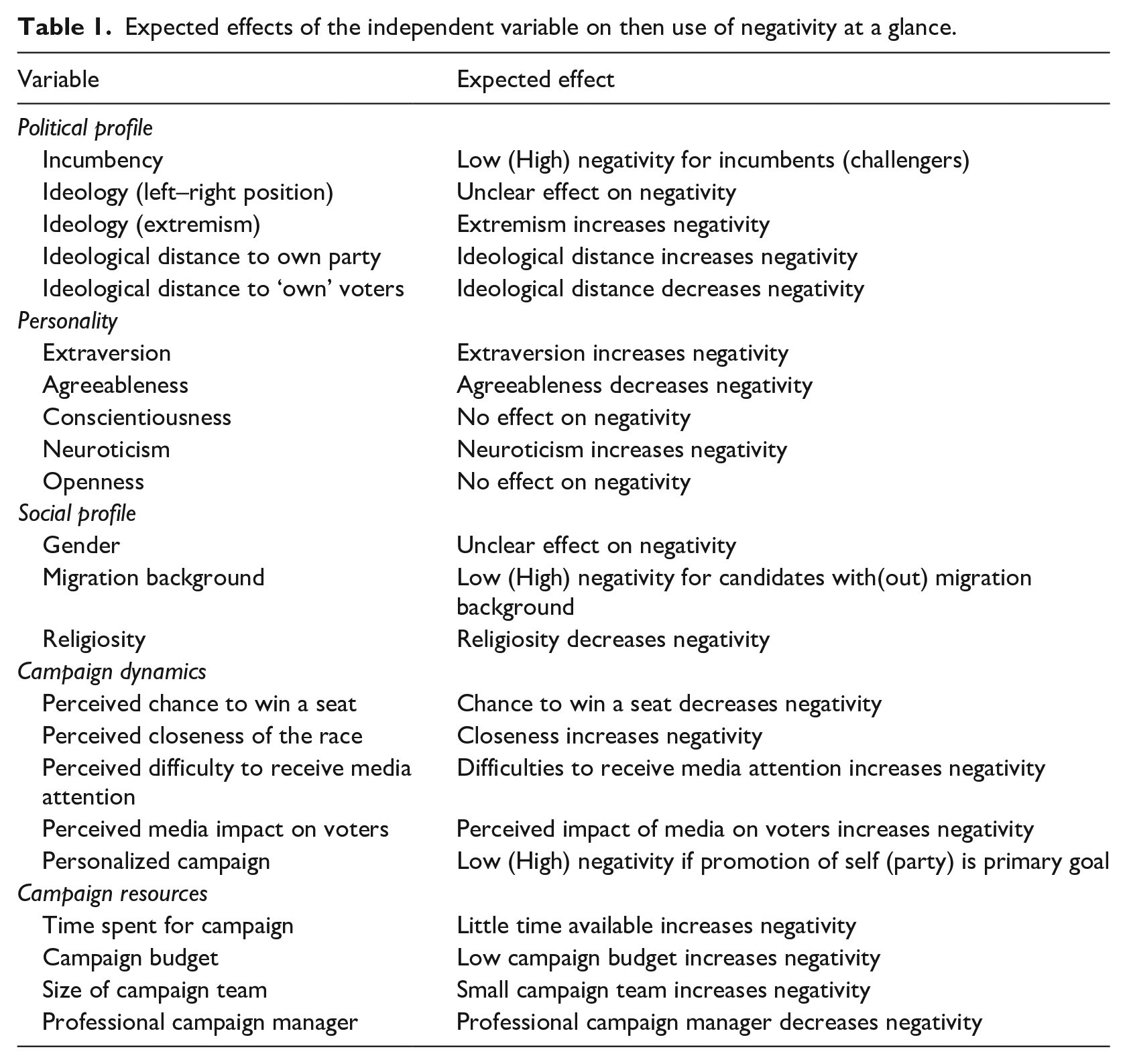
Table 1 presents an overview of the expected effects.
Expected effects of the independent variable on then use of negativity at a glance.
Data and methods
This article analyses candidates’ campaign behavior in the 2017 German federal election. For Germany, this election was unusual in several respects. First, voters were asked to assess the performance of a ‘grand coalition’ between the two largest German parties, the Christian Democrats (CDU/CSU) and the Social Democrats (SPD). This coalition was the result of a difficult political constellation, an arrangement that none of the involved parties were looking for. As a result, none of the coalition partners were eager to promote a similar solution arising out of the 2017 election campaign. Second, the election saw the rise on the national stage of the Alternative for Germany (AfD), a party that had previously been mostly successful in second order elections. As with populists in other countries, the AfD has shaken up the political establishment considerably. Third, the election campaign was dominated by the controversial and emotional issue of Germany’s refugee intake. Chancellor Angela Merkel in particular was under massive pressure, having decided to open the borders to refugees from the Middle East for humanitarian reasons, which caused a system overload in the eyes of many citizens and politicians. Whereas the resulting dissatisfaction was a burden on the governing parties (compared to 2013 they lost 13.8% of their votes), the AfD was able to benefit from it and emerged as the strongest opposition party in the election.
Data
Our analyses are based on a post-election survey of candidates competing at the 2017 German federal election. The survey is part of the German Longitudinal Election Study (GLES). 1 All candidates running for the most important parties, that is the CDU/CSU, the SPD, the Green Party (Bündnis 90/Die Grünen), the Socialist Party (Die Linke), the Liberal Party (FDP), and the AfD, were asked to fill out a questionnaire (online or offline). From the initially 2516 contacted candidates 803 participated in the study. 14.6% of the participating candidates ran for CDU/CSU, 18.7% for the SPD, 20.7% for Bündnis 90/Die Grünen, 16.3% for Die Linke, 16.4% for the FDP and 13.3% for the AfD. 2 For our analyses we used a weighting factor included in the dataset which adjusts the characteristics of the candidates in the sample to the characteristics of all candidates contacted for age, gender, party, and type of candidacy. 3
All measures of our analysis are based on candidates’ self-reports or perceptions. As the data are anonymous (i.e. we do not know the names of the candidates providing us with information) we are unfortunately not able to cross-validate their answers. The fact that candidates provide us with their view of the world, we argue, can actually be more of an advantage than a liability. Research has shown early on that it is not so much reality that matters for attitudes and behavior but its perception: ‘If men define situations as real, they are real in their consequences’ (Thomas and Thomas, 1928: 571–572). Hence, according to the so-called Thomas theorem it should be more important to, for example, assess the perceived competitiveness of an electoral race to understand candidate behavior than to measure its factual closeness. If a candidate does not perceive a close race as such, it is unlikely that he adjusts his behavior. However, if he believes that competitiveness is high his perception might affect how he campaigns—even if his perception does not match reality. For coding and descriptive statistics of the independent variables see Table A1 in the Appendix (Supplemental Appendices are available at the following Open Science Foundation repository: osf.io/fe4zw).
Dependent variables
Candidates were asked five questions with respect to their use of negative campaigning: ‘How strongly did you criticize each of the following aspects of other parties and candidates in your campaign? (1) Particular items on the platform of other parties, (2) Other parties’ records during the term, (3) Issues specific to the personal campaign of other candidates, (4) Personal characteristics and circumstances of other candidates, (5) The characteristics of the top candidates of other parties.’ For each item, a five-point scale from 1 (‘very much’) to 5 (‘not at all’) was provided. All items are highly positively correlated (mean r = .40, SD = .12, min = .25, max = .64). 4 Furthermore, a factor analysis indicates that the items belong to a single higher-order dimension (Eigenvalue = 2.6, 51.9% variance explained). Therefore, we created an additive index reflecting the general use of negative campaigning, which serves as the dependent variable for our analyses. Additional analysis indicates that the additive index has high reliability (α = .77). For descriptive statistics, correlation matrix, and results of the factor analysis see Table B1 to B3 in Appendix. Even if empirically unidimensional, this index conceptually merges two rather different aspects of negative campaigning: the difference between policy (items 1–3) and character attacks (items 4 and 5). With this in mind, we create two additional variables, one for each of the two types of attacks. The two additive indices have acceptable levels of reliability given the low number of items they are based on (αpolicy attacks = .72, αcharacter attacks = .64), and are of course strongly correlated (r = .50, p < .001).
To be sure, self-reports about the use of negative campaigning might suffer from validity issues. As voters usually report that they do not like attacks (Fridkin and Kenney, 2011), candidates might have a motivation to downplay the level of negativity they have used in the campaign. In other terms, due to dynamics of social desirability it is not impossible that the self-reported level of negative campaigning in our data is lower than the negativity used in their campaigns. However, there are good arguments to believe that in the context of our study the issue is less severe. First, more than other professions, political candidates—especially when they are running for office—have strong incentives to be sincere; honesty, sincerity, and integrity are perhaps the most important image traits that voters look for in competing candidates (Holian and Prysby, 2014). Given that the candidate dataset is anonymized, we have no way to crosscheck the reported levels with external independent measures at the candidate level. We were however able to compare the self-reported level of candidates’ attacks (five-item index), aggregated by party, with the use of negative campaigning of those same parties as assessed by an expert survey. 5 Results indicate that the correlation is extremely high, supporting our assumption (r = .95, p < .01; see Figure B2 in the Appendix). Second, and more importantly, we are not interested in investigating the level of negativity across candidates, but rather the conditions under which different candidates report different levels of campaign tone. As biased self-reports in the political realm have no major consequences for explicative models (Katosh and Traugott, 1981), we believe that, in our case, a generalized underestimation of the actual levels of negativity—if occurring—should have no implications for the tested correlations between negativity and its drivers, too.
Controls
All multivariate analyses are controlled for age and region—that is, if a candidate campaigns in Eastern or Western Germany. Furthermore, we control for the type of candidacy as the nature of electoral competition is radically different depending on whether a candidate is running for a constituency (where the majority rule applies), for a seat provided by his party’s list (where proportional representation is the electoral rule), or both. Ridout and Walter (2015) have demonstrated that electoral systems are likely to matter for the use of negativity.
Analytical strategy
In order to assess the impact of the various drivers of negative campaigning we estimate OLS regression models, using robust clustered standard errors to account for the fact that candidates are nested in states (see also Damore, 2002). In a first step, we estimate the impact of each of the five broader categories of determinants in separate models on the general use of negative campaigning. In a second step, we estimate a full model including all variables from all categories. As in this model all effects are controlled for the impact of other predictors our main interest in this study focusses on these results. 6 To assess the relative importance of each of the five categories in the full model, we additionally estimate the minimum variance explained by each category. Minimum R2 can be calculated when including the variables assigned to a specific category (e.g. the candidate’s social profile) after all other variables are already in the model. The increment to R2 is the minimum explanatory power a set of predictors uniquely has, controlling for all other factors potentially influencing the use of negative campaigning. A subsequent F-test indicates whether the observed increase in R2 is statistically significant. Finally, we replicate our main analysis for the use of policy and character attacks.
Results
General use of negative campaigning
Candidates running for the 2017 German parliament used a moderate number of attacks (see Figure B1 in Appendix). Among all candidates, the average use of negativity is 2.64 on a scale from 1 (‘not at all’) to 5 (‘very much’). Very few candidates (5.5%) did not attack their political opponents at all. On the other extreme, only a small minority of the candidates (3.6%) made heavy use of negative campaigning (i.e. score above 4). 7 This finding supports the popular rationale that the level of negative campaigning in Germany is much more moderate than in other countries (e.g. Walter, 2014). However, the reported trends also indicate that German campaigns are not free of conflicts. Attacks are an indisputable part of most candidates’ campaign strategies.
What accounts for these variations? In a first step, we regress the level of negative campaigning on different sets of predictors (see Appendix E). 8 Our analyses demonstrate that (1) the explanatory power of the different categories of factors is quite limited; the maximum adjusted R2 is 9.5%; (2) the use of attacks rests on multiple factors; 44% of the considered potential drivers of negative campaigning (12 out of 27) turn out to be statistically significant. Among these we find some of the usual suspects but also some new drivers.
Table 2 (M1) presents the full model. The adjusted R2 is only moderate (16.8%)—in other terms, much of the variance remains unexplained even after accounting for a relatively large number of predictors. Furthermore, the number of significant predictors in the full model is considerably lower than in the separate models (8 out of 27), suggesting that the drivers of attack behavior come from very different categories located on different levels that are partially interdependent. In a nutshell, our results can be summarized as follows: 9 (1) The candidates’ political profile matters particularly. Candidates running for governing parties attack their competitors less often than candidates from opposition parties (predicted difference of negativity: .40 scale points). Furthermore, attacks are more likely when the candidate (or their party) shows extreme ideological positions; the predicted difference in negative campaigning between moderate and extreme candidates (parties) is .37 (.33) scale points. Furthermore, candidates that perceive a greater ideological distance between their position and the position of their voters are less likely to go negative. If there is no distance, the predicted level of attacks is 2.73 scale points. If the distance is maximum, candidates score 1.88; (2) Personality is an important factor influencing the use of negativity. Candidates low in agreeableness are more likely to report high levels of negative campaigning. The predicted difference in negative campaigning for candidates scoring low and candidates scoring high on agreeableness is .88 scale points. All other personality traits have no direct effect; (3) Candidates’ social profile matters: Male candidates attack more often than female candidates; the predicted difference is .21 scale points; (4) Perceived campaign dynamics matter. Candidates who perceive the media as a powerful channel to persuade voters attack more often. The difference in attacks between candidates perceiving no and candidates perceiving a high media impact is .62 scale points. Furthermore, candidates running personalized campaigns tend to go negative less often; the predicted difference in attack behavior between candidates running exclusively personalized campaigns and candidates running campaigns exclusively serving the party is .29 scale points. In contrast, perceived race dynamics do not matter. Candidates’ campaign resources do not emerge as significant predictors of attack behavior in the full model. However, the significance level of time spent for campaigning is exactly p = .05; the direction of the effect points to a positive influence of opportunity structures rather than supporting the ‘more bang for the buck’ hypothesis (Lau and Pomper, 2004: 32).
Determinants of negative campaigning of candidates running for the 2017 German parliament.
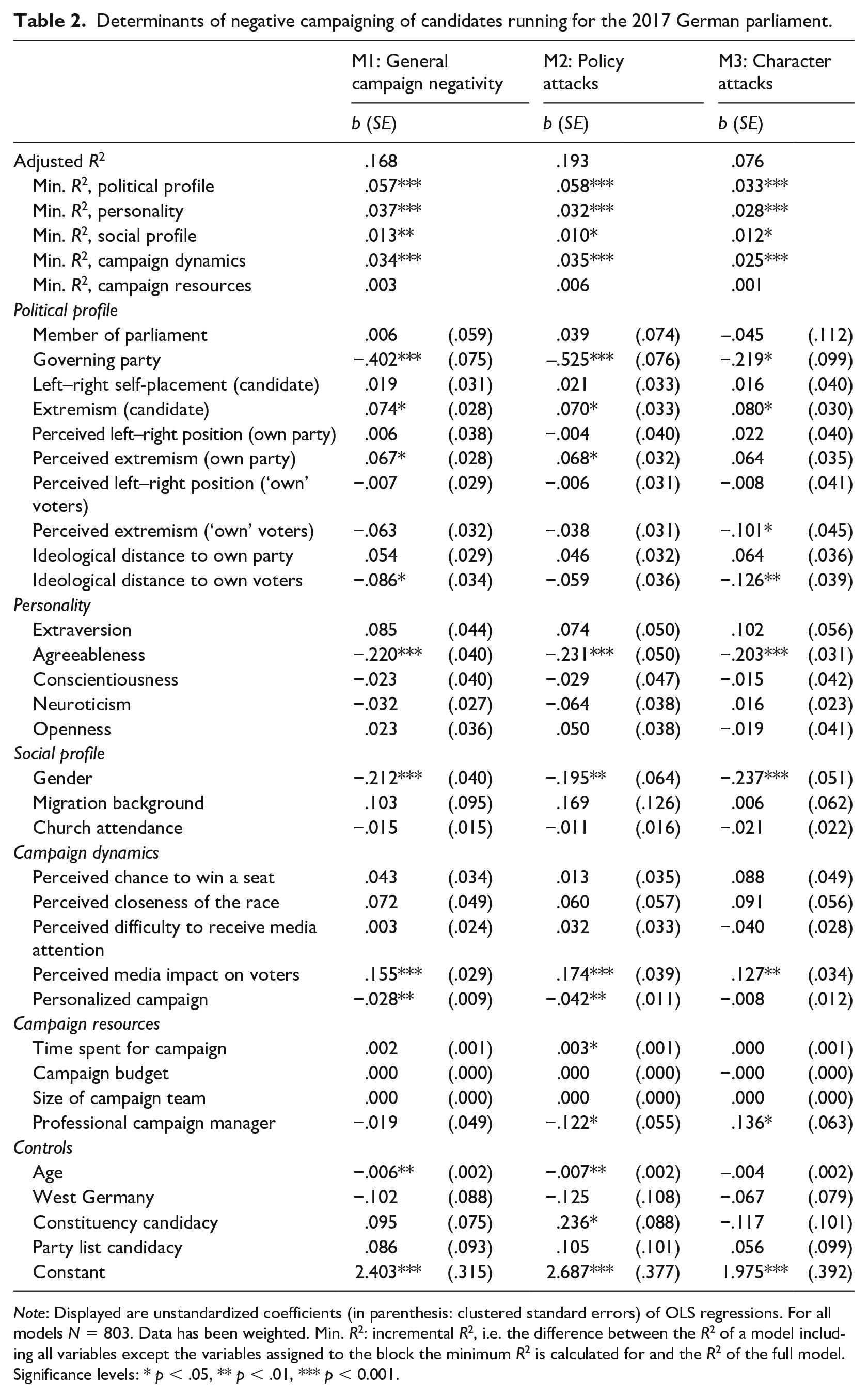
Note: Displayed are unstandardized coefficients (in parenthesis: clustered standard errors) of OLS regressions. For all models N = 803. Data has been weighted. Min. R2: incremental R2, i.e. the difference between the R2 of a model including all variables except the variables assigned to the block the minimum R2 is calculated for and the R2 of the full model.
Significance levels: * p < .05, ** p < .01, *** p < 0.001.
The analysis of minimum R2 gives an idea of the relative importance of the various categories for the candidates’ decision to attack the political opponent. The results show that the explanatory power of political profile is the highest (5.7%) followed by personality traits (3.7%), the campaign dynamics (3.4%) and a candidate’s social profile (1.3%). The impact of campaign resources is virtually non-existent for the German context if we control for other potential drivers of negative campaigning (.3%).
Use of policy and character attacks
Comparison between the two types of attacks shows that when candidates go negative they more often criticize their rivals’ policy positions than their character (M = 3.03 vs. M = 2.06). 10 Models M2 and M3 replicate the previous analysis, but for each of these two types of attacks. The first finding is that character attacks are much more difficult to explain than policy attacks; adjusted R2 is more than twice as high for policy than for character attacks (19.3% vs. 7.8%). However, in both cases factors related to the candidates’ political profile are most important for the use of negativity followed by personality traits and campaign dynamics, the social profile, and campaign resources. Second, some factors jointly influence the use of policy and character attacks: 11 attacks on both policy and character are more likely for members of the opposition, more extreme candidates, less agreeable candidates, males, and candidates perceiving a high impact of the media on voters. In other terms: candidates who exhibit one or more of these characteristics or perceptions attack—no matter in which mode. Furthermore, having professional campaign advise also turns out as significant in both cases. Interestingly, candidates who rely on campaign managers attack less on policy but more on character. Third, some factors are only relevant to explain either policy or character attacks. Policy attacks are more likely for candidates of extreme parties, younger candidates, candidates running non-personalized campaigns, candidates who invest more time for their campaign, and constituency candidates. Character attacks are more likely when the ‘own’ voters are ideologically moderate and the ideological distance to the ‘own’ voters is low.
Discussion
What drives the use of political attacks? Using data from a survey conducted among 800-plus candidates having run in the 2017 German federal election, we find that candidates’ political profile seems to be the most important factor, followed by their personality, their perception of campaign dynamics, and their social profile. Rather surprisingly, given the common belief that money matters in electoral races, available campaign resources have a negligible effect in our models. Within these categories, only few factors turned out as important across the board—that is, showing a significant impact on the use of negative campaigning in general, on policy attacks and on character attacks. First, members of the governing parties are less likely to attack. Although those candidates are not necessarily ‘incumbents’ per se, they might have incentives to rather ‘go positive’ and advertise what the government has achieved in the last term. Second, extremism is an important driver of negativity. According to our findings, an ‘extreme ideology’ of the candidate fuels the use of attack politics. In a political climate characterized by deepening polarization of the political elites (Giebler and Melcher, 2019), this finding suggests that the negativity of the political discourse is unlikely to abate anytime soon. Third, expectations about the impact of the media drives the use of negative campaigning; candidates who believe that the media can persuade voters tend to attack more often. As media are usually happy to comply and grant a preferential coverage to ‘roaring’ candidates (Maier and Nai, 2020), this effect seems particularly logical. Fourth, personality traits seem to be an important factor driving candidates’ campaign strategy. Our results especially show that disagreeable candidates tend to go negative—suggesting that only assessing the drivers of negativity in terms of a rational cost-benefit analysis omits important dynamics. Fifth, we have consistent evidence that male candidates are more likely to attack their political opponent(s) than are their female colleagues.
Nonetheless, some factors are relevant to only one of the two types of attacks—for example, the perceived extremism of the own party only affects the use of policy attacks whereas perceived extremism of the own voters only has an impact on character attacks—suggesting that there are different mechanisms at work. This highlights the need for more differentiated research on negative campaigning, distinguishing for the focus of an attack.
Beyond discussing the factors who turned out as significant drivers of negative campaigning it is also interesting to take a look at those factors usually considered as important to explain attack behavior but had no effect in our analysis. The ‘celebrities’ in this respect are the political role of the candidate himself/herself, campaign resources, and particularly the dynamics of the race. The absence of effect for the components of the race (chances to win, closeness) might be a consequence of the specific (and complex) voting system at play in German federal elections, the lack of polls at the state and the constituency level and the subsequent difficulties for candidates to assess the relevant parameters of the competition. However, the failure of these factors to explain the use of negativity suggests a less-than-perfect exportability of trends found in the American literature; some of the incentives for candidates believed with certainty to explain attack behavior seem to work differently in a multiparty system with proportional representation.
In addition, our findings suggest that even in democracies with a strong influence of political parties, candidates run independent campaigns. This is also reflected in the different use of negative campaigning (Giebler and Melcher, 2019). Running individual campaigns make sense as candidates’ performance in constituencies (e.g. Klingemann and Weßels, 2001) as well as their individual campaign efforts matter for electoral success (Giebler et al., 2014). Hence, it is worth to study candidates’ campaign behavior in parliamentary systems.
Our approach comes, of course, with some limitations. First, our results hold for a single country—Germany. There is, of course, nothing wrong with country-specific case studies—the literature is full of examples in which only one country (usually the United States) has been studied. However, the question remains whether our findings are specific for this case or whether they can be generalized for other countries in which the macro-level constraints are different (e.g. the electoral system, social cleavages, culture). Second, although there are good arguments that analyzing the perceptions of candidates has advantages it also raises the problem that candidate responses can be tainted by social desirability or processes of rationalization. As our dataset includes candidates whose identities are anonymous to us we are not able to validate their self-reports on the use of negative campaigning (and some of its drivers) with ‘objective’ data; however, triangulation with expert data (at the aggregate level) show a high correlation. Further research triangulating objective external measures with candidate perceptions is encouraged to shed light on both candidate campaign behavior and the reliability of tone measurement. Third, some of the measures where suboptimal - for instance the measure used to capture personality traits were based on short scales with low empirical reliability. Fourth, and more importantly, our study lacks any analysis of conditional effects. For instance, party affiliation has the potential to affect the impact of factors associated with negative campaigning. Parties have, for example, very different political roles, different understandings of the political process, and different opportunities in terms of resources. Fifth, an important contextual driver of negative campaigning is missing in our study as the data does not provide any information here: the target under attack. Research has indicated that the characteristics and the behavior of the target can influence the use of attacks (e.g. Ansolabehere and Iyengar, 1995: 121–127; Maier and Renner, 2018). Thus, future research assessing in more detail who is in the spotlight of attack politics is needed. Our article sets the stage for such research, by providing a comprehensive mapping of the drivers of attack politics from the sponsor side.
Footnotes
Acknowledgements
We are very grateful to the anonymous reviewers and IPSR editors for their support, critical assessment, and constructive suggestions during the publication process. We take, of course, full responsibility for any remaining mistakes.
Funding
The author(s) received no financial support for the research, authorship, and/or publication of this article.
