




Abstract
The British decision to leave the European Union after the 2016 referendum raises questions about who could be next. This article analyzes why citizens in East European Member States would vote to leave the European Union in the event of further referendums. It proposes an analytical framework that seeks to explain this strong form of Euroscepticism through four variables that are rarely linked to the European Union: political apathy and alienation, dissatisfaction with domestic democracy and economy, conservative values, and social isolation. We use individual-level data from the 2018 wave of the European Social Survey to show that citizens’ conservative attitudes and social isolation are robust determinants of a potential European Union exit vote in Eastern Europe. We also identify several country-specific causes, which means that the European Union faces particular challenges across political settings.
Introduction
The post-communist countries in Eastern Europe joined the European Union (EU) in an attempt to consolidate their democracies, develop their economies and solve social problems. Pre-accession conditionality ticked many of these boxes and led to extensive support for European integration among domestic political elites and the public in many countries. However, the post-accession period marks the rise of secessionist tendencies, poor consolidation of agreed reforms, security threats, social cleavages, enhanced national identities, tensions between national and European policies, and democratic backsliding. Several forms of Euroscepticism that emerged prior to the accession of many East European countries continue to be visible over time and contribute to the contestation of the European project today.
Leaving the EU is a specific and very strong form of Euroscepticism. The 2016 Brexit referendum led to a short-term increase in the confidence of Eurosceptic actors in several EU member states. A few days after the Brexit referendum, the populist radical right Party for Freedom in the Netherlands called for a Dutch EU Membership referendum. Around the same time, the Czech president mentioned the possibility to initiate a Czexit referendum. The medium-term effect was mainly in the opposite direction: Eurosceptic discourses grew moderate and politicians no longer called for withdrawal from the EU. One exception to this occurred in Poland where the idea of Polexit emerged in the fall of 2021 after the EU openly criticized a Polish court ruling against EU legal supremacy. These examples demonstrate how politicians express this specific form of Euroscepticism, but we know little about what the people believe. Understanding which segments of society agree with such discourses is important because it indicates which groups may eventually support withdrawal from the EU if the opportunity arises. Moreover, this could empirically inform our knowledge of individuals rejecting both the ideas of European integration and the general practice of integration; that is, the ‘Eurorejects’ (Kopecký and Mudde, 2002) in the new Member States.
This article addresses this research gap and analyzes what can trigger this strong form of hard Euroscepticism in Eastern Europe. We seek to explain why citizens in 10 East European Member States would vote to leave the EU should a referendum arise. Our analysis focuses on this region due to the similarities between the countries in terms of previous authoritarian regime and moment of accession, as well as contradictory trends observable around the accession, and in the post-accession period. Around the time of accession both political elites and citizens were predominantly enthusiastic due to the envisaged benefits of membership (Tverdova and Anderson, 2004). However, during the post-accession period, several governments became increasingly critical of the EU and adopted strong Eurosceptic stances or political reforms that challenged European norms (Schimmelfennig and Sedelmeier, 2020). We use individual-level data from the 9th wave of the European Social Survey (ESS) (2018), which includes 10 out of the 11 East European countries that are EU members. The analysis takes place in 2 steps: one comparative analysis including the respondents from 10 countries, followed by a comparison of 3 countries that display different attitudes toward the EU: Bulgaria, Czechia and Hungary. Case selection is further explained in the data and methods section.
This specific and strong form of Euroscepticism rests on the concept of ‘Eurorejects’, which includes people with neither diffuse nor specific support for European integration (Kopecký and Mudde, 2002: 300–301). We focus on this specific form of Euroscepticism which includes an implicit behavioral component in addition to attitudes of rejection. People may have the opportunity – which has gained credibility following Brexit – to decide in a potential referendum the fate of their country’s EU membership. The analytical framework used to explain this specific form of Euroscepticism goes beyond common indicators such as EU attachment, attitudes toward European unification, or trust in European institutions. Our analysis controls for these to ensure the robustness of results, but we believe there are particular reasons linked to everyday life and domestic politics that could drive citizens in this direction. We argue and test the explanatory power of four main categories of determinants: political apathy and alienation, dissatisfaction with domestic democracy and economy, conservative values and social isolation.
We contribute to the literature in two ways. First, we show how several variables that are not directly related to the EU may explain this strong form of Euroscepticism. Some of these, such as attitudes toward migrants, were included in research on Brexit voting patterns. However, others such as political alienation, dissatisfaction or social isolation of individuals have not been explored so far in direct relation to Euroscepticism; one important exception to this rule is the study by Fox (2021) who links political alienation and support for Brexit. By focusing on these overlooked attitudes, we unfold a broader web of political attitudes and social behaviors. Second, this is the first comparative study that moves beyond the over-explored single-case study of Britain to explain a potential EU exit vote. We test empirically the sources of this specific type of behavior that complements the traditional understanding of Euroscepticism.
The following section reviews the literature and presents the analytical framework proposed by this article. Next, we discuss the research design with emphasis on the case selection, data and variable operationalization. The third section includes the analysis and interpretation of results. The conclusions summarize key findings and discuss the main implications for the broader field of study.
An analytical framework
The existing literature explains the specific and strong form of Euroscepticism investigated here – the vote to leave the EU – through determinants such as national identity, ideological orientation, the degree of openness toward multiculturalism and modernization. These focus on the materialization of Brexit and the UK’s Eurosceptic stance. They conclude that Brexit was a vote against the EU, globalization, integration and multiculturalism (Outhwaite, 2017). The UK has a different cultural identity from the rest of Europe, it is exclusive and profoundly nationalistic. The rise of Eurosceptic parties enforced the idea that European integration affected national sovereignty, self-determination of the state and produces threats for British society (Schimmelfennig, 2018). The fear of losing its cultural identity and its resistance to relinquish powers to European institutions contributed to the British leave vote (Schimmelfennig, 2018). Some studies illustrate that support for Brexit was high among those who were dissatisfied with their social and economic status, had lower income, lacked professional skills, opposed immigrants and perceived them as competitors on the job market, had lower levels of education and had conservative values (Carl et al., 2018). There is also research showing that Brexiteers are not confined to societal dropouts but also include middle-class individuals with declining financial situations (Antonucci et al., 2017).
There are two main shortcomings with these approaches. First, they are case specific and cover extensively Euroscepticism or national identity, which may not be as prominent in other countries as in the UK. Second, several determinants have been studied in isolation and do not provide a comprehensive and broadly applicable framework for analysis. Moreover, other factors could also play a relevant role in voters’ decision to leave the EU in addition to what is presented.
To address these shortcomings, we propose an analytical framework with several determinants. Our argument is that the desire to leave the EU is a function of several characteristics linked to the political, economic and social life of individuals. It is rooted in the apathy, alienation and dissatisfaction of citizens with what they have in their countries in terms of politics and economics (H1–H4). In line with earlier studies, we argue that voters with conservative values are against the EU (H5–H6), but we also contend that those individuals who feel socially isolated may also wish to leave the EU (H7–H8). Our approach is consistent with earlier studies that discuss how public opinion toward the EU can be shaped by the interconnections between the European and the national levels (Anderson, 1998). Each of these determinants is covered in detail in the following sub-sections.
Political apathy and alienation
Our first argument is that political apathy and alienation can favor a leave vote. This happens either because people do not care about the existing political setting or because they see themselves as powerless in the decision-making process. Political apathy and alienation can be related, but earlier research indicates that the major difference between the two is the level of cognitive awareness. Apathetic individuals have low cognitive awareness and they have sufficient knowledge about politics yet decide that they are not concerned. Alienated individuals have higher cognitive awareness and they know the source of the alienation (Fox, 2015). Political apathy is an attitudinal orientation characterized by a lack of desire or motive to take an interest in politics (Dahl et al., 2018; Rosenberg, 1954). Unlike other works that define apathy relative to political participation (DeLuca, 1995), this approach allows us to identify behavioral consequences of an indifferent stance toward politics. Apathy can result in lower levels of political participation overall but could also result in casting a particular type of vote when people are exposed to a salient issue. We argue that people who lack interest in politics are not aware of the benefits EU membership brings to their country. Extensive research documents the positive effects of EU membership and the Europeanization process in post-communist Europe. These effects can be observed for a broad range of polity issues such as the rule of law, improvement of administrative capacity or political institution reform (Schimmelfennig and Sedelmeier, 2005). However, individuals with little interest in politics are unlikely to be aware that the EU is the source of such positive developments. To them, the benefits of membership may not be obvious and they may be more inclined to cast a leave vote in a potential referendum.
Political alienation is traditionally associated with the rejection of everything that comes from politics (e.g. values, politicians, institutions); a sense of powerlessness and negativity in individuals. It is usually motivated by the government’s performance, corruption, manipulation and the belief that the enacted policies favor only specific groups (Citrin et al., 1975). Alienated individuals believe that they cannot make a difference in politics and are insignificant when it comes to influencing social dynamics. They perceive politics as being senseless, unfair and are unable to identify with any of the existing norms and policies (Finifter, 1970). Alienation is often motivated by specific political expectations and social discontent. For instance, younger generations tend to feel alienated when they are dissatisfied with how governmental policies and social evolution takes place, while older generations point to poor law enforcement and increased criminality as the main sources of their uneasiness and social discontent (House and Mason, 1975). Both categories are inclined to withdraw when their expectations are not met by governments, they feel that their interests are not represented and they do not trust politicians (Bowler and Karp, 2004).
Political alienation is a mix between powerlessness, lack of trust in the political system and lower socioeconomic status. Alienated individuals are not usually well informed regarding policies and political processes, make uninformed decisions when it comes to voting and are unwilling to live in specific social and political communities (Benz and Stutzer, 2004; Citrin et al., 1975; Finifter, 1970). Alienated individuals tend to take part in specific political actions (e.g. protests) to express their dissatisfaction and frustration about politics. Their actions are motivated by negative feelings and dissatisfaction with the existing order. They usually participate in electoral processes only to invalidate their votes or will take part in referendums and social protests to signal to governments that they are not satisfied with how their interests are represented (Damore et al., 2012). One key indicator of political alienation is powerlessness, which is traditionally reflected in the belief that ordinary people cannot influence politics. In our specific case, people with such perceptions may perceive the EU as being out of their reach; a political project that hardly listens to citizens’ voices. Their alienation may feed adversarial attitudes when having the opportunity to leave an institution over which they have little control. Following all these arguments, we hypothesize that a vote to exit the EU is favored by:
H1: Low political interest H2: The belief that ordinary people cannot influence politics
Satisfaction with democracy and the economy
In Eastern Europe, the EU has been often associated with democracy and economic development. We argue that individuals who are unhappy about the democratic and economic developments in their countries are more likely to cast a leave vote. The new democracies continue to have problems that originate in their authoritarian past such as corruption, misuse of authority, manipulation of electoral processes or political rights and civil liberties violations (Dahlberg et al., 2015). The dissatisfaction toward politics gives birth to a specific group of citizens; that is, critical citizens or dissatisfied democrats. They support the values of democracies but are dissatisfied with how democracy works in their countries (Norris, 2011). Unlike those who are alienated, the dissatisfied citizens may improve the quality of democracy through particular forms of political participation (Webb, 2013).
The dissatisfied democrats may wish to do something to change their situation and, in our specific case, this can be a vote to leave the EU. The pre-accession conditionality brought relevant democratic developments through the Copenhagen Criteria and the EU was often regarded as an alternative to the poor performing and corrupt domestic elites. Nevertheless, many new joiners struggle with the quality of democracy after accession, with several recent examples of democratic backsliding. The direct benefits of EU membership for democracy consolidation are not always perceived. The challenges faced by the EU in the last decade (e.g. Eurozone, refugees, Brexit) have weakened citizens’ confidence in the EU’s ability to promote democracy in Member States. In addition, European integration takes time and there are countries that are still monitored for their progress well after accession. For example, the Mechanism for Cooperation and Verification is still active in Romania and Bulgaria 13 years after joining the EU. Yet the EU still has not provided feasible solutions to address rule of law and corruption problems that plague the two countries. As a result of these developments, those who are dissatisfied with how democracy works in their country may stop perceiving the EU as a remedy and begin to mistrust EU institutions (Dahlberg et al., 2015).
Individual satisfaction with economic development may lead to a similar attitude. The basic principle was provided roughly four decades ago: when people perceive the government as capable of meeting their economic expectations and providing working opportunities, they are more likely to support it (Feldman, 1982). Conversely, when the political system is corrupt and there are high levels of unemployment, economic instability, and citizen welfare is threatened, support for the political system decreases (Feldman, 1982). The unequal distribution of economic resources, the overall economic development of the country and the cleavages between politicians and individuals enhance dissatisfaction with the regime and the public starts to perceive the existing order as unable to fulfill its expectations (Solt, 2008). In Eastern Europe, economic development is an important predictor of vote choice. For many citizens in the region, the EU has long been associated with economic prosperity mainly due to the rapid economic development of countries following accession. As soon as satisfaction with this development vanishes, the EU may not be seen as the same source of prosperity. Consequently, we expect that a vote to exit the EU may be positively influenced by:
H3: Dissatisfaction with the way democracy works in the country H4: Dissatisfaction with the way the economy works in the country
Conservative values
The conservative values of East Europeans may create a desire to leave the EU. We argue that this happens because such values are in contrast with the equality and inclusiveness promoted at the EU level. Individuals and societies aim to achieve certain goals in hierarchic order; when they achieve one target, they move to another (Inglehart, 1971). The process of setting and reaching a target could be ascribed to the modernization of societies. Modernization was initially considered a feature of western societies, while eastern societies were perceived as more conservative and closed because of their communist regimes. Since economic development and individuals’ welfare is closely connected to political and cultural values, western societies achieved their economic objectives more rapidly and moved forward to other aims compared to Eastern Europe (Inglehart, 1971). Modern societies moved on to post-materialist aims (e.g. trust in authorities, welfare, tolerance for minorities), while those still under the process of modernization are more conservative, influenced by traditional institutions, religious authorities and lack economic development (Inglehart and Baker, 2000).
The conservative values of citizens may clash with what the EU promotes mainly in terms of accepting diversity. Two groups that are subject to this are migrants and sexual minorities. Regarding migrants, as with many countries in the EU, populations have aged which has led to a reduction in the workforce. Since life expectancy is high and the socioeconomic systems are developed, the EU is one of the favorite destinations for migrants (Grande et al., 2019; Sides and Citrin, 2007). The level of acceptance and integration of immigrants in European societies is related to the discussion regarding the winners and losers of globalization. The winners are more likely to accept and integrate the immigrants in their societies. The losers are inclined to reject them and perceive immigrants as a threat to national security (Sides and Citrin, 2007). Individuals who have lower income, lack professional skills and are nationalistic may reject immigrants on the grounds that they steal their jobs, exploit social and educational systems and alter their national identity by promoting their cultural particularities (Sides and Citrin, 2007). Consequently, those who are against migrants are likely to oppose the EU, which uses an open-border approach in which migration has few limits. This idea is strengthened by the fact that migration was one of the key issues on the agenda of the Leave campaign in the UK during Brexit (Carl et al., 2018).
The lack of tolerance towards gay people is specific to conservative societies where religion and traditional values play a significant role in cultural and national identity, or social order (Adamczyk and Pitt, 2009). Although in the last decades countries from Western Europe have accepted and integrated gay people in their societies, East European countries continue to oppose these dynamics. The latter are more conservative and religious, and they consider the acceptance of ‘homosexuals’ rights’ to represent a threat to their cultural identity and national pride. In many of these countries, right-wing politicians, members of the clergy and the media portray the EU as decadent and consider ‘homosexual manifestations’ (e.g. marches, protests) as a threat to public morality (Abou-Chadi and Finnigan, 2019). One indication of the conservative attitudes toward the inclusiveness of sexual minorities among particular segments of society is the fact that in the most recent decade four East European Member States organized referendums against same-sex marriage. People with such attitudes are unlikely to favor a presence in the EU, where inclusiveness and equality are promoted. Consequently, we hypothesize that a vote to exit the EU may be favored by:
H5: The belief that immigrants make the country a worse place to live in H6: The belief that gays and lesbians should not be free to live as they wish
Social isolation
Social isolation is often associated with loneliness, retreat, lack of power, stigma and lack of desire or interest to take part in social activities (Warren, 1993). Despite some similarities, social isolation is different from political alienation because the former rejects social initiatives and working opportunities as well as the creation of social networks (Hortulanus et al., 2006). Socially isolated individuals are detached and disconnected from everything related to social life. Social isolation is usually ascribed to a lack of motivation or inability to take part in social events or actions. It is generated by the absence of reasons for involvment in social activities and it is explained by the distance to the mainstream and social norms (Warren, 1993). Social isolation can be enhanced by the values and principles of western societies. Economic and social development and the promotion of individualism have incentivized individuals to become less dependent on social communities and other members of society. Therefore, social isolation could be influenced by the desire to forego social involvement to achieve individual goals autonomously (Hortulanus et al., 2006). Social isolation can be stimulated by poverty, social polarization or inequalities. Those who are dissatisfied with their social status and income are more likely to isolate themselves from others (Barry, 1998; Warren, 1993).
Citizens play a relevant role in the stabilization of governance systems and the legitimacy of democracies (Welzel and Inglehart, 2008). Socially isolated individuals can hardly make a change in their societies because they refuse to create social networks and get involved in social activities. Socially isolated individuals can develop feelings that they are exploited by the majorities for specific purposes and fellow citizens or state authorities take advantage of them (Barry, 1998). They are dissatisfied with the existing order and believe that popular masses are manipulated by corrupt and untrustworthy politicians for their benefit (Hortulanus et al., 2006). We argue that the fear of being manipulated and exploited by their communities, coupled with the absence of community-oriented behaviors, could influence socially isolated individuals to reject the EU. Such people may perceive the EU as a supplementary source of manipulation. These arguments lead to the expectation that a vote to exit the EU is driven by:
H7: A belief that most people try to take advantage of others H8: Low involvement in social activities with other people
Control variables
We test these main effects when controlling for four variables: three various gauging facets of Euroscepticism (EU attachment, European unification and trust in the European Parliament (EP)) and education. The EU attachment is a set of values or a space that creates development opportunities for its members (Antonsich, 2008). Usually, individuals who are emotionally attached to a community are more likely to continue living in it. This is in line with the idea of favoring in-group characteristics and favoring membership to that group. A low EU attachment may thus favor leaving the EU. European unification involves the creation of common institutions, policies and guidelines but implies also the transfer of national sovereignty and authority to European institutions (Alesina and Wacziarg, 1999). Increasing competencies and power of the EP leads to a decrease in influence for the national parliaments. It is thus possible that attitudes toward the EP may influence an EU exit vote. Education is the final control variable because many studies indicate that it is positively associated with a pro-European stance (Kuhn and Stoeckel, 2014). 1
Data and methods
This article uses individual-level data from the 9th wave of the ESS (2018). The survey uses probability representative samples at the national level, using a face-to-face data collection method. We focus on Eastern Europe for the reasons explained in the introduction. There is an important contrast between the convergence of elite and public support for the EU around the accession and the changing trends in the post-accession period. Some of the political elites changed their attitudes toward European integration, and the most recent decades provide several examples of government actions against EU principles, practices and policies. The public in Eastern Europe continued to have more positive attitudes toward the EU compared with people from Western Europe during the financial crisis in the late 2000s (De Vries, 2013). However, this changed several years later when the critical attitudes of elites were matched by the public in several eastern Member States (Sanders and Toka, 2013). An illustration of this changing trend of attitudes toward the EU is reflected in the increasing vote share for hard Eurosceptic parties in most East European countries (De Vries, 2018).
The analysis includes all East European Member States for which data is available in the 2018 ESS survey: 10 out of 11 countries (Bulgaria, Croatia, Czechia, Estonia, Hungary, Latvia, Lithuania, Poland, Slovakia and Slovenia); Romania is the only one missing. The sample size varies between 918 (Latvia) and 2398 (Czechia). The analysis proceeds in two steps. First, we conduct a comparative analysis of all 10 countries to explain the likelihood to vote for an EU exit. Second, we compare the effects across three countries (Bulgaria, Czechia and Hungary) that belong to different categories in terms of their elite and population attitudes toward the EU. Bulgaria complies with the EU, has isolated anti-EU voices and has been one of the champions of EU support throughout the years. Czechia has traditionally contested the EU more than other countries in Eastern Europe and in recent times there are increasing anti-EU voices in domestic politics (De Vries, 2018). Hungary had, and continues to have, relatively high levels of support for the EU within the population, but for roughly one decade the governing elites occasionally digressed from the path of Europeanization and have openly contested the EU (Schimmelfennig and Sedelmeier, 2020). The idea behind this case selection is to check the extent to which the effects hold in very different political settings.
The dependent variable of this study is measured through the answers to the following question: ‘Imagine there were a referendum in [country] tomorrow about membership of the European Union. Would you vote for [country] to remain a member of the European Union or to leave the European Union?’ The available answers were coded dichotomously as 0 for remain and 1 for leave. To make interpretation of results straightforward and to maintain consistency with the hypothesis wording, the independent variables were (re)coded from the highest to the lowest value (see Appendix 1). All ‘Don’t know/Not applicable’ (DK/NA) answers are treated as missing values and excluded from the analysis. We use binary logistic regression and we tested for multicollinearity. The results indicate no highly correlated predictors (the highest value is 0.37) and the values of the variance inflation factor (VIF) test for multicollinearity are smaller than 1.80.
For a robustness check, we ran supplementary statistical models that illustrate how our independent variables explain mainly the individuals’ likelihood to vote EU exit in a referendum and no other general negative attitudes toward the EU. We used the first three control variables – EU attachment, attitudes toward European unification and trust in the European Parliament – as dependent variables for Model 1 (pooled) in Appendix 2. The results indicate that the model presented in this paper (with the EU exit vote as dependent variable) has a much better fit and the independent variables have considerably higher effects and statistical significance. For example, the model with EU attachment as dependent variable has a model fit of 0.01, while only three variables have an effect and are statistically significant.
Analysis and results
Figure 1 includes the distribution of respondents who would vote to leave the EU across the 10 East European countries included in this analysis. The last bar in the figure is the average for the entire region. The distribution indicates great variation in terms of desire to leave the EU, which ranges from roughly 5% in Poland to more than 25% in Czechia. The average of all countries is around 14%. Poland and Hungary are at the lower end of the spectrum, which contrasts with the recent discourse of political elites in these countries regarding the EU. The data indicate that the populations in both countries support EU membership and a potential referendum would be unsuccessful.
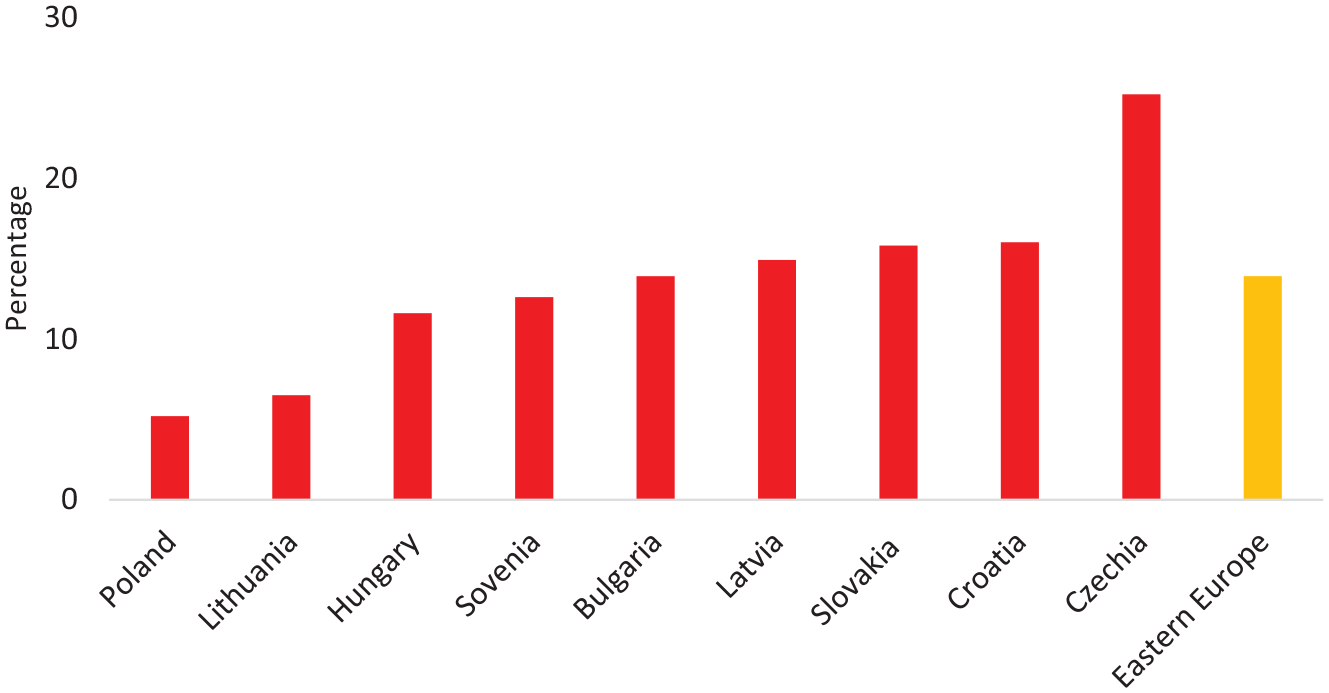
The distribution of European Union exit respondents across East European countries.
Overall, an EU exit referendum would be unsuccessful in every East European country because even those with the highest percentage of supporters for leave are in the minority compared to those who wish to remain. The three cases selected for the country-level comparative analysis reflect different levels of desire to leave the EU: Hungary is at the lower end, Bulgaria is somewhere in the middle, while Czechia is the country with the highest number of leavers.
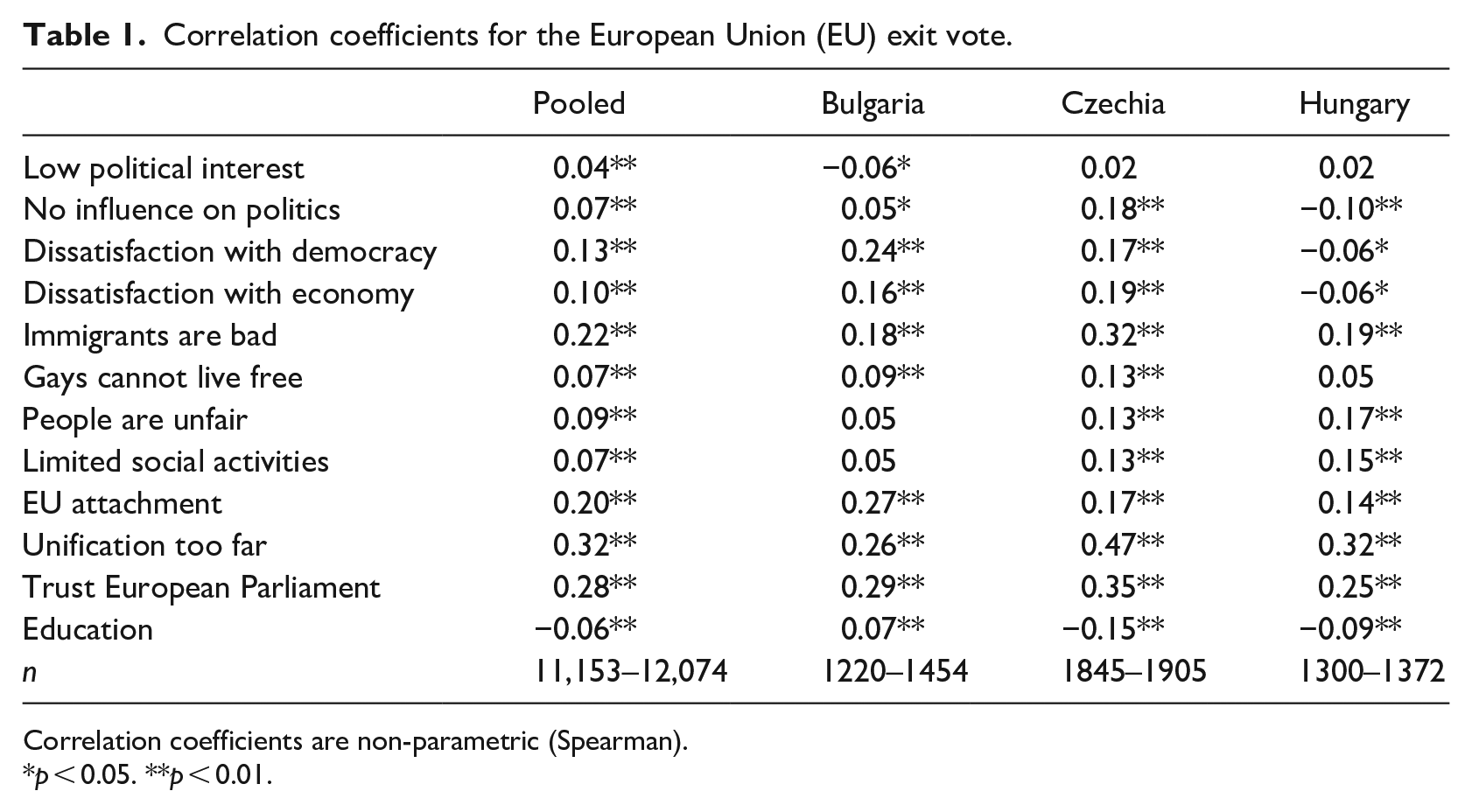
The bivariate correlations in Table 1 distinguish between the pooled model that accounts for all 10 countries and the 3 countries compared in this article. At pooled level, there is empirical support for almost all hypothesized relationships. There is a positive correlation, statistically significant at the 0.01 level, between an EU exit vote and each of the independent variables. Among the latter, low political interest, the absence of influence in politics, conservatism oriented against gay people, and limited number of social activities correlate the lowest. The anti-migrant attitude correlates the highest among the main effects (0.22).
Correlation coefficients for the European Union (EU) exit vote.
Correlation coefficients are non-parametric (Spearman).
p < 0.05. **p < 0.01.
In line with previous research, the controls reflecting the anti-EU feelings are highly correlated with the desire to exit the EU. The East European respondents who do not feel attached to the EU believe that the unification has gone too far, and do not trust the EP vote to leave the EU more than the others. Lower-educated people are overall slightly more inclined to leave the EU, education correlates weakly (−0.06).
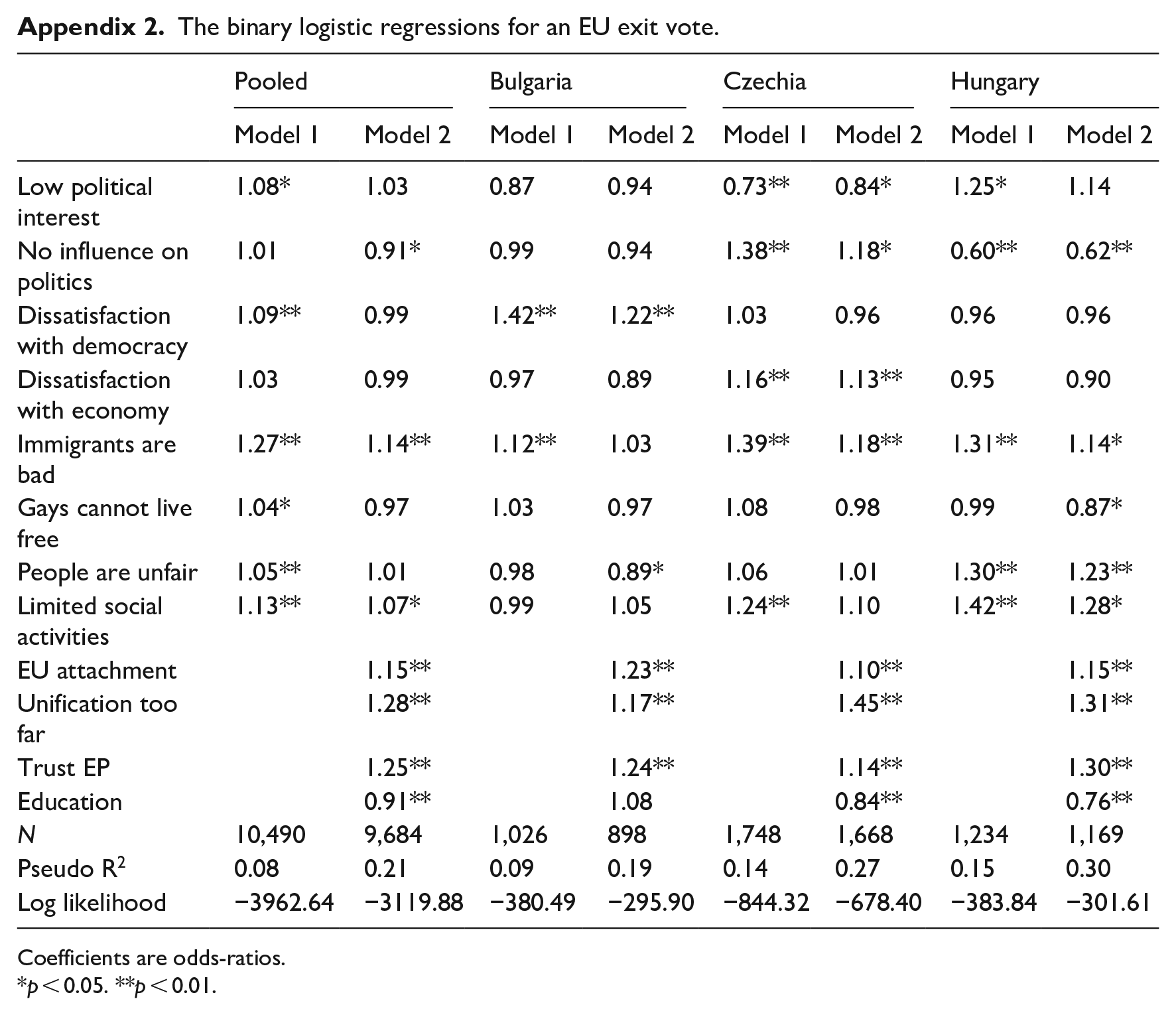
The effects on the EU exit vote in Eastern Europe are presented in Figure 2 and Appendix 2. The graph includes two models: one without the controls (Model 1) and one with the controls (Model 2). Model 1 provides empirical support for six out of the eight hypothesized effects. The findings illustrate that all variables for conservative values (H5 and H6) and social isolation (H7 and H8) have a statistically significant effect on a potential vote for an EU exit. Some of these effects are stronger. For example, the respondents with a negative attitude toward immigrants (H5) are 1.27 times more likely than respondents who have a positive attitude toward immigrants to vote leave. People who are socially isolated (H8) and have limited social activities are 1.13 times more likely to vote for an EU exit.
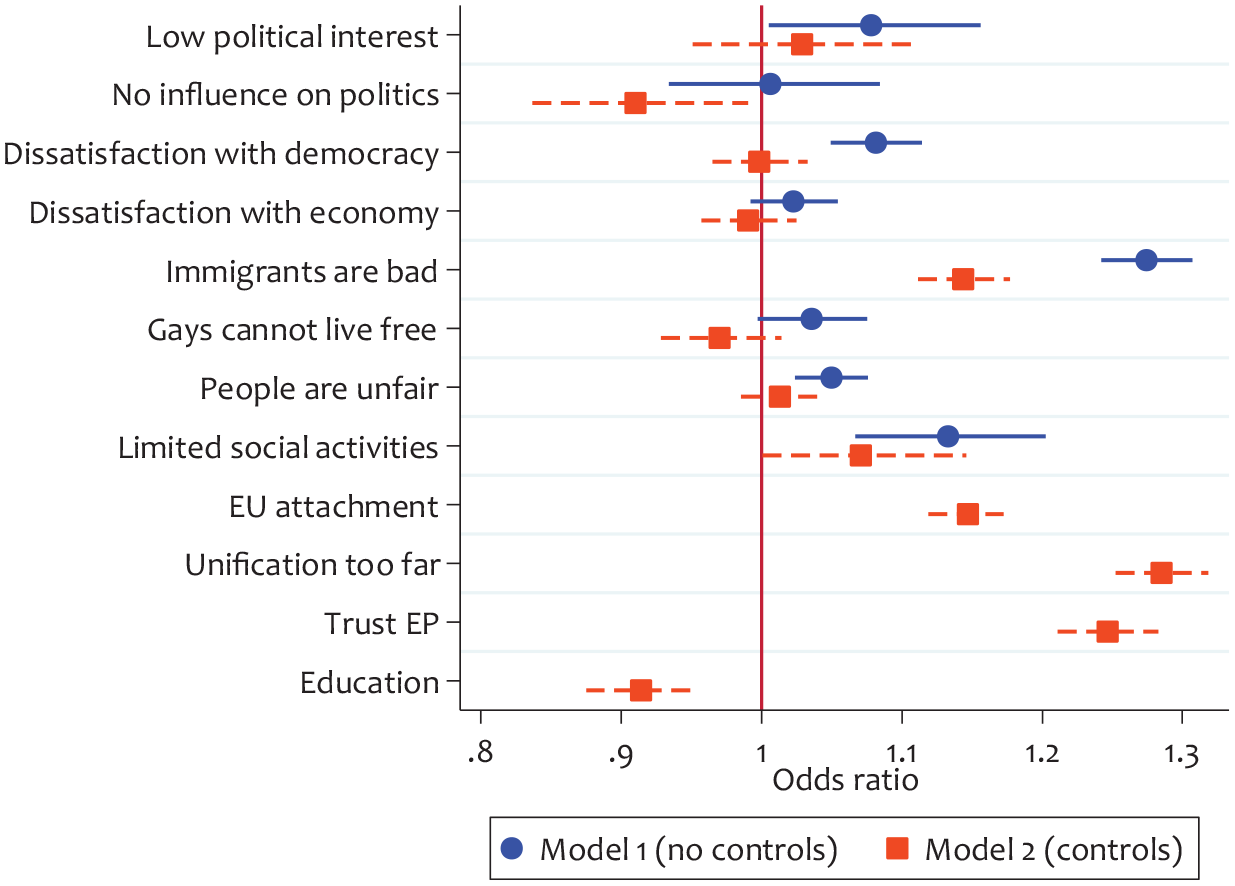
The effects on the European Union exit vote in Eastern Europe (pooled analysis).
There is also empirical support for one variable belonging to each of the other two categories of potential explanations: political interest (H1) and dissatisfaction with democracy (H3). However, the belief that the people have no influence in politics (H2) and dissatisfaction with the economy (H4) have no effect on the likelihood to cast a leave vote. In the case of dissatisfaction with the economy, one possible explanation for the lack of effect may be that citizens understood that the EU is not responsible for what goes wrong in the country’s economy. The positive economic trends following accession have often been considered a result of Europeanization. The problems encountered by many East European economies in the aftermath of the financial crisis appear to be decoupled.
Model 2 introduces the controls associated with anti-EU rhetoric, which appear to have a statistically significant effect on the likelihood to vote leave. For example, individuals who believe that EU unification has gone too far are 1.28 times more likely to cast a leave vote compared to citizens who believe that the EU can go further. Poorly educated people are also more likely to vote leave. Once we control for the general Eurosceptic attitudes, there is still strong empirical support for two hypotheses belonging to the conservative values and social isolation categories from the analytical framework: perceptions on immigration (H5) and limited social activities (H8). One effect goes against the hypothesis: those who feel they have no influence on politics (H2) are less likely to vote leave. One possible explanation for this result is that several respondents with anti-EU feelings perceive that people have influence on politics. One example in that direction is Brexit where the popular vote determined the Parliament’s decision although the referendum was not binding. Dissatisfaction with democracy has no effect when controlling for anti-EU feelings although it had a positive effect in Model 1. One explanation is that some of the citizens who are unhappy about democracy are also against the EU. Another variable with a similar change of effect is the conservative attitude toward sexual minorities (H6). When including the controls, this variable has a weak effect and loses statistical significance mainly because it is reflected in other anti-EU attitudes.
Country-level effects
The country-level comparisons provide important nuances and useful insights to the general picture. Figure 3 depicts the effects of all models without the controls (see Appendix 2). The results indicate that there are several common drivers of an EU exit vote across these countries. Similar to the results in the general analysis above, conservative values and social isolation are the two categories of determinants that have a strong and significant effect on the likelihood of an EU exit in each country. Negative perceptions about immigration (H5) and limited social activities (H8) provide the most consistent and strong effects, but the other two variables are often statistically significant in the hypothesized direction. In Czechia and Hungary, the first category of potential determinants (political apathy and alienation) has strong and statistically significant effects, but they are not always in line with the theoretical expectations.
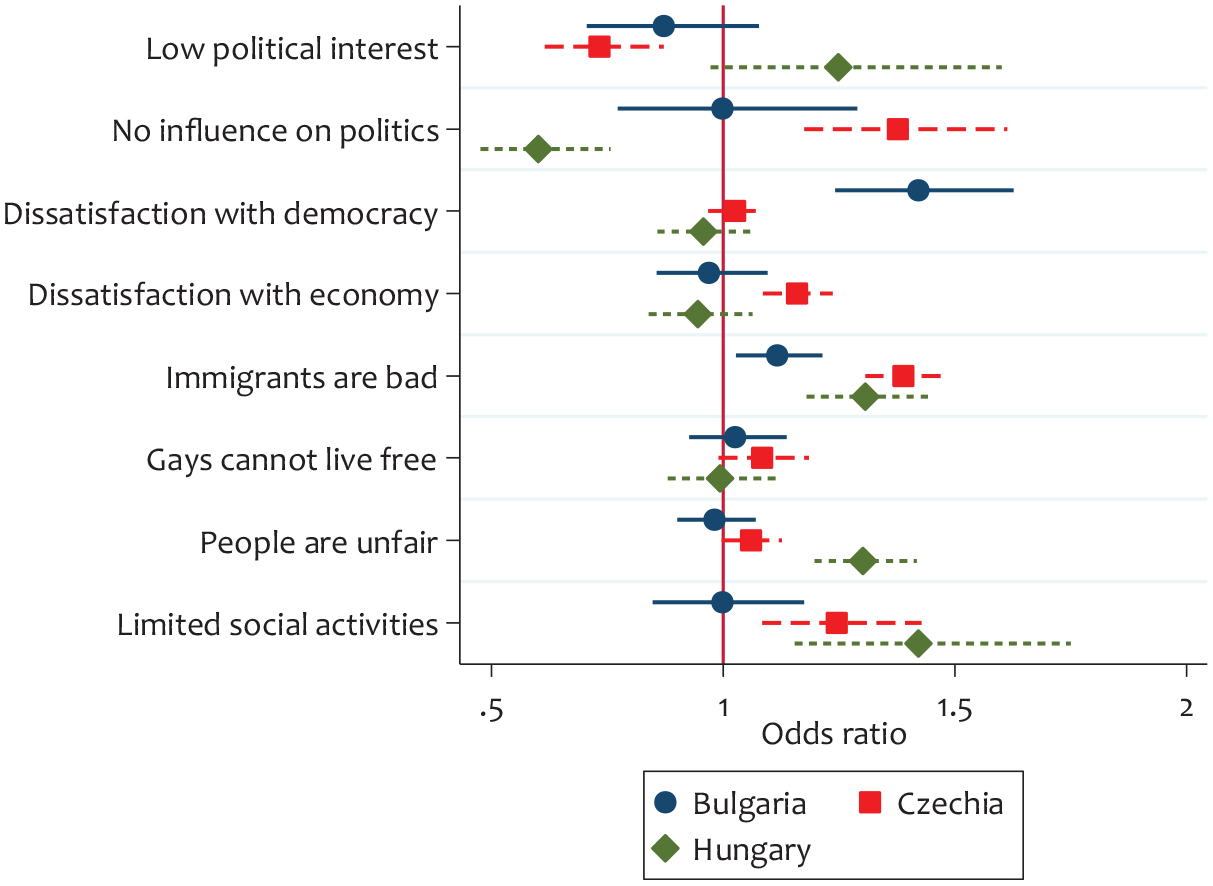
The effects on the European Union exit vote in Eastern Europe (country comparisons).
In addition to these common drivers there are also particular determinants that have contextual explanations. In Bulgaria, dissatisfaction with democracy is important for an EU exit vote and this observation matches what happened recently in Bulgarian politics. The population is increasingly dissatisfied with political institutions and politicians, which is reflected in the high number of protests throughout the country. This level of dissatisfaction can spill over to attitudes toward democracy and trigger an EU exit since the EU does not appear to solve the democratic problems in the country. The negative perceptions of migrants also fuel a leave EU vote, but their effect diminishes when controlling for general anti-EU feelings (Appendix 2). In Czechia, people who are dissatisfied with the economy (H4) are likely to cast a leave vote. Another strong effect goes against the hypothesized relationship: people with low interest in politics (H1) are less likely to cast such a vote. One possible explanation for which the Czechs who are interested in politics are more willing to vote leave is the development of critical attitudes toward the EU based on information. Czechia has had for a long time one of the highest numbers of critics of the EU, which remains a topic of debate in the political arena. Interested citizens are exposed to such debates and thus likely to adopt a position based on their content.
In Hungary, the people who believe they have no influence on politics (H2) are less likely to cast a vote to leave the EU. One possible explanation is that over the last decade Hungarians could observe how their vote was translated into decision-making. For example, Fidesz, the governing party since 2010, introduced many reforms backed by a large share of the population. Another example is how the 2016 referendum against the EU quota for refugees determined a particular course of action for the country.
Conclusions
This article aimed to explain why citizens in East European Member States would vote to leave the EU in the case of a referendum. The results indicate that conservative attitudes and social isolation are important determinants of an EU exit vote in Eastern Europe both in general and at the country level. Some of these observations hold also when controlling for broader anti-EU attitudes and education. This means that these specific categories of factors have an effect beyond the general determinants of Euroscepticism. To strengthen this idea, other variables such as low political interest or dissatisfaction with democracy may also be conducive to an EU exit vote. In addition to these observations, the comparison between countries shows that specific variables could influence a potential EU exit vote according to the domestic political dynamics.
Another important finding is that the political alienation and dissatisfaction with the economy have no effect on an EU exit vote. Citizens do not wish to leave the EU because they feel powerless in the decision-making process or because they blame the EU for the domestic economic situation. As such, this specific form of Euroscepticism is not rooted in the distance between the citizens and politics or in a punitive attitude as illustrated by previous research for other forms of Euroscepticism.
The study has two relevant implications for the broader field of Euroscepticism. At a theoretical level, it proposes an analytical framework that can explain a strong form of Euroscepticism associated with an EU exit vote. This framework includes political and social attitudes that are not traditionally linked to the EU. The results show that many of these influence an exit vote at either a pooled or country level. The explanatory power of this analytical framework is appropriate for country comparisons and it is improved within country-specific contexts. This framework could be developed further in studies aiming to explain similar strong Eurosceptic attitudes. At an empirical level, the finding that citizens are driven by different factors across countries is important. This means that the EU faces specific challenges across political settings. Since the EU is more contested by political elites in some East European Member States than in others, these elites may target some of the attitudes that favor this form of strong Euroscepticism.
Further research can take the discussion in the direction of explaining in detail the causal relationships. This article identifies several potential sources of an EU exit vote but does not explain how these may work. Such an explanation requires different types of data, which can be collected with semi-structured interviews, focus-groups or experiments. These can investigate what people consider to be the essence of such a vote and how they see the interplay between the domestic and European levels. Future research could also empirically test the extent to which the variables used in our analysis explain the specific and strong forms of Euroscepticism investigated in this article as opposed to other forms of Euroscepticism. A comparative analysis would use a separate design that has the different forms of Euroscepticism as dependent variables and several sets of general and specific explanations as independent variables. Another venue for research could be a comparison between the old and the new Member States in terms of these determinants. Such a comparison could test for additional variables that may mediate or complement the effects investigated here, which can also be analyzed at the country level.
Footnotes
Appendix
The binary logistic regressions for an EU exit vote.
| Pooled | Bulgaria | Czechia | Hungary | |||||
|---|---|---|---|---|---|---|---|---|
| Model 1 | Model 2 | Model 1 | Model 2 | Model 1 | Model 2 | Model 1 | Model 2 | |
| Low political interest | 1.08* | 1.03 | 0.87 | 0.94 | 0.73** | 0.84* | 1.25* | 1.14 |
| No influence on politics | 1.01 | 0.91* | 0.99 | 0.94 | 1.38** | 1.18* | 0.60** | 0.62** |
| Dissatisfaction with democracy | 1.09** | 0.99 | 1.42** | 1.22** | 1.03 | 0.96 | 0.96 | 0.96 |
| Dissatisfaction with economy | 1.03 | 0.99 | 0.97 | 0.89 | 1.16** | 1.13** | 0.95 | 0.90 |
| Immigrants are bad | 1.27** | 1.14** | 1.12** | 1.03 | 1.39** | 1.18** | 1.31** | 1.14* |
| Gays cannot live free | 1.04* | 0.97 | 1.03 | 0.97 | 1.08 | 0.98 | 0.99 | 0.87* |
| People are unfair | 1.05** | 1.01 | 0.98 | 0.89* | 1.06 | 1.01 | 1.30** | 1.23** |
| Limited social activities | 1.13** | 1.07* | 0.99 | 1.05 | 1.24** | 1.10 | 1.42** | 1.28* |
| EU attachment | 1.15** | 1.23** | 1.10** | 1.15** | ||||
| Unification too far | 1.28** | 1.17** | 1.45** | 1.31** | ||||
| Trust EP | 1.25** | 1.24** | 1.14** | 1.30** | ||||
| Education | 0.91** | 1.08 | 0.84** | 0.76** | ||||
| N | 10,490 | 9,684 | 1,026 | 898 | 1,748 | 1,668 | 1,234 | 1,169 |
| Pseudo R2 | 0.08 | 0.21 | 0.09 | 0.19 | 0.14 | 0.27 | 0.15 | 0.30 |
| Log likelihood | −3962.64 | −3119.88 | −380.49 | −295.90 | −844.32 | −678.40 | −383.84 | −301.61 |
Coefficients are odds-ratios.
p < 0.05. **p < 0.01.
Acknowledgements
The authors are grateful to Gábor Tóka, Zachary Dickson, the participants in the European Social Survey Conference in Budapest (2020) and the participants in the Seminar Series of the Department of International Studies and Contemporary History at Babes-Bolya University Cluj, the three anonymous reviewers and the editor for their constructive comments and excellent suggestions on earlier versions of this article.
Funding
The authors disclosed receipt of the following financial support for the research, authorship and/or publication of this article: This article is based upon work from COST Action ‘Constitution-making and deliberative democracy’ (CA17135), supported by COST (European Cooperation in Science and Technology).
