




Abstract
The fracture between citizens and elites on European integration remains understudied, most notably when it comes to specific issues. One of these issues, particularly salient in the aftermath of Brexit, is holding further European Union exit referendums across the Union. While regularly floated by (Eurosceptic) parties for electoral purposes, it remains unclear to what extent parties and citizens agree to actually hold European Union exit referendums. We examine the relationship between party and citizen stances on this issue in 10 European Union member states, leveraging original cross-country survey data and expert survey data on parties’ positions, both collected in 2019. The results show that parties tend to be more against holding a European Union exit referendum than their voters, less so the more extreme parties. Moreover, higher media saliency correlates with greater party–voter congruence, and the issue is more polarised among the electorate than at the party level.
Introduction
Many feared, in the aftermath of the 2016 Brexit referendum, that holding similar referendums in other European Union (EU) member states would gain traction. The Telegraph (2016) called it a Brexit contagion, warning that the ‘UK vote raises fears of a tsunami of EU membership referendums’. Unsurprisingly, various politicians from the populist radical right spectrum jumped on the bandwagon, after campaigning for this already for years. Next to the more famous and mediatized examples – Geert Wilders demanding a Dutch ‘Nexit’ or Marine Le Pen asking for a French ‘Frexit’ – radical right parties in Greece, Denmark or Finland have advanced similar claims. However, public support of the EU has rather increased after Brexit, which subsequently also resulted in parties shying away from their previous calls to leave the EU (e.g. Chopin and Lequesne, 2021; van Kessel et al., 2020), even though the issue has recently returned to the electoral agenda, for example, during the 2025 German (Knight, 2024) and the 2023 Dutch (Ross et al., 2023) parliamentary elections.
Although calls for EU exit referendums have somewhat diminished in recent years, geopolitical developments across the globe showcase a strong push for protectionist and ‘we first’ narratives. To give just one particularly salient example, the re-election of Donald Trump at the US presidency was quickly accompanied by the radical disinvestment of the United States from several supranational organisations (e.g. WHO), and the drastic curtailing of outward-looking expenses in the federal budget (e.g. the dismantling of USAID). More in general, contentious issues related to the economy or immigration, and the EU’s response to them, remain likely to fuel nationalist sentiment and Euroscepticism in the (near) future. The latter may result in citizens wanting to have a say on their country’s EU membership, similar to Brexit in 2016, and political parties may capitalise on such feelings by promising to hold such a referendum.
Surprisingly, we do not know much about how parties and citizens across the Union stand on the issue of holding an EU exit referendum, and even less whether there is a consistency (congruence) between the opinions of parties and those of (their) voters. 1 Yet, such an understanding is likely to matter greatly in the context of increasing politicisation of EU issues across member states over the past decades. Events such as the economic crisis, the refugee influx and Brexit have fuelled the salience of EU issues for domestic politics (e.g. Börzel, 2016; Hooghe and Marks, 2018). Following the for many decades lasting permissive consensus, the changing ‘level of consensus surrounding the EU (. . .) is an important and under studied phenomenon’ (Down and Wilson, 2008: 46). The study by Bakker et al. (2020) shows the potential consequences of party–voter incongruence on political disaffection and support for anti-establishment parties across various EU member states (see also Erol et al., 2024; Stecker and Tausendpfund, 2016). In addition, considering the recurring use of national referendums to decide on EU-related issues (Mendez et al., 2014), a better understanding of party–voter congruence on opinions towards the potentially most far-reaching referendum seems fundamental, especially in light of Article 50 of the Treaty on European Union paving the way for a country’s EU withdrawal. Following in the tradition of (EU issue) congruence studies (Pareschi et al., 2023), a first research goal of this study is more descriptive to answer the question: What is the congruence of positions on holding an EU exit referendum between parties and their voters?
Looking at 10 EU member states (Czech Republic, Denmark, France, Germany, Greece, Hungary, the Netherlands, Poland, Spain and Sweden), our article considers congruence from related, albeit conceptually distinct angles. Next to the common many-to-one conceptualisation focusing on (1) the congruence of positions between parties and their electorates (e.g. Belchior, 2010), we also examine the system-level perspective in terms of (2) how polarised this discussion is among parties and the public across countries and (3) the (mis)match of such polarisation. We link original cross-country survey data with data from an expert survey on parties’ positions, both collected in 2019, that is, at a time when the UK was still negotiating its exit from the EU, with unknown consequences.
Next to the more descriptive and exploratory goal of mapping the voter–party congruence, a second research goal is to explain the level of convergence. To this end, we focus on both the party and country levels, which are commonly used in congruence studies and have been identified as the crucial levels of analysis (e.g. Dalton, 1985; Pareschi et al., 2023). We examine the relationship between factors associated with these two levels and convergence, that is, we ask: Which factors explain the congruence of positions between parties and their voters?
The contributions of our investigation are manifold. First, by leveraging new empirical evidence from citizens and experts, we are the first to map the convergence of citizen-elite opinions on holding EU exit referendums, and in a comparative fashion. Second, we examine congruence in two related perspectives, that is, party–voter congruence (e.g. Shim and Gherghina, 2020) and country-level polarisation of voters and parties (e.g. Goldberg et al., 2020), which are often investigated separately. Third, our results open up potential new avenues to investigate the centrality of EU-related issues in driving the electoral success of (extreme) parties, by showing whether – and for whom – such issues find an echo in their ‘base’ (Gherghina and Pilet, 2021; Jacobs et al., 2018; van Kessel et al., 2020). Fourth, by deepening our knowledge about party–voter linkages and their underlying reasons, our study indirectly contributes to a better understanding of the dynamics of (mis)representation of the electorate by the party system – an issue that is particularly salient against the backdrop of the consolidation of populist, Eurosceptic and generally anti-establishment movements in Europe and beyond (e.g. Huber and Ruth, 2017; Werner and Giebler, 2019).
Broadly speaking, our results indicate that parties are generally less supportive of holding an EU exit referendum than their voters. This gap is most pronounced among mainstream parties, as both left- and right-wing parties tend to be as supportive – or even more supportive – of such referendums than their voters. Media saliency also matters: the more coverage ‘EU exit’ receives in a country, the greater the alignment between parties and voters. At a systemic level, the electorate is highly polarised on this issue, but party positions vary considerably: in some countries parties are deeply divided, while in others they largely agree. This mismatch – especially weaker polarisation among parties – may fuel citizens’ frustration with a democratic system that fails to offer meaningful alternatives (e.g. Berger, 2017).
Theory
In the early days of the EU, European integration was an ‘elite issue’ finding little to no interest in the public. Yet, ever since the Maastricht Treaty (1992) the increasing EU politicisation meant that the issue is no longer an affair exclusively reserved for national and European elites. By contrast, political parties, citizens and other political groups have become more and more involved – and vocal – on the issue (Hooghe and Marks, 2009; Marks and Steenbergen, 2002). For overviews of the development of citizen and party stances on the EU see Hobolt and de Vries (2016) and Jolly et al. (2022). At the same time, the past decades saw a growing use of direct democracy across the world (Qvortrup, 2018). Since the early 1970s, EU referendums represent an integral part of the integration process and have been regularly used in several member states, particularly in the context of EU membership or other (looser) associations and relations with it (Mendez et al., 2014). Three attempts have been made so far to withdraw from the EU – or the European Community (EC) – via a national referendum. After the unsuccessful attempt in 1975 in the UK, the two following ones were ‘successful’, 1982 in Greenland and 2016 in the UK. The latter Brexit referendum was the first under the new withdrawal mechanism introduced by the Lisbon Treaty, Article 50 of the Treaty on European Union (TEU). As a result, parties and citizens’ groups can be expected to campaign for this option, backed up by a more realistic ‘threat’ scenario (see also Mendez et al., 2014).
The long-term consequences of leaving the EU are (still) unclear, including concretely when it comes to the last successful attempt (Brexit). In the case of less severe consequences than feared, EU exit referendums may become popular (de Vries, 2017; van Kessel et al., 2020). However, looking at the years and (national) elections since the 2016 Brexit vote, the principal proponents of an EU exit, the radical right parties, have mostly retreated from this position in the context of increasing public EU support (Chopin and Lequesne, 2021; van Kessel et al., 2020). However, the AfD’s discussion of a desired German EU exit during the 2025 German election campaign shows that this retreat may only be temporary (Knight, 2024).
Eurosceptic parties may have strong (electoral) incentives to call for EU referendums, surfing on the wave of populist sentiments on the rise across the EU (and beyond). On one hand, anti-EU referendums tap into sentiments of anti-elitism and anti-globalism at the heart of the ‘vertical’ conflict lines advocated by populist movements. On the other hand, by their institutional design, referendums are necessarily more inclusive and horizontal, thus finding a coherent echo into the populist claims for more direct democracy and stronger inclusion of ‘the people’ into decisional processes (Bowler et al., 2017; Mudde, 2007). Ultimately, the position towards holding an EU exit referendum may also represent EU attitudes more broadly, although the possible outcome of leaving the EU is not necessarily linked to very negative EU attitudes among citizens, as the latter rather result in preferences to (substantially) reform the EU, but not necessarily to leave it altogether (Goldberg et al., 2021a).
Party and Citizen Attitudes Towards the EU (Many-to-One Congruence)
Given our research interest in comparing party attitudes with the attitudes of citizens who are (potential) voters of that party, we consider the many-to-one congruence (Golder and Stramski, 2010) in terms of party–voter congruence as defined by Belchior (2010). 2 Previous research has analysed the congruence between party and citizen positions towards the EU, yielding to different conclusions (for an overview of the state of the art of congruence studies more generally, see Shim and Gherghina, 2020). In one of the earliest studies, van der Eijk and Franklin (1991) found a relatively good party–voter congruence on European integration matters, contested in more recent studies showing (strong) evidence of poor party–voter congruence (Mattila and Raunio, 2006; Thomassen and Schmitt, 1997; van der Eijk and Franklin, 2004) – leading some authors to conclude that ‘voters and their potential representatives are living in different European worlds’ (Thomassen and Schmitt, 1997: 181). Confirming the existence of a shift over time, Mattila and Raunio (2012) show that parties drift further apart from citizens on the EU dimension. A general finding is that parties are commonly more pro-EU than their voters (e.g. Mattila and Raunio, 2006, 2012; Thomassen and Schmitt, 1997).
Importantly, the quality of the party–voter link may also depend on the exact EU item or measure under consideration. Schmitt and Thomassen (2000) find a reasonable match for overall EU attitudes, but more diverging views when it comes to specific EU policy preferences. This study’s focus on positions towards holding an EU exit referendum contributes to the line of research examining congruence for more specific EU issues/policies (e.g. Goldberg et al., 2020; Schmitt and Thomassen, 2000; Thomassen and Schmitt, 1997). Given the paucity of evidence on whether there is any congruence between parties and their electorates on the issue, we first want to examine which positions voters and parties take on holding an EU exit referendum and, in doing so, map a possible link between parties and voters.
A practical reason why we focus on opinions about holding the referendum – and not voting preferences for or against an EU exit – is because deciding to hold the referendum in the first place is a required yet hypothetical first step. 3 Voting preferences for something that might not happen introduces an additional layer of abstraction, especially when it comes to the opinions of the public. Furthermore, and importantly, both parties and citizen groups may initiate and campaign for holding an EU exit referendum, thus allowing for a party–voter comparison in their positions, whereas only citizens would ultimately vote in the referendum. Concerning the latter, and more empirically, one should not equate support for or against an EU exit with the opinion on holding the referendum, as the relationship between these two measures is by no means deterministic, as shown by Eichhorn et al. (2021) and using our own survey data (see following data description).
Having mapped the party–voter congruence, we then aim to examine the possible reasons for higher or lower congruence. We do this both at the party level and at the country level (i.e. aggregating party-level congruence per country). Starting with the party level, Mattila and Raunio (2006) and Gabel and Scheve (2007) argue that smaller parties are ideologically more homogeneous than larger mainstream parties, which should result in higher party–voter congruence for smaller parties. Linking this idea to Zaller’s (1992) work, because of smaller parties’ provision of ‘a unified message, we would expect to see partisans’ opinions converge on their party’s position, which is the standard cue-taking effect described in the literature on public support for European integration’ (Gabel and Scheve, 2007: 42). Notwithstanding the confirmation of this argument in Mattila and Raunio (2012), the study by McEvoy (2012) partly finds higher congruence for larger parties, and this despite both studies relying on the same EES 2009 data. Yet, we follow the more common argumentation and expect a higher party–voter congruence for smaller parties (H1).
Another potentially relevant aspect is the ideological extremity of a party. Parties located more clearly on the left or right of the ideological spectrum tend to have a clearer policy profile and present more distinct viewpoints to their voters (Dalton, 1985; Mattila and Raunio, 2006). This ideological clarity should facilitate the match between a party and its voters. By contrast, more centrist parties often lack a similarly clear policy profile, which may result in lower levels of congruence. The studies by McEvoy (2012) and Lefkofridi and Casado-Asensio (2013) provide a more nuanced argument by further distinguishing between left- and right-wing parties (and between political dimensions). Indeed, most of the aforementioned party demands for EU exit referendums have been voiced by right-wing parties. However, albeit for different reasons than right-wing parties, also left-wing parties have voiced their preferences for an EU exit (e.g. Bertoncini and Koenig, 2014). Using the example of the ‘Lexit’ position, that is, the left leave campaign for Brexit, scholars such as Worth (2017) and Tuck (2016) argue that, as reform towards a social Europe is not achievable from within the EU, the natural position of the left should have been in favour of ‘Leave’ (see also Vankovska and Nakarada, 2020). In sum, both left- and right-wing parties may have an equally clear position when it comes to the possibility of holding an EU exit referendum in their country. Our hypothesis thus expects a higher party-voter congruence for more extreme parties (H2).
Turning to the country level, the party-level expectation of party size is easily transferable to the country level. For instance, Down and Wilson (2010) argue that party–voter congruence should in general be higher in countries with many smaller parties compared with national party systems consisting of fewer and larger parties. While some studies, mainly relying on the effective number of parties (ENP) measure, could partly confirm a positive association between ENP and congruence (Dolný and Baboš, 2015), other studies found no significant relationship (Mattila and Raunio, 2006, 2012). Yet, at the country level we expect that party–voter congruence is higher in countries with a party system consisting of many small(er) parties (H3).
A second potential structuring exogenous force at the country level is the media saliency of the ‘EU exit’ issue in the country. We expect that countries in which the issue is more salient in national media will be characterised by a higher party–voter congruence (H4). The rationale supporting this expectation is twofold: on one hand, issues that are particularly salient in the information environment can increase citizens’ involvement with (and knowledge/awareness of) such issues (Brians and Wattenberg, 1996; Hutchings, 2001), even beyond their initial preferences. On the other hand, and fundamentally, higher issue saliency should allow citizens to have a better image of the party landscape on that issue (Dejaeghere and van Erkel, 2017) – that is, the specific position that various parties hold on the issue, and to what extent that issue is salient for their party platform – which in turn would allow them to align their opinion on that issue much more closely with the parties’, enhancing voter–party congruence. The general mechanism here is thus top-down, with the availability of information at the contextual level creating better conditions for individual mechanisms, notably, an alignment of individual positions with a (better understood) party landscape. This overlap between citizens and their party reflects what is discussed in the literature on ‘correct voting’ (e.g. (Lau and Redlawsk, 2006; Nai, 2015). Citizens, according to these works, vote ‘incorrectly’ if their final decision would have been different if taken while holding full information on the issues at stake (Lau et al., 2008). Issue-related information provides the required elements for voters to match their values and preferences with the political offer. At the systemic level, this is likely to result in a greater alignment between parties and their voters on those issues. Otherwise said, enhanced issue information allows voters to match their positions with the party landscape more effectively, which results in an overall higher level of voter–party congruence.
Polarisation of the Debate
Next to party–voter congruence in a many-to-one conceptualisation, zooming out on the more systemic level is relevant as well. Following the conceptual discussion by Golder and Stramski (2010), it is equally crucial to examine how the collective body of (legislative) parties of a country reflects the respective country’s citizens (see also Devine and Ibenskas, 2021). In fact, from a democratic theory perspective going back to theorists like John Stuart Mill, the correspondence between the overall representative body and the nation as a whole might be even more relevant than single party–voter relationships (or the aggregation of them) (Golder and Stramski, 2010). We follow this argument by considering polarisation – typically more discussed at the party level – which represents the ‘degree of ideological differentiation among political parties’ (Dalton, 2008: 900). Ideally, party-level polarisation should match the polarisation/dispersion of voters along a given dimension, for example, concerning European integration (Dalton, 2008; Downs, 1957). A more diverse set of parties can better represent different issue positions and give more weight to those issues (Dalton, 2008). By contrast, in case of a mismatch of party–voter polarisation, (more polarised) voters may perceive the ‘democratic system as not the quintessential environment to protect people’s identities, values and interest’ (Erol et al., 2024: 3). In the context of increasing EU politicisation, party systems should reflect the increasing dispersion of citizens’ EU attitudes by offering more dispersed party choices (Dalton, 2008; Goldberg et al., 2020).
So far, only little research examined the dispersion and polarisation of EU attitudes at the party and/or voter level. The study by Mattila and Raunio (2012) showed a lower dispersion on EU issues among parties than among voters. One of the few studies that examined polarisation at the citizen level is by Down and Wilson (2008), showing declining levels of consensus and increasingly dispersed public attitudes. The more recent comparative study by Goldberg et al. (2020) shows a relatively strong association between citizen- and party-level polarisation, and highlights larger differences in polarisation between parties and citizens for more specific EU policies (asylum and budget) compared with general EU attitudes. Given the scarcity of evidence, our goal is to explore the level of party- and citizen-level polarisation for the specific EU exit referendum and its (mis)match.
In the context of this more exploratory goal, and while we refrain from formulating detailed theoretical expectations about polarisation levels, we nevertheless want to mention some related arguments. According to Devine and Ibenskas (2021), a high party–citizen congruence in polarisation may be found due to successful challenger parties (including populist right parties) that compensate for the convergence of (and thus less polarised) mainstream parties on EU issues. Alternatively, mainstream party convergence may be accompanied by similar citizen convergence, for example, as observed in increasing EU support after Brexit.
Data and Methods
For our analysis, we link party information from an expert survey and citizen information from a general population survey for 10 EU member states: Czech Republic (CZ), Denmark (DK), France (FR), Germany (DE), Greece (GR), Hungary (HU), Poland (PL), Spain (ES), Sweden (SE) and the Netherlands (NL). The 10 countries represent the diversity of the EU by including smaller and larger countries, geographically spread across Europe, with varying degrees of EU support and with varying experience in the use of referendums. They furthermore differ in the extent of their ‘viable EU exit option’ (de Vries, 2018) and their propensity to leave the EU (Gastinger, 2021), two indicators that may be relevant for both parties’ and citizens’ positioning towards holding an EU exit referendum. 4
Expert Survey
Information about the position of parties on the ‘EU exit referendum’ issue comes from a large-scale expert survey that was conducted in the direct aftermath 5 of the 2019 European Parliament (EP) elections across all 28 EU countries – the 2019 European Parliament Election Expert Survey dataset (EPEES_19; Nai et al., 2019). We can only use the 10 countries mentioned before because the remaining 18 are not included in the citizen survey we use. The dataset replicates the procedure developed for national elections worldwide (Maier and Nai, 2020; Nai, 2020), where country-specific samples of scholars with expertise in electoral politics and political communication are asked to rate the content of party campaigns on relevant dimensions. Expert surveys are a widespread instrument to assess the position of parties on issues (e.g. Bakker et al., 2015) and often used in congruence studies (Shim and Gherghina, 2020); if they have received substantial methodological critiques over the years (e.g. McDonald et al., 2007), expert surveys tend to align rather effectively with the perceptions of citizens (Bakker et al., 2015), making them a particularly relevant instrument in our case. Several studies highlight a high coherence between experts regarding the positioning of parties (e.g. Hooghe et al., 2010), and the extent to which the ideological stance of experts affects their judgements should not be overestimated (e.g. Nai and Maier, 2019).
Parties were included in the questionnaire to account for their relative strength in pre-electoral polls (e.g. POLITICO’s ‘Poll of Polls’) 6 and recent national elections, while excluding excessively small and marginal parties. Up to 10 parties per country were included in the questionnaire; furthermore, the selection of parties covers a substantial share of the votes cast in the most recent national election in each country, that is, on average, the selected parties represent 89.6% of the votes cast (between a minimum of 79.9% for France and a maximum of 94.5% for Germany).
In total, 381 of the 2525 experts contacted answered the questionnaire, which makes a response rate of about 15% (13.6 experts per country on average); for comparison, the 1999–2010 Chapel Hill Expert Survey (CHES) (Bakker et al., 2015) reports an average of 12.8 experts per country. The number of expert ratings collected varies considerably across the 28 countries. Table A1 in the Appendix details the response rate for the 10 countries included in this article.
Relevant for this study is the question to evaluate to what extent the selected parties are generally ‘in favour of or against holding a referendum about the country’s EU membership’ (from 0 ‘fully against holding a referendum’ to 10 ‘fully in favour of holding a referendum’). Experts were quite consensual in their assessments. On average across all parties, the standard deviation of their assessments is SD = 1.8, which is relatively reasonable on a 11-point scale. Figure 1 displays the average expert positioning of the parties per country along the 11-point scale (on the x-axis), using the official party acronyms; the right-hand side of the graph, that is, higher values, reflects support of holding the referendum. 7
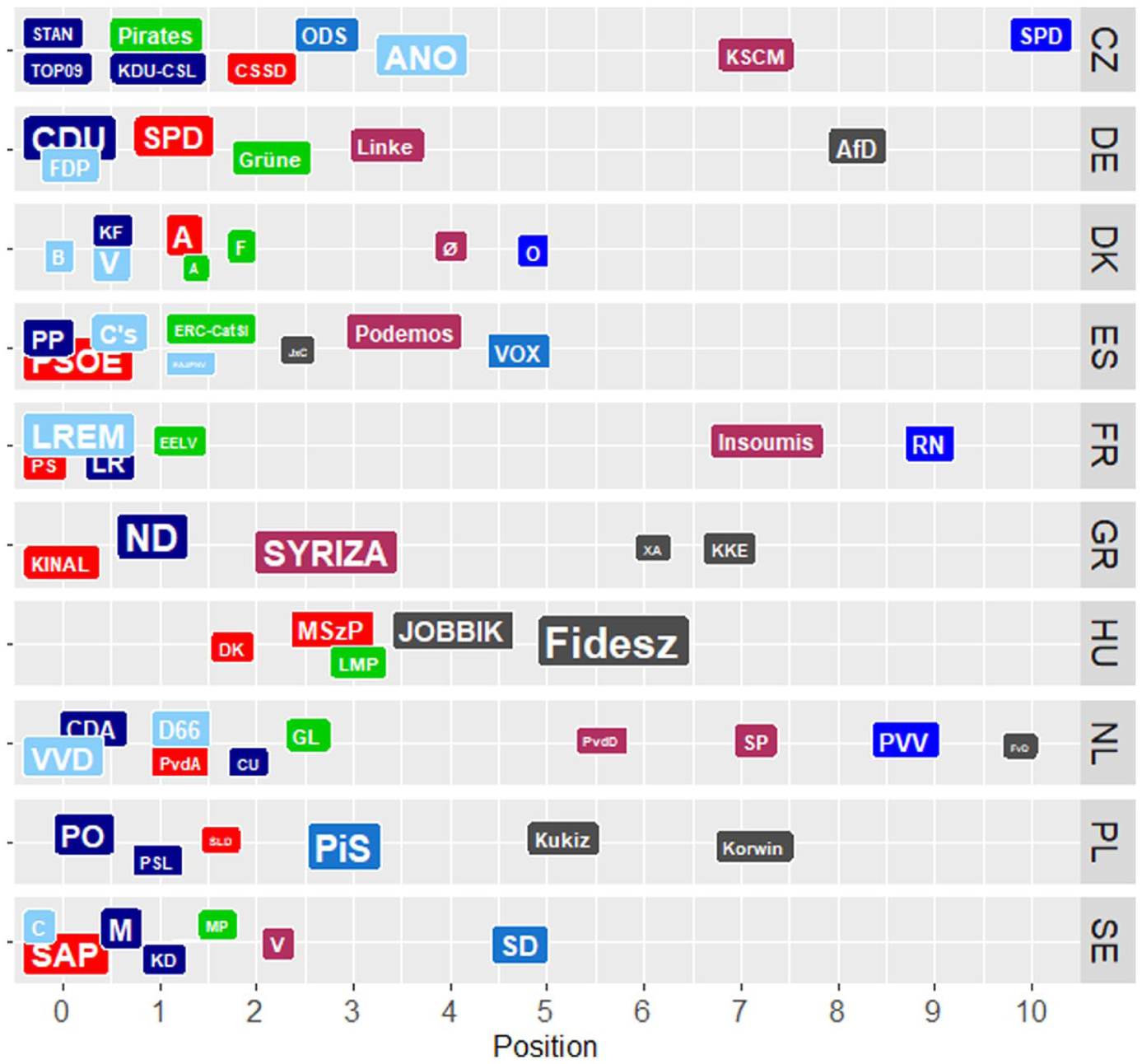
Party Positions Towards Holding an EU Membership Referendum Across Countries.
Citizen Survey
For the citizen information, we use original survey data collected as part of a larger multi-country project in cooperation with Kantar using Computer Assisted Web Interviewing (CAWI) (Goldberg et al., 2021b). The databases from which the country samples were drawn stem from Kantar themselves or partner-panels such as Lightspeed. Non-interlocking quotas on age, gender, region and education were enforced in sampling from these databases. The survey followed a panel logic with the wave of interest for this study running between 5 and 24 April 2019, that is, the data collection happened ca. 1.5–2 months before the expert survey. The final numbers of respondents per country are: NCZ = 1507, NDE = 1749, NDK = 1631, NES = 1579, NFR = 1984, NGR = 2083, NHU = 1289, NNL = 1637, NPL = 2253, NSE = 1315 (Ntotal = 17,027).
The main variable of interest asked respondents: Sometimes there is discussion about the possibility for [NATIONALITY] citizens to express their opinion in a referendum on whether [COUNTRY] should remain in the EU or leave the EU. Are you in favour or against holding a referendum about [NATIONALITY] EU membership?
The answer scale ranges from ‘fully against holding a referendum’ (1) to ‘fully in favour of holding a referendum’ (7) with a labelled middle point ‘neither in favour nor against holding a referendum’ (4). The respondents’ positioning follows a tripolar distribution with roughly 25% of responses each located at the extremes of the scale or in the middle of it. 8 The mean respondent position in the pooled dataset is almost perfectly in the middle of the scale (M = 4.02, SD = 2.19). The country-specific patterns are displayed in Figure A2 in the Appendix.
Method
For party-level congruence, we compare the positions of voters and their preferred parties. This requires a harmonisation of the citizen-survey 7-point answer scale compared with the 11-point scale in the expert survey (both scales represent a symmetrical bipolar scale with a middle point and equally labelled end points). To match both scales, we transformed the expert scale to fit the 1–7 citizen answer scale. This should not pose any problem as for the party-level position we rely on the average expert value, which usually does not represent a ‘full’ number anyway.
For the definition of party voters, we use survey information about respondents’ voting intention in national elections. 9 By excluding intended non-voters, and small party voters, the number of respondents is reduced by 30% with a total remaining N = 11,881 used for the congruence measure. 10 The literature offers several ways to calculate voter–party congruence. We focus on two of the most common measures. First, we measure congruence as the absolute voter–party distance – independent of the direction – by calculating the mean absolute distance between each voter’s position and the respective party position (e.g. Costello et al., 2012, 2021). Second, in order to see the direction of the difference, we also calculate the simple mean voter-party distance, partly called ‘bias’ in the congruence literature (e.g. Mattila and Raunio, 2012). We calculate both congruence measures at the party level, as well as at the country level. When calculating the country-level congruence, we follow the same procedure but calculate the congruence per country instead of per party. This implies that the country-level congruence represents the national parties according to the share of intended voters in the survey, that is, we do not add external weights to adjust it to election outcomes or similar.
For the measurement of polarisation, we use the polarisation index by Dalton (2008):

with v = vote share, p = party position,
The Dalton index includes both the relative position/extremity of each party, by subtracting the average position of all included national parties p from the respective party’s position pi, and the size of each party, by weighting it according to its received vote share v. For the latter we use the vote shares of the last national election before data collection or the one having followed suit after, that is, we still consider the 2019 Danish (June 5) and Greek elections (July 7). The polarisation index ranges from 0 to 10, with higher polarisation values when parties are more dispersed along the 11-point scale, particularly so when extreme positions are taken up by large parties.
To calculate the citizen-level polarisation, we use the same formula by simply giving an equal weight (v = vote share (in %) in original equation) of 100/n (with n = number of respondents) to each individual citizen position. 11 Because our citizen-level variable of EU exit referendum attitudes is a 7-point scale – instead of an assumed 11-point scale in Dalton’s index (and our party-level variable) – we had to use a denominator of 3 (instead of 5) in the equation above to standardise the citizen-level polarisation values to the min/max range between 0 and 10.
As an alternative measure for polarisation, we also calculate the (vote-weighted) compactness measure by Alvarez and Nagler (2004). Instead of being an absolute measure of dispersion for either the citizen or the party level separately, this measure provides information about the dispersion of citizens’ positions relative to the dispersion of parties’ positions. Mathematically speaking, it divides the standard deviation of citizen positions by the summed (and vote weighted) distances of party positions. Values of 1 represent an equal dispersion of the two levels, while values below 1 represent relatively more dispersed parties compared with a more clustered citizen opinion on the issue, and values above 1 represent the opposite, with the electorate being more dispersed than the parties. As it is a metric-free measure, it allows for an easy comparison across countries and to validate the differences in absolute polarisation levels between citizens and parties.
Explanatory Factors
For testing our expectations H1–H4, we use both variables from the expert survey and additional external sources. Party size (H1) is operationalised as the vote share a party received in the last/current national elections, as retrieved from official national election authorities. The country-level equivalent uses the mean party size per country (H3), that is, the mean vote share per country, restricted to the parties we used for the party–voter linkage. Party extremity (H2) is based on a 1–7 left–right scale from the expert survey, which we first recoded into a −3 to +3 scale. We then took the absolute values, so that both very left (−3) and very right (+3) parties received the value 3 on the final 0–3 scale. Media saliency in a country (H4) reflects how prominently the possibility of a country leaving the EU was featured in media coverage. It is derived from a manual content analysis of EU-related news items published between March and June 2019 across major TV news programmes, online outlets and newspapers in 10 countries (79 outlets in total) (Brosius et al., 2021). Human coders identified whether stories mentioned a potential exit and, if so, how it was evaluated. For the saliency score, all mentions of a potential exit (regardless of evaluation) were summed up and divided by the total number of EU-related news items per country. This proportion indicates the relative importance of an EU exit within each country’s EU media coverage. Table A2 in the Appendix provides more details for this and the other country-level variables, while Table A3 presents descriptive values per country.
Given the small N of 10 countries, we (can only) employ simple correlation measures to test our hypotheses at the country level (H3 & H4). For the party-level hypotheses H1 and H2, we equally employ simple correlation measures, but mainly rely on regression models (using country-clustered standard errors) by benefitting from the higher N of 70 parties under study. The regression models control for the occurrence of national elections around the period in which the citizen survey was conducted, that is, April 2019, as the importance of EU issues tends to be greater during election periods than during non-election periods. We have included a dummy variable representing the three countries – Denmark, Greece and Spain – that held national elections no more than 3 months before or after the survey was conducted.
Results
This section mirrors the structure of our theoretical section. We begin by presenting descriptive evidence of party–voter congruence at the party level across all 10 countries, followed by statistical tests addressing H1 and H2. Next, we examine party–voter congruence at the country level, again starting with descriptive evidence before testing H3 and H4. Finally, we take a systemic perspective, assessing how polarised the debate is at both the citizen and party levels.
Congruence (Party Level)
We start with congruence at the party level, both calculated as the simple party–voter difference and the absolute one. The simple mean differences between each party and its voters are displayed on the x-axis in Figure 2. Overall, most differences are negative, which means that parties are less in favour of holding an EU exit referendum than their voters. When looking at the size of this bias, we observe in several countries that it is the more extreme parties which show the least negative differences (or partly even positive differences). Interestingly, this holds for extreme parties from both the right and the left, for example, in the Czech Republic (KSCM and SPD), France (FI and RN), Germany (AfD and Linke) and Greece (XA and KKE), where these parties are relatively speaking more in favour of holding an EU exit referendum than their voters compared with more mainstream parties. In the three largest countries under study, the ideologically most right-wing parties match their electorate especially well by displaying almost no mean difference (i.e. RN in France, AfD in Germany and Vox in Spain). An outlier to the overall pattern of mostly negative mean differences is the Netherlands, where about half of the parties each are less or more in favour of holding an EU exit referendum than their voters. Similar to the patterns in the other countries, the most positive differences in the Netherlands include extreme parties on both the right (PVV and FvD) and left side (SP) of the political spectrum.
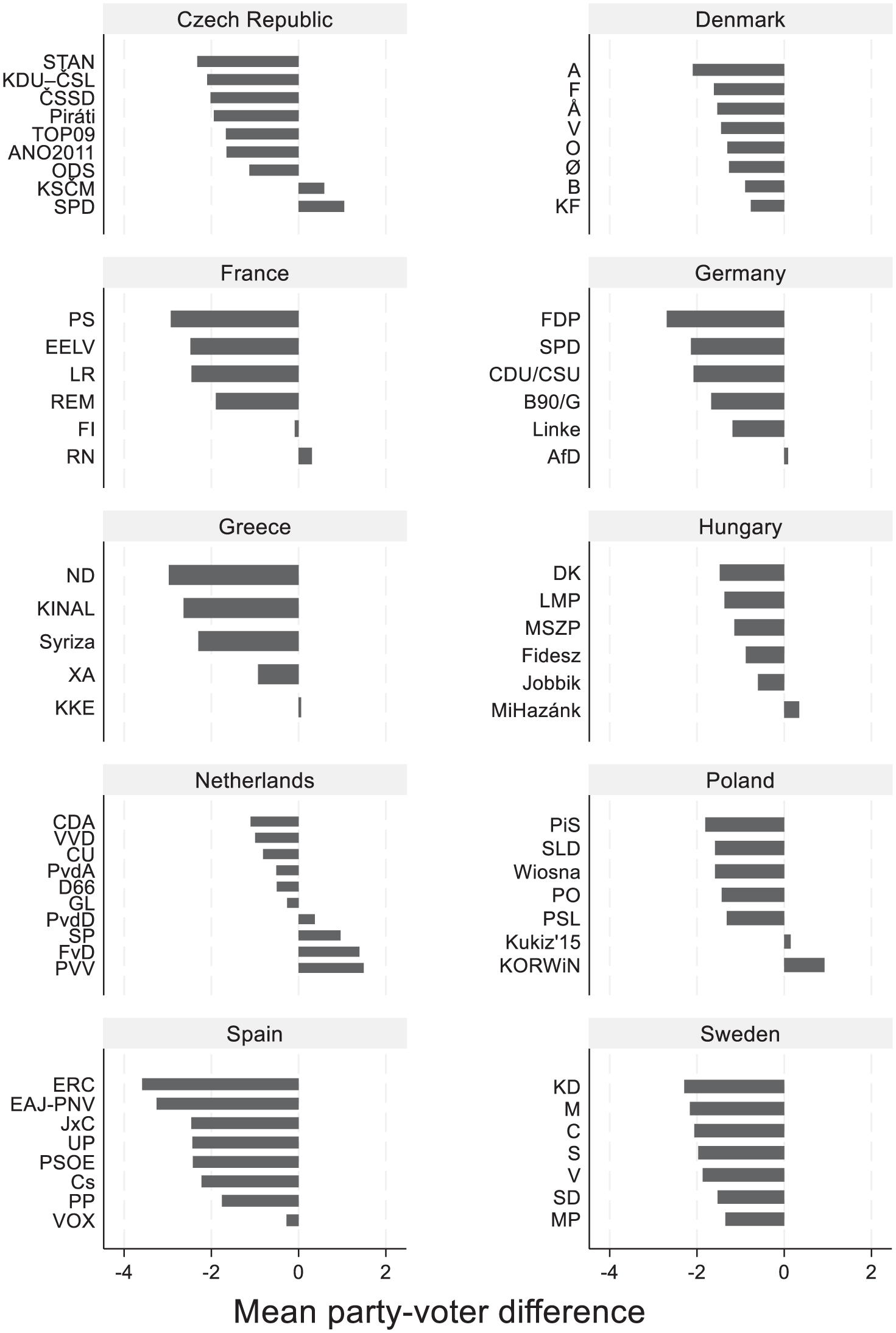
Congruence Across Parties and Countries (Simple Difference).
In terms of absolute differences, Figure 3 shows some very similar party orders across countries (though in reverse order), especially in countries where party–voter differences were almost uniquely negative in Figure 2, for example, in Germany, Denmark, Spain, France or Greece. In countries such as the Netherlands, with previously more mixed positive and negative differences, the order of the absolute differences is unsurprisingly a bit different. Overall, in most countries, we again observe the highest congruence, that is, shorter bars on the x-axis, for more extreme parties from either the left and/or right, for example, in Czech Republic, France, Germany, Greece, Hungary and Spain. While one commonality of those parties with the smallest absolute differences is their anti-EU positions, in several other countries the pattern with the highest congruence among anti-EU parties does not hold, for example, in the Netherlands, Poland or Sweden, and partly also Denmark.
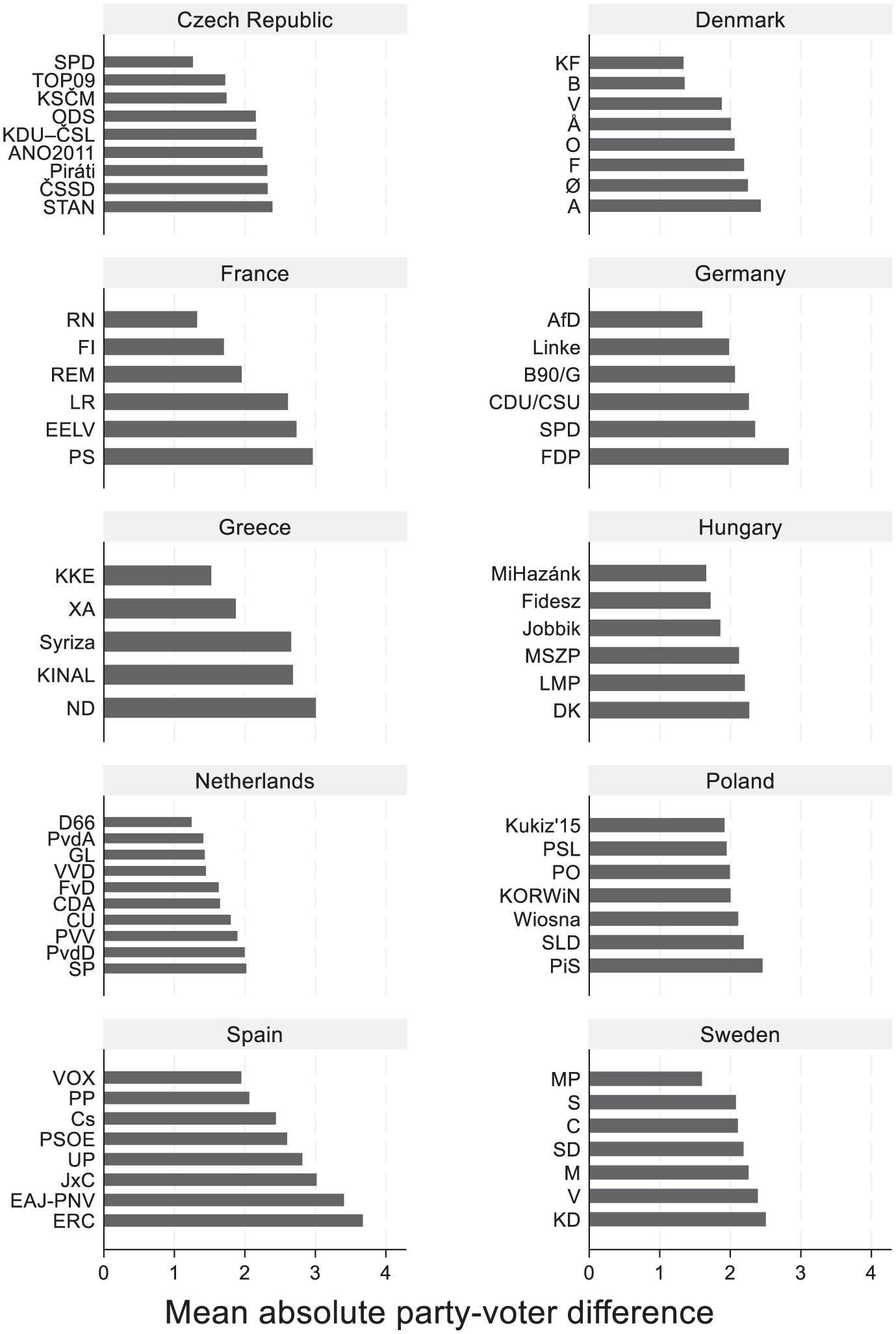
Congruence Across Parties and Countries (Absolute Difference).
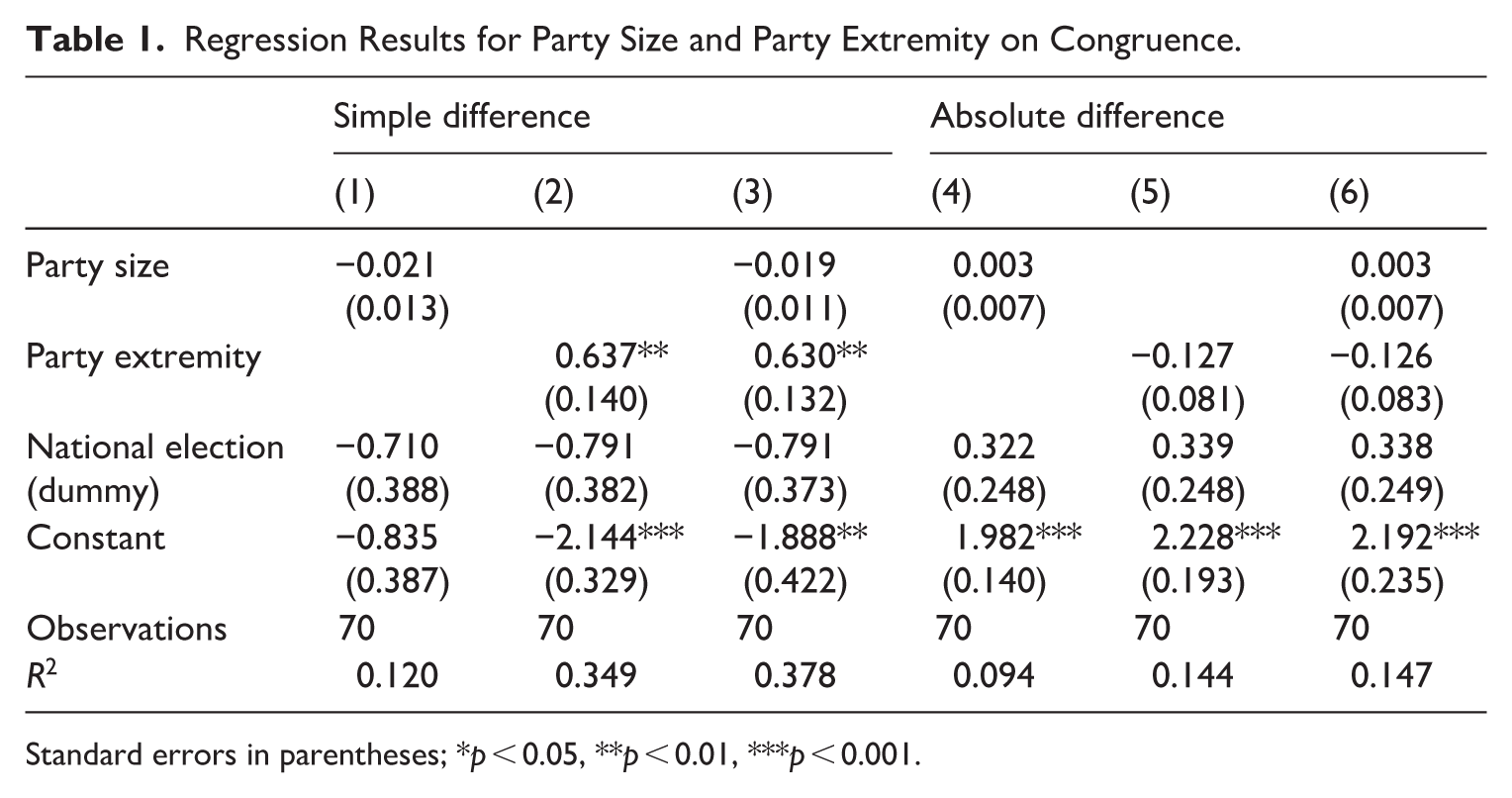
To put these descriptive patterns to a more formal test, we turn to our statistical analyses for the respective hypotheses. First, we expected a higher congruence among smaller parties (H1), because of their potentially more homogeneous party stance on an EU exit referendum. However, calculating simple correlations between party size and both the simple (r = −0.19) and absolute (r = 0.06) mean party–voter differences, no such relationship can be established (p > 0.1). Similarly, when regressing party size on the two congruence measures, Models 1 and 3 in Table 1 do not display a significant party size coefficient.
Regression Results for Party Size and Party Extremity on Congruence.
Standard errors in parentheses; *p < 0.05, **p < 0.01, ***p < 0.001.
Second, we expected a higher congruence for ideologically more extreme parties(H2). Calculating simple correlations yields a highly significant one between extremity and the simple mean party–voter difference (r = 0.49; p < 0.001) and a weaker and only marginally significant one for the absolute difference measure (r = −0.21; p < 0.1). These results are confirmed by the regression models in Table 1. Party extremity has a significantly positive association with congruence when considering the simple difference (Model 2). In the context of the overall mostly negative party–voter differences (see Figure 2), this means that party-voter differences for more extreme parties are less negative or even turn into positive differences. Related, the extremity coefficient in model 5 points to a negative association with congruence in terms of the absolute difference, i.e. smaller party-voter differences between extreme parties and their voters, but fails to reach statistical significance. These results remain stable when controlling for party size in Models 3 and 6. 12
To examine whether the effect of extremity is driven by parties located on only one side of the ideological scale, for example, that only right-wing parties drive the results, we calculated a robustness check by focusing on the original 7-point left-right scale we used to recode extremity. The results in Table A5 in the Appendix confirm an effect of extremity for the simple difference measure. That is, the squared left–right term, and not the simple left–right scale, is significant in Models 2 and 3. We again find no effects for the absolute congruence models, neither for the simple nor the squared left–right scale in Models 5 and 6.
Congruence (Country Level)
We now turn to congruence at the country level, that is, the aggregated difference between parties and voters. Figure 4(a) displays the simple difference and Figure 4(b) the absolute difference on the x-axis. In line with the party-level patterns, we observe mainly negative simple differences, meaning that parties are on average more against holding an EU exit referendum than their voters. The only exception is the Netherlands, where parties and voters have a very similar mean position. The differences in the other nine countries are remarkable with up to −2.25 points difference on the 7-point scale. The order of countries is relatively similar when looking at the absolute differences (Figure 4(b)), with the Netherlands now a less extreme outlier. Overall, the mean absolute differences in most countries are around two points, which is substantial on a 7-point scale.
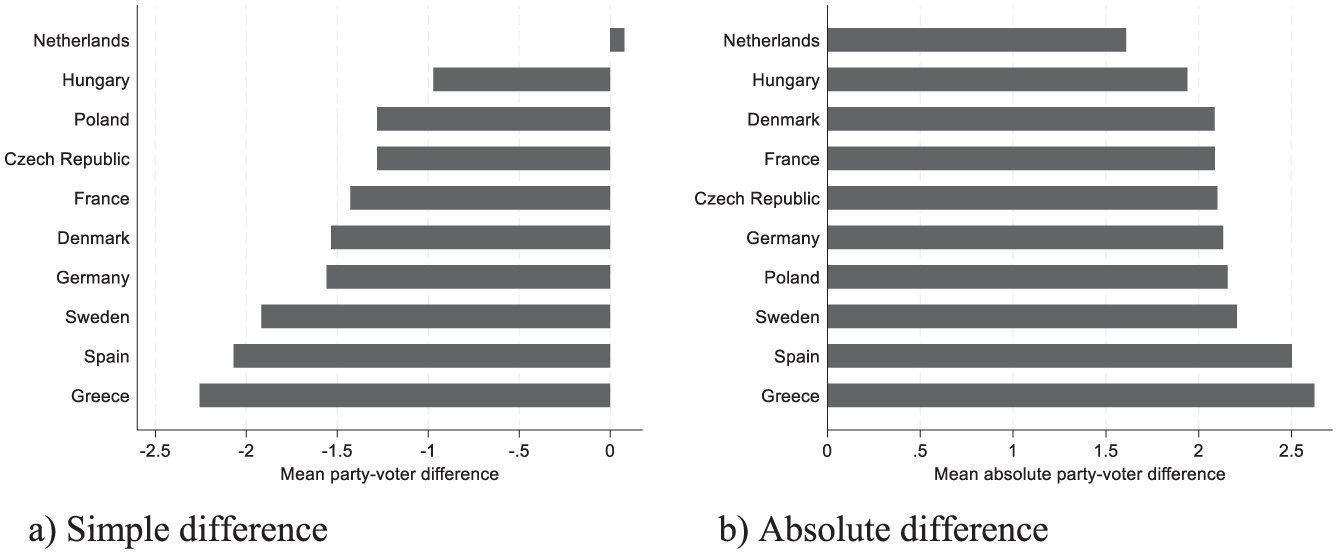
Congruence across Countries: (a) Simple Difference and (b) Absolute Difference.
As potential explanatory factors of country-level differences, we first expected that the structure of the national party systems, in particular a larger number of smaller parties, may be responsible for higher congruence (H3). Simple correlations between the mean party size and the two congruence measures show moderate relationships (r = −0.51 and r = 0.50), however, fail to reach statistical significance (p > 0.05). We further expected higher congruence in countries in which the topic of an EU exit is more salient (H4). Looking at the correlations between this measure and the two congruence measures supports our expectations. We find relatively strong correlations for both measures (r = 0.68 for the simple and r = −0.64 for the absolute measure) that are also statistically significant (p < 0.05). This means that a higher media saliency of the topic is indeed related with higher party–voter congruence at the country level.
In addition to these two expectations, we also calculated correlations of congruence with the countries’ propensity for an EU exit based on Gastinger’s (2021) index, mainly for methodological reasons. While our country sample represents varying levels of viable EU exit options (see data description), we want to make sure that this selection does not pre-determine party–voter congruence, in the sense that in countries with lower EU exit propensities citizens have higher incentives to align with the traditional pro-EU elite consensus. We observe (very) small correlations (r = 0.03 for the simple and r = −0.21 for the absolute difference), which point to the absence of potential sample selection effects. Hence, there is more to the country-level congruence patterns than a rather simple split between potential EU exit countries and others. Table A4 presents an overview of all tested country-level correlations.
Polarisation
Finally, we turn to polarisation of both the citizen and party level and their similarity. Figure 5 displays the polarisation of citizens (red text boxes) and parties (blue boxes) along the x-axis (higher values representing higher polarisation), as well as the alternative measure of compactness in orange (positioning along the x-axis without any meaning). We first note the very similar, and high polarisation of citizens across all 10 countries (strongly aligned red boxes). On average, the polarisation amounts to values between 7 and 7.5, which is comparatively high on the 0–10 scale. There is thus a significant amount of disagreement between citizens about whether to hold an EU exit referendum or not. By contrast, we observe not only lower levels of party polarisation (see also results in Real-Dato, 2017) but also greater cross-country variation at the party level (spread-out blue boxes). Whereas in some countries parties are strongly polarised on the issue, for instance, in France or the Netherlands, in other countries such as Hungary, Spain or Denmark, parties are very much in agreement with each other. While this means parties prefer to rather not hold an EU exit referendum in Spain or Denmark, the strong party agreement in Hungary is representing a somewhat more moderate position (see Figure 1).
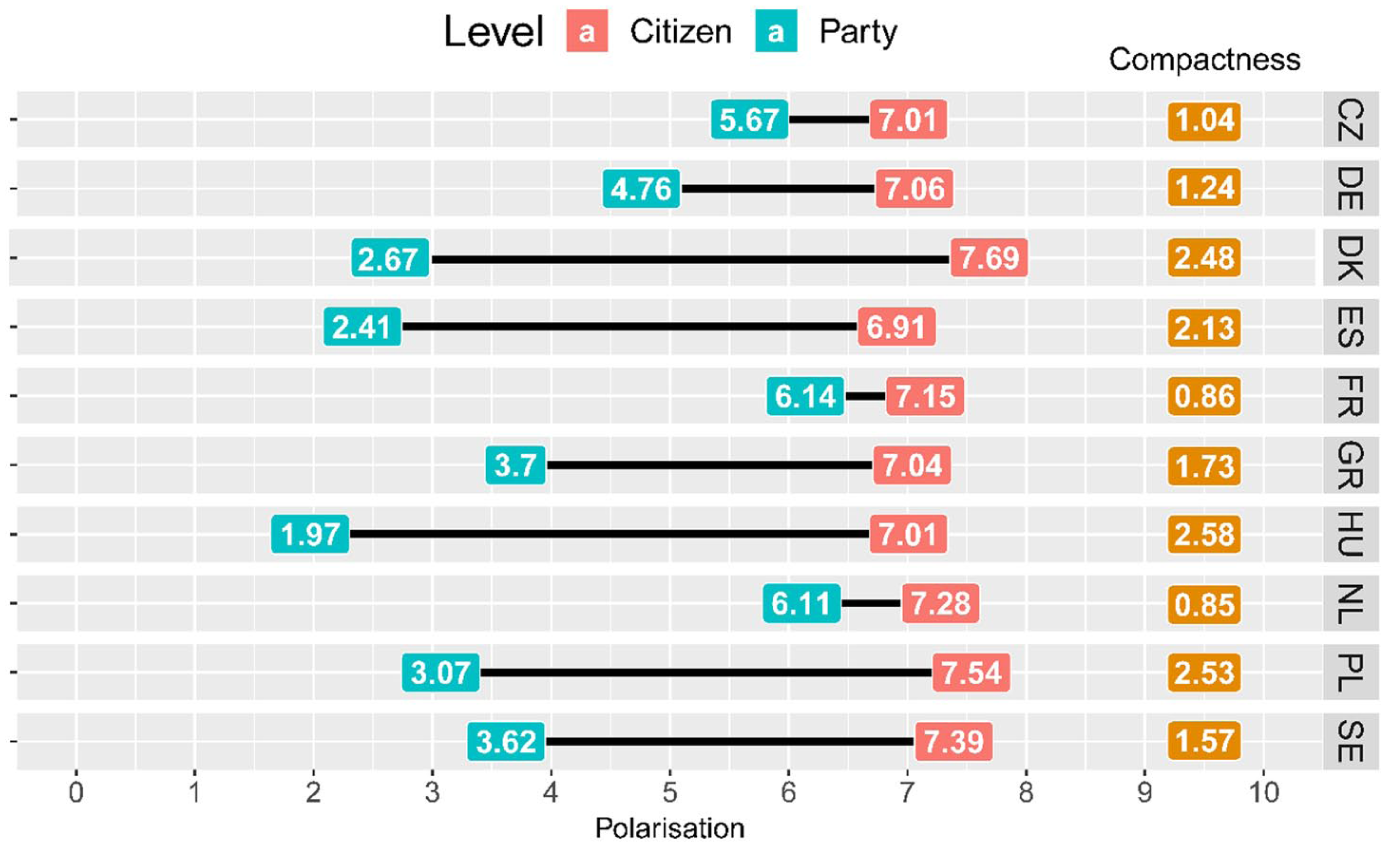
Polarisation Among Parties and Citizens (Plus Compactness).
The similar cross-country polarisation among citizens but diverging party polarisations results in strong differences in terms of the similarity of the two polarisation levels across countries (represented by the thick black lines between the blue and red boxes). Party- and citizen-level polarisation differs only by 1–1.5 points in countries such as France, the Netherlands or the Czech Republic, while it amounts to 4.5–5 points in Denmark, Spain, Hungary and Poland. In these latter countries, the overall positions and discussions of holding an EU exit referendum do not match well between the citizen and party arena. The compactness measures add to the simple comparison of the polarisation levels by providing a relative measure of dispersion (as explained in the ‘Data and Methods’ section). Except for the Netherlands and France, where the dispersion is higher among parties (values below 1), in all other countries the dispersion is higher among citizens. The two measures of polarisation and compactness are strongly correlated. Calculating the difference between the party- and citizen-level polarisation and comparing it with the compactness measure results in a very strong correlation (r = 0.97; p < 0.01).
Conclusion
Among the multitude of ripples (or ‘tsunami’ waves; Telegraph, 2016) generated by the surprising result of the Brexit referendum in the pond of EU politics, initiating a formal divorce from the Union via a popular consultation is suddenly not an abstract possibility anymore for the remaining 27 countries. Even if calls to hold similar referenda in other countries have become somewhat less frequent over the years since the UK referendum (van Kessel et al., 2020), an investigation into whether citizens and parties hold convergent opinions about the option of holding an EU exit referendum in their country remains urgent. Citizens across the Union can be expected to hold opinions about such referenda that exist independently from actual voting preferences for or against an eventual EU exit. Precisely because an exit referendum might not take place anytime soon in their country, citizens’ attitudes towards such exit are often artificial and excessively abstract – which is not the case for their opinions about holding the referendum in the first place.
Looking at 10 EU member states and leveraging new empirical evidence from citizen and expert surveys, our study showed, first, that across most countries, parties tend on average to be more against holding an EU exit referendum than their voters. These divergences between parties and their voters are associated with how salient the issue of ‘EU exit’ was in the country media – higher media saliency of the topic is associated with higher party–voter congruence.
Another important take-home message is that more extreme parties, both on the right and the left of the political spectrum, are as favourable or even more in favour of holding an EU exit referendum than their voters compared with more mainstream parties. Although we can only speculate about the mechanisms supporting these trends, the pattern fits the more general argument in the EU literature that more extreme, eurosceptic parties aim to distinguish themselves from mainstream parties by taking more radical positions (e.g. Taggart, 1998). Related, more extreme (‘niche’) parties are also said to be more responsive to the positions of their supporters (as more policy-oriented), while more mainstream parties tend to focus on the overall mean voter position (as more vote-seeking) and less so on the position of their specific party supporters (Ezrow et al., 2011; Ferland, 2020). The findings of greater congruence at the extremes could also reflect a more risk taking and confrontational approach to politics by these parties (and voters); more extreme parties tend to have less to lose than mainstream parties compared with the status quo, and can thus adopt riskier strategies; a similar argument is often discussed in the literature showing that it is especially among more extreme parties that harsher and more negative rhetoric is found (e.g. Nai, 2020).
Finally, across all countries under investigation, the issue of holding an EU exit referendum is a highly polarised one in the electorate – but this is not the case across the board at the party level: in some countries parties are rather polarised (e.g. France and the Netherlands), whereas in other countries parties are rather in agreement (e.g. Denmark). Hence, the mismatch of party–voter polarisation, and particularly the missing/weaker polarisation on the party level, may contribute to citizens’ growing frustration with a disconnected democratic system by not offering meaningful political alternatives, as found in the recent study by Erol et al. (2024).
These results are not without limitations. First, focusing ‘only’ on 10 countries hinders a more sophisticated analysis of country-level explanations linked to differences around the availability or use of referendums in general, length of EU membership, being an EU net contributor or beneficiary, mean EU support and so on. Relatedly, a larger N may allow methods that go beyond bivariate correlations, such as multiple regression models, to test country-level factors in more detail – yet, from a statistical standpoint, this is always challenging in the context of the limited overall number of EU member states. Including a larger number of countries would also allow us to move beyond our exploratory and descriptive analysis of systemic levels, that is, the polarisation of citizens and parties, to identify factors that explain a greater (dis)similarity between both levels.
Future research might also examine other potential party-level determinants of congruence, for example, mainstream versus niche, government-opposition status, anti-EU position and so on. Again, such an endeavour may benefit from including more countries and thus more party–voter combinations to be tested. Another obvious extension would be to examine citizen-level factors, for example, political knowledge, interest, education and so on. Second, the static nature of data at the party and voter level, measured only as a snapshot in the context of the 2019 EP election, does not allow us to investigate variations in party positions over time – and whether these variations precede or follow big shifts in the opinion of the public. More generally, much has happened since 2019, for example, the Corona crisis and the war in Ukraine, so that both citizen and party positions on holding an EU exit referendum may have changed. However, our 2019 results are still a relevant baseline to assess the stability or volatility of these positions when measuring public and party positions now and in the future. Third, and relatedly, questions remain regarding the direction of causality between party positions and positions of the public on specific issues: who follows whom? The causal relationship between (aggregated) opinions of the public and the nature and informational content of the environment in which they live remains an outstanding matter – for instance, in research investigating the mutual relationship between opinion polls and the content of election campaigns (Blackwell, 2013), or whether news media influence the public, or vice versa (Wlezien, 2024). Further research, ideally leveraging longitudinal designs, should strive to identify who leads the tango, so to speak, between people’s opinions and party positioning on specific EU matters such as holding EU exit referendums. This would enrich the already existing research focusing on the dynamic relationships between parties and citizens when it comes to more general left–right attitudes (e.g. Ezrow et al., 2011; Ferland, 2020) or support for European integration more broadly (e.g. Steenbergen et al., 2007). Finally, our research interest was specific by focusing on attitudes towards the holding of an EU exit referendum, which we measured with a single item. Yet, as shown in recent work (Lesschaeve and Padmos, 2023), in terms of reliability (and validity) of measuring congruence more broadly, the use of multiple items (policy statements) is superior.
These limitations notwithstanding, our article paves the way for a better understanding of the linkage of elite positioning and public opinion in a critical – and potentially increasingly salient – area, with countless implications for multilevel governance. Especially considering high-stakes elections in Europe and across the worlds resulting in the rise of a new breed of leaders sceptical of political centralisation, from Wilders in the Netherlands to Milei in Argentina – the question of the nature and evolution of anti-system sentiments in the public and elites is not merely a theoretical exercise. Whether the dynamics illustrated here have electoral consequences, at the European but also domestic levels, is an issue for which the jury is still out – but that we aim to tackle next.
Supplemental Material
sj-docx-1-psx-10.1177_00323217261433303 – Supplemental material for Nexit, Frexit or Grexit? A Comparison of Party and Citizen Positions Towards European Union Exit Referendums
Supplemental material, sj-docx-1-psx-10.1177_00323217261433303 for Nexit, Frexit or Grexit? A Comparison of Party and Citizen Positions Towards European Union Exit Referendums by Andreas C Goldberg and Alessandro Nai in Political Studies
Footnotes
Declaration of Conflicting Interests
The authors declared no potential conflicts of interest with respect to the research, authorship and/or publication of this article.
Funding
The authors received no financial support for the research, authorship and/or publication of this article.
Data availability
The used survey and media content data is available under https://doi.org/10.4232/1.13795 and  .
.
Supplemental Material
Additional Supplementary Information may be found with the online version of this article.
Table A1: Survey Distribution (10 Countries under Study). Table A2: Operationalisation of Country-Level Variables. Table A3: Descriptive Information of Country-Level Variables. Table A4: Correlation between Congruence and Country-Level Variables. Table A5: Robustness Check with Left–Right Measure. Figure A1: Party Positions on General EU Integration (x-axis) versus EU Exit Referendum (y-axis). Figure A2: Citizen Positions across Countries.