




Abstract
Oftentimes, democracy is not spread out evenly over the territory of a country. Instead, pockets of authoritarianism can persist within a democratic system. A growing body of literature questions how such subnational authoritarian enclaves can be democratized. Despite fascinating insights, all existing pathways rely on the actions of elites and are therefore top-down. This article seeks to kick-start the discussion on a bottom-up pathway to subnational democratization, by proposing the attrition mechanism. This mechanism consists of four parts and is the product of abductive inference through theory-building causal process tracing. The building blocks consist of subnational democratization literature, social movement theory, and original empirical data gathered during extensive field research. This case study focuses on the ‘Dynasty Slayer’ in the province of Isabela, the Philippines, where civil society actors used the attrition mechanism to facilitate subnational democratization. This study implies that civil society actors in subnational authoritarian enclaves have agency.
Keywords
Introduction
Authoritarianism sometimes persists in countries that are considered democratic. Such countries are considered to be democratic due to the faulty assumption that democracy is spread out evenly within a territory. In reality, however, there can be big differences in the degree of democracy within a country, allowing pockets or enclaves of subnational authoritarianism to persist. A subnational authoritarian enclave is ‘a local regime in which the local offices and agencies of the state have been captured by a single locally based individual, family, clan, clique, or organization, who enjoys and exercises the discretionary powers and resources of the state outside effective democratic accountability, electoral challenge, and the rule of law’ (Sidel, 2014: 163). This phenomenon is not only a ghost from the past but is also quite widespread nowadays, with cases located in highly institutionalized countries, for example in Latin America, India and Southeast Asia (Gibson, 2013; McMann et al., 2020).
Scholarship on authoritarian enclaves has so far identified several mechanisms through which these enclaves can be democratized. These mechanisms include intervention by the central state, an opposition party (Gibson, 2013), a neighbouring state (Lankina and Getachew, 2006), or by implementation of certain policies (Souza, 2016). All the pathways in the existing literature are similar in that they depend on the actions of elites to enforce subnational democratization. In other words, scholars have focused on top-down pathways but have so far neglected bottom-up pathways of democratization in authoritarian enclaves. Therefore, we still lack theorization on how civil society in subnational authoritarian enclaves can initiate a process of democratization from within the enclave itself.
In this article, I seek to kick-start the discussion on the role of civil society in subnational democratization by proposing ‘attrition’ as a bottom-up mechanism. This mechanism is the product of abductive inference through theory-building causal process tracing (Beach and Pedersen, 2016). It combines existing theories with original fieldwork data. Theoretically, I incorporate literature on subnational democratization and social movement studies. Through the four-part attrition mechanism, civil society actors incrementally disintegrate subnational authoritarianism. The mechanism ignites when civil society actors make covert claims against the subnational authoritarian incumbent. Thereafter, they build alliances with other existing civil society groups. As the alliance grows, they identify and groom an alternative candidate to run for gubernatorial elections. The civil society actors thereby switch from solely making claims against the subnational authoritarian to also campaigning for the alternative candidate. In doing so, they incrementally cultivate subnational democracy. If the candidate wins and spends a full term in office, an episode of bottom-up subnational democratization has taken place.
Empirically, this article draws from original evidence that I gathered during fieldwork on the case of the ‘Dynasty Slayer’ in the province of Isabela, the Philippines. An authoritarian political dynasty had been ruling Isabela for decades, when aggrieved farmers started to make covert claims against the dynasty in 2001. They created a civil society alliance that groomed and campaigned for an alternative candidate, Grace Padaca. Padaca won the gubernatorial elections in 2004 and 2007, whereby she ‘slayed the dynastic beast’ and temporarily democratized the province. During fieldwork in Isabela in 2019, I conducted nineteen semi-structured in-depth interviews with civil society actors and regional experts. 1 To study the case in its historical and sociopolitical context, I combined 606 newspaper articles with primary and secondary sources to make a timeline of national- and local-level events. 2 I also studied the national and local political opportunity structure and the strategic choices of activists.
This article makes four contributions. First, the attrition mechanism seeks to kick-start the discussion on bottom-up subnational authoritarian enclave democratization. Second, it adds to social movement literature by focusing specifically on subnational democratization as an outcome of civil society initiatives. Third, as the Philippines is a highly decentralized yet unitary country in Asia, this case study broadens the scope of the literature on subnational authoritarianism, in which theorization is mainly based on cases in federal countries and in Latin America. Finally, this case study adds to the under-studied phenomenon of dynasty defeat, as most studies on Philippine dynasties focus rather on continuation (Rosuelo, 2016; Teehankee, 2001).
This article proceeds as follows. First, I review the subnational democratization literature and establish the need for studying a bottom-up pathway. Second, I theoretically build the attrition mechanism and set out the conditions and central concepts. Third, I provide the empirical evidence on which the attrition mechanism is based and consider alternative explanations. Finally, I conclude and discuss the prospects for further research.
Subnational democratization literature
The ‘subnational turn’ in comparative politics literature has brought more nuance to the study of democracy. We now recognize that the spread of democracy within countries is often quite uneven (Gel’man and Lankina, 2008; Tudor and Ziegfeld, 2016), with different degrees of democracy at the subnational levels (Gervasoni, 2010; Harbers et al., 2019; McMann et al., 2020). In the wake of this subnational turn, scholars have identified pockets of democracy in authoritarian countries (Gilley, 2010) and pockets of authoritarianism in democratic countries (Benton, 2017; Durazo Herrmann, 2010; Giraudy, 2015; Sidel, 2014). Moreover, they have analyzed the democratization of subnational authoritarian enclaves (Durazo Herrmann, 2018; Gibson, 2013; Hiskey and Moseley, 2020; Mickey, 2015) and have suggested that pathways to subnational democratization are inherently different from those on the national level (Gibson, 2013).
Four pathways to subnational democratization feature in the existing literature. The first pathway is centre-led, which is direct intervention by the national-level government, as exemplified by cases located in Argentina and in the south of the US (Behrend, 2016; Gibson, 2013; Mickey, 2015). The underlying assumption in this pathway is that national-level governments have the capacity and willingness to intervene (McMann, 2015; Whitehead and Behrend, 2016). The second pathway to subnational democratization is party-led, when opposition parties defeat the authoritarian incumbent electorally (Borges, 2016; Gibson, 2013). Many developing democracies, however, have weak party systems that are susceptible to co-optation (McMann, 2015). The third pathway is policy-led, when the national-level government implements effective pro-poor policies that reduce the dependency of the electorate on the subnational authoritarian incumbent, exemplified by the case of Bahia, Brazil (Souza, 2016). The fourth pathway is neighbour-led, when democratic diffusion emanates from a neighbouring subnational unit or from another nation, as illustrated by cases within Russia (Gel’man and Lankina, 2008; Lankina and Getachew, 2006).
All these pathways are top-down in nature, as the facilitation of the subnational democratization process fully depends on elites. These theories thereby attribute little or no agency to civil society. In his seminal work ‘Paths out of Dixie’, Mickey (2015) considers a ‘largely indigenous or self-imposed democratization’ (p. 16) unlikely, due to the severe power imbalance and the threat of repression. However, repression does not necessarily silence civil society in authoritarian countries either. Another leading scholar on subnational democratization, Gibson (2013), acknowledges that he did not take civil society into consideration in developing his theory on boundary control. Other scholars point to the potential of civil society agency in subnational democratization processes (McMann, 2015; Whitehead and Behrend, 2016), but have so far not focused on civil society in a comprehensive way. The literature on social movements has shown that protest activities can push democratization on a national level (Vladisavljević, 2016). This scholarship shows a growing interest in ‘going subnational’ (Arce and Mangonnet, 2012; Lankina, 2015; Sullivan, 2019), but scholars do not specifically focus on subnational democratization as an outcome. Case studies in which civil society organizations played a major role in combating organized crime on the subnational level (Moncada, 2016; Schneider and Schneider, 2003) further point to the potential of a bottom-up pathway. In short, the top-down nature of the existing pathways to subnational democratization leads us to assume that civil society has no agency, even though there are indicators of its relevance. We still lack systematic research that focuses on the bottom-up pathway to subnational democratization.
Theoretical framework: Attrition
This article proposes attrition as the bottom-up pathway to subnational democratization (Figure 1).
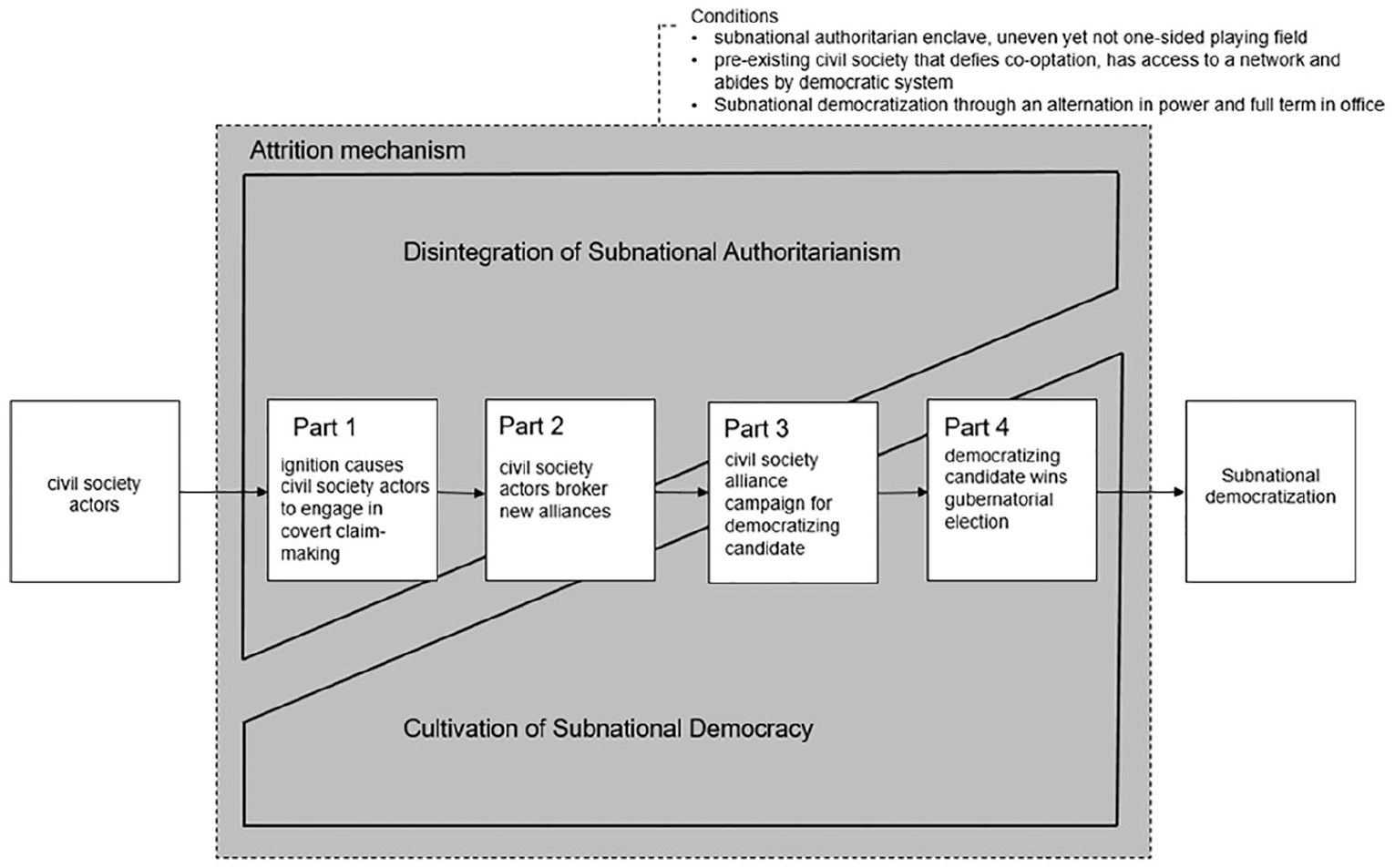
Bottom-up pathway to subnational democratization.
This mechanism operates under three conditions. The first condition is that there is a subnational authoritarian enclave, 3 which constitutes a highly uneven yet not one-sided playing field. Subnational authoritarian incumbents actively try to make the playing field as uneven as they can. As defined in the introduction, the incumbents of authoritarian enclaves may be individuals or part of a family, clan, clique or organization (Sidel, 2014). Other terms include political bosses, local strongmen, chiefs or mafias (Sidel, 2014). To maintain power, the authoritarian incumbents engage in local elections but rig them through vote buying, gerrymandering or electoral manipulation. They thereby make sure that their kin take turns in occupying local political positions. To achieve an uneven playing field, they engage in ‘boundary control’, aiming to minimize outside involvement in local politics and to deprive local constituents of access to national-level politics and resources (Gibson, 2013). To minimize outside involvement, subnational authoritarian incumbents may deliver blocks of votes to national-level politicians or control fiscal allocations to the province (Gibson, 2013). In addition, they may try to build regional coalitions to strengthen their influence on the national level. To deprive local constituents of access to the national level, authoritarian incumbents may co-opt potential sources of local opposition, including politicians, mayors, judges and civil society members. They thereby form a clientelist network and engage in patronage politics, whereby they maintain personal relationships and donate gifts. Constituents may be further isolated by their economic dependency on authoritarian incumbents (McMann, 2015). The group around the authoritarian incumbent presumably aims to create favourable circumstances for businesses in which they have a vested interest. They might thereby engage in rent-seeking activities, corruption or fraud. Lastly, authoritarian incumbents may engage in repression, by instructing mercenaries to coerce, intimidate, or make use of violence. Although the strategies of the incumbent make the playing field very uneven, it is not one-sided. Precisely because the authoritarian enclave exists within a more democratic nation, authoritarian incumbents may never achieve absolute control. In other words, ‘the playing field may well be very far from level, and yet there is a game that two sides can play’ (Whitehead and Behrend, 2016: 307). The attrition mechanism operates in such a highly uneven yet not one-sided playing field.
The second condition is that there are pre-existing civil society groups that defy cooperation with the authoritarian incumbent, have access to a civil society network outside of the enclave, and abide by the nationwide democratic system. Civil society is ‘the sphere of association and conversation which falls outside the direct control of the state and other authorities’ (Goodwin and Jasper, 2015: 214). This is a purposefully broad concept, and may include: pre-existing nongovernmental organizations; religious groups; student, sport and social associations; art collectives; interest groups; or unions (della Porta, 2020). The groups are typically issue-based and respond to political events and opportunities. The level of activity of civil society groups depends on the voluntary investment of time or resources by activists. The position vis-à-vis the subnational authoritarian incumbent may differ between but also within groups, which may cause division. Some groups or individuals may seek cooperation with the authoritarian incumbent, making them susceptible to clientelism and co-optation (Kale and Mazaheri, 2019). Thus, for the attrition mechanism to work, there must be civil society groups that are not prone to co-optation and defy cooperation with the authoritarian incumbent. Such groups may maintain a strong moral code or bear insurmountable grievances against the authoritarian incumbent. However, grievances alone are not enough. Strategic choice and political opportunity structure may facilitate or inhibit the capacity of civil society to make claims (Jasper, 2004; Tilly and Tarrow, 2015). Additionally, civil society actors must have access to a civil society network outside of their own enclave. This access allows them to initiate an upward scale-shift, which is ‘coordination of collective action at a higher level . . . than its initiation’ (Tilly and Tarrow, 2015: 125). Networks on a higher level may stimulate the process of organizing by providing capacity, skills, resources, sanctuaries, or a network of volunteers. Furthermore, the attrition mechanism only works for civil society alliances that abide by the nationwide democratic system. Some activists may be disgruntled by their political system. They may have different ideas about what a good political system is, or they may simply focus on a specific issue. As democratization can be the byproduct of another objective (McMann, 2015), civil society actors do not specifically have to identify democracy as their main goal. However, the attrition mechanism does not function for civil society groups that aim for a coup or for insurgency. 4 It is more in the interest of civil society to take a pro-democratic stance, as authoritarian incumbents may try to frame civil society actors as unwanted or even dangerous.
The third condition is that subnational democratization takes place through the electoral defeat of the authoritarian hegemony by a democratizing candidate who gets civil society support and serves a full term in office. When selecting a case study for this article, I used an ‘alternation in power and full term in office’ definition of democratization (Tudor and Ziegfeld, 2016: 56). This made it possible to be certain that I was dealing with a case where subnational democratization had actually occurred. The chosen case centres on a democratizing governor who had the full backing of civil society organizations. It would be undue to expect civil society to install a fully fledged subnational democracy. Rather, I understand democratization to be ‘any change in the direction of more democracy, no matter how small’ (Bogaards, 2010: 476). Within the selected case, I therefore traced the incremental changes that increased the degree of subnational democracy. The disaggregated concept of the degree of subnational democracy by Gervasoni (2008) functioned as a guide to identifying such incremental changes in the data.
Once these three conditions are met, the attrition mechanism can function. I define attrition as the incremental weakening of an opponent or structure by sustained pressure from the bottom-up. The mechanism consists of four parts, during which subnational authoritarianism incrementally disintegrates while subnational democracy is cultivated. In the first two parts, civil society actors progressively make covert claims in order to grow. In the last two parts of the mechanism, the civil society alliance switches to making overt claims by campaigning for a democratizing candidate. As multiple pathways may co-exist, I do not argue that the attrition mechanism is the sole pathway to subnational democratization. Rather, I aim to kick-start a discussion and hereby take the first steps.
The attrition mechanism may ignite after a trigger event or a shift in the political opportunity structure. A trigger event may be the disappearance of livelihood or perceived injustice. A shift in political opportunity structure may be a change in political alignments, access to elites, or an increase in repression (Tilly and Tarrow, 2015). In the first part of the mechanism, civil society actors ignite attrition and make covert claims. Mobilization in authoritarian regimes often starts with secretive or hidden ‘everyday forms of resistance’ (Robertson, 2011). Civil society actors thereby organize events that the authoritarian incumbent deems acceptable, only to give it oppositional content (Johnston, 2015). During these events, civil society actors identify the authoritarian incumbent to be the cause of their discontent. They may use their civil society network to activate an upward scale-shift.
In the second part of the mechanism, civil society actors broker new alliances with other groups. Brokerage is the ‘production of a new connection between previously unconnected sites’ (Tilly and Tarrow, 2015: 31). The civil society actors identify with other groups and individuals who experience similar problems and injustices. They might have to make strategic adaptations to convince some groups to join. In this part of the mechanism, the civil society actors may continue their upward scale-shift activities and seek alliances with regional, national or international civil society groups. As the alliance grows, the claims against the authoritarian incumbent gradually become more overt. This is when the disintegration of subnational authoritarianism slowly starts to combine with the cultivation of subnational democracy.
In the third part of the mechanism, the civil society alliance campaigns for a democratizing candidate. They do so not only because they want to make claims against the authoritarian incumbent, which they continue to do, but also because they want to propose an alternative. The civil society actors probably perceive local elections to be fraudulent. However, the political campaign serves as a vehicle for making claims, or an embodiment thereof. It can furthermore divert the attention of the authoritarian incumbent away from local-level boundary-strengthening activities and toward the gubernatorial campaign. The selected candidate must appeal to the various groups in the civil society alliance and cannot be part of the authoritarian political machine. The civil society alliance grooms this candidate and actively engages in campaigning. The candidate may strategically frame themself as the opposite of the authoritarian incumbent and is therefore likely to embody a pro-democracy movement.
In the fourth part of the mechanism, the democratizing candidate wins the gubernatorial election and defeats the subnational authoritarian incumbent. The authoritarian clan will likely declare the elections fraudulent and seek to hamper the transfer of power by judicial means. Therefore, the civil society alliance must have access to good lawyers. Furthermore, the civil society alliance plans to diminish the boundary control of the subnational authoritarian by seeking national and international media attention. The democratizing candidate is proclaimed victorious and spends at least one full term in office. During their term, the democratizing governor will likely continue to cultivate subnational democratization by breaking down the political machine of the predecessor. Civil liberties might slightly increase, such as freedom of expression and information, or space for independent civil society organizations. However, the new governor plausibly inherits an office that is a central bolt in the authoritarian political machine. Thus, the democratizing governor has to deal with individuals who are still loyal to or economically dependent on the predecessor (Whitehead and Behrend, 2016). Therefore, it is not likely that the democratizing governor will immediately succeed in entrenching subnational democracy in the relatively short time span of a term. Democratic deepening is beyond the scope of this article, yet it merits further research (Behrend, 2016).
Attrition to ‘Slay the Dynasty’ in Isabela
The attrition mechanism is not only derived from theory, but also from original empirical evidence in the case of the ‘Dynasty Slayer’ in the Filipino province of Isabela. This case meets the three conditions under which the attrition mechanism can function. The case meets the first condition, as Isabela is a subnational authoritarian enclave with a highly uneven yet not one-sided playing field. Subnational authoritarianism is widespread in the Philippines and takes the shape of political dynasties. A political dynasty is ‘a phenomenon that concentrates political power and public resources within the control of a few families whose members alternately hold elective offices, deftly skirting term limits’ (Tadem and Tadem, 2016: 329). Sidel (2014), an expert on local politics in the Southeast-Asian region, argues that certain political dynasties in the Philippines comprise subnational authoritarian enclaves and that they warrant further research. Various dynasties engage in illegal activities and in the systematic plunder of state resources. Strategies for dynastic survival include rent-seeking, clientelism, patronage politics, corruption, coercion, vote buying, violence and the use of private armies (McCoy, 1994; Thompson and Battalla, 2018). Dynasties adapt their strategies throughout time to stay in power. For example, many dynastic families circumvented institutional reforms that introduced term limits in mayoral elections by introducing female relatives to ascend the throne (Helms, 2020).
In Isabela, the authoritarian incumbent is the Dy family, which ruled from the mid-60s until 2004. They maintained their authoritarian enclave by having family members take turns as governor, along with occupying many other local positions. The Dy family make the playing field in Isabela as uneven as they can. To minimize outside involvement in local politics, they promise block-vote delivery and seek to make regional and national-level coalitions. 5 In doing so, they regularly switch political parties or divide brothers into different parties. To deprive local constituents of access to the national level, the Dy family engage in patronage politics, pork barrelling and clientelism. 6 They thereby maintain personal relationships with their network of influential persons such as the police, the military, and clergy. 7 The dynasty deals with opposition by co-optation or by draining them of time and resources. For example, the Dy family practically paralyzed a local opposition politician by suing him five times. 8 The Dy family engage in local elections, but many research respondents believe that they structurally buy votes. They claim that armed men are present during the vote-buying act, which serves as a veiled threat. 9 Dynasty members often go unopposed in elections, as many people are afraid to oppose them or expect the endeavor to be futile. 10 Although Isabela is a province ridden by poverty (van der Ploeg et al., 2011), the Dy family is affluent. They own several construction companies and thereby engage in rent-seeking. Many research respondents believe that the Dy family engages in corruption, illegal logging and illegal gambling. 11 Because of these actions, they constitute an uneven yet not one-sided playing field.
The case meets the second condition, as there are pre-existing civil society groups in Isabela who defy co-optation, have access to a nationwide network of civil society groups, and abide by the nationwide democratic system. The main initiators of the attrition mechanism in Isabela were leftists and farmers organized into pre-existing, issue-specific civil society groups. They managed to ally with some religious leaders, who had access to local church-related nongovernmental organizations. The position of civil society actors toward the Dy family differed by person and over time. The advantages of the clientelist network tempted some individuals, while others positioned themselves firmly against the Dy family. For most leftist civil society actors, their motivation to resist cooperation with the dynasty was ideological, whereas the farmers were motivated by economic injustices and marginalization. 12 The pre-existing civil society groups in Isabela had access to a nationwide civil society network. Although most civil society actors were sceptical about democracy in the Philippines as a whole, they abided by the democratic system. They chose engagement in a political campaign to portray their discontent with the Dy family. The Dy family accused the civil society actors of having connections to armed insurgents, an accusation mocked by all research respondents. There was no evidence that the civil society actors had any inclination to commit a coup or take up arms.
The case meets the third condition, as Grace Padaca electorally defeated the Dy family in 2004. During her electoral campaign, she was fully dependent on the support of civil society actors. She served two full terms in office and held the gubernatorial seat until 2010. During her time in office, Padaca made incremental changes toward more subnational democracy, as she opened up democratic space, combatted illegal logging and reduced patronage politics.
In the first part of the attrition mechanism, ignition causes civil society actors to make covert claims. Civil society actors in Isabela started to do so in 2001, three years prior to Padaca’s electoral success. Three trigger events ignited the attrition mechanism. First, the Dy family supported a big corporation that had cassava plantations. This corporation engaged in land grabbing from local farmers.
13
Second, the Dy governor planned to build a coal-fired power station that would cause environmental damage without consulting civil society.
14
Third, illegal logging activities in the Sierra Madre mountain range caused flooding on the farmland below.
15
Research respondents said it was ‘common knowledge’ that the Dy family supported illegal logging activities. These three trigger events caused the disappearance of livelihood for farmers, which they perceived as an injustice. Local, organized farmers activated their existing relations with leftist civil society actors, who initiated a scale-shift and contacted their existing connections with Manila-based environmental groups. The latter strategically organized an ‘environmental investigative mission’ to the affected communities in Isabela. In the words of one of the civil society organizers: . . . we are afraid to militarize the area if we go in with a fact-finding mission. What we did is to go in and conduct an environmental investigative mission, so . . . that matter, it is lighter . . . It appears like it is not very political.
16
In other words, civil society actors overcame the boundary-closing efforts of the subnational authoritarian incumbent by framing their goal as a seemingly unpolitical environmental mission. Apart from actually gathering data on the environment, they also engaged in political discussions. In secret, the civil society actors collectively studied the issues and concluded that the Dy family was causing the three trigger events. These first, incremental steps of mobilization instigated the disintegration of subnational authoritarianism.
In the second part of the attrition mechanism, civil society actors broker new alliances. The civil society actors in Isabela identified three other groups that experienced injustices caused by the Dy family. First, local political opposition leaders had an interest in joining the alliance to increase their own bid for power. 17 Most of them joined secretly to maintain personal safety and not to agitate the authoritarian incumbent. Second, a section of religious leaders was interested to join on moral grounds. It was only a section, because the clergy did not form a coherent group. Some of them were opposed to dynasties whereas others were part of the clientelist network of the Dy family. Religious leaders are very powerful in the conservative province of Isabela. They play an educative and consultative role in their communities. To obtain the cooperation of certain religious leaders, civil society actors had to make tactical adaptations. For example, they gave a religious character to a political rally by changing it into a prayer rally. This enabled religious leaders to join, as they would be leading the prayer. 18 The inclusion of these religious leaders into the civil society group enabled cooperation with highly skilled church-related nongovernmental organizations. The third group that civil society actors made alliances with were local business people. Unfair bidding processes and compulsory bribes were dynasty-instigated issues that aggrieved the local business sector in Isabela. 19 The incremental growth of the civil society alliance fostered the further disintegration of subnational authoritarianism.
In the third part of the attrition mechanism, the civil society alliance campaigns for an alternative, democratizing candidate. Although most research respondents perceived elections to be fraudulent, they saw the electoral campaign as a vehicle for switching their covert claims into overt ones. They continued to make claims against the dynasty, but also offered an alternative, in this case, Grace Padaca. There were several reasons for the civil society to convince and groom Padaca to run for governor. Padaca was a known voice to the electorate, as she had been a very popular critical local radio broadcaster in the 14 years prior to running. She had a reasonable claim that the dynasty cheated in the 2001 elections, when she ran for local congresswoman.
20
In addition, Padaca was an ideal candidate to embody the counterframe against the Dy family. She is a disabled woman who walks on crutches, which made her seem unthreatening and powerless. Padaca was not a dynasty member and had a clean corruption record. She was pious and studious, with a firm moral compass. These characteristics made her the embodiment of ‘the good’ taking on ‘the bad’, making a sensational story. Filipinos oftentimes compare Padaca’s electoral success with the story of David and Goliath, which resonates nationwide and beyond. Lastly, the gubernatorial post would have gone unopposed had Padaca not been persuaded to file candidacy. By running for governor, she diverted the attention of the dynasty away from local-level boundary-strengthening actions. In the words of a local opposition politician: [I said to her] . . . at least you will be helping the other candidates, especially the municipal candidates, because if there will be nobody to challenge the governorship, they can easily manipulate the other municipalities under them. But with somebody challenging them, they will be busy looking after the victory also for them.
21
In other words, the dynasty had less time and fewer resources to influence municipal elections to fortify its patronage network because they had to focus on the gubernatorial elections. 22 The civil society alliance played a big role in convincing and grooming Padaca to run for governor. They saw her as a potential source of subnational democratization. Her focus points were good governance, transparency and accessibility. She supported farmers and promised to review the coal-fired power station and cassava projects. 23 She focused on hospital reform and combatting illegal logging and illegal gambling.
The civil society alliance campaigned for Grace Padaca in a number of ways. Religious leaders indirectly made claims against the subnational incumbent and for Padaca. The bishop, who joined the alliance, issued pastoral statements in which he discussed specific issues that the alliance supported. Another religious leader discussed political issues, such as vote buying and democracy, in his Sunday Mass.
24
Church-related civil society actors visited communities throughout Isabela to provide education about clean and fair elections. Moreover, they oversaw the vote-counting process. The civil society alliance also provided sanctuary in Manila for activists who were being intimidated or harassed.
25
Individuals from the business sector gave secret donations.
26
About the donations, Grace Padaca recalls: . . . they quietly gave me their help. For example, if they would give some cash they would not bring it here to our house, they would bring it to my friend’s house. So that my friend would give it to me. And then they would give T-shirts, or a kilo of rice, or bottled water, or biscuits, but they will never do it openly because here, especially in the town of Cauayan where the dynasty started, if you just show anything that is in opposition to them, expect that next time, you will find difficulty in renewing your business permit, or in getting contacts.
27
Others in the alliance volunteered their time and resources to the campaign by making folders, posters, songs and a film. 28 Farmers organized rallies in Manila, and other individuals organized a local multi-sectoral gathering. 29 Civil society actors in the alliance initiated these campaign activities from the bottom-up. By openly supporting a democratizing candidate, civil society actors incrementally cultivated space for subnational democracy.
In the fourth part of the attrition mechanism, the democratizing governor wins the gubernatorial election and defeats the authoritarian incumbent. It took more than a month before Grace Padaca was officially proclaimed governor, as the Dy family refused to accept defeat. They filed cases at the Commission on Elections and accused Padaca of having connections to armed insurgent groups. Padaca had access to a good lawyer, who worked pro bono. During the proclamation struggle, news about the election in Isabela spread like wildfire, further diminishing the boundary control of the Dy family. After a peaceful transfer of power, Padaca started her first of two terms in office. As governor, Padaca cultivated subnational democracy in three ways. First, she increased inclusiveness and accessibility to governance. She created a weekly ‘people’s day’, in which she visited far-flung communities to listen to the concerns of the people. 30 Poor people in such communities experienced increased accessibility to governance. 31 Second, freedom of expression increased because Padaca, unlike the dynasty, did not have a patronage network. This implies that people did not have to swear allegiance in order to get attention or funding from the provincial government. Third, space for independent civil society organizations increased. Padaca invited civil society groups to oversee bidding processes and the implementation of her projects, and there was no longer a compulsory bribe. 32 Additionally, Kaya Natin was established – a new, nationwide civil society group for good governance. These small, incremental changes served to increase subnational democracy during Padaca’s time in office.
Grace Padaca’s two terms in office were too short to achieve structural, sustained democratization in Isabela. Although she tried to weaken the political machine of the Dy family, this proved an uphill battle. She was governing an office in which many people were still loyal to or economically dependent on the Dy family. She tried to reshuffle positions within the provincial capitol, but the Civil Service Commission blocked this effort. She aimed to reduce illegal logging and illegal gambling, as she believed that these were sources of income for the Dy family. Furthermore, Padaca installed a rice subsidy program to support farmers and reduce their dependence on the dynasty. Despite her efforts, Padaca lost the 2010 elections to a Dy. A change in the political opportunity structure, namely a shift in elite alliances on the provincial level, can partly provide explanation. The Dy family had always had rivalries with the Albano family, who were influential in the first district of the province. In 2010, however, the families created an unprecedented alliance against Padaca. The Albano family could deliver votes in favour of the Dy family. Another explanation for Padaca’s loss is that some of her supporters expected to be adopted into a political machine that Padaca would build of her own. Padaca, refusing to engage in practices that she criticized her opponents for, could not meet this expectation. Back in office, the Dy family reinforced their boundary-closing strategies and oiled their political machine. Grace Padaca continued to make claims against the Dy family up until the time of research. As a strategy to silence her, the dynasty is suing her for graft and malversation.
Beyond the role of civil society, it is imperative to consider alternative explanations to subnational democratization in Isabela. First, the central government could have played a role. Yet, it is unlikely that the president facilitated subnational democratization in Isabela, because she was allied to the Dy family. Although the 1987 constitution prohibits political dynasties, the anti-dynasty law has not passed congress because the majority of legislators are themselves dynasty members (Tadem and Tadem, 2016). Philippine legislators therefore lack an incentive to intervene in subnational authoritarian enclaves. There was no evidence that pro-poor policies or neighbouring countries played a role, nor was there a broader trend of subnational democratization in the Philippines prior to Padaca’s electoral gain. A second alternative explanation could be the role of the opposition. The Philippines has a weak party system, wherein politicians constantly switch parties (Hutchcroft, 2019). As stated previously, the local opposition was co-opted, repressed, or drained of time and resources. The opposition politician that helped to facilitate attrition was part of the same national-level alliance as the Dy family at the time, rendering the explanation of factional political gain unlikely. 33 Third, economic or demographic factors could have played a role in subnational democratization, but statistical data do not show startling trends in Isabela (Philippine Statistics Authority, 2004). Although Isabela is a poor, agricultural province, this characteristic is not indispensable for dynasties in the Philippines (McCoy, 1994). The evidence also does not support the hypothesis that the Dy family made changes to the local political economy that altered relations with local businesses in the time prior to subnational democratization. Fourth, it is necessary to assess the role of ‘uncivil society’, as the armed insurgency group, the New People’s Army (NPA), is present in Isabela. Although the NPA was not in favour of the Dy family, there is no evidence that they impeded or contributed to the subnational democratization process. Alternatively, civil society actors in Isabela facilitated the democratization of their subnational authoritarian enclave through the attrition mechanism.
Conclusion
This article seeks to kick-start the discussion on the bottom-up pathway to subnational democratization by proposing the attrition mechanism. The attrition mechanism functions in subnational authoritarian enclaves with an uneven but not one-sided playing field. There are existing civil society groups that defy cooperation with the authoritarian incumbent to avoid co-optation. They have access to a wider network of civil society groups and they abide by the nationwide democratic system. An alternation in power and a full term in office define the subnational democratization event. A shift in political opportunity structure or the loss of livelihood ignites the mechanism, whereby civil society actors make covert claims against the authoritarian incumbent. They broker new alliances, whereby they slowly disintegrate subnational authoritarianism. They continue to campaign for a democratizing candidate, whereby their claims become overt and subnational democracy is cultivated. When the democratizing governor wins the elections and spends a full term in office, an episode of subnational democratization has taken place. The theoretical implication of the attrition mechanism is that civil society actors in subnational authoritarian enclaves have agency.
This mechanism is the product of abductive inference. The building blocks of the mechanism consist of existing literature on subnational democratization and social movement studies, and evidence from the case of the ‘Dynasty Slayer’ in the province of Isabela, the Philippines. The Dy family had ruled this province as a subnational authoritarian enclave for decades when pre-existing civil society groups, who had lost their livelihood, started to make covert claims against this dynasty. After brokering new alliances, civil society switched to making overt claims as they groomed and campaigned for Grace Padaca, a candidate with democratizing potential. Padaca made national headlines when she, a disabled woman walking on crutches, slayed the dynasty in the 2004 elections, with the help of the civil society alliance.
As this is an exploratory study, further development is called for. This mechanism can be refined by testing it with evidence from comparable cases. Furthermore, we need more research tracing bottom-up pathways to subnational democratization in cases with different conditions. We can expand social movement literature by studying how national and subnational authoritarian contexts make a difference to the claim-making activities of civil society. As subnational democratization did not survive in post-Padaca Isabela, it is important to analyze the long-term implications for subnational democracy there. One could theorize an autocratization process through boundary-closing strategies by the Dy family, but also a learning process and innovation from their side. Such insights would teach us how to prevent a province from ending up in the hands of the authoritarian predecessor. This would not only inform academia, but also has relevance for civil society actors that want to achieve sustainable subnational democracy in their own communities.
Supplemental Material
sj-pdf-1-ips-10.1177_01925121211019269 – Supplemental material for Attrition as a bottom-up pathway to subnational democratization
Supplemental material, sj-pdf-1-ips-10.1177_01925121211019269 for Attrition as a bottom-up pathway to subnational democratization by Trix van Mierlo in International Political Science Review
Footnotes
Acknowledgements
I feel indebted to the editors of this journal and the four anonymous reviewers for their helpful comments that greatly improved this article. Furthermore, I thank Ludger Helms, Martin Senn, Lore Hayek and Ana Tereza Fernandes for their continuous support. I am grateful to Rosanne Rutten for pointing me in the direction of Isabela. Lastly, I thank all research respondents in the Philippines for generously sharing their time and knowledge.
Funding
The author disclosed receipt of the following financial support for the research, authorship, and/or publication of this article: This research is funded by the University of Innsbruck.

Notes
Author biography
References
Supplementary Material
Please find the following supplemental material available below.
For Open Access articles published under a Creative Commons License, all supplemental material carries the same license as the article it is associated with.
For non-Open Access articles published, all supplemental material carries a non-exclusive license, and permission requests for re-use of supplemental material or any part of supplemental material shall be sent directly to the copyright owner as specified in the copyright notice associated with the article.
