




Abstract
The European Union’s (EU) economic governance is pivotal for gender equality in the EU, yet gender equality concerns have been sidelined in governance processes. This article analyzes the struggles involved in integrating a gender perspective into the EU’s economic governance in the European Parliament (EP). It explores how the EP, often perceived as a champion of gender equality, constructs gender in relation to economic governance and how conflicts between the EP’s political groups and committees influence the EP’s ability to challenge gendered inequalities related to the governance regime. This article reveals that the EP’s positions have been characterized by strategic silence about gender and understandings of gender equality as a productive factor that legitimized gendered policies. Party-political conflicts and compromises that have sidelined critical views, and a boundary between social and economic issues and actors, were key barriers for the integration of critical gender perspectives.
Introduction
International economic governance has long been criticized for its lack of democratic accountability as well as its unequal and gendered effects. Similar claims can also be levelled at the European Union’s (EU’s) economic governance, which was strengthened in the aftermath of the financial crisis of 2007–2008 and the ensuing Eurozone crisis. This article analyzes the struggles involved in integrating a gender perspective into the EU’s economic governance in the European Parliament (EP). The article explores how the EP constructs gender in relation to economic governance and how political conflicts within the EP influence its possibilities to challenge gendered inequalities related to the governance regime.
Amongst other things, the EU’s recent economic governance regime has been criticized for constitutionalizing austerity through new and more strictly enforced fiscal rules (Bruff, 2014), for being unaccountable to democratically elected bodies (Crum, 2018), and for further subordinating the EU’s social goals to its economic priorities (Crespy and Menz, 2015). Feminist scholars have added new layers to this critique by revealing the gendered and racialized impacts of the policies implemented in the governance framework (Bruff and Wöhl, 2016; Kantola and Lombardo, 2017), the dominance of masculine norms within the all-male expert-led fiscal bureaucracy in charge of its implementation (Klatzer and Schlager, 2019; O’Dwyer, 2019), and the sidelining of gender equality concerns and actors (Cavaghan, 2017). The new economic governance framework of the EU thus constitutes a critical structural element in the complexion of gender equality in the EU.
Despite being largely sidelined in the development and implementation of the EU’s economic governance, (Bressanelli and Chelotti, 2018; Crum, 2018), the EP has consistently demanded greater involvement whilst attempting to establish a more visible profile as the democratic watchdog of the governance process. From a gender perspective, the EP is interesting because it is often portrayed as an agenda-setter for gender equality, taking a stronger stance on gender equality legislation and gender mainstreaming than other EU institutions (van der Vleuten, 2019). This context provides an opportunity to explore whether or not the EP’s reputation as a progressive actor with regards to gender equality, extends to its policies on EU economic governance. Intra-parliamentary struggles over gender and the EU’s economic governance have a broader significance, because such tensions are indicative of the EP’s ability to hold other EU institutions accountable for inequalities related to economic governance implementation, and to provide alternatives to ensure general wellbeing. More specifically, the present article draws on feminist political economy to investigate how gender is constructed in the EP in relation to the EU’s economic governance, and under what conditions the EP legitimizes or challenges the gender inequalities involved in its implementation. Intrinsic to this process is how conflicts between the EP’s political groups and committees have shaped the EP’s position. The research material on the 8th Legislature of the EP (2014–2019), consisting of 10 EP reports on the European Semester—the key tool for implementing the economic governance framework—prepared by the Committee for Economic and Monetary Affairs (ECON) and the Committee for Employment and Social Affairs (EMPL), as well as 16 research interviews with MEPs and staff involved in these reports, provided a rich seam of material to mine in illustrating the critical junctures where policy responses were shaped.
This article shows how the EP’s positions were characterized by a strategic silence about gender on the one hand, and understandings of gender equality as a productive factor on the other, which legitimized the gendered policies of the EU’s economic governance and reproduced gendered understandings of the economy that underpinned these policies. This outcome was the consequence of an artificial boundary between social and economic issues and actors, in combination with party-political conflicts and compromises that sidelined the critical views of left-green groups. For scholars of feminist political economy and feminist EU studies, these findings will provide novel insights into the political, institutional, and epistemological challenges involved in integrating a gender perspective into economic governance policies and processes in the context of a representative institution. For mainstream literature on economic governance and the EP, this article illustrates the crucial role that gender plays in the political struggles concerning the EU’s economic governance.
Analyzing EP economic governance policies from a gender perspective
Since the onset of the Eurozone crisis, the EU’s economic governance has undergone a significant transformation that has served to strengthen the EU’s influence over fiscal and budgetary policies, and other key areas of member states’ competence. The new economic governance framework is implemented through the annual European Semester process—the topic of the EP policies analyzed in this article—steered by the European Commission (EC). During this process, the EC, the Council, and the European Council set socio-economic priorities for the EU (the Annual Growth Survey, AGS), monitor progress and give recommendations to member states (country-specific recommendations, CSRs) (Zeitlin and Vanhercke, 2018). Within this framework, the role of the EP is limited to dialogue with other EU institutions, and non-legislative resolutions on the AGS and member states’ policies.
Recent reconfigurations of the EU’s economic governance have had significant implications for gender regimes across the EU. Low-income and minority women have borne the brunt of austerity policies and retrenchment of welfare states that has been reinforced by the governance framework (Bassel and Emejulu, 2017; Kantola and Lombardo, 2017). The implemented policies reduced both the level and the scope of public provisioning, increased the burdens of unpaid care work, and intensified the crisis of social reproduction (Bruff and Wöhl, 2016; Klatzer and Schlager, 2019), while at the same time pushing women into the labor market (Chieregato, 2020). The EU’s economic governance has thus played a key role in the shift toward a neoliberal gender regime, which requires women’s contribution both at home and in the labor market (Walby, 2015).
Economic governance, and its implementation, are prime examples of the gendered outcomes of EU policies and the difficulties of integrating a positive gender perspective into these policies—a topic at the heart of feminist EU studies (e.g. Abels and Mushaben, 2012; Weiner and MacRae, 2014). Despite political commitments to integrate the gender perspective into the European Semester, and the efforts of gender equality actors within the EU institutions to raise awareness of the gendered impacts of austerity (Guerrina, 2017), the visibility of gender equality in economic governance has remained low and focused on labor market issues (Chieregato, 2020). The absence of a gender perspective has been connected to the absence of women at the negotiation tables (Walby, 2015), dominant gender ideologies within the institutions (Guerrina, 2017), as well as to discourse(s) of economic expertise that explicitly exclude feminist concerns (O’Dwyer, 2019). Moreover, the economic actors within the EU institutions have a long track record of resisting the integration of gender perspectives (Hoskyns, 2008).
Conceptualizing competing constructions of gender and economic governance
The first part of my framework for analyzing the EP’s policies on the implementation of the EU’s economic governance, concerns the assessment of how they were either gendered or challenged gender inequalities. Economic policies can be gendered in different ways. For example, they can produce unequal effects, exclude discussion of gender inequalities, or be predicated on assumptions that embody gender bias. Drawing on feminist political economy, I distinguish four paradigms that illustrate the competing constructions of the relationship between gender and economic governance: (1) strategic silence about gender, (2) gender equality as a productive factor, (3) recognition of gendered impacts and processes, and (4) recognition of the reproductive economy (Table 1).
Four paradigms for understanding the relationship between gender and economic governance.
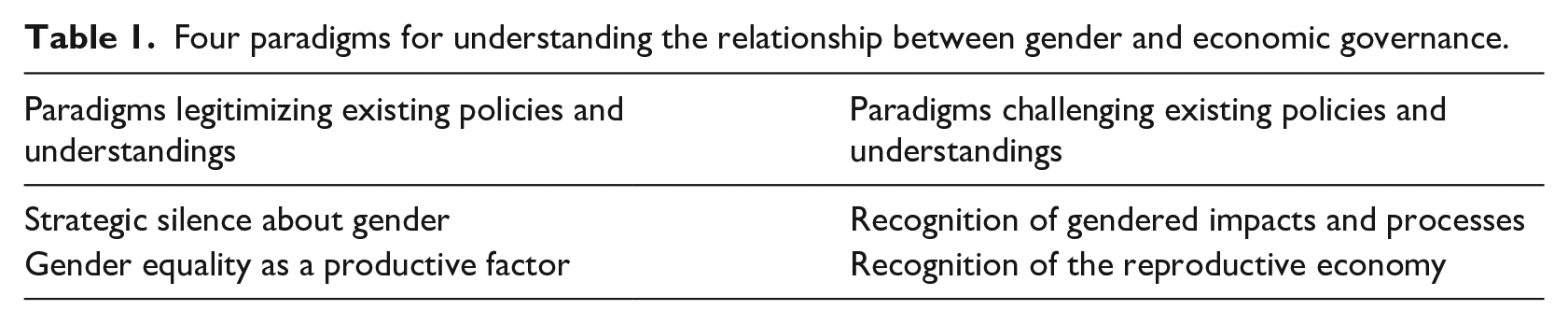
First, a strategic silence about gender refers to the omission of gender equality by definitial fiat. Economic policies are often presented as gender-neutral, rarely explicitly discussing gender, which is a strong indication that these policies are gendered to the extent that they ignore the different positions of women and men vis-à-vis the economy and are underpinned by social understandings expressive of established gendered power relations (Elson, 1994: 40). Economic institutions’ silence surrounding gender is not accidental, instead it should be seen as strategic silence (Bakker, 1994)—reinforced by dominant policy discourses and the empirical evidence used in policymaking—that constitutes and masks unequal economic relationships, obscures the gendered impacts of economic policies, and marginalizes certain interests while working to the benefit of others (O’Dwyer, 2018; Young et al., 2011). The lack of gender-sensitive analysis in economic governance has been argued to legitimize austerity policies (O’Dwyer, 2018), but also alternative growth models may be unequal in their outcomes and not take everyone’s interests equally into account due to the omission of gender perspective (Cavaghan and O’Dwyer, 2018). For example, the discourses regarding investment that have been mobilized at the EU level as an alternative to austerity—and more recently in response to the COVID-19 pandemic—have explicitly focused on male-dominated sectors (Klatzer and Rinaldi, 2020).
The paradigmatic consideration of gender equality as a productive factor relates to (re)constructions of gender equality as tools for achieving existing economic objectives. Such constructions either explicitly frame gender equality in terms of economic benefits or focus on policies compatible with economic goals. Such constructions produce narrow and economized understandings of gender equality that are co-opted to the goals of economic growth, competitiveness, and productivity (Stratigaki, 2004), and have been characteristic of efforts to integrate gender into economic governance and macroeconomic policies (Caglar, 2013; Hoskyns, 2008). Similar to strategic silence, these understandings legitimize policies that may be detrimental to gender equality (Elomäki, 2015), and silence criticism of gendered economic structures (Caglar, 2013).
The third and fourth paradigms are critical of existing policy priorities. The recognition of gendered impacts and processes reverses the causal arrow and draws attention to the gendered impacts of economic policies and the lack of a gender perspective in governance processes. The fourth paradigm, recognition of the reproductive economy, goes further in challenging the gendered understandings of the economy that underpin economic policies. Feminist political economists have drawn attention to how the boundaries of the economy exclude factors that are considered noneconomic (Caglar, 2013), and thereby maintain a false distinction between the productive and reproductive sectors of the economy (Elson, 1994; Pearson and Elson, 2015). The reproductive economy, consisting of ‘services directly concerned with the daily and inter-generational reproduction of people as human beings, especially through their care, socialization and education,’ including both unpaid work, and paid work in public services (Pearson and Elson, 2015: 10), is routinely ignored or undervalued in mainstream economic analysis and policymaking. However, human wellbeing and the productive economy are dependent upon the reproductive economy (Elson, 1994) and economic policies influence the reproductive economy (Rai et al., 2014). Ignorance and the undervaluing of the reproductive economy are intrinsic to the dominant indicators economic governance depends on, such as gross domestic product (GDP), growth, productivity and investment. The economic inputs of unpaid reproductive work are not included in the GDP (Hoskyns and Rai, 2007), and definitions of public investment categorize public spending on education and care—both of which are necessary for wellbeing and for the future productivity of the economy—as mere expenditure (Elson, 2016).
Ignorance of the reproductive economy has a similar function to strategic silence about gender: it allows governments to benefit from the unpaid or poorly paid reproductive work mainly performed by women, often of migrant background, and obfuscates the fact that cuts and marketization of public services shift the responsibility and costs of reproduction to these people (Rai et al., 2014). Recognizing the reproductive economy demands the acknowledgment of the economic input of unpaid care, the value of public care services, and the effects economic policies have on these factors, as well as the logical imperative to rethink the objectives of economic policy to regard human well-being as a goal in itself.
Conceptualizing conflicts surrounding gender and economic governance in the EP
The second part of my framework identifies two intertwined layers of conflict within the EP that impact upon its policies. Both economic governance and gender equality are highly contested and their combination inevitably causes conflicts between, and within, the EP’s political groups and across its committees. Although economic policy has traditionally divided EP political groups on a left/right axis, the pro/anti-EU axis has become more dominant in the wake of the economic crisis (Otjes and van der Veer, 2016) which disturbed traditional political-economic coalitions of interest. In the case of economic governance, legislation adopted in the 2009–2014 parliamentary term, the pro-EU groups on the center-left and center-right—the Socialists & Democrats (S&D), the Greens and the European Free Alliance (Greens-EFA), the conservative European People’s Party (EPP), and the liberal Alliance of Liberals and Democrats in Europe (ALDE) —put their ideological differences on issues such as austerity aside in order to save the Euro and gain a strong negotiation position vis-à-vis the Council (Bressanelli and Chelotti, 2018; Roger et al., 2017).
At the same time, questions relating to gender equality have become increasingly polarizing on the left/right axes. The S&D, the Greens-EFA, and the left-wing and Eurosceptic Confederal Group of the European United Left/Nordic Green Left (GUE/NGL) tend to embrace feminist discourses and solutions and address gender equality both as a specific issue and as something that is mainstreamed with other policy, while the EPP is more conservative and the ALDE takes a middle ground. The Eurosceptic radical right groups, which in the 2014–2019 term consisted of the European Conservative and Reformists (ECR), the Europe of Freedom and Direct Democracy (EFDD), and the European Nations and Freedom (ENF), oppose gender equality in votes as well as discursively (Kantola and Lombardo, 2020; Kantola and Rolandsen Agustin, 2016). Gender equality is also a contentious topic within the political groups, particularly the EPP (Kantola and Rolandsen Agustin, 2016).
In matters of gender and economic governance implementation, political groups’ divergent priorities and understandings of the economy, intertwine with constructions of gender equality to create multiple conflicting positions. The EP’s consensus-oriented decision-making has been characterized by broad coalitions, in which the EP’s two largest political groups, the EPP and the S&D, have played a key role (Settembri and Neuhold, 2009). This was also the case in the 2014–2019 term, when neither the left nor the right had a majority. Compromise-building takes place in informal arenas between rapporteurs and shadow rapporteurs—the MEPs appointed by the political groups to follow a specific file—and other key actors (Ripoll Servent and Panning, 2019; Settembri and Neuhold, 2009).
The EP’s committees are key arenas for the expression and negotiation of party-political conflicts (Roger et al., 2017; Yordanova, 2009). Political dynamics differ between committees (Settembri and Neuhold, 2009), and committees attract MEPs with special interest in the committee’s topic and draft particularistic policies (Yordanova, 2009). Different dynamics and policies between the two committees that debate the implementation of economic governance are not unexpected in relation to the gender dimension of economic governance. The EMPL Committee has a better track record of gender equality than the male-dominated ECON Committee, which routinely neglects women’s expertise (Kantola and Rolandsen Agustin, 2019: 777). Moreover, committees’ fields of expertise reflect the following institutional barriers to gender equality within EU policymaking: gender equality has been viewed as a social, rather than an economic, issue (Cavaghan and O’Dwyer, 2018), ensuring that economic actors have resisted gender mainstreaming (Hoskyns, 2008).
Research material and methods
In contrast to most studies that have used quantitative or mixed methods (e.g. Otjes and van der Veer, 2016; Roger et al., 2017), I analyze the EP’s policies on economic governance through a constructivist, critical-interpretative approach and qualitative methods. This focuses on how meaning is generated within political institutions, emphasizing the contested nature of problem definition, and the role played by conceptual disputes and institutional power relations in shaping meanings (LeGreco and Tracy, 2009; Lombardo et al., 2009). My analysis focuses on ten EP reports on the annual agenda-setting document of the European Semester, the AGS (see Online Supplementary Material, Table 1), which were adopted in the 2014–2019 parliamentary term. In addition to describing the EP’s view on the socio-economic priorities set in the AGS, these reports discussed aspects of economic governance implementation, in particular, the application of the fiscal rules and the use of indicators. Five of these reports were adopted by the ECON Committee and the remainder, those that focused on the social and employment aspects, by the EMPL Committee.
The research material consists of draft reports written by the MEPs in charge of the reports, 3516 amendments tabled by MEPs, the adopted reports, as well as 16 semi-structured interviews with MEPs and group staff that had engaged with the reports (see list after References). Radical right groups (i.e. the EFDD and the ENF) that rarely participate in parliamentary work (cf. Ripoll-Servent and Panning, 2019) were excluded from these interviews, and the actors approached from ECR declined. The interviews were conducted in Brussels face-to-face or by phone between November 2018 and May 2020 and were transcribed. The interviewees were promised full anonymity. The interviews focused on group positions, intra-group negotiations, and negotiations between groups.
The analysis combined a discursive content analysis of groups’ and committees’ positions with a descriptive analysis of their political dynamics. The documentary material was coded with ATLAS.ti (version 8.4.5) through keyword searches derived from the theoretical framework (e.g. gender, women/men, female/male, equal opportunities, equality, care, and austerity/cuts/fiscal consolidation), after which specific gender equality themes were identified. Consistent with the discursive politics approach to gender equality that sees gender as a contested and constructed discourse (Lombardo et al., 2009), the references to gender equality—and their absence—were further analyzed by examining how political groups and committees constructed gender equality in relation to economic governance to identify competing constructions. Draft reports, amendments, and the adopted texts were further compared in order to determine which constructions were included in the compromises, whilst interviews were used to shed light on dynamics within and between key actors, and to illustrate how particular constructions became dominant and others were marginalized.
The following analysis is organized around the four paradigms for constructing gender in relation to economic governance identified above. The strategic silence surrounding gender in the ECON Committee will be critically discussed before moving on to consider the competing constructions of gender and economic governance (gender as a productive factor vs. recognition of gendered impacts and processes) in the EMPL Committee. The final section addresses the nature and consequence to the (non)recognition of the reproductive economy.
Strategic silence about gender
In line with the tendency of the economic actors within the EU institutions to ignore, or explicitly exclude, gender (e.g. Hoskyns, 2008), the topic was close to being invisible in the ECON Committee’s AGS reports on the EU’s economic situation, investment priorities, structural reforms, and budget discipline and the application of fiscal rules. Despite the efforts to enhance the social dimension of the European Semester in the 2014–2019 period (Zeitlin and Vanhercke, 2018), gender equality concerns were raised only three times in the five adopted ECON reports: the 2015 report referred to the gender pay gap and to investing in the employability of female workers, and the 2018 report mentioned the gendered effects of labor market discrimination. An analysis of the processes and conflicts underlying these reports suggested that this silence was connected to the marginalization of gender issues within political groups and to the EPP’s opposition in negotiations.
When gender equality was discussed in the political groups’ ECON working groups constituted of committee members and staff, it was largely confined to appointments to the boards of financial institutions (Interviews 3, 4, 5, 6, 7, and 8). The invisibility of gender equality concerns was starkly reflected in groups’ work on the European Semester where only 11 (0.6%), of approximately 1900 amendments tabled by MEPs on the five reports, made any mention of gender. Their priorities were elsewhere: whereas the EPP and the ALDE focused on strict implementation of fiscal rules, spending cuts and neoliberal labor market reforms, the S&D and the Greens-EFA pushed for public investment, raised social issues and called for flexibility, or changes to soften the impact of the fiscal rules. Of the Eurosceptic groups, the GUE/NGL saw the European Semester as a tool for advancing neoliberal policies and drew attention to social impacts, while the radical right groups had more heterogeneous positions.
The Greens-EFA were the only group in interviews that demonstrated explicit gender equality priorities in relation to the European Semester (Interview 16). The Greens-EFA and the S&D, were the only groups that raised gender equality issues through amendments, but considering their pro-equality reputations (Kantola and Rolandsen Agustin, 2016), they were similarly reticent to engage with the topic (Greens-EFA: six references, S&D: five references). Whereas the Greens-EFA took a critical approach and drew attention to the gendered impacts of austerity, the S&D focused on labor market equality in line with the productive factor paradigm.
The interviews revealed the nuanced reasons that lie behind the groups’ silence on gender matters. In the case of the EPP, the silence was explained by direct opposition to gender equality. The key actors within the EPP’s ECON working group explicitly excluded gender issues from intra-group debate, making it difficult for those thinking otherwise to voice their concerns: ‘. . .the most vocal members (. . .) I think they just are of the fundamental opinion that economic policy coordination shouldn’t be about gender. Gender doesn’t have anything to do with it’ (Interview 9). This exclusion was connected to a strict ideological separation between economic and social issues. Social issues, including gender equality, were understood as something additional to the European Semester, which should instead focus primarily on fiscal rules and the correction of macroeconomic imbalances (Interviews 6 and 8). This perfectly illustrates the manner in which economic thinking has tended to construct the economic sphere as one which, by definition, excludes persons and activities that do not easily fit with a narrow interpretation of what is ‘economic’ (Caglar, 2013), and allows the strategic decoupling of economic policies from their social impacts (Bruff and Wöhl, 2016). An example of the EPP explicitly excluding discussions of gendered impacts of austerity was evident in the following extract: [W]e never can vote in favor, for saying that the austerity measures have hit hardest the women. That’s total no-no. And when I’m rapporteur, I don’t even put it on there because it’s totally against, it’s like saying Jesus was a communist, that you just don’t say something like that. Because money is money, and debt is debt, and it’s feministic and communistic rhetoric to say that the austerity measures have hit hardest or had the highest impact on women. (Interview 1)
For the left-leaning groups, the silence was more connected to shifting political priorities. According to the GUE/NGL and S&D actors, these groups’ MEPs understood that economic policies have gendered effects, but the topic was not discussed in the ECON working group: ’. . .if you ask people ‘do you think austerity policy leads to gender inequality,’ everybody would probably say yes. But I cannot think of a debate around this, that this was somehow in a focus’ (Interview 11). This quote from a GUE/NGL staff member revealed that gender would not be viewed as a relevant issue despite that the policies under discussion were known to produce adverse gendered outcomes.
This silence surrounding gender was reinforced in the negotiations between groups. In the compromises between the two biggest groups, the EPP and the S&D, which characterized decision-making in the 2014–2019 term, the rare amendments concerning gender equality were almost completely rejected. One reason for this was the manner in which the EPP patrolled the boundary between economic and noneconomic issues in negotiations: ‘from our side, we’ve always said “OK, let’s now try first to keep economic policy coordination as pure as it is”’ (Interview 8). This meant that the progressive groups had to fight hard for the inclusion of their social priorities (Interviews 4, 5, 7, 8, and 16), and, as illustrated above, gender equality was not necessarily perceived as a priority. Moreover, the most gender-aware Greens-EFA found that they had little leverage in inter-group negotiations dominated by the EPP and the S&D (Interview 5; cf. Ripoll Servent and Panning, 2019: 308).
I would argue that the invisibility of gender in the ECON is best understood as a ‘strategic silence,’ which serves to obscure, and consequently enhance, the gender bias and the negative social outcomes of economic priorities and policies (Bakker, 1994). The party-political conflicts surrounding gender are prima facie illustrations of how this silence is actively maintained. Importantly, the EPP, the ALDE and the ECR who all opposed integrating gender concerns, were those who were most in favor of cuts of public services and social protection, and flexibilization of labor markets—in other words, policies that disproportionally impact women and increase the burdens of unpaid reproductive work. As Muireann O’Dwyer (2018: 759) has pointed out, ‘it is the very absence of gender analysis that helps to make austerity seem legitimate and coherent.‘ The silence surrounding the gendered impacts of austerity and gendered structures of the economy in the ECON Committee thus served to legitimize the focus on austerity and neoliberal structural reforms within the European Semester. Further, the groups on the left that opposed austerity and drew attention to its social impacts implicitly reinforced this silence by deprioritizing gender, which ironically undermined their later critique of austerity.
Gender as a productive factor versus recognition of gendered impacts and processes
The tendency in EU policy-making to regard gender equality as a social, rather than economic, issue (Cavaghan and O’Dwyer, 2018), meant that gender and other inequalities found themselves highly visible in the EMPL Committee’s discussions about the European Semester. Each of the five AGS reports contained between 6 to 29 paragraphs that focused on or mentioned gender equality. The visibility of gender equality concerns was dependent on the political group in charge: EPP rapporteurs included less gender-related content in the reports than S&D and ALDE rapporteurs (see Online Supplementary Material, Table 2). Over 7% (110) of the 1612 amendments tabled mentioned gender, with some individual EPP MEPs, and to a lesser extent, ALDE MEPs joining the Greens-EFA and the S&D in raising gender perspectives. Unlike in the ECON Committee, gender was not politically controversial, at least over issues that were ideologically non-threatening, or did not involve binding measures (Interviews 2, 5, and 14). The differences between the committees were related to their different political dynamics and interests: the EMPL’s consensual way of working in order to have a strong voice against the ECON (Interview 5) and the preferences of the EPP and ALDE MEPs within the EMPL that were more socially progressive than those within the ECON (Interviews 3 and 15).
A closer examination of the constructions of gender and economic governance shows that the productive factor paradigm prevailed. The EMPL Committee predominantly constructed gender equality in instrumentalized economic terms with both an explicit, and implicit, emphasis on its contribution to the EU’s economic goals. As shown in Online Supplementary Material (Table 2) labor market issues were the most commonly addressed theme. In some reports, over half of the references to gender equality were connected to women’s employment. Although the adopted reports rarely framed gender equality explicitly as a tool to achieve economic growth and competitiveness as it has been framed at the EU level more broadly (Elomäki, 2015), the focus on labor market instrumentalized and co-opted gender equality to the EU’s economic priorities of job creation and economic growth (cf. Stratigaki, 2004). The result, consistent with a neoliberal gender regime that requires women’s increased presence in the labor market (Walby, 2015), was a narrow understanding of gender equality as equality within the straightjacket of the productive economy of paid labor. Although issues related to the reproductive economy, such as work-life balance, unpaid care, and public care services, were prominent in these reports, they were mainly framed in terms of increasing women’s labor supply. Gender equality issues without any clear connections to economic goals, such as gender-based violence, were conspicuously overlooked.
The dominance of the productive factor paradigm meant that the EMPL Committee constructed gender in terms of the economic priorities of growth, jobs, competitiveness, and budgetary discipline and rarely challenged the EU’s gendered economic policies or the economic assumptions underpinning them. While some of the adopted EMPL reports referred to the need to assess the gender impacts of economic policies, the gendered hardships related to austerity were acknowledged only once: ‘whereas women are affected by cuts to public services, including healthcare, education and housing, both directly as service users and employees, and indirectly through their support for family members who rely on core public services’ (European Parliament, 2019: 6). This reflects how efforts to integrate gender perspectives into economic governance without a critical feminist lens, results in gender becoming condensed into a predetermined macroeconomic framework (Caglar, 2013; Hoskyns, 2008). More significantly, in their economized form, gender equality discourses consequently play the role of legitimating gendered economic policies (Elomäki, 2015).
These economized constructions of gender equality were shaped by political conflicts and compromises between the center-right groups embedded in the productive factor paradigm, and the left-green groups that recognized the gendered impacts and processes of economic governance. Although most groups saw labor market equality, the gender pay gap, work-life balance, and care as relevant issues, they were divided with regard to themes that challenged the priorities and processes of the EU’s economic governance, such as the issue of integrating a gender perspective into economic governance processes and the gendered impacts of economic policies (see Online Supplementary Material, Table 3). The EPP, ALDE, and the ECR completely ignored the gendered impacts of economic policies in draft reports and amendments, and their constructions of gender equality as work-life balance, labor market participation, and pay and pension equality did not challenge their economic priorities, such as neoliberal reforms in the labor market and public services, and budgetary discipline. The EFDD and the ENF did not discuss gender equality.
In contrast, the Greens-EFA and the S&D challenged the priorities and processes of the EU’s economic governance from a gender perspective. The Greens-EFA, in particular, drew attention to the gendered impact of fiscal assistance programs, austerity, and structural reforms: ’. . .fiscal consolidation policies and structural reforms such as pensions systems and labor market reforms have disproportionately affected women and have increased gender inequalities in the EU’ (European Parliament, 2017: Amendment 133 by Jean Lambert). The S&D were less explicit about the gendered effects of austerity. Instead of condemning specific policy measures as gendered, the S&D drew attention to the lack of a gender perspective in economic governance processes. For example, they called for ‘CSRs to systemically address gender pay and pension gap reduction’ (European Parliament, 2015: Amendment 221 by Maria Arena and Hugues Bayet). Surprisingly, the left-wing GUE/NGL did not integrate a gender perspective into its vocal critique of austerity and the neoliberal underpinnings of the European Semester.
Due to the EPP’s opposition, the left-green groups’ efforts to challenge the existing macroeconomic framework by drawing attention to gendered impacts and gender-blind processes, only made it into the adopted reports in a watered-down form. For example, whereas the aforementioned S&D amendment regarding the integration of a gender perspective into CSRs passed, the Greens-EFA amendment regarding the gendered impacts of economic policies was not adopted. While the EMPL Committee thus broke the strategic silence surrounding gender characteristics of the ECON Committee, its constructions of the relationship between gender and economic governance functioned to maintain the status quo.
(Non)recognition of the reproductive economy
Finally, I turn to the gendered understandings of the economy that underpin the EP’s and the political groups’ policies. Taking unpaid care and public care services as an illustrative example, I analyzed how committees and political groups either reproduced or challenged the false distinction between the productive and reproductive sectors of the economy (Elson, 1994; Pearson and Elson, 2015). For this purpose, all references to unpaid care and public care services in the documentary material were coded for cost/input and impacts of economic policies.
The ECON reports ignored unpaid care, reflecting the manner in which mainstream economic thinking and policymaking render invisible the unpaid reproductive economy while simultaneously expecting it to step in when the state withdraws from public provisioning (Elson, 1994). In contrast, the EMPL reports acknowledged unpaid care, and even noted its economic input in calling for improvements to the social protection of informal carers, constructing them as an ‘resource for society’ (European Parliament, 2016: 9). Interestingly, the EPP was the most vocal group regarding unpaid care. While recognizing the input of this form of unpaid reproductive labor, the EPP’s positions were nonetheless embedded within a familial discourse compatible with neoliberal agendas that preferred care by family members over public provision. The left-green groups drew attention to the gendered division of this labor as well as the need to alleviate care responsibilities with public policies, but these amendments rarely passed.
The committees also differed in how they understood the value of public care services. Whereas the ECON Committee mainly constructed public care as a threat to the public finances and the EU’s fiscal rules, the EMPL Committee represented public care services as investments. References to ‘the importance of. . . social investments, such as healthcare, childcare or affordable housing’ and calls to fund ‘social infrastructure'‘ (European Parliament, 2016: 10, 16) challenged the narrow, gendered notions of public investment that focus on physical infrastructure and regard public care services as mere expenditure (Elson, 2016). Political groups’ positions revealed an internal cleavage between economic and social actors within the groups. Although the left-green groups constructed care services as investments in both committees, their ECON Committee members focused on physical infrastructure, research, education, and green technologies and gave less consideration to care. In the ECON Committee, the EPP, and the ALDE represented care services strictly as a cost, whilst in the EMPL Committee many EPP MEPs adopted an investment perspective, tipping the compromise toward investment.
The interconnections between the productive and the reproductive economy were less visible in relation to the impact of austerity. This indicates that the constructions of care as an economic input that bore similarities to the productive factor paradigm were easier to integrate into dominant understandings, than those that considered the effects of economic reform on the reproductive economy. Whereas the ECON Committee never mentioned the myriad impacts of austerity on care, the EMPL Committee acknowledged in the 2015 and 2019 reports that cuts in public care services hit specific groups, such as women, the elderly, and those providing unpaid care. Overall, however, the concern with how cuts and the structural reforms of care services undermined social rights and transfer costs to individuals that were mainly raised by the Greens-EFA, the GUE/NGL, and the EFDD, rarely made it into the finished reports. Moreover, the data also showed how these groups mainly conceptualized the social impacts of austerity in terms of income distribution, inequality, and poverty. Thus, the crisis of social reproduction (Bruff and Wöhl, 2016) and the depletion of individuals’ and communities’ reproductive capacities (Rai et al., 2014) which were intensified and reinforced by austerity policies at the heart of the European Semester framework, remained largely unaddressed.
The committees’ and political groups’ constructions thus reproduced a narrow understanding of the economy based on the deep-seated non-recognition and devaluation of the reproductive economy. This was dominant in the ECON Committee and in the discourses of the political right, and legitimized austerity policies and structural reforms of the public sector and obfuscated their gendered effects. Even the economic actors within the left-green groups who challenged austerity with post-Keynesian ideas about public investment, largely ignored the reproductive economy. This limited their collective ability to recognize gendered inequalities and develop alternative discourses based upon inclusive strategies.
The interviews suggest that the non-recognition of the reproductive economy in the ECON Committee was maintained by the dominance of narrow notions of objectivity and legitimate economic expertise, which was hostile to feminist and other heterodox ideas: ‘I would say [those who raise heterodox ideas] are seen as loony leftists that are definitely out of touch with the reality and that do not understand the laws of the markets’ (Interview 6; also see Interview 11). When notions of objective economic expertise within EU economic governance exclude feminist concerns (O’Dwyer, 2019: 169), even well-evidenced research about the gender impacts of austerity will inevitably be seen as too ideological to be taken seriously (Interview 1).
Conclusion
By analyzing EP’s policies on the implementation of the EU’s economic governance and the intra-institutional conflicts surrounding these policies, this article provides new insights into the narrow frame of reference to gender equality within the EU’s economic governance as well as on the political, institutional, and epistemological barriers involved in the integration of a critical gender perspective. The EP’s policies on the European Semester, the key tool for implementing the EU’s economic governance, have been constrained within a strategic silence about gender, constructions of gender equality as a productive factor contributing to existing economic priorities, and narrow understandings of the economy that ignore and undervalue the reproductive economy. These constructions and understandings, which are typical of economic policy-making (Caglar, 2013; Elson, 1994; O’Dwyer, 2018), have sidelined discussion of the gendered impacts and biases of the EU’s economic governance and legitimized austerity policies and structural reforms. They were the outcome of artificial boundaries between economic and social issues and actors as well as party-political conflicts and compromises.
The findings make a particular contribution to the literature on gender and economic governance by exposing inter-institutional barriers to the integration of a critical gender perspective within the context of a representative institution often perceived as a champion of gender equality. The long-standing understanding of gender as a social rather than economic issue in EU policy-making (Cavaghan and O’Dwyer, 2018; Hoskyns, 2008) led the economic actors within most political groups to delegate discussions concerning gender to the EMPL Committee. This allowed the powerful ECON Committee to maintain its strategic silence about gender and the interrelationships between the productive and reproductive sectors of the economy. This silence isolated the processes and policies of the EU’s economic governance (e.g. fiscal rules, macroeconomic imbalances, investments, structural reforms, and fiscal policy) from the unequal power relations they are embedded in as well as their gendered effects. Interviews also revealed how the invisibilization and co-optation of gender equality were an outcome of party-political struggles on the left-right axis. In the political compromises dominated by the two biggest political groups, the center-right EPP and the socialist S&D, the green-left groups’ efforts to expose gendered impacts and question gendered understandings of the economy were ignored in the ECON Committee and watered down in the EMPL Committee. The EPP’s resistance was a key factor contributing to the silences and uncritical constructions. Narrow notions of economic expertise further sidelined critical perspectives.
The lack of democratic legitimacy is a key subject of criticism in the EU’s new economic governance, and the EP’s increased presence in implementation—together with that of national parliaments—has been proposed as a key solution to fix the democratic deficit (Crum, 2018). This analysis shows that, whilst important, the involvement of democratic actors is not a silver bullet to address the gendered effects and silences of the EU’s economic governance. The EP’s policy-making procedures are as deeply entangled by the same hierarchies between economic and social issues as the EC’s expert-led processes, and these hierarchies have persisted despite the efforts to enhance the social dimension of the European Semester in the time period under study (Zeitlin and Vanhercke, 2018). Party-political struggles posed additional hurdles for the integration of critical gender perspectives, ironically leading to some harsher positions than those of the EC.
Supplemental Material
sj-pdf-1-ips-10.1177_0192512120978329 – Supplemental material for ‘It’s a total no-no’: The strategic silence about gender in the European Parliament’s economic governance policies
Supplemental material, sj-pdf-1-ips-10.1177_0192512120978329 for ‘It’s a total no-no’: The strategic silence about gender in the European Parliament’s economic governance policies by Anna Elomäki in International Political Science Review
Footnotes
Funding
The author disclosed receipt of the following financial support for the research, authorship, and/or publication of this article: the research was supported by the European Research Council (ERC) under the European Union’s Horizon 2020 research and innovation program grant number 771676.

Supplemental material
Supplemental material for this article is available online.
Author biography
References
Supplementary Material
Please find the following supplemental material available below.
For Open Access articles published under a Creative Commons License, all supplemental material carries the same license as the article it is associated with.
For non-Open Access articles published, all supplemental material carries a non-exclusive license, and permission requests for re-use of supplemental material or any part of supplemental material shall be sent directly to the copyright owner as specified in the copyright notice associated with the article.
