




Abstract
Far-right and populist right-wing political parties have garnered significant scholarly attention in recent years. They have acquired importance also in European political institutions such as the European Parliament (EP). We explore this issue by focusing on the European Conservatives and Reformists’ (ECR) group in the EP. We analyse its current and former main national party delegations – the British Conservative Party, the Polish Law and Justice Party, and the Brothers of Italy – and unpack the ideological underpinnings of ‘conservative’ positions of the ECR group. How is ‘conservatism’ constructed in the EP? What role does gender play in these constructions? Significantly, we locate gender equality as a key area, crucial to the identity of what it means to be a conservative party in Europe today. We combine the analysis of ECR political programs with interview and ethnographic data. The article contributes to both the study of European Union (EU) politics and to research on national conservative parties.
Introduction
The rise of the radical right and populist right-wing political parties has garnered significant academic and popular attention in recent years, both domestically in European Union (EU) member states and at the transnational level (cf. Betz, 2018; De Clercy, 2020; Lutz, 2019; Norris and Inglehart, 2019). The appeal of ultra-conservative and right-wing parties preaching ‘traditional’ values and promoting essentialist conceptions of gender, along with the rise of the ‘anti-gender’ movements has impacted gender equality goals in politics (Köttig et al., 2017; Kováts and Põim, 2015; Kuhar and Paternotte, 2017). The article contributes to this literature by looking at a political group that can be overlooked as not quite radical right and yet not part of the traditional Christian Democrat center-right (cf. Steven and Szczerbiak, 2022).
Several radical right parties have been rebranding themselves as ‘conservatives’, thereby creating a discursive link to one of the long-standing European political traditions, conservatism. By doing so, they are partly reconstructing it. This article unpacks the current meaning of conservatism as a political project and ideology. Our main research questions are: how is ‘conservatism’ constructed in the European Parliament (EP)? What role does gender play in these constructions? We argue that the discursive reconstruction of conservatism is functional to mainstreaming the views and positions of parties that come from different political traditions, such as post-fascism, or that are best qualified by their domestic illiberal and authoritarian policies. Rather than looking at Eurosceptic or Atlanticist views of the European Conservatives and Reformists (ECR), we locate gender equality as a key area, crucial to the identity of what it means to be a conservative party in Europe today.
We explore these dynamics at the European level, but with reference also to domestic politics. To do so, we focus on the ECR group in the EP. We explore the ambiguity of the ECR, its positionality in terms of conservatism and the volatility of its composition. By focusing on the current and former main national party delegations (NPDs) in the eighth (2014–19) and ninth (2019–24) parliamentary terms – the British Conservative Party (Tories), the Polish Law and Justice Party (PiS), and the Italian Brothers of Italy (FdI) – we unpack the ideological underpinnings of the ECR group. We combine the analysis of ECR group data (statutes, political programs, position papers) with unique interview and ethnographic data. Our empirical analysis shows that, in the period under investigation, the ECR has moved to the right on issues such as social conservatism and nationalism. We argue that this is primarily a consequence of shifts in group composition, most notably the departure of the Tories following the critical juncture of Brexit and the arrival of new far-right NPDs, of which Fratelli d’Italia (FdI) is the most significant example due to its size and role in the group.
The article contributes not only to the study of EU politics, but also to the research agendas concerned with national conservative parties in Europe. Our approach differs from the large body of recent scholarly literature that has studied ECR group parties, together with other European radical right parties, primarily in terms of ‘right-wing populism’ (see McDonnell and Werner, 2019; Kantola and Miller, 2021; Orenstein and Bugarič, 2022). We are interested in exploring why and how some of them rather define themselves as ‘conservative’. Building on feminist research that exposes discourses of right-wing groups as anti-feminist, anti-LGBTQ+, nationalist, racist, and anti-democratic (Köttig et al., 2017), we examine the broadly understood gender equality issues that constitute the ‘conservative’ agenda, such as the support for ‘traditional' family and essentialist binary gender roles, clear opposition to sexual health and reproductive rights, and LGBTQ+ rights.
The article starts with an introduction of the ECR group and its history, followed by a presentation of the three parties and NPDs under investigation. Subsequently, we discuss the relationship between gender and conservatism and present Elomäki and Kantola’s (2018) conceptualization of the three main aspects of conservatism: nationalism, neoliberalism, and social conservatism. Following a brief methodological discussion, we examine the gendered constructions of conservatism in ECR discourses. The empirical analysis is organized around the themes of conservatism identified following Elomäki and Kantola (2018). We conclude with an analysis of recent shifts in ECR and of what the gender lens tells us about current ‘conservatism’ in the EP.
Why the ECR?
Due to the weakening of the centrist political groups that traditionally formed majorities in the EP (notably the European People’s Party, EPP, and the Socialists & Democrats), the influence of the ECR has steadily increased (cf. Steven and Szczerbiak, 2022). The group can now profile itself as a potential or necessary majority coalition partner on certain issues. In terms of sheer numbers, the ECR delegation decreased slightly, from 70 Members of the European Parliament (MEPs) in 2014 to the current 64, but this was mostly because of Brexit (the Tories had 19 MEPs in 2014-19). 1 Moreover, as other parties may join ECR (especially Hungary’s Fidesz) and the domestic support of some NPDs (notably FdI) is rising, the importance of the ECR might increase in the future.
With the notable exceptions of Steven (2020), McDonnell and Werner (2018; 2019), and Lynch and Whitaker (2014), extant literature focuses little on ECR. The ECR appears to be glossed over as not quite belonging to the far-right analyses and usually qualified as more ‘respectable radicals’ (cf. McDonnell and Werner, 2018; Steven and Szczerbiak, 2022). Yet the ‘group is the most visible vehicle for the values of conservatism in the EU and represents a substantial cross-section of right-of-center public opinion in European countries’, its detailed understanding is highly useful and topical (Steven, 2020: 1). As Mair and Mudde highlighted (1998: 222), conservative parties are subject to ‘border problems’ between the far-right and the Christian Democrats, who are grouped in the Identity & Democracy and EPP groups in the EP, respectively. We expand on this argument and contend that an analysis of the ECR illustrates the current state of ‘conservatism’ in Europe.
The ECR group was created in 2009, with three larger NPDs playing an important role in its formation: the UK Conservatives, Prawo i Sprawiedliwość (PiS), and the Czech Civic Democratic (ODS) Party. The group was born out of divisions in the UK Conservative Party, when David Cameron sought to take the party out of the EPP, seen as too integrationist (Lynch and Whitaker, 2014). The Prague Declaration of March 2009, outlining the pro-market, anti-integrationist, and Atlanticist principles of ECR, as well as the position of ‘the family as the bedrock of society’, was signed by the UK Conservatives, PiS, and ODS.
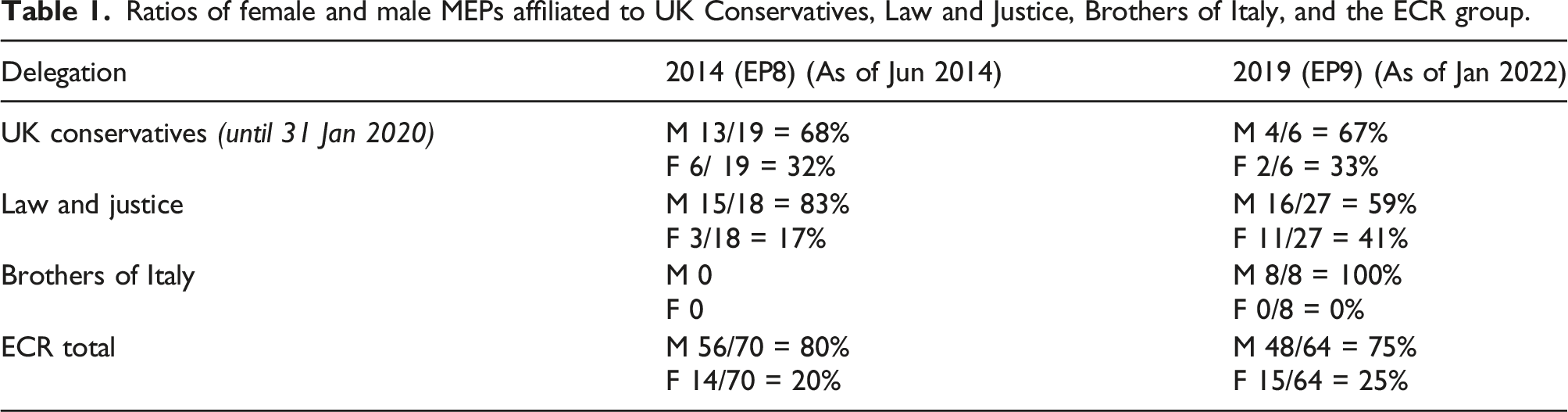
Ratios of female and male MEPs affiliated to UK Conservatives, Law and Justice, Brothers of Italy, and the ECR group.
Steven based his analysis on a similar case study selection, arguing that ‘[u]ltimately theoretical questions surrounding the true ideological identity of ECR are crystallized by the activities of the UK and Polish delegations, the former an economically conservative but broadly now a socially progressive party, the latter an economically progressive but socially conservative party’ (Steven, 2020: 62). Compared to his study, we add a focus on the FdI, a relatively recent ECR member that already has the second largest NPD in the group. Given the rising support for Brothers of Italy domestically, it is likely that they will have a significant role to play in the ideological composition of the ECR in the future. Its main distinctive feature is that it is the heir of the Italian post-fascist parliamentary right (Feo and Lavizzari, 2021).
Main national delegations of the ECR
UK Conservatives
The Conservative Party (UK) was founded in 1834. It has never received less than 30.7% (1997) of the vote share in the general elections. In the EP elections, the party received 23% of the votes in 2014, electing 19 MEPs, but only 8.8% in 2019 - when Britain’s exit from the EU had already been decided, and the newly elected British MEPs would only serve a few months in the EP. The Tories have been bitterly divided over the relationship of the UK with the EU. A majority supported accession to the European Communities, but vehemently opposed the common currency and an ‘ever-closer union’. Eventually, the more Eurosceptic wing of the party successfully campaigned for leaving the EU altogether in the 2016 Brexit referendum, and then won the 2019 parliamentary election with the slogan ‘Get Brexit Done’.
Women’s descriptive representation of UK Tories reached only 33% in the EP (see Table 1) and 40% domestically (cf. Childs and Webb, 2012: 69). In terms of the substantive representation of women, the political party modernization strategy under the leadership of David Cameron garnered much comment about gender, or rather, the extent to which the party had feminized, integrating women and their ‘interests’ into the parliamentary and broader party.
Heppell and Bryson (2010) identified four ideological tendencies of British conservatism: traditional conservatism, liberal conservatism, new right conservatism, and recent developments in the Conservative Party. They argued that, whilst there was some overlap between some conservative policies and strands of feminism, overall, the Conservative Party’s emphasis on individual merit and competition rather than collective problems and solutions only enables limited feminist goals (2010: 46). Intra-party ideological differences relate to hostility toward gender-related reform (Childs and Webb, 2012). Thatcherites are the most hostile; the (youngest and mostly male) Liberal Conservatives are the least. Traditionalist Tories, (the largest, most working class and most female) are ‘surprisingly progressive’ on the descriptive and substantive representation of women (2012: 165).
Prawo i Sprawiedliwość
The Polish Law and Justice party was created by Lech and Jarosław Kaczyńscy in 2001. The party was first in power in 2005–2007 and, after a long spell in opposition, returned to government in 2015, heading coalition governments since. In 2014, the PiS coalition list came a close second in the EP elections, with 31% of the votes and 18 MEPs. In 2019, PiS won the European elections with 45% of the popular vote and elected 26 MEPs.
In terms of its relationship with European integration, PiS also opposes an ‘ever-closer union’. For PiS advocates, Poland’s emergence from state socialist rule signified the restoration of the historical nation, defined by national and Christian traditions, and the ‘return to Europe’ – characterized as an ultraconservative ‘Europe of nations’. The narrative of moral resurrection was infused by Christian morality and a stress on state sovereignty that draws extensively on nationalism and religion (Markowski, 2007). In its depiction of a reclaimed Poland, the PiS program employed a normative terminology relying on confessional culture, economic populism, claiming to favour state intervention to remedy inequalities, and a revived Euroscepticism to safeguard economic and cultural independence (Bielasiak, 2010: 50).
In terms of women’s descriptive representation, nationally, PiS had 24% women MPs, but 41% of female MEPs (see Table 1). In terms of its stance on gender equality, PiS has managed to restrict the abortion law in Poland, allowing pregnancy termination solely in the cases of rape/incest and the threat to the life of the woman, thereby practically outlawing over 90% of legal abortions. Prawo i Sprawiedliwość has been a vocal proponent of anti-gender mobilizations in Poland since 2012. They have also taken vehement stances against LGBTQ+ people and used hate speech against refugees.
Prawo i Sprawiedliwość governments have attempted to consolidate power by curtailing the judiciary and the independence of the administration; dismantling checks and balances, environmental standards, and civic freedoms; and violating women’s and minority rights, which triggered several European Court of Justice cases against Poland for breaches of EU fundamental values (Karolewski, 2021). Poland is an example of party state capture, where PiS managed to monopolize the political and judicial system in their own and their clients’ favour (Karolewski, 2021).
Fratelli d’Italia
Brothers of Italy was founded in 2012 with the declared intent of ‘recreating the Italian right’. It is a far-right party and the main heir of Italy’s post-fascist political forces (Feo and Lavizzari, 2021: 1–3). Significantly, the party founder and current leader, Giorgia Meloni, began her political career in the youth wing of the Italian Social Movement, the post-war descendant of the Italian fascist party. While FdI received only 2% of the votes in 2013, its growth has been constant. It obtained over 4% of the votes in the 2018 national elections and 6.4% at the 2019 European elections (Albertazzi et al., 2021; see also Table 1). Since then, its support in surveys has increased even faster and appears to have reached over 20% in the summer of 2021 – which would make it the largest party in the center-right coalition. 3
The party has contributed to the mainstreaming of its central tenets – nationalism, anti-immigration policies, law and order, support of traditional values and of Catholicism – in national political and societal debates. Fratelli d’Italia supports a confederal ‘Europe of nations’. Its leadership has claimed that it wants to discuss Eurozone rules and amend the Italian constitution to give Italian law primacy over European law.
In terms of women’s descriptive representation, even though the party is led by a woman, it has assigned nearly all other prominent internal positions to men and has the lowest percentage of seats held by women in the Italian parliament (29%) (Belluati, 2020: 370). In the EP, the party has had no female MEP. Its eight MEPs elected at the 2019 European elections are all men.
On gender equality, FdI revived numerous long-standing programmatic elements of the Italian (far) right, including nationalism, nativism, the promotion of so-called ‘family values’, opposition to migration and multiculturalism and hard Euroscepticism. Populist rhetoric and an ‘obsession with gender’ (Dietze and Roth, 2020: 7) shape the party’s discourse. Fratelli d’Italia is a vocal opponent of so-called ‘gender ideology’ and same-sex marriage, and understands gender as based on biological and binary differences. It has a restrictive stance on reproductive rights and opposes sex education in schools (Feo and Lavizzari, 2021: 3).
Theorizing conservatism and gender
As an ideology, conservatism has long been associated with the willingness to maintain the status quo and defined as a ‘counter-movement’ to the progressive and rationalist ideas of the Enlightenment (Allen, 1981). Broadly speaking, conservatives prefer stability and continuity over disruptive change and advocate political concepts such as hierarchy, elitism, religiosity, property rights, free enterprise, and state sovereignty (Drolet and Williams, 2021: 275–276). A more extreme wing of conservatism – defined in the literature as ‘radical’, ‘militant’ or ‘reactionary’ – has existed since the 19th century, endorsing nationalistic, imperialist, and anti-Semitic ideas (Allen, 1981: 597–591). Current radical conservatism in Europe advocates the defense of European identity from multiculturalism and immigration, and of the traditional moral order from the relativism of liberalism (Varga and Buzogany, 2021).
Scholars have undertaken discursive examinations of what gender equality means in contemporary right-wing politics. Literature on gender equality policy backsliding focuses on radical right parties in Europe (cf. Köttig et al., 2017; Kovats and Põim, 2015; Feo and Lavizzari, 2021) and on Central and Eastern European states (see for instance: Krizsán and Roggeband, 2018; Grzebalska and Pető, 2018). This scholarship has exposed how narratives that even indirectly oppose gender equality ‘bend and stretch’ the concept to manipulate its meaning strategically ‘toward xenophobic, Eurosceptic, and illiberal goals’ (Kantola and Lombardo, 2020: 576). Kantola and Saari (2014) explored conservative women as shapers of national gender equality discourses, bending gender equality away from leftist statist priorities towards resources, the economy, and the nation. Drawing on this literature, we apply a gender lens to ascertain what conservatism ‘is’ and how the stance on gender equality broadly understood delineates its ideological content. Thus, we contend that conservatism as an ideology is gendered and gendering.
There is a growing literature on the condition, compatibility between, and consequences of gender and conservatism in Europe, especially at the domestic political level. Childs and Webb’s (2012) analysis of gender and conservatism develops and refines the concepts of representation and party feminization. They argue that it should not be assumed that the substantive representation of women equals the feminist substantive representation of women. Many parts of the world are experiencing a ‘conservative moment’. (…) Conservative gender ideologies — adhered to by various rightist, extreme right, populist, and traditionalist religious political actors — foremost envision a private role for women, limiting their individual and collective access to the public sphere. (…) Such a reassertion of traditional gender roles seemingly goes hand in hand with state retrenchment and a neoliberalism regarded by most feminists as detrimental to the material situation of, and equal opportunities for, women (Celis and Childs, 2018: 2).
Theoretically, we rely on Elomäki and Kantola’s (2018) conceptualization of features that we see as main ‘components’ of conservative ideology. The authors have explored how conservatism and gender relate to the discourses and policies in the three political projects of nationalism, social conservatism, and neoliberalism. They argue that focusing on one point in the triangle compartmentalizes feminist struggle and neglects the problematic convergences and intersections that come out of these three projects. We draw on this argument and focus our empirical analysis around the themes of the genderedness of neoliberalism, social conservatism, and nationalism.
Neoliberalism refers to the marketisation of public services, the transfer of costs and risk from the state to individuals and families, and the extension of private sector management practices to the public sector. Importantly, neoliberal gender neutrality can co-exist with liberal feminism that emphasizes rights, individual women, choices, opportunities, education, career and merit, women’s descriptive representation, and the gender quota system (Kantola and Saari, 2014). Social conservatism encompasses a conservative stance on moral and ethical issues, including most notably the promotion of conventional family structures and gender roles. Finally, we conceptualize nationalism as exclusionary politics focusing on a racialized distinction between an in-group and outsiders; it is shaped by anti-immigration, anti-diversity, and racist arguments (Elomäki and Kantola, 2018: 340–1). These three discursive constructions are interconnected, sometimes overlapping, mutually reinforcing, and always gendered and gendering. Gender plays an essential role in them because they all converge in promoting institutionalized patriarchy and heterosexism.
Methodology and research material
Discursive practices contribute to sustaining, reproducing, and transforming social structures. They reflect and affect power relations through their representation of the world. To investigate the discourses of Tory, PiS, and FdI representatives in the EP, the article applies critical discourse analysis, which allows exposing the gendered dimension of political narratives by deconstructing texts and relating them to their social, political, and ideological background (Van Dijk, 2002: 101–2). Critical discourse analysis explores how discourses evolve and political attempts at restructuring them (Torfing, 2005: 14). It is therefore an apt methodology for the investigation of how ECR discourses and political positions evolved from the 2010s until 2021. It also highlights how discursive constructions such as ‘conservatism’ are unstable, complex, and context-dependent, reflecting the dominant ideology and power relations.
Critical discourse analysis involves tracing the development of key concepts and themes that reflect the gist of a discourse (for step-by-step application of the methodology, see Siddi, 2017: 32). When reading the sources, we identified key discourses about gender equality and nationalism, neoliberalism, and social conservatism that have clear implications in terms of conservative ideology. From this analysis, we derive our arguments on what it means to be ‘conservative’ in the EP and in the ECR today.
We have collected research material consisting of ECR MEP and staff interviews (n = 13). These included: PiS (n = 2), FdI (n = 1), UK Conservative (n = 5), other ECR delegations (n = 1) and group staff (n = 4). We interviewed 10 men and 2 women. It was significantly more difficult to obtain access to Italian and Polish MEPs, who were overall less responsive to interview requests. We also analyzed fieldnotes of ECR parliamentary activities from a larger ethnography. These included: shadowing an ECR MEP (UK) in 2018; attending an ECR ‘Conference on the Traditional Family’ held in Brussels (that had PiS and FdI representation) in 2020; and observing broader ECR activity around the formal and informal spaces of the EP. We also examined the 2009 Prague Declaration, ECR statutes, 2014 and 2019 election programs and manifestos, as well as publicly available statements relevant to our research questions. The documents and interviews were translated from Italian and Polish by the authors.
Different shades of conservatism: discourses of the ECR
Nationalism
Our empirical material highlights two main discursive constructions through which nationalist stances appear in the statements of ECR MEPs: the defense of national sovereignty and explicit or implicit claims of national superiority. Both constructions include a focus on conservative understandings of gender to bolster their arguments. While these constructions are broadly shared in the three delegations under analysis, UK Conservatives appear to be relatively more sensitive to diversity issues.
European Conservatives and Reformist Members of the European Parliaments are especially keen to protect national sovereignty from perceived attempts of European institutions to legislate beyond their competence. Most notably, they consistently argue that gender equality is not an EU competence (Interview 2). This argument also appears in European election manifestos. For instance, the 2014 EP election manifesto of FdI states that the party ‘defends the prerogatives of Nation States to prevent European lawmakers’ interferences on ethical questions and family law’ (FdI, 2014). In a similar guise, the 2014 EP PiS election program asserts that the party will ‘defend Polish national identity, traditions, culture as well as the Polish mode of life and customs’ from ‘risky supranational cultural experiments’ and ‘cultural reeducation from outside’ (PiS, 2014). As noted by Kantola and Lombardo (2020), to advocate this stance within the EU, ECR discourses emphasize the principle of subsidiarity (PiS, 2014; Interview 2) embedding it in Euroscepticism. A PiS MEP even framed subsidiarity as ‘an active social policy’ to support the family (Fieldnote 2).
Discourses about ‘defending the nation’ are sometimes transposed to the European level and presented in terms of defending ‘Christian Europe’ or ‘European nations’ from certain ethical values and external threats. In this context, ECR criticizes the Lisbon Treaty because it allegedly ‘rejected common cultural heritage and Christian Values’, which purportedly could cause a ‘domino effect’ into other areas of life (Fieldnote 2). The 2019 EP election program of FdI claims that ‘Europe is experiencing a dramatic demographic crisis and if the trend is not inverted the European people is bound to become extinct’ (FdI, 2019). To prevent this, the program advocates making ‘support of family and pro-natalist policy as the main expense in the European budget’ (FdI, 2019). This policy implies that European women should devote more time to reproduction and family. It therefore reiterates the long-standing nationalist view that women should focus on their role as biological reproducers of the nation (Peterson, 2007). The issue is heavily securitized: if they do not do this, Europe faces an existential threat.
Arguments about the defense of national sovereignty are often accompanied by attitudes of national superiority, reflected in statements that ‘things work better in my country’. European Conservatives and Reformist MEPs from the UK stressed that their delegation was the most diverse, both in terms of race and gender. To highlight this, they sometimes mentioned the fact that the ECR Co-Chair in the eighth EP term was a black Muslim Tory (Interview 2). One interviewed British MEP even justified his ‘Leave’ vote in the Brexit referendum with the argument that there is ‘far more pernicious’ racism in the EU (Interview 7).
Regarding gender equality issues, such as the use of appropriate language, British MEPs argued that ‘the UK tends to be very advanced in these things’ because ‘culturally, there are things that are acceptable in other member states that we wouldn’t find acceptable in the UK’ (Interview 3). This stance is echoed in the statements of PiS MEPs. One interviewed Polish ECR MEP argued that ‘in Poland we are one of the more equal societies. The position of women is incredibly strong, we know in fact that women rule in the family’ (Interview 12). Fratelli d’Italia members argued that women were better represented in their party than in left-wing political organizations because their current national leader, Giorgia Meloni, is a woman (Interview 11) – thereby disregarding the fact that their ECR delegation does not have a single woman. Hence, the nationalist discourses of ECR MEPs focus on the defense of ‘superior’ nations and Europe from alleged external threats. This stance is articulated through narratives that relegate women to the role of reproducers and carers of the nation/Europe, thereby exposing the tight connection between nationalism, gender, and radical conservatism in ECR discourses.
(Neo)liberalism
Our empirical material shows that our respondents from the UK Conservatives and FdI framed their beliefs in varieties of liberal conservatism that emphasized freedom and markets. One Tory described herself as a ‘liberal woman in the parliament’ (Interview 3), another referred to the UK Conservatives as a ‘liberal delegation’ (Interview 2; also Interview 7). A FdI MEP said his ‘background [was] from the liberal party’, and that he was ‘an end of 19th century liberal’, ‘a man on the right’ (Interview 11).
There are three main discursive constructions in which neoliberal stances manifest themselves in the statements of ECR MEPs: the free market economy; gender equality framed as descriptive representation; and an emphasis on personal voluntaristic advancement in the competitive (political) marketplace. Neoliberalism is manifested variably in the economic policies of all three delegations. FdI’s 2019 electoral program exposes both the party’s neoliberal stance on fiscal policy and its contradictory support for more generous public investments. The program focuses on ‘reducing taxation’ and argues for ‘a 15% flat tax for everyone’ (FdI, 2019). While the implementation of such a low flat tax would increase inequality and considerably limit the budget for welfare and social spending, FdI’s program calls for ‘an end to stifling austerity’ and ‘an imposing national and European investment plan in infrastructure’. Most notably, it advocates the introduction of a ‘European maternity income’, defined ‘as a monthly cheque for every child’, and several other financial and fiscal incentives to support a natalist policy.
The 2014 and 2019 PiS electoral programs also favour spending for natalist-nativist policies, but they are less precise on policy priorities. In terms of the economy, they very bluntly state: ‘We do not believe that “capital has no nationality”. We reject the rules of neoliberalism’ (PiS, 2019: 17). Economic neoliberalism is presented as a villain, often connected to ‘foreign’ gender equality: ‘the expansion of the neoliberal ideology, which in practice has taken the form of social Darwinism hidden behind individual rights. This freedom however means permissivism or the acceptance of breaking social norms’ (PiS, 2019: 23). Prawo i Sprawiedliwość electoral programs also stress the role of ‘Polish traditional values’ and ‘religious tolerance’ in the growth of the economy, showing interdiscursivity with narratives of ‘politics of values’, nationalism, and social conservatism.
UK Conservatives place emphasis on growing small businesses, arguing that women could actualize empowerment in these structures through neoliberal autonomy (Fieldnote 3). A female MEP spoke about being spotted and fast-tracked as a ‘female businessperson’ (Interview 3). Whilst one Tory regretted the poor work-life balance for young families in the parliament, arguing that ‘they have no interest or care in the parliament or in the group’ about childcare (Interview 2), a British staff member positively appraised their boss’ ‘family values’ for granting care leave, rather than statutory or gender considerations (Fieldnote 1). Following similar logic, a PiS MEP suggested that the left groups in the parliament frame maternity as an ‘obstacle for women’s professional development and that professional development is given a higher priority than the family' (Fieldnote 2).
The descriptive representation of individual women and minorities and their competence and merit was stressed by all three delegations: ‘It’s been done on competence (…) it’s always been on merit (…) the ECR’s been one of the most meritocracy-based of groups I’ve ever come across. I have never been held back because of my gender within my group’ (Interview 3; also Interview 2). A PiS MEP noted: ‘we have a large group of women who are very active; the group is very balanced (…) the group is very lively thanks to this diversity’ (Interview 12). Criticism directed at FdI on its stance on women’s representation and gender quotas is dismissed with the argument that FdI has a female leader at national level (Interview 11).
Voluntarism is emphasized as democratic practice within the group. A PiS MEP noted ‘the group works on a voluntary basis (…) we have no gender equality practices. We believe that male and female deputies are the same (…) the fact whether someone is a man or a woman is secondary to the fact that they are an MEP’ (Interview 9). Whilst they tended to espouse gender neutrality, Tory MEPs were happy to talk about individual men, such as party leaders and heads of delegation, as critical male actors providing openings for women. In the ECR, gender quotas are frowned on by all delegations, though some affirmative action took place in the UK Conservatives. However, in the EP seats and positions are assigned based on the D’Hondt method, and a cordon sanitaire is created that often excludes ECR. For example, a PiS MEP complained that ECR were excluded from the EP’s Committee on Women’s Rights and Gender Equality (FEMM) event for International Women’s Day, whilst the EPP had a disproportionate presence (Fieldnote 2).
European Conservatives and Reformist Members of the European Parliaments often relegate gender equality to women, who are presumed to take responsibility for equality issues based on their socialization. A PiS MEP noted ‘the ladies often raise human rights issues (…) also women’s rights but from a conservative perspective’ (Interview 12). One female PiS MEP noted how she had joined the FEMM Committee to advance support for the family (Fieldnote 2). Women are also presumed to work harder. An FdI MEP noted ‘actually I work much better with women in the EP [laughing] because typically they are much more prepared which is probably the reason why they got there’ (Interview 11).
A PiS MEP noted that on matters of gender equality: ‘We do not discuss this matter any further, except for FEMM Committee members where they have those discussions also about the language. But is it discriminatory to state that a glass is feminine, but I am far away from these discussions and our group does not partake in them either’ (Interview 9). Personal responsibility and ‘choices’ in professional encounters were emphasized. When discussing the #MeTooEP movement, a staff member for a British ECR MEP said that ‘30% of the sexual harassment cases had been men and women putting themselves in those positions’ (Fieldnote 1).
Therefore, (neo)liberal discourses of ECR MEPs tend to prioritize what they term individual competence over gender equality. Gender equality topics are relegated to women, reflecting an essentialist and binary conservative division of labour. Hence, especially among the Tories, we do not find a full rejection of gender equality concerns; rather, we observe a declarative liberal recognition of equality concerns that is diluted and used to whitewash the radically conservative makeup of the group.
Social conservatism
‘Social conservatism’ is the theme most frequently associated with ECR, particularly on issues like family policy, gender identity and expression, sexuality, and reproductive health and rights. Our data nuances this assumption and demonstrates a tension between social liberalism and social conservatism between the different NPDs under analysis. While believing the ECR was intersectionally progressive, our Tory interviewees stressed tensions along religious and national lines: the group’s fairly strong I think on issues to do with, race, disability, on gender as well. (…) [I]n terms of these three areas there is a commitment to want to, see, a level playing field and equality (…) but things like…sexual orientation, this for some of the people in the ECR group is problematic. (Interview 2)
Social liberalism was strongly felt in the Tory delegation, putting them in opposition to the PiS MEPs in particular: ‘I’m a very liberal [person] who believes it’s a human right to have access to family planning (…) I feel most uncomfortable within my political group when we’re voting on access to abortion services for victims of rape’ (Interview 3). Similarly, an FdI MEP acknowledged PiS positions as often uncomfortable for the group: ‘we do have some very ideological people that are against gays. That are against lesbians, transgenders [sic!] (…) They also created the LGBT free zone in Poland (…) The Polish are much more aggressive’ (Interview 11). Nonetheless, intolerant and bigoted positions were widespread in FdI too.
Fratelli d’ItaliadI use anti-LGBTQ+ narratives, veiling their homophobia and heterosexism behind the defense of the ‘traditional family’ (Fieldnote 2). Their party program for the 2014 elections stated: While respecting all individual orientations against any form of discrimination, Brothers of Italy (…) firmly opposes the attempt of the left to demolish the concept of traditional family, going as far as replacing the words ‘mum’ and ‘dad’ with the neutral terms ‘parent 1’ and ‘parent 2’. Brothers of Italy (…) defends the prerogatives of Nation States in order to prevent European lawmakers’ interferences on ethical questions and family law.
As observed previously by Grzebalska and Pető (2018: 167), the centrality of familialism emerges as ‘a form of biopolitics which views the traditional family as a foundation of the nation and subjugates individual reproductive and self-determination rights (of women in particular) to the normative demand of the reproduction of the nation’. This is the case for both PiS and FdI. They attribute centrality to the traditional, heteronormative family, with a strong natalist focus.
Moreover, FdI interviewees present their homophobia as the right to freedom of speech and expression: ‘When you come to me and you say that you have to dress in pink or whatever I don’t know of if I say something against gay [s] and I am criminally accused, that I don’t like’ (Interview 11). ‘Linguistic domination’ was criticized and an appeal to common sense was made. Referring to the above ‘parent 1 and parent 2’ terminology, an ECR MEP exclaimed: ‘today everything has been turned upside down!’ Criticism was directed at those groups in the EP who were ‘hysterically explaining how their rights were being trampled on’ and dissenters were ‘constantly in a corner’ attacked by those with ‘liberal stamina’ (Fieldnote 2). This position is akin to that expressed by a PiS interviewee: In general, we believe that LGBT environments are creating an artificial political situation and demanding not equal treatment, which they have, but privileges. (…) We think these are artificially created problems by neo-Marxists who want to replace the former working class with so-called marginalized groups and arm these groups in battering rams to destroy society and atomize people. We think this is an ideology, (..) I never met anyone who would be reprimanded for sleeping or not sleeping in someone’s bedroom, however the moment this person comes out in the streets and makes political moves, then these moves meet with our counter-moves and that’s it (Interview 12).
Prawo i Sprawiedliwość Members of the European Parliaments argue that ‘human rights and gender equality issues are artificially conjured up (…) We do not accept that we are moving away from two sexes and starting to create 50 genders now’ (Interview 12). Prawo i Sprawiedliwość bend and stretch the understanding of gender equality to fit their purposes (cf. Ahrens et al., 2021; Kantola and Lombardo, 2020). Their ‘traditional’ values present women paternalistically and with ‘benign’ sexism: We have never had problems with women being in politics in Poland. We actually encourage it. We had several female prime ministers already and a multiplicity of female ministers. The only problem there is in how to spur women on to political life (Interview 12).
By joining in the legislative work of the FEMM Committee, ECR MEPs take pragmatist-participatory positions (cf. Brack, 2018), influencing the debate through the social conservative rhetoric of PiS and FdI MEPs.
Gendered conservatism: changing constructions?
McDonnell and Werner (2019) have shown that the founding NPDs of ECR have shifted increasingly to the right. Our research demonstrates that, while the group displayed an ideological division along the liberal-conservative axis in 2019, that gap is closing after Brexit, with ECR firmly moving to nationalist, chauvinist, and exclusionary positions typical of the far right. This is reflected in the diachronic development of the nationalist, neoliberal, and socially conservative narratives analyzed above.
In the 2019–24 parliamentary term, the ECR is dominated by Eastern European NPDs – 39 out of 64 MEPs are from the region. This marks a significant change from 2014 when the Polish and British delegations had the same number of MEPs. At the same time, our interviewees preferred to call their grouping ‘center-right’ (Interview 13) and ‘conservative’ (Interview 12), thereby obfuscating and misnaming themselves to present a ‘respectable’ face (cf. McDonnell and Werner 2019).
The internal balance of the group may tilt further in favour of illiberal Eastern European parties if Hungary’s Fidesz joins ECR, following its departure from the European Peoples’ Party. In November 2021, the ECR group issued an official statement claiming: We will [therefore] start working towards the expansion of the ECR Group by opening a dialogue with like-minded national delegations, starting with the Fidesz Delegation in the EP. The ECR is here to stay. We will continue to be Europe’s conservative voice, to fight for a strong, united Europe of proud nations, and to grow in a coherent manner. (ECR, 2021)
Likewise, our interviews suggest that ECR has moved to the right and become more nationalist following the 2019 EP election and Brexit. Our empirical material demonstrates that British Conservatives had a moderating effect in ECR on topics such as equality and diversity, where other NPDs took more rightist positions. Interviewed British MEPs admitted that leaving the EPP and joining the ECR in 2009 led to ‘a lot of regressive steps in terms of [their] position within the EU’ (Interview 1). At the same time, they argued, if UK Conservatives had a large delegation, they would negotiate and dissuade other members from pursuing policies perceived as overly rightist (Interview 7).
British ECR MEPs openly criticized the fact that Polish group members pursued national(ist) and anti-feminist positions while representing the entire group, as well as the lack of women MEPs in the Italian ECR delegation (Interview 1). While these statements must be treated with caution, particularly as the domestic policies of UK Conservatives were far from moderate on topics such as immigration, in our interviews British ECR MEPs were the only ones who admitted the existence of issues such as racism or the lack of gender equality, both in their group and more broadly in the EU. Therefore, their departure from the EP in 2020, together with FdI joining the group and PiS remaining as the only large NPD, has shifted ECR towards more nationalist and rightwing positions.
Furthermore, at the declarative level, PiS and FdI hide behind women’s empowerment and freedom of speech positions to refute claims of them being against women’s rights. Arguably, this mirrors the use of the label of ‘conservatism’ to legitimize the group and present themselves as ‘respectable’ (McDonnell and Werner, 2019). If conservatism is supposed to ‘defend the political status quo’ (Allen, 1981), then it seems that at some level a very stripped-down version of women’s and LGBTQ+ rights is now included, albeit framed rather paternalistically. This articulation of gender equality points to purposeful political statecraft strategy, rather than genuine political commitment.
Conclusions
The article contributed to the scholarly literature on the ECR group through a focus on gender equality and how gendered constructions pervade key group narratives on nationalism, (neo)liberalism, and social conservatism. It highlighted that the ECR group are significant shapers of gender equality discourse in the EP, due to their willingness to engage in EP legislative and deliberative work. The analysis of ECR discourses in the EP and in European election manifestos reveals that ‘conservatism’ is increasingly entangled with nationalist, neoliberal, and often paternalistic and heterosexist stances, covered up by a veil of seemingly pro-women narratives in terms of representation. In the group, a pronounced tension exists between widespread socially conservative anti-equality discourses and more liberal ‘common sense’ status quo narratives about women’s and minority rights. However, the latter mainly recur in Tory statements and appear to be more ‘declarative’ than reflecting policy commitment. Moreover, the departure of the Tories from ECR in 2020 and the far-right FdI joining the group in 2019 led to the further marginalization of even such declaratory stances in group narratives and to a more reactionary framing of conservatism on gender equality.
Our data demonstrated that conservatism as a political project within the EP is mutable and the stress on the different strands changes over time, but the stance on gender equality is a crucial ideological boundary that defines it. Overall, the gender lens reveals that conservatism at the European level does not merely consist of a direct rejection and renouncement of gender equality, branded as ‘gender ideology’. Whilst ECR MEPs (especially PiS and FdI) explicitly and directly do this, they also engage with gender equality through use of (neo)liberal narratives about women’s and minority representation and individual political empowerment and advancement.
Hence, conservatism does not refer to women being excluded from the public sphere anymore. Instead, European conservatives under analysis make claims about gender and racial equality, often bending and stretching the terms to obfuscate especially homo- and transphobia. Homophobic narratives and remarks permeate ECR discourses in different policy areas, from economic to social, migration, and family policies. The focus of the currently dominant NPDs in the ECR on defending the nation or Europe from migrants, liberalism, and ‘neo-Marxism’ – concepts that are constructed as alien and threatening – provides the context in which the group ubiquitously disseminates anti-equality rhetoric. To use the terminology of seminal studies on historical conservatism, the type of conservatism advocated by ECR can be defined as radical, militant, and reactionary (Allen, 1981; cf. Varga and Buzogany, 2021). Both future research and political configurations in the EP will need to consider the increasingly radical stance of the ECR and their reactionary construction of conservatism.
Research material
Fieldnote 1: Shadowing day ECR MEP1, Brussels, 05.12.2018
Fieldnote 2: ECR Traditional Family Conference, Brussels, 04.02.2020
Fieldnote 3: Political Group Leader Exhibition, Parlamentarium, Brussels, 18.10.2018
Interview 1: ECR MEP1, Brussels, 05.12.2018
Interview 2: ECR MEP2, Brussels, 31.01.2019
Interview 3: ECR MEP3, Brussels, 06.02.2019
Interview 4: ECR staff1, Brussels, 20.02.20,194
Interview 5: ECR MEP4, Brussels, 21.02.2019
Interview 6: ECR staff1, Brussels, 18.03.2019
Interview 7: ECR MEP5, national capital, 19.12.2019
Interview 8: ECR MEP6, Brussels, 04.03.2020
Interview 9: ECR MEP7, Brussels, 05.03.2020
Interview 10: ECR staff2, online, 28.10.2020
Interview 11: ECR MEP8, online, 12.05.2021
Interview 12: ECR MEP9, online 13.05.2021
Interview 13: ECR staff3, online 07.04.2022
Footnotes
Declaration of conflicting interests
The author(s) declared no potential conflicts of interest with respect to the research, authorship, and/or publication of this article.
Funding
The author(s) disclosed receipt of the following financial support for the research, authorship, and/or publication of this article: This research received financial support from H2020 European Research Council and the grant number 771676.
