



Abstract
An increasingly polarized European Parliament (EP) has become an important site of radical right populist opposition to gender equality. Through a qualitative analysis of populist interventions in EP plenary debates on gender equality in the 8th legislature (2014–2019), this article identifies the discursive strategies adopted by right populists to oppose gender equality. It contributes to scholarly debates on populisms and on gender and politics by respectively suggesting to the former the need to dedicate attention to gender equality as a central aspect in populist ideologies, and to the latter the importance of considering a variety of strategies of radical right opposition to gender equality. Radical right populist strategies include not only indirect but also direct opposition to gender equality and draw on old and traditional gender imaginaries packaged in novel populist ways.
Introduction
Populism has come under intense scholarly scrutiny over recent years as populist parties have had sustained electoral victories in different parts of the world and entered national governments and executive positions. In addition to theoretical work on populism (Laclau, 2005; Mudde and Rovira, 2013), empirical studies to date address: who votes for populists and why; the impact of populists on party systems and democracy; the country and party specific characteristics of populism; as well as the contents and the impact of populist claims (Norris and Inglehart, 2019). However, most research on populism has paid little attention to research about the ways in which gender equality and radical right populism (RRP) are intertwined and the role that opposing gender equality plays for populist politics (Kantola and Lombardo 2019).
This article analyzes the discursive strategies radical right populists adopted in the European Parliament (EP) plenaries to oppose gender equality in the 8th legislature (2014–2019). The research question we pose is: What discursive opposition strategies do radical right populists adopt in relation to gender equality in parliamentary debates? Studying radical right populist opposition to gender equality matters. Firstly, gender equality issues are part of the discourse of RRP in addition to more widely studied aspects such as nativism. The way in which gender is addressed can help to better understanding the values and content of RRP. In this respect, radical right populists have opposed gender equality by reframing the democratic principle of gender equality as a dangerous and elitist ‘gender ideology’ 1 which challenges traditional family values based on heteronormative relations and education; the sexual division of labour that assigns women the main role in the domestic and private sphere and men the main role in the public sphere; and sexual and reproductive rights (Kováts, 2020; Kuhar and Paternotte, 2017; Rawłuszko, 2019). The framing of gender equality around traditional values shows it is an issue of relevance in itself for radical right populists and not only an instrument to use against migration, exemplified in the exclusionary rhetoric about protecting ‘native women’ against threatening or ‘backward migrants’ (Wodak, 2015). Secondly, studying the discourse of radical right populists on gender equality reveals their illiberal attitudes. Equality is an integral part of democracy (International Panel on Social Progress (IPSP), 2016), as the relation between women’s status and progress on all indicators in global comparative studies shows (Htun and Weldon, 2010; Inglehart and Norris, 2003). As a result, radical right parties’ opposition to gender equality is a threat to democracy itself. Thirdly, radical right populist rhetoric against gender equality has political effects. It has had the political impact of curtailing the space for debating progressive gender policies concerning sexual and reproductive rights, including abortion and the Istanbul Convention, in national parliaments and international forums.
The EP is a particularly relevant site for studying radical right populist opposition to gender equality. The EP represents a unique transnational platform for both communicating to radical right populist national constituencies and bringing together political parties with similar ideologies. Studying radical right populist discourse in the EP provides important clues for understanding who these parties are and where they are going at the national and international level (McDonnell and Werner, 2019). The EP is indeed a unique political institution in that – during the legislative term 2014–2019 – its 754 political representatives (Members of European Parliament (MEPs)) came from 28 different countries, 232 political parties, and formed eight political groups 2 . The EP is the only directly elected decision-making body of the European Union (EU). It has considerably increased its powers over the past 10 years, no longer being a rubberstamp for policy initiatives coming from the European Commission and Council. Populist parties and MEPs have come to form a substantive minority within the parliament. Their opposition is channelled not just toward the policies of the EU but against the very institution.
In addition to being the most democratic EU actor, the EP is represented as the most gender equal of the EU institutions (Van der Vleuten, 2020). Women’s representation has increased steadily to 40% in 2019. Despite a downturn in EU gender equality policies in the 2010s (Jacquot, 2015), the EP has generally been supportive of gender equality policies (Ahrens and Rolandsen Agustín, 2020). The need to assess whether such supportiveness persists in a more polarized EP, with conflicting positions about gender equality from the populist right and left (DeWilde and Zürn, 2012), motivates our focus on analyzing the oppositional side of the political spectrum represented by the right populist strategies against gender equality in the EP.
Since national and EU levels of government interact in policymaking, studying the EP arena helps understanding national developments on gender equality, and vice versa: radical right populist discourses against gender equality at the EU level contribute to shape the political agenda and commitments on gender equality both of the EU and of the member states that have to implement EU policies in their national contexts (Abels, 2016). In the last decade, different European countries have experienced backsliding in democracy and gender equality policies, concomitant with the rise of radical right and anti-gender movements and parties (Krizsan and Roggeband, 2018; Mayer and Sauer, 2017). Europe is therefore a good case to address the phenomenon of radical right populist attitudes toward gender equality. Yet, while there are studies on the member state level, the EP level still needs to be addressed.
To address our research question, we analyze radical right populist framings in EP parliamentary debates on gender equality. We focus on EP plenaries because they are the most suitable stage to observe populist performance, considering national audience and media tend to be the ultimate target of speeches, especially for radical right populists (Brack, 2018). Our study contributes to scholarly debates on radical right populism and opposition to gender equality in EU policymaking by showing that populists’ discursive strategies of opposition to gender equality are much more diversified than found by former studies. RRP strategies are both direct and indirect and draw on old and traditional gender imaginaries packaged in novel populist ways.
Radical right populism and gender equality in the European Parliament
Recent theoretical work on populism provides a number of possibilities for defining the concept for analytical purposes. Famously, Cas Mudde and Cristóbal Rovira Kaltwasser (2013: 151) provide a ‘minimal definition’ of populism that conceives it as a thin ideology opposing ‘the elite’ and defending ‘the common people’, proclaiming ‘popular sovereignty as the only legitimate source of political power’. Mudde and Rovira Kaltwasser say little about the content of this thin ideology. From a critical gender perspective, the minimal definition allows empirical analyses about the ways in which opposing gender equality adds content to this thin ideology. Populism can also be studied as a particular political style. According to Benjamin Moffitt (2016), populism as a political style is not a mere rhetorical communicative strategy but rather performative and relational, explaining its versatile and malleable nature. The leaders become the performers, the people the audience, and media the stage for the performances. Radical right populist political style, for example, features a ‘low’ political style of ‘bad manners’ which includes ‘use of slang, swearing, political incorrectness, and being overly demonstrative, passionate and “colourful”’, as opposed to the ‘high’ behavior of ‘rigidness, rationality, composure and use of technocratic language’ (Moffitt, 2019: 52). Observing the political style displayed in populist opposition to gender equality in the EP provides elements for understanding how such opposition is performed.
A number of approaches to the study of populism have focused on discourses. This focus on discourse fills the signifier ‘populism’ with content, allowing empirical analysis of the kind of rhetoric that characterizes radical right populist parties. Ruth Wodak (2015) has analyzed the ways in which RRP parties construct their discourses around a ‘politics of fear’ that constructs threats and plays with the emotions of fear this triggers. The politics of fear is based on a nativist ‘rhetoric of exclusion’ (Wodak, 2015: 21) that opposes ‘us’ – which often means the Occident or Christian Europe – to ‘them’ or ‘the Other’ – often meaning the Orient, Muslims, Roma, Jews, and migrants. Such rhetoric includes discourses that use gender equality mostly as an instrument against migrant and especially Muslim people, but also discourses against feminist values and pro-choice movements that radical right populist present as threats to traditional family values (Wodak, 2015: 22). Another component of the RRP discourse shows how these actors develop strategies to side with ‘the people’ against ‘elitist conspiracies’ (Wodak, 2015: 4); it is a rhetoric of ‘arrogance of ignorance’ that takes pride in anti-intellectualism and appeals to common sense and traditional conservative values (Wodak, 2015: 22).
In our study we draw on analyses such as Wodak’s that focus on discourses of leaders and complement it with approaches such as those of Jonathan Dean and Bice Maiguashca (2020) that see populism as a relational construct between leaders and people. They argue for a discursive approach to populism with a focus on ‘discourses about populism’. This means analyzing how debates about populism condense around certain meanings. In their approach, inspired by social movement theory, populism is a political project that is continuously constructed through discourses and performances by populist parties and the people, activists and social movements that mobilize around it (Dean and Maiguascha, 2020: 10). Meanings around populism are constructed in a ‘dynamic social relationship’ in which populist leaders and the people that follow them ‘co-constitute each other through the interplay of their respective discursive claims, the embodied performances that accompany them and, in particular, the bonds and emotions generated by them’ (Dean and Maiguascha, 2020: 10).
Understanding populism as a discourse that is co-constructed in a relationship between populist leaders and the people makes it particularly relevant to study framing strategies of radical right populist parties around gender equality. The analysis of actors that advocate a particular social cause relies, among other conceptual tools, on the frames that such actors construct to give meaning to reality, attribute blame and suggest lines of action (Rein and Schön, 1994; Snow et al., 1986). Inspired by this, we analyze the framing strategies of radical right populists in the EP to understand how they construct discourses that oppose gender equality with aim of: mobilizing sympathizers and demobilizing opponents; defining the boundaries of elites and the people; and shaping the borders of what is possible in terms of gender equality politics and policies.
Such discourses can be studied in the EP plenary debates, which represent a privileged discursive space in terms of authority, legitimacy and reach. Such debates are not necessarily about substantive policy impact or only about it, but, as noted above, they are about shifting the parameters of the debate. The ways in which gender equality is opposed by radical right populists influence the agenda-setting phase of policymaking and frame what is politically possible and legitimate. Existing research on RRP in Europe has so far mainly studied party manifestos, opinion surveys, media debates and voting patterns to make sense of policies (Cavallaro et al., 2018: 322). This research shows that in a number of policy fields, such as economic policy, the radical right populists in the EP are divided, which reduces their policy impact (Cavallaro et al., 2018). Recent studies have also begun to show how they attempt to join forces in the EP to form political groups and to have access to the political, administrative and financial resources granted to political groups. They have made use of the plenary debates to address their national constituents and to voice their opposition to EU-level policy making (Brack, 2018).
RRP has indeed become a core feature of the political life of the EP. It has been preceded by the presence of Eurosceptic parties, which have reluctantly formed political groups for pragmatic reasons in an institution they oppose, as in the case of the UK Independence Party (UKIP) forming Europe of Freedom and Democracy (EFD) in the 7th legislature (2009–2014) (Whitaker and Lynch 2014). The 8th legislature (2014–2019) saw electoral victories for RRP parties across Europe, and their share of the parliamentary seats reached 23% 3 . They were split into three political groups: the Europe of Nations and Freedoms (ENF) (with for example the French National Front, the Italian Lega), Europe of Freedom and Direct Democracy (EFDD) (dominated by UKIP and the Italian Five Star Movement (M5S)), and some RRP parties joined the British Conservative Party in the European Conservatives and Reformists (ECR) (including the Law and Order Party from Poland and the Nordic parties: The Finns Party, The Danish People’s Party, and, since 2018, Swedish Democrats). The ENF and EFDD were formed after the elections whilst the ECR had been formed in the previous legislature already and only its composition changed slightly (McDonnell and Werner, 2019). Orbán’s Fidesz stayed on in the EPP causing the conservative group increasing internal tensions throughout the legislature (Kelemen, 2020). This scattering to different groups and failing to unite their powers to gain more resources and positions within the EP potentially diminished their substantive parliamentary impact.
The framing strategies we analyze focus on opposition to gender equality, because of its key role in RRP rhetoric and action (Köttig et al., 2017). Opposition to gender equality is a central concept for capturing RRP strategies toward gender equality. Mieke Verloo (2018: 6) defines opposition to gender equality as ‘any activity in which a perspective of opposing feminist politics and gender+ equality policy is articulated in a way that can be expected to influence or is actually influencing politics or policymaking at any stage’. The definition draws attention to ‘activities’ rather than ‘abstract structures’ and it centres on what is done by actors – MEPs in this article. Opposition is understood as not only intentional but also as a ‘side-effect of other dominant intentions’ – such as Euroscepticism. In the definition, it is not only policies that are opposed but also ‘feminist politics’ as a whole (Verloo, 2018: 6-7). In her study of opposition to gender equality in the European Commission policymaking, Petra Ahrens has discerned forms of indirect opposition inertia, such as evasion and degradation, which hamper improvements in gender policy (2018: 77). Her interview material shows few instances of direct opposition to gender equality, indicating the prevalence of political correctness toward gender equality and accepting it as a norm in EU policymaking (Ahrens, 2018: 80-81). Our analysis makes novel contributions to scholarly debates on opposition to gender equality in the EU by identifying, for the first time, a variety of populist strategies toward gender equality in EP plenaries that include not only indirect forms of opposition but also direct opposition to equality.
Methodology and research material: Qualitative analysis of plenary debates
Since the aim of this research is to understand the content and meaning of RRP strategies of opposition to gender equality expressed in the EP debates, we apply qualitative methods of analysis. For the sake of qualitative clarity, we make explicit how we selected the sample and analyzed the RRP discursive strategies of opposition to gender equality. Qualitative sampling employed here, or ‘sampling for meaning’, is aimed at understanding the meanings, interpretations, ideas and values of the object of study. In particular, of the different types of qualitative sampling, we employed purposive sampling, with the aim of intentionally selecting EP debates about gender equality within the selected timeframe, and identifying those debates in which RRP MEPs were intervening to a greater extent. This type of qualitative sampling is not aimed at determining incidence and prevalence, but the interpretative dimensions of the opposition strategies against gender equality employed by radical right populists in their speeches (Luborsky and Rubinstein 1995).
Therefore, to analyze the strategies populists adopted to oppose gender equality we reviewed all EP parliamentary debates on gender for the 2014–2019 parliamentary term (the so called 8th legislature). We conducted an online search of all plenary debates using the keywords ‘gender’, ‘women’, ‘sex’, ‘sexuality’, and ‘gender equality’ and identified 95 plenary debates in total. The range of topics illustrates the relevance of gender to a wide variety of issues and included: gender in education, empowering women and girls through the digital sector, child and forced marriage, female entrepreneurship, taxation, nominations to institutions such as the European Court of Justice, external relations, trade agreements, and media.
We selected 35 debates for closer analysis. The selection was informed by the level of populist engagement with the topic. We then analyzed the speeches by radical right populists to discern their strategies. In line with qualitative methods, our research interest is in discerning the dimensions of these strategies rather than quantitatively mapping how common they are. Nevertheless, the research material saturated quickly; the patterns encountered tended to be similar across the debates – and not so dependent on the topic – illustrating the strategic nature of opposing gender equality.
Our methodological approach is inspired by analyzing framings (Lombardo et al., 2009). Frames construct policy problems in specific ways and offer certain policy solutions to these policy problems closing off other alternatives. In this article, we analyze framing strategies. Actors strategically use particular frames or meanings with the aim of constructing realities: opening some lines of interpretation of the social world and closing off others. Framing strategies can have multiple aims. In social movements’ theory, activists are understood to employ frames in support of a particular cause with the aim of mobilizing their supporters and discouraging their opponents (McAdam et al., 1996). In relation to gender equality, discursive theories have identified a number of framing dynamics: different framings can ‘stretch’ the meaning of gender equality by broadening it, ‘bend’ it toward other goals than gender equality, and ‘fix’ the meaning of gender equality in ways that hamper or favour its progress (Lombardo et al., 2009). In oppositional dynamics, rhetorical moral arguments and appeals to reason are often the key tactics (Roggeband, 2018: 26). Examples of tactics and strategies include polarization (‘us’ versus ‘them’); framing the opponent as ‘bad’ and hence moral agents fighting against evil; or discrediting competing ideologies (Roggeband, 2018: 27).
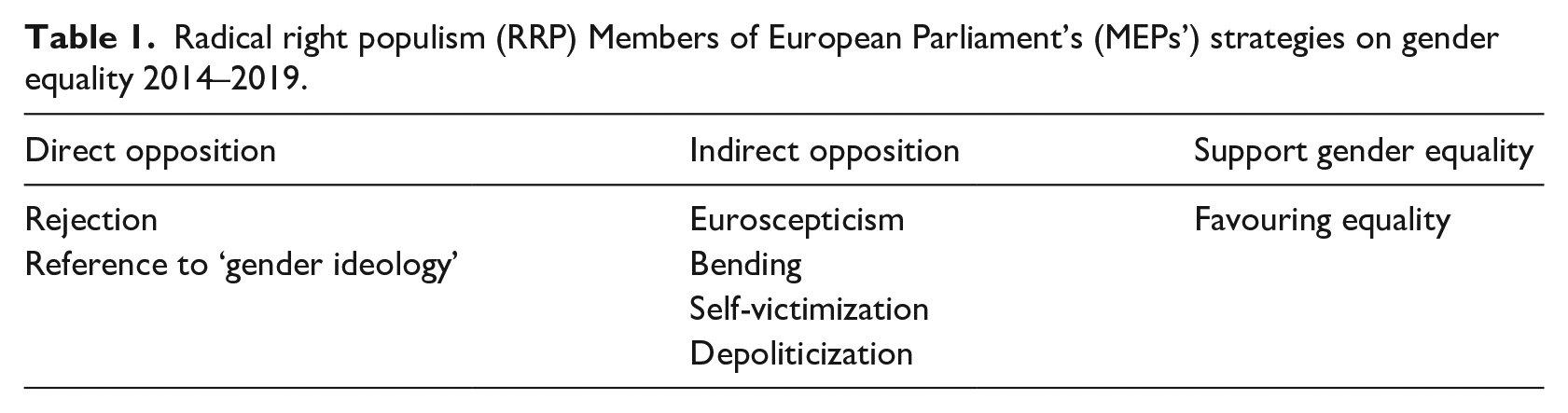
Overall, RRP framing strategies of opposition to gender equality policies help construct the boundaries of what gender relations are ‘appropriate’ and the boundaries between elites and the people. Empirically, we have structured the analysis of EP parliamentary debates by distinguishing, within oppositional strategies, between direct opposition and indirect opposition to gender equality and sexuality policies (see Table 1). Central to direct opposition is not only outright rejection of gender equality but also reference to ‘gender ideology’. Our analysis shows that indirect opposition comes in many forms and we discern the following: a) embedding in Euroscepticism and subsidiarity 4 debates; b) bending gender equality toward other issues (e.g. migration) and goals; c) depoliticization of gender based on biological arguments; d) self-victimization and blame games – taking the focus away from gender equality. Finally, we identified one party within an RRP group that manifested strategies of supporting gender equality by speaking in its favour. In the next section, we present the results of the empirical analysis, illustrating the discursive strategies toward gender equality through a selection of citations that exemplify the expression of prevalent RRP opposition in the EP plenaries on gender equality in 2014–2019.
Radical right populism (RRP) Members of European Parliament’s (MEPs’) strategies on gender equality 2014–2019.
Direct opposition to gender equality
In the 2014–2019 plenary debates on gender equality, manifestations of direct opposition to gender equality by radical right populists abounded. We suggest that firstly, direct opposition was evident as outright rejection of gender equality in relation to policy issues constructed as controversial. These included gender quotas and lesbian, gay, bisexual, transgender and intersex (LGBTI) rights. Secondly, opposing what the radical right populists termed ‘gender ideology’ was a central strategy in several debates, but was strongly used in debates on gender and education. These findings contradict previous studies which have suggested that direct opposition is not so common in EU gender policymaking (Ahrens, 2018).
Gender quotas for corporate boards has been on the EU gender policy agenda since Vivien Reding was a Commissioner in 2012 and proposed them as a solution to women’s underrepresentation on company boards (Elomäki, 2018). The directive has been stalled in the Council since. It has been a regular topic in plenaries and the rejection of gender quotas is most radically illustrated by RRP statements. In the debate on women on boards (CRE 31/01/2019 – 3), EFDD members – both women and men – from the UK opposed gender quotas on the basis of merit and freedom of companies. Jill Seymour (EFDD) said:
As an MEP who was elected onto my party’s list without a quota and then elected without a quota by the public, I find this demeaning and insulting to all hard-working women up and down the UK. . . . we certainly should not be forcing businesses and parliaments to have mandatory quotas.
James Carver (EFDD) concurred: ‘I have more respect for ladies who achieve on merit, rather than those in similar positions on the ground of gender equality’ where the use of the word ‘ladies’ – traditionally refined, polite, upper class women – might refer to not all but some ‘worthier’ women, building an opposition to ‘quota women’ who would supposedly not be capable of achieving positions on their own. Arguments about quotas bypassing merit and making ‘quota women’ inferior are familiar tactics of opponents and meant ignoring normative and factual arguments for quotas (Elomäki, 2018). In this debate, they were combined with neoliberal arguments about freedom of markets and businesses to act without public control. As Mayer and Sauer argue in the Austrian context, radical right populists rely on a strategy where ‘entrepreneurs are argued to be hindered by the regulations demanded by political correctness like women’s quota, tax money is wasted on gender issues, and women are encouraged to study unproductive subjects at university and work in sectors of little economic value’ (2017: 34).
In EP debate on equal employment, RRP groups also expressed direct opposition to LGBT rights. Marie-Christine Arnautu (ENF) states (CRE 08/10/2015 – 2):
What’s the point of introducing (. . .) considerations on race, ethnicity or religion in this report? What’s the need of distinguishing lesbian or bisexual women from other women? What is this obsession with the change of sex in this report? Change of sex and transsexualism are mentioned no less than six times, I have counted them.
RRP articulations of homophobic, misogynistic and xenophobic arguments against migrant, LGBTI and poor people are all direct forms of opposition to gender equality, expressed in the ‘bad manners’ political style identified by Moffitt (2019: 52). In EP plenaries, this style serves to oppose gender equality and create a hostile environment for advancing it. Transgender scholars and activists would question the above citations for misrepresenting complex trans questions.
One overtly misogynistic speech by a Polish MEP went viral in 2017. Janusz Korwin-Mikke (NI) interrupted the speech of S&D Iratxe García Pérez with the following blue-card question
5
(P8_CRE-REV(2017)03–01(19):
Do you know which was the place in the Polish theoretical physics Olympiad, the first place of women, of girls? I can tell you: 800th. Do you know how many women are in the first 100 chess players? I can tell you: not one. Of course women must earn less than men because they are weaker, they are smaller, they are less intelligent, and they must earn less. That is all.
Feminist socialist MEP, Iratxe García Pérez (S&D) promptly replied in her blue-card response: ‘According to you and your theories, I would not have the right to be here as MP, and I know this hurts you. I know it hurts and worries you that today women are representing citizens on equal terms as you. I come here to defend European women from men like you.’ While the EP imposed sanctions on the Polish MEP due to his misogynistic comment, the European Court of Justice (ECJ) in 2018 annulled the sanction defending his right to speak ‘in the exercise of his parliamentary functions’. 6 The occasion illustrates not just misogyny as a strategy of rejection of gender equality but also the parliamentary norms which allow its expressions. The blue-card interventions are intended to make the debate livelier, yet are used by radical right populists to target women and feminist MEPs and express opposition to gender equality. The right to express offensive views in parliamentary work in the name of freedom of expression enforced by the ECJ relates to broader reluctance to outlaw sexist speech and practices in the cases of sexual harassment in the EP (Berthet and Kantola, 2020).
Direct opposition to gender equality was mostly evidenced by resisting ‘gender ideology’. This occurred in several debates on gender equality issues. One of the most prominent was the debate on empowering girls through education in the EU (CRE 08/09/2015–19). Branislav Škripek (ECR) opposed ‘gender ideology’:
People don’t agree with this pressure to introduce gender ideology into our families, schools and societies. Millions of people in Europe say no, no in France, Italy, Croatia, Slovakia. We have the obligation to hear this voice and act accordingly.
Gender is framed as the key problem because it is argued to negate ‘nature’ (Mayer and Sauer, 2017: 29). This strategy bypasses the extensive documentation of those not fitting into binary gender categories and the harm these norms do to them (Butler, 1990) and represents what Ruth Wodak (2015: 4) calls the populist strategy of ‘arrogance of ignorance’. Whilst the term gender has been strongly opposed in the past, by religious representatives since the United Nations (UN) conferences on women’s rights, the populist element here is to appeal to the ‘people’ claiming to represent their interests.
Another example comes from the debate on three gender issues
7
by Beatrix von Storch (EFDD):
And now you wonder the increasing resistance towards this gender nonsense. . . Most people are either men or women. They marry or don’t. They become fathers and mothers and they don’t want that policies are made for a small minority and money is wasted for them. People have other problems: work, pensions, health, security – public toilets for the third gender and gender neutral natural parks are not part of these.
In the citation, gender equality is an insignificant question. Resisting ‘gender ideology’ is also a strategy to oppose the funding directed toward gender equality work: no money should be ‘wasted on it’. A strong opposition is built between ‘real problems’ and insignificant ‘minority’ issues. The strategy of talking about gender ideology communicates the idea that the EU imposes ‘deviant and minority values on average people’ (Kuhar and Paternotte, 2017: 6).
The Istanbul Convention on gender violence – hailed by feminist activists, practitioners, scholars and politicians as a major advance in European gender violence norms – has become the target of RRP opposition to gender equality in Europe. In a debate on ‘Experiencing a backlash in women’s rights and gender equality in the EU’ in 2019 (2018/2684(RSP), Angel Chavdarov Dzhambazki (ECR) explained he voted against because of his ‘convictions’:
I believe that behind the pretext of equal opportunities we are conducting scandalous propaganda for the Istanbul Convention. Once again the plenary of the European Parliament is used as a stage for these scandalous campaigns for intersexed people. It’s just propaganda. We adopt documents on fisheries in the Baltic Sea and then we include in that the rights of the LGBTI people. We are engaged in propaganda against traditional family values. Ordinary people don’t understand it.
International institutions, the EU and the Council of Europe, are constructed as vehicles for spreading these harmful ideas and undermining the principles of national sovereignty and democracy (Kuhar and Paternotte, 2017: 7).
These citations show how ‘gender ideology’ is used to directly oppose attempts to advance gender equality. The key populist elements of the proponents of opposing ‘gender ideology’ – corrupt international elites interfering in national politics and imposing political correctness (Kuhar and Paternotte, 2017: 14) – are well represented in the EP plenaries as repertoires for opposing gender equality. The EU itself is constructed as a harmful proponent of this gender ideology. Both women and men RRP MEPs articulate these discourses arguing gender equality was constructed in harmful ways challenging natural categories of women, men, sexuality and family. These MEPs come from three RRP political groups in particular: ENF, ECR and EFDD. The ENF is most united and systematic in its direct opposition to gender equality, which can be articulated at the level of group speeches, whilst in the ECR and EFDD the MEPs directly opposing gender equality come from specific national delegations: for example, in the ECR from the Polish Law and Justice party, and, in the EFDD, from UKIP.
Indirect opposition to gender equality
Indirect opposition to gender equality is popular among RRP MEPs and took several forms (see Table 1). Some indirect opposition strategies have been used across different political contexts, while others – such as appeals to Euroscepticism and subsidiarity – are specific to the EU context. Opposition to women’s rights then draws on longstanding patriarchal ideas. Analysing them makes these ideas, claims and repertoires visible in today’s politics. Their presence in the EP is significant for understanding the challenges that gender equality faces in Europe today.
First, indirect opposition to gender equality was based on Euroscepticism, hidden in not being against gender equality but against the EU. Daniel Hannan (ECR) argued in a 2015 debate (A8-0163/2015) that a gender equality report covered issues that should be decided at member state rather than EU level, such as ‘pay, workplace rules, violence against women, media portrayals, abortion rights’. The number of topics included in the gender equality report would supposedly show the EU ‘is not an association of states collaborating intergovernmentally’ as the Eurosceptic MEP wishes the Union to be. The argument for voting against the report was therefore: ‘because I do not think any of these things should have to do with Brussels’. While in this case the opposition to gender equality policies is expressed only as a means to oppose the EU, other responses, mostly from MEPs from the UKIP in the EFDD, reveal a mix of Euroscepticism and opposition to gender equality based on a reactionary defence of traditional values.
Similarly, subsidiarity is used to oppose gender equality policies (Ahrens and Van der Vleuten, 2019). In the abovementioned debate on education, Arne Gericke (ECR) argued the report ‘breaches subsidiarity’ because ‘education isn’t for EU’ and ‘Children haven’t lost anything when it comes to sexual matters. Education for girls, all I can say, it’s the wrong topic. Europe has other challenges. The last thing we need is sexual teaching in our primary schools’ and in his view such arguments and debates ‘get on people’s nerves’. Florian Philippot (ENF) justified his vote against the ‘EU Strategy for equality between women and men post 2015’ because ‘it does not respect the principle of subsidiarity and happily invades the competences of Member states (. . .)’ as in the case of ‘policies in matters of abortion and contraception or sexual education’. In the debate on work-life balance for parents and carers (CRE 04/04/2019 - 3), the ENF group speech by Joëlle Mélin suggested the issue was of no concern to the EU and instead a private life issue: ‘a classic example of EU getting involved in everybody’s life taking away people’s independence’. Again the strategy of defending privacy surfaces, involving RRP claims to stand up for people’s right to decide for themselves and the EU as imposing on it.
The second strategy of indirect opposition to gender equality is bending, whereby the meaning of gender equality is bent toward issues and goals other than gender equality, such as migration and Islamophobia (Lombardo et al., 2009). In the debate on ‘The situation of women refugees and asylum seekers in the EU’ (CRE 08/03/2016–5), Janice Atkinson (ENF) expresses the following Islamophobic arguments through a blue-card question:
I did not hear from you when I raised the question that actually the Islamic values of these women coming in (. . .) is incompatible with our Western values and your feminism – and my feminism, which I think really differs. Should we not be protecting our own women and children against the rapes and assaults that we have seen across European cities before we start trying to integrate more? Because they do not integrate. They have not integrated for 40 or 50 years.
Instead of focusing on the problems and violence that refugee women face – the purpose of the debate – the MEPs bend the issue to say that European migration policies have failed to protect ‘women and children’. Islamophobic language is used to construct an ‘other’ hostile to gender equality, to claim the EU fails to protect its ‘women’ from this threat. It is related to what Ruth Wodak (2015: 4) has termed the populist strategy of ‘politics of fear’. Gender equality is a key component in constructing threats and provoking emotions of fear, and it is here bent to Islamophobic purposes.
Self-victimization is the third indirect strategy of opposition in plenary debates. In Austria, radical right populists have used self-victimization to argue they are victims of silencing by gender-sensitive language argued to dictate the terms of the debate (Mayer and Sauer, 2017: 31). In the EP debate on sexual harassment in the EU (CRE 25/10/2017), radical right populists used self-victimization, first, for ‘shifting the blame’ (Wodak, 2015: 67) to the EP which is argued to have excluded the ENF group from the resolution on sexual harassment (Mylène Troszczynski, ENF). Second, parliamentary opponents are blamed for double standards, as illustrated by David Coburn’s (EFDD) blue-card questions against liberal MEPs:
Sexual harassment should never be tolerated, and I am sure you agree with me. (. . .) However, some liberals here are in favour of stereotyping. Ms Vautmans, did you not say something that was, I believe, reported in ‘Politico’ – that sexual harassment is commonplace in southern and eastern Europe? Is that not stereotyping people? I do not think that is quite right. If a right-wing Eurosceptic had said such a thing, everyone would go crazy here.
Such strategies constructing radical right populists as victims of double standards distract attention from the core problem of violence against women in the EP and shift it to national cultures and radical right populists.
Self-victimization is also expressed through what Wodak (2015: 67) calls the ‘victim–perpetrator reversal’, that shows sympathy for the men in sexual harassment debates, either because ‘each man or boy is made a potential pig’ (Mylène Troszczynski, ENF), or because men as victims of harassment are ignored and ‘sexual harassment should not be gender-specific’ (Diane James, NI) since ‘sexual harassment and abuse affects both men and women’ (Margot Parker, EFDD). Feeling threatened by women who would supposedly control men is part of the RRP repertoire of ‘hostile sexism’ (Mudde 2019: 150). The fact that right populist MEPs use their speaking time in a debate on combating sexual harassment to defend men as victims – both as potential perpetrators and victims – is a misogynistic attitude that Kate Manne (2017) names ‘himpathy’, namely sympathy for male perpetrators of violence. It effectively reduces the space for debating the gendered power structures behind such violence and calls for ‘gender neutrality’.
The fourth strategy of opposition is depoliticizing gender equality and presenting gender as a biological given and therefore indisputable. This is illustrated by RRP framing of intersex people’s rights around ‘medicalization’. In the EP debate on ‘The rights of intersex people’ (B8-0101/2019) some radical right populists defended their vote against the resolution by arguing these are ‘fake rights’. The argument developed by Branislav Škripek (ECR) is that ‘This is a medical issue, it’s not a political question. Babies born with deformed genitalia must be given the best healthcare and the problem must be resolved.’ Scientific claims are put forward to minimise the importance of the problem and challenge the idea of gender and sex as socially constructed: ‘A world-renowned geneticist has informed me that only one in 200,000 babies is born with this condition, and there is almost never any uncertainty about the true sex.’ The appeal to scientific knowledge and biological arguments is used to depoliticize the issue and argue against the rights of intersex people. The strategy is based on spreading false information about the use of ‘simple chromosome tests’ in determining ‘if it’s a boy or girl’. RRP rhetoric against ‘gender ideology’ is very present in this debate, pretending the denial of intersex rights is based on scientific knowledge, while suggesting gender knowledge is just propaganda: ‘So this is unscientific and manipulative on the part of some politicians and gender ideologists here. They want to confuse European citizens, brainwashing them into believing another human right is being denied. It’s not true.’ This illustrates the misuse of science, opposing some disciplines and appropriating knowledge selectively and representing it in false ways as key components of RRP opposition strategies (see also Kuhar and Paternotte, 2017; Mayer and Sauer, 2017: 30).
Favouring equality
Although the pattern of right populist discourses about gender equality in the EP is one of opposition to gender equality, there are differences within parties of the same political group. The Italian M5S MEPs (EFDD), a heterogeneous ideological mix of right and left, differs from other parties of the same group (and from other right populists from other political groups) through discursive strategies that favour gender equality and sexuality policies. Arguments range from equality being ‘a fundamental right recognised in EU treaties’ and needed for the progress of European societies (Ignazio Corrao, EFDD), to the importance of giving the EU a role in the promotion of women’s sexual and reproductive rights and health (‘EU Strategy for equality between women and men post 2015’, Eleonora Evi; Ignazio Corrao; Fabio Massimo Castaldo; Dario Tamburrano, EFDD). M5S also voted and argued in favour of unblocking the maternity leave directive, promote equal sharing in parental life, and address gender inequalities in work and pension (Fabio Massimo Castaldo; Ignazio Corrao; Dario Tamburrano; Eleonora Evi, ‘Maternity leave’ B8-0453/2015). The strategy of favouring gender equality was also evident in debates on migration, so strongly opposed by other right populist MEPs (‘The situation of women refugees and asylum seekers in the EU’). These divisions have been documented in the attempts of M5S MEPs to participate in more legislative work (e.g. shadow meetings) despite the reluctance of the others in their group significantly reducing their chances of influencing policy (Ripoll Servent and Panning, 2019: 310).
Conclusions
This article has shown how in an increasingly polarized EP, radical right populists construct discursive strategies of opposition to gender equality that shape the boundaries not only of what gender equality means and what gender relations are appropriate, but also the general positioning of radical right populists on democratic rights of equality. The EP arena allows right populists to play at two levels, by constructing discourses that contribute to frame debates at the European level and at the same time to connect right populist MEPs with people at the national level (Dean and Maiguashca, 2020; McDonnell and Werner, 2019). This article contributes to scholarly debates on populism and on gender and politics by respectively suggesting to the former the need to dedicate attention to gender equality as a central aspect of populist ideologies, and to the latter the importance of considering a variety of strategies of right populist opposition to gender equality.
Despite the general downturn of gender equality polices in the EU since the economic crisis in 2008 (Jacquot, 2015), gender equality was surprisingly extensively debated in the EP in the 8th legislature. Our qualitative frame analysis of 35 such debates showed how radical right populists used the opportunities to oppose gender equality this provided. The analysis of their framings of gender equality also shows how populism is constructed and how it obtains content from opposing it.
Gender equality was opposed, first, directly, and through framing attempts to advance it as a harmful ‘gender ideology’. This was a contradictory finding to those analyses which have suggested that gender equality is so widely accepted in EU circles that it is mainly opposed indirectly (Ahrens, 2018). Our article also draws attention to these indirect opposition strategies, undocumented in former literature on the EP, showing the debate is more complex than just relying on demonization of ‘gender ideology’. Indirect opposition strategies include Euroscepticism, bending, self-victimisation and depoliticization. This variety shows the repertoire of radical right populists against equality is broader and more sophisticated than expected. The strategies were employed by RRP MEPs, both women and men, from the ENF, ECR and EFDD. We have suggested that ENF was most systematic in using these, also at the group level, whilst the strategies were employed by particular national delegations in the two other groups. Existing research also shows that radical right populists wage some power within more mainstream groups, such as the EPP (Kelemen, 2020), although they did not figure in our research material. Overall, this opposition was quite unified and there were little differences between the groups and the MEPs using these strategies, for example the ways in which ‘gender ideology’ is used by different actors.
The effect is to make gender equality and feminist politics more contentious: polarizing debates on gender, attacking gender quotas, LGBT rights or the concept of gender violence, and reopening and questioning policies that had already been ‘accepted’ such as equal employment opportunity. Manipulative, misogynistic strategies of self-victimization are also used, bending the issue to distract attention from gender equality toward xenophobic, Eurosceptic, and illiberal goals. These framing strategies are combined with concrete tactics such as using blue-card – as explained above – to pose offensive and distracting questions and parliamentary norms which allow freedom of expression for misogynistic comments. The ‘low’ political style of RRP MEPs performs political incorrectness. Their capacity to affect gender equality is limited by the fact that, while using plenaries for monopolizing debates, they do not have a significant impact on votes about gender equality, in line with previous findings about their limited work in committees. There are also internal divisions within the right populist group, shown in the support for gender equality expressed by M5S (EFDD), that weaken the oppositional front.
This article shows that the place of gender and the work that it does in RRP discourses matters both instrumentally – as a tool in populist rhetoric – and in itself – a democratic right and value to be opposed as such. The analysis has illustrated that radical right populists in the EP use gender in the oppositional logics of ‘us’ versus ‘them’, by suggesting who the appropriate people are, what their supposed demands would be, what suitable gender relations are, and who the elites are. Gender is rhetorically used as an instrument against migration, exemplified in the exclusionary rhetoric about protecting ‘native women’ against ‘threatening’ or ‘backward migrants’ (Wodak, 2015). Right populists also use discursive strategies against gender equality to express Euroscepticism, by arguing that policies on sexual education, reconciliation of work and family life, or refugees should not be decided at EU level. At the same time, the analysis has shown how gender equality is an issue of relevance in itself in the narrative of radical right populists. Opposition to both progressive gender equality policies and EU competence on them, as well as articulation of meanings of gender equality that support traditional values and limitation of rights to sexuality, show, first, that radical right populists have an interest in shaping not only race and ethnicity but also gender relations, and second, that the content of the ideology underpinning RRP politics is patriarchal and illiberal.
The direct opposition to gender equality that we have identified in RRP MEPs’ interventions is detrimental for the construction of equality and democracy in the EP because it shapes in restrictive ways the meanings of gender equality and the borders of gender equality political agendas and commitments. Yet, if gender equality becomes an increasingly politicized issue, and debates are channelled through respectful confrontation, this might not in itself be negative for gender equality. Direct opposition could result in making the arguments for and against gender equality more explicit and tangible. Once made explicit, direct opposition could be debated and countered by active supporters of gender equality.
Footnotes
Acknowledgements
We wish to thank the editor, Marian Sawer, and anonymous reviewers for their helpful comments. Special thanks to EUGenDem team and Gender Studies research seminar at Tampere University for very helpful feedback on an earlier version of the paper.
Funding
The author(s) disclosed receipt of the following financial support for the research, authorship, and/or publication of this article: Johanna Kantola’s research has received funding from the European Research Council (ERC) under the European Union’s Horizon 2020 research and innovation program grant number 771676. Emanuela Lombardo’s research has received funding by the Spanish Ministry of Research through the UNiGUAL Project (Ref: Fem2017-86004-R).
