




Abstract
Around one-sixth of the European population have a disability, yet there are few self-declared disabled politicians. Despite scholarly and political interest in the under-representation of various social groups, little attention has been paid to disabled people. This article identifies and analyses the barriers to elected office faced by disabled people by drawing upon interviews with 51 candidates and elected politicians in the United Kingdom. It reveals barriers which occur throughout the political recruitment process, from initial participation to selection and the election campaign. They broadly fall into: (a) a lack of accessibility, including the built environment and documents; (b) a lack of resources to make events and activities accessible; and (c) ableism, including openly expressed prejudices but also a lack of awareness and willingness to make processes inclusive. While people with different impairments encounter some distinct barriers, all of them have similar experiences of obstacles and exclusion which go beyond those faced by people from other under-represented groups seeking elected office.
Introduction
Disabled people 1 constitute a heterogeneous but sizeable social group, and yet close inspection of the make-up of our political legislatures reveals few disabled politicians. While disabilities are sometimes invisible or ‘hidden’, and people seeking elected office might be hesitant to disclose them, all available figures and estimates suggest that the proportion of disabled politicians vastly lags behind 20%, the approximate proportion of disabled people in Britain. This article explores the obstacles to political representation faced by disabled people by examining the experiences of disabled candidates and elected politicians in the UK. It reveals barriers which occur throughout the political recruitment process, from initial participation to selection and the election campaign. We have grouped these obstacles into three categories: accessibility; resources; and ableism.
According to the UK Equality Act 2010, a person is disabled if they have ‘a physical or mental impairment. . . [that] has a substantial and long-term adverse effect on the person’s ability to carry out normal day-to-day activities.’ 2 The disability rights movement has long recognised the marginalisation of disabled people in positions of power, arguing that they must be directly involved in political processes where decisions are made that affect their lives (Maroto and Pettinicchio, 2014; Prince, 2009) – reflected in the slogan ‘nothing about us without us’ (Charlton, 1998). The importance of equality of access, participation and representation is mirrored by democratic theorists who identify increased political participation as a necessary part of a well-functioning representative democracy (Phillips, 1995; Powell and Powell, 2000; Przeworski et al., 1999). Indeed, the under-representation of societal groups can be an indication that they lack equality of access (Mansbridge, 1999).
There has been extensive research into the descriptive, or numerical, under-representation of social groups in politics, primarily focusing on women (e.g. Norris, 1985) and ethnic minorities (e.g. Bird, 2005). In contrast, with a few notable exceptions (D’Aubin and Stienstra, 2004; Langford and Levesque, 2017; Levesque, 2016; Sackey, 2015; Waltz and Schippers, 2020), there has been little scholarly analysis of the barriers to elected office for disabled people. Neither has there been much political interest on the part of parties, legislatures or governments to increase the number of disabled politicians. 3 Our research aims to shed further light on the experiences of disabled people seeking elected office, using the UK as a case to generate insights that can help inform research and policy on a global level.
To analyse the barriers that disabled people face during the political recruitment process, we draw on interviews with 51 disabled politicians, candidates, and people who have thought about standing for national or local election. Our sample covers a broad range of different impairment types, including physical and learning disabilities, chronic health conditions, and mental health problems. Our findings show that although disabled people experience many of the obstacles identified in research on women and ethnic minority candidates (e.g. Norris and Lovenduski, 1995), they also face a very distinct set of additional barriers. We have categorised these as related to: (a) accessibility; (b) resourcing; and (c) ableism. 4 While the specific impact of the barriers vary dependent on the nature of the impairment(s), all interviewees encountered difficulties that are generally not experienced by non-disabled people, and many barriers were experienced by people with all kinds of impairments.
This study contributes to ongoing debates surrounding political recruitment processes, specifically the role of political parties as gatekeepers, and the cultural and institutional norms that shape selection and election processes (Gallagher and Marsh, 1988; Kenny and Verge, 2016). It also adds to the diverse body of scholarship on the under-representation of social groups within our political institutions (e.g. Celis et al., 2014; Giger et al., 2012). In addition, our findings may be useful for governments and political parties when (re)designing processes and measures to improve disabled people’s access to elected office and, thus, their ability to fully participate in shaping society.
Literature review
Scholars have identified various factors that explain why certain groups in society remain under-represented in politics, and why others remain over-represented, all of which are grounded in gendered and racialised norms of cultural and institutional power (Bjarnegård, 2013; Norris and Lovenduski, 1995). Research on the barriers to elected office tends to focus on the interaction between supply-side and demand-side factors which shape the political recruitment process (Norris and Lovenduski, 1995). Political parties often claim that they are prevented from selecting people from under-represented groups because they do not put themselves forward (supply). Yet, there is evidence to suggest that candidates from under-represented groups are not selected due to various forms of discrimination (demand) (Kittilson, 2006). In truth, barriers to elected office tend to be an interaction between supply and demand (Lovenduski, 2016) including: attitudes and perceptions; time constraints, for instance due to caring responsibilities; financial costs; institutional norms; the culture and style of politics; lack of support networks; and lower levels of political experience and ambition (Hazan and Rahat, 2010; Norris and Lovenduski, 1995).
In contrast, research on disabled political candidates and representatives is relatively scarce. The rare exceptions include a recent study by Waltz and Schippers (2020) based on interviews with nine disabled politicians from four European countries and Sackey’s (2015) study of disability organisations and non-disabled local government officials in Ghana. Moreover, a few studies from Canada have focused on disabled people in elected office, including Langford and Levesque’s (2017) analysis of interviews with three disabled candidates and elected office holders in British Columbia; D’Aubin and Stienstra’s (2004) discussion of disabled candidates and elected politicians; Levesque’s (2016) analysis of disabled candidates in provincial elections in Canada; and Michael Prince’s (2009) study of disability and the policy-making process.
These studies identify the following main categories of barriers that disabled candidates experience: inaccessibility of the built environment and written material, making participating in events and door-knocking more difficult; lack of financial resources and provision of support, such as sign language interpreters, specialised equipment, and carers; and stigmatisation and negative public perceptions of people’s capabilities. Yet, on the latter point Langford and Levesque point out that public perceptions are not necessarily always negative: their interviewees thought that being disabled made them more identifiable and might be perceived as ‘contributing positively to their life experience’ (Langford and Levesque, 2017: 12).
Several of the studies (D’Aubin and Stienstra, 2004; Langford and Levesque, 2017; Levesque, 2016) also discuss the lack of disabled ‘role models’ in politics as a barrier, echoing the broader argument that the presence of under-represented social groups can have symbolic benefits and increase engagement among group members (cf. Mansbridge, 1999; Phillips, 1995). Furthermore, Sackey (2015) argues that lower education levels among disabled people might prevent them from attaining elected office, while Waltz and Schippers (2020) emphasise that access to particular networks – for instance within elite universities – is often crucial but not always accessible to disabled people. It thus appears that, while there is some degree of overlap between the barriers in the recruitment process that are faced by disabled people and other under-represented groups, there are also a range of unique obstacles. The aim of our study is to add systematic evidence to this important yet still limited basis of knowledge through interviews with a diverse sample of disabled people in the UK.
Methods and data
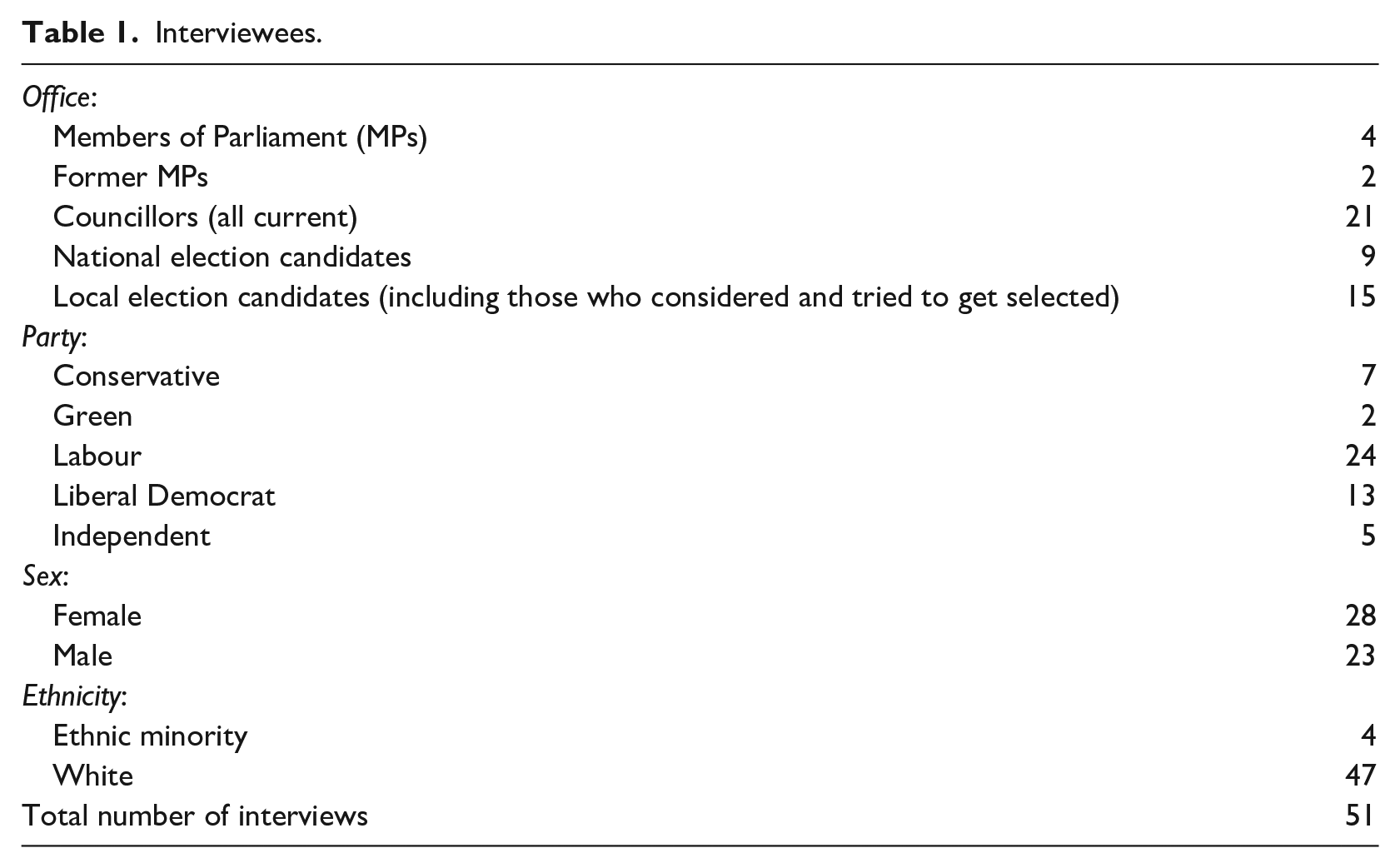
We conducted 51 semi-structured interviews with disabled elected politicians (Members of Parliament (MPs), former MPs and local politicians), candidates (at both the national and local level) and those who have thought about running for office. 5 Semi-structured interviews are particularly effective for exploring people’s experiences and perspectives and are routinely used to investigate the barriers to elected office for under-represented groups (Norris and Lovenduski, 1995). We analysed the data by initially taking notes on the main questions explored; we then grouped and coded the data by identifying categories and concepts, before drawing out overarching themes.
Recruiting participants for our study necessitated a diverse strategy, since there is no list of disabled candidates and we wanted to include individuals who had not been selected as candidates. Participants were recruited via initial contact with the political parties’ disability groups and via emails distributed by various stakeholders (e.g. Local Government Association). Additional participants were identified via the ‘snowballing’ technique, where interviewees recommend other people. Social media platforms, including Twitter, were also used to recruit interviewees; in a couple of instances we contacted people directly via Twitter. We interviewed anyone who agreed to participate and self-identified as disabled. Every effort was made to ensure diversity among our interviewees in terms of gender, ethnicity, party, and level of office.
Table 1 provides information about demographic and other characteristics of our sample of interviewees. Table 2 lists the distribution of participants’ impairment types. Around a third reported either multiple impairments or conditions that imply several impairment types; for instance, cerebral palsy can imply a mobility impairment and a speech impairment. The largest category (24 interviewees) were those with mobility problems, which include amputations, cerebral palsy, arthritis, and a range of other impairments; at least 10 of the interviewees in this category were wheelchair users. 14 interviewees were blind or visually impaired and nine were neurodivergent, whilst several other impairments were represented in lower numbers. Notably, seven interviewees reported mental health problems. Therefore, our sample of interviewees covers an extremely diverse range of impairment types, including different physical impairments, learning disabilities, and mental health conditions.
Interviewees.
Distribution of impairment types among interviewees*.
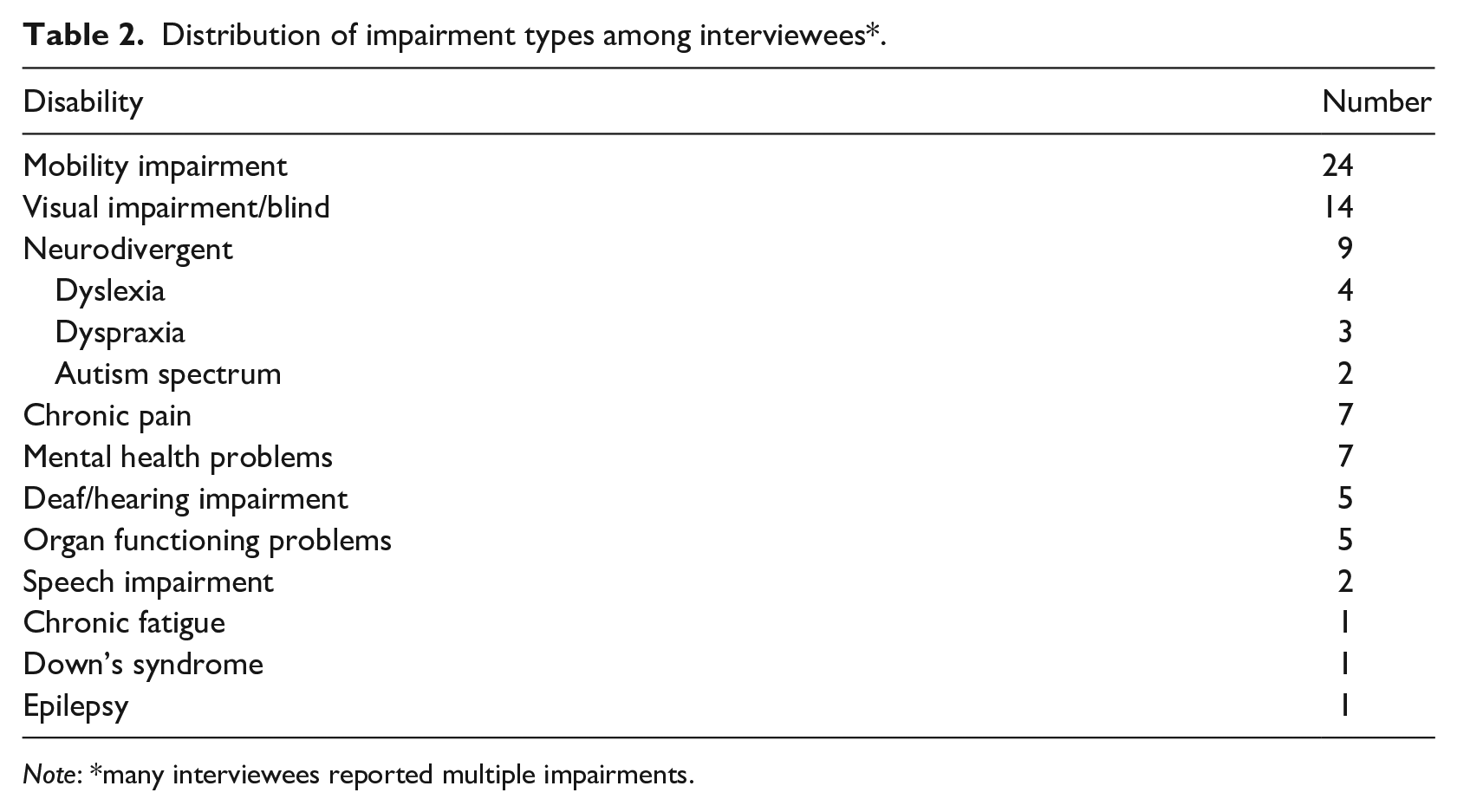
Note: *many interviewees reported multiple impairments.
Interviews were conducted by the authors and two research assistants between January and September 2019, lasting between 15 and 100 minutes. The majority were face-to-face, with some conducted via Skype and telephone. We offered to pay for accessibility requirements such as sign language interpreters. Three interviewees had assistants present. For face-to-face meetings, we asked interviewees to propose a location they could access and found comfortable. The interviewers were guided by the language used by the participants during the interviews, for instance whether an interviewee identified as D/deaf, hard of hearing or as having a hearing impairment. The interviewees were keen to participate in the research, which they viewed as being politically important.
In order to adhere to ethical guidelines, interviewees were told in advance the broad themes and types of questions, how we would use the research, and how, and for how long, we would store their data. All interviewees signed a consent form and were informed that they could terminate the interview at any point or refuse to answer any questions. To counter problems of validity, we sought to reduce the opportunity for bias by stressing the anonymity of the interviews. The interviews were recorded and fully transcribed by a professional company. The Online Supplementary Information includes the full list of questions and further information regarding the interviewees.
Disability and political representation in the UK
The UK is somewhat of an exception in terms of the availability of both statistics about and (financial) support for disabled candidates and politicians, even if neither may be seen as sufficient, as our findings will suggest (cf. European Union Agency for Fundamental Rights, 2014). Survey data shows that in the 2015 and 2017 general elections, 10 and 11% of candidates, respectively, indicated a disability (see Figure 1). In the 2016 Scottish Parliament election the proportion of disabled candidates was 5%, in the 2017 Scottish local elections 10%, and in the 2017 Welsh local elections 20%. Meanwhile, 13% of English local councillors indicated a disability in 2013, and 18% of Welsh local councillors did so in 2017 (Lamprinakou et al., 2019).
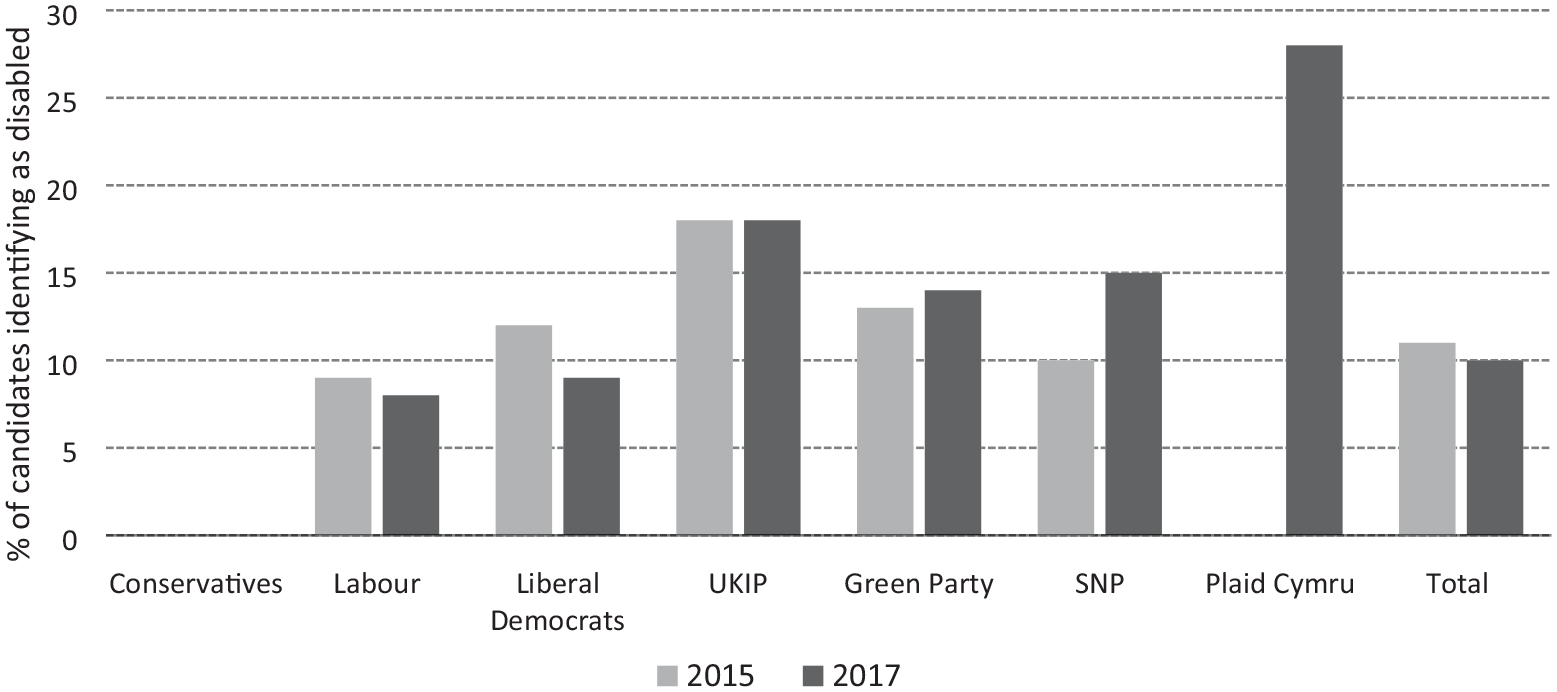
Percentage of candidates in the 2015 and 2017 UK general elections who declared a disability in the UK Candidates Study.
Available figures do need to be treated with some caution, as the surveys tend to have low response rates and rely on self-reporting. Given the stigma suffered by disabled people, with a lack of competence being a common stereotype, some disabled people seeking elected office might not identify as disabled (cf. Levesque, 2016; Schur, 1998). Nevertheless, the statistics strongly suggest that disabled people are generally, albeit with some variation, under-represented in politics.
The UK Equality Act 2010 requires political parties and local authorities to make ‘reasonable adjustments’ 6 in anticipation of what disabled people might need to participate on an equal basis (Electoral and Human Rights Commission, 2018). It also permits parties to take positive action to encourage and facilitate the participation of disabled people in politics and their election to public office. Additionally, there has at times been funding to support disabled people seeking (s)election: the UK Government’s Access to Elected Office for Disabled People Fund (2012–2015) and interim EnAble Fund (2019–2020, England and Wales); and the Scottish Government’s Access to Elected Office Fund Scotland, active since 2016. The funds, which are unique around the world, cover additional costs faced by disabled people campaigning in elections, for example, transport or assistive equipment, with the aim of allowing them to compete on a ‘level playing field’ with non-disabled candidates (Government Equalities Office, 2018; Inclusion Scotland, 2018).
Legislatures across the UK are elected according to different rules. General elections and local council elections in England and Wales, in which our interviewees stood or sought to stand, use first-past-the-post systems. Each party can only nominate one person per constituency or ward, and voters choose an individual candidate. Aspiring candidates thus need to convince the ‘selectorate’ that they are able to attract the support of a broad range of voters in order to win a plurality. Candidate selection processes in the UK differ according to both level and party; moreover, they are shaped by whether or not the seat is held or competitive (Ashe, 2019). UK law permits political parties to use positive discrimination measures (i.e. quotas) during selection processes but only in relation to sex. It is up to each political party whether or not they choose to use such mechanisms. While the selection process remains somewhat of a ‘secret garden’ (Gallagher and Marsh, 1988), the ‘selectorate’ is made up of party members, although the Conservatives have experimented with open primaries. Research has repeatedly found that the ideal candidate for ‘selectorates’ in the UK is a White, middle-aged, male professional without disabilities (Ashe, 2019; Norris and Lovenduski, 1995).
Given the diverse range of selection processes, there are a wide range of barriers which might be more or less relevant depending on level and party, including: direct and indirect forms of discrimination during the assessment and subsequent selection process; lengthy selection processes which require significant time commitment; prohibitive financial costs required in order to stand for selection; a lack of transparency surrounding the selection process; and the extent to which the central party intervenes in the selection process (Norris and Lovenduski, 1995). Once selected, further barriers might appear during the election campaign. Since individual candidates compete with each other in each constituency, the campaign process tends to be candidate-centred; for instance, candidates are expected to go door-knocking and participate in hustings (meetings where candidates or parties are invited to debate policies and answer questions from the audience). This might present disabled candidates in the UK with more barriers as compared to less candidate-centred proportional representation systems with party lists.
Experiences of disabled candidates and politicians in the UK
Although the focus of this article is the barriers to elected office, many of our interviewees also reported positive experiences with regard to the attitudes they encountered from their party and voters. Several were strongly encouraged to stand as a candidate by their local party. In some cases, local parties explicitly sought to increase the diversity of candidates and representatives, expressing that they valued the perspectives and skills that come with the lived experience of being disabled. Other interviewees felt that the encouragement was not directly linked to them being disabled but rather to their engagement in the party or other qualities. Several participants had the impression that voters appreciated seeing a disabled person standing for office. Such encouragement and support were recounted by interviewees with various types of impairments, echoing the reports by the Canadian candidates interviewed by Langford and Levesque (2017).
However, many of the experiences of our interviewees were not positive. Again, we detected no pattern with regard to the types of disabilities or mental health issues of those who reported negative experiences, even though evidence suggests that both the content and levels of stigma and stereotypes vary between disability types (Deal, 2003; Nario-Redmond, 2020). Analysing the accounts of disabled people in relation to the various stages of the political recruitment process revealed three key obstacles which we have grouped together as: (a) accessibility; (b) resourcing; and (c) ableism. In the next subsection we explore each of these dimensions. To protect the identity of those involved, we refer to interviewees as Participant 1 (P1), etc.
Accessibility
For people with physical impairments that influence their mobility, inaccessible buildings and infrastructure often represent major barriers to their participation in society. Individuals with impairments affecting hearing, speech or vision often require adjustments in order to access information or for communication. As such, it is perhaps unsurprising that this constituted a significant obstacle to the political recruitment process. Despite the stipulation of the UK Equality Act 2010 that parties and local authorities must provide reasonable adjustments, we found that many disabled people face substantial barriers from the point of becoming politically active to competing in elections.
Accessibility issues prevented some interviewees from attending local party meetings and campaign events. Meetings were frequently reported to be held in buildings without ramps or lifts. Other times, meeting rooms were too small or there were no accessible toilets. One local election candidate was told that a campaign social event was taking place in a restaurant that was inaccessible for wheelchair users because it was cheap and, therefore, accessible for people on low incomes (P41). In this instance we see the inclusion of low income or disabled people presented as a trade-off. Importantly, not knowing in advance whether a building or room is accessible produced additional stress and anxiety for many of our interviewees.
Attending election campaign events, regular party meetings, and assessment days, which are a key part of the selection process of some parties in the UK, often requires party members and candidates to travel long distances or to locations with poor access to public transport. This presents a barrier to many disabled people, including those with mobility impairments who cannot walk long distances and/or use a wheelchair; those who do not drive, for instance, due to a visual impairment; and those who cannot afford a car because they have little disposable income due to being disabled.
Several of our interviewees explained that this required them to invest a lot of additional time into planning their travel and getting to locations. They routinely had to rely on family members, friends, and other party members to drive them to meetings. This created a degree of stress for individuals, in particular when required to travel to unknown venues, sometimes on the other side of the constituency, which one interviewee identified as being ‘scary’ (P22). This is a routine problem because local parties tend to hold meetings in many different venues across a ward or constituency. One participant suggested that those organising the meetings simply did not have ‘accessibility on their radar’ (P7).
Barriers related to mobility also emerged as particularly salient in the context of canvassing – one of the major activities of an election campaign, where candidates and party activists deliver leaflets and knock on doors to talk to voters. Almost all of our interviewees discussed the difficulties they had faced in relation to canvassing. Although some of our interviewees reported that the party provided additional support for them, such as organising a volunteer to stay with them during canvassing, others were left with little support (P41). Interviewees reflected on the pressure they felt to prove that they were a ‘normal’ candidate while also acknowledging that there were limitations on what they could do. This was felt to be less of an issue for those more experienced politicians who felt more confident about the ways in which they were perceived (P20).
Several interviewees, especially those with visual impairments and/or learning disabilities, such as Down’s syndrome or dyslexia, noted that materials were not written or formatted in an accessible way. A recurring issue reported by visually impaired interviewees was that certain audio computer packages used for text-to-speech translation struggle to read documents that contain images, cut and pasted sections, or dialogue boxes. This particular problem was felt to be an obstacle at all levels of the recruitment process, considered by one former MP to be the ‘biggest barrier I’ve experienced in public life’ (P34). Several interviewees involved in both local and national politics noted the extra time required to go through the necessary paperwork, which put them at an unacknowledged disadvantage (P9, P40).
Lack of sign language interpretation and technology, such as hearing loops and speech-to-text software, determined whether or not D/deaf or hard of hearing interviewees were able to participate in local party meetings. Several interviewees noted that hearing loops were not in place, which meant that they were unable to participate. As a result, some interviewees decided not to attend further meetings (P42, P6). Election campaigns in particular tend to include a range of events where D/deaf and hard of hearing people reported experiencing difficulties when interpreters, scribes, or hearing loops were not provided, in particular during hustings but also door-to-door canvassing and other activities.
Resourcing
Many of the accessibility problems described above could be addressed through adjustments and/or (financial) support. Physical and mobility barriers can often be reduced by choosing fully accessible venues connected to public transport. Printing materials in accessible formats, installing hearing loops, and providing scribes can also make politics more accessible. Yet, many of our interviewees found that that financial constraints were often used to explain and/or justify why such adjustments were not made. In response, disabled candidates had to either rely heavily upon informal networks to enable them to participate or, in some instances, were forced to opt out of certain events. The additional costs faced by disabled people seeking office are very often not covered by political parties or other actors or institutions, as the government funding for disabled candidates addressed above has only been in place for a few elections.
Interviewees recalled how they were made to feel that their requests for reasonable adjustments were in competition with other spending demands. Moreover, in some cases local parties claimed they did not have enough money to make the necessary adjustments. For example, one local election candidate was told that the temporary disabled toilet, which had been installed in campaign headquarters during the election, had to be removed because it was ‘too expensive’; as a result of that decision, which the interviewee unsuccessfully contested on the grounds of discrimination, the individual was not able to participate in local party meetings (P7).
At the same time, some interviewees recognised that resources were often stretched and felt embarrassed about asking for accessibility to be prioritised by the party. This was noted by one national election candidate who required sign language interpreters, something which made him feel ‘really embarrassed’ and so as a result he decided he ‘wouldn’t go to meetings anymore so that they could save that money’ (P6). This view was shared by one MP who noted that their party ‘just didn’t have any money’ to spend on induction loops in order to make meetings accessible (P42). Moreover, if the party had paid to have an interpreter present, there was an additional pressure on D/deaf individuals to actually attend all meetings – a requirement not made of other local party members.
Lack of financial resourcing meant that many had no choice but to spend their own money in order to gain access. One local election candidate recounted how she did not have access to a mobility scooter and as a result was ill and ‘unable to function’ after knocking on doors and, in the end, had to buy herself a scooter because ‘without it, I couldn’t go’ (P41). Standing for selection and election generally requires investing personal financial resources for non-disabled people, too, and can be particularly difficult for women and ethnic minorities. However, disabled people face a double-burden, as they tend to have fewer financial means at their disposal due to lower education, income, and employment levels (Powell, 2019; Schur et al., 2013), while often facing additional costs which are not always covered by disability benefits (Mitra et al., 2017).
Standing for national office, and in particular in a competitive seat, often places candidates in a financially vulnerable position, not least because they often have to campaign full-time in the run-up to an election. For a couple of our interviewees, this was a significant problem and resulted in some going into debt. One interviewee described how he had taken time off work during the campaign, but because he was self-employed this meant that he had lost out on income and had to borrow money and turn work down (P26). An additional financial barrier and concern, which several of our interviewees who had considered standing for office raised, was that they would lose their benefits, as they would be deemed ‘fit to work’. This loophole was considered particularly discriminatory and ‘unfair’, as running for elected office meant effectively losing one’s income. However, as several interviewees noted, standing for elected office was not the same as being fit for work (P11, P48) (see Waltz and Schippers (2020) for similar observations in other countries).
Due to their limited financial resources, both parties and individuals frequently relied upon volunteers for help. Overall, our interviewees reported overwhelmingly positive experiences in terms of the support they received from friends, family, and fellow party members and volunteers. One former national election candidate pointed out that a friend in the party used to go out of her way to give him lifts to meetings on the other side of the constituency ‘completely out of the goodness of her heart.’ (P1) Yet, the majority also noted the negative sides of being, in the words of one local candidate, ‘heavily reliant’ on such informal support (P9). Several interviewees experienced a high degree of unpredictability, for instance, about whether a scribe would be present or a lift to a meeting could be found, and this created additional stress. It was also felt to be particularly difficult for people new to politics who had yet to build up a strong network, as well as for those standing as Independent candidates.
Ableism
Many of our interviewees, especially those who had decided not to stand for office, reflected on the culture of politics as being ableist, and indeed this underpins attitudes to both accessibility and resourcing. Not only was politics itself seen as ableist but the idealised candidate was perceived to be able-bodied and able-minded. Interviewees recounted how they had been expected to adapt themselves to existing political cultures and processes, rather than political parties and ‘selectorates’ adapting their processes and cultures. For example, one participant observed that disabled people were less likely to have work experience than non-disabled people, and that this meant that the overly formal style of meetings as well as the aggressive nature of political debate would be particularly challenging (P43).
Debates proved to be difficult for our interviewees: one described them as ‘utterly exhausting’ (P37); a local councillor with anxiety found public speaking challenging (P29); and another interviewee with autism noted ‘I find it very difficult when I’m interrupted, and I can’t really cope with the heckling’ (P26). Similarly, D/deaf candidates also faced particular challenges in this environment: one interviewee observed that ‘Deaf people like straight information, direct answers to the question. Politics isn’t like that. People don’t speak that way’ (P6). In these examples, the culture and processes of politics are not inclusive and not designed in a way that would make it easy for some disabled people to participate.
Ableism helps explain the resistance to adapting (or, in some cases, acknowledging) the ways in which politics excludes or marginalises disabled people. A couple of candidates described feeling ‘abandoned’ by their local party once they had been selected, feeling as though there were no support structures in place for them, with parties assuming a ‘one size fits all’ approach to political campaigning. We also heard several examples of misguided or half-hearted attempts to eliminate barriers. One interviewee had been given extra time to complete the tasks during a candidate assessment process, but the party had placed him in a different room for most of the day, which meant that he missed out on the networking and socialising with the other candidates (P5).
Among those who were relatively new to electoral politics or sought election for the first time, we observed a tendency to push themselves as hard as possible in order to overcome ableist expectations. In one instance this led to a local election candidate (now councillor) being hospitalised as she tried to prove how she could campaign with the same intensity and style as everyone else (P25). Indeed, for those interviewees with ongoing illnesses or chronic health conditions the election campaign took a physical and emotional toll.
Interviewees reflected on how they had to manage their activities so as to appear to be carrying out the same, or normal, style of campaigning. One local politician explained how he had to manage his time ‘effectively’ so as to ensure that he had sufficient energy during the campaign: ‘If I walk down the street, I have to get seen that I’m out and about’ (P19). Those who stood at the national level tended to report a much higher level of exhaustion and stress due to higher demands in terms of activity and visibility than in local elections. One interviewee reported that the election had ‘created illnesses I didn’t have previously because of the barriers I’m facing [. . .] and relentless discrimination’ (P37).
Many of our interviewees considered how they thought their party perceived them during the selection process. In particular, respondents stressed the ways in which disability came up during interviews or at husting events. It appeared that some local parties directly questioned the candidates’ ability to campaign, with one blind local politician recalling that she was asked how she was ‘going to manage’ with her disability, to which she responded ‘well, I work, I already go canvassing, so I’ve had a track record’ (P9). Although a couple of interviewees welcomed the chance to directly address any perceived negativity with regards to their disability, one MP also acknowledged that ‘I know that is not the case for very many disabled people’ (P42). Indeed, some participants were reluctant to call attention to their disability. However, the vast majority of our interviewees disclosed their impairments during the selection and the subsequent election process, in many cases because their impairments are visible.
While reports of outright hostility were rare, one former national election candidate (P37) was told by her local party that they did not want a disabled candidate and that they felt ‘ashamed’ about her nomination. She experienced their refusal to recognise and support her candidacy as discriminatory and developed anxiety as a result. Another interviewee recalled how his political opponents had sought to attack him through the fact the he was in receipt of welfare benefits (P16). This strategy actually backfired, because many voters were sympathetic when he received questions about this. Another local politician spoke about how her opponents used her disability in their campaigns to indicate that her visual impairment would prevent her from doing her job properly (P9).
Despite the ableism present within political party culture and within political recruitment and campaigning processes, very few of our interviewees reported negative reactions from voters to their disability. However, several did identify situations in which voters had responded to them in a way which they considered to be patronising or dismissive. For instance, one local councillor said that people frequently assumed that he was not the candidate but campaigning on behalf of someone else (P5). A local candidate who used a wheelchair to deliver leaflets said that people’s attempts to help were sometimes thoughtless or misguided, for example offering to push her up the road, which in her view ‘did not identify me as an equal’ (P41). Notably, we heard accounts of ableism but also of positive reactions by parties and voters from interviewees with very different impairment types.
Conclusion and discussion
Disabled people who stand for election or seek to be nominated as candidates face a multitude of barriers. Many of these are present throughout all stages of the political recruitment cycle. The main issues that our interviewees described are related to: (a) accessibility – inaccessible venues, including a lack of facilities, a lack of interpreters and assistive technology to aid communication, and inaccessible formatting of documents and materials preventing disabled (aspiring) candidates from participating in events at all stages of the recruitment process; (b) resourcing – a lack of financial resources preventing the necessary reasonable adjustments that disabled people are entitled to by law; and (c) ableism – the assumption that political candidates would (and should) be able-bodied and able-minded and be able to adapt themselves to the existing political culture.
While our findings largely confirm those of previous studies on the topic (D’Aubin and Stienstra, 2004; Langford and Levesque 2017; Levesque, 2016; Sackey, 2015; Waltz and Schippers, 2020), they also provide a range of new insights. We addressed in more detail how particular requirements and activities at the different stages of the recruitment process affect people with a range of different impairments, including not only physical disabilities but also cognitive and mental health issues. Although some of our interviewees reported very positive experiences of the selection process, it was clear that there were a number of distinct challenges. Underpinning them was a perception that parties had not always sought to make reasonable adjustments for disabled people, nor had they taken disability into account when running processes for selection or setting expectations for aspirant candidates. Overall, the range of barriers experienced by our interviewees during the election process were more extensive than those reported during the selection stage. In particular, assumptions regarding political campaigning and electioneering as well as a lack of adjustments and resources to help disabled candidates meet these expectations were felt to put them at a disadvantage.
Our interviews with a uniquely large sample of people with a broad range of different impairment types, including many with multiple disabilities, revealed that they encounter many distinct barriers, especially with respect to accessibility. However, we also observed that different barriers often result in similar experiences of exclusion. For instance, public debates may be equally inaccessible for wheelchair users who cannot enter the stage, D/deaf candidates who are not provided with sign language interpreters, and candidates with anxiety who struggle with public speaking. Importantly, barriers related to resources and ableism were reiterated by participants with very different disabilities and impairments, underlining that these are structural issues that affect a large section of society and require comprehensive measures and policies.
Despite previous evidence of variation in the stigma suffered by people with different impairment types (Deal, 2003; Nario-Redmond, 2020), we found that participants with all kinds of impairments encountered doubts about their capabilities voiced by parties, opponents, and – to a less degree – voters. Such explicit prejudice can represent a barrier in itself, as it may be detrimental to (aspiring) candidates’ confidence and influence the beliefs of others, including voters. However, our research design certainly cannot determine the real nature of parties’ and voters’ attitudes; this would require surveying (local) party leaders and voters, building on recent research suggesting that voters indeed hold stereotypes about disabled candidates and those with mental health conditions and potentially ‘punish’ them at the ballot box (Loewen and Rheault, 2019; Reher, 2018). Whether the presence of more disabled candidates and politicians can reduce stigma and prejudice is one among many of the questions to be explored in this context.
The other important commonality across our diverse sample of interviewees were reports of combinations of a lack of understanding and knowledge, effort and willingness, and financial resources to provide adjustments and support, often on the part of political parties. Many barriers could be reduced simply by taking them into account when organising meetings and events and ensuring that they are accessible. Others may require creative thinking – for which disabled people themselves are arguably best placed – and more radical solutions. This may include alternative formats of debating and canvassing, for instance with a greater role for online activities (cf. Langford and Levesque, 2017), to formats such as job sharing. While mentoring schemes might be a promising way of recruiting prospective disabled candidates and helping them navigate the processes (cf. Waltz and Schippers, 2020), greater flexibility in – and potentially broader changes to – the ways in which selection processes, campaigns, and politics more generally are run seem unavoidable.
Meanwhile, financial resources remain critical in helping disabled candidates compete on a more level playing field, for instance by covering the cost of transport, assistive technology or sign language interpreters. While (aspiring) candidates from other groups in society, such as women, ethnic minorities or those on low income, also often face financial constraints, it is clear that disabled people encounter additional, distinct difficulties. In addition, the intersection of disability with other (under-represented) identities might create further barriers. Establishing a permanent and reliable source of financial support for disabled people seeking to stand for both selection and election is thus imperative. To avoid inequalities between people seeking to represent different parties or stand as Independent candidates, this support would best be provided by governments, building on the models of the (thus far mostly temporary) funds provided in the UK.
Given the wide range of barriers and insecurities about the availability of support, many disabled people might not even consider getting involved in politics or stand for elected office in the first place. This could be one of several reasons for the low numbers of disabled people among candidates and elected office-holders in the UK and elsewhere. However, our primary focus on the higher levels of recruitment (Norris and Lovenduski, 1995) means that our study is not well placed to capture considerations that might prevent citizens and voters from becoming party members, or party members from becoming aspirants and applicants (cf. Lovenduski, 2016). Further research should thus focus on the different stages of the recruitment process to help solve the puzzle of the under-representation of disabled people in politics.
To what extent the barriers we identified apply to other countries likely depends on the respective political recruitment and election processes, as well as on societal attitudes towards disability. In systems with less pressure on individual candidates to participate in debates and canvassing, some of the barriers might be less relevant or salient. Yet, the high level of awareness and the various policies already in place in the UK to improve access to elected office, such as the UK Equality Act 2010 and the government funds, might also mean that the barriers are lower than in societies with less awareness and support. Future studies should therefore extend this research to a diverse set of contexts and adopt a comparative perspective.
Supplemental Material
IPS947458_Supplemental_Material_CLN – Supplemental material for Disability and political representation: Analysing the obstacles to elected office in the UK
Supplemental material, IPS947458_Supplemental_Material_CLN for Disability and political representation: Analysing the obstacles to elected office in the UK by Elizabeth Evans and Stefanie Reher in International Political Science Review
Footnotes
Acknowledgements
We thank all of our interviewees for being so generous with their time and their thoughts. We also thank the anonymous reviewers who helped improve the article. Finally, we are grateful to Dr Faith Armitage and Alina Dragos for their valuable research assistance.
Funding
The authors disclosed receipt of the following financial support for the research, authorship, and/or publication of this article: The collection of the data analysed in the article was partially funded by the Government Equalities Office as part of the project ‘Barriers to Political Representation: Disability and The Enable Fund’.

Supplemental material
Supplemental material for this article is available online.
Notes
Author biographies
References
Supplementary Material
Please find the following supplemental material available below.
For Open Access articles published under a Creative Commons License, all supplemental material carries the same license as the article it is associated with.
For non-Open Access articles published, all supplemental material carries a non-exclusive license, and permission requests for re-use of supplemental material or any part of supplemental material shall be sent directly to the copyright owner as specified in the copyright notice associated with the article.
