




Abstract
What role do the Leadership Trait Analysis (LTA) criteria projected by a British Prime Minister (PM) have on the perceived effectiveness of their time in office? In this paper, the analysis of 20th-century British PMs utilized automated at-a-distance content analysis and the LTA coding system to determine the conceptual complexity, ability to control events, and need for power scores projected by PMs. The impact these traits had on the perceived effectiveness of the totality of the PMs’ tenure in office, as measured by the 2004 MORI/University of Leeds survey, was then examined via one-tailed ordinary least squares regression.
This project provides evidence that British PMs who project traits associated with the LTA measure regarding strong power motivation are significantly viewed as more effective while in office. These findings provide more than a novel historical profile of British PMs. The relationship between effective leadership and LTA traits could be utilized by political campaigns, especially given the introduction of prime ministerial debates, to portray a prime ministerial candidate as more politically effective than his/her competition.
Introduction
What role do the Leadership Trait Analysis (LTA) criteria projected by a British Prime Minister (PM) have on the perceived effectiveness of their time in office? This paper first applies automated at-a-distance content analysis and the LTA coding system to the study of 20th-century British PMs, assessing these PMs’ scores for conceptual complexity, ability to control events, and need for power. These measures examine an individual’s underlying desire for power, the belief that they can uniquely shape events, and their openness to new and/or conflicting information. The impact of these measures was then compared to the perceived effectiveness of the totality of the PM’s tenure in office.
This project provides evidence that British PMs who project psychological traits associated with strong power motivation are perceived by the respondents to the MORI/Leeds survey of British PMs to be significantly more effective while in office. In doing so, the article contributes more than a novel historical profile of British PMs to our understanding of politics and what psychological traits are associated with effective leadership. By drawing on prime ministerial debates, it offers insights about the relationship between effective leadership and LTA traits. These insights may prove useful to political campaigns seeking to portray a likely prime ministerial candidate as more politically effective than his or her competition.
Why British Prime Ministers?
British historians and political scientists have expressed a greater sense of caution in regularly assessing the perceived greatness or effectiveness of British PMs than have their counterparts in American academia, cautioning against the hubris and political parlor games of such rankings (Theakston and Gill, 2006). A side effect of this caution has been a relative dearth of rankings assessing the effectiveness of British PMs.
In recent years, several efforts have been made to assess the efficacy of British Heads of Government. The Guardian organized a poll of 50 historians, political scientists, and other social scientists in 1991 to rank the greatness of nine post-war PMs. In 1999, BBC Radio 4 conducted a poll of 20 historians, politicians, and commentators in order to rank British PMs from Lord Salisbury to John Major. In 2000, the British Politics Group conducted a similar poll that attracted a turnout of only 22 responses. The largest and most systematic attempt at ranking the effectiveness of British PMs occurred in 2004 with the MORI/University of Leeds survey of 139 British political scientists and historians. This survey ranked PMs from Lord Salisbury to Tony Blair on a continuous 0–10 scale, assessing the effectiveness of their time in office—a score of 0 indicated a highly ineffective PM, while a score of 10 indicated a highly effective PM (Theakston and Gill, 2006). This work provides an opportunity to examine the British executive and determine if the LTA traits of British Heads of Government have a similar impact on their perceived effectiveness as their peers in the government of the USA.
My argument builds on scholarship investigating British office holders from the perspective of political psychology. Notable contributions have been made by Dyson (2006, 2007), Kaarbo (1997), Kaarbo and Hermann (1997), Schafer and Walker (2006), and Walker and Watson (1992, 1994), to name only a few. These works have established that psychological traits can be remotely assessed at-a-distance based on spontaneous verbal samples, and that these traits influence foreign policy decisions (Kaarbo, 1997; Kaarbo and Hermann, 1997). In addition, these projects have applied at-a-distance assessment to identify personality characteristics associated with group-think during political crises and belief structures associated with democratic peace (Schafer and Walker, 2006; Walker and Watson, 1992, 1994). This project contributes to the ongoing debate by examining the impact of at-a-distance traits on the perceived effectiveness of consecutive British PMs for the duration of their time in office.
At-a-distance assessment and research objectives
At-a-distance assessment of the psychological characteristics of political leaders has become increasingly common and has provided insights into the traits of US Presidents, US presidential candidates, members of the Soviet Politburo, Russian presidential candidates, and a wide array of additional political figures (Hermann, 1980; Valenty and Shiraev, 2001; Winter, 1987, 1988). At-a-distance analysis utilizes various content analysis schemes linked to psychological concepts to analyze the verbal output of political leaders. In doing so, it identifies characteristics that have implications regarding how political actors behave and make decisions (Hermann, 2005; Walker et al., 2005; Weintraub, 2005; Winter, 2005a). The underlying assumption throughout such analyses is that thought processes serve as the basis for verbal and written material and that it is reasonable to assume this material can be analyzed to identify the perceived underlying characteristics of political leaders (Suedfeld et al., 2005).
As discussed by Winter (2005b), many documents and speeches are produced by speechwriters rather than directly by a political leader. For instance, press conferences and other ‘spontaneous’ question and answer sessions are frequently scripted and rehearsed in advance. Winter (1995) and Suedfeld (1994) address the impact that speechwriters have on the validity of analyzing verbal samples from these events. Both research projects found that the impact of speechwriters is negligible for two primary reasons. Firstly, leaders select their speechwriters and review their drafts. Secondly, the speechwriters are aware of the leader’s preferences when selecting themes and structuring their work. Based on a comparison of content analysis scores of material prepared by a political leader and material prepared by a speechwriter, both projects find that material prepared by speechwriters does not significantly differ from material prepared by the political leader for whom they write (Suedfeld, 1994; Winter, 1995).
A politician’s need for power is a commonly researched leadership trait. This measure indicates a concern for establishing, maintaining, or restoring one’s power; it is the desire to control, influence, or have an impact on other persons or groups (Hermann, 2005; Winter, 1973). High levels of power motivation exhibited by political figures have been linked to strong, forceful actions, and such behavior increases the likelihood that supporters will perceive leaders as charismatic (Hermann, 2005; House, 1977; McClelland and Burnham, 1976), politically effective, and/or ‘great.’ In addition, a high power motivation is linked to charismatic leadership for two primary reasons. Firstly, without this motivation, political figures are unlikely to have developed effective persuasive skills to influence others in order to meet their goals. Secondly, without a strong power motivation, political leaders are less likely to derive a sense of satisfaction from obtaining a position of leadership (House, 1977; House et al., 1991).
The persuasive skills that power-motivated leaders develop allow them to build on the needs, values, and aspirations of their followers, articulating goals that motivate their followers towards collective action (Bass, 1985). The general theory of behavior regarding charismatic leaders outlined by McClelland (1985) suggests that political figures with high power motivation scores are capable of having extraordinary effects on their followers, to the extent that the political leader can shape the basic beliefs of followers and catalyze a strong commitment to the leader and his/her mission. By motivating their followers in such a way, charismatic leaders may be able to enhance their own effectiveness (Winter, 1987, 1993).Drawing on this work, the following hypothesis is proposed:
In addition to a political leader’s sense of power motivation, Hermann (2005) also draws attention to the belief in one’s ability to control events. This LTA measure focuses on the leader’s perception of having some degree of control over situations in which they find themselves—specifically, it assesses the belief that individuals and governments can influence outcomes. The existing at-a-distance literature suggests that politicians who possess traits associated with possessing a strong power motivation are more likely to take decisive political action. However, in addition to power, this finding may be in part explained by the belief that one can control events. Drawing on this scenario, the following hypothesis is advanced:
Rubenzer et al. (2000) assessed US presidents based on the Neuroticism–Extraversion–Openness (NEO) personality inventory. They surveyed 115 historians, asking them to rate the neuroticism, extraversion, openness to experience, agreeableness, and conscientiousness for presidents from George Washington to George HW Bush. The results were largely insignificant, with the exception of a correlation between perceived greatness and openness to new experiences. While the Rubenzer et al. personality inventory was not focused on rhetoric in the same manner as a content analysis project, it is plausible that the historians involved provided a reasonably frank analysis of the personality and rhetorical style of historical leaders. Hypothesis 3 draws on two LTA traits—‘conceptual complexity’ and ‘an openness to new information.’ Conceptual complexity indicates how open leaders are to accepting new information from others and from the wider political environment (Hermann, 2005).The openness measure used in the NEO inventory and the conceptual complexity measure employed in LTA measures bear a strong similarity. Drawing on this work the following hypothesis is advanced:
Methodology
Dependent variable: MORI/Leeds ranking
The effectiveness of each PM’s time in office is measured using the MORI/University of Leeds survey of 20th-century British PMs. The unit of analysis in the survey is the totality of a PM’s time in office. While annual effectiveness scores, or effectiveness scores for the duration of each session of parliament, would provide more nuanced data points, such information consistently ranking the overall effectiveness of a British PM’s time in power is not currently available. As such, the unit of analysis employed in this project is the same as the MORI/University of Leeds survey: the totality of a PM’s time in office.
The survey was conducted online, polling 258 British historians and political scientists, 139 of whom completed the questionnaire in full. The survey did not specify the criteria by which prime ministerial performance should be ranked. PMs with multiple terms divided by periods out of government were not disaggregated. The respondents indicated on a scale from 0 (highly unsuccessful) to 10 (highly successful) how effective they considered each PM’s time in office for PMs from Lord Salisbury to Tony Blair. From these results, a mean score for the overall effectiveness of each PM was calculated and used to rank their performance (Theakston and Gill, 2006). 1
Independent variables: Need for power, control over events, and conceptual complexity
In order to determine the LTA traits measuring need for power, control over events, and the conceptual complexity of 20th-century British PMs ranging from Arthur Balfour to Tony Blair (n = 19) (see Table 1), a new data set was constructed. Random verbal samples were collected for each year that a PM was in office. These samples were drawn from the Hansard Archive, which provides access to verbatim records of every word spoken in the British House of Commons from 1803 to 2005. Similar records were not available for the House of Lords. Therefore, Lord Salisbury (1895–1902) is excluded from the data set, despite his presence in the 2004 MORI/University of Leeds ranking, as he was the last PM to lead a government from the House of Lords.
MORI/University of Leeds ranking.

Source: MORI/University of Leeds.
The MORI/University of Leeds Survey was conducted in 2004.
Therefore, Tony Blair’s full term as prime minister was not analyzed.
The verbal samples consisted of answers to policy questions and rebuttals to a previous statement that were greater than 100 words in length. These criteria increase the likelihood that the subjects were exposed to moderate stress. 2 This requirement helps to meet the LTA criteria that the verbal samples are relatively spontaneous answers of sufficient length that personality-driven word selections occur (Hermann, 2005; Weintraub, 2005). Ceremonial and procedural statements in the House of Commons records were excluded from the samples. Verbal samples were collected until a total of 5000–7000 words were available for each year that a PM was in office.
The samples were analyzed using Profiler+ automated content analysis software. Automated coding was chosen due to the high level of consistency that it provides, reducing the potential that unintended personal opinions, or partisan sympathies, affect the scoring of the material. The program analyzed the verbal samples for evidence of words associated with the LTA coding scheme and calculated a numeric score for the selected traits: (1) the belief that one can control events; (2) the need for power; and (3) conceptual complexity. As the totality of each PM’s time in office spanned multiple years, the mean LTA score was calculated using the annual data described above. This process provides an overall LTA score that aligns with the dependent variable’s unit of measurement, the totality of the PM’s time in office.
Additional controls: Party identification and months at war
The party identification of each PM was coded using two dichotomous variables. The first is coded 1 to identify affiliation with the Labour party and 0 for affiliation with any other party. The second is coded 1 to indicate an affiliation with the Conservative party and 0 for affiliation with any other party. Affiliation with the Liberal party is indicated when both preceding variables are coded as 0. These variables are included to determine if party identification plays a significant role in the ranking of the PMs.
Analysts link the occurrence of war during an American president’s term in office with the projection of strong power scores, which in turn are associated with charismatic leadership. This phenomenon has been generalized to other Western leaders (Winter, 2002). As the unit of analysis employed in the MORI/University of Leeds survey is the totality of a PM’s time in office, the variable used to control for an interstate conflict conforms to the same unit of measure. As such, a PM-level variable measuring the percentage of months at war was calculated. The initiation and termination of an interstate conflict measures were based on the Correlates of War Inter-State War Data version 3.0 for conflicts occurring between the years 1902 and 2004 (Sarkees, 2000). As the Inter-State War Data ends in 1997, the Second Persian Gulf War was added to the data set with an initiation date of March 2003 through the remainder of Tony Blair’s term in the data set.
Test selection
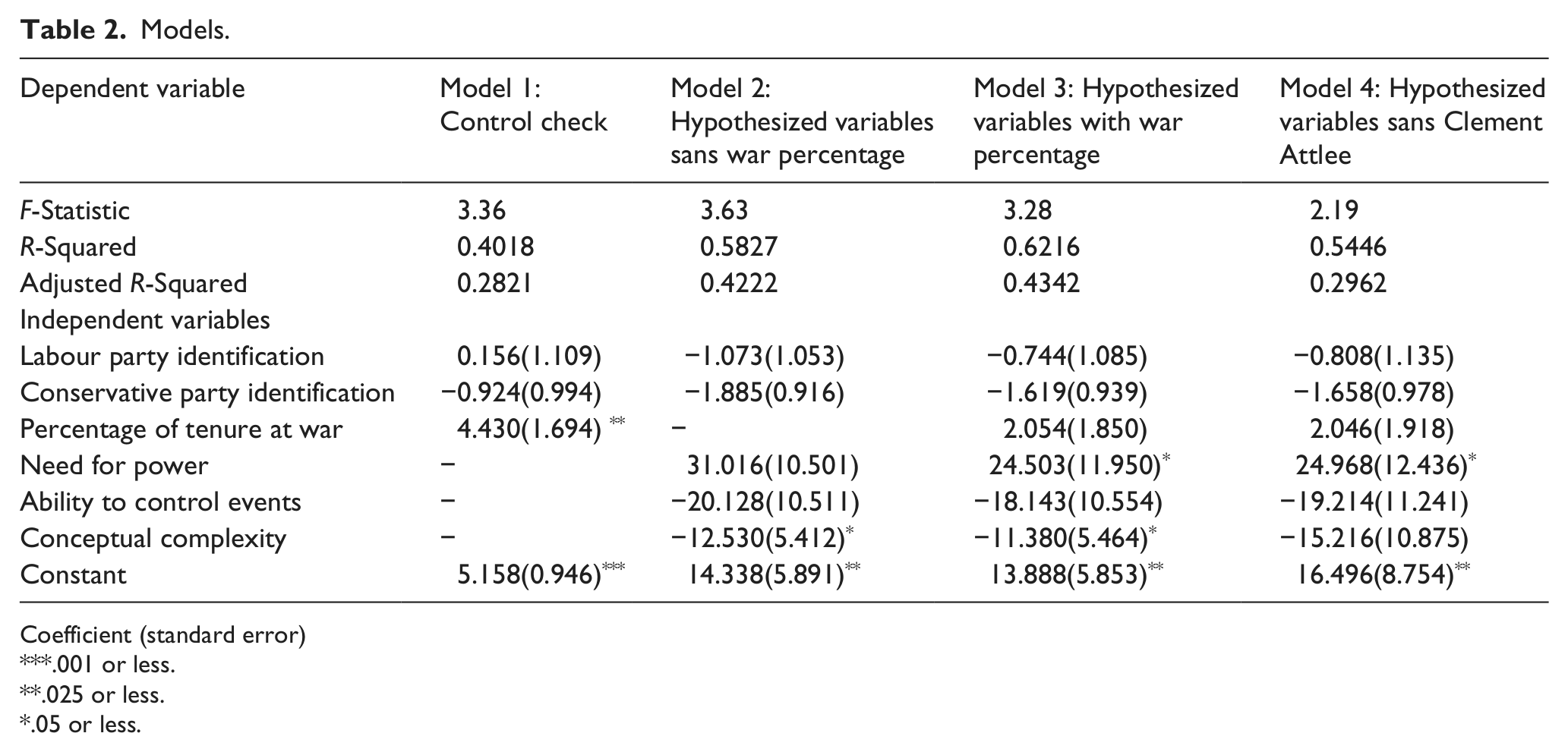
The relationship between the dependent and independent variables will be assessed via a series of one-tailed ordinary least squares (OLS) regressions. One-tailed models were selected because the hypotheses are centered around the occurrence of high LTA trait scores and the perceived efficacy of British PMs. The first model serves as a control check for the Labour party identification, Conservative party identification, and percentage of tenure at war on the MORI/University of Leeds ranking to determine if they significantly influence the dependent variable. The second model investigates the impact of the hypothesized independent variables (the ability to control events, need for power, and conceptual complexity), as well as the control variables (Conservative party identification, Labour party identification), on the dependent variable (the MORI/University of Leeds ranking of prime ministerial effectiveness). The third model includes all of the variables selected for model two and adds the war percentage variable to the regression.
As this data set contains a finite number of observations (n = 19), it is critical to ensure that outlier variables do not inadvertently skew the results from the previous models. The fourth model excludes observations that are two standard deviations or more from the mean score of any of the three investigated LTA variables. This data set contains one notable outlier: Clement Attlee’s LTA score regarding the ability to control events is 0.583, a score greater than two standard deviations above the sample’s mean ability to control events score, 0.358. Accordingly, model four includes all of model three’s variables, with the exception of all of the observations for Clement Attlee.
Multivariate regression results
Control check
The control check regression run using the Labour party identification, Conservative party identification, and percentage of months at war during a PM’s time in office against the MORI/University of Leeds dependent variable produces a lone significant result (see Model 1 in Table 2). Neither party identification with the Conservative or Labour parties serves as a significant indicator of effectiveness or greatness. However, the variable measuring the percentage of a PM’s tenure while at war indicates a strong level of significance. This result will be analyzed in greater detail in subsequent tests.
Models.
Coefficient (standard error)
.001 or less.
.025 or less.
.05 or less.
Discussion of results
Overall, the results support the hypotheses investigating LTA traits focused on power motivation and conceptual complexity (see Table 2). However, the LTA trait indicating a leader’s ability to control events produces insignificant results in models three and four. While model three offers a strong f-statistic and higher r-squared figure than model four, both models will be discussed in order to examine the impact of outlier variables.
Regardless of whether PMs project traits associated with strong LTA scores measuring power motivation as a result of natural charisma, or as the result of a diligent public relations staff, leaders that do so efficiently are significantly more likely to have their time in office considered effective. When all variables except the LTA power variable are set at their mean value, and then increasing the LTA power variable by one standard deviation, we find an increase in the MORI/Leeds effectiveness measure of 1.304. As a result, PMs that effectively project power-motivated traits, which increase the likelihood that they will be perceived as charismatic, are 13.04 percent more likely to be considered effective or great while in office. The strength and significance of the need for power variable persists when outlier variables are removed in model four. This finding aligns with LTA work conducted on the American presidency and establishes comparable results for how British society assesses effective executives.
Hypothesis two, which draws from the work of Rubenzer et al. (2000), initially finds that British PMs who project an image that is open to new information are significantly less likely to be assessed as effective leaders (see Model 3 in Table 2). Setting all variables at their mean and then increasing the LTA conceptual complexity variable by one standard deviation results in a decrease in the MORI/Leeds effectiveness measure of 1.471, or 14.71 percent. However, when the outlier variables are removed in model four, we find that the significance of conceptual complexity decreases from 0.030 to 0.095. While this variable no longer clears the 0.05 or less threshold of significance, it remains an interesting result of near significance. British PMs who appear notably open to new experiences and information are less likely to be assessed as effective while in office.
There are two ways to interpret this result, as well as its divergence from the work of Rubenzer et al.’s findings. The first option is that historians are notably more likely to assess leaders who are open to information as effective; hence, the significance of this trait in the aforementioned work. As the MORI/Leeds survey includes a large portion of political scientists, we may be observing differences that are field specific. Perhaps political scientists do not assess openness to new information in the same manner as historians.
The second option would be that the LTA trait measuring conceptual complexity is dissimilar from the NEO measure of openness, or, if the two variables are measuring a similar trait, there is a notable difference in the role it plays in assessing the effectiveness of US presidents and British PMs. This difference could be the result of cultural variation between the US and the UK or perhaps a difference resulting from the institutional structures found in a parliamentary and presidential system. Regardless, we can assess that British PMs who project traits associated with high LTA scores regarding conceptual complexity are less likely to be viewed as effective or great by British historians and political scientists.
The addition of the variable measuring the percentage of wartime months during a British PM’s tenure in office resulted in notable changes across models two, three, and four. Perhaps ironically, the perceived ability of an individual to project a unique control over events becomes insignificant when interstate conflict is added to the equation. This variable also negates the un-hypothesized significance of Conservative Party affiliation that was found in model two, as well as the unanticipated significance of the war percentage variable in the control check. As a result, we find that the occurrence of an interstate conflict alone is not enough to ensure a favorable assessment from historians and political scientists. Instead, we find that the strongest LTA trait associated with ‘greatness’ in the British executive is power motivation.
Conclusion
Existing literature on the effectiveness of political office holders has focused strongly on the American presidency without examining how its findings applied to leaders of additional states across varying political structures. This project has identified that increasing LTA scores regarding power motivation significantly increases the likelihood that a British PM will be considered effective. This significant finding is similar to existing work in the literature investigating power motivation, charisma, and effectiveness (Hermann, 2005; House, 1977; McClelland and Burnham, 1976). The results also identify a near-significant finding that suggests that PMs who project traits associated with strong LTA measures of conceptual complexity are likely to be viewed as ineffective leaders. As more detailed rankings of the effectiveness of British PMs become available, and larger data sets become possible, the roles of power motivation and conceptual complexity on the effectiveness of British PMs should continue to be examined.
The statistically significant findings of this project can be practically utilized in several ways. Firstly, political campaigns could use automated text analysis to measure a political candidate’s, or their spokesperson’s, LTA scores. These scores would reveal if psychological traits that are significantly linked to effective, or even great, political leadership by the public are naturally present. Secondly, in a political debate, stressing the behavior of an opponent that suggests they have a low ‘need for power’ will make them appear as an unappealing candidate. Potential examples would include previous behavior that indicates that a candidate has trouble reading and assessing other political actors, and/or examples where a candidate has wielded political power too blatantly. Thirdly, indicating that a political candidate possesses traits associated with high conceptual complexity, such as constantly collecting new information, but failing to act decisively, would emphasize psychological traits that are significantly associated with ineffective leadership in the UK. If these traits were targeted successfully, it could create the impression that opponent X would make an ineffective national leader if his/her party were to win the election.
In summary, psychological traits as measured by the LTA coding scheme have a significant impact on the perception of effectiveness and greatness of British PMs spanning the 20th and early 21st centuries. In addition to providing historical insight into what has made a great PM in the past, this project also provides suggestions that can strategically influence the political campaign messages and debating strategies for future PMs in the UK and perhaps similar parliamentary structures across the globe.
