




Abstract
Political consumerism refers to the deliberate purchase or avoidance of products, goods, or services for political reasons. For decades, researchers have studied the micro-level predictors of political consumerism in many countries and across a variety of contexts. However, many questions remain. Do resource-based models of political participation or theories of lifestyle politics best explain why some people are more likely to engage in political consumerism? To answer this question, we conduct a meta-analysis of 66 studies with more than 1000 tests. We find more support for theories of lifestyle politics. Political consumerism is associated with political distrust, liberal ideology, and media use, as well as education, political interest, and organizational membership. The findings help us understand the subset of people who are using their purchasing power to express political opinions. They also help us identify gaps in existing research.
Introduction
Social scientists have long been interested in the key predictors of political participation, at least in part because people who are more likely to participate can communicate their views to decision-makers and have more influence on public policy. Most of the scholarly work on this topic has focused on elite-directed participation, or activities aimed at influencing the government, and has utilized resource-based theories of participation to explain why some people are more likely than others to participate.
The tendency to use resource-based models of participation to explain political behavior is problematic because these models were developed to explain participation directed at the state. Yet, political-participation repertoires have expanded over time to include elite-challenging acts, as well as various forms of lifestyle politics, which target actors other than the state, blur the boundaries between the public and private spheres, and rely heavily on digital-media use (Bennett, 2012; de Moor, 2017; Pickard, 2019; Theocharis and van Deth, 2018). Can we use existing theories of political participation, such as resource-based models, to understand participation in these activities, or do we need alternative theories, such as lifestyle politics, to explain this form of participation?
This question is important for acts such as political consumerism, or the use of one’s purchasing power to express political views and affect change in the marketplace (Stolle and Micheletti, 2013). As political consumers, people can boycott products, companies, or services for undesirable practices. They can also utilize labeling schemes and shopping guides to deliberately purchase, or buycott, products or services that are consistent with their views (Stolle and Micheletti, 2013). 1
Over the past few decades, researchers have examined the extent to which various micro-level predictors of political participation matter for political consumerism. However, there are many contradictory findings in the literature, and many questions remain. Here, we focus on whether resource-based models of participation, such as the Civic Voluntarism Model (CVM) (Schlozman et al., 2018; Verba et al., 1995), or theories of lifestyle politics best explain why some people are more likely than others to engage in political consumerism.
To do so, we conduct the first meta-analysis of political consumerism, which includes 66 studies with more than 1000 tests. This meta-analysis is valuable because it summarizes decades of research findings on political consumerism across dozens of countries. In doing so, it helps researchers identify the extent to which various micro-level predictors are consistent across many studies, and in turn, which models of participation best explain participation in political consumerism.
Conceptual framework
Political consumerism refers to the ‘use of the market as an arena for politics in order to change institutional or market practices found to be ethically, environmentally, or politically objectionable’ or to reward companies for favorable practices (Stolle and Micheletti, 2013: 39). People can boycott (or avoid purchasing) products or brands to punish companies for undesirable policies or business practices. Alternatively, people can deliberately purchase (or buycott) products or services to reward companies or brands for favorable business practices. For example, people may choose to boycott Nike because the company made the controversial former quarterback for the San Francisco 49ers (American football team) Colin Kaepernick the face of its ‘Just Do It’ campaign (Moore, 2018). Conversely, people who support Nike’s decision may deliberately purchase Nike products. 2
Political consumerism is a popular form of participation. In the USA, approximately 35% of Americans engage in political consumerism (Endres and Panagopoulos, 2017). Data from the 2016 European Social Survey show that the rates of political consumerism in Denmark (about 36%), Finland (about 37%), and France (about 32%) are comparable to those in the USA. Across nine African countries, about 27% of people have engaged, or might engage, in consumer boycotts (Adugu, 2016). In Brazil, about 19% of people participate in boycotts or buycotts (Echegaray, 2015). These figures speak to the global appeal of using one’s purchasing power to affect political change.
Boycotts and buycotts are often conceptualized as forms of lifestyle politics. Lifestyle politics refer to ‘the politicization of everyday life, including ethically, morally, or politically inspired decisions’ (de Moor, 2017: 181). People who engage in lifestyle politics view everyday decisions as political statements (Bennett, 2012). For example, people may reduce energy use, use public transportation, or choose a vegetarian lifestyle for political reasons (de Moor, 2017). They may also, of course, engage in boycotts and buycotts for political reasons. In these ways, lifestyle politics blurs the boundaries between the public and private spheres.
Theories of lifestyle politics are premised on discussions of modernization (Giddens, 1991), individualization (Beck, 2007), and value change (Inglehart, 1997). According to these theories, broad societal changes, including globalization, have resulted in the breakdown of traditional institutions and led to a newfound emphasis on self-reflexivity and political expression. As de Moor (2017: 180) writes, ‘Lifestyle politics depart from a realization that one’s everyday decisions have global implications, and that global considerations should therefore affect lifestyle choices.’ Lifestyle politics also differs from elite-directed acts because mobilization tends to be spontaneous, target multiple actors, and rely heavily on digital media use (Bennett, 2012; Stolle and Micheletti, 2013). The differences between elite-directed acts and lifestyle politics are important because they suggest that resource-based theories of participation differ from those of lifestyle politics in their claims about which factors influence participation.
In the political-behavior literature, Verba et al.’s (1995) CVM serves as one of the dominant explanations as to why some people are more likely than others to participate in politics. This model highlights the role of resources, psychological engagement, and recruitment for political participation. As Schlozman et al. (2010: 488) contend, people do not participate because ‘[t]hey can’t; they don’t want to; and nobody asked.’
Although the CVM is broad and powerful (Schlozman et al., 2018), it focuses on a narrow band of political activity directed at the state. The narrow focus is problematic because political participation repertoires have expanded over time (Theocharis and van Deth, 2018) to include elite-challenging acts (Dalton, 2017; Grasso, 2016), as well as various forms of lifestyle politics (de Moor, 2017; Pickard, 2019). Moreover, unlike elite-directed acts, elite-challenging acts target actors other than the state, blur the boundaries between the public and private spheres, and rely heavily on digital media use (Bennett, 2012; de Moor, 2017; Stolle and Micheletti, 2013). Does the CVM apply to political consumerism or do theories of lifestyle politics better explain which people are more likely to participate? In the next section, we utilize the CVM to structure our discussion of the key antecedents of political consumerism. We conclude by discussing the role of media use for political consumerism.
Who participates in political consumerism?
The CVM and lifestyle politics differ in their claims about which factors influence participation. These differences are summarized in Table 1.
Points of debate for the Civic Voluntarism Model (CVM) and lifestyle politics as they relate to political consumerism.
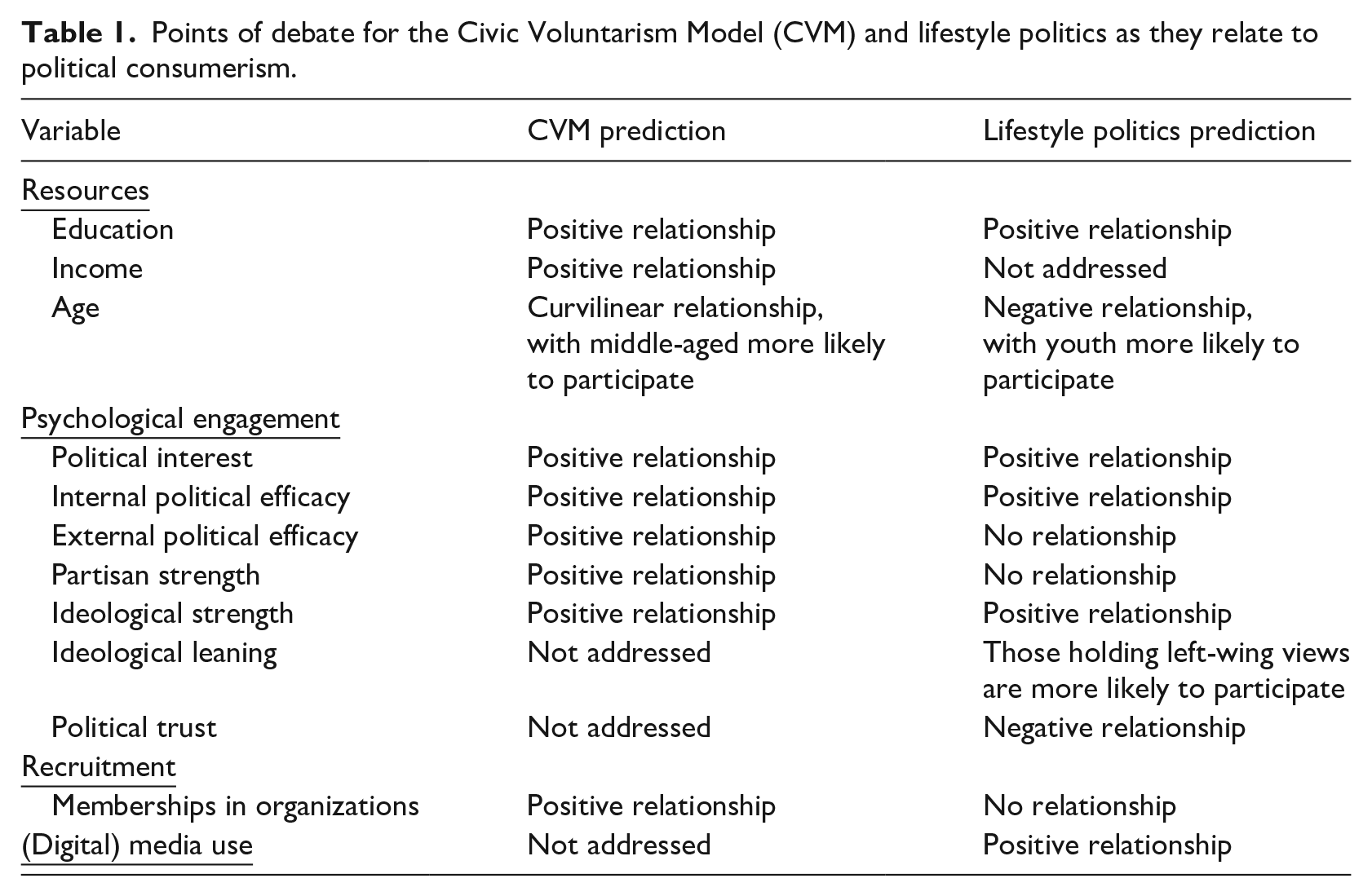
Higher levels of education should be associated with participation in political consumerism. Researchers argue that educational effects are stronger for elite-challenging acts because they require a higher level of political sophistication than participation in elite-directed acts (Dalton, 2017; Koos, 2012). In short, both the CVM and lifestyle politics emphasize the importance of education for political consumerism (Table 1).
The literature is divided on whether financial resources matter for lifestyle politics in general, as well as political consumerism, specifically. Although some researchers contend that political consumerism is dependent on financial resources (e.g. Baumann, et al., 2015), others argue that income matters more for buycotting than boycotting because products that are consistent with one’s values may be more expensive (Arbache, 2014; Koos, 2012).
In short, the CVM stresses the importance of income, but lifestyle politics, including the subset of research on political consumerism, does not offer clear expectations about the role of income (Table 1).
At the same time, the relationship between age and participation is not consistent across different political acts. Whereas increases in age are associated with voting in elections and campaign participation, younger citizens are more likely to engage in direct or elite-challenging acts (Dalton, 2017; Grasso, 2016), as well as in online forms of participation (Schlozman et al., 2010, 2018).
In addition, lifestyle politics posits that younger generations of well-educated citizens have become increasingly active in elite-challenging forms of participation because they are more likely to prefer more expressive, non-traditional forms of participation, such as boycotting (Inglehart, 1997). Whereas older generations are more likely to work through traditional political institutions, younger generations are more disillusioned with electoral politics and are more likely to view their everyday choices as political statements (Pickard, 2019).
To summarize, the CVM contends that middle-aged people are more likely to participate, but lifestyle politics suggests that younger individuals are more attracted to acts such as political consumerism (Table 1).
Psychological engagement: They want to
Psychological engagement is also associated with participation in politics. Variables associated with psychological engagement include political interest, political efficacy, partisan strength, ideological strength, ideological leaning, and political trust.
Similarly, theories of lifestyle politics contend that political interest drives participation in activities that target actors other than the state and blur the boundaries between the public and private spheres. Political interest is important for political consumerism because political values motivate participation in boycotts and buycotts (Micheletti, 2010; Stolle et al., 2005). As Micheletti (2010: xi) explains, ‘Political consumers choose products, producers, and services more based on the politics of the product than the product as material object per se.’ Without political motivation for this behavior, purchasing choices would be mere consumption (Micheletti, 2010). In short, both the CVM and lifestyle politics view political interest as a driver of participation in political consumerism (Table 1).
Internal efficacy may matter for political consumerism because it gives people a sense of agency or empowerment; when people believe their participation matters, they are more likely to engage in individualized responsibility-taking, and they are less likely to free ride (Arbache, 2014; Stolle and Micheletti, 2013). Both the CVM and lifestyle politics view internal political efficacy as a predictor of participation (Table 1).
The relationship between external efficacy and political consumerism is more complicated. The CVM focuses on activities to influence the state, which makes external political efficacy a relevant predictor. According to lifestyle politics, however, people engage in direct, elite-challenging forms of participation because they believe that the state cannot solve collective action problems (Inglehart, 1997). From this perspective, external efficacy, as measured by views about the political system, does not matter. Therefore, lifestyle politics does not expect a relationship between external efficacy and political consumerism (Table 1).
In contrast, lifestyle politics posits that people who engage in direct forms of action should be less likely to identify with political parties because they are skeptical of traditional political institutions (Bennett, 1998; Berlin, 2011; Dalton, 2017; Inglehart, 1997). Dalton (2017) also argues that non-partisans are among the most likely to participate in various forms of direct action because they have a greater ability to make informed political choices on their own in the absence of partisan cues. Consequently, partisan strength does not matter for lifestyle politics (Table 1).
Similarly, lifestyle politics posits that people engage in political consumerism to address concerns about specific issues, such as the environment, climate change, animal welfare, racial injustice, fair-labor standards, and minority rights (Bennett, 2012; Copeland, 2014; de Moor, 2017). People also engage in political consumerism to promote traditional family values or conservative causes. Consequently, people who identify as ‘very liberal’ or ‘very conservative’ should be more likely than moderates to engage in political consumerism. To summarize, both models view ideological strength as a predictor of participation (Table 1).
In contrast, lifestyle politics posits that progressives are more likely to engage in protest because they do not shy away from confrontation (Arbache, 2014). Dalton (2017) adds that progressives utilize protest to challenge the status quo, especially when elite-directed modes of participation prove ineffective, or when access to electoral participation, such as voting, is restricted (e.g. the Montgomery Bus Boycotts in 1955–1996). In short, lifestyle politics posits that political consumers should be more likely than non-political consumers to identify with the left side of the left–right ideological spectrum (Table 1).
In contrast, theories of lifestyle politics contend that people with the lowest levels of trust in government should be among the most likely to engage in elite-challenging forms of participation (Hooghe et al., 2017; Quintelier and van Deth, 2014). People engage in activities such as political consumerism because they are frustrated with the government’s inability to address important political problems (Berlin, 2011; Inglehart, 1997). In response, people choose to express political views in other ways rather than focusing on the state. For example, people might choose to protest, or if the problem is attached to a specific company, they may boycott or buycott their products or services. In sum, lifestyle politics posits that political distrust mobilizes people to participate in acts such as political consumerism (Table 1).
Recruitment: Someone asked
The final tenant of the CVM is that recruitment matters (Schlozman et al., 2018; Verba et al., 1995). Whereas some people participate in politics because they care about a specific issue or feel a sense of civic duty, other people get involved because someone asks them to participate (Schlozman et al., 2018). Requests to participate can come from neighbors and friends or from organizations such as churches or political parties (Schlozman et al., 2018). People who belong to organizations are more likely to participate in politics because they are more likely to be asked to do so, and they are less likely to shirk their obligation (Verba et al., 1995). According to the CVM, therefore, membership of organizations should increase the likelihood of being asked to boycott or buycott a product, service, or company (Table 1).
Lifestyle politics, in contrast, posits that participation occurs in everyday settings, such as grocery and clothing stores, in the absence of formal, hierarchical organizations (Bennett, 2012; Stolle and Micheletti, 2013). Instead, participation is self-directed (Earl et al., 2017) and tends to be spontaneous because citizens decide when and how often they want to participate (Bennett, 2012; Stolle and Micheletti, 2013). Consequently, organizational ties do not matter for lifestyle politics (Table 1).
(Digital) media use
The CVM explains participation in terms of resources, psychological engagement, and recruitment, but it is silent on the role of (digital) media use. This is somewhat surprising since the authors recognize that political knowledge is an important aspect of psychological engagement (Verba et al., 1995), and people acquire political knowledge by following the news online and offline.
(Digital) media also have important implications for mobilization. In their latest work, Schlozman et al. (2018, chapter 6) note that organizations can utilize emails and text messages to mobilize members. However, they do not test whether (digital) media use influences participation. In short, the researchers who developed the CVM do not view (digital) media as an important influence on participation.
In contrast, (digital) media use lies at the heart of lifestyle politics. According to lifestyle politics, digital media are ‘central to the organization and conduct of collective action’ because they lower information and communication costs and facilitate expressive and personalized forms of participation (Bennett and Segerberg, 2013: 56). Digital media use helps political consumers gather information about corporate practices and product-labeling schemes, as well as ethical shopping guides (Stolle and Micheletti, 2013). People can also use apps on their smartphones to inform their shopping decisions. During the 2016 US presidential election, for example, the Democratic Coalition Against (Donald) Trump created a “Boycott Trump” app to encourage people to boycott products, services, and companies associated with the Trump family (Copeland and Becker, 2019).
Social media also allow people to share information about products, brands, and other interests associated with consumption (Gil de Zúñiga et al., 2014). In fact, Gil de Zúñiga et al. (2014) theorize that social influence and information sharing drive political consumerism. Becker and Copeland (2016) add that social media use empowers people with similar interests and/or identities to create imagined communities in which people share information and encourage each other to engage in political participation, including political consumerism. Finally, digital media use facilitates political consumerism because people increasingly do their shopping online (Kelm and Dohle, 2018; Stolle and Micheletti, 2013). In short, the CVM does not treat (digital) media use as a key antecedent to political participation, but lifestyle politics treats (digital) media as a key predictor of participation (Table 1).
To summarize, the CVM and lifestyle politics have different claims about which factors predict political participation (Table 1). To test which theory best explains participation in political consumerism, we conduct a meta-analysis of 66 studies on political consumerism.
Methodology and scope
Meta-analyses are quantitative analyses of quantitative studies. They are distinct from literature reviews because they focus on the relationship between variables, and they offer a comprehensive review of existing research (Imbeau, et al., 2001). For this meta-analysis, we examined quantitative, survey-based studies of self-reported boycotting and/or buycotting.
We identified political consumerism studies as follows. First, we searched Google Scholar, International Political Science Abstracts, Political Science Complete, Scopus, SocINDEX, and Web of Science for studies. To do so, we utilized a set of search strings to query the databases. Keywords included ‘boycott’, ‘buycott’, ‘political consumerism’, ‘political consumption’, ‘ethical consumerism’, ‘ethical consumption’, ‘citizen consumer’, ‘citizen-consumer’, ‘sustainable consumption’, and ‘sustainable consumerism’. Second, we cross-referenced key authors’ curriculum vitaes. Third, we looked at each article’s citations to determine if we had missed any studies (i.e. snowball sampling). Finally, we used Publish or Perish to search Google Scholar and to download citations to Stolle et al.’s (2005) article on political consumerism, which is well cited with more than 1000 citations as of September 2019. To determine which studies to examine more closely, we developed a schematic (see Online Appendix A).
All works included multivariate analysis of survey data with at least two independent variables and boycotting and/or buycotting as the dependent variable. We did not include studies that included boycotting and/or buycotting as part of a scale or additive index (e.g. indices with marching or signing petitions) because we were only interested in examining predictors of political consumerism itself. Finally, all measures were about self-reported past boycotting and/or buycotting behavior, not expected behavior or a willingness to participate in boycotting and/or buycotting.
Description of studies and analysis approach
We identified 66 papers that met our criteria (see Online Appendix B). Each study has, on average, 13 variables predicting political consumerism. Studies have additional lines of data if they analyzed boycotting separately from buycotting (e.g. Baumann et al., 2015; Kelm and Dohle, 2018), if they conducted analyses for multiple countries (e.g. Echegaray, 2015; Stolle et al., 2005; Yates, 2011), or if the authors used multiple datasets (e.g. Endres and Panagopoulos, 2017; Kelm and Dohle, 2018). Across these 66 studies and 184 lines of data, there are more than 1000 data points (i.e. relationships tested).
Although there are many approaches to meta-analysis, we utilized the approach outlined by Geys (2006) and Imbeau et al. (2001), which has been utilized in recent studies (Cancela and Geys, 2016; Smets and van Ham, 2013). The approach relies on vote-counting. We describe whether the relationship is as follows:
Positive and significant (p less than .05);
Positive, but not significant (p greater than .05);
Negative, but not significant (p greater than .05); or
Negative and significant (p less than .05).
We would have liked to calculate and report the average effect size of the independent variables. However, this was not feasible given the variety of analyses (e.g. logistic, ordinary least squares, and multinomial regression models) and the lack of information to make conversions (standard deviations) to a standard metric.
As Table 2 shows, most studies operationalize political consumerism as boycotting (78 tests). Few studies operationalize political consumerism as buycotting alone (38 tests). Consequently, we are not able to examine how the key predictors of boycotting differ from those of buycotting.
Profile of data in meta-analysis.
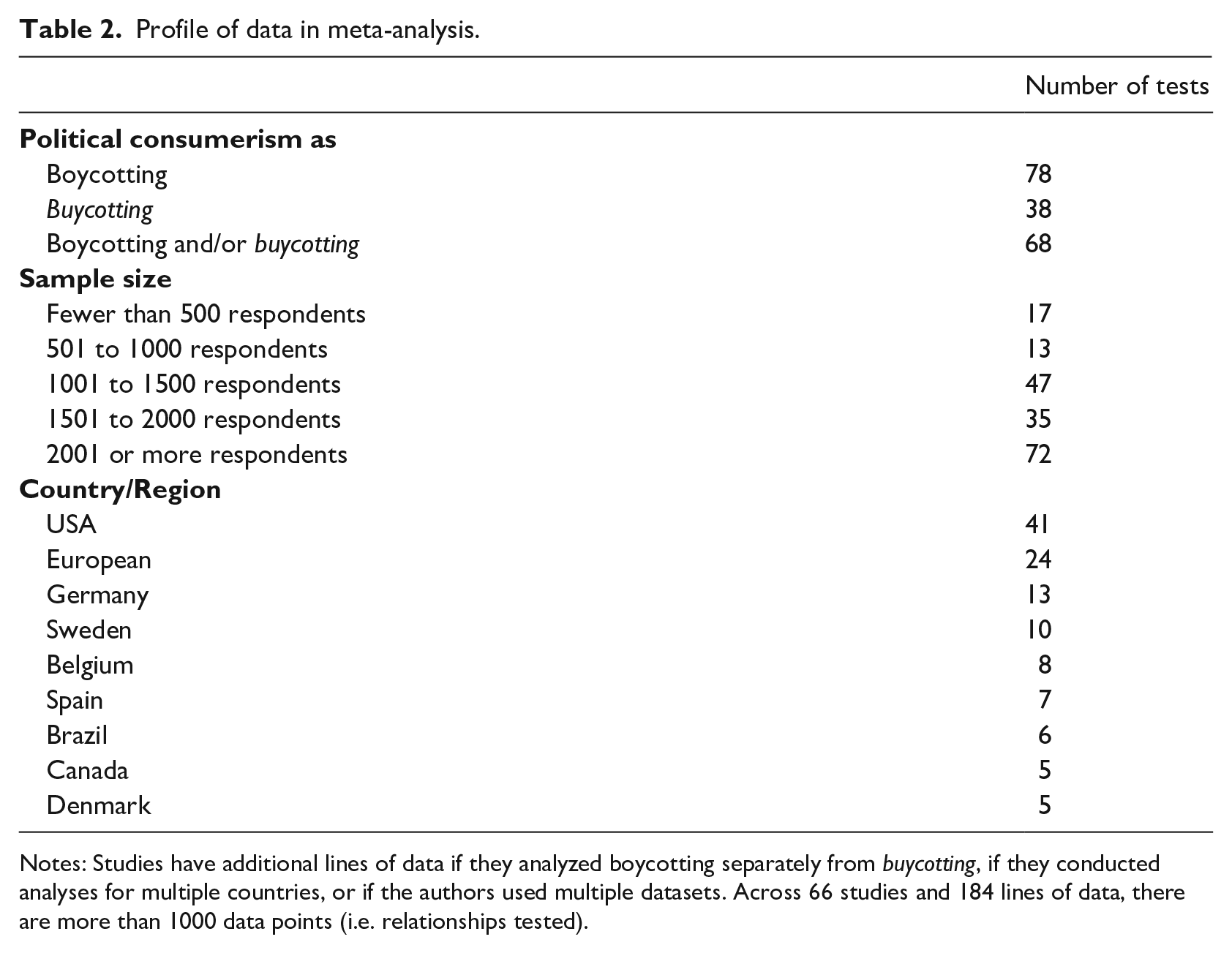
Notes: Studies have additional lines of data if they analyzed boycotting separately from buycotting, if they conducted analyses for multiple countries, or if the authors used multiple datasets. Across 66 studies and 184 lines of data, there are more than 1000 data points (i.e. relationships tested).
Many studies also blur the distinction between boycotting and buycotting (68 tests). For instance, some studies combine one measure of boycotting and one measure of buycotting into a single, dichotomous variable coded 0 if the respondent did not engage in political consumerism and 1 if the respondent engaged in at least one mode of political consumerism. Therefore, logistic regression was the most popular analytic technique (153 of 184 tests).
Table 2 also shows that most studies relied on large-sample surveys, such as the European Social Survey (ESS) or the World Values Survey (WVS). In addition, most of the data in our meta-analysis were collected after 1999; only one study utilizes survey data on boycotting before that time (Grasso, 2016). Moreover, the data examine political consumerism around the world. Many studies pooled results across different countries, such as Campante and Chor’s (2014) analysis of 77 countries using WVS data. However, some studies utilized survey data to study political consumerism in 20 separate countries (Table 2).
Results
For our results, the unit of analysis is the test – a test between an independent variable and political consumerism as the dependent variable. There are more than 1000 tests in our database, but the analysis presented here focuses on the variables relevant to the CVM and lifestyle politics. We present the results in Table 3. In Online Appendix C, we also include the results for other variables that were tested at least 15 times in the 66 studies but do not relate directly to the CVM or lifestyle politics.
Meta-analysis of key predictors of political consumerism based on the Civic Voluntarism Model (CVM) and theories of lifestyle politics.
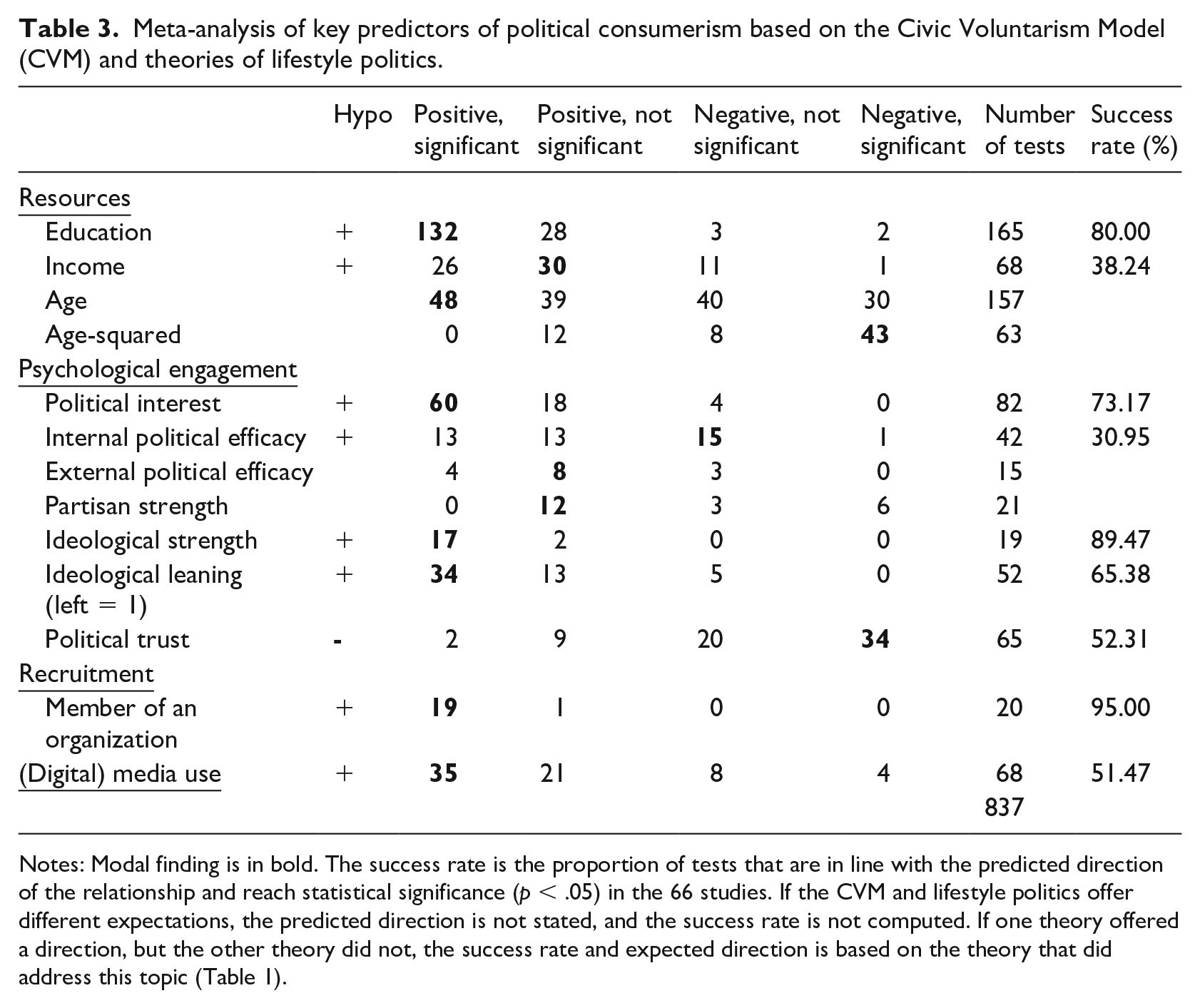
Notes: Modal finding is in bold. The success rate is the proportion of tests that are in line with the predicted direction of the relationship and reach statistical significance (p < .05) in the 66 studies. If the CVM and lifestyle politics offer different expectations, the predicted direction is not stated, and the success rate is not computed. If one theory offered a direction, but the other theory did not, the success rate and expected direction is based on the theory that did address this topic (Table 1).
To begin, we focus on the variables associated with resources: education, income, and age. As Table 3 shows, the modal relationship between education and political consumerism is positive and significant. Of 165 tests, education is a positive and significant predictor in 80% of these tests, which is consistent with the CVM and lifestyle politics.
Of the 68 tests for income, the modal finding is a positive but not statistically significant effect. Most tests are positive, but only 26 tests (38.2%) are statistically significant. Income does not appear to matter for political consumerism, which is consistent with lifestyle politics.
The effects for age are often modeled as linear effects (157 tests), and the most popular finding is a positive and significant relationship. However, there are many tests of a non-linear relationship between age and political consumerism. Of the 63 tests of non-linear effects, 43 of these tests (68.3%) are negative and significant. These tests suggest that middle-aged people are more likely to participate than the youngest or oldest segments of the population, which is consistent with the CVM.
Next, we turn to tests associated with psychological engagement. Political interest has a strong positive correlation with engaging in political consumerism. Of the 82 tests, 73.2% are positive and significant. People who are more interested in politics are more likely to engage in political consumerism, which is consistent with the CVM and lifestyle politics.
There are 42 tests of the relationship between internal political efficacy and political consumerism, but the findings are mixed. Thirteen tests are positive and significant at p < .05, and 13 tests are positive but not significant. An additional 15 tests show that the relationship is negative and not significant. Although the CVM and lifestyle politics contend that internal efficacy matters for participation, the results suggest that internal efficacy is not important for political consumerism.
In terms of external efficacy, the modal finding is positive, but not significant. Like internal efficacy, external political efficacy does not have a strong relationship with political consumerism, which is consistent with lifestyle politics.
Our data have 21 tests of partisan strength. The modal finding is positive but not significant (57.1% of tests). Therefore, we cannot conclude that partisan strength drives political consumerism, which is consistent with lifestyle politics.
Compared to partisan strength, our tests for ideological strength and ideological leanings are more conclusive. Of the 19 tests of ideological strength, 89.5% are positive and significant. Of the 52 tests of liberal or leftist ideology, 65.4% are positive and significant. Whereas the finding for ideological strength is consistent with the CVM and lifestyle politics, the finding for ideological direction is only consistent with lifestyle politics.
The data include 65 tests for political trust. Of these tests, 34 tests (52.3%) are negative and significant. An additional 20 tests are negative but not significant. People who have lower levels of political trust are more likely to engage in political consumerism, which is consistent with lifestyle politics.
Next, we turn to organizational membership. This is one of the most consistent predictors of political consumerism. Of 20 tests, 95% are positive and statistically significant; organizational ties matter for political consumerism, which is consistent with the CVM.
Finally, we examine the relationship between (digital) media use and political consumerism. Unfortunately, we were not able to untangle the distinct contribution of digital media, as opposed to other media, because of researchers’ tendency to combine different forms of media use into one index or scale. This creates methodological ambiguity, as well as ambiguity in the findings. Of the 68 tests, 35 are positive and significant, and 21 tests are positive but not significant. Although we cannot speak to digital media use specifically, we can conclude that media use matters for political consumerism and that the relationship is positive. This finding is consistent with theories of lifestyle politics.
Discussion
In this study, we conducted a meta-analysis of 66 studies of political consumerism to ascertain whether resource-based models of political participation or theories of lifestyle politics explain why some people are more likely than others to engage in political consumerism. The CVM and lifestyle politics have the same expectations for education, political interest, internal political efficacy, and ideological strength. Apart from political efficacy, these expectations are supported by the meta-data; education, political interest, and ideological strength are key predictors of political consumerism. However, the CVM and lifestyle politics have different expectations with respect to age, income, external efficacy, partisan strength, political trust, organizational membership, and (digital) media use. Table 4 summarizes the finding for each variable, as well as whether the finding is consistent with the CVM or theories of lifestyle politics. Overall, we find more support for lifestyle politics than we do for the CVM.
Summary of findings for competing expectations from the Civic Voluntarism Model (CVM) and theories of lifestyle politics.
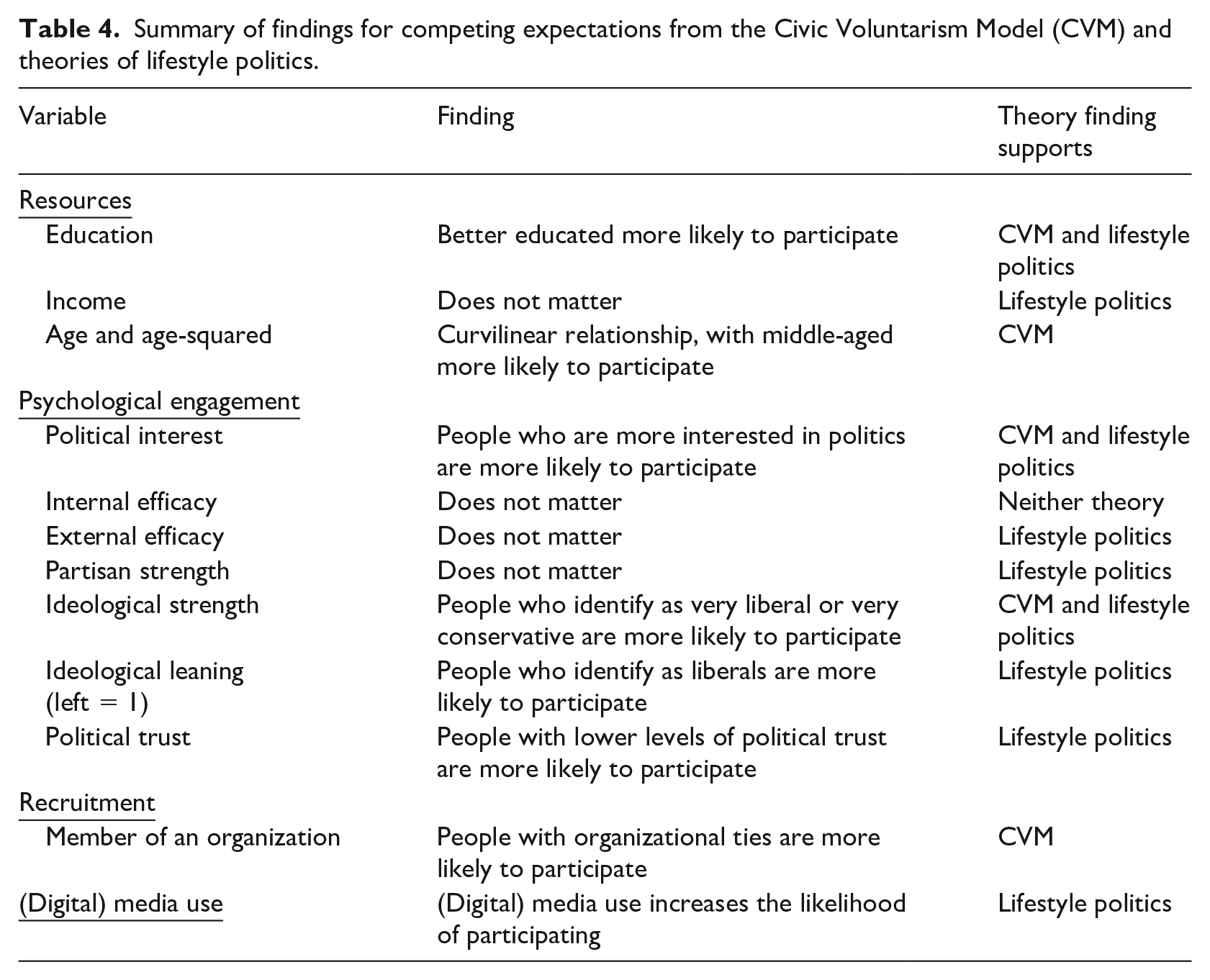
With respect to the role of age and organizational ties for political consumerism, the evidence is on the side of the CVM (Table 4). For age, we see a pattern where participation in political consumerism increases until middle age and then declines among the oldest age group. 3 The CVM also emphasizes the importance of organizational ties for recruitment, and the meta-data are consistent with this (Table 4). However, the meta-analysis did not find consistent evidence that income matters for political consumerism (Table 4). Income is a core element of CVM and thus a key weakness of this model if we want to understand what drives political consumerism.
For all other variables, the evidence is on the side of lifestyle politics (Table 4). Lifestyle politics theorizes that people with lower levels of political trust are more likely to participate, and the meta-data confirm this. Lifestyle politics also posits that people who identify with the left side of the left–right ideological spectrum are more likely to participate, and this expectation is consistent with the meta-data. Finally, lifestyle politics views (digital) media use as an important predictor of participation, and the meta-data confirm this. People who use (digital) media for political information are more likely to engage in political consumerism.
Conclusion
Our meta-analysis found that political consumers tend to be middle-aged, well-educated individuals who are interested in politics but skeptical of traditional institutions. Political consumers also tend to have strong ideological leanings and organizational ties, and they use (digital) media for political information. These findings matter because those who participate advocate for different policies than those who do not participate (Dalton, 2017; Schlozman et al., 2018). Some citizens speak with a megaphone and others with a whisper, resulting in public policies that favor the loudest (Schlozman et al., 2018). Political consumerism is an important, transnational form of political participation that allows people to target actors other than the state, including multinational corporations, brands, and retailers. Therefore, it matters which people participate.
In addition, our findings demonstrate that resource-based models of political participation are limited in their ability to explain participation in acts, such as political consumerism, that are not directed at the state and are associated with political distrust. Our findings suggest that different modes of participation require different theories to understand the key predictors. Since research suggests that there are seven modes of participation (Theocharis and van Deth, 2018), we encourage greater attention to how different theories apply to different modes. For some modes, resource-based models might be effective in explaining participation, but resource-based models may not be as effective for other modes, such as “consumerist participation” (Theocharis and van Deth, 2018: 98).
Although our meta-analysis offers strong findings about which predictors matter for political consumerism, the meta-analysis could not address a number of issues. First, we could not differentiate between boycotting and buycotting because few studies distinguish between different types of political consumerism. This limitation is important because income may matter more for buycotting than boycotting (see e.g. Koos, 2012).
Second, we could not address cross-national differences, because there were not enough studies conducted in countries outside the USA (see Table 2). The importance of the CVM versus lifestyle politics may differ cross-nationally. For instance, income may matter more in countries with higher levels of economic inequality than in countries with lower levels of economic inequality. Future research should untangle how income matters across different societal contexts.
Third, we cannot account for differences in how researchers operationalize political consumerism. For instance, some survey instruments ask respondents to consider environmental values (e.g. the 2002 ESS), while others do not (see e.g. the WVS). These wording differences may explain some of the differences in the findings (Table 3), but we cannot test these nuances, nor can we offer a conclusion about which question wording works best. Instead, we encourage researchers to use focus groups to delineate how respondents conceptualize boycotting and buycotting, as well as to utilize survey experiments to examine question-wording effects.
Despite these limitations, our meta-analysis identified many other fruitful areas for future research. First, researchers need to clarify the role of internal and external efficacy for political consumerism. We suspect that our findings for external efficacy might be different if the researchers measured efficacy as one’s ability to affect change through purchasing decisions or through the marketplace.
Another area for future research concerns the role of organizational ties and social capital. Although a study conducted in the USA shows that boycotts and buycotts are self-directed (e.g. Earl et al., 2017), the meta-data on multiple countries show that organizational ties matter. In addition, several studies show that interaction with family and friends increases the likelihood of engaging in political consumerism (Giugni and Lorenzini, 2017; Neilson and Paxton, 2010; Ropaul, 2016). More research is needed to unpack the mechanisms associated with organizational ties, social capital, and mobilization.
Researchers should also examine the relationship between pro-environmental attitudes and political consumerism. Several studies found a strong, positive relationship between pro-environmental attitudes and political consumerism (Berlin, 2011; Koos, 2011; Scruggs et al., 2011), but there were too few tests to include them in our results.
To conclude, political consumerism is a unique form of participation in its capacity to influence market practices, as well as to influence government indirectly by signaling citizens’ values and identifying areas that may require government intervention and regulation. The recent example of protests related to President Trump and the Trump family brand (e.g. Ivanka Trump’s clothing line) also signal that the boundaries between the political and economic spheres are not clear (see Copeland and Becker, 2019). Political consumers view the marketplace as an arena for politics, and they use their purchasing power to signal the need for institutional change (Stolle and Micheletti, 2013). In a globalized world in which citizens are increasingly frustrated by traditional institutions, we expect the prevalence of political consumerism to increase. We encourage additional studies on this important mode of political behavior.
Supplemental Material
Online_Appendix_A_B_C – Supplemental material for Political consumerism: A meta-analysis
Supplemental material, Online_Appendix_A_B_C for Political consumerism: A meta-analysis by Lauren Copeland and Shelley Boulianne in International Political Science Review
Footnotes
Acknowledgements
The authors are grateful to Ada Bemis and Ashlyn Sawyer for their research assistance. The authors would also like to thank the anonymous reviewers, as well as the Editor, for comments on an earlier version of this paper.
Funding
The authors disclosed receipt of the following financial support for the research, authorship, and/or publication of this article: This research received funding from Baldwin Wallace University, Berea, Ohio, USA. It also received funding from MacEwan University, Edmonton, Alberta, Canada.

Notes
Author biographies
References
Supplementary Material
Please find the following supplemental material available below.
For Open Access articles published under a Creative Commons License, all supplemental material carries the same license as the article it is associated with.
For non-Open Access articles published, all supplemental material carries a non-exclusive license, and permission requests for re-use of supplemental material or any part of supplemental material shall be sent directly to the copyright owner as specified in the copyright notice associated with the article.
