




Abstract
We report the results from an experiment that examines how and when joint tasks and financial incentive structures promote group performance on an objective task. The purpose is to identify behavioral mechanisms produced by these factors that link structural interdependencies to task accuracy. The context is a cooperative four-person group that seeks to resolve a collective problem (i.e., find a solution to a survival task). The experiment manipulates task jointness and group-based incentives. Subjects freely interacted in their assigned groups over a 10-minute period, and three behavioral mechanisms were derived from the coding of their interaction: nonverbal synchronization (eye contact, body orientation, task focus), evaluative engagement (statements of agreement and disagreement), and external (observers) assessments of the group's cohesion. The results indicate that (1) task jointness is a stronger predictor of group performance than the group incentive structure, (2) nonverbal synchronization and the frequency of evaluative engagement mediate the effect of task jointness, and (3) the assessments of group's cohesion reveal a negative impact on group performance. This study finds that task jointness is more important to task performance (accuracy) than collective incentives because of the interaction patterns unleashed by joint tasks.
Keywords
Introduction
That structural interdependence shapes human interaction and outcomes is among the most fundamental assumptions of sociology (e.g., Durkheim [1933] 1964; Emerson 1972a, 1972b; Hechter 1987; Lawler, Thye, and Yoon 2009). Interdependencies are foundational to human social organization. Because of interdependencies, it is possible for two or more actors to cooperate and produce joint goods (Hechter 1987; Olson 1965) and to exchange valued rewards or benefits (Emerson 1972a, 1972b; Homans 1961). These also serve as a central pillar in theories of social solidarity (Collins 2004; Durkheim [1933] 1964; Lawler et al. 2015; Thye et al. 2014). More broadly, interdependencies help to explain the role of stickiness in economic markets and a wide range of other macro-sociological phenomena (Gulati and Sytch 2007; Mizruchi 1989; Uzzi 1999). This article aims to shed light on the behavioral processes that mediate the effects of structural interdependencies on these sorts of outcomes. Theorizing how interdependencies produce concrete behaviors that lead to better group performance is the primary contribution of this article.
A central sociological idea in both micro and macro work is that individuals and organizations capitalize on structural interdependencies as a pathway to group performance or success that may be otherwise unattainable (for a recent review, see Magpili and Pazos 2018). This pathway entails behavior and social interaction. We adopt a “process-focused approach” to small group analyses (Hackman and Katz 2010; Hackman and Oldham 1976), as exemplified by the classic work of Bales (1950; Bales and Strodtbeck 1951; see also Thye and Kalkhoff 2014) and more recent contemporary scholars (Ilgen et al. 2005; Larcher 2007). The specific focus of this article is to examine the social interactions that mediate the effect of structural interdependence on the performance and accuracy of a small group, such as a committee or team. We ask how structural interdependencies shape behaviors and how those behaviors, in turn, bear on the group's performance.
Our empirical focus is on the micro level, but this research has broad implications for a range of social units. Units of all shapes and sizes (e.g., dyads, groups, organizations) often entail structural interdependencies and social interactions that can promote more accurate performance. A key question is which “promotive interactions” or behaviors most facilitate individuals working on a small group task. The concept of promotive interaction can be found in Johnson and Johnson's (1989, 1999, 2006) analyses of group processes (see also Kristiansen, Burner, and Johnsen 2019) and is defined as “individual actions [that] encourage and facilitate each other's efforts to accomplish group goals” (Johnson and Johnson 1989:92). They identify a long and comprehensive list of such behaviors that instantiate the concept—far beyond the scope of our discussion here. Relevant to our analysis are promotive interactions that produce behaviors especially likely to impact group performance under higher structural interdependencies (Courtright et al. 2015; Magpili and Pazos 2018).
In this study, we identify and examine three basic indicators of promotive interactions: (1) nonverbal synchronization (e.g., members’ behavioral gestures that convey attention to and responsiveness to one another, such as eye contact, body orientation, and task focus), (2) evaluative engagement (e.g., task suggestions or evaluations in the form of agreement or disagreement with one another), and (3) external assessments of group cohesion (e.g., third-party perceptions that the group is coming together as a unit). These indicators signify interest and motivation to work collaboratively toward a common goal or solution (Hambrick 1994; Johnson and Johnson 1989; Simsek et al. 2005). Figure 1 portrays the research problem and focus.

The overarching theoretical problem.
We assume a social context with the following properties or scope conditions. First, three or more individuals are brought together to accomplish both individual and collective tasks. Second, they are task-oriented and motivated by incentives to perform well. Third, the context is a fully cooperative setting in which there is no explicit motivation to defect or compete, as in a social dilemma (Axelrod 1984). Finally, group members freely interact in a face-to-face context with no preestablished power or status hierarchies. These conditions describe a variety of groups that individuals encounter in both their personal and professional endeavors (e.g., dean-appointed academics who jointly review a peer department or ad hoc committees who take on special projects for compensation in an organization).
We contrast two sources of interdependence: collective incentives and joint tasks (Allen, Sargent, and Bradley 2003; Kelley and Thibaut 1978; Lawler 2001; Miller and Hamblin 1963; Wageman and Baker 1997). Collective incentives capture reward or financial interdependences and are classically assumed to motivate performance in corporate and business domains (Lazear 2018). When payoffs for task success are individually based, members are incentivized to focus primarily on their own efforts. Input from others may be seen as helpful but not necessary or essential to maximize financial gain or success. However, when monetary payoffs are determined collectively, members are incentivized to engage with others and view their input as both necessary and beneficial. Under such conditions, individuals should be more responsive and open to the input from others and sensitive to the group dynamic. This study addresses a group context where both individual and group incentives are present; however, the ratio of the two incentives varies across conditions. This sort of environment mirrors corporate settings in which some ratio of individual-based and group-based incentives determines an individual's total compensation (Barnes et al. 2011; Condly, Clark, and Stolovitch 2003).
Task interdependence (or jointness) has been recognized as one of the defining characteristics of teams and organizations, entailing both opportunities and constraints (Guzzo and Shea 1992; Hackman and Katz 2010; Magpili and Pazos 2018; Weick 1979). It has also been linked to high levels of cohesion and social order (Lawler et al. 2008, 2009, 2015; Thye, Lawler, and Yoon 2002, 2011). Task jointness varies from simple to complex. The simplest level of task jointness occurs when group members pool their individual contributions to produce a common outcome. For example, the sales team of a local office may simply aggregate individual sales to quantify their output. Task jointness becomes more interdependent when each member works collectively with others to achieve a shared group goal. Here, an individual's output is essentially indistinguishable from the group output. A committee that collectively writes a report with all members working on all sections is a common example. In this vein, we compare a task structure where there is an open discussion leading to a product consisting of (1) an aggregation of individual performances or (2) one that is collectively produced and agreed on by the group.
To test these ideas, we designed an experiment wherein individuals first complete a task individually and then engage in face-to-face discussion before completing a “lost at sea” survival task. In a general sense, the groups were similar in form to those used in Bales’s (1950) classic work on open-interaction groups, although in our study, the tasks have correct answers and thus an objective measure of group performance. The experiment manipulates reward interdependence as the proportion of the payment received from the individual task versus group task; task interdependence is manipulated as whether subjects complete the task alone or together. Each session was video-taped, and two independent raters coded the interaction to measure the three dimensions of promotive interaction (Johnson and Johnson 2006; Kristiansen et al. 2019): (1) nonverbal synchronization during group discussion (i.e., eye contact, forward body orientation, task focus), (2) evaluative engagement with the task (i.e., frequency of agreement and disagreement statements), and (3) levels of cohesion or unity as perceived by the independent raters. The use of open-interaction task groups affords a unique opportunity to examine how structural interdependencies generate promotive behaviors that shape task performance.
Behavioral Mechanisms Leading to Task Success
One barrier to investigating open-interaction groups is the sheer complexity and difficulty of coding and analyzing behavioral data. We do not aim for a comprehensive conceptualization of group interaction, as did Bales (1950), nor do we rely on bottom-up induction to understand the interaction process (Glaser and Strauss 1967; Strauss 1978). Instead, we selected and coded forms of behavior that are theoretically relevant to our argument, guided by some prior analyses (Hambrick 1994; Johnson and Johnson 1989; Simsek et al. 2005). At issue are behavioral and perceptual mechanisms or cues that are observable in social interaction and likely to facilitate group performance (Barreto, Oyarzun, and Conklin 2022). We examine three specific mechanisms: nonverbal synchronization, evaluative engagement, and external assessments of group cohesion.
Nonverbal synchronization refers to behaviors that reflect or indicate mutual attention to the task and to others in the group. In sociology, this concept is leveraged in a variety of approaches that employ the idea of “copresence” or “mutual entrainment” to explain group-based emotional energy (Campos-Castillo and Hitlin 2013; Collins 2004). More generally, nonverbal synchrony is associated with positive task outcomes in a variety of domains. Psychologists report that such synchrony has been shown to boost prosocial behavior and cooperation (Wiltermuth and Heath 2009), and clinicians find synchronization tends to improve the quality of therapeutic sessions and the doctor-patient relationship (Ramseyer and Tschacher 2011). A recent meta-analysis of 42 independent studies found that synchronous actions impact prosocial behavior, social bonding, social cognition, and positive affect (Morgan, Fischer, and Bulbulia 2017). As a collection, these studies suggest the importance of synchronous behavior, as opposed to traits or contextual factors, in yielding positive outcomes (for evidence to this effect, see Jung et al. 2020). In problem-solving groups such as ours, nonverbal synchronization reflects shared intentions and a sense that members are focused on the task at hand. Eye contact is one concrete example of such a cue. If members of the group make frequent eye contact, then this communicates responsiveness, respect, and mutual support. Bodily orientation, such as leaning inward toward others in the group, is another specific behavior that communicates mutual attention and focus. Both eye contact and bodily orientation are key signals of interest and intent, but there are, of course, other ways that people may subtly communicate such intentions. Task focus is another indication that people are concentrating on the problem and are attempting to solve it. It is reasonable to infer that groups higher in interdependence (reward or task) will exhibit greater levels of nonverbal synchronization in the forms described here.
Evaluative engagement occurs when group members actively participate in evaluating the task, that is, think critically about one another's suggestions, propose specific solutions to the problem, and are responsive to feedback regarding their own suggestions. For our purposes, evaluative engagement takes the form of expressions of agreement and disagreement in discussions of the task. Goal-setting theory indicates that such feedback facilitates group problem-solving (Gonzalez-Mule et al., 2016; Locke and Latham 1990). Disagreement, in particular, plays a crucial role because it promotes discussion of alternative solutions and tends to lay bare existing gaps in the analysis under consideration (Klein 1991). Agreement between members is a more complex issue. On the one hand, agreement reflects that members are converging on a common set of ideas or unique solutions as documented in the “wisdom of crowds” literature (Surowiecki 2004). Yet overtly high levels of agreement may invoke conformity processes and a sense of false unanimity or pluralistic ignorance that can lead groups to suboptimal outcomes (Asch 1951; Willer, Kuwabara, and Macy 2009). By and large, groups that can strike a balance between agreement and disagreement tend to perform better overall (Fabozzi 2004).
External assessment of group cohesion, defined here as observers’ perceptions that the group is coming together as a social unit, is our final indicator of promotive interaction. Unlike the other two indicators, this measure involves whether or not acts of cohesion are perceptible to naive external evaluators. Over the past several decades, there has been a trend in group dynamics research emphasizing “entitativity,” or group cohesion as it is perceived by others. Forsyth (2021:222) explains the measure: “Some groups are more cohesive than other groups because they look cohesive: Perceivers, from their vantage point either inside or outside of the group, conclude the group is a unified, intact group rather than an aggregate of separate individuals.” The use of outside evaluators also is not uncommon in social psychology, as when research participants are asked to make quick or “thin slice” judgments of others (Borkenau et al. 2004) or in organizational behavior when supervisors provide external assessments of employee leadership or communication skills (Zhou et al. 2024). For our purposes, external assessments of group cohesion provide the advantage of determining whether or not promotive behaviors “bleed over” such that they are perceptible to individuals beyond the group. Because the external evaluators are ultimately making their evaluations of cohesion on the basis of their observations regarding the group's behavior, and for the sake of parsimony, we refer to this as an instance of promotive behavior.
The literature specifying the effect of group cohesion on task performance is mixed and sometimes leads to divergent conclusions (Forsyth 2021). On one hand, the importance of group cohesion is suggested by the work of Lawler and associates (see Lawler et al. 2009, 2015; Thye et al. 2002, 2014), who find that relational cohesion produces robust levels of commitment and prosocial behavior. On the other hand, the classic literature on group dynamics suggests that cohesion may hinder task accuracy due to overt conformity pressures and implicit self-censorship (Asch 1951; Janis 1972; Sherif and Sherif 1953). Modern studies paint a more complex picture of the effect of cohesion on group performance. In the past several decades, a relatively large literature on cohesion and group performance has accumulated in business and psychology. Meta-analyses conducted between 1991 and 2012 have shown that the preponderance of evidence generally supports a positive effect of cohesion on task performance (Beal et al. 2003; Chiocchio and Essiembre 2009; Evans and Dion 1991; Greer 2012; Gully, Devine, and Whitney 1995). The overall effect size is generally positive and moderate in size (Cohen’s d = .92; indicating that the average cohesive group is performing at the 68th percentile, or 18 percentile points above the average noncohesive group). Importantly, this has been found in both laboratory studies and a wide variety of other contexts, including sports teams, military details, and work groups. The most recent evidence suggests that these effects are robust and stable (Greer 2012).
These meta-analyses imply several conditions that trigger the positive effects of cohesion on performance. A crucial role for interdependent or joint tasks is a recurring theme in these studies—that is, positive effects of cohesion on performance tend to occur when members have interdependent tasks, interact with each other in a face-to-face context, and have task-oriented norms (Beal et al. 2003; Gully et al. 1995; Langfred 1998; Mullen and Cooper 1994). Notably, these effects occur when cohesion is treated as a pathway or mediator toward task performance rather than the terminal outcome. The mediation effect is crucial because cohesion actually dampens performance when it is treated in isolation of other processes (Katzenbach and Smith 1993). To conclude, there is reasonable evidence that ceteris paribus, group cohesion promotes group performance and that these mediating effects are stronger when members have a joint task.
The literature provides less guidance regarding the pathway linking incentive structure to group cohesion and performance. Yet here we can draw implications from Hechter’s (1987) theory of group solidarity. Hechter treats the alignment of individual and group interests as a key to unleash group cohesion and consequently, members’ capacity to produce collective goods that are mutually beneficial (in lieu of a social contract). The centerpiece of the argument is that when individuals are interdependent on group incentives, cohesion and solidarity may be seen as a means to attain individual and collective goals because these are aligned. This is especially likely to happen when individuals can monitor and sanction one another's behavior, conditions satisfied most prominently in the kinds of open-interaction groups studied here. Field studies further support Hechter's notion that collective incentives (e.g., profit sharing) enhance group performance through cohesion and solidarity among organizational members (Estrin et al. 1997; Long 2000). These literatures suggest that group incentives increase both group cohesion and task performance.
Hypotheses
Based on these previous findings, Figure 2 portrays the theoretical model to be tested in this study. Two exogenous conditions (joint tasks and group incentives) are predicted to generate three promotive interaction mechanisms (nonverbal synchronization, evaluative engagement, and assessments of group cohesion); these in turn produce task accuracy. Thus, the effects of the two forms of interdependence on task performance are indirect and mediated by the three behavioral mechanisms. Based on this model, we test the following hypotheses:
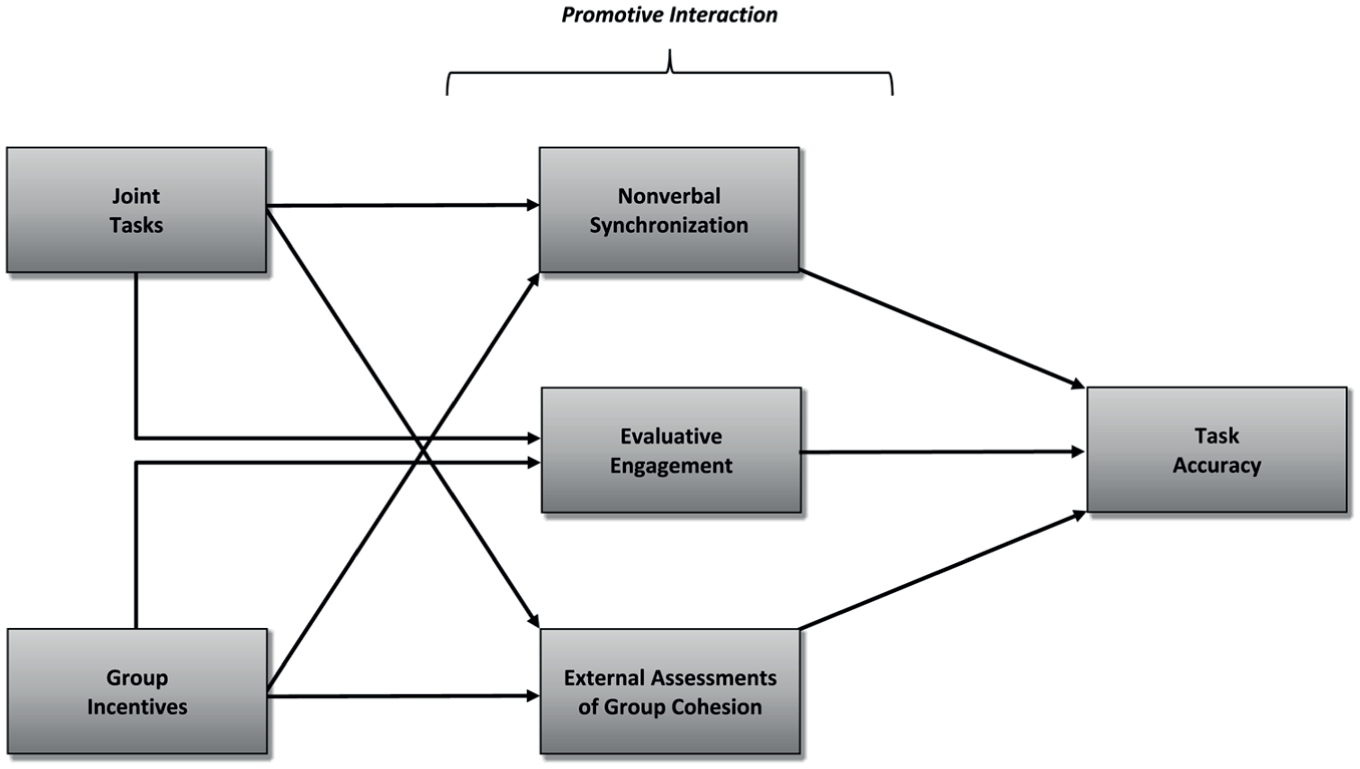
The theoretical model.
The overall model and hypothesized mediating effects are consistent with the classic input-process-output (IPO) model of team performance (Hackman and Katz 2010; Ilgen et al. 2005; McGrath 1984; Steiner 1972). The IPO model explains team performance via classic system theory: task or reward properties set the stage for interaction processes, which, in turn, mediate some variety of group performance. Our model posits that structural conditions (i.e., task and reward interdependencies) are conducive to group performance insofar as they promote specific behaviors that enhance problem-solving. In further specifying these models, we suggest that promotive behaviors are a key mediating mechanism in this process. This shift in focus to behavior is subtle but important. By emphasizing specific behaviors instead of generalized attitudes or orientations, we aim to gain explanatory leverage on how task performance emerges in groups.
Methods
Overview
The experiment established a context in which four people first undertook an individual task and then a group task (cf. Thye et al. 2019). The experimental conditions manipulated the incentive structure (i.e., how much pay for the experiment was determined by the individual task vs. the group task) and the jointness in producing the group task (i.e., whether at the end of a 10-minute discussion, the participants completed the group task individually or together). Overall, the experiment was structured to (1) examine the impact of task jointness and incentive structures on task performance, (2) determine whether these effects are mediated by indicators of promotive interaction (i.e., nonverbal synchronization, evaluative engagement, and group cohesion), and if so, (3) assess the relative sign and strength of these mediating pathways.
Experimental Procedures
The procedures created a situation where four individuals first worked separately on an individual task (in distinct isolation cubicles) and then worked together on a second task (in the same room, face-to-face). Participants were told that both tasks had objectively correct answers and that their pay for the study would be determined by their performance. There was no pay or incentive for the participants to behave similarly or coordinate their answers on either task. This information was disclosed to participants at the beginning of the study in the context of obtaining informed consent.
Upon consent, the subjects were escorted to separate cubicles where they began work on the Phase I, individual task, “the things that kill us” (Fischhoff et al. 1978; Fox-Glassman and Weber 2016). The instructions for this task explained that people face potentially harmful objects or engage in dangerous activities every day and listed 15 dangers. Subjects were asked to rank-order how dangerous an item is based on the number of yearly deaths caused by that item. Subjects had 10 minutes to complete the task. Specifically, subjects were asked to place a “1” next to the most dangerous item or activity, “2” by the second most dangerous, and so on. The specific items included swimming, railroads, police work, home appliances, alcohol, nuclear power, smoking, motor vehicles, pesticide, handguns, bicycles, firefighting, mountain climbing, vaccinations, and surgery. 1 The subjects’ performance was determined by their ranking compared to recent statistics, and they did not receive feedback on their Phase I performance before moving to the second part of the study.
After completing the Phase I task, subjects were escorted to an open-interaction room, seated around a semicircular table, and given the instructions for the Phase II group task—the “lost at sea” survival task. At this juncture all subjects learned (1) they would have up to 10 minutes to discuss the task and (2) whether they would be completing the task individually or generating a single collectively agreed-on list. Subjects were also reminded of the incentive manipulation, that is, how much of their pay would be determined by the Phase I versus Phase II task. The Phase II task was similar in form but not content to the Phase I task. The instructions explained they had chartered a yacht for a holiday trip across the Atlantic Ocean when a fierce fire occurs on the ship. Much of the yacht is destroyed and is now slowly sinking. However, they and the others have salvaged a four-person rubber life raft and managed to save 15 items. Their task is to rank the importance of those items for their survival. The items included a sextant (a navigational tool), a shaving mirror, mosquito netting, a 25 liter container of water, a case of army rations, maps of the Atlantic ocean, a floating seat cushion, a 10 liter can of oil/petrol mixture, a small transistor radio, 20 square feet of opaque plastic sheeting, a can of shark repellent, one bottle of 160% proof rum, 15 feet of nylon rope, two boxes of chocolate bars, and a fishing kit. Subjects were asked to place the number “1” by the most critical item, the number “2” by the second most important, and so on. All interactions on the Phase II task were video-recorded on a Sony HiDef camcorder placed on a tripod in an adjacent room. The video was shot through a one-way mirror, and a microphone was placed in the center of the subjects’ table to ensure high-quality audio capture.
Group performance on the Phase II task is measured as the degree to which the group's ranking of the lost at sea items is consistent with the U.S. Coast Guard ranking. The U.S. Coast Guard ranks the items from most to least significant as follows: (1) shaving mirror, (2) 10 liter can of oil/petrol mixture, (3) 25 liter container of water, (4) a case of army rations, (5) 20 square feet of opaque plastic sheeting, (6) two boxes of chocolate bars, (7) a fishing kit, (8) 15 feet of nylon rope, (9), a floating seat cushion, (10) a can of shark repellent, (11) one bottle of 160% proof rum, (12) a small transistor radio, (13) maps of the Atlantic ocean, (14) mosquito netting, (15) sextant (a navigational tool).
Design and Subjects
The data reported here were collected as a part of a larger project. 2 The present experiment consists of a between-subjects 2 × 2 factorial design crossing incentive structure (whether incentives are more individually based vs. more group-based) and levels of task jointness (low, high). When incentives are more individually based, subjects are told that 80 percent of their pay is based on their performance on the individual task (i.e. the things that kill us) and that 20 percent of their pay will be based on the group task (i.e., lost at sea). When incentive structures were group-based, these percentages were reversed (20 percent based on the individual task, 80 percent on the group task). A prequestionnaire manipulation check confirmed that all subjects understood the incentive manipulation. To manipulate task jointness, the experiment varied whether the score for the lost at sea ranking was an aggregation of individually produced rankings or a single joint ranking of items produced by the group. In the low task jointness conditions, subjects were allowed to discuss the task for up to 10 minutes but then completed the lost at sea ranking individually and without any further communication with the others. In the high task jointness conditions, subjects were allowed to freely interact for up to 10 minutes and then reach consensus by coming to agreement on a single list of rankings.
A total of 272 undergraduate students at large southeastern and northeastern universities participated in the experiment for payment. In all, 68 same-sex tetrads were randomly assigned to one of the four experimental conditions (17 tetrads per cell). The racial composition of the group was not controlled but allowed to vary naturally. Because data were collected at two locations, university affiliation and gender were counterbalanced in each experimental condition. No tetrads were excluded from the analysis.
Measure of the Dependent Variable
The dependent variable is the group performance on the lost at sea task. To construct this measure, we first calculate the mean score for each of the 15 ranked items, averaged across the four group members (in the low jointness condition) or the single value associated with each item (in the high jointness condition). We then calculate the absolute difference between the group's ranking of each item and the Coast Guard's ranking of each item, summed across all 15 items. This variable can range from 0 (i.e., perfect inversion of the U.S. Coast Guard ranking) to 112 (i.e., perfect correspondence with the U.S. Coast Guard ranking). This overall measure captures the accuracy of the group vis-à-vis the official Coast Guard ranking (overall M = 48.41, SD = 11.30).
Measures of Intervening Variables
We rely on coded evaluations of the videotapes to capture each of our intervening constructs. Specifically, two coders who were blind to the experimental conditions and hypotheses coded each of the 68 recordings. Coders were asked to watch each participant separately and code his or her behavior at the end of each 2-minute interval. This continued for each participant until the entire session was coded and then repeated for each participant in the group. As a result, coders provided five coded measures for each individual (a measure at the end of each 2-minute interval for 10 minutes total). Thus, we received 40 coded judgments per group (2 coders × 5 judgments × 4 subjects per group). Coders were restricted as to the number of consecutive hours they could code to minimize sources of random measurement error, such as boredom or fatigue effects (Thye 2000). The coding schemes for each mediating variable are discussed in the following.
Nonverbal synchronization was assessed by three items: eye contact, bodily orientation, and task focus. Each item was measured on a 5-point Likert scale. The eye contact measure ranged from 1 = no eye contact—does not look to other participants to 5 = a lot of eye contact—always makes eye contact with others while speaking; the middle point was 3 = some eye contact—sometimes makes eye contact with the group, sometimes looks elsewhere. Our measure of bodily orientation ranged from 1 = orienting body away from the group to 5 = fully oriented toward group members; potential physical contact, with a middle point of 3 = body poised to include group members. Finally, our measure of task focus ranged from 1 = not at all focused on task—staring into distance or seems apathetic to 5 = very focused on task—actively engaged and concentrating on task, with a midpoint of 3 = somewhat focused on the task—engaged but occasionally losing focus, for example looking at other objects in room. Nonverbal synchronization is the average of these three items, averaged across time for each subject and then across subjects in each group. The composite score for each group is simply the average of the two coders’ scores (Cronbach’s α = .69; intercoder reliability = .66). 3 The result is a single index for each of the 68 groups capturing nonverbal synchronization.
Evaluative engagement is a count variable that captures the extent to which group members evaluate one another's ideas. This measure is the total number of agreement and disagreement statements divided by the total number of task participations. Coders counted the number of verbal and nonverbal behaviors wherein a subject agreed or disagreed with another group member. Coders also calculated the number of statements that were directly on-task participation. We aggregated counts of these variables for each member and averaged the scores across the four members and both coders for each group. The specific details of these operationalizations are discussed next.
Agreements included any variety of “yes,”“ya,”“mm-hmm,”“true,” or a head shake up and down. This also included any compliment to an idea (e.g., “That’s a good idea”) or writing down another's suggestion as a form of agreement. Coders also coded agreements as any form of repetition (Person A: “Mosquito netting is good”; Person B: “Mosquito netting is required”) or providing elaborations for another's suggestion (Person A: “Plastic is important for catching rainwater”; Person B; “Ya, it could also be used as a blanket”). Disagreements comprised each instance of disagreement with another group member's point or suggestion. This included any variety of “no,”“I don't think so,”“I disagree,” or a head shake from side to side. It also included alternate suggestions, such as “Well, what about putting water first instead of food.”
Task participation is the denominator of the evaluative engagement measure. This is also a count variable capturing each time a statement is made about the task (e.g., “Water is important”) or a question was generated or posed (e.g., “Do you think water should be number 1?”). New suggestions regarding an item's importance were also counted as task participations. For example, “Water is also important for hydration” and “Water can clean wounds” would be counted as two instances of task participation. Further task-focused comments including ideas about how to approach the task were counted as task participation (e.g., “Maybe we should start with the least important items first”). Replies to questions (but not agreements) were also counted as task participation. For example, Person A: “What is a sextant?” and Person B: “It is a navigational tool” is counted as two acts of task participation. Only complete thoughts, sentences, or phrases were counted as on-task participation; not “uhhs” or “umms” followed by nothing or “alright.” Off-task participation included statements such as “I’m super hungry” or questions like “Is it raining outside?”
External assessments of group cohesion were measured at the end of each viewing session by both coders. Coders were asked to characterize the group along three 5-point Likert scales that contained the following anchors: becoming more distant—becoming closer; divisive—cohesive; diverging—converging (Cronbach’s α = .89). These items were summed and averaged across the two coders to provide a single index per group (intercoder reliability = .76). Previous research consistently has found that these items are reliable and display desirable measurement properties (e.g., see Lawler et al. 2008; Lawler and Yoon 1996).
Results
The results are divided into three sections: (1) analyses of correlations among the key theoretical variables, (2) maximum likelihood estimates of a structural equation model testing the four hypotheses of the model, and (3) ancillary analyses regarding the mediating effects of agreement and disagreement on group performance.
Correlation Analyses
Table 1 provides correlations among the key theoretical variables. The pattern of zero-order correlations is generally consistent with our theoretical argument—the correlations are moderate in size, although not all are statistically significant. As implied in Hypothesis 1, the correlations between the high jointness condition and promotive behaviors are positive and significant (nonverbal synchronization: r = .380, p < .001; evaluative engagement: r = .239, p < .01; external assessments of group cohesion: r = .359, p < .01). Hypothesis 2 also predicts an association between group incentives and promotive behaviors, but this was not fully confirmed; group incentives are only positively associated with external (third-party observer) assessments of group cohesion (r = .284, p < .01). Hypothesis 3 suggests positive associations between the three promotive behaviors and group performance. Our correlational analyses, however, indicate that only evaluative engagement is significantly correlated with group performance (r = .265, p < .05). To further explore this pattern of findings and how they square with the hypothesized relations, we next analyze the data via a series of structural equations models.
Correlations, Means, Standard Deviations for Key Variables (N = 68).
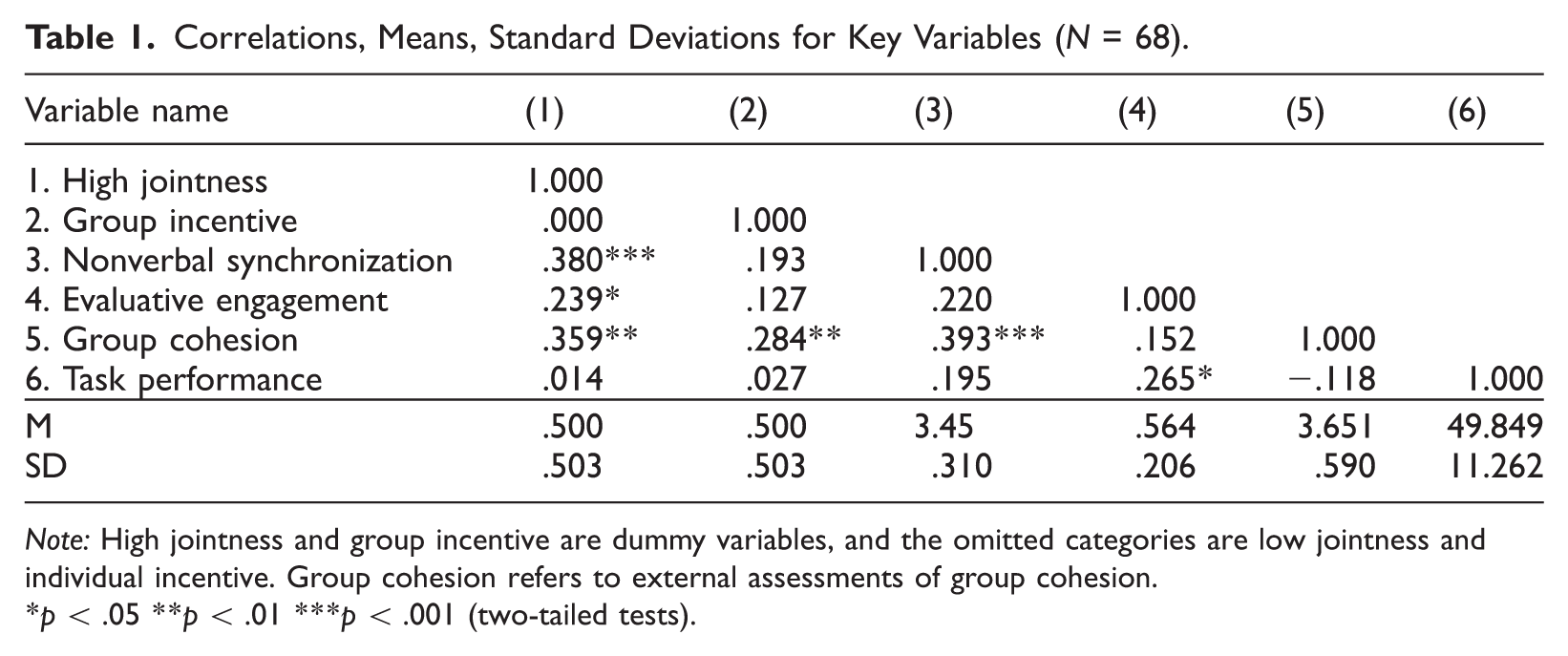
Note: High jointness and group incentive are dummy variables, and the omitted categories are low jointness and individual incentive. Group cohesion refers to external assessments of group cohesion.
p < .05 **p < .01 ***p < .001 (two-tailed tests).
Test of Hypotheses
We employed maximum likelihood structural equation modeling (Mplus 7.11; Muthén and Muthén 2012) to test the main hypotheses. Structural equation modeling has the advantages of (1) correcting the path estimates for random measurement error and (2) estimating the hypothesized direct and indirect effects using simultaneous equations. 4 First, we examine the effects of high jointness and group incentive on nonverbal synchronization, evaluative engagement, and external assessments of group cohesion. Second, we test the effect of these three mediators on group performance controlling for the exogenous experimental conditions. Third, we analyze the relative strength and valence of the hypothesized direct and indirect effects. Table 2 displays the results.
Maximum Likelihood Structural Equation Analysis for the Theoretical Model (Number of Groups = 68).

Note: High jointness and group incentive are dummy variables, and the omitted categories are low jointness and individual incentive. Entries corresponding to predicting variables are unstandardized estimates. Numbers in parentheses are standardized errors. AIC = Akaike information criterion.
p < .05 **p < .01 ***p < .001 (one-tailed tests).
Hypothesis 1 predicts a positive effect of high task jointness on nonverbal synchronization, evaluative engagement, and external assessments of group cohesion. The Table 2 findings support this hypothesis. Compared to the low task jointness conditions, high task jointness increases synchronization, evaluative engagement, and observer ratings of group cohesion (respectively, b = .234, p < .001; b = .098, p < .05; b = .422, p < .001). These findings suggest that when subjects are highly interdependent as they work together on a joint task, they engage in specific forms of promotive interaction, such as nonverbal forms of synchronization, communicative acts of agreeing and disagreeing with one another, and display of visible markers of cohesion that are detectable by external observers. This pattern of results affirms the important role of task jointness in our overarching theoretical model. 5
Hypothesis 2 predicts that group incentives will have comparable effects on promotive behaviors. This hypothesis is partially supported. The results indicate that compared to individual incentives, group incentives produce greater nonverbal synchronization and external assessments of group cohesion (respectively, b = .119, p < .05; b = .333, p < .001). However, group incentives have no significant impact on evaluative engagement (b = .052, n.s.). This pattern suggests that group incentives produce some forms of promotive behavior but not others. The overall implication is that task jointness has somewhat broader effects on promotive behaviors than group incentives.
Hypothesis 3 predicts the positive impact of promotive behaviors—nonverbal synchronization, evaluative engagement, and group cohesion—on group performance. Controlling for experimental condition, this prediction is supported for nonverbal synchronization and evaluative engagement (respectively, b = 9.13, p < .05; b = 14.08, p < .05) but not for group cohesion (b = −4.588, p < .05). Consistent with the hypothesis, synchronizing nonverbal behavior and more frequent acts of evaluative engagement (in the form of agreement and disagreement) boost the performance of the group. Alhough not predicted, the negative impact of group cohesion on performance conforms with other literatures that find similar negative effects (Janis 1972; Langfred 1998). We examine this finding further following the presentation of the results for Hypothesis 4.
Hypothesis 4 predicts that the three promotive behaviors will mediate the effects of task and reward interdependence on task performance. To test for mediation, we used the bootstrapping option in Mplus to arrive at the effect estimates and associated standardized errors. The primary advantage of bootstrapping is that it eliminates reliance on the assumption that the underlying sampling distribution of the indirect effect is normally distributed. This assumption is required by conventional models (Baron and Kenny 1986) but often violated. Eliminating it results in more powerful statistical estimation and a more accurate assessment of the Type I error rate. Table 3 displays the results. The mediation effects of task jointness on group performance through nonverbal synchronization, evaluative engagement, and group cohesion are all statistically significant (respectively, b = 2.14, p < .001; b = 1.38, p < .001; b = −1.93, p < .01), but the effect through group cohesion again was negative. Nevertheless, the total indirect effect of the mediating pathways remains significant (b = 1.59, p < .05).
Test of Mediation Effects of Nonverbal Synchronization and Evaluative Task on Task Performance with Bootstrapping Sampling (Number of Groups = 68).
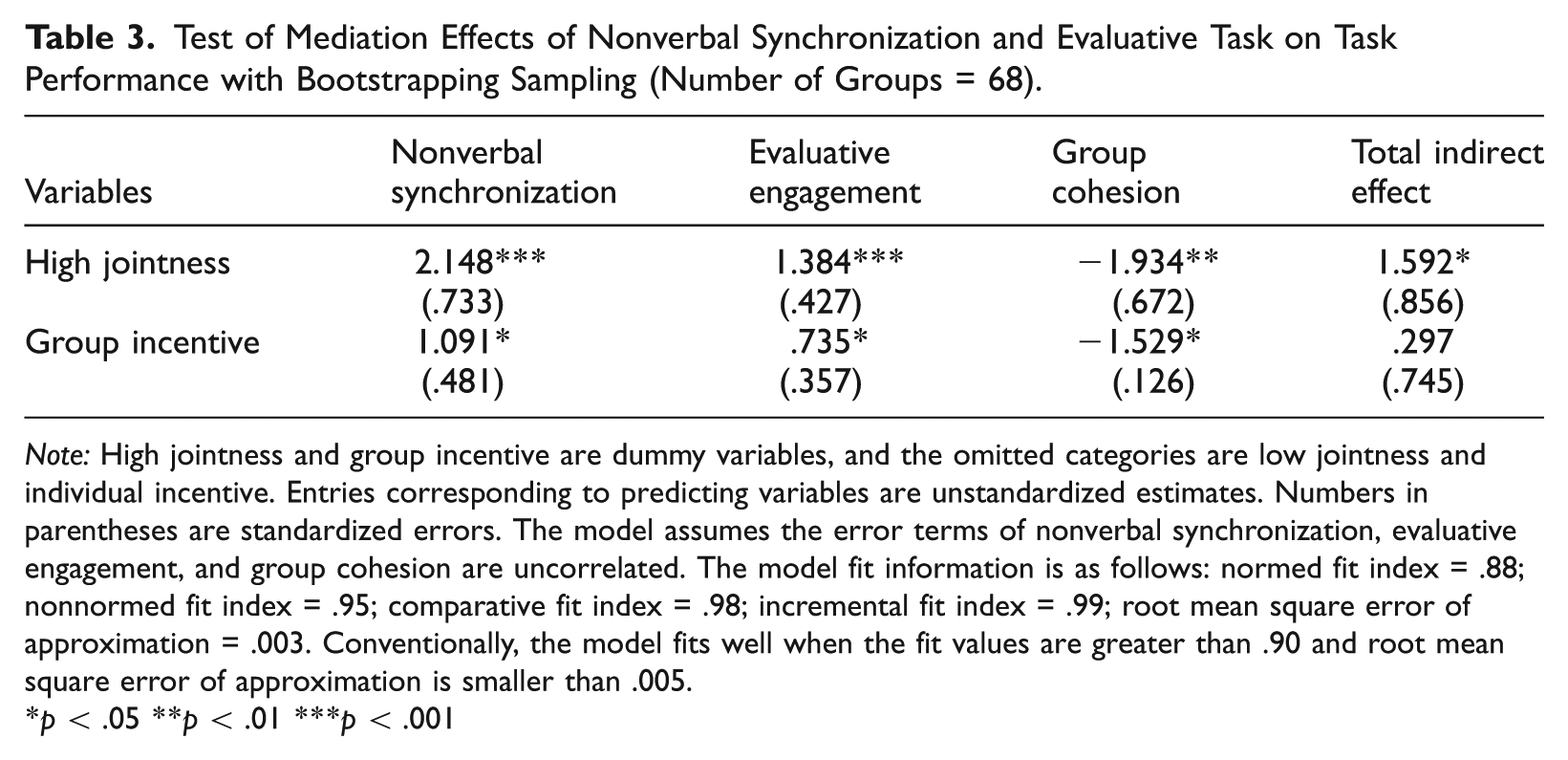
Note: High jointness and group incentive are dummy variables, and the omitted categories are low jointness and individual incentive. Entries corresponding to predicting variables are unstandardized estimates. Numbers in parentheses are standardized errors. The model assumes the error terms of nonverbal synchronization, evaluative engagement, and group cohesion are uncorrelated. The model fit information is as follows: normed fit index = .88; nonnormed fit index = .95; comparative fit index = .98; incremental fit index = .99; root mean square error of approximation = .003. Conventionally, the model fits well when the fit values are greater than .90 and root mean square error of approximation is smaller than .005.
p < .05 **p < .01 ***p < .001
Table 3 also shows the results for the mediating effects flowing from group incentives. The mediating effects of each individual promotive behavior on task performance are statistically significant (nonverbal synchronization b = 1.09, p < .05; evaluative engagement b = .73, p < .05; group cohesion b = −1.52, p < .05)—and again, positive for nonverbal synchronization and evaluative engagement but negative for group cohesion. However, in this case, the total indirect mediation effect is not significant (b = .29, n.s.) due to the absence of strong mediation through evaluative engagement and the negative effect of group cohesion (b = −1.52). In both models, most of the mediation effect stems from the large positive effects of nonverbal synchronization (b = 2.14, p < .001; b = 1.09, p < .05). Overall, the results reveal stronger evidence of behavioral mediation for task jointness than for group incentives but also consistently show negative effects for group cohesion. In the next section, we address this unexpected negative result.
Exploring the Negative Effect of Group Cohesions on Task Performance
A supplemental analysis further explored the negative effect of group cohesion on task performance. Given prior research indicating that task performance is optimized with a balanced mix of agreement and disagreement among group members, we wondered if the contours of dis/agreement in our experimental groups may impact group cohesion and consequently, task performance. This possibility is suggested by classic research indicating that group conformity pressures may produce inaccurate judgements due to inflated levels of false consensus (Asch 1951; Janis 1972; Sherif and Sherif 1953). To test this possibility, we created a new variable termed agreement ratio. Agreement ratio is the number of agreement statements and actions divided by the total number of agreement plus disagreement statements and actions (as both are previously defined). Note that the denominator here is the total sum of agreements and disagreements. It is not the total task participation, as it is for our measure of evaluative agreement. Agreement ratio captures a specific type of task participation—namely, only evaluative engagements that entail expressions of agreement. If excessively high levels of conformity or agreement are operating to undermine task performance, then a higher agreement ratio will have a negative impact on task performance. The results of this analysis are presented in Table 4.
Maximum Likelihood Effects of Agreement Ratio on Task Performance (N = 68).
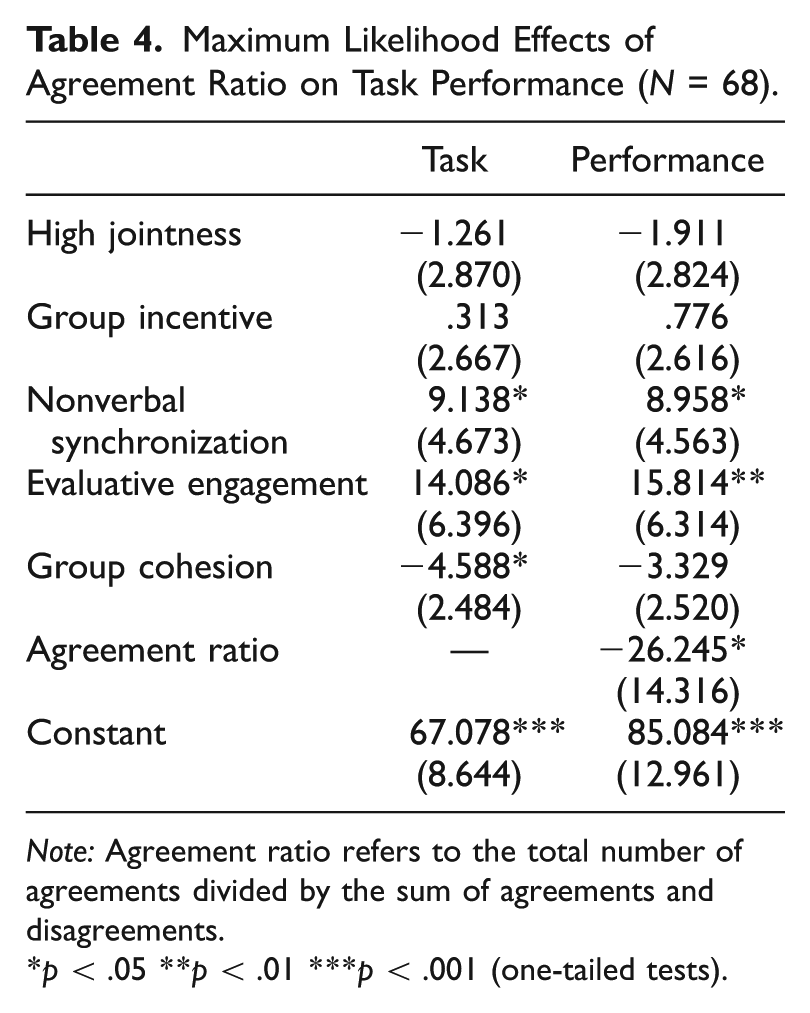
Note: Agreement ratio refers to the total number of agreements divided by the sum of agreements and disagreements.
p < .05 **p < .01 ***p < .001 (one-tailed tests).
The results indicate, as we suspected, that higher ratios of agreement strongly reduced the group's performance (b = −26.24, p < .001). Moreover, when agreement ratio is added to our main model, the negative effect of group cohesion on performance becomes nonsignificant (b = −4.588, p = .05 versus b = −3.329, p = n.s.). This suggests that the negative impact of group cohesion on task performance is attributable, in part, to high rates of agreement in the group discussions. Thus, stronger pressures toward agreement and consensus seem to account for the negative effects of group cohesion on task performance.
Discussion
This article addressed a fundamental question: How does structural interdependence promote or inhibit the collective performance of a group? The idea that interdependent actors—whether at the individual or collective level—tend to cooperate in the production of collective goods is fundamental to micro- and macro-sociological analyses (Coleman 1990; Durkheim [1933] 1964; Emerson 1972b; Hechter 1987; Olson 1965). This idea can be applied to a multitude of collaborative contexts, such as coordination efforts among teams in a corporation or interorganizational partnerships in a multinational conglomerate. Standard explanations emphasize the monetary incentives, rewards, or compensation systems embedded in interdependent structures. Put simply, interdependent actors are predicted to cooperate if and when it is in their financial interest to do so (e.g., Hechter 1987; Lawler 1990). Still, there are many well-known obstacles to cooperation among such actors, including incongruent perceptions of self and other interests, interpersonal distrust, incentives to free ride, concerns with distributive justice, and negative emotions directed at others or the group itself. As a result, those with common interests and strong incentives for achieving goals through cooperation often find it difficult to work together despite these forces (Howard and Dougherty 2004; Nyberg et al. 2018).
We suggest task jointness as an alternative pathway for facilitating task performance. We emphasize, in particular, how the task is defined or structured and the behavioral processes that are consequently unleashed. This research compares the effects of task jointness to reward interdependence in small face-to-face groups working on a collective problem with an objectively correct solution. Our main hypothesis is that joint tasks have effects on group performance distinct from the impact of incentives or reward interdependencies. Rewards are contingent on the task outcome that is produced, whereas task jointness is more tightly intertwined with the process of producing that outcome. Task jointness is important because it shapes the style of interaction and behavioral mechanisms through which actors engage with one another and accomplish their joint or collective endeavors. These behavioral mechanisms, in turn, bear on the group's success. Behavioral mechanisms include subtle nonverbal gestures or cues, task-oriented proposals and responses, and social-emotional behaviors (Bales 1950; Bales and Strodtbeck 1951). Guided by early work on group dynamics, we focus on behavioral mechanisms that are “promotive” of task success.
We examine two levels of task jointness: (a) a high joint task in which members of a group interact and arrive at a single group-level solution to the problem and (2) a low joint task in which members interact but then provide individual solutions that are aggregated to produce a group result. The experiment generally supports the central hypothesis of the study. As expected, the high joint task generated more accurate group performance than the low joint task, and these effects are mediated by the hypothesized behaviors and interactions. Importantly, these effects are independent of the effects of group incentives. Group incentives had effects on some behavioral mechanisms, but the observed effects were more limited in scope. Overall, task jointness was empirically more crucial to group performance than group incentives in the context studied here. 6
With respect to the mediation process, task jointness had the predicted effects on all the three behavioral mechanisms. Task jointness increased (1) the nonverbal synchronization of behaviors (e.g., eye contact, body orientation, task focus), (2) evaluative engagement (e.g., the frequency of task-related agree or disagree statements in the group discussion, and (3) external assessments of group cohesion (e.g., how close-distant, converging-diverging members were perceived). Group-based incentives (versus individually based incentives) increased nonverbal synchronization and group cohesion but had no effects on evaluative engagement. Overall, five of the six specific hypotheses for the impact of interdependence (both task and incentive) on the mediating behavioral mechanisms were affirmed, with the exception being that group incentives did not increase evaluative engagement. This exception is one reason group incentives failed to generate better performance indirectly through the behavioral mechanisms. The implication is that careful attention to the task process is important for understanding group performance, accuracy, and success (see Hackman and Katz 2010; Hackman and Oldham 1976).
Turning to the last step in the theoretical model, each behavioral mechanism had a mediating impact on group performance (see Table 3). Consistent with our hypotheses, nonverbal synchronization and evaluative engagement had positive effects, but contrary to our prediction, group cohesion had a significant negative effect. The mediation analysis reveals that for task jointness, the indirect effects of nonverbal synchronization (b = 2.148) and evaluative engagement (b = 1.384) are seemingly large enough to counteract the negative impact of group cohesion (b = −1.934). With respect to group incentives, the same pattern occurs, but the effects of each variable are smaller, and thus, there is no total indirect effect of incentive on task performance (b = .297, n.s.). Next, we more closely examine each of the three behavioral mechanisms in turn.
First, nonverbal synchronization is important because it involves subtle, generally nonconscious signals of coordination and cooperative effort. If people in groups engage in more eye contact with each other, lean toward one another rather than away, and stay focused on the task at hand, then this is likely to convey responsiveness to others and the intent to collaborate. In our study, four college students sat around a semicircular table and interacted face-to-face before solving a problem individually or collectively. To what extent might nonverbal synchronization have an impact beyond the laboratory groups studied here? We argue that nonverbal synchronization is a generic phenomenon present in many forms of group discussion. Even virtual groups who connect digitally (texting, e-mail, Zoom) or on social media (Facebook, X, Instagram) have this capacity using a variety of images and emojis to express nonverbal cues. Overall, we suggest that nonverbal synchronization is important in virtual as well as “face-to-face” task groups, although it may take different specific forms. This speculation awaits further research.
Second, evaluative engagement measures the propensity of group members to make assessments of the task in the form of agreements or disagreements. This is a classic form of task-oriented behavior, but there are many others that we did not measure, such as making proposals, asking questions, and so on (e.g., Bales 1950; Bales and Strodtbeck 1951; Berger, Cohen, and Zelditch 1972; Berger et al. 1977). 7 We targeted the exchange of evaluations because this is essential for success in a survival-type task because the value of different items is not obvious and requires thought and analysis. Our measure of evaluative engagement can be thought of as a proxy for the degree that group members shared ideas and analyzed the task. In our experimental groups, which involve four total strangers analyzing a novel task, people may be reluctant to express negative opinions too openly due to uncertainty and the potential for embarrassment. Evaluative engagement can have social costs in such a context. In fact, the overall rate of disagreement in our study was low (M = 1.56 disagreement acts per each four-person group), which may reflect the interpersonal costs and awkwardness of such behavior among strangers. Yet even small amounts of disagreement can make a difference, as it did in this study.
Third, perhaps the most surprising result is the negative impact of group cohesion. This was not expected based on several meta-analyses conducted in the last 20 years or so (e.g., Beal et al. 2003; Greer 2012; Mullen and Cooper 1994) but echoes Janis’s (1972) warning about groupthink and the deleterious effects of conformity (Asch 1951; Sherif and Sherif 1953). 8 The question is: Under what conditions will group cohesion facilitate or hinder task performance? The meta-analyses as a whole find that group cohesion has a moderately positive association with group performance under three basic conditions: (1) the group task is interdependent, (2) group members interact face-to-face, and (3) the group is task-oriented. All three of these conditions are reasonably met by our experimental setting and procedures. On that basis, we predicted a positive effect—one that was not supported. A plausible interpretation for this is that conformity and consensus pressures inhibited task performance by suppressing disagreement (Asch 1951; Sherif and Sherif 1953). To investigate this possibility, we conducted a supplemental analysis that examined a measure of agreement ratio (i.e., the proportion of agreements among all agreements and disagreements) in the context of our model. As suspected, we found that agreement ratio has a strong negative effect on task performance. That is to say, groups with higher rates of agreement tended to perform more poorly than otherwise (see Table 4, Model 2). Adding agreement ratio into our main model, the negative effect of group cohesion was no longer statistically significant. This indicates that “too much” agreement may dampen the sharing of new ideas, critical analyses, constructive evaluations, and ultimately, task performance. The more general implication is that cohesion founded upon excessive agreement breeds complacency.
This study is part of a larger project that examines the role of joint tasks compared to group-based incentives on the development of cognitive versus affective ties (Thye et al. 2019). That research finds task jointness promotes the affective ties individuals form to a group, whereas group-based incentives increase cognitive ties but not affective ties. Importantly, task jointness there operates through different channels, including positive emotions, perceptions of shared responsibility, and the group-oriented attributions people experience as they work together on a common task. The current study complements this work by illustrating how task jointness enhances the behaviors and social interactions leading to better performance in addition to affective ties. Taken together, these two studies underscore that task jointness produces a variety of beneficial group outcomes.
To conclude, the message of this study embodies four key points. First, task interdependencies are an important precursor to successful group performance. This suggests that designing group tasks to make them more collective and less individualistic will promote better performance. We find the effects of task interdependencies are also stronger than the effects of reward interdependences, primarily because the latter generates less evaluative engagement. Second, the more limited role of group incentives in boosting performance contradicts conventional wisdom about the primacy of compensation structures in generating collective success. We speculate that rewards, compensation, and the like are more important to individual performance on individual tasks, but when moving to a group or even organizational level, group structure and processes become more central to collective success. Third, the impact of task interdependence is not direct; it is indirect and mediated by two behavioral mechanisms in the form of nonverbal synchronization and evaluative engagement. Joint tasks produce better performance to the degree that they promote (1) nonverbal cues of coordination and cooperation and (2) more engaged assessments and evaluations of the task at hand. Fourth, the enabling versus inhibiting effects of group cohesion are contingent on the relative rates of agreement and disagreement found in group discussions. Cohesion anchored in disproportionately high levels of agreement tends to attenuate group performance, whereas a mixture of agreement and disagreement is more optimal for generating task accuracy. In the context of our research program, the preceding points add weight to the growing evidence that joint tasks produce an array of positive social outcomes—in the form of stronger affective ties to groups, greater acts of cooperation or prosocial behavior, and more resilient social orders (see Lawler et al. 2008, 2009, 2015; Thye et al. 2011, 2014). To this list, we can now include that joint tasks have the additional capacity to yield objectively better task performance.
Footnotes
Acknowledgements
We thank Rachel Ruttan and Na Yoon Kim for assisting with the coding scheme and data collection and Ashley Harrell and Joseph M. Quinn for providing valuable comments on an earlier draft.
Authors Note
The order of authorship is random and does not reflect differential contributions.
Funding
The authors disclosed receipt of the following financial support for the research, authorship, and/or publication of this article: This material is based on work supported by the National Science Foundation under Collaborative Grant Nos. SBR-9817706 and SBR-9816259 to the University of South Carolina and Cornell University.
Declaration of Conflicting Interests
The authors declared no potential conflicts of interest with respect to the research, authorship, and/or publication of this article.
1
Each subject's score on this task consisted of the absolute difference between their ranking on each item and the danger ranking given by statistical reports, summed across all 15 items. Statistical reports rank the dangerousness of items as follows: smoking (1), alcohol (2), vehicles (3), handguns (4), swimming (5), surgery (6), railroads (7), bicycles (8), home appliance (9), fire (11), nuclear power (12), mountains (13), vaccinations (14), pesticides (15).
2
That project tested the theory of social commitments using questionnaire data on emotions and shared responsibility to predict the strength of affective ties to the group (Thye, Lawler, and Yoon 2019). Here, our purpose is different. We use interaction data from the group discussions to explain how well the group performs on the task. There is no data overlap between this article and  beyond the manipulated conditions.
3
The impact of relatively low reliability here for the nonverbal synchronization measure will attenuate its relationship with other variables in the model. However, this attenuation is estimated and corrected for in the structural equation models we present in the results.
4
As a robustness check, we also analyzed the data using a piecewise structural equation modeling approach. There were no substantive differences in the results (available from the authors on request).
5
In addition to these results, we estimated an additional model that predicts performance based on a measure of participation inequality (i.e., a measure that captures the collective differences in task participation). Participation inequality has no significant effect on performance and does not alter the other results.
6
Further support is indicated by the pattern of means across the four experimental conditions. For all three indicators of promotive behavior and task performance, the mean value is highest when task jointness and group incentives are highest and lowest when task jointness group incentives levels are lowest. The means for the other experimental conditions fall in between these extremes. The data are available from the authors on request.
7
This includes the development of status hierarchies and vocal adaptations, which we did not explicitly measure in our experimental groups (cf. Kalkhoff, Thye and Gregory 2017). In principle, the impact of status hierarchies would be to reduce the levels of promotive behaviors stemming from low-status members (i.e., lower participation rates and evaluative engagement) and increase such behaviors among high-status members. The extent to which status structures impact promotive behaviors and ultimately, task performance is a topic that awaits future investigation.
8
The negative impact of group cohesion may be a partial function of the fact our participants consisted of strangers who only interacted for a short period of time. That the indicators of cohesion emerged at all and were detectable to external evaluators within a mere 10 minutes represents a conservative test of the hypothesis. We would expect stronger (perhaps even positive) effects over a longer period of time, where the participants themselves may experience and self-report feelings of cohesion.