



Abstract
We relied on a content analysis of freely generated stereotypes about Muslims and Muslim-majority immigrant groups from a representative sample of Dutch natives. Building on intersectionality theory and stereotype prototypicality, we hypothesized and found that ethnic-group stereotypes more accurately reflect stereotypes of ethnic-minority men compared with ethnic-minority women and that stereotypes of ethnic-minority women contain more unique elements that do not overlap with either stereotypes about the gender group or stereotypes about the general ethnic group. We also examined the overlap between stereotypes about Muslims and those associated with Turks, Moroccans, Somalis, and Syrians in the Netherlands. The overlap in stereotype content was largest with Turks and Moroccans, the two largest and most long-established Muslim immigrant groups in the Netherlands. Overall, our results demonstrate the importance of an intersectional approach to stereotypes based on gender and ethnicity and of distinguishing between different ethnic groups in research about Muslims.
In Europe, Islam has been described as a central symbolic boundary that defines intergroup relations (Foner and Alba 2008). Muslims are a sizeable and growing share of the population in many European countries, and according to recent survey and experimental evidence, they are one of the most stigmatized minorities in society, facing strong barriers in access to education (Olsen, Kyhse-Andersen, and Moynihan 2022), employment (Di Stasio et al. 2021), and housing (Flage 2018). Muslims are also a chronically salient category in the eyes of the public, as people tend to associate foreigners with Muslim groups even in contexts with a predominantly Christian foreign population (Spruyt and Van der Noll 2017). Muslims are not only targets of ethnic prejudice and discrimination but also victims of hypersurveillance in the public space, for they are widely perceived as aggressive, disloyal, and a threat to national identity and security (Garner and Selod 2015).
Research on anti-Muslim attitudes and discriminatory behaviors is abundant and typically draws on general theories of intergroup relations, such as the social identity approach, contact theory, and threat theories (for a review, see Verkuyten 2021). Some studies focus more specifically on negative stereotypes (e.g., Velasco González et al. 2008) or on the groups the public associates with Muslims (e.g., Wallrich, West, and Rutland 2020). However, this literature hardly ever applies an intersectional lens. This is unfortunate, given the chronic salience of gender as a social category (Stangor et al. 1992) and recent theoretical developments on multiple categorization (Nicolas, de la Fuente, and Fiske 2017) and intersectional stereotyping (Petsko, Rosette, and Bodenhausen 2022). With respect to stereotypes, evidence from several studies conducted in the United States confirms that ethnic and racial stereotypes differ between men and women as targets of evaluation (Eagly and Kite 1987; Ghavami and Peplau 2012; Timberlake and Estes 2007). According to intersectionality theory (Cole 2009; Crenshaw 1989), the overlap of multiple social identities, such as gender and ethnicity, can elicit intersectional stereotypes that contribute to distinct experiences of disadvantage. For example, the wearing of the veil (i.e., a gendered religious signifier) makes Muslim women readily identifiable and thus vulnerable to gendered Islamophobia, while Muslim men are racialized as misogynistic and potential terrorists (Chakraborti and Zempi 2012; Perry 2014; Selod 2019). Research on intersectional stereotypes, however, is still underdeveloped, particularly in the European context (Fourgassie, Subra, and Sanitioso 2023).
In this study, we bridge the literature on intersectionality (Cole 2009; Crenshaw 1989) and applied research on stereotype content to investigate stereotypes about Muslims and ethnic-minority groups originating from predominantly Muslim countries. The study of stereotype content is necessary to map the cognitive schemata, widely held beliefs, expectations, and spontaneous associations that are activated in social encounters and are often at the roots of anti-Muslim attitudes and behaviors. Indeed, while stereotypes refer to cognitive beliefs, they can prompt acts of discrimination by systematically affecting group perceptions and consequent judgments and behavioral orientations (Dovidio et al. 2010). Traditionally, studies using the stereotype content model (SCM) have asked respondents to report the extent to which predetermined warmth and competence traits apply to target groups defined by single social categories (e.g., gender or ethnicity), because these are considered the two universal dimensions of social perception (Fiske 2017). Recent developments in the SCM have relied on spontaneously generated stereotype content to capture the more complex and varied set of stereotypes people use to make sense of the world (Nicolas, Bai, and Fiske 2022) and included multiply categorized targets (Nicolas and Fiske 2023). Our study contributes to this literature and extends the study of intersectional stereotype content to the European context. We focus on Muslims, a group that is at the same time homogenized into a genderless mass and constantly racialized in different, gendered ways (Garner and Selod 2015).
Specifically, we study stereotypes at the intersection of religion, gender, and ethnicity in the Netherlands, a country that has experienced a large growth in its Muslim immigrant population in recent years. The Dutch public discourse on immigration is highly politicized: right-wing parties that criticize immigration and Muslim migrants, such as the Party for Freedom (PVV), have attracted a rising number of voters during the last decades (Van Heerden et al. 2014), and Muslims are construed in political discourse as a threat to national identity, democratic values, and security (Van Meeteren and Van Oostendorp 2019). Especially the wearing of the headscarf and the presumed oppression of women in Islam have been heavily contested, by right-wing politicians as well as leftist feminists (Van den Berg and Schinkel 2009).
We build on the research design of Ghavami and Peplau (2012), who compared freely generated stereotypes ascribed to gender groups, racial groups, and groups at the intersection of gender and race in the United States. 1 Similarly, we draw on a content analysis of freely generated stereotype content to compare the stereotypes that Dutch natives assign to Muslims, to four ethnic groups that are predominantly Muslim (Turks, Moroccans, Syrians, and Somalis), and to men and women in general, with the stereotypes they attribute to the men and women of the different Muslim groups (e.g., Turkish men, Moroccan women). With this design, we can test the core propositions—drawn from the concepts of stereotype prototypicality, intersectional invisibility, and gendered racism reviewed further next—that the stereotype content of Muslim groups is highly gendered and that nonprototypical target groups should elicit more distinctive stereotypes.
Theoretical framework
Intersectionality and Stereotype Prototypicality
Research on stereotype content has traditionally focused on single identities, such as ethnicity and national origin (e.g., Fiske et al. 2002), immigrant status (e.g., Lee and Fiske 2006), or gender (e.g., Ellemers 2018). However, this unidimensional approach to stereotype research ignores the unique content of intersectional stereotypes (Ghavami and Peplau 2012). Intersectionality theory emerged in the 1980s in the field of Black feminist theory. Crenshaw (1989) is credited with coining the term intersectionality in her groundbreaking work, which criticized the feminist and antiracist movements for categorizing disadvantage along a single axis (i.e., gender or race), thus rendering the experiences of Black women invisible. The focus on the most privileged members in each category (i.e., men, White people) would marginalize those, like Black women, who are multiply burdened for simultaneously belonging to several groups that are devalued in society. The intersectional perspective argues that individuals have multiple social identities and that it is the conjunction of these identities that shapes individuals’ experiences of privilege and oppression.
These varying experiences of oppression are influenced by the stereotypes associated with intersectional groups. The literature on stereotype prototypicality explains that stereotypes about a wider social category most strongly reflect the characteristics of its dominant subgroups (see Sesko and Biernat 2010; Wong and McCullough 2021). Which subgroup is perceived as dominant is influenced by population shares and status perceptions, such that high-status subgroups are seen as more prototypical for a social group than low-status subgroups (Rubin 2011). In other words, as we will explain, the prototype of a “woman” would be a White woman (Sesko and Biernat 2010), and the prototype of a “Muslim” would be an Arabic man (Di Stasio and Larsen 2020; Ghani et al. 2023).
Because of their lower group status, people with multiple subordinate identities are not fully recognized as members of their constituent groups, a phenomenon called intersectional invisibility (Purdie-Vaughns and Eibach 2008). This invisibility has advantages, as subordinate groups are not the primary targets of negative stereotyping, but also disadvantages, as these same groups struggle to get recognized and represented or even to be seen and remembered (in other words, they experience intersectional binds and freedoms; Ridgeway and Kricheli-Katz 2013). Most importantly, intersectional invisibility results in dominant and subordinate groups experiencing qualitatively, rather than quantitatively, different forms of oppression.
We investigate the stereotype prototypicality and invisibility of intersectional groups using the concepts of stereotype content overlap and uniqueness. The greater the prototypicality of a subgroup in relation to the superordinate group, the larger the expected overlap in stereotype content between the groups. For those subgroups that are less prototypical, the stereotype content associated with these groups should be less similar to those about the superordinate group and therefore more unique. In the following sections, we review the empirical literature on the intersection of gender and ethnicity and of ethnicity and religion to formulate our hypotheses.
Stereotype Prototypicality at the Intersection of Gender and Ethnicity
Stereotypes associated with ethnic groups are highly dependent on the target gender. According to the theory of gendered prejudice (Sidanius et al. 2018), men hold disproportionate sociopolitical and military power compared with women, lending them a higher status in the patriarchal system and subsequent higher perceptions of group prototypicality (i.e., androcentric bias). For example, social cognitive research has found that people are more likely to remember pictures of White and Black men compared with White and Black women (Sesko and Biernat 2010) and that people more easily recognize male versus female faces after being primed with an ethnic category (Zarate and Smith 1990).
Recent studies investigating ethnic gendered stereotypes in the United States found that stereotypes differ between racial-minority groups as well as between men and women within particular groups (Ghavami and Peplau 2012; Timberlake and Estes 2007). Ghavami and Peplau (2012) examined stereotypes of Asian American, Black, Latino, Middle Eastern, and White men and women and found that each ethnic group elicited distinct stereotypes. For example, the label “terrorists” was among the most frequently ascribed attributes only for Middle Easterners, while only Black people were often described as “athletic.” Additionally, for most groups, stereotypes about ethnic-minority women were most distinct from stereotypes about women in general and the ethnic group as a whole. For example, 112 attributes (56 percent) listed for Black women did not overlap with stereotypes of “women” or “Black people” and were thus “unique,” compared with only 42 unique attributes (27 percent) listed for Black men.
This gendered association of ethnic and racial stereotypes can give rise to gendered experiences of discrimination. As the more prototypical members of ethnic groups, minority men are more frequently the targets of discrimination directed at their groups (Purdie-Vaughns and Eibach 2008). For example, field experiments on hiring discrimination in Scandinavia found that Middle Eastern men faced a much higher degree of hiring discrimination than Middle Eastern women (Bursell 2014; Dahl and Krog 2018; Erlandsson 2023). Bursell (2014) argued that stereotypes assigned to Middle Easterners are often masculine (consistent with results in Ghavami and Peplau 2012), resulting in the perception of Middle Eastern men as more prototypically Middle Eastern than women of the same origin. In a similar vein, Di Stasio and Larsen (2020) found that employers in five European countries discriminated against Muslims, especially against Muslim men from the Middle East and Africa.
Building on the intersectional framework, we hypothesize that intersecting gendered ethnic stereotypes contain distinct attributes that do not overlap with either gender or ethnic stereotypes (Hypothesis 1). As ethnic-minority women have two subordinate identities (i.e., ethnic-minority group, nondominant-gender group), intersectional invisibility theory suggests that intersectional stereotypes for ethnic-minority women would contain more unique elements than stereotypes about ethnic-minority men (Hypothesis 2).
Due to their higher group prototypicality, men could be more readily associated with stereotypes about ethnic groups than women (Ma, Correll, and Wittenbrink 2018; Purdie-Vaughns and Eibach 2008). In line with this argument, Eagly and Kite (1987) found that the stereotypes of 25 nationalities were more closely aligned with the stereotypes of male versus female nationals, especially when respondents had negative attitudes toward the specific country. These findings were echoed in later studies by Ghavami and Peplau (2012) in the United States and Fourgassie et al. (2023) in France. However, it is important to note that there are boundary conditions to these androcentric biases. Studies on gendered racism (Galinsky, Hall, and Cuddy 2013; Johnson, Freeman, and Pauker 2012) found an implicit overlap between racial and gender categories, with Asian people being stereotypically associated with femininity and Black people stereotypically associated with masculinity. When two categories are implicitly connected, as in these examples, the activation of one category (e.g., Black group) would make the associated category (e.g., men) more cognitively salient, as predicted by the MOSAIC model (Hall et al. 2019).
Gendered Stereotypes of Muslim Groups
For the ethnic groups under study, as well as the broader category of Muslims, we expect “men” to be an associated demographic category that is implicitly cognitively linked. First, Muslim groups are often portrayed as masculine, violent, and oppressive, attributes that are stereotypically associated with men (Chakraborti and Zempi 2012; Selod 2019). Second, initial migration from Muslim-majority countries has predominantly been undertaken by men, while immigrant women were more likely to migrate at a later stage through family reunification. Additionally, women in these groups are often less integrated in terms of labor market participation and sociocultural integration relative to men (Huijnk and Andriessen 2016). They may therefore be less visible in society due to less contact with native majority members (Van Tubergen and Volker 2015). Finally, the dominant discourse on Islam and its alleged incompatibility with Western cultural norms portrays Muslim women as oppressed by conservative gender norms perpetuated by men (Van den Berg and Schinkel 2009). As such, Muslim men are construed as the perpetrators of gender oppression and may remain the primary subjects of anti-Muslim prejudice and negative stereotyping. Hence, we expect that stereotypes about ethnic groups as a whole (i.e., ethnic stereotypes) show more overlap with the stereotypes of men than with stereotypes of women in these groups (Hypothesis 3) and that stereotypes about Muslims show a larger overlap with the stereotypes of Muslim men than with stereotypes of Muslim women (Hypothesis 4).
Stereotype Prototypicality at the Intersection of Ethnicity and Religion
Moving beyond the original focus of intersectionality on gender and ethnic group membership, stereotype prototypicality is crucial in the stereotyping of religious ethnic groups, too. While the Muslim community in western Europe is rather heterogeneous, this group has been racialized by contemporary discourses that have amalgamated culturally and phenotypically diverse individuals into one homogeneous category (Garner and Selod 2015). Through this process of racialization, all Muslims are perceived to be part of the same essentialized category with inherent religious and cultural values (Foner 2015). In the European context, the relatively low socioeconomic status of many Muslim minorities, the presence of historically Christian state institutions in Western European societies (Foner and Alba 2008), and differences in social values (e.g., emancipative values) between the population in Muslim immigrants’ origin countries and in Western Europe (Koopmans, Veit, and Yemane 2019) have been proposed as explanations for the negative public attitudes about Muslims. Other research suggests that besides differences in values and beliefs, ascribed negative stereotypes (i.e., rather low warmth and competence, violence-related stereotypes) contribute to the overall negative sentiment about Muslims (for Western Europe, see, e.g., Kotzur et al. 2020; Wirtz, Van der Pligt, and Doosje 2016). As a result, Muslim minorities face strong discrimination in various domains of life. For example, origin in a Muslim-majority country and individual references to the Muslim faith independently reduce minority labor market opportunities (Di Stasio et al. 2021).
Zooming in on the Netherlands, previous research using focus groups (Dekker and Van der Noll 2012) and discourse analysis (Van den Berg and Schinkel 2009) found that debates on Muslim immigrants predominantly focus on Turkish and Moroccan immigrants. These immigrant groups have been in the Netherlands for several decades after immigration was initiated by labor and family migration agreements in the ’70s and ’80s. With about 420,000 Turkish and Moroccan migrants currently residing in the country, they constitute two of the largest immigrant groups (Statline 2022) and Muslim groups. As Turks and Moroccans were the first substantial Muslim groups in the Netherlands, they may have played a major role in the formation of Muslim stereotypes.
Yet the Muslim community in the Netherlands has become more diverse over the past decades, partly due to the recent arrival of Muslim refugees from Syria and Somalia (Centraal Bureau voor de Statistiek 2020). During the so-called refugee crisis in 2015, Syrians became increasingly visible to Western Europeans due to extensive coverage of their migration journey on both mainstream and social media (Holzberg, Kolbe, and Zaborowski 2018). The rapid inflow of Syrian refugees, resulting in approximately 130,000 Syrians living in the Netherlands in 2022 (Statline 2022), and the abundant attention paid to them in media and politics may have made Syrians more salient for Dutch natives when thinking about Muslim immigrants. The Somali community, on the other hand, is relatively small, with about 41,000 Somalians (Statline 2022) but considered “hypervisible” due to their recent migration history and distinct language and skin color (Hoehne and Scharrer 2021). War refugees are generally perceived as higher in warmth than competence and are treated more benevolently than other migrant groups, probably because their reason for flight elicits feelings of pity and deservingness attributions (Hager and Veit 2019). Migration motives (i.e., refuge) may therefore be more salient than religion in the perception of refugee groups so that Syrians and Somalis might be more readily associated with other refugees than with established Muslim immigrant groups. In other words, it is plausible that Syrians and Somali are perceived as less prototypical Muslims in the Netherlands.
Drawing on the MOSAIC model (Hall et al. 2019), demographic categories that frequently co-occur (i.e., Muslims and Turkish, Muslims and Moroccans) are likely to be cognitively associated, resulting in greater stereotype content overlap between Muslims in general and specific Muslim groups that are both salient and well established in society. Therefore, we expect that stereotypes about Muslims as a group show a larger overlap with stereotypes of Turks and Moroccans than with those of Syrians and Somalis (Hypothesis 5). 2
Method
Data and Participants
Interested readers can find the ethical approval statement with the preregistration of hypotheses, stereotype coding library, and stereotype categories for all thresholds online at the Open Science Framework: https://osf.io/nby9w/.
We drew on data collected in 2020 through a survey of the Dutch population. We preregistered our hypotheses and power calculation before data collection and while applying for ethical approval. 3 In a between-subjects design, respondents were randomly assigned to one of 32 target groups. The target groups consisted of two gender groups (women or men), one religious group (Muslims), nine ethnic groups (e.g., Turks, Moroccans), two gender-by-religion groups (Muslim women, Muslim men), and 18 gender-by-ethnic groups (e.g., Syrian women, Somali men). The nine included ethnic groups were Chinese, Dutch, Indians, Moroccans, Spanish, Polish, Somalis, Syrians, and Turks. A quota sample representative of the native Dutch population of 18 years and older was approached through an online research panel to participate in the study. The survey was administered in Dutch and took around 10 minutes to complete. Participants were born in the Netherlands with both parents born in the Netherlands (i.e., native Dutch). 4
For the purpose of this study, only participants that were assigned to the two gender groups, the Muslims group, and the four ethnic groups that could be associated with Islam (i.e., Turks, Moroccans, Somalis, and Syrians) were selected, resulting in 1,204 participants distributed across 17 target groups. 5 Participants’ age ranged from 20 to 80 (M = 50.65, SD = 16.41), and the gender distribution was approximately balanced (49.2 percent women). Nearly half of the sample had attained tertiary education (45.9 percent), while 41.0 percent attained middle-level education and 13.1 percent received less than secondary education.
Measures
The survey started with several items about participants’ background characteristics, including their gender, age, educational attainment, and their own and their parents’ place of birth. Subsequently, participants were presented with the following instructions based on previous research on intersectional stereotypes in the United States (Ghavami and Peplau 2012): We are all aware of stereotypes of social groups. These may be ideas that you learned from movies, saw in commercials, or in magazines, etc. For example, people often perceive models as beautiful, tall, but dumb. Note that these characteristics may or may not reflect your own personal beliefs about these groups. In the space below, list 10 characteristics that are part of the current cultural stereotypes of [the target group]. Think of [the target group]
Participants could list up to 10 attributes or descriptions of the respective target group in an open-ended response format. Spontaneously generated stereotypes can best reveal the contents that come to perceivers’ minds upon encountering a target (Nicolas et al. 2022). Compared with predefined checklists, which likely induce respondents to rely on controlled processing to complete the rating task, this free-response format more closely reflects the process of stereotype activation that occurs unintentionally in response to a stimulus (Niemann et al. 1994). The instruction asked for the beliefs held by people in general rather than for personal beliefs (Kotzur et al. 2020) in order to minimize social desirability biases. The same measurement has been used in previous research on stereotype content (e.g., Ghavami and Peplau 2012; Nicolas et al. 2022). Following this task, participants evaluated their respective target group among others on several stereotype measures based on the stereotype content model (Fiske et al. 2002), the Big Five Inventory (Rammstedt et al. 2014), and the BIAS map framework (Cuddy, Fiske, and Glick 2007), using semantic differentials scales.
Treatment of Free-Response Data
Participants generated 6,368 words or combinations of words in total (from here onward referred to as attributes). To organize the free-response data, we followed Ghavami and Peplau (2012) and derived conceptual categories inductively from the data rather than imposing them a priori. Our first step was to combine identical attributes with and without capitals and organize the data alphabetically per target group. Subsequently, two coders (the first author and a graduate research assistant, both Dutch native speakers) independently combined similar attributes into stereotype categories. For example, “low education,”“uneducated,” and “low literacy” were combined into the umbrella category “uneducated.” Similarly, “good chef,”“delicious cooking,” and “cook very well” were combined under the category “good chefs.” During the data coding, specific attention was paid to matching the valence and content of stereotype categories as closely with the attributes as possible.
After the independent coding, the two coders compared the stereotype categories. Intercoder reliability was computed per target group as the percentage of similarly coded attributes out of the total number of listed attributes. Finally, the percentages of intercoder agreement for all target groups were averaged to arrive at a mean intercoder agreement of 95.0 percent. Inconsistencies in the coding were resolved by the project leader in separate meetings.
Consistent with Ghavami and Peplau (2012), we decided to limit our analysis to the 15 most frequently listed stereotype categories to arrive at a standard number of stereotype categories per target group. For some groups, we retained more than 15 stereotype categories due to frequency ties for the 15th place. We calculated frequency distributions for each stereotype category within each target group by summing the number of times attributes in the category were listed. To avoid the inclusion of idiosyncratic stereotype categories, we considered only categories that represented at least 1 percent of the total number of attributes listed for the respective group as stereotypes (Ghavami and Peplau 2012). For example, 340 attributes were listed for Syrians, of which 3 were coded under the stereotype category “religious.” This category accounted for only 0.9 percent of the total number of attributes listed for Syrians and was therefore excluded.
Analysis
Following Ghavami and Peplau (2012), the main analyses were conducted by comparing the top 15 stereotype categories for the relevant groups. Stereotype categories were considered unique if they were not included in the 15 most frequently listed stereotype categories of the comparison group(s). Conversely, stereotype categories were considered overlapping if they were included in the top 15 stereotype categories of the comparison group(s). The frequencies of all attributes in unique or overlapping stereotype categories were then summed and compared using chi-square tests of independence.
Results
The average number of attributes listed for each group is shown in Table 1, together with the three stereotype categories that were most frequently mentioned. The average number of attributes that respondents listed for their respective target group varied considerably, ranging from 3.6 (for Somali women) to 6.3 (for Muslim people). The number of emerging stereotype categories differed between groups, too. For example, 23 stereotype categories emerged for Turkish women, while 36 stereotype categories emerged for Somalis. These descriptive findings indicate that people find it easier to name stereotypical attributes for groups that they are more likely to encounter in society (e.g., the largest minority groups), for whom stereotype categories are also more consensual. The stereotype category “Islamic” emerged for all groups, except for men and women in general, which confirmed that the groups in this study were associated with the Muslim faith.
Descriptive Statistics.
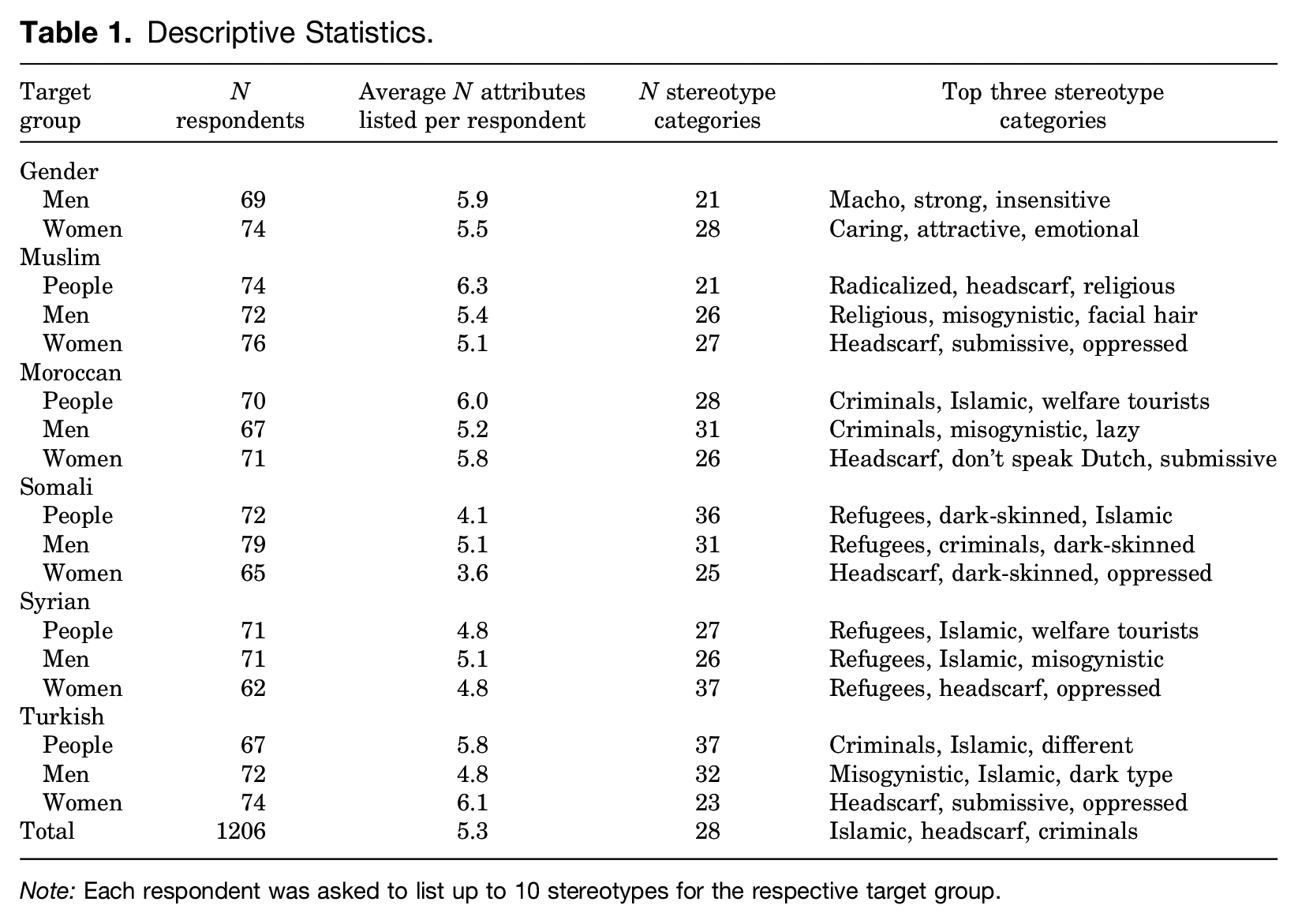
Note: Each respondent was asked to list up to 10 stereotypes for the respective target group.
Intersectional Stereotypes
To start, we expected that intersectional stereotypes would contain distinct categories that would not overlap with either gender or ethnic stereotypes (Hypothesis 1). For example, stereotypes about Turkish women should include unique content that is part of neither stereotypes about “Turkish people” nor stereotypes about “women.” As a corollary of this hypothesis, we expected that the stereotype content of ethnic-minority women would contain more unique elements than that of ethnic-minority men (Hypothesis 2).
In our analyses, we took three steps. First, we summed the frequencies of all unique stereotype categories for each group separately. For example, for Moroccan women, we summed the frequency of all attributes that belonged to unique stereotype categories (n“submissive” = 18, n“oppressed” = 14, n“big families” = 13, n“good chefs” = 13, n“socially distant” = 9, n“veiled” = 9, n“uneducated” = 7, and n“dark type” = 6) to arrive at the total number of attributes belonging to unique stereotype categories for Moroccan women (ntotal = 89). To allow for a relative comparison between groups, we then computed the percentage of attributes belonging to unique stereotype categories per target group as a fraction of the total number of attributes listed for this group. Hence, for Moroccan women, 89 out of 214 attributes belonged to unique stereotype categories, resulting in a 41.6 percent uniqueness rate. Third, to test whether the uniqueness rates significantly differed between ethnic-minority men and women, we compared the proportion of attributes belonging to unique stereotype categories separately for men and women, within each ethnic group, with chi-square tests of independence. The 15 most frequently listed stereotype categories for the Moroccan groups are displayed in Table 2 as an example. The most frequently listed stereotype categories for the other groups can be found in Appendix A of the Supplemental Material.
Top 15 Stereotypes Listed for Moroccan People, Moroccan Men, and Moroccan Women.
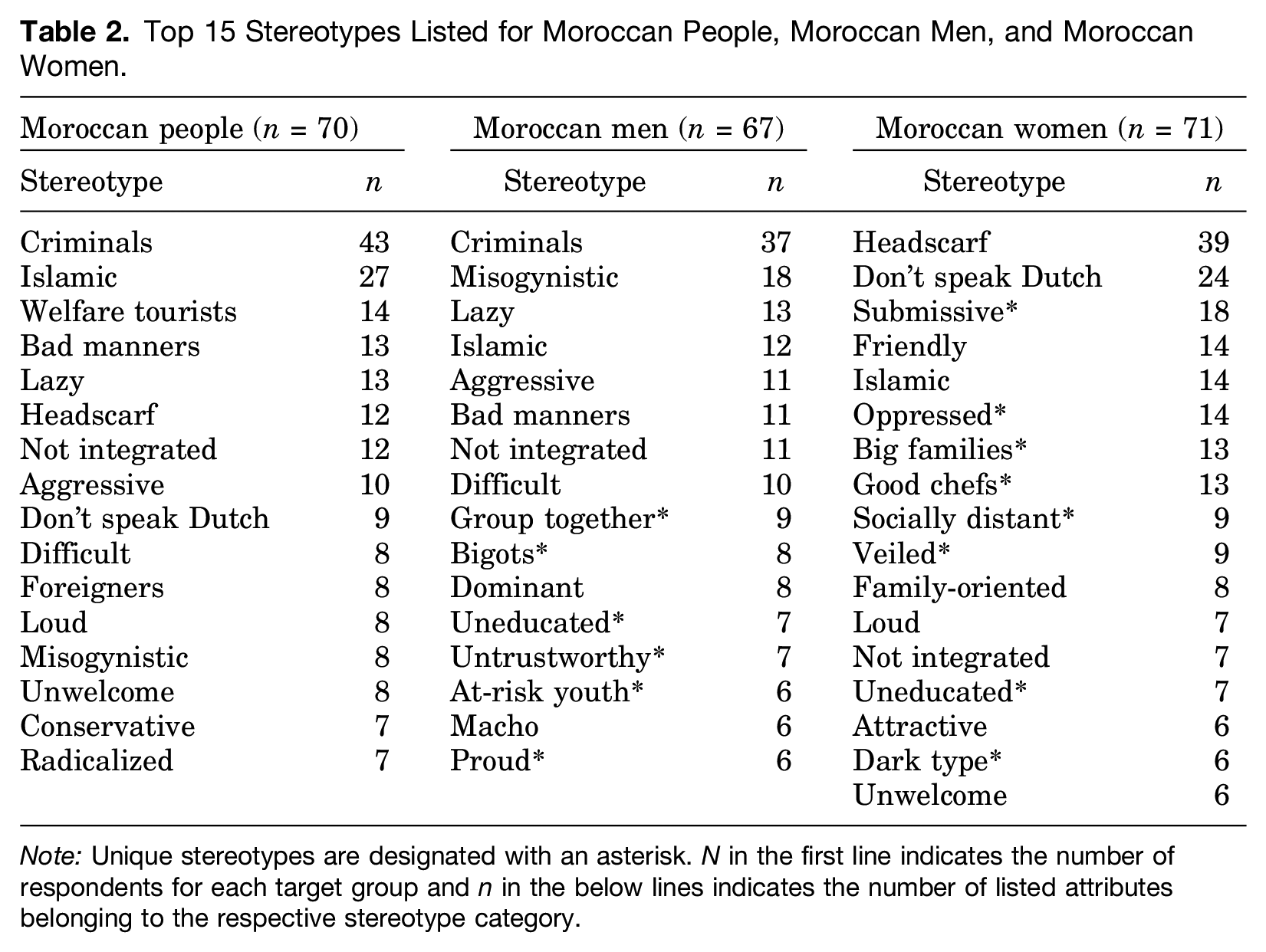
Note: Unique stereotypes are designated with an asterisk. N in the first line indicates the number of respondents for each target group and n in the below lines indicates the number of listed attributes belonging to the respective stereotype category.
Our results provided strong support for Hypothesis 1 and Hypothesis 2. Unique stereotype categories appeared for all intersectional groups, but ethnic-minority women elicited consistently and across all groups significantly more unique stereotype content than ethnic-minority men (Table 3). All female groups were uniquely described as submissive, oppressed, and being covered and/or veiled. Other unique stereotype categories that emerged referred to low competence in speaking Dutch (for Muslim, Somali, and Syrian women), having big families (for all groups except Syrian women), and being unemployed (for Muslim, Somali, and Syrian women). Attributes from unique stereotype categories were listed most frequently for Somali women and Muslim women: for these groups, more than half of the listed attributes belonged to unique stereotype categories (71.6 percent and 64.3 percent, respectively).
Uniqueness Rates for the Intersectional Groups.
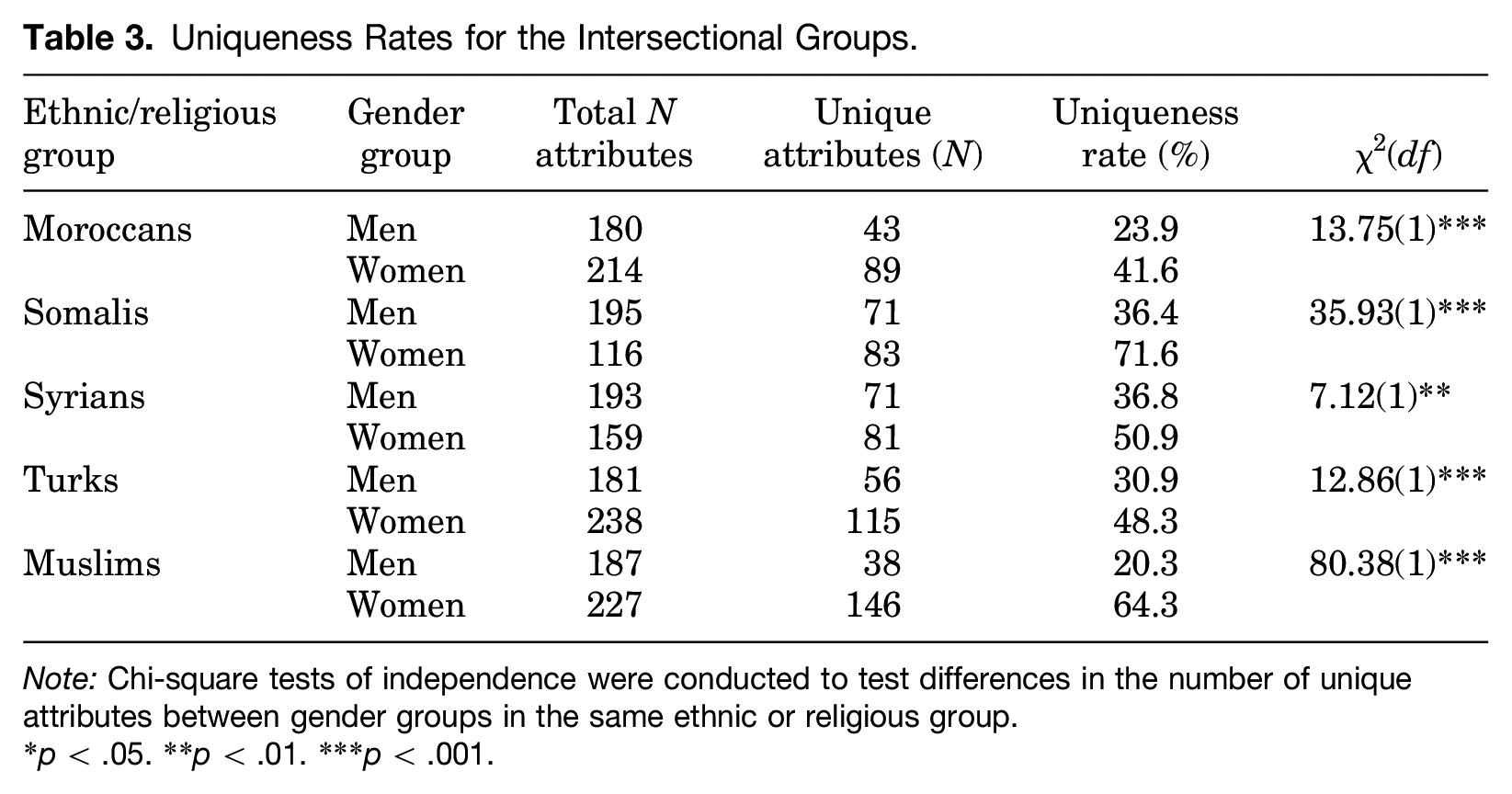
Note: Chi-square tests of independence were conducted to test differences in the number of unique attributes between gender groups in the same ethnic or religious group.
p < .05. **p < .01. ***p < .001.
By contrast, the number of attributes belonging to unique stereotype categories associated with ethnic-minority men never exceeded 37 percent. Some unique stereotypes that emerged for male groups referred to being patriarchal or dangerous (for Muslim, Somali, Syrian, and Turkish men), being lazy (for Somali and Turkish men), and socializing with co-ethnics (for Moroccan, Muslim, and Somali men). In relative terms, intersectional stereotype categories were most unique for Muslim women, who evoked 3.1 times as many attributes belonging to unique categories as Muslim men.
Male Dominance in Ethnic Stereotypes
Next, we predicted that stereotypes of ethnic groups and Muslims would show more overlap with stereotypes about men compared with women in these groups (Hypothesis 3 and Hypothesis 4). To calculate this overlap, we compared the proportions of overlap assigned to the general (ethnic or Muslim) groups and the corresponding gender groups:

For example, we summed the frequencies of attributes in all the categories that arose for both Turks and Turkish women (n“headscarf” = 10, n“don’t speak Dutch” = 10, n“Islamic” = 17, n“not integrated” = 13, n“family oriented” = 9, n“group together” = 7, and n“religious” = 7) and calculated its proportion of the total number of attributes listed for Turks (ntotal = 167; 43.7 percent). We subsequently calculated the proportion of overlap for Turkish men and compared both using a chi-square test of difference.
For each ethnic or religious category, several identical stereotypes emerged for the general and gender-specific groups, revealing stereotypes that were salient regardless of the target group's gender. This was especially the case for the Turkish groups, which were all described as religious, family oriented, socializing with co-ethnics, not being able to speak Dutch, and not being integrated. Somalis were consistently associated with being dark-skinned and poor, while Syrians were stereotyped as refugees, traumatized, radicalized, and welfare tourists. Although the stereotypes associated with the Muslim and Moroccan groups were the most variable, Muslims were consistently described as religious and Moroccans as not being integrated into Dutch society, regardless of gender.
In line with our hypotheses, we found for all groups except for Syrians that the Muslim and ethnic stereotype categories showed a significantly greater overlap with the stereotype categories associated with the men of these groups (see Table 4). General groups and male groups were both described as misogynistic, criminals, and aggressive, stereotype categories that are typically associated with men. Other stereotypes that emerged only for the general and male groups include references to being entrepreneurial (for Turkish groups), being bigots (for Muslim groups), having bad manners (for Moroccan groups), and not being welcome in the Netherlands (for Somali and Syrian groups). General and female groups were both associated with wearing a headscarf (for Muslim, Moroccan, and Turkish groups), being poor (for Syrian groups), and being loud (for Moroccan groups). In relative terms, gender differences in stereotype overlap were particularly pronounced for Moroccans and Muslims, for whom the degree of overlap between group stereotypes and stereotypes about men was about twice as large as the overlap for women.
Overlap in Stereotypes of General Ethnic Group and Ethnic Gendered Groups: Top 15.
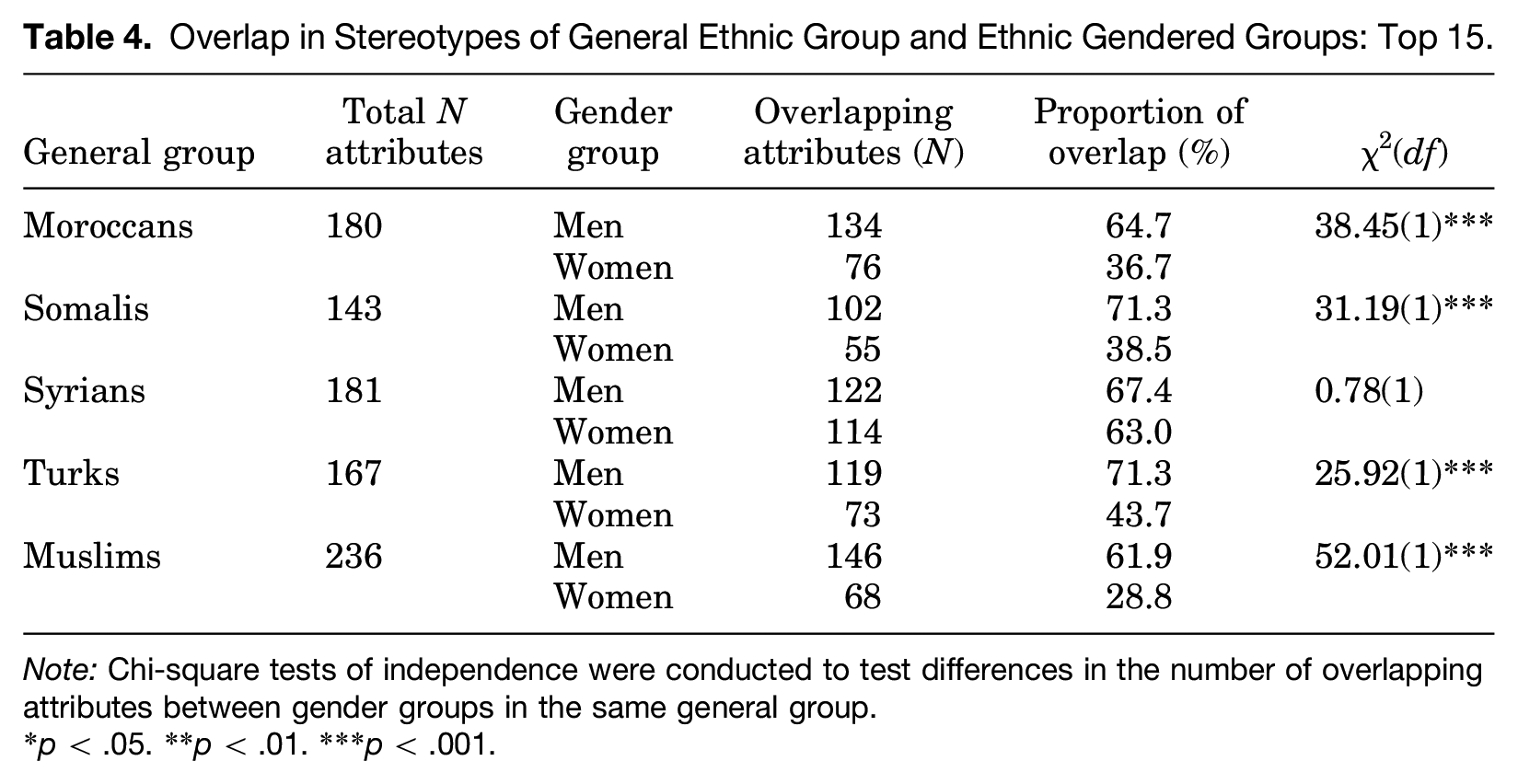
Note: Chi-square tests of independence were conducted to test differences in the number of overlapping attributes between gender groups in the same general group.
p < .05. **p < .01. ***p < .001.
The Salience of Ethnic Groups in Muslim Stereotypes
Finally, we expected that stereotypes about Muslims would show a larger overlap with stereotypes of Turks and Moroccans than with stereotypes associated with Somalis and Syrians (H5). Table 5 below shows the proportion of overlap in stereotypes assigned to Muslims and the four ethnic groups:

Overlap in Stereotypes of Muslims and the Ethnic Groups: Top 15.
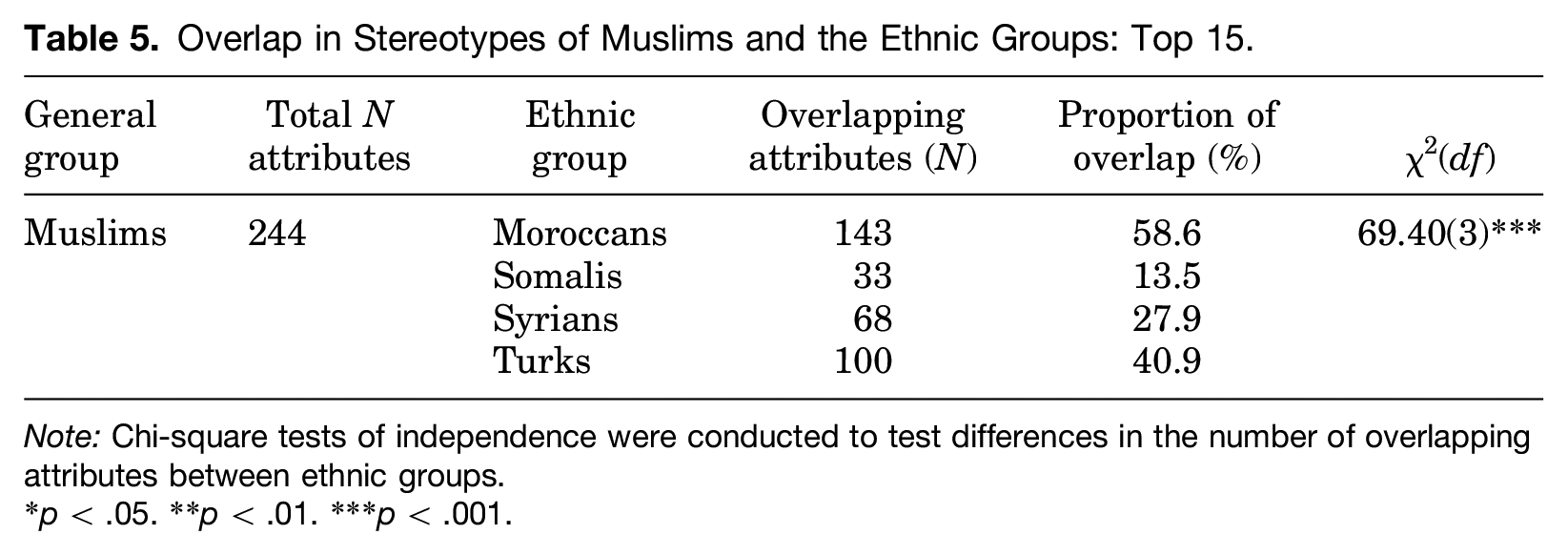
Note: Chi-square tests of independence were conducted to test differences in the number of overlapping attributes between ethnic groups.
p < .05. **p < .01. ***p < .001.
For example, we summed the frequencies of all attributes from categories that arose for both Muslims and Somalis (n“Islamic” = 22 and n“criminals” = 11) and calculated its proportion of the total number of attributes listed for Muslims (n“Muslims” = 244; 13.5 Percent).
All groups were described as Islamic and criminals. Interestingly, the label “Moroccan” was part of the top 15 stereotype categories for Muslims. Since “Moroccan” could not emerge as a stereotype category for Moroccans, we counted this category as an overlapping one. The overlap in stereotype content between Muslims and the four ethnic groups differed significantly, χ2(3) = 69.40, p < .001 (see Table 5). The number of overlapping stereotypes was largest for Moroccans (n = 8), including wearing a headscarf, not being integrated, and being aggressive and difficult, misogynistic, and radicalized. The shared stereotype content was significantly larger between Muslims and Moroccans than between Muslims and Turks, χ2(1) = 15.16, p < .001; Muslims and Syrians, χ2(1) = 46.97, p < .001; and Muslims and Somalis, χ2(1) = 107.53, p < .001. The overlap in stereotypes about Muslims with Turks was significantly larger than the overlap with Syrians, χ2(1) = 9.30, p = .002, and Somalis, χ2(1) = 46.40, p < .001. Finally, there was significantly more overlap between stereotypes about Muslims and Syrians than between stereotypes about Muslims and Somalis, χ2(1) = 15.29, p < .001. Combining the groups to test Hypothesis 5 shows that stereotypes about Muslims overlap more with stereotypes about Moroccans and Turks (nattributes = 77) than with stereotypes about Syrians and Somalis (attributes in shared categories: nattributes = 33), χ2(1) = 22.72, p < .001. Combining the Syrian and Somali groups did not add any stereotypes beyond those that were shared between the Muslim and all ethnic groups (i.e., “Islamic” and “criminals”), while Muslims, Moroccans, and Turks were all additionally described as being misogynistic, being poorly integrated, and wearing a headscarf.
Robustness Checks
We conducted multiple additional tests to examine the robustness of our results. In this study, we replicated the procedure followed by Ghavami and Peplau (2012) by including an arbitrary threshold of 15 stereotype categories. To test the influence of this threshold on the results, we repeated our main analyses using different thresholds (i.e., top 5, top 10, top 15, top 20) and no threshold (i.e., all stereotype categories except those resulting from less than 1 percent of the total number of attributes listed for each target group: the top 99 percent). The results of the tests can be found in Appendix B for Hypothesis 1 and Hypothesis 2, Appendix C for Hypothesis 3 and Hypothesis 4, and Appendix D for Hypothesis 5 in the Supplemental Material.
The results of these robustness checks are by and large in line with the results of our main analyses, but the optimal threshold (i.e., the number of included stereotype categories that produced the strongest support for our hypotheses) varied between groups and hypotheses. In addition, depending on the hypothesis and the group considered, some differences became nonsignificant at certain thresholds. With few exceptions, the robustness checks provide stronger support for our hypotheses when fewer, and thus the most salient stereotype categories were considered.
Second, we wanted to account for the gendered stereotype categories used in the main analyses. For example, the categories “headscarf” and “veiled” could emerge for women but not for men, possibly inflating the unique stereotype content for women. Therefore, we combined the stereotype categories “headscarf,”“veiled,” and “covered clothing” into one category and tested if this recoding altered the results. Combining these categories highlighted the prominence of religious clothing in descriptions of Muslim women, as the combined category became far and away the most frequently used stereotype category for all groups of ethnic-minority and Muslim women. Still, the results of this robustness check were by and large in line with the results of our main analyses (see Appendix E in the Supplemental Material).
Discussion
In this study, we relied on freely generated stereotypes from a representative sample of the Dutch population to examine stereotypes about Muslim groups at the intersection of gender, ethnicity, and religion. Our aim was to examine the stereotype prototypicality of men and women in stereotypes about ethnic groups and one religious group as well as the prototypicality of different Muslim immigrant groups in stereotypes about Muslims.
Our findings provide strong support for intersectionality theory (Cole 2009; Crenshaw 1989). Across all ethnic groups, gendered ethnic stereotypes (e.g., Muslim women or Syrian men) contained unique elements that were not part of the stereotypes applied to the respective gender (i.e., women or men) and religious or ethnic (i.e., Muslim or Syrian) group. In line with the theory of intersectional invisibility (Purdie-Vaughns and Eibach 2008), stereotypes about ethnic-minority women were most different from stereotypes about the general ethnic and gender groups.
Further and in line with the theory of gendered prejudice, we found for all groups that general ethnic group stereotypes showed a greater overlap with stereotypes of ethnic-minority men than with those of ethnic-minority women of the same groups. Our results are thus consistent with earlier research on stereotypes at the intersection of gender and ethnicity conducted in the United States (Eagly and Kite 1987; Ghavami and Peplau 2012) and provide a contemporary replication of these findings in the European context.
In a similar vein and despite the salience of both Muslim men and women in the Dutch public debate and the salience of the Muslim headscarf, we found that stereotypes associated with Muslims are more similar to stereotypes about Muslim men than to those about Muslim women. The gender difference was most pronounced for Muslims compared with the ethnic groups, which is in line with recent findings that Muslim women are strongly nonprototypical for their religious category (Ghani et al. 2023). Gendered practices in Islam with respect to religious rituals (e.g., separate prayer areas for men and women) and visible symbols (e.g., wearing a headscarf) may result in a stronger differentiation between Muslim men and women stereotypes.
The common stereotypical depiction of Muslim men as dominant and patriarchal, with Muslim women as covered and oppressed (Van den Berg and Schinkel 2009), is reflected in our findings: many of the most frequently named attributes of Muslim women refer to their clothing (e.g., “headscarf,”“covered clothing”) and subordinate position (e.g., “submissive,”“oppressed”), while Muslim men are predominantly associated with dominant traits (e.g., “misogynistic,”“aggressive,”“dominant”). In particular, the association of religious clothing with Muslim women reflects the prominence of the headscarf in debates on the integration of Muslim immigrants, illustrated by pleas for a headscarf tax and even a ban on headscarves by right-wing politicians (Van Es 2016). This salience of the headscarf and its role as signifier of religiosity makes it difficult for Muslim women to escape gendered Islamophobia. While intersectional invisibility suggests that minority women, as the nonprototypical members of their constituent groups, may to a certain extent escape the prejudice directed at their groups, this may not improve the situation of Muslim women. Indeed, previous research indicates that Muslim women experience forms of disadvantage that are distinct from those experienced by Muslim men and other minority women (see Perry 2014). When applying for jobs (Fernández-Reino, Di Stasio, and Veit 2023) and when navigating the public space (Choi, Poertner, and Sambanis 2023), veiled Muslim women experience more disadvantage compared with native women as well as unveiled Muslim women.
Our analysis of the prototypicality of various Muslim immigrant groups in stereotypes about Muslims indicated the highest stereotype prototypicality for Moroccans and Turks, the most established Muslim minorities in the Netherlands. This is in line with previous research that has demonstrated the salience of Moroccans and Turks in discussions on Muslim immigrants (Dekker and Van der Noll 2012; Van den Berg and Schinkel 2009). The perception of refugee immigrant groups appears to be influenced by their migration motive (i.e., refuge) next to stereotypes commonly associated with their religious background (i.e., Islam), as Syrian and Somali groups elicited stereotype categories such as “refugees,”“war,” and “pitiful” as well as “radicalized” and “criminals.”
The influence of migration motives on the content of stereotypes associated with different immigrant groups points to the importance of the context in which stereotype research is conducted. While the presence of intersectional stereotypes is documented across contexts (for the United States, see Ghavami and Peplau 2012 as well as Timberlake and Estes 2007; for France, see Fourgassie et al. 2023), the content of stereotypes about intersectional subgroups can provide an important insight into the formation of superordinate group stereotypes. For example, differences in migration histories and cultural characteristics between the most established Muslim groups in different countries (e.g., Moroccans and Turks in the Netherlands, Bangladeshis and Pakistanis in the United Kingdom) could result in differences in stereotype content between contexts. We encourage future researchers to replicate this study in other countries to further disentangle the stereotype content for intersectional groups in various settings. In addition, it would be interesting to study intersectional stereotype content over time, as gender issues and relations between native and immigrant groups are subject to change (Fourgassie et al. 2023).
Another suggestion for future research relates to the instructed perspective of this study. Respondents were asked to list stereotypes that were held by “people in general” rather than their personal views. Although this type of instruction is often used in stereotype research to examine culturally shared stereotypes and diminish social desirability bias (Fiske et al. 2002; Ghavami and Peplau 2012), false perceptions of societal beliefs—so-called pluralistic ignorance (e.g., Zou et al. 2009)—may have influenced participants’ answers. Previous research found that target groups received more negative evaluations when participants were asked to provide society's perspective (Kotzur et al. 2020). Future research could extend our study by experimentally varying the instructed perspective, as done by Kotzur et al. (2020).
Finally, to provide an accurate replication of Ghavami and Peplau (2012), we limited our main analyses to the top 15 stereotype categories, rather than including all stereotype categories that emerged. Robustness checks with varying thresholds for the inclusion of stereotype categories indicated that the uniqueness of stereotype content for the different groups was higher when including fewer stereotype categories. Stereotype content that comes most easily to people's minds and is consensually shared thus appears to contain more distinct group characteristics, representing qualities considered to represent the essence of the specific group (Dovidio et al. 2010).
Overall, our findings highlight the importance of an intersectional approach to stereotype research. Due to the gendered nature of ethnic stereotypes and the intersectional invisibility of ethnic-minority women, results from empirical research on outgroup prejudice may be more applicable to outgroup men than to outgroup women. Hence, future research on outgroup prejudice may benefit from the inclusion of gender-specific items in attitudinal surveys. Similarly, future research could further examine the salience of subgroups in perceptions of broader categories, such as foreigners or Muslims, by explicitly asking respondents which ethnic or religious groups come to mind when they think about a broader category (e.g., Spruyt and Elchardus 2012; Wallrich et al. 2020).
Our findings also have implications for the way in which we try to understand the experiences of ethnic-minority members. Awareness and recognition of the ways in which intersectional stereotypes differentially affect the lives of ethnic-minority men and women can benefit therapists, guidance counselors, and others who work with individuals from diverse backgrounds. In addition, when formulating policies aimed at reducing discrimination in various fields, such as the labor market, education, and ethnic profiling, it is important for policymakers to keep in mind the differences in stereotypes and consequent experiences of disadvantage for men and women from various minority groups.
Taken together, these findings contribute to research on stereotype prototypicality, gendered prejudice, and intersectionality. As our study has demonstrated the value of an intersectional approach to stereotype research, we hope to inspire future researchers to take this perspective into account.
Supplemental Material
sj-docx-1-spq-10.1177_01902725231219688 – Supplemental material for Stereotypes about Muslims in the Netherlands: An Intersectional Approach
Supplemental material, sj-docx-1-spq-10.1177_01902725231219688 for Stereotypes about Muslims in the Netherlands: An Intersectional Approach by Samira A. Wiemers, Valentina Di Stasio and Susanne Veit in Social Psychology Quarterly
Footnotes
Acknowledgements
The authors are grateful to Hannah Arnu, Judith Ehmeir, Milynn Koene, Amina Op de Weegh, Karelis A. Olivo Rumpf, and Maxime Yenga for their help with the preparation of the survey and stereotype coding. This research was supported by a seed money grant from the Migration and Societal Change focus area of Utrecht University.
Supplemental Material
Supplemental material for this article is available online.
1
In Europe, Muslims have been discursively construed as a racialized Other with inherent religious and cultural characteristics (Foner 2015). Yet, when considering the use of the terms ethnicity and race, scholars in the European context tend to prefer the former, which is inherently associated with other group characteristics, such as immigration background, religion, and skin color (for a discussion, see  ). In this study, we follow the European literature but use the labels authors originally utilized when referring to other articles.
2
This hypothesis was not preregistered but rather formulated on the basis of the MOSAIC model and prototypicality theory after collecting the data.
3
The project received ethical approval from the Ethics Committee of the Faculty of Social and Behavioral Sciences of Utrecht University (number 20-516).
4
This approach is in line with the definition of people with a migration background by Statistics Netherlands. By definition, third-generation immigrants could be part of the sample; however, they make up only 0.1 percent of the adult population in the Netherlands (CBS 2016). The percentage of Muslims among Dutch natives is further estimated at 0.08 percent (), altogether minimizing the possibility that people with an immigration background or Muslims were included in our Dutch native sample.
5
Men, women, Moroccans, Moroccan men, Moroccan women, Muslims, Muslim men, Muslim women, Somalis, Somali men, Somali women, Syrians, Syrian men, Syrian women, Turks, Turkish men, and Turkish women.
Bios
References
Supplementary Material
Please find the following supplemental material available below.
For Open Access articles published under a Creative Commons License, all supplemental material carries the same license as the article it is associated with.
For non-Open Access articles published, all supplemental material carries a non-exclusive license, and permission requests for re-use of supplemental material or any part of supplemental material shall be sent directly to the copyright owner as specified in the copyright notice associated with the article.
