




Abstract
The present research examines the stereotypes held about North Africans in French society today. Extending past works, we included gender and separately studied the stereotypes of North African men and women. Using three techniques, namely, spontaneous generation, attribute rating, and pathfinder analysis, our results revealed distinct stereotypes of North African men and women in French society. North African men are ascribed more antisocial traits. Traits associated with North African women are related to submissiveness and domestic chores. This suggests that stereotypes revealed in past studies concerned mainly the men of the group. The results underscore the need to consider gender when studying stereotypes of ethnic and minority groups.
This article examines the stereotypes of North African men and women in France and extends past research that never took gender into account in studying the stereotypes of this group. North Africans (designation for people from Morocco, Tunisia, and Algeria) represent one of the main immigrant groups in France (Aunay 2017) that is visible physically (i.e., non-European appearance) and culturally (i.e., have different cultural practices). North Africans have been frequent targets of stereotyping, prejudice, and discrimination in France (Lacassagne et al. 2001; Lambert et al. 1990; Pettigrew et al. 1997; Pierné 2013). Terrorist attacks in France and Europe over the past decade may have accentuated this reality given that North Africans are often conflated with the perpetrators of these attacks, namely, radical Islamists. Indeed, past studies showed that terrorist attacks carried out by radical Islamists led to increased stereotyping and prejudice as well as support for discriminatory policies against Muslims and more generally against groups conflated with the perpetrators of these attacks (Doosje et al. 2009; Oswald 2005). More recently, increased prejudices against North Africans were observed in France, after the January 2015 Charlie-Hebdo and the Kosher supermarket attacks in Paris (Cohu, Maisonneuve, and Testé 2016).
Although North Africans are targeted by stereotypes and prejudice in France, surprisingly few studies have examined the contents of these stereotypes, and none have been updated in France since the terrorist attacks took place. The few studies conducted on North Africans as a group in France showed that they are generally perceived, among other characterizations, as religious, violent, aggressive, impolite, threatening, sexist, incompetent, thieves, family oriented, and having a great sense of solidarity (Collange, Benbouzyane, and Sanitioso 2006; Dambrun and Guimond 2001; Lacassagne et al. 2001; Lambert et al. 1990). More recent studies conducted in other European countries showed that North Africans are rated low on both warmth and competence dimensions (Kotzur et al. 2019) but did not assess the descriptive contents of their stereotypes.
Central to the present article is the idea that studying ethnic groups, as a whole, can give an incomplete picture of the perception of their members. Indeed, the combination of gender and ethnic origin can give rise to completely different stereotypes (Eagly and Kite 1987; Ghavami and Peplau 2012). To our knowledge, no study has investigated the stereotypes of North African men and women separately (in France or elsewhere). The present research aims to fill this gap.
Gender-by-Ethnic Stereotypes
Stereotypes are defined as shared beliefs about the personal characteristics and behaviors of a group of persons (Leyens, Yzerbyt, and Schadron 1994). Stereotypes can be used to make predictions, to evaluate opportunities and threats brought by others (Sng, Williams, and Neuberg 2017), and to guide judgment and behaviors toward them even when people do not endorse the stereotypes at an explicit level (Devine 1989).
Gender stereotypes have been particularly documented (Eagly et al. 2020; Fiske et al. 2002; Koch et al. 2016). Indeed, a great number of studies on gender stereotypes have shown that men are usually perceived as more agentic and women as more communal (Abele 2003; Eagly et al. 2020; Spence and Buckner 2000). In line with this, men have been described, among others, as aggressive, competitive, brave, independent, and strong, whereas women have been more traditionally described with adjectives such as beautiful, sensitive, kind, submissive, and generous (Cejka and Eagly 1999; Lips 2008; Magne, Lagabrielle, and Felonneau 2018), and these gender stereotypes hold in many different cultural contexts (Williams and Best 1990).
However, stereotypes are often studied in single social categories despite the fact that the intersection of multiple identities has been shown to influence how one is perceived (Donovan 2011; Eagly and Kite 1987; Rosette et al. 2016). The question of intersectionality has been particularly investigated for gender by ethnic stereotypes because this combination gives rise to unique stereotypes that cannot be summarized as the addition of gender and ethnic stereotypes (Ghavami and Peplau 2012). Thus, gender stereotypes essentially capture stereotypes associated with White or middle class women (Donovan 2011; Landrine 1985; Rosette et al. 2016), and stereotypes of ethnic groups do not entirely capture the stereotypes associated with women in the group (Eagly and Kite 1987; Ghavami and Peplau 2012; Niemann et al. 1994). To illustrate, Ghavami and Peplau (2012) investigated the stereotypes of men and women of 17 ethnic groups. They observed that not only were stereotypes of men (vs. women) in an ethnic group more similar to stereotypes of the ethnic group (e.g., “dangerous” was listed for Black people in general and Black men but not for Black women) but also that unique stereotypes were listed with the combination of ethnic and gender identity.
Interestingly, the finding that ethnic stereotypes are closer to stereotypes of men of the ethnic group than women (Eagly and Kite 1987; Ghavami and Peplau 2012) is particularly observed for groups thought to have very distinct gender roles (Eagly and Kite 1987). Because traditional gender roles are valued in North African cultures (Killian 2006), we can expect to observe different and new attributes associated with North African women compared to men. These expectations seem to be supported by a report on discrimination in employment (IMS-Entreprendre pour la Cité 2014) that showed that managers hold different stereotypes for men (perceived as misogynist and violent) and women employees of North African origin. Besides, as mentioned earlier, the stereotypes of North Africans could be influenced by the conflation between ethnic origin, religion, and terrorism. However, the conflation between ethnic origin and terrorism is more likely to be true for North African men because perpetrators of terrorist attacks are often men and men have been shown to be perceived as more threatening than women (Navarette et al. 2010). Data from past research lead us to expect that stereotypes of North African men and women cannot be completely derived from studies conducted on gender stereotypes or from studies conducted on stereotypes of North Africans (Donovan 2011; Ghavami and Peplau 2012).
Present Research
In three studies, we aimed to explore separately the stereotypes of North African men and women in France. First, we created a list of traits that people associate with the stereotypes of North African men and women using a thought listing task. This measure is based on the idea that if a certain trait is part of the stereotype of a group, it should be easily accessible in memory and thus listed spontaneously (Berjot and Drozda-Senkowska 2007). This technique has the advantage of obtaining up to date stereotype contents not constrained by possibly outdated traits used in previous studies, such as in rating tasks (Madon et al. 2001). Second, using an attribute rating technique, we investigated the strength of the association between the traits generated in the first thought listing study for North African men and women separately and comparatively to French men and women. This technique not only allows us to determine which of the traits are strongly associated with the category label but also to determine whether these traits are diagnostic of the group and allow for differentiating the group from other groups. Finally, we moved from stereotype content to its structure with the pathfinder technique (Schvaneveldt, Durso, and Dearholt 1989). This technique, inspired by research on the organization of information in memory, examines the structure of stereotypes by creating a network showing relations between the traits constituting the stereotype based on similarity judgments (see Stephan et al. 1993).
Study 1
This study implemented a free response methodology, widely used to measure stereotypes of different groups in the past (Eagly and Mladinic 1989), to assess traits that people associate with North African men and women in France. We included four target groups: North African men, North African women, French men, and French women. The groups of French men and women served as comparison groups. Finally, given the social context following recent events, we expected North African men to be described as having relatively more antisocial traits.
Method
Participants
This study was conducted online using LimeSurvey software. The link to the survey was published in various Facebook groups in different cities in France, whichenabled us to recruit 306 volunteer participants.Twenty-three participants were excluded (5 were underage, and 18 did not follow instructions). A total of 283 participants (238 women and 45 men), including 267 native French speakers, made up the final sample. The participants were between 18 and 46 years old (M = 21.94, SD = 3.69).
Materials and Procedure
After consenting to participate in the study, subjects were randomly assigned to evaluate one of the four target groups: North African men (n = 62), North African women (n = 64), French men (n = 81), and French women (n = 76). The choice of the labels “French” and “North Africans” was made based on previous studies conducted in France (e.g., Collange et al. 2006). We asked participants to list up to 10 characteristics (personality traits, competencies, behaviors, etc.) that most people think are typical of the group they evaluated, namely, French men or women and men or women of North African origin. Focusing the instruction on what people in general think instead of the participant's personal beliefs should minimize social desirability (Devine 1989). Because we are interested more in the cultural knowledge of the stereotypes than their endorsement, this instruction should allow us to assess current societal stereotypes independently of the participants' level of prejudice and of their ethnicity. After reading the instructions, participants listed different words/terms/short phrases in the blank spaces provided for this purpose. They were instructed to list the words that spontaneously came to mind. No time limit was imposed.
Results and Discussion
Data Description
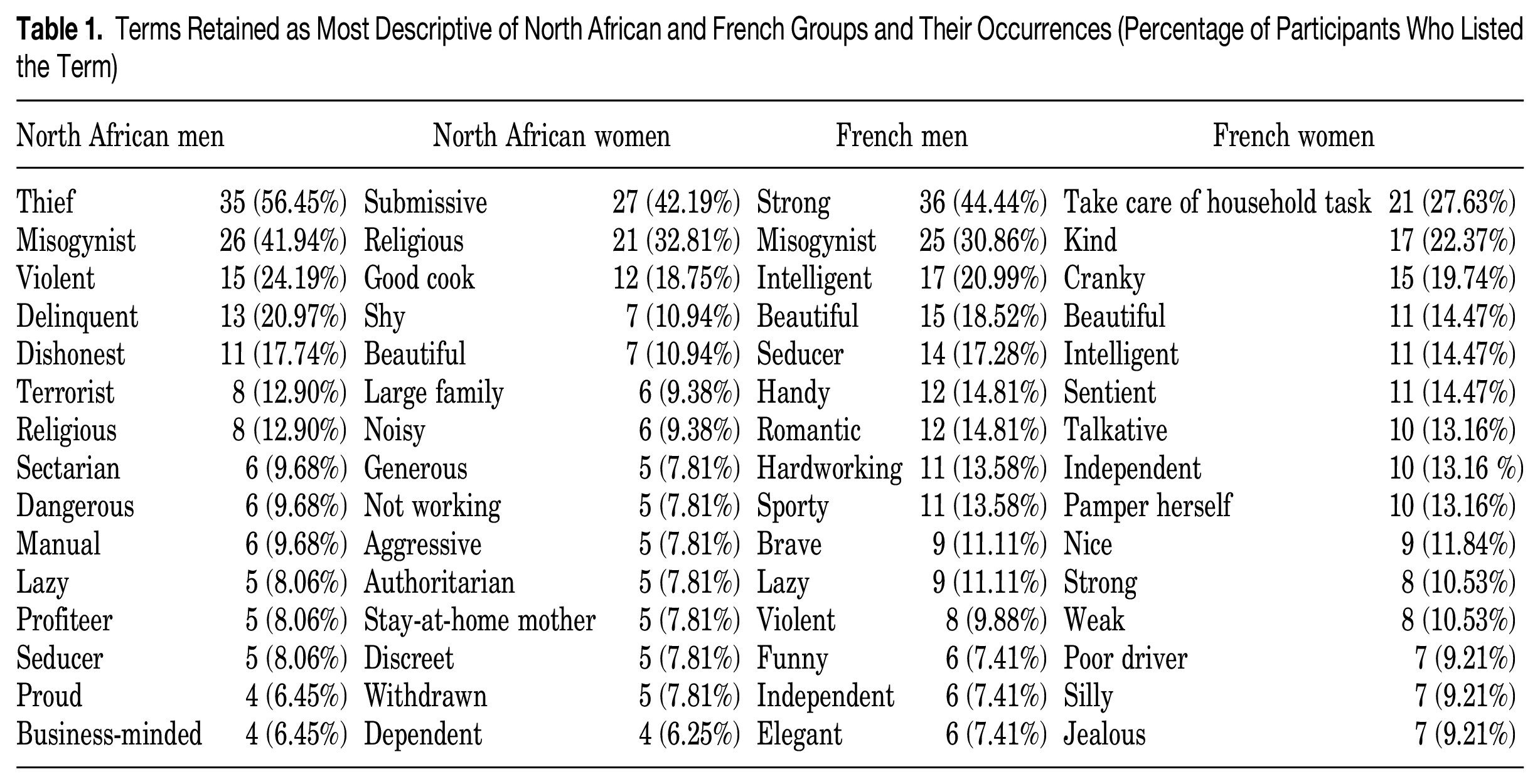
A total of 1,631 terms (or short phrases) were obtained (M = 5.76 terms/participant). Participants listed 342 terms for North African men (M = 5.5 terms/participant), 302 for North African women (M = 4.72 terms/participant), 505 for French men (M = 6.23 terms/participant), and 482 for French women (M = 6.34 terms/participant). Significantly more terms were listed for the French (60.52%) than for the North African categories (39.49%), χ2(1) = 144.27, p < .001. This difference in the number of terms generated for the two groups (i.e., more restrictive for North Africans) is consistent with previous findings (Lacassagne et al. 2001). Because contacts with ingroup (vs. outgroup) members are more frequent and intimate, their representations should be richer (vs. simplified) and contain more (vs. fewer) traits. No significant difference was found between the number of traits listed for North African men (20.93%) and women (18.52%), χ2(1) = 3.10, p = .08, or between French men (30.96%) and French women (29.56%), χ2(1) = 0.77, p = .38. To create the final list, two independent judges grouped terms considered synonyms (e.g., sexist and misogynist) when both judges agreed. We retained the 15 most frequently listed terms for each group (see Table 1). The 15 retained terms for North African men accounted for 45.91% of the total terms listed. For North African women, they accounted for 41.39%. For French men and women, they accounted for 39% and 33.61% of the total terms, respectively. 1
Terms Retained as Most Descriptive of North African and French Groups and Their Occurrences (Percentage of Participants Who Listed the Term)
North African Men and Women Stereotypes
As expected, the traits listed for North African women differed from those for North African men, except for the term “religious,” listed for both. Consistent with our expectation, antisocial traits were predominantly used to describe the men, except for the notion of aggressiveness found in both gender groups of North African stereotypes, using different terms: men were described as violent and women as aggressive (see Table 1). “Aggressive” here may refer to verbal rather than physical aggression, consistent with the form of aggression associated with women (Eagly and Steffen 1986).
French Men and Women Stereotypes
The traits listed for French men and women are consistent with gender stereotypes found in past studies (Eagly et al. 2020; Magne et al. 2018). Men were ascribed more agentic terms (strong, violent, independent) and women more communal terms (nice, kind, sentient) and terms associated with gender roles (take care of household tasks). However, French women have also been ascribed some agentic terms (strong, independent), possibly due to the evolution of societal roles (Wood and Eagly 2012).
North Africans and French Stereotypes
There was a small overlap between traits listed for French (men and women) and North Africans (men and women). The greatest overlap was between North African and French men, both described as lazy, seducer, violent, and misogynist, although the number of occurrences differed (see Table 1). The trait “violence” is a trait attributed to men in general (Eagly and Steffen 1986) and therefore not surprising to find it used to describe both North African and French men (see Lacassagne et al. 2001). However, as expected, it was more frequently listed to describe North African (4.40%) than French men (1.58%), χ2(1) = 5.08, p = .02.
We did not observe many similarities between North African women and French women except for the terms linked to gender and gender stereotype roles such as domestic chores. On a contrasting note, French women were described by participants as independent, whereas North African women were described as submissive and dependent. The latter could be partially explained in part by the association of North African women, the Muslim religion, and the veil. The veil is often seen as a symbol of submission and oppression in western countries (Zimmerman 2014).
Evaluative Content Analysis
Based on the work conducted by Eagly et al. (2020), we examined the evaluative content of the stereotypes and tested the likability ratings for each group. To do so, we retrieved the mean likability of each of the retained stereotypes using the database created by Chandler (2018). When the exact word was absent, we chose a synonym (23 synonyms in total). For seven words, no match was possible (business-minded, good cook, large family, not working, stay at home mother/father, poor driver, and take care of household tasks). Analysis of variance revealed a significant difference in the mean likability of traits listed for the four groups, F(3, 48) = 6.00, p = 001, η2 p = .27. Helmert contrasts revealed lower mean trait likability of stereotypes of North African men (M = 1.74, SD = 1.38) than any other group, t(48) = 4.07, p < .001, d = 1.13. The mean likability of stereotypes of North African women (M = 3.21, SD = 1.21) did not differ significantly from those of French men and women, t(48) = 1.00, p = .32. Finally, the mean likability of stereotypes of French men (M = 3.69, SD = 1.52) did not differ from that of French women (M = 3.76, SD = 1.51), t(48) = .13, p = .90.
To summarize, using a free response method, this study examined the traits, behaviors, and characteristics that people spontaneously associate with North African men and women in France today. Results showed that stereotypes of North African men differ greatly from stereotypes of North African women. As expected, North African men were described as more antisocial. Of note and consistent with past findings (Ghavami and Peplau 2012), the stereotypes of North African men resemble the stereotypes of North Africans observed in past studies (Collange et al. 2006; Dambrun and Guimond 2001; Lacassagne et al. 2001). Finally, stereotypes of French men and women are consistent with gender stereotypes traditionally found in the literature (Magne et al. 2018).
Thus, our findings are consistent with previous findings showing that North Africans are described more negatively than the French (Lacassagne et al. 2001). However, this finding was only true for North African men. This could be because the low agency associated with women precludes them from being held accountable for the actions associated with the group (Eagly and Kite 1987). In the next study, we measured not only the strength of association between traits and target groups but also what traits are uniquely associated with a group and differentiate it from others.
Study 2
Study 2 aimed at examining the strength of association between the traits listed in Study 1 and the four target groups, using the attribute rating technique. Because stereotypes can be conceived as ways to distinguish one group from another (McCauley and Stitt 1978), we expected the traits listed to describe North African men and women to be more strongly associated with these categories than with the French men and women categories. We also expected differences between North African men and women, specifically regarding antisocial traits. These traits should be more strongly associated with men than with women.
Method
Participants
Four hundred two participants were recruited via Facebook groups in France and completed the survey voluntarily. Five participants were excluded because they were underage, leaving a sample of 397 participants (337 women, 58 men, and 2 others), of whom 382 were native French speakers, ages 18 to 56 years (M = 20.92, SD = 4.34). This study was conducted online using LimeSurvey software.
Materials and Procedure
Participants who consented to participate in the study were randomly assigned to evaluate one of the four groups: North African men (n = 90), North African women (n = 110), French men (n = 93), and French women (n = 104). Participants were presented with the list of all the terms most frequently associated with the target groups from Study 1 (see Table 1) in randomized order. For each trait, participants were asked to indicate using a 9 point scale (1 = not at all; 9 = extremely) to what extent they believe people in general associate the trait with the group they evaluate: French men (vs. women) or men (vs. women) of North African origin). As in Study 1, we focused the instruction on the participants’ beliefs of how most people perceive the group and not their personal beliefs. 2
Results
We conducted regression analysis on each of the traits listed in Study 1. 3 To examine gender differences within ethnic groups, the first comparison opposed North African men to North African women, and the second opposed French men to French women. The third and fourth comparisons opposed French men to North African men and French women to North African women, respectively, to examine ethnic differences within gender groups.
North African Men and Women Comparison
Of the 14 terms listed only for North African men (“religious” was common for both men and women) in Study 1, 13 were associated significantly more with North African men than women (only “sectarian” was not). Of the 14 terms associated only with North African women, 10 were significantly more associated with North African women than the men, 3 terms (aggressive, authoritarian, independent) were significantly more associated with North African men, and 2 did not differ (large family and noisy). If violence and terrorism are indeed now parts of the North African stereotype, this was particularly true for North African men. Indeed, physical threat was more associated with North African men than women. North African men were considered more violent, t(393) = 7.20, p < .001, d = .72, and more dangerous, t(393) = 4.31, p < .001, d = .43, than North African women. Interestingly, given the assumed association between religion and terrorism and although North African women were considered as religious as the men, t(393) = −1.45, p = .15, they were less associated with terrorism than were the men, t(393) = −4.27, p < .001, d = .43. 4
French Men and Women Comparison
Four terms (listed only for French men in Study 1) were more strongly associated with French men than women (handy, lazy, violent, and misogynist). Three were less strongly associated (elegant, hardworking, and romantic), and four did not differ (brave, funny, sporty, and seducer). Eight terms listed only for French women were more strongly associated with French women than men (jealous, kind, nice, talkative, take care of household tasks, sentient, poor driver, pamper herself). One term was less strongly associated (silly), and one did not differ (cranky). For the four terms listed for both French men and women, three were more associated with French women (intelligent, independent, and beautiful), and one term did not differ (strong). Although communal traits (e.g., kind, sentient) and intelligence were more associated with women as found in past studies (Eagly et al. 2020), agentic traits (e.g., violent, hardworking, brave) were not always more associated with French men. 5
North Africans and French Comparison
Among the terms listed only for North African men, 10 (business-minded, dangerous, delinquent, dishonest, profiteer, proud, religious, sectarian, terrorist, thief) were more strongly associated with this category than with French men, and 1 did not differ (manual). Among terms listed only for French men in Study 1, 5 (beautiful, brave, elegant, intelligent, romantic) were more strongly associated with this category than with North African men, and 6 did not differ (funny, handy, hardworking, independent, sporty, strong). The results show that antisocial traits are particularly ascribed to North African men than to French men. Several gender stereotypical traits are equally associated with both groups (e.g., handy, sporty, strong) and do not seem to be influenced by the ethnicity of the target. 6
On the traits listed only for North African women, 10 (aggressive, authoritarian, good cook, large family, noisy, not working, religious, stay at home mother, submissive, withdrawn) were more strongly associated with this group than with French women, 1 was less associated (shy), and 2 did not differ (discreet, generous). On the traits listed only for French women, 9 (cranky, intelligent, jealous, kind, nice, pamper herself, poor driver, sentient, talkative) were more strongly associated with this group than with North African women, 2 were less associated (silly, take care of household tasks), and 1 did not differ (strong). Traditional stereotypes of women and communal traits (e.g., poor driver, nice, kind, jealous) were more associated with French women. On the other hand, traits related to traditional gender roles (e.g., stay at home mother, take care of household tasks) were more associated with North African women.
Discussion
This study examined the characteristics that people believe are strongly associated with and uniquely descriptive of North African men and women. First, as can be seen in the factor analysis, 7 most of the terms listed spontaneously for North African men in Study 1 loaded on a single factor. A similar observation was gleaned for North African women. Additionally, some of the traits listed spontaneously for the French in Study 1 loaded negatively on North Africans factors.This may suggest that North Africansand the French are perceived as contrasting groups in terms of characteristics. Items loading on Factors 2 and 4 are consistent with gender stereotypes on personality traits and abilities found in the literature (Magne et al. 2018). As expected, antisocial traits are consistently more strongly associated with North African men than women. This difference cannot be explained only by gender stereotypes given that North African men were assigned antisocial traits more strongly than French men. Whereas North African women were associated to a greater extent with violence and terrorism than French women, they were less associated with these traits than their male counterparts.
Interestingly, most traits listed for French men in Study 1 were not more associated with that group in Study 2, whereas the opposite was true for French women. In their study, Eagly et al. (2020) observed that there is still a traditional gender repartition in terms of agency and communion but that women today were perceived as more competent and intelligent than men. Our results are partially consistent with these findings. Indeed, communal traits were more associated with French women than men, as were traits linked to intelligence. Results were mixed for agency. This could be because the evolution of gender roles influences the perception of agency (Wood and Eagly 2012). However, traditional gender roles seem to remain associated with North African women, potentially indicative of a greater perception of gender inequality in the North African group. Besides, even though they are perceived as possessing more communal traits than their male counterparts, North African women were assigned these traits to a lesser extent in comparison to French women.
This study highlights traits that people associate with each target group and completes the results of Study 1. Indeed, even if people consider some traits as characteristic of a given group and list them spontaneously, these traits may not be those considered the most defining or distinguishing vis-à-vis other groups. For instance, the term “brave” was frequently listed in spontaneous generation for French men. However, it did not appear among the terms that people most strongly associate with French men (vs. women). Study 3 was conducted to examine the structure of these stereotypes, which should reveal how the different terms are linked to each other and their hierarchical positioning in the cognitive representation of North Africans in French society.
Study 3
The first two studies, using different methodologies, revealed what traits come spontaneously to mind when the category North African is activated and the strength of the association of each stereotypic trait with the target group (compared to another relevant group). Study 3, using the pathfinder technique, aimed to determine the structure of North African stereotypes or how the traits are organized in relation to the category label North Africans. Pathfinder calculates the distance between nodes (or constructs) in a network. This technique should reveal the shortest path between a category label (e.g., Russians) and the associated traits (e.g., disciplined, proud, competitive) to generate a graphical representation of the structure based on the judgments of similarity between the traits. According to Stephan et al. (1993), the pathfinder technique reveals the structure of knowledge, here stereotype content, and can be used to “infer the accessibility of category-related” information in memory.
Method
Participants
Four hundred twenty two participants took part in this online study. The link to the study was posted in various Facebook groups. Eight participants were underage and thus excluded, leaving a sample of 414 participants (360 women and 54 men), including 394 native French speakers, ages 18 to 65 years (M = 21.15, SD = 5.31). The study was programmed using LimeSurvey software.
Materials and Procedure
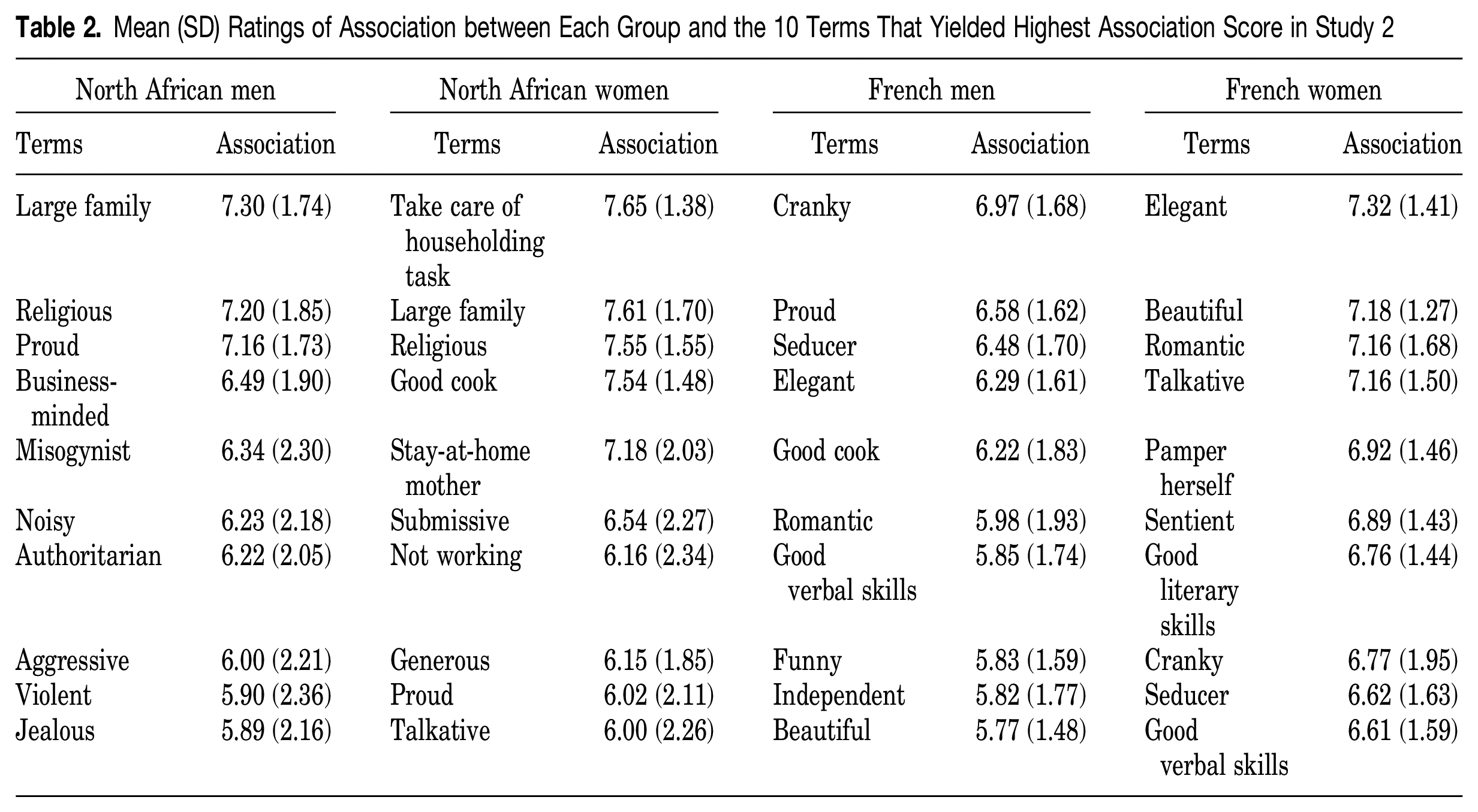
After consenting to participate in the study, subjects were randomly assigned to evaluate one of four groups: North African men (n = 123), North African women (n = 85), French men (n = 97), and French women (n = 109). Following the procedure of Stephan et al. (1993), the 10 traits that yielded the highest scores in the attribute rating task in Study 2 (see Table 2) were selected for this study. All the traits were presented in pairs (e.g., aggressive-authoritative), and participants were asked to indicate the probability that a person possessing one trait of a given pair (e.g., aggressive) would also possess the other trait (e.g., authoritative) on a 9 point scale (from 1 = not at all likely to 9 = extremely likely). Each trait was paired with every other trait, resulting in 45 combinations. Participants also indicated to what extent each trait was associated with the given group (e.g., the probability that a North African man would be aggressive) using the same response format, yielding an additional 10 combinations of similarity ratings. In total, participants completed 55 similarity judgments. The presentation of the two rating tasks (i.e., similarities between pairs of traits and similarities between traits and the category label) was counterbalanced across participants, and the order of the presentation of the trait pairs was randomized within each task. 8
Mean (SD) Ratings of Association between Each Group and the 10 Terms That Yielded Highest Association Score in Study 2
Results
Analyses were run on JPathfinder software (Schvaneveldt et al. 1989). Two participants were excluded from the networks of North African men, three from the North African women, two from the French men, and three from the French women because they did not follow the instructions. A pathfinder network was created for each participant, and all networks were then aggregated using the means. Pathfinder algorithm calculates the distance between constructs and searches for the shorter path between them. If two concepts are highly related, they will be directly connected in the network or connected by fewer links than if they were not or less strongly related. Direct links between constructs are included only if there is no alternative shorter path (i.e., no indirect path is shorter than the direct path). To compute a network, Pathfinder uses two parameters, r and q. The r parameter can range from 1 to ∞ and determines the metric used to calculate the distance of a path. As the value of r increases, only the links with the largest weights determine the total weight of the path. When r = ∞, the distance of a path equals the magnitude of the maximum link between two nodes in the path. The q parameter constrains the number of links allowed in indirect paths. If q = n – 1 (n equals the number of constructs), there is no limit to the number of links allowed in indirect paths. The longest path can then have n – 1 links. We used the parameters r = ∞ and q = n – 1 as recommended to generate the most parsimonious network (Schvaneveldt et al. 1989).
As shown in Figure 1, the stereotype of North African men has a more hierarchical structure than that of North African women. Only three terms (business-minded, proud, and religious) were directly linked to the category North African men. Five terms were directly linked to the category North African women (generous, good cook, submissive, religious, and take care of household tasks). Religion is directly linked to both groups. For North African women, a group of features consistent with the gender roles was revealed. This includes the terms stay at home mother, take care of household tasks, and not working. For North African men, antisocial traits were pooledand connected to the category label through an indirect path. This observation is consistent with the results of Study 2. Indeed, the traits that yielded the higher scores in Study 2 are also the traits directly linked to the category label (except for large family). These results suggest that even though violence is listed spontaneously, it might not in fact be a core characteristic of the stereotype.
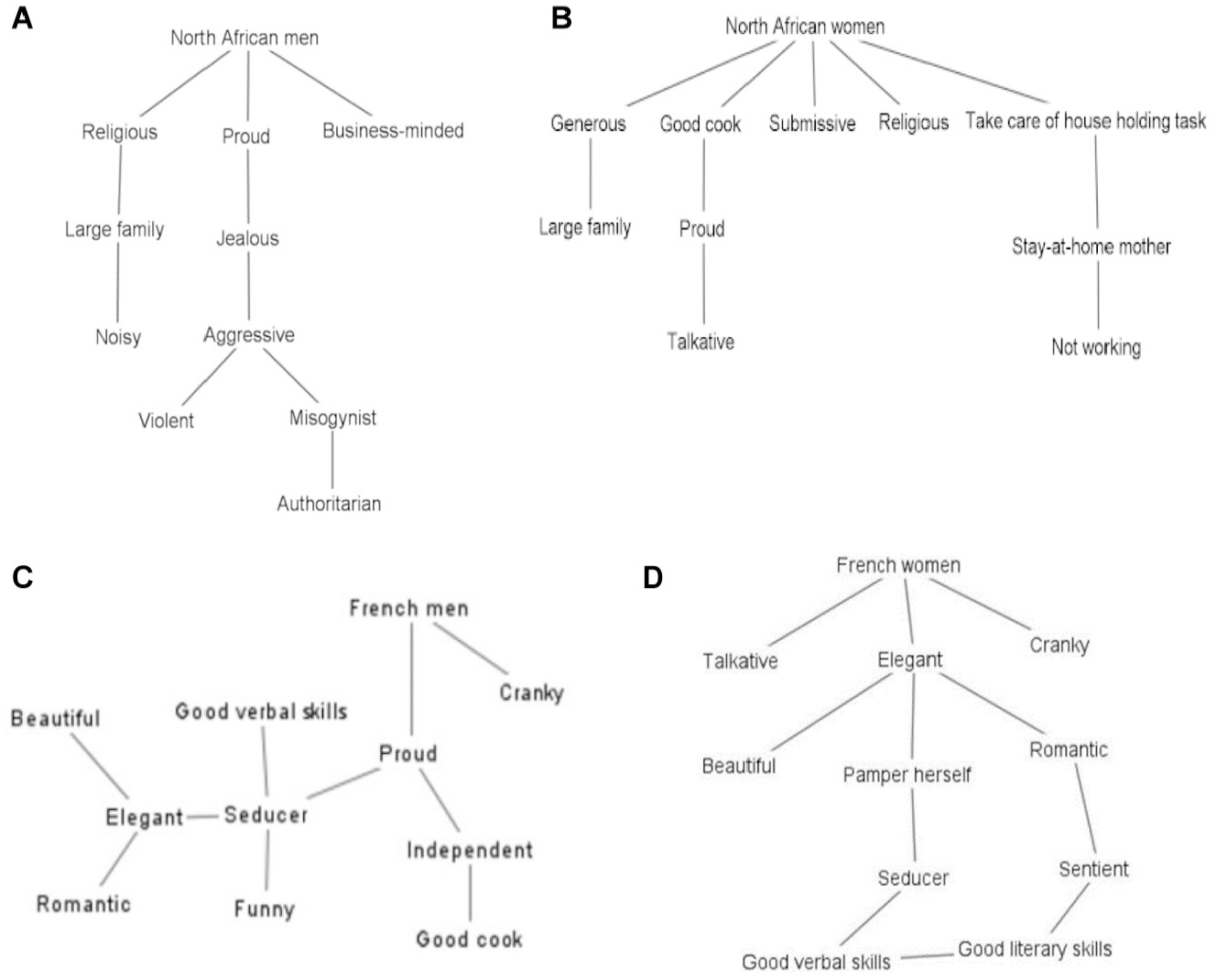
Network of Stereotypes of North African Men (A) and Women (B) and French Men (C) and Women (D)
The networks of French men and women stereotypes have a hierarchical structure. For French men, the same two traits that yielded the strongest association ratings in Study 2 are directly linked to the category label (proud and cranky). Terms related to seduction and appearance are connected to the category label via the trait proud. For French women, the terms cranky, talkative, and elegant are directly connected to the category label. In this network, traits related to appearance and seduction seem to be clustered and are connected to the category label via the term elegant.
Discussion
This study examined the structure of the stereotypes of North African men and women. Results showed that some traits found as strongly associated with these groups may not be the ones that are directly accessible when activating the category label. They are instead indirectly linked to the category via other (associated) traits. When activating the category North African women, more traits are directly accessible than when activating the category North African men. As expected, given the conflation between North Africans and Muslims, religion is readily accessible for both groups.
For North African men, even though violence seems to be a central element of the stereotype, it did not appear to be directly linked to the category label. One possible explanation is that “violence” is not perceived as inherent to an individual but more as a consequence of other personality traits. For instance, it is possible that individuals explain North African men’s “aggressiveness” as a consequence of their perceived pride and jealousy. Indeed, wronged ego is often an antecedent of aggressive behavior (Baumeister, Smart, and Boden 1996; Cohen and Nisbett 1994). Another possible explanation is social desirability. Contrary to the two previous studies, participants were not asked to respond according to what “people in general” think. Thus, participants might have been reluctant to indicate that it is highly probable that a group possesses negative traits (Stephan et al. 1993). Also, violence did not appear to be linked with religion, which would be expected if respondents would conflate religion and terrorism. A possibility is that there is a conflation between North African people and Islam specifically and between Islam and terrorism. Here, participants were asked to rate the similarity between religion in general and violence, which could have yielded a different interpretation.
For North African women, more terms are directly linked to the category label. Terms linked to domestic chores like household task or stay at home mother are linked to each other and are linked to the label North African women. This part of the network seems to reflect gender roles and may not necessarily be representative only of North African women. This is consistent with previous findings (e.g., Collange et al. 2006) that showed that North Africans were stereotyped as family oriented. Note that in their study, as in almost all other past studies, Collange et al. (2006) did not distinguish between men and women. Interestingly for both French men and women, a large part of the network seems to connect traits related to appearance, seduction, and romance. One possibility is that some traits related to romanticism are associated with the French in general (Koomen and Bähler 1996).
For each network structure, an indicator of coherence was calculated. For North African men, the coherence value of the network is .66; for French women, the value is .59; for French men, the value is .51; and for North African women, the value is lower (.43). The lower coherence value for North African women could indicate that North African women are perceived as less prototypical than men and thus are more invisible (Purdie-Vaughns and Eibach 2008), which could pose difficulties to form a clear image of the group. This was not the case for the crossed categorization of North Africans and of men, which may mean that these two categories may have relatively more overlaps, or alternatively, that when participants thought of North Africans, it is the stereotype of North African men that readily came to mind. 9
General Discussion
In France, North Africans represent a major minority group that has been and is still the target of stereotyping, prejudice, and discrimination (Pettigrew et al. 1997; Pierné 2013). Yet in contrast to studies on Black Americans in the United States, studies on the stereotypes of North Africans in France have been few and far between. Indeed, the most recent study on the stereotype content of this group dates back 15 years (Collange et al. 2006). Furthermore, past descriptions of the North African stereotypes might have been incomplete because they might not have included North African women. In this series of studies, we aimed to investigate separately the content of the stereotypes of North African men and women in French society today.
Studies 1 and 2 showed that North African men and women are perceived very differently in French society. Both groups were associated with religion, reflecting the conflation of ethnic identity and religion for North Africans. However, North African men were described with more antisocial traits, were perceived more negatively, and were more associated with terrorism than women. This observation is consistent with past findings showing that men from outgroups are perceived as more threatening than women (Ghavami and Peplau 2012; Navarrete et al. 2010; Plant, Goplen, and Kunstman 2011). The association with terrorism and violence was less strong for North African women, who were often attributed with submissiveness and traditional gender stereotypes and roles consistent with the perceived low agency and invisibility of women from different ethnic groups (Eagly and Kite 1987). This perception might have been accentuated by the conflation between ethnic identity and religion (Zimmerman 2014).
Results of Studies 1 and 2 are also consistent with previous findings on gender by ethnic stereotypes conducted on other stereotyped groups (Ghavami and Peplau 2012). Indeed, there was an overlap between the stereotypical traits associated with North Africans in past studies (Collange et al. 2006; Dambrun and Guimond 2001; Lacassagne et al. 2001) and the traits listed for North African men in our studies. The overlap was weak for North African women. This supports the idea that when a group such as “North African” is made salient in studies, it is actually the group “North African men” that is activated in the mind of participants (Ghavami and Peplau 2012). Also, compared to the stereotypes of North African men and women, the stereotypes of French men and women are closer to the gender stereotypes found in the literature as observed in past studies (e.g., Donovan 2011; Ghavami and Peplau 2012).
Our studies also allow a glimpse at the evolution of stereotypes in society, in particular following significant societal events. Thus, despite the stability of the stereotypes of North Africans (particularly concerning North African men), we observe the inclusion of new traits compared to the results of past studies (Collange et al. 2006). The term “terrorist” appeared in our study but was absent in past French studies. The lumping together of Muslim North Africans and radical Islamists who perpetrated the relatively recent terrorist attacks in France could have impacted negatively the stereotypes of North Africans (see Bar-Tal and Labin 2001; Gilbert 1951). When comparing stereotypes listed for North African men and women and French men and women, stereotypes seem relatively stable over time. Traits associated with French men and women are consistent with traits listed in past investigations (Eagly et al. 2020; Magne et al. 2018).
Finally, Study 3 revealed different structures and organizations of the stereotypes of North African men and women. Interestingly and possibly consistent with the societal context, religious was the only term with a direct association with the category label for both North African men and women. For French and women, only the term cranky was directly connected to the category label. Both French men and women seem to have a cluster of stereotypes linked to seduction. Evaluating the structure of stereotypes can be insightful to understand the interrelationship between the traits that constitute their content, but there are limitations, and results should be interpreted with caution. Indeed, the social desirability (i.e., to not be seen as prejudiced) is a factor that might have led participants to underrate some links. Moreover, we observed a lower coherence value for North African women that could indicate that they are less prototypical than men and thus more invisible, which makes it difficult to form a clear representation (Purdie-Vaughns and Eibach 2008).
Limitations and Perspectives
Several limitations should be noted in this work. First, we did not collect stereotypes for the group North Africans in general or for men and women in general. Although we did observe an overlap between gender stereotypes and stereotypes associated with French men and women and an overlap between the stereotypes of North African men and the stereotypes of North Africans observed in past studies, these conclusions can only be made indirectly by comparing our results to past investigations. Besides, because we do not have these categories, it is difficult to conclude on the evolution of stereotypes of North Africans in general. Future studies should add these categories to determine the overlap between North African men and women and the North Africans stereotypes and to determine more explicitly how recent events have impacted the evolution of these stereotypes. Another limitation is that our respondents were mostly women. However, because we are interested in culturally shared stereotypes, it is likely that men and women share the same stereotypes (Heilman 2012).
Besides, our respondents are mostly French (determined via native language) because we were interested in stereotypes of North Africans, a prejudiced group, in France. However, it could be interesting to determine whether North Africans hold the same views of French men and women as done in past studies (e.g., Streufert and Sandler 1971). Finally, future studies could test the influence of individual variables (e.g., political orientation) on stereotypes. If these variables should not influence stereotype knowledge (Devine 1989), they could influence the personal endorsement of those stereotypes.
Conclusion
Our findings revealed that North African men and women have very distinct representations. North African men are perceived more negatively and as being more antisocial. This perception of North African men and the conflation of North African people and Muslims could explain the increase in threats and aggression against Muslims following the terrorist attacks in Paris (Commission nationale consultative des droits de l'Homme 2015). As pointed out in earlier studies, stereotypes of North African women did not seem to be consistent with the stereotype of North African people. Also, traditional gender stereotypes seem closer to stereotypes of French men and women than to North African men and women. To study and fight stereotypes, it is necessary to understand to whom they are applied. Gender should be considered for any group (e.g., Blacks, Arabs, Latinos) to design better interventions to reduce stereotyping, prejudice, and discrimination or to improve intergroup relations.
Supplemental Material
sj-docx-1-spq-10.1177_01902725231159938 – Supplemental material for Stereotype Content of North African Men and Women in France and Its Relation to Aggression
Supplemental material, sj-docx-1-spq-10.1177_01902725231159938 for Stereotype Content of North African Men and Women in France and Its Relation to Aggression by Lisa Fourgassie, Baptiste Subra and Rasyid Bo Sanitioso in Social Psychology Quarterly
Supplemental Material
sj-pptx-1-spq-10.1177_01902725231159938 – Supplemental material for Stereotype Content of North African Men and Women in France and Its Relation to Aggression
Supplemental material, sj-pptx-1-spq-10.1177_01902725231159938 for Stereotype Content of North African Men and Women in France and Its Relation to Aggression by Lisa Fourgassie, Baptiste Subra and Rasyid Bo Sanitioso in Social Psychology Quarterly
Footnotes
Funding
The author(s) disclosed receipt of the following financial support for the research, authorship, and/or publication of this article: This work was supported by a research grant from the Agence Nationale de la Recherche (ANR-16-CE41-0009).

Supplemental Material
Supplemental material for this article is available online.
1
When terms were listed as frequently, we chose one trait on an arbitrary criterion. Besides, some terms were eliminated even though frequently listed when they were too specific (e.g., veiled or manly).
2
We also included stereotypes about competence such as math performance and verbal skills, added to the traits included based on the results of Study 1. These terms have been added within the framework of a research project on stereotype threat.
4
For exploratory purposes, we included the gender of the respondent in the analyses. Gender interacted with the contrast opposing North African women to North African men only for the following terms: beautiful, business minded, dishonest, elegant, handy, hardworking, seducer, not working. Note that the inclusion of gender did not change the effect observed when comparing North African men to women except for two terms: dishonest and hardworking. For these two terms, the comparison between the two groups became nonsignificant.
5
For exploratory purposes, we included the gender of the respondent in the analyses. Gender interacted with the contrast opposing French women to French men only for the following terms: terrorist, large family, not working, and take care of household tasks. Note that the inclusion of gender did not change the effect observed when comparing French men to women.
6
For exploratory purposes, we included the gender of the respondent in the analyses. Gender interacted with the contrast opposing French women to North African women only for the following terms: good verbal skills, handy, elegant, noisy, and business minded. Gender also interacted with the contrast opposing French men to North African men for the following terms: terrorist and beautiful. Note that the inclusion of gender did not change the effect observed when comparing French women to North African women, except for noisy, which became nonsignificant. The inclusion of gender did not change the effect observed when comparing French men to North African men.
8
Due to an error in task programming, the pair take care of house holding task and large family were not evaluated by participants.
9
Coherence value is a measure of the consistency of the data. The higher the coherence value, the more consistent the data are. A coherence less than .15 is considered low and may reflect difficulties for participants to generate consistent data. Forty-eight, 42, 27, and 28 participants, for North African men, North African women, French men, and French women, respectively, had individual networks below this threshold. Networks were created with and without these participants. Because the similarity between the two networks for North African men (.82, p < .001), North African women (.67, p < .001), French men (1.0, p < .001) and French women (.62, p < .001) was satisfying, we included all participants for network creation.
Bios
References
Supplementary Material
Please find the following supplemental material available below.
For Open Access articles published under a Creative Commons License, all supplemental material carries the same license as the article it is associated with.
For non-Open Access articles published, all supplemental material carries a non-exclusive license, and permission requests for re-use of supplemental material or any part of supplemental material shall be sent directly to the copyright owner as specified in the copyright notice associated with the article.
