




Abstract
Existing theories explain how the states of nominal characteristics acquire status value and the implications of status characteristics for the distribution of rewards, honor, and esteem in groups. It is less clear how characteristics lose status value. In this article, we combine the logic of status construction theory with loss aversion from decision theory to develop novel predictions about status loss. We predict that removing the mechanism of status construction theory will result in fading consensual status beliefs and that this will occur faster for low status actors. This results in a period of conflicting or asymmetric status beliefs between groups. Results from a six-condition controlled experiment support key predictions of consensual status loss, with low status actors viewing a gain in their status faster than high status actors view a loss to theirs. We discuss ways to extend and refine the work and the implications of our theory for racial and gender status-based inequalities.
Several prominent calls for the study of social mechanisms have highlighted the importance of explaining how the social world is organized the way it is (Gross 2009; Hedström and Swedberg 1998; Reskin 2003; Ridgeway 2014; Tilly 2001). In particular, more attention needs to be paid to unpacking the mechanisms and processes of social inequality. As Reskin (2003:2) argued in her presidential address, sociologists have missed the mark by focusing on why there are differences in important outcomes rather than focusing on how such variation comes about. Similarly, Ridgeway (2014:1) noted in her address, “We want to understand the deeper problem of how inequality is made, and, therefore, could potentially be unmade.”
Status distinctions, such as those defined by race or gender, are a key dimension of inequality and are at the root of several calls for emphasis on social mechanisms (e.g., Reskin 2003; Ridgeway 2014). In terms of objective inequalities, women and people of color face adverse effects when trying to secure employment (Dobbin and Kalev 2016; Pager 2003; Pager and Pedulla 2015), are at increased risk of being bullied at work (Roscigno, Lopez, and Hodson 2009), and have constrained opportunities for advancement once employment is secured (Wilson 1997). While the mechanisms maintaining these macro-level patterns are many, status beliefs about category members are one such mechanism (Berger et al. 1977; Ridgeway 2014). Once status beliefs about category members are held generally in a population, those status beliefs themselves form an independent means of sustaining inequalities between category members.
As Ridgeway (1997:218) notes, “because changes in the status dimension of gender stereotypes lag behind changes in resource inequalities, interactional status processes can reestablish gender inequalities in new structural forms.” That is, even if categorical status distinctions were unassociated with resource inequalities, cultural status beliefs about the competence and worth of group members persist, forming a separate means by which group membership results in inequalities in interpersonal interactions.
Existing theory explains how nominal characteristics, such as race or gender, acquire status value. Status construction theory (Mark, Smith-Lovin, and Ridgeway 2009; Ridgeway 1991) and the spread of status value theory (Berger and Fişek 2006) both offer explanations for how nominal distinctions can acquire status value. But to our knowledge, existing theory does not fully explain the mechanisms and rates of status loss. If we understand how status characteristics lose status value, we will be better positioned to intervene to stop inequitable distributions of influence, participation, and rewards in small group settings. Here we develop novel hypotheses about status deconstruction. To do so, we combine the logic of Ridgeway’s (1991) status construction theory with loss aversion from decision theory (Gilovich, Griffin, and Kahneman 2002; Tversky and Kahneman 1974). Based on this logic, we develop novel hypotheses about the factors that shape how a characteristic loses status value and why this occurs at a slower rate for higher status actors.
In the next section, we review existing work on status construction processes. We then review relevant work from decision theory (Gilovich et al. 2002) and detail how we think loss aversion can be applied to understand status deconstruction. Based on this, we develop a series of novel hypotheses and test those hypotheses with an experiment. Results largely support the theoretical arguments. We then discuss the potential implications of this work for mitigating status-based inequalities, including racial and gender inequalities.
Theoretical Background
Status Construction
To date, two separate mechanisms explain how a nominal characteristic can acquire status value. The spread of status value theory (Berger and Fişek 2006; Harkness 2017; Walker, Webster, and Bianchi 2011) asserts that a characteristic can acquire status value when it is associated with characteristics already possessing status value. For example, in the first empirical test of the theory, Walker and colleagues (2011) showed that an arbitrary nominal distinction acquires status value through its association with either specific abilities (success at an experimental task) or an association with education and income. While this theory offers one explanation for status construction, our status deconstruction argument builds on the mechanism developed by Ridgeway (1991).
Ridgeway’s (1991) status construction theory developed the original mechanism explaining how nominal characteristics acquire status value. The theory argues that an association between resources and states of the characteristic sets the stage for status acquisition. This association need not be at the macro level, such as the association between race and wealth in the United States (Oliver and Shapiro 2013), but can occur at the local, interactional level. Given an association between resources and states of a nomial characteristic, repeated interactions where those possessing more resources are more assertive and influential result in consensual status beliefs favoring the resource-advantaged group (Ridgeway 1991). Two such encounters seem to be sufficient to create status beliefs (Ridgeway et al. 1998). So a characteristic can acquire status value if states of the characteristic are associated with valued resources and individuals with the same state of the characteristic exert influence in small group settings. Importantly, the result of this process is that both those with the state of the characteristic associated with few resources and those with the state of the characteristic with many resources believe that most people would view those with resources as being more competent, worthy, and capable. Experimental results support the logic of the argument (Ridgeway et al. 1998) and show that these beliefs can spread by witnessing the interactions or by treating others in accord with the newly formed beliefs (Ridgeway and Erickson 2000).
Together, status construction theory (Ridgeway 1991; Webster and Hysom 1998) and status characteristics theory (Berger et al. 1977; Webster and Walker 2022), respectively, explain how attributes acquire status value within a given cultural context and the consequences of status characteristics for social interaction. What is lacking is an understanding of how attributes lose status value. On the one hand, within the framework of the mechanism put forth by Ridgeway, it may be as simple as removing one of the two necessary conditions for status construction: the association between states of the characteristic and resources or behavioral patterns that favor those with the culturally valued states of the characteristic. If either or both of these are missing over repeated encounters, the consensual beliefs associated with the characteristic should wane. Specifically, removing one of these conditions over repeated encounters should reduce the extent to which the actors view the characteristics as possessing status value. In particular, removing both of these components should have the strongest effect because there would no longer be a basis for status differentiation.
It is unlikely that both the association between resources and the nominal characteristic and the behavioral patterns favoring the advantaged would change at the same time or even at the same rate. Accordingly, it is important to understand how each of these conditions shapes status construction and persistence. We assert that the behavioral or interactional patterns are more likely to shape status beliefs than is the association with resources. Associations between nominal characteristics and goal objects or rewards, particularly at the local level, can be attributed to many factors. That is, resources differences are not generally explicitly tied to states of nominal characteristics. Instead, participants must infer that resource differences have something to do with competence and worth (Berger and Zelditch 1998; Cook 1975). Interaction patterns consistent with status beliefs reify the status distinction itself. The act of deference or influence (depending on whether other is high or low status, respectively) behaviorally drives home the qualitative difference between interactants, and the experience of the influence hierarchy is essential for status construction theory (Ridgeway et al. 1998). And as noted in Bem’s (1972) self-perception theory, for consistency, people infer their attitudes and dispositions from their behavior. In this context, the act of deference or influence should reinforce existing status beliefs. Accordingly, we expect the following:
Hypothesis 1: Removing the association between resources and a nominal characteristic and the influence and assertiveness of those advantaged by a nominal characteristic possessing status value reduces consensual status beliefs.
Hypothesis 2: The relative effect of the association between resources and a nominal characteristic is stronger than the effect of the influence and assertiveness of those advantaged by a nominal characteristic possessing status value on reducing consensual status beliefs.
Loss Aversion
Hypotheses 1 and 2 assume symmetry in the loss of status beliefs for both those advantaged by the status beliefs and those disadvantaged by the status beliefs. That is, it assumes high and low status individuals lose status beliefs at the same rate. Research in decision theory, however, suggests that status deconstruction may be more complicated. The concept of loss aversion, which has received a lot of empirical support (Tom et al. 2007; Tversky and Kahneman 1992), suggests that people prefer to avoid losses more than they prefer equivalent gains. Applied to status deconstruction, loss aversion implies that those with the positively evaluated state of the attribute are less likely to let go of their advantage than are those with negatively evaluated states of the attribute. That is, lower status individuals should be quicker to view a characteristic as losing status value than high status individuals. Over repeated interactions with one or both of the necessary conditions for status construction removed, loss aversion implies that low status individuals will lose their consensual status beliefs faster than high status individuals.
Consider a minimal situation that satisfies the conditions for status construction: two types of interactants are differentiated by resources, and over two encounters, those advantaged by resources are more assertive and influential. Research shows that both the advantaged and the disadvantaged in such situations view the characteristic as possessing status value (Ridgeway et al. 1998), meaning the interactional inequalities are likely to be perpetuated by those involved in subsequent interactions. In subsequent interactions, removing the (1) association with resources, (2) the interactional patterns favoring those with resources, or (3) both should decrease the extent to which the interactants view the characteristics as possessing status value. This should occur fastest under the third condition, next fastest under the second condition, and slowest under the first condition. What's more, if the principle of loss aversion applies to status value, those disadvantaged by the status beliefs should be quicker to view the characteristic as not having status value than those advantaged by the status beliefs. Thus, we predict:
Hypothesis 3: Those advantaged by a nominal characteristic possessing status value will be slower to view the characteristic as losing status value than those disadvantaged by a nominal characteristic possessing status value.
Together, our theorizing develops predictions for how a nominal characteristic loses status value. This is an important topic because the status value of characteristics such as race and gender is an independent mechanism promoting intergroup inequality (Ridgeway 2014). While some existing work points to interventions that can decrease the effects of status characteristics once they have become salient in small groups, this work focuses on established characteristics with well-entrenched status beliefs (Markovsky, Smith, and Berger 1984; Walker 2019). Here we seek detailed scientific knowledge about basic processes that underlie the creation and dissolution of status beliefs void of other social processes, such as xenophobia, that may drive other natural or uncontrolled group differences. To do so, we build on existing protocols for understanding basic status processes that do not rely on existing characteristics that have varied and entrenched beliefs. Before describing our research methods used to test our hypotheses, we comment on our conception of the actor.
We explicitly adopt a minimalist conception of the actor (Lawler, Ridgeway, and Markovsky 1993), meaning that we make as few assumptions as possible about actors. From the perspective of theories of status, we assume that people have an internalized conception of status beliefs but do not assume that people consciously rely on these status beliefs to guide behavior. This assumption is explicit in status characteristics theory (Berger et al. 1977). From the perspective of decision theory, we borrow another heuristic: namely, that individuals engage in loss aversion. Traditionally, loss aversion is applied to economic transactions (e.g., Tversky and Kahneman 1992). However, loss aversion has been applied to many domains, including environmental (Ghelsa et al. 2020) and voting behaviors (Alesina and Passarelli 2019). If the conditions for status change are present—that is, there is a structural change in rewards or interaction patterns—then loss aversion will be applied to that characteristic. That is, we do not assume that all statuses are constantly in flux and that status beliefs are always changing. In our view, structural conditions must set the stage for status belief change (see also, Ridgeway et al. 1998). In the following, we describe our experiment that systematically varied the structural conditions argued to shape status beliefs.
Method
Our experiment replicates and then extends the key experimental test of status construction theory (Ridgeway et al. 1998). Over two phases of interaction, Ridgeway and colleagues (1998) had participants interact with experimental confederates (i.e., a research assistant other participants think is a naïve participant) who were distinct from themselves on a categorical attribute. Participants were randomly assigned to states of “doubly dissimilar” encounters, meaning that they were either advantaged in terms of resources and deference or disadvantaged in terms of resources and deference. Results showed that both advantaged and disadvantaged participants came to view the categorical attribute as a status characteristic. Specifically, participants reported that “most people” would ratethose advantaged in the experiment by resources and deference as having more status and power. We replicated this design and added three additional phases that allow us to study status deconstruction.
In terms of general procedures, participants first completed a “background information questionnaire,” including items about their work and leadership experience. Next, they read instructions about and completed a “personal response style test,” which is a bogus task used to create a nominal categorical difference between participants (Tajfel et al. 1971; Ridgeway et al. 1998). After completing this task, participants were introduced to the main task for the experiment—meaning insight. Participants are asked which of three “words taken from early languages reconstructed by archaeologists” matches a common English word. Participants are told there is only one correct answer for each trial. In each of five phases, participants interacted with a different confederate. Participants and confederates did not have to come to consensus but were encouraged to do so. After each phase, participants answered several questions about that phase, including the key measure of status beliefs. After the fifth phase was completed, participants were debriefed about the study. The research assistant interviewed participants to assess whether they were suspicious about any aspect of the study. Finally, the research assistant explained to participants why they were deceived.
Design and Participants
Our experiment was a completely randomized 2 × 3 factorial design. The first factor was whether the participant acquires the positively or negatively evaluated state of the categorical attribute over the first two phases of the study. As detailed further, those constructed as high (low) status were paid more (less) than their partner and their confederate partners were deferential (assertive), ensuring that participants experienced repeated doubly dissimilar encounters (Ridgeway et al. 1998). The second factor was which parts of the doubly dissimilar interaction is altered in Phases 3 to 5 of the experiment. In Phases 3 to 5, we systematically removed the association between pay and states of the nominal characteristics, whether the confederate was assertive or deferential, or both. To remove the association with pay, participants’ pay was equated. To alter the behavioral component of the interactions, confederates in Phases 3 to 5 acted neutrally toward participant (instead of assertive or deferential). These manipulations are described in greater detail next.
A total of 133 participants from a large public university completed our study. Data were collected from January 2020 through April 2021. Data were collected in person until March 2020, and then following a break to move the study online, data were collected using computer-mediated interactions from September 2020 until completion. 1 Aside from the location where participants completed the study, the study experience was otherwise identical. All participants were women; past work shows that women may be slower to act on newly forming status characteristics but behave the same as men for established statuses (Ridgeway and Erickson 2000). Their average age was 19.05, with a standard deviation of 1.58. We prefer sample homogeneity because we are “not making generalizations, but testing them” (Mook 1983:380, as cited in Thye 2000); that is, the results from our experiment either support or refute our general theoretical argument with carefully controlled observations. If supported, the theory can then be refined or applied (Webster 2016; Zelditch 1969).
Procedures
Participants began the study by reading instructions that told them we were interested in how people make decisions in groups and in examining how group composition was related to performance. After this brief introduction, we asked participants a series of background questions, including their high school GPA, family background, employment history, and leadership experience. Following these questions, participants completed the personal response style task. This is used to create a nominal distinction between the participant and her confederate partners for the study. Personal response style is a standard manipulation from social identity theory (Tajfel et al. 1971) that was adapted by Ridgeway et al. (1998) to generate the nominal distinction. Over five trials, participants choose which of two paintings they prefer (one by Paul Klee and one by Wassily Kandinsky). Participants are told that preferences on the response style task identifies two types of people—S2s and Q2s. Participants are also told that the response style of each type of person is very different and that the S2/Q2 distinction is a stable aspect of self. 2
After participants completed the personal response style task and received feedback, they read instructions and completed the group task. Participants completed a “Meaning Insight Ability” task with their partner for the phase over five phases. All partners were experimental confederates that interacted with the participant in a neutral, assertive, or passive manner. Participants were told that their task is to match early non-English words to their English counterpart. Specifically, they were given one English word (e.g., “depart”) and asked which of three non-English words (e.g., “sum-yeh,”“lak-tun,” or “ter-san”) has the same meaning as the English word. Participants were told that teams consistently perform better than individuals at such tasks and that the study is investigating such teams. Accordingly, they worked with a partner on the task. Participants were connected to confederates via an audio link that changed with each phase of the study. We used participant numbers as a cover story to make participants announce their initial opinion first, and then the confederate partner announced her initial opinion (different from the participants on 80 percent of the trials). Then the participant and her partner had two minutes to discuss the question. Finally, they recorded their final opinions. Following Ridgeway and colleagues (1998), participants were told that only those trials that both the participant and her partner select the correct answer will result in them receiving credit. Participants were told that the highest team over the duration of the study would receive a $100 gift card. This deception is intended to promote task and collective orientation (Melamed and Savage 2016; Ridgeway and Correll 2006; Ridgeway et al. 1998).
After completing Phase 1, participants completed an additional four phases of the meaning insight task, each time with a different confederate partner who was different from them on the S2/Q2 distinction. After each phase, participants completed a brief questionnaire about their status beliefs of the S2/Q2 distinction. Participants were asked how “most people” would rate S2s and Q2s on seven items that tap status beliefs (Ridgeway et al. 1998). Upon completing all five phases of the meaning insight task, participants were asked if they had any questions, debriefed, paid $20, and thanked for their time.
Manipulations
The first manipulated factor was whether the participant acquired the positively or negatively evaluated state of the nominal distinction, that is, whether participant's state of the nominal characteristic was constructed to be positively or negatively evaluated. Following protocols developed by Ridgeway and colleagues (1998), the first two phases constructed the S2/Q2 distinction as a status characteristic. Following Ridgeway’s (1991) argument, status construction requires a repeated twofold doubly dissimilar encounter. The first part of this has to do with the resource distribution, and the second part has to do with interaction patterns. In terms of resources, participants were told that “based on the information the laboratory has about them, they are assigned to a pay schedule for each phase of the experiment” and that “their earnings for the study are based on their payments across 5 different phases.” Participants were then shown a table with pay categories ranging from $1 to $4 in half-dollar increments. In low status conditions, either $1, $1.50, or $2 was circled for the subject (randomly selected), and either $3, $3.50, or $4 was circled for the partner (also randomly selected). In high status conditions, either $3, $3.50, or $4 was circled for the subject, and either $1, $1.50, or $2 was circled for the partner. Beneath the table was a “pay record” that was divided into two columns for S2s and Q2s. This pay record showed the pay for the phase for the last four S2s and last four Q2s. In low status conditions, the same S2/Q2 group as the participant received relatively small amounts ($1–$2), and in the high status conditions, their group received relatively large amounts ($3–$4). This information creates an association between valued resources and the nominal distinction. Participants were asked to report this information back to us to reinforce the manipulation. 3
In each phase of the experiment, the participant interacted with a different confederate. Confederates received multiple rounds of training on presenting their arguments assertively, deferentially, and neutrally using the same training manual used by Ridgeway and colleagues (1998). For status construction to occur over the first two phases, it is important that the participants experience the influence hierarchy. Assertive behavior coupled with reward differences have been shown to instill status beliefs (Cook 1975; Stewart and Moore 1992). Accordingly, when participants were low status, confederates were relatively high paid and presented their arguments assertively. When participants were high status, confederates were low paid and were deferential in their arguments.
The second manipulated factor was which parts of the doubly dissimilar interaction we altered in Phases 3 to 5 of the experiment. For the doubly dissimilar interactions, high (low) status participants are paid more (less) and interact with deferential (assertive) confederates in Phases 1 and 2. In Phases 3 to 5, we systematically removed either or both the pay differential and the confederate demeanor. In the first condition, in Phases 3 to 5, we removed the association between the S2/Q2 distinction and resources by equating the participant with the confederate in pay (both paid $2.50) while maintaining the assertive or deferential demeanor of the confederates. In the second condition, in Phases 3 to 5, the confederates used a neutral demeanor toward the participant while maintaining the association between the S2/Q2 distinction and resources. Finally, in the third condition, in Phases 3 to 5, we removed the association between the S2/Q2 distinction and resources by equating participant and confederate pay, and the confederates used a neutral demeanor toward the participant. Table 1 presents the full factorial design along with the sample sizes per cell.
Summary of Factorial Design and Sample Size per Cell
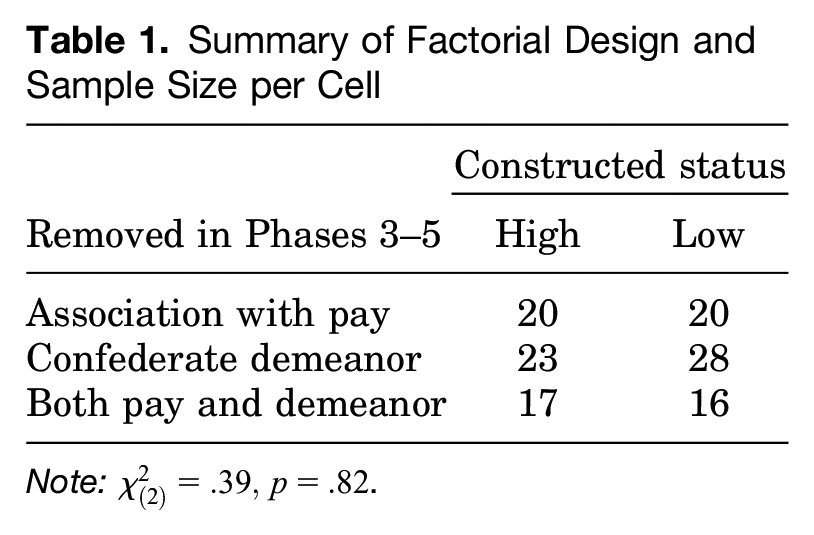
Note:
Combined, our manipulated factors allows us to explicitly test Hypotheses 1 and 2 on a newly constructed status characteristic while testing whether removing either aspect of the doubly dissimilar encounters is sufficient for status deconstruction. Moreover, the repeated phases with status deconstruction give us an opportunity to test for loss aversion in status beliefs between high and low status participants, as implied in Hypothesis 3.
Measures
The key measures are the influence behaviors and the participant reports of what most people think about the status value of S2s and Q2s. If the participant changes her mind on the meaning insight task, this is an indicator of social influence (Berger et al. 1977). The participant should stay with her initial opinion more often when she is paid more and interacts with a deferential confederate than when she is paid less and interacts with an assertive confederate. This behavioral measure taps the extent to which the participant supports the S2/Q2 distinction as a status characteristic and serves as a check for whether the participants are “acting” high or low status. The other key measure is the participants’ perceptions of how most people would rate the status value of S2s and Q2s. After each phase, we asked participants to rate S2s and Q2s (separately) on respected versus not respected, powerful versus powerless, low status versus high status, leader versus follower, competent versus incompetent, knowledgeable versus unknowledgeable, and incapable versus capable on 7-point Likert-type scales (Ridgeway et al. 1998). From these items, we can track the difference in the status beliefs of S2s and Q2s through time.
Results
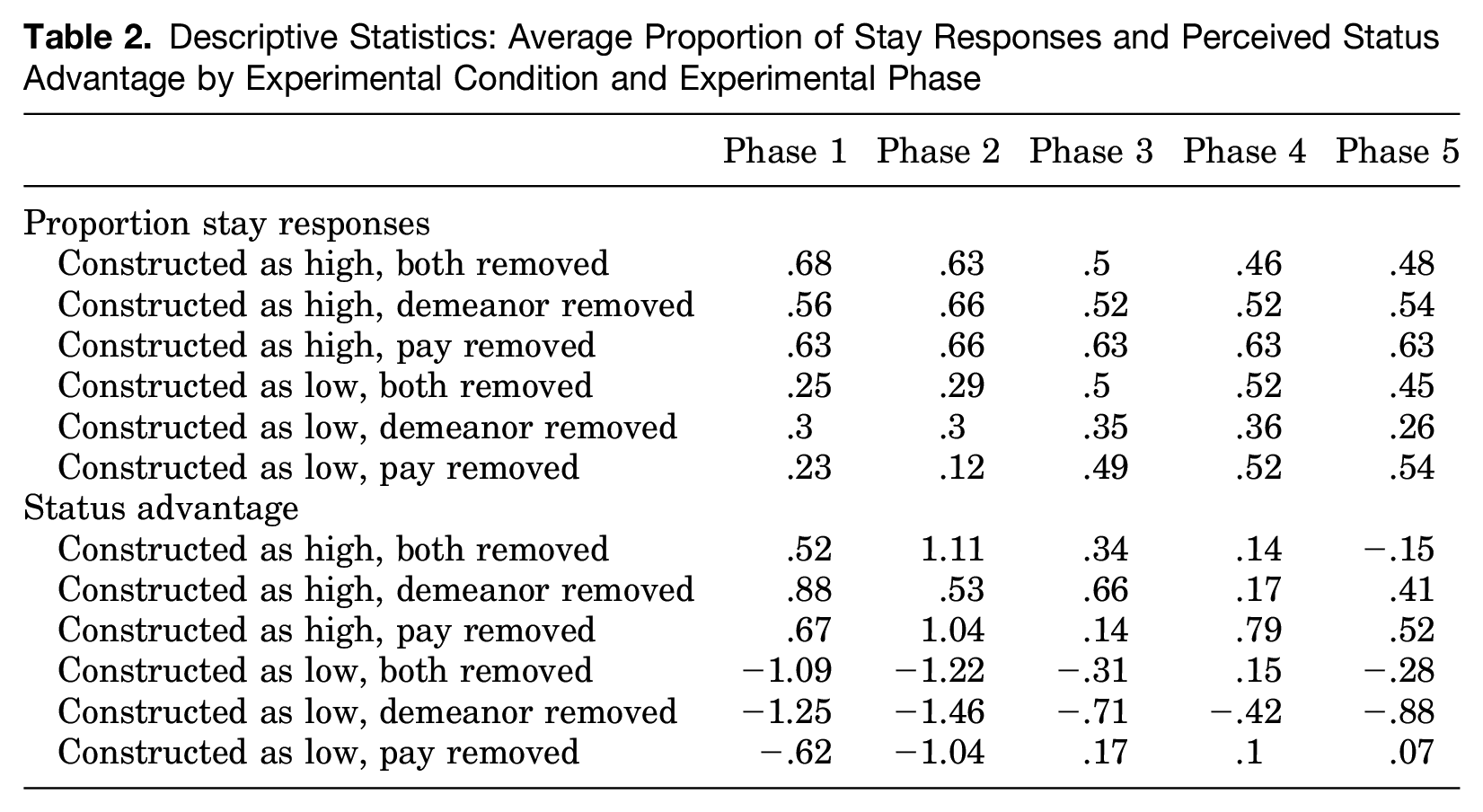
Based on our poststudy interviews with participants, we exclude responses from nine participants, leaving a final sample size of 124. 4 Six participants were suspicious that all partners were from the same category, and another three were suspicious that pay differences were equalized. Figure 1a visually presents the proportion of trials that participants resisted influence attempts from their confederate partners, and Table 2 presents the summary statistics that generated Figure 1. Even in Phase 1, we see stark differences in patterns of social influence. Specifically, participants who were paid more and who interacted with confederates who presented their arguments deferentially deferred less than participants who were paid less and who interacted with assertive confederates. Phases 3 to 5 are the phases intended to deconstruct the status characteristic that was constructed in Phases 1 and 2. We see clear differences in influence in the first two phases. Those differences diminish when the demeanor of the confederate changed in Phases 3 to 5 but not when only the pay differences changed.
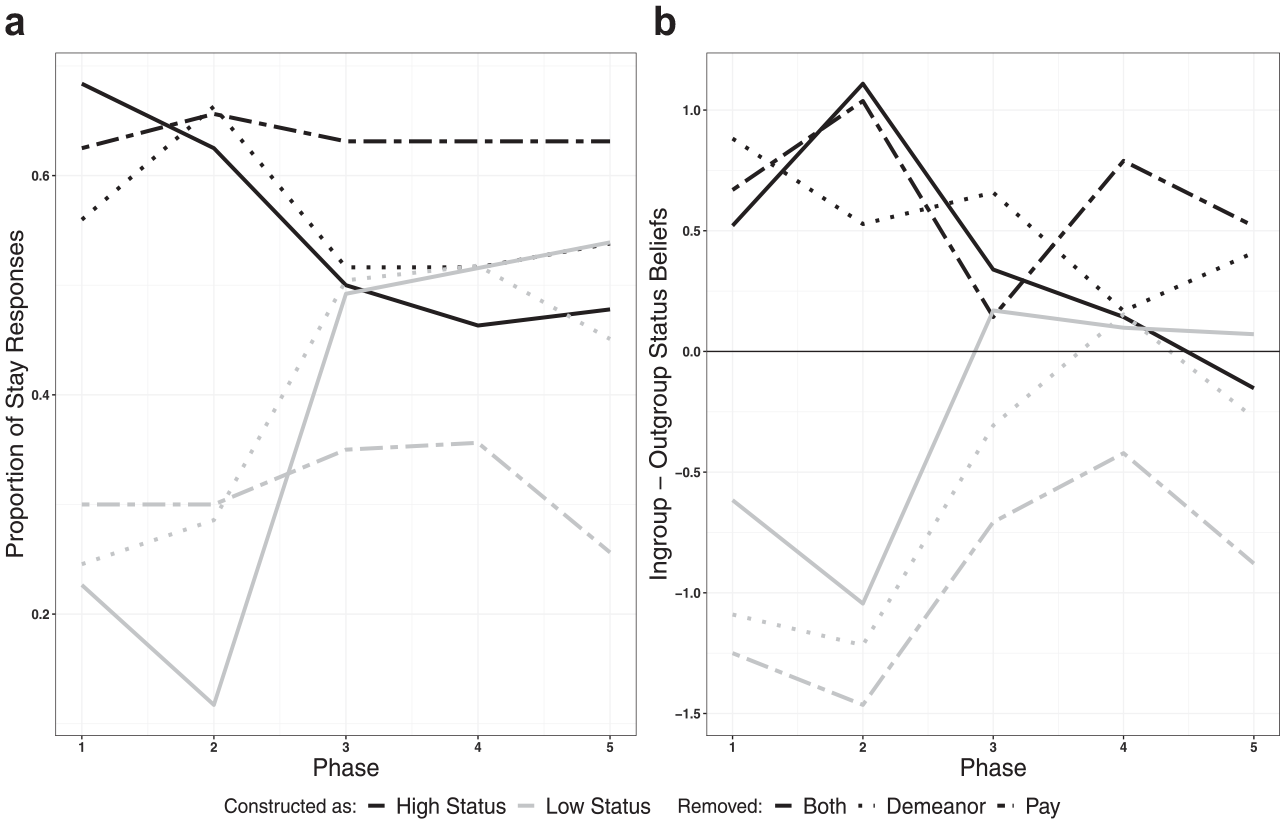
Proportion of Trials Rejecting Influence Attempts from Partner (a) and Differences in Group Status Beliefs (b) by Experimental Condition and Phase
Descriptive Statistics: Average Proportion of Stay Responses and Perceived Status Advantage by Experimental Condition and Experimental Phase
In terms of status beliefs, we measured participant perceptions of what most people believe about the status value of S2s and Q2s. Such legitimate status beliefs are at the core of status advantages in meritocratic settings (Correll et al. 2017) and drive behavioral compliance even in the absence of personal support for the status order (Melamed et al. 2019). After each phase, participants evaluated the status value of both S2s and Q2s. As with past work (Ridgeway et al. 1998), the items are reliable (all 10
Our first hypothesis is that removing the association with pay and the association with confederate demeanor in Phases 3 through 5 will reduce the extent to which both high and low status participants view the S2/Q2 distinction as a status distinction. To formally evaluate this, we estimated a series of linear mixed models. We treated status advantage in Phases 2 to 5 as nested in participants. We begin with Phase 2 because this is our baseline for status deconstruction: an existing nominal status distinction. By design, our experimental manipulations should impact these beliefs in different phases. As such, when we specified the effect of phase or time, we included interactions with experimental manipulations. We find that phase has a squared effect on status advantage (LR tests: cubic to squared,
Table 3 presents a summary of our final model, and Figure 2 shows marginal means from the model. Consistent with Hypothesis 1, we find that the differences in status beliefs between those constructed as high or low status in the first two phases diminish over subsequent phases. By Phase 3, low status participants no longer distinguish the status value of S2s and Q2s, but high status participants still do. For example, the confidence interval around −.32 for those constructed to be low status participants in Phase 3 of Figure 2 has an upper limit of .012, meaning that it is not different from zero, but the confidence interval around .47 for high status participants in Phase 3 has a lower limit of .12, which does not include zero. By the end of Phase 4, both initially high and low status participants no longer distinguish the status value of S2s and Q2s (both confidence intervals overlap with the reference line of zero). That is, removing the association with pay, the association with demeanor, or both decreases the status advantage for those constructed to be high status and increases the status advantage for those constructed to be low status. We do, however, find that the consensual nature of this breaks down in Phase 5. We see a decrease in the relative status beliefs of those constructed to be low status. This results in a difference between high and low status participants in Phase 5. 5 Nonetheless, we observe a consensual status hierarchy at the end of Phase 2, and then that status hierarchy significantly diminishes over subsequent phases by removing the association with pay, the association with demeanor, or both.
Summary of Linear Mixed Model Predicting Status Advantage
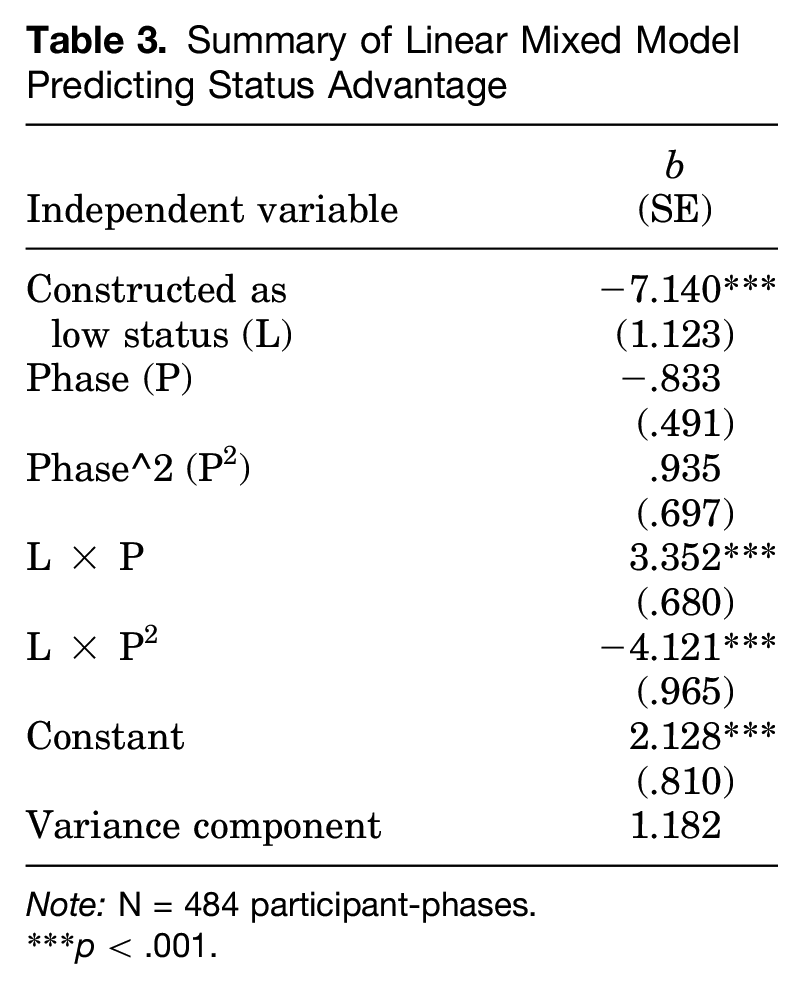
Note: N = 484 participant-phases.
p < .001.
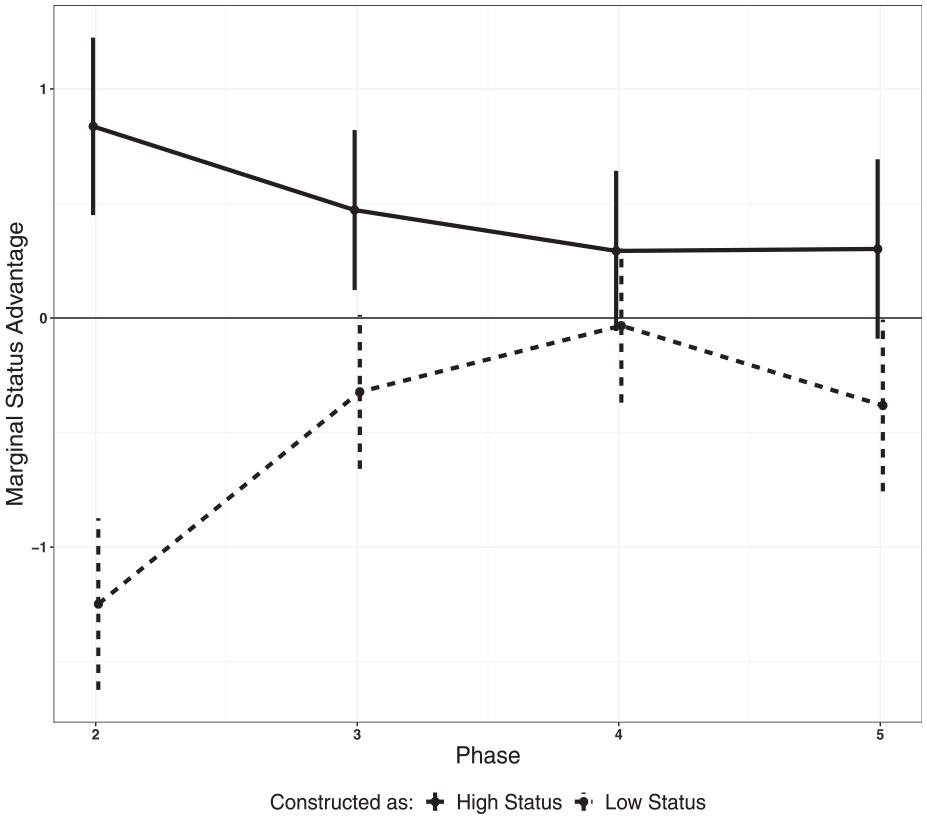
Marginal Status Advantage by Whether the Participant Was High or Low Status by the End of Phase 2, over Phases 2 through 5
Our third hypothesis addresses the possibility of loss aversion operating in the context of status advantage. Specifically, we predicted that high status participants would be slower to change their status beliefs than low status participants. The first evidence we point to in support of this hypothesis is in Table 3. The linear effect of phase captures the beginning of the trajectories of status advantage (while the squared term reflects the trajectory after the inflection point). The negative main effect (i.e., −.833) refers to the decrease in the status advantage for high status participants (the negative slope initiating the curve in Figure 2), and the positive interaction effect (i.e., 3.352) refers to the increase in the status advantage for low status participants (the positive slope initiating the other curve). The 95 percent confidence interval around the interaction effect is 2.02 to 4.68, significantly larger than .83 (the absolute value of the main effect for high status participants). That is, the trajectory of status advantage increases faster for low status participants than it decreases for high status participants.
More concretely, we computed the change in status advantage between Phases 2 and 3, Phases 2 and 4, and Phases 2 and 5. We recoded this variable so that positive values refer to a decrease in status advantage for initially low status participants (i.e., perceived status loss) and an increase in status advantage for initially high status participants (i.e., perceived status gain). This way, positive values refer to an increase in viewing S2/Q2 as a status distinction regardless of whether the participant was constructed to be high or low status. Figure 3 illustrates marginal recoded change in status advantage between Phase 2 and each subsequent phase by whether the participant was assigned to become high or low status. As illustrated in the figure, participants constructed to be high status change less than participants constructed to be low status following Phases 3 and 4, but by Phase 5, the difference in change between groups is no longer significant. This means that the status advantage for participants constructed to be low status is changing at a faster rate than it is for participants constructed to be high status.
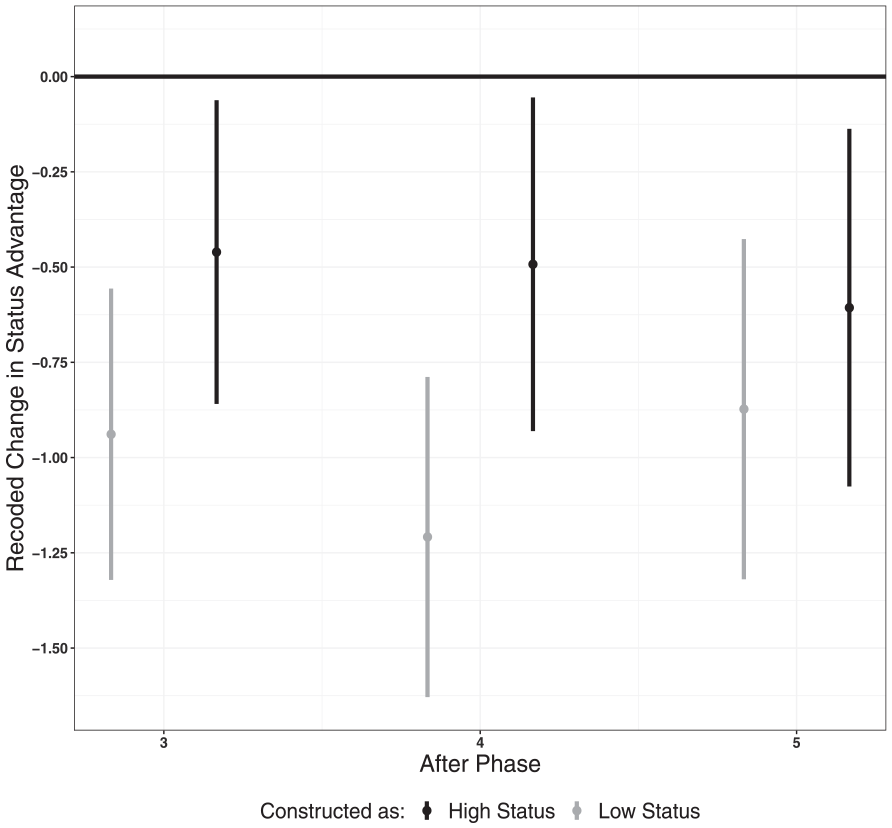
Recoded Change in Marginal Status Advantage by Whether the Participant Was Assigned to be High or Low Status by the End of Phase 2
Combined, these results show support for our core argument. Status deconstruction happened faster for low status participants than for high status participants (Figure 3), while the eventual result was deconstruction of a consensual status hierarchy. We also predicted that the dimensions of the doubly dissimilar encounter—demeanor or pay—would impact the extent of status deconstruction. Contrary to expectations, we found that the trajectories did not vary by this manipulation. But in the following, we report sensitivity analyses of the effects of this manipulation on the recoded change scores in status advantage.
Sensitivity analyses
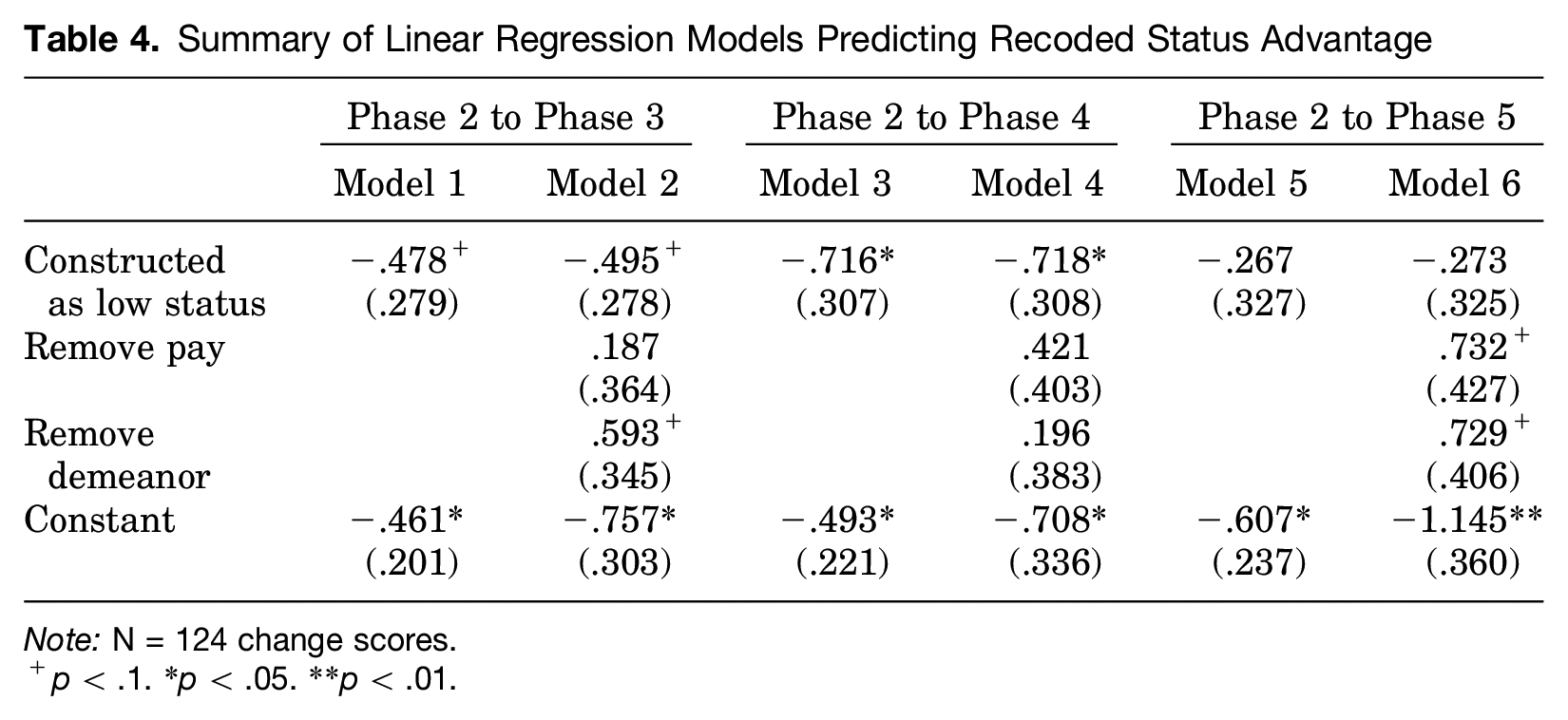
Existing work suggests important roles for reward differences (Cook 1975) and the experience of influence (Ridgeway et al. 2009). Status construction theory (Mark et al. 2009; Ridgeway 1991) further presumes repeated doubly dissimilar encounters to generate status differences. As such, we were surprised to see that removing either the association with pay or the association with confederate demeanor resulted in similar changes as removing both of those factors. To examine the effect of this factor in more detail, Table 4 presents six ordinary least squares regression models predicting the recoded changes in status advantage. For each change, we present models including only relative status and relative status and what we removed in Phases 3 to 5. These models use the recoded variable, reflecting decreases in status advantage for participants constructed to be low status and increases in status advantage for participants constructed to be high status. We include dummy variables for removing only one aspect of the doubly dissimilar encounter, with the reference category being that both were removed. Across all three models that include this factor, both of the coefficients are negative. Looking at the changes in status advantage from Phase 2 to Phase 5, we see that both conditions that removed only a single aspect of the doubly dissimilar encounter resulted in decreases thatapproach significance (p < .1). We present these results because we do notwant to imply that removing onlyone aspect of doubly dissimilar encounters will be sufficient for status deconstruction. Based on established scholarship and the trends we find in these supplemental analyses, we recommend caution in interpreting this result. What is more, we also note that removing only the association with pay did not alterthe behavioral patterns (Figure 1a).
Summary of Linear Regression Models Predicting Recoded Status Advantage
Note: N = 124 change scores.
p < .1. *p < .05. **p < .01.
Discussion
Our goal in this article is to develop predictions about status deconstruction and test those predictions under controlled conditions. We find support for much of our argument. Altering the structure of doubly dissimilar encounters can reduce the extent to which members view the characteristics as imbued with status value. Moreover, we find that those advantaged by status beliefs are slower to change their status beliefs than are those disadvantaged by them.
We believe this asymmetry in how status beliefs change has important implications for both conflict and stratification. When status beliefs are not consensual, group members become withdrawn, and performance suffers (Allinor 2021; Kilduff, Willer, and Anderson 2016). Such asymmetries in implicitly held group differences in competence and worth are at the heart of tribal conflicts outside of small group settings (Fiske 2002), and mitigating such conflicts requires understanding how they come about. Because high status actors occupy many gatekeeping roles and are more likely to use status beliefs that advantage their ingroup, institutional allocations will more likely be inequitable (Correll et al. 2017).
We attribute the asymmetry in status beliefs by relative status to loss aversion. Specifically, we assume that participants are more averse to status loss than they are keen to gaining a similar amount of status. Such a self-bias is also found in the original experimental test of status construction theory (Ridgeway et al. 1998). Ridgeway and colleagues (1998: 340, Table 2) found that participants constructed to be high status reported a larger status advantage than the status disadvantage of participants constructed to be low status. That is, in status construction, there is some evidence of asymmetric status acquisition. Whether this empirical pattern results from self-bias, ingroup bias, or loss aversion is unclear because all three would generate the same empirical patterns. Here we highlight this asymmetry but note that such an asymmetry is not explicitly part of status construction theory. Subsequent research is needed to establish the extent of loss aversion/self-bias in status construction, and hopefully a clever empirical strategy can distinguish loss aversion from self-bias in subsequent research.
One of our main hypotheses was not supported. Contrary to expectations, we found that all three of our experimental conditions for status deconstruction resulted in similar trends in status beliefs. We anticipated that confederate demeanor would have a stronger impact than pay differences (Hypothesis 2). On the one hand, our empirical evidence shows that all three conditions are equivocal in terms of status advantage scores. On the other hand, the abstract nature of our experimental setting and the somewhat arbitrary nature of our manipulations make this result hard to interpret. This is easiest to understand with pay differences. There were differences of approximately $3 separating high and low status participants. If we used different values, the effect of this manipulation would be different. As such, it is hard to compare demeanor with pay when they do not have a naturally comparable metric and were observed only at certain levels(that cannot be standardized for comparisons). Subsequent work hoping to compare demeanor and pay should pay careful attention to the magnitudes of these factors that are used in empirical studies.
The two main diffuse status characteristics in the United States are race and gender. These status distinctions have been the subject of countless studies of both macro and micro stratification, and there are reasons to expect status deconstruction to operate differentially for entrenched statuses. That is, we cannot assume that our work has direct bearing on these characteristics because there are a variety of reasons to suspect that the deconstruction of a status characteristic “in the wild” will be quite different than in the lab. Both race and sex are imbued with cultural meanings that our experimental manipulation lacks. Still, our work may raise useful questions for the deconstruction of status differences by gender and race. In terms of gender, despite progress in women's earnings and career outcomes for much of the twentieth century, the gender revolution has largely stalled (England 2010). Occupations that have traditionally been feminine-typed or that currently employ more women than men tend to be devalued in terms of general social status, occupational prestige, and pay (Busch 2018; Cohen and Huffman 2003; Valentino 2020). Stereotypical views of “women’s work” then impact job polarization and economic structures by extending tocare-based occupations with both highand low levels of pay (Dwyer 2013). As such, men should be less likely to occupy traditionally feminine occupations because those occupations are perceived as lower status by men than they are bywomen. Addressing the cultural devaluation of women may help to reduce the devaluation of feminine-typed occupations, which could in turn reduce structural economic inequalities (Magnusson 2009). As our results suggest, the comparatively conservative gender status beliefs of men lag behind those of women because they are presumably changing at a slower rate. Men's reluctance to let go of their relative status explains, for example, why despite labor market entry by women, the division of household labor remains unchanged (Hochschild and Machung 2012).
In terms of race, the threat of changing status has often generated white backlash that serves to maintain inequality (Hewitt 2005; Hughey 2014). White people in the U.S. context maintain status advantages that, in part, result in better jobs, higher income, assumptions of competence, and higher levels of political leadership (Bonilla-Silva 1997; Ridgeway 2014). When those status advantages have been threatened, high status actors have worked quickly to secure them. For example, calls for racial justice in 2020 have given way to restrictions in voting rights and school curricula that look to be more fundamental and long term than the protests that preceded them (Jefferson 2022). Although these changes occur institutionally, they possess within them implicit claims of worth, such as whose votes should be counted. Here, loss aversion from high status actors has the potential to create an even less equal society than the one that existed before because of backlash.
Loss aversion shows that even as people racialized as black assert their claims to a higher status, it may be difficult to achieve consensus to those claims if racial majority members continue to push back against them. This is also true for other people of color, such as Hispanic Americans, who share relatively low racial status with Black Americans, and Asian Americans, who face status challenges because of their perpetual foreigner assignment (Jimeno-Ingrum, Berdahl, and Lucero-Wagoner 2009; Zou and Cheryan 2017). The understanding of loss aversion that this article uncovers bolsters the idea of interest convergence (Bell 1980)—unless status gains for other racial groups secure the status of White people, they are unlikely to succeed.
As our discussion highlights, applying our theory to understand gender or racial status dynamics entails also considering the culturally and historically specific contexts of those status beliefs. Subsequent work should consider the competing social processes operating in real-world settings and whether/how they can alter status deconstruction processes. But understanding the basic process of status deconstruction can shed light on gender and racial status inequalities and other status distinctions that may be relevant to small groups (e.g., rank or specific abilities). Our work implies that altering the reward structure alters beliefs about competence. If institutions wanted to create equity, our work suggests that they could contribute to it via reward structures that advantage individuals who are status disadvantaged.
In conclusion, based on combining the logic of status construction theory (Ridgeway 1991) with the notion of loss aversion from decision theory (Tversky and Kahneman 1992), we developed three novel hypotheses about status loss and asymmetries in that process for high and low status individuals. Results of a controlled laboratory experiment support much of our argument. We found that removing the association with pay, the assertive demeanor of confederate, or both reduced consensual status beliefs. Sensitivity analyses found these results to be strongest when both are removed. We also demonstrated that low status individuals change their beliefs faster than high status individuals. This period of asymmetry has implications for group conflict when expectations are not consensual, making this a particularly important topic for future work.
Footnotes
Acknowledgements
We thank Alison Bianchi, Will Kalkhoff, and Cecilia Ridgeway for valuable feedback and discussions, and we thank Cecilia for sharing her research materials with us.
Funding
The author(s) disclosed receipt of the following financial support for the research, authorship, and/or publication of this article: The research reported here was funded in whole under Award SES-1917256 from the National Science Foundation. The views expressed are those of the authors and should not be attributed to the National Science Foundation.

1
This change in data collection was due to the COVID-19 pandemic. Forty-four participants completed the study in person, and the remaining 89 completed it online. The mode of administration is unassociated with whether cases were removed for being suspicious of protocols (
2
We counterbalanced (randomized) on whether participants were assigned to be an S2 or a Q2.
3
The in-person participants filled out a paper form. The online participants answered questions in the program.
5
The 95 percent confidence interval for status advantage for low status participants in Phase 5 is −.76 to −.01, which technically means that low status participants distinguish the status value of S2s and Q2s at the end of Phase 5.