




Abstract
Legitimacy is crucial for the effectiveness of leaders in the workplace. We investigate pathways by which authorities in the workplace gain legitimacy and how they differ by authority race. In addition to leaders’ behaviors, subordinates’ impressions of leaders’ competence and warmth, stemming from those behaviors, impact their views of leader legitimacy. We further assess how the role of mediating impressions depends on the race of the authority enacting the behaviors. In an experimental vignette study, we manipulate the authority’s actions (use of fair procedures and power benevolently) and race (Black/white) and measure perceived competence, warmth, and legitimacy. Results indicate that the effects of leader behaviors on legitimacy operate through impressions of competence and warmth. Moreover, authority race alters this pathway; behaviors operate through competence impressions for white managers and through warmth impressions for Black managers. Our study illuminates how leaders gain legitimacy at work and how this process is racialized.
A significant source of racial inequality in the workplace has been the persistent gap in leadership and executive roles between Black and white workers. For instance, most Fortune 500 CEOs are white men, with Black leaders running only 1 percent of the companies (Fortune 2022). Widely held stereotypes and beliefs about social categories lend cultural backing and justification to hierarchies in which individuals from privileged social categories, such as white people in the United States, hold authority positions while those from disadvantaged groups, such as people of color, occupy subordinate roles, ultimately maintaining such leadership disparities (Ridgeway and Correll 2006). Thus, even when socially disadvantaged workers do gain positions of authority, they are often not seen as deserving of the role and may face more difficulty in proving themselves as worthy of their positions in the workplace in comparison to men and white workers (Foschi 2000; Ridgeway and Nakagawa 2014; Vial, Napier, and Brescoll 2016). In other words, when Black workers achieve leadership positions, they often struggle to establish and maintain their legitimacy.
Legitimacy is defined as “a generalized perception or assumption that the actions of an entity are desirable, proper, or appropriate within some socially constructed system of norms, values, beliefs, and definitions” (Suchman 1995:574). Leaders who are legitimated have garnered social support and approval (Johnson, Dowd, and Ridgeway 2006; Zelditch and Walker 1984), which provides them with greater freedom of action and fewer challenges from their workers (Tyler 2010). Without legitimacy, authorities risk the noncompliance of subordinates and face greater scrutiny in their actions, which together threaten the achievement of workplace goals (Vial et al. 2016). In sum, leaders aim to gain legitimacy in the eyes of their subordinates to maintain authority. However, complexities in the pathway to legitimacy abound (Hegtvedt et al. 2022) and, as previously suggested, establishing oneself as legitimate may be especially difficult for people of color who do not fit the prototypical image of a business leader as white (Rosette, Leonardelli, and Phillips 2008).
While much sociological work illustrates disadvantages associated with racial status in the United States (e.g., Omi and Winant 2014; Ridgeway and Correll 2006), substantially less work examines mechanisms of interaction that link race to the perception of an authority’s legitimacy. As such, we draw upon social psychological theories anchored in cultural beliefs, including those about race, to investigate specific pathways by which members of racially disadvantaged groups, specifically, Black authorities, can gain legitimacy in the workplace, thereby moving toward overcoming persistent leadership inequalities. We build on recent work demonstrating that authorities gain legitimacy at work through behavioral strategies, such as using fair procedures in decision-making (see Tyler, 2010) and using their power in a benevolent fashion to provide resources to subordinates to facilitate their work (Hegtvedt et al. 2022).
We augment previous work by considering a mechanism by which behaviors affect legitimacy that, we propose, works differently depending on authority race. We argue that procedural justice and benevolent power use produce consequential impressions of authorities, thereby constituting an indirect pathway to legitimacy.Specifically, we focus on thetwo fundamental dimensions of impressions: competence and warmth (Wojciszke, Bazinska, and Jaworski 1998). Competence reflects appraisals of an authority’s efficacy, intelligence, and capability, while warmth evaluations stem from appraisals of friendliness, likeability, and kindness (Cuddy, Glick, and Beninger, 2011). Increasingly, scholars (Cuddy et al. 2011; Koenig et al. 2011) claim that both competence and warmth are necessary for effective leadership (especially in organizational contexts requiring collaboration, teamwork, and task interdependence). As such, we argue that behaviors that enhance an authority’s legitimacy do so through shaping impressions of the authority as competent and warm.
Additionally, impressions of competence and warmth are tied to race. Advantaged groups, like white people, tend to be considered more competent compared with other disadvantaged groups, like Black people, that are viewed as more reactive and agreeable (i.e., warm) (Omi and Winant 2014; Rogers 2019a; Schröder et al. 2013). These impressions, therefore, are likely to have implications for how Black versus white authorities gain legitimacy.
By considering these impressions as a mechanism by which behaviors affect legitimacy, we uniquely illuminate the racialization of the legitimacy process. Figure 1 illustrates our theoretical model, consisting of all positive relationships, linking behaviors to impressions and both to legitimacy. The shaded part of the model highlights our particular emphasis on impressions fostering pathways to legitimacy dependent upon the authority’s race.
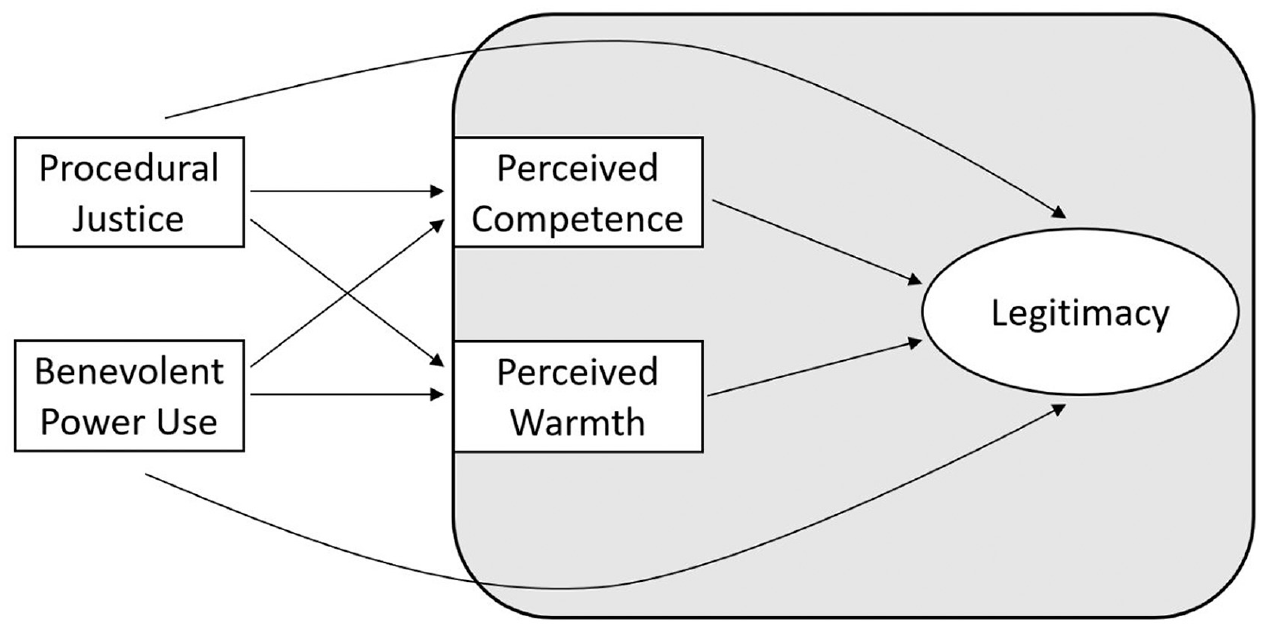
Pathways to Legitimacy with Shading Indicating Racialized Paths
To assess the impact of behavioral strategies and impressions on legitimacy, we first describe identity- and resource-based behavioral strategies for gaining legitimacy supported by previous empirical work. We then draw from two social psychological frameworks whose premises rely upon shared cultural beliefs about behaviors and statuses. Affect control theory (ACT; e.g., Robinson and Smith-Lovin 2018) helps to address the proposed associations between the behaviors of authorities and the impressions of warmth (evaluation) and competence (potency) that they evoke (see Rogers, Schröder, and Scholl 2013). We incorporate a range of empirical work to substantiate our proposal that competence and warmth impressions enhance legitimacy and mediate the effects of the behaviors on legitimacy. Expectation states theory (EST; e.g., Berger, Rosenholtz, and Zelditch 1980) provides the basis for status arguments, complementing identity elements inherent in ACT, regarding our theorizing about how an authority’s race shapes the role of the impressions as a pathway to legitimacy. In doing so, we argue that race permeates the legitimacy process.
To investigate these linkages, we conducted an experimental vignette study in which we manipulate an authority’s behaviors and race (white or Black male). Study participants were working adults, half of whom identified as Black and half as white. To assess the proposed racialized pathways to legitimacy, we used multigroup structural equation modeling, which allows us to examine specific direct and indirect effects of the authority’s behaviors and resulting impressions on the authority’s legitimacy. Such a strategy simultaneously estimates our hypothesized model across subgroups to assess whether the authority’s race moderates the relationships among all factors specified in the model. We also explore whether this process differs for situations involving white and Black subordinates. Our study thus offers a novel view, both theoretically and empirically, of the extent to which pathways to legitimacy may diverge depending on the authority’s race.
Conceptualizing Legitimacy and Behavioral Pathways
Legitimacy
As previously noted, the legitimacy of an individual, social entity, or social order stems from people’s views of it as desirable, proper, or appropriate, thus conveying the object’s taken-for-grantedness and wide acceptance (Johnson et al. 2006; Suchman 1995; Zelditch and Walker 1984). When individuals personally approve of a social entity, they are likely to conform to its directives. Furthermore, when individuals perceive a social entity to enjoy wide social acceptance and approval, they are likely to feel obligated to conform to the social order regardless of their own opinions (Johnson et al. 2006; Zelditch and Walker 1984). Legitimated authorities also engender willing cooperation, going beyond a passive acquiescence to include voluntary, “everyday” adherence to rules and regulations and even assistance to authorities carrying out responsibilities (Tyler and Jackson 2014). For these reasons, legitimacy is crucial for the effectiveness of workplace authorities managing subordinates.
In hierarchical organizations, an authority’s legitimacy may stem from that bestowed upon the position per se as represented within the hierarchy (Weber 1978). Yet, legitimacy comes from sources beyond the hierarchical position itself. Dornbusch and Scott (1975) identify additional sources, including authorization by those in upper echelons of the hierarchy and support (endorsement) from subordinates. Legitimacy derived from subordinates’ approval and support, and their perceptions that their coworkers share these sentiments, ensures authorities’ effectiveness in securing collaboration among subordinates and optimizing their performance, especially on interdependent tasks (see Yoon and Thye 2011). How authorities behave toward their subordinates constitute a means by which they may achieve legitimacy.
Behavioral Strategies Enhancing Legitimacy
Previous research demonstrates ways for authorities to gain legitimacy in the eyes of subordinates by leveraging identity concerns and resources in their interactions with subordinates (Hegtvedt et al. 2022). Tyler (e.g., 1997, 2001) offers an identity-based approach to legitimacy, focused on procedural justice in decision-making. Key to ensuring that procedures are just (see Jost & Kay, 2010) is representativeness, or the opportunity for those affected by a decision to “voice” their views to the decision maker (Leventhal, Karuza, and Fry 1980). The identity-based model presumes that people value how decision-making procedures unfold beyond the consequences for securing outcomes because people want to be well regarded within their groups, and such processes signal to subordinates the extent to which an authority values them. An authority’s use of fair procedures boosts the dignity and self-esteem of workers, which increases their commitment to the group. Identifying with the group, then, increases the likelihood that subordinates will see the leader as legitimate (e.g., Hegtvedt et al. 2022; Mueller and Landsman 2004; Tyler 1997).
Complementing the identity-based approach, a resource-based model highlights the role of power use, drawing from work in social exchange (e.g., Blau 1964; Lawler, Thye, and Yoon 2009; Molm 2006). Power is typically conceived as the ability of actors to impose their will over others through their control of resources that others value (e.g., Cook and Emerson, 1978; Weber 1978). Such imposition of will may be coercive, involving the threat or use of punishment, or, as Blau (1964) describes, benevolent, contributing to the welfare of workers. In the workplace, benevolent power use involves providing resources and opportunities to workers to facilitate their job performance and professional growth (Hegtvedt and Johnson 2009). It is in the leader’s interest to cultivate subordinates’ job performance, and subordinates depend upon the authority to get theirjobs done. The use of benevolent power is akin to power use in reciprocal exchanges that involve performing a beneficial act for another without anticipation of direct reciprocation (Molm 2006). 1 These actions increase subordinates’ attachment to and identification with the leader (Dulebohn et al. 2012; Scholl et al. 2017), which then paves a way to gaining legitimacy.
How subordinates interpret legitimacy- enhancing behavioral strategies—the impressions they form of an authority—are critical for understanding variation in pathways to legitimacy for white and Black authorities. Thus, we turn to how the behaviors shape impressions of competence and warmth and how those impressions shape legitimacy as well as how the authority’s race affects the role of the impressions as a pathway to legitimacy.
Competence and Warmth Impressions Mediating Pathways to Legitimacy
We draw upon ACT to illustrate how an authority’s behaviors evoke affective meanings, captured as impressions of competence and warmth. Empirical patterns from previous research complement ACT reasoning to bolster the (positive) relationships between the behaviors and impressions depicted in Figure 1. We augment this reasoning with other empirical studies and elements of EST to motivate the connections between impressions and authority legitimacy. In doing so, we highlight how impressions operate as a mediating mechanism creating pathways to legitimacy.
Authorities’ Behaviors and Competence and Warmth Impressions
ACT emphasizes the culturally shared meanings associated with identities, behaviors, and objects (Robinson and Smith-Lovin 2018). The theory presumes that people seek consistency between cultural meanings, such as for a behavior and the assessment of an actor, which shapes people’s perceptions and expectations in a situation. The meanings fall along three affective dimensions: evaluation (E: good vs. bad), potency (P: weak vs. strong), and activity (A: calm vs. excited) (Osgood, May, and Miron 1975). Affective meanings of behaviors represented by evaluation and potency signal warmth and competence, respectively (Rogers et al. 2013).
Few ACT studies directly examine an authority’s use of procedural justice or benevolent power. Yet, the dictionaries of affective meaning created by ACT researchers (University of Georgia 2022) tap into components of each behavior. Providing voice to subordinates to ensure procedural justice corresponds to the affective meanings of behaviors such as “consult,” “confer with,” and “listen to,” which convey warmth and, to some extent, competence. At the core of benevolent power use is an authority’s willingness to provide resources, thereby “supporting” subordinates and not “coercing” them. Thus, benevolent power use is likely to convey both warmth and competence.
Complementing ACT, other empirical studies reinforce the nature of the impressions evoked by an authority’s behaviors. By using fair procedures, an authority reduces workers’ uncertainty regarding how the leader views them (Van den Bos and Lind 2002), thereby engendering worker commitment and job satisfaction (e.g., Liao and Rupp 2005). Use of fair decision-making procedures also enhances the perceived effectiveness of authorities (Pierro et al. 2014), implying greater competence. And to the extent that procedural justice in decision-making suggests that leaders act honorably and beneficially toward others, it evokes images of friendliness, likeability, and care, all pertinent to warmth assessments (e.g., Chory 2007; Colquitt 2001).
When authorities use power benevolently toward workers, they contribute to the shared group task of accomplishing work and indicate their managerial skill, thereby demonstrating competence. Subordinates view authorities as competent and successful in achieving productivity when they provide them with needed resources (Kanter 1977). Additionally, Blau (1964) noted that actors who provide resources to others gain status and engender obligations from the subordinates (Lawler et al. 2009). Such status gains presume competence (Berger et al. 1980).
Insofar as benevolent power use cultivates feelings of mutual obligation and reciprocity between the authority and subordinates (Blau, 1964), such actions should promote perceptions of the authority’s warmth. Studies guided by the stereotypecontent model suggest that structural relationships inducing cooperation enhance perceived warmth (Fiske, Cuddy, and Glick 2007). Moreover, using power benevolently shows the leader’s concern with workers’ well-being, facilitating the authority’s identification with them (Scholl et al. 2017) and workers’ feelings of value to the group. Such identity-sharing consequences anchor subordinates’ perceptions of the authority’s warmth. In sum, the behaviors of using procedural justice and benevolent power will be positively related to competence and warmth.
Competence and Warmth Impressions and Legitimacy
An array of empirical studies motivated by various psychological theoretical traditions offer evidence of positive relationships between competence and warmth impressions of authorities and perceptions of them as legitimate, and of the role these impressions play as a mediating mechanism. As a key ingredient for effective leadership (Cuddy, Kohut, and Neffinger 2013), competence is likely to enhance legitimacy. Subordinates’ assessments of their authority as intelligent, skillful, and capable signal the extent to which the authority can lead the team effectively. Tyler (1994) shows that when subordinates see authorities as possessing competence and problem-solving abilities, they judge them as more legitimate. In contrast, incompetent authorities face challenges and lack of support from subordinates, indicating failure to achieve legitimacy (Taylor et al. 2002).
Additionally, EST (Berger et al. 1980) demonstrates that individuals believed to be competent enjoy more opportunities to participate in groups, receive more positive evaluations of their input, and ultimately gain more status and influence than those perceived to lack competence. This process likely engenders views of such authorities as more legitimate in leadership roles than authorities perceived as incompetent.
Views of effective leaders have evolved to include traits such as warmth and sensitivity, in addition to competence, especially in contexts requiring task interdependence and teamwork (Cuddy et al. 2011; Koenig et al. 2011). Indeed, individuals who demonstrate warmth through “friendly, other-oriented behaviors” at work are more likely to be viewed as a leader (Porath, Gerbasi, and Schorch, 2015:3). Cuddy et al. (2013) argue that a leader’s demonstration of warmth toward subordinates facilitates the establishment of trust, which encourages compliance with directives, even when unsupervised, and personal adoption of the values and goals of the team or organization. Such processes enhance group identity, which, consistent with the identity- and resource-based approaches to legitimacy, increases the likelihood that subordinates will perceive their authority as legitimate (Hegtvedt et al. 2022).
Impressions of competence and warmth, moreover, are likely to mediate the relationship between authorities’ behaviors and subordinates’ perceptions of them as legitimate. In interpreting others’ behaviors, individuals primarily rely on their perceptions of individuals’ intentions (signaled by warmth) and abilityto carry out those intentions (connectedto competence) to inform theirassessments of social situations (Wojciszke et al. 1998). Such impressions of competence and warmth consciously or subconsciously trigger subsequent evaluations of people (Fiske and Taylor 2021). Presuming an authority to be competent and warm may stimulate inference of other positive characteristics (see Uleman 1999), such as the legitimacy of an autho-rity. Thus, we expect that authorities’ behaviors that enhance legitimacy do so through positively shaping impressions of the authority as competent and warm.
Racialization of the Pathways to Legitimacy
To understand how pathways to legitimacy, captured by competence and warmth impressions, differ for Black and white authorities requires additional consideration of how cultural beliefs about race in the United States have shaped the trajectories and possibilities for Black leaders. Racial beliefs about social groups deigned (un)suitable to occupy positions of authority stem from patterns of historic stratification, exclusion, and framing (Feagin 2020; Omi and Winant 2014). As a result of such practices, impressions of social groups transform, and people come to categorize members of some social groups (e.g., white, men) as more competent and therefore suitable for leadership roles while casting members of other, disadvantaged social groups (e.g., Black, women) as warmer and thus more suited to subordinate roles (Ridgeway and Correll 2006; Rogers 2019a). Yet, these cultural beliefs do more: they contribute to perceptions of the legitimacy of racial hierarchies, suggesting that advantaged (white) persons are deserving of authority positions while disadvantaged (Black) persons deserve inferior roles (Ridgeway and Berger 1986; Rogers 2019a). That people also tend to assume others share and endorse these beliefs lends further justification to racial hierarchies (Ridgeway and Berger 1986).
ACT and EST detail in different wayshow such cultural beliefs imbue individual-level processes of categorization and meaning making that maintain and reproduce inequality among social groups. These traditions lend insight into how the authority’s race shapes the role of the impressions evoked by the behaviors proposed to enhance legitimacy.
ACT proposes that culturally shared meanings associated with racial identities inform expectations for individuals and views of appropriate behaviors in social situations. The affective meaning profile associated with white people, higher potency (competence) than evaluation (warmth), matches the meaning profile attached to authority roles, whereas meanings associated with Black people, higher evaluation than potency, are more akin to the meaning profile representing subordinate roles (Rogers 2019a; Schröder et al. 2013). When faced with an incongruency between fundamental meanings and those evoked in an interaction (such as a subordinate encountering a Black authority figure), people attempt to rectify the inconsistency by reinterpreting their understanding of the situation to align with their fundamental meanings (Robinson and Smith-Lovin 2018). For Black authorities, behaviors that convey competence should reduce perceived incongruence by bringing the situational meanings in closer alignment to fundamental meanings about authorities, and behaviors bolstering warmth impressions confirm expectations associated with a Black identity. Thus, both competence and warmth impressions for Black authorities should enhance their perceived legitimacy. In contrast, white authorities demonstrating competence affirm meanings associated with both white and authority identities. Thus, in contrast to the impressions that matter for Black authorities, competence impressions alone should contribute to perceptions of white authorities as legitimate.
Reasoning from EST (Berger et al. 1980) produces a similar pattern of racialized pathways to legitimacy for Black and white authorities. When deciding whether to confer status/influence, groups evaluate contributions to a task made by individual members based on two dimensions: whether the contribution is competent and whether it is offered for “group-oriented or self-oriented purposes,” which signals warm intentions (Ridgeway 1978, 1982; Shackelford, Wood, and Worchel 1996). The importance of these dimensions, however, depends on the diffuse status characteristics (such as race) of the member making the contribution. People expect individuals possessing a high level of a diffuse status characteristic in a society, such as a historically advantaged racial category (white), to be more competent, whereas they expect those possessing the lower level of the characteristic (Black) to be less competent but more communal (Conway et al. 1996) and socially considerate (Ridgeway and Correll 2006). Given these patterns, groups evaluate the task contributions of high-status members solely based on whether they convey competence. In contrast, group members are less accepting of the contributions of the presumably less competent low-status actors unless their contributions signal both competence and the desire to benefit the group rather than oneself. Only under such conditions do other group members grant low-status actors influence and increased status in the group. Thus, EST suggests that for white authorities holding the more highly valued state of the diffuse status characteristic, competence alone should mediate the effects of the behaviors on legitimacy, whereas for Black authorities, the impressions of both competence and warmth should matter.
Thus, drawing from two social psychological theoretical traditions, we suggest that Black authorities must manage two fundamental impressions to gain legitimacy, whereas white authorities generally need to manage only one. The proposed differences in how impressions mediate the relationship between behaviors and legitimacy may partially explain how gaps in the legitimation of white and Black authorities can persist even if authorities behave in the same legitimacy-enhancing ways.
Given that within a culture, fundamental meanings associated with identities are largely shared (Robinson and Smith-Lovin 2018), as are status beliefs (Ridgeway and Correll 2006), we expect that the proposed pathways to legitimacy operate similarly regardless of whether a subordinate is white or Black. Nonetheless, we recognize that individuals’ fundamental meanings may diverge based on background experiences, social class, and demographic characteristics, including race (e.g., Rogers 2019b). Thus, we also empirically explore whether the legitimacy process for white and Black authorities differs depending on the race of the subordinate.
Method
Design
Data come from an experimental vignette study titled “Workplace Dynamics.” We adapted a vignette of a hypothetical manager-employee work situation from Johnson, Ford, and Kaufman (2000). We manipulated three factors: (1) use of fair decision-making procedures (high/low), (2) use of benevolent power (high/low), and (3) the race of the manager (black/white). The 2 × 2 × 2 factorial design resulted in eight versions of the vignette. We randomly assigned study participants to read one vignette. Our between-subject design minimizes social desirability (Auspurg and Hinz 2015) and respondents’ ability to detect the experimental manipulations. Reading the vignette and completing a questionnaire took 10 to 15 minutes (median = 13.80).
Study Participants
The Survey Research Lab (SRL) at a large state university, in partnership with Dynata, collected vignette responses online from samples of working adults. The goal was 100 respondents per vignette, with Black females, white females, Black males, and white males each representing 25 percent. Data collection proceeded until we procured a satisfactory number of respondents who accurately recalled the name of the manager described in the vignette that they read (e.g., Pedulla 2014). 2 We worked with Dynata to ensure randomization within our final sample and conducted successful randomization checks for internal validity. Our final sample of 673 included 363 white respondents (182 males, 181 females) and 310 Black respondents (140 males, 170 females). The number of respondents in each condition varied from 72 to 90, with missing data on questionnaire items distributed across all vignettes. Table 1 provides descriptive characteristics of the study participants and the variables included in the model.
Means and Standard Deviations for Key Variables and Sample Characteristics
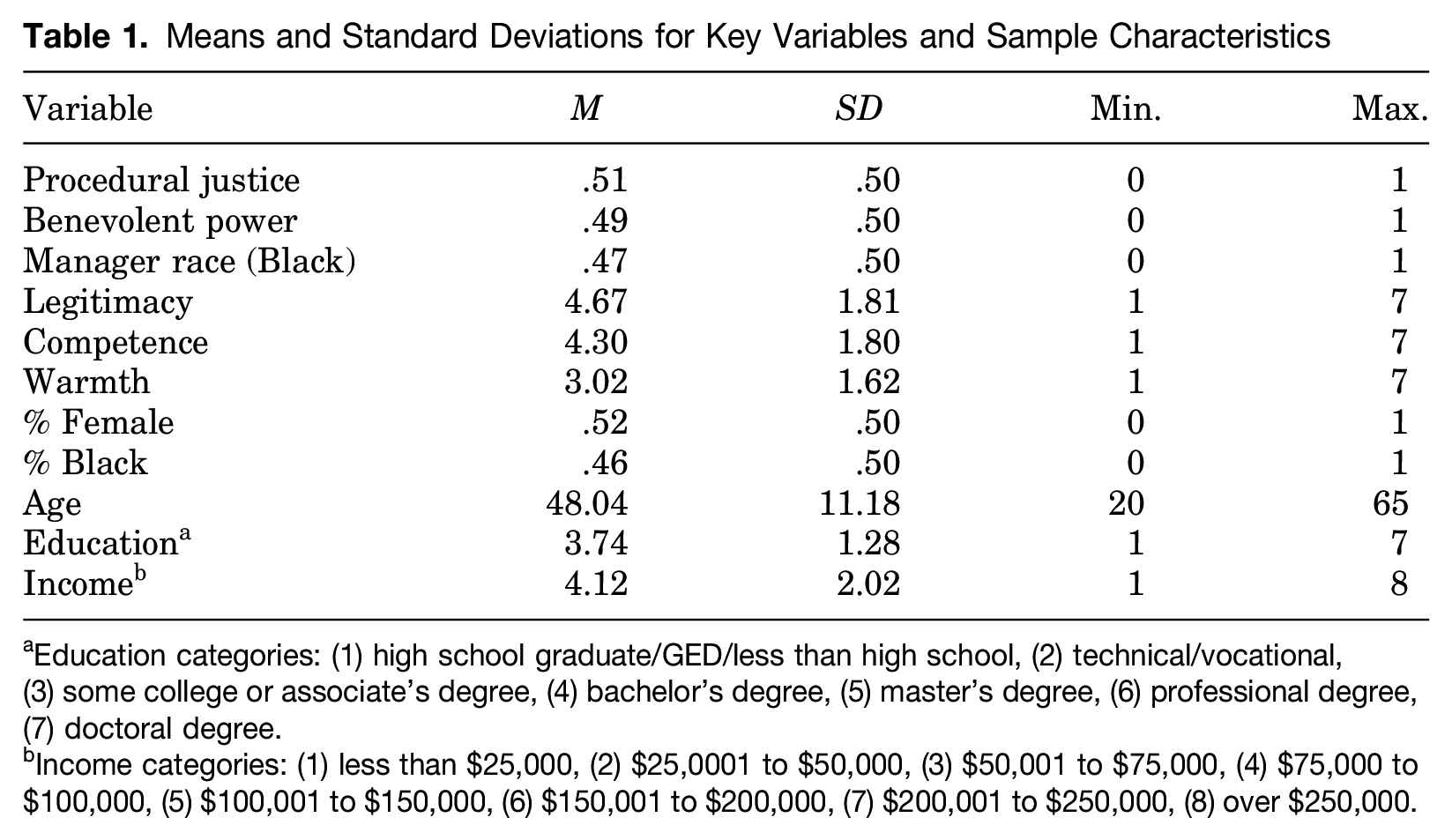
Education categories: (1) high school graduate/GED/less than high school, (2) technical/vocational, (3) some college or associate’s degree, (4) bachelor’s degree, (5) master’s degree, (6) professional degree, (7) doctoral degree.
Income categories: (1) less than $25,000, (2) $25,0001 to $50,000, (3) $50,001 to $75,000, (4) $75,000 to $100,000, (5) $100,001 to $150,000, (6) $150,001 to $200,000, (7) $200,001 to $250,000, (8) over $250,000.
Vignettes and Manipulations
The vignettes describe a hypothetical manager-employee situation in a workplace in which the participant is instructed to take the role of the employee. All vignette versions begin with the following: You are employed as a salesperson at Lin-Co, a medium-size clothing manufacturer. The 12 salespeople at Lin-Co are paid a salary and do not receive any commissions from their sales. Over the last year, your sales performance has steadily increased. As a result, you have decided to ask for a moderate 5 percent raise in your salary.
The vignette provides information on the manager-employee interaction without specifying a decision on the pay raise (eliminating the impact of any pay outcome).
To manipulate the use of fair procedures, we signify the central procedural justice principle of “voice” by describing high procedural justice (coded 1) as how the manager either listens to employees and encourages them to offer their input on work and policy development or fails to do so (low procedural justice, coded 0). The vignette also indicates whether securing an appointment with the manager was done easily or with great difficulty given the manager’s willingness/unwillingness to listen to employees (high/low procedural justice, respectively).
To operationalize benevolent power use, we specify whether the manager provides opportunities for employees to aid them in accomplishing their work and to grow professionally (high benevolent power use, coded 1) or rarely does so (low benevolent power use, coded 0). Additionally, the manager either strongly or weakly urges upper management to approve new tablet computers that would facilitate employees’ work (high/low benevolent power use, respectively) and, as a result, indicates that they are either at the top or bottom of the company list to receive the tablets.
We use first names to indicate the manager’s race (e.g., Bertrand and Mullainathan 2004), drawing upon research by Gaddis (2017). We chose the name Brad (coded 0) to represent a white manager, given that slightly over 95 percent of respondents in Gaddis’s study perceived that name as white. Similarly, the name Jamal (coded 1) is typically perceived as a Black name (by about 95 percent of study participants). We repeated each name five times in the vignettes.
The vignette signals these manipulations, presented next with high levels of the actions (and low levels in brackets).
3
Your manager, Brad [Jamal], has supervised your division for two years and is thus familiar with the people and culture in your division as well as other divisions. Brad [Jamal] listens [does not listen] to employees and encourages [does not encourage] them to (1) offer suggestions about how they handle their work or (2) comment on policy development within the division. He, also [however], often [rarely] finds ways to provide opportunities for his sales employees to perform the work that they do well, for example, by ensuring [denying] access to opportunities for further training or sending them to sales conferences to expand their networks. You get an appointment with Brad [Jamal] very easily [with great difficulty] (given his willingness [unwillingness] to listen to employees). Before discussing the potential pay raise, Brad [Jamal] indicates that you and your sales colleagues are on top [bottom] of the company list for the much-desired new tablet computers to facilitate your work, something he strongly [only weakly] urged upper management to approve. At the end of your meeting, Brad [Jamal] tells you that your salary request will be considered at your next performance review.
We designed the vignettes to be realistic and engaging without being too complex or containing distracting information (Aguinis and Bradley 2014). Information to operationalize the theoretical constructs portrayed the manager’s behavior to conform closely with relevant definitions, which creates high internal validity, thereby ensuring convincing tests of our predictions (Aguinis and Bradley 2014; Auspurg and Hinz 2015). Questionnaire items include manipulation checks and assessment of the realism of the vignettes.
Measures
For impressions of the manager, we created additive scales, averaged by the number of items in each, based on theoretical reasoning and principal component factor analyses. We asked respondents, “Do you perceive your manager to be . . .” and provided a list of attributes. Respondents indicated whether the attribute characterized their manager as 1 = not at all or 7 = a great deal. Competence includes: competent, confident, capable, and knowledgeable. The alpha reliability for competence is .94. Five attributes—likeable, caring, sensitive, sincere, and helpful—constitute the warmth scale, with an alpha reliability of .96.
We capture perceived legitimacy of the manager with four items. Respondents indicated how much or to what extent they support the manager, see the manager as the right and proper person for the position, believe that coworkers support the manager, and believe that coworkers see the manager as the right and proper person for the position. Scale responses range from 1 = very little to 7 = a great deal. These indicators create a one-factor latent measure. 4
Analysis Strategy
We used ANOVA to assess the effectiveness of our manipulations. To test our hypothesized model, we use multigroup structural equation modeling (SEM) in Stata 15.1. SEM includes a measurement component representing the relationship between a latent construct and its indicators as well as a structural component specifying relationships between exogenous and endogenous variables. SEM allows examination of both direct effects of our manipulations on impressions andlegitimacy along with the indirect effects of our manipulations on legitimacy through impressions. To assess the mediation,we looked at the presence of significant indirect and total effects of the manipulated factors on legitimacy through competence and warmth. 5
Multigroup SEM permits investigation of whether our hypothesized paths to legitimacy differ by the manager’s race. Stata’s multigroup SEM tool simultaneously estimates the model across groups, allowing assessment of how the manager’s race moderates the relationships among all the variables in the model. We compared model fit between a model in which paths are constrained to be equal across groups and an unconstrained model in which structural paths may vary between groups. A worse fit of the constrained model compared with that of the unconstrained model (determined by a chi-square difference test) suggests that the parameters may not be equal across groups (Acock, 2013). We use Wald tests to determine whether specific parameters between models are significantly different from each other (Acock, 2013).
We fit our measurement and structural models using maximum likelihood estimation with missing values. Fit indices include the model chi-square with its degrees of freedom and p value, Bentler comparative fit index (CFI; Bentler, 1990), Tucker-Lewis index (TLI; Tucker & Lewis, 1973), and Steiger-Lind root mean square error of approximation and its 90 percent confidence interval (RMSEA; Steiger, 1990). A model chi-square with a p value greater than .05, CFI greater than .90, TLI greater than .95, and RMSEA less than .05 indicate good model fit. We report unstandardized parameter estimates with standard errors. Owing to random assignment of study participants to our experimental conditions, we exclude controls in our analysis except for respondent race.
Results
Manipulation Checks and Means
Checks stemming from responses to questionnaire items pertaining to how much the manager in the vignette performed certain actions (ranging from 1 = very little to 7 = a great deal) generally confirm success of the manipulations. 6 ANOVA results show that respondents in the high procedural justice condition rated the manager as more encouraging of suggestions (M = 6.14) and comments on policies (M = 5.69) than those in the low procedural justice condition (M = 1.97 and 2.12, respectively), F(1,661) = 1173.55, p< .001, and F(1,657) = 708.97, p < .001, respectively. Study participants indicated higher ratings for the manager with regard to finding ways to provide opportunities to enhance job performance in the high benevolent power condition (M = 5.78) than in the low (M = 2.28), F(1,661) = 678.23, p < .001. Likewise, participants recognized managers characterized by high benevolent power use as urging uppermanagement to provide tablet computersmore (M = 6.20) than those inthe low power condition (M = 2.43), F(1,659) = 815.82, p < .001. Respondents also reported the extent to which they felt involved in the situation described in the vignette (from 1 = not very involved to 7 = very involved) and how realistic they perceive their responses to the questionnaire to be (from 1 = not very realistic to 7 = very realistic. They reported feeling strong involvement (M = 5.04) and a strong sense that their responses were realistic (M = 5.90), indicating that our vignettes are realistic and engaging and thus meet the criteria for best practices in vignette experiments (Aguinis and Bradley 2014).
Table 2 presents the means and standard errors for competence, warmth, and legitimacy by vignette condition. Means for both Black and white managers generally show that those exercising both fair procedures and benevolent power are seen as the most competent, warm, and legitimate, whereas participants perceive managers who use unfair procedures and fail to exercise benevolent power as the least competent, warm, and legitimate. 7
Means (Standard Errors) of Competence, Warmth, and Legitimacy by Vignette Condition (High versus Low Procedural Justice and Benevolent Power Use)
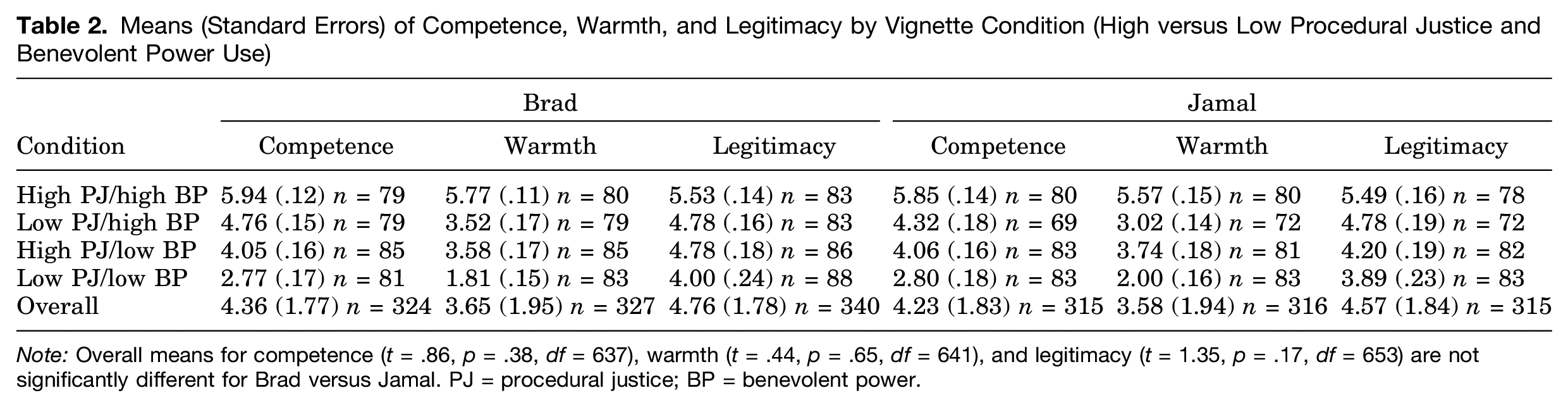
Note: Overall means for competence (t = .86, p = .38, df = 637), warmth (t = .44, p = .65, df = 641), and legitimacy (t = 1.35, p = .17, df = 653) are not significantly different for Brad versus Jamal. PJ = procedural justice; BP = benevolent power.
Structural Equation Models
We first analyzed a measurement model for the latent construct of legitimacy using confirmatory factor analysis involving the four indicators. 8 Fit indices for the measurement model indicate a good fit between the model and the sample data: χ2(1) = .565, p = .452, CFI = 1.000, TLI = 1.001, RMSEA = .000 [CI: .000, .092], suggesting that our indicators capture the latent construct of legitimacy. For our multigroup structural model, we compared an unconstrained model in which parameters are allowed to vary across groups, χ2(33) = 42.352, p = .128, CFI = .998, TLI = .996, RMSEA = .029 [CI: .000, .052]), with a constrained model in which all structural paths are constrained to be equal, χ2(44) = 67.973, p = .012, CFI = .995, TLI = .992, RMSEA = .040 [CI: .019, .058]. The unconstrained model provides a significantly better fit to the data, Δχ2(11) = 25.62, p = .007, indicating that some of the parameters truly differ across groups. Wald tests show that the following paths are significantly different across groups: benevolent power → warmth, χ2(1) = 4.430, p = .035; procedural justice → legitimacy, χ2(1) = 3.840, p = .050; competence → legitimacy, χ2(1) = 9.942, p = .0016; warmth → legitimacy, χ2(1) = 10.391, p = .0013. The final two-group model, in which all pathsare constrained except for the preceding, has excellent fit: χ2(40) = 51.899, p = .098, CFI = .997, TLI = .996, RMSEA = .030 [CI: .000, .051].
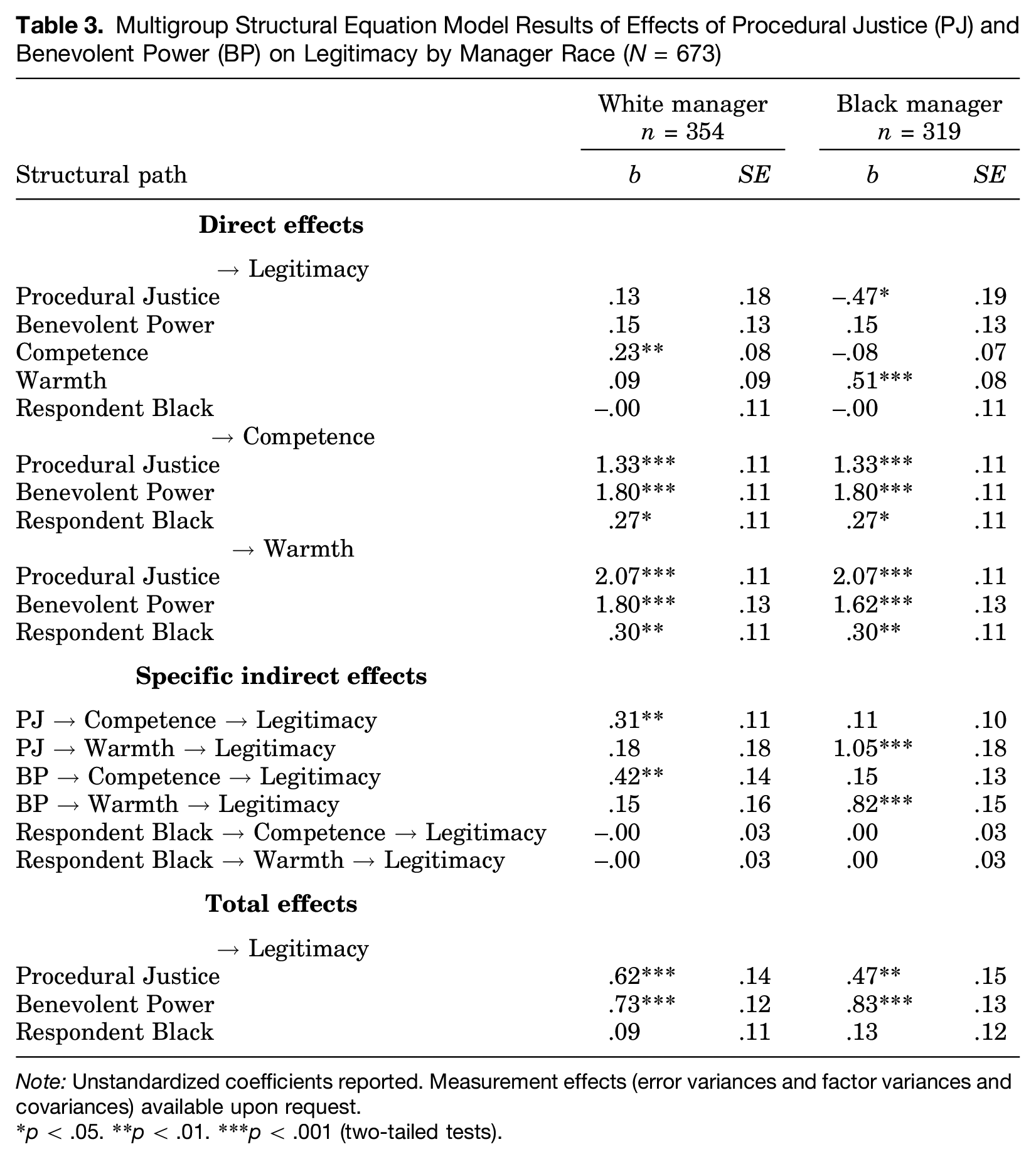
Table 3 provides the results of our multigroup analysis by manager race, including the direct, indirect, and total effects represented in our model, and Figure 2 shows unstandardized path coefficients for direct effects. We argued that each of the manager’s manipulated behaviors would enhance respondents’ impressions of them as competent and warm. As expected, the manager’s use of fair decision-making procedures positively contributes to perceptions of the manager as competent (b = 1.33, p < .001) and warm (b = 2.07, p < .001) for both white and Black managers. Benevolent power use also has a positive effect on competence impressions for both white and Black managers (b = 1.80, p < .001) and contributes slightly more to warmth impressions when the manager is white (b = 1.80, p < .001) compared to when the manager is Black (b = 1.62, p < .001).
Multigroup Structural Equation Model Results of Effects of Procedural Justice (PJ) and Benevolent Power (BP) on Legitimacy by Manager Race (N = 673)
Note: Unstandardized coefficients reported. Measurement effects (error variances and factor variances and covariances) available upon request.
p < .05. **p < .01. ***p < .001 (two-tailed tests).
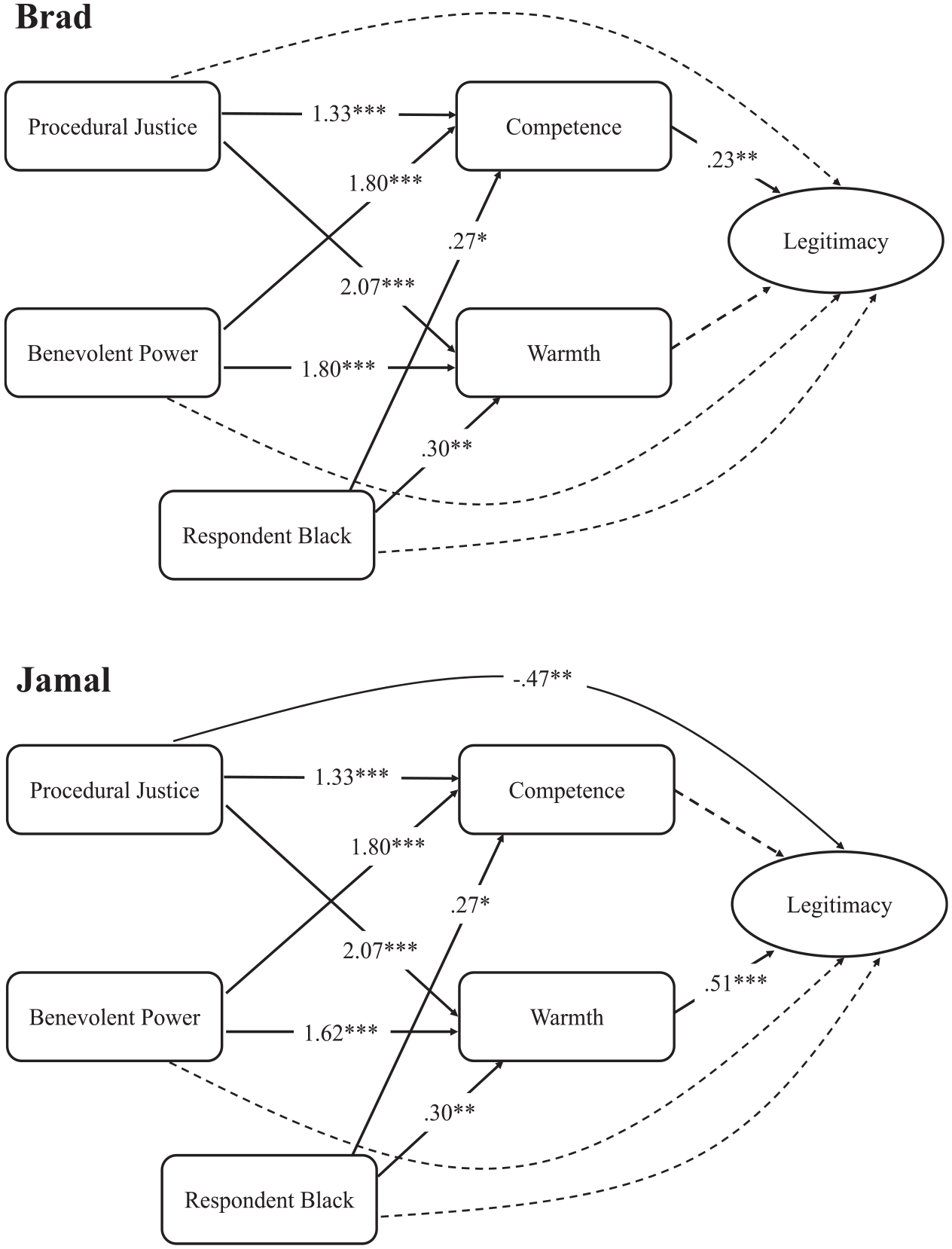
Multigroup Structural Equation Model by Manager Race
We argued that both competence and warmth impressions would positively contribute to perceptions of the authority as legitimate. We find that competence has a positive effect on legitimacy when the manager is white (b = .23, p < .01) but not when the manager is Black. In contrast, warmth enhances legitimacy for Black (b = .51, p < .001) but not white managers.
We also expected that impressions of the manager as competent and warm would mediate the effects of the manipulated behaviors on perceived legitimacy but that the nature of the mediation would depend on the manager’s race. For white managers, we predicted that impressions of competence only would mediate the effect of the behaviors on legitimacy. Results confirm this prediction, as competence alone (b = .23, p < .01) enhances legitimacy for white managers and both procedural justice and benevolent power indirectly affect legitimacy through competence but not warmth (b = .31, p < .01, and b = .42, p < .01, respectively). The lack of direct effects and presence of significant total effects for procedural justice (b = .62, p < .001) and benevolent power (b = .73, p < .001) on legitimacy indicate that competence impressions fully mediate the effects of the behaviors on legitimacy for white managers.
For Black managers, we predicted that impressions of both competence and warmth would mediate the effects of the behaviors on legitimacy. Our results provide partial support for this argument. In contrast to white managers, for Black managers, only warmth (b = .51, p < .001) enhances legitimacy. Furthermore, warmth alone mediates the effects of the behaviors on legitimacy, with procedural justice and benevolent power operating through warmth but not competence (b = 1.05, p < .001, and b = .82, p < .001, respectively). The differences between the indirect paths for white and Black managers are statistically significant: procedural justice → competence → legitimacy, χ2(1) = 10.32, p = .0013; procedural justice → warmth → legitimacy, χ2(1) = 11.93, p = .0006; benevolent power → competence → legitimacy, χ2(1) = 10.71, p = .0011; benevolent power → warmth → legitimacy, χ2(1) = 9.64, p = .0019.
Findings also revealed an unexpected difference in the effect of procedural justice on legitimacy by manager race. For Black managers, while procedural justice enhances legitimacy through positively contributing to warmth impressions, it also maintains a significant negative direct effect on legitimacy perceptions (b = −.47, p < .05), indicating evidence of inconsistent mediation (MacKinnon, Fairchild, and Fritz 2007). The total effectof procedural justice on legitimacy remains positive (b = .47, p < .01). Warmth impressions fully mediate the effect of benevolent power use on legitimacy for Black managers as evidenced by the lack of direct effects and presence of significant total effects (b = .83, p < .001) on legitimacy.
Regardless of manager race, Black respondents are more likely to view the manager as competent (b = .27, p < .05) and warm (b = .30, p < .01) than are white respondents. Respondent race, however, does not have a direct effect on legitimacy perceptions, nor does it operate through competence and warmth impressions to affect legitimacy. Moreover, no evidence of an interaction effect between manager race and respondent race emerges.
Discussion
Recognizing the persistence of racial inequality in workplace leadership, our study investigates pathways by which authorities in the workplace gain legitimacy and how this process differs for white versus Black authorities. As Figure 1 illustrates, we proposed that an authority’s use of fair procedures and benevolent power shape competence and warmth impressions, which then mediate the impact of authorities’ behaviors on perceived legitimacy. Our focus on these impressions as a mechanism in the pathway to legitimacy allowed us to reveal how the legitimacy process is racialized. Specifically, we argued that for white authorities, competence impressions alone mediate the effects of authority behaviors on legitimacy, whereas for Black authorities, both competence and warmth impressions matter.
Results confirm parts of our proposed theoretical model and reveal important variation based on the authority’s race. First, authorities’ behaviors shaped impressions of them as competent and warm, regardless of race. Authorities who behaved in a procedurally just manner were perceived as more competent and warmer, consistent with arguments linking the desire for feedback from subordinates to the predictability of the work environment and positive intentions toward subordinates (e.g., Chory 2007; Van den Bos and Lind 2002). Similarly, workers saw authorities who used their power to benefit employees as considerably more competent and warmer. These findings support Kanter’s (1977) claim that providing subordinates what they need to accomplish their tasks reinforces perceived competence of the leader and engenders feelings of reciprocity, support, and care that characterize warmth (Cuddy et al. 2011).
Second, viewing the authority as competent and warm contributes positively to workers’ perceptions of the authority’s legitimacy, and these impressions constitute a key mechanism by which leaders’ behaviors influence their perceived legitimacy. Use of both procedural justice and benevolent power are ultimately associated with significant increases in legitimacy indirectly, as competence and warmth mediate the effects of these actions. This pattern of findings highlights that how an authority is perceived is as important as what that authority does.
Third, our study reveals complex variation by race in the role of impressions in cultivating legitimacy. The authority’s race alters how behaviors filter through impressions of competence or warmth to affect perceptions of legitimacy. In other words, how an authority gains legitimacy, via competence or warmth, varies by race. In general, enacting fair decision-making procedures and using power benevolently enhances impressions of competence and warmth for both white and Black managers. However, for white managers, only impressions of competence engendered by these behaviors contribute to legitimacy. In contrast, for Black managers, only impressions of warmth stemming from the behaviors enhance legitimacy. Additionally, the indirect pathways from behaviors to legitimacy operate through competence for white authorities and through warmth for Black authorities. These effects hold regardless of respondent race.
This pattern signals the importance of race in the legitimacy process over and above expectations related to the authority identity (demonstrating competence) and status processes that require low-status individuals to demonstrate both competence and group-oriented motivations to overcome their status disadvantage and gain influence. Though the behaviors also produce impressions of Black managers as competent, they ultimately gain legitimacy only through creating impressions that they are well intentioned, likeable, and caring (warm). Thus, to gain legitimacy, authority behaviors must produce impressions that align with culturally shared meanings associated with their racial identity (competence for white and warmth for Black managers).
Our study demonstrates that behavioral strategies benefit both Black and white authorities similarly as the overall assessments of legitimacy are not significantly different by manager race (see note on Table 2), indicating ways for Black authorities to gain legitimacy and overcome racial inequality in leadership at work. However, in uncovering the nature of the racialized pathways to legitimacy, we show how racial inequality remains in the mechanisms by which authorities achieve legitimacy in the eyes of subordinates. Though competence at a managerial role is necessary for effective leadership, respondents invoke the racialized impression of warmth, rather than their managerial skills, in forming their legitimacy assessments of Black managers. While Black authorities, like white authorities, must demonstrate competence to succeed in and keep their jobs, they must also perform the emotional labor necessary to convey warmth in their interactions to be viewed as legitimate by subordinates. Wingfield (2010) shows that maintaining a warm and pleasant demeanor in the workplace is especially emotionally burdensome for workers of color, who contend with tokenism and racial discrimination in the workplace. Black professionals also experience pressure to conceal feelings of anger and frustration and fear of penalties for failing to convey warmth, all issues not faced by their white counterparts.
Our results also produce a curiosity: procedural justice, while partially mediated by warmth impressions, has a significant and negative direct effect on legitimacy for Black managers. This may be an artifact of the analysis, given that the total effect of procedural justice remains positive. If not, however, this pattern may indicate another hurdle for Black authorities in their path to legitimacy. Some respondents might interpret consultive behaviors, such as “voice,” by Black managers as indicating weakness rather than authority, thereby diminishing legitimacy. If so, this finding suggests that Black authorities must find ways to convey warmth while avoiding coming across as too collaborative or democratic, which can incur legitimacy penalties. Investigating this balance is a direction for future research.
Our vignette study provides the advantage of clearly testing theoretical relationships and pathways to legitimacy, but we are unable to capture respondents’ actual perceptions of their managers in their own workplace. Although vignettes offer clear and straightforward images of an authority’s behaviors, real-world interactions are vastly more complex, involving both explicit and implicit cues and signals that influence the meaning and interpretation of the situation. Thus, future work should assess workers’ perceptions of the behaviors, impressions of competence and warmth, and legitimacy of their own managers in their workplace.
While our study reveals strategies for Black male authorities to gain legitimacy at work, we also show how culturally shared meanings about racial identities are central to the legitimacy process in a way that places an additional burden on Black male authorities. A next step would be to investigate pathways to legitimacy for Black and white female authorities. ACT scholars might leverage the patterns revealed here to simulate models of pathways to legitimacy for authorities represented by various identities and behaviors. More generally, other scholars could examine additional culturally shared meanings shaping pathways to legitimacy for authorities from other historically marginalized groups and across intersectional identities.
Supplemental Material
sj-docx-1-spq-10.1177_01902725231162068 – Supplemental material for Pathways to Legitimacy for Black and White Authorities: Impressions of Competence and Warmth
Supplemental material, sj-docx-1-spq-10.1177_01902725231162068 for Pathways to Legitimacy for Black and White Authorities: Impressions of Competence and Warmth by Kate Hawks, Karen A. Hegtvedt, Ryan Gibson, Cathryn Johnson and Jamica Zion in Social Psychology Quarterly
Supplemental Material
sj-pptx-2-spq-10.1177_01902725231162068 – Supplemental material for Pathways to Legitimacy for Black and White Authorities: Impressions of Competence and Warmth
Supplemental material, sj-pptx-2-spq-10.1177_01902725231162068 for Pathways to Legitimacy for Black and White Authorities: Impressions of Competence and Warmth by Kate Hawks, Karen A. Hegtvedt, Ryan Gibson, Cathryn Johnson and Jamica Zion in Social Psychology Quarterly
Footnotes
Funding
The author(s) disclosed receipt of the following financial support for the research, authorship, and/or publication of this article: Research supported with a grant from the National Science Foundation (SES-1756853) to the second and fourth authors.

Supplemental Material
Supplemental material for this article is available online.
1
2
To tap into respondents’ recall of the race-related name of their vignette manager, we listed a choice of four names (Brad, Dwayne, Greg, Jamal). Out of the 938 responses collected, 72 percent correctly named Brad or Jamal for their assigned condition.
3
The supplementary material online provides two versions of the vignette.
4
We treat legitimacy as a latent construct because we do not measure legitimacy perceptions directly. Instead, respondents’ perception that the manager is legitimate causes our observed indicators (e.g., how much respondents support and see the manager as the right and proper person for the job). In contrast, we directly measure competence and warmth impressions. We thus treat these as composite scales and use multiple indicators for competence and warmth in line with previous work (e.g., Cuddy, Fiske, and Glick 2007) and to improve measurement reliability.
5
While our manipulations temporally precede respondents’ impressions and legitimacy perceptions, our study design does not allow temporal ordering for the connection between the mediators and legitimacy. Although tests of our theoretically motivated statistical models substantiate the temporal ordering, we recognize that the mediation analysis is correlational.
6
See Table B1 in the supplementary material online for means and standard errors for perceptions of the manager’s use of procedural justice and benevolent power by vignette condition. See Table B2 for an ordinary least squares regression analysis investigating the effect of the manipulated manager behaviors and their interaction on respondent perceptions of the manager’s use of procedural justice and benevolent power (no interactions found).
7
In a preliminary analysis, we investigated interactions between our manipulated factors, but none were significant.
8
See Table C1 in the supplementary material online for standardized and unstandardized factor loadings.
Bios
References
Supplementary Material
Please find the following supplemental material available below.
For Open Access articles published under a Creative Commons License, all supplemental material carries the same license as the article it is associated with.
For non-Open Access articles published, all supplemental material carries a non-exclusive license, and permission requests for re-use of supplemental material or any part of supplemental material shall be sent directly to the copyright owner as specified in the copyright notice associated with the article.
