



Abstract
Better understanding the social patterning of personal control beliefs is crucial for research on health and inequality. In this study, I argue for and explain an association between social capital and mastery in a national sample. How, for whom, and to what extent do people who report more occupationally diverse ties also report a stronger sense of control over life outcomes? Using a position generator approach to social capital, the 2008 Canadian General Social Survey, and regression models, I test three hypotheses about total and gendered social capitals across the categorical boundaries of respondent gender, visible minority, and foreign-born status. I conclude this approach to the classic question of who benefits from diverse social networks by suggesting directions for future research on the interplay between social networks, stress, and well-being.
Introduction
Understanding the causes and consequences of personal control beliefs is central to sociological research on health, inequality, and life course development (Aneshensel and Mitchell 2014; Pearlin and Schooler 1978; Ross and Mirowsky 2013; Wheaton et al. 2013). Among the most consistent findings from social stress research is that people who believe they can shape the course of their lives experience better mental and physical health and cope more effectively, whereas fatalistic people who believe they are at the mercy of powerful forces are more vulnerable to the deleterious consequences of stress (Mirowsky and Ross 2003; Thoits 2006, 2010). Studying the social patterning of control beliefs has been an essential component of stress and health research over the past four decades (Thoits 2010), yet much remains to be known about the structural mechanisms contributing to their unequal distribution in the population.
Decades of research also demonstrate that the structure and qualities of personal social networks play a key role in health inequalities (Reiner, De Gioannis, and Steinhoff 2025; Smith and Christakis 2008; Song et al. 2021; Valente 2010) by stratifying access to resources and stress exposure (Berkman et al. 2000; Thoits 2011). While theory outlines potential mechanisms linking social networks and personal control beliefs, empirical research has yet to assess whether these mechanisms generalize or whether some social groups unequally benefit. Building on the foundational insights of Lin (2001) and Erickson (2003, 2004) about social capital as a pool of resources for instrumental action, I argue that connections with people in varied occupations are associated with beliefs about personal mastery and control. Do people with more social capital also report feeling more in control of their lives?
Explaining whether, to what extent, and for whom social capital is associated with personal control beliefs advances knowledge about social and emotional inequality in several ways. Empirically, this study is the first to examine the relationship between social capital, measured through an occupational position generator, and personal control beliefs in a national sample. Theoretically, I integrate intersectional insights from social capital (Erickson 2024) and health (Richman and Zucker 2019) research to offer a novel approach to an enduring question: who benefits from diverse social networks? To do so, I bring studies on mental health, social networks, and gender dynamics into dialogue and test three competing confirmatory hypotheses: mastery is most strongly associated with (1) the overall number of ties to different jobs (i.e., total social capital); (2) ties to gender-similar others (i.e., homophily regarding gendered social capital); or (3) ties to men (i.e., male social capital).
I then extend prior theory to examine how gender, visible minority, and foreign-born statuses may modify the associations between these forms of social capital and personal control beliefs. To account for this potential prism of social differences, I turn to scholarship showing that the benefits of social capital are structured by the social characteristics of respondents and their network members. Theories of cumulative advantage and resource substitution provide valuable insights about the ways that categorical boundaries may shape whether network resources compensate for, or reinforce, existing social inequalities. Ultimately, this approach advances a relational account of control beliefs to illuminate how social networks can serve as a context where resilience is cultivated for some and vulnerability is entrenched for others.
Background
A central finding from social stress research is that mastery—generalized beliefs that one has control over their life—acts to buffer stress and promote well-being (Pearlin and Schooler 1978; Thoits 2010). Mastery is a validated and reliable measure of the subjective aspects of agency (Hitlin and Kwon 2016; Mirowsky and Ross 2015; Pearlin et al. 2007; Thoits 2006), and this construct has been called many interrelated and often overlapping things, including personal control (Mirowsky and Ross 2003; Pearlin and Pioli 2003), locus of control (Rotter 1966), self-efficacy (Bandura 1977; Gecas 1989), personal helplessness (Seligman 1975), and planful competence (Clausen 1991). For clarity, I use the terms mastery and personal control interchangeably (in part because the latter updated the former to balance response bias tendencies, see Mirowsky and Ross 1990:77). Decades of research have shown that, notwithstanding individual variation due to the specific construct being empirically tested (Haidt and Rodin 1999; Rotter 1992; Scholz et al. 2002; Skinner 1996), control beliefs are an important determinant of adaptive functioning and biopsychosocial well-being.
Although scholarship has persuasively emphasized the importance of mastery to facilitate adaptive coping and promote mental health (Pearlin et al. 1981; Pearlin and Schooler 1978; Wheaton 1985a), studies also show that these beliefs have consequences for physical health (Lee et al. 2016; Mirowsky and Ross 2003), life course role transitions (Lewis, Ross, and Mirowsky 1999; Reynolds et al. 2007), health behavior (Latham-Mintus and Clarke 2019; Seeman and Seeman 1983), and all-cause mortality (Infurna, Ram, and Gerstorf 2013). Mastery fosters an active and deliberate problem-solving orientation toward the world, as opposed to the passive and emotion-focused coping strategies adopted by fatalists who feel their life is controlled by powerful external forces (Brett and Dubash 2023; Pearlin and Schooler 1978; Thoits 1994), which in turn influences physiological stress responses (Roepke and Grant 2011). These considerable consequences have recently brought scholars to argue that “social differences in mastery are a life-or-death issue” (Brett and Dubash 2023:1).
Given mastery's importance as one of the “linchpins in the causal mechanisms” connecting stress and mental health (Aneshensel and Avison 2015:71), extensive research focuses on social inequality and personal control beliefs. Studies show that gender (Cassidy and Davies 2003; Ross and Mirowsky 2002), race-ethnicity (Jang et al. 2003; Louie 2020), age (Pearlin et al. 2007; Schieman 2001), education (Mirowsky and Ross 1998; Ross and Broh 2000; Schieman and Plickert 2008), social class (Falci 2011; Lachman and Weaver 1998), marital status (Cassidy and Davies 2003; Thoits 1987), religion (Schieman, Nguyen, and Elliott 2003), and ecological contexts such as neighborhoods (Christie-Mizell and Erickson 2007; Ross, Mirowsky, and Pribesh 2001) contribute to the unequal patterning of this key coping resource across population groups. A growing body of work also emphasizes the intersectional nature of these inequalities, suggesting that their combinations may be multiplicative instead of additive.
Research also demonstrates how mastery evolves across the life course. Studies show that these beliefs develop slowly (Falci 2011; Mirowsky and Ross 2007) and are generally stable during adulthood (Hitlin and Johnson 2015; Mirowsky 2013; Pearlin et al. 2007). Personal control beliefs develop in response to the challenges, constraints, and demands people cope with as they strive for desired ends with strategies and resources provided first through the family and educational institutions and later through work and social contexts (Conger et al. 2009; Lewis et al. 1999; Mirowsky and Ross 1990:72; Rogers, Parcel, and Menaghan 1991; Tyndall and Christie-Mizell 2016). Generally, these beliefs accurately reflect people's real powers and resources to achieve what they want and avoid unwanted outcomes (Dannefer and Wenxuan 2017; Ross and Mirowsky 2013; cf. Seeman 1959:784–785). Although this line of research shows how parents are of primary importance during adolescence, then partners during the transition to adulthood, Surjadi et al. (2011:620) speculate that “the salience of support from significant others outside the family on mastery may be greater” during adulthood. Despite the extensive scholarly attention to the social causes and correlates of mastery, however, research showing how personal control may be associated with the web of personal relationships people are enmeshed in has remained theoretical and speculative to date.
Network Resources as an Opportunity Structure for Effective Action
There are many approaches to social capital. One of the most common, associated with Lin (2001:25), refers to the “resources embedded in social networks accessed and used by actors for actions.” The primary explanation for the benefits of social capital is that “investment and mobilization of capital will enhance the outcomes desirable to individuals or communities” (Lin 2000:786). Although debates continue about the operationalization of social capital (for reviews, see Adler and Kwon 2002; Farr 2004; Fine 2010; Kadushin 2004; Li 2015; Portes 1998), for the purposes of this study I employ Lin and colleagues’ (Lin 2001; Lin and Bian 2021; Lin and Erickson 2008) approach. In this school of thought, having a broad range of ties to diverse others (i.e., alters)—whether weak or strong ties—provides valuable resources for enabling instrumental action. This is often referred to as network range (Marsden 1987), extensity (Song, Son, and Lin 2014), or diversity.
One of the most important forms of social capital is network diversity. Asking respondents if they know someone in a range of positions across the occupational structure is known as the position generator approach (for reviews, see Lin, Fu, and Hsung 2017; van der Gaag, Snijders, and Flap 2008; Verhaeghe and Li 2015). Particularly, the number of occupations in which a respondent knows at least one person indicates their network diversity. Having connections to persons in various occupations, in turn, can structurally afford access to their diverse resources when people seek to fulfill important goals, such as finding a job (Lin 1999; Seibert, Kraimer, and Liden 2001; Son and Lin 2012) or promoting health (Smith and Christakis 2008; Song et al. 2021; Thoits 2011). Ties to the right people can transform challenging life course circumstances, such as finding somewhere to live after being evicted (e.g., Desmond 2016), into relatively minor upsets.
A central tenet of Lin’s (2001) social capital theory is that investing in and mobilizing social connections is crucial for enabling instrumental action. The more diverse ties one has, the more likely it is that a connection (or connection's connections, etc.) will be able to provide the resources one needs (Erickson 2003). This is in part because the resources available through one's web of social relations “can provide custom-tailored helpful resources that are flexible, efficient and effective” (Plickert, Côté, and Wellman 2007:406) when people are willing and able to help. Simply, social capital provides the structural preconditions for effective action. The benefits of bridging diverse social structural locations are why Burt (1998:7) stated that “social capital refers to opportunity.” In the argument I present here, this is the opportunity to feel in control of one's life. Taken together, these studies suggest my first research question: When people report greater social capital, do they also report greater beliefs in their personal control?
Who Benefits from Social Capital? Network Stratification as an Intersectional Process
Drawing on the conceptual lens provided by intercategorical intersectionality scholarship (McCall 2001, 2005), in what follows I argue that network stratification as an intersectional process can modify the association between social capital and personal control. Particularly, I bring studies on mental health, social networks, and gender dynamics into dialogue to explain how the characteristics of respondents, and their ties, may cultivate resilience for some while entrenching vulnerability for others. Intercategorical intersectional analyses advance knowledge by showing how the mechanisms driving outcomes vary according to the relative privileges and disadvantages awarded by the hierarchical positions of social groups (McCall 2005). This study tests whether the focal association generalizes across three categorical boundaries (Tilly 2009), and their intersections: gender, visible minority status, and nativity. Given the diversity of Canada, detailed information on race-ethnicity would allow for the comparison of many intersectional categories. However, only a binary measure of visible minority status (i.e., White/non-White) is available in these data. As I explain in greater detail below, these categories are likely to be salient boundaries because access to resources routinely depends on cross-cutting locations in social hierarchies (Erickson 2024).
How Alter Characteristics Can Influence the Benefits that Ties May Provide
Recent theoretical work on the intersectionality of social capital offers valuable insights into how social capital can operate conditionally in shaping the perception of control over life outcomes. Erickson (2024) sought to explain the intersectional effects of social capital on income. People in higher status occupations and people higher in the internal stratification of occupations have the power to increase income, and this is caused in part through the ways that homophily leads to unequal access to these powerful positions. However, the explanation of a plausible intersectional association between social capital and personal control calls for a somewhat different argument. In this case, people with more social capital would also report higher personal control because their connections have access to many kinds of resources useful for feeling in control of life circumstances. Knowing people in a range of high or low positions would lead to access to multiple pools of varied resources, and ties to women or men can provide differential returns even when they are in the same occupations (Burt 1998).
It is not that ties to women or men are inherently better or worse. Instead, women and men are likely to have access to different types and amounts of resources (Erickson 2004; McDonald, Lin, and Ao 2009; O’Neill and Gidengil 2006). For example, men on average have more access to instrumental resources (e.g., technical and financial, see Solano and Rooks 2018; Wellman and Frank 2001) while women on average have access to more emotional support skills (e.g., Wellman and Wortley 1990) and access to other kinds of valuable information (e.g., health information, see Perry and Pescosolido 2010). This is because women and men routinely have different aspirations, cultural tastes, and lifestyles that result in substantially different life course outcomes regarding positions of power and access to resources (Bourdieu 1984; Ridgeway and Correll 2004). The gendered nature of social capital evokes two conflicting predictions about gender's modifying role regarding personal control and social capital. On one hand, reporting ties to same-gender people, compared with overall network diversity or different-gender ties, would be associated with higher personal control. Yet on the other hand, numerous studies have shown that ties to men yield better returns for both women and men (Burt 1998; McDonald 2011; McDonald et al. 2009). Reporting a greater number of ties to men (i.e., male social capital) across the occupational structure, then, would be associated with higher reported personal control, compared with ties to women (i.e., female social capital) or overall network diversity.
Alternatively, it may be that overall network diversity—regardless of the gender of the person in each occupation—is more important for beliefs of control over one's life course outcomes. When faced with the challenges, constraints, and demands that constitute stressors (Wheaton et al. 2013), having a diverse network of people to turn to for aid may be useful for one's sense of personal control regardless of access to the resources that women and men tend to control. Thus, people reporting higher total social capital would also report higher mastery. It is plausible that the association between social capital and mastery is more about whether respondents have ties to diverse positions across the occupational structure, and thus the perception of potential access to their network resources, rather than being about the gender of the people in those positions.
Taking these studies together implies three competing, confirmatory hypotheses: (1) total social capital has the strongest association with mastery, regardless of respondent characteristics or tie gender; (2) women's ties to women and men's to men have the strongest association with mastery; and (3) ties to men have the strongest association with mastery, net of respondent gender. By adjudicating between these theory-driven hypotheses in a national sample, this study contributes to knowledge about whether gendered returns to social capital also extend to individuals’ sense of control over their lives.
Research shows the importance of occupational network diversity in terms of ties to women or men (Erickson 2004, 2021), or to people of various ethnic groups (Chen 2015; Côté and Evans 2023). However, few nationally representative surveys have information about the multiple statuses respondents’ ties hold. This truncates the intersectional dimensions of social capital that can be examined quantitatively. There are several alter statuses that are likely to influence respondent beliefs about personal control, such as race-ethnicity and nativity, which are not included in these data. As mentioned above, it is likely that women and men have access to different types and amounts of resources. Racial-ethnic and foreign-born groups are also likely to have different types and amounts of resources. There may also be cultural differences in one's willingness to mobilize resources or tap into a person's social network when help is needed (e.g., Smith 2005; Stack 1983). For example, people may withhold information from job seekers (Marin 2012). This in turn increases workplace segregation (Elliott 2001) and economic inequality (Kmec and Trimble 2009) along categorical boundaries. Although these data only have information about alter gender, there is rich information about the respondent's own statuses available.
How Social Characteristics Can Influence the Benefits that Ties May Provide
Social characteristics shape the quantity and qualities of personal ties (Chetty et al. 2022; DiMaggio and Garip 2012; Young et al. 2025). Because networks are segregated by race, gender, and nativity, these categorical axes of societal stratification are associated with differences in the creation and returns of social capital. Respondents’ statuses influence the contexts through which people make ties (i.e., structural homophily); the choices people make about associating with similar others (i.e., preference homophily); tastes to associate with people of higher, similar, or lower status; and the resources that ties can and will facilitate access to (Erickson 2004; Hsung, Lin, and Breiger 2008; Lynn and Podolny 2011). In the broad sense, race, gender, and nativity serve as categories that relationally distinguish and legitimatize evaluations of moral worth, competence, and beliefs about status hierarchies (Massey 2007; Pachucki, Pendergrass, and Lamont 2007; Ridgeway 1991; Tilly 2009). Because categorical boundaries tend to demarcate positions in socioeconomic hierarchies, they influence opportunities and constraints for the accumulation of social capital as well as the benefits available through diverse social ties.
On one hand, prior research highlights how social capital processes play out unequally across social categories in ways that reinforce existing hierarchies of power and resources. For example, gender shapes personal network structure (Moore 1990) and unequally influences opportunities and equal participation in the domains of work (Burt 1998; McGuire 2002), voluntary organizations (McDonald and Mair 2010), and politics (Tindall and Cormier 2008). Race-ethnicity, also, structures the availability and returns of social capital. This occurs through racial disparities in access to high status ties (Cornwell and Cornwell 2008; Ibarra 1995; Parks-Yancy, DiTomaso, and Post 2009), and judgments from members of dominant groups about the potential risks of helping ties perceived to be lower status—both of which can result in lower relative returns to social capital (Desmond 2016; Smith 2000, 2005; Son and Lin 2012). Finally, migration processes influence both the industries that immigrants pursue and the formation of co-ethnic networks, which in turn can influence the breadth of ties to people in diverse occupations and the extent to which ties can serve as resources (Boyd 1989; Boyd and Nowak 2012). Groups at the intersections of each of these categorical boundaries would be likely to experience relatively fewer benefits compared with advantaged groups (i.e., foreign-born and visible minority persons, compared with White and Canadian-born persons) that could both additively and multiplicatively compound social inequalities in ways consistent with cumulative disadvantage theory (DiPrete and Eirich 2006; Willson et al. 2007).
On the other hand, however, it is plausible that unequal returns on social capital hold the potential to shrink social disparities. The driving mechanism for this would be resource substitution (Ross and Mirowsky 1989). People who are more likely to be categorically excluded (through the processes of opportunity hoarding and social closure described above) could stand to benefit more from social capital than members of relatively advantaged social groups. Having multiple resources makes outcomes less dependent on any one resource, and “the effect of having a specific resource is greater for those who have fewer alternative resources” (Ross and Mirowsky 2006:1402). In this case, social capital may be a particularly valuable resource for fostering feelings of personal control because each additional tie can provide access (or contribute to the perception that access would be forthcoming if needed) to a range of useful resources, when compared with having no one to turn to at all. Relatively less advantaged groups would benefit more from social capital because they would have fewer resources to substitute, and they would also report the lowest levels of personal control when social capital is absent, compared with relatively advantaged social groups.
The Present Study
The present study extends Lin’s (2001) call to examine the differential returns of social capital by taking a novel approach to a classic question: who benefits from diverse social networks? Examining heterogeneity in this association across respondent gender, visible minority, and foreign-born statuses provides a stronger test of theory by eliminating plausible alternatives about subgroup conditional effects (see Stinchcombe 1987:20–22). If this mechanism generalizes across these categorical boundaries, then the proposed explanation represents a previously untested dynamic through which network stratification broadly translates social inequalities into vulnerability and resilience to stress. Although these are, to my knowledge, the only publicly available data with measures of social capital and personal control, they are limited in that they only contain a binary measure of visible minority status instead of detailed information on race-ethnicity. The Canadian Employment Equity Act defines visible minorities as “persons, other than Aboriginal peoples, who are non-Caucasian in race or non-white in color”, such as people of South Asian, Chinese, Black, Filipino, Arab, Latin American, Southeast Asian, West Asian, Korean and Japanese descent (Government of Canada, Statistics Canada 2021). This homogenizes important heterogeneity regarding social capital, socioeconomic positioning, and lived experience for the racially diverse population of Canada. 1 As a result, this study may only modestly contribute to the literature on intersectional social inequalities.
The demographic category of visible minorities has long been controversial (Statistics Canada 2024). Yet this distinction is still useful given that persons within this category often experience similar constraints (i.e., opportunity hoarding, exploitation) and differential access to resources that shape both their personal networks and their sense of personal control. For example, visible minority persons have lower employment rates and are not equitably compensated in the Canadian labor market for their education and skills (Hou and Coulombe 2010; Pendakur and Pendakur 2002; Samuel and Basavarajappa 2006). Accordingly, results involving this measure should be interpreted cautiously as they reflect broad patterns of inequality—and potentially divergent contributing processes—in Canada rather than the experiences of any specific racialized population group. This limits the generalizability of the results and constrains the extent to which this study can fully assess intersectional differences across distinct racialized groups, but it does not diminish the broader value of identifying whether visible minority status modifies the relationship between social capital and personal control. By synthesizing theory on social capital, personal control, and stratification, this study advances a relational account of stress coping resources and provides the first empirical assessment of a relationship that has thus far remained theoretical and speculative. More specifically, I examine whether and for whom social capital functions as an opportunity structure for beliefs about effective action.
Methods and Data
Sample
I test this theory and argument with a nationally representative sample: the Canadian General Social Survey (GSS). Data were collected by Statistics Canada using random digit dialing and telephone interviews to provide a cross-sectional snapshot of the Canadian population and their networks. The non-response rate for this cycle of the GSS was 42.7 percent. This is similar to other nationally representative surveys at the time. Survey weights supplied by Statistics Canada make this sample approximately representative of the Canadian community-dwelling population 15 years or older in 2008. No research ethics board review was required as this study used the Public Use Microdata File. After applying survey weights and handling missing data, the analytical sample represents 26,311,765 Canadians.
Covariates
Mastery
Mastery is measured with all seven questions from the seminal Pearlin and Schooler (1978): You have little control over the things that happen to you; There is little you can do to change many important things in your life; There is no way you can solve some of the problems you have; You often feel helpless in dealing with problems of life; You sometimes feel you are being pushed around in life; What happens to you in the future mostly depends on you; You can do just about anything you set your mind to. I take the mean score of these items to minimize the effects of missing items, and code this covariate so higher scores indicate higher mastery. This is similar to other research using mastery as a dependent variable (e.g., Brett and Dubash 2023). This is a well-validated measure often used to examine stress and coping (e.g., Louie 2020; Pudrovska 2018) with good reliability (Tavakol and Dennick 2011) in the analytic sample (α = .75), and across key sociodemographic subgroups: α = .75/.75 for women and men, respectively; α = .72/.75 for visible minority and White persons, respectively; and α = .74/.75 for foreign- and Canadian-born respondents.
Social Capital
Social capital is measured using a standard network diversity position generator asking respondents whether they know at least one man or woman in 18 occupations: social workers; police officers or firefighters; food or beverage servers; laborers in landscaping or grounds maintenance; managers in sales, marketing or advertising; computer programmers; instructors or leaders in recreation and sport; security guards; engineers; farmers; nurses; janitors or caretakers; accountants or auditors; graphic designers or illustrators; delivery or courier drivers; early childhood educators or assistants; sewing machine operators; and carpenters. Social capital is the sum of these questions. For each occupation, respondents indicated whether they knew at least one woman or man. Gendered social capital (i.e., female or male social capital) is the sum of the 18 occupations in which the respondent reports knowing at least one woman or man. For example, knowing one male engineer would count as one scale point for total and male social capital, but would not count for female social capital; correspondingly, knowing five female computer programmers would count as one scale point for total and female social capital, and zero scale points for male social capital.
Statistics Canada adapted Lin and Dumin's (1986) seminal measure to represent the Canadian occupational structure. To better test the returns of gendered social capital, Statistics Canada selected occupations with a high representation of female and male workers instead of a random sample of occupations. Three network diversity scales were provided by Statistics Canada based on the 18 occupations listed above: the number of occupations that the respondent indicated knowing at least one woman or man in (total social capital); the number of occupations where the respondent knows at least one woman (female social capital); and the number of occupations where the respondent knows at least one man (male social capital). For all scales, higher scores represent greater social capital.
Covariates
The coding of all covariates is shown, along with descriptive statistics, in Table 1. These include gender, age, education, visible minority status, foreign-born status, income, marital status, rural/urban location, limitations in activity due to mental or physical health conditions, select life events, and religion. All these characteristics are known confounders. For the intersectional moderation analyses, I jointly code gender and visible minority status, gender and foreign-born status, and foreign-born and visible minority status.
Description of Study Variables, N = 26,311,765.
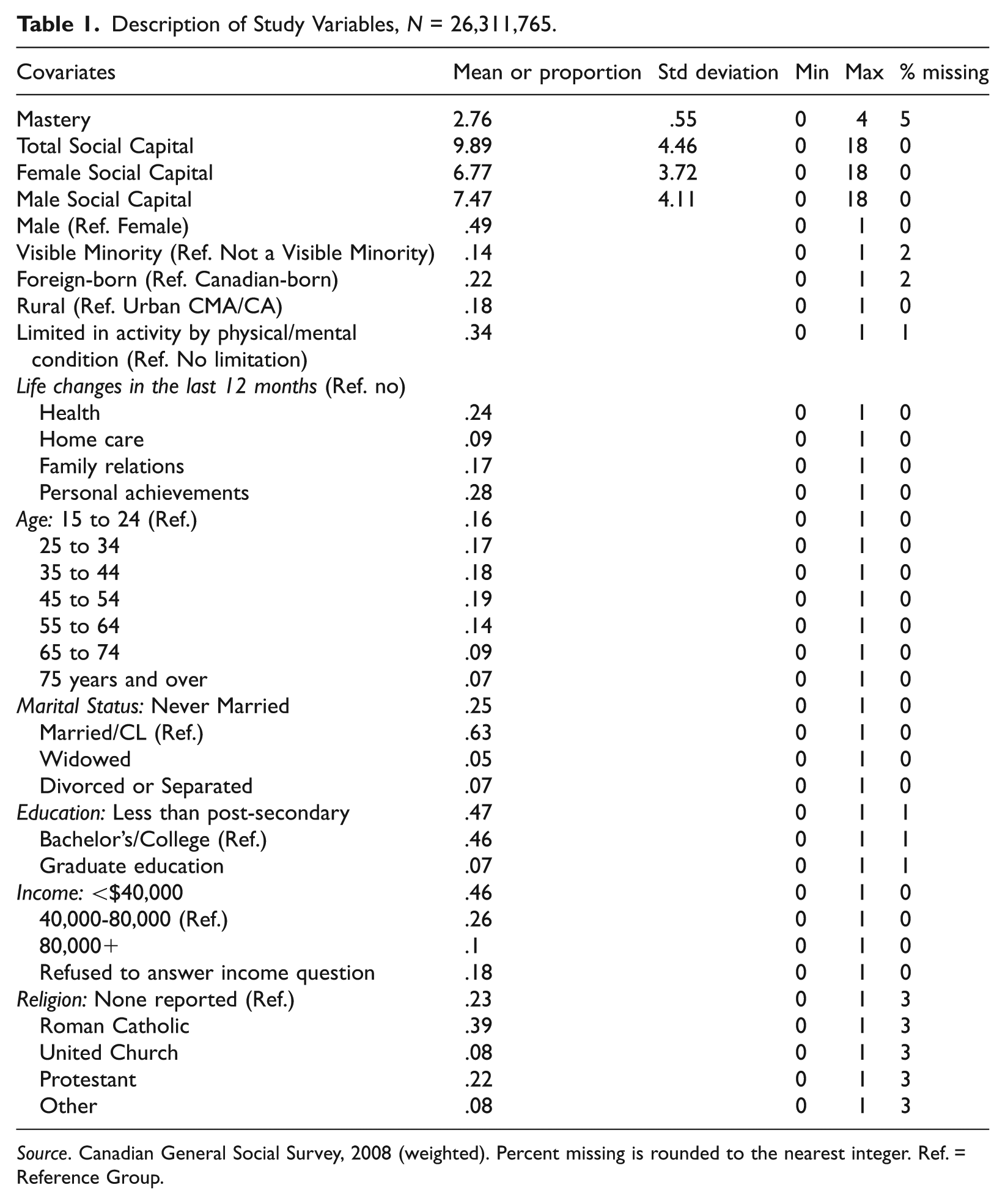
Source. Canadian General Social Survey, 2008 (weighted). Percent missing is rounded to the nearest integer. Ref. = Reference Group.
Analytical Strategy
Regression models provide parameter estimates and hypothesis tests. Survey design features and complex sampling were adjusted for with Stata's svyset command and Statistics Canada weights. Missing data were handled using listwise deletion to facilitate the graphical presentation of the intersectional analyses. Results using Full Information Maximum Likelihood (FIML; Enders 2010) for handling missing data were not substantially different from those presented here. Data were processed and modeled using Stata 16 (College Station, Texas).
Table 1 describes all study variables. Figure 1 displays a ridgeline plot (Naqvi [2022] 2025) to show the distribution of mastery for each level of social capital. Table 2 reports the regression of mastery on total and gendered social capital while adjusting for theoretically relevant covariates. Complete estimates for all covariates can be found in Supplemental Appendix 1. Table 3 reports tests for the gender-specific returns of social capital. Because there are not significant differences, I do not visualize predictions from those models. Figures 2 and 3 present combined margins plots (Jann 2014; Williams 2012) to illustrate how the focal association varies by visible minority and foreign-born statuses, respectively. Complete estimates from the quantitative intersectional analyses of gender and visible minority status, gender and foreign-born status, and visible minority and foreign-born status can be found in the replication package for this study. Because the three-way interactions were not significant, I do not visualize predictions from those models. All figures are color vision inclusive and maintain visibility for monochrome print.
Mastery Regressed on Social Capital, N = 26,311,765.
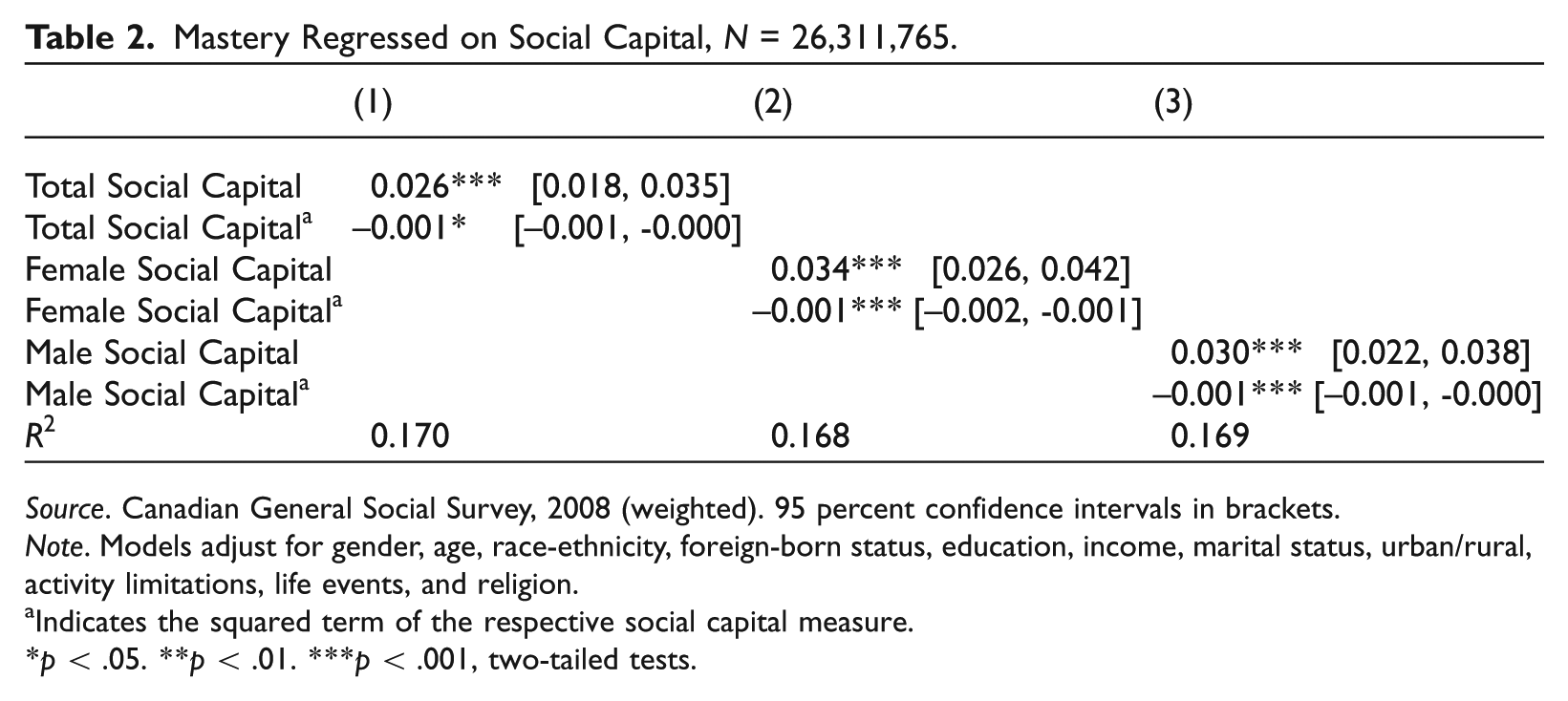
Source. Canadian General Social Survey, 2008 (weighted). 95 percent confidence intervals in brackets.
Note. Models adjust for gender, age, race-ethnicity, foreign-born status, education, income, marital status, urban/rural, activity limitations, life events, and religion.
Indicates the squared term of the respective social capital measure.
p < .05. **p < .01. ***p < .001, two-tailed tests.
Does the Association between Social Capital and Mastery Differ for Women and Men? N = 26,311,765.
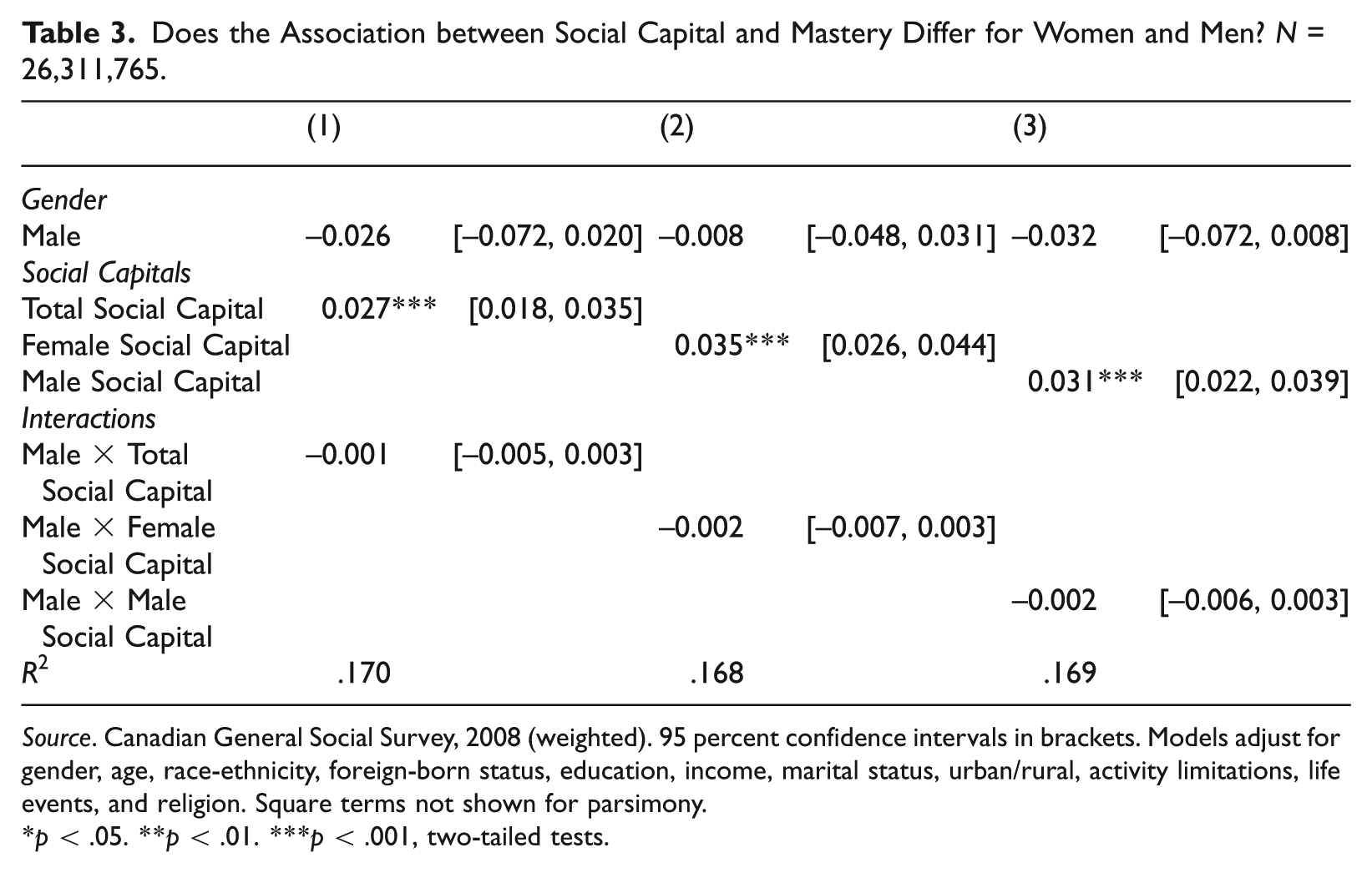
Source. Canadian General Social Survey, 2008 (weighted). 95 percent confidence intervals in brackets. Models adjust for gender, age, race-ethnicity, foreign-born status, education, income, marital status, urban/rural, activity limitations, life events, and religion. Square terms not shown for parsimony.
p < .05. **p < .01. ***p < .001, two-tailed tests.
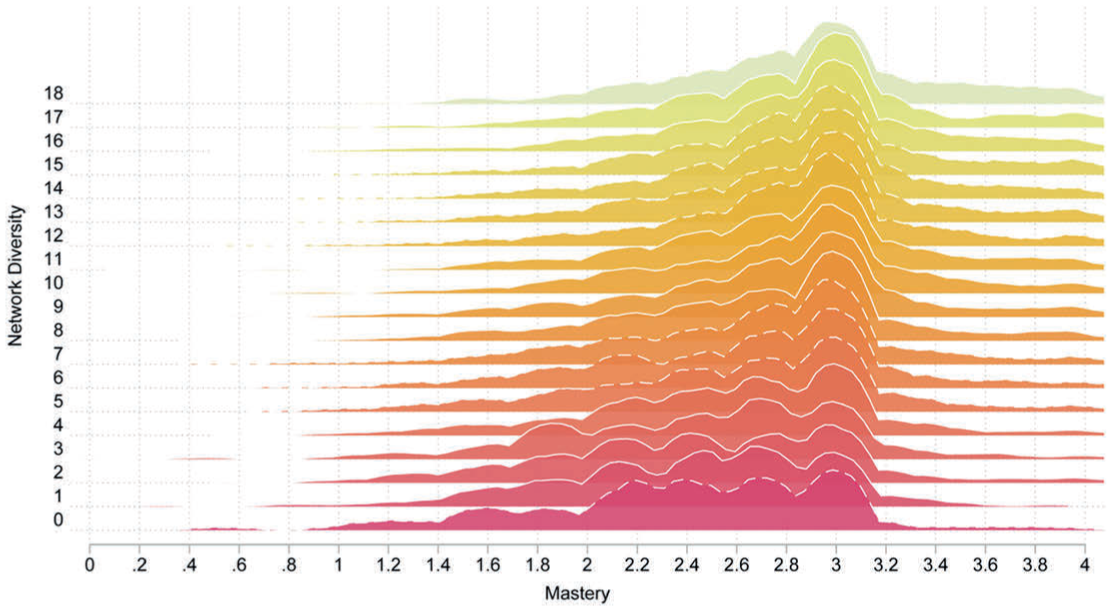
The Distribution of Mastery at Each Level of Social Capital.
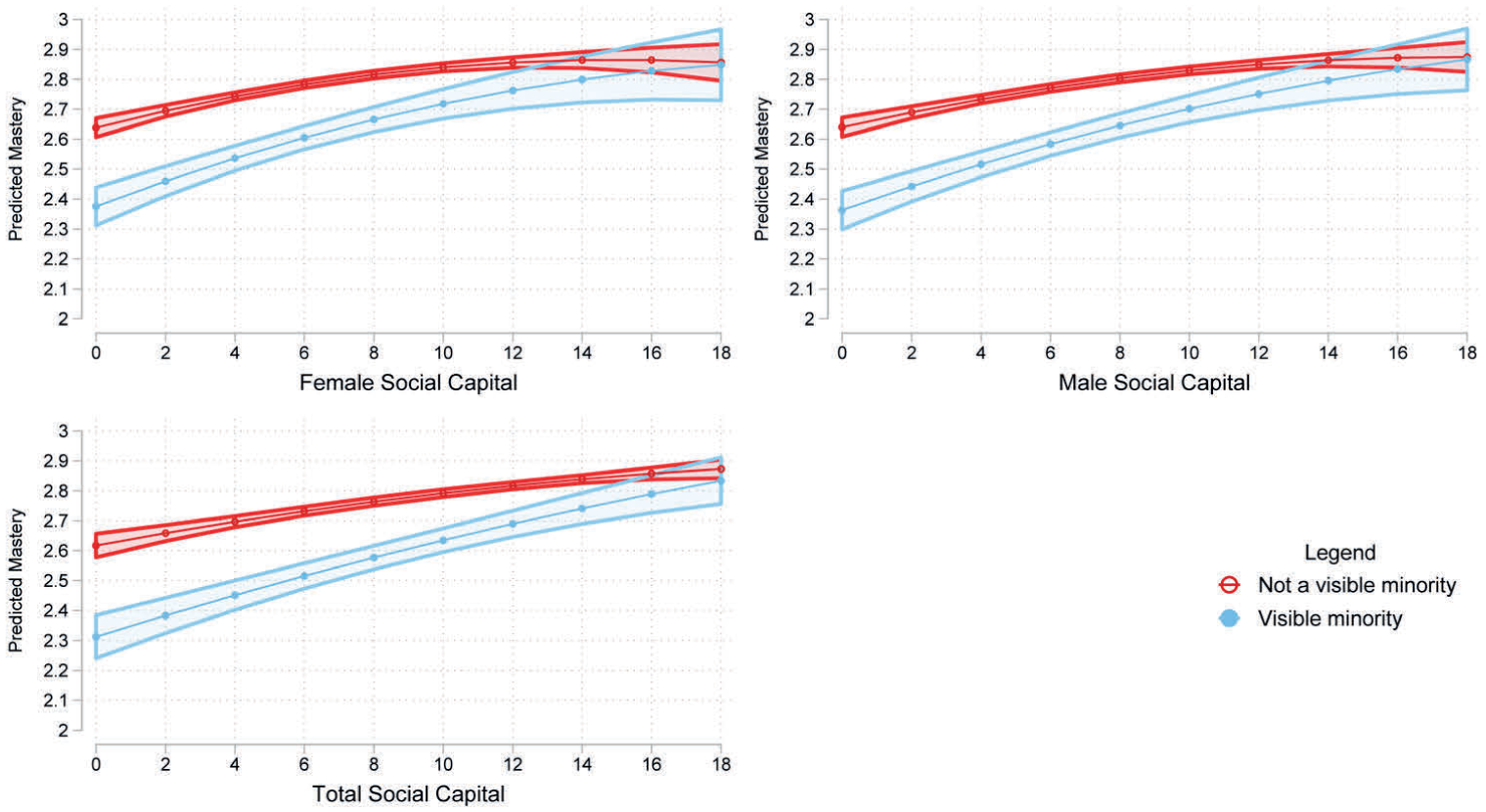
Does the Association Between Social Capital and Mastery Differ for Visible Minority and White people?
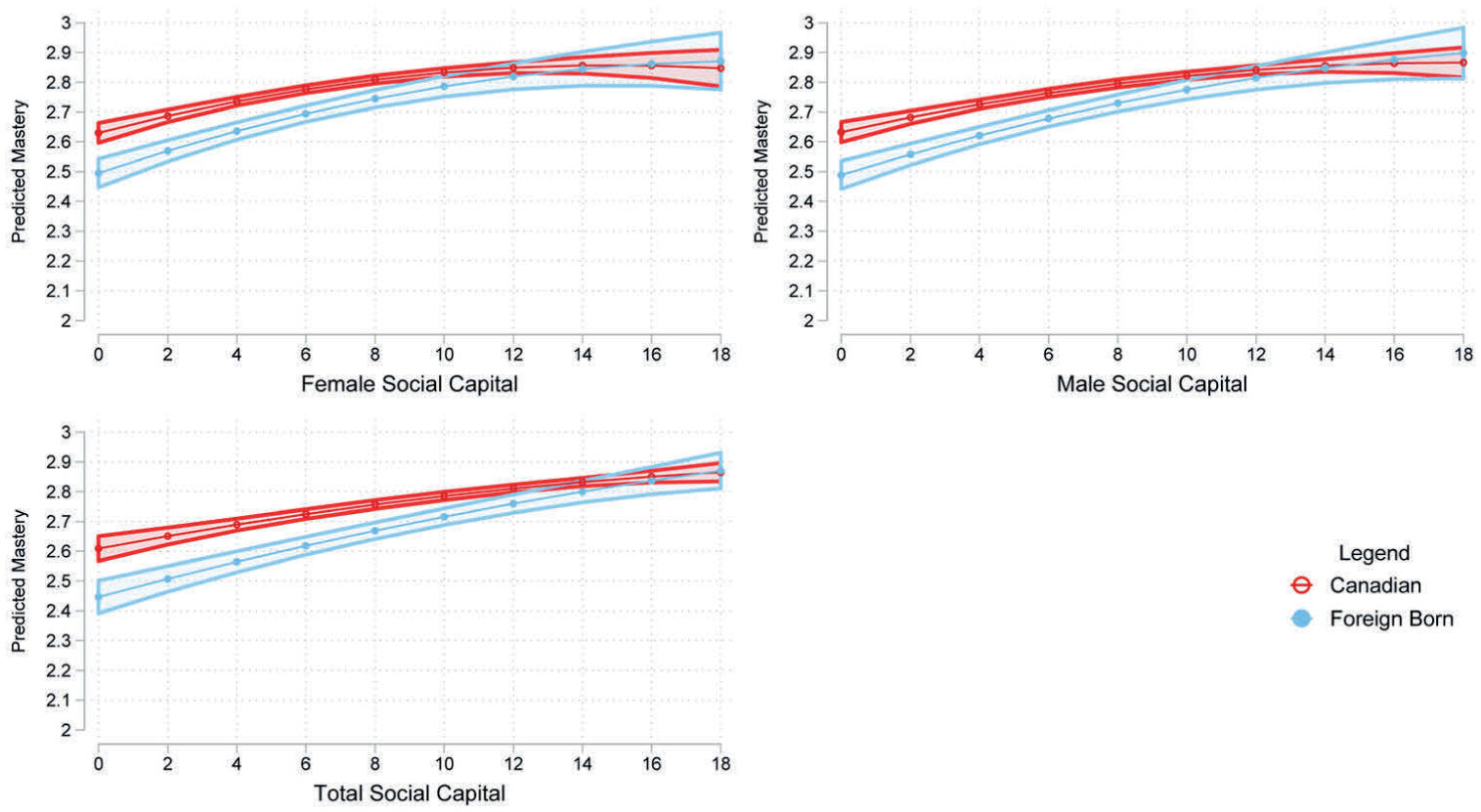
Does the Association Between Social Capital and Mastery Differ for Foreign-Born and Canadian-Born people?
Identifying the shape and conditional nature of a hypothesized relationship is an important aspect of theory development that strengthens inference (Brett, Silver, and Beelen 2020). This is because non-linearity, curvature, and conditional associations modified by other characteristics (i.e., interactions) influence the empirical consequences of theory (Stinchcombe 1987; Wheaton and Young 2021). It is likely that the resources available through alters overlap across some occupations, due to similar levels of required education or income, so before the top of the social capital scale is reached the positive association levels off. 2 This is distinct from the classic ‘too much of a good thing’ effect (Grant and Schwartz 2011; e.g., Wheaton 1985b), as the positive effects would not turn negative but instead may not detectably provide additional returns. Instead, there would be a ceiling where the respondent has access to a wide range of resources and thus feels suitably equipped to navigate their life course. I test for this with a square term.
Several sensitivity analyses were undertaken. This included testing whether the focal association significantly varied by age group, urban/rural status, activity limitations, life events, marital status, income, or religion. Complete results and detailed log files can be found in the OSF replication package for this study: osf.io/c54qm.
Results
Figure 1 shows that respondents reporting lower levels of social capital are more likely to report lower mastery. At the lowest levels of social capital, respondents are more likely to indicate that they disagree they can control fate and successfully resist external forces. Meanwhile, once respondents report above the half-way point of the social capital scale, they also increasingly report that they strongly agree they are in control of their life. As this figure does not adjust for theoretically motivated covariates, we turn to Table 2 for hypothesis testing.
Table 2 investigates the general relationship between mastery and social capital. When adults report more social capital, they also report higher mastery (b = 0.026***; 95% CI = 0.018, 0.035). After covariate adjustment, gendered social capital in terms of ties to women (b = 0.034***; 95% CI = 0.026, 0.042) or men (b = 0.030***; 95% CI = 0.022, 0.038) are slightly greater in magnitude than total ties. However, as shown by the overlapping 95 percent confidence intervals, the focal pattern does not differ substantively when examining total social capital, ties to women, or ties to men. The significant squared terms indicate that this relationship is marked by a ceiling: as social capital increases, additional connections add less benefit (b = 0.001*; 95% CI = 0.001, 0.000) until a threshold is reached where differences are no longer detectable. Finally, the bivariate model (see Supplemental Appendix 1) shows that social capital explains about 4 percent of the variation in mastery. The fully adjusted model shown in Table 2 explains about 17 percent of the variation in mastery. This is substantial, given that Canadian research often explains only about 5 percent of the variation in mastery after covariate adjustment (see Brett and Dubash 2023; Pearlin et al. 2007; Schieman and Narisada 2014). This demonstrates that explanations about the unequal patterning of control beliefs in the population are improved by considering social capital.
Table 3 and Figures 2 and 3 address the second research question: Who benefits from diverse social networks? Table 3 tests all three hypotheses about the gender-specific returns of social capital. Results demonstrate that, after adjustment, there are no detectable gender-specific returns to social capital or mean gender differences in personal control (p > .5). As I return to below, this is a surprise given prior research showing the gendered nature of social capital. Furthermore, overlapping 95 percent confidence intervals demonstrate that the patterns described are substantively similar when examining total social capital, ties to women, or ties to men.
Figure 2 (see also Table S1) shows significant interactions between visible minority status and total (btotal = 0.015***; 95% CI = 0.008, 0.022), female (bfemale = 0.014***; 95% CI = 0.006, 0.023), and male social capitals (bmale = 0.015***; 95% CI = 0.007, 0.023). Figure 2 indicates that non-White persons report higher levels of personal control for each corresponding increase in personal network diversity than White persons, until the association reaches a ceiling. For example, regarding total social capital, this is a 68 percent increase in personal control for each additional tie reported (bwhite = 0.022; bvismin = 0.037; 0.015/0.022 = 0.68). However, visible minority persons, on average, report between about one-quarter and one-third of a scale point lower personal control than White persons (e.g., btotal = 0.305***; 95% CI = 0.379, 0.230). Visible minority persons may gain greater benefits from social connections in ways that may help equalize disparities in personal control, but they may also experience alienation and fatalism when reporting low levels of social capital.
Figure 3 (see also Table S2) shows that there are also unequal benefits to social capital along the lines of nativity. Significant interactions for total (b = 0.009***; 95% CI = 0.004, 0.015), female (b = 0.009**; 95% CI = 0.002, 0.015), and male social capitals (b = 0.010**; 95% CI = 0.004, 0.016) demonstrate that this association is stronger for foreign-born persons than Canadian-born persons. For example, regarding total social capital, this is about a 41 percent increase in personal control for each additional tie reported (bCanadian-born = 0.022; bforeign-born = 0.031; 0.009/0.022 = 0.409). When foreign-born and Canadian-born respondents report knowing at least one person in 12 or more occupations they can be expected to report similar levels of personal control. The mutually exclusive confidence intervals at lower levels of social capital illustrate that foreign-born respondents with little network diversity are also reporting, on average, substantially lower levels of personal control than people born in Canada. Generally, these results indicate that disparities in personal control associated with visible minority and nativity statuses are most pronounced when social networks contain little occupational diversity. Yet people hold multiple statuses, and it is plausible that these associations may obscure heterogeneity that would be elucidated with more fine-grained identity categories.
To comprehensively investigate the second research question, I test interactions between social capital and the combinations of gender, visible minority, and foreign-born statuses. However, none of these interactions are significant at conventional levels (see Supplemental Appendix 3). There are unequal returns to social capital regarding personal control across two of the three categorical boundaries tested (e.g., visible minority and nativity statuses, but not gender), but not across the prism of intersecting social identities (e.g., visible minority women vs. visible minority men vs. White women vs. White men). Because these interactions are not significant, I do not report them in the body of this study (details can be found in the OSF replication package).
Discussion
Network diversity matters. As challenges and problems arise, knowing persons in a variety of social domains can be widely beneficial. Prior theorizing pointed out important possibilities for explaining a linkage between social capital and personal control. This study is the first to empirically test this association. Results from a national sample of Canadians demonstrate that, ceteris paribus, adults who report more social capital also report stronger beliefs in their personal control, although the association reaches a ceiling at higher levels of network diversity. Personal control appears to be shaped by the resources that people possess and by the interpersonal opportunity structures they are embedded in. Future qualitative research is required to elucidate the mechanisms linking beliefs about effective action and social network structure.
Theoretically, this study modestly continues the discussion about the valuable insights derived from quantitative approaches to intersectional identities and inequalities (Bauer 2014; Choo and Ferree 2010; Dubrow 2008; Erickson 2024). In this case, many proposed sources of heterogeneity, particularly gender, had null results. To develop a comprehensive account of social stress and health disparities, we cannot simply assume differences between population groups but must instead test them (McCall 2001; Wheaton 2003). The null findings are meaningful because they demonstrate that many theoretically plausible forms of heterogeneity were not empirically consequential. This improves explanation by showing whether network stratification processes matter, and for whom.
Taking intersectionality seriously in quantitative research about stress and social capital is challenging, however, for at least two reasons. First, social identities and inequality are interdependent in ways that are not simply additive (Bowleg 2008). To address this, studies commonly use regression with interactions and cross-classified (i.e., jointly-coded) variables (Bauer et al. 2021). However, these techniques require large samples to provide the statistical power required to avoid false negatives (i.e., Type II errors) because interaction effects are typically smaller and harder to detect (Gelman 2018; Gelman, Hill, and Vehtari 2020). Another challenge is that publicly available surveys often have few if any alter characteristics to examine. Correspondingly, the present analysis likely underestimates the complexity of intersectional social capital. The processes through which people decide to provide resources are racialized in that they are influenced by the larger social positions of ethnic groups (Tilly 2005; Wimmer 2008). Having information on alter race-ethnicity, education, migration characteristics, and specific position within each occupation (i.e., fire captain instead of new recruit) will demonstrate additional insights about the association between social capital and personal control. It may be that having ties to high status alters within each occupation may matter more than occupational diversity per se. As richer network data become available, future studies will be better positioned to evaluate these dynamics directly and advance theory.
Above, I outlined three predictions from prior research about whether total social capital, ties to same-gender others, or ties to men would have the greatest association with mastery. However, results showed that gender dynamics did not modify the association between social capital and personal control. This is unexpected given the findings of prior research. For example, gender homophily confers benefits to some groups while contributing to opportunity hoarding and social closure for others (e.g., McDonald 2011; Son and Lin 2012), which in turn can reproduce larger patterns of social inequality such as gender wage gaps (Collischon and Eberl 2021). However, it may be that feelings of personal control are less about the types and amounts of resources that women or men have access to and instead more about fostering the perception that people and resources are available to assist with effective action (in whatever form that may take). In this case, it may be that the cognitive structures activated during personal network solicitation influence perceptions of personal control, in a similar fashion to how perceived social support increases when people think about their interconnected social resources (e.g., Lee, Stahl, and Bayer 2020). 3
Sociological studies of culture and cognition can provide a compelling lens to investigate the psychosocial mechanisms connecting social and personal coping resources. Mastery is associated with preferences for deliberate cognition (Brett and Dubash 2023) but research has yet to examine whether personal control beliefs are fast and automatic, or, are instead deliberations about capacities, circumstances, and contexts. I speculate that it is likely to be the former (cf., Pearlin et al. 2007), because mastery is engendered through unequal social class experiences and family socialization, and in turn these beliefs are physiologically associated with cardiovascular responses. Simply, people with different mastery beliefs perceive the world as more or less challenging, which shapes social action across the life course. Much remains to be known. For example, do people ask themselves, “do I know someone who can help me?” or is it that access to social connections and their potential resources become an intuitive sense of the feel of the rules of the game and one's personal potency? Better understanding how aware people are of the connection between their social networks and personal control matters for interventions and policy, as different approaches are required to influence beliefs encoded in the mind as declarative or non-declarative forms of personal culture (Lizardo 2017; for a review, see Leschziner 2019).
Although this study uses the only publicly available national sample with measures of network diversity and personal control, as with all studies there are methodological limitations. Foremost, the binary measure of race-ethnicity based on visible minority status generally distinguishes between White and non-White respondents in Statistics Canada data. However, it is a crude measure given that specific racial-ethnic statuses differentially organize daily life due to structural patterns of inequality (Massey 2007; Tilly 2009). This means known racial-ethnic heterogeneity in mastery, such as Black-White differences (e.g., Louie 2020), is left uninvestigated. Future research can disaggregate visible minority status into specific racial and ethnic groups. Additionally, the questions about gender in these data only allowed for binary female or male response options. Future research can examine gender non-conforming persons, whose lived experiences are likely to be substantively different than those of men and women.
Generating novel empirical findings about whether, to what extent, and for whom social capital is associated with personal control beliefs helps test and extend theory by refining the abstractions that make theory a powerful tool for explaining general patterns of social inequality (Besbris and Khan 2017; Healy 2017). For example, this study demonstrated that respondent and alter gender were not meaningful scope conditions for this relationship at the population level. Causal inference in cross-sectional data presents major challenges, however, due to unmeasured confounding and reverse causality (Hedström and Ylikoski 2010; Zyphur et al. 2020). For these reasons, the regression coefficients from this study are best interpreted as descriptive comparisons (Gelman et al. 2020; Wheaton and Young 2021). Future research is required with longitudinal techniques that can adjust for unmeasured confounders and evaluate causal order.
It is possible that differences in personal control may influence social capital (i.e., reverse causality). For example, having lower mastery can cause conflicts in relationships that in turn could result in smaller networks (Thorsen and Pearce-Morris 2016). Wellman and Frank (2001:238), too, mention that “the availability of network capital may well be affected by individual ‘agency.’” To the best of my knowledge, no existing theory suggests that having higher or lower mastery would predict seeking out and maintaining relationships with people in specific occupational positions. However, this line of research does suggest that mastery could cause differences in social network size. Larger networks can then provide more opportunities to make diverse contacts across the occupational structure, and thus more access to network resources that could provide an opportunity structure for personal control beliefs. Additionally, one of the reasons why people selectively provide or deny network resources to others is to protect their own reputation and resources (Marin 2012). For example, when mastery is interpreted as a signal of competence, higher mastery may inadvertently signal stability and ability to reciprocate, which others may find appealing; while others may limit their engagement with people who signal fatalistic helplessness to avoid personal risk from reputational spillovers (for an excellent example of this last point, see Smith 2005). Thus, personal control beliefs could influence social capital processes. Future research should collect longitudinal panel data to determine causal order and examine the role of mastery in fostering larger and more diverse personal networks. It could also be valuable to investigate whether and to what extent people provide or deny resources based on perceptions of their network members’ agency beliefs and interpersonal signaling about personal control.
Conclusion
Social capital is crucial for enabling instrumental action. The present study focused on an important form of social capital, network diversity, to argue that social capital can also enable or constrain beliefs about personal mastery and control. Employing a national sample, I brought studies on mental health, social networks, and gender dynamics into dialogue to test three competing confirmatory hypotheses: mastery is most strongly associated with (1) the overall number of ties to different jobs (i.e., total social capital); (2) ties to gender-similar others (i.e., homophily regarding gendered social capital); or (3) ties to men (i.e., male social capital). Results demonstrate that people reporting greater network diversity also report, ceteris paribus, higher mastery, albeit with a non-linear ceiling where respondents reporting the highest levels of social capital do not report substantially higher personal control.
Extending theory on network stratification, I then examined whether the association between social capital and personal control generalized across three social boundaries: gender, visible minority status, and nativity. Based on the evidence presented here, the unequal benefits of social capital do not appear to be associated with the gender of the respondents or the gender of personal network members. Regarding personal control, the breadth of potential access to varied resources matters more than knowing at least one woman or man in diverse positions across the occupational structure. However, visible minority and foreign-born respondents report lower average levels of personal control than White Canadian-born respondents when reporting less social capital, and they also report larger increases in personal control as their network diversity increases. Differential impacts of social capital for visible minority and foreign-born persons, with all else being equal, narrow the substantial gap between minority and majority groups expected when social capital is absent. With Canada being one of the most diverse countries in the world, replication in other national contexts is essential to determine whether these patterns reflect general processes or context-specific dynamics.
Supplemental Material
sj-docx-1-smh-10.1177_21568693261447786 – Supplemental material for Social Capital and Personal Control: Who Benefits from Diverse Social Networks?
Supplemental material, sj-docx-1-smh-10.1177_21568693261447786 for Social Capital and Personal Control: Who Benefits from Diverse Social Networks? by Soli Dubash in Society and Mental Health
Supplemental Material
sj-csv-2-smh-10.1177_21568693261447786 – Supplemental material for Social Capital and Personal Control: Who Benefits from Diverse Social Networks?
Supplemental material, sj-csv-2-smh-10.1177_21568693261447786 for Social Capital and Personal Control: Who Benefits from Diverse Social Networks? by Soli Dubash in Society and Mental Health
Supplemental Material
sj-csv-3-smh-10.1177_21568693261447786 – Supplemental material for Social Capital and Personal Control: Who Benefits from Diverse Social Networks?
Supplemental material, sj-csv-3-smh-10.1177_21568693261447786 for Social Capital and Personal Control: Who Benefits from Diverse Social Networks? by Soli Dubash in Society and Mental Health
Supplemental Material
sj-xlsx-4-smh-10.1177_21568693261447786 – Supplemental material for Social Capital and Personal Control: Who Benefits from Diverse Social Networks?
Supplemental material, sj-xlsx-4-smh-10.1177_21568693261447786 for Social Capital and Personal Control: Who Benefits from Diverse Social Networks? by Soli Dubash in Society and Mental Health
Footnotes
Acknowledgements
I thank Bonnie Erickson, Monica Boyd, Lisa Kaida, Blair Wheaton, the participants of the Social Capital Session at INSNA Sunbelt 2024, and the participants of the 2023 Canadian Population Society Conference, for their contributions to this study.

Funding
The author disclosed receipt of the following financial support for the research, authorship, and/or publication of this article: The research presented in this report is that of the author and does not reflect the position of Statistics Canada or the funding sources. During the development of this study, the author was funded in part by the Social Sciences and Humanities Research Council Joseph-Armand Bombardier Canada Doctoral Graduate Scholarship (grant # 767-2020-1225), the Ontario Graduate Scholars Program, and the University of Toronto. Statistics Canada and the funding sources did not have any role in the study design; collection, analysis, and interpretation of data; writing of the report; or the decision to submit the report for publication.
Declaration of Conflicting Interests
The author declared no potential conflicts of interest with respect to the research, authorship, and/or publication of this article.
Supplemental Material
Supplemental material for this article is available online: osf.io/c54qm
Notes
References
Supplementary Material
Please find the following supplemental material available below.
For Open Access articles published under a Creative Commons License, all supplemental material carries the same license as the article it is associated with.
For non-Open Access articles published, all supplemental material carries a non-exclusive license, and permission requests for re-use of supplemental material or any part of supplemental material shall be sent directly to the copyright owner as specified in the copyright notice associated with the article.
