



Abstract
This article explores how the French theatre company Pupella-Noguès adapted I, Caliban, a rewriting of William Shakespeare's The Tempest by English playwright Tim Crouch, in which the slave Caliban relates his own version of the story. La Tempête de Caliban [The Tempest of Caliban] (2023) offers a scenography reminiscent of puppetry: on a magical table representing the island, Caliban manipulates various objects symbolising the other characters. On another table, a foley artist creates a live soundscape of the island. These elements create an experience both magical and metatheatrical for the audience members, who, witnessing the story of Caliban's emancipation, are encouraged to experience their own emancipation as spectators.
This article will look at La Tempête de Caliban [The Tempest of Caliban], a play created in 2023 by Pupella-Noguès, a French company whose theatrical language is often related to puppetry and objects. 1 It is a stage adaptation of a play by English playwright Tim Crouch, entitled I, Caliban (2003), which is itself a contemporary rewriting of William Shakespeare's The Tempest in the form of a monologue spoken by Caliban. 2 Although La Tempête de Caliban results from a series of adaptations, Shakespeare's original text is still easily perceptible in it. Pupella-Noguès’ members decided not to use the French translation of I, Caliban that had already been published, as they felt the language of this translation lacked the flexibility of Crouch's original text. The production team therefore made its own translation of I, Caliban, 3 slightly modifying the text at times or cutting it in some places to adapt it to the performance project. 4
La Tempête de Caliban is particularly notable in that it brings something very much reminiscent of puppetry to Crouch's play, something that could be termed a ‘marionnettique’ dimension (‘marionnettique’ is systematically translated by ‘reminiscent of puppetry’ or ‘borrowing from puppetry’ here). ‘Marionnettique’ is a neologism theorised in 2010 by French scholar Julie Sermon, who defined it as ‘un champ esthétique, renvoyant à une certaine manière de dire, de faire et de représenter (l’homme, le monde), qui emprunte au théâtre de marionnettes ses fonctionnements et ses conventions caractéristiques, mais sans nécessairement se destiner à cette forme’ [an aesthetic notion referring to performances or sequences within performances which do not necessarily show puppets, but are devised and staged according to dramatic conventions, scenic techniques, creative processes and/or imaginary universes typically found in puppet theatre]. 5
Therefore, La Tempête de Caliban is not, strictly speaking, a puppet show – in fact, it does not even feature puppets. It is rather a performance reminiscent of puppetry and influenced by the techniques of object theatre. 6 This creative direction was possible because objects were also given a substantial role in I, Caliban. Thus, in La Tempête de Caliban, while the spring-loaded toys representing the crew of the King of Naples’ ship are anthropomorphic, the actor-puppeteer manipulates them as though they were merely objects, rather than characters. Object theatre can also bring together objects, puppets, and actors. In Pupella-Noguès’ staging, Caliban is played by an actor. 7 He is accompanied by a foley artist dressed in a camouflage suit covering him fully; the rest of the cast is represented by objects or puppets.
This article will analyse La Tempête de Caliban, drawing from comparative literature and theatre studies as well as testimonies from the creators of the play. 8 The hope is that these varying points of view will bring an original perspective to this volume dedicated to the relationship between Shakespeare's work and puppets, by shedding light on a contemporary example of a stage adaptation both related to a play by Shakespeare and reminiscent of puppetry.
The hybridity of the theatrical language in La Tempête de Caliban, along with the multiple intermediaries that exist between it and Shakespeare's text, inspired the title of this article, which offers to ‘make theatre from the debris of The Tempest’. The core hypothesis of this study is that, through means reminiscent of puppetry, La Tempête de Caliban brings about a process of deconstruction of the Shakespearean hypotext, 9 in order to showcase the magic of its theatricality with the aim of emancipating the audience.
The first part of this article presents the Pupella-Noguès’ project, which saw in Crouch's text the liberatory material to tackle a Shakespearean performance. The second part illustrates how the scenography that borrows from puppetry creates a harmonious relationship between the magic of the theatre and the natural magic at the heart of Caliban's kingdom. Finally, the third part develops the idea that La Tempête de Caliban is a performance about emancipation – both the central character and the audience.
Crouch's I, Caliban by Pupella-Noguès: a liberating text
The French company primarily chose Crouch's play because of the freedom shown by I, Caliban in regard to the Shakespearean hypotext, even as it maintains an intense dialogue with it. I, Caliban is free from the original dramatic structure while remaining faithful to The Tempest: not a word or excerpt is alien to Shakespeare's play, just as Caliban relates his story using only objects left from the shipwreck. Indeed, in Crouch's I, Caliban, Prospero's slave begins a monologue while he is surrounded by debris from the shipwreck after the other characters have left the island to travel back to Milan. No voice but his is heard in the play, and he relates his own version of the story with objects he finds around him. In doing so, he counterbalances the voice of Prospero, whose presence pervaded the original text, and he provides a missing part of the Shakespearian narrative – most particularly Caliban's life before he met Prospero: ‘The stage littered with flotsam and jetsam, like a hide-tide mark – objects that he will use to tell his story’ (I, Caliban, 55, SD). Shakespeare's dialogues are then replaced by a narrative related to Caliban at present – meaning the day after Prospero and the castaways have left. The slave recounts his life from the moment he washed up on the island with his mother Sycorax. He mostly follows the chronology of the major episodes of The Tempest, with a particular emphasis on the evolution of his relationship with Prospero and on his meeting with Trinculo and Stephano, who fell victim, as he did, to the sorcerer's revenge after their plot to assassinate him. 10 However, this story is not linear; rather, it is faithful to the circular nature and spontaneity of an oral discourse that features prolepses and analepses. For these reasons, as a dramaturg, I thought the debris scattered on the floor at the beginning of I, Caliban could symbolise, like a metaphor, Crouch's rewriting work. 11
The company was charmed by Crouch's text because of the importance of the objects, but also because it focuses on the peripheral point of view embodied by Caliban. Written to meet the expectations of a relatively young audience, I, Caliban deals with oppression, submission, and revolt throughout the play. Crouch's readership and the audience of La Tempête de Caliban could thus, depending on their cultural background and their sensibilities, project the experience of colonial, familial, institutional, or even educational violence onto the ‘monster’ onstage. In this stage adaptation inspired by puppetry, the company attempted to keep the various possibilities of the audience identifying with the protagonist's frustration and rebellion, by bringing together a personal reading (with which teenagers feeling a sense of injustice or rejection could identify) and a more political reading (power struggles and postcolonial readings
12
of Shakespeare's play). Discussing with director Joëlle Noguès, I suggested that Crouch's monologue could be seen as a variation on the following monologue from The Tempest: This island's mine by Sycorax, my mother, Which thou tak'st from me. When thou cam'st first, Thou strok'st me and made much of me, wouldst give me Water with berries in ’t, and teach me how To name the bigger light and how the less, That burn by day and night. And then I loved thee, And showed thee all the qualities o’ th’ isle, The fresh springs, brine pits, barren place and fertile. Cursed be I that did so! All the charms Of Sycorax, toads, beetles, bats, light on you, For I am all the subjects that you have, Which first was mine own king; and here you sty me In this hard rock, whiles you do keep from me The rest o’ th’ island. (1.2.396–411)
13
Finally, the company chose Crouch's play because of the potential audience of the show. It is intended to be accessible to all audiences – neither for children nor for adults only – and Crouch's text stands at the crossroads of different age groups. In particular, I, Caliban was meant to be accessible to primary school children from the age of eight. 14 Thus, Crouch's play resonates both with school children and with adults familiar with Shakespeare, or simply interested in questions of injustice, of the other's gaze, and of differences. The language used is both simple and charming, therefore making this adaptation suitable for all ages. Crouch's text as well as the French translation reworked by Pupella-Noguès, use everyday language adapted to a young audience (‘he decides to bump his brother off’, I, Caliban, 59), sometimes playing with words which children would use: ‘A really good storm, she’d say, like a really good poo’ (I, Caliban, 56). This use of language coexists with a sustained play on phrases from the Shakespearian text, which are sometimes quoted word for word, or barely altered but in a meaningful way. For example, in Crouch's text, Caliban's instructions to Stephano and Trinculo for the purpose of killing Prospero, ‘First to possess his books, for without them / He's but a sot, as I am, nor hath not / One spirit to command’ (3.2.101–3), becomes, ‘Without his books he's nothing, he's just a monster like me’ (I, Caliban, 64). The substitution of the word ‘sot’ with ‘monster’ is central here since, soon after he takes the stage, Caliban describes himself as a monster, ‘an ugly tortoise of man’ (I, Caliban, 55). This monstrous image haunts the character throughout his story, until he reclaims it as a form of liberation in the final words of his monologue: ‘And now the storm's gone, and Prospero's gone I’ve nothing or no one to fear apart from myself, and I’m a monster, so it doesn’t matter’ (I, Caliban, 69). Such a line at the end of the play may serve to spark a process of identification on the part of young audience members, as Caliban invites them to accept their identity or their differences.
Therefore, considering the space made for both the objects and the unheroic and unloved young character, this monologue seems especially appropriate to address Pupella-Noguès’ desire to confront Shakespeare's work. This deconstruction avoids the pitfalls with which some adaptions from English contemporary playwrights are faced: according to Giorgio Pupella, they either tend towards mockery or parody, or they tend to be crushed under the symbolic weight of the great author. 15 Although Caliban somehow sets himself free from the image others have forced upon him by claiming and exaggerating it – Jean Genet's play Les Nègres [The Blacks] may come to mind here, since it also builds on this principle – Crouch's text on the other hand immediately ‘freed’ Pupella-Noguès from Shakespeare and, in doing so, enabled the company to focus on practising a language reminiscent of puppetry. All that remained was to give it body and to unfold its signs and language, also freed from Crouch's stage directions.
A scenography borrowing from puppetry: the magical table island, kingdom of Caliban
Pupella-Noguès’ staging choices move away from Crouch's stage directions and instead create a set design centred on a magical table, the stage of various incarnations. The wooden table is completely empty at first and represents the enchanted island of The Tempest, deemed as such through the simple statement ‘Ça, c’est mon île’ [This, right here, is my island], (La Tempête de Caliban [TC]). But this table is special, as it is imagined and built by a magician, 16 with numerous trapdoors suggesting potential caves, holes, and caverns, and serves as the focal point of a scenography borrowing from puppetry. Every object that appears onstage is taken out of one of the table's niches and is grabbed, manipulated, or thrown by Caliban. The actor playing Caliban is properly an actor, taking on the substantial monologue of the performance, but he is also a puppeteer who tells his story with the objects he manipulates. Other layers are added: Caliban is on his table like a child pulling toys from a trunk and improvising a story with them. The table resembles both a treasure chest with which the younger members of the audience can identify and the chess board table on which Ferdinand and Miranda play. In turn, the chess game may symbolise Prospero's manipulation of the other characters, but also Caliban's gradual awakening: the more pawn-castaways he sets on his island table, the more he realises that he was ‘duped’. Therefore, the influence of puppetry in the performance is also felt in the lability of incarnation, since a medium – an object – can signify different referents, depending on the moment of the action and the status accorded to it by an act of manipulation.
From this initial convention – the table is the island – stems the choice of objects. In Crouch's play, Caliban grabs ‘an object’ to represent a character, such as Miranda, Prospero, or Alonso. The nature of these objects is not specified, but Crouch's readership implicitly understands them to be remains from the shipwreck. However, the company decided to play most of the time with everyday objects that do not evoke one specific world or another. These are not natural elements from the island or vestiges of the stranded ship; rather, they are objects one can set on a table or put in a trunk, such as postcards (of Naples and Milan, to first depict Alonso and Antonio), spring-loaded toys sometimes found on the dashboards of cars, decorative items, and, of course, books. Choosing varied objects served to limit the show to a single reading, while allowing for a greater freedom of imagination for the audience.
The magical table is not the only element onstage. It is accompanied, stage right, by a bizarre entity: a foley artist, dressed in a vegetable camouflage suit covering him fully. This character adds to the performance a dimension not as obvious in Crouch's text, as the foley artist embodies both the spirit of the island (its music, bird calls, or the sounds of its reeds) and the simple magic of the theatre. Indeed, the audience witnesses the behind-the-scenes of the show's sound design. The sounds of the island, but also those of the acts of torture inflicted on Caliban; the jeering whistles of the elusive Ariel; or the beating of Caliban's heart when he sees Miranda, are all created live using rudimentary means (fabrics, basins of water, plastic bottles, decoys, and crumpled paper), the sounds of which are amplified with a microphone. The foley artist's table completes this scenography reminiscent of puppetry with another form of object manipulation different from Caliban's and which contributes to the life of this magic island (Figure 1).
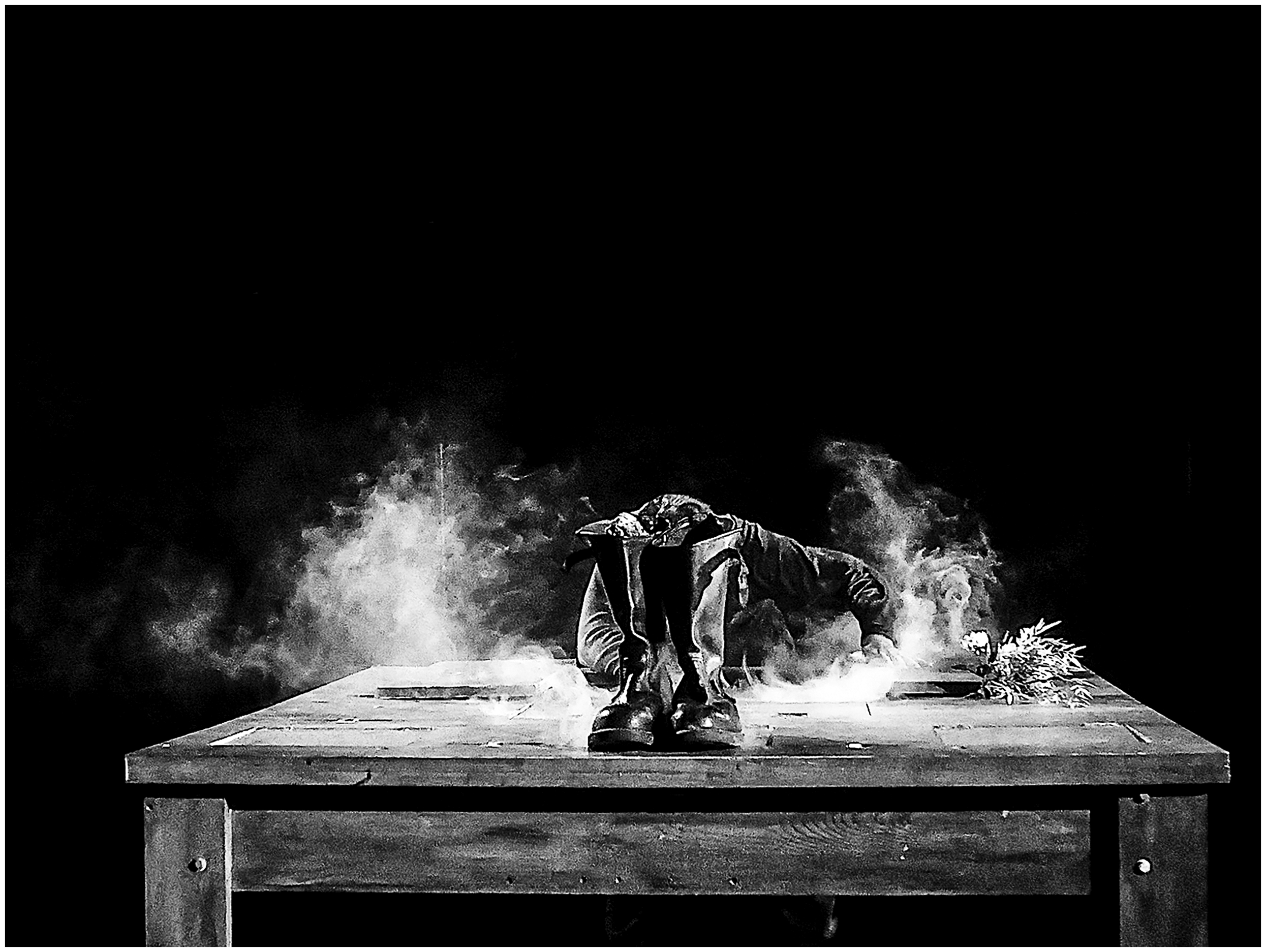
Antoine Raffalli (Caliban), La Tempête de Caliban, dir. Joëlle Noguès. Photograph by Giorgio Pupella.
One stated company goal with this adaptation of I, Caliban was to produce a performance about magic, which could surprise the audience or fill them with wonder, while also playing with the artifices of theatrical shows. Giorgio Pupella underscores the importance of this theatrical language made of codes and signs, which rests on the audience's willingness to take part in a theatrical conceit where artifices, although obvious, serve to ‘transport’ the audience. The most representative effect of this theatrical pleasure is arguably that of Caliban's heartbeat when he confesses his attraction to Miranda. Viewing the action on centre stage, audience members can see that Caliban is captivated by the china bell representing Miranda as he holds her in his hand, and they can hear his heartbeat grow louder and faster. But they only need to turn their attention to the foley artist to realise that this emotion is created by a piece of fabric stretched and then loosened at a steady rhythm under a microphone. The company felt it was important that the audience thus goes from experiencing the emotions of the character to being surprised at seeing live the simple and insignificant means through which they are produced. This ‘second island’ represented by the foley artist's table operates as a suggestive space, where the audience may make the connection between what they see (a wooden spoon stirred in a basin of water or a plastic bottle crushed in front of a microphone) and what they hear (Caliban exploring the swamps of the island or the conspirators’ bodies ‘tourmentés de crampes de vieillards et de convulsions qui font craquer [leurs] os’ [‘tormented by old men's cramps and spams that make [their] joints crack’, TC]. The foley artist is like a conductor hidden under a balaclava of wild grasses and seems to confide secretly to the audience, just as the chorus in Henry V did: ‘Thus with imagined wing our swift scene flies / In motion of no less celerity / Than that of thought […]’ (3.Chorus.1–3). 17
In La Tempête de Caliban, the addition of the foley artist brings out a new link connecting the magic of the theatre with Caliban's natural magic: the two worlds are no longer separate. Indeed, the most essential part of the relationship between Caliban and the foley artist builds in the harmony that connects the gestures and the words of Caliban with the foley artist's actions. Whether he plays musical tracks or recorded sounds (the sound of the sea, the highbrow and ‘belle musique’ [beautiful music] to which Prospero introduced Caliban) or accompanies the tortured slave's agonising pain, the foley artist is always present – in an echo, listening – and is inextricably linked to the actor. This is meant to represent a silent dialogue between Caliban and the magic spirit of the island. The presence of the foley artist and his instruments gives body to the relations between the character and the natural environment as well as the resources of the island, and it embodies onstage the belief in animism that governs his vision of the world, as opposed to Prospero's book-learned magic that is used to subjugate nature. This may call to mind Caliban's famous monologue: Be not afeard. The isle is full of noises, Sounds and sweet airs that give delight and hurt not. Sometimes a thousand twangling instruments Will hum about mine ears, and sometimes voices That, if I then had waked after long sleep, Will make me sleep again; and then, in dreaming, The clouds methought would open, and show riches Ready to drop upon me, that when I waked I cried to dream again (3.2.148–56)
Then, the magic changes course and is displayed for the benefit of theatrical tricks – a dimension at the heart of Pupella-Noguès’ project. This is particularly noticeable in the decision to personify Ariel's spiritual nature not with a puppet or an object that would frolic in the air, but rather with a sound (whistling) and with fire. When Caliban tries to capture his mother's ‘home help’ to imprison her inside a tree, her presence is signified by flames coming out of the table. Here, it seems that the staging plays with the sheer pleasure created by magic effects, the most troubling of which, according to audience testimonials, is the one in which the special effect cannot be broken down. Although the artificial nature of the fire and smoke effects is evident and perfectly embraced, Caliban's final disappearance into the table remains a mystery. How can he disappear in it? Is the actor a contortionist? 18 In fact, an invisible trapdoor and black fabric were both well-placed at the back of the table by the magician who designed it – a trick that may remind us of the trapdoors of the Elizabethan stage.
Such is the magical and theatrical kingdom where Caliban takes back control over his story, marked by oppression and revolt. The objects and the visual dramaturgy, even more so than the text itself, are tasked with the embodiment of a political reading of Shakespeare's play, in a discreet but resolute manner.
A performance about emancipation
Joëlle Noguès specifies that when they had to choose the objects for the performance, the most important criterion was that Caliban should be able to ‘grab’ them. The language of manipulation lets the audience know that the slave, by the very act of relating his story in such a manner, symbolically takes back control over those who have mocked him, oppressed him, or dispossessed him of what was his. Indeed, these objects are purely instruments to Caliban, who uses them to tell his story. The King of Naples and his bunch are deconstructed, desacralised, and dehumanised, as they had been in Crouch's text, in which they had been turned into comic archetypes (‘the whole shooting party’, I, Caliban, 61) or fairytale villains. Thus, in I, Caliban, some expressions are repeated over and over again: ‘the baddy King of Naples’, ‘Prospero's evil brother’, ‘drunken idiots’ (Trinculo and Stephano), or ‘blooming spirit’ (Ariel).
La Tempête de Caliban stages a symbolic emancipation of Caliban, first, through the type of manipulation used: the objects are grabbed, moved, thrown, and shoved unceremoniously into niches. The character and the audience can then amuse themselves with these trivial figures. For instance, a comic game begins when Caliban lays the castaways out haphazardly on the table, saying that they have been ‘a little shaken’ by the tempest: at this moment, the spring-mounted puppets of Alonso, Antonio, Ferdinand, and Gonzalo swing before the audience's eyes, ‘shaken’ indeed by regular jolts. When there is truly a form of illusion to make the objects look alive, by having them speak for instance, it is done parodically, as in Miranda and Ferdinand's dialogue. The latter – a spring-loaded puppet with a baby doll's head – can only answer ‘Ouaf, ouaf’ [Woof, woof] to the spellbound words of Miranda who, because she has never seen a human being other than Prospero and Caliban, ‘pense qu’il est une chose divine’ [‘thinks he is a divine thing’, TC]. Miranda is represented by a china bell, crowned with a rose, which may indicate that she is ‘un peu cloche’ (‘a little stupid’, ‘cloche’ being both a bell and a derogatory term in French). It may also ironically refer to a world associated with young girls, such as Tinker Bell's 19 – that is, a world in which she has been kept by her father since birth. The parodic dimension is enhanced here by the dissociation between gestures and speech – although Caliban manipulates Ferdinand's puppet and the bell quite nervously, the fiery barking of Miranda's suitor is the responsibility of the foley artist, who exaggerates it.
However, one object, and a good one at that, seems not to be controlled by Caliban, suggesting that his emancipation through the act of storytelling is uncertain: Prospero is represented by commanding black boots, suggesting authority and power, which are put on the table-island abruptly while Caliban proclaims: ‘JUSQU'À CE QU’IL ARRIVE ET GÂCHE TOUT’ [UNTIL HE ARRIVED AND RUINED EVERYTHING, TC]. Using boots to represent Prospero is one of the discreet signs linking the performance to postcolonial interpretations of The Tempest, in which Prospero has often been identified as a coloniser. Thus, the small spring-loaded puppet representing Antonio is dressed as a colonialist, with a white shirt and a colonial hat, and the King of Naples and his party are wearing military uniforms. Speaking to the company's members as dramaturg, I shared these political readings, and I suggested to Noguès and Pupella several texts they could read, starting with Michel de Montaigne's essay ‘On the Cannibals’. When Gonzalo mentions it in Shakespeare's play, a link is drawn between the island of The Tempest, even though it may be in the Mediterranean, and the discovery and conquest of the New World, which is the topic of Montaigne's essay. In The Tempest, Gonzalo imagines a new society on this island, which he believes to be uninhabited, and he takes up Montaigne's text almost word for word: I’ th’ commonwealth I would by contraries Execute all things, for no kind of traffic Would I admit; no name of magistrate; Letters should not be known; riches, poverty, And use of service, none; contract, succession, Bourn, bound of land, tilth, vineyard, none; No use of metal, corn, or wine, or oil; No occupation; all men idle, all, And women too, but innocent and pure; No sovereignty– (2.1.162–71)
20
In this interpretation, Caliban's emancipation is both suggested and strongly disputed. A particularly intense moment occurs towards the end of the performance, as the audience sees Caliban imitating Prospero. At that moment, the actor playing the slave puts on Prospero's boots for a brief moment, creating an ambiguous image. All of a sudden, Caliban seems all-powerful: he grows onstage, while his voice, now a bass, is amplified by an echo and the light is removed from his face so that the focus is now on his boots. The scene is also paced by the foley artist, with the solemn and worrying sound of a war drum. But one must not be fooled, and Caliban knows it. This rise to power is a short-lived theatrical effect and the master's magic (or the slave's ancestral fear) is always close by.
Because of the objects selected and manipulated in it, La Tempête de Caliban can be said to deal with oppression and emancipation – two notions that may affect the younger members of the audience in particular. Indeed, these spectators are not merely passive witnesses to ‘l’histoire’ [the story], but are instead often invited to distance themselves from the work of fiction, whether through direct quotes by Caliban or exchanges taking place on a metatheatrical level between Caliban and the foley artist. Their theatrical bond builds in these moments, which unfold outside of the fictional world – for instance in an interlude during which Caliban does a classic magic trick with cups, which amazes the younger members of the audience and amuses the older ones. Caliban interacts with the audience at this moment – he asks a member to come onstage to take part in the trick, much like illusionists do in their shows. While he remains seated behind his instruments, the foley artist takes on the role of the magician's assistant by adding the fitting sounds to the magic act, and by exchanging knowing looks with Caliban. Such games with the audience occur several times in the performance and are an obvious legacy of Crouch, whose work as a playwright and performer always questions the status of theatrical fiction. According to Crouch, theatre happens in the imagination and reception of the audience, and not in a fictional proposal according to which an actor plays a character in a given plot. A central role is therefore often given to the audience in his creations, such as in The Author (2009), in which ‘Crouch se débarrasse littéralement de la scène et le public devient le nouveau lieu de l’action théâtrale’ [Crouch literally does away with the stage, and the audience becomes the new stage of the theatrical action], in which ‘le spectateur s’émancipe’ [the audience emancipate themselves], and ‘l’auteur abandonne de fait l’autorité sur le texte’ [the author effectively renounces authorship over the text]. 22 Even without arriving at this conclusion, the multiple direct addresses to the audience by Caliban draw a parallel between Caliban's emancipation and that of the audience members, who are invited to feel that they have a right to participate in the play. Audience direct address is also a distinguishing feature of dramatic works reminiscent of puppetry 23 – an art form that often works as miniature theatre that asserts its artificial nature and in which mises en abimes [metatheatrical games] and interactions with the audience traditionally play an important role.
This metatheatrical dimension also helps mitigate the symbolic weight brought by the Shakespearian legacy. La Tempête de Caliban stages a story by Shakespeare to an audience who may have never heard of him. In France, secondary school pupils are familiar with Molière, but Shakespeare seems to be unknown to many of them, as illustrated by the reaction of a middle school teacher who attended the show. During a conversation with his class, when Pupella said that a famous author named Shakespeare had come up with the story, the teacher exclaimed: ‘Ah oui quand même, c’est du Shakespeare!’ [Oh, Shakespeare! That's quite something then!]. 24 Audience members of diverse backgrounds inevitably interpret La Tempête de Caliban differently, perhaps even more so than was the case with Crouch's text. While Caliban and Prospero's relationship is generally guided by the question of the relationship between master and student in I, Caliban, 25 the master–slave dialectic is even more pertinent in La Tempête de Caliban – but school students may still recognise their resentment towards authority. They can see this in Caliban ‘the kid who is a dunce at school but has other gifts’ 26 because he knew how to manage on the island and inhabit it instinctively before Prospero arrived with his books. Indeed, nods are made to those left out by academic learning: ‘IL A DES LIVRES. Il a des livres. Il a des livres. Et il sait lire. Et je trouve ça déjà assez dur de prononcer le mot “livre”, alors en lire un’ [HE HAS BOOKS. He has books. He has books. And he can read. And I find it hard enough to pronounce the word “book”, let alone to read one, TC]. While he pronounces this line, the actor takes several old books from a trapdoor, one by one, and throws them unceremoniously at the audience members’ feet – the sense of transgression it awakens creates great joy among them. Thus, the show's faithfulness to the Shakespearian spirit also appears to lie in this ability to resonate with everyone, without necessarily appearing to originate in highbrow or elite culture or to be catered to a target audience defined by programming policies.
Ultimately, La Tempête de Caliban is a production about emancipation, and not only Caliban's – who liberates himself from the other's gaze and power. It is a play inspired by Shakespeare that is also liberated from the widespread sacralisation of the Elizabethan playwright; a performance reminiscent of puppetry without puppets; a magic act without a magician; a theatre performance in which the only plays on illusion are produced by a table with trapdoors.
Footnotes
Acknowledgements
The author wishes to thank Manon Nafraîcheur, who kindly translated this article, and Carole Guidicelli, for her precious advice.
Declaration of conflicting interests
The author declared no potential conflicts of interest with respect to the research, authorship, and/or publication of this article.
Funding
The author disclosed receipt of the following financial support for the publication of this article: This article is one of the outputs of the European Research Commission's PuppetPlays project (Horizon 2020/G.A. 835193), which paid for this publication's open access.
