




Abstract
The article discusses William Shakespeare's Caliban in the context of early modern knowledge culture and its representation of the ‘monstrous’ in wonder cabinets and works of natural history. According to Stephano, Caliban is ‘a present for any emperor’ (2.2.69). This connects him to the real-life case of Pedro Gonsalvus, who became just such a ‘present’ given to the French king in 1547. His face and body overgrown with hair, Gonsalvus and subsequently his equally hirsute children became marvels at several European courts. Their case shows the same intermingling of artifice and animality that went into the creation of Caliban and shaped his afterlife in the theatre.
Hamlet begins with the question ‘Who's there?’ It trembles with apprehension that ‘this thing’ – the thing that has been sighted twice already – will ‘appear[ ] again tonight’ (1.1.21).
1
When it does appear, Horatio questions it: ‘What art thou […]?’ (1.1.46). But he receives no answer. Three scenes on, Hamlet still cannot decide who or what the ‘questionable shape’ (1.4.43) is – ‘a spirit of health, or goblin damned’ (1.4.40). ‘Who's there?’ The opening question reverberates through the rest of the play.
The Tempest has such a question too. It is not quite as prominently placed right at the start of the action, yet it also voices an uncertainty that virtually saturates the whole play. We have to wait until 2.2 for it to surface: ‘What have we here’, exclaims Trinculo, the jester, when he first lays eyes on Caliban, ‘a man or a fish?’ (2.2.24–5).
2
To be sure, this differs quite a bit in mood and tone from the ‘Who's there?’ of Hamlet. The Tempest, after all, is a comedy. ‘What have we here?’ is not as portentous, not as fraught with a sense of impending calamity as the ‘Who's there?’ of Hamlet. Instead, it strikes a keynote of amazement, of surprise, of not quite knowing what to make of what one is seeing. As in Act 5, when King Alonso of Naples sees his supposedly drowned son Ferdinand playing chess with a young lady and hesitates to believe his eyes for fear of disappointment: ‘If this prove / A vision of the island’, he declares, then ‘one dear son / Shall I twice lose’ (5.1.175–6). But the happy resolution of Prospero's ‘project’ is near, and so it is not just a vision, and Alonso does not lose his son a second time. And then, faced with the band of courtly castaways trudging onto the stage, it is Miranda's turn for her ‘What have we here’ moment. She gives it utterance in one of the most famous lines of the play: Miranda. O wonder! How many goodly creatures are there here! How beauteous mankind is! O brave new world That has such people in’t. (5.1.181–4)
The two fundamental binaries involved here are the one between nature and culture, more specifically nature and art, and the one between human and animal.
4
Normally, and normatively, we find them aligned in two parallel pairs: ‘human’ goes with ‘art’; ‘animal’ goes with ‘nature’. But on the enchanted isle of The Tempest, this does not necessarily apply. Take Ariel's song, for example: Full fathom five thy father lies, Of his bones are coral made; Those are pearls that were his eyes, Nothing of him that doth fade But doth suffer a sea-change Into something rich and strange. (1.2.397–402)
But let us begin again with the moment in 2.2 when Trinculo encounters Caliban: What have we here, a man or a fish? Dead or alive? A fish: he smells like a fish, a very ancient and fish-like smell […]. A strange fish! Were I in England now (as once I was) and had but this fish painted, not a holiday fool there but would give a piece of silver. There would this monster make a man. When they will not give a doit to relieve a lame beggar, they will lay out ten to see a dead Indian. (2.2.24–32) Stephano. This is some monster of the isle […]. If I can recover him and keep him tame, and get to Naples with him, he's a present for any emperor that ever trod on neat's leather. (2.2.64–9)
*
In 1547, a present much like the one Stephano has in mind ‘for any emperor’ was given to King Henry II of France for his coronation. This was not one of the customary precious artefacts or beasts, such as horses, lions or the famous rhinoceros given to the King of Portugal in 1515. Instead, it was a boy. A boy about ten years of age, apparently very handsome, but certainly very unusual. His face was completely overgrown with hair. Very thin, fine hair, finer even than the particularly fine and precious hair of a sable, dark blond and about three and half inches long. Because it was so fine and not growing very thickly, the boy's features were clearly visible. Not only his face but also his chest and back were covered with hair. Only the neck showed sparser growth. We owe this precise description to the ambassador of the Duke of Ferrara at the French court. In the report to his master he also writes that the boy looked ‘like it is customary to paint the wild men’ 5 (Figure 1).
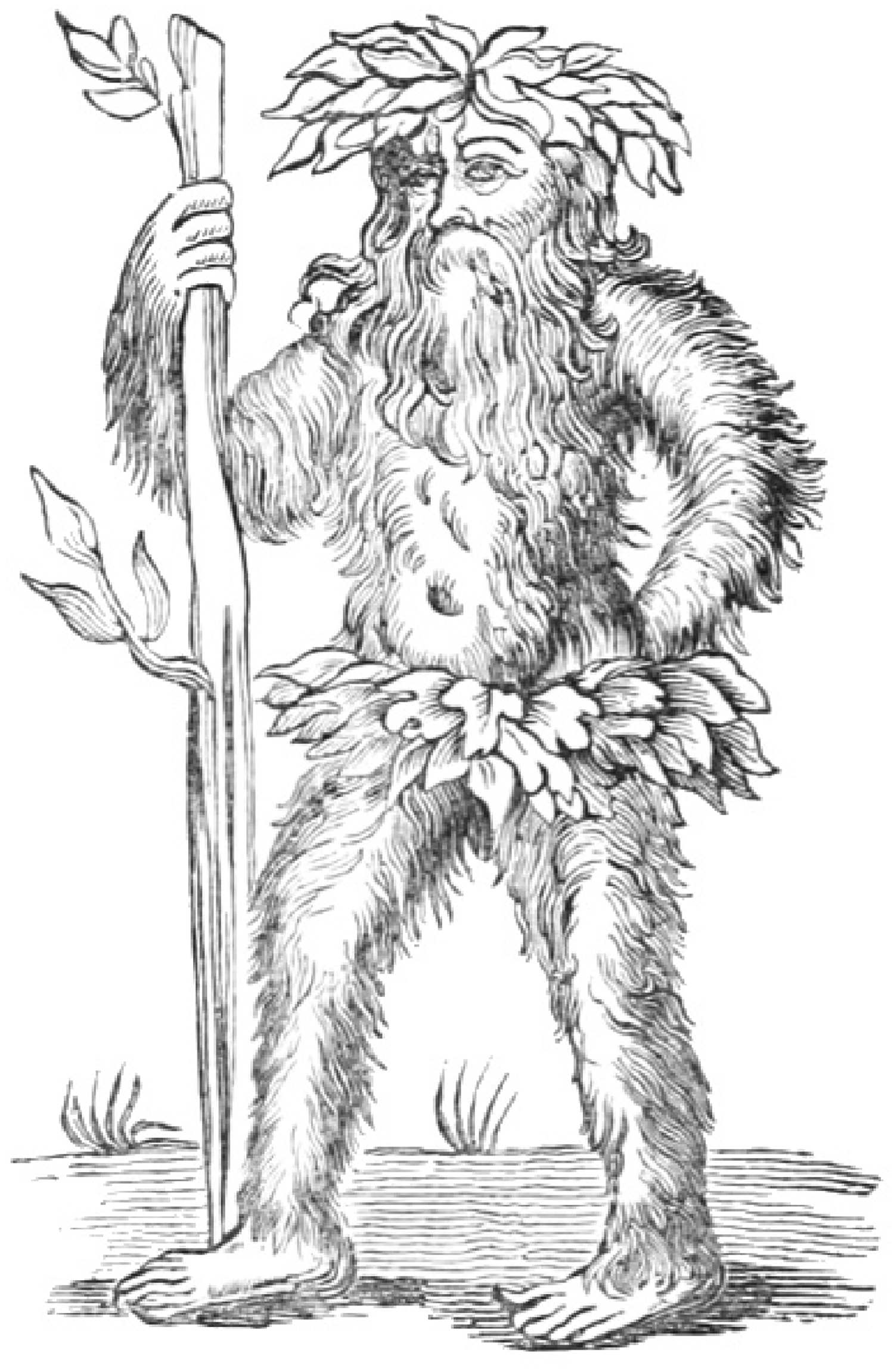
Image of a wild man. Joseph Strutt, The Sports and Pastimes of the People of England (London: Thomas Tegg, 1838), p. 378: ‘The figure itself is taken from a ballad, in black letter, entitled “The mad, merry Pranks of Robin Good Fellow”’.
Such hairy creatures had been familiar in pictures and stories long before their first real-life exemplum appeared at the French court in 1547. Art had preceded nature almost as if to anticipate Oscar Wilde's claim that London fogs hadn’t existed until Impressionist ‘Art had invented them’. 6 My point here is not so much precedence as exchange and circulation in what we might term an economy of wonder. The ambassador from Ferrara just as promptly associates the hairy boy with pictures he has seen as does Trinculo when he thinks how he could profit if he ‘had but this fish painted’.
Of the real boy there is no picture, but there are several that show him as an adult (Figure 2). His name was Pedro Gonzales or, in its Latinate form, Petrus Gonsalvus. An Italian source from 1591 calls him Don Pietro Gonzales Selvaggio. This constitutes something of a social paradox, a contradiction in terms: ‘Don’ – a man of high standing; ‘Selvaggio’ – a savage, a wild man from the woods.
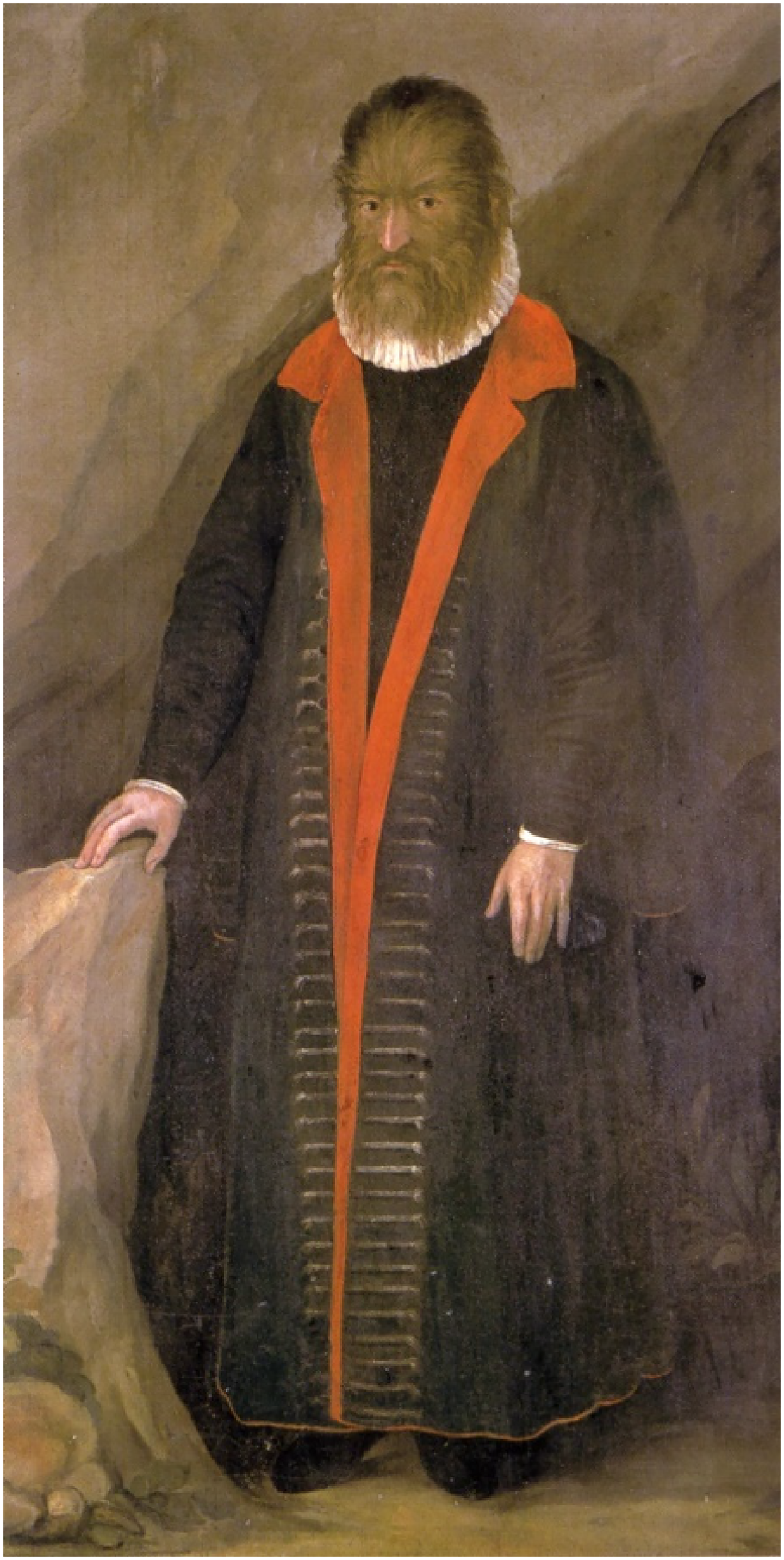
Anonymous, portrait of Petrus Gonsalvus (c. 1580). Ambras Castle, www.khm.at/de/object/5529/ (accessed 15 May 2024).
Unlike most human rarities given to Renaissance princes, Pedro Gonzales fared rather well on his curiosity status. During his years at the French court, he was assigned lodgings in the royal park at Fontainebleau. This was apparently regarded as the appropriate setting for a creature that seemed to have stepped right out of the fanciful forests of chivalric romance.
His actual origin was the island of Tenerife, in itself a place of liminal status. Like Prospero's isle, it belonged to both the Old World and the New. The last of the Canary Islands to be conquered by Spain in 1496, its original inhabitants, the fiercely independent Guanches, were said to have lived in a state close to animality before the Spaniards succeeded in making civilising nurture stick on their wild nature. The German cosmographer Hieronymus Müntzer lauds the ‘doctrine and diligence’ of the colonisers that turned animals with merely human bodies into proper humans – and tame ones at that. 7
The boy Pedro Gonzales, however, was definitely not wild when he arrived in France. He apparently had even learned a little Latin. So, for all his hirsutism he rose to the rank of a minor court official. He was also permitted to marry a perfectly normal wife. The couple is depicted on a small watercolour by Georg (or Joris) Hoefnagel (Figure 3). The first line of the caption quotes Saint Augustine: ‘A greater miracle than all the miracles worked by man is man himself.’ 8
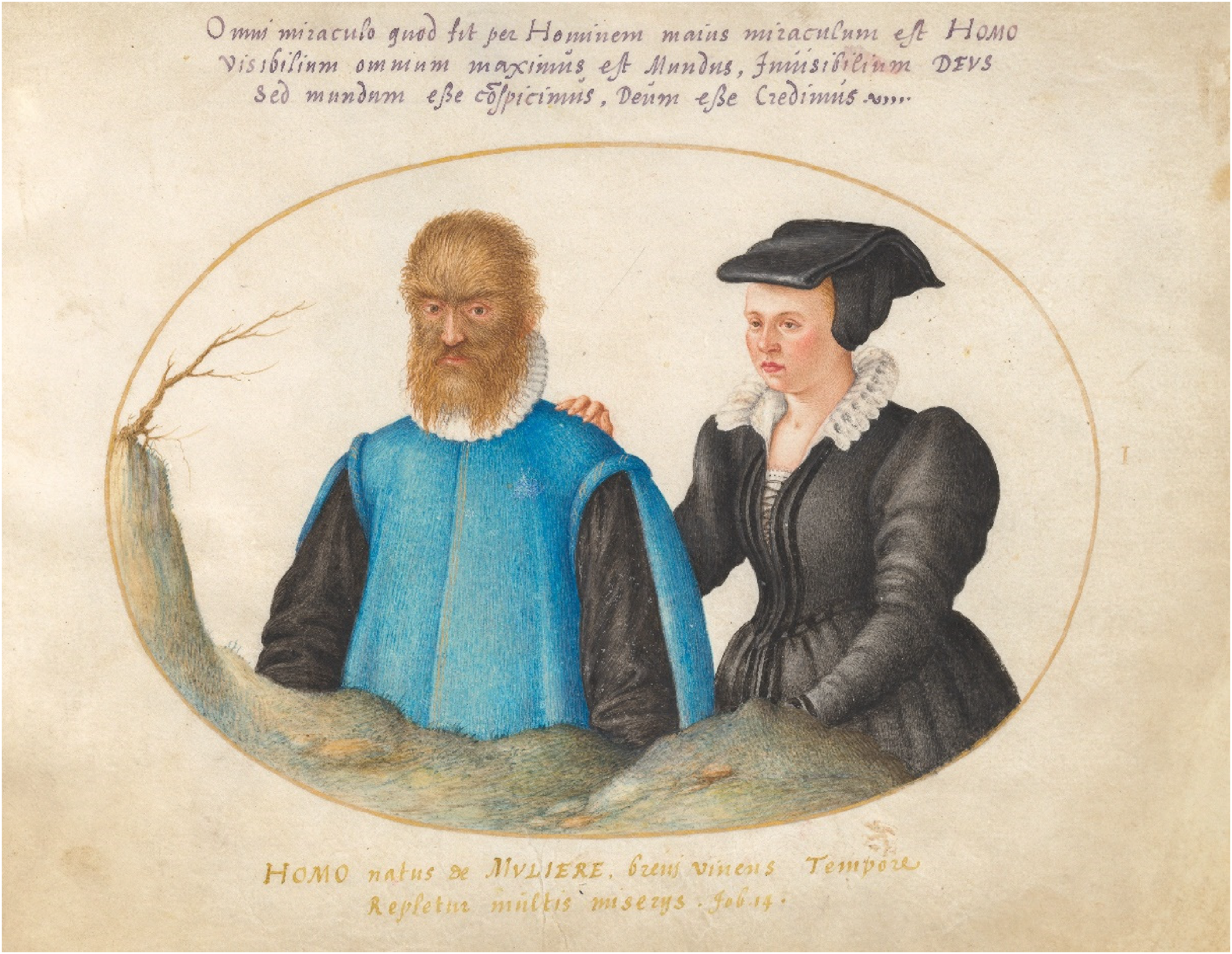
Joris Hoefnagel (Petrus Gonsalvus) and His Wife, Catherine (c. 1575), from Hoefnagel's series Animalia rationalia et insecta (ignis); Animalia quadrupedia et reptilia (terra); Animalia aquatilia et conchiliata (aqua); and Animalia volatilia et amphibia (aier) (also referred to as the Four Elements). Plate I, watercolor and gouache, National Gallery of Art, Washington, DC.
Several websites of our own time extol the couple as the real-life model for Beauty and the Beast. 9 But the story continues. The couple had children, some quite ordinary, but some taking after their father. One of the daughters, Antonietta (‘Tognina’) was painted by the acclaimed portraitist Lavinia Fontana (1552–1614) (Figure 4). By then, the Gonsalvus family had moved from France to Italy, where they joined the household of the Dukes of Parma, the Farnese family. The writ the girl is holding up accredits her status. While it circumscribes her as an object to be looked at, an exhibit in the spectacle of princely entertainment, it also protects her from the violent assault which her abnormality might provoke. No picture of Tognina or her father ever shows them au naturel, that is, according to the pictorial tradition with which their contemporaries associated the legendary wild men (and women) of the woods.
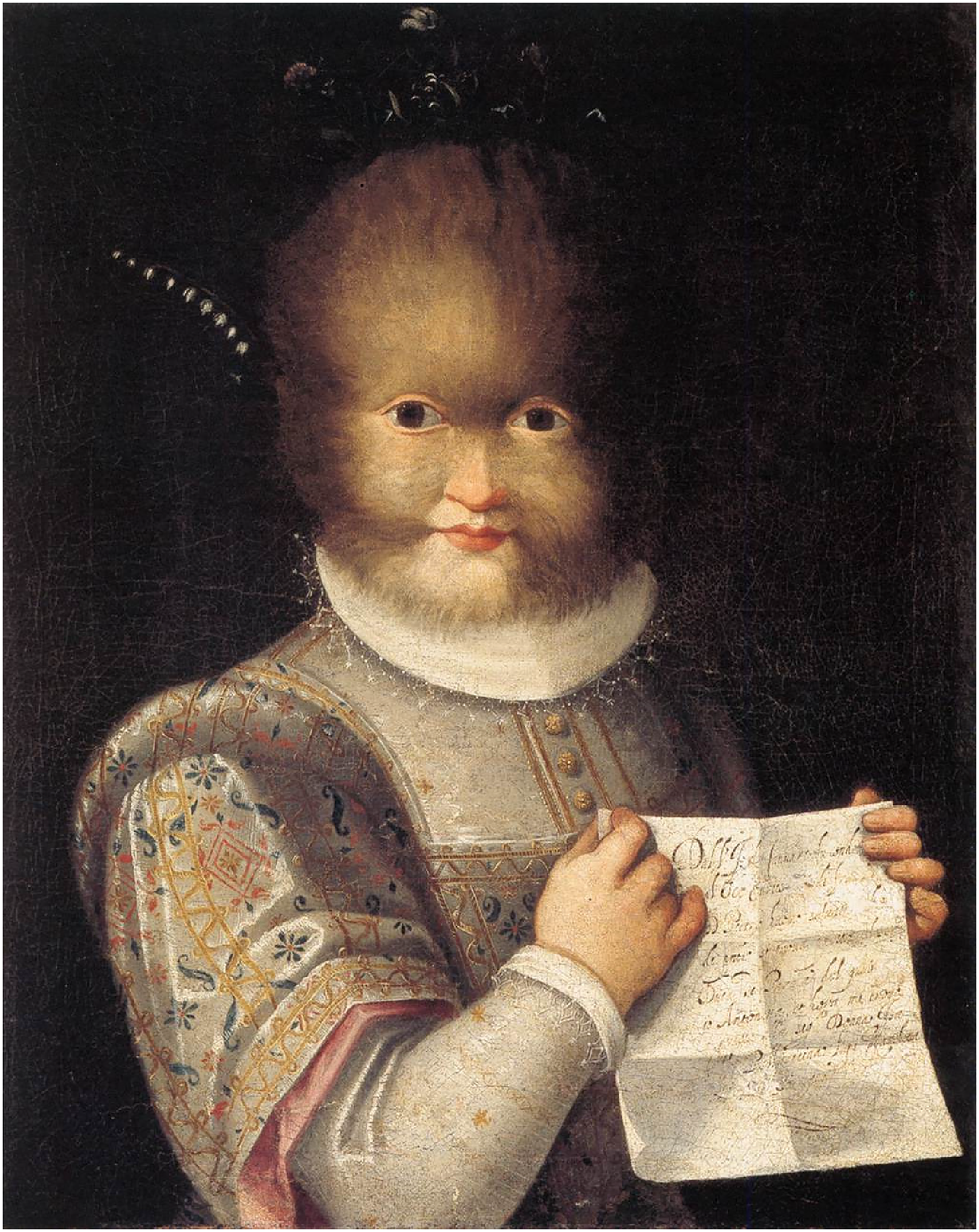
Lavinia Fontana, portrait of Tognina Gonsalvus. Musée des Beaux-Arts de Blois.
At the height of the mannerist taste in art, of which Lavinia Fontana's painting is a good example, the appeal lay in the commingling of the incongruous – artifice and animality – the more incongruous the better. Whenever the Gonzales girls were on display their hairy wildness was contrastively enhanced by the civilised restraint of their impeccable court dress. They were fitted out like costly dolls. The fascination, the frisson was in the hybridity, as if to effect a fusion of a Caliban and a Miranda, of a monster to be abhorred and a miracle to be admired.
Monsters in the Latin root meaning – which derives from monstrare, to show – were originally thought to be signs sent by the gods. And so were miracles. This Christian belief persisted during the Renaissance. But it also became possible to regard them in a more secularised way. As objects to be wondered at and, in the sense of miranda, admired. Tricks, freaks, playful variants of an infinitely productive nature on display in the collections of the high and mighty either as live specimens or as dead exhibits in their ‘cabinets of wonder’, Wunderkammern. Or described in encyclopaedic tomes of natural history.
The Gonzales girls turn up there too: among the multitude of abnormities and malformations – human, non-human or somewhere in-between – which the Italian naturalist Ulisse Aldrovandi records in his History of Monsters (Monstrorum Historia). 10 The illustration of a ‘hairy girl of twelve’ follows the by now established pictorial formula (Figure 5). Despite being featured in a work of natural history, the girl is shown dressed in her usual court attire. The natural history genre, however, determines the pictorial code of her setting. Instead of the courtly environment that goes with her dress, she is stranded on a bare little island of a hillock, a generalised emblem of wilderness that serves most of the other monsters as their minimalist habitat (Figure 6).
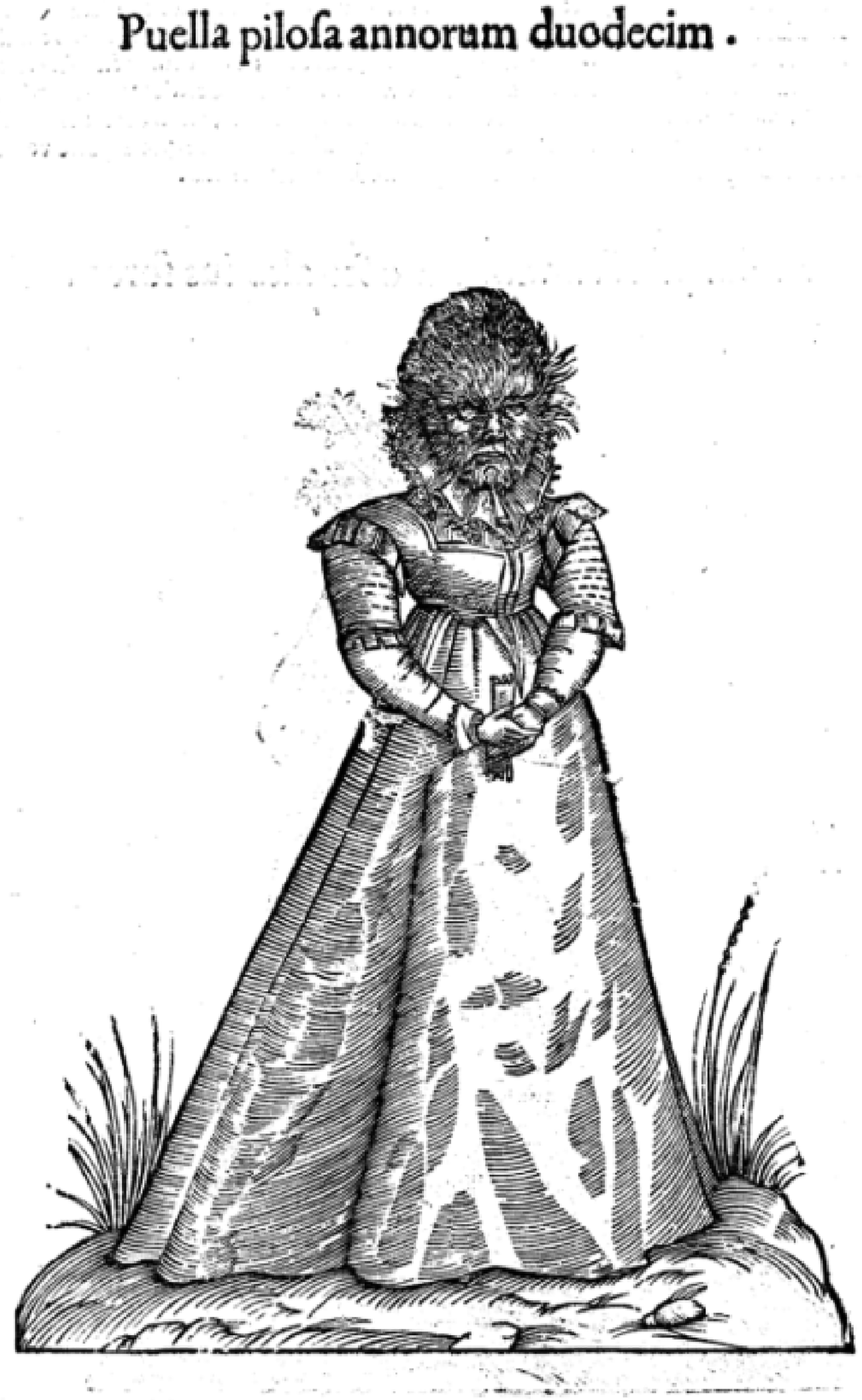
Ulisse Aldrovandi, ‘A hairy girl of twelve’, Monstrorum Historia, p. 17 (see note 8).
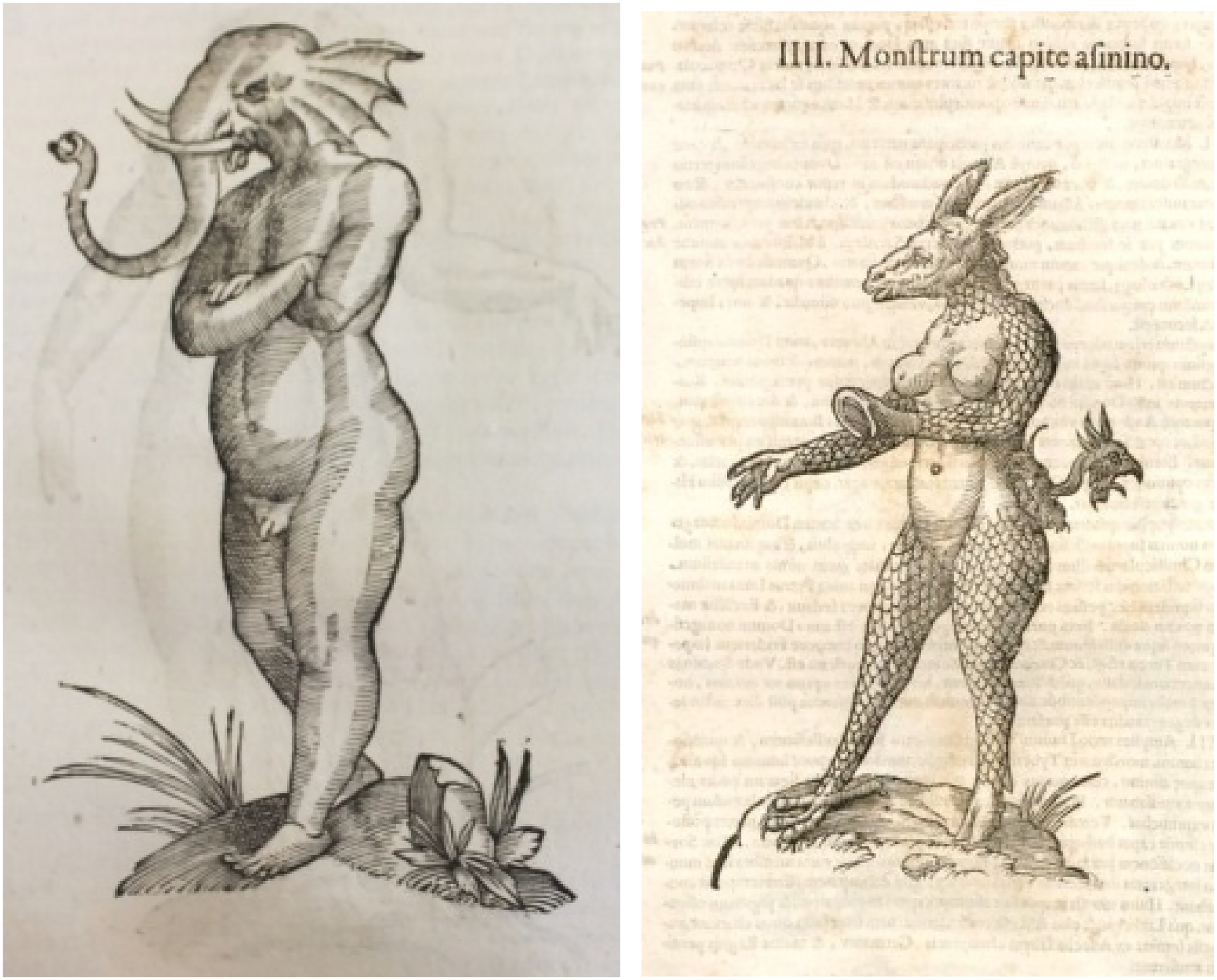
Two more examples from Aldrovandi, Monstrorum Historia.
Aldrovandi's gallery of monsters draws on the ancient canon of fabulous beings taken from Pliny the Elder and other ancient authorities. It bears out Lorraine Daston and Katherine Park's observation that ‘the wonders of nature […] were highly textualized objects’ (88) handed down by a long tradition of learned books. 11 But wherever facts are available to him, Aldrovandi makes use of them. In the case of the Gonsalvus family he gives as precise as possible an account of their medical condition. Today, this condition is understood as a rare variety of congenital hypertrichosis. Since 1993 it has run under the official medical sobriquet of ‘Ambras syndrome’. 12 Ambras Castle near Innsbruck is the home of a famous Renaissance wonder cabinet, the first one to be actually called ‘museum’. The Gonzales family never went there. But their portraits did (see Figure 2), confirming Trinculo's guess that where the live mirabilia were not available, art could replace them. The Ambras collection was established by Archduke Frederick of Tyrol. He eventually sold it to another great connoisseur of natural and supernatural wonders: his nephew Rudolf II, Holy Roman Emperor, King of Bohemia and for a time sponsor of the English magus John Dee's quest for the philosophers’ stone.
Rudolf has often been regarded as the real-life model for Prospero. An ineffectual ruler beset by the troubles that would eventually ignite the Thirty Years War, he withdrew to his arcane studies and his books, enabling his brother Matthias to snatch away the crowns of Austria and Hungary and his imperial title. Unlike Prospero, Rudolf never recovered his losses.
But he too turned into something rich and strange, undergoing a sea-change at the hands of art. The portrait Rudolf is mostly remembered by is all nature and totally artificial at the same time. Again, a work of mannerist art: Giuseppe Arcimboldo's Rudolf II as Vertumnus, the Roman god of the seasons (Figure 7). A flattering imperial allegory, composed entirely of vegetables, fruits and flowers, signifying a golden era of fruitful prosperity under the Emperor's rule. Pure wishful thinking, of course: Rudolf's power was as unreal as the simultaneity of fruits and flowers from different seasons at a time when deep-freezers and airborne pineapples were things of a distant future.
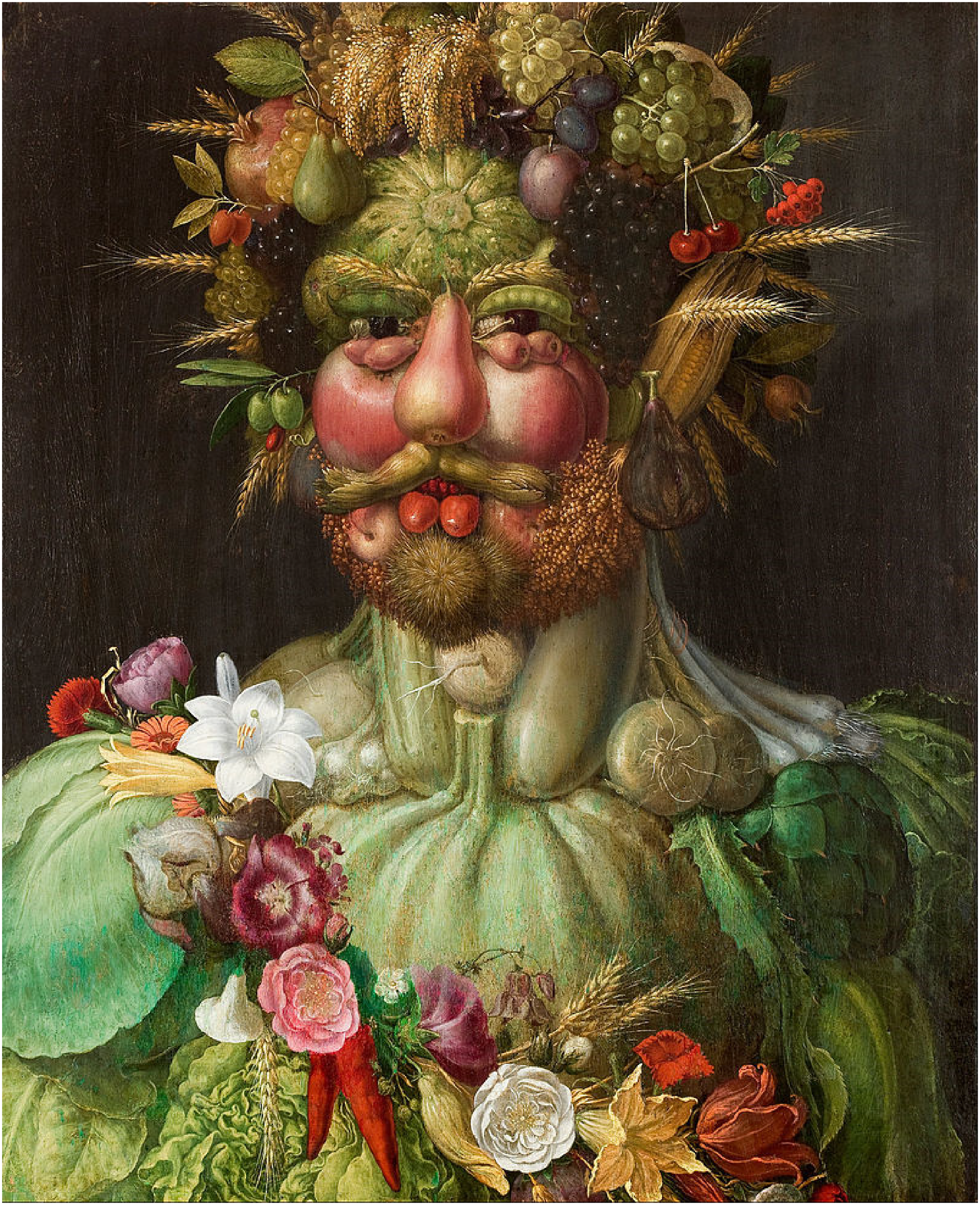
Giuseppe Arcimboldo, Rudolph II of Habsburg as Vertumnus (1591).
*
It is quite possible, even likely, that Shakespeare had the unfortunate Emperor at the back of his mind when conceiving Prospero.
13
No such claim can be seriously made for the Gonzales family. There is no evidence that Shakespeare knew of them, let alone drew on them for his portrayal of Caliban. But their case belongs to the same cultural and intellectual environment, the same epistemic matrix from which the figure of Caliban was hatched. This environment was shaped by the expansion of the world known to Europeans into realms hitherto regarded as pure fantasy. Just like the fantastic creatures inhabiting these realms, quite a few of which, according to old Gonzalo, had migrated from fable to fact in his own lifetime: When we were boys, Who would believe that there were mountaineers Dewlapped like bulls, whose throats had hanging at ‘em Wallets of flesh? Or that there were such men Whose heads stood in their breasts, which now we find Each putter-out of five for one will bring us Good warrant of? (3.3.43–49)
Generically, Caliban and the hairy Gonsalvuses attract the same label: ‘monster’. In Aldrovandi's History of Monsters this means either malformation or hybridity and often a combination of both. As with the Gonsalvus family: their hairiness is a malformation and a signifier of animality as well, and thus a case of human-animal hybridity. The same seems to go for Caliban: according to the list of characters he is ‘deformed’. Trinculo's ‘man or a fish?’ suggests his unclear species affiliation.
Learned commentators have shared Trinculo's puzzlement. The editor of the First Arden Tempest of 1901 states the quandary: ‘If all the suggestions as to Caliban's form and feature and endowments that are thrown out in the play are collected, it will be found that one half renders the other half impossible’.
14
If ‘tortoise’, ‘fish’, ‘mooncalf’, ‘freckled whelp’, ‘cat’ or simply ‘beast Caliban’ are all taken as literal descriptions, then indeed a veritable cocktail of species ensues. But, interwoven with the markers of his monstrous hybridity, the text offers clear enough evidence that the nature of the monster is understood to be human. Prospero's account of his and Miranda's arrival is unmistakable on this point: Prospero. Then was this island (Save for the son that she [Sycorax] did litter here, A freckled whelp, hag-born) not honoured with A human shape. Ariel. Yes, Caliban, her son. (1.2.281–4)
The full description Caliban receives in the list of dramatis personae is ‘a savage and deformed slave’. Although almost certainly not Shakespeare's phrasing but Ralph Crane's, the scrivener's, in our own time it has frequently been taken as the final word on what Caliban ‘really’ is: an oppressed person of colour. This makes eminent sense in postcolonial readings, even if somewhat inconvenienced by his mother being called ‘blue-eyed’ and himself ‘freckled’. 15 Any attempt at closure, at reaching a conclusive picture, is derailed by the glut of attributes that refuse to add up to any recognisable form or shape.
The term ‘creature’, Julia Lupton suggests, best captures this ‘indeterminacy at the heart of Caliban’. 16 The suffix of the Latin root word creatura – the suffix -ura – indicates a permanent state of becoming, of ongoing creation. This catches Caliban's ‘oddly faceless and featureless being, caught at the perpetually flooded border between metamorphic mud and mere life’. 17 ‘Creature’ neither clearly grants nor clearly denies Caliban's humanity, which ‘remains a question rather than a given in the play.’ 18 The radical indeterminacy of the creature Caliban mirrors that of the island he inhabits. Their indeterminacies supplement and reinforce each other.
The Tempest is set in a world of romance that had been vastly expanded by the real-life maritime discoveries of the previous century. Yet this immensely wider horizon undergoes a contraction: the play is governed by a dialectic of unbounded expanse and cramped confinement. Ranging widely over the Western hemisphere, The Tempest crams this range into the narrowest time-space frame. No other Shakespeare play is as compatible with the Aristotelian unities as The Tempest. Beginning at three in the afternoon, it concludes at six. The action, in the halting verse of the Epilogue, is limited to ‘this bare island’ (Epilogue 8).
‘Cell’ is a keyword here. As a marker of location, it precedes Prospero's first mention of ‘this island’ (1.2.171). Just half a dozen lines into his first speech (1.2.20) he introduces himself as ‘Prospero, master of a full poor cell’, using ‘cell’ to designate not only his place of residence but, metonymically, the whole extent of his dominion. The Arden 3 editors clarify that ‘[i]n the early seventeenth century, “cell” did not yet carry implications of imprisonment’. 19 Yet enforced confinement is much in evidence on Prospero's isle. Caliban is ‘confined into this rock’ (1.2.362). The shipwrecked courtiers are ‘[c]onfined together […] all prisoners, sir, […] They cannot budge’ (5.1.7–11), and even Prospero himself ‘must be here confined […] [i]n this bare island’, unless the audience ‘set [him] free’ (Epilogue).
But a ‘cell’ is, of course, also the exemplary locus of the contemplative life, offering the insular seclusion or ‘closeness’ needed for the pursuit of learning. Thus Prospero – ‘all dedicated/To closeness and the bettering of my mind’ (1.2.89–90) – was already islanded and closeted while still in Milan. The Tempest is steeped in a culture that associated the production and storage of knowledge with such cell-like, insular interiors as the study, the library, the alchemist's kitchen or the ‘cabinet of wonders’ (Wunderkammer).
Like his island and like The Tempest itself, Caliban belongs both to the far-away reaches of an expanding world and to the cell-like enclosures where the treasures of this world were collected, catalogued, studied, and stored: wonders both natural and artificial. And some in which the art itself was – or was made to look like – nature or vice versa: ‘infinite riches in a little room’. 20
Virginia and Alden Vaughan call The Tempest ‘a theatrical wonder cabinet of a play, a collection of exotic sights and sounds’.
21
Caliban is at the heart of this theatrical wonder cabinet, a prime specimen of its exotic sights and a prime source – through poetic evocation – of its exotic sounds. So, indeterminate ‘creature’ (in Julia Lupton's sense) he may be, but literally shapeless? Certainly not. He is a very physical presence in the play and a very visible one too. He is an object of curiosity, a tangible rarity – and therefore marketable. This is what his observers from the outside world immediately realise: Trinculo and Stephano in Act 2; Sebastian and Antonio in Act 5: Sebastian. Ha, ha! What things are these, my lord Antonio? Will money buy ‘em? Antonio Is a plain fish and no doubt marketable. (5.1.263–6)
But face and features Caliban certainly does have for Trinculo, Antonio and all the rest of the characters, and he must acquire them once he steps onstage embodied by an actor. Unfortunately, there is no documentary evidence telling us what he looked like to the spectators at the Blackfriars or the Globe. Or to King James and his court at Whitehall Palace. The Tempest was performed there sometime between December 1612 and May 1613 to celebrate the wedding of James's daughter Elizabeth to Frederick, the Elector Palatine and hapless future accessor to Rudolf II's Bohemian crown. If Caliban's human-animal ambiguity served as leitmotif for his costume, he may have looked something like the satyrs in another court entertainment staged at the same venue, Whitehall Palace, a year earlier: the Ben Jonson/Inigo Jones masque Oberon, the Faery Prince (Figure 8). The lecherous pagan nature spirit readily amalgamates with the medieval wild man and would have been consistent with Caliban's attempted sexual assault on Miranda. But we really don’t know.
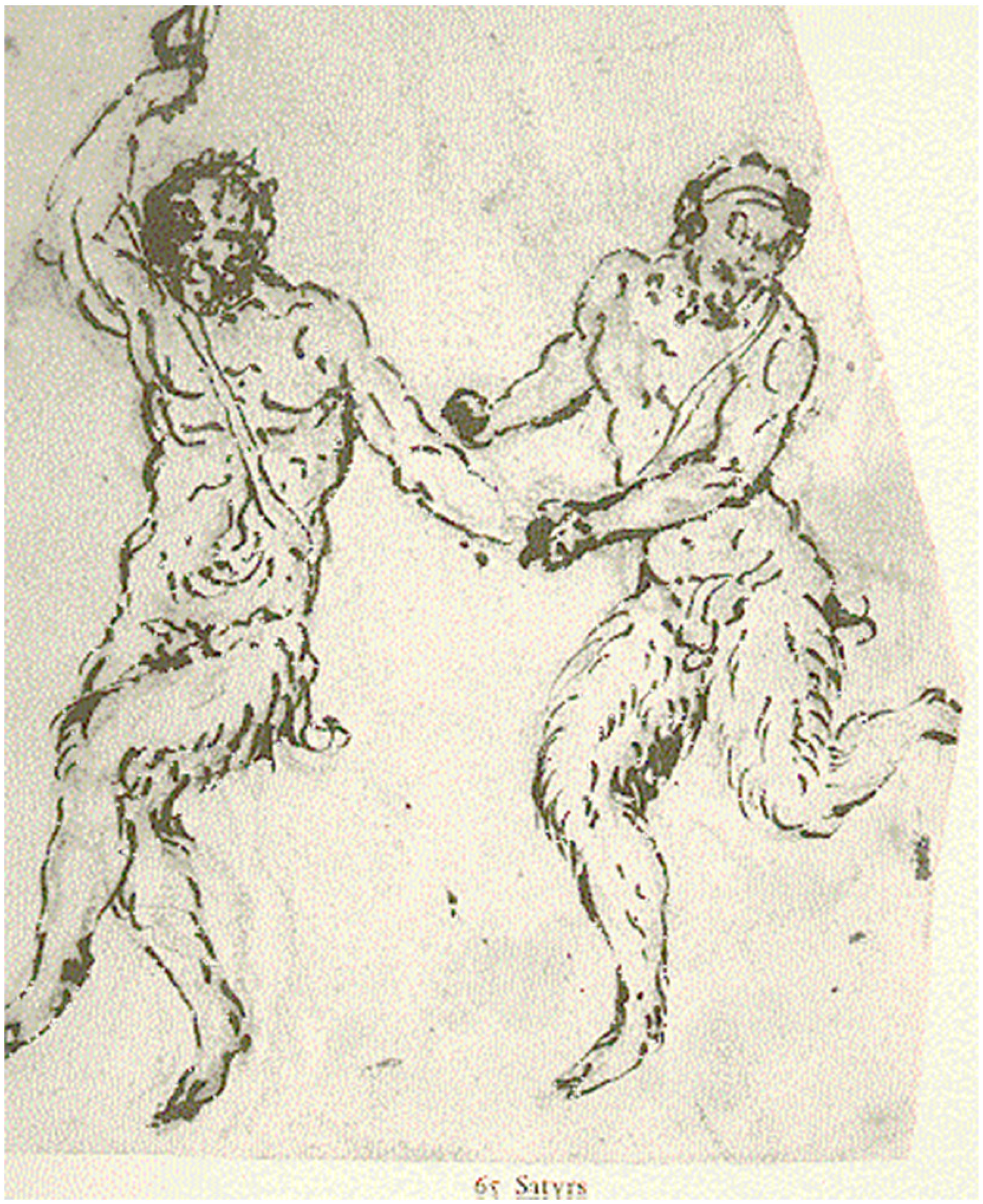
Inigo Jones, Satyrs for Oberon the Faery Prince (1611).
*
What we do know is that this did not prevent but rather inspired theatre practitioners and artists to develop very specific ideas as to Caliban's appearance. A selective survey of these ideas will round off this essay.
For Caliban's features to acquire concrete shape and be documented, we must wait until the eighteenth century. His strange and varied pictorial history shows that, like ‘lovers and madmen’, painters and actors ‘have such seething brains / Such shaping fantasies, that apprehend / More than cool reason ever comprehends’ (MND 5.1.4–6). 22 Johann Heinrich Ramberg (1763–1840), court painter and scene designer at Hannover, shows a happily inebriated chimera dancing on the beach with his new friends Stephano and Trinculo (Figure 9). While this composite being retains some human features, Germany's Hogarth, the popular illustrator Daniel Chodowiecki (1726–1801), turns Caliban into a giant Ninja Turtle (Figure 10). Literalising Prospero's ‘Come, thou tortoise’ (1.2.317), this Caliban marks the furthest point of separation between master and slave, humanity and the bestial in the pictorial history of Shakespeare's changeling. This critter is no longer liminal, certainly not a dark mirror of the self as in Prospero's admission: ‘this thing of darkness I / Acknowledge mine’ (5.1.275–6). The very impossibility of the figure makes it rationally acceptable as pure, unadulterated fantasy. Chodowiecki removes Caliban to a safely circumscribed dream world of exotic fabulation where simply everything is possible and nothing is real. 23
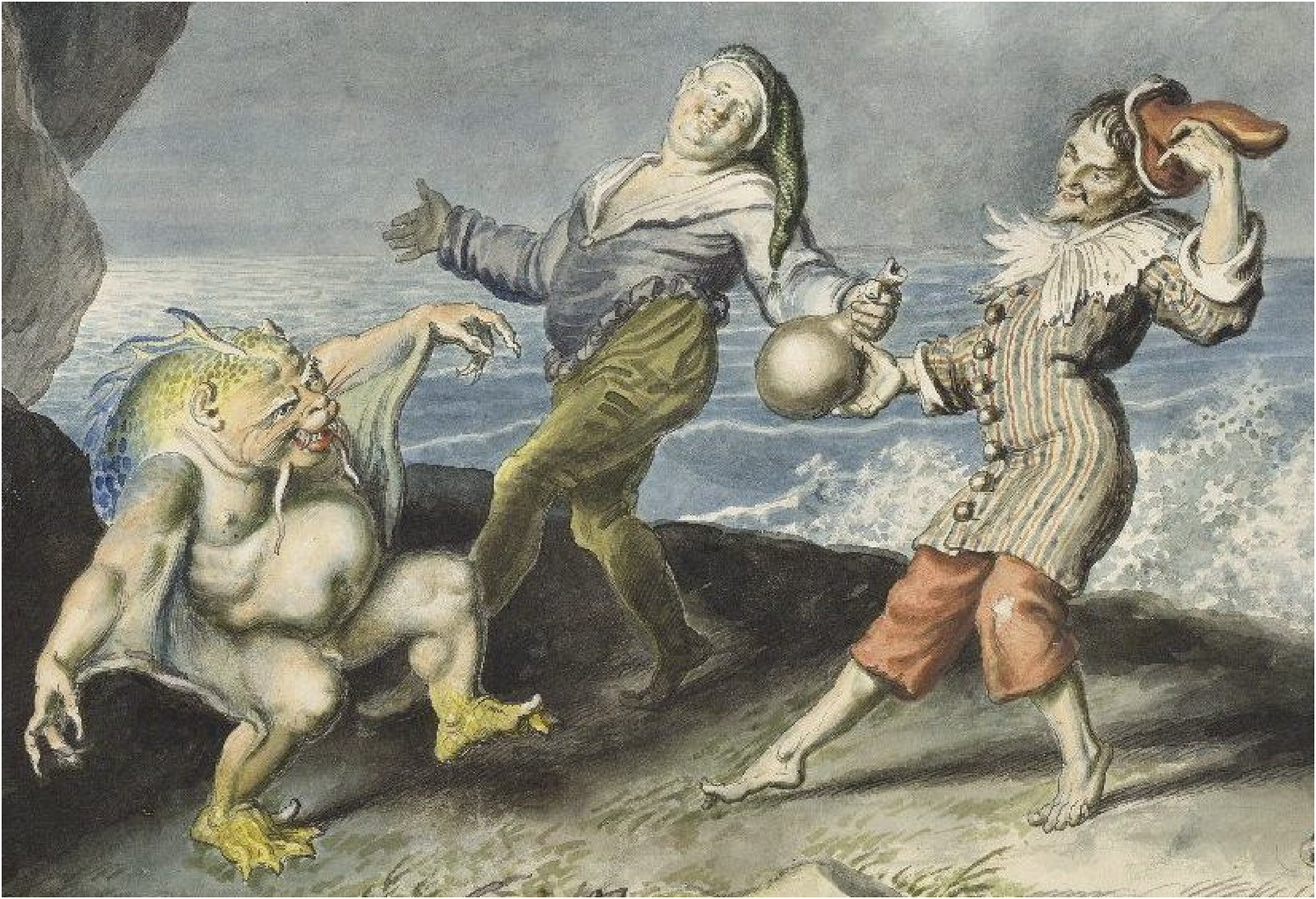
Johann Heinrich Ramberg, Caliban dancing with Stephano and Trinculo.
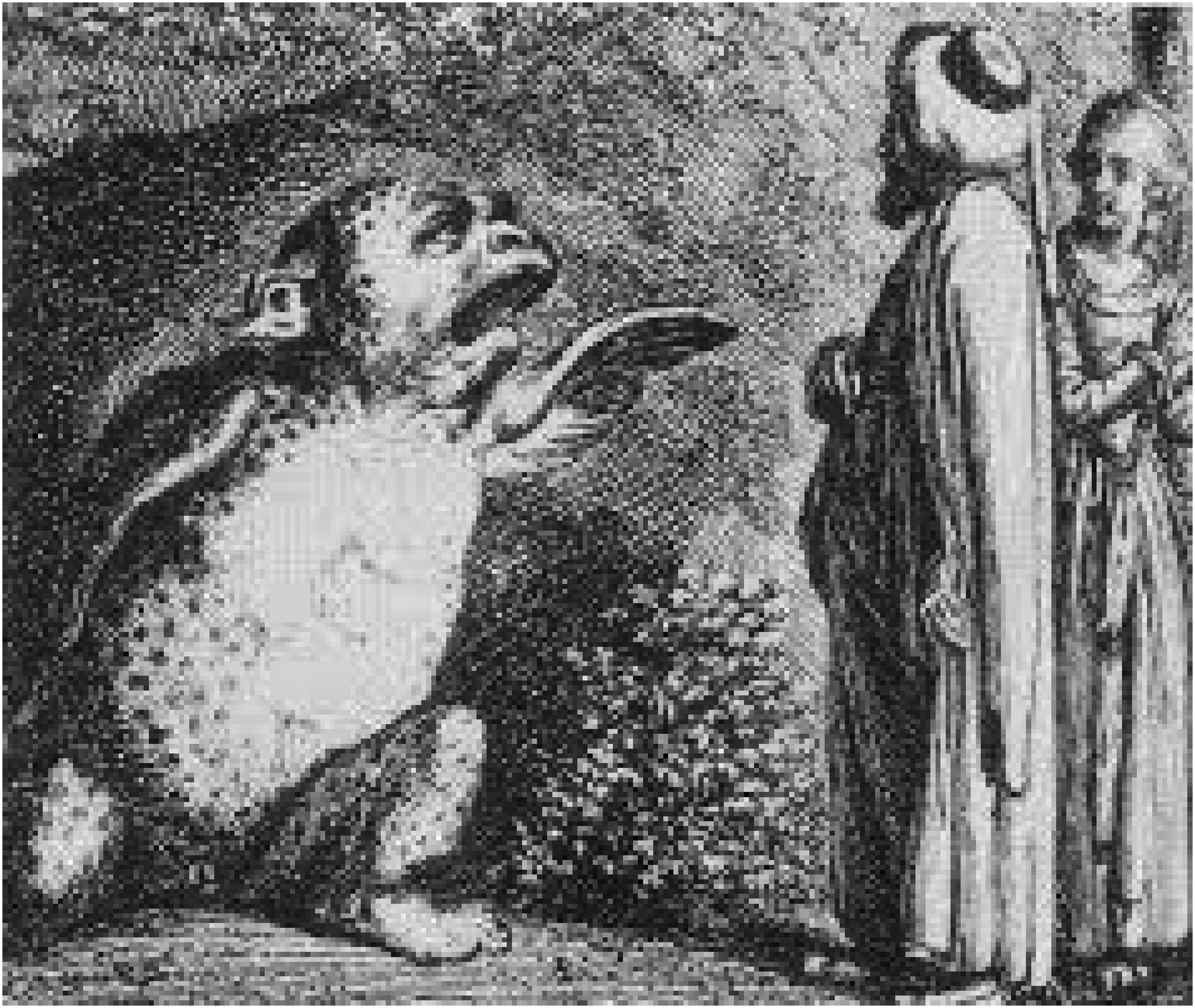
Caliban addressing Prospero and Miranda (1.2.322 ff). Daniel Chodowiecki, Göttinger Taschenkalender 1788. Reprinted with permission by Bayerische Staatsbibliothek.
What we see in these two images thus differs fundamentally from Aldrovandi's monsters. It is a deliberate embracing of the fantastic. It does not claim to bear any semblance to varieties of life – however remote, bizarre, or monstrous – that really exist. Between Shakespeare's time and the late eighteenth-century taste for the marvellous lies the great watershed that drew a strict demarcation line between serious science with its quest for regularity and systematic order and the teeming mingle-mangle of the wonder cabinets.
Something like a return to the earlier stage occurs in the second half of the nineteenth century. The fantastic is put back in touch, as it were, with the science of the day. In 1873, a study by Daniel Wilson, a future president of the University of Toronto, claimed Caliban as the Bard's visionary anticipation of Darwin's missing link.
24
The theatre followed suit. Herbert Beerbohm Tree's Caliban of 1904 is the most famous of a whole bevy of Darwinian performances of the part. A ‘sort of Demon King’,
25
this Caliban was given unprecedented prominence in Tree's production. Though Prospero had the last word, Caliban had the last silence. He even appropriated the melancholy pathos of his artist-master in a visual epilogue all of Tree's own making. As described in the promptbook, Caliban listens for the last time to the sweet air, then turns sadly in the direction of the departing ship. The play is ended. As the curtain rises again, the ship is seen on the horizon, Caliban stretching out his arms towards it in mute despair. The night falls, and Caliban is left on the lonely rock. He is a King once more.
26
Even if Tree's upgrading of Caliban to Prospero's rival king of the island may have been prompted by the fact that he himself played the part, it deserves credit for being remarkably original. Translating key words of Prospero's epilogue (which according to the promptbook was cut) into dumb show, Tree presents a Caliban who has been ‘set free’ from his ‘bands’ and is yet all the more ‘confined’. A Caliban whose ‘ending is despair’ – ‘mute despair’, a revocation of language – and whose ‘hands’ are stretched out towards his departing master in a gesture of ‘prayer’. He may be his ‘own king’ once more, but King of a ‘bare island’, a ‘lonely rock’ on which ‘night falls’ as the coloniser withdraws his ‘charms’, the gifts of enlightened civilisation.
This is the hirsute, clawed creature with mournful eyes that Charles Buchel captured in his portrait of Tree's Caliban (Figure 11). He is the native of the White Man's Burden for whom the withdrawal of the coloniser means not liberation but loss, relapse to a primeval, subhuman form of life. It is difficult to imagine this sad Caliban rebutting Prospero's charge of attempted rape with the indecorously gleeful lines: O ho, O ho! Would’t had been done; Thou didst prevent me, I had peopled else This isle with Calibans. (1.2.352)
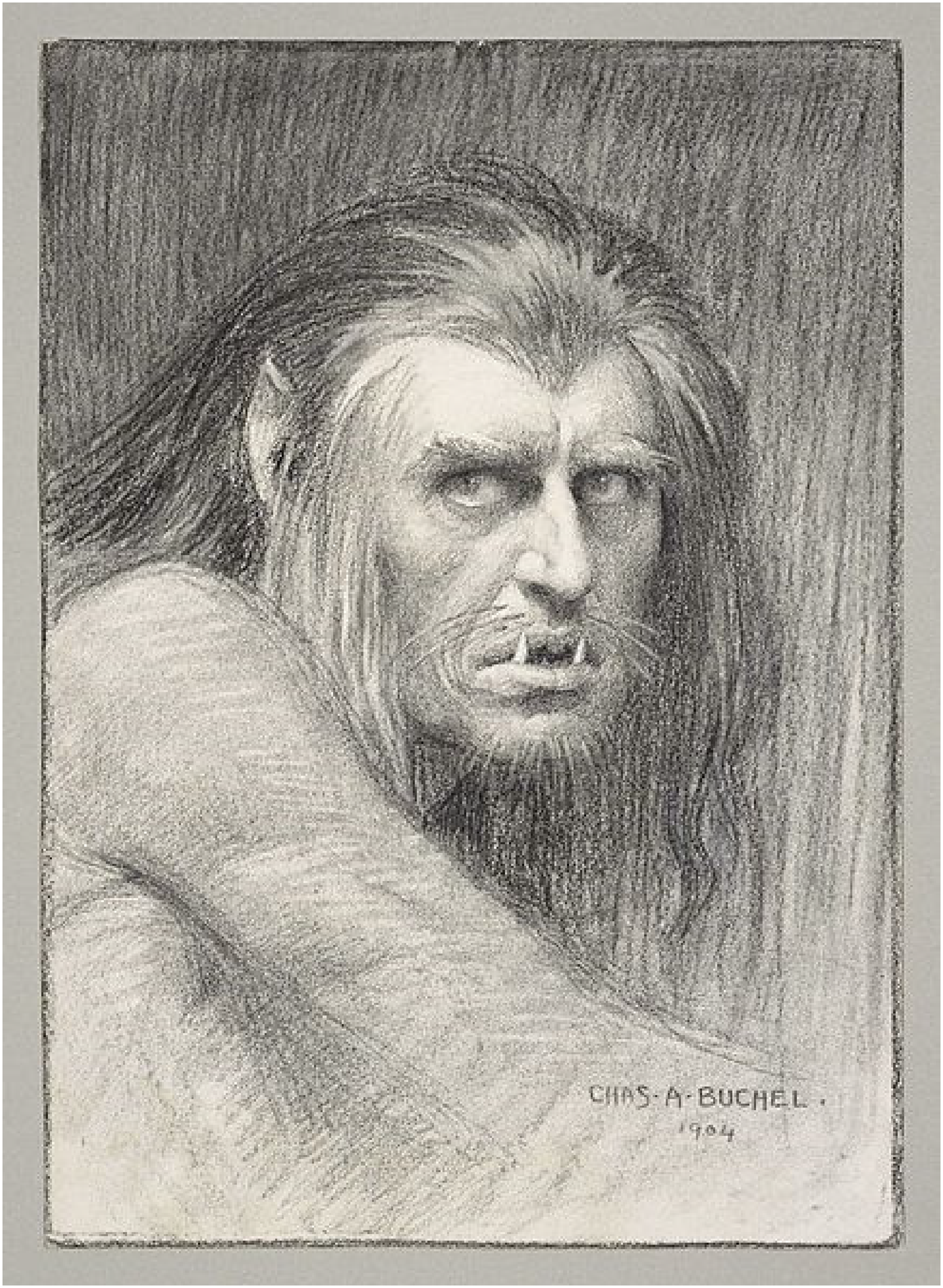
Charles Buchel, charcoal drawing of Herbert Beerbohm Tree as Caliban in his 1904 production of The Tempest. Folger Shakespeare Library, Washington, DC.
My final example of artifice and animality conjoined appeared just a few years before Tree's Tempest. H. G. Wells's Island of Doctor Moreau (1896), though certainly no lineal descendant of the Caliban tradition, shows enough family likeness to be counted among its offshoots. Projecting Darwinian descent into a brave new world of genetic engineering, Doctor Moreau's not so goodly creatures represent the sinister outcome of a project launched at about the same time as Shakespeare's Tempest. Baconian science is clearly present in the mix of early modern knowledge cultures on Prospero's laboratory island; an emergent historical force that Francis Bacon's list of projects to be achieved envisioned giving scientists powers of ‘making […] new species’ and of ‘raising tempests’. 28 Moreau's island and its man-made monsters offer a nightmare variation on this Baconian dream of dominating nature with the ‘vexations of art’.
Footnotes
Declaration of conflicting interests
The author declared no potential conflicts of interest with respect to the research, authorship and/or publication of this article.
Funding
The author received no financial support for the research, authorship and/or publication of this article.
