




Abstract
At the time of writing, the war in Ukraine is entering its fourth year. So far, more than six million Ukrainian refugees have sought shelter in the European Union. In this paper, we study the experiences of liminality among the displaced Ukrainian community in Finland. This paper addresses the question: How do Ukrainian refugees seek to organize and make sense of their situation? Using a practice-based phenomenological approach, we identify three practices: integrating into Finnish society; gaining financial independence; and resisting separation from their former lives in Ukraine. Based on these findings, we offer two contributions to understanding liminality: first, that it emerges through a collapse of practical intelligibility; and second, that it becomes an unattainable embodied concern and a site of struggle. Our study re-theorizes liminality not as a fixed feature of certain contexts or boundaries, but as an ongoing process and lived experience.
Keywords
Introduction
Since February 2022, Europe has been facing its largest humanitarian crisis since the Second World War. As a consequence of Russia’s invasion of Ukraine, by December 2023, approximately 6 million people were displaced across Europe (UNHCR, 2024). Current literature in organization studies and related fields highlights the importance of the notion of liminality (Turner, 1967; Van Gennep, 1960) for understanding the lifeworlds of displaced communities (Alkhaled & Sasaki, 2022; Fathallah, Williams, & McMullen, 2024; Ghorashi, de Boer, & ten Holder, 2018). Liminality is traditionally conceived as a transitional state, preceded by a ‘separation’ from established social structures and followed by ‘reaggregation’ (Turner, 1967). For the displaced, such assumptions suggest that displacement is an abnormal state, in which they are ‘betwixt and between’ (Turner, 1967) the lives that they left behind and a new, unpredictable future.
Viewing liminality as a distinct abnormal state signals that research on liminality is predominantly rooted in an understanding of reality as a singular ‘composed of discrete entities standing in hierarchical or inclusive relations with one another’ (Law & Urry, 2004, p. 397). This approach is problematic for two reasons when theorizing increasingly complex, non-linear, malleable and mobile social relations (Orlikowski, 2010). First, such theorizing of liminality risks depicting certain contexts as bounded entities inherently liminal and not as emergent through social action. Recent literature has not only moved beyond the importance of boundaries and extended the original definition of liminality as a distinct transitory state (Ybema, Beech, & Ellis, 2011) but has also called for approaches that are ‘considerably more liminal, with the ability to grasp ongoing acts of sensemaking, frustrations, uncertainties, ambiguities and ill-defined end states’ (Söderlund & Borg, 2018, p. 895). Second, theorizing liminality by drawing a boundary between the liminal and the non-liminal leaves the nature of lived liminal experience underexplored (Söderlund & Borg, 2018). In the case of displaced people, studies acknowledge that lives lived in displacement may be far from uniform and characterized by a variety of experiences not necessarily abnormal or linearly connected in time and space (Schiltz, Vindevogel, Derluyn, & Vanderplasschen, 2019). Building on these theoretical advances calls for both recognizing the complex realities of ambiguous liminal experiences (Beech, 2011) and using these as a starting point in understanding the emergence of liminality and what marks lived experience as liminal.
To explain the emergence of the lived experience of liminality (Söderlund & Borg, 2018) requires detailing the consequential and co-constitutive relations of enactment through everyday practices (Feldman & Orlikowski, 2011). Instead of assuming a state of displacement as inherently liminal, drawing on practice theory (Schatzki, 2002, 2012) and practice phenomenology (De Rond, Lok, & Marrison, 2022; Sandberg & Dall’Alba, 2009) we account for the emergent and communal nature of liminality, where displacement is enacted by displaced people through their practices. As our empirical case, we study displaced Ukrainians residing in Finland under temporary protection, seeking to delve deeper into the lived liminal experience and its significance for liminars (Söderlund & Borg, 2018). We follow De Rond et al. (2022) and Del Rio, Fernandez, Martí, and Willi (2025) in turning to practice phenomenology to discuss how embodied concerns mark what matters in a particular situation (Slaby & Wüschner, 2014). According to practice phenomenology, embodied concerns are formed through our daily practices as the basis of belonging to a certain community. In turn, these embodied concerns orient the practice performance, which (re)constitutes a community’s phenomenological lifeworld. Thus, we attempt to understand the lived experience of liminality through a practice phenomenology perspective and ask, ‘How does practice engagement shape the (1) emergence and the (2) lived experience of liminality?’ This allows us to distinguish the embodied concerns, the ‘what matters and how’ (De Rond et al., 2022, p. 875), by identifying how in our empirical case, the need to prioritize a sense of fulfilment, or a sense of security, or a sense of connection marked the lived experiences of displaced Ukrainians residing in Finland under temporary protection as liminal.
Our study makes two contributions to studies on liminality. First, we argue that liminal experiences emerge as a consequence of a collapse of practical intelligibility, caused by engagement with practices having non-complementary elements such as teleoaffective structures and practical understandings. Second, we argue that liminal experience is lived as such when practitioners experience the unattainability of the embodied concerns in their re-enacted practice engagement. This perspective allows us to broaden our understanding of liminal experience as emerging from and sustained by practice enactment, rather than focusing on the temporal, spatial or structural boundaries of the liminal and the non-liminal (Meira, 2014; Shortt, 2015; Vesala & Tuomivaara, 2018).
Towards a Practice-Based Perspective on Liminality
The concept of liminality has become increasingly popular in theorizing the ‘fluid, the temporary and the ambiguous elements of work and organising’ (Söderlund & Borg, 2018, p. 880), but also experiences of ambiguity and in-betweenness within a changeful context (Beech, 2011). Existing literature has developed the concept of liminality by proposing analytical distinctions between its different types (Bamber, Allen-Collinson, & McCormack, 2017; Ellis & Ybema, 2010; Lê & Lander, 2023). These types revolve around conceptualizing the limen as boundaries in between which the liminal states occur such as: social structures (Turner, 1969); stable states marking the unstable period of change and transformation (Howard-Grenville, Golden-Biddle, Irwin, & Mao, 2011); dominant spaces marking liminal spaces in-between them (Shortt, 2015, p. 634); temporary phases bounded in time (Tempest & Starkey, 2004; Van Gennep, 1960); or professional roles, identities or organizations (Czarniawska & Mazza, 2003). Overall, the core feature of liminality lies in the organization of social relations on the principle of distinct dominance of certain entities (ordinary structures, normal states) over others (unfamiliar structures, abnormal states). Liminal experience is typically associated with the less dominant ones (Sturdy, Schwarz, & Spicer, 2006; Vesala & Tuomivaara, 2018) or between the two (Meira, 2014).
Recent studies have, however, recognized that the boundaries which distinguish the liminal from the non-liminal are rather blurry (Söderlund & Borg, 2018), and that the experience of liminality can originate from the inability to draw boundaries altogether (Johnsen & Sørensen, 2015). Relying on dominant/non-dominant representational categories may overlook how liminal spaces or structures are lived and experienced and thus limit our understanding of liminality to experiences a priori understood as interstitial or ‘on the margins’ in organizational contexts. This gives rise to a paradox already noted in the existing literature: when these ‘non-dominant’ sites or structures are experienced as meaningful, we might start to question ‘if they continue to be “liminal” at all’ (Liu & Fan, 2023, p. 1730). This invites further exploration of various ways the experiences are significant to liminars themselves (Liu & Fan, 2023; Söderlund & Borg, 2018).
Practice-based ontology offers a possibility to move beyond a focus on the limen and comparisons of liminal/non-liminal and towards the ongoing production and relational constitution of liminality (Feldman & Orlikowski, 2011). This differs from discussions on the ‘liminality practices’ as practices through which liminal actors seek to resolve (Beech, 2011), embrace (Daskalaki & Simosi, 2018; Lê & Lander, 2023), or cope with liminality (Alkhaled & Sasaki, 2022; Dorow & Jean, 2022). Practice theories place the origin of important patterns in how socio-material relations are enacted and why practices continue to be repeated (Feldman & Orlikowski, 2011; Schatzki, 2002). Therefore, from a practice-based ontology perspective, we argue that it is insufficient to prioritize the individual intentionality in ‘becoming liminal’ as the key for understanding the emergence and persistence of liminality, as has been done in the existing literature (Beech, 2011; Ibarra & Obodaru, 2016; Lê & Lander, 2023). Instead, practice-based ontology would associate the tensions of liminal experience as arising from the complex ways in which our doings, sayings and affective concerns are mediated and (re)constituted in practice engagement.
Practice, Understanding and Intelligibility
In this study, we use Schatzki’s (2001, 2002, 2012) practice theory to structure our analysis and develop our findings. For Schatzki, practices are intentional and collective, and we engage in practices because we desire specific outcomes. Yet practices are not fixed or deterministic; rather, they are open and reconstituted whenever activities of a practice are performed. Three central concepts of Schatzki’s practices warrant a closer examination here: practical understanding, teleoaffective structure and practical intelligibility. The concept of practical understanding expresses our habitual, embodied know-how of performing actions (Schatzki, 2002) that make up a practice. The actions and activities contained in a given practice are manifold, simple, everyday doings and sayings. For Schatzki (2012), these can be doings such as knowing how to file papers or sayings like knowing how to start an exam with the words ‘Your exam has begun’. Hence, to possess a practical understanding of a given practice implies having its inherent know-how.
The teleoaffective structure of a practice is an acceptable set of end–project–activity combinations (Schatzki, 2012) where the activities also evoke emotional attachment. Understanding the teleoaffective structure of a practice means being literate in the if–then logic of the practice: if I do this, then it is likely to produce these outcomes. This is an orientation toward acceptable or correct ends and the tasks for accomplishing these, as well as the acceptable and correct emotions that guide the action (Schatzki, 2001). Practical intelligibility is about what makes sense for a subject to do within the semantic space of a given practice in a specific situation for a desired outcome (Schatzki, 2001; Taylor, 2023). Practical intelligibility allows for interpretation; a know-why; a justification for actions within the embodied know-how of practical understanding and the if–then of teleoaffective structures. Hence, practical intelligibility is relevant for understanding what guides action and activities within practices. Practical intelligibility outlines sensible action for a practitioner – what it makes sense to do – keeping in mind that such intelligibility is always contextual and affective (Schatzki, 2001). As Schatzki explains: What makes sense to a person to do largely depends on the matters for the sake of which she is prepared to act, on how she will proceed for the sake of achieving or possessing those matters, and on how things matter to her; thus, on her ends, the projects and tasks she will carry out for the sake of those ends given her beliefs, hopes, and expectations, and her emotions and moods. (Schatzki, 2001, p. 60)
Yet, as we shall show in the analysis and the discussion, this tranquil picture can become disrupted, and what makes sense to a person can become a contested matter. This exposes the liminal experience arising from the complex ways in which our doings, sayings and affective concerns’ relations are mediated through practice engagement.
Practice Phenomenology and Embodied Concern
The existing literature identifies differences in liminal experiences (Söderlund & Borg, 2018), for example, as negative or positive depending on the liminars’ ability to terminate liminality (Bamber et al., 2017; Lê & Lander, 2023), or as connected to affects such as anxiety, excitement, or confusion (Ibarra & Obodaru, 2016; Liu & Fan, 2023). To better understand how liminal experiences come to matter, we must return to the liminars’ ‘embodied affective ways of experiencing the world’ (De Rond et al., 2022, p. 894). This is important when the world of ‘the other’ needs to be grasped on its terms (De Rond et al., 2022). Practice phenomenology allows us to foreground the lived experience of liminality, recognizing how liminality ‘continuously unfolds through practice performance, bringing about its particular experiential specificity at any given moment in time’ (De Rond et al., 2022, p. 893). This specificity from a practice phenomenology perspective allows for explaining engagement in practices both through practical understandings and the affective-embodied concerns encapsulated in subjects’ practice performance (De Rond et al., 2022; Del Rio et al., 2025).
It is through particular modes of practice engagement that we are inevitably and inextricably entwined with the world. Such modes of practice engagement reveal the everyday meanings people make use of in relation to their own experiences of the world (De Rond et al., 2022). Thus, our modes of practice engagement affect our behaviours and actions, and are guided by what we care about (Schatzki, 2017, as cited in Del Rio et al., 2025, p. 6). Collective modes of practice engagement are constituted in the network of practices the community engages in (De Rond et al., 2022) and denote the community’s lifeworld. This lifeworld captures the community’s taken-for-granted sense of shared experience as ‘an organised set of practices that produce a relatively self-contained web of meanings’ (De Rond et al., 2022, p. 12). Modes of practice engagement expose how people orient their sense of what is happening and what to do next through attuning to their embodied concerns – what matters in a particular situation (Slaby & Wüschner, 2014).
Embodied concerns reveal the specific affective quality of practice engagement – how and why things matter (De Rond et al., 2022). Ratcliffe (2020) describes this quality as the ‘feeling of being’, an embodied existential sense of one’s place in the world. This disclosure involves not just thoughts but also emotions, highlighting that humans act based on both cognitive orientations and affective senses (De Rond et al., 2019). These senses are not limited to primary emotions such as fear and anxiety but include embodied affective ways of experiencing the world, which are specific to particular modes of practice engagement. In sum, by bringing together the concept of practical intelligibility with phenomenological notions of practice engagement and embodied concerns, we can centre the theorizing of liminality not on boundaries or the marking of certain states as abnormal, but on what matters in liminal experience and how it emerges. Previous studies explain that liminal experiences may matter to the liminars because such experiences involve paradoxical tensions and invite a further exploration of what such tensions might be (Söderlund & Borg, 2018). Our practice phenomenology perspective posits that the concept of embodied concerns, in its turn, may help explain how such tensions emerge and what keeps them sustained, as it is the embodied concerns that animate our engagement in practice.
Methodology
To date, some 68,000 Ukrainians have applied for temporary protection status in Finland (Ministry of Interior Affairs, 2024). Though not oppressive as a state compared to the constant threat of evictions faced by many refugee communities (Kodeih, Schildt, & Lawrence, 2023), displaced Ukrainians still face the insecurity of uncertainty regarding the duration of their temporary protection status. Meanwhile, the displaced continue to heavily rely on their own networks, which underscores the ambivalent logic of, and absence of fundamental shifts in, managing displacement in the European Union (Ferreira, Kea, Kraler, & Wagner, 2022).
The empirical material collected for this study (see Table 1) consists of field notes of participant observations (69 field notes, 221 h) and in-depth interviews (n.17) conducted by the first author. Participant observation was conducted at (1) a Red Cross-operated reception centre for displaced Ukrainians in Finland, (2) the Help Centre for Ukrainians in Helsinki and (3) the Ukrainian Community Centre; the last two operated by the Ukrainian Association in Finland. The in-depth interviews allowed us to gain insights into the practices characterizing the everyday life of displaced Ukrainians in Finland, as well as their concerns. We agree with Hitchings (2012) in their argument that research participants can talk about their practices in quite revealing ways, even if it involves actions they may usually take as a matter of course. The interview data were important for exposing the practical intelligibility upon which practice engagement is premised, manifesting as practitioners’ interpretations and reflections of what makes sense to do (Fuller, 2022).
Timeline of generating research material.
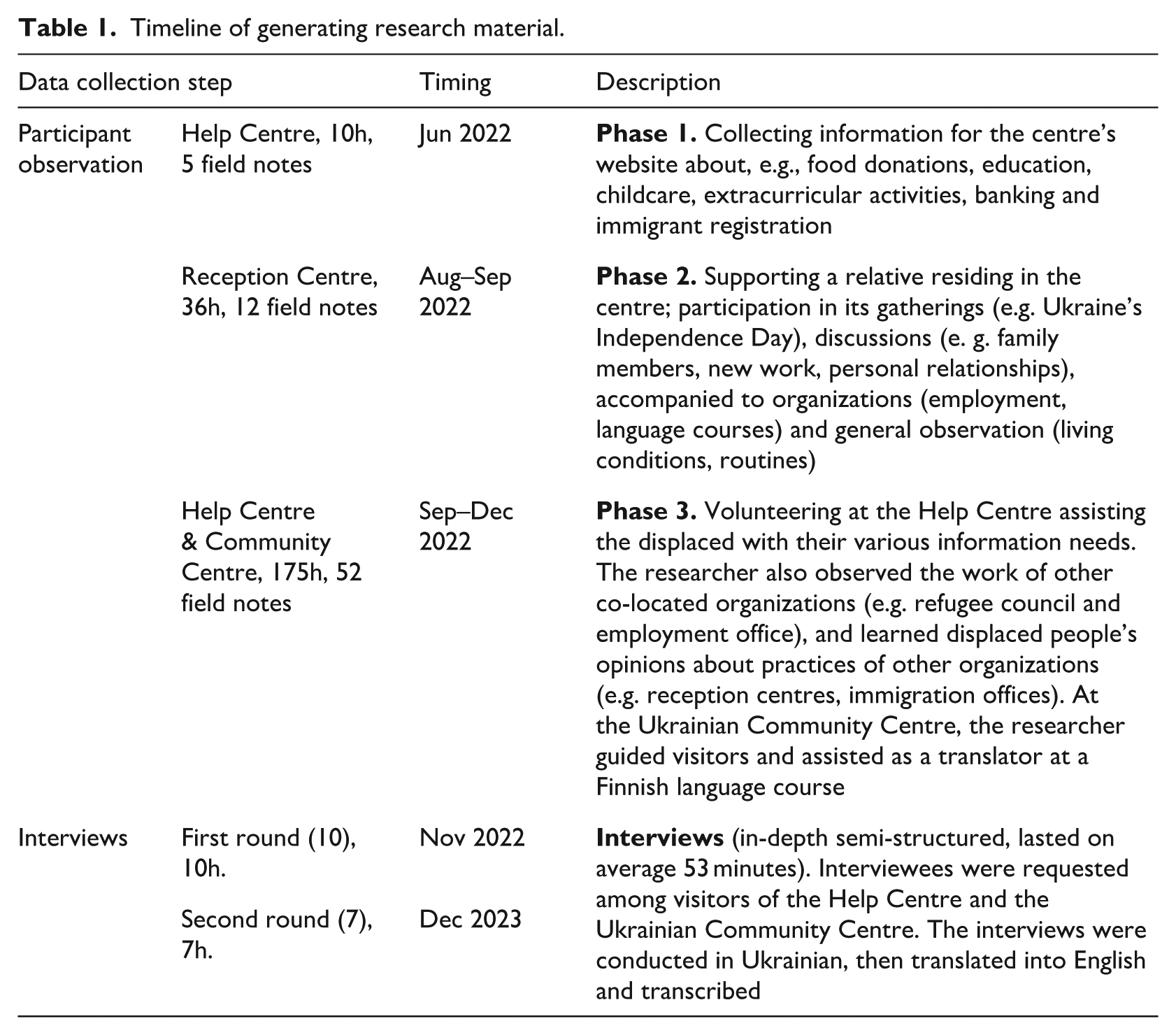
To study the embodied, affective ways of engaging with and experiencing the world (De Rond et al., 2022), which are difficult to articulate in interviews, we engaged in participant observation. The first author observed practices in situ, for instance, how the displaced Ukrainians engaged in learning the Finnish language, updated their CVs to look for specific jobs, or made arrangements to return to Ukraine. In line with embodied and careful reflexivity (Mandalaki, 2023), the first author’s personal background and contextual sensitivity (e.g. in a reception centre context and through close connections to the Ukrainian community in Finland) were especially useful. These facilitated noticing and appreciating the practices and embodied concerns of the displaced. The implicit details were reflected, for example, in varying moods of whether to attend courses or not, whether one succeeds in arranging one’s life around the services available, or casual talks about connections at home. This contextualization enabled the first author to continuously reflect on her role in shaping the interactions, using both her observations and experiences (Silverman, 2000, p. 128), thereby perceiving the everyday nuances, ambiguities and hidden aspects (Ybema, Yanow, Wels, & Kamsteeg, 2009). Thus, she transforms her role from that of a shadow to that of a person (McCabe, Ciuk, & Gilbert, 2020) in the field. The first author’s Ukrainian origin enabled her to connect and build trust with the research participants on the basis of speaking a common language, having the same cultural background and being exposed (in part) to the same collapse of familiar structures in terms of the home country going through a war. Such commonalities contributed to creating a safer setting for the interviewees to share their experiences, even if capturing the experience of others is always partial. As written by Stowell and Warren (2018, p. 795): ‘So although my pain, suffering, warmth or joy is almost certainly quite different subjectively from yours (and can never be known), we can agree that we all feel something and that allows for a sharing of experience.. Having migrated to Finland before the war, the first author’s own experiences differ in various important ways from those of the displaced, and these differences were equally important for our methodological and analytical process. Notably, during the fieldwork and in interviews, the research participants often compared their experiences of displacement to those of the first author, who migrated voluntarily. This helped surface elements of the practice engagement and embodied concerns characterizing the experiences of the community of displaced people.
Researching vulnerable informants demands ethical consideration throughout the research process. We have complied with the national and university ethical guidelines for scientific research, including ensuring anonymity, informed consent and voluntary participation from our informants, as well as mitigating psychological, social and legal risks. A collaboration agreement was signed with the Ukrainian Association in Finland, under which the Help Centre operates as a project. The agreement specified, for example, the terms of collaboration and the use of data. During the fieldwork, the first author disclosed her status as a researcher and informed participants about the purpose of the study as well as how the data would be processed and anonymized.
Our ethical stance also shaped our choice of theoretical framework and analytical depth. First, we selected the practice-based phenomenological perspective – which conceptualizes liminality as the lived experience of the displaced – because it aligns with our ethical aim of addressing epistemic inequalities that have traditionally silenced the perspectives of marginalized communities (Fricker, 2007). Second, we were persistently self-critical of the challenges involved in analytically representing the lived experiences and voices of marginalized groups (Manning, 2018; Spivak, 1988). In working with the data, we paid specific attention to avoiding essentializing accounts of displacement that rely on stereotypical and reductive representations. This is why we do not stop with identifying the practices of navigating liminality. Instead, we aim to convey the messy, complex, lived realities of the displaced lives by staying close to the first author’s embodied and affective experiences during fieldwork interactions. The first author also shared initial interpretations with participants, which helped to amplify their voices.
Data analysis
We have conducted our analysis using an abductive approach, iterating between theory and the empirical material (Charmaz & Mitchell, 2007). Initially drawing on our field notes from the fieldwork phases 1 and 2, we identified the doings, sayings and material arrangements of how the displaced organize themselves in displacement. This resulted in first-level codes such as getting oneself busy, taking one day at a time, learning new ways of being, accepting the limiting position of uncertainty and postponing the good life. We then consulted practice literature (Loscher, Splitter, & Seidl, 2019; Schatzki, 2002; Welch & Warde, 2016) and converged the first round of analysis on three practices of navigating displacement (see Figure 1). These were formalized using Schatzki’s (2001, 2002, 2012) concepts of (1) practical understandings (embedded doings and sayings), (2) teleoaffective structures (the end that the doings and sayings are aimed at and the associated emotional attachment to that end) and (3) practical intelligibility (sensible action for a practitioner – what it makes sense to do).
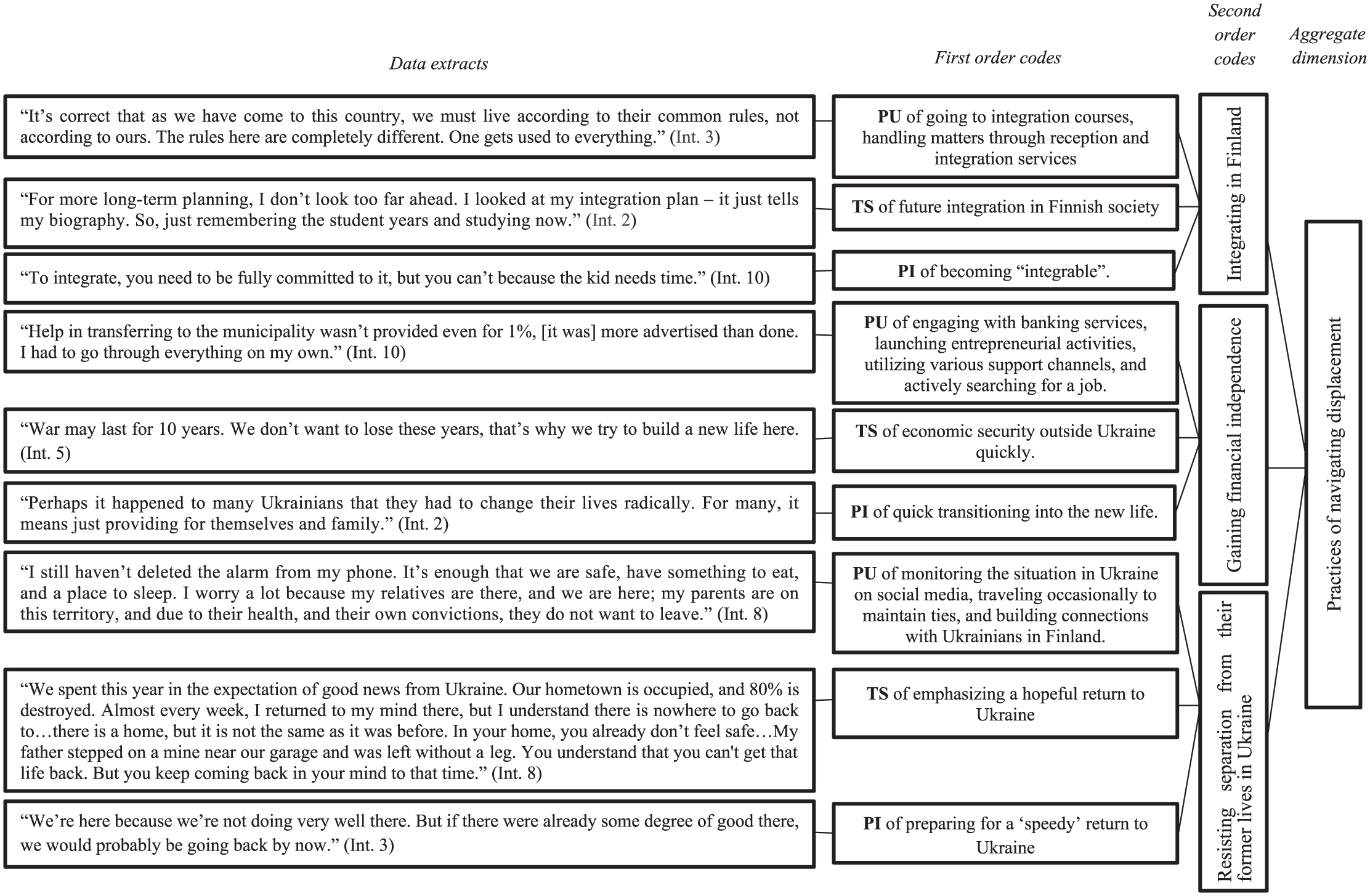
Data structure: practices of navigating displacement.
In phase 3, we initiated interviews with the displaced to clarify these themes and infer more about their experiences. We observed tensions within the informants’ accounts of lived experiences; how they identify what they or others are supposed to do, yet struggle for resonance with their actual affective needs and desires. This key observation motivated the separation of the displaced accounts based on how they construct their understanding action, and their experiences in relation to such understandings. We conducted a second round of analysis to deepen our understanding of what such tensions may be related to. We also initiated a new round of interviews at this stage, and observed that the tensional experience was associated with the inability of the displaced to adhere to a given practice. Notably, what emerged was a sense of concern from being in-among different practices. As the displaced tried to simultaneously follow different practices of navigating displacement, they struggled, as these different practices had (to a certain extent) non-complementary elements. This exposed an experience of not being able to make sense of what to do, as what they affectively experienced as necessary for enacting displacement was unavailable. We conceptualized such experiences as a collapse of practical intelligibility arising from engaging in practices that have non-complementary elements. This triggered our analysis of the experiential dimension of the lived experience of liminality (see Figure 2). Thus, we turned analytical attention to the embodied concerns revealed through the practice engagement of the displaced. We identified patterns of how things mattered in different ways to the displaced within such experiences. Having engaged more deeply with how the teleoaffectivity construct has been advanced to understand the complex layered affectivity of practice engagement (De Rond et al., 2022), we generated second-order categories of the embodied concerns for fulfilment, connection and security, which animated liminal modes of practice engagement.
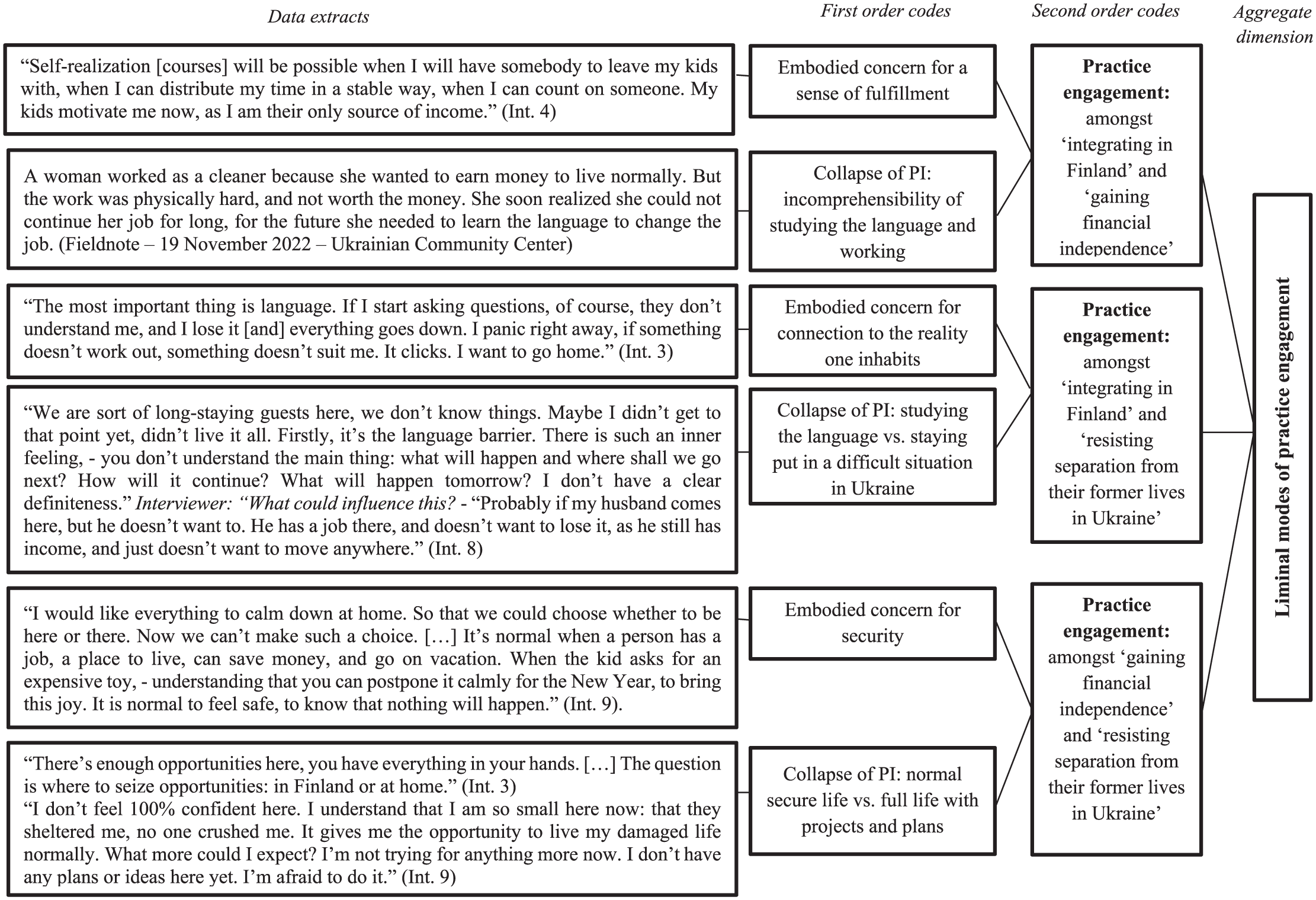
Data structure: lived liminal experiences animated through practice engagement.
Findings
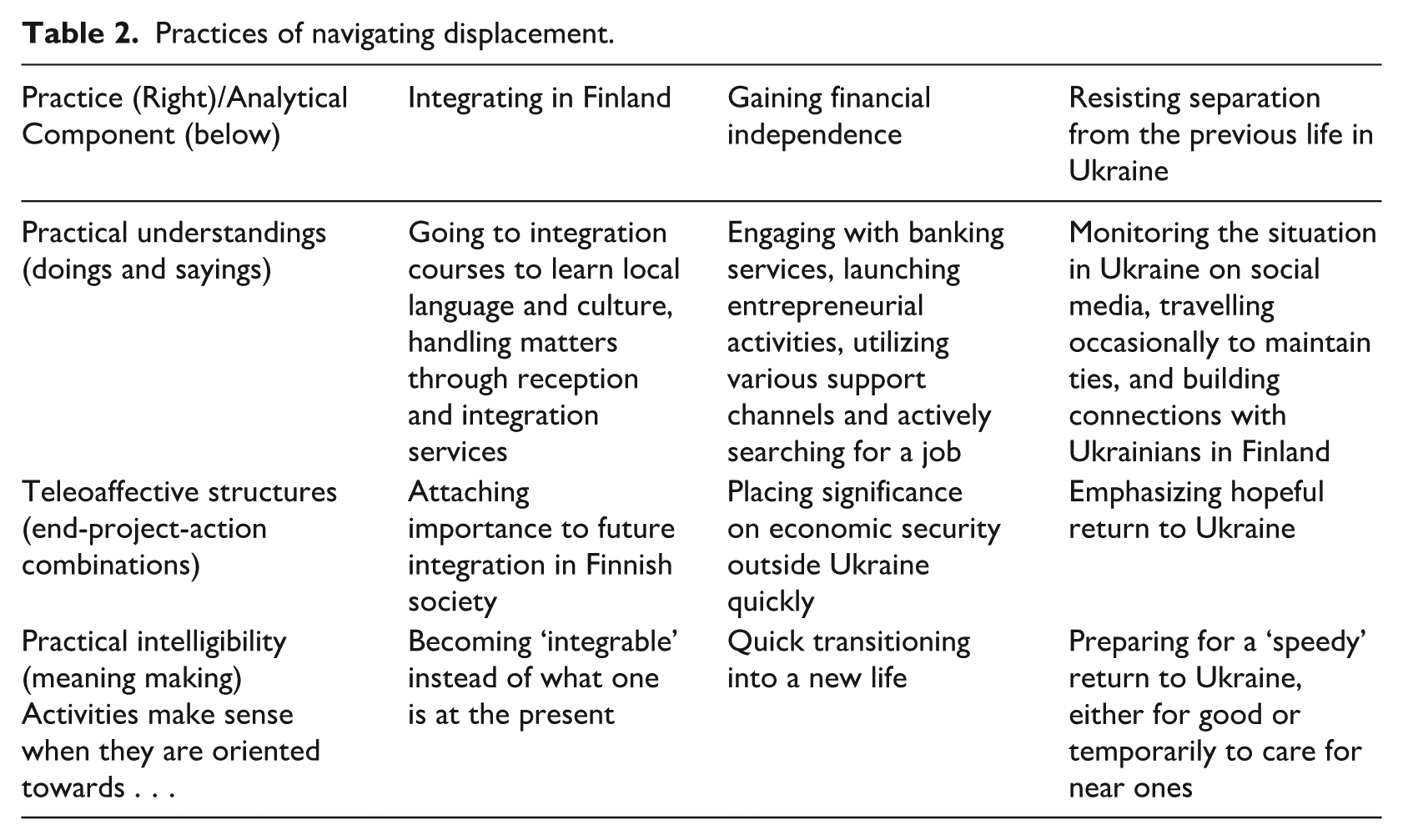
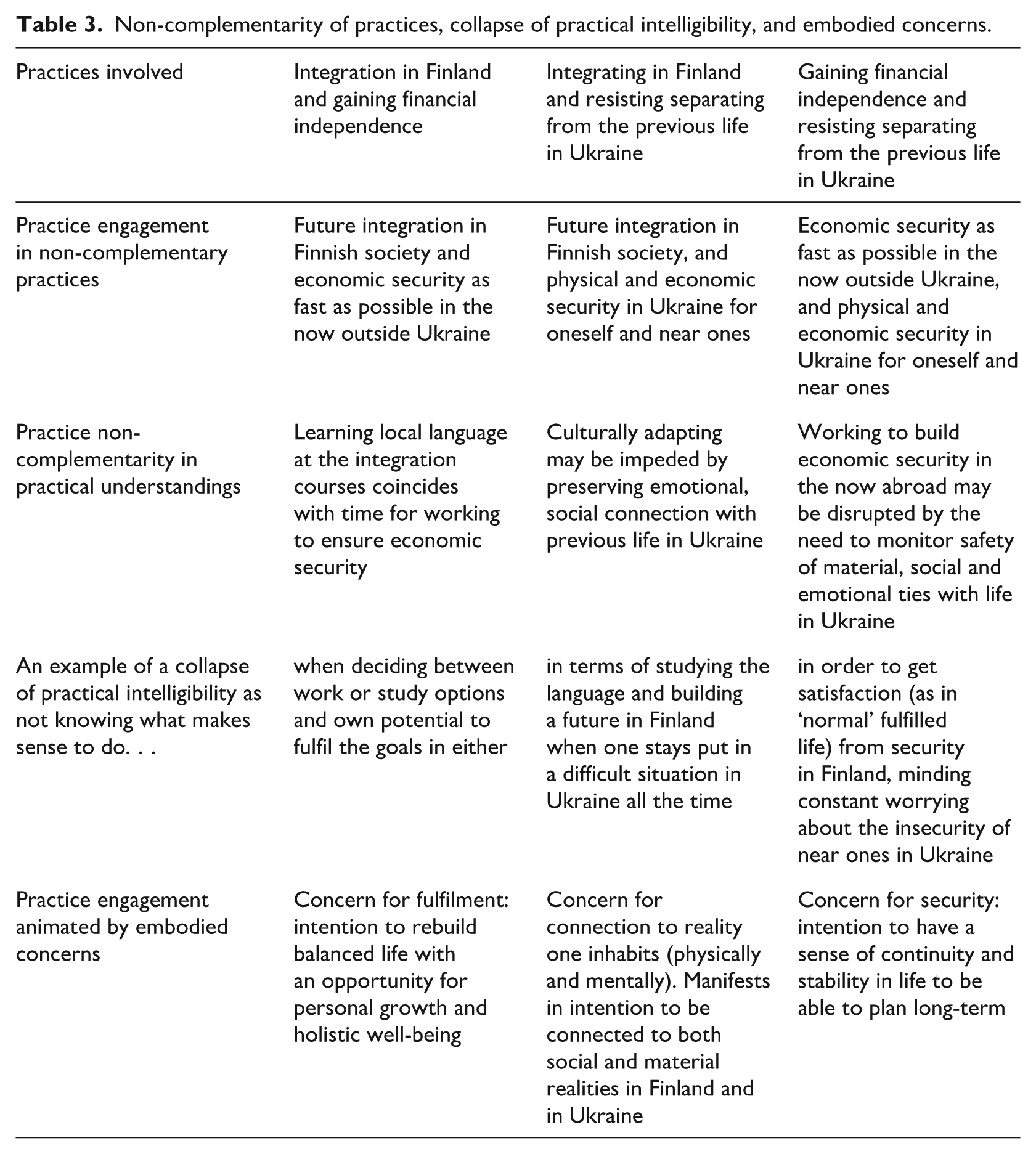
We structure our findings in two sections. First, using the conceptual categories of Schatzki’s (2002) practice theory (see Table 2 for a summary), we describe the three main, largely non-complementary practices of navigating displacement evident in the data: integration, gaining financial independence and resisting separation. Second, we observe that these three practices do not map neatly to the embodied concerns of the displaced Ukrainians; rather, the displaced often engage simultaneously in multiple practices. As the practice engagement of the displaced is animated by their embodied concerns – namely, concern for fulfilment, connection and security – experientially, liminality emerges from being among non-complementary practices, which results in a collapse of practical intelligibility (see Table 3).
Practices of navigating displacement.
Non-complementarity of practices, collapse of practical intelligibility, and embodied concerns.
Practices of navigating displacement
We observed that the community of displaced Ukrainians organize themselves along three core practices: integrating in Finland, gaining financial independence and resisting separation from their previous life in Ukraine. It is important to note that this list is not exhaustive, as the complete lifeworld of a community is always more complex. These three do, however, reflect the core practices through which adult Ukrainians under temporary protection in Finland orient their everyday life: a main disposition towards the foundational question of how to understand one’s life and situation.
Integrating in Finland
Through the practice of ‘integrating in Finland’, the displaced people’s striving to navigate displacement was based on following the integration path, as a precondition for building a meaningful future in Finland.
The dream and its fulfilment, probably comes in the course of it. It depends on how you settle down here, whether you will get accustomed here or not. (interviewee 3)
In this quote, interviewee 3, who is currently unemployed in Finland and taking care of her family, compares her experience as a displaced person with the experience of the interviewer, who moved to Finland for studies long before the war. She reflects that, as a displaced person, her understanding of dreams is different: before one can envision a meaningful future in a new country after fleeing war, it is essential to first come to terms with what it means to rebuild a life there. Only after this adjustment can the pursuit of dreams in this new country take shape.
The respective practical understanding involves organizing one’s life through learning the local language and the local culture at integration courses, and how matters are handled with different authorities. Such practical understanding is reflected in the quote below by interviewee 2, responding to a question about his daily doings.
It’s more of a routine time now. My schedule is dictated by language courses. They are from Monday to Friday, from 12 to 18, including time for transportation. For the most part, all my week is spent studying. (interviewee 2)
Such practical understandings made sense to the displaced with a view of streamlining their lives towards integration in Finland and receiving resident status in the future. The practical intelligibility of such actions was based on what one becomes ‘integrable’ instead of what one is at present, as interviewee 1 – preserving the idea of continuing her career in Finland – reflects.
I imagine that when I conclude the integration course, and have learnt some Finnish and improved my English, it will be easier for me to find a job. It depends on me, how fast I can learn the language and if the local authorities will be ready to accept my application. (interviewee 1)
The quote demonstrates how the activities were evaluated (whether they make sense or not) against their alignment with the teleoaffective structure of integration in Finland in the future: typically, by following the official integration services offered to them.
Gaining financial independence
Often, the displaced arrived in Finland bare of material belongings and support that gave meaning to life prior to displacement. For instance, leaving behind reputable jobs and long-worked-for property, and arriving typically with a couple of suitcases. In such cases, the practices were geared towards overcoming the practical limits of such a state of displacement, such as low material livelihood. An opportunity to gain financial independence quickly was provided by access to the formal job market, provided by the temporary protection status granted to displaced Ukrainians. This is illuminated in the interview excerpt below: Why was it important for you to start working right away? I don’t have anything, and don’t have money. It is important for me to be confident in myself. Nobody knows what will happen tomorrow: today, the Finnish government supports Ukrainians and pays the benefits. But many countries have already stopped doing that. If that happens, what would we do? We don’t need the benefits; we’d better manage on our own. When you have worked all your life, now to start depending on something [the government], it’s not a comfortable feeling. Moreover, we have an opportunity to work. (interviewee 5)
The respective practical understanding implied resolving matters independently, for example, through friends or acquaintances, and other support and information channels, rather than relying on the integration-related authorities.
They [the authorities] send you to another organization. You go there; they send you back. I have always consulted them [local acquaintances], but even they do not know all the nuances. I joke that I can already write a book on how to organize one’s life in Finland. (interviewee 4)
Such practical understandings made sense for the displaced in their pursuit of the teleoaffective structure of achieving economic security outside Ukraine for themselves and their family, and quickly, in the ‘here and now’ – often out of perceived necessity.
A young man came to ask for help with updating his CV and finding a job. He planned to go to Ukraine to pick up his family. He was the first one to move, to look for a job. He was hoping to find a job really fast, as it was difficult to persuade his family to leave even now when they have lost means of support, and he doesn’t want them to come ‘nowhere’. (field note – 16 September 2022 – Help Centre)
In this case, the practical intelligibility of actions implied that getting a job as fast as possible would help one to organize one’s immediate surroundings in the new country and to make the transition into the new life smooth, turning a place of ‘nowhere’ into a meaningful one.
Resisting separation from the previous life in Ukraine
Finally, the practice of resisting separation from the previous life in Ukraine implied that the displacement could be overcome by returning to Ukraine, which was conditional on the safety situation improving in Ukraine. In such a way, the displaced maintained the emotional connection and societally appropriate sense of being a Ukrainian who continues to suffer through the war, even while abroad and hoping to return. The memories of staying there throughout what interviewee 7 called ’the scariest stage: when the airplanes were flying above, artillery was shooting 20 to 30 times a day’, reinstated such identity. The practical understanding that reflected such practice included preserving social, material and emotional ties with the previous life in Ukraine. The displaced continuously monitored the safety status in Ukraine. ‘I take sedatives and watch videos about the situation. It is very difficult when you worry about the safety of loved ones. I miss them more and more as time goes by’, stated interviewee 7.
Here, interviewee 7 reflects on her pain of not visiting her family, as her hometown is continuously under attack. The displaced retained a practical understanding of what everyday life in Ukraine is like by travelling there occasionally to maintain connections with family and relatives, handling property- and business-related issues, paying loans or services in Ukraine, and preserving their employment or study place. Through such repeated temporary ‘homecomings’, the displaced had not moved ‘out-of’ the familiar social structures and instead tried to keep attached to them. In addition, they sought to keep close connections to other Ukrainians in Finland. ‘Forming a Ukrainian community in Finland and Helsinki can help Ukrainians who are here. Because with Finns, there is no contact yet, either mental or personal. Maybe it’s because of the language or culture’, said interviewee 2. This illustrates that emotional attachment could animate reaffirming the Ukrainian identity. For example, the displaced would speak Ukrainian, even if in Ukraine they were speaking Russian, and engage with Ukrainian culture by visiting different events and reading Ukrainian literature.
They [Finnish authorities] resettle people very far away. And so, people are somehow on their own. They [the displaced Ukrainians] still try to come to the big city in some way. In principle, to live in the same environment as you lived in at home in Ukraine. (interviewee 3)
Hence, even if a physical return was not conceived as possible, the displaced attempted to replicate the spaces and lifestyles they used to have, for example, the same living conditions. In other cases, returning to Ukraine remained at the forefront of their minds.
Another visitor came first to Lapland in March and then to Helsinki in April. She wants to go back home. She doesn’t go to integration courses. For several months already, she feels like tomorrow she will go home. She is not motivated to look for opportunities in Finland unless she knows that she won’t return home. She just does things that everyone else is doing. (field note – 21 October 2022 – Ukrainian Community Centre)
Such daily doings underlined the idea of a hopeful future return as the teleoaffective structure against which the doings are evaluated. This is also illustrated in the quote below by interviewee 7. When asked about plans to stay in Finland, she shares that all the substantial plans that mattered were left in Ukraine. ‘We don’t have any big achievements here for now. We had bigger achievements in Ukraine. We are still living in that winter before the war’, stated interviewee 7.
The practical intelligibility implies meaningfulness in terms of preparing oneself for a ‘speedy’ return either to reconnect with the previous life for good or to support near ones when safety conditions deteriorate in specific areas (field note – 29 October 2022 – Ukrainian Community Centre)
Embodied concerns and the collapse of practical intelligibility
Our analysis points out that adherence to one given practice is not conformist because the practices do not resonate fully with the embodied concerns of the displaced for fulfilment, connection and security. This non-complementarity of the practices results in a collapse of practical intelligibility, not being able to discern what it makes sense to do. The attempt to engage in these multiple non-complementary practices triggers the experience of liminality for the displaced.
Practice engagement animated by concern for fulfilment
Practice engagement of the displaced was characterized by a dual focus of seeking to ensure a meaningful life in Finland for the future, while also addressing their present by attempting to access employment quickly. Engagement in both of these practices (seeking integration in Finland and gaining financial independence) was animated by a concern for fulfilment – they wanted to rebuild their life with a sense of fulfilment they once had before displacement, such as balance in various aspects of life, personal growth and holistic well-being.
Despite the fact that we are now safe, everything is fine here, and we are treated well, but there comes a moment when you feel fine and smile, and then suddenly you burst into tears. You look at something in your apartment and return to your memories of the past, of how great everything was before the war, or you see this picture, a reminder ‘one year ago’ – it was somehow especially magical, a New Year, full of prospects. This is emotional. In practice, in life, you cannot give up; you need to fight. But emotionally, you have these moments. (interviewee 5)
The quote above shows how displacement forces one to put a fulfilled life on hold and accept basic safety as the satisfactory condition of a new normal. However, reminders of the past reveal a yearning not just for mere survival but for ‘the life once lived – one filled with purpose, passion and goals. This concern for a fulfilled life is not abstract, it’s rather rooted in particular practices the displaced engage in.
I am motivated by the idea of getting my life here, finding myself in this country, finding a job, a circle of friends, buying housing, learning the language. I will know that I have built my life here when I can freely communicate in Finnish, will know Finnish laws, won’t feel discomfort that I don’t know how to behave here. (interviewee 1)
The quote above highlights interviewee 1’s concern for fulfilment, which motivates the efforts to integrate into Finnish society. This pursuit of ‘getting one’s life’ involves finding a job, building social connections and buying a house – all of which depend on learning the local language and culture.
Such concern for fulfilment can also be inferred from the displaced people’s motivation to find employment in the ‘here and now’ to rebuild their lives in a new country, and from the motivation to integrate into Finland. Attempts to integrate into Finland and secure financial independence are both geared at attaining fulfilment, albeit in non-complementary ways. The non-complementarity of the two practices manifested as the displaced felt the need to always sacrifice one for the other.
Of course, I really want to study and study Finnish. To get a degree, I first need to study Finnish. We were hoping that my husband will come this year, but it didn’t work out. I thought if he comes, I will have more opportunities, more free time. Kids limit me a lot of course. Well, it’s possible, but I need to sacrifice work somewhat and I will be very exhausted. But if I am exhausted it will negatively affect my kids. . . In terms of financial security, it can be scary. Sometimes I think about whether I will make it this month. (interviewee 4)
This quote by interviewee 4 illustrates how the two practices are non-complementary in terms of their practical understandings (going to courses to learn the language and working hours coincide in terms of time). As a consequence, the displaced find themselves in a position where practical intelligibility (what makes sense to do) collapses.
A man came to ask how long he could leave Finland for, and whether he would lose his benefits if he leaves. He had a job opportunity in another country. He could leave only for three months if he wanted to keep his temporary protection status. Otherwise, he needed to cancel his status in Finland and apply for it in a new country. He replied that it seemed like both options had their complications. (field note – 11 November 2022 – Help Centre)
Either of the options sought after exclusively – seeking future integration or gaining financial independence fast – fails to satisfy their concern for fulfilment. Deciding between the two practices felt absurd to the displaced.
When you don’t know how to do something, it seems so scary and incomprehensible to you. It’s hard to plan the future now, but still, you need to, at least a little bit. My courses will end now, job search will take me some time, and it’s not guaranteed that I will find work. Same with the studies: if I try to get a new profession and my language skills are not enough to get into the school, again I am stuck up in the air. I don’t want that. This long ‘holiday’, almost two years without working, is very difficult for me. I feel very unconfident, because I need to be doing something, moving forward in some way. (interviewee 8)
Interviewee 8 reflects on how she does not quite understand the reality of how to pursue a new profession in a new country. The displaced are faced with the concern of ‘doing something’ to recover the experience of life making sense to them, as when they used to feel fulfilled. Yet, because any possibility is experienced as limited and uncertain, due to practices’ non-complementarity, such ambition of ‘moving forward’ towards fulfilment only results in a sense of ‘being stuck’. Such insufficiency of either of the options alone in satisfying the concern for fulfilment keeps the displaced engaged in two practices simultaneously, which in turn sustains fulfilment as unattainable.
Practice engagement animated by a concern for connection
The displaced found themselves simultaneously engaging in practices of integrating into Finland by taking language studies seriously, resisting separation from their previous life in Ukraine and cherishing the idea of returning home soon. Both of these were animated by a concern for connection; a connection both to their social and material realities and surroundings in Finland and those left behind in Ukraine.
Displacement disrupts meaningful connections one once had. In order to restore their place in the world, the displaced longed to become ‘part of society’ through engaging in the practice of seeking integration in Finland, as illustrated in the quote below.
I don’t know if I want to stay in Finland. Maybe when the war is over, I will return to Ukraine. I haven’t decided on this yet. For now, I will just go to courses and follow this integration plan to not just sit at home, but to do something and be a part of society. When I arrived here and was staying at home for a whole month, it demoralized me. The courses give the opportunity to get out of your bubble, to talk a bit about studies, and a bit about life. This helps. It makes it a bit more pleasant and easier to be in society. (interviewee 2)
Such concern is also evident in the displaced who resist separation from their previous lives in Ukraine. They maintain connections to their previous reality by preserving social and emotional ties at home, demonstrated thus: I keep thinking about all my friends and my parents. Every morning, I check Telegram news. It happened a couple of months ago that a rocket hit the house where my friend was living, and my nephew lives 200 metres away. I immediately wrote to her, as I saw it on the news. Luckily, she wasn’t at home at the time of the strike. Before she answered for half an hour, my hands were trembling and I was at the course. They asked me something and I could not answer. (interviewee 7)
As demonstrated in both quotes, such concern for connection cannot be fully attained through exclusively engaging in either of the practices. The displaced could be going to integration courses, but could not really focus on learning the language. Building a future in Finland was difficult when one’s attention remained fixed on the situation in Ukraine, knowing that at any moment, they might need to return immediately to care for family members, as the quote above by interviewee 7 shows.
At the same time, engaging in both of these practices simultaneously still makes the concern for connection unattainable, due to the practices being non-complementary. When thoughts of the physical danger facing loved ones in Ukraine persist, it becomes difficult to connect with the surrounding world, where other concerns take precedence. Thus, one cannot fully engage in both practices in terms of respective practical understandings.
After the language course the visitors at the centre were sharing that it’s difficult to learn the language, but they are trying to. It’s especially difficult for them when they hear the news from home, in particular if they have somebody at the front or in dangerous situation. Then they get distracted completely (field note – 24 September 2022 - Ukrainian Community Centre)
For example, if the displaced focus on integration and keep the connection to Ukraine (even if in one’s mind), they find it demoralizing, as such a combination constantly reaffirms the idea of safety (either for self or for near ones) and disconnects from the society one inhabits in Finland, as illustrated in the field note above.
Practice engagement animated by concern for security
The displacement allowed Ukrainians in Finland to regain physical safety, yet security in a broader sense of living life as previously known, with a sense of stability and continuity, was disrupted. This gave rise to concerns about security. Such a concern manifests in the displaced wanting to transition from living ‘one day at a time’ to having reliable support systems, possessing the knowledge and skills to navigate daily challenges, recognizing and celebrating personal achievements and experiencing a stable environment that allows for long-term planning and goal-setting. The quote below by interviewee 10 demonstrates how the displaced seek to satisfy their concern for security by following the practice of gaining financial independence.
I try to hold on and understand that we are alive and safe, and this is the most important. This indeterminacy will end when I receive a job in Finland and try myself here and evaluate whether I enjoyed my work more here or there. When you have a seasonal job, you know that you will go back and your loved ones are ok. But when you know that your friends are at the front line, and your parents don’t want to leave – this is completely different, because you are worried all the time. (interviewee 10)
However, the attainment of security is still compromised as the satisfaction of securing employment is compromised by the worries about those who are more insecure. In that sense, security as life stability and continuity cannot be attained by only aiming for one’s financial independence. The security of life once lived, or continued to be lived by loved ones at home, cannot be separated from this. As the displaced resisted separation from their previous life in Ukraine, the concern for security is also evident in how they prepared the basis for a secure life back home, hoping for a return when the situation allows for it, as illustrated in the field note below.
A woman shared that her two sons are fighting in Ukraine. She was constantly in touch with them and was reflecting that she wants to go back, but she will keep on working in Finland as long as it is not clear how the war will end in Ukraine. If/when it is safe, she will return. If it worsens, then she will continue working here. She said she just wants a normal, secure life, but she understands that such a life is not possible so far in Ukraine. Moreover, if she goes back now, she will spend more than she will earn, and will become a financial burden for her kids, as life has become very expensive there. (field note – November 20 – Ukrainian Community Centre)
However, just as engaging in either of the practices exclusively doesn’t warrant attaining security, engaging in both of them simultaneously does not warrant attaining security. One longs for a return home that manifests in the idea of living the good life with the stability of material livelihoods once had. At the same time, one needs safety, which is no longer possible in Ukraine, but is possible in Finland, though in a form of just ‘normal’, but unpredictable, safe life. Because of pursuing non-complementary teleoaffective structures simultaneously, the displaced find themselves in-among the practices, where practical intelligibility collapses. A normal secure life (as in fulfilled physiological needs) is critical; however, it does not suffice and does not compensate for the full life with projects and plans once had. ‘I cannot plan for a long time now. I want to stay here. But I am worried about my relatives in Ukraine. My parents are older. I also have a grandma. I might need to go there for them’, said interviewee 9.
The collapse manifests as one cannot pursue both courses of action simultaneously, even if their everyday engagement with their ‘world’ places them in a position to prioritize both. On the one hand, possibilities of reclaiming normality through employment in a new country are circumscribed as one cannot calmly plan one’s life in Finland due to the possibility of imminent threat at home and the need to address it, as illustrated in the quote above. Furthermore, one’s possibilities of gaining the stability of old life through preserving material and social ties are limited, due to either physical or material security threats, or contacts not marking the old life.
Such engagement in practices that are non-complementary sustains the embodied concern for security as unattainable. As the quote below shows, a ‘normal’ life – one where one is able ‘to postpone calmly,’ ‘to know that nothing will happen’ and ‘to plan something’ – is a state one longs for.
I am happy about the small things because, for now, I am afraid to plan something more here. That is a step back, so to speak. But here I have to start with this. It seems to me that when I feel myself the same as others, then it will be possible to talk about something. And now I feel like a B-type of person. In Ukraine, I had my help, the ones whom I turned to because I have lived there all my life. And now it’s not there for you. That’s what I mean that I don’t feel like everyone else, I don’t know who to turn to in any situation; who exactly decides whichever question. (interviewee 9)
With such concern being unattainable, the displaced find themselves ‘a step back’, due to lacking the resources to establish life stability and continuity. From that perspective, having a sense of their own physical security and being able to think at least about the short-term future is already perceived as an improvement.
Discussion: The emergence of the lived experience of liminality
In our discussion, we’ll first explore three findings arising from our analysis and then formulate two key contributions to studies on liminality. Two of these findings relate to the practice theoretical insights we develop in our analysis: the non-complementarity of practice and the collapse of practical intelligibility, i.e., no longer being able to discern ‘what it makes sense to do’. These are central for understanding the emergence and lived experience of liminality. Then, as our third finding, we examine the unattainability of embodied concerns in practice engagement. Finally, we elaborated on the two contributions this paper makes to the literature on liminality. First, responding to our research question on the emergence of liminality, our study shows that liminality emerges through a collapse of practical intelligibility caused by a non-complementarity of practices. Second, responding to our research question on the lived experience of liminality, the consequence of this collapse is a lived experience of liminality as an unattainable embodied concern; a struggle for fulfilment, connection and security.
The practice antecedents of liminal experience
The central finding of the first part of our analysis is the non-complementarity of practice (see Figure 1 and Table 2). This non-complementarity is exposed in two ways. First, as non-complementarity in practical understandings, while a displaced person may be competent with the various doings and sayings associated with the practices, yet in the moment, these doings and sayings cannot be pursued concurrently due to considerations of time and space. This is highlighted in our analysis by the struggles with both attending daytime language classes and having a full-time job. Second, non-complementarity is also exposed in the teleoaffective structure of practices. In this case, the practices present end–project–action combinations that diverge significantly to the extent that they are not teleologically meaningful. As intentional and affective future outcomes to strive for, one cannot meaningfully commit to, for example, both integrating into Finnish society and re-integrating into Ukrainian society. The three practices of navigating displacement identified in our study are distinct practices with their own practical understandings and teleoaffective structures that are non-complementary. No single one of these practices can attain the affective needs and embodied concerns (De Rond et al., 2022) of the displaced. Rather, all three often concurrently and very intimately relate to their lifeworld, and hence to choose becomes absurd. As our findings show, even if a displaced person seeks to integrate and start a new life in Finland, their everyday engagements and obligations as caregivers, providers, spouses and citizens require them to also prioritize financial independence or resisting separation from Ukraine.
Hence, and contrary to Schatzki’s (2001, p. 60) baseline, there is no satisfactory way to make sense of how to act or proceed with the given expectations and affective conditions. In navigating the central practices that make up the everyday flow of their life, the liminar is stuck between a rock and a hard place. The dilemma of non-complementarity becomes exposed as a collapse of practical intelligibility: not being able to make sense of what to do. There is no configuration of doings and sayings, ends and actions that can address the liminar’s embodied concerns. Yet, as we can see in our analysis, the consequence of this collapse is rarely paralysis. Rather, it results in a mode of practice engagement that gives rise to liminal experience exposed as embodied concerns. This is what is seen in the second part of our analysis (see Figure 2 and Table 3).
Embodied concerns and liminal modes of practice engagement
As the second section of our analysis illustrates, the lived experience of liminality is intimately connected to ‘what is significant and what [one] is concerned with’ (Del Rio et al., 2025, p. 22) in the community’s practice engagement. We find that displaced people’s liminal experience is marked by the unattainable embodied concerns for fulfilment, connection and security. A concern for fulfilment arises from a sense of life being on pause and the desire to rebuild a balanced life, achieve personal growth and attain holistic well-being. It is evident in efforts to integrate into Finnish society and gain financial independence. A concern for connection manifests as displacement disrupts meaningful connections, leading to a desire to feel present and be part of a shared reality, both physically and mentally. This is seen in the longing to be part of both Finnish and Ukrainian realities while seeking integration and resisting separation from life in Ukraine. Concern for security involves a broader sense of stability and continuity, transitioning from living ‘one day at a time’ to having reliable support systems and the ability to plan and set long-term goals. It is evident in efforts to gain financial independence and maintain connections with life in Ukraine.
Importantly, the three concerns are not to be understood as mere motivations for the practice engagement. Instead, the concerns are ‘manifested in and through practice performance, rather than being an independent antecedent to it’ (De Rond et al., 2022, p. 874). This is where the simultaneous engagement in non-complementary practices, as discussed above, complicates things. While the three practices orient the displaced Ukrainians towards attaining fulfilment, connection and security, they do so in ways that are in conflict in terms of time (in the future or now) or place (Finland, Ukraine, or elsewhere). Thus, the ‘feeling of being’ (De Rond et al., 2022, p. 894) connected to the practice engagement is an unresolved struggle towards attaining the embodied concerns. For example, as our findings show, through their practice performance, the displaced Ukrainians simultaneously experience an accentuated awareness of the need to attain a connection both to their present realities in Finland and to their past lives in Ukraine. This practice engagement does not ‘make sense’ to them. As such, it affectively signals both the concerns and their sustained unattainability. This tension illustrates what De Rond et al. (2022) refer to as the complex, layered affectivity of lived practices. In contrast to practice engagement that promotes, for example, one’s aspirational identity by reinforcing specific ways of understanding the self and others (De Rond et al., 2022), liminal modes of practice engagement rather interrupt such meaning-making.
Liminal experiences arise through practice engagement involving non-complementary elements. These experiences are inherently dynamic and emergent. The ongoing struggle to attain what ‘matters’ makes the experience fluid, while the persistent tension of unattainable embodied concerns remains. This unattainability continually drives engagement in multiple non-complementary practices, leading to a collapse of practical intelligibility that triggers the liminal state. In this state, embodied concerns are intensified, creating a self-sustaining tension where individuals are guided by these concerns, yet remain unable to attain them.
How liminal experience emerges in practice engagement
The concept of the collapse of practical intelligibility allows us to refine existing theories on the emergence of liminal experiences by focusing on liminars’ practice engagement and the embodied concerns that shape it. This focus shifts attention away from events that temporarily suspend norms (Alkhaled & Sasaki, 2022; Beech, 2011) or specific practices that challenge existing norms or create new ones (Howard-Grenville et al., 2011; Piironen, 2022; Vesala & Tuomala, 2018). Instead, it emphasizes the ‘chaotic dynamics’ of mutual constitution and contestation of norms (Liu & Fan, 2023). In our empirical case, these chaotic dynamics emerge from simultaneous engagement in practices that are non-complementary but equally essential for satisfying embodied concerns.
The collapse of practical intelligibility connects the emergence of liminal experiences to engagement in practices characterized by non-complementary doings, sayings and aspirations. In the liminality literature, such non-complementarity often involves conflicting logics or values, as seen in the work of consultants or project workers (Czarniawska & Mazza, 2003; Ellis & Ybema, 2010; Sturdy et al., 2006). However, by not attributing the origins of liminal experience solely to the position of these actors (Söderlund & Borg, 2018), this theorization broadens our understanding to include actors not traditionally seen as ‘in-between’. For example, women leaders (Mavin & Yusupova, 2024) may experience a collapse of practical intelligibility due to competing dynamics within their practice engagement. This perspective is important in helping to explain the emergence of varied liminal experiences in organizational contexts that have arguably become ‘more liminal’ (Johnsen & Sørensen, 2015) and are spreading beyond determined bounded contexts into something more akin to a ‘modern condition’ (Czarniawska & Mazza, 2003).
The lived experience of liminality accentuated by embodied concerns
Finally, we want to return to our second research question, ‘How does practice engagement shape the lived experience of liminality?’, by exploring the ongoing effects of unattainable embodied concerns. Building on what we wrote concerning its emergence, we posit that ongoing lived liminality is experienced as an accentuated awareness of what matters and a persistent inability to attain these embodied concerns. This experience of accentuated awareness brings unattainable embodied concerns to the fore. Our findings contribute to debates on the tensions that constitute liminality (Liu & Fan, 2023; Mavin & Yusupova, 2024; Söderlund & Borg, 2018) by showing how they manifest as embodied concerns that remain unresolved, driving ambiguity and a multiplicity of meanings (Beech, 2011, p. 288). The persistence or transience of liminal experiences depends on the perceived (un)attainability of these concerns. When concerns are seen as highly unattainable, they become more prominent, making the liminal experience more enduring.
Such accentuated awareness is an ongoing quality emerging from reconstitutive practice engagement and can be exposed in multiple ways, for example, fleeting, multiple, or persistent. This stems from the practices not being fixed but rather changing each time they are reconstituted in everyday life. As a consequence, rather than essentializing liminal experiences as either positive or negative (Bamber et al., 2017) or viewing them as stable and fixed, practice-based theorizing focusing on unattainable embodied concerns exposes liminal experiences as multiple: fleeting or persistent, totalizing or coexisting with other experience orientations shaped by communal practice engagements. This approach builds on Liu and Fan (2023), who challenge linear and uncontested understandings of liminal experiences, describing them as ‘multiple and chaotic sites of un/becoming’ (pp. 1723–1724). As Liu and Fan (2023) suggest, the chaotic and transitory nature of these experiences underscores their inconsistency and tension. For example, displaced individuals may partially satisfy certain concerns through practice engagement, yet never fully – resulting in simultaneous experiences of attainability and unattainability.
Contrary to studies on intentionally embracing liminoid identities (Daskalaki & Simosi, 2018; Lê & Lander, 2023), engagement in non-complementary practices does not imply an intentional pursuit of liminal experiences. However, such engagement still explains why individuals remain in tension-laden states. By focusing on the unattainability of concerns, we further illuminate the unsettling nature of liminal experiences (Czarniawska & Mazza, 2003), often characterized by anxiety and uncertainty as individuals ‘straddle between the experienced and the imagined’ (Liu & Fan, 2023, p. 1723). Misalignments in liminal experiences may evoke surprise and bafflement (Beech, 2011), as individuals reframe their understanding of meaning. Our theorizing suggests that individuals attribute significance to unattainable concerns precisely because these concerns are exposed through their unattainability. Finally, we want to – somewhat speculatively – suggest that such liminal experience grounded in embodied concern liminars – such as seeking fulfilment, connection and security – can persist past formal reaggregation or closure of a liminal condition (such as attaining new citizenship). For instance, when displaced individuals become citizens (Chakraborty, 2022), the institutionalized rites of passage may not align with their embodied concerns, failing to resolve these concerns.
Conclusions, Limitations, and Future Research Directions
We embarked on exploring displacement, traditionally understood as a transitory liminal state, through a practice phenomenology perspective. We focus on the lived experiences of displaced people in their own unique ‘world’ and reframe liminality as emerging from specific modes of practice engagement, capturing its ambiguous and unsettling qualities. Our findings show that collective practices of navigating displacement are co-constitutive of concerns for fulfilment, connection and security. This explains why displaced people persist in integrating, gaining financial independence and resisting separation despite the unsettling nature of their experiences and the non-complementarity of the three practices.
While our study makes novel contributions to understanding liminality in organizational contexts, it has limitations that provide directions for future research. First, although we aim to move from categorizing liminal experience to exploring its emergence, we recognize the limits of our study design, particularly in capturing the embodied apprehension of everyday ‘liminal becoming’ in its multiplicity and ambiguity. We encourage future studies to embrace embodied and affective methodologies (Gherardi, 2019; Thanem & Knights, 2019), focus more closely on embodiment, materiality and affect, and experiment with different forms of writing (Beyes & Steyaert, 2012). Second, our theoretical perspective of practice phenomenology explains the emergence and lived liminal experience as entwined with the community’s practice engagement. What remains out of the scope of the study are the relations and contexts of power that shape the field of practices. As practices are shaped by contextual power structures in a particular manner to reinforce ways of seeing the world and values associated with those ways of seeing (May, 2001), it is evident how the context of displacement, national and international policy responses (e.g. temporary protection directive), reception services in host countries, or the safety conditions in countries of origin promote certain ways of seeing the world and oneself in displacement, and not others. Studies focusing on such power structures, and how they allow certain practices (and not others) would complement our perspective. Our findings call for policy implications to consider a more inclusive and participatory design of settlement and support services that would account more fully for the embodied concerns and needs of the displaced. In particular, the reception, community integration and employment services can be evaluated not simply based on the spaces provided for living, places at the language courses and granted access to the labour market, but rather on satisfying the displaced people’s concerns for fulfilment in their everyday life, building meaningful social connections and developing a sense of stability and security in planning their lives.
Footnotes
Acknowledgements
We are deeply grateful to the editorial team and the anonymous reviewers for their thoughtful engagement with our manuscript and their constructive feedback throughout the review process. Our sincere thanks also go to Professor Katja Maria Hydle, whose insights were invaluable in shaping the final version of this article. We would like to express our appreciation to the Ukrainian Association in Finland, including all their volunteers, for their crucial support in facilitating access to our empirical materials. Most important, we are indebted to all the interviewees and individuals who generously shared their time, experiences and reflections of life in displacement.
Funding
The authors disclosed receipt of the following financial support for the research, authorship, and/or publication of this article: This work was supported by the Foundation for Economic Education (Liikesivistysrahasto) [grant number 220265].
