




Abstract
We address the question of how embodiment enables tacit knowledge acquisition in the workplace. Although references to tacit knowledge in organizational research are common, we still lack a refined theoretical account of how tacit knowledge is acquired, especially in relation to embodiment. Following Polanyi, we start with the premise that to know something tacitly implies a movement from subsidiary to focal awareness. We provide a process account of how embodiment enables tacit knowledge acquisition, by developing further Polanyi’s insights through Merleau-Ponty’s phenomenology and phenomenologically oriented cognitive science. We argue that tacit knowledge is inferred to exist when fluency is manifested in task-specific performance. In particular, task-specific tacit knowledge is acquired once the objective body, having engaged in indwelling, is co-operatively turned to a phenomenal body that develops focal/subsidiary awareness and task-specific body schemas. The phenomenal body is capable of responding to the solicitations of the task at hand, thus striving to find an optimal grip on task-related particulars. This ability develops through authoritative guidance by more experienced others, in the effort to improve the fluency of task execution by focusing on and scrutinizing subsidiary particulars. We illustrate this process with several examples and discuss its implications for organizational research.
Keywords
Introduction
Tacit knowledge (TK) has been a popular concept in streams of organizational research, and justifiably so. 1 No matter whether a task is considered manual or knowledge-intensive, simple or complex, mundane or creative, it cannot be accomplished without drawing on tacit knowledge (Ericsson & Pool, 2016, p. 131; Hadjimichael & Tsoukas, 2019; Ribeiro, 2013). It is broadly accepted that TK is knowledge that individuals draw upon in action but is difficult to have consciousness of or express in language (Cianciolo, Matthew, Sternberg, & Wagner, 2006, p. 615; Tsoukas, 2011, p. 459) (a more formal definition will be provided in the next section). Ιt is widely acknowledged that the ineffability of TK stems, to a large extent, from its being embodied (Collins, 2007; Ribeiro, 2017; Tsoukas, 2021). As de Rond, Holeman, and Howard-Grenville (2019, p. 1971) note, ‘people [. . .] know the world through sensory engagement – through tacit schemata acquired in and for practice’.
Tacit knowledge has had a paradoxical status in the field – seen as ‘the “problem” requiring solution’ (Barley, Treem, & Kuhn, 2018, p. 284). On the one hand, it is thought to be ‘elusive’ (Stenmark, 2000, p. 9), to have ‘profligate ambiguity’ (Hager, 2000, p. 286), even to lead to ‘mystification and magification’ (Donaldson, 2001, p. 955). On the other hand, TK has been widely viewed as the foundation of skilled action (J. S. Brown & Duguid, 1991; Kroezen, Ravasi, Sasaki, Żebrowska, & Suddaby, 2021; Sandberg, Rouleau, Langley, & Tsoukas, 2017) and, due to its difficulty to transfer, substitute and imitate (Ichijo & Nonaka, 2007; Teece, 2011), an important contributor to firms’ capabilities and competitive advantage (Barney, 2001; Boisot, 1998; Grant, 2003; Spender, 2014).
Over time, scepticism has been set aside. It is now recognized that we cannot properly account for organizational phenomena that involve ‘knowledge enacted in action’ (Barley et al., 2018, p. 280), without referring to or presupposing TK (Sandberg & Tsoukas, 2011; Tsoukas, 2023). Thus, the greater the focus on agency and related concepts that analytically foreground action (e.g. routine enactment, sensemaking, strategy-as-practice, competence-in-use, etc.), the more TK is presupposed (Ackermann, Pyrko, & Hill, 2023; Pyrko, Dörfler, & Eden, 2017; Sandberg & Tsoukas, 2020; Shotter, 2005; Tsoukas, 2021). More narrowly, TK has been at the core of studies related to organizational knowledge (Barley et al., 2018), workplace learning (Argote, 2012; Gherardi, 2006; Lam, 2000; Raelin, 1997, 2007) and expertise and skill development (Dreyfus & Dreyfus, 2005; Kroezen et al., 2021; Ribeiro & Collins, 2007; Sandberg et al., 2017). The emergence of knowledge-intensive organizations, critically relying on intangible assets and human capital (Boisot, 1998; Teece, 2011; von Nordenflycht, 2010), has given further impetus to an interest in TK (Hadjimichael & Tsoukas, 2019).
However, for all its importance for organizations, we still have a limited understanding of TK acquisition. 2 To be sure, we know from existing research that TK is developed through experience: typically, it is acquired by embodied agents embedded in a collective domain of action, who repeatedly practise an activity, using materials and tools, under the guidance of more experienced others (Beane, 2019; Cattani, Dunbar, & Shapira, 2013; Nicolini, Gherardi, & Yanow, 2003). However, we lack a theoretical account of how this happens. On the one hand, there is a tendency to view TK as a fait accompli, seeking to link it with a phenomenon of interest, be it sensemaking (Sandberg & Tsoukas, 2020), learning (Argote, 2012), culture (Cook & Yanow, 1993; Yanow, 2003), routines (Cohen, 2007, 2012) or competitive advantage (Ichijo & Nonaka, 2007; Teece, 2011). On the other hand, even when learning at work is illuminatingly thought of as involving competent participation in communities-of-practice, the process of TK development in task-specific domains remains under-theorized (Beane, 2019; Nicolini, Pyrko, Omidvar, & Spanellis, 2022; Ribeiro, 2017). A general theoretical account of how TK develops is still missing.
When researchers do turn their attention to the process of TK acquisition, studies leave room for theoretical development, especially with regard to exploring how embodiment makes TK acquisition possible: either TK acquisition is treated at a level of granularity that does not explore the relevant process in depth, or studies are concerned with primarily empirically documenting the details of TK development while refraining from theoretical depth. An example of the former is Nonaka and Takeuchi’s (1995) seminal study of Matsushita engineers’ acquisition of haptic experience of dough kneading as a prerequisite for developing a bread-breaking machine. While highlighting the role of the body (haptic experience), the authors do not conceptually account for how it makes TK acquisition possible. Likewise, Dreyfus and Dreyfus’s (2005) influential model of stages of expertise development refrains from showing how TK is developed – the role of the body is noticed but is under-specified. An illustration of the latter is A. Brown, Greig, and Ferraro’s (2017) auto-ethnographic study of making mugs in a pottery studio. The authors richly describe how one of them, through practice, ‘begun to “just know” when the clay was at the right stage to work, when to apply pressure, and when to give way to my tools and material’ (Brown et al., 2017, p. 217). This is a typical description of TK acquisition whereby the practitioner manifests her TK in action but is unable to articulate it – she ‘just knows’ what needs to be done. What, however, is missing from such valuable ethnographic descriptions is an account of how TK develops. How do practitioners come to ‘just know’ what they need to do?
In general, the embodied nature of TK – its ‘ties[s] to our physiology and sensory and motor functioning’ (Nonaka & von Krogh, 2009, p. 642) – has been widely acknowledged. This has been most clearly visible in studies of so-called manual tasks (e.g. pottery, violin or flute making, etc.) (Brown et al., 2017; Cattani et al., 2013; Cook & Yanow, 1993) and, also, albeit in less visible ways, in studies of what are also conventionally called knowledge-based tasks (J. S. Brown & Duguid, 2001, p. 204), such as investment banking (Michel, 2011), robotic surgery (Beane, 2019; Sergeeva, Faraj, & Huysman, 2020), legal practice (Spaeth, 1999), product design (Stigliani & Ravasi, 2018), architectural design (Schön, 1987) or civil aviation (Hadjimichael, 2019). It is increasingly realized that focusing on what practitioners do, no matter how abstract or intellectual it is, brings out the importance of embodiment, i.e. how the body shapes human agency in skilled action (de Rond et al., 2019; Hindmarsh & Pilnick, 2007; Michel, 2011; Sergeeva et al., 2020; Yakhlef, 2010). Yet, for all its importance, we know theoretically little about how embodiment matters to TK acquisition.
This is an important gap for two reasons. First, we are left with an incomplete understanding of TK acquisition per se. Insofar as it is acknowledged that the body is critically implicated in TK development, we need to know more about how it is so. Second, without accounting for embodiment in TK acquisition, we cannot properly understand skilled action and how it matters for organizations: among others, the building of practical sense (or ‘intelligibility’) (see Lindberg & Rantatalo, 2015, p. 564; Beane, 2019; Sandberg & Tsoukas, 2020); the learning of new skills and the development of competence in the workplace through ‘guided practice’ (Benner, Tanner, & Chesla, 2009, p. 17; see also Cattani et al., 2013; Nicolini et al., 2022; Nonaka & Takeuchi, 1995; Prentice, 2007; Schön, 1987); and the creation of distinctive organizational capabilities (Nayak, Chia, & Canales, 2020; Sandberg et al., 2017). In this paper, we aim to fill in this gap. The research question, therefore, we will address is the following: How is the body implicated in the acquisition of tacit knowledge in organizations?
In particular, we aim to provide a process account of how TK is acquired through the body, and how embodiment matters for a deeper understanding of the use of knowledge in skilled action in the workplace. Our point of departure is Polanyi’s (1958, 1966, 1969) pioneering work on TK; for an overview of Polanyi’s work on knowledge, see Hadjimichael, Pyrko, & Tsoukas (2023). We acknowledge its impact on organization studies and seek to build on it by drawing on phenomenology, especially the work of Merleau-Ponty (2002/1945) and his interpreters (de Vaujany, 2023; Dreyfus, 2014; Ribeiro, 2014; Yakhlef, 2010) and on phenomenologically oriented cognitive science (Gallagher, 2017; Noë, 2004, 2009). Phenomenology is particularly well suited to this task, since it focuses on the first-person experiences embodied-cum-embedded agents acquire while interacting with others and the world (de Vaujany, Aroles, & Pérezts, 2023; Holt & Sandberg, 2011; Yakhlef, 2010). We will describe the process of TK development and illustrate it with several examples.
The paper is structured as follows. In the next section, we review existing studies on embodiment and TK acquisition. This is followed by the main part of the paper, which develops our phenomenologically informed theoretical framework. Following this, we present our contributions, relate our framework to relevant debates in the field, and outline implications for organizational research.
Theoretical Background
In this section, we first provide a brief outline of tacit knowledge (or ‘tacit knowing’, as Polanyi preferred to call it) and, second, locate our study in the context of TK-relevant organizational research (for a recent review of TK in organizations, see Hadjimichael & Tsoukas, 2019). Specifically, we focus on TK acquisition and the role of the body in it. We acknowledge contributions and, importantly, problematize current research.
The main feature of TK is its ineffability by those who draw on it in action. Polanyi (1966, p. 4) famously remarked that ‘we can know more than we can tell’. Similarly, Ryle (1949) drew a distinction between (tacit) ‘knowing-how’ and (explicit) ‘knowing-that’. Knowing how to do X draws on knowledge that is different from describing that one does X – the former is tacit (procedural), the latter explicit (declarative) (Cianciolo et al., 2006, p. 617; Stanley, 2011). Polanyi’s (1969, pp. 139–140) thinking illuminates tacit ‘knowing-how’ by distinguishing two types of awareness: focal and subsidiary. Focal awareness refers to what is at the centre of one’s attention (e.g. when reading, the meaning of a text). Subsidiary awareness includes those particulars that form the background to one’s attention, without which the focus would be impossible (e.g. grammar). Thus, when we read, we attend focally to the meaning of the text, assisted by our subsidiary awareness of the words in it (Polanyi, 1969, pp. 235–236). If, however, what we read contains unfamiliar jargon, we stumble on the meaning of particular words, thus shifting our focal attention to those words themselves at the expense of the meaning of the text. Tacit knowing, therefore, entails a ‘from-to relation’ between the two types of awareness: we attend from the subsidiary to the focal (Polanyi, 1969, p. 146). To put it more formally, ‘tacit knowing consists in subsidiary things (B) bearing on a focus (C) by virtue of an integration performed by a person (A)’ (Polanyi, 1969, p. 182).
Polanyi (1969, p. 182) accounts for how tacit knowing comes about as follows: ‘it is our subsidiary awareness of a thing that endows it with meaning: with a meaning that bears on an object of which we are focally aware’. In other words, unless something has been turned into a subsidiary particular – that is, ‘interiorized’ (Polanyi, 1969) and, therefore, made transparently familiar – it cannot be meaningfully drawn upon in action. When external objects (including discursive ones) are assimilated in the human body, they are endowed with meaning, thus, losing ‘their character as external objects’ (Polanyi, 1969, p. 184) – they become subsidiary particulars. Polanyi (1969, p. 148) calls this process of assimilation ‘indwelling’. Indwelling ‘causes us to participate feelingly in that which we understand’ (Polanyi, 1969, pp. 148–149). Put differently, indwelling is the process whereby an embodied individual gains experience, in the context of a practice, by performing a task repeatedly, and thereby interiorizing subsidiary particulars, thus gradually enabling himself/herself to focus on the task as a whole (Cattani et al., 2013, p. 821; Cohen, 2012, p. 1384; Nonaka & von Krogh, 2009, p. 644). Individuals are able to engage in skilled action insofar as they increasingly integrate several elementary motions into a joint performance (Ericsson & Pool, 2016, p. 58). As individuals indwell the subsidiary particulars, they integrate them into a focal pattern (Polanyi, 1969; Tsoukas, 2011).
Indwelling depends essentially on embodiment (Nonaka & von Krogh, 2009, p. 642; see also Hindmarsh & Pilnick, 2007). As Polanyi and Prosch (1975, p. 36) remark: ‘we attend to the external objects by being subsidiarily aware of things happening within our body’. Indeed, for Polanyi (1969, p. 183), the body provides ‘a paradigm of tacit knowing’: ‘it is the subsidiary sensing of our body that makes us feel that it is our body. This is the meaning our body normally has for us’ (italics in the original). Thus, learning and performing a task, ranging from intensely manual, such as pottery-making (Brown et al., 2017), to more knowledge-intensive ones, such as performing surgery (Beane, 2019; Prentice, 2007; Sergeeva et al., 2020) or making a legal argument (Spaeth, 1999), relies essentially on attending from one’s own body (de Rond et al., 2019, p. 1964; Polanyi, 1958, p. 101; see also Tsoukas, 2011, p. 462), since without the body it would be impossible for one to perceive and, importantly, appropriately attune oneself with one’s meaningful environment. However, Polanyi does not explore how the body is transformed when acquiring new skills. He rightly stresses the significance of the body in tacit knowing but stops short of suggesting how ‘the meaningful integration of our body and of the sensations felt by our body’ (Polanyi, 1969, p. 183) is accomplished.
Polanyi’s work has had significant and diverse impact on TK-related organizational research. Depending on their onto-epistemological assumptions, organizational researchers have taken different views on Polanyi’s conceptualization of TK. Hadjimichael and Tsoukas’ (2019) review of the TK literature has relevantly identified three main perspectives: conversion, interaction and practice. We will draw on their categorization below, focusing on how the body is understood in TK acquisition.
For ‘conversion’ scholars, TK is seen as knowledge that has not become explicit yet: knowing-how on its way to being converted to knowing-that. The body is acknowledged but assumed to be a mere medium in primarily cognitive-discursive processes of knowledge conversion. The seminal work of Nonaka and his associates bears this out (Nonaka & Takeuchi, 1995; Nonaka & von Krogh, 2009). For Nonaka and his co-authors, TK is convertible to, and from, declarative (explicit) knowledge. Knowledge conversion is thought to be driven primarily by cognitive or discursive means (see Nonaka & Takeuchi, 1995, p. 64; Nonaka & von Krogh, 2009, p. 642). TK acquisition occurs through ‘socialization’ (from TK to TK) and ‘internalization’ (from explicit knowledge to TK). However, how the body contributes to a process of TK acquisition remains unaccounted. Thus, when, in ‘internalization’, explicit knowledge is ‘converted’ to TK through action, this is thought to occur by agents sharing ‘mental models’ (Nonaka & von Krogh, 2009, cf. Raelin, 1997, p. 571) – individuals’ embodiment is not seen as essential or it is taken for granted. Similarly, while the importance of ‘sensing’ (Teece & Al-Aali, 2011, p. 512), ‘perception’ (Vera, Crossan, & Apaydin, 2011, p. 156) and ‘experience’ (Leonard & Swap, 2005, pp. 19–25) have been noted by several management scholars, they have either been viewed in mainly cognitivist terms (Teece & Al-Aali, 2011, p. 512) or how their embodied nature enables TK development has been insufficiently theorized.
The ‘ontological prominence of the body’ (Sergeeva et al., 2020, p. 1267) is more visible in studies adopting the ‘interactional perspective’ (Hadjimichael & Tsoukas, 2019, p. 683). The latter goes beyond cognitivist-discursive assumptions in TK acquisition to stress the social-somatic interaction in the acquisition of TK (Collins, 2007). However, the emphasis on the two constituents of this interaction (‘social’ and ‘somatic’) has been different in the relevant literature. Some scholars underscore the role of the body as a repository of a specific type of TK. Embodied (or somatic) TK is, thus, understood to be ‘stored in the physical organs of individuals of differentiated perceptual and cognitive abilities, including, but not exclusively, their brain and nervous system’ (Tywoniak, 2007, p. 61). For Lam (2000, p. 492), the acquisition of embodied TK is essential and depends on ‘bodily or practical experience (doing)’. This process is largely ‘automatic and voluntaristic’, without the need for it to be ‘processed through a conscious decision-making schema’ (Lam, 2000). However, how the body enables TK acquisition has yet to be explored.
The focus on embodiment and TK acquisition is strongest in what Hadjimichael and Tsoukas (2019, p. 685) identify as the ‘practice perspective’. In the context of studies of organizational knowledge and workplace learning, the practice perspective maintains that TK underlies all knowledge wielded by embodied agents, who skilfully undertake situated action while embedded in sociomaterial practices (Brown & Duguid, 2001, pp. 203–204; Pyrko et al., 2017; Yakhlef, 2010; Yanow & Tsoukas, 2009). In particular, the process of ‘skilful performance’ (Hadjimichael & Tsoukas, 2019: 687) has received ethnographic attention: practitioners, embedded in practices, develop skills through bodily attunement with the world they interact with (Brown et al., 2017; Goodwin, 2018; O’Connor, 2007). As Cook and Yanow (1993, p. 363) remark, in their study of flutemakers, workers learn the know-how of their craft ‘tacitly, in the hand-to-hand judgments of feel and eye, by working on flutes and having that work judged by the other flutemakers’. On this view, bodily attunement involves gradually ‘finding synchronicity with the tools and material of a practice’ (Brown et al., 2017, p. 213), that is ‘listening’ to one’s raw materials (p. 220) and ‘following [their] natural rhythms’ (p. 217), as well as developing one’s own rhythm and style through guidance from more experienced others (O’Connor, 2007; Wacquant, 1995, p. 506). During both learning from others and dealing with potential malfunctions of tools and materials, one’s ability to ‘reflect-in-action’ (i.e. momentarily reflect on how to successfully cope and carry on) is central to skilled action (Schön, 1987; Yanow & Tsoukas, 2009).
From a practice perspective, to become a skilled agent is to learn to dwell in the corpus of bodily-mediated, normative distinctions concerning the smooth performance of particular tasks, in the context of a practice (Beane, 2019, p. 96; de Rond et al., 2019, pp. 1971–1977; Yanow, 2015, pp. 281–285). Indwelling is an integral part of all types of expertise, and has been captured across different settings (Hadjimichael & Tsoukas, 2019, pp. 685–687). For instance, to diagnose and treat medical conditions, it has been shown that dwelling in bodily postures (Sergeeva et al., 2020), shared terminology (Pyrko et al., 2017), legitimate sources of knowledge (Oborn & Dawson, 2010) and responding to ‘affordances’ (i.e. action possibilities) (Yakhlef & Rietveld, 2019, p. 103) is a fundamental aspect of skilfulness (Yakhlef, 2010).
Yet, despite the numerous insights offered by practice scholars of TK (Hadjimichael & Tsoukas, 2019, p. 685), how the development of indwelling is connected to TK acquisition (i.e. the essential role of the body in skilful action, see de Rond et al., 2019; Sergeeva et al., 2020) has remained under-theorized (Hadjimichael & Tsoukas, 2019, p. 964). Thus, although Michel (2011, p. 352), Sandberg and Tsoukas (2020, pp. 6–7) and Yakhlef (2010, p. 418) have explicitly noted that ‘body schemas’ encode tacit knowledge, how they do so with regard to TK acquisition has remained unclear. While Brown et al. (2017, p. 213) promisingly refer to the ‘synchronicity’ that emerges as practitioners strive to attune themselves with their tasks, they stop short of specifying how. Finally, while the kinaesthetic dimension of TK has been highlighted (Strati, 2003, p. 55; Yanow, 2003, p. 39), we do not know enough about how it helps practitioners acquire TK. All in all, for all the insights provided, theorizing how embodiment is implicated in TK acquisition is currently missing from practice studies.
In this paper, we aim to fill in this gap by drawing on phenomenology. The affinity between practice-based studies and phenomenology has been noted by several organizational researchers, and we intend to build on it (Bancou, de Vaujany, Pérezts, & Aroles, 2023; Nicolini, 2012; Sandberg & Tsoukas, 2011; Tsoukas, 2023; Yakhlef, 2010; Yanow & Tsoukas, 2009). In the next section, we will primarily focus on Merleau-Ponty’s version of phenomenology, which centres on the body, to further refine Polanyi’s indwelling and show how the latter is connected to TK acquisition. That Polanyi’s and Merleau-Ponty’s work is compatible was ‘foreshadowed’ by Polanyi (1969, p. 222) himself a long time ago, although he did not specify how. A careful reading of the two philosophers shows, indeed, their convergence: they both highlight the importance of perception, embodiment and the personal character of knowledge used in skilled action (de Rond et al., 2019; Tsoukas, 2011; Yakhlef, 2010, p. 416; Yakhlef & Rietveld, 2019). All these themes will feature in our account below.
How Does the Body Enable the Acquisition of Tacit Knowledge in the Workplace? A phenomenological account
In this section, we draw on phenomenology (especially the work of Merleau-Ponty and his interpreters) and phenomenologically inspired enactivist cognitive science (especially the work of Noë and Gallagher) to develop a theoretical account of TK acquisition in the workplace. Encouraged by the turn to phenomenology in organizational research (de Rond et al., 2019; de Vaujany et al., 2023; Holt & Sandberg, 2011; Sandberg & Tsoukas, 2011; Yakhlef, 2010), we consider the phenomenological emphasis on agents’ embodied first-person experience, especially as articulated by Merleau-Ponty (2002), to be particularly relevant to understanding TK and, thus, capable of strengthening the theoretical robustness of practice studies of TK, on which we seek to build (Gallagher, 2012; Ribeiro, 2014). Although phenomenology is by no means the only relevant philosophy (Gallagher, 2017, ch. 3), its insights on perception, embodiment and pre-reflective knowledge provide rich conceptual resources for unpacking TK acquisition.
It might appear as a contradiction in terms to seek to conceptualize something that practitioners cannot express in language. 3 However, this is not the case. While a surgeon, a flute maker or an investment banker may not be able to articulate what makes their skilled action possible, there is no a priori reason why an outsider cannot articulate the process underlying it (Gascoigne & Thornton, 2013; Stanley, 2011). The challenge is to conceptualize TK in a way that will do justice to the ‘structure of tacit knowing’(Polanyi, 1969, p. 181). We approach TK similarly to how Weick and Roberts (1993, p. 361) approach ‘collective mind’ – a concept that ‘denotes a propensity to act in a certain manner or style’ (our italics). Specifically, TK is manifested when individuals act in a certain manner, namely ‘fluently’, i.e. more or less effortlessly and spontaneously (i.e. non-deliberatively) (Noë, 2009, p. 99). To slightly paraphrase Weick and Roberts (1993, p. 361) and directly quote from Lindberg and Rantatalo (2015, p. 565), TK is ‘inferred’ to exist when fluency is manifested in performance (see also Cianciolo et al., 2006; Sergeeva et al., 2020). We will show that the ‘style’ of performative fluency is likely to be accomplished insofar as embodied agents, authoritatively assisted by others, learn to integrate subsidiary particulars to a focal pattern, within a particular practice.
In line with previous research (Brown et al., 2017; Cattani et al., 2013; Goodwin, 2018; O’Connor, 2007; Prentice, 2007; Sergeeva et al., 2020), in theorizing TK acquisition, we will assume that the learner is embedded in a workplace-based practice, is instructed by more experienced persons, makes use of tools (including language) and carries out a task that involves a mixture of what are conventionally called ‘manual’ 4 and ‘intellectual’ types of work. We will illustrate our theorizing by drawing on ethnographic work available, especially O’Connor’s (2007) auto-ethnography of a ‘manual’ task (i.e. glassblowing) as well as research that mainly focusses on ‘intellectual’ work (Faÿ, Introna, & Puyou, 2010; Pérezts, Faÿ, & Picard, 2015; Schön, 1987). Finally, we have modelled our process-driven style of theorizing to that of Weick and his associates (Weick, 1979, 1995; Weick & Roberts, 1993; see also Tsoukas, Patriotta, Sutcliffe, & Maitlis, 2020). Thus, as Weick does in his theories of organizing and sensemaking, our theorizing seeks to specify the general process through which embodiment makes TK acquisition possible. We will add more nuances to this in the Discussion.
To theorize about embodiment in the acquisition of tacit knowledge, in the following subsections we outline a series of phenomenological concepts that are mainly drawn from Polanyi’s and, especially, Merleau-Ponty’s work. These concepts are selected due to their systematic interrelation with the development of embodied knowledge – a point made not only by Polanyi (1958, 1966,1969) and Merleau-Ponty (2002/1945), but, also, by their contemporary interpreters (de Vaujany, 2023; Dreyfus, 2002, 2014; Ribeiro, 2014; Yakhlef, 2010). While each concept is individually introduced, we seek to show that all are coherently intertwined. At the end of this section, we bring all the concepts together in the summary and in Figure 1.
Perception, indwelling and the creation of the phenomenal body
Like Polanyi, Merleau-Ponty was influenced by Gestalt theory (de Vaujany, 2023, p. 101), which plays a central role in his theory of embodied perception. Gestalt theorists posit that to perceive anything, one needs to view it as a gestalt, namely to have it focally stand out as a figure in one’s perceptual scene, while other things remain as subsidiary particulars in the background (Gallagher & Zahavi, 2008, pp. 95–96; Ribeiro, 2014). Thus, an agent learning a skill is confronted with a perceptual scene that allows several figure–ground possibilities. Studies of workplace learning demonstrate that novices do not know where to look, nor what to attend to; they need to be trained in order to start perceiving, that is, to start integrating particular features of a perceptual scene into a focal pattern (Hadjimichael, 2019; O’Connor, 2007; Ribeiro, 2014).
Such integration, as well as being embodied, is a social process: through practices of ‘co-operative action’ (Goodwin, 2018), novices learn to transform their sensory experiences into abstract categories (e.g. a ‘pathological lung’, a ‘cranky’ flute, an ‘itchy case’ in anti-money laundering investigations – see Polanyi, 1958, p. 101; Cook & Yanow, 1993, p. 362 and Pérezts et al., 2015, p. 227, respectively). Novices gradually learn abstract categories – ‘the categories that animate discourse within a specific [. . .] community’ (Goodwin, 2018, p. 349) – through authoritatively confirmed ostensive definition, that is, having more experienced others authoritatively point out and confirm examples to them (Goodwin, 2018, pp. 350–353). As this process unfolds, a particular, meaningful, figure–ground unity (i.e. configuration, gestalt) emerges and, thus, focal awareness is accomplished.
Polanyi’s classic example of medical students taking a course in X-ray diagnosis of pulmonary diseases is relevant. Polanyi writes: [Students] can see in the X-ray picture of a chest only the shadows of the heart and the ribs, with a few blotches between them. [. . .] they cannot see what the experts are talking about. Later, however, with more training, students will gradually forget about the ribs and begin to see the lungs. [. . .] And eventually [. . .] a rich panorama of significant details will be revealed to [them].
5
(Polanyi, 1958, p. 101)
Goodwin’s (2018, pp. 407–424) seminal work on the making of professional vision has shown the practices (e.g. highlighting, coding and graphic representations) through which novices learn both abstract categories and how to link them to specific phenomena in particular task domains.
Human beings can experience a figure–ground in two ways. One is mechanical: if one directs one’s attention to something, this something can stand out as a figure against other features that are bracketed out. This is clear and simple. What, however, is more complex (and more relevant here) is when something appears for some agents as a figure while remaining for others in the background. The question, then, is how this something stands out differently for different individuals (or for the same agent in different contexts), that is, what particular agents see when they look at something; what they listen to when they hear something, etc. In short, what matters is how perception becomes personalized.
In the context of the workplace, perception becomes personalized – that is, agents begin to see relevance and start integrating perceptual features that matter to them in figure–ground unities – through indwelling (Merleau-Ponty, 2002, pp. 60–62; see also, Ribeiro, 2014, p. 560). By indwelling, a perceptual scene is gradually transformed, through co-operative action, into a ‘phenomenal field’ (Merleau-Ponty, 2002, p. 62), and the ‘objective body’ (Merleau-Ponty, 2002, p. 121) is turned to a ‘phenomenal body’ (Merleau-Ponty, 2002, p. 121) (or ‘subjective body’, Henry, 1975, p. 8; Pérezts et al., 2015, p. 221). The phenomenal field indicates that sensory experience is no mere accumulation of data but a world infused with meaning (Merleau-Ponty, 2002, pp. 60–62). The phenomenal body is the body that, through inhabiting the phenomenal field, has acquired potentialities – abilities to perceive and do certain things. Merleau-Ponty notes: The subject when put in front of scissors, needles and familiar tasks, does not need to look for his hands or his fingers, because they are not objects to be discovered in objective space [. . .] but potentialities already mobilized by the perception of scissors or needles. [. . .] (Merleau-Ponty, 2002, p. 121)
The subject’s body is singularly shaped (Henry, 1975): what is perceived acquires ‘living value’ – a signification for the subject (Merleau-Ponty, 2002, p. 352, see also O’Connor, 2007, p. 130). We expand on these newly introduced concepts and their inter-relationships below.
A perceptual scene comprises all the physical aspects of a situation that are, in principle, available to the perceiver’s senses (i.e. potential figures). However, the phenomenal field is the particular figure–ground unity that co-operatively emerges based on what a specific embodied perceiver learns, assisted by more experienced others, to perceive as meaningful. The phenomenal field provides a subjective background, in addition to the physical one provided by the perceptual scene (Goodwin, 2018, p. 424; Ribeiro, 2014, p. 567). The development of the phenomenal field is co-extensive with the development of the phenomenal body, that is, a subjective body that has a distinct history and has acquired, through habit (Merleau-Ponty, 2002, pp. 157–162; see also Goodwin, 2018, p. 353) and meaning-invested movement (Noë, 2009), particular ways of perceiving and acting (i.e. potentialities) in the world (de Vaujany, 2023, p. 99; Ribeiro, 2014, p. 561; see also Sandberg & Pinnington, 2009). It is the phenomenal body, for example, that enables a glassblowing trainee to stop experiencing ‘gathering’ (i.e. a particular component task of glassblowing) as an aggregation of distinct steps and starts, instead perceiving it as a coherent, ongoing experience (O’Connor, 2007; see also Polanyi, 1958, p. 101; Scarselletta, 1997, p. 204; Sergeeva et al., 2020, p. 1257). In short, out of a multitude of figure–ground possibilities, gradually, a particular figure–ground unity (i.e. gestalt) appears for an embodied agent (Ribeiro, 2014, p. 576).
Since the phenomenal body is singular (no two technicians, glassblowers or medical students have identical embodied experiences), different agents are solicited by, and respond to, the world differently, while facing the same perceptual scene (Ribeiro, 2014, p. 572). This implies that two aspects of perception necessarily vary from one person to another, depending on individuals’ unique embodied experiences: (i) what comes to the fore (i.e. figure) or stays in the background within a given perceptual scene; and (ii) how it comes to the fore, that is, whether it appears as relevant/irrelevant, similar/different, risky/safe, and so forth. In short, agents’ phenomenal bodies work as historical and contextual grounds against which something can appear as a figure, having a particular significance.
For instance, when an experienced manager reads a report and a number stands out as a ‘discrepanc[y]’ (Faÿ et al., 2010, p. 31) (as was the case of airport retail chain Omega’s financial controllers comparing actual sales to projections, by using a management accounting system to understand and communicate operational activities from the shop floor), it does so against her familiarity with seeing numbers that are considered ‘good’ (Faÿ et al., 2010, p. 27), ‘normal’, or ‘canonical’ (Brown & Duguid, 1991). The manager’s embodied experience (her phenomenal body) provides the ground against which the number she deems ‘anomalous’ appears as a figure. This is because the ‘normal’ number is not in the perceptual scene – it is not in the report, available for contrasting with (i.e. serving as the ground for) the ‘anomalous’ number. Rather, the ‘normal number’ is inscribed into the phenomenal body of the manager, which has been set to see it. In other words, the ‘embodied anticipation’ or ‘readiness’ (Ribeiro, 2014, p. 579) for seeing the ‘normal number’ is broken down when an ‘anomalous’ number appears. By contrast, novices reading the report would not likely spot the difference as their bodies would not have ‘assimilated’ or ‘interiorized’ (Polanyi, 1969, p. 134) ‘good’ reports. Their current embodied experience would not have provided the historical background (of which a ‘normal number’ is part) against which the figure (the ‘anomalous number’) would appear.
As well as the development of a particular figure–ground unity, the making of a phenomenal body involves the co-operative development of ‘body schemas’ (or ‘corporeal schema’) (Merleau-Ponty, 2002, p. 239, see also de Vaujany, 2023, p. 100; Yakhlef, 2010, p. 418). A body schema is a ‘system of sensory-motor capacities that function without awareness or the necessity of perceptual monitoring’ (Gallagher, 2005, p. 24; see also Gallagher & Zahavi, 2008, p. 146; Noë, 2009, p. 77). We execute tasks fluently in the workplace insofar as we have developed, through meaning-laden habitual action (Noë, 2009, pp. 97–100; Yakhlef, 2010, p. 417), typically assisted by more experienced others, particular sensorimotor capacities, which we normally use without focal self-awareness and which render bodily movement orderly. This is what O’Connor (2007) describes, in her auto-ethnographic study of learning the skill of glassblowing (especially blowing a goblet), when she painstakingly documents how she became proficient in ‘gathering’ by seamlessly integrating its components to a whole. ‘When I understood [gathering]’, she remarks, ‘I effectively aligned the particular techniques with the whole intended end through bodily intentionality’ (O’Connor, 2007, p. 131). It was not an intellectual synthesis she had mastered but a ‘synthesis in the flesh’ (Merleau-Ponty quoted in Morris, 2008, p. 117). Similarly, Pérezts et al. (2015, p. 227) document how a bank’s anti-money laundering analysts immerse themselves in the relevant practice, guided by peer mentoring. Analysts become aware that they are personally liable if a money laundering case is missed. Through practice, analysts detect potential money laundering cases by relying on an intuitive bodily sense that a case is ‘itchy’ or ‘doesn’t smell right’.
Although we do have a sense of our bodies as present when we act, we do not normally pay attention to the sensorimotor functions that enable movement and posture (Gallagher, 2005, p. 24; Noë, 2009, p. 77). Body schemas operate at a subpersonal, unconscious level (Gallagher, 2017, p. 141), akin to the neuronal and endocrinal processes through which felt emotional experiences arise (Johnson, 2007, p. 6; see also, Gallagher & Zahavi, 2008, p. 146). The formation of body schemas indicates that the agent has developed a bodily disposition or readiness to act in a particular manner (Yakhlef, 2010, pp. 417–418). Moreover, a body schema changes: it is modified as the agent integrates a tool into her action through experience (e.g. the cane habitually used by a blind person, Noë, 2009; the blowpipe used by O’Connor, 2007; the robot used by a surgeon, Sergeeva et al., 2020) or gives up certain habits. As a body schema changes, so does an agent’s relation to the world – the range of action possibilities is remapped.
The development of body schemas brings to attention the ‘I can’ structure of human agency: agents relate to the world in terms of embodied capabilities for action rather than in terms of abstract thinking (de Vaujany, 2023, p. 98; Pérezts et al., 2015, p. 227; Yakhlef, 2010, p. 419). For example, a flute maker affixing the key mechanism to the body of a flute (Yanow, 2003, pp. 33–34) or an anti-money laundering analyst manually triangulating information to properly conduct a screening investigation (Pérezts et al., 2015, p. 227), do not approach their tasks in terms of ‘I think’ (as a lay person might), but in terms of ‘I can’ – a readiness to respond, through exercising perceptual and sensorimotor capacities, to the solicitations of the task in a particular manner (Ribeiro, 2014, p. 566; Sergeeva et al., 2020, p. 1267).
Phenomenal body, solicitations and maximal grip
The creation of the phenomenal body within a phenomenal field allow affordances offered by the surrounding objects, tools and resources to stand out as relevant (van Dijk & Rietveld, 2017). Affordances are action possibilities that the environment offers to a suitably trained agent (Fayard & Weeks, 2007, p. 609; Nayak et al., 2020, pp. 288–289). While in each situation there may be various affordances available to an agent, the ones that stand out as being the most relevant are referred to as ‘solicitations’ (Dreyfus, 2002, p. 378; Yakhlef, 2010, p. 416). Solicitations are meaningful (hence they provide action opportunities) to agents who are responsive to their phenomenal field and are, thus, drawn to engage through solicitations (Rietveld, Denys, & van Westen, 2018, pp. 52–53). Or, to put it differently, solicitations are affordances the sociomaterial environment offers to agents already disposed to perceive and use them in situ. Yakhlef (2010, p. 417) points out the connection between solicitations and Merleau-Ponty’s (2002) theorization. A skate affords, for example, riding on it, provided I have developed a phenomenal body so that I am solicited by the skate.
Affordances (including solicitations) are, thus, relational properties – neither objective nor subjective. As Gibson (2015, p. 129) remarks, ‘an affordance cuts across the dichotomy of subjective–objective [. . .] It is equally a fact of the environment and a fact of behavior.’ For example, having become proficient in gathering, O’Connor’s (2007, p. 129) phenomenal body is solicited towards the relevant affordances of gathering: she is capable of ‘sensing’ the right moment to remove the blowpipe from the furnace and that the glass at the tip of the blowpipe was fine. When, however, O’Connor tried to attach the stem to the goblet, she found she could not respond proficiently to the technical challenges involved – the features of her environment had not become solicitations yet, since her body had not become a phenomenal body with regard to this task. Similarly, anti-money laundering analysts, having developed a phenomenal body, are solicited to further investigate a suspicious file (Pérezts et al., 2015, p. 227).
Situated in a ‘landscape of affordances’ in the phenomenal field, skilled agents are ‘selectively open and responsive to solicitations that reduce [their] state of dis-equilibrium’ (Rietveld et al., 2018, p. 60). Certain bodily postures and sensorimotor movements enable agents to perceive things more or less well: the body constantly corrects itself so as to enter in an ‘optimum’ relationship with one’s sociomaterial context (Merleau-Ponty, 2002, p. 352). This ‘tendency towards an optimal grip. . .was introduced by Merleau-Ponty’, note Rietveld and Brouwers (2017, p. 545), and in phenomenological literature it is also referred to as ‘maximal grip’ (Dreyfus, 2002, p. 378). For the phenomenal body, the distance between the perceiver and surrounding objects is not an objective size ‘but a tension which fluctuates around a norm’ (Merleau-Ponty, 2002, p. 352). Surgeons engaged in robotic surgery, for example, need to learn, through practice, the ‘norm’ in how to manipulate their tools and, thus, how to reach an equilibrium in their grip on them (Sergeeva et al., 2020, p. 1261; see also Prentice, 2007, p. 545). Similarly, due to experienced tension (e.g. ‘itchiness’/‘smelling bad’), anti-money laundering analysts are drawn to investigate a suspicious case (Pérezts et al., 2015, p. 227).
When a situation deviates from an optimal body–environment relation, the ensuing tension is spontaneously relieved by appropriate action (Yakhlef, 2010, p. 417). Dreyfus (2002, p. 379) illustrates the optimal grip with a tennis swing – the tennis player’s nonreflective effort to reduce the deviation from a satisfactory gestalt. O’Connor (2007) provides evidence of her failure to get an optimal grip by describing her difficulty to find ‘rhythm’ (p. 133) in her movements when attaching the stem to the goblet. She writes: ‘I had lost the ability to synthesize the movements of my hand with a greater whole body movement towards the goblet’ (p. 134). 6 Similarly, anti-money laundering agents, especially when novices, feel pressured, guilty and stressed when receiving communication by colleagues from other departments to rush an approval of a case (Pérezts et al., 2015, p. 228). The tension to be relieved – the disequilibrium to be removed – depends on how developed an agent’s phenomenal body is. There is no limit to such a process insofar as the agent makes ever more refined distinctions in the task–body gestalt (hence new tensions arise) to which he/she responds with ever more appropriate actions (Dreyfus, 2002, p. 379; Dreyfus & Dreyfus, 1999, p. 114). Continuing with the example of the anti-money laundering analysts, through mentoring, novices learn to relate in a different affective manner to colleagues’ pressure. Some develop the capacity to regard pressure from other departments as a game. The latter allowed analysts to reduce the felt tension and, thus, focus on their task (Pérezts et al., 2015, p. 228).
Guided reflection-in-action: Scrutinizing and reintegrating subsidiary particulars
One cannot develop and inhabit a phenomenal field without being able to comprehend it. As Noë (2004, p. 189) remarks, ‘to have an experience is to be confronted with a possible way the world is. For this reason, the experiences themselves, although not judgments, are thoroughly thoughtful’ (italics in the original). The phenomenal field and its ‘thoughtful’ (i.e. conceptual) content go together (Dreyfus, 2001, p. xvi): it is the latter that invests sensorimotor know-how with meaning, turning it into experience; mere sensory stimulation does not constitute experience.
The conceptual content of a phenomenal field comes to the fore when agents withdraw from fully engaging with their tasks to think about what is happening (or has happened). When absorbed in their tasks, agents experience things and others as a unity, spontaneously responding to the solicitations of their tasks (Dreyfus, 2002; Kiverstein, van Dijk, & Rietveld, 2021; Yakhlef, 2010). When, however, encountering difficulties, interruptions or breakdowns in carrying out their tasks, agents may step back to reflect-in-action, with the help of more experienced others, about what they do and how they do it (Goodwin, 2018; Prentice, 2007; Yanow & Tsoukas, 2009). Agents, then, while still engaged in action, withdraw from being absorbed in their tasks, leading to a transformation of the phenomenal field: certain subsidiary particulars are now turned into focal items of attention. Agents, then, seek to uncover what they have accomplished or taken for granted while attending to a particular task, for the sake of evaluating and improving their action (Raelin, 1997, p. 567). Having done so, they then re-integrate the scrutinized subsidiary particulars into a new figure–ground configuration and revamped body schema.
O’Connor illustrates this process richly. She describes how, guided by her instructors, she focuses her attention on a particular component of gathering, in order to hone her technique. She writes: So while Paul [her instructor], observing me warming my gather in the glory-hole as prior preparation for blowing out into a bubble, would call my attention to the pace of my twirling – ‘Slow it down there cowgirl. Keep it steady.’ – He would also quickly thereafter refocus my attention to the task of getting the glass to the desired end, calling out over my shoulder, ‘But keep your eyes on the glass!! Don’t take your eyes off the glass! It’s starting to hang.’ By bringing the technique into focal awareness, we could hone that technique. But we were quickly urged to allow what had become a momentary object of focal awareness, the technique and tool, to slip back into subsidiary awareness, a movement of attention which, having consciously attempted to mimic the correct technique, forged a slow process of restructuring. (O’Connor, 2007, p. 130)
Having her attention directed towards a particular component of gathering (twirling) brings the relevant body schema to focal awareness. O’Connor calls this act ‘reading’ – ‘a moment of reflection, evaluation and decision’ (p. 131). By stepping back to take a reflective look at what she was doing, she thematizes her particular task (and the associated body schema), that is, she turns her focal attention to a hitherto subsidiary particular, while remaining practically engaged in the task. With the verbal aid of her instructor who authoritatively points at (focuses on) aspects of what she is doing, she seeks to improve her particular technique and then allow ‘the revised technique to again recede into unconsciousness’ (O’Connor, 2007, p. 130; see also Prentice, 2007, pp. 547–549). Similarly, to return to the example of anti-money laundering analysts, noticing suspicious files related to non-profit organizations is particularly difficult for ‘neophytes’ (Pérezts et al., 2015, p. 227). However, neophytes learn by interacting with more experienced analysts. Noticing suspected ‘stinky files’ is accompanied by an ‘itchy feeling that something doesn’t smell right’. The latter gears analysts to focus on the files as objects of thinking in order to find relevant legal arguments for grounding their judgement to block cases.
Schön (1987) has provided illustrations of authoritatively guided reflection-in-action in knowledge-based work – architectural design, in particular. The instructor, first, demonstrates to the learner what needs to be done, and how. The learner, then, seeks to imitate the instructor and by so doing (i.e. by drawing a design), the learner reveals her hitherto knowing-in-action – knowledge in the ‘action-present’ that is tacitly held (Schön, 1987, pp. 26–28). The instructor, thus, gets an understanding of what the learner already tacitly knows and guides her through instructing. With questions, observations and criticism, the instructor instructs the learner to focus her attention to a particular aspect of the design (‘What if you opened up the space here?’, ‘Why does the administration belong here?’, etc.) (Schön, 1987, p. 106). In response to the instructions, the learner further manifests her understanding through fresh action – her modified designs. Just as the learner’s initial designs revealed her tacit knowing-in-action, so do her new modified designs. The reason, as Schön (1987, p. 104) notes, is that the learner’s understanding is, at any point in time, ‘constructed’, and like all constructions, it is grounded on tacit knowing. The latter cannot be fully expressed by the learner in language but can be revealed – manifested – in the learner’s actions (i.e. her designs). Through demonstrating and instructing, the instructor tries to get the learner to perform particular operations ‘in order [the learner] to learn [their] meaning’ (Schön, 1987, p. 106) – to see their functions in the situation. By so doing, particular task features are gradually turned into subsidiary particulars, which can be effortlessly integrated by the learner.
To put it more generally, focusing on, and thinking about, aspects of one’s tasks, in action, usually with the authoritative guidance of more experienced others (Dreyfus & Dreyfus, 2014, p. 31; see also Goodwin, 2018, pp. 350–353; Prentice, 2007, pp. 547–549), enables agents to bring out the conceptual content of their experience (Raelin, 1997, p. 571, 2007, pp. 500–501; Schön, 1987, p. 5). Although guided reflection-in-action is often verbal, it need not be so. Pointing, providing visual cues and offering physical guidance can also be used (Goodwin, 2018, pp. 396–403; Prentice, 2007, p. 549). Reflecting on the conceptual content of their experience is likely to stimulate learners’ thinking, which aids further action, and so on. As Gallagher (2017, p. 204) notes, concepts ‘can be regarded as nothing other than affordances that offer (or solicit us to) possibilities to go one way or another as we engage in thinking’. Through authoritative guided reflection-in-action, learners hone particular skills, thus turning task-related features into subsidiary particulars from which they focally attend to their tasks.
Summary
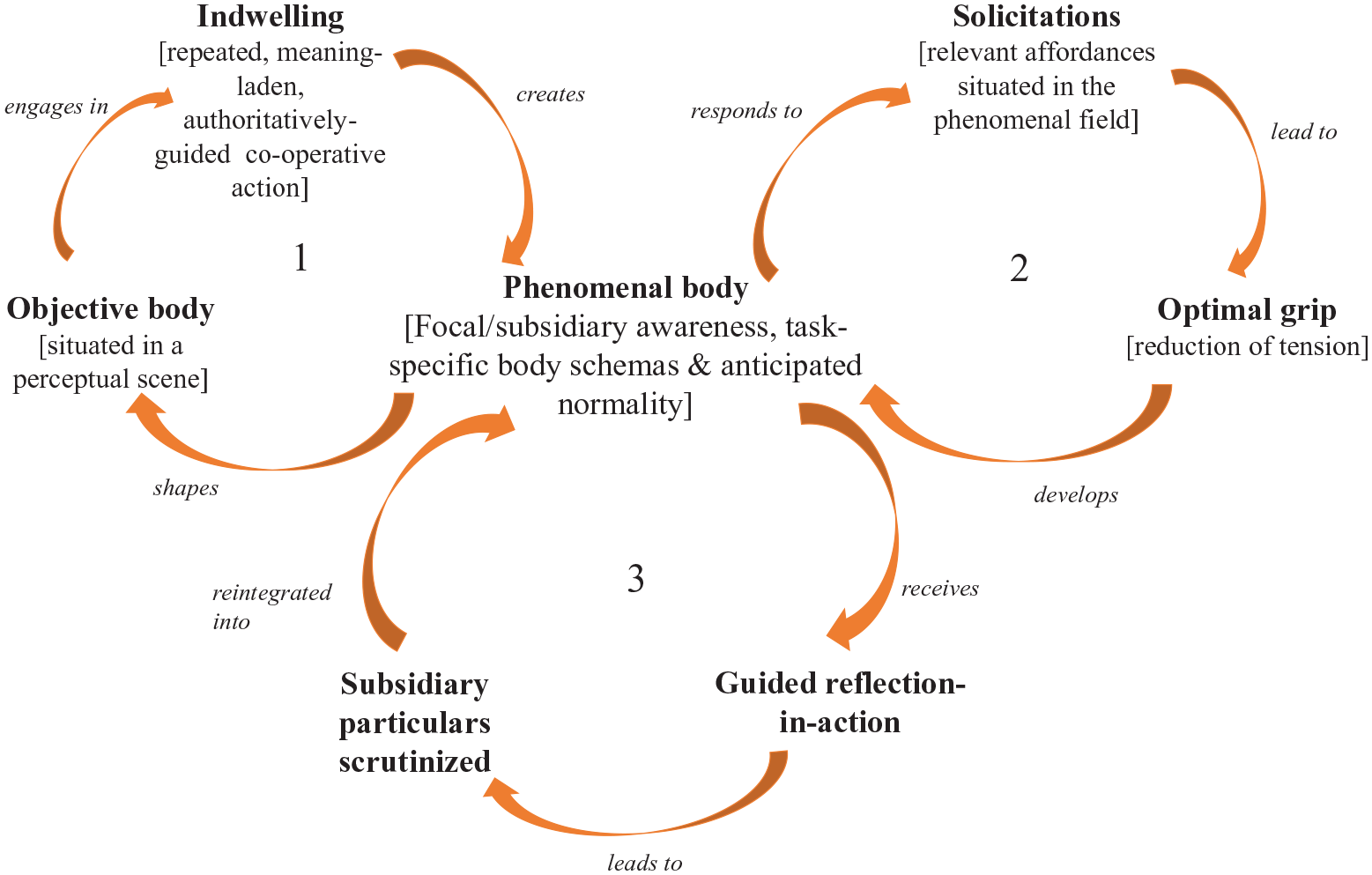
The process through which embodiment enables TK acquisition in the workplace can be summarized as follows (see Figure 1).
Embodiment and tacit knowledge acquisition.
In starting to execute a task, the novice does not know where to focus on; their objective body is situated in a perceptual scene that enables a multiplicity of figure–ground configurations – they have not developed a holistic (i.e. phenomenal) experience of what is situationally relevant yet. The novice experiences the task as an aggregate of relevant particulars on which they need to focally attend (Dreyfus & Dreyfus, 2005). By engaging in repeated, meaning-laden, co-operative action in the context of a practice, under the authoritative guidance of more experienced others, the learner becomes familiar with the practice, thereby starting assimilating – dwelling in (Polanyi, 1966) – task-related particulars. A phenomenal body is gradually created: task-specific particulars recede into subsidiary awareness; focal awareness emerges; and task-specific body schemas are formed. As the learner responds to the requirements of distinct task-relevant particulars, he/she begins to notice connections between them (Dreyfus & Dreyfus, 2005) and to form a feeling of what is normal/abnormal in practice. The novice is now better able to respond to task requirements in an integrative manner.
The creation of a phenomenal body enables the learner to focally perceive situationally relevant figure–ground unities (i.e. phenomenal field) and spontaneously use their newly developed bodily schemas to cope with task requirements. The learner’s phenomenal body spontaneously responds to solicitations situated in their phenomenal field, in an effort to obtain optimal grip on the situation and, thus, achieve what is considered satisfactory in their practice. In this way, the move to a satisfactory state is experienced as a reduction of tension (Dreyfus, 2002, p. 379). Over time, the learner’ adaptations to newly presented challenges are increasingly reliant on the phenomenal body’s responses to solicitations (Dreyfus & Dreyfus, 2005). The body appears to observe rules of which the learner is unaware: it unconsciously takes those postures that are conducive to the smooth carrying out of the task (O’Connor, 2007, p. 132; Polanyi, 1958, p. 49).
Intuitively grasping what a satisfactory state constitutes, suggests that the phenomenal body creates an anticipated normality, which, as well as enabling agents to be solicited by canonical (normal) cases, enables agents to distinguish and tackle non-canonical (anomalous) ones (Ribeiro, 2014; Tsoukas, 2011). The more developed the phenomenal body is, the more able the learner will be to discriminate more refined cases and pair them with appropriate actions (Dreyfus, 2002, p. 379). When, however, the learner encounters difficulties, anomalies or simply wants to focus on particular task-related particulars (e.g. certain body schemas) in order to gain more fluency in their actions, they receive guided reflection-in-action (often with the help of more experienced others), whereby they focally think about and act on the content of their experience while still being immersed in action. Certain subsidiary particulars are then scrutinized and subsequently re-integrated into the phenomenal body.
In short, task-specific TK is acquired – that is, fluency in task execution is developed – once the body, having engaged in indwelling, is gradually turned to a phenomenal body that develops focal/subsidiary awareness and task-specific body schemas as well as anticipated normality (see loop 1 in Figure 1). The phenomenal body is capable of responding to the solicitations of the task at hand, thus striving to find an optimal grip on task-related particulars (see loop 2 in Figure 1), while being authoritatively guided by more experienced others, in the effort to improve the fluency of task execution by scrutinizing subsidiary particulars (see loop 3 in Figure 1).
Discussion
In this section, we (i) discuss how our account contributes to what is already known about TK acquisition, especially from the perspective of practice studies, (ii) outline broader implications of our account for organizational research and (iii) offer suggestions for further research.
Contributions
Our phenomenological account builds on and extends insights provided by the practice perspective on TK. As noticed earlier, practice studies foreground embodiment in TK acquisition but fall short of analytically specifying how (Hadjimichael & Tsoukas, 2019, p. 685). Our first contribution is that, while previous studies have mentioned the significance of body schemas (Yakhlef, 2010), perception (Ribeiro, 2014, 2017) and practice (Brown & Duguid, 2001; Cook & Brown, 1999; Pyrko et al., 2017) for workplace learning, ours has analytically outlined how all three are linked to contribute to TK acquisition. How, for example, a roof repairer develops a ‘feel[ing] for the roof’ (Gherardi, 2006, pp. 82, 98; Strati, 2003); how an engineer involved in designing car engines acquires a ‘practical sense of the engine’ (Sandberg, 2000, p. 18); or how a resident surgeon ‘learns the “feel” of [drilling] correctly’ (Prentice, 2007, p. 545). Our account provides the missing conceptual details: the general process through which the phenomenal body, embedded in collective practice and authoritatively guided by others, is gradually formed, and how focal/subsidiary awareness, the requisite body schemas, and solicitations develop and further refined through guided reflection-in-action.
Tied to the above, is our second contribution, namely extending the current understanding of Polanyian ‘indwelling’ through connecting it to Merleau-Ponty’s phenomenology. Indwelling, it may be recalled, creates a from-to relationship between subsidiary particulars and a focal object, mediated by the body (Nonaka & von Krogh, 2009, p. 644; Polanyi, 1969, pp. 147–148). However, while TK practice scholars have noted this, they have stopped short of elaborating the from–to relationship. It has rather been assumed that the body serves as the site of subsidiary particulars from which agents attend to a focal object (Pyrko et al., 2017, p. 393; Tsoukas, 1996, p. 17, 2011, p. 457). Our theoretical account sharpens the understanding of indwelling.
Specifically, the from–to relationship between subsidiary awareness and a focal object, which is brought to attention by indwelling, can be unpacked through the figure–ground (i.e. gestalt) configuration. Each component of the relationship is enabled by a different process. In particular, to see a gestalt, or to be solicited by an affordance, one must attend from a background which one has assimilated. Practising provides the ‘from’ in the from–to relationship surfaced by indwelling, since it captures how phenomenal bodies are developed through experience. To put it differently, one’s phenomenal body is a prerequisite for perceiving relevant affordances present in a particular context to solicit one’s action. Past studies in organizational theory have not linked affordances with TK, nor have they made the distinction between affordances and solicitations (Faraj & Azad, 2012; Fayard & Weeks, 2007; Leonardi, 2011; cf. Yakhlef & Rietveld, 2019). We have shown that one needs to dwell in practice for affordances to stand out and to solicit them (cf. Fayard & Weeks, 2014). Moreover, solicitation provides the ‘to’ in the from–to relationship surfaced by indwelling. Attending from past practice to the perceptual scene of a particular situation entails that one’s phenomenal body is polarized to both skilfully perceiving a situation from within a specific figure–ground perspective (i.e. phenomenal field) and to being responsive to solicitations through relevant body schemas.
Our third contribution has been to analytically unpack what is involved in TK acquisition through ‘guided practice’ (Benner et al., 2009, p. 17; see also Prentice, 2007, pp. 547–549). As mentioned earlier, research has shown that, typically, first, an instructor demonstrates to the learner aspects of the activity to be learned; second, the learner starts practising the activity by imitating the instructor, while being watched by him/her. And third, the instructor provides feedback to the learner (Schön, 1987, pp. 100–118, see also Nonaka & Takeuchi, 1995; O’Connor, 2007). Our model provides analytical insights to this process by focusing on TK acquisition and re-interpreting it through phenomenology.
In particular, demonstration by instructors provides the learner something to work with – to imitate the instructor’s demonstration (Beane, 2019, p. 96). As illustrated through the examples of mentoring in glassblowing, anti-money laundering and architectural design, imitation, in turn, helps train the learner through repeated action. That is, through habit and guided by others, the objective body is co-operatively turned to a phenomenal body, namely a body that has developed a figure–ground unity, body schemas and responsiveness to the solicitations of the task. Moreover, imitating reveals the meaning of the construction created by the learner (e.g. drawing an architectural design, tying a knot in surgery, making a mug, etc.), that is, what the learner has taken the demonstration and the accompanying instructions to mean. Finally, the meaning revealed by the learner’s mimetic construction invites the instructor to offer concrete feedback (i.e. corrections and further demonstrations and instructions) through which the learner engages in guided reflection-in-action. Receiving feedback while in action leads the learner to withdraw temporarily from the activity while still engaged in it, in order to think about her performance and discuss with the instructor how the learner could do better (Raelin, 2007, p. 501). In other words, practical sense is built by agents acquiring TK, that is, through co-operatively creating a phenomenal body on whose process of formation the agent is capable of exercising guided reflection (Bucher & Langley, 2016).
Broader implications for organizational research
Our account of TK acquisition provides further insights to organizational research beyond those narrowly related to theories of organizational knowledge (Gherardi, 2006; Grant, 2003; Nicolini et al., 2003). Indeed, phenomena such as routine dynamics, organizational capabilities, strategy-as-practice, sensemaking, improvisation and situated learning in communities of practice, to mention a few, necessarily involve the exercise of TK, since skilful action is foregrounded in all (de Rond et al., 2019; Hadjimichael & Tsoukas, 2023; Sandberg & Tsoukas, 2020; Tsoukas, 2021).
In particular, through their immersion in a sociomaterial practice, actors dwell in it, thus assimilating several subsidiary particulars, which is necessary for skilful action to be accomplished. Foregrounding skilful action enables researchers to focus on how the body is trained (i.e. how body schemas develop) and how actors are equipped with perceptual abilities and the use of tools (including language). Moreover, when carrying out a task, actors may be interrupted by anomalies (accidental or not, see Sandberg & Tsoukas, 2011), which prompt them to step back a distance from their action and reflect on their interiorized pattern of subsidiary particulars. In short, on such a view, actors, by virtue of being embodied and embedded, are assumed to be ‘knowledgeable and often reflective’ (Feldman, Pentland, D’Adderio, & Lazaric, 2016, p. 506). Studying, therefore, routine enactment, strategy-as-practice, improvisation or sensemaking involves studying how, and the extent to which, actors become knowledgeable (i.e. how, among others, they develop TK), and how, and the extent to which, actors’ reflectiveness furthers their knowledgeability (see Sandberg and Tsoukas (2020, pp. 19–20), on how, inter alia, the insufficient development of antiterrorist police officers’ body schemas contributed to sensemaking failure). Our framework enables a unified understanding of how TK is developed through the body and, therefore, how skilful action, the bedrock of organizational phenomena when explored from within, is generated (or not). Below, to illustrate further, we expand on organizational capabilities and situated learning in communities of practice.
Our account helps illuminate how endogenously produced know-how makes firms repositories of unique knowledge, allowing them to develop distinctive capabilities (Barney, 2001; Barney & Felin, 2013, p. 148; Nayak et al., 2020, p. 281; Spender, 2014; Winter, 2003). Knowledge uniqueness stems, in part, from organizational members’ immersion in collective practices (Hadjimichael & Tsoukas, 2023; MacKay, Chia, & Nair, 2021; Moore, 2017; Nicolini et al., 2022; Tsoukas, 2018). Specifically, through indwelling, organizational members’ phenomenal bodies are distinctly shaped, thus developing particular figure–ground gestalts and body schemas, which solicit members to respond to the affordances of their tasks and, through engaging in guided reflection-in-action, improve their performance. The accumulation of experience and learning is idiosyncratic, insofar as it involves singularly embodied processes, shaped by normatively bounded interaction in routine joint activities (Dionysiou & Tsoukas, 2013; Ribeiro, 2014). Organizational members learn to dwell in routine joint activities, thus developing habits (Cohen, 2012, p. 1383; Winter, 2013, p. 128), which enable them to systematically and effortlessly attend from past interiorized experiences to the perceptual scenes of the particular tasks they tackle. Further research on organizational capabilities can show how they are built over time through, among others, the enactment of routines and the concomitant formation of phenomenal bodies in particular practice worlds.
Our account helps to widen theories of situated learning and communities of practice. Specifically, Lave and Wenger’s (1991) significant insight was to show how learning at work, far from being a purely individual activity, is shaped by relationships in situated social contexts. Learners take part in communities of practice, in which the gradual mastery of skills enables learners to participate more fully in the community. As Lave and Wenger (1991, p. 49) note, ‘in contrast with learning as internalization, learning as increasing participation in communities of practice concerns the whole person acting in the world’. By ‘whole person’, Lave and Wenger mean a ‘relational’ person: ‘learning, thinking and knowing are relations among people in activity in, with, and arising from the socially and culturally structured world’ (p. 51). While this was an important corrective to hitherto dominant individualist accounts, it left out the body – Lave and Wenger’s ‘whole persons’ did not analytically include embodied persons (Yakhlef, 2010, p. 420).
Our account broadens the notion of ‘whole persons’ to acknowledge the critical role of embodiment to learning in communities-of-practice. We have shown that the mastery of skills (i.e. increased competence, see Nicolini et al., 2022) that is necessary for moving from peripheral to full participation in a community-of-practice involves the acquisition of TK through the development of a phenomenal body. Moreover, while subsequent research on situated learning has referred to ‘embodied practice’ (Beane, 2019, p. 98), it has left room for more in-depth theorizing. Beane (2019, p. 105), for example, usefully points out, without expanding, the need for residents trained in robotic surgery to ‘master a new bodily grammar’. Our account shows how a ‘new bodily grammar’ develops, that is, how residents’ body schemas, figure–ground gestalts and solicitations by affordances are co-operatively developed and, further, refined through authoritatively guided reflection-in-action. Future research, aiming to provide an integrated account of situated learning in communities of practice, may explore in more depth how embodied practice works – that is, how embodiment mediates relationality – in different contexts, with what effects.
Suggestions for further research
We conclude by offering additional suggestions for future research. First, researchers may explore how the general process of TK acquisition we have specified here can be made more domain-specific by situating it in particular contexts of skilled action. For example, the involvement of the body in task execution is variable – skills may be more or less embodied. How might differences in the nature and degree of embodiment affect the process of TK acquisition differently? And vice versa: how is the type of knowledge used in particular tasks shaped by the body? For example, expert team members notice and act on each other’s facial expressions, gestures and moods (Sergeeva et al., 2020, p. 1251). Although perceptual sensitivity to faces is a generic human skill (Rosenbaum, Augustyn, Cohen, & Jax, 2006), it takes particular training to enable knowledge workers to develop specialized forms of perceptual sensitivity to others’ faces, be they clients, patients, learners, associates, etc. (Michel, 2011). How is it accomplished?
Second, insofar as TK acquisition takes place in structured workplaces, how do task structure, power differentials, efficiency pressures, types of technology and/or organizational culture impact on TK acquisition? In particular, how does the TK acquired during simulations differ from that acquired during task execution? How does the creation of a new occupational and/or organizational identity shape the ‘building of embodied capability’ (Beane, 2019, p. 96), in particular contexts? When organizational members are trained virtually (Baralou & Tsoukas, 2015; Sergeeva et al., 2020) rather than face-to-face, how does guided reflection-in-action shape TK acquisition? Since the body is critical in fluently enacting routines (Cohen, 2012; Tsoukas, 2021), how are body schemas, figure–ground gestalts and solicitations developed when routines change?
Third, future research could focus on how dialogical interaction (D’Eredita & Barreto, 2006; Tsoukas, 2009) helps organizational members further refine their TK. What difference does it make if reflection-in-action is authoritatively guided by more senior peers or supervisors (Schön, 1987)? How, accordingly, do authoritative pointing, demonstrating and verbal and nonverbal guidance work? How do conversations with others (Ehrlich, 2003, p. 140), especially those more powerful or experienced, either during task execution or after it, assist practitioners to develop their phenomenal bodies, including the use of conceptual tools and the affordances they offer (Gallagher, 2017, p. 204; Hutchins, 2010, p. 429)? More generally, how does the process of demonstrating, instructing and guided reflection-in-action operate in different settings, with what outcomes for TK acquisition?
Conclusions
In this paper, we set out to provide a general process account of how embodiment enables TK acquisition in the workplace. We have acknowledged prior contributions, especially from the perspective of practice studies of organizational knowledge and workplace learning, and sought to extend them through phenomenologically inspired theorizing. Our phenomenological account adds analytical depth to practice studies by showing in theoretical detail how embodiment enables TK acquisition. Specifically, we have argued that TK is inferred to exist when fluency is manifested in task-specific performance. Task-specific TK is acquired once the body, having engaged in indwelling, is co-operatively turned to a phenomenal body that develops focal–subsidiary awareness and task-specific body schemas. The phenomenal body is capable of responding to the solicitations of the task at hand, thus striving to find an optimal grip on task-related particulars. This ability develops through authoritative guidance by more experienced others, in the effort to improve the fluency of task execution by focusing on and scrutinizing subsidiary particulars. We have illustrated this process with several examples from so-called manual and intellectual types of work.
Footnotes
Acknowledgements
We would like to thank Senior Editor Linda Rouleau and the three anonymous reviewers for their constructive, collegial and valuable guidance throughout the review process. We also express our deepest gratitude to Dvora Yanow, Gerardo Patriotta, Jörgen Sandberg, Richard Whitley, Stuart Dreyfus and Sean Kelly for offering invaluable feedback on earlier versions of the manuscript.
Funding
The author(s) disclosed receipt of the following financial support for the research, authorship, and/or publication of this article: A part of Demetris Hadjimichael’s work was supported by the Economic and Social Research Council (grant number: ES/J500203/1).
